Quantum Physics · arXiv:2609.04462 v1 · submitted 3 Sep 2026 · 40 references
A Representation-Theoretic Framework for Characterizing Barren Plateaus
The paper says
“The scalability of variational quantum algorithms is fundamentally limited by the barren plateau effect, where the cost-function variance vanishes with system size, rendering optimization impractical.”
more of the abstract
Recent Lie-algebraic approaches for deep parameterized have enabled a unified analytical understanding of this challenge but require either the initial state or the measurement observable to belong to the dynamical Lie algebra generated by the circuit. Here, we introduce a representation-theoretic framework under 2-design hypothesis showing that variational quantum landscapes admit a natural decomposition into irreducible representation channels. This yields exact expressions and analytical bounds for the cost-function variance applicable to arbitrary initial states and observables, with previous Lie-algebraic results emerging as a special case. We illustrate the framework by analyzing the energy landscape of the one-dimensional ANNNI model for several circuit architectures, revealing trainability regimes inaccessible to existing methods. Our results establish a general representation-theoretic framework for analyzing variational quantum landscapes, substantially extending the analytical theory of barren plateaus.
from the abstract
Pith says
Machine review · deepseek-v4-flash · 8 Sep 2026 · what was read was not recorded · not checked by a person
It can be wrong. Challenge this review or reply to it.
The passes disagreed. Reader: holds up. Skeptic: holds up only with conditions. Referee: minor revision.
Theorem 8 is a genuine advance and holds up; Theorem 10 as printed is false, and the fix is local but mandatory. This line is wrong
This review says the paper's mathematics is wrong. Pith did not check that against the paper's source.
2 major objections · 5 minor
How often objections from reviews like this one are right: not yet measured
Not checked: figures, code, what the 40 references say.
The paper says, at Section II, Theorem 10
The review did not quote this passage.
Pith says: Objection 1 of 2 · major
The statement of Theorem 10 is incorrect as written. It claims Var_θ[ℓ_θ(ρ,O)] ≤ (∥O∥_∞ ∥O∥_1 − tr(O)^2)/2^n, but the correct bound derived from Lemma 9 is Var ≤ (∥O∥_∞ ∥O∥_1)/2^n − tr(O)^2/4^n. The denominator for the tr(O)^2 term is off by a factor of 2^n.
more of objection 1
This makes the theorem false for observables with non-zero trace (e.g., O=I yields Var=0 but a negative right-hand side). The appendix proof (Lemma 9 and Theorem 9) yields the correct form, suggesting this is a typographical slip. The authors must correct the theorem statement and verify that nothing else in the paper relies on the erroneous version. (The ANNNI application is unaffected because tr(H)=0.)
This review says the paper's mathematics is wrong. Pith did not check that against the paper's source.
The paper says, at Sections II and IV
The review did not quote this passage.
Pith says: Objection 2 of 2 · major
The entire derivation rests on the assumption that the circuit ensemble forms a unitary 2-design over a compact Lie group G. While the authors acknowledge this is restrictive for finite-depth circuits (Section IV), the main results offer no quantitative guidance on how rapidly this regime is approached or how sensitive the variance bounds are to deviations from exact 2-design.
more of objection 2
The discussion would be strengthened by a more explicit analysis of the finite-depth corrections—or at least by citing concrete convergence rates from the literature for the circuit architectures studied. This is not a fatal flaw but limits the immediate applicability of the results beyond the deep-circuit asymptotic regime.
5 minor objections
The paper says, at Abstract
Pith says: minor objection 1 of 5
The phrase "deep parameterized have enabled" (line 3) appears to be missing the word "circuits"; it should read "deep parameterized quantum circuits."
The paper says, at Section I, footnote 29
Pith says: minor objection 2 of 5
The notation CG(φ) is first used without direct explanation in the main text; its meaning is clarified in the footnote. For readability, consider defining it parenthetically in the main body when it first appears (end of paragraph before Eq. (10)).
show 3 more
The paper says, at Figure 2 caption
Pith says: minor objection 3 of 5
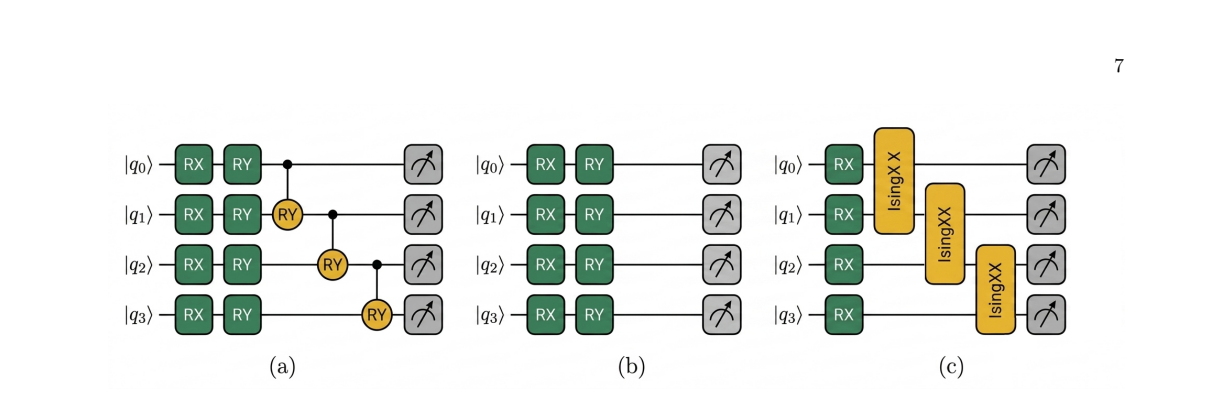
The umlaut in "ans¨ atze" renders as an artifact; please typeset as "ansätze" for readability.
The paper says, at Appendix A, Lemma 6
Pith says: minor objection 4 of 5
The bound uses the Hilbert–Schmidt norm ∥·∥ (defined in Section II). It would be helpful to restate this explicitly in the lemma statement to avoid confusion with other Schatten norms used later.
The paper says, at Section II, proof of Lemma 9
Pith says: minor objection 5 of 5
The inequality (A11) |β_{ρ,O}(g)| ≤ β_{ρ,|O|}(g) relies on the fact that |tr(ρ_g O)| ≤ tr(ρ_g |O|) for positive ρ_g. This is correct but is worth a brief justification, as it is central to the spectral bound.
What would settle it
Re-derive Theorem 10 for the simplest counterexample: n=1, φ(g)=g on C², ρ=|0⟩⟨0|, O=I. Since ℓθ=1 for every θ, Var=0, while the stated RHS is (||I||∞||I||₁ − tr(I)²)/2 = (2−4)/2 = −1. Then verify the corrected inequality Var ≤ ||O||∞||O||₁/2^n − tr(O)²/4^n on a non-traceless observable, e.g. O=2|0⟩⟨0|=I+Z: the exact Haar variance is 1/3, Lemma 9 gives the upper bound 3, and the corrected bound is 4·2/2 − 4/4 = 3, so the inequality holds. Finally, check every downstream use of Theorem 10 (notably Eqs. (29)–(30)) to confirm all applications have tr(O)=0, so no numerical conclusion inherits the error.
from the skeptic's reading
How the review went
4 readings by deepseek-v4-flash · 8 Sep 2026
- Reader holds up
- Skeptic disagrees: says it holds up only with conditions Theorem 10's variance bound is false as stated: it subtracts tr(O)^2/2^n instead of tr(O)^2/4^n, so the RHS is negative for O=I. The main Theorem 8 appears sound, but the advertised spectral bound needs correction.
- Editor wrote the verdict above
- Referee minor revision: 2 major objections, 5 minor
Not run on this paper: the simulated authors' defence.
Pith did not check this review's objections against the paper.
The review in full
The review in brief, machine-written
The main result is real and, as far as I can tell from the text, correct. Theorem 8 decomposes the cost-function variance into irreducible-representation channels and genuinely removes the DLA-membership restriction that limits Ragone et al. The recovery of the Lie-algebraic formulas as the adjoint-sector special case is clean. I looked for circular reasoning and hidden fitting; there is none. The appendix proofs are complete and standard (Schur orthogonality), and the numerics match the analytical scalings, including the u(1)2n−1 variance floor, where the lower-bound argument is doing the real work.
Now the part the reader's report under-flagged. The stress-test note is correct: Theorem 10 is false as stated. The printed bound subtracts tr(O)2/2n, but Lemma 9 plus the mean value give a subtraction of tr(O)2/4n. The counterexample is immediate: n=1, O=I, any state, the cost is identically 1, so Var=0, while the stated RHS is -1. The appendix actually proves the corrected form, so this is a slip in the theorem statement rather than a structural failure, and since tr(H)=0 for the ANNNI Hamiltonian, every application in Section III survives untouched. But the theorem is advertised as a universal representation-independent bound, and as printed it is not even a bound. It must be corrected before the paper is final.
Nothing else in the math bothered me. Lemma 9's Schatten bound is fine; the (A11) step is just |tr(rho_g O)| <= tr(rho_g |O|), which holds for states and Hermitian observables. The 2-design hypothesis is the standard assumption in this literature, and the authors flag its restrictiveness for finite-depth circuits in Section IV, so it reads as an honest scope condition rather than a hidden weakness. The citation pattern is solid, with one real blemish: several footnotes point to '[?]' for the DLA classification and need filling.
Who this is for: people working on analytical barren-plateau theory and symmetry-informed ansatz design. It deserves a serious referee. My recommendation: send it out, and make the Theorem 10 correction a required item. If that fix lands, this is a solid publication.
The strongest objection
The central result, Theorem 8, is internally consistent: given the 2-design hypothesis, Lemma 4 and Lemma 6 do yield the variance decomposition and the sum bound, and the trace-free irreducible special case works out. The concrete defect is in the secondary spectral bound, Theorem 10. Lemma 9 gives E[ℓ²] ≤ ||O||∞||O||₁/2^n, and for an irreducible φ the mean is E[ℓ] = tr(O)/2^n. Therefore Var = E[ℓ²] − E[ℓ]² ≤ ||O||∞||O||₁/2^n − tr(O)²/4^n. Theorem 10 instead states Var ≤ (||O||∞||O||₁ − tr(O)²)/2^n, which subtracts tr(O)²/2^n, a factor 2^n too large. The stated inequality is false: take n=1, φ the defining SU(2) irrep, ρ=|0⟩⟨0|, O=I. Then ℓθ=1 identically, so Var=0, while the theorem's RHS is (1·2 − 4)/2 = −1. The error does not affect the fully expressive ANNNI application, since tr(H)=0, which is why the numerical comparisons in Section III survive. But it contradicts the paper's claim that Theorem 10 supplies a universal representation-independent bound for arbitrary observables. The appendix proof, which derives the bound directly from Lemmas 1 and 8, yields the corrected form, so this appears to be a typographical slip in the theorem statement rather than a deep failure of the derivation.
The reader's acceptance rests on the soundness of the harmonic-analysis framework, and that part is indeed sound: Theorem 8 follows from the stated 2-design hypothesis via Schur orthogonality, and the example calculations in Section III, including the u(1)^{2n-1} construction, check out after working through the non-orthogonal A-basis expansions. The 2-design assumption is explicit, standard for deep-circuit analyses, and acknowledged by the authors as restrictive; it is a limitation, not a hidden defect. However, the paper also advertises Theorem 10 as a general representation-independent variance bound for arbitrary observables, and that theorem is false as stated. The algebra error is localized and does not invalidate the central variance decomposition, and the numerical applications all use traceless observables where the incorrect term vanishes. For that reason a full rejection would be disproportionate, but the current ACCEPT verdict should be conditional on correcting the statement of Theorem 10 and confirming that no downstream claim relies on the uncorrected form.
The referee's report
This is a significant theoretical advance in the analytical theory of barren plateaus. It unifies and extends existing Lie-algebraic results, providing a rigorous representation-theoretic description that applies to arbitrary initial states and observables. The framework identifies irreducible representation channels as the fundamental carriers of landscape fluctuations and offers a clear connection between circuit symmetry and trainability. The application to the ANNNI model demonstrates the practical ability to diagnose trainability beyond the scope of earlier methods. If the central results hold, this paper will be influential in guiding the design of scalable variational quantum algorithms.
Pith's reading of the paper (a machine's summary, not the authors')
This paper develops a unified representation-theoretic framework for analyzing barren plateaus in variational quantum algorithms. By treating the cost function as a function on the orbit of a compact Lie group, the authors decompose landscape fluctuations into contributions from irreducible representations of the circuit's symmetry group. The central result, Theorem 8, gives an exact formula for the variance as a sum over nontrivial irreducible channels, each bounded by the norms of projected state and observable. This removes the previous restriction that the initial state or observable must belong to the dynamical Lie algebra. If correct, the framework provides a powerful tool for designing trainable quantum circuits by controlling which representation sectors are populated.
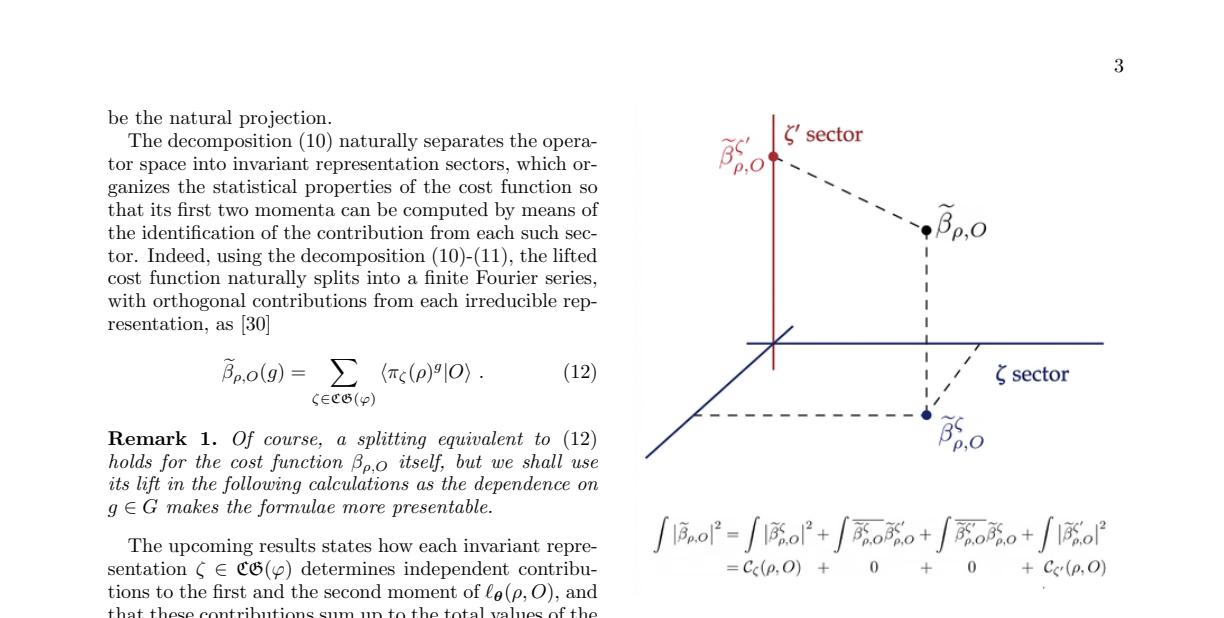
What carries the argument. The key machinery is the decomposition of the operator space B(H_n) into irreducible representation channels of the compact Lie group G, combined with Schur's orthogonality relations for integration over G. The cost function lift β̃_ρ,O(g) = tr(ρ_g,O) becomes a finite Fourier series over irreducible characters, and its second moment reduces to a sum of per-channel contributions C_ζ(ρ,O). Lemma 7 gives an explicit coordinate expression using multiplicity resolution.
Core claim. The core discovery is that under a unitary 2-design assumption, the variance of the cost function ℓ_ heta(ρ,O) splits into independent contributions from each nontrivial irreducible representation ζ of the compact Lie group G generated by the circuit: Var = ∑_{ζ≠τ} C_ζ(ρ,O), with C_ζ(ρ,O) bounded by (1/dim ζ)∥π_ζ(ρ)∥²∥π_ζ(O)∥². The mean depends only on the trivial representation channel. This decomposition holds for arbitrary initial states and observables, subsuming previous Lie-algebraic results (e.g., Corollary 8.3) as the special case where state or observable lies in the adjoint representation.
The premise it rests on. The circuit ensemble must form a unitary 2-design over the compact Lie group G, meaning expectation values of monomials up to degree two match Haar averages over G.
If the paper is right (Pith's inferences, not the authors')
Previous Lie-algebraic variance formulas (Ragone et al.) emerge as the special case where state or observable lie in the complexified DLA, corresponding to multiplicity-free adjoint sectors.
One can certify a non-vanishing variance (and hence avoid barren plateaus) by identifying a single nontrivial irreducible sector with C_ζ(ρ,O) > 0.
The framework applies to any compact Lie group, not just su(n), enabling analysis of symmetry-tailored ansätze.
It provides analytical variance expressions for problems where initial states or observables contain components outside the DLA, such as highly entangled states or multi-body Hamiltonians.
The 2-design assumption limits direct application to finite-depth circuits; an important extension would be to quantify how deviation from 2-design modifies the variance decomposition.
The framework suggests a design principle: to preserve trainability, choose initial states and observables whose support on high-dimensional nontrivial irreps is suppressed, concentrating variance on low-dimensional or many low-dimensional channels.
The harmonic analysis viewpoint may connect barren plateau theory to other areas of quantum information, such as random matrix theory and unitary t-designs.
Check this review
Pith stored no record of this review's passes and took no fingerprint of it. Reviews made by code from 13 Nov 2026 on carry both.
How often reviews like this one are right
Reviews like this one: written by deepseek-v4-flash, where what was read was not recorded.
How often objections from reviews like this one are right: not yet measured
Reviews by people
This review was written by a machine. No person has reviewed this paper on Pith yet. A scientist listed on Pith can review it for a fee, and their review is published here whatever it concludes.
The paper
Abstract
The scalability of variational quantum algorithms is fundamentally limited by the barren plateau effect, where the cost-function variance vanishes with system size, rendering optimization impractical. Recent Lie-algebraic approaches for deep parameterized have enabled a unified analytical understanding of this challenge but require either the initial state or the measurement observable to belong to the dynamical Lie algebra generated by the circuit. Here, we introduce a representation-theoretic framework under 2-design hypothesis showing that variational quantum landscapes admit a natural decomposition into irreducible representation channels. This yields exact expressions and analytical bounds for the cost-function variance applicable to arbitrary initial states and observables, with previous Lie-algebraic results emerging as a special case. We illustrate the framework by analyzing the energy landscape of the one-dimensional ANNNI model for several circuit architectures, revealing trainability regimes inaccessible to existing methods. Our results establish a general representation-theoretic framework for analyzing variational quantum landscapes, substantially extending the analytical theory of barren plateaus.
The paper's own sentences, arranged, kept beside the review and separate from it. Each label is drawn from a closed vocabulary; the number beside it is the probability the classifier gave that label. No sentence in this record was written by a model.
abstract compiled · 2026-09-23
The authors' main claim, as the classifier picked it out 0.99
“Our results establish a general representation-theoretic framework for analyzing variational quantum landscapes, substantially extending the analytical theory of barren plateaus.”
How the main claim is stated: asserted 1.00
What the abstract itself states, as probabilities: claims first 0.12 · states limitation 0.56 · human participants 0.01 · controlled comparison 0.10 · randomized assignment 0.01 · states quantitative result 0.34 · compares with prior results 0.96 · mentions code or data availability 0.02
The abstract, sentence by sentence
This table labels the abstract only (arXiv listing abstract v1). The number is the probability the classifier gave the label.
| Sentence | Role | The authors' own work | States the main conclusion | Strength |
|---|---|---|---|---|
| The scalability of variational quantum algorithms is fundamentally limited by the barren plateau effect, where the cost-function variance vanishes with system size, rendering optimization impractical. | background 1.00 | 0.05 | 0.04 | asserted 1.00 |
| Recent Lie-algebraic approaches for deep parameterized have enabled a unified analytical understanding of this challenge but require either the initial state or the measurement observable to belong to the dynamical Lie algebra generated by the circuit. | background 0.62 | 0.05 | 0.04 | asserted 1.00 |
| Here, we introduce a representation-theoretic framework under $2$-design hypothesis showing that variational quantum landscapes admit a natural decomposition into irreducible representation channels. | contribution 0.91 | 0.93 | 0.19 | asserted 1.00 |
| This yields exact expressions and analytical bounds for the cost-function variance applicable to arbitrary initial states and observables, with previous Lie-algebraic results emerging as a special case. | result 0.90 | 0.92 | 0.33 | asserted 1.00 |
| We illustrate the framework by analyzing the energy landscape of the one-dimensional ANNNI model for several circuit architectures, revealing trainability regimes inaccessible to existing methods. | result 0.46 | 0.95 | 0.07 | asserted 1.00 |
| Our results establish a general representation-theoretic framework for analyzing variational quantum landscapes, substantially extending the analytical theory of barren plateaus. | interpretation 0.52 | 0.91 | 0.89 | asserted 1.00 |
What kind of paper the classifier reports this is: theoretical result 0.93 · evidence from proof or derivation 1.00
What was examined, and what was not
Sources read
- arXiv listing abstract v1
Not examined
- full text
- figures and tables
- references and citing sentences
- relations to other papers
Levels run
- P abstract
Not run
- S sections
- T body sentences
- C citations
- R cross-paper relations
How the labels were made
Compiled by classifier-1.13.0 via TypeSafe API, question bank abstract-p1-20260923, 2026-09-23: 1 request, 5,013 input tokens.
Every quoted sentence on this record is the authors'. Every label is from Pith's closed vocabulary, with the probability shown beside it. This record as JSON
Figures (4)
Showing 2 of the paper's 4 figures. Figures are the authors', reproduced from the paper.
References (40)
- [1] A. Peruzzo, J. McClean, P. Shadbolt, M.-H. Yung, X.-Q. Zhou, P. J. Love, A. Aspuru-Guzik, and J. L. O’brien, A variational eigenvalue solver on a photonic quantum processor, Nature Communications5, 4213 (2014) on Pith
- [2] E. Farhi, J. Goldstone, and S. Gutmann, A quan- tum approximate optimization algorithm, arXiv preprint arXiv:1411.4028 (2014) on PithPith's reviewarXiv
- [3] J. L. Beckey, M. Cerezo, A. Sone, and P. J. Coles, Vari- ational quantum algorithm for estimating the quantum fisher information, Physical Review Research4, 013083 (2022) on Pith
- [4] M. Cerezo, A. Arrasmith, R. Babbush, S. C. Benjamin, S. Endo, K. Fujii, J. R. McClean, K. Mitarai, X. Yuan, L. Cincio,et al., Variational quantum algorithms, Nature Reviews Physics3, 625 (2021) on Pith
- [5] M. Sciorilli, L. Borges, T. L. Patti, D. Garc´ ıa-Mart´ ın, G. Camilo, A. Anandkumar, and L. Aolita, Towards large-scale quantum optimization solvers with few qubits, Nature Communications16, 476 (2025) on Pith
- [6] R. Sweke, F. Wilde, J. Meyer, M. Schuld, P. K. F¨ ahrmann, B. Meynard-Piganeau, and J. Eisert, Stochastic gradient descent for hybrid quantum-classical optimization, Quantum4, 314 (2020) on Pith
- [7] J. Stokes, J. Izaac, N. Killoran, and G. Carleo, Quantum natural gradient, Quantum4, 269 (2020) on Pith
- [8] G. E. Crooks, Gradients of parameterized quantum gates using the parameter-shift rule and gate decomposition, arXiv preprint arXiv:1905.13311 (2019) on PithPith's reviewarXiv
- [9] A. Arrasmith, Z. Holmes, M. Cerezo, and P. J. Coles, Equivalence of quantum barren plateaus to cost concen- tration and narrow gorges, Quantum Science & Technol- ogy7, 045015 (2022) on Pith
- [10] S. Wang, E. Fontana, M. Cerezo, K. Sharma, A. Sone, L. Cincio, and P. J. Coles, Noise-induced barren plateaus in variational quantum algorithms, Nature Communica- tions12, 6961 (2021) on Pith
- [11] M. Larocca, S. Thanasilp, S. Wang, K. Sharma, J. Bia- monte, P. J. Coles, L. Cincio, J. R. McClean, Z. Holmes, and M. Cerezo, Barren plateaus in variational quantum computing, Nature Reviews Physics7, 174 (2025) on Pith
- [12] Z. Holmes, K. Sharma, M. Cerezo, and P. J. Coles, Con- necting ansatz expressibility to gradient magnitudes and barren plateaus, PRX quantum3, 010313 (2022) on Pith
- [13] P. de Alcˆ antara, G. Audi, and L. Morais, Lie groups for quantum complexity and barren plateau theory, Brazilian Journal of Physics55, 287 (2025) on Pith
- [14] M. Cerezo, M. Larocca, D. Garc´ ıa-Mart´ ın, N. L. Diaz, P. Braccia, E. Fontana, M. S. Rudolph, P. Bermejo, A. Ijaz, S. Thanasilp,et al., Does provable absence of bar- ren plateaus imply classical simulability?, Nature Com- munications16, 7907 (2025) on Pith
- [15] S. Kazi, M. Larocca, M. Farinati, P. J. Coles, M. Cerezo, and R. Zeier, Analyzing the quantum approximate op- timization algorithm: ans¨ atze, symmetries, and lie alge- bras, PRX Quantum6, 040345 (2025) on Pith
- [16] M. Ragone, P. Braccia, Q. T. Nguyen, L. Schatzki, P. J. Coles, F. Sauvage, M. Larocca, and M. Cerezo, Represen- tation theory for geometric quantum machine learning, arXiv preprint arXiv:2210.07980 (2022) on PithPith's reviewarXiv
- [17] M. Ragone, B. N. Bakalov, F. Sauvage, A. F. Kemper, C. Ortiz Marrero, M. Larocca, and M. Cerezo, A lie al- gebraic theory of barren plateaus for deep parameter- ized quantum circuits, Nature Communications15, 7172 (2024). 13 on Pith
- [18] M. L. Goh, M. Larocca, L. Cincio, M. Cerezo, and F. Sauvage, Lie-algebraic classical simulations for quan- tum computing, Physical Review Research7, 033266 (2025) on Pith
- [19] E. Fontana, D. Herman, S. Chakrabarti, N. Kumar, R. Yalovetzky, J. Heredge, S. H. Sureshbabu, and M. Pis- toia, Characterizing barren plateaus in quantum ans¨ atze with the adjoint representation, Nature Communications 15, 7171 (2024) on Pith
- [20] R. Wiersema, E. K¨ okc¨ u, A. F. Kemper, and B. N. Bakalov, Classification of dynamical lie algebras of 2- local spin systems on linear, circular and fully connected topologies, npj Quantum Information10, 110 (2024) on Pith
show 20 more
- [21] N. L. Diaz, D. Garc´ ıa-Mart´ ın, S. Kazi, M. Larocca, and M. Cerezo, Showcasing a barren plateau the- ory beyond the dynamical lie algebra, arXiv preprint arXiv:2310.11505 (2023) on PithPith's reviewarXiv
- [22] W. Selke, The ANNNI model — theoretical analysis and experimental application, Physics Reports170, 213 (1988) on Pith
- [23] S. Suzuki, J. ichi Inoue, and B. K. Chakrabarti,Quantum Ising Phases and Transitions in Transverse Ising Models (Springer Berlin Heidelberg, 2013) on Pith
- [24] A. Canabarro, F. F. Fanchini, A. L. Malvezzi, R. Pereira, and R. Chaves, Unveiling phase transitions with machine learning, Physical Review B100, 045129 (2019) on Pith
- [25] L. Morais, T. Pernambuco, R. G. Pereira, A. Canabarro, D. O. Soares-Pinto, and R. Chaves, Distinguishing or- dered phases using machine learning and classical shad- ows, International Journal of Modern Physics C , 2643006 (2026) on Pith
- [26] W. Fulton and J. Harris,Representation theory: a first course(Springer Science & Business Media, 2013) on Pith
- [27] J. E. Humphreys, Representation theory, inIntroduction to Lie Algebras and Representation Theory(Springer, on Pith
- [28] G. B. Folland,A course in abstract harmonic analysis (CRC Press, 1995) on Pith
- [29] The notationCG(φ) refers to the fact that, ifφis an irrep, such decomposition is an instance of a Clebsch- Gordan series for theG-representationφ⊗φ ∗, whereφ∗ is the dual representation ofφ on Pith
- [30] By construction, the decomposition in (10) is orthogo- nal with respect to the Hilbert-Schmidt inner product, meaning the mapsπ ζ are, by definition, orthogonal pro- jectors. As such, the identity⟨πζ(A)|B⟩=⟨π ζ(A)|πζ(B)⟩ holds for any operatorsA,B∈B(H n). However, we pur- pose... on Pith
- [31] Note that the imageφ ∗(g) is arealalgebra comprised by skew-Hermitian operators, hence the imaginary unit and the complexification on Pith
- [32] That corresponds to the DLAa k, withk= 12,17,18,19,21,22, in [?] on Pith
- [33] Note thatm(τ) = 1 was already expected sinceφis irre- ducible on Pith
- [34] That is generated by the DLAb 3 in [?] on Pith
- [35] That is the DLAb 1 in the classification of [?] on Pith
- [36] V. Bergholm, J. Izaac, M. Schuld, C. Gogolin, S. Ahmed, V. Ajith, M. S. Alam, G. Alonso-Linaje, B. Akash- Narayanan, A. Asadi,et al., Pennylane: Automatic dif- ferentiation of hybrid quantum-classical computations, arXiv preprint arXiv:1811.04968 (2018) on PithPith's reviewarXiv
- [37] Y. Kwak, W. J. Yun, S. Jung, J.-K. Kim, and J. Kim, Introduction to quantum reinforcement learning: The- ory and pennylane-based implementation, in2021 inter- national conference on information and communication technology convergence (ICTC)(IEEE, 2021) pp. 416– 420 on Pith
- [38] M. Larocca, F. Sauvage, F. M. Sbahi, G. Verdon, P. J. Coles, and M. Cerezo, Group-invariant quantum machine learning, PRX Quantum3, 030341 (2022) on Pith
- [39] Q. T. Nguyen, L. Schatzki, P. Braccia, M. Ragone, P. J. Coles, F. Sauvage, M. Larocca, and M. Cerezo, Theory for equivariant quantum neural networks, PRX Quantum 5, 020328 (2024). 14 Appendix A: Proofs of results in Section II Except for the corollaries, here we restate the re... on Pith
- [40] for its statement and proof. Lemma 1. ⟨βρ,O⟩=⟨π τ(ρ)|πτ(O)⟩= tr(π τ(ρ)πτ(O)). Proof.By definition, eβρ,O(g) =⟨ρ g|O⟩,(A1) so the result follows by applying Schur’s Orthogonality Relations to the decomposition (10). The group aver- age annihilates every nontrivial irreducible c... on Pith
Cited by 1 Pith paper
Reviewed papers on Pith that cite this one. The full citation record
Challenges and discussion
Disagree with the review, or know something it missed? Leave a comment, or challenge this review formally: a challenge becomes a permanent entry in this paper's record, and its decision is published here.
Come back by email
A short list of the week's newly reviewed papers. Nothing is sent until you confirm from your inbox, and every email has a link that stops it. No account.
No comments yet.
Sign in to comment