Quantum Physics · arXiv:2610.38193 v1 · submitted 28 Oct 2026 · 49 references
Barren Plateaus in Quantum Linear Combinations: Interference and Lie-Algebraic Control
The paper says
“A coherent sum of quantum circuits introduces interference that can alter the training signal. We distinguish a single linear combination of unitaries (LCU) from a circuit that repeatedly alternates branch operations and ancilla mixing.”
more of the abstract
For a single-pass LCU, independent branches with zero matrix means cannot erase the differentiated branch's gradient variance: the total variance is at least the branch variance times the fourth power of its coefficient magnitude. This bound holds at any gate position and does not require the circuit unitaries to be Haar-random. Beyond this lower bound, we derive exact loss and gradient formulas that quantify the additional contributions from interference between branches. One of these terms depends on relative coefficient phases and vanishes when the branch ensemble is invariant under multiplication by i𝕀; a four-qubit matchgate example shows that it can be nonzero. For repeated interleaving with full special-unitary ancilla control, we determine the generated Lie algebra from the associative algebra of the branches, including the available central phase directions. This control result predicts concentration only with additional assumptions on circuit sampling. Matchgate examples exhibit polynomial single-pass LCU variances and exponential concentration under joint Haar-random sampling. We also derive coefficient-selection rules and bounds for postselection, measurement error, and approximate moments.
from the abstract
Pith says
Machine review · deepseek-v4-flash · 31 Oct 2026 · what was read was not recorded · not checked by a person
It can be wrong. Challenge this review or reply to it.
Holds up. The math is right and honestly scoped; the single-pass gradient floor and the fixed-coefficient phase-sensitive moments are real contributions, while the interleaved half is a control result plus a variance claim that is conditional on a sampling assumption nobody has shown to hold. This line is wrong
2 major objections · 10 minor
How often objections from reviews like this one are right: not yet measured
Not checked: figures, code, what the 49 references say.
The paper says, at §4.1 (Prop. 4.1) and §8.4 (Prop. H.2)
The review did not quote this passage.
Pith says: Objection 1 of 2 · major
The floor is exact only at exactly zero branch means, and the manuscript nowhere quantifies how it degrades. §3.6 (b232) acknowledges that shared-parameter and near-identity ensembles 'require checking these hypotheses separately', so the condition is disclosed; what is missing is any statement of the consequence.
more of objection 1
Prop. H.2 does not supply one, for two reasons the manuscript itself would recognize: it bounds the loss variance rather than the gradient variance, and its error scale is λ⁴‖O‖²Σ_ℓ w_ℓε_ℓ, not the scale |α_ℓ|⁴Var(g^ℓ_branch) at which the floor lives. The failure is not perturbative in the relevant sense. Writing δ_k = E[U_k] ≠ 0, each interference term acquires the piece r_k = 2Re(α_ℓᾱ_k Tr[O U̇_ℓ ρ δ_k†]), which is a function of the same U̇_ℓ that fixes g^ℓ_branch; the covariance with the branch term is generically nonzero and its sign is not controlled, so the only unconditional statement is the Cauchy–Schwarz one, Var(∂_θL) ≥ |α_ℓ|⁴v + Σ_k Var(R_k) − 2|α_ℓ|²√(v Σ_k Var(R_k)), which is vacuous exactly when Σ_k Var(R_k) = |α_ℓ|⁴v. Because the deterministic part r_k is explicit, a first-order correction is available at little cost: conditioning on U̇_ℓ gives Cov(g, Σ_k r_k) in closed form and hence a floor of the shape |α_ℓ|⁴v − C‖δ‖√(v·Var(g)) + O(‖δ‖²). I would like either such a proposition, or at minimum a worked near-identity example (for instance U_ℓ(θ)=e^{iθH} with the undifferentiated branches evaluated where E[U]=I) showing how fast the guaranteed floor collapses. Without one of these, the abstract's 'cannot erase' is exact only for ensembles whose undifferentiated branches are fully randomized, which is also the regime in which those branches typically concentrate on their own.
The paper says, at §7, 'Fixed depth and the joint Haar-random variance bound', and §6.1
The review did not quote this passage.
A classifier read this sentence of the paper as acknowledging the concern (probability 0.75):
“The finite-depth crossover for the interleaved family remains a conditional prediction here, without numerical verification.”
Pith says: Objection 2 of 2 · major
The abstract contrasts polynomial single-pass LCU variances with exponential concentration of matchgate interleaved circuits, but the second half is conditional on the joint-design hypothesis, and §7 states at b596–b597 that neither analysis locates the crossover nor verifies convergence, 'without numerical verification'.
more of objection 2
The conditional framing is correct and clearly labelled, and Fig. 2's caption properly separates the ensembles; the concern is that the abstract's pairing invites the reading that interleaving itself, rather than the added sampling assumption, produces concentration. Since matchgate circuits are classically simulable in the Gaussian formalism used in Appendix F, a modest numerical anchor is feasible: for L=2 and n up to about 10, compute the first two conjugation moments of the interleaved ensemble as a function of depth T and report the depth at which they approach the joint Haar values, or show that at accessible depth the discrepancy is large. Either outcome would sharpen the architectural contrast; an explicit statement that the interleaved ensemble at polynomial depth is provably far from a second-moment design over su(L2^{n−1})^{⊕2} would serve equally well. As it stands, Eq. (56) and the Fig. 2(c) curves are correct benchmark values for an assumed sampling law, not evidence about interleaved circuits at any depth.
10 minor objections
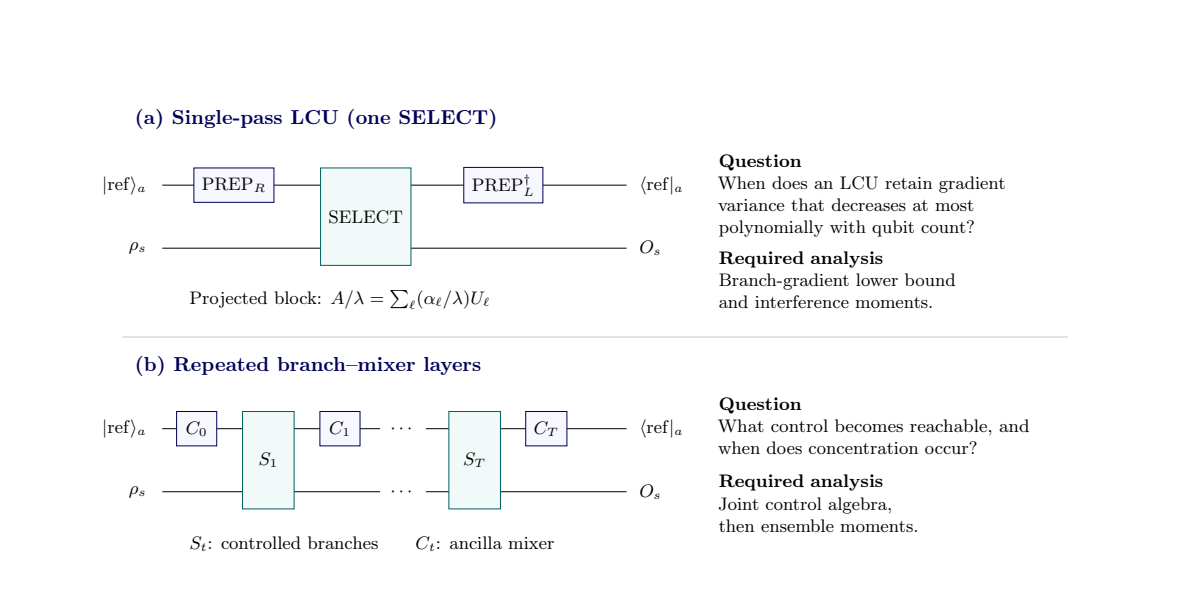
The paper says, at Figure 1 caption
Pith says: minor objection 1 of 10
The caption says the detailed definitions appear in Section 3.6, but PREP, SELECT and Eq. (13) are defined in §3.4, while §3.6 defines the two circuit models. Please correct the cross-reference.
The paper says, at Notation, §§3.3, 3.4, 4.7, 7
Pith says: minor objection 2 of 10
The glyph P carries three distinct meanings: the projected purity P_g(X) in Eq. (4), the ancilla projectors P_ℓ in Eq. (12), and the fermion parity operator Z^{⊗n} in §7 and Example 4.7. Similarly κ_ℓ denotes a branch commutant dimension while κ_s denotes the joint one. Distinct symbols for the projected purity and the parity operator would remove a real source of misreading.
show 8 more
The paper says, at §3.4, Eq. (16)
Pith says: minor objection 3 of 10
PREP_R and PREP_L are defined as separate unitaries, but Eq. (16) names a single coefficient-layer DLA g_coeff, and Definition 5.1 uses only that one algebra. Please state whether the model assumes a single trainable coefficient layer (with PREP_R = PREP_L up to fixed phases) or two, and which algebra enters Eq. (44) in the two-preparation case.
The paper says, at Eq. (20) and §6.1
Pith says: minor objection 4 of 10
Four objectives now coexist — L, L/λ², L_BE and L_BE/λ² — with different prefactors, and the text switches between them in a sentence ('all of its variance formulas are obtained by dividing the displayed variances by λ⁴'). A one-row table listing each objective, its definition and the prefactor carried by its variance would eliminate the ambiguity.
The paper says, at §4.1, remark after Prop. 4.1
Pith says: minor objection 5 of 10
The sentence 'No Haar-random sampling law, zero mean for U_ℓ, or restriction on the position of the differentiated gate is required' is correct, but it sits immediately before Theorem 4.9, whose closed form is restricted to measurement-adjacent gates. Please add an explicit pointer in the floor's remark so the two scopes are not conflated by a reader skimming §4.
The paper says, at Table 2, first row
Pith says: minor objection 6 of 10
The 'Gradient floor' row should list the finite-second-moment hypothesis and should say that the zero-mean condition E[U_k]=0 is entrywise (matrix mean), since §4.2 rightly stresses the distinction between a zero matrix mean and a zero conjugation moment.
The paper says, at §8.1, step A2, Eq. (58)
Pith says: minor objection 7 of 10
The two invariance conditions are typeset on a single line and appear to be a conjunction, whereas the first is the infinitesimal commutant condition and the second the infinitesimal form condition. Please separate them and note that the second is needed only for the E(m²) channel.
The paper says, at §2, paragraph on Khatri et al.
Pith says: minor objection 8 of 10
'Theorem 4.10 recovers their identical-group formula when the unconjugated overlap moment vanishes' reads as an unconditional claim, while Remark 4.11 shows the Dirichlet-averaged variance acquires the extra term (43) whenever τ>0 and the input does not satisfy Lemma B.1. Please foreshadow that qualification in §2.
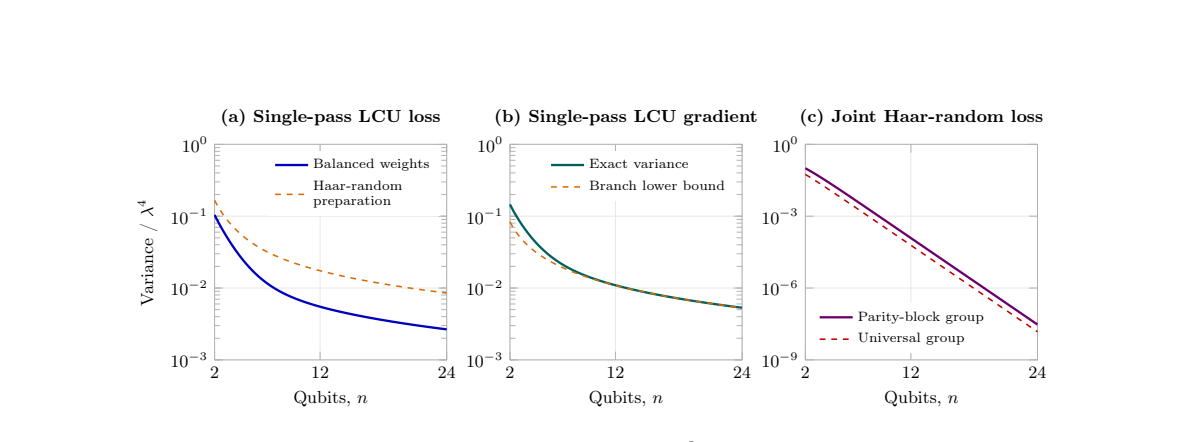
The paper says, at Fig. 2 caption and Eq. (57)
Pith says: minor objection 9 of 10
The caption should say that panel (a)'s 'Haar-random preparation' curve is the L=2, λ=1 specialization of Theorem 4.10 and that panel (b)'s floor is Eq. (24) with Var(g_branch)=4/(2n−1). For Eq. (57), one intermediate line giving E|Γ₁₂|²=2/2^n and the resulting (1/4)2^{−n} would help, since the exponents are easy to misread in the typeset form.
The paper says, at Example 4.7
Pith says: minor objection 10 of 10
'Direct multiplication gives' precedes the two contractions (35)–(36); a single intermediate step for Tr[J†₊ O J₊ O^T]=−5/4 would let a reader verify the number without redoing the Majorana algebra, which is the point of including an exactly solvable example.
What would settle it
Take the paper's two-branch measurement-adjacent benchmark (Eq. 57, Figure 2(b)) and dilute the undifferentiated branch to the mixture E_p = (1−p)δ_{U=I} + p·Haar(e^{so(2n)}), so E[U₂] = (1−p)I, keeping U₁ = e^{iθX₁X₂}V₁ with V₁ Haar-random. Matchgate circuits are classically simulable in poly(n), so Var(∂θL)/λ⁴ can be estimated to high precision at n = 4, 6, 8 for p = 0.9, 0.99, 0.999 and compared with |α₁|⁴Var(g_branch) = w₁⁴·4/(2n−1). If the ratio falls below 1 already at p = 0.999, the zero-mean hypothesis is doing decisive work rather than being a technical convenience, and the abstract should carry that qualifier.
from the skeptic's reading
How the review went
4 readings by deepseek-v4-flash · 31 Oct 2026
- Reader holds up
- Skeptic agrees
- Editor wrote the verdict above
- Referee minor revision: 2 major objections, 10 minor
Not run on this paper: the simulated authors' defence.
Pith did not check this review's objections against the paper.
The review in full
The review in brief, machine-written
Short version: the derivations hold up and the authors label their own limits, which is rarer than it should be. The single-pass half is the part worth your time; the interleaved half is a control-algebra result wearing a variance result's clothes.
What is actually new. Proposition 4.1 is simple and useful: with fixed coefficients, if the other branches have zero entrywise means and are independent of the differentiated branch and its derivative, the interference terms have zero conditional mean, the cross-covariances vanish, and the |αl|^4 floor is just a sum of squares. Anyone could have written that argument; the point is nobody did. The second real contribution is retaining the unconjugated moment E(m2) at fixed coefficients (Theorems 4.3 and 4.9). Khatri et al. average it away with Dirichlet weights; here it survives with explicit phase dependence, and the four-qubit matchgate example (E(m2) = −5/32, Eq. 38) shows it can be nonzero. Lemma 4.6 is the right tool for that and the matchgate counts τ = 2 are checked. Theorem 5.8 is a clean block-by-block answer — su(Ld_i) per Wedderburn block plus a q-dimensional center — and the center bookkeeping in Example 5.7 is exactly where these papers usually slip. The trace-component condition in Corollary 5.9 is a nice catch. Theorem 4.10 recovering Khatri's Eq. (9) term by term is the kind of check that earns trust.
Where it is soft. Section 3.6 (b232) already says the floor's hypotheses fail for shared-parameter and near-identity ensembles, so the stress-test concern is acknowledged rather than concealed. I would push back on how the stress test framed it: zero-mean branch ensembles are a modeling class, not a measure-zero accident — Haar on a group with no fixed vectors, or any ensemble with a uniform global phase, satisfies it. What is fair is narrower: the abstract's "cannot erase" reads stronger than the theorem, and Proposition H.2 bounds moment error at the λ4‖O‖² scale rather than the branch-variance scale, so approximate moments do not obviously extend the floor. One careful sentence in the abstract would close that gap. Second, the closed-form gradient covers only measurement-adjacent gates; other positions need the edge or independent-factor conditions of C.2, which the text states (b609). Third, all the interleaved concentration statements are conditional on joint-design sampling (b512, b597, b699). That is honest, but it means the second half of the paper is a control paper plus a conditional prediction, and readers should not read it as a blank-plateau theorem for interleaved LCUs.
The Section 8.1 audit and the weight thresholds in Theorem I.1 are practically useful and I would hand them to a student.
Who it is for: anyone building LCU-based models who needs to know which quantities survive coefficient tuning, and anyone working on DLA-based variance theory. The citation pattern is normal — the borrowed theorems come from published or posted sources and are attributed, including the explicit concession that Theorem 4.3 specializes Alcântara et al.
Recommendation: send it out. Ask the referees to press on the abstract wording for the floor and on whether the near-identity regime can be handled at all, and to check the saturation proof's step 3 independently.
The strongest objection
The floor's proof (Eqs. 25–26) is a conditional-expectation argument: holding (U_l, U̇_l) fixed, each interference term R_k = 2Re(α_l ᾱ_k Tr[O U̇_l ρ U_k†]) has zero conditional mean because E[U_k†] = 0, so Cov(g_branch, Σ_k R_k) = 0 and only nonnegative squares survive. That algebra is exact and correct. The load-bearing point is that the cancellation is an exact-first-moment statement. If E[U_k] = δ ≠ 0, each R_k acquires the deterministic piece 2Re(α_l ᾱ_k Tr[O U̇_l ρ δ†]), which depends on the same random U̇_l that determines g_branch; the covariance is then generically nonzero and may be negative. Writing v = Var(g_branch) and ρ = Var(Σ_k R_k), one only has Var(∂θL) ≥ |α_l|⁴v + ρ − 2|α_l|²√(ρv), which vanishes at ρ = |α_l|⁴v, so no positive floor survives in the worst case. Section 3.6 acknowledges that shared-parameter and near-identity ensembles 'require checking these hypotheses separately' (b232), so this is not concealed. What is missing is a stability statement: Prop. H.2 bounds |Var_E[L] − Var_Haar[L]| ≤ 8λ⁴‖O‖² Σ_l w_l ε_l, an error measured at the scale λ⁴‖O‖² rather than at the scale of the branch variance, and it concerns the loss, not the floor. In the relevant regime the moment error needed to certify |α_l|⁴Var(g_branch) is therefore exponentially small whenever Var(g_branch) is inverse-polynomial and λ⁴‖O‖² is only polynomially bounded. Since near-identity initialization violates E[U] = 0 by construction, the abstract's 'cannot erase' phrasing is exact only in a measure-zero regime of initialization schemes.
I treated Proposition 4.1 as the load-bearing claim and checked the proof line by line: Eq. (25) is the exact decomposition, conditioning on (U_l, U̇_l) makes each R_k zero-mean and mutually independent, and the covariance with g_branch vanishes, giving Var(∂θL) = |α_l|⁴Var(g_branch) + Σ E[R_k²]. Nothing in the argument uses Haar measure, a particular gate position, or a special form for U_l, so the proposition and its 'any gate position' remark hold as stated. I also checked claims the headline rests on: the L = 2 case of Theorem 4.10 reproduces the Dirichlet moments (E[c⁴] = 1/5, E[c₁²c₂²] = 1/30) and reduces to Var[m] at L = 1; the 3V and 7V thresholds in §8.2 follow from Eq. (124); r* ≈ 7.41 and w* ≈ 0.5437 in Theorem I.1(iv) satisfy the stated stationarity relation; and the matchgate gradient benchmark 4/(2n−1) agrees with the independent adjoint-orbit computation E[(RΓRᵀ)²_ab] = ‖Γ‖²_F/(2n(2n−1)) = 1/(2n−1). The reader's weakest_assumption names the right premise, so I agree on the locus of concern. My difference is one of emphasis: the issue is not that the premise is unstated (it is stated in §3.6 and b232) but that no stability version exists, and the paper's approximate-moment results do not supply one, because their error scale is not tied to the branch variance. That limits how far the abstract can be pushed, but it does not impugn the theorem, and the paper's scoping statements are accurate, so the verdict should not change. One secondary internal check I could not settle by hand: whether the sector formula (28), applied with a single so(2n) sector, reproduces the 1/(2n−1) branch variance used in Figure 2(a) for n ≥ 3. At n = 4 my hand evaluation gives (1 − 2/16)·16/28 = 1/2 versus the figure's 1/7, which suggests (28) is being used where the two half-spinor blocks require blockwise projections; this would affect the 'resolve by (28)' remark in Theorem 7.1(i), not the floor itself.
The referee's report
The paper is careful, and in the places I recomputed it is arithmetically exact. Every headline statement carries its hypotheses, Table 2 maps arguments to proof locations, and the authors state plainly that a large control algebra is not a sampling law, that no depth is shown to reach the design hypothesis, and that the normalized postselected gradient is not covered. Strengths worth naming explicitly: the gradient floor is proved by a clean conditional-expectation argument that needs no Haar randomness; the phase-sensitive channel E(m²) is a genuine addition to the second-moment analysis of Khatri et al., and the four-qubit value is checkable by hand; the Dirichlet specialization (Thm 4.10) and the number in Fig. 2 agree with independently computed values I reproduced (Eqs. 38, 57, and both curves of Fig. 2c); and the saturation theorem pins the central directions rather than only a dimension. The result is a useful, falsifiable design guide for LCU architectures, and the paper is honest about what it does not establish.
Pith's reading of the paper (a machine's summary, not the authors')
This paper asks when a coherent sum of quantum circuits — a linear combination of unitaries — destroys the training signal that one of its constituent circuits would have had on its own. Its central claim is a floor: if the differentiated branch is independent of the others and every other branch has zero average as a matrix, interference cannot push the total gradient variance below that branch's own gradient variance times the fourth power of its coefficient magnitude. The result needs no Haar-randomness and no particular gate position, which makes it a design rule rather than a statement about one sampling convention. Beyond the floor, the paper gives exact bookkeeping for the two kinds of interference term — one set by the squared magnitude of the overlap between two branch outputs, one set by the complex square of that overlap — and shows the second is the only place relative coefficient phases enter. It then turns to circuits that alternate branch operations with ancilla mixing, computes what control those circuits generate, and uses matchgate examples to show that polynomial single-pass variance and exponential concentration under joint Haar-random sampling can coexist in the same family of branches.
What carries the argument. Two objects carry the argument. The first is the gradient floor of Proposition 4.1, which is a conditional-expectation argument rather than a random-matrix one. The second is the split of every pairwise interference moment into two invariant channels. The conjugated moment $\mathbb{E}|m_{\ell k}|^2$ is governed by the commutant of the branch group — the matrices $Y$ with $UYU^\dagger = Y$ — evaluated through Hilbert–Schmidt-orthonormal commutant bases. The unconjugated moment $\mathbb{E}(m_{\ell k}^2)$ is governed instead by the invariant bilinear forms $J$ with $UJU^{\mathsf T} = J$; the transpose rather than the adjoint is what separates this channel, and its dimension $\tau(G)$ vanishes exactly when the two-copy ensemble has zero mean, which is why an independent uniform global phase or a group such as $U(d)$ removes the phase-dependent term. For the interleaved architecture the organising object is the associative envelope of the branch generators: ancilla commutators turn symmetric products into Lie brackets, so the generated Lie algebra can saturate the envelope block by block even when the joint branch Lie algebra is small, with the only shortfall an at-most-$q$-dimensional centre of block phases.
Core claim. The load-bearing claim is Proposition 4.1, a single-branch gradient floor. Fix the coefficients, let $\theta$ occur only in branch $\ell$, and let $g^{\ell}_{\mathrm{branch}}$ be that branch's own gradient. If the pair $(U_\ell, \dot U_\ell)$ is independent of all other branch unitaries, and each other branch has zero entrywise mean, then $\mathrm{Var}(\partial_\theta L) \ge |\alpha_\ell|^4\, \mathrm{Var}(g^{\ell}_{\mathrm{branch}})$. The proof conditions on the differentiated branch, notes that each interference term then has zero conditional mean, and keeps only the nonnegative average squares that remain. Nothing about Haar measure, the position of the differentiated gate, or the mean of $U_\ell$ itself is used. The corollary the authors draw is that an inverse-polynomial branch variance plus an inverse-polynomial $|\alpha_\ell|$ is enough to keep the unnormalized gradient variance inverse-polynomial, so the coherent sum does not by itself manufacture a barren plateau. The rest of the single-pass analysis makes the accounting exact: the loss variance splits into branch variances weighted by $|\alpha_\ell|^4$ and pairwise interference terms built from $\mathbb{E}|m_{\ell k}|^2$ and $\mathbb{E}(m_{\ell k}^2)$, where $m_{\ell k} = \mathrm{Tr}[O\,U_\ell\rho U_k^\dagger]$; only the second carries the relative phases $\gamma_\ell-\gamma_k$. A four-qubit matchgate example gives $\mathbb{E}(m_{12}^2) = -5/32$ and an interference contribution $\tfrac{5}{16}\lambda^4 w_1^2 w_2^2[1-\cos 2(\gamma_1-\gamma_2)]$ that vanishes at equal phases and peaks at relative phase $\pi/2$.
The premise it rests on. The floor rests on the differentiated branch and its derivative being independent of every other branch, and on those other branches averaging to zero as matrices; shared parameters or correlated branch ensembles break this and leave interference free to offset the branch gradient in the mean.
If the paper is right (Pith's inferences, not the authors')
An inverse-polynomial branch gradient variance together with an inverse-polynomial coefficient magnitude suffices for an inverse-polynomial unnormalized gradient variance, at any gate position and without assuming Haar-random branches.
Relative coefficient phases matter only through the invariant-form channel, so phase tuning changes the loss variance and the added gradient variance in opposite directions; for two branches, balanced weights maximize the loss variance only when the interference term is at least seven times the branch variance.
With a full special-unitary ancilla mixer, the interleaved algebra saturates the associative envelope up to central block phases, so branches whose joint Lie closure is small — such as independent Pauli-$X$ and Pauli-$Z$ branches of dimension $3n$ — can still generate universal joint control.
For matchgate branches the single-pass LCU keeps inverse-polynomial loss and gradient variance, while the interleaved circuit under joint Haar-random sampling concentrates as $1/(L^2 4^{n-1}-1)$, and fermion parity survives in both regimes as a superselection rule.
Normalized postselected losses need separate treatment: the unnormalized variance transfers only when success-factor fluctuations are small relative to loss fluctuations, and an accepted shot costs $\lambda^2/p_{\mathrm{acc}}$ circuit repetitions on average.
The fourth-power coefficient factor is a concrete design tax on wide coherent sums: at $L$ balanced branches the hardware-scaled variance carries $L^{-4}$ before any interference effect, so adding branches to an LCU is not free even in the floor's best case.
Because only the invariant-form channel carries relative phases, the phase-dependent part of the variance is a measurable fingerprint of whether a branch group is self-dual; a four-qubit experiment with matchgate branches, a GHZ input, and two chosen phases would test the predicted null at equal phases and peak at $\pi/2$.
The gap between the joint Lie closure and the associative envelope suggests that dynamical-Lie-algebra dimension is a weak proxy for trainability in interleaved architectures, since the same small branch algebra can sit under either a small envelope or a maximal one.
Shared-parameter architectures that draw all branches from one circuit with token-dependent angles violate the independence premise outright, so measuring cross-branch correlations in such models is the natural next test of whether the floor applies.
Check this review
Pith stored no record of this review's passes and took no fingerprint of it. Reviews made by code from 13 Nov 2026 on carry both.
How often reviews like this one are right
Reviews like this one: written by deepseek-v4-flash, where what was read was not recorded.
How often objections from reviews like this one are right: not yet measured
Reviews by people
This review was written by a machine. No person has reviewed this paper on Pith yet. A scientist listed on Pith can review it for a fee, and their review is published here whatever it concludes.
The paper
Abstract
A coherent sum of quantum circuits introduces interference that can alter the training signal. We distinguish a single linear combination of unitaries (LCU) from a circuit that repeatedly alternates branch operations and ancilla mixing. For a single-pass LCU, independent branches with zero matrix means cannot erase the differentiated branch's gradient variance: the total variance is at least the branch variance times the fourth power of its coefficient magnitude. This bound holds at any gate position and does not require the circuit unitaries to be Haar-random. Beyond this lower bound, we derive exact loss and gradient formulas that quantify the additional contributions from interference between branches. One of these terms depends on relative coefficient phases and vanishes when the branch ensemble is invariant under multiplication by i𝕀; a four-qubit matchgate example shows that it can be nonzero. For repeated interleaving with full special-unitary ancilla control, we determine the generated Lie algebra from the associative algebra of the branches, including the available central phase directions. This control result predicts concentration only with additional assumptions on circuit sampling. Matchgate examples exhibit polynomial single-pass LCU variances and exponential concentration under joint Haar-random sampling. We also derive coefficient-selection rules and bounds for postselection, measurement error, and approximate moments.
The paper's own sentences, arranged, kept beside the review and separate from it. Each label is drawn from a closed vocabulary; the number beside it is the probability the classifier gave that label. No sentence in this record was written by a model.
abstract compiled · 2026-10-30
The authors' main claim, as the classifier picked it out 0.89
“For a single-pass LCU, independent branches with zero matrix means cannot erase the differentiated branch's gradient variance: the total variance is at least the branch variance times the fourth power of its coefficient magnitude.”
How the main claim is stated: asserted 1.00
What the abstract itself states, as probabilities: claims first 0.04 · states limitation 0.85 · human participants 0.01 · controlled comparison 0.18 · randomized assignment 0.03 · states quantitative result 0.95 · compares with prior results 0.32 · mentions code or data availability 0.02
The abstract, sentence by sentence
This table labels the abstract only (arXiv listing abstract v1). The number is the probability the classifier gave the label.
| Sentence | Role | The authors' own work | States the main conclusion | Strength |
|---|---|---|---|---|
| A coherent sum of quantum circuits introduces interference that can alter the training signal. | background 1.00 | 0.10 | 0.05 | asserted 0.64 |
| We distinguish a single linear combination of unitaries (LCU) from a circuit that repeatedly alternates branch operations and ancilla mixing. | contribution 0.65 | 0.61 | 0.06 | asserted 0.97 |
| For a single-pass LCU, independent branches with zero matrix means cannot erase the differentiated branch's gradient variance: the total variance is at least the branch variance times the fourth power of its coefficient magnitude. | result 1.00 | 0.88 | 0.42 | asserted 1.00 |
| This bound holds at any gate position and does not require the circuit unitaries to be Haar-random. | result 0.94 | 0.87 | 0.13 | asserted 1.00 |
| Beyond this lower bound, we derive exact loss and gradient formulas that quantify the additional contributions from interference between branches. | contribution 0.78 | 0.95 | 0.12 | asserted 1.00 |
| One of these terms depends on relative coefficient phases and vanishes when the branch ensemble is invariant under multiplication by $i \mathbb{I}$; a four-qubit matchgate example shows that it can be nonzero. | result 0.98 | 0.89 | 0.06 | asserted 0.94 |
| For repeated interleaving with full special-unitary ancilla control, we determine the generated Lie algebra from the associative algebra of the branches, including the available central phase directions. | contribution 0.52 | 0.93 | 0.09 | asserted 1.00 |
| This control result predicts concentration only with additional assumptions on circuit sampling. | interpretation 0.60 | 0.82 | 0.13 | asserted 0.69 |
| Matchgate examples exhibit polynomial single-pass LCU variances and exponential concentration under joint Haar-random sampling. | result 1.00 | 0.85 | 0.18 | asserted 1.00 |
| We also derive coefficient-selection rules and bounds for postselection, measurement error, and approximate moments. | contribution 0.75 | 0.95 | 0.06 | asserted 1.00 |
What kind of paper the classifier reports this is: theoretical result 1.00 · evidence from proof or derivation 1.00
What was examined, and what was not
Sources read
- arXiv listing abstract v1
Not examined
- full text
- figures and tables
- references and citing sentences
- relations to other papers
Levels run
- P abstract
Not run
- S sections
- T body sentences
- C citations
- R cross-paper relations
How the labels were made
Compiled by classifier-1.13.0 via TypeSafe API, question bank abstract-p1-20260923, 2026-10-30: 1 request, 7,478 input tokens.
Every quoted sentence on this record is the authors'. Every label is from Pith's closed vocabulary, with the probability shown beside it. This record as JSON
Figures (2)
Figures are the authors', reproduced from the paper.
References (49)
- [1] Jarrod R. McClean, Sergio Boixo, Vadim N. Smelyanskiy, Ryan Babbush, and Hartmut Neven. Barren Plateaus in Quantum Neural Network Training Landscapes.Nature Communications, 9:4812, 2018. doi: 10.1038/s41467-018-07090-4 on Pithdoi:10.1038/s41467-018-07090-4
- [2] Marco Cerezo, Akira Sone, Tyler Volkoff, Lukasz Cincio, and Patrick J. Coles. Cost Function Dependent Barren Plateaus in Shallow Parametrized Quantum Circuits.Nature Communications, 12:1791, 2021. doi: 10.1038/s41467-021-21728-w on Pithdoi:10.1038/s41467-021-21728-w
- [3] Zoë Holmes, Kunal Sharma, Marco Cerezo, and Patrick J. Coles. Connecting Ansatz Expressibility to Gradient Magnitudes and Barren Plateaus.PRX Quantum, 3:010313, 2022. doi: 10.1103/PRXQuantum.3.010313 on Pithdoi:10.1103/prxquantum.3.010313
- [4] Martín Larocca, Supanut Thanasilp, Samson Wang, Kunal Sharma, Jacob Biamonte, Patrick J. Coles, Lukasz Cincio, Jarrod R. McClean, Zoë Holmes, and Marco Cerezo. Barren Plateaus in Variational Quantum Computing.Nature Reviews Physics, 7: 174–189, 2025. doi: 10.1038/s42254-025-00813-9 on Pithdoi:10.1038/s42254-025-00813-9
- [5] Andrew M. Childs and Nathan Wiebe. Hamiltonian Simulation Using Linear Combinations of Unitary Operations.Quantum Information & Computation, 12 (11–12):901–924, 2012. doi: 10.26421/QIC12.11-12 on Pithdoi:10.26421/qic12.11-12
- [6] Nikhil Khatri, Stefan Zohren, and Gabriel Matos. Trainability of Parametrised Linear Combinations of Unitaries. arXiv:2506.22310v1, 2025 on PithPith's reviewarXiv
- [7] Martín Larocca, Piotr Czarnik, Kunal Sharma, Gopikrishnan Muraleedharan, Patrick J. Coles, and Marco Cerezo. Diagnosing Barren Plateaus with Tools from Quantum Optimal Control.Quantum, 6:824, on Pith
- [8] Michael Ragone, Bojko N. Bakalov, Frédéric Sauvage, Alexander F. Kemper, Carlos Ortiz Marrero, Martín Larocca, and Marco Cerezo. A Lie Algebraic Theory of Barren Plateaus for Deep Parameterized Quantum Circuits.Nature Communications, 15:7172, 2024. doi: 10.1038/s41467-024-49909-3 on Pithdoi:10.1038/s41467-024-49909-3
- [9] Enrico Fontana, Dylan Herman, Shouvanik Chakrabarti, Niraj Kumar, Romina Yalovetzky, Jamie Heredge, Shree Hari Sureshbabu, and Marco Pistoia. Characterizing Barren Plateaus in Quantum Ansätze with the Adjoint Representation.Nature 20 Communications, 15:7171, 2024. doi: 10.1038... on Pithdoi:10.1038/s41467-024-49910-w
- [10] N. L. Diaz, Diego García-Martín, Sujay Kazi, Martín Larocca, and Marco Cerezo. Showcasing a Barren Plateau Theory beyond the Dynamical Lie Algebra. arXiv:2310.11505, 2023 on PithPith's reviewarXiv
- [11] Pedro Alcântara, Leandro Morais, and Rafael Chaves. A Representation-Theoretic Framework for Characterizing Barren Plateaus. arXiv:2609.04462, 2026 on PithPith's reviewarXiv
- [12] Antonio Anna Mele. Introduction to Haar Measure Tools in Quantum Information: A Beginner’s Tutorial. Quantum, 8:1340, 2024. doi: 10.22331/q-2024-05-08-1340 on Pithdoi:10.22331/q-2024-05-08-1340
- [13] Benoît Collins. Moments and Cumulants of Polynomial Random Variables on Unitary Groups, the Itzykson–Zuber Integral, and Free Probability. International Mathematics Research Notices, 2003(17): 953–982, 2003. doi: 10.1155/S107379280320917X on Pithdoi:10.1155/s107379280320917x
- [14] Benoît Collins and Piotr Śniady. Integration with Respect to the Haar Measure on Unitary, Orthogonal and Symplectic Group.Communications in Mathematical Physics, 264:773–795, 2006. doi: 10.1007/s00220-006-1554-3 on Pithdoi:10.1007/s00220-006-1554-3
- [15] Hongshun Yao, Xia Liu, Mingrui Jing, Guangxi Li, and Xin Wang. LCQNN: Linear Combination of Quantum Neural Networks.Quantum Machine Intelligence, 8:29, on Pith
- [16] András Gilyén, Yuan Su, Guang Hao Low, and Nathan Wiebe. Quantum Singular Value Transformation and Beyond: Exponential Improvements for Quantum Matrix Arithmetics. InProceedings of the 51st Annual ACM SIGACT Symposium on Theory of Computing, pages 193–204, 2019. doi: 10.1145/3... on PithPith's reviewdoi:10.1145/3313276.3316366
- [17] Nikhil Khatri, Stefan Zohren, and Gabriel Matos. Stacking the deck: Tunable trainability in stacked LCUs. arXiv:2607.24686, 2026 on PithPith's reviewarXiv
- [18] Antonio Sannia, Francesco Tacchino, Ivano Tavernelli, Gian Luca Giorgi, and Roberta Zambrini. Engineered Dissipation to Mitigate Barren Plateaus.npj Quantum Information, 10(1):81, 2024. doi: 10.1038/s41534-024-00875-0 on Pithdoi:10.1038/s41534-024-00875-0
- [19] Elias Zapusek, Ivan Rojkov, and Florentin Reiter. Scaling Quantum Algorithms via Dissipation: Avoiding Barren Plateaus. arXiv:2507.02043, 2025 on PithPith's reviewarXiv
- [20] Abhinav Deshpande, Marcel Hinsche, Khadijeh Najafi, Kunal Sharma, Ryan Sweke, and Christa Zoufal. Dynamic Parameterized Quantum Circuits: Expressive and Barren-Plateau Free. arXiv:2411.05760, 2024 on PithPith's reviewarXiv
show 29 more
- [21] Nikhil Khatri, Gabriel Matos, Luuk Coopmans, and Stephen Clark. Quixer: A Quantum Transformer Model. arXiv:2406.04305, 2024 on PithPith's reviewarXiv
- [22] Luuk Coopmans and Marcello Benedetti. On the Sample Complexity of Quantum Boltzmann Machine Learning.Communications Physics, 7:274, 2024. doi: 10.1038/s42005-024-01763-x on Pithdoi:10.1038/s42005-024-01763-x
- [23] Jamie Heredge, Maxwell West, Lloyd Hollenberg, and Martin Sevior. Nonunitary Quantum Machine Learning.Physical Review Applied, 23:044046, 2025. doi: 10.1103/PhysRevApplied.23.044046 on Pithdoi:10.1103/physrevapplied.23.044046
- [24] Domenico D’Alessandro.Introduction to Quantum Control and Dynamics. Chapman & Hall/CRC, Boca Raton, FL, 2007. doi: 10.1201/9781584888833 on Pithdoi:10.1201/9781584888833
- [25] Aram W. Harrow and Richard A. Low. Random Quantum Circuits Are Approximate 2-Designs. Communications in Mathematical Physics, 291:257–302, on Pith
- [26] Fernando G. S. L. Brandão, Aram W. Harrow, and Michał Horodecki. Local Random Quantum Circuits Are Approximate Polynomial-Designs. Communications in Mathematical Physics, 346:397–434, on Pith
- [27] Jonas Haferkamp. Random Quantum Circuits Are Approximate Unitaryt-Designs in DepthO(nt 5+o(1)). Quantum, 6:795, 2022. doi: 10.22331/q-2022-09-08-795 on Pithdoi:10.22331/q-2022-09-08-795
- [28] Thomas Schuster, Jonas Haferkamp, and Hsin-Yuan Huang. Random Unitaries in Extremely Low Depth. Science, 389(6755):92–96, 2025. doi: 10.1126/science.adv8590 on Pithdoi:10.1126/science.adv8590
- [29] Eric R. Anschuetz and Bobak T. Kiani. Quantum Variational Algorithms Are Swamped with Traps. Nature Communications, 13:7760, 2022. doi: 10.1038/s41467-022-35364-5 on Pithdoi:10.1038/s41467-022-35364-5
- [30] Andrew Arrasmith, Zoë Holmes, Marco Cerezo, and Patrick J. Coles. Equivalence of Quantum Barren Plateaus to Cost Concentration and Narrow Gorges. Quantum Science and Technology, 7(4):045015, 2022. doi: 10.1088/2058-9565/ac7d06 on Pithdoi:10.1088/2058-9565/ac7d06
- [31] Marco Cerezo, Martín Larocca, Diego García-Martín, N. L. Diaz, Paolo Braccia, Enrico Fontana, Manuel S. Rudolph, Pablo Bermejo, Aroosa Ijaz, Supanut Thanasilp, Eric R. Anschuetz, and Zoë Holmes. Does Provable Absence of Barren Plateaus Imply Classical Simulability?Nature Commu... on Pithdoi:10.1038/s41467-025-63099-6
- [32] Matthew L. Goh, Martín Larocca, Lukasz Cincio, Marco Cerezo, and Frédéric Sauvage. Lie-Algebraic Classical Simulations for Quantum Computing. Physical Review Research, 7:033266, 2025. doi: 10.1103/3y65-f5w6 on Pithdoi:10.1103/3y65-f5w6
- [33] Zoltán Zimborás, Robert Zeier, Thomas Schulte-Herbrüggen, and Daniel Burgarth. Symmetry criteria for quantum simulability of effective interactions.Physical Review A, 92:042309, 2015. doi: 10.1103/PhysRevA.92.042309 on Pithdoi:10.1103/physreva.92.042309
- [34] Velimir Jurdjevic and Héctor J. Sussmann. Control Systems on Lie Groups.Journal of Differential Equations, 12(2):313–329, 1972. doi: 10.1016/0022-0396(72)90035-6 on Pithdoi:10.1016/0022-0396(72)90035-6
- [35] Barbara M. Terhal and David P. DiVincenzo. Classical Simulation of Noninteracting-Fermion Quantum Circuits.Physical Review A, 65:032325, 2002. doi: 10.1103/PhysRevA.65.032325 on Pithdoi:10.1103/physreva.65.032325
- [36] Richard Jozsa and Akimasa Miyake. Matchgates and Classical Simulation of Quantum Circuits.Proceedings of the Royal Society A, 464(2100):3089–3106, 2008. doi: 10.1098/rspa.2008.0189 on Pithdoi:10.1098/rspa.2008.0189
- [37] Martín Larocca, Nathan Ju, Diego García-Martín, Patrick J. Coles, and Marco Cerezo. Theory of Overparametrization in Quantum Neural Networks. Nature Computational Science, 3:542–551, 2023. doi: 10.1038/s43588-023-00467-6 on Pithdoi:10.1038/s43588-023-00467-6
- [38] Edward Grant, Leonard Wossnig, Mateusz Ostaszewski, and Marcello Benedetti. An Initialization Strategy for Addressing Barren Plateaus in Parametrized Quantum Circuits.Quantum, 3:214, on Pith
- [39] David Wierichs, Josh Izaac, Cody Wang, and Cedric Yen-Yu Lin. General Parameter-Shift Rules for Quantum Gradients.Quantum, 6:677, 2022. doi: 10.22331/q-2022-03-30-677. 21 on Pithdoi:10.22331/q-2022-03-30-677
- [40] Daniel A. Roberts and Beni Yoshida. Chaos and Complexity by Design.Journal of High Energy Physics, 2017(4):121, 2017. doi: 10.1007/JHEP04(2017)121 on Pithdoi:10.1007/jhep04(2017)121
- [41] Beatriz Dias and Robert König. Classical simulation of non-Gaussian fermionic circuits.Quantum, 8:1350, on Pith
- [48] For(61), decompose any anti-HermitianP + iQ with P, Q∈g into its anti-Hermitian partP and Hermitian part iQ; anti-Hermiticity of the sum forces iQ anti- Hermitian, hence Q = 0by the first claim applied toiQ. (ii) is standard; see Mele [12]. Lemma A.2(DLA variance formula [ 8, ... on Pith
- [49] Each simple ideal is spanned by its commutators, hence C is HS-orthogonal to everyigj and Pgj (σ) = Pgj (σg). The observable-side case follows by cyclic- ity. B Single-pass LCU loss moments We prove the single-pass LCU loss formula by expand- ing its second moment. Independenc... on Pith
- [2009] doi: 10.1007/s00220-009-0873-6 on Pithdoi:10.1007/s00220-009-0873-6
- [2016] doi: 10.1007/s00220-016-2706-8 on Pithdoi:10.1007/s00220-016-2706-8
- [2019] doi: 10.22331/q-2019-12-09-214 on Pithdoi:10.22331/q-2019-12-09-214
- [2022] doi: 10.22331/q-2022-09-29-824 on Pithdoi:10.22331/q-2022-09-29-824
- [2024] doi: 10.22331/q-2024-05-21-1350. A Technical preliminaries Complexification and group averaging simplify several proofs below. Complexification allows complex coeffi- cients in a real generator space, givinggC = g + ig; retaining the anti-Hermitian matrices recovers the origi-... on Pithdoi:10.22331/q-2024-05-21-1350
- [2026] doi: 10.1007/s42484-026-00364-x on Pithdoi:10.1007/s42484-026-00364-x
Challenges and discussion
Disagree with the review, or know something it missed? Leave a comment, or challenge this review formally: a challenge becomes a permanent entry in this paper's record, and its decision is published here.
Come back by email
A short list of the week's newly reviewed papers. Nothing is sent until you confirm from your inbox, and every email has a link that stops it. No account.
No comments yet.
Sign in to comment