Artificial Intelligence · arXiv:2609.05736 v2 · submitted 4 Sep 2026 · 18 references
Beyond Prompts: Measuring and Optimizing LLM Tool-Agent Harnesses
The paper says
“LLM tool agents can be improved without retraining by modifying the runtime harness around a fixed model: prompts, tool interfaces, middleware, state handling, and recovery logic.”
more of the abstract
We study this setting as resource-bounded harness selection for fixed-model multi-turn tool agents, with the search surface scoped to prompts and tool-boundary middleware: edits are guarded intercepts at the tool boundary, not arbitrary rewriting of agent execution logic. Our optimizer-agnostic protocol reports mean held-out lift, worst-condition lift, repeatability, logged cost diagnostics, and RelLift95(B), a conservative estimate of the held-out gain of the harness selected under budget B. We instantiate the protocol with prompt-only and prompt-plus-middleware optimizers, including PRISM, which clusters failures and routes repairs to prompt, tool-boundary middleware, or joint edit surfaces within a Pareto search. On BFCL multi-round, tau2-Retail, and tau2-Telecom, PRISM obtains mean held-out lifts of 14.2, 14.9, and 10.1 percentage points and positive empirical RelLift95 on all three benchmarks, and a component ablation attributes the margin chiefly to failure-surface routing and the edit-pattern constraint. Across optimizers, the results show that some search procedures can occasionally find large gains but still choose brittle updates, so the reliability of the chosen harness should be reported alongside average held-out lift.
from the abstract
Pith says
Machine review · deepseek-v4-flash · 10 Sep 2026 · what was read was not recorded · not checked by a person
It can be wrong. Challenge this review or reply to it.
Holds up, with conditions. Solid methodological contribution with a clear and honest limitations section, but the Telecom scoring inconsistency means the headline claim about positive RelLift95 on all three benchmarks is not yet supported—needs a fix before publication. This line is wrong
2 major objections · 4 minor
How often objections from reviews like this one are right: not yet measured
Not checked: figures, code, what the 18 references say.
The paper says, at Limitations (Telecom scoring caveat), Table 2
The review did not quote this passage.
Pith says: Objection 1 of 2 · major
The two PRISM Telecom rows (PRISM-PO and PRISM-MW, marked §) were scored using four simulator trials AND-combined outside the benchmark-native pass4 path used by all other Telecom arms. The abstract’s central claim of 'positive empirical RelLift95 on all three benchmarks' therefore depends on an unverified measurement premise for Telecom.
more of objection 1
The authors must either (a) re-evaluate the already-selected PRISM Telecom harnesses through the native pass4 path and report the corrected lifts, or (b) explicitly separate Telecom from the 'all three' claim and explain why the post-hoc path is expected to produce equivalent results. Until this is resolved, the claim is formally unsupported for Telecom.
The paper says, at §6.1, Table 3 (τ²-Telecom component ablation)
The review did not quote this passage.
Pith says: Objection 2 of 2 · major
In Table 3, the PRISM-MW reference row for Telecom uses the post-hoc pass4 scoring, while all ablation variants (e.g., PRISM-NoRoute, PRISM-NoGate) use the native pass4 protocol. The claim that 'every removal is first-order' on Telecom is therefore based on a non-uniform measurement baseline. The ablation should either be re-run with a consistent scoring path, or the text should acknowledge that the Telecom comparisons in that table are confounded by the scoring discrepancy.
4 minor objections
The paper says, at §4.2, Appendix E.4
Pith says: minor objection 1 of 4
The run-exclusion rule removes any run whose final repair-split reliability is below 0.5. Please report the number of excluded runs per arm and discuss whether this could introduce selection bias, especially for optimizers with higher variance.
The paper says, at §4.5, Table 2
Pith says: minor objection 2 of 4
The RelLift95 column in Table 2 is defined at a reference budget Bref (the mean cost of a single optimizer run). It would be helpful to explicitly label the column as 'RelLift95 (Bref)' to remind readers that the value is budget-dependent. The curves in Figure 2 already show this dependence, but the table column could benefit from a footnote.
show 2 more
The paper says, at §4.2
Pith says: minor objection 3 of 4
The tie-breaking for Gi is deterministic by run identifier. Please state whether this tie-break actually occurred in any selection (e.g., for runs with identical gate pass rate and reliability), and if so, how often.
The paper says, at Appendix F
Pith says: minor objection 4 of 4
The cost accounting convention uses the larger of an internal route-card price and a public standard price, which is conservative but may overstate costs for some models. This is acceptable as a diagnostic, but the text should note that the reported costs are not provider-independent prices and should not be interpreted as deployment economics.
What would settle it
Re-score the already-selected PRISM-PO and PRISM-MW Telecom harnesses, and the h0 baseline, on the same 74-case per-seed held-out scorecard splits using the benchmark-native pass4 implementation exactly as used for the other Telecom arms, with the same simulator seeds and failure-handling rules, replacing the post-hoc AND of one saved and three later trials. Keep everything else in the run tuples fixed, recompute Table 2's Telecom MeanLift and RelLift95 with confidence intervals, and check whether PRISM-MW's Telecom RelLift95 remains positive and its mean lift remains at least as large as MIPROv2-MW's 7.3 pp. If either condition fails, the abstract's all-three positive-RelLift95 claim and the conclusion's reliability comparison are not supported as stated.
from the skeptic's reading
How the review went
4 readings by deepseek-v4-flash · 10 Sep 2026
- Reader holds up, with conditions
- Skeptic agrees
- Editor wrote the verdict above
- Referee major revision: 2 major objections, 4 minor
Not run on this paper: the simulated authors' defence.
Pith did not check this review's objections against the paper.
The review in full
The review in brief, machine-written
This is a well-constructed paper that does two things well: it introduces a deployer-side evaluation protocol (RelLift95, budgeted selection framing) that is genuinely useful for production teams, and it shows that routing repairs to prompt vs. tool-boundary middleware, with constrained edit patterns, produces a more reliably selectable harness than prompt-only or unconstrained search. The ablation cleanly separates the new pieces from inherited machinery, and the paper is refreshingly transparent about its limitations.
The stress-test note is correct: the Telecom PRISM rows were scored via a post-hoc non-native pass4 path, while every other Telecom arm uses the native path. The paper's own Limitations section discloses this, but disclosure does not make the measurement valid. The abstract's claim of "positive empirical RelLift95 on all three benchmarks" therefore rests on an unverified premise for Telecom. This is the paper's load-bearing flaw. The Telecom result is the smallest and weakest of the three, and the scoring change means we simply do not know whether PRISM's advantage there is real or an artifact of the protocol break.
Other soft spots: confidence intervals overlap with MIPROv2-MW on two benchmarks, the run-exclusion threshold can drop low-reliability outcomes, and the run counts are small (n≤16, sometimes as low as 4–8 after exclusions). The paper acknowledges most of these, but they matter when assessing the strength of the comparative claim.
That said, the core contributions are real: the RelLift95 metric, the failure-surface routing with constrained edit patterns, and the overall protocol are well designed and honestly evaluated. This is a serious thinker's paper. The Telecom issue is fixable—re-score those rows with the native pass4 path and update the numbers—and I would accept this for peer review conditional on that fix. The work is valuable for researchers and engineers working on harness optimization for multi-turn tool agents.
The strongest objection
The central quantified claim is that PRISM obtains positive held-out RelLift95 on all three benchmarks. Telecom is the weakest and smallest of the three results, and it is the only benchmark where the two PRISM rows (PRISM-PO and PRISM-MW, marked § in Table 2) were not evaluated through the benchmark-native pass4 path used by every other Telecom arm. Instead, per the paper's own Limitations section, those rows were scored by AND-combining four genuine simulator trials per task, one original plus three run afterwards, outside the native path. That scoring change alters the measurement protocol for exactly the rows that carry the 'all three' claim. It is not a cosmetic difference: native pass4 encodes the benchmark's rules for how the four rollouts are managed, seeded, and combined, including how failures, retries, and simulator state are handled. A post-hoc AND of independently scheduled trials can differ from the native path on any of those dimensions, and no evidence is provided that the two procedures agree. The mean Telecom lift of 10.1 pp and the RelLift95 of 7.8 pp are therefore not yet comparable to MIPROv2-MW's 7.3 pp or to the h0 baseline of 6.1 pass4, both of which use the native path. Until the already-selected PRISM harnesses are re-evaluated through the benchmark-native pass4 scorer on the same held-out scorecard splits, the positive-RelLift95-on-all-three claim is formally unsupported. The paper's disclosure is commendable, but disclosure of a protocol break does not make the measurement valid.
The reader's weakest_assumption identifies the same load-bearing concern: the Telecom PRISM rows use a non-native scoring path, and the positive-RelLift95-on-all-three claim depends on those rows. I agree that this is the single most load-bearing issue. The other candidate concerns I considered are real but secondary: the outcome-based run-exclusion rule of Appendix E.4 could in principle bias reliability statistics if excluded runs were optimizer outcomes rather than infrastructure failures, and confidence intervals for mean lift overlap with MIPROv2-MW on Retail and Telecom. Both would be worth addressing in a revision, but they do not strike me as individually as decisive as the Telecom measurement break. The Telecom issue is directly flagged in the paper, which is a point in the paper's favor, but it remains an unverified premise for the headline claim. The concrete test is a straightforward re-scoring of already-selected harnesses through the native pass4 path; no new search is needed. Because the reader's verdict was already CONDITIONAL and my analysis does not push it further in either direction, I leave the verdict unchanged.
The referee's report
If the results hold, the paper offers a rigorous, optimizer-agnostic evaluation framework that moves beyond single-score reporting to measure how reliably a harness can be selected under budget. PRISM demonstrates that failure-routed, pattern-constrained middleware editing can produce more predictable gains than prompt-only or unconstrained approaches. The RelLift95 metric is a practical tool for deployment decisions. The protocol and ablations are well-structured, and the code release supports reproducibility.
Pith's reading of the paper (a machine's summary, not the authors')
The paper studies automatic optimization of the runtime harness around a fixed LLM tool agent—the prompts, tool interfaces, middleware, and recovery logic—without retraining. It argues that evaluation of such optimization should focus on the reliability of the selected harness, not just the best single lift. The authors introduce PRISM, an evolutionary optimizer that clusters failures, routes repairs to either prompt or tool-boundary middleware surfaces, and maintains a Pareto frontier over gate pass rate and reliability. Across three benchmarks (BFCL multi-round, τ2-Retail, τ2-Telecom), PRISM achieves mean held-out lifts of 14.2, 14.9, and 10.1 percentage points and positive empirical RelLift95 on all three, meaning the selected harness reliably outperforms the baseline even in the lower tail of search outcomes.
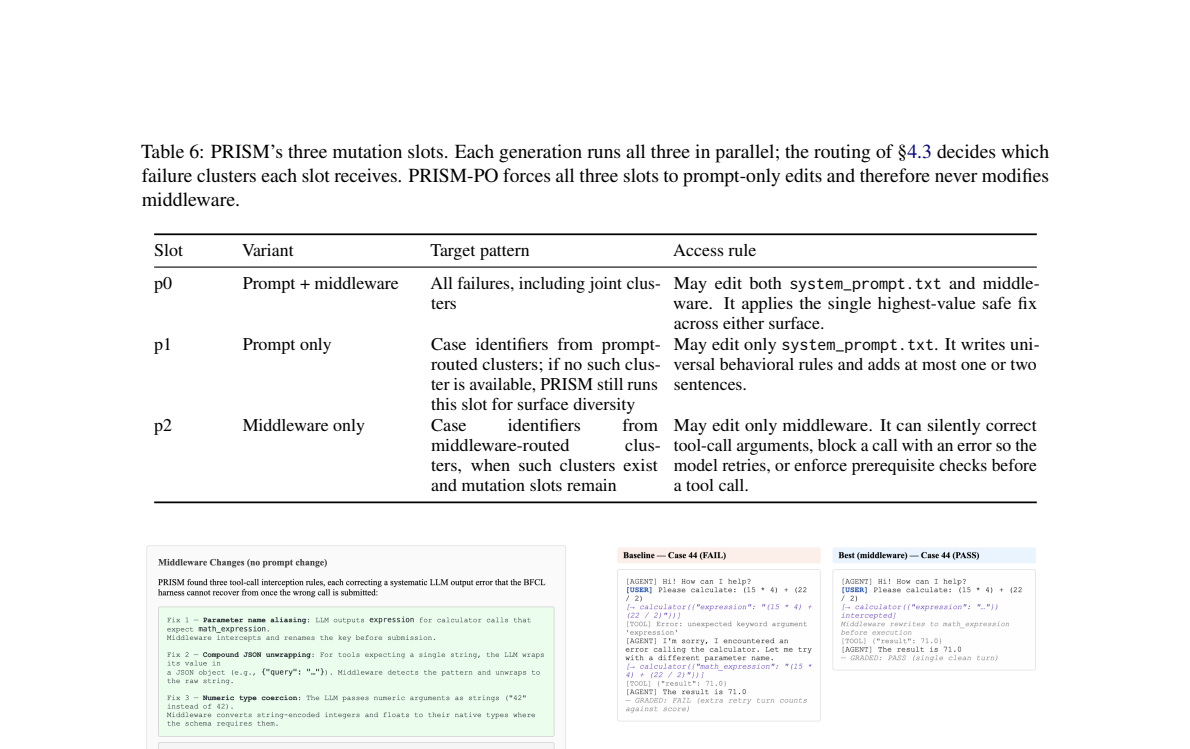
What carries the argument. PRISM is a failure-routed evolutionary optimizer that, each generation, clusters failing cases by root cause (using an analyst LLM), routes each cluster to one of three surface-constrained mutation slots (prompt-only, middleware-only, or joint), and updates a Pareto frontier over gate pass rate and reliability. Middleware edits are constrained to three tool-boundary patterns: silent correction, error blocking, and prerequisite blocking. The optimizer runs under a fixed inner-model rollout budget and selects a final harness using only pre-scorecard information (gate pass rate and reliability).
Core claim. Under a fixed rollout budget and scorecard-held-out protocol, failure-routed prompt/middleware search produces a more reliably selectable harness than prompt-only or hill-climbing baselines. The key empirical claim is that PRISM's mean held-out lifts of 14.2, 14.9, and 10.1 percentage points on BFCL multi-round, τ2-Retail, and τ2-Telecom, respectively, come with positive RelLift95 on all three benchmarks, while comparators such as BetterHarness, GEPA, and MIPROv2 show weaker or negative lower-tail lift. The component ablation attributes the margin primarily to failure-surface routing and the edit-pattern constraint, not to in-loop gate access or the failure matrix alone.
The premise it rests on. The Telecom part of the central claim (positive RelLift95 on τ2‑Telecom) depends on the validity of a non‑native pass4 scoring method (post‑hoc AND‑combination of four simulator trials) that was not used for the other Telecom arms, a measurement premise the paper itself flags in its Limitations section.
If the paper is right (Pith's inferences, not the authors')
If the central claim holds, production teams can automate harness improvement for fixed LLM agents by routing failures to the appropriate repair surface, reducing the need for manual prompt engineering.
The RelLift95 metric provides a deployer-sidediagnostic that complements average lift, enabling safer selection of harnesses under search budget constraints.
Pattern‑constrained middleware is a viable optimization surface only when failures are locally observable at the tool boundary; unconstrained middleware can degrade reliability.
The same evaluation protocol—split roles, budgeted reliable lift, and component ablation—can be applied to future optimizer designs for agent harness search.
PRISM's routing and constraint framework may transfer to other agent architectures (code agents, research agents) where failures can be clustered by root cause and fixed at the boundary of observable subsystems, but the paper explicitly leaves this untested.
The small τ2 scorecard sizes (74 cases per split) and stochastic simulator mean that the positive RelLift95 estimates are empirical lower‑tail approximations, not guarantees; broader validation on larger, production‑like datasets would strengthen the claim.
The Telecom scoring caveat (post‑hoc AND‑combination of four trials instead of the native pass4 path) means the Telecom portion of the central claim rests on a measurement premise not used for the other arms; if that premise introduces systematic bias, the Telecom lifts may be inflated or deflated.
Check this review
Pith stored no record of this review's passes and took no fingerprint of it. Reviews made by code from 13 Nov 2026 on carry both.
How often reviews like this one are right
Reviews like this one: written by deepseek-v4-flash, where what was read was not recorded.
How often objections from reviews like this one are right: not yet measured
Reviews by people
This review was written by a machine. No person has reviewed this paper on Pith yet. A scientist listed on Pith can review it for a fee, and their review is published here whatever it concludes.
How Pith checks papers · The full audit of this paper · Review history (2 versions)
The paper
Abstract
LLM tool agents can be improved without retraining by modifying the runtime harness around a fixed model: prompts, tool interfaces, middleware, state handling, and recovery logic. We study this setting as resource-bounded harness selection for fixed-model multi-turn tool agents, with the search surface scoped to prompts and tool-boundary middleware: edits are guarded intercepts at the tool boundary, not arbitrary rewriting of agent execution logic. Our optimizer-agnostic protocol reports mean held-out lift, worst-condition lift, repeatability, logged cost diagnostics, and RelLift95(B), a conservative estimate of the held-out gain of the harness selected under budget B. We instantiate the protocol with prompt-only and prompt-plus-middleware optimizers, including PRISM, which clusters failures and routes repairs to prompt, tool-boundary middleware, or joint edit surfaces within a Pareto search. On BFCL multi-round, tau2-Retail, and tau2-Telecom, PRISM obtains mean held-out lifts of 14.2, 14.9, and 10.1 percentage points and positive empirical RelLift95 on all three benchmarks, and a component ablation attributes the margin chiefly to failure-surface routing and the edit-pattern constraint. Across optimizers, the results show that some search procedures can occasionally find large gains but still choose brittle updates, so the reliability of the chosen harness should be reported alongside average held-out lift.
The paper's own sentences, arranged, kept beside the review and separate from it. Each label is drawn from a closed vocabulary; the number beside it is the probability the classifier gave that label. No sentence in this record was written by a model.
abstract compiled · 2026-09-23
The authors' main claim, as the classifier picked it out 0.63
“Across optimizers, the results show that some search procedures can occasionally find large gains but still choose brittle updates, so the reliability of the chosen harness should be reported alongside average held-out lift.”
How the main claim is stated: asserted 0.78
What the abstract itself states, as probabilities: claims first 0.04 · states limitation 0.83 · human participants 0.03 · controlled comparison 0.69 · randomized assignment 0.02 · states quantitative result 0.99 · compares with prior results 0.70 · mentions code or data availability 0.04
The abstract, sentence by sentence
This table labels the abstract only (arXiv listing abstract v2). The number is the probability the classifier gave the label.
| Sentence | Role | The authors' own work | States the main conclusion | Strength |
|---|---|---|---|---|
| LLM tool agents can be improved without retraining by modifying the runtime harness around a fixed model: prompts, tool interfaces, middleware, state handling, and recovery logic. | background 0.94 | 0.14 | 0.27 | asserted 0.84 |
| We study this setting as resource-bounded harness selection for fixed-model multi-turn tool agents, with the search surface scoped to prompts and tool-boundary middleware: edits are guarded intercepts at the tool boundary, not arbitrary rewriting of agent execution logic. | contribution 0.71 | 0.59 | 0.08 | asserted 0.97 |
| Our optimizer-agnostic protocol reports mean held-out lift, worst-condition lift, repeatability, logged cost diagnostics, and RelLift95(B), a conservative estimate of the held-out gain of the harness selected under budget B. | method 0.79 | 0.93 | 0.08 | asserted 0.99 |
| We instantiate the protocol with prompt-only and prompt-plus-middleware optimizers, including PRISM, which clusters failures and routes repairs to prompt, tool-boundary middleware, or joint edit surfaces within a Pareto search. | method 0.92 | 0.89 | 0.06 | asserted 0.99 |
| On BFCL multi-round, tau2-Retail, and tau2-Telecom, PRISM obtains mean held-out lifts of 14.2, 14.9, and 10.1 percentage points and positive empirical RelLift95 on all three benchmarks, and a component ablation attributes the margin chiefly to failure-surface routing and the edit-pattern constraint. | result 1.00 | 0.97 | 0.44 | asserted 1.00 |
| Across optimizers, the results show that some search procedures can occasionally find large gains but still choose brittle updates, so the reliability of the chosen harness should be reported alongside average held-out lift. | interpretation 0.95 | 0.87 | 0.42 | asserted 0.78 |
What kind of paper the classifier reports this is: method or tool 0.87 · evidence from observation or experiment 0.99
What was examined, and what was not
Sources read
- arXiv listing abstract v2
Not examined
- full text
- figures and tables
- references and citing sentences
- relations to other papers
Levels run
- P abstract
Not run
- S sections
- T body sentences
- C citations
- R cross-paper relations
How the labels were made
Compiled by classifier-1.13.0 via TypeSafe API, question bank abstract-p1-20260923, 2026-09-23: 1 request, 5,283 input tokens.
Every quoted sentence on this record is the authors'. Every label is from Pith's closed vocabulary, with the probability shown beside it. This record as JSON
Figures (9)






Showing 7 of the paper's 9 figures. Figures are the authors', reproduced from the paper.
References (18)
- [1] Lakshya A. Agrawal, Shangyin Tan, Dilara Soylu, Noah Ziems, Rishi Khare, Krista Opsahl-Ong, Arnav Singhvi, Herumb Shandilya, Michael J. Ryan, Meng Jiang, Christopher Potts, Koushik Sen, Alexandros G. Dimakis, Ion Stoica, Dan Klein, Matei Zaharia, and Omar Khattab. 2026. https:... on PithPith's reviewarXiv
- [2] Victor Barres, Honghua Dong, Soham Ray, Xujie Si, and Karthik Narasimhan. 2025. https://arxiv.org/abs/2506.07982 ^2 -bench: Evaluating conversational agents in a dual-control environment . Preprint, arXiv:2506.07982 on PithPith's reviewarXiv
- [3] Bjarni Haukur Bjarnason, Andr \'e Silva, and Martin Monperrus. 2026. https://arxiv.org/abs/2602.07150 On randomness in agentic evals . Preprint, arXiv:2602.07150 on PitharXiv
- [4] Lingjiao Chen, Matei Zaharia, and James Zou. 2024. https://openreview.net/forum?id=cSimKw5p6R FrugalGPT : How to use large language models while reducing cost and improving performance . Transactions on Machine Learning Research on Pith
- [5] Sam Chen, Ritvik Kapila, and Gauri Gupta. 2026. https://neosigma.ai/blog/investigating-the-optimal-harness-for-a-model The scaffolding tax: Investigating the optimal harness for a model . NeoSigma Blog. Accessed 2026-08-30. Archived at https://perma.cc/77GY-JPXE on Pith
- [6] Ching-An Cheng, Allen Nie, and Adith Swaminathan. 2024. https://arxiv.org/abs/2406.16218 Trace is the next autodiff: Generative optimization with rich feedback, execution traces, and LLMs . In Advances in Neural Information Processing Systems 37 on PithPith's reviewarXiv
- [7] Jo \ a o Gama, Indr \.e Z liobait \.e , Albert Bifet, Mykola Pechenizkiy, and Abdelhamid Bouchachia. 2014. https://doi.org/10.1145/2523813 A survey on concept drift adaptation . ACM Computing Surveys, 46(4):44:1--44:37 on Pithdoi:10.1145/2523813
- [8] Qingyan Guo, Rui Wang, Junliang Guo, Bei Li, Kaitao Song, Xu Tan, Guoqing Liu, Jiang Bian, and Yujiu Yang. 2024. https://arxiv.org/abs/2309.08532 Connecting large language models with evolutionary algorithms yields powerful prompt optimizers . In The Twelfth International Conf... on PithPith's reviewarXiv
- [9] Nick Hollon and Harrison Chase. 2026. https://www.langchain.com/blog/how-we-benchmark-deep-agents How we benchmark deep agents . LangChain Blog. Accessed 2026-09-04. Archived at https://perma.cc/A6ZY-PZXA on Pith
- [10] Shengran Hu, Cong Lu, and Jeff Clune. 2025. https://arxiv.org/abs/2408.08435 Automated design of agentic systems . In The Thirteenth International Conference on Learning Representations on PithPith's reviewarXiv
- [11] Omar Khattab, Arnav Singhvi, Paridhi Maheshwari, Zhiyuan Zhang, Keshav Santhanam, Sri Vardhamanan, Saiful Haq, Ashutosh Sharma, Thomas T. Joshi, Hanna Moazam, Heather Miller, Matei Zaharia, and Christopher Potts. 2024. https://arxiv.org/abs/2310.03714 DSPy : Compiling declarat... on PithPith's reviewarXiv
- [12] LangChain . 2025. Deep agents: The batteries-included agent harness. https://github.com/langchain-ai/deepagents. Version 0.5.6 on Pith
- [13] Yoonho Lee, Roshen Nair, Qizheng Zhang, Kangwook Lee, Omar Khattab, and Chelsea Finn. 2026. https://arxiv.org/abs/2603.28052 Meta-harness: End-to-end optimization of model harnesses . Preprint, arXiv:2603.28052 on PithPith's reviewarXiv
- [14] Krista Opsahl-Ong, Michael J Ryan, Josh Purtell, David Broman, Christopher Potts, Matei Zaharia, and Omar Khattab. 2024. https://doi.org/10.18653/v1/2024.emnlp-main.525 Optimizing instructions and demonstrations for multi-stage language model programs . In Proceedings of the 2... on Pithdoi:10.18653/v1/2024.emnlp-main.525
- [15] Vivek Trivedy. 2026. https://www.langchain.com/blog/better-harness-a-recipe-for-harness-hill-climbing-with-evals Better harness: A recipe for harness hill-climbing with evals . LangChain Blog. Accessed 2026-05-25. Archived at https://perma.cc/H4H9-VB4J on Pith
- [16] Chengrun Yang, Xuezhi Wang, Yifeng Lu, Hanxiao Liu, Quoc V. Le, Denny Zhou, and Xinyun Chen. 2024. https://arxiv.org/abs/2309.03409 Large language models as optimizers . In The Twelfth International Conference on Learning Representations on PithPith's reviewarXiv
- [17] Shunyu Yao, Jeffrey Zhao, Dian Yu, Nan Du, Izhak Shafran, Karthik Narasimhan, and Yuan Cao. 2023. https://openreview.net/forum?id=WE_vluYUL-X ReAct : Synergizing reasoning and acting in language models . In International Conference on Learning Representations on Pith
- [18] Mert Yuksekgonul, Federico Bianchi, Joseph Boen, Sheng Liu, Zhi Huang, Carlos Guestrin, and James Zou. 2024. https://arxiv.org/abs/2406.07496 Textgrad: Automatic ``differentiation'' via text . Preprint, arXiv:2406.07496 on PithPith's reviewarXiv
Cited by 8 Pith papers
Reviewed papers on Pith that cite this one. The full citation record
- Bad Genius: Counterfactual-Guided Harness Evolution Beyond Task-Specific Shortcuts cs.AI · Sep 2026
- How Do AI Agents Waste Your Money? cs.CL · Nov 2026
- HarnessFlow: MCTS-Guided Harness Optimization for LLM Agents cs.AI · Nov 2026
- Work Agents: Systems, Capabilities, and Optimization cs.LG · Oct 2026
- Elicitation or Expansion? Demystifying Gains from Agent Harness Optimization cs.LG · Oct 2026
- SHarP: Saliency-based Pruning of Agent Harnesses cs.AI · Oct 2026
- Scale and Selection: What Makes Automatic Harness Evolution Work for Visual-Interface Robot Agents cs.RO · Sep 2026
- From Migration to Calibration: Aligning Agents with Deployment Requirements cs.AI · Sep 2026
Challenges and discussion
Disagree with the review, or know something it missed? Leave a comment, or challenge this review formally: a challenge becomes a permanent entry in this paper's record, and its decision is published here.
Come back by email
A short list of the week's newly reviewed papers. Nothing is sent until you confirm from your inbox, and every email has a link that stops it. No account.
No comments yet.
Sign in to comment