Computer Vision and Pattern Recognition · arXiv:2609.07258 v1 · submitted 7 Sep 2026 · 65 references
MV-STRIDE: Enabling MLLMs to Master Multi-View Spatial Reasoning via Hierarchical Capability Modeling
The paper says
“Despite the rapid progress of Multimodal Large Language Models (MLLMs) in 2D vision-language tasks, robust multi-view spatial reasoning remains a fundamental bottleneck due to the lack of structured 3D cognitive pathways in existing datasets.”
more of the abstract
To address this, we introduce MV-STRIDE, a Multi-View hierarchical SpaTial Reasoning dataset with Interdependent and DEcomposed capabilitiEs. Moving beyond flat data structures, MV-STRIDE explicitly models the dependency relationships between foundational perception, scene understanding, and complex contextual reasoning, providing a coherent learning pathway aligned with human spatial cognition. We develop a systematic QA generation pipeline leveraging diverse 3D scene sources that enforces cross-view dependency constraints to prevent single-view solvability, generating multi-level spatial reasoning tasks supported by cognitively grounded chain-of-thought supervision for complex inference. Extensive evaluations demonstrate that our multi-stage training framework based on our hierarchical dataset achieves state-of-the-art performance across multiple spatial reasoning benchmarks, notably the multi-view oriented MMSI-Bench. Our approach enables MLLMs to maintain robust, 3D-consistent spatial reasoning across diverse viewpoints. The code and dataset are available at https://co1dspring.github.io/MV-STRIDE/.
from the abstract
Pith says
Machine review · deepseek-v4-flash · 10 Sep 2026 · what was read was not recorded · not checked by a person
It can be wrong. Challenge this review or reply to it.
The passes disagreed. Reader: holds up. Skeptic: holds up only with conditions. Referee: minor revision.
Useful dataset and training framework for multi-view spatial reasoning, but the stress test concern about leaky single-view unsolvability is real and not adequately addressed. Worth engaging with, but the central design claim is weaker than advertised. This line is wrong
4 major objections · 6 minor
How often objections from reviews like this one are right: not yet measured
Not checked: figures, code, what the 65 references say.
The paper says, at Section 3.2, Section 3.1
The review did not quote this passage.
Pith says: Objection 1 of 4 · major
The cross-view dependency constraint validation shows that a model (Gemini-3-Flash) achieves 31.5% accuracy on 1K sampled Level III questions when given only a single random view, which is well above random chance (25% for 4-option MC). The multi-view accuracy is 41.2%, a gap of only 9.7 pp.
more of objection 1
This undermines the claim that Level III questions are 'unsolvable from any single perspective' (Section 3.1). The authors should discuss this discrepancy, quantify the fraction of truly unsolvable questions, and explain how the leaky constraint affects the rationale for the hierarchical dependency structure. At minimum, the wording should be softened to 'difficult to solve from a single view' rather than 'unsolvable.'
The paper says, at Section 3.2 (Quality Verification)
The review did not quote this passage.
Pith says: Objection 2 of 4 · major
The quality verification is conducted on only 200 samples each for QA pairs and CoT annotations. For a dataset of this scale (hundreds of thousands of samples), 200 samples is a very small validation. The reported QA accuracy of 88% indicates non-negligible noise. The authors should acknowledge this limitation, provide confidence intervals, and ideally expand the verification set or describe how label noise is mitigated during training.
The paper says, at Section 4.3, Table 1
The review did not quote this passage.
Pith says: Objection 3 of 4 · major
The 'reasoning tax' observed when transitioning from Stage 1 to Stage 2/3 is explained qualitatively, but the paper does not provide a systematic analysis. Moreover, the all-in-one SFT baseline (MV-STRIDE-SFT(Full)) outperforms the multi-stage approach on some benchmarks (e.g., MMSI-Bench). The authors should include evidence (e.g., an OOD evaluation or a robustness test) to support the claim that the multi-stage model generalizes better or reasons more genuinely rather than merely imitating patterns.
The paper says, at Section 3.3, Appendix A.1
The review did not quote this passage.
Pith says: Objection 4 of 4 · major
The GRPO hyperparameters (group size G=8, KL coefficient 0.001, soft-length constraints) are free parameters. No sensitivity analysis is provided. The authors should include an ablation or at least discuss the sensitivity of the RL stage to these settings, as the results may depend on careful tuning.
6 minor objections
The paper says, at Section 3.1
Pith says: minor objection 1 of 6
The term 'unsolvable from any single perspective' is used repeatedly. As noted in the major comments, this is not strictly supported by the validation. Consider replacing with 'difficult to solve without cross-view integration' throughout the manuscript.
The paper says, at Section 1, Introduction
Pith says: minor objection 2 of 6
The sentence 'robust spatial reasoning under multi-view visual conditions remains major unresolved challenges' has a grammatical error: 'challenges' should be singular or the sentence should be restructured.
show 4 more
The paper says, at Table 1
Pith says: minor objection 3 of 6
The table would benefit from a footnote explaining what 'Avg.' columns aggregate (e.g., average over sub-tasks or over benchmarks). Currently, the column naming is inconsistent between 'Avg.' and 'Avg. Avg.'.
The paper says, at Appendix C.3
Pith says: minor objection 4 of 6
The normalization of bounding box coordinates to [0,1000] is an important implementation detail that should be mentioned in the main text (e.g., Section 3.2) for completeness.
The paper says, at Reference [30]
Pith says: minor objection 5 of 6
The reference for OpenAI GPT-4o contains a typo: 'zh- HansCN' appears in the URL. This should be corrected.
The paper says, at Figure 3
Pith says: minor objection 6 of 6
The font size in the figure is very small; consider enlarging it for readability in print or digital versions.
What would settle it
Select 200 Level III questions from MV-STRIDE where the single-view-solvability check (Section 3.2) gave the largest accuracy gaps. Evaluate the best-performing MV-STRIDE-SFT(Full) model in two conditions: (a) full multi-view input, (b) only one random view. If condition (b) accuracy on these 'hard' Level III questions exceeds 35% (well above chance), the cross-view constraint is demonstrably leaky and the hierarchical claim is weakened. If condition (b) accuracy is near 25%, the constraint holds for the questions that matter most.
from the skeptic's reading
How the review went
4 readings by deepseek-v4-flash · 10 Sep 2026
- Reader holds up
- Skeptic partly agrees: says it holds up only with conditions Level III 'single-view unsolvability' constraint may be leaky: 31.5% random-single-view accuracy on supposedly unsolvable questions (Section 3.2) suggests the hierarchical dependency structure is weaker than claimed.
- Editor wrote the verdict above
- Referee minor revision: 4 major objections, 6 minor
Not run on this paper: the simulated authors' defence.
Pith did not check this review's objections against the paper.
The review in full
The review in brief, machine-written
This paper introduces MV-STRIDE, a dataset and training framework for multi-view spatial reasoning. The hierarchical capability modeling across three levels is a genuine engineering contribution, and the cross-view dependency constraint is a thoughtful design principle. The empirical results on MMSI-Bench (29.2% to 38.9%) are substantial, and the ablation studies are thorough. The dataset construction pipeline is systematic, and the multi-stage training framework (SFT, CoT cold-start, RL) is well-executed.
The stress test concern about the single-view unsolvability constraint is a real problem. The paper reports that Gemini-3-Flash gets 31.5% on a single random view for supposedly unsolvable Level III questions, compared to 41.2% with multi-view input. That is only a 9.7 pp gap above a 25% random baseline, meaning many questions are solvable from a single view. This undermines the central claim that the dependency structure is the main driver of improvement. Additional data volume could explain much of the gain. The paper needs a stronger validation of this constraint and a clearer discussion of its limitations.
Other soft spots: quality verification on only 200 samples is thin for a dataset paper, and the 'reasoning tax' explanation for accuracy drops in later stages feels somewhat convenient. The cognitive science grounding is asserted but not validated. This is common for the area but worth noting.
Despite this, the paper makes a real engineering contribution. The dataset and training framework will be useful to the community. The empirical improvements on multi-view benchmarks are significant and validated across architectures.
Recommendation: this deserves a serious referee. The contribution is real, but the authors need to address the leaky unsolvability constraint. The stress test concern should be a major revision item, not a minor one. If they can better quantify how often the constraint actually holds and be honest about when it does not, the paper would be much stronger.
The strongest objection
The paper's central design principle is that Level III questions are strictly unsolvable from a single view, enforced by deterministic cross-view dependency constraints (Section 3.2). Yet the validation in Section 3.2 shows that Gemini-3-Flash achieves 31.5% accuracy on 1K sampled Level III questions when given only one random view—well above random chance (25% for 4-option MC). The multi-view accuracy is 41.2%, a gap of only 9.7 percentage points. This indicates that many Level III questions are solvable from a single view, contradicting the claimed constraint. If the cross-view dependency constraint is leaky, then the hierarchical structure (Level I → Level II → Level III) may not actually require cross-view integration for many samples. Models could learn to shortcut Level III by relying on single-view perceptual cues (Level I) alone, undermining the argument that the hierarchical decomposition is the driver of improvement. The claimed 9.7 pp gain on MMSI-Bench could then come primarily from additional multi-view data volume rather than from the structured dependency pathway. The paper's own validation thus raises a direct challenge to its core design foundation.
The reader identified the hierarchical decomposition assumption as the weakest assumption, focusing on whether the cognitive pathway ordering is correct. My concern is more concrete and falsifiable: the paper's own validation data (31.5% single-view accuracy on Level III questions) shows the cross-view dependency constraint is leaky, which directly undermines the claim that Level III tasks require cross-view integration. This is a correctness risk because it attacks the foundation of the dataset design. If the constraint is weak, the claimed benefits of hierarchical structure may be confounded with simply having more data. The reader's verdict of ACCEPT is reasonable given the paper's empirical strength, but this specific concern deserves a conditional acceptance with a requested additional control experiment. The concrete test proposed would settle the issue with minimal additional compute. The paper's other contributions (data volume, multi-stage training pipeline) remain valuable even if the hierarchical constraint is partially leaky, which is why I recommend CONDITIONAL rather than REJECT.
The referee's report
If the results hold, MV-STRIDE provides a structured pathway for MLLMs to acquire multi-view spatial reasoning, a known bottleneck. The hierarchical dataset design with dependency modeling is a methodological advance over flat spatial reasoning datasets. The multi-stage training recipe (SFT → CoT cold-start → RL) is well-motivated and shows that RL can instill interpretable spatial reasoning chains. The performance gains on multiple benchmarks, including generalization beyond indoor training domains, suggest the approach is effective. The dataset and code are publicly released, which will benefit the community.
Pith's reading of the paper (a machine's summary, not the authors')
Multimodal large language models (MLLMs) can answer many single-image spatial questions, but they struggle when the correct answer requires merging two or more views into one coherent 3D scene. This paper argues that the gap is partly a data-design problem: existing spatial datasets treat the skill as flat, so models never learn the dependency chain from basic perception, to cross-view alignment, to high-level contextual reasoning. Its MV-STRIDE dataset embodies that chain by building each high-level multi-view question top-down, forcing the question to be unsolvable from any single image, and attaching ordered prerequisite sub-questions whose answers become step-by-step chain-of-thought supervision. The paper reports that models trained on this data reach 38.9% average accuracy on the MMSI-Bench multi-view benchmark, up from 29.2% for the base model, with gains transferring to other 3D and multi-perspective benchmarks. The staged SFT-to-chain-of-thought-to-reinforcement-learning path trades a small amount of raw accuracy for more interpretable, multi-stage spatial reasoning.
What carries the argument. The load-bearing device is the spatial cognition process question group: for every complex Level III problem, the pipeline fixes one scene and one set of camera views, then instantiates the perceptual and cross-view questions that logically feed that problem from the same 3D annotations. This is what makes the dataset hierarchical rather than merely harder; the answers to the constituent questions are exactly the steps of the chain-of-thought. The Level III construction also includes a deterministic cross-view dependency constraint that filters out any question solvable from a single frame. Together these devices turn a flat collection of questions into a curriculum with explicit capability dependencies.
Core claim. The paper's central claim is that multi-view spatial reasoning is not one monolithic capability but a hierarchy of three interdependent levels: single-view perception, 3D-consistent cross-view understanding, and multi-view contextual reasoning. MV-STRIDE operationalizes the claim with a top-down generation pipeline: Level III tasks are written first under a cross-view dependency constraint so that no single view contains enough information to answer them, and each such task is then decomposed into the Level I and Level II sub-questions that would be needed to solve it. Because all questions for a scene share the same 3D ground truth, the ordered sub-answers provide verifiable chain-of-thought steps for the high-level task. Evaluated from an 8-billion-parameter base model, the dataset produces 38.9% accuracy on MMSI-Bench in pooled supervised fine-tuning, the best open-source result in the paper's comparison, while the progressive SFT-to-CoT-to-RL path reaches about 37.5% with markedly more structured and interpretable reasoning outputs, plus strong scores on ViewSpatial-Bench, 3DSRBench, and CV-Bench.
The premise it rests on. The load-bearing premise is that multi-view spatial reasoning really is a chain of three ordered capabilities, perception before cross-view modeling before contextual reasoning, so that enforcing that exact order in the data teaches it better than presenting the same questions in any other order.
If the paper is right (Pith's inferences, not the authors')
Using MV-STRIDE's data should lift other open-source MLLMs on multi-view benchmarks, since the paper reports consistent gains across base models of different architectures and sizes.
Pooled SFT on all levels gives the best raw MMSI-Bench score, while the staged training path produces more interpretable chains; applications that need explainable spatial judgments should prefer the staged path despite its small raw-accuracy cost.
Dropping Level I or Level II data should reduce final performance, because the paper's controlled level ablation shows each layer contributes to the overall gain.
The cross-view dependency constraint does measurable work: on a 1,000-question probe, the paper reports 31.5% accuracy with a single view versus 41.2% with full multi-view input.
Benchmarks designed to measure cross-view integration should show a large single-view versus full-view accuracy gap, or they risk rewarding 2D shortcuts.
A testable extension the paper leaves implicit is to shuffle or invert the Level I-II prerequisite order within question groups while keeping the same QA content; if held-out spatial accuracy is unchanged, the dependency ordering itself is not the active ingredient.
The paper's 'reasoning tax' observation implies that answer-only benchmarks may systematically underrate reinforcement-learning-trained spatial models; a separate evaluation of reasoning-chain validity would be needed to see which training path truly reasons better.
The measured single-view versus full-view accuracy gap could serve as a cheap diagnostic for future multi-view benchmarks: a narrow gap means questions can be gamed with 2D cues and will not measure cross-view integration.
The same top-down capability-decomposition recipe could be tried for other multi-step multimodal skills, such as temporal event reasoning or embodied navigation, where prerequisite capabilities may be similarly identifiable.
Check this review
Pith stored no record of this review's passes and took no fingerprint of it. Reviews made by code from 13 Nov 2026 on carry both.
How often reviews like this one are right
Reviews like this one: written by deepseek-v4-flash, where what was read was not recorded.
How often objections from reviews like this one are right: not yet measured
Reviews by people
This review was written by a machine. No person has reviewed this paper on Pith yet. A scientist listed on Pith can review it for a fee, and their review is published here whatever it concludes.
The paper
Abstract
Despite the rapid progress of Multimodal Large Language Models (MLLMs) in 2D vision-language tasks, robust multi-view spatial reasoning remains a fundamental bottleneck due to the lack of structured 3D cognitive pathways in existing datasets. To address this, we introduce MV-STRIDE, a Multi-View hierarchical SpaTial Reasoning dataset with Interdependent and DEcomposed capabilitiEs. Moving beyond flat data structures, MV-STRIDE explicitly models the dependency relationships between foundational perception, scene understanding, and complex contextual reasoning, providing a coherent learning pathway aligned with human spatial cognition. We develop a systematic QA generation pipeline leveraging diverse 3D scene sources that enforces cross-view dependency constraints to prevent single-view solvability, generating multi-level spatial reasoning tasks supported by cognitively grounded chain-of-thought supervision for complex inference. Extensive evaluations demonstrate that our multi-stage training framework based on our hierarchical dataset achieves state-of-the-art performance across multiple spatial reasoning benchmarks, notably the multi-view oriented MMSI-Bench. Our approach enables MLLMs to maintain robust, 3D-consistent spatial reasoning across diverse viewpoints. The code and dataset are available at https://co1dspring.github.io/MV-STRIDE/.
The paper's own sentences, arranged, kept beside the review and separate from it. Each label is drawn from a closed vocabulary; the number beside it is the probability the classifier gave that label. No sentence in this record was written by a model.
abstract compiled · 2026-09-23
The authors' main claim, as the classifier picked it out 0.60
“Our approach enables MLLMs to maintain robust, 3D-consistent spatial reasoning across diverse viewpoints.”
How the main claim is stated: asserted 0.96
What the abstract itself states, as probabilities: claims first 0.10 · states limitation 0.07 · human participants 0.05 · controlled comparison 0.21 · randomized assignment 0.01 · states quantitative result 0.05 · compares with prior results 0.73 · mentions code or data availability 0.99
The abstract, sentence by sentence
This table labels the abstract only (arXiv listing abstract v1). The number is the probability the classifier gave the label.
| Sentence | Role | The authors' own work | States the main conclusion | Strength |
|---|---|---|---|---|
| Despite the rapid progress of Multimodal Large Language Models (MLLMs) in 2D vision-language tasks, robust multi-view spatial reasoning remains a fundamental bottleneck due to the lack of structured 3D cognitive pathways in existing datasets. | gap 0.65 | 0.07 | 0.03 | asserted 1.00 |
| To address this, we introduce MV-STRIDE, a Multi-View hierarchical SpaTial Reasoning dataset with Interdependent and DEcomposed capabilitiEs. | contribution 0.98 | 0.90 | 0.05 | asserted 0.98 |
| Moving beyond flat data structures, MV-STRIDE explicitly models the dependency relationships between foundational perception, scene understanding, and complex contextual reasoning, providing a coherent learning pathway aligned with human spatial cognition. | contribution 0.55 | 0.79 | 0.07 | asserted 1.00 |
| We develop a systematic QA generation pipeline leveraging diverse 3D scene sources that enforces cross-view dependency constraints to prevent single-view solvability, generating multi-level spatial reasoning tasks supported by cognitively grounded chain-of-thought supervision for complex inference. | method 0.98 | 0.96 | 0.05 | asserted 1.00 |
| Extensive evaluations demonstrate that our multi-stage training framework based on our hierarchical dataset achieves state-of-the-art performance across multiple spatial reasoning benchmarks, notably the multi-view oriented MMSI-Bench. | result 1.00 | 0.96 | 0.48 | asserted 1.00 |
| Our approach enables MLLMs to maintain robust, 3D-consistent spatial reasoning across diverse viewpoints. | result 0.51 | 0.85 | 0.61 | asserted 0.96 |
| The code and dataset are available at https://co1dspring.github.io/MV-STRIDE/. | contribution 0.80 | 0.43 | 0.02 | asserted 0.98 |
What kind of paper the classifier reports this is: dataset or benchmark 1.00 · evidence from observation or experiment 0.96
What was examined, and what was not
Sources read
- arXiv listing abstract v1
Not examined
- full text
- figures and tables
- references and citing sentences
- relations to other papers
Levels run
- P abstract
Not run
- S sections
- T body sentences
- C citations
- R cross-paper relations
How the labels were made
Compiled by classifier-1.13.0 via TypeSafe API, question bank abstract-p1-20260923, 2026-09-23: 1 request, 5,736 input tokens.
Every quoted sentence on this record is the authors'. Every label is from Pith's closed vocabulary, with the probability shown beside it. This record as JSON
Figures (4)



Figures are the authors', reproduced from the paper.
References (65)
- [1] Acharya,M.,Kafle,K.,Kanan,C.:Tallyqa:Answeringcomplexcountingquestions. In: Proceedings of the AAAI conference on artificial intelligence. vol. 33, pp. 8076– 8084 (2019) on Pith
- [2] AIDC-AI: Ovis2. Open-source Multimodel Large Language Model (2025),https: //github.com/AIDC-AI/Ovis, accessed: 2026-03-02 on Pith
- [3] Bai, S., Cai, Y., Chen, R., Chen, K., Chen, X., Cheng, Z., Deng, L., Ding, W., Gao, C., Ge, C., et al.: Qwen3-vl technical report. arXiv preprint arXiv:2511.21631 (2025) on PithPith's reviewarXiv
- [4] Bai, S., Chen, K., Liu, X., Wang, J., Ge, W., Song, S., Dang, K., Wang, P., Wang, S., Tang, J., Zhong, H., Zhu, Y., Yang, M., Li, Z., Wan, J., Wang, P., Ding, W., Fu, Z., Xu, Y., Ye, J., Zhang, X., Xie, T., Cheng, Z., Zhang, H., Yang, Z., Xu, H., Lin, J.: Qwen2.5-vl technical ... on PithPith's reviewarXiv
- [5] Cai, W., Ponomarenko, I., Yuan, J., Li, X., Yang, W., Dong, H., Zhao, B.: Spa- tialbot: Precise spatial understanding with vision language models. arXiv preprint arXiv:2406.13642 (2024) on PithPith's reviewarXiv
- [6] Cai, W., Ponomarenko, I., Yuan, J., Li, X., Yang, W., Dong, H., Zhao, B.: Spa- tialbot: Precise spatial understanding with vision language models. In: 2025 IEEE International Conference on Robotics and Automation (ICRA). pp. 9490–9498. IEEE (2025) on Pith
- [7] Chen, B., Xu, Z., Kirmani, S., Ichter, B., Sadigh, D., Guibas, L., Xia, F.: Spa- tialvlm: Endowing vision-language models with spatial reasoning capabilities. In: Proceedings of the IEEE/CVF Conference on Computer Vision and Pattern Recog- nition. pp. 14455–14465 (2024) 16 MV-... on Pith
- [8] Chen, Z., Wang, W., Cao, Y., Liu, Y., Gao, Z., Cui, E., Zhu, J., Ye, S., Tian, H., Liu, Z., et al.: Expanding performance boundaries of open-source multimodal models with model, data, and test-time scaling. arXiv preprint arXiv:2412.05271 (2024) on PithPith's reviewarXiv
- [9] Cheng, A.C., Yin, H., Fu, Y., Guo, Q., Yang, R., Kautz, J., Wang, X., Liu, S.: Spatialrgpt: Grounded spatial reasoning in vision-language models. Advances in Neural Information Processing Systems37, 135062–135093 (2024) on Pith
- [10] Comanici, G., Bieber, E., Schaekermann, M., Pasupat, I., Sachdeva, N., Dhillon, I., Blistein, M., Ram, O., Zhang, D., Rosen, E., et al.: Gemini 2.5: Pushing the frontier with advanced reasoning, multimodality, long context, and next generation agentic capabilities. arXiv prepr... on PithPith's reviewarXiv
- [11] Daxberger, E., Wenzel, N., Griffiths, D., Gang, H., Lazarow, J., Kohavi, G., Kang, K., Eichner, M., Yang, Y., Dehghan, A., et al.: Mm-spatial: Exploring 3d spatial understanding in multimodal llms. arXiv preprint arXiv:2503.13111 (2025) on PithPith's reviewarXiv
- [12] Deitke, M., Clark, C., Lee, S., Tripathi, R., Yang, Y., Park, J.S., Salehi, M., Muen- nighoff, N., Lo, K., Soldaini, L., et al.: Molmo and pixmo: Open weights and open data for state-of-the-art vision-language models. In: Proceedings of the Computer Vision and Pattern Recognit... on Pith
- [13] Deitke, M., VanderBilt, E., Herrasti, A., Weihs, L., Ehsani, K., Salvador, J., Han, W., Kolve, E., Kembhavi, A., Mottaghi, R.: Procthor: Large-scale embodied ai using procedural generation. Advances in Neural Information Processing Systems 35, 5982–5994 (2022) on Pith
- [14] Fan, Z., Zhang, J., Li, R., Zhang, J., Chen, R., Hu, H., Wang, K., Qu, H., Wang, D., Yan, Z., et al.: Vlm-3r: Vision-language models augmented with instruction-aligned 3d reconstruction. arXiv preprint arXiv:2505.20279 (2025) on PithPith's reviewarXiv
- [15] Fu, X., Hu, Y., Li, B., Feng, Y., Wang, H., Lin, X., Roth, D., Smith, N.A., Ma, W.C., Krishna, R.: Blink: Multimodal large language models can see but not per- ceive. In: European Conference on Computer Vision. pp. 148–166. Springer (2024) on Pith
- [16] Google: Gemini 3. Online AI assistant (2025),https://gemini.google.com/, ac- cessed: 2026-03-02 on Pith
- [17] Guo, D., Wu, F., Zhu, F., Leng, F., Shi, G., Chen, H., Fan, H., Wang, J., Jiang, J., Wang, J., et al.: Seed1. 5-vl technical report. arXiv preprint arXiv:2505.07062 (2025) on PithPith's reviewarXiv
- [18] Hong, W., Yu, W., Gu, X., Wang, G., Gan, G., Tang, H., Cheng, J., Qi, J., Ji, J., Pan, L., et al.: Glm-4.5 v and glm-4.1 v-thinking: Towards versatile multimodal reasoning with scalable reinforcement learning. arXiv preprint arXiv:2507.01006 (2025) on PithPith's reviewarXiv
- [19] Hurst, A., Lerer, A., Goucher, A.P., Perelman, A., Ramesh, A., Clark, A., Os- trow, A., Welihinda, A., Hayes, A., Radford, A., et al.: Gpt-4o system card. arXiv preprint arXiv:2410.21276 (2024) on PithPith's reviewarXiv
- [20] Jung, J.H., Kim, E.T., Kim, S., Lee, J.H., Kim, B., Chang, B.: Is ‘right’right? enhancing object orientation understanding in multimodal large language models through egocentric instruction tuning. In: 2025 IEEE/CVF Conference on Com- puter Vision and Pattern Recognition (CVPR... on Pith
show 45 more
- [21] Lee, P.Y., Je, J., Park, C., Uy, M.A., Guibas, L., Sung, M.: Perspective-aware reasoninginvision-languagemodelsviamentalimagerysimulation.In:Proceedings of the IEEE/CVF International Conference on Computer Vision. pp. 9241–9251 (2025) on Pith
- [22] Li, B., Zhang, Y., Guo, D., Zhang, R., Li, F., Zhang, H., Zhang, K., Zhang, P., Li, Y., Liu, Z., et al.: Llava-onevision: Easy visual task transfer. arXiv preprint arXiv:2408.03326 (2024) Title Suppressed Due to Excessive Length 17 on PithPith's reviewarXiv
- [23] Li, D., Li, H., Wang, Z., Yan, Y., Zhang, H., Chen, S., Hou, G., Jiang, S., Zhang, W., Shen, Y., et al.: Viewspatial-bench: Evaluating multi-perspective spatial local- ization in vision-language models. arXiv preprint arXiv:2505.21500 (2025) on PitharXiv
- [24] Li, H., Li, D., Wang, Z., Yan, Y., Wu, H., Zhang, W., Shen, Y., Lu, W., Xiao, J., Zhuang, Y.: Spatialladder: Progressive training for spatial reasoning in vision- language models. arXiv preprint arXiv:2510.08531 (2025) on PitharXiv
- [25] Liu, Y., Ma, M., Yu, X., Ding, P., Zhao, H., Sun, M., Huang, S., Wang, D.: Ssr: Enhancing depth perception in vision-language models via rationale-guided spatial reasoning. arXiv preprint arXiv:2505.12448 (2025) on PitharXiv
- [26] Liu, Y., Chi, D., Wu, S., Zhang, Z., Hu, Y., Zhang, L., Zhang, Y., Wu, S., Cao, T., Huang, G., et al.: Spatialcot: Advancing spatial reasoning through coordi- nate alignment and chain-of-thought for embodied task planning. arXiv preprint arXiv:2501.10074 (2025) on PithPith's reviewarXiv
- [27] Lu, S., Li, Y., Xia, Y., Hu, Y., Zhao, S., Ma, Y., Wei, Z., Li, Y., Duan, L., Zhao, J., et al.: Ovis2. 5 technical report. arXiv preprint arXiv:2508.11737 (2025) on PithPith's reviewarXiv
- [28] Ma, W., Chen, H., Zhang, G., Chou, Y.C., de Melo, C.M., Yuille, A.: 3dsrbench: A comprehensive 3d spatial reasoning benchmark. arXiv preprint arXiv:2412.07825 (2024) on PitharXiv
- [29] Ma, W., Chou, Y.C., Liu, Q., Wang, X., de Melo, C., Xie, J., Yuille, A.: Spatial- reasoner: Towards explicit and generalizable 3d spatial reasoning. arXiv preprint arXiv:2504.20024 (2025) on PithPith's reviewarXiv
- [30] OpenAI: GPT-4o. Online AI assistant (2024),https://openai.com/zh- Hans- CN/index/gpt-4o-system-card/, accessed: 2026-03-02 on Pith
- [31] OpenAI: GPT5. Online AI assistant (2025),https://openai.com/zh-Hans-CN/ index/introducing-gpt-5/, accessed: 2026-03-02 on Pith
- [32] Raistrick, A., Lipson, L., Ma, Z., Mei, L., Wang, M., Zuo, Y., Kayan, K., Wen, H., Han, B., Wang, Y., Newell, A., Law, H., Goyal, A., Yang, K., Deng, J.: Infinite pho- torealistic worlds using procedural generation. In: Proceedings of the IEEE/CVF Conference on Computer Vision... on Pith
- [33] Raistrick, A., Mei, L., Kayan, K., Yan, D., Zuo, Y., Han, B., Wen, H., Parakh, M., Alexandropoulos, S., Lipson, L., et al.: Infinigen indoors: Photorealistic indoor scenes using procedural generation. In: Proceedings of the IEEE/CVF Conference on Computer Vision and Pattern Re... on Pith
- [34] Ray, A., Duan, J., Brown, E., Tan, R., Bashkirova, D., Hendrix, R., Ehsani, K., Kembhavi, A., Plummer, B.A., Krishna, R., et al.: Sat: Dynamic spatial aptitude training for multimodal language models. arXiv preprint arXiv:2412.07755 (2024) on PitharXiv
- [35] Shao, Z., Wang, P., Zhu, Q., Xu, R., Song, J., Bi, X., Zhang, H., Zhang, M., Li, Y., Wu, Y., et al.: Deepseekmath: Pushing the limits of mathematical reasoning in open language models. arXiv preprint arXiv:2402.03300 (2024) on PithPith's reviewarXiv
- [36] Singh, A., Fry, A., Perelman, A., Tart, A., Ganesh, A., El-Kishky, A., McLaughlin, A., Low, A., Ostrow, A., Ananthram, A., et al.: Openai gpt-5 system card. arXiv preprint arXiv:2601.03267 (2025) on PithPith's reviewarXiv
- [37] Team, C., Yue, Z., Lin, Z., Song, Y., Wang, W., Ren, S., Gu, S., Li, S., Li, P., Zhao, L., Li, L., Bao, K., Tian, H., Zhang, H., Wang, G., Zhu, D., Cici, He, C., Ye, B., Shen, B., Zhang, Z., Jiang, Z., Zheng, Z., Song, Z., Luo, Z., Yu, Y., Wang, Y., Tian, Y., Tu, Y., Yan, Y., ... on PithPith's reviewarXiv
- [38] Tong, P., Brown, E., Wu, P., Woo, S., IYER, A.J.V., Akula, S.C., Yang, S., Yang, J., Middepogu, M., Wang, Z., et al.: Cambrian-1: A fully open, vision-centric ex- ploration of multimodal llms. Advances in Neural Information Processing Systems 37, 87310–87356 (2024) on Pith
- [39] Wang,J.,Zhang,Z.,Liu,Z.,Li,Y.,Ge,J.,Xie,H.,Zhang,Y.:Spacevllm:Endowing multimodal large language model with spatio-temporal video grounding capability. arXiv preprint arXiv:2503.13983 (2025) on PithPith's reviewarXiv
- [40] Wang, P., Bai, S., Tan, S., Wang, S., Fan, Z., Bai, J., Chen, K., Liu, X., Wang, J., Ge, W., et al.: Qwen2-vl: Enhancing vision-language model’s perception of the world at any resolution. arXiv preprint arXiv:2409.12191 (2024) on PithPith's reviewarXiv
- [41] Wang, W., Gao, Z., Gu, L., Pu, H., Cui, L., Wei, X., Liu, Z., Jing, L., Ye, S., Shao, J., et al.: Internvl3. 5: Advancing open-source multimodal models in versatility, reasoning, and efficiency. arXiv preprint arXiv:2508.18265 (2025) on PithPith's reviewarXiv
- [42] Wang, X., Ma, W., Zhang, T., de Melo, C.M., Chen, J., Yuille, A.: Spatial457: A diagnostic benchmark for 6d spatial reasoning of large mutimodal models. In: Pro- ceedings of the Computer Vision and Pattern Recognition Conference. pp. 24669– 24679 (2025) on Pith
- [43] Wang, Y., Ji, Y., Liu, Y., Zhou, E., Yang, Z., Tian, Y., Qin, Z., Liu, Y., Tan, H., Chi, C., et al.: Towards cross-view point correspondence in vision-language models. arXiv preprint arXiv:2512.04686 (2025) on PitharXiv
- [44] Xu, R., Wang, W., Tang, H., Chen, X., Wang, X., Chu, F.J., Lin, D., Feiszli, M., Liang, K.J.: Multi-spatialmllm: Multi-frame spatial understanding with multi- modal large language models. arXiv preprint arXiv:2505.17015 (2025) on PithPith's reviewarXiv
- [45] Xue, Q., Liu, W., Wang, S., Wang, H., Wu, Y., Gao, W.: Reasoning path and latent state analysis for multi-view visual spatial reasoning: A cognitive science perspective. arXiv preprint arXiv:2512.02340 (2025) on PitharXiv
- [46] Yang, R., Zhu, Z., Li, Y., Huang, J., Yan, S., Zhou, S., Liu, Z., Li, X., Li, S., Wang, W., et al.: Visual spatial tuning. arXiv preprint arXiv:2511.05491 (2025) on PitharXiv
- [47] Yang, S., Xu, R., Xie, Y., Yang, S., Li, M., Lin, J., Zhu, C., Chen, X., Duan, H., Yue, X., et al.: Mmsi-bench: A benchmark for multi-image spatial intelligence. arXiv preprint arXiv:2505.23764 (2025) on PithPith's reviewarXiv
- [48] Yeshwanth, C., Liu, Y.C., Nießner, M., Dai, A.: Scannet++: A high-fidelity dataset of 3d indoor scenes. In: Proceedings of the IEEE/CVF International Conference on Computer Vision. pp. 12–22 (2023) on Pith
- [49] Yu, Q., Zhang, Z., Zhu, R., Yuan, Y., Zuo, X., Yue, Y., Dai, W., Fan, T., Liu, G., Liu, L., et al.: Dapo: An open-source llm reinforcement learning system at scale. arXiv preprint arXiv:2503.14476 (2025) on PithPith's reviewarXiv
- [50] Zhan, X., Huang, W., Sun, H., Fu, X., Ma, C., Cao, S., Jia, B., Lin, S., Yin, Z., Bai, L., et al.: Actial: Activate spatial reasoning ability of multimodal large language models. arXiv preprint arXiv:2511.01618 (2025) on PitharXiv
- [51] Zhang, J., Chen, Y., Zhou, Y., Xu, Y., Huang, Z., Mei, J., Chen, J., Yuan, Y.J., Cai, X., Huang, G., et al.: From flatland to space: Teaching vision-language models to perceive and reason in 3d. arXiv preprint arXiv:2503.22976 (2025) on PitharXiv
- [52] Zhou, E., An, J., Chi, C., Han, Y., Rong, S., Zhang, C., Wang, P., Wang, Z., Huang, T., Sheng, L., et al.: Roborefer: Towards spatial referring with reasoning in vision-language models for robotics. arXiv preprint arXiv:2506.04308 (2025) on PitharXiv
- [53] Zhu, J., Wang, W., Chen, Z., Liu, Z., Ye, S., Gu, L., Tian, H., Duan, Y., Su, W., Shao, J., et al.: Internvl3: Exploring advanced training and test-time recipes for open-source multimodal models. arXiv preprint arXiv:2504.10479 (2025) Title Suppressed Due to Excessive Length 1... on PithPith's reviewarXiv
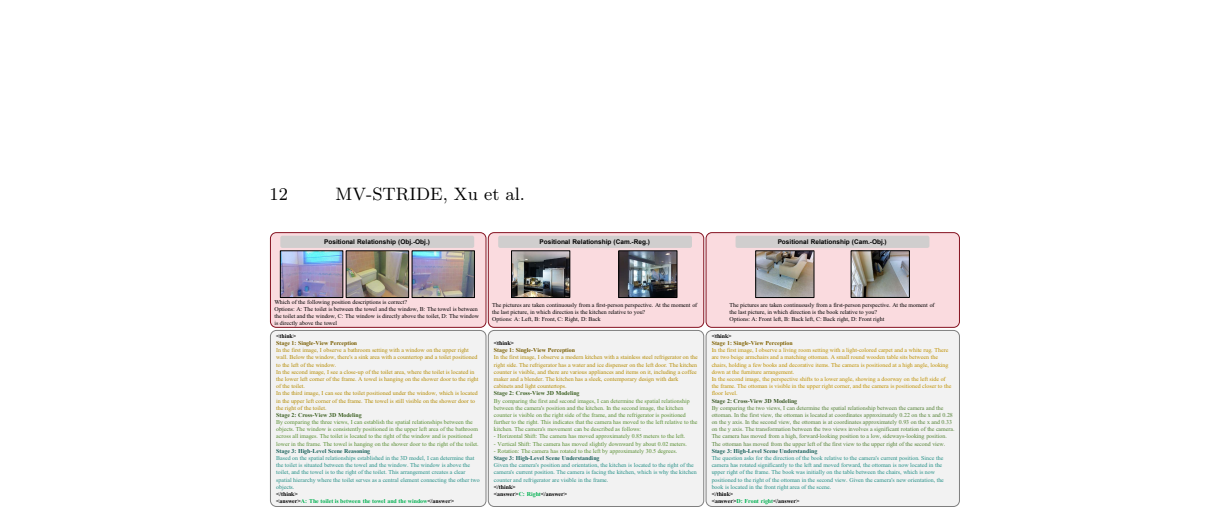
- [54] **Rotation:** Between Figure 1 and Figure 2, the camera underwent a significant rightward rotation of approximately 67.78 degrees. This explains why the couch, which was in the background of Figure 1, now appears on the far left side of Figure 2. Addi- tionally, the camera til... on Pith
- [55] **Translation:** * **Forward/Backward:** In Figure 2, the coffee table and the couch appear larger and the perspective on the floor rug is more "top-down," indicating the camera has moved closer to the center of the room. Quantitatively, the camera moved forward by approximate... on Pith
- [56] **Angular Summation:** In Figure 2, the camera is already rotated 33.59°to the left. From that rotated heading, the door frame is another 35.45°to the left. This suggests that relative to the forward vector of Figure 1, the door frame is at a very wide angle to the left (roughly 69°) on Pith
- [57] **Translational Impact:** The camera moved significantly to the right (2.25m) to reach the position in Figure 2. Despite moving right, the door frame still appears on the left side of the view. This implies the door frame is physically located well to the left of the initial c... on Pith
- [58] **Depth Consideration:** The camera moved backward to Figure 2. Since the door frame is visible in Figure 2 along the same wall structure as the bookshelf (which is in front of the camera in Figure 1), the door frame is located in the forward space relative to the Figure 1 pos... on Pith
- [59] From Figure 2, we see the dark desk (leftmost table) in the foreground and the light desk (containing the speaker) further away. If the speaker is to the "back" of the dark desk, then the "back" direction in this scene points deeper into the room, toward the wall where the wor... on Pith
- [60] In Figure 1, we can see the spatial relationship between the light desk and the picture. The picture is mounted on the wall directly behind and to the right of the monitor and speakers on Pith
- [61] Since the speaker is "back" relative to the dark desk, and the picture is located on the wall that the speaker’s desk is placed against, the picture is also situated in that same "back" direction relative to the dark desk on Pith
- [62] Therefore, relative to the leftmost table, the picture is located in the back. </think> <answer>B: back</answer> 48 MV-STRIDE, Xu et al. System Prompt for CoT Generation Role:You are an expert in 3D Scene Understanding and Multimodal Spatial Reasoning. Unlike standard 2D analy... on Pith
- [63] Simulated Discovery & anchor: Please assume that you have only received the image and the Level III question, and try to generate a multi-stage reasoning process and answer for the question. You can directly follow the thought progression and answers from Level I and II, and p... on Pith
- [64] Image-Text Verification: For most of the time, you can trust the authenticity of all questions and answers, especially the level III answer is definitely correct. But images are the "source of truth." If you find there are inconsistencies, omissions, or errors between the QA c... on Pith
- [65] Logical Connectivity: Explicitly bridge the gap between different levels and different question types in the same level. Explain how the perception in Level I supports the modeling in Level II, and how that modeling enables the final inference in Level III. Output F ormat:You ... on Pith
Cited by 1 Pith paper
Reviewed papers on Pith that cite this one. The full citation record
- DeSpatial: The devil of Agentic Spatial Reasoning Lies in 3D Itself cs.CV · Oct 2026
Challenges and discussion
Disagree with the review, or know something it missed? Leave a comment, or challenge this review formally: a challenge becomes a permanent entry in this paper's record, and its decision is published here.
Come back by email
A short list of the week's newly reviewed papers. Nothing is sent until you confirm from your inbox, and every email has a link that stops it. No account.
No comments yet.
Sign in to comment