Quantum Physics · arXiv:2609.08233 v1 · submitted 8 Sep 2026 · 28 references
Transversal Fanout for Fault Tolerant Distributed Quantum Computing: Analysis and Application
The paper says
“We study a resource-efficient approach for implementing logical fanout operations in fault-tolerant distributed quantum computing using transversal operations on quantum error-correcting code blocks.”
more of the abstract
Logical fanout, comprising multiple controlled-NOT operations from a common control qubit to target qubits located at remote nodes, is an important primitive for distributed quantum computation but can require substantial non-local communication when implemented directly between encoded blocks. We exploit the structure of encoded blocks and the availability of transversal logical operations to construct distributed fanout circuits that reduce the required non-local operations while preserving the logical action of the fanout operation. The construction is developed for encoded quantum information and illustrated using Bivariate Bicycle (BB)-code blocks. We analyze the resulting physical gate, entanglement, circuit-depth, and ancilla requirements. The approach provides a systematic method for implementing large logical fanout operations across distributed error-corrected quantum processors. Also, we study a distributed implementation of the global gate GCZ involving logical qubits (encoded using BB-code blocks), exploiting the concurrency in transversal distributed fanouts.
from the abstract
Pith says
Machine review · deepseek-v4-flash · 9 Sep 2026 · what was read was not recorded · not checked by a person
It can be wrong. Challenge this review or reply to it.
Holds up, with conditions. Paper proposes a transversal fanout for BB-encoded distributed quantum computing; the math is clean but the enabling transversal-CNOT property for the [[36,4,6]] code is imported from [21] without verification, and the LER advantage is modest. This line is wrong
3 major objections · 5 minor
How often objections from reviews like this one are right: not yet measured
Not checked: figures, code, what the 28 references say.
The paper says, at Section III (central decomposition)
The review did not quote this passage.
Pith says: Objection 1 of 3 · major
The entire construction hinges on the claim—imported from reference [21] without proof or explicit verification—that the BB code blocks admit a transversal logical CNOT that acts diagonally on the k logical qubits (i.e., maps logical qubit l of the control block to logical qubit l of each target block).
more of objection 1
No stabilizer calculation, logical-operator transformation table, or independent verification is provided for the [[36,4,6]] code used in the simulations. If the transversal CNOT permutes logical qubits, acts non-trivially on multiple logical qubits, or is unavailable for this specific code, the decomposition in Eq. (1) (and the entire resource saving in Table I) does not follow. The authors must either give a proof for the [[36,4,6]] code or provide a citation that explicitly confirms the diagonal logical action for that code.
This review says the paper's mathematics is wrong. Pith did not check that against the paper's source.
The paper says, at Section IV, Table II and Figures 3–6
The review did not quote this passage.
Pith says: Objection 2 of 3 · major
The simulation treats the 1-shot GHZ generation as a single step with noise model E_GHZ(p_ghz) (independent DEPOLARIZE1 on each GHZ qubit). No physical process or fault-tolerant protocol for generating a distributed GHZ state in one step is described or justified.
more of objection 2
If a realistic generation procedure (e.g., a sequence of non-local CNOTs followed by distillation) were included, the effective noise and resource cost would differ, potentially altering the LER comparisons. The paper should state the assumptions about the GHZ generation and discuss how the one-shot model relates to concrete implementations.
The paper says, at Table I
The review did not quote this passage.
Pith says: Objection 3 of 3 · major
The resource table compares Bell pairs and GHZ states without including the cost of generating the GHZ states. The paper notes this is architecture-dependent. However, the comparison is incomplete: for a fair resource assessment, one should consider that a single m-party GHZ state may require several Bell pairs to produce, so the claimed savings might be offset.
more of objection 3
A brief discussion of GHZ generation overhead (e.g., via a linear number of non-local CNOTs or via single-shot emission) and how it affects the resource balance would strengthen the paper.
5 minor objections
The paper says, at Section II, Figure 2
Pith says: minor objection 1 of 5
The notation 'Dfan-out' appears in the figure caption but is not defined in the text; consider introducing it explicitly.
The paper says, at Section IV
Pith says: minor objection 2 of 5
Typo: 'utlised' should be 'utilized' or 'used'.
show 3 more
The paper says, at Section IV, Table II
Pith says: minor objection 3 of 5
The description of E_GHZ(p_ghz) could be clearer: it applies DEPOLARIZE1 to each GHZ qubit independently. It would help to state whether the same p_ghz is used for GHZ states generated by different methods.
The paper says, at Section V
Pith says: minor objection 4 of 5
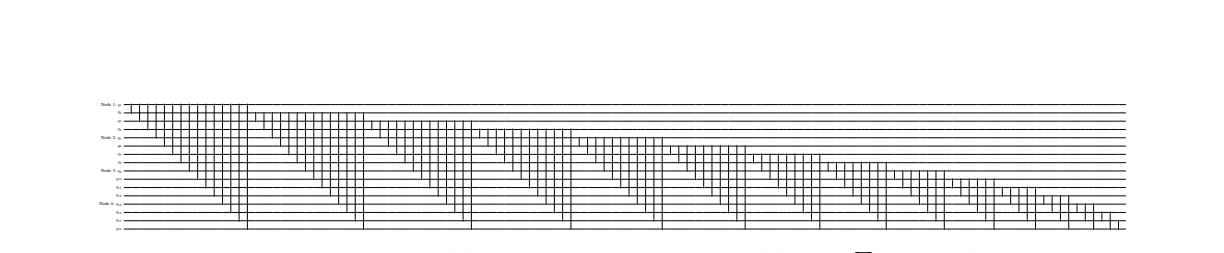
The circuit diagrams (Figures 7–10) are detailed but the notation 'dFANOUT' is used before being fully defined; define it earlier or in the caption.
The paper says, at General
Pith says: minor objection 5 of 5
The manuscript would benefit from a table summarizing the used notation (e.g., physical vs logical fanout, dFANOUT, FANOUT_Z, etc.) to improve readability.
What would settle it
Reproduce the transversal CNOT property for the [[36,4,6]] BB code: obtain the code’s stabilizer generators and logical Pauli operators (e.g., from the parity check matrix of the original BB construction or from [21]). Construct the product of physical CNOTs on all n physical qubit pairs between two code blocks. Compute the transformation of each stabilizer generator and each logical Pauli operator under this transversal CNOT. Verify that all stabilizers map to stabilizers, logical X maps to logical X⊗X, logical Z maps to logical Z⊗I (control) and I⊗Z (target), and that the mapping is diagonal (logical qubit l of control→logical qubit l of target). Publish the stabilizer transformation table. If any logical qubit is permuted or if the operation fails to preserve the code space, the central claim is invalidated.
from the skeptic's reading
How the review went
4 readings by deepseek-v4-flash · 9 Sep 2026
- Reader holds up, with conditions
- Skeptic agrees
- Editor wrote the verdict above
- Referee major revision: 3 major objections, 5 minor
Not run on this paper: the simulated authors' defence.
Pith did not check this review's objections against the paper.
The review in full
The review in brief, machine-written
The paper's core observation—that a logical fanout decomposes into independent physical fanouts per coordinate when the logical CNOT is transversal—is mathematically straightforward and correctly argued. The resource comparison in Table I and the GCZ application are the new contributions, and the simulation shows a modest LER improvement (up to ~2.3×) for the one-shot GHZ fanout. The writing is clear and the paper is well-organized.
The soft spots are real but proportionate. The load-bearing assumption—that the BB codes used ([[36,4,6]]) admit a transversal logical CNOT acting diagonally on logical qubits—is entirely imported from reference [21]. The paper does not include its own stabilizer calculation or logical operator table for this code. If the transversal CNOT does not have the required action, the entire construction breaks. The stress-test note is correct: this is an unvalidated assumption. The reader's weakest_assumption already flags this. It is not a fatal flaw—many papers build on prior transversal-gate results—but it should be stated transparently and ideally verified via a short computation in the appendix.
The simulations are another delimiter. The noise model charges GHZ creation a single-qubit depolarizing step while charging the baseline a two-qubit depolarizing step per non-local CNOT. This is acknowledged but favorable to the GHZ approach. The improvement factor is modest and may be sensitive to model choices. No code or data are released, blocking reproduction.
Overall, this is a solid incremental contribution. The math is correct under its assumptions; the simulations are suggestive but not definitive. The paper deserves peer review because it addresses an active subfield with a clean idea, but it needs a clearer statement of assumptions and ideally a verification step for the [[36,4,6]] transversal CNOT. I would accept a referee assignment on this.
The strongest objection
The paper’s central claim—that a logical fanout among BB-encoded blocks decomposes into independent physical fanouts per coordinate—rests entirely on the assumption, imported from reference [21], that the BB codes admit a transversal logical CNOT acting diagonally on the k logical qubits. This property is neither proved nor stated for the [[36,4,6]] code used in the simulations. If the transversal CNOT does not exist for that code, or if it permutes logical qubits, or if it requires intra-block routing that couples qubits within a block (violating transversality), then the decomposition FANOUT(C; T1,…,Tm) = ∏_i FANOUT(c_i; t_{1i},…,t_{mi}) fails. Consequently, the resource savings in Table I (n(m−1) Bell pairs replaced by n m-party GHZ states) do not follow, and the simulation results in Section IV lose their foundation. The paper provides no stabilizer calculation, no logical-operator transformation table, and no verification that the transversal physical CNOT lifts to the desired logical action for the specific [[36,4,6]] code. Until this property is independently confirmed, the entire construction is conditional on an unvalidated assumption.
The reader’s weakest assumption correctly identifies the reliance on the transversal-CNOT property from reference [21] as the most load-bearing assumption. My stress-test analysis confirms this: every subsequent claim—resource reduction, simulation results, circuit-level distance—depends on this property holding for the [[36,4,6]] code. The paper provides no internal verification, and the property is not universally guaranteed for all BB codes; each code must be checked. The proposed concrete test, an explicit stabilizer computation, would settle whether the assumption holds. Since the reader’s CONDITIONAL verdict already acknowledges this uncertainty, no change in verdict is warranted. The condition can be resolved by the author providing the verification or by an independent check.
The referee's report
If the central construction is correct, the paper offers a resource-efficient primitive for fault-tolerant distributed quantum computing: it reduces the required entanglement from n(m-1) Bell pairs to n m-party GHZ states per logical fanout, and it can execute k logical fanouts concurrently (k being the number of logical qubits per block). The simulation suggests a logical error rate improvement of up to a factor of ~2.3 for the 8-node case at low physical error rates. The application to distributed GCZ gates is a plausible use case. The work is timely given the growing interest in modular quantum architectures.
Pith's reading of the paper (a machine's summary, not the authors')
The paper shows that a logical fanout operation (one control qubit targeting multiple remote qubits) can be implemented transversally when qubits are encoded in Bivariate Bicycle (BB) codes. Because the logical CNOT between BB code blocks is transversal, the fanout decomposes into independent physical fanout operations, one per physical qubit coordinate. This decomposes the resource requirement from n(m-1) Bell pairs to n m‑party GHZ states, substantially reducing non‑local entanglement. Simulations with the [[36,4,6]] BB code show that a one‑shot GHZ implementation of the fanout yields up to about 2.3 times lower logical error rates than an equivalent sequence of non‑local CNOTs at low physical error rates. The same transversal fanout can be used to implement distributed global CZ gates with linear qubit overhead.
What carries the argument. The key identity is the product decomposition of a logical fanout over BB code blocks into independent physical fanouts per coordinate. The load‑bearing step is that logical CNOT between BB blocks is transversal: CNOT(C;T) = ∏_{i=1}^{n} CNOT(c_i; t_i). Because the CNOTs on distinct logical qubit groups commute and because a fanout is a product of CNOTs, the entire logical fanout factorises. This allows all n physical fanout operations to be executed concurrently, each requiring one m‑qubit GHZ state rather than m‑1 Bell pairs.
Core claim. The central discovery is that a logical fanout among BB‑encoded blocks can be expressed as a product of physical fanout operations on each of the n physical qubit coordinates, because the logical CNOT between BB blocks is transversal. This factorization holds for all m target blocks: FANOUT(C; T1,…,Tm) = ∏_{i=1}^{n} FANOUT(c_i; t_{1i}, …, t_{mi}). Consequently, a single code block encoding k logical qubits executes k concurrent logical fanouts using the same physical operations, and the non‑local entanglement cost drops from n(m‑1) Bell pairs (needed for a sequence of pairwise CNOTs) to n m‑party GHZ states.
The premise it rests on. The logical CNOT between BB code blocks is transversal and acts as the identity on the logical qubit space block‑wise, so that a logical fanout decomposes into independent physical fanouts per coordinate; this property is taken from reference [21] and is not proved in the present paper.
If the paper is right (Pith's inferences, not the authors')
Distributed fanout on BB‑encoded qubits requires only n m‑party GHZ states instead of n(m‑1) Bell pairs, reducing the number of non‑local entanglement resources by a factor of (m‑1).
The transversal construction executes k logical fanout operations simultaneously when using [[n,k,d]] BB codes, providing concurrency that a sequential CNOT approach cannot match.
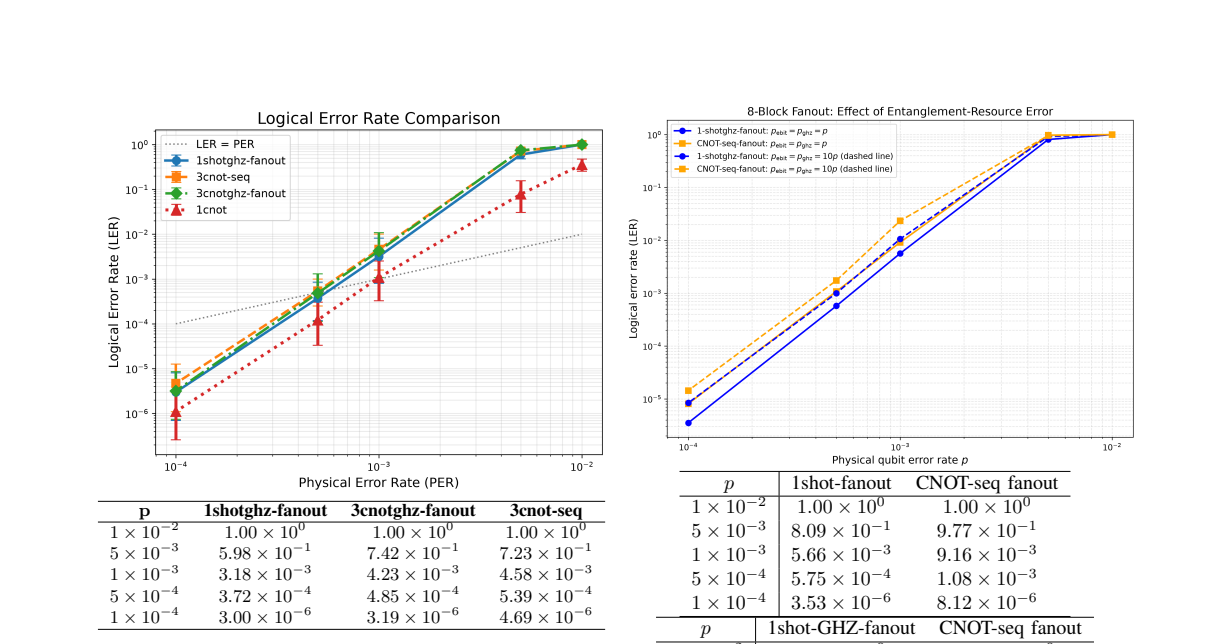
Simulations show that the one‑shot GHZ fanout achieves lower logical error rates than the sequential‑CNOT fanout for physical error rates below 5×10⁻⁴, with improvement factors up to about 2.3 for eight nodes.
The same transversal fanout can be composed to implement distributed global CZ (GCZ) gates on N = km logical qubits with O(N) physical GHZ states, offering a modular building block for fault‑tolerant distributed quantum algorithms.
Circuit‑level distance is preserved: both the sequential‑CNOT and the one‑shot GHZ fanout maintain d_circ = 6 for the [[36,4,6]] code in both 4‑node and 8‑node settings.
The reduction in non‑local operations may shorten qubit wait times and reduce decoherence, though the trade‑off depends on GHZ‑state generation fidelity.
The advantage hinges on the ability to generate m‑party GHZ states with low enough noise; if GHZ generation is substantially more error‑prone than Bell‑pair generation, the crossover point where the GHZ fanout wins could shift to higher physical error rates or vanish altogether.
The transversal fanout construction generalises naturally to any quantum error‑correcting code that admits a transversal logical CNOT (e.g., some versions of the surface code), but the concrete resource savings and circuit depth would differ because block sizes and transversality patterns vary.
The count of GHZ states in Table I excludes the cost of creating those GHZ states; a fair comparison with the Bell‑pair approach must include that overhead. If GHZ creation itself requires several Bell pairs, the claimed resource reduction may be partially offset.
Because the transversal fanout acts on all k logical qubits simultaneously, it may be especially useful in algorithms requiring many concurrent fanouts, such as Shor's factoring or quantum simulation routines that map to GCZ circuits.
Check this review
Pith stored no record of this review's passes and took no fingerprint of it. Reviews made by code from 13 Nov 2026 on carry both.
How often reviews like this one are right
Reviews like this one: written by deepseek-v4-flash, where what was read was not recorded.
How often objections from reviews like this one are right: not yet measured
Reviews by people
This review was written by a machine. No person has reviewed this paper on Pith yet. A scientist listed on Pith can review it for a fee, and their review is published here whatever it concludes.
The paper
Abstract
We study a resource-efficient approach for implementing logical fanout operations in fault-tolerant distributed quantum computing using transversal operations on quantum error-correcting code blocks. Logical fanout, comprising multiple controlled-NOT operations from a common control qubit to target qubits located at remote nodes, is an important primitive for distributed quantum computation but can require substantial non-local communication when implemented directly between encoded blocks. We exploit the structure of encoded blocks and the availability of transversal logical operations to construct distributed fanout circuits that reduce the required non-local operations while preserving the logical action of the fanout operation. The construction is developed for encoded quantum information and illustrated using Bivariate Bicycle (BB)-code blocks. We analyze the resulting physical gate, entanglement, circuit-depth, and ancilla requirements. The approach provides a systematic method for implementing large logical fanout operations across distributed error-corrected quantum processors. Also, we study a distributed implementation of the global gate GCZ involving logical qubits (encoded using BB-code blocks), exploiting the concurrency in transversal distributed fanouts.
The paper's own sentences, arranged, kept beside the review and separate from it. Each label is drawn from a closed vocabulary; the number beside it is the probability the classifier gave that label. No sentence in this record was written by a model.
abstract compiled · 2026-09-23
The authors' main claim, as the classifier picked it out 0.84
“The approach provides a systematic method for implementing large logical fanout operations across distributed error-corrected quantum processors.”
How the main claim is stated: asserted 1.00
What the abstract itself states, as probabilities: claims first 0.04 · states limitation 0.15 · human participants 0.01 · controlled comparison 0.10 · randomized assignment 0.01 · states quantitative result 0.06 · compares with prior results 0.21 · mentions code or data availability 0.02
The abstract, sentence by sentence
This table labels the abstract only (arXiv listing abstract v1). The number is the probability the classifier gave the label.
| Sentence | Role | The authors' own work | States the main conclusion | Strength |
|---|---|---|---|---|
| We study a resource-efficient approach for implementing logical fanout operations in fault-tolerant distributed quantum computing using transversal operations on quantum error-correcting code blocks. | contribution 1.00 | 0.92 | 0.17 | asserted 0.86 |
| Logical fanout, comprising multiple controlled-NOT operations from a common control qubit to target qubits located at remote nodes, is an important primitive for distributed quantum computation but can require substantial non-local communication when implemented directly between encoded blocks. | background 1.00 | 0.07 | 0.04 | asserted 0.81 |
| We exploit the structure of encoded blocks and the availability of transversal logical operations to construct distributed fanout circuits that reduce the required non-local operations while preserving the logical action of the fanout operation. | method 0.73 | 0.94 | 0.42 | asserted 1.00 |
| The construction is developed for encoded quantum information and illustrated using Bivariate Bicycle (BB)-code blocks. | method 0.78 | 0.90 | 0.06 | asserted 1.00 |
| We analyze the resulting physical gate, entanglement, circuit-depth, and ancilla requirements. | contribution 0.62 | 0.94 | 0.07 | asserted 0.94 |
| The approach provides a systematic method for implementing large logical fanout operations across distributed error-corrected quantum processors. | contribution 0.47 | 0.84 | 0.58 | asserted 1.00 |
| Also, we study a distributed implementation of the global gate GCZ involving logical qubits (encoded using BB-code blocks), exploiting the concurrency in transversal distributed fanouts. | contribution 0.99 | 0.94 | 0.12 | asserted 1.00 |
What kind of paper the classifier reports this is: method or tool 1.00 · evidence from proof or derivation 0.94
What was examined, and what was not
Sources read
- arXiv listing abstract v1
Not examined
- full text
- figures and tables
- references and citing sentences
- relations to other papers
Levels run
- P abstract
Not run
- S sections
- T body sentences
- C citations
- R cross-paper relations
How the labels were made
Compiled by classifier-1.13.0 via TypeSafe API, question bank abstract-p1-20260923, 2026-09-23: 1 request, 5,607 input tokens.
Every quoted sentence on this record is the authors'. Every label is from Pith's closed vocabulary, with the probability shown beside it. This record as JSON
Figures (10)





Showing 9 of the paper's 10 figures. Figures are the authors', reproduced from the paper.
References (28)
- [21] John Stack, Ming Wang, and Frank Mueller. Transversal fault tolerant distributed quantum computing operations.Nature Communications, on Pith
- [1] E. M. Ainley, A. Agrawal, D. Main, P. Drmota, D. P. Nadlinger, B. C. Nichol, R. Srinivas, and G. Araneda. Multipartite Entanglement for Multi-node Quantum Networks. Jul 2024. arXiv:2408.00149 [quant- ph] on PithPith's reviewarXiv
- [2] David Barral, F. Javier Cardama, Guillermo D ´ıaz-Camacho, Daniel Fa´ılde, Iago F. Llovo, Mariamo Mussa-Juane, Jorge V´azquez-P´erez, Juan Villasuso, C´esar Pi ˜neiro, Natalia Costas, Juan C. Pichel, Tom ´as F. Pena, and Andr ´es G ´omez. Review of distributed quantum computin... on Pith
- [3] Marcello Caleffi, Michele Amoretti, Davide Ferrari, Jessica Illiano, Antonio Manzalini, and Angela Sara Cacciapuoti. Distributed quantum computing: A survey.Computer Networks, 254:110672, 2024 on Pith
- [4] Nitish Kumar Chandra, Reza Nejabati, and Eneet Kaur. Towards the Characterization of Logical Errors in Distributed Lattice Surgery. In2026 IEEE International Conference on Quantum Computing and Engineering, 7 2026 on Pith
- [5] Ang et al. Arquin: Architectures for multinode superconducting quantum computers.ACM Transactions on Quantum Computing, 5(3), September 2024 on Pith
- [6] Stephen A. Fenner and Rabins Wosti. Implementing the quantum fanout operation with simple pairwise interactions.Quantum Inf. Comput., 23(13&14):1081–1090, 2023 on Pith
- [7] Craig Gidney. Stim: a fast stabilizer circuit simulator.Quantum, 5:497, July 2021 on Pith
- [8] D. Gottesman.Surviving as a Quantum Computer in a Classical World on Pith
- [9] Peter Høyer and Robert Spalek. Quantum fan-out is powerful.Theory Comput., 1(1):81–103, 2005 on Pith
- [10] Photonic Inc. Distributed Quantum Computing in Silicon.arXiv e-prints, page arXiv:2406.01704, June 2024 on PithPith's reviewarXiv
- [11] Johannes Kn ¨orzer, Xiaoyu Liu, Benjamin F. Schaffer, and Jordi Tura. Distributed Quantum Information Processing: A Review of Recent Progress. 10 2025. arXiv:2510.15630 [quant-ph] on PitharXiv
- [12] Seng W. Loke. Distributed quantum computing with fan-out operations and qudits: the case of distributed global gates. In2026 International Conference on Quantum Communications, Networking, and Computing (QCNC), pages 134–141, 2026 on Pith
- [13] Seng W. Loke. On distributed quantum computing with distributed fan- out operations. In2026 IEEE International Conference on Quantum Software (QSW), pages 1–6, 2026 on Pith
- [14] S.W. Loke.From Distributed Quantum Computing to Quantum Internet Computing: An Introduction. Wiley, 2023 on Pith
- [15] D. Main, P. Drmota, D. P. Nadlinger, E. M. Ainley, A. Agrawal, B. C. Nichol, R. Srinivas, G. Araneda, and D. M. Lucas. Distributed quantum computing across an optical network link.Nature, 638(8050):383–388, 2025 on Pith
- [16] Frederik K. Marqversen, Gefen Baranes, Maxim Sirotin, and Johannes Borregaard. Fault-tolerant interfaces for modular quantum computing on diverse qubit platforms.Phys. Rev. Res., 8:023097, Apr 2026 on Pith
- [17] Dmitri Maslov and Yunseong Nam. Use of global interactions in efficient quantum circuit constructions.New Journal of Physics, 20(3):033018, Mar 2018 on Pith
- [18] Siddhant Singh, Fenglei Gu, S ´ebastian de Bone, Eduardo Villase ˜nor, David Elkouss, and Johannes Borregaard. Modular architectures and entanglement schemes for error-corrected distributed quantum compu- tation.npj Quantum Information, 11(1):146, 2025 on Pith
- [19] Siddhant Singh, Rikiya Kashiwagi, Kazufumi Tanji, Wojciech Roga, Daniel Bhatti, Masahiro Takeoka, and David Elkouss. Fault-tolerant modular quantum computing with surface codes using single-shot emission-based hardware.Phys. Rev. Appl., 26:024005, Aug 2026 on Pith
show 8 more
- [20] Anders Sørensen and Klaus Mølmer. Quantum computation with ions in thermal motion.Phys. Rev. Lett., 82:1971–1974, Mar 1999 on Pith
- [22] Evan Sutcliffe, Bhargavi Jonnadula, Claire Le Gall, Alexandra E. Moylett, and Coral M. Westoby. Distributed quantum error correction based on hyperbolic floquet codes. In2025 IEEE International Confer- ence on Quantum Computing and Engineering (QCE), pages 649–657. IEEE, 2025 on Pith
- [23] Published online: 20 July 2026 on Pith
- [24] Shufeng Xu, Ya-Li Mao, Lixin Feng, Hu Chen, Bixiang Guo, Shiting Liu, Zheng-Da Li, and Jingyun Fan. Multiqubit quantum logical gates between distant quantum modules in a network.Phys. Rev. A, 107:L060601, Jun 2023 on Pith
- [25] John van de Wetering. Constructing quantum circuits with global gates. New Journal of Physics, 23(4):043015, Apr 2021 on Pith
- [26] Theodore J. Yoder, Eddie Schoute, Patrick Rall, Emily Pritchett, Jay M. Gambetta, Andrew W. Cross, Malcolm Carroll, and Michael E. Bever- land. Tour de gross: A modular quantum computer based on bivariate bicycle codes, 2025. Fig. 9: Partial distributed implementation of the 5... on Pith
- [27] Anocha Yimsiriwattana and Samuel J. Lomonaco. Generalized GHZ States and Distributed Quantum Computing. Mar 2004. arXiv:quant- ph/0402148 [quant-ph] on PitharXiv
- [2026] https://www.cs.umd.edu/ dgottesm/QECCbook-2026.pdf on Pith
Cited by 2 Pith papers
Reviewed papers on Pith that cite this one. The full citation record
Challenges and discussion
Disagree with the review, or know something it missed? Leave a comment, or challenge this review formally: a challenge becomes a permanent entry in this paper's record, and its decision is published here.
Come back by email
A short list of the week's newly reviewed papers. Nothing is sent until you confirm from your inbox, and every email has a link that stops it. No account.
No comments yet.
Sign in to comment