Quantum Physics · arXiv:2610.22966 v1 · submitted 16 Oct 2026 · 32 references
Encodings and Node Architecture: Lessons from the Fault-Tolerant Distributed Transversal Fanout
The paper says
“An encoding choice specifies the quantum error-correcting code used to encode logical qubits at a given node.”
more of the abstract
Different encoding choices may differ in the number of physical qubits, the number of encoded logical qubits, the code distance, and the available fault-tolerant operations. We study different encodings for a distributed transversal fanout operation and look at its implications on node architecture. Our experiments suggest that an encoding with higher distance, even if requiring more ebits, can yield a lower logical error rate for distributed operations, and that “upgrading” an encoding prior to distributed operations and having a cache, as part of node architecture, for qubits can be useful for distributed operations.
from the abstract
Pith says
Machine review · deepseek-v4-flash · 19 Oct 2026 · what was read was not recorded · not checked by a person
It can be wrong. Challenge this review or reply to it.
Holds up, with conditions. Clean simulation of three BB codes for distributed fanout, but the central compensation claim rests on a single noise ratio (10x) that is never varied. This line is wrong
2 major objections · 5 minor
How often objections from reviews like this one are right: not yet measured
Not checked: figures, code, what the 32 references say.
The paper says, at Section IV, Figures 4–6, Tables II–IV
The review did not quote this passage.
Pith says: Objection 1 of 2 · major
The central comparative result—that higher distance compensates for increased ebit consumption to yield LER < PER and match local performance—is supported only at a single noise ratio: p_ebit = p_ghz = 10p. This ratio is introduced without justification, and no sensitivity analysis is performed over different multiplicative factors (e.g., 2x, 5x, 20x).
more of objection 1
Since the trade-off between code distance and entanglement noise is likely to depend strongly on this ratio, the generality of the conclusion is unconstrained. The paper acknowledges (sentence [b59]) that high network error rates reduce fault tolerance, but never quantifies the threshold at which the compensation breaks. Without varying the ratio, the architectural proposals in Section V rest on an untested assumption. A systematic exploration of the ratio space (or a theoretical bound) is needed to support the central claim.
The paper says, at Section V, architectural discussion
The review did not quote this passage.
A classifier read this sentence of the paper as acknowledging the concern (probability 0.95):
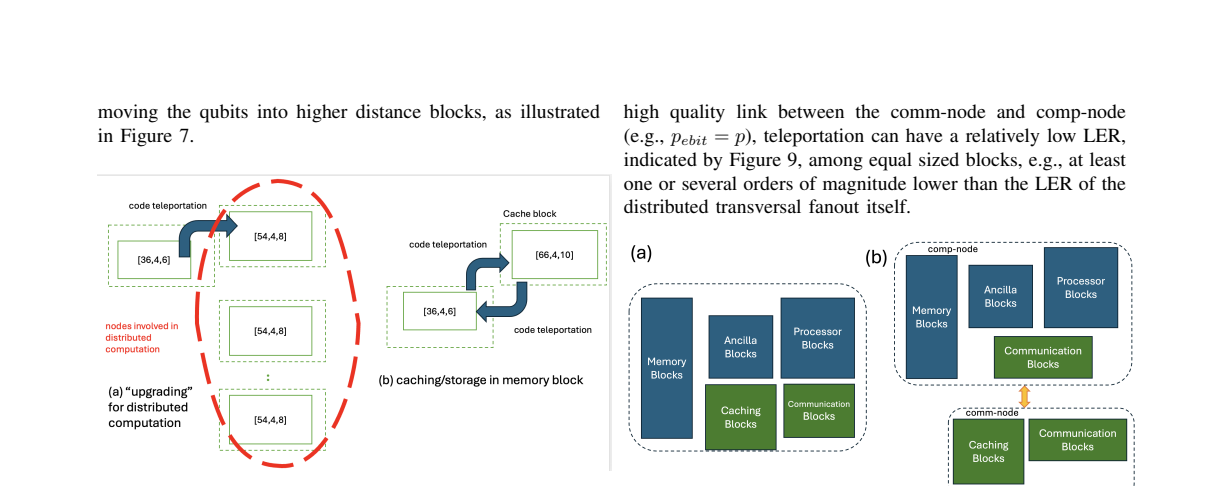
“However, ad- ditional resources such as fault-tolerant operations are required for the “upgrading” (or for “downgrading” later if required), so that a further cost-benefit analysis is required.”
Pith says: Objection 2 of 2 · major
The proposal to "upgrade" encodings prior to distributed operations (Figure 7) is motivated by the simulation results, but the cost of fault-tolerant code switching is not quantified. Sentence [b84] correctly notes that a cost-benefit analysis is required; however, the paper stops short of providing any such analysis.
more of objection 2
As a result, the architectural recommendations remain speculative. While this limitation is acknowledged, the paper would benefit from at least a qualitative discussion of the overheads (e.g., logical Bell pair preparation, additional error correction rounds) that would be incurred by upgrading and caching.
5 minor objections
The paper says, at Abstract / Index Terms
Pith says: minor objection 1 of 5
The index term "tansversal" contains a typo; should be "transversal".
The paper says, at Figure 3 caption
Pith says: minor objection 2 of 5
The caption appears to be cut off or incomplete: it ends with "Fig. 3: Configurations used in our experiments - four nodes:" and then a fragment. Please provide the full caption.
This objection may describe the copy Pith gave the reviewer, not the paper.
show 3 more
The paper says, at Table II header
Pith says: minor objection 3 of 5
The header of Table II repeats "p_ghz = 10p" twice in a way that is confusing. Consider clarifying that the table covers both the 1-shot GHZ and 3-CNOT sequential methods, each with the same noise ratio.
The paper says, at Section IV, sentence about Table II
Pith says: minor objection 4 of 5
The sentence "Table II in the Appendix shows the figures plotted here" is slightly unclear because Table II provides the data for Figure 4, not the figures themselves. Rephrase to "Table II in the Appendix lists the data plotted in Figure 4."
The paper says, at General
Pith says: minor objection 5 of 5
The abbreviation "LER" is defined in the abstract but used throughout; ensure all acronyms are defined at first use in each section (e.g., "PER" is defined only in the caption of Figure 4, but used earlier in the text).
What would settle it
Repeat the main simulations (Figures 4–6, Tables II–IV) for at least two additional ratios: p_ebit = p_ghz = p and p_ebit = p_ghz = 100p, spanning two orders of magnitude. For the 3-CNOT sequential fanout, compute LER for [[18,4,4]], [[36,4,6]], and [[54,4,8]] at each ratio. Plot LER vs PER on the same axes. If [[54,4,8]] no longer achieves LER < PER at the same PER threshold, or if the local-equivalency claim (distributed [[54,4,8]] LER ≈ local [[36,4,6]] LER) fails by more than a factor of 2, then the central claim is sensitive to the ratio and the architectural recommendations should be qualified accordingly.
from the skeptic's reading
How the review went
4 readings by deepseek-v4-flash · 19 Oct 2026
- Reader holds up, with conditions
- Skeptic agrees
- Editor wrote the verdict above
- Referee major revision: 2 major objections, 5 minor
Not run on this paper: the simulated authors' defence.
Pith did not check this review's objections against the paper.
The review in full
The review in brief, machine-written
The paper gives a concrete quantitative comparison missing from [18,20]: three BB codes ([[18,4,4]], [[36,4,6]], [[54,4,8]]) for distributed transversal fanout, showing the highest-distance code overcomes more ebits to match local lower-distance performance. The simulation is honest—TMCBS on stim/sinter, 95% Clopper-Pearson intervals, full raw tables. For a small-scale head-to-head, it's well executed.
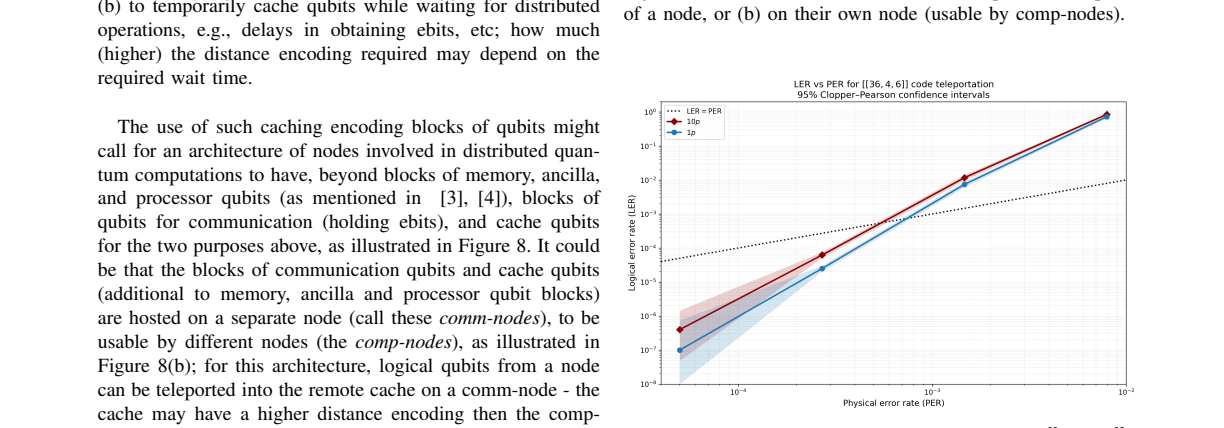
The load-bearing assumption is p_ebit = p_ghz = 10p, fixed across all main comparisons (Figures 4–6). The paper varies p_ebit and p_ghz at discrete values (0, 1e-2, 1e-3) but always with the same 10× multiplier relative to p. The claim that higher distance compensates for more ebits is inherently a claim about noise budgets: if the real ratio were 2× or 100×, the advantage could shrink or reverse. The authors note that high network error rates reduce fault tolerance (sentence [b59]), but never quantify where the compensation breaks. That gap is the main fragility.
The architectural discussion (code upgrades, caching) is speculative; the authors call for more work, which is fine.
This paper is for someone building small distributed nodes who wants a data point on BB code trade-offs. The question is worth asking, and the authors have the tools to address the ratio sensitivity. A referee should demand that sweep before the architectural proposals carry weight.
I'd send it to peer review as a preliminary experimental report, not as a definitive guideline. I'd cite it only if the ratio sweep gets added.
The strongest objection
The central empirical result—that higher-distance encodings ([[54,4,8]]) overcome the cost of more ebits to achieve LER < PER and match local [[36,4,6]] performance—rests on one noise ratio: p_ebit = p_ghz = 10p. This ratio is introduced without justification in Section IV. Figures 4–6 and Tables II–IV all use this ratio for the main comparison. The paper varies p_ebit and p_ghz in Figures 5 and 6, but only by fixing them at discrete values (0, 10^{-2}, 10^{-3}) while keeping the ratio to p variable; it never systematically changes the multiplicative factor. If p_ebit/p = 2 or 100, the [[54,4,8]] advantage might vanish or reverse. The claim that "higher distance compensates for more ebits" is a comparative statement about noise budgets: it holds if the per-ebit noise is not too large relative to gate noise. Without exploring the ratio space, the generality of the conclusion is unconstrained. The architectural proposal to "upgrade" encodings for distributed operations (Section V) hinges on this trade-off being favorable; if it fails for realistic ratios, the proposal loses support. The paper acknowledges that "high network error rates... can reduce the fault tolerance" (sentence [b59]), but never quantifies the threshold where the compensation breaks. This is the load-bearing gap: the central comparative result is supported for one point in the ratio space, and the paper does not demonstrate robustness to variation of that ratio.
The reader flagged the fixed 10x ratio as the weakest assumption. The stress-test examines that assumption in detail and finds it is indeed the most load-bearing concern: the paper's main comparative claims about compensation and local-equivalency depend on the relative magnitude of ebit noise to gate noise. Without systematic variation, the generality of the results is unknown. The paper itself acknowledges the dependence on network noise in sentence [b59] and calls for future work, but the architectural proposals in Section V assume the trade-off is favorable. The proposed concrete test would determine whether the effect is robust to realistic ratio variations. The stress-test finds no other significant concerns: the simulation methodology is standard (stim/sinter), the noise models are clearly described, the error bars are reported, and the code switching proposal is acknowledged as speculative. The author's self-acknowledged limitations about small codes and need for further trade-off analysis are not hidden. The reader's CONDITIONAL verdict is appropriate; a more severe adjustment (REJECT) would be unwarranted because the simulation data are internally consistent and the central claim is supported for the explored regime. The stress-test simply sharpens the condition: require variation of the noise ratio to validate the claim's robustness.
The referee's report
If the central compensation claim holds across realistic noise regimes, the results would provide a practical guideline for node architecture in distributed quantum computing: increasing code distance can offset the cost of entanglement distribution noise, enabling fault-tolerant distributed operations without requiring a monolithic high-qubit machine. The simulations are carefully executed using well-established tools (TMCBS, stim, sinter), full data are tabulated, and 95% Clopper–Pearson confidence intervals are reported, supporting reproducibility. The architectural discussion about upgrading and caching qubits frames a potentially useful design principle.
Pith's reading of the paper (a machine's summary, not the authors')
This paper studies how the choice of quantum error-correcting code affects the logical error rate (LER) of distributed transversal fanout operations. The author simulates three Bivariate-Bicycle (BB) codes of increasing distance—[[18,4,4]], [[36,4,6]], and [[54,4,8]]—on a four-node network performing either a single-shot GHZ-based fanout or a sequential CNOT-based fanout. The central finding is that the highest-distance code ([[54,4,8]]) achieves a lower LER than the lower-distance codes, even though it requires 50% more ebits or GHZ states per operation. At a sufficiently low network noise rate ($p_{\text{ebit}} = 10^{-3}$), this encoding even matches the LER of an entirely local fanout using four [[36,4,6]] blocks on one node. The paper argues that "upgrading" an encoding to a higher distance before a distributed operation, and caching qubits in such a block, could be a useful architectural strategy for distributed quantum computing nodes.
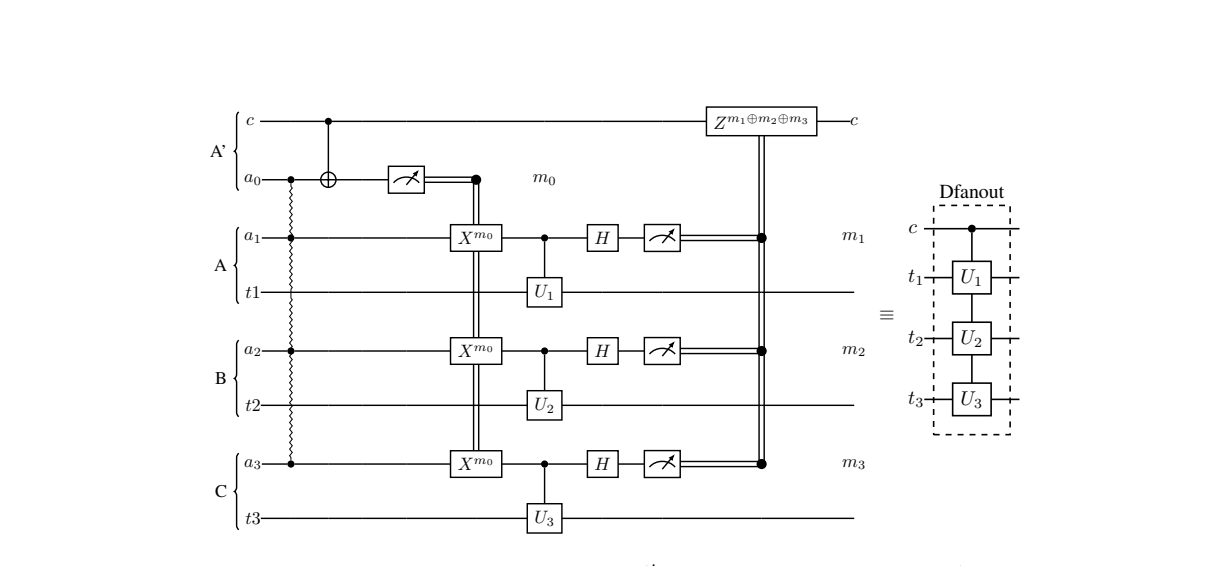
What carries the argument. The key machinery is the transversal implementation of the logical fanout using Bivariate-Bicycle (BB) quantum low-density parity-check codes. In BB codes, a logical CNOT is transversal—it decomposes into independent physical CNOTs on each of the $n$ qubit coordinates. A logical fanout (multiple CNOTs from one control block to multiple target blocks) inherits this transversality, becoming a product of physical fanout operations per coordinate. The non-local connections between nodes are then realized either by a sequence of distributed CNOTs or by a single-shot distributed GHZ state, both of which introduce additional noise modeled at rates $p_{\text{ebit}}$ and $p_{\text{ghz}}$.
Core claim. The paper's core discovery is a quantitative demonstration that, in the context of distributed transversal fanout with BB codes, the overhead of extra physical qubits and additional entanglement (ebits or GHZ states) can be fully compensated by the higher code distance. For the 4-node, 16-logical-qubit configuration tested, the [[54,4,8]] encoding (54 physical qubits per node, distance 8) yields a logical error rate comparable to or lower than the [[36,4,6]] encoding (36 qubits, distance 6), and at $p_{\text{ebit}} = 10^{-3}$ its performance is equivalent to a fully local fanout using four [[36,4,6]] blocks. This equivalence implies that a distributed node with 54 physical qubits can match the error protection of a single larger machine with 144 physical qubits, which is a practical advantage for scaling via modular architectures.
The premise it rests on. The noise model fixes the ratio of entanglement distribution noise to local gate noise at exactly $p_{\text{ebit}} = p_{\text{ghz}} = 10p$ and does not vary this ratio, so the conclusions about when higher distance compensates for extra resources may be sensitive to this specific choice.
If the paper is right (Pith's inferences, not the authors')
Distributed quantum computing nodes could adopt a 'cache block' with a higher-distance encoding to protect logical qubits before they participate in error-prone non-local operations.
For a given target logical error rate, the trade-off between physical qubit count and required entanglement quality can be quantified, helping architects choose encodings based on network properties.
The result suggests that modular quantum computers with many modest-sized nodes (e.g., 54 physical qubits each) can achieve the same logical performance as a larger monolithic device (e.g., 144 qubits) if the code distance is increased.
The simulator used (TMCBS) and the methodology of comparing different BB encodings can be applied to other distributed quantum circuits beyond fanout, such as controlled-adders or multiple-control gates.
The noise model assumption $p_{\text{ebit}} = p_{\text{ghz}} = 10p$ (entanglement noise ten times local gate noise) is critical; if this ratio is different, the relative advantage of higher-distance codes might change.
The concept of 'upgrading' encodings before distributed operations could be extended to dynamic code switching based on real-time network noise conditions.
The equivalence between distributed ([[54,4,8]], 4 nodes) and local ([[36,4,6]], 1 node) suggests a potential resource threshold: once the network noise drops below a certain level, distributed computation becomes as reliable as local computation of the same logical size.
The overhead of code teleportation for upgrading (mentioned but not simulated) will add extra noise; a full cost-benefit analysis would need to compare the LER gain against the teleportation cost.
Check this review
Pith stored no record of this review's passes and took no fingerprint of it. Reviews made by code from 13 Nov 2026 on carry both.
How often reviews like this one are right
Reviews like this one: written by deepseek-v4-flash, where what was read was not recorded.
How often objections from reviews like this one are right: not yet measured
Reviews by people
This review was written by a machine. No person has reviewed this paper on Pith yet. A scientist listed on Pith can review it for a fee, and their review is published here whatever it concludes.
The paper
Abstract
An encoding choice specifies the quantum error-correcting code used to encode logical qubits at a given node. Different encoding choices may differ in the number of physical qubits, the number of encoded logical qubits, the code distance, and the available fault-tolerant operations. We study different encodings for a distributed transversal fanout operation and look at its implications on node architecture. Our experiments suggest that an encoding with higher distance, even if requiring more ebits, can yield a lower logical error rate for distributed operations, and that “upgrading” an encoding prior to distributed operations and having a cache, as part of node architecture, for qubits can be useful for distributed operations.
The paper's own sentences, arranged, kept beside the review and separate from it. Each label is drawn from a closed vocabulary; the number beside it is the probability the classifier gave that label. No sentence in this record was written by a model.
abstract compiled · 2026-10-20
The authors' main claim, as the classifier picked it out 1.00
“Our experiments suggest that an encoding with higher distance, even if requiring more ebits, can yield a lower logical error rate for distributed operations, and that ``upgrading'' an encoding prior to distributed operations and having a cache, as part of node architecture, for qubits can be useful for distributed operations.”
How the main claim is stated: hedged possibility 1.00
What the abstract itself states, as probabilities: claims first 0.03 · states limitation 0.19 · human participants 0.02 · controlled comparison 0.17 · randomized assignment 0.02 · states quantitative result 0.06 · compares with prior results 0.26 · mentions code or data availability 0.02
The abstract, sentence by sentence
This table labels the abstract only (arXiv listing abstract v1). The number is the probability the classifier gave the label.
| Sentence | Role | The authors' own work | States the main conclusion | Strength |
|---|---|---|---|---|
| An encoding choice specifies the quantum error-correcting code used to encode logical qubits at a given node. | background 1.00 | 0.06 | 0.02 | asserted 1.00 |
| Different encoding choices may differ in the number of physical qubits, the number of encoded logical qubits, the code distance, and the available fault-tolerant operations. | background 1.00 | 0.06 | 0.03 | hedged possibility 0.99 |
| We study different encodings for a distributed transversal fanout operation and look at its implications on node architecture. | contribution 1.00 | 0.84 | 0.05 | asserted 0.63 |
| Our experiments suggest that an encoding with higher distance, even if requiring more ebits, can yield a lower logical error rate for distributed operations, and that ``upgrading'' an encoding prior to distributed operations and having a cache, as part of node architecture, for qubits can be useful for distributed operations. | result 0.85 | 0.94 | 0.87 | hedged possibility 1.00 |
What kind of paper the classifier reports this is: empirical study 0.59 · evidence from observation or experiment 0.71
What was examined, and what was not
Sources read
- arXiv listing abstract v1
Not examined
- full text
- figures and tables
- references and citing sentences
- relations to other papers
Levels run
- P abstract
Not run
- S sections
- T body sentences
- C citations
- R cross-paper relations
How the labels were made
Compiled by classifier-1.13.0 via TypeSafe API, question bank abstract-p1-20260923, 2026-10-20: 1 request, 3,653 input tokens.
Every quoted sentence on this record is the authors'. Every label is from Pith's closed vocabulary, with the probability shown beside it. This record as JSON
Figures (9)



Showing 6 of the paper's 9 figures. Figures are the authors', reproduced from the paper.
References (32)
- [1] E. M. Ainley, A. Agrawal, D. Main, P. Drmota, D. P. Nadlinger, B. C. Nichol, R. Srinivas, and G. Araneda. Multipartite Entanglement for Multi-node Quantum Networks. Jul 2024. arXiv:2408.00149 [quant- ph] on PithPith's reviewarXiv
- [2] David Barral, F. Javier Cardama, Guillermo D ´ıaz-Camacho, Daniel Fa´ılde, Iago F. Llovo, Mariamo Mussa-Juane, Jorge V´azquez-P´erez, Juan Villasuso, C´esar Pi ˜neiro, Natalia Costas, Juan C. Pichel, Tom ´as F. Pena, and Andr ´es G ´omez. Review of distributed quantum computin... on Pith
- [3] Todd A. Brun, Yi-Cong Zheng, Kung-Chuan Hsu, Joshua Job, and Ching-Yi Lai. Teleportation-based Fault-tolerant Quantum Computation in Multi-qubit Large Block Codes. 4 2015 on Pith
- [4] Madelyn Cain, Qian Xu, Robbie King, Lewis R. B. Picard, Harry Levine, Manuel Endres, John Preskill, Hsin-Yuan Huang, and Dolev Bluvstein. Shor’s algorithm is possible with as few as 10,000 reconfigurable atomic qubits.arXiv preprint arXiv:2603.28627, 2026 on PithPith's reviewarXiv
- [5] Marcello Caleffi, Michele Amoretti, Davide Ferrari, Jessica Illiano, Antonio Manzalini, and Angela Sara Cacciapuoti. Distributed quantum computing: A survey.Computer Networks, 254:110672, 2024 on Pith
- [6] Nitish Kumar Chandra, Reza Nejabati, and Eneet Kaur. Towards the Characterization of Logical Errors in Distributed Lattice Surgery. In2026 IEEE International Conference on Quantum Computing and Engineering, 7 2026 on Pith
- [7] Byung-Soo Choi. Cost comparison between code teleportation and stabilizer sequence methods for quantum code conversion. In2013 International Conference on ICT Convergence (ICTC), pages 1083– 1087, 2013 on Pith
- [8] Ang et al. Arquin: Architectures for multinode superconducting quantum computers.ACM Transactions on Quantum Computing, 5(3), September 2024 on Pith
- [9] Stephen A. Fenner and Rabins Wosti. Implementing the quantum fanout operation with simple pairwise interactions.Quantum Inf. Comput., 23(13&14):1081–1090, 2023 on Pith
- [10] D. Gottesman.Surviving as a Quantum Computer in a Classical World on Pith
- [11] Sascha Heußen and Janine Hilder. Efficient fault-tolerant code switching via one-way transversal CNOT gates.Quantum, 9:1846, September 2025 on Pith
- [12] Peter Høyer and Robert Spalek. Quantum fan-out is powerful.Theory Comput., 1(1):81–103, 2005 on Pith
- [13] Photonic Inc. Distributed Quantum Computing in Silicon.arXiv e-prints, page arXiv:2406.01704, June 2024 on PithPith's reviewarXiv
- [14] Johannes Kn ¨orzer, Xiaoyu Liu, Benjamin F. Schaffer, and Jordi Tura. Distributed Quantum Information Processing: A Review of Recent Progress. 10 2025. arXiv:2510.15630 [quant-ph] on PitharXiv
- [15] Zijian Liang, Boren Gu, Yu-An Chen, Jens Eisert, and Zongyuan Wang. Ultra-high-distance quantum memories from amplified qldpc codes. arXiv preprint arXiv:2609.37231, 2026 on PithPith's reviewarXiv
- [16] Wen-Qiang Liu and Hai-Rui Wei. Linear optical fan-out gates using fewer ancillary single photons with enhanced success probability.Phys- ical Review Applied, 2026 on Pith
- [17] Seng W. Loke. Distributed quantum computing with fan-out operations and qudits: the case of distributed global gates. In2026 International Conference on Quantum Communications, Networking, and Computing (QCNC), pages 134–141, 2026 on Pith
- [18] Seng W. Loke. Encoding and node choices in transversal fault-tolerant distributed quantum computations: An initial study.arXiv preprint arXiv:2609.37210, sep 2026 on PithPith's reviewarXiv
- [19] Seng W. Loke. On distributed quantum computing with distributed fan- out operations. In2026 IEEE International Conference on Quantum Software (QSW), pages 1–6, 2026 on Pith
- [20] Seng W. Loke. Transversal fanout for fault tolerant distributed quantum computing: Analysis and application.arXiv preprint arXiv:2609.08233, 2026 on PithPith's reviewarXiv
show 12 more
- [21] S.W. Loke.From Distributed Quantum Computing to Quantum Internet Computing: An Introduction. Wiley, 2023 on Pith
- [22] Frederik K. Marqversen, Gefen Baranes, Maxim Sirotin, and Johannes Borregaard. Fault-tolerant interfaces for modular quantum computing on diverse qubit platforms.Phys. Rev. Res., 8:023097, Apr 2026 on Pith
- [23] Siddhant Singh, Fenglei Gu, S ´ebastian de Bone, Eduardo Villase ˜nor, David Elkouss, and Johannes Borregaard. Modular architectures and entanglement schemes for error-corrected distributed quantum compu- tation.npj Quantum Information, 11(1):146, 2025 on Pith
- [24] Siddhant Singh, Rikiya Kashiwagi, Kazufumi Tanji, Wojciech Roga, Daniel Bhatti, Masahiro Takeoka, and David Elkouss. Fault-tolerant modular quantum computing with surface codes using single-shot emission-based hardware.Phys. Rev. Appl., 26:024005, Aug 2026 on Pith
- [25] John Stack, Ming Wang, and Frank Mueller. Transversal fault tolerant distributed quantum computing operations.Nature Communications, 17:8838, 2026 on Pith
- [26] Shinichi Sunami, Yutaka Hirano, Toshihide Hinokuma, and Hayata Yamasaki. Entanglement boosting: Low-volume logical bell pair prepa- ration for distributed fault-tolerant quantum computation.PRX Quantum, 7:033014, Jul 2026 on Pith
- [27] Evan Sutcliffe, Bhargavi Jonnadula, Claire Le Gall, Alexandra E. Moylett, and Coral M. Westoby. Distributed quantum error correction based on hyperbolic floquet codes. In2025 IEEE International Confer- ence on Quantum Computing and Engineering (QCE), pages 649–657. IEEE, 2025 on Pith
- [28] J.-F. Wei, F.-Q. Guo, D.-Y . Wang, Y . Jia, L.-L. Yan, M. Feng, and S.-L. Su. Fast multiqubit rydberg geometric fan-out gates with optimal control technology.Phys. Rev. A, 105:042404, Apr 2022 on Pith
- [29] Shufeng Xu, Ya-Li Mao, Lixin Feng, Hu Chen, Bixiang Guo, Shiting Liu, Zheng-Da Li, and Jingyun Fan. Multiqubit quantum logical gates between distant quantum modules in a network.Phys. Rev. A, 107:L060601, Jun 2023 on Pith
- [30] Anocha Yimsiriwattana and Samuel J. Lomonaco. Generalized GHZ States and Distributed Quantum Computing. Mar 2004. arXiv:quant- ph/0402148 [quant-ph] on Pith
- [31] Theodore J. Yoder, Eddie Schoute, Patrick Rall, Emily Pritchett, Jay M. Gambetta, Andrew W. Cross, Malcolm Carroll, and Michael E. Bever- land. Tour de gross: A modular quantum computer based on bivariate bicycle codes.arXiv preprint arXiv:2506.03094, 2025. APPENDIX TABLE II: ... on PithPith's reviewarXiv
- [2026] https://www.cs.umd.edu/ dgottesm/QECCbook-2026.pdf on Pith
Challenges and discussion
Disagree with the review, or know something it missed? Leave a comment, or challenge this review formally: a challenge becomes a permanent entry in this paper's record, and its decision is published here.
Come back by email
A short list of the week's newly reviewed papers. Nothing is sent until you confirm from your inbox, and every email has a link that stops it. No account.
No comments yet.
Sign in to comment