Quantum Physics · arXiv:2609.37210 v1 · submitted 29 Sep 2026 · 21 references
Encoding and Node Choices in Transversal Fault-Tolerant Distributed Quantum Computations: An Initial Study
The paper says
“We compare and study different Bivariate-Bicycle (BB) encodings and node choices for distributed quantum operations such as transversal non-local CNOTs.”
more of the abstract
We observe that while some encodings have more physical qubits requiring more ebits for a distributed computation, reducing ebit consumption alone might not be the best criterion for selecting an encoding for the logical qubits, if the goal is to reduce the logical error rate of the distributed computation; for example, one should also consider encodings with a larger distance, which using more physical qubits can provide. We consider distributed, or non-local, CNOTs and computation of the global gate (GCZ) over distributed logical qubits as examples. The choice of encoding enables particular concurrent operations; e.g., we show that a transversal physical GCZ on a self-dual [[120,8,12]]BB code can realize eight concurrent logical GCZ operations after accounting for the logical permutation induced by transversal Hadamard.
from the abstract
Pith says
Machine review · deepseek-v4-flash · 30 Sep 2026 · what was read was not recorded · not checked by a person
It can be wrong. Challenge this review or reply to it.
Holds up, with conditions. A genuinely new transversal-GCZ concurrency gadget on the [[120,8,12]] code anchors an honest but single-noise-model empirical study of distributed encoding choice. This line is wrong
3 major objections · 5 minor
How often objections from reviews like this one are right: not yet measured
Not checked: figures, code, what the 21 references say.
The paper says, at Section II, Figures 3 and 7
The review did not quote this passage.
Pith says: Objection 1 of 3 · major
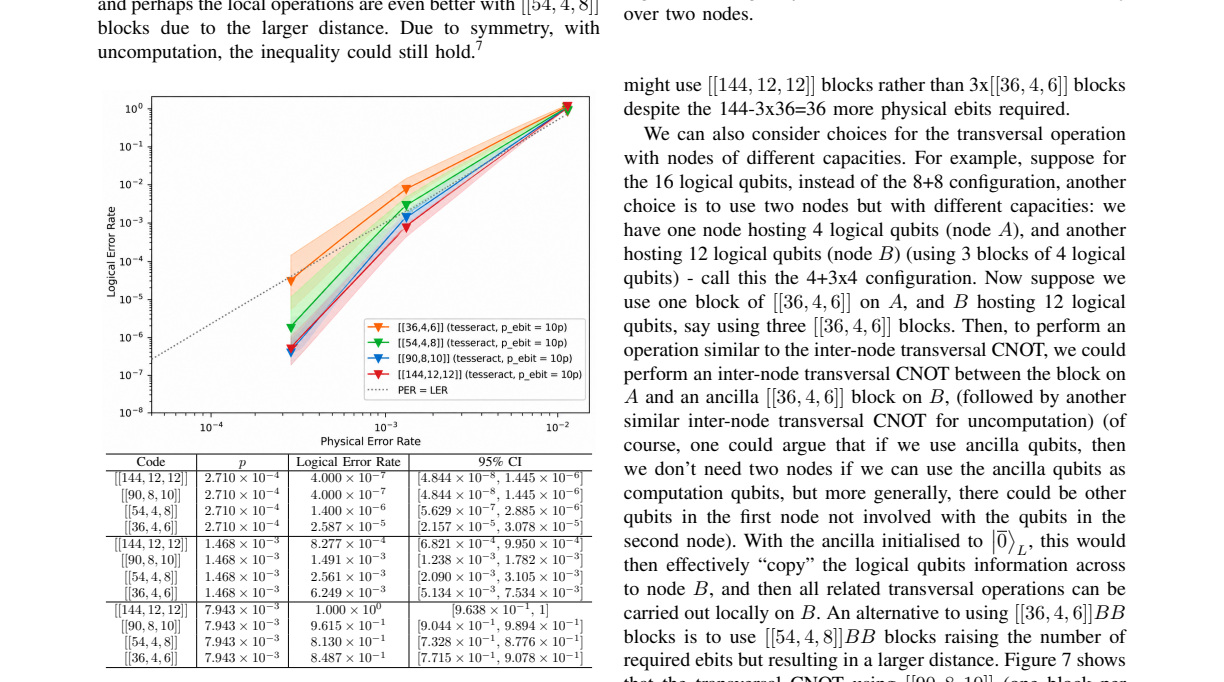
The reported 140x improvement at p=2.71e-4 is not a resolved measurement. In Figure 7 both [[90,8,10]] and [[144,12,12]] report the identical point estimate 4.00e-7 with identical 95% CIs [4.844e-8, 1.445e-6], which is characteristic of a Monte Carlo sampling floor with zero or very few observed logical failures.
more of objection 1
Consequently 5.60e-5/4.00e-7 = 140 is a lower bound on the true ratio rather than a measured value, and at this operating point the data cannot even rank [[90,8,10]] against [[144,12,12]], which weakens the 'higher k d²/n yields a lower LER' correlation claimed in Section II. Please either increase the shot count at p=2.71e-4 to resolve the floor, or quote the headline comparison at a resolved operating point (e.g., p=1.468e-3, where the ratio is about 10x for p_ebit=10p), and label the 140x figure as a lower bound wherever it appears.
The paper says, at Section II, Figures 3 and 7; Section IV
The review did not quote this passage.
Pith says: Objection 2 of 3 · major
The central practical claim — that the distance advantage outweighs the extra ebit cost — is established at only two ebit-error scalings (p_ebit=10p and 50p), and the crossover ratio r* at which the additional ebit error overtakes the distance advantage is never located.
more of objection 2
The margin is strongly erosion-prone: at p=1.468e-3 the [[90,8,10]]-versus-2x[[36,4,6]] ratio falls from about 10x at p_ebit=10p to about 2.7x at p_ebit=50p, and at p=7.943e-3 the ordering nearly vanishes. Because real ebit infidelity is set by entanglement-distillation protocols and memory-coherence time and need not be a small constant multiple of the gate error p, the guidance in Section IV that 'reducing ebits between nodes is not necessarily a dominant factor' would flip if r* falls within realistic budgets. I credit the authors for disclosing the noise model (b45, Figures 3 and 7), but the paper should either sweep p_ebit/p to locate r* — a well-defined simulation task — or explicitly bound the error-budget regime in which the guidance applies.
The paper says, at Section III, equations after Figure 7 and footnote 7
The review did not quote this passage.
Pith says: Objection 3 of 3 · major
The composite estimate for the distributed GCZL16, LER ≈ 6·LER(tCNOT) + LER(localOps) + l_unc (and its doubled form in footnote 7 with uncomputation), supports the inequality LER(GCZL16, 4+4+4+4 [[54,4,8]]) ≤ LER(GCZL16, 4+4+4+4 [[36,4,6]]) only under the asserted condition that LER(localOps [[54,4,8]]) is close to LER(localOps [[36,4,6]]) and that the uncomputation term l_unc is symmetric across encodings.
more of objection 3
Neither LER(localOps) nor l_unc is quantified; the tCNOT difference is modest (about 1.5e-4 at p=2.71e-4 over six tCNOTs versus the ~2.3e-5 difference per tCNOT), so an asymmetric local or uncomputation term comparable to the tCNOT contribution could violate the inequality. The paper acknowledges the symmetry assumption ('Due to symmetry, with uncomputation, the inequality could still hold'), but it should either quantify these terms or state explicitly that the GCZL16 comparison is conditional on a bound for them.
5 minor objections
The paper says, at Footnote 9
Pith says: minor objection 1 of 5
Footnote 9 contains 'There is the the three-monomial construction' with a duplicated article; please fix the typo.
The paper says, at Section I
Pith says: minor objection 2 of 5
Section I contains '(e.g.,assuminga cloud service model' (missing space) and 'different possible encoding choices, 2 etc' (a stray '2'); please clean up these typos.
show 3 more
The paper says, at Overall
Pith says: minor objection 3 of 5
The manuscript gives no data/code availability statement for the simulation runs; since the acknowledgments mention code generation with author verification, a reproducibility statement listing the TMCBS/stim/sinter versions and per-row shot counts would strengthen the empirical claims and is, in fact, needed to interpret the sampling floor discussed in the first major comment.
The paper says, at Section IV, second bullet
Pith says: minor objection 4 of 5
The guidance to 'use [[120,8,12]] instead of [[90,8,10]]' is extended by analogy although the [[120,8,12]] code is never simulated and, being self-dual with a transversal Hadamard, differs structurally from [[90,8,10]]; the existing hedge in Section II ('could achieve a lower LER... which is future work') should be restated inside this bullet as well.
The paper says, at Figure 4 caption
Pith says: minor objection 5 of 5
The caption writes the product over CZLs as a raw 'Q'; it should be typeset as a proper product symbol to avoid ambiguity with a qubit label.
What would settle it
Re-run the Figure 3 comparison ([[90,8,10]] versus 2x[[36,4,6]] inter-node transversal CNOT) in the TMCBS/stim framework at p = 2.71e-4 and p = 1.468e-3, sweeping the ebit-error ratio r = p_ebit/p continuously on a log scale over, say, r in [0, 10^4] (including correlated-ebit-failure runs, not only independent), and record the crossover ratio r* where the LER ordering inverts. Then compare r* against the ebit/PER ratios implied by a concrete entanglement-distribution budget, e.g., the output infidelity of a Bell-pair distillation protocol at the relevant node-to-node distance plus memory-storage-time infidelity for ebits held over the transversal-CNOT circuit.
from the skeptic's reading
How the review went
4 readings by deepseek-v4-flash · 30 Sep 2026
- Reader holds up, with conditions
- Skeptic agrees
- Editor wrote the verdict above
- Referee major revision: 3 major objections, 5 minor
Not run on this paper: the simulated authors' defence.
Pith did not check this review's objections against the paper.
The review in full
The review in brief, machine-written
The one thing to remember about this paper is the GCZ concurrency result on the self-dual [[120,8,12]] BB code. The derivation in Section III (b76-b80) is clean, parameter-free, and absent from the cited literature: a single transversal physical GCZ on that code realizes eight concurrent logical GCZ operations, up to the permutation induced by the transversal Hadamard. That is a genuinely useful gadget for global-gate circuits, and it checks out against the cited Liang–Chen construction. The rest of the paper—LER comparisons across BB encodings for distributed transversal CNOTs—is honest, bounded work that reads like a real initial study rather than a finished one.
What is good: the TMCBS/stim/sinter simulations carry 95% confidence intervals, the 140x figure matches the table (5.60e-5 / 4.00e-7), and the authors flag their own limits repeatedly (b86-b89). Framing the problem as a constrained optimization over (partition, encoding) pairs is sensible and correctly circuit-dependent.
The soft spots are real but I would keep them proportionate. The 'distance over ebits' ordering is established inside a single simulated noise model with two hand-picked ebit-error ratios (10p, 50p); the crossover ratio where extra ebit cost flips the ordering is never located, so transferring the guidance to real hardware assumes those modeled ebit budgets are representative. That is the load-bearing premise, and the stress-test note is right to press it. Second, the headline 140x sits at p=2.71e-4, where the [[90,8,10]] row equals the [[144,12,12]] row exactly (4.00e-7)—a shot-noise floor of roughly zero observed logical failures—so 140x is a lower bound on the true ratio. That directionally helps the claim, but it is not a measured ratio at that operating point. Third, the GCZL16 estimate assumes operation-level independence and asserts equal local-operations LER across encodings without testing it (footnote 6, b70). None of this is hidden; the authors say 'initial study' and 'indicative.' But these are exactly the premises the practical guidance rests on.
Who this is for: people choosing codes and node layouts for modular QEC hardware, and anyone building global-gate gadgets. It deserves a serious referee—the GCZ construction alone justifies that—but the revision should add more circuits, more code points, and a located crossover in ebit-error scaling before the 'distance over ebits' takeaway is treated as general. I would send it to review with a conditional-accept direction.
The strongest objection
The central empirical claim — a distance-10 [[90,8,10]] block per node beats two [[36,4,6]] blocks despite 90 versus 72 ebits, so ebit consumption alone should not drive encoding selection — is an ordering between two simulated LER curves, not an absolute hardware statement. Its load-bearing premise is that the modeled relation between ebit infidelity and physical error (p_ebit = 10p, 50p; independent errors; Figures 3 and 7 and the footnote below Figure 7) spans the regime real distributed nodes occupy. In practice ebit fidelity is set by the entanglement-distribution/distillation protocol and by memory-coherence time while qubits wait across nodes; those budgets can put ebit infidelity well above a fixed small multiple of the gate error p, and need not be linear or independent. The paper tests two isolated ratios and never locates the crossover ratio r* = p_ebit/p at which the extra 18 ebits' error cost overtakes the distance-10 versus distance-6 correction advantage; if r* falls within realistic ebit/PER budgets, the ordering flips and the paper's practical guidance reverses. Two further points. First, the quoted 140x improvement sits at p=2.71e-4 where the [[90,8,10]] row (4.00e-7, CI [4.84e-8, 1.45e-6]) exactly equals the [[144,12,12]] row, consistent with a shot-noise floor of roughly 0-1 observed logical failures; 140x is then a lower bound on the true ratio, which directionally helps the claim but means the headline number is not a measured ratio at that operating point. Second, the GCZL16 estimate in Section III assumes operation-level independence (footnote 6: p approx 6*p_tCNOT + p_localOps) and asserts LER(localOps) equality across encodings (Section III, sentence b70), untested. These limits are honestly disclosed in b85-b89, but they are exactly the premise on which the 'distance over ebits' guidance rests.
The reader's weakest assumption — noise-model representativeness, with the GCZL16 local-operation equivalence as a secondary assumption — matches the concern I would pick, so I agree with the reader and recommend UNCHANGED. I examined the two candidate central claims independently before settling. The algebraic claim (Section III, 'Transversal GCZ'): a transversal physical GCZ on the self-dual [[120,8,12]] realizes eight concurrent logical GCZ operations up to the permutation P_π induced by transversal H. This is a parameter-free derivation: (I⊗H)CNOT(I⊗H) = CZ holds at both physical and logical levels, the 120-fold tensor product reorders freely, and the π-pairing permutations telescope through P_π(A)P_π(B)P_π(C)P_π(D). The required self-duality and transversal H for [[120,8,12]] are cited from published refs [10] and [11], so per review rules this is supported rather than unproved here. I find no sound objection to that part and give it credit. The empirical claim carries the risk. Within its stated scope the ordering is robust — three physical error rates and two ebit scales, with honest 95% confidence intervals. The specific fragilities are: (i) the headline 140x is read off the p=2.71e-4 row where the [[90,8,10]] point estimate equals the [[144,12,12]] row and the confidence intervals indicate a roughly 0-1 observed-error floor, so 140x is a lower bound, favorable to the claim but not a measured ratio; and (ii) more importantly, the paper never locates the crossover at which 18 extra ebits' error cost outweighs the distance gain, so the generalization 'ebit consumption is not the best criterion' is asserted from two hand-chosen ebit ratios against an untested background. That is precisely the premise that would be falsified by realistic ebit-error budgets, and the reader's CONDITIONAL verdict already captures the needed verification step. Hence no verdict change.
The referee's report
The GCZ concurrency derivation (Section III) is a genuine, parameter-free algebraic result: given the transversal-H property (X_{L,2j-1} ↔ Z_{L,2j}, j=1..4) of the self-dual [[120,8,12]] code cited from Liang and Chen [10], the identity H = P_π H_L^{⊗8} with π=(1 2)(3 4)(5 6)(7 8) is internally consistent (H²=I), and the six-fold factorization of the 120-qubit physical GCZ into products of transversal CZ pairs reduces cleanly to eight concurrent logical GCZLs up to the logical permutation P_π(A)P_π(B)P_π(C)P_π(D). I checked the algebra and it is sound. The LER study is also conducted honestly: it uses an external simulation framework ([18]), discloses the noise model (p_ebit=10p and 50p, independent errors), quotes 95% confidence intervals, and is carefully scoped as 'mainly indicative' (b86). If the empirical ordering survives scrutiny, the paper provides a useful counterexample to ebit-minimization heuristics for distributed code selection, with a plausible mechanism (higher k d²/n) that is testable across more code points.
Pith's reading of the paper (a machine's summary, not the authors')
This paper studies how to choose a quantum error-correcting code block and a node layout for distributed, fault-tolerant operations such as a transversal non-local CNOT and a global CZ (GCZ) gate. Its central claim is that the number of entanglement bits (ebits) consumed is not the right selection criterion by itself: in the simulated cases, using a larger, higher-distance encoding gives a lower logical error rate than using more numerous smaller blocks, even though the larger block costs more ebits. Concretely, two [[90,8,10]] blocks beat the 2×[[36,4,6]] configuration by roughly a factor of 140 at physical error rate $p = 2.71\times10^{-4}$ with ebit error $p_{\mathrm{ebit}} = 10p$, despite consuming 90 versus 72 ebits. The paper also shows algebraically that a transversal physical GCZ on the self-dual [[120,8,12]] code realizes eight concurrent logical GCZ operations, up to a logical permutation, so that the code choice itself enables a particular kind of parallel distributed computation.
What carries the argument. The argument runs on transversal gate gadgets for BB codes. A non-local transversal CNOT between two blocks applies physical CNOTs on all $n$ corresponding qubit pairs, costing $n$ physical ebits, and this is where the paper's efficiency metric $kd^2/n$ enters: larger-distance codes have higher $kd^2/n$ and lower logical error rates per Figure 7 even when they cost more ebits. The second mechanism is the self-dual [[120,8,12]] code with a transversal Hadamard that acts not as the logical transversal Hadamard $H^{\otimes 8}_L$ but as $P_\pi H^{\otimes 8}_L$ with $\pi = (1\,2)(3\,4)(5\,6)(7\,8)$; sandwiching the physical transversal CNOT with $I\otimes H$ gives $\bigotimes_{i=1}^{120} CZ$, and from this the paper derives that a transversal physical GCZ over four [[120,8,12]] blocks equals the tensor product of eight logical GCZ operations, up to the logical permutation $P'_\pi = P_\pi(B)P_\pi(C)P_\pi(D)$.
Core claim. The paper's central discovery is that for the distributed transversal CNOTs studied, reducing ebit consumption is not the dominant factor in lowering logical error rate: a higher-efficiency encoding ($kd^2/n$) with larger distance can win despite more ebits. In the numerical study, the one-block-per-node [[90,8,10]] configuration delivers a logical error rate about 140 times lower than the two-[[36,4,6]]-blocks-per-node configuration at $p = 2.71\times10^{-4}$ with $p_{\mathrm{ebit}} = 10p$, and still wins at $p_{\mathrm{ebit}} = 50p$. The same ordering holds in Figure 7 across [[144,12,12]], [[90,8,10]], [[54,4,8]], and [[36,4,6]] blocks in the low-error regime. A separate algebraic claim is that a transversal physical GCZ on the self-dual [[120,8,12]] BB code, whose transversal Hadamard acts as a logical permutation $\pi = (1\,2)(3\,4)(5\,6)(7\,8)$, evaluates to eight concurrent logical GCZ operations up to that permutation, so the encoding choice determines which concurrent logical operations are available.
The premise it rests on. The load-bearing premise is that the single simulation noise model — independent physical errors at rate $p$ and ebit errors at $10p$ or $50p$, with product-form failure rates from the TMCBS simulator — is representative enough that the ordering of logical error rates between encodings transfers to real distributed hardware, along with the further assumption that local-operation logical error rates are similar across encodings.
If the paper is right (Pith's inferences, not the authors')
For transversal-CNOT circuits, choosing the encoding by ebit count alone can be actively wrong; the combined metric $kd^2/n$ and the circuit's actual logical error rate should be the target.
Larger single blocks enable coarser operations with more concurrency ($k$ logical CNOTs at once), which helps global-gate circuits but may hurt sparse circuits where only parts of one node interact with parts of another.
The 8+8 configuration appears to beat the 4+12 configuration in logical error rate, and by extension the paper hypothesizes that 12+12 beats 8+16.
For a GCZL16 circuit over four nodes, six inter-node transversal CNOTs suffice, and the [[54,4,8]] configuration gives a logical error rate no worse than [[36,4,6]] despite 108 more ebits.
Because the outcome depends on the circuit structure and available nodes, the paper frames encoding and node choice as a constrained optimization problem minimizing the circuit's logical error rate.
If the ordering holds beyond the simulated gadget, a distributed compiler that reduces ebit count at the cost of code distance may be trading correctness for entanglement, and an LER-aware scheduler co-selecting block decomposition and node assignment would be the natural next step.
The [[120,8,12]] transversal-GCZ identity could be used directly: a single global-gate round implements eight independent logical GCZ operations, which should cut circuit depth for computations whose structure matches this concurrency.
A testable extension is to benchmark the same two configurations against a surface-code distributed teleportation baseline to see whether the BB-code advantage is specific to the transversal-CNOT gadget or holds generically across teleportation-based entanglement.
The paper's own caveat that only BB codes with transversal operations were studied suggests the distance-over-ebits conclusion should be re-examined for codes without transversal Clifford structure, such as surface codes, where the local-operation cost may dominate.
Check this review
Pith stored no record of this review's passes and took no fingerprint of it. Reviews made by code from 13 Nov 2026 on carry both.
How often reviews like this one are right
Reviews like this one: written by deepseek-v4-flash, where what was read was not recorded.
How often objections from reviews like this one are right: not yet measured
Reviews by people
This review was written by a machine. No person has reviewed this paper on Pith yet. A scientist listed on Pith can review it for a fee, and their review is published here whatever it concludes.
The paper
Abstract
We compare and study different Bivariate-Bicycle (BB) encodings and node choices for distributed quantum operations such as transversal non-local CNOTs. We observe that while some encodings have more physical qubits requiring more ebits for a distributed computation, reducing ebit consumption alone might not be the best criterion for selecting an encoding for the logical qubits, if the goal is to reduce the logical error rate of the distributed computation; for example, one should also consider encodings with a larger distance, which using more physical qubits can provide. We consider distributed, or non-local, CNOTs and computation of the global gate (GCZ) over distributed logical qubits as examples. The choice of encoding enables particular concurrent operations; e.g., we show that a transversal physical GCZ on a self-dual [[120,8,12]]BB code can realize eight concurrent logical GCZ operations after accounting for the logical permutation induced by transversal Hadamard.
The paper's own sentences, arranged, kept beside the review and separate from it. Each label is drawn from a closed vocabulary; the number beside it is the probability the classifier gave that label. No sentence in this record was written by a model.
abstract compiled · 2026-09-30
The authors' main claim, as the classifier picked it out 1.00
“We observe that while some encodings have more physical qubits requiring more ebits for a distributed computation, reducing ebit consumption alone might not be the best criterion for selecting an encoding for the logical qubits, if the goal is to reduce the logical error rate of the distributed computation; for example, one should also consider encodings with a larger distance, which using more physical qubits can provide.”
How the main claim is stated: hedged possibility 0.47
What the abstract itself states, as probabilities: claims first 0.09 · states limitation 0.59 · human participants 0.02 · controlled comparison 0.13 · randomized assignment 0.01 · states quantitative result 0.92 · compares with prior results 0.52 · mentions code or data availability 0.02
The abstract, sentence by sentence
This table labels the abstract only (arXiv listing abstract v1). The number is the probability the classifier gave the label.
| Sentence | Role | The authors' own work | States the main conclusion | Strength |
|---|---|---|---|---|
| We compare and study different Bivariate-Bicycle (BB) encodings and node choices for distributed quantum operations such as transversal non-local CNOTs. | contribution 1.00 | 0.91 | 0.07 | asserted 0.83 |
| We observe that while some encodings have more physical qubits requiring more ebits for a distributed computation, reducing ebit consumption alone might not be the best criterion for selecting an encoding for the logical qubits, if the goal is to reduce the logical error rate of the distributed computation; for example, one should also consider encodings with a larger distance, which using more physical qubits can provide. | interpretation 0.63 | 0.83 | 0.70 | hedged possibility 0.47 |
| We consider distributed, or non-local, CNOTs and computation of the global gate (GCZ) over distributed logical qubits as examples. | contribution 0.60 | 0.42 | 0.04 | asserted 0.86 |
| The choice of encoding enables particular concurrent operations; e.g., we show that a transversal physical GCZ on a self-dual $[[120,8,12]] BB$ code can realize eight concurrent logical GCZ operations after accounting for the logical permutation induced by transversal Hadamard. | result 0.98 | 0.91 | 0.15 | asserted 1.00 |
What kind of paper the classifier reports this is: theoretical result 0.46 · evidence from proof or derivation 0.58
What was examined, and what was not
Sources read
- arXiv listing abstract v1
Not examined
- full text
- figures and tables
- references and citing sentences
- relations to other papers
Levels run
- P abstract
Not run
- S sections
- T body sentences
- C citations
- R cross-paper relations
How the labels were made
Compiled by classifier-1.13.0 via TypeSafe API, question bank abstract-p1-20260923, 2026-09-30: 1 request, 3,811 input tokens.
Every quoted sentence on this record is the authors'. Every label is from Pith's closed vocabulary, with the probability shown beside it. This record as JSON
Figures (9)




Figures are the authors', reproduced from the paper.
References (21)
- [18] John Stack, Ming Wang, and Frank Mueller. Transversal fault tolerant distributed quantum computing operations.Nature Communications, 17:8838, 2026 on Pith
- [10] Z. Liang and Y . A. Chen. Self-dual bivariate bicycle codes with transversal clifford gates.npj Quantum Information, 2026. https://doi.org/10.1038/s41534-026-01303-1 on Pithdoi:10.1038/s41534-026-01303-1
- [1] David Barral, F. Javier Cardama, Guillermo D ´ıaz-Camacho, Daniel Fa´ılde, Iago F. Llovo, Mariamo Mussa-Juane, Jorge V´azquez-P´erez, Juan Villasuso, C´esar Pi ˜neiro, Natalia Costas, Juan C. Pichel, Tom ´as F. Pena, and Andr ´es G ´omez. Review of distributed quantum computin... on Pith
- [2] Marcello Caleffi, Michele Amoretti, Davide Ferrari, Jessica Illiano, Antonio Manzalini, and Angela Sara Cacciapuoti. Distributed quantum computing: A survey.Computer Networks, 254:110672, 2024 on Pith
- [3] Nitish Kumar Chandra, Eneet Kaur, and Kaushik P. Seshadreesan. Architectural approaches to fault-tolerant distributed quantum computing and their entanglement overheads. In2025 IEEE 7th International Conference on Trust, Privacy and Security in Intelligent Systems, and Applica... on Pith
- [4] Nitish Kumar Chandra, Reza Nejabati, and Eneet Kaur. Towards the Characterization of Logical Errors in Distributed Lattice Surgery. In2026 IEEE International Conference on Quantum Computing and Engineering, 7 2026 on Pith
- [5] J. Eisert, K. Jacobs, P. Papadopoulos, and M. B. Plenio. Optimal local implementation of nonlocal quantum gates.Phys. Rev. A, 62:052317, Oct 2000 on Pith
- [6] Ang et al. Arquin: Architectures for multinode superconducting quantum computers.ACM Transactions on Quantum Computing, 5(3), September 2024 on Pith
- [7] Austin G. Fowler, David S. Wang, Charles D. Hill, Thaddeus D. Ladd, Rodney Van Meter, and Lloyd C. L. Hollenberg. Surface code quantum communication.Phys. Rev. Lett., 104:180503, May 2010 on Pith
- [8] Photonic Inc. Distributed Quantum Computing in Silicon.arXiv e-prints, page arXiv:2406.01704, June 2024 on PithPith's reviewarXiv
- [9] Johannes Kn ¨orzer, Xiaoyu Liu, Benjamin F. Schaffer, and Jordi Tura. Distributed Quantum Information Processing: A Review of Recent Progress. 10 2025. arXiv:2510.15630 [quant-ph] on PitharXiv
- [11] Zijian Liang, Ke Liu, Hao Song, and Yu-An Chen. Generalized toric codes on twisted tori for quantum error correction.PRX Quantum, 6:020357, Jun 2025 on Pith
- [12] Seng W. Loke. Transversal fanout for fault tolerant distributed quantum computing: Analysis and application.arXiv preprint arXiv:2609.08233, 2026 on PithPith's reviewarXiv
- [13] Frederik K. Marqversen, Gefen Baranes, Maxim Sirotin, and Johannes Borregaard. Fault-tolerant interfaces for modular quantum computing on diverse qubit platforms.Phys. Rev. Res., 8:023097, Apr 2026 on Pith
- [14] Dmitri Maslov and Yunseong Nam. Use of global interactions in efficient quantum circuit constructions.New Journal of Physics, 20(3):033018, Mar 2018 on Pith
- [15] Ivan Pogorelov, Friederike Butt, Lukas Postler, Christian D. Marciniak, Philipp Schindler, Markus M ¨uller, and Thomas Monz. Experimental fault-tolerant code switching.Nature Physics, 21:298–303, 2025 on Pith
- [16] Mathys Rennela. Design rules for fault-tolerant multi-gate teleportation. arXiv preprint arXiv:2607.01342, 2026 on PithPith's reviewarXiv
- [17] Siddhant Singh, Fenglei Gu, S ´ebastian de Bone, Eduardo Villase ˜nor, David Elkouss, and Johannes Borregaard. Modular architectures and entanglement schemes for error-corrected distributed quantum compu- tation.npj Quantum Information, 11(1):146, 2025 on Pith
- [19] Evan Sutcliffe, Bhargavi Jonnadula, Claire Le Gall, Alexandra E. Moylett, and Coral M. Westoby. Distributed quantum error correction based on hyperbolic floquet codes. In2025 IEEE International Confer- ence on Quantum Computing and Engineering (QCE), pages 649–657. IEEE, 2025 on Pith
- [20] John van de Wetering. Constructing quantum circuits with global gates. New Journal of Physics, 23(4):043015, Apr 2021 on Pith
show 1 more
- [21] Theodore J. Yoder, Eddie Schoute, Patrick Rall, Emily Pritchett, Jay M. Gambetta, Andrew W. Cross, Malcolm Carroll, and Michael E. Bever- land. Tour de gross: A modular quantum computer based on bivariate bicycle codes.arXiv preprint arXiv:2506.03094, 2025. APPENDIXA The opera... on PithPith's reviewarXiv
Cited by 1 Pith paper
Reviewed papers on Pith that cite this one. The full citation record
Challenges and discussion
Disagree with the review, or know something it missed? Leave a comment, or challenge this review formally: a challenge becomes a permanent entry in this paper's record, and its decision is published here.
Come back by email
A short list of the week's newly reviewed papers. Nothing is sent until you confirm from your inbox, and every email has a link that stops it. No account.
No comments yet.
Sign in to comment