Computation and Language · arXiv:2609.35748 v1 · submitted 28 Sep 2026 · 123 references
Improving Test-Time Scaling with Adaptive Looped Transformers
The paper says
“Looped transformers have demonstrated promising parameter efficiency by reusing layers for latent computation. Prior studies compare looped and non-looped models at matched parameters or per-token FLOPs.”
more of the abstract
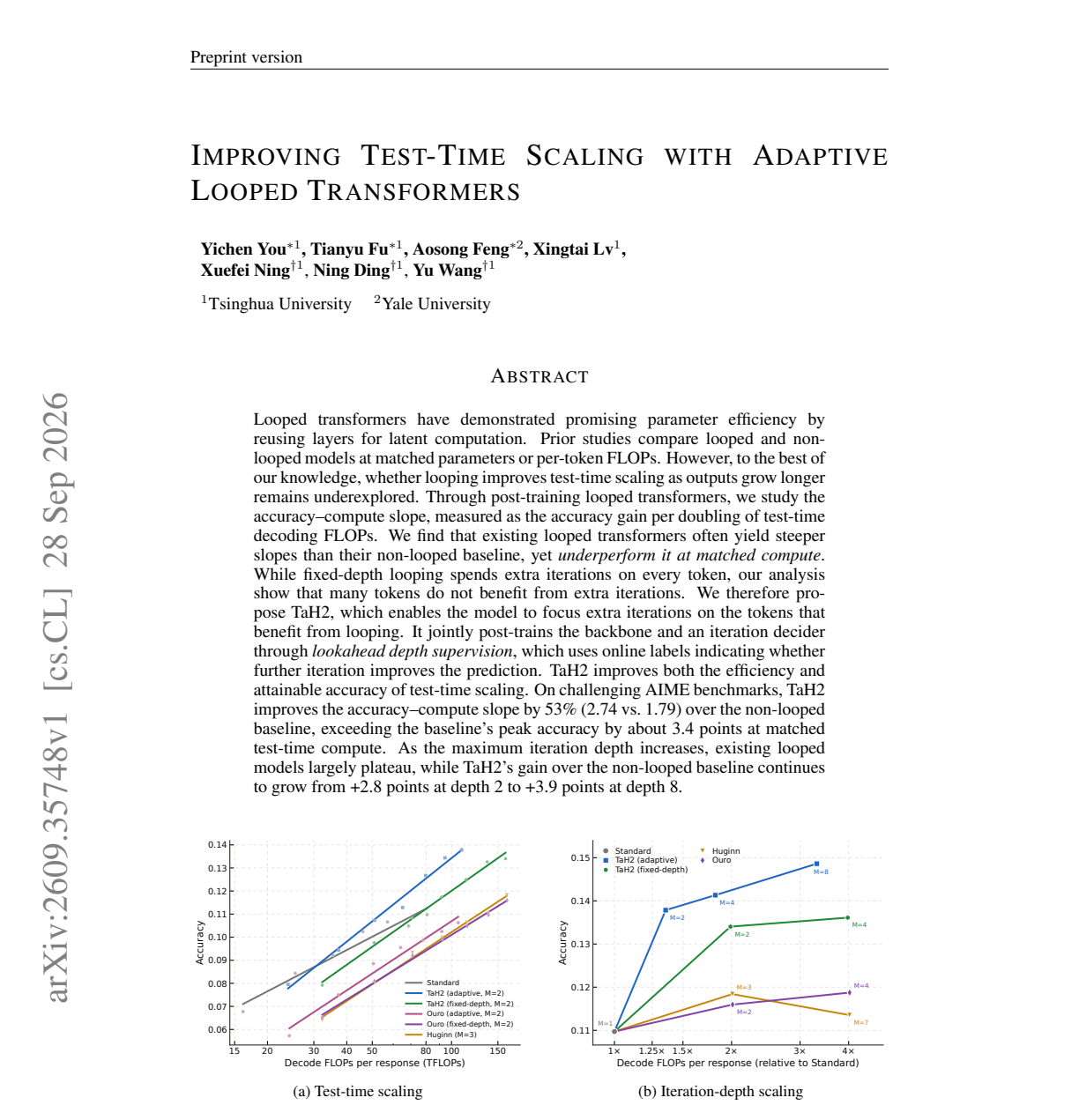
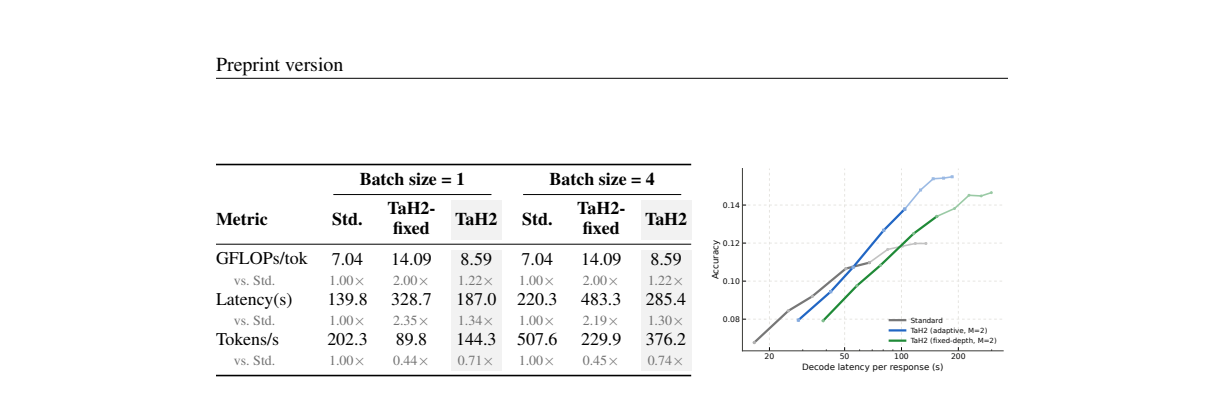
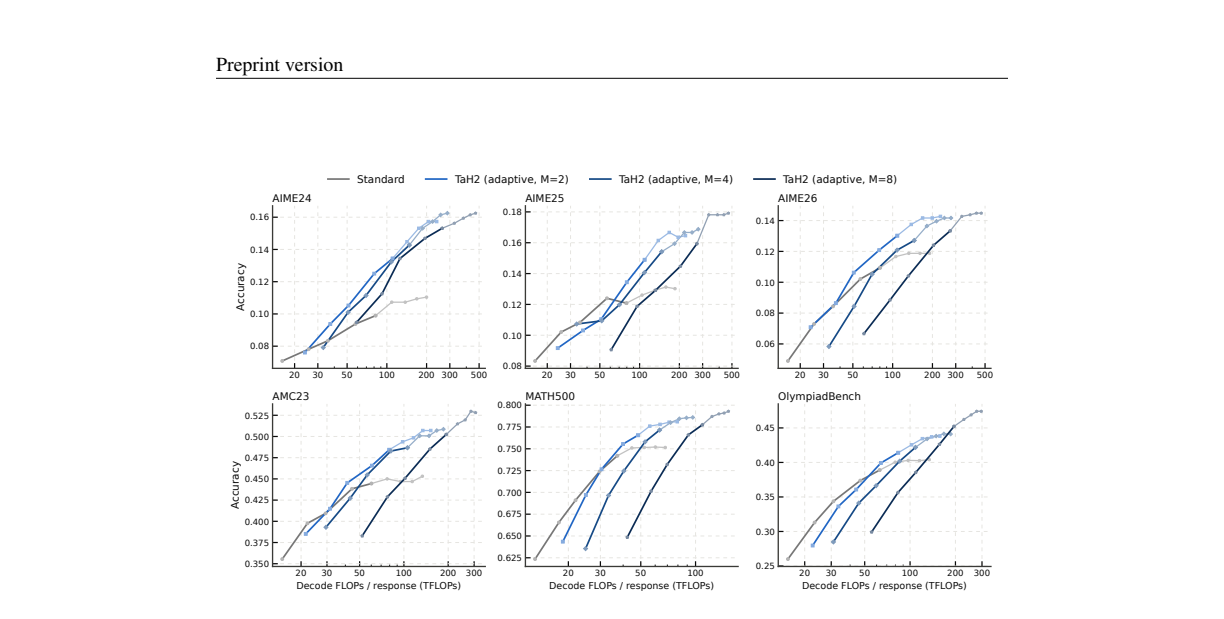
However, to the best of our knowledge, whether looping improves test-time scaling as outputs grow longer remains underexplored. Through post-training looped transformers, we study the accuracy-compute slope, measured as the accuracy gain per doubling of test-time decoding FLOPs. We find that existing looped transformers often yield steeper slopes than their non-looped baseline, yet underperform it at matched compute. While fixed-depth looping spends extra iterations on every token, our analysis shows that many tokens do not benefit from extra iterations. We therefore propose TaH2, which enables the model to focus extra iterations on the tokens that benefit from looping. It jointly post-trains the backbone and an iteration decider through lookahead depth supervision, which uses online labels indicating whether further iteration improves the prediction. TaH2 improves both the efficiency and attainable accuracy of test-time scaling. On challenging AIME benchmarks, TaH2 improves the accuracy-compute slope by 53% (2.74 vs. 1.79) over the non-looped baseline, exceeding the baseline's peak accuracy by about 3.4 points at matched test-time compute. As the maximum iteration depth increases, existing looped models largely plateau, while TaH2's gain over the non-looped baseline continues to grow from +2.8 points at depth 2 to +3.9 points at depth 8. Our code is available at https://github.com/thu-nics/TaH.
from the abstract
Pith says
Machine review · deepseek-v4-flash · 29 Sep 2026 · what was read was not recorded · not checked by a person
It can be wrong. Challenge this review or reply to it.
Holds up, with conditions. A solid, broadly ablated method whose qualitative claim is convincing, but whose headline slope numbers need error bars before they should be quoted. This line is wrong
3 major objections · 4 minor
How often objections from reviews like this one are right: not yet measured
Not checked: figures, code, what the 123 references say.
The paper says, at §5.2, Appendix A.3, Figure 1a
The review did not quote this passage.
Pith says: Objection 1 of 3 · major
The headline quantitative claims — the 53% slope improvement (2.74 vs 1.79 points per FLOP doubling) and the 3.4-point matched-compute gap — come from single post-training runs evaluated on 90 AIME problems (30 per year, Table 8) and are reported without confidence intervals, seed variation, or error bars on any fitted slope.
more of objection 1
Appendix A.3 reports R-squared for the Standard (0.955), Ouro (0.997), and Huginn (0.994) fits but omits the R-squared for the TaH2 curve that carries the central claim. The per-configuration variation inside Table 4 (1.0–3.6 points) is the same order of magnitude as the headline 3.4-point gain, so without uncertainty quantification it is not possible to determine whether the slope advantage is attributable to the online depth supervision or to endpoint noise and tuning. This is fixable: bootstrap confidence intervals computed from the already-recorded responses, plus the R-squared for the TaH2 fit, would establish whether the specific magnitudes of the slope advantage and matched-compute gap are distinguishable from noise.
The paper says, at §4.2, Table 4
The review did not quote this passage.
Pith says: Objection 2 of 3 · major
The method's headline gain depends on hand-set free parameters — coverage rho = 0.99, decider loss coefficient alpha_D = 0.05, and exit threshold tau_exit = 0.5 — and the ablation shows that a single design change (uniform loss weights) costs 3.6 points, larger than the headline matched-compute gain over Standard.
more of objection 2
No sensitivity sweep over rho or alpha_D is reported, so it is unclear whether the 53% slope improvement is a property of the method or of this particular tuning. Reporting the fitted slope and matched-compute gap under reasonable perturbations of rho and alpha_D would materially strengthen the robustness of the central claim.
The paper says, at §5.5, Figure 6
The review did not quote this passage.
Pith says: Objection 3 of 3 · major
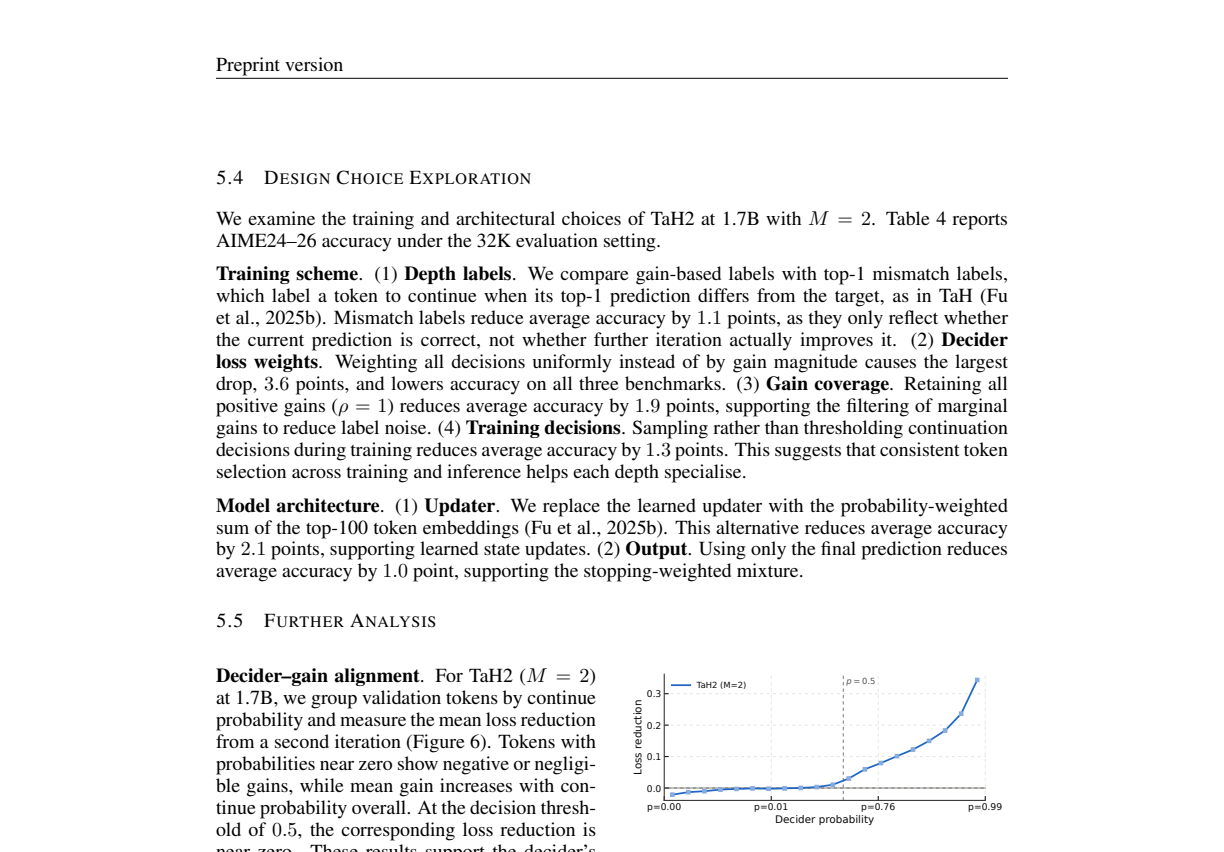
The decider–gain alignment analysis measures, on the validation set, the same quantity (per-token loss reduction from an additional iteration) that the decider was trained to predict, so the positive correlation in Figure 6 largely confirms that the decider matches its own training signal rather than demonstrating that the allocated depth improves task accuracy.
more of objection 3
The externally meaningful evidence is the end-task accuracy against the non-looped baseline, which is provided in Tables 1 and 3 and Figures 1 and 4. Figure 6 should be re-framed as a check of label consistency, or supplemented with an external cost of decider errors stated in task-accuracy terms, e.g., how much accuracy is lost when the decider sends a token to a depth that does not reduce loss.
4 minor objections
The paper says, at Abstract and §1
Pith says: minor objection 1 of 4
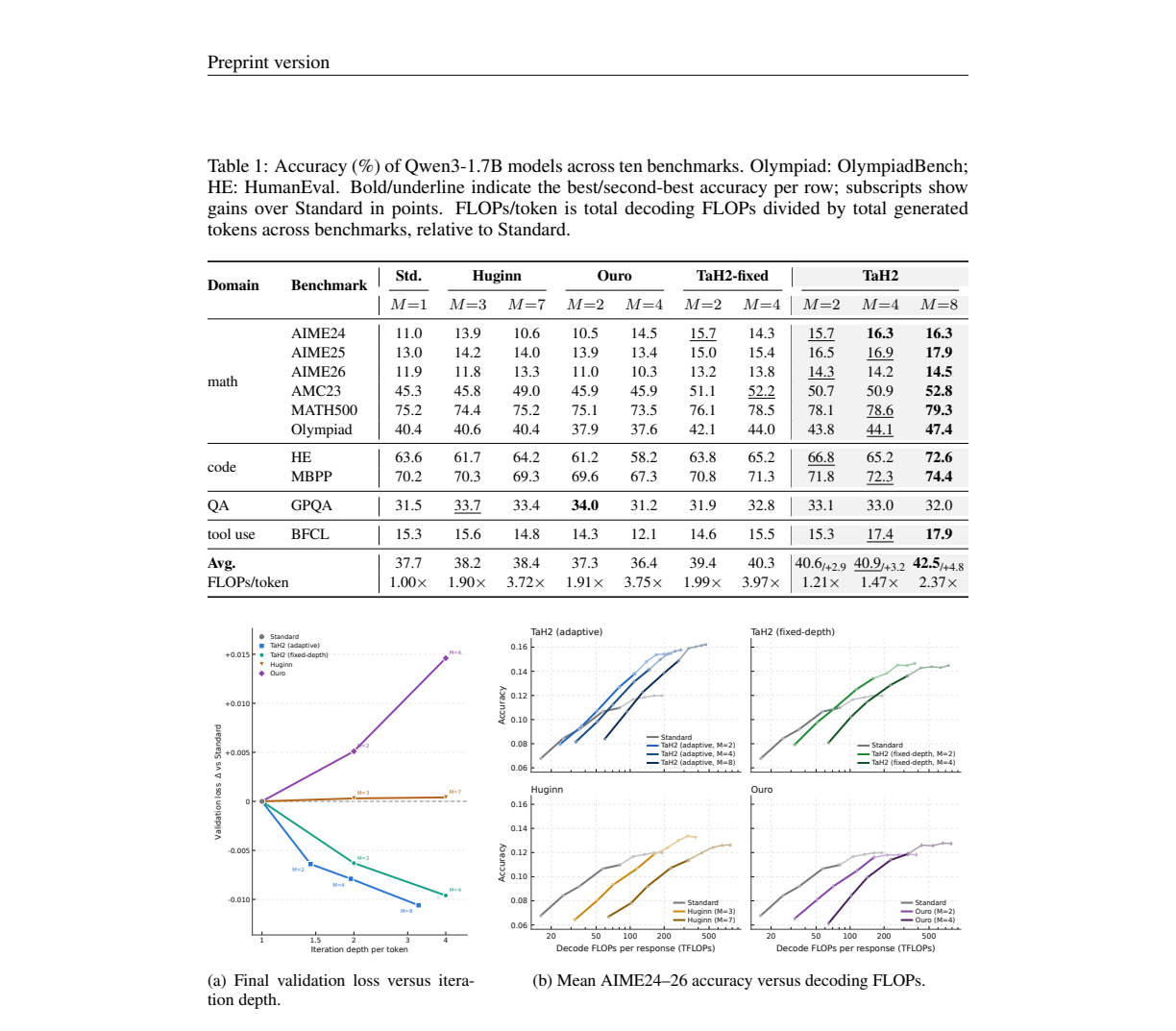
The depth-scaling claim in the abstract and contribution list ('gain grows from +2.8 to +3.9 points as maximum iteration depth grows from 2 to 8') is reported at increasing per-token compute — Table 1 shows TaH2's relative FLOPs/token rising from 1.21x at M=2 to 2.37x at M=8 — so part of the growth accompanies added compute.
more of objection 1
The fixed-depth controls in Figure 1b fairly show that baselines plateau, supporting the claim, but the main text should state explicitly that the depth-scaling comparison is not matched-compute.
The paper says, at §5.2, Figure 4b
Pith says: minor objection 2 of 4
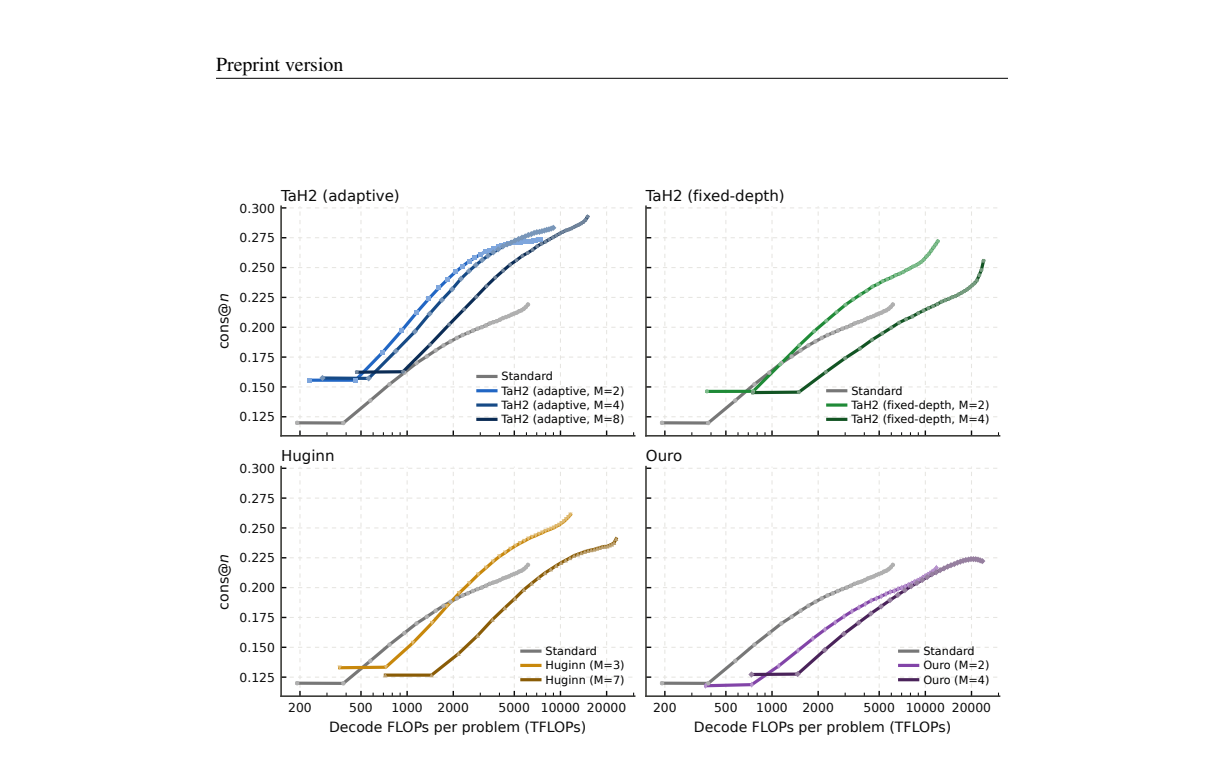
The matched-FLOPs comparison point (TaH2 at 15.4% versus Standard at 12.0% at 191.7 TFLOPs) should be stated in the main text with the specific output-token cutoffs that realize the matched FLOPs, since the light 32K-extended segments in Figure 4b make the read approximate.
show 2 more
The paper says, at Table 2, Appendix A.3
Pith says: minor objection 3 of 4
The runtime measurements in Table 2 are single-run latency and throughput numbers over 30 AIME26 problems; a sentence stating that these are single-seed measurements (as the appendix already notes for evaluation) would help the reader calibrate the 30-34% latency overhead figures.
The paper says, at Throughout
Pith says: minor objection 4 of 4
There are minor wording and formatting issues: the abstract says 'our analysis show that many tokens' (should be 'shows'); Table 1's Avg. row uses '+X.X' subscripts while benchmark rows do not, which is slightly inconsistent; and the class-balancing weight beta^(m) in Eq. (26) of Appendix D is computed per batch but is not mentioned in the main-text objective Eq. (7), where a brief pointer would help.
What would settle it
Using the saved full-length AIME24-26 responses (32 samples per problem), resample the 90 problems with replacement, and optionally resample the 32 samples within each problem, to recompute the accuracy-versus-log-FLOP curves at all cutoffs and the fitted slopes for Standard and TaH2 M=2. Report bootstrap 95% confidence intervals for (a) the slope difference 2.74-1.79 and (b) the accuracy gap at matched FLOPs. If either interval includes zero, the paper should present the claim as directional and add seed variation before quantitative acceptance; if both exclude zero, the headline is supported and the conditional can be lifted.
from the skeptic's reading
How the review went
4 readings by deepseek-v4-flash · 29 Sep 2026
- Reader holds up, with conditions
- Skeptic partly agrees
- Editor wrote the verdict above
- Referee major revision: 3 major objections, 4 minor
Not run on this paper: the simulated authors' defence.
Pith did not check this review's objections against the paper.
The review in full
The review in brief, machine-written
Bottom line: this is a genuinely useful paper, and the central direction is almost certainly right, even though the headline number is softer than it looks. The new thing is TaH2's online lookahead depth supervision: instead of TaH's offline mismatch labels or Ouro's frozen-backbone gate, TaH2 jointly post-trains backbone and decider on token-level "does another iteration actually reduce next-token loss" labels, with a learned updater and stopping-weighted outputs. That is a real increment, and the paper earns it with a broad comparison: 1.7B/4B/8B, ten benchmarks, depth sweeps, FLOPs accounting, runtime measurements, and a design ablation that tests each component. The finding that post-trained looped models scale faster but lag at matched compute is clearly demonstrated and worth having on record.
What I would not defend is the precision of the headline numbers. The 53% slope improvement (2.74 vs 1.79) and the 3.4-point matched-compute gap come from one post-training run per configuration, on 90 AIME problems, without confidence intervals or seed variation. Per-year AIME sets are 30 problems; avg@32 helps but doesn't fix the fact that a few problems move these numbers by more than the claimed gap. Table 4's own ablations swing 1.0-3.6 points, same order as the headline gain. The stress-test note is right that a bootstrap over recorded responses would tell you whether the slope advantage is real. That said, this is a soft spot in the quantitative claim, not the qualitative one: the direction is consistent across 4B/8B, non-AIME benchmarks, the ablation pattern, and the validation-loss curves. I'd ask for error bars and seed variation before publication, not reject over them.
The hand-set hyperparameters (rho=0.99, alpha_D=0.05, tau_exit=0.5) matter — the ablation shows up to a 3.6-point drop when weights are uniform — but the authors did the ablation and report it, so this is a tuning-sensitivity caveat, not a hidden flaw. The decider's self-referential training labels are standard for adaptive computation, and since the comparison target is an external non-looped baseline, the central claim isn't circular. Code and checkpoints are deferred to publication, which is a real but minor inconvenience.
Who should read: anyone working on latent reasoning, adaptive computation, or post-training recurrence. It deserves a serious referee; I'd send it out and ask for bootstrap CIs, multi-seed runs on the headline AIME comparison, and code release.
The strongest objection
The central quantitative claim is a comparison of fitted accuracy-compute slopes on AIME24-26: 2.74 vs 1.79 points per FLOP doubling, plus a 3.4-point matched-compute gap. These numbers come from a single post-training run per configuration, on 90 AIME problems, and are reported without confidence intervals or seed variation (Figures 1a and 4b, Table 1). Appendix A.3 reports R-squared for Standard, Ouro, and Huginn but not for the TaH2 curve that carries the headline slope. The per-configuration variation in Table 4 is 1.0-3.6 points, the same order as the headline matched-compute gain, so without error bars it is not possible to tell whether the slope advantage is attributable to the online depth supervision or to endpoint noise and tuned components. This is not a fatal flaw: the direction is independently supported by the 4B/8B results, the non-AIME benchmarks, and the ablation pattern. The unresolved issue is specifically whether the quantitative headline, not the qualitative direction, is solid.
I read the paper as making an empirical claim about adaptive depth allocation improving test-time scaling, supported by architecture design, ablations, and multi-scale experiments. The weakest link is not the depth-supervision proxy itself: the ablation of top-1 mismatch labels, the decider-gain alignment in Figure 6, and the growth of gains with depth ceiling all provide evidence that the loss-reduction signal is doing useful work. The weaker link is the statistical footing of the headline numbers. The AIME24-26 set has only 90 problems, each configuration appears to be a single training run, and the reported slopes and matched-compute gaps carry no confidence intervals; Appendix A.3 even omits the R-squared of the TaH2 fit whose slope is the paper's headline. The ablation deltas in Table 4 (up to 3.6 points) are comparable in size to the 3.4-point matched-compute claim, so the reader cannot distinguish a robust effect from a tuned configuration. The paper does acknowledge relevant limitations, namely higher training FLOPs and SFT-only scope, and those are honestly stated. My concrete test uses data the authors already have, so it is a feasible first-order check rather than a demand for expensive retraining. On this basis I keep the reader's conditional verdict unchanged: accept once the bootstrap intervals, and ideally a second seed, are reported.
The referee's report
If the quantitative claims hold, the paper fills a genuine gap: prior looped-models comparisons fixed parameters or per-token FLOPs rather than accuracy-compute scaling over output budgets, and the post-training setting is practically relevant. The experimental hygiene is a real strength: identical checkpoints, data, and recipes across methods; a transparent FLOPs model with the recurrent pass, updater, decider, and attention costs all itemized (Appendix A.4); runtime results from an actual modified serving engine rather than idealized FLOPs alone; and ablations isolating each design component. The qualitative direction of the claim is supported by multiple independent strands: the 4B/8B results (Table 3), the non-AIME rows of Table 1, and the fixed-depth controls in Figure 1b that plateau while TaH2 improves. The principal gap is uncertainty quantification: the headline 53% slope advantage and the 3.4-point matched-compute gap rest on single runs over 90 AIME problems with no confidence intervals, and the design-ablation spread in Table 4 is of the same order as the headline gain.
Pith's reading of the paper (a machine's summary, not the authors')
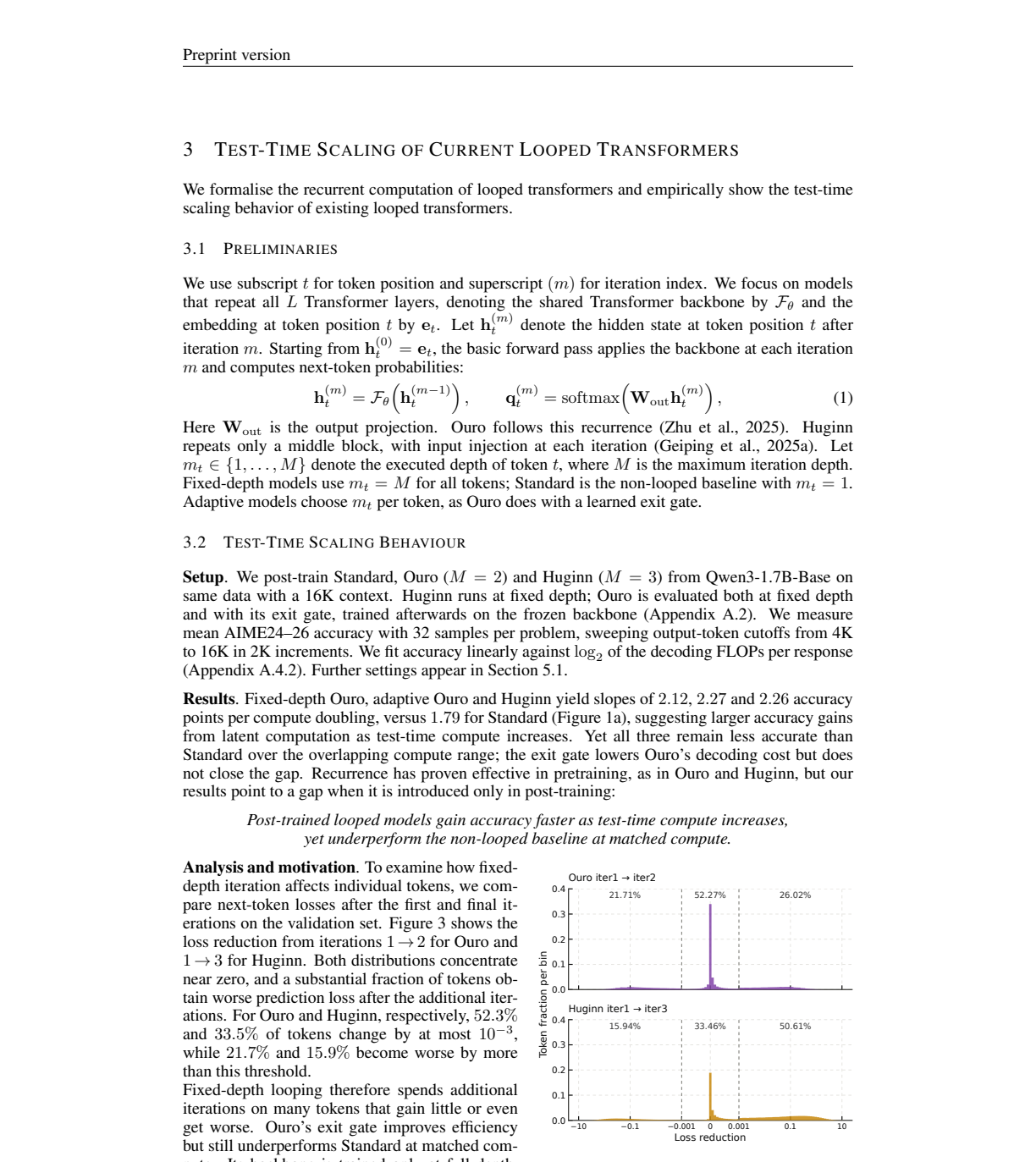
This paper asks whether looping a transformer's layers through post-training improves accuracy as test-time compute grows, and answers that looping helps only if the extra iterations are spent on the right tokens. Fixed-depth looped models (Ouro, Huginn) trained from the same checkpoint gain accuracy faster per doubling of decoding FLOPs than the single-pass baseline, yet stay below it at matched compute because many tokens gain nothing, or get worse, from another pass. The paper proposes TaH2, which jointly post-trains the backbone with a per-token iteration decider whose continue decisions are supervised online by measured next-token loss reductions. On AIME24–26 at 1.7B this raises the accuracy–compute slope by 53% (2.74 vs 1.79 points per doubling of decoding FLOPs) and surpasses the baseline's peak accuracy by about 3.4 points at matched compute.
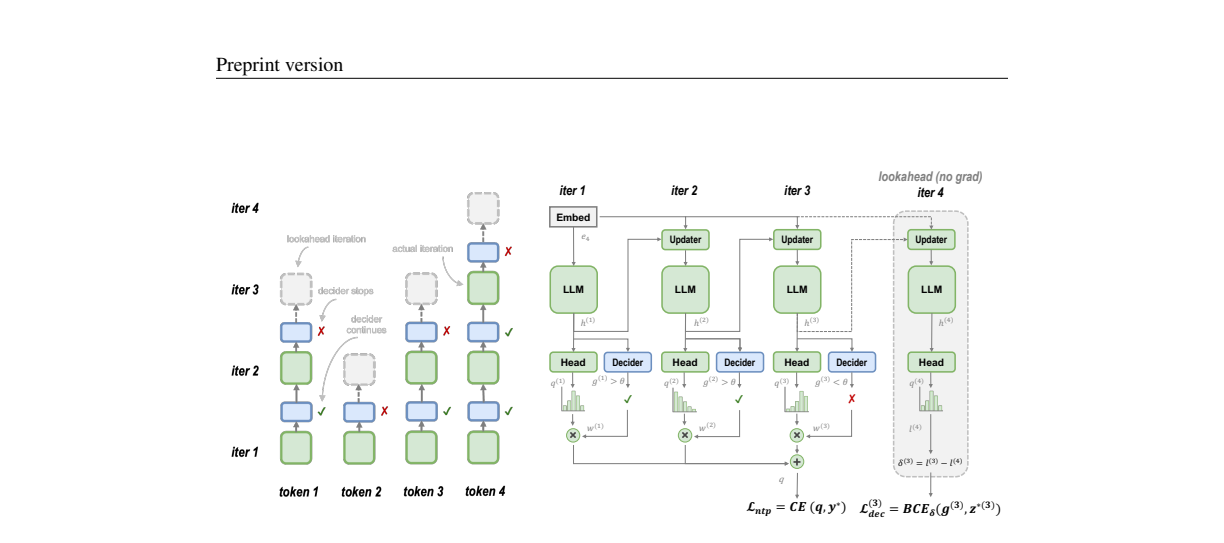
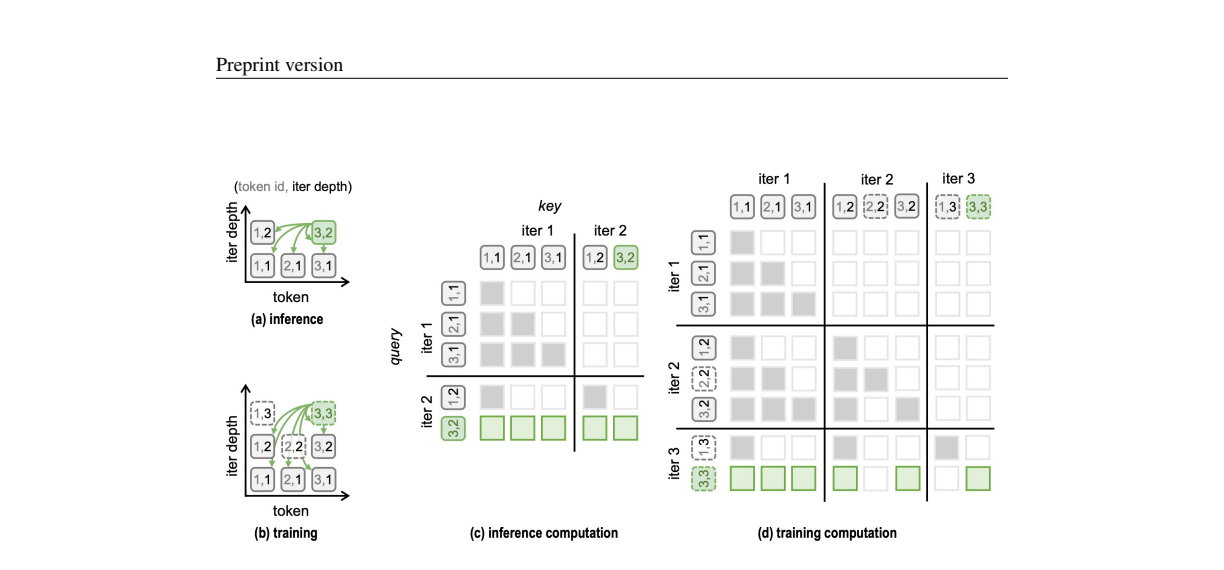
What carries the argument. The load-bearing mechanism is lookahead depth supervision: for each token that executes an iteration, the paper measures the next-token loss reduction $\delta^{(m)}_t = \ell^{(m)}_t - \ell^{(m+1)}_t$ from an extra pass (a no-gradient lookahead supplies the label for tokens that stop early), ranks positive gains, and labels a token 'continue' if its gain clears a coverage cutoff $\rho=0.99$ that retains 99% of total positive gain. These online labels supervise a lightweight decider $D_\phi$ predicting a continue probability $g^{(m)}_t$, via a cost-sensitive BCE whose weights grow with distance from the cutoff, added to the next-token loss with coefficient $\alpha_D=0.05$. A learned updater $U_\psi$ reinjects the token embedding between iterations, and stopping probabilities weight the per-iteration predictions into a mixture. The decider, not a fixed depth, allocates compute; training is on-policy, so the backbone sees the same depth routes used at inference, avoiding the train–inference mismatch that hurts a gate trained on a frozen full-depth backbone.
Core claim. The central claim is that adaptive depth allocation, supervised online by actual iteration gains, converts the steeper-but-shallower scaling of looped transformers into a genuine test-time-scaling win. TaH2's decider learns to route extra iterations toward tokens whose prediction loss actually drops, rather than executing a fixed depth on every token; training is on-policy with respect to the decider's choices, and outputs weight per-iteration predictions by stopping probabilities. The paper reports that joint post-training raises the accuracy–compute slope over the non-looped baseline by 53% (2.74 vs 1.79 points per doubling of decoding FLOPs) on AIME24–26 at 1.7B, exceeds Standard's peak accuracy by about 3.4 points at matched compute, and keeps improving with depth ceiling: the gain over Standard grows from +2.8 points at $M=2$ to +3.9 at $M=8$, whereas existing looped models plateau. The gains persist at 4B and 8B and generalise to code, QA and tool use.
The premise it rests on. The whole gain rests on a proxy: the method assumes that the next-token loss reduction measured on the current backbone, combined with the hand-set coverage $\rho=0.99$, loss coefficient $\alpha_D=0.05$ and exit threshold $\tau_{\text{exit}}=0.5$, faithfully indicates whether a token benefits from another iteration, and the design ablation shows the result is sensitive to those choices.
If the paper is right (Pith's inferences, not the authors')
If the mechanism holds, looping a pretrained model by post-training becomes a route to test-time scaling that beats spending the same FLOPs on more output tokens from a single pass.
The accuracy–compute slope gives a common yardstick for comparing looped and non-looped models as output budgets grow, beyond matched-parameter or matched-per-token-FLOPs comparisons.
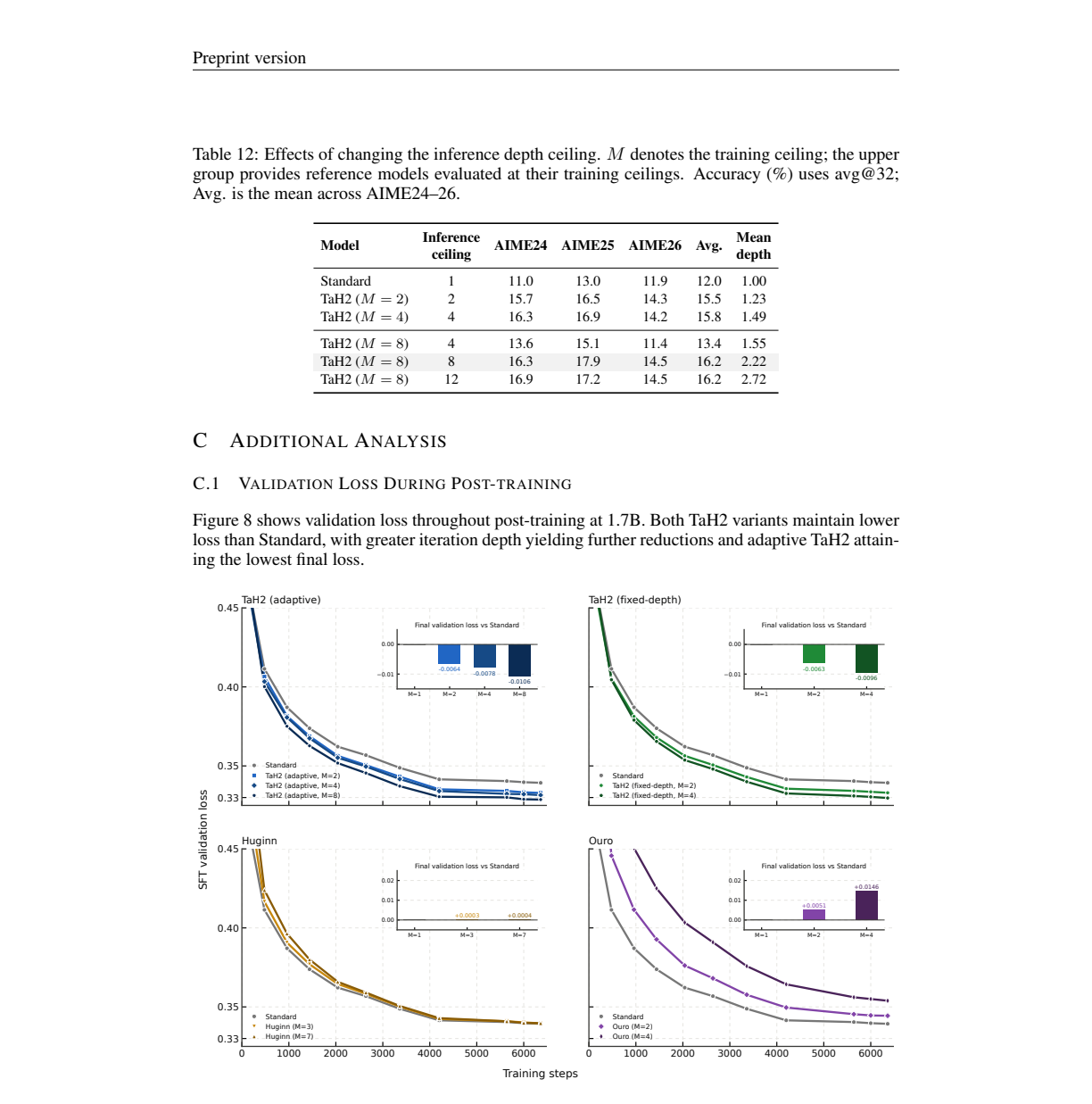
Adaptive TaH2 keeps improving from depth 2 to 8 while fixed-depth models plateau, suggesting a scaling regime where depth budgets can grow substantially with correct allocation.
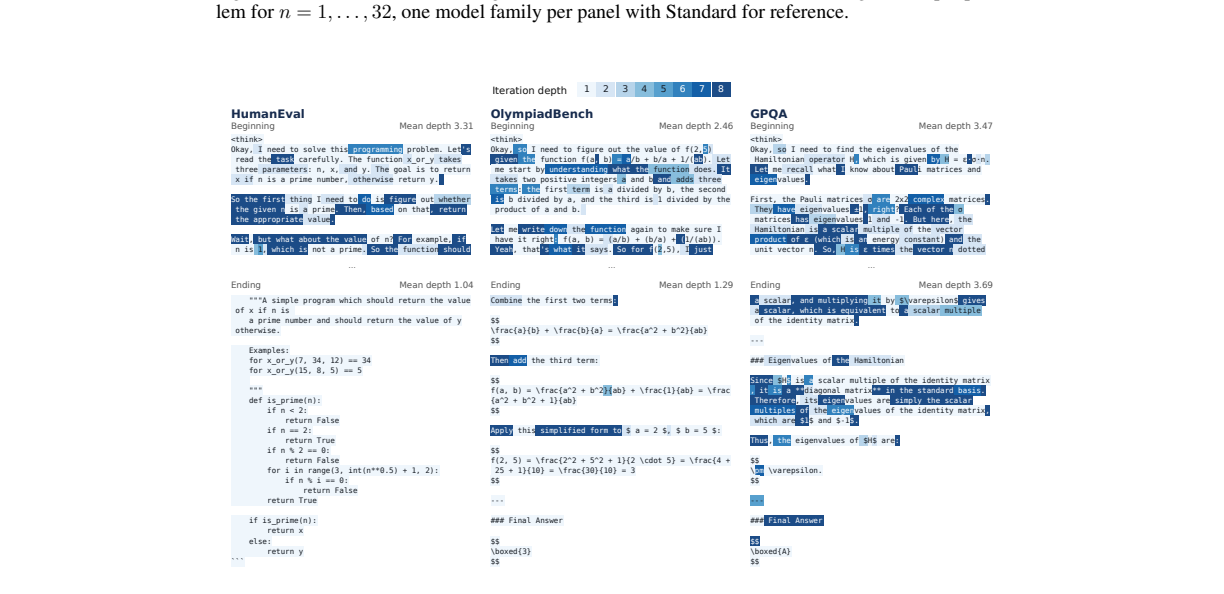
Because the decider routes depth by content (deeper on reasoning prose, shallower on final code and formulas), the method points toward serving efficiency: about 22% extra decoding FLOPs per token buys a steeper accuracy curve and higher peak accuracy.
Editorial: the supervision signal, next-token loss reduction, is a proxy for answer-level value; if deeper processing changes the reasoning trace without moving the immediate token's loss, the decider could under-credit useful depth. Probing decider decisions against answer-level improvement would test whether loss reduction is the right target.
Editorial: the design ablation's sensitivity (uniform loss weights cost 3.6 points, coverage $\rho=1$ costs 1.9) suggests the gains depend on hand-set training constants; a natural extension is whether $\rho$, $\alpha_D$ and $\tau_{\text{exit}}$ need re-tuning per scale or depth ceiling, or whether a learned schedule removes the sensitivity.
Editorial: since raising the inference ceiling of an $M=8$ model to 12 leaves accuracy unchanged, depth allocation is learned rather than extrapolable; a depth-conditional decoding scheme that spends more iterations when the decider is uncertain is a testable further step.
Check this review
Pith stored no record of this review's passes and took no fingerprint of it. Reviews made by code from 13 Nov 2026 on carry both.
How often reviews like this one are right
Reviews like this one: written by deepseek-v4-flash, where what was read was not recorded.
How often objections from reviews like this one are right: not yet measured
Reviews by people
This review was written by a machine. No person has reviewed this paper on Pith yet. A scientist listed on Pith can review it for a fee, and their review is published here whatever it concludes.
The paper
Abstract
Looped transformers have demonstrated promising parameter efficiency by reusing layers for latent computation. Prior studies compare looped and non-looped models at matched parameters or per-token FLOPs. However, to the best of our knowledge, whether looping improves test-time scaling as outputs grow longer remains underexplored. Through post-training looped transformers, we study the accuracy-compute slope, measured as the accuracy gain per doubling of test-time decoding FLOPs. We find that existing looped transformers often yield steeper slopes than their non-looped baseline, yet underperform it at matched compute. While fixed-depth looping spends extra iterations on every token, our analysis shows that many tokens do not benefit from extra iterations. We therefore propose TaH2, which enables the model to focus extra iterations on the tokens that benefit from looping. It jointly post-trains the backbone and an iteration decider through lookahead depth supervision, which uses online labels indicating whether further iteration improves the prediction. TaH2 improves both the efficiency and attainable accuracy of test-time scaling. On challenging AIME benchmarks, TaH2 improves the accuracy-compute slope by 53% (2.74 vs. 1.79) over the non-looped baseline, exceeding the baseline's peak accuracy by about 3.4 points at matched test-time compute. As the maximum iteration depth increases, existing looped models largely plateau, while TaH2's gain over the non-looped baseline continues to grow from +2.8 points at depth 2 to +3.9 points at depth 8. Our code is available at https://github.com/thu-nics/TaH.
The paper's own sentences, arranged, kept beside the review and separate from it. Each label is drawn from a closed vocabulary; the number beside it is the probability the classifier gave that label. No sentence in this record was written by a model.
abstract compiled · 2026-09-29
The authors' main claim, as the classifier picked it out 0.96
“TaH2 improves both the efficiency and attainable accuracy of test-time scaling.”
How the main claim is stated: asserted 1.00
What the abstract itself states, as probabilities: claims first 0.40 · states limitation 0.16 · human participants 0.02 · controlled comparison 0.97 · randomized assignment 0.02 · states quantitative result 0.99 · compares with prior results 0.98 · mentions code or data availability 0.99
The abstract, sentence by sentence
This table labels the abstract only (arXiv listing abstract v1). The number is the probability the classifier gave the label.
| Sentence | Role | The authors' own work | States the main conclusion | Strength |
|---|---|---|---|---|
| Looped transformers have demonstrated promising parameter efficiency by reusing layers for latent computation. | background 1.00 | 0.07 | 0.02 | asserted 0.97 |
| Prior studies compare looped and non-looped models at matched parameters or per-token FLOPs. | background 1.00 | 0.03 | 0.01 | asserted 1.00 |
| However, to the best of our knowledge, whether looping improves test-time scaling as outputs grow longer remains underexplored. | gap 1.00 | 0.07 | 0.03 | asserted 0.76 |
| Through post-training looped transformers, we study the accuracy-compute slope, measured as the accuracy gain per doubling of test-time decoding FLOPs. | method 0.56 | 0.89 | 0.05 | asserted 0.91 |
| We find that existing looped transformers often yield steeper slopes than their non-looped baseline, yet underperform it at matched compute. | result 1.00 | 0.93 | 0.10 | asserted 1.00 |
| While fixed-depth looping spends extra iterations on every token, our analysis shows that many tokens do not benefit from extra iterations. | result 0.59 | 0.85 | 0.05 | asserted 1.00 |
| We therefore propose TaH2, which enables the model to focus extra iterations on the tokens that benefit from looping. | contribution 0.74 | 0.66 | 0.15 | asserted 0.99 |
| It jointly post-trains the backbone and an iteration decider through lookahead depth supervision, which uses online labels indicating whether further iteration improves the prediction. | method 0.99 | 0.87 | 0.06 | asserted 0.98 |
| TaH2 improves both the efficiency and attainable accuracy of test-time scaling. | result 0.91 | 0.88 | 0.58 | asserted 1.00 |
| On challenging AIME benchmarks, TaH2 improves the accuracy-compute slope by 53% (2.74 vs. 1.79) over the non-looped baseline, exceeding the baseline's peak accuracy by about 3.4 points at matched test-time compute. | result 1.00 | 0.96 | 0.47 | asserted 1.00 |
| As the maximum iteration depth increases, existing looped models largely plateau, while TaH2's gain over the non-looped baseline continues to grow from +2.8 points at depth 2 to +3.9 points at depth 8. | result 1.00 | 0.94 | 0.16 | asserted 1.00 |
| Our code is available at https://github.com/thu-nics/TaH. | contribution 0.66 | 0.41 | 0.02 | asserted 0.90 |
What kind of paper the classifier reports this is: method or tool 1.00 · evidence from observation or experiment 0.96
What was examined, and what was not
Sources read
- arXiv listing abstract v1
Not examined
- full text
- figures and tables
- references and citing sentences
- relations to other papers
Levels run
- P abstract
Not run
- S sections
- T body sentences
- C citations
- R cross-paper relations
How the labels were made
Compiled by classifier-1.13.0 via TypeSafe API, question bank abstract-p1-20260923, 2026-09-29: 1 request, 8,850 input tokens.
Every quoted sentence on this record is the authors'. Every label is from Pith's closed vocabulary, with the probability shown beside it. This record as JSON
Figures (13)

Figures are the authors', reproduced from the paper.
References (123)
- [1] Fu, Tianyu and You, Yichen and Chen, Zekai and Dai, Guohao and Yang, Huazhong and Wang, Yu , journal=. 2025 , url= on Pith
- [2] R2R: Efficiently Navigating Divergent Reasoning Paths with Small-Large Model Token Routing , author=. arXiv preprint arXiv:2505.21600 , year= on PitharXiv
- [3] Universal Transformers , author=. International Conference on Learning Representations (ICLR) , year= on Pith
- [4] Block-recurrent transformers , author=. Advances in Neural Information Processing Systems , volume= on Pith
- [5] Looped transformers are better at learning learning algorithms , author=. arXiv preprint arXiv:2311.12424 , year= on PithPith's reviewarXiv
- [6] Saunshi, Nikunj and Dikkala, Nishanth and Li, Zhiyuan and Kumar, Sanjiv and Reddi, Sashank J. , journal=. 2025 , url= on Pith
- [7] Geiping, Jonas and McLeish, Sean and Jain, Neel and Kirchenbauer, John and Singh, Siddharth and Bartoldson, Brian R. and Kailkhura, Bhavya and Bhatele, Abhinav and Goldstein, Tom , journal=. 2025 , url= on Pith
- [8] Zhu, Rui-Jie and Wang, Zixuan and Hua, Kai and Zhang, Tianyu and Li, Ziniu and Que, Haoran and Wei, Boyi and Wen, Zixin and Yin, Fan and Xing, He and Li, Lu and Shi, Jiajun and Ma, Kaijing and Li, Shanda and Kergan, Taylor and Smith, Andrew and Qu, Xingwei and Hui, Mude and Wu... on Pith
- [9] Huang, Benhao and Shi, Chufan and Chen, Junlin and Wen, Shicheng and Liu, Zhengzhong and Xing, Eric and Ma, Xuezhe , year= on Pith
- [10] Pretraining Language Models to Ponder in Continuous Space , author=. arXiv preprint arXiv:2505.20674 , year= on PitharXiv
- [11] CoTFormer: A chain-of-thought driven architecture with budget-adaptive computation cost at inference , author=. arXiv preprint arXiv:2310.10845 , year= on PithPith's reviewarXiv
- [12] Adaptive computation time for recurrent neural networks , author=. arXiv preprint arXiv:1603.08983 , year= on PithPith's reviewarXiv
- [13] Banino, Andrea and Balaguer, Jan and Blundell, Charles , journal=. 2021 , url= on Pith
- [14] Raposo, David and Ritter, Sam and Richards, Blake and Lillicrap, Timothy and Humphreys, Peter Conway and Santoro, Adam , journal=. 2024 , url= on Pith
- [15] Confident adaptive language modeling , author=. Advances in Neural Information Processing Systems , volume= on Pith
- [16] Bae, Sangmin and Kim, Yujin and Bayat, Reza and Kim, Sungnyun and Ha, Jiyoun and Schuster, Tal and Fisch, Adam and Harutyunyan, Hrayr and Ji, Ziwei and Courville, Aaron and Yun, Se-Young , journal=. 2025 , url= on Pith
- [17] Scaling laws for neural language models , author=. arXiv preprint arXiv:2001.08361 , year= on PithPith's reviewarXiv
- [18] Training compute-optimal large language models , author=. arXiv preprint arXiv:2203.15556 , year= on PithPith's reviewarXiv
- [19] Snell, Charlie and Lee, Jaehoon and Xu, Kelvin and Kumar, Aviral , journal=. 2024 , url= on Pith
- [20] Muennighoff, Niklas and Yang, Zitong and Shi, Weijia and Li, Xiang Lisa and Fei-Fei, Li and Hajishirzi, Hannaneh and Zettlemoyer, Luke and Liang, Percy and Candès, Emmanuel and Hashimoto, Tatsunori , journal=. 2025 , url= on Pith
show 80 more
- [21] When more is less: Understanding chain-of-thought length in LLMs , author=. arXiv preprint arXiv:2502.07266 , year= on PithPith's reviewarXiv
- [22] OpenAI o1 system card , author=. arXiv preprint arXiv:2412.16720 , year= on PithPith's reviewarXiv
- [23] DeepSeek-R1: Incentivizing reasoning capability in LLMs via reinforcement learning , author=. arXiv preprint arXiv:2501.12948 , year= on PithPith's reviewarXiv
- [24] Training large language models to reason in a continuous latent space , author=. arXiv preprint arXiv:2412.06769 , year= on PithPith's reviewarXiv
- [25] Implicit Reasoning in Large Language Models: A Comprehensive Survey , author=. arXiv preprint arXiv:2509.02350 , year= on PithPith's reviewarXiv
- [26] Rho-1: Not all tokens are what you need , author=. arXiv preprint arXiv:2404.07965 , year= on PithPith's reviewarXiv
- [27] Qwen3 technical report , author=. arXiv preprint arXiv:2505.09388 , year= on PithPith's reviewarXiv
- [28] AM-Qwen3-Distilled , author= on Pith
- [29] Nemotron-Agentic-v1 , author= on Pith
- [30] 1.4 Million Open-Source Distilled Reasoning Dataset to Empower Large Language Model Training , author=. arXiv preprint arXiv:2503.19633 , year= on PithPith's reviewarXiv
- [31] Open R1: A fully open reproduction of DeepSeek-R1 , url= on Pith
- [32] Measuring mathematical problem solving with the MATH dataset , author=. arXiv preprint arXiv:2103.03874 , year= on PithPith's reviewarXiv
- [33] Towards Robust Mathematical Reasoning , author=. Proceedings of the 2025 Conference on Empirical Methods in Natural Language Processing , pages=. 2025 , publisher=. doi:10.18653/v1/2025.emnlp-main.1794 , url= on Pithdoi:10.18653/v1/2025.emnlp-main.1794
- [34] Let's verify step by step , author=. arXiv preprint arXiv:2305.20050 , year= on PithPith's reviewarXiv
- [35] LiveCodeBench: Holistic and contamination free evaluation of large language models for code , author=. arXiv preprint arXiv:2403.07974 , year= on PithPith's reviewarXiv
- [36] Program synthesis with large language models , author=. arXiv preprint arXiv:2108.07732 , year= on PithPith's reviewarXiv
- [37] The Berkeley Function Calling Leaderboard (BFCL): From tool use to agentic evaluation of large language models , author=. International Conference on Machine Learning (ICML) , year= on Pith
- [38] arXiv preprint arXiv:2502.14739 , year= on PithPith's reviewarXiv
- [39] OlympiadBench: A challenging benchmark for promoting AGI with olympiad-level bilingual multimodal scientific problems , author=. arXiv preprint arXiv:2402.14008 , year= on PithPith's reviewarXiv
- [40] GPQA: A graduate-level Google-proof Q&A benchmark , author=. arXiv preprint arXiv:2311.12022 , year= on PithPith's reviewarXiv
- [41] SGLang: Efficient execution of structured language model programs , author=. arXiv preprint arXiv:2312.07104 , year= on PithPith's reviewarXiv
- [42] Evaluating Large Language Models Trained on Code , author=. arXiv preprint arXiv:2107.03374 , year= on PithPith's reviewarXiv
- [43] Liu, Jiawei and Xia, Chunqiu Steven and Wang, Yuyao and Zhang, Lingming , booktitle=. Is Your Code Generated by Chat on Pith
- [44] Brown, Bradley and Juravsky, Jordan and Ehrlich, Ryan and Clark, Ronald and Le, Quoc V. and Ré, Christopher and Mirhoseini, Azalia , journal=. 2024 , url= on Pith
- [45] Guan, Xinyu and Zhang, Li Lyna and Liu, Yifei and Shang, Ning and Sun, Youran and Zhu, Yi and Yang, Fan and Yang, Mao , journal=. 2025 , url= on Pith
- [46] Aggarwal, Pranjal and Welleck, Sean , journal=. 2025 , url= on Pith
- [47] Chen, Mouxiang and Hui, Binyuan and Cui, Zeyu and Yang, Jiaxi and Liu, Dayiheng and Sun, Jianling and Lin, Junyang and Liu, Zhongxin , journal=. 2025 , url= on Pith
- [48] Bae, Sangmin and Fisch, Adam and Harutyunyan, Hrayr and Ji, Ziwei and Kim, Seungyeon and Schuster, Tal , journal=. 2024 , url= on Pith
- [49] McLeish, Sean and Li, Ang and Kirchenbauer, John and Kalra, Dayal Singh and Bartoldson, Brian R. and Kailkhura, Bhavya and Schwarzschild, Avi and Geiping, Jonas and Goldstein, Tom and Goldblum, Micah , journal=. 2025 , url= on Pith
- [50] Park, Taekhyun and Lee, Yongjae and Kim, Dohee and Bae, Hyerim , journal=. 2026 , url= on Pith
- [51] Schwethelm, Kristian and Rueckert, Daniel and Kaissis, Georgios , journal=. 2026 , url= on Pith
- [52] Li, He and Song, Feichen and Zeng, Boyi and Song, Shixiang and Xu, Zhiqin John and He, Ziwei and Lin, Zhouhan , journal=. 2026 , url= on Pith
- [53] Zeng, Boyi and Hao, Yiqin and Li, He and Song, Shixiang and Song, Feichen and Wang, Zitong and Huang, Siyuan and Xu, Yi and He, Ziwei and Wang, Xinbing and Lin, Zhouhan , journal=. 2026 , url= on Pith
- [54] Song, Shixiang and Li, He and Wang, Zitong and Zeng, Boyi and Song, Feichen and Wang, Yixuan and Xu, Zhiqin John and He, Ziwei and Lin, Zhouhan , journal=. 2026 , url= on Pith
- [55] Popescu, Andrei Cristian and S. arXiv preprint arXiv:2607.20519 , year= on PithPith's reviewarXiv
- [56] Sharma, Rituraj and Vu, Tu , journal=. 2026 , url= on Pith
- [57] Chen, Tieyuan and Chen, Xiaodong and Chen, Haoxing and Lan, Zhenzhong and Lin, Weiyao and Li, Jianguo , journal=. 2025 , url= on Pith
- [58] Wang, Yuxiang and Feng, Kunyu and Shen, Yingda and Xu, Haoning and Wang, Junyu and Wu, Zhizheng , journal=. 2026 , url= on Pith
- [59] Wu, Yangzhen and Sun, Zhiqing and Li, Shanda and Welleck, Sean and Yang, Yiming , journal=. 2024 , url= on Pith
- [60] Chen, Lingjiao and Davis, Jared Quincy and Hanin, Boris and Bailis, Peter and Stoica, Ion and Zaharia, Matei and Zou, James , journal=. 2024 , url= on Pith
- [61] Karan, Aayush and Du, Yilun , journal=. 2025 , url= on Pith
- [62] Chen, Wei-Lin and Peng, Liqian and Tan, Tian and Zhao, Chao and Chen, Blake JianHang and Lin, Ziqian and Go, Alec and Meng, Yu , journal=. 2026 , url= on Pith
- [63] Li, Yulin and Tu, Tengyao and Ding, Li and Wang, Junjie and Zhen, Huiling and Chen, Yixin and Li, Yong and Tian, Zhuotao , journal=. 2026 , url= on Pith
- [64] Shen, Xuan and Wang, Yizhou and Zhou, Yufa and Shi, Xiangxi and Zhao, Pu and Wang, Yanzhi and Gu, Jiuxiang , journal=. 2025 , url= on Pith
- [65] Fan, Ying and Svete, Anej and Lee, Kangwook , journal=. 2026 , url= on Pith
- [66] Xu, Xin and Yu, Tong and Chen, Xiang and Wang, Haoliang and McAuley, Julian and Mitra, Saayan , journal=. 2026 , url= on Pith
- [67] Prairie, Hayden and Novack, Zachary and Berg-Kirkpatrick, Taylor and Fu, Daniel Y. , journal=. 2026 , url= on Pith
- [68] Wang, Shaowen and Zhang, Ge and Luo, Kairong and Wu, Yuhao and Liu, Shaofan and Liu, Jiaheng and Huang, Wenhao and Yan, Shen and Li, Jian , journal=. 2026 , url= on Pith
- [69] Lee, Ryan and Biloki, Jacob and Hu, Edward J. and May, Jonathan , journal=. 2026 , url= on Pith
- [70] Gao, Zitian and Chen, Yilong and Xiao, Yihao and Yang, Xinyu and Tao, Ran and Zhou, Joey and Dai, Bryan , journal=. 2026 , url= on Pith
- [71] Li, Shuzhen and Zhang, Yifan and Guo, Jiacheng and Gu, Quanquan and Wang, Mengdi , journal=. 2026 , url= on Pith
- [72] Yang, Xiao-Wen and Han, Ziyu and Zhang, Xi-Hua and Wei, Wen-Da and Shao, Jie-Jing and Guo, Lan-Zhe and Li, Yu-Feng , journal=. 2026 , url= on Pith
- [73] Yu, Chengting and Shu, Xiaobo and Wang, Yadao and Zhang, Yizhen and Wu, Haoyi and Li, Jiaang and Long, Rujiao and Chen, Ziheng and Xu, Yuchi and Su, Wenbo and Zheng, Bo , journal=. 2025 , url= on Pith
- [74] Knupp, Jonas and Metzen, Jan Hendrik and Bohn, Jeremias and Groh, Georg and Kersting, Kristian , journal=. 2026 , url= on Pith
- [75] Chen, Guanxu and Liu, Dongrui and Shao, Jing , journal=. 2026 , url= on Pith
- [76] Yang, Jian and Guo, Shawn and Zhang, Wei and Zheng, Tianyu and Du, Yaxin and Li, Haau-Sing and Wu, Jiajun and Song, Yue and Xing, Yan and Cai, Qingsong and Huang, Zelong and Hao, Chuan and Tao, Ran and Liu, Xianglong and Zhao, Wayne Xin and Tang, Mingjie and Lv, Weifeng and Zh... on Pith
- [77] Ge, Renee and Liao, Qianli and Poggio, Tomaso , journal=. 2025 , url= on Pith
- [78] Ren, Zirui and Liu, Ziming , journal=. 2026 , url= on Pith
- [79] Baek, Junyeob and Jo, Mingyu and Kim, Minsu and Ren, Mengye and Bengio, Yoshua and Ahn, Sungjin , journal=. 2026 , url= on Pith
- [80] Altabaa, Awni and Chen, Siyu and Lafferty, John and Yang, Zhuoran , journal=. 2025 , url= on Pith
- [81] Wu, Bohong and Chen, Mengzhao and Luo, Xiang and Yan, Shen and Yu, Qifan and Xia, Fan and Zhang, Tianqi and Zhan, Hongrui and Zhong, Zheng and Zhou, Xun and Qiao, Siyuan and Bin, Xingyan , journal=. 2025 , url= on Pith
- [82] Geiping, Jonas and Yang, Xinyu and Su, Guinan , journal=. 2025 , url= on Pith
- [83] Shapiro, Mark , journal=. 2026 , url= on Pith
- [84] Elhoushi, Mostafa and Shrivastava, Akshat and Liskovich, Diana and Hosmer, Basil and Wasti, Bram and Lai, Liangzhen and Mahmoud, Anas and Acun, Bilge and Agarwal, Saurabh and Roman, Ahmed and Aly, Ahmed A and Chen, Beidi and Wu, Carole-Jean , journal=. 2024 , url= on Pith
- [85] Huang, Zihao and Zhou, Jundong and Qu, Xingwei and Min, Qiyang and Zhang, Ge , journal=. 2026 , url= on Pith
- [86] Qu, Xingwei and Wang, Shaowen and Huang, Zihao and Hua, Kai and Yin, Fan and Zhu, Rui-Jie and Zhou, Jundong and Min, Qiyang and Wang, Zihao and Li, Yizhi and Zhang, Tianyu and Xing, He and Zhang, Zheng and Song, Yuxuan and Zheng, Tianyu and Zeng, Zhiyuan and Lin, Chenghua and ... on Pith
- [87] Komatsuzaki, Aran and Puigcerver, Joan and Lee-Thorp, James and Ruiz, Carlos Riquelme and Mustafa, Basil and Ainslie, Joshua and Tay, Yi and Dehghani, Mostafa and Houlsby, Neil , journal=. 2022 , url= on Pith
- [88] Kim, Dahyun and Park, Chanjun and Kim, Sanghoon and Lee, Wonsung and Song, Wonho and Kim, Yunsu and Kim, Hyeonwoo and Kim, Yungi and Lee, Hyeonju and Kim, Jihoo and Ahn, Changbae and Yang, Seonghoon and Lee, Sukyung and Park, Hyunbyung and Gim, Gyoungjin and Cha, Mikyoung and ... on Pith
- [89] Wu, Chengyue and Gan, Yukang and Ge, Yixiao and Lu, Zeyu and Wang, Jiahao and Feng, Ye and Shan, Ying and Luo, Ping , journal=. 2024 , url= on Pith
- [90] Yu, Mingqian and Zhang, Wenpeng and Zhao, Peilin , journal=. 2026 , url= on Pith
- [91] Moosa, Ibraheem Muhammad and Lohit, Suhas and Wang, Ye and Chatterjee, Moitreya and Yin, Wenpeng , journal=. 2026 , url= on Pith
- [92] Frey, Markus and Shomali, Behzad and Bashir, Ali Hamza and Berghaus, David and Koehler, Joachim and Ali, Mehdi , journal=. 2026 , url= on Pith
- [93] Chen, Lizhang and Li, Jonathan and Liang, Chen and Lao, Ni and Liu, Qiang , journal=. 2026 , url= on Pith
- [94] Jeddi, Ahmadreza and Ciccone, Marco and Taati, Babak , journal=. 2026 , url= on Pith
- [95] Kuo, Hsun-Yu and Chayti, El Mahdi and Reizinger, Patrik and Brendel, Wieland and Jaggi, Martin , journal=. 2026 , url= on Pith
- [96] Fu, Rao and Yang, Zixuan and Zhang, Jiankun and Ma, Jing and Chen, Hechang and Li, Yu and Chang, Yi , journal=. 2026 , url= on Pith
- [97] Wang, Shaowen and Li, Bingrui and Zhang, Ge and Huang, Wenhao and Yan, Shen and Li, Jian , journal=. 2026 , url= on Pith
- [98] Vendrell, Victor Conchello and Masdemont, Arnau Padres and Grillo, Niccolò and Ros-Giralt, Jordi and Behboodi, Arash and Massoli, Fabio Valerio , journal=. 2026 , url= on Pith
- [99] Deng, Chunyuan and Zhang, Yizhe and Zhu, Rui-Jie and Xu, Yuanyuan and Liu, Jiarui and Ng, T. S. Eugene and Chen, Hanjie , journal=. 2026 , url= on Pith
- [100] Kim, Bum Jun and Hayashi, Kohei and Kamiya, Shunsuke and Koyama, Masanori and Iwasawa, Yusuke and Matsuo, Yutaka , journal=. 2026 , url= on Pith
The first 100 of 123 references are listed here. All of them are in this paper's citation record.
Cited by 4 Pith papers
Reviewed papers on Pith that cite this one. The full citation record
- Unlocking the Power of Loops in Pretrained LLMs with Loop Residuals cs.CL · Nov 2026
- Rectified Looped Transformer cs.LG · Nov 2026
- There Is No Free Loop: When Does Looping a Trained Model Pay for Its Inference Compute? cs.LG · Oct 2026
- Accordion: Elastic-Depth Inference via Fixed-Prefix Layer Looping cs.LG · Oct 2026
Challenges and discussion
Disagree with the review, or know something it missed? Leave a comment, or challenge this review formally: a challenge becomes a permanent entry in this paper's record, and its decision is published here.
Come back by email
A short list of the week's newly reviewed papers. Nothing is sent until you confirm from your inbox, and every email has a link that stops it. No account.
No comments yet.
Sign in to comment