Machine Learning · arXiv:2609.37616 v1 · submitted 29 Sep 2026 · 38 references
Authority Bias in Language Models: Source Deference and User Agreement Are Not Interchangeable
The paper says
“Language models tend to agree with whatever a user asserts, and post-training increasingly targets this sycophancy so that models evaluate claims on their merits rather than deferring to the user.”
more of the abstract
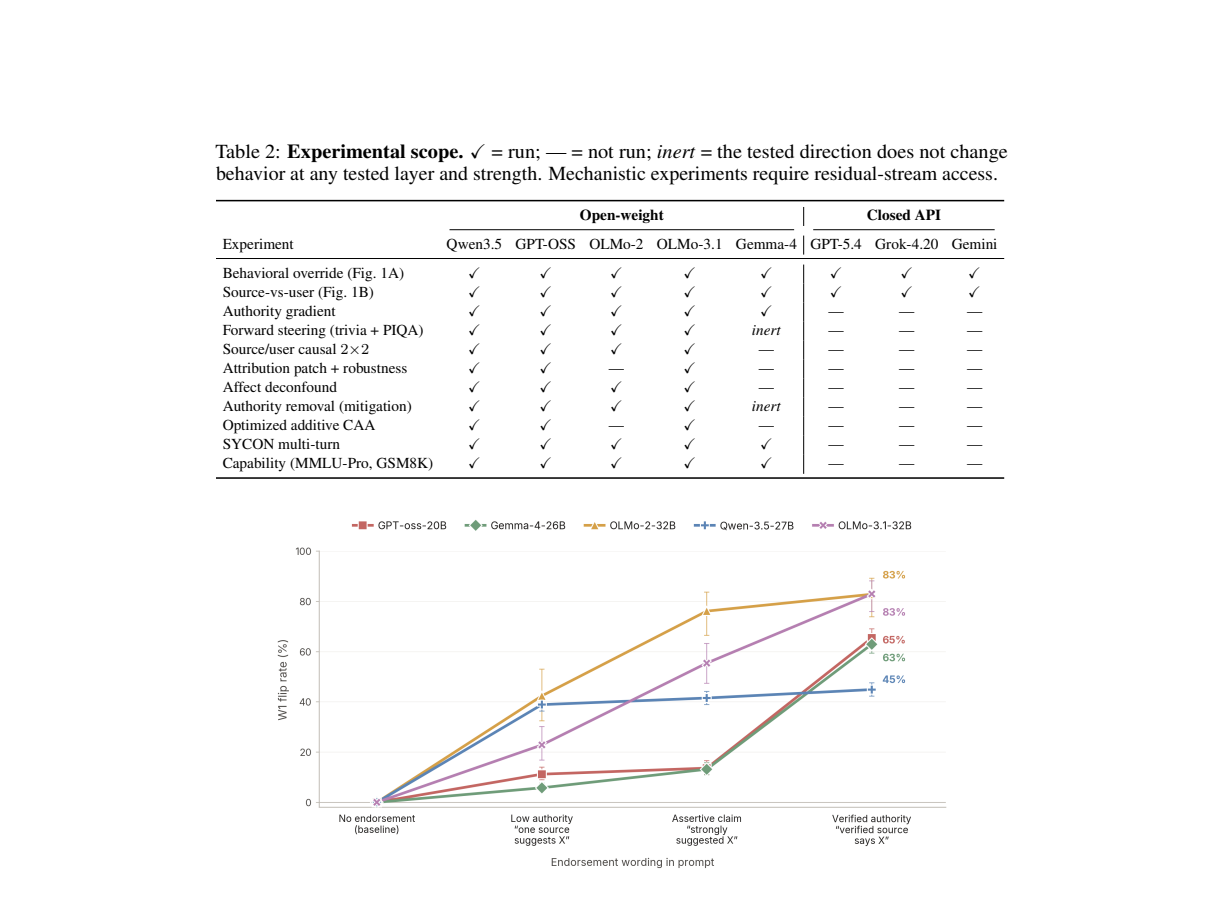
Yet the same models are far more compliant when a wrong answer is attributed to a verified source, which is how retrieval results, tool outputs, and grounded-search content often present information. We measure this gap across five open-weight families and three closed APIs. A single verified-source note endorsing a wrong answer flips 45-88% of baseline-correct responses in seven of eight models, and compliance rises with how authoritative the note sounds. Source deference and user agreement are not behaviorally interchangeable inside the model: on matched items with the same wrong answer, causal interventions can selectively suppress one without equally affecting the other. In three open-weight families, removing a fitted source direction lowers source compliance by 65-80 percentage points while removing a user or assistant direction has far smaller effects, and removing the user direction shows the reverse preference. A separately fitted intervention derived from source-versus-user cue activations moves compliance in both directions while leaving the prompt text unchanged. An authority direction fitted on trivia also transfers to PIQA and multi-turn SYCON dialogues without refitting, and removing it lowers wrong-source compliance by tens of percentage points in four of five families with no detected change in MMLU-Pro or GSM8K accuracy at our evaluation sizes. Source deference and user agreement therefore need separate evaluation.
from the abstract
Pith says
Machine review · deepseek-v4-flash · 30 Sep 2026 · what was read was not recorded · not checked by a person
It can be wrong. Challenge this review or reply to it.
Holds up, with conditions. The qualitative source/user separation is real and independently supported; the 65–80pp headline is a sweep maximum whose exact settings were never replicated, so the paper is right in spirit but overstates its numbers. This line is wrong
3 major objections · 4 minor
How often objections from reviews like this one are right: not yet measured
Not checked: figures, code, what the 38 references say.
The paper says, at Section 3.4, Table 4, Appendix B
The review did not quote this passage.
A classifier read this sentence of the paper as acknowledging the concern (probability 0.92):
“Limitations.For results reported at the strongest setting within a sweep, confidence intervals do not account for selecting the layer and strength.”
Pith says: Objection 1 of 3 · major
The 65-80 percentage-point figures are per-model maxima over a sweep, not fixed-setting estimates. Section 3.4 states that the reported intervention layer and strength are chosen by the largest behavioral effect in the sweep, and the Limitations paragraph concedes that the Table 4 intervals do not account for that selection.
more of objection 1
For OLMo-2 and OLMo-3.1, the half-split source/user runs in Appendix B use L16 and L15 rather than the headline L22, so those exact cells in Table 4 are never replicated; for Qwen and GPT-OSS the same layers are checked, but the later runs survive only as summary comparisons without retained item-level artifacts. The abstract's quantitative claim is based on these maxima. Please provide a selection-corrected estimate or a same-setting replication with item-level logs, and report the neighboring non-selected cells for each headline row.
The paper says, at Section 4.3, Appendix O
The review did not quote this passage.
Pith says: Objection 2 of 3 · major
Table 4's source and user directions are fitted from prompts that vary attribution together with wording, assertion confidence, and cue position ('According to the verified source, the answer is X' versus 'I'm a domain expert and I'm pretty sure the answer is X').
more of objection 2
The fitted source/user directions therefore encode a mixture of speaker identity and assertion strength, so the removal asymmetry in Table 4 does not by itself establish a source-versus-user dissociation. The reported-speech and structured-field wordings in Appendix H remove this confound for the attribution patch, but the 2x2 removal experiment is not repeated under those identity-controlled wordings. Please refit the source and user directions on the controlled wordings and repeat the 2x2 removals, or explicitly relabel Table 4 as a cue-format contrast and make the attribution patch the primary dissociation evidence.
The paper says, at Section 4.3, Appendix I, Table 23
The review did not quote this passage.
A classifier read this sentence of the paper as acknowledging the concern (probability 0.91):
“The source/user geometry 24 may contain shared and cue-specific components, but isolating their separate causal roles requires a direct component ablation.”
Pith says: Objection 3 of 3 · major
Because the source and user directions have cosine similarities of 0.90-0.99, the differential removal effects could in principle be driven by the shared endorsement component projecting slightly differently onto the two fitted directions. The paper acknowledges in Appendix I that it does not isolate the cue-specific residual, and the conclusion that the two failures need separate evaluation is behavioral rather than mechanistic.
more of objection 3
This is not fatal, but the Discussion should either add a component ablation, for example removing the shared component before fitting each cue direction, or state explicitly that the mechanistic underpinning of the behavioral dissociation remains unresolved.
4 minor objections
The paper says, at Section 5.1, Appendix J
Pith says: minor objection 1 of 4
The SYCON headline cells are also per-model sweep maxima, and the cross-judge audit reports only the selected settings; for the OLMo and Gemma rows, the positive deltas under the primary judge are not robust to the second judge. Please report the cross-judge results for all settings or restrict the transfer claim to GPT-OSS and Qwen3.5.
The paper says, at Section 5.2, Table 9
Pith says: minor objection 2 of 4
The phrase 'no detected accuracy change' is correctly hedged in the body, but the abstract should use the same hedging, since the lower bounds of the confidence intervals allow losses of roughly 6-14 percentage points at the evaluation sizes.
show 2 more
The paper says, at Appendix B
Pith says: minor objection 3 of 4
The statement that 46 of 48 held-out measurements are within 3.5 percentage points of their stored references refers to stored comparisons, not to a replication of every main-text setting; the main text should make this distinction explicit when citing Appendix B as stability support.
The paper says, at Table 3, Appendix F
Pith says: minor objection 4 of 4
The forward-steering matched-flip rates are reported at the strongest cell in each sweep without per-cell intervals; adding intervals or a selection caveat would make the Table 3 numbers easier to interpret alongside the full sweep curves.
What would settle it
Freeze the source/user removal for each of Qwen3.5, GPT-OSS, and OLMo-3.1 at a layer/strength picked on a disjoint tuning fold (pre-registered), then re-run the full 2×2 at that fixed setting across all ~10 nearby layers and both decoding seeds, archiving per-item outputs; report the matched-cell minus cross-cell Δpp with intervals adjusted for the sweep (max-statistic bootstrap or Bonferroni over cells). If the matched-minus-cross gap remains clearly positive at the fixed setting in all three families, the reported scale of the selectivity claim stands; if it collapses toward the cross-cell effects, the 65–80 pp headline is selection-driven. Optionally repeat Table 4 with a confidence-matched user cue ('...and I know the answer is [X]') to separate assertion strength from attribution in the fitted directions.
from the skeptic's reading
How the review went
4 readings by deepseek-v4-flash · 30 Sep 2026
- Reader holds up, with conditions
- Skeptic partly agrees
- Editor wrote the verdict above
- Referee major revision: 3 major objections, 4 minor
Not run on this paper: the simulated authors' defence.
Pith did not check this review's objections against the paper.
The review in full
The review in brief, machine-written
The qualitative finding here holds up: a verified-source endorsement and a user's assertion of the same wrong answer are not interchangeable inside the model, and suppressing one does not cure the other. That claim survives reading, and it is supported by more than the direction-removal table. The attribution patch is the strongest evidence — fixed settings chosen before evaluation on disjoint items, three prompt wordings, five adjacent layers, both signs moving compliance as predicted, closing 55–61% of the source/user gap. The GPT-OSS reversal (source removal actually raising user-cued compliance by +8pp) also rules out a generic “make the model less wrong” effect, which is a nice touch. Transfer to PIQA, SYCON, and system-message/RAG formats without refitting is a genuinely new result. The null controls — shuffled labels, placebo notes, random directions, the affect plane — are done properly, and the paper is unusually honest about its own failures: it explicitly excludes OLMo-2 from the causal claim and runs a real audit of why linear directions do not control Gemma-4.
The soft spots are real but do not sink the qualitative claim. First, the 65–80pp numbers in the abstract are per-model sweep maxima, with intervals computed only at the winning cell and no adjustment for having chosen layer and strength. The authors acknowledge this in the Limitations (b198), but the abstract repeats the figure as a fixed-setting effect. Second, the exact headline settings are never actually replicated: the held-out source/user runs used L16 for OLMo-2 and L15 for OLMo-3.1 instead of the L22 in Table 4, and survive only as summary rates without item-level artifacts (b328). So the magnitude, and to some degree the layer, rests on a single run. Third, the source and user cues differ in assertion confidence as well as identity (“verified source” vs. “I'm pretty sure”), and the Table 4 directions are fitted on those conflated wordings. The reported-speech patch is cleaner on this axis and still moves compliance bidirectionally, but the paper itself concedes it does not isolate the shared component (Section 4.3, b452). That is an honest open question, not a hidden one.
One pushback: the stress-test's OLMo-2 point is weaker than it looks. The paper already flags OLMo-2 as confounded at L22 and excludes it from the claim; that case is handled, not buried. What remains is the selection and non-replication problem for the three clean families.
This is for alignment and interpretability people working on sycophancy, and anyone building RAG or agentic systems worried about grounded misinformation. It deserves a serious referee. My recommendation: send it out, conditional on either rerunning the exact headline settings held out and archiving item-level outputs, or re-presenting the magnitudes as sweep-maxima with appropriate hedging.
The strongest objection
The central claim's quantitative core—source-direction removal lowering source compliance by 65–80 pp with far smaller user/assistant effects—is Table 4, whose layers and strengths were chosen as the largest effect in each sweep (§3.4, Appendix A), with bootstrap intervals computed only at the fixed cell, leaving selection unaccounted (acknowledged, Limitations b198). The paper's own runs show the hazard is real: for OLMo-2 the selected L22 layer is exactly where assistant removal (−70.1 pp) matches source removal (−65.9 pp), forcing the model out of the causal claim; at the unselected L16 layer the assistant control is clean (Appendix B, Table 13). Held-out source/user runs for OLMo-2 use L16 and for OLMo-3.1 use L15, not the headline L22, and the stored comparisons survive only as summary rates without item-level artifacts (b328), so the exact headline settings are never replicated. Because the abstract's 65–80 pp figures are per-model maxima over the grid, the true fixed-setting dissociation may be materially smaller even where the qualitative selectivity persists. A narrower second issue: the source and user cues differ in both speaker identity and assertion confidence ('verified source' vs. 'I'm pretty sure'), and although the reported-speech attribution patch (Appendix H) isolates identity by holding claim structure fixed, the Table 4 directions are fitted on the conflated wordings, so the fitted dissociation could partly encode assertion strength rather than attribution per se (the 4.3 shared-component caveat, b452). The qualitative non-interchangeability claim does have independent support from the attribution patch and held-outs at non-selected layers; what is not established is the magnitude and specificity of the headline selectivity at fixed settings.
The reader's weakest assumption is the shared-component/single-linear-direction concern; I agree that Section 4.3 and Table 23 leave it open, but the attribution patch (Equation 3) explicitly removes the shared component m and still moves compliance bidirectionally at fixed settings across five adjacent layers, three wordings, and two positions, so that concern is substantially answered for the qualitative claim. My load-bearing concern is different in slot: the 65–80 pp magnitude and the specificity of Table 4 are per-model maxima over layer/strength sweeps, with selection-unadjusted intervals and no exact-settings held-out replication. The paper's own Appendix B demonstrates the hazard concretely: at the selected L22 for OLMo-2, the assistant control fails (hence OLMo-2 is excluded), while the clean assistant control appears only at the unselected L16; OLMo-3.1's held-out run uses a different layer, and the stored comparisons are summary-only (b328). The detection of a confound at exactly the selected layer shows the sweep can choose layers where specificity is compromised, so selection cannot be dismissed as calculation. I do not move the verdict because the dissociation is corroborated qualitatively by the attribution patch and by held-out runs at non-selected layers, and the paper honestly reports its limitations and exclusions. The conditional status (reconcile/archive data, report selection-aware intervals) is the right bar; my test sharpens precisely what evidence would settle whether the headline magnitude survives fixed settings.
The referee's report
If the central claim holds, the result is practically relevant: current sycophancy mitigations aimed at user assertions may not cover the distinct failure mode introduced by retrieval and tool outputs that present claims as verified. The paper is unusually thorough in its controls: shuffled-label and placebo-note steering controls, random-direction and item-shuffle baselines, assistant-axis removal, lexical-affect deconfounding, a fairly tuned CAA comparison, and a two-judge SYCON audit. The attribution-patch experiment in Section 4.4 is the strongest evidence: settings are fixed before evaluation on disjoint items, and the predicted bidirectional effects replicate across nearby layers, three wordings, and two cue positions, with random-span and no-op controls near zero. The stated limitations are candid. If the selection and cue-confounding issues below are addressed, this would be a solid empirical contribution to sycophancy and representation-engineering research.
Pith's reading of the paper (a machine's summary, not the authors')
Post-training increasingly teaches language models to judge claims on their merits rather than agree with whatever a user asserts, but the paper shows the same models are far more compliant when a wrong answer is attributed to a verified source: in seven of eight tested models, a single source note endorsing a wrong answer flips 45–88% of otherwise-correct responses, and compliance grows with how authoritative the note sounds. The core claim is that source deference and user agreement are not interchangeable inside the model: in three open-weight families, removing a direction fitted to the source cue cuts wrong-source compliance by 64–78 percentage points, while a user-fitted direction barely moves it, and the reverse holds for user-cued prompts — even though the source and user directions are 90–99% collinear. A separately fitted attribution patch that changes only who the model believes made the claim shifts compliance both ways, closing over half the source–user gap without touching the prompt text. If this picture is right, a model trained not to defer to users can still defer to a misleading source on the same answer, and grounded-search or tool-output contexts inherit that exposure.
What carries the argument. The carrying mechanism is a set of contrastive activation directions: mean differences of residual-stream activations at a chosen layer and token position, fitted by subtracting the neutral condition from the wrong-source and wrong-user conditions to get $\hat{v}_{\mathrm{src}}$ and $\hat{v}_{\mathrm{usr}}$, and pooling correct- and wrong-endorsement contrasts for the authority direction $\hat{v}_{\mathrm{auth}}$. Two interventions are used: projection removal $h' = h - \alpha(h \cdot \hat{v})\hat{v}$, which erases a hidden state's component along the fitted direction, and an attribution patch whose direction $\hat{v}_{\mathrm{attr}}$ is the source-minus-user cue shift with the shared endorsement part $\boldsymbol{m} = (\boldsymbol{s} + \boldsymbol{u})/2$ subtracted. The patch is the stricter test because it changes only which speaker the model perceives while leaving the prompt text, options, and endorsed answer untouched. Before mitigation, the authority direction is made orthogonal to the assistant axis (projecting $\hat{v}_{\mathrm{auth}}$ off $\hat{v}_{\mathrm{asst}}$) so that reducing compliance cannot work merely by shifting the model's assistant persona.
Core claim. The discovery is that compliance with an endorsed wrong answer is not one behavior. Keeping the question and wrong answer fixed and varying only the attribution, verified-source framing consistently outranks a user's claim of expertise in most tested models, and the two behaviors are causally separable: in Qwen3.5, GPT-OSS, and OLMo-3.1, projection-removing the source direction $h' = h - (h \cdot \hat{v}_{\mathrm{src}})\hat{v}_{\mathrm{src}}$ cuts wrong-source compliance by 64.3–77.5 percentage points, where user-direction removal cuts it by at most about 11 points; on user-cued prompts the preference reverses. The attribution patch, fitted from source-versus-user cue activations with the shared endorsement component subtracted, moves compliance toward the user or the source at will and closes 55–61% of the gap between the two cues. An authority direction fitted on trivia transfers to PIQA and multi-turn SYCON without refitting, and removing it lowers wrong-source compliance by tens of points in four of five families with no detected MMLU-Pro or GSM8K change at the tested sizes. The authors read this as a shared endorsement component that carries across speakers and tasks together with a smaller cue-specific component that separates source from user; they state the shared component is not isolated and that a direct component ablation is needed before its causal role is settled.
The premise it rests on. The load-bearing premise is that removing one linear mean-difference direction, fitted at a single layer and token position, isolates the mechanism tied to who endorses the answer rather than the generic presence of an endorsement; the authors concede this is open because the source and user directions are 90–99% collinear and the shared endorsement component is not isolated.
If the paper is right (Pith's inferences, not the authors')
Sycophancy benchmarks that only test user assertions understate the exposure of grounded-search and tool-output pipelines, because a single verified-source note flips 45–88% of baseline-correct answers in seven of eight models.
Reducing user deference does not close the source gap: removing the user-fitted direction cuts source-cued compliance by at most about 11 points, while removing the source direction cuts it by 64–78 points, so the two failure modes need separate mitigation targets.
Cue-level mechanisms generalize across tasks: an authority direction fitted on trivia transfers to PIQA and multi-turn SYCON without refitting, and its removal lowers wrong-source compliance on both tasks in four of five families with no detected MMLU-Pro or GSM8K degradation at the tested sizes.
For agents, grounding itself can be the error source: a retrieved document or tool output that carries a 'verified' claim can override a correct answer, so reliance on external sources should be evaluated alongside instruction hierarchy and tool restrictions.
Generic sycophancy steering is a weak lever on source compliance: contrastive activation addition tuned per model lowers wrong-source compliance by roughly 3–17 points, where source-direction removal delivers far larger drops.
If the shared endorsement component truly dominates both directions, the mitigation story may be subtler than the framing: a generic endorsement-direction removal might already cover most of the source exposure, and the separate-evaluation recommendation would hold because current direction-based methods target the wrong component rather than because the underlying mechanisms are orthogonal.
The headline effect sizes are best-effort ceilings, since the layer and strength were chosen as the largest behavioral effect within a sweep — an acknowledged limitation — so a replication that fixes settings a priori would likely report smaller, though still non-zero, reductions.
A decisive test the paper leaves open is a live agent acting on real tool outputs: whether lower source compliance changes downstream actions, not just single answers, remains unmeasured.
The transfer of one cue-level direction across trivia, PIQA, and SYCON hints that diverse authoritative framings — verified sources, experts, system-message endorsements, retrieved documents — may converge on a small shared internal representation, which could be tested by checking whether non-verbal authority cues such as citation counts or institutional names map onto the same direction.
Check this review
Pith stored no record of this review's passes and took no fingerprint of it. Reviews made by code from 13 Nov 2026 on carry both.
How often reviews like this one are right
Reviews like this one: written by deepseek-v4-flash, where what was read was not recorded.
How often objections from reviews like this one are right: not yet measured
Reviews by people
This review was written by a machine. No person has reviewed this paper on Pith yet. A scientist listed on Pith can review it for a fee, and their review is published here whatever it concludes.
The paper
Abstract
Language models tend to agree with whatever a user asserts, and post-training increasingly targets this sycophancy so that models evaluate claims on their merits rather than deferring to the user. Yet the same models are far more compliant when a wrong answer is attributed to a verified source, which is how retrieval results, tool outputs, and grounded-search content often present information. We measure this gap across five open-weight families and three closed APIs. A single verified-source note endorsing a wrong answer flips 45-88% of baseline-correct responses in seven of eight models, and compliance rises with how authoritative the note sounds. Source deference and user agreement are not behaviorally interchangeable inside the model: on matched items with the same wrong answer, causal interventions can selectively suppress one without equally affecting the other. In three open-weight families, removing a fitted source direction lowers source compliance by 65-80 percentage points while removing a user or assistant direction has far smaller effects, and removing the user direction shows the reverse preference. A separately fitted intervention derived from source-versus-user cue activations moves compliance in both directions while leaving the prompt text unchanged. An authority direction fitted on trivia also transfers to PIQA and multi-turn SYCON dialogues without refitting, and removing it lowers wrong-source compliance by tens of percentage points in four of five families with no detected change in MMLU-Pro or GSM8K accuracy at our evaluation sizes. Source deference and user agreement therefore need separate evaluation.
The paper's own sentences, arranged, kept beside the review and separate from it. Each label is drawn from a closed vocabulary; the number beside it is the probability the classifier gave that label. No sentence in this record was written by a model.
abstract compiled · 2026-09-30
The authors' main claim, as the classifier picked it out 0.61
“Source deference and user agreement therefore need separate evaluation.”
How the main claim is stated: asserted 0.97
What the abstract itself states, as probabilities: claims first 0.05 · states limitation 0.71 · human participants 0.07 · controlled comparison 0.90 · randomized assignment 0.03 · states quantitative result 0.99 · compares with prior results 0.84 · mentions code or data availability 0.03
The abstract, sentence by sentence
This table labels the abstract only (arXiv listing abstract v1). The number is the probability the classifier gave the label.
| Sentence | Role | The authors' own work | States the main conclusion | Strength |
|---|---|---|---|---|
| Language models tend to agree with whatever a user asserts, and post-training increasingly targets this sycophancy so that models evaluate claims on their merits rather than deferring to the user. | background 1.00 | 0.06 | 0.05 | asserted 0.97 |
| Yet the same models are far more compliant when a wrong answer is attributed to a verified source, which is how retrieval results, tool outputs, and grounded-search content often present information. | background 0.47 | 0.22 | 0.09 | asserted 0.99 |
| We measure this gap across five open-weight families and three closed APIs. | method 0.90 | 0.95 | 0.02 | asserted 1.00 |
| A single verified-source note endorsing a wrong answer flips 45-88% of baseline-correct responses in seven of eight models, and compliance rises with how authoritative the note sounds. | result 1.00 | 0.95 | 0.11 | asserted 1.00 |
| Source deference and user agreement are not behaviorally interchangeable inside the model: on matched items with the same wrong answer, causal interventions can selectively suppress one without equally affecting the other. | result 0.88 | 0.93 | 0.66 | asserted 1.00 |
| In three open-weight families, removing a fitted source direction lowers source compliance by 65-80 percentage points while removing a user or assistant direction has far smaller effects, and removing the user direction shows the reverse preference. | result 0.98 | 0.95 | 0.09 | asserted 1.00 |
| A separately fitted intervention derived from source-versus-user cue activations moves compliance in both directions while leaving the prompt text unchanged. | result 0.53 | 0.94 | 0.05 | asserted 1.00 |
| An authority direction fitted on trivia also transfers to PIQA and multi-turn SYCON dialogues without refitting, and removing it lowers wrong-source compliance by tens of percentage points in four of five families with no detected change in MMLU-Pro or GSM8K accuracy at our evaluation sizes. | result 0.99 | 0.95 | 0.10 | asserted 1.00 |
| Source deference and user agreement therefore need separate evaluation. | interpretation 0.97 | 0.45 | 0.86 | asserted 0.97 |
What kind of paper the classifier reports this is: empirical study 1.00 · evidence from observation or experiment 1.00
What was examined, and what was not
Sources read
- arXiv listing abstract v1
Not examined
- full text
- figures and tables
- references and citing sentences
- relations to other papers
Levels run
- P abstract
Not run
- S sections
- T body sentences
- C citations
- R cross-paper relations
How the labels were made
Compiled by classifier-1.13.0 via TypeSafe API, question bank abstract-p1-20260923, 2026-09-30: 1 request, 7,033 input tokens.
Every quoted sentence on this record is the authors'. Every label is from Pith's closed vocabulary, with the probability shown beside it. This record as JSON
Figures (8)



Figures are the authors', reproduced from the paper.
References (38)
- [1] Andy Arditi, Oscar Obeso, Aaquib Syed, Daniel Paleka, Nina Panickssery, Wes Gurnee, and Neel Nanda. Refusal in language models is mediated by a single direction. InAdvances in Neural Information Processing Systems (NeurIPS), 2024. URL https://arxiv.org/abs/ 2406.11717 on PithPith's reviewarXiv
- [2] Yonatan Bisk, Rowan Zellers, Ronan Le Bras, Jianfeng Gao, and Yejin Choi. PIQA: Reasoning about physical commonsense in natural language. InProceedings of the AAAI Conference on Artificial Intelligence, pages 7432–7439, 2020. URL https://arxiv.org/abs/1911.11641 on PithPith's reviewarXiv
- [3] Yusuf Çelebi, Özay Ezerceli, and Mahmoud El Hussieni. PARROT: Persuasion and agreement robustness rating of output truth – a sycophancy robustness benchmark for LLMs.arXiv preprint arXiv:2511.17220, 2025. URLhttps://arxiv.org/abs/2511.17220 on PitharXiv
- [4] Runjin Chen, Andy Arditi, Henry Sleight, Owain Evans, and Jack Lindsey. Persona vectors: Monitoring and controlling character traits in language models.arXiv preprint arXiv:2507.21509, 2025. URLhttps://arxiv.org/abs/2507.21509 on PithPith's reviewarXiv
- [5] Myra Cheng, Sunny Yu, Cinoo Lee, Pranav Khadpe, Lujain Ibrahim, and Dan Jurafsky. ELE- PHANT: Measuring and understanding social sycophancy in LLMs. InInternational Conference on Learning Representations (ICLR), 2026. URLhttps://arxiv.org/abs/2505.13995 on PithPith's reviewarXiv
- [7] Edoardo Debenedetti, Jie Zhang, Mislav Balunovi´c, Luca Beurer-Kellner, Marc Fischer, and Florian Tramèr. AgentDojo: A dynamic environment to evaluate prompt injection attacks and defenses for LLM agents. InAdvances in Neural Information Processing Systems, volume 37, on Pith
- [8] Magda Dubois, Cozmin Ududec, Christopher Summerfield, and Lennart Luettgau. Ask don’t tell: Reducing sycophancy in large language models.arXiv preprint arXiv:2602.23971, 2026. URLhttps://arxiv.org/abs/2602.23971 on PithPith's reviewarXiv
- [9] Aaron Fanous, Jacob Goldberg, Ank Agarwal, Joanna Lin, Anson Zhou, Sonnet Xu, Vasiliki Bikia, Roxana Daneshjou, and Sanmi Koyejo. SycEval: Evaluating LLM sycophancy. In Proceedings of the AAAI/ACM Conference on AI, Ethics, and Society (AIES), pages 893–900, on Pith
- [10] Rifo Ahmad Genadi, Munachiso Samuel Nwadike, Nurdaulet Mukhituly, Tatsuya Hiraoka, Hilal AlQuabeh, and Kentaro Inui. Sycophancy hides linearly in the attention heads. InPro- ceedings of the 19th Conference of the European Chapter of the Association for Computational Linguistic... on Pithdoi:10.18653/v1/2026.eacl-long.324
- [11] Kai Greshake, Sahar Abdelnabi, Shailesh Mishra, Christoph Endres, Thorsten Holz, and Mario Fritz. Not what you’ve signed up for: Compromising real-world LLM-integrated applications with indirect prompt injection, 2023. URLhttps://arxiv.org/abs/2302.12173. 12 on PithPith's reviewarXiv
- [12] Jiseung Hong, Grace Byun, Seungone Kim, and Kai Shu. Measuring sycophancy of language models in multi-turn dialogues. InFindings of the Association for Computational Linguistics: EMNLP 2025, pages 2239–2259, 2025. doi: 10.18653/v1/2025.findings-emnlp.121. URL https://aclanthol... on Pithdoi:10.18653/v1/2025.findings-emnlp.121
- [13] Lujain Ibrahim, Franziska Sofia Hafner, and Luc Rocher. Training language models to be warm can reduce accuracy and increase sycophancy.Nature, 652:1159–1165, on Pith
- [14] Faaiz Joad, Majd Hawasly, Sabri Boughorbel, Nadir Durrani, and Husrev Taha Sencar. There is more to refusal in large language models than a single direction.arXiv preprint arXiv:2602.02132, 2026. URLhttps://arxiv.org/abs/2602.02132 on PithPith's reviewarXiv
- [15] Mandar Joshi, Eunsol Choi, Daniel S. Weld, and Luke Zettlemoyer. TriviaQA: A large scale distantly supervised challenge dataset for reading comprehension. InProceedings of the 55th Annual Meeting of the Association for Computational Linguistics (Volume 1: Long Papers), pages 1... on Pithdoi:10.18653/v1/p17-1147
- [16] Emil Joswin, Srujananjali Medicherla, and Priyanka Mary Mammen. A mechanistic view of authority hierarchy in LLM sycophancy. InICML 2026 Mechanistic Interpretability Workshop, on Pith
- [17] Kenneth Li, Oam Patel, Fernanda Viégas, Hanspeter Pfister, and Martin Wattenberg. Inference- time intervention: Eliciting truthful answers from a language model. InAdvances in Neural Information Processing Systems (NeurIPS), 2023. URL https://arxiv.org/abs/2306. 03341 on Pith
- [18] Yuxuan Li, Xinwei Guo, Jiashi Gao, Guanhua Chen, Xiangyu Zhao, Jiaxin Zhang, Quanying Liu, Haiyan Wu, Xin Yao, and Xuetao Wei. LLMs trust humans more, that’s a problem! unveiling and mitigating the authority bias in retrieval-augmented generation. InProceedings of the 63rd Ann... on Pithdoi:10.18653/v1/2025.acl-long.1400
- [19] Christina Lu, Jack Gallagher, Jonathan Michala, Kyle Fish, and Jack Lindsey. The assis- tant axis: Situating and stabilizing the default persona of language models.arXiv preprint arXiv:2601.10387, 2026. URLhttps://arxiv.org/abs/2601.10387 on PitharXiv
- [20] Priyanka Mary Mammen, Emil Joswin, and Shankar Venkitachalam. Who endorsed it? measuring authority bias across expertise levels in language models, 2026. URL https: //arxiv.org/abs/2601.13433 on PithPith's reviewarXiv
- [21] URLhttps://arxiv.org/abs/2607.00415. arXiv:2607.00415 on PithPith's reviewarXiv
show 18 more
- [22] Saif M. Mohammad. NRC V AD lexicon v2: Norms for valence, arousal, and dominance for over 55k English terms.arXiv preprint arXiv:2503.23547, 2025. URL https://arxiv.org/ abs/2503.23547 on PithPith's reviewarXiv
- [23] Nina Rimsky, Nick Gabrieli, Julian Schulz, Meg Tong, Evan Hubinger, and Alexander Matt Turner. Steering Llama 2 via contrastive activation addition. InProceedings of the 62nd Annual Meeting of the Association for Computational Linguistics (Volume 1: Long Papers), pages 15504–1... on Pithdoi:10.18653/v1/2024.acl-long.828
- [24] Mrinank Sharma, Meg Tong, Tomasz Korbak, David Duvenaud, Amanda Askell, Samuel R. Bowman, Newton Cheng, Esin Durmus, Zac Hatfield-Dodds, Scott R. Johnston, Shauna Kravec, Timothy Maxwell, Sam McCandlish, Kamal Ndousse, Oliver Rausch, Nicholas Schiefer, Da Yan, Miranda Zhang, a... on PithPith's reviewarXiv
- [25] Alexander Matt Turner, Lisa Thiergart, Gavin Leech, David Udell, Juan J. Vazquez, Ulisse Mini, and Monte MacDiarmid. Steering language models with activation engineering.arXiv preprint arXiv:2308.10248, 2023. URLhttps://arxiv.org/abs/2308.10248 on PithPith's reviewarXiv
- [26] Saif M. Mohammad. Obtaining reliable human ratings of valence, arousal, and dominance for 20,000 English words. InProceedings of the 56th Annual Meeting of the Association for Computational Linguistics (Volume 1: Long Papers), pages 174–184, 2018. URL https: //aclanthology.org... on Pith
- [27] Eric Wallace, Kai Xiao, Reimar Leike, Lilian Weng, Johannes Heidecke, and Alex Beutel. The instruction hierarchy: Training LLMs to prioritize privileged instructions, 2024. URL https://arxiv.org/abs/2404.13208 on PithPith's reviewarXiv
- [28] Keyu Wang, Jin Li, Shu Yang, Zhuoran Zhang, and Di Wang. When truth is overridden: Uncovering the internal origins of sycophancy in large language models. InProceedings of the AAAI Conference on Artificial Intelligence, volume 40, pages 33566–33574, 2026. doi: 10.1609/aaai.v40... on Pithdoi:10.1609/aaai.v40i39.40645
- [29] Yubo Wang, Xueguang Ma, Ge Zhang, Yuansheng Ni, Abhranil Chandra, Shiguang Guo, Weiming Ren, Aaran Arulraj, Xuan He, Ziyan Jiang, Tianle Li, Max Ku, Kai Wang, Alex Zhuang, Rongqi Fan, Xiang Yue, and Wenhu Chen. MMLU-Pro: A more robust and challenging multi-task language unders... on PithPith's reviewarXiv
- [30] Jerry Wei, Da Huang, Yifeng Lu, Denny Zhou, and Quoc V . Le. Simple synthetic data reduces sycophancy in large language models.arXiv preprint arXiv:2308.03958, 2023. URL https://arxiv.org/abs/2308.03958 on PithPith's reviewarXiv
- [32] URLhttps://arxiv.org/abs/2509.21305 on PithPith's reviewarXiv
- [33] Andy Zou, Long Phan, Sarah Chen, James Campbell, Phillip Guo, Richard Ren, Alexander Pan, Xuwang Yin, Mantas Mazeika, Ann-Kathrin Dombrowski, Shashwat Goel, Nathaniel Li, Michael J. Byun, Zifan Wang, Alex Mallen, Steven Basart, Sanmi Koyejo, Dawn Song, Matt Fredrikson, J. Zico... on PithPith's reviewarXiv
- [34] Wei Zou, Runpeng Geng, Binghui Wang, and Jinyuan Jia. PoisonedRAG: Knowledge corruption attacks to Retrieval-Augmented generation of large language models. In 34th USENIX Security Symposium (USENIX Security 25), pages 3827–3844. USENIX Association, 2025. URL https://www.usenix... on Pith
- [37] Zhiyuan Weng, Guikun Chen, and Wenguan Wang. Do as we do, not as you think: The conformity of large language models. InInternational Conference on Learning Representations (ICLR), 2025. URLhttps://arxiv.org/abs/2501.13381 on PithPith's reviewarXiv
- [39] URLhttps://arxiv.org/abs/2411.11407 on PithPith's reviewarXiv
- [2021] URLhttps://arxiv.org/abs/2110.14168 on PithPith's reviewarXiv
- [2024] doi: 10.52202/079017-2636. URLhttps://arxiv.org/abs/2406.13352 on PithPith's reviewarXiv
- [2025] doi: 10.1609/aies.v8i1.36598. URL https://ojs.aaai.org/index.php/AIES/ article/view/36598 on Pithdoi:10.1609/aies.v8i1.36598
- [2026] doi: 10.1038/s41586-026-10410-0. URL https://www.nature.com/articles/ s41586-026-10410-0 on Pithdoi:10.1038/s41586-026-10410-0
Cited by 2 Pith papers
Reviewed papers on Pith that cite this one. The full citation record
- Position Matters More Than Channel: Talking a Language Model Out of a Correct Answer cs.CL · Oct 2026
- Anatomy of LLM Sycophancy: What a Flip Rate Hides cs.CL · Oct 2026
Challenges and discussion
Disagree with the review, or know something it missed? Leave a comment, or challenge this review formally: a challenge becomes a permanent entry in this paper's record, and its decision is published here.
Come back by email
A short list of the week's newly reviewed papers. Nothing is sent until you confirm from your inbox, and every email has a link that stops it. No account.
No comments yet.
Sign in to comment