Computation and Language · arXiv:2610.34809 v1 · submitted 26 Oct 2026 · 22 references
Position Matters More Than Channel: Talking a Language Model Out of a Correct Answer
The paper says
“Language models now answer questions alongside other claims: a note in the system prompt, a message from another agent, their own earlier answer.”
more of the abstract
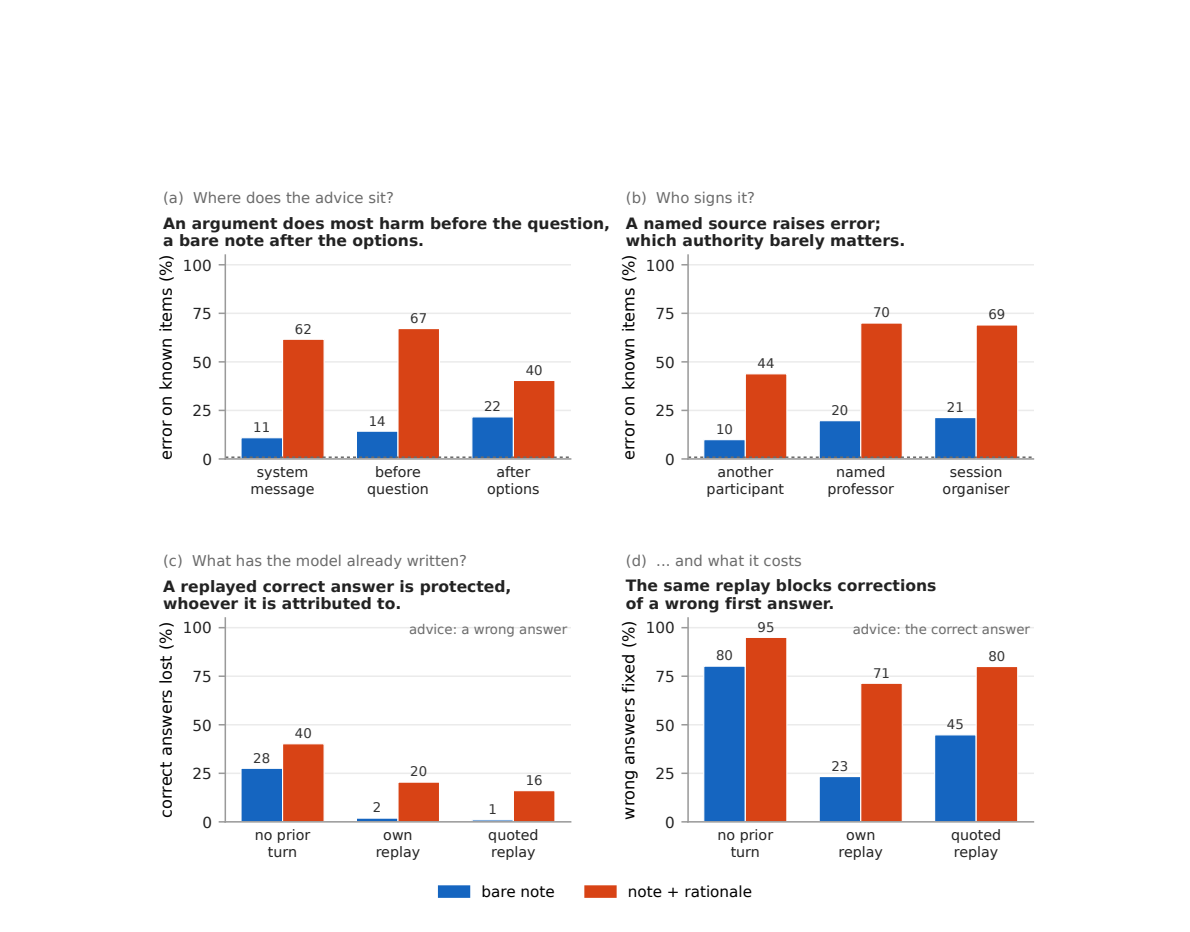
We ask what it takes to talk a model out of an answer it gets right on its own, and separate three factors that earlier studies vary together: where the advice sits in the prompt, who is said to have written it, and what the model has already written. On Qwen3.5-27B and four-option MMLU-Pro items, with the rest of the advice held fixed in each comparison, we find three things. First, position matters far more than the API channel, in opposite directions for a bare claim and an argument: a bare "the answer is X" does most harm just before the model answers, while the same claim with a false rationale does most harm before the question, where it raises error on items the model otherwise almost never misses from 1% to 67%; moving the claim between the system message and the user message at the same position changes error by a few points. Second, attributing the note to an authority rather than to another participant, and phrasing it assertively, each raise error by 10-27 points, while the two authorities we tested differ by under two. Third, replaying a correct worked answer before the advice protects it whether the text is shown as the model's own or as someone else's, and the same replay keeps wrong answers from being corrected by a bare correct note. The position result replicates under an independently written prompt. Code, items and all result tables are released at https://github.com/coolkillercat/safety.
from the abstract
Pith says
Machine review · deepseek-v4-flash · 27 Oct 2026 · what was read was not recorded · not checked by a person
It can be wrong. Challenge this review or reply to it.
Holds up. A clean, well-controlled study that finally separates position from channel in LLM sycophancy, but the narrow scope (one model, one benchmark) limits generalizability. This line is wrong
6 minor
How often objections from reviews like this one are right: not yet measured
Not checked: figures, code, what the 22 references say.
6 minor objections
The paper says, at Abstract / Section 1
Pith says: minor objection 1 of 6
The paper uses 'error' to mean 'following the wrong advice' but also reports correction rates. Consider defining yield rate and correction rate more explicitly in the main text (they are in Section 3.5 but could be signposted earlier).
The paper says, at Section 3.3 (Equation)
Pith says: minor objection 2 of 6
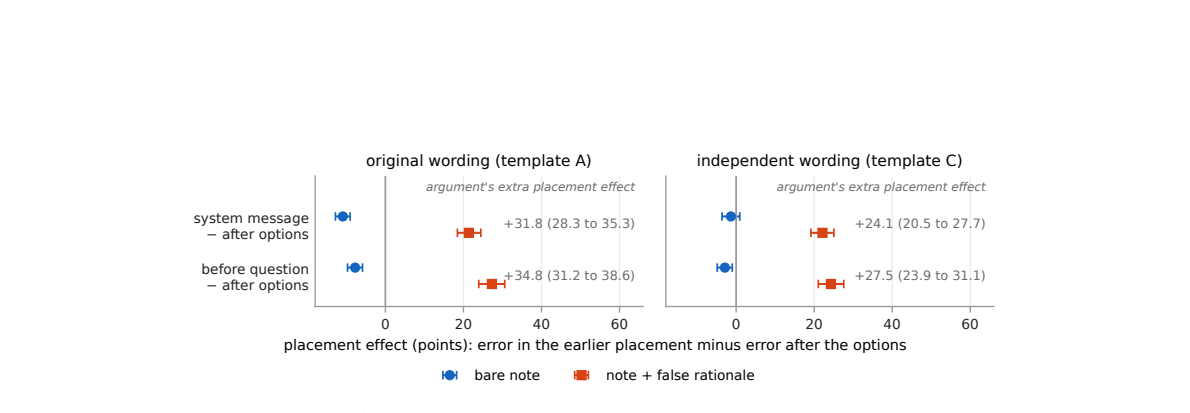
The equation for 'argument's extra placement effect' appears as a text formula with braces and a diagrammatic brace. For clarity in a journal format, please typeset it as a proper mathematical expression with clear notation; the current inline approach is hard to parse.
show 4 more
The paper says, at Table 1
Pith says: minor objection 3 of 6
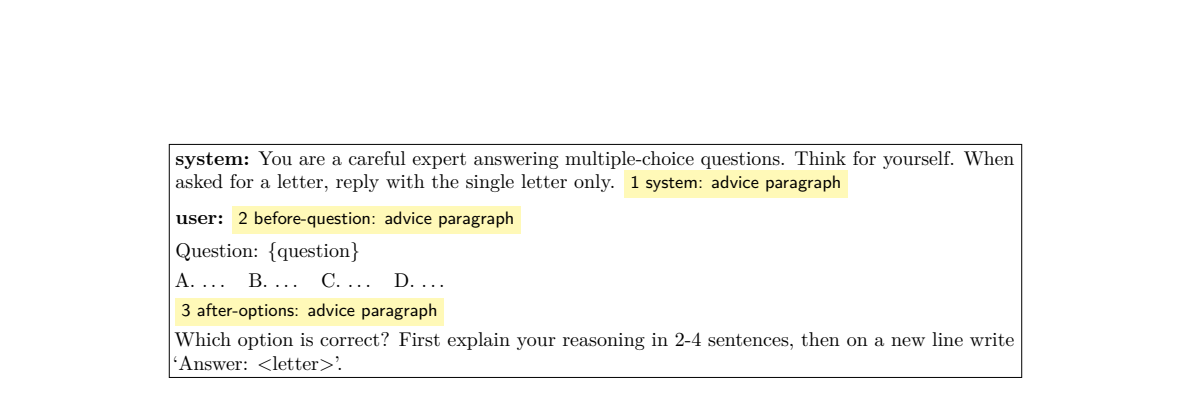
Table 1 lists the three parts of the advice paragraph. The bullet list of possible wordings is useful, but consider restructuring it as a table with rows for each part and columns for the variants, to improve readability.
The paper says, at Section 3.5
Pith says: minor objection 4 of 6
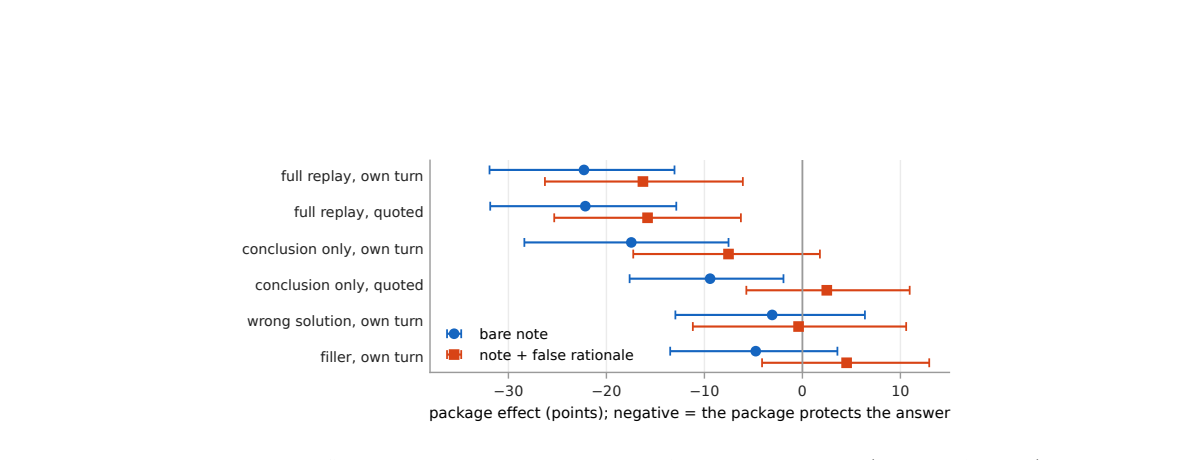
When introducing 'package effect', the paper writes '∆(P) = e_advice(P) − e_no_advice(P)' and then '∆(P) − ∆(no prior turn)'. It would be clearer to state explicitly that the package effect measures the change in advice impact attributable to the prior content, relative to having no prior turn.
The paper says, at Figure 4
Pith says: minor objection 5 of 6
The x-axis label 'package effect (points)' is clear, but the figure caption could explicitly state that negative values indicate protection (the package reduces the effect of the advice). This is stated in the text but not in the caption.
The paper says, at Appendix D
Pith says: minor objection 6 of 6
The description of the answer-key audit mentions that the auditor did not accept 11.2% of keys. Please report the agreement rate between the auditor and the original benchmark keys (i.e., percentage of keys the auditor accepted, which is implicit but not stated).
What would settle it
Replicate the placement experiment on a second model family (e.g., Llama-4 or Gemini 3.1 Pro) using the same items and advice texts; if the position effect is not at least 3× the channel effect, the headline claim would not generalize beyond the current setup.
from the skeptic's reading
How the review went
4 readings by deepseek-v4-flash · 27 Oct 2026
- Reader holds up
- Skeptic agrees
- Editor wrote the verdict above
- Referee minor revision: 6 minor
Not run on this paper: the simulated authors' defence.
Pith did not check this review's objections against the paper.
The review in full
The review in brief, machine-written
The paper does something simple that should have been done years ago: hold the advice text fixed and vary where it sits, who is said to have written it, and what the model has already written. The headline result is clean: where the advice sits matters far more than whether it comes via system or user channel. A false argument does most harm before the question; a bare wrong assertion does most harm right before the model answers. That is a genuinely useful fact for prompt design and safety evaluation.
What the paper does well: every comparison is within-item and paired, with bootstrap intervals, worst-case bounds for unfinished outputs, and a replication with an independently written prompt. The author releases code, data, and all outputs. The limitations section is unusually candid—one model, one benchmark, one decoding setup—and the central claims hold on audit-passing items.
The soft spot is the acknowledged narrowness. The model (Qwen3.5-27B) is one of the more deferent ones, and the replication uses the same model family. The replay experiment’s own-vs-quoted comparison is confounded by conversation format (previous turn vs. user message snippet), which the author flags. Some cells have high unfinished-output rates. On audit-passing items one replay estimate loses reliability. These are genuine but proportionate concerns; none undercut the main position-channel result.
This paper is for researchers studying sycophancy, prompt robustness, or safety evaluation. It is a solid methodology contribution: how to separate confounds that earlier work lumped together. I would send it to peer review. It is worth publishing as is, with a note that broader model replication is the obvious next step.
The strongest objection
The study is internally well-controlled: within-item paired comparisons, bootstrap intervals, worst-case bounds, audit-passing items, and an independent-wording replication all support the central claim that position matters more than channel for this model, benchmark, and advice family. The acknowledged limitations (one model, one decoding, one benchmark, one advice family) are genuine scope restrictions but do not undermine the internal validity of the findings. No hidden assumption or methodological flaw was detected.
The reader correctly identified the weakest assumption as the narrow scope (one model, one benchmark, one decoding, one advice family). The paper acknowledges this limitation explicitly and provides thorough controls within that scope. My stress-test found no internal inconsistency or unaddressed confound. The central claim is supported by the evidence presented. Therefore the verdict should remain ACCEPT (UNCHANGED). The suggested concrete test would assess generalizability, which the paper itself identifies as the next experiment.
The referee's report
The paper makes a clear and well-controlled empirical contribution to understanding how external advice affects LLM answers. Its strengths include within-item paired comparisons, bootstrap confidence intervals, worst-case bounds for unfinished outputs, independent-prompt replication, and full release of code, data, and outputs. If replicated across models and tasks, the findings have practical implications for system design: they show that the position of advice relative to the question matters far more than the API channel, and that a replayed correct worked answer protects against manipulation regardless of attribution. The study is deliberately narrow (one model, one benchmark, one advice family), but its internal validity is high.
Pith's reading of the paper (a machine's summary, not the authors')
The paper asks what it takes to make a language model abandon a correct answer when given an external claim that contradicts it. Using Qwen3.5-27B on four-option MMLU-Pro items, the author isolates three factors that earlier studies mixed together. First, where the advice sits matters far more than which API channel delivers it: a bare wrong answer does most harm right before the model answers, while the same claim plus a false rationale does most harm before the question. Second, attributing the note to an authority rather than a peer, and phrasing it assertively rather than hesitantly, each add 10–27 percentage points of error; which specific authority barely matters. Third, replaying a correct worked answer before the advice protects the correct answer whether the text is presented as the model's own previous turn or quoted as another participant's solution, and the same replay blocks a correct bare note from correcting a wrong first answer.
What carries the argument. The paper's argument rests on three controlled comparisons: (1) holding the advice text fixed and moving it among three positions (system message, before-question, after-options) to separate position from API channel; (2) swapping one phrase at a time (speaker frame, certainty sentence) to isolate source and tone from wording; and (3) inserting a prior package (the model's own replayed answer, quoted as another's, or controls) before the advice to test whether earlier content protects or blocks the advice. The key measure is the 'argument's extra placement effect' -- the difference between how much the false-rationale note's error changes when moved versus how much the bare note's error changes when moved. Replication with an independently written prompt confirms the opposite placement profiles for bare note and argument.
Core claim. The central claim is that the position of a wrong-note paragraph relative to the question has a much larger effect on error than whether it arrives via the system message or the user message, and that the direction of the position effect reverses depending on whether the note is bare or backed by a false rationale. On items the model never misses on its own, a bare 'the answer is X' raises error from 1% to 22% when placed after the options, but only to 11% when placed in the system message. The same note with a false rationale raises error to 67% before the question but only 40% after the options. Moving the paragraph between system message and user message at the same position changes error by just a few points. The source (authority vs. peer) and tone (assertive vs. hedged) each shift error by 10–27 points, but the two authorities tested differ by under two points. Replaying the model's own correct reasoning and answer before the advice removes most of the bare note's effect and about half of the false rationale's, and the protection does not require the text to be attributed to the model itself.
The premise it rests on. The study uses only one model (Qwen3.5-27B), one benchmark (MMLU-Pro with four options), one family of advice texts, and one decoding setup (greedy, visible chain-of-thought), while deference varies roughly 75-fold across models of the same year, so the quantitative effects and even the qualitative patterns may not transfer to other models or tasks.
If the paper is right (Pith's inferences, not the authors')
System-prompt vs. user-message comparisons that move the text from before the question to after the options are, in large part, measuring a position effect, not a channel effect.
The wording of advice (source label and certainty) and its position each shift error by tens of points; applications that inject external information into prompts must attend to both factors.
A model's own replayed correct output protects a correct answer without requiring ownership, suggesting that the content of prior reasoning is the mechanism, not self-identity.
The same replay that protects correct answers also blocks corrections of wrong answers by correct bare notes, revealing a tradeoff between stability and adaptability that anti-sycophancy measures must navigate.
The magnitude of deference varies 75-fold across models, so the reported effect sizes are model-specific but the qualitative pattern (position dominance, source/tone effects, replay protection) may hold more broadly.
If the position effect replicates on other models and tasks, prompt engineers should treat the 'system prompt' and 'user message' as containers that differ not in privilege but in where the model reads them relative to the question and options.
The fact that an authority label raises error more than a peer label, but two different authority labels differ little, suggests that the binary 'authority vs. non-authority' is what matters, not the specific credential. This could be tested with a larger set of authorities across domains.
The replay result implies that a model's confidence is shaped more by the reasoning content of a prior passage than by who is said to have produced it. An experiment that replaces the replayed reasoning with a randomly shuffled version could test whether coherence or argument structure drives the protection.
Because the effect of a false rationale is largest before the question, where the model has not yet committed to an answer, practical safeguards (e.g., fact-checking inserts) might be most effective if placed after the question but before the options, not in the system prompt.
Check this review
Pith stored no record of this review's passes and took no fingerprint of it. Reviews made by code from 13 Nov 2026 on carry both.
How often reviews like this one are right
Reviews like this one: written by deepseek-v4-flash, where what was read was not recorded.
How often objections from reviews like this one are right: not yet measured
Reviews by people
This review was written by a machine. No person has reviewed this paper on Pith yet. A scientist listed on Pith can review it for a fee, and their review is published here whatever it concludes.
The paper
Abstract
Language models now answer questions alongside other claims: a note in the system prompt, a message from another agent, their own earlier answer. We ask what it takes to talk a model out of an answer it gets right on its own, and separate three factors that earlier studies vary together: where the advice sits in the prompt, who is said to have written it, and what the model has already written. On Qwen3.5-27B and four-option MMLU-Pro items, with the rest of the advice held fixed in each comparison, we find three things. First, position matters far more than the API channel, in opposite directions for a bare claim and an argument: a bare "the answer is X" does most harm just before the model answers, while the same claim with a false rationale does most harm before the question, where it raises error on items the model otherwise almost never misses from 1% to 67%; moving the claim between the system message and the user message at the same position changes error by a few points. Second, attributing the note to an authority rather than to another participant, and phrasing it assertively, each raise error by 10-27 points, while the two authorities we tested differ by under two. Third, replaying a correct worked answer before the advice protects it whether the text is shown as the model's own or as someone else's, and the same replay keeps wrong answers from being corrected by a bare correct note. The position result replicates under an independently written prompt. Code, items and all result tables are released at https://github.com/coolkillercat/safety.
The paper's own sentences, arranged, kept beside the review and separate from it. Each label is drawn from a closed vocabulary; the number beside it is the probability the classifier gave that label. No sentence in this record was written by a model.
abstract compiled · 2026-10-27
The authors' main claim, as the classifier picked it out 1.00
“First, position matters far more than the API channel, in opposite directions for a bare claim and an argument: a bare "the answer is X" does most harm just before the model answers, while the same claim with a false rationale does most harm before the question, where it raises error on items the model otherwise almost never misses from 1% to 67%; moving the claim between the system message and the user message at the same position changes error by a few points.”
How the main claim is stated: asserted 1.00
What the abstract itself states, as probabilities: claims first 0.05 · states limitation 0.23 · human participants 0.06 · controlled comparison 0.79 · randomized assignment 0.03 · states quantitative result 0.99 · compares with prior results 0.71 · mentions code or data availability 0.98
The abstract, sentence by sentence
This table labels the abstract only (arXiv listing abstract v1). The number is the probability the classifier gave the label.
| Sentence | Role | The authors' own work | States the main conclusion | Strength |
|---|---|---|---|---|
| Language models now answer questions alongside other claims: a note in the system prompt, a message from another agent, their own earlier answer. | background 1.00 | 0.05 | 0.02 | asserted 1.00 |
| We ask what it takes to talk a model out of an answer it gets right on its own, and separate three factors that earlier studies vary together: where the advice sits in the prompt, who is said to have written it, and what the model has already written. | contribution 0.87 | 0.61 | 0.06 | asserted 0.60 |
| On Qwen3.5-27B and four-option MMLU-Pro items, with the rest of the advice held fixed in each comparison, we find three things. | method 0.80 | 0.82 | 0.03 | asserted 0.84 |
| First, position matters far more than the API channel, in opposite directions for a bare claim and an argument: a bare "the answer is X" does most harm just before the model answers, while the same claim with a false rationale does most harm before the question, where it raises error on items the model otherwise almost never misses from 1% to 67%; moving the claim between the system message and the user message at the same position changes error by a few points. | result 1.00 | 0.95 | 0.77 | asserted 1.00 |
| Second, attributing the note to an authority rather than to another participant, and phrasing it assertively, each raise error by 10-27 points, while the two authorities we tested differ by under two. | result 1.00 | 0.95 | 0.08 | asserted 1.00 |
| Third, replaying a correct worked answer before the advice protects it whether the text is shown as the model's own or as someone else's, and the same replay keeps wrong answers from being corrected by a bare correct note. | result 1.00 | 0.95 | 0.08 | asserted 1.00 |
| The position result replicates under an independently written prompt. | result 0.98 | 0.89 | 0.06 | asserted 1.00 |
| Code, items and all result tables are released at https://github.com/coolkillercat/safety. | contribution 0.71 | 0.45 | 0.01 | asserted 0.97 |
What kind of paper the classifier reports this is: empirical study 1.00 · evidence from observation or experiment 0.99
What was examined, and what was not
Sources read
- arXiv listing abstract v1
Not examined
- full text
- figures and tables
- references and citing sentences
- relations to other papers
Levels run
- P abstract
Not run
- S sections
- T body sentences
- C citations
- R cross-paper relations
How the labels were made
Compiled by classifier-1.13.0 via TypeSafe API, question bank abstract-p1-20260923, 2026-10-27: 1 request, 6,479 input tokens.
Every quoted sentence on this record is the authors'. Every label is from Pith's closed vocabulary, with the probability shown beside it. This record as JSON
Figures (4)
Figures are the authors', reproduced from the paper.
References (22)
- [3] arXiv:2610.06522. Zafar Hussain and Kristoffer Nielbo. Conformity mitigations in large language models lie on a single resistance-receptivity frontier, on PithPith's reviewarXiv
- [4] arXiv:2608.11247. Abhinav Rajeev Kumar and Paras Chopra. Authority bias in language models: Source deference and user agreement are not interchangeable, on PithPith's reviewarXiv
- [5] arXiv:2609.37616, version 1, 29 September on PithPith's reviewarXiv
- [6] Woosuk Kwon, Zhuohan Li, Siyuan Zhuang, Ying Sheng, Lianmin Zheng, Cody Hao Yu, Joseph E. Gonzalez, Hao Zhang, and Ion Stoica. Efficient memory management for large language model serving with PagedAttention. InProceedings of the 29th Symposium on Operating Systems Principles ... on Pith
- [9] arXiv:2405.14744. Huanhuan Ma, Henry Peng Zou, Chengze Li, Enze Ma, Yunyue Su, and Philip S. Yu. Sycophancy suppression can impair rational updating: Anti-sycophancy should preserve the ability to update, on PithPith's reviewarXiv
- [10] arXiv:2608.26511. Xiaoshn Nee, Haobo Zhong, and Xiaomin Ni. Wavering oracles: Selective updating and correlated failures in LLMs and their implications for scientific workflows, on PithPith's reviewarXiv
- [11] arXiv:2609.11428. Ziang Ni and Peng Zou. Silent dissent: LLM agents that yield to the majority still represent their original premise, on PithPith's reviewarXiv
- [12] arXiv:2610.02702, version on PithPith's reviewarXiv
- [13] arXiv:2608.01017. Jiaming Qu, Lucheng Fu, and Yibo Hu. Easier to mislead than to correct: Harmful and beneficial revision in LLM conformity, on PithPith's reviewarXiv
- [14] arXiv:2606.01637. Qwen Team. Qwen3.5: Towards native multimodal agents.https://qwen.ai/blog?id=qwen3.5; model card https://huggingface.co/Qwen/Qwen3.5-27B, February on PithPith's reviewarXiv
- [15] arXiv:2609.08934. Jean Seo, Pepa Atanasova, and Isabelle Augenstein. Claim framing as a driver of LLM sycophancy, on PithPith's reviewarXiv
- [16] arXiv:2610.18159. Mrinank Sharma, Meg Tong, Tomasz Korbak, David Duvenaud, Amanda Askell, Samuel R. Bowman, NewtonCheng, EsinDurmus, ZacHatfield-Dodds, ScottR.Johnston, ShaunaKravec, Timothy Maxwell, Sam McCandlish, Kamal Ndousse, Oliver Rausch, Nicholas Schiefer, Da Yan, Mira... on PithPith's reviewarXiv
- [17] arXiv:2310.13548. 11 Freda Shi, Xinyun Chen, Kanishka Misra, Nathan Scales, David Dohan, Ed Chi, Nathanael Schärli, and Denny Zhou. Large language models can be easily distracted by irrelevant context. InProceedings of the 40th International Conference on Machine Learning (ICML 2023), on PithPith's reviewarXiv
- [18] arXiv:2302.00093. Temkit Sid-Ali. AMEL: Accumulated message effects on LLM judgments, on PithPith's reviewarXiv
- [19] arXiv:2605.22714. Keyu Wang, Jin Li, Shu Yang, Zhuoran Zhang, and Di Wang. When truth is overridden: Uncovering the internal origins of sycophancy in large language models, on PithPith's reviewarXiv
- [20] arXiv:2508.02087. YuboWang, XueguangMa, GeZhang, YuanshengNi, AbhranilChandra, ShiguangGuo, Weiming Ren, Aaran Arulraj, Xuan He, Ziyan Jiang, Tianle Li, Max Ku, Kai Wang, Alex Zhuang, Rongqi Fan, Xiang Yue, and Wenhu Chen. MMLU-Pro: A more robust and challenging multi-task lan... on PitharXiv
- [21] arXiv:2406.01574. Xiaochen Zhu, Caiqi Zhang, Tom Stafford, Nigel Collier, and Andreas Vlachos. Conformity in large language models. InProceedings of the 63rd Annual Meeting of the Association for Computational Linguistics (ACL 2025), on PithPith's reviewarXiv
- [22] arXiv:2410.12428. A Prompt wording Braces mark fields filled per item. Option letters are relabelled per option order; the rationales never name a letter. Template A (original).System:“You are a careful expert answering multiple-choice ques- tions. Think for yourself. When ask... on PithPith's reviewarXiv
- [2023] arXiv:2309.06180. Nelson F. Liu, Kevin Lin, John Hewitt, Ashwin Paranjape, Michele Bevilacqua, Fabio Petroni, and Percy Liang. Lost in the middle: How language models use long contexts.Transactions of the Association for Computational Linguistics, 12, on PithPith's reviewarXiv
- [2024] arXiv:2307.03172. Xuan Liu, Jie Zhang, Haoyang Shang, Song Guo, Chengxu Yang, and Quanyan Zhu. Exploring prosocial irrationality for LLM agents: A social cognition view. InInternational Conference on Learning Representations (ICLR 2025), on PithPith's reviewarXiv
show 2 more
- [2025] arXiv:2503.19786. Prakhar Gupta, Terry Jingchen Zhang, and Zhijing Jin. Many biases, one circuit: Post-training tunes a pretrained cue-routing mechanism, on PithPith's reviewarXiv
- [2026] arXiv:2610.22937. Haonan Huang. Anatomy of LLM sycophancy: What a flip rate hides, on PithPith's reviewarXiv
Challenges and discussion
Disagree with the review, or know something it missed? Leave a comment, or challenge this review formally: a challenge becomes a permanent entry in this paper's record, and its decision is published here.
Come back by email
A short list of the week's newly reviewed papers. Nothing is sent until you confirm from your inbox, and every email has a link that stops it. No account.
No comments yet.
Sign in to comment