Artificial Intelligence · arXiv:2609.39392 v1 · submitted 30 Sep 2026 · 13 references
Experimental Experience Modeling for Autonomous Research
The paper says
“Autonomous research agents can generate hypotheses and conduct experiments, but experimentation remains a major source of computational cost. A fundamental challenge is deciding which experiments are worth running, particularly when prior evidence is insufficient to resolve uncertainty.”
more of the abstract
Yet current research agents lack a systematic way to leverage experimental experience when making such decisions. We introduce Experimental Experience Modeling (EEM), a framework for making informed experimental decisions by acquiring, reusing, and accumulating experimental experience. EEM extracts decision-relevant records from earlier experimental trajectories, distills them into reusable experience, and organizes them in an experience library. For a new experimental decision, EEM retrieves relevant historical experience and assesses whether it provides sufficient support for deciding whether a candidate direction warrants further investment. When historical experience is insufficient, EEM conducts a targeted, low-cost pilot experiment to acquire the missing decision-relevant experience on demand. It then combines this newly acquired experience with retrieved historical experience to determine whether the direction warrants full-scale evaluation, which requires substantial resources. The resulting experimental outcomes are further distilled into reusable experience, allowing the library to continually grow through iterative accumulation. Experiments on autonomous research benchmarks show that EEM improves research performance while reducing model interaction overhead, demonstrating the value of reusing accumulated experience and acquiring additional experience only when needed.
from the abstract
Pith says
Machine review · deepseek-v4-flash · 1 Oct 2026 · what was read was not recorded · not checked by a person
It can be wrong. Challenge this review or reply to it.
Holds up, with conditions. The EEM mechanism is a sensible, clean addition to the experience-reuse line, but the headline 13.1% gain is not statistically secured as reported. This line is wrong
4 major objections · 4 minor
How often objections from reviews like this one are right: not yet measured
Not checked: figures, code, what the 13 references say.
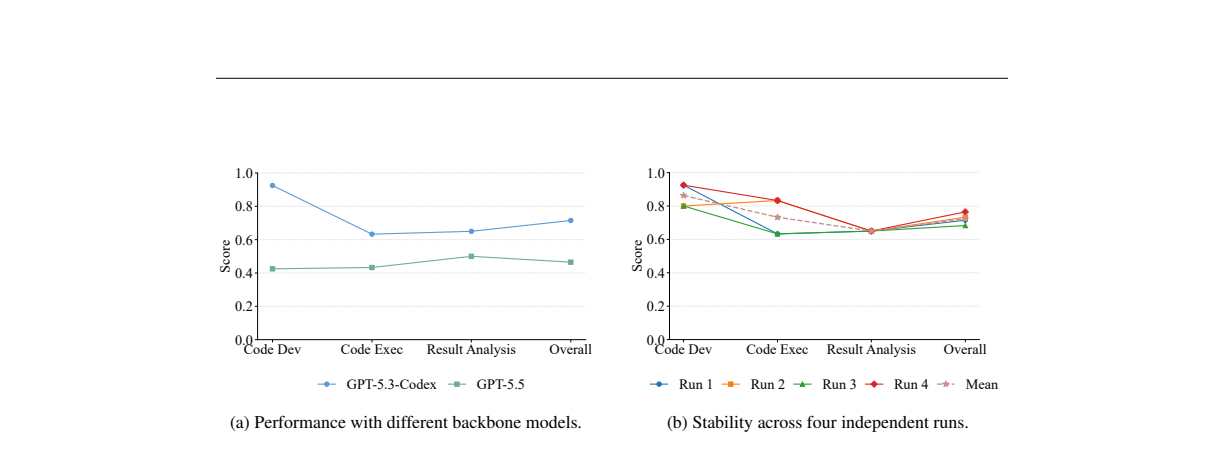
The paper says, at Section 3.2, Table 1; Section 3.6, Figure 2(b)
The review did not quote this passage.
Pith says: Objection 1 of 4 · major
The central comparative claim, stated in the abstract and Section 3.2 (sentences b9 and b36), is not statistically supported as reported. As written, the main comparison gives one overall score per framework, with no variance for AutoResearchClaw and no per-topic breakdown; repeated-run variability is reported only for EEM on the single task ML10 (Section 3.6), with an overall range of approximately 0.68–0.77.
more of objection 1
Without standard errors, confidence intervals, or a paired test over the 25 topics, the 13.1% overall advantage and the 31.7% result-analysis advantage cannot be distinguished from run-to-run noise. This is load-bearing because the paper's core claim is exactly this comparative improvement. The paper should report topic-level scores, dispersion measures, and a paired significance test or confidence interval for the Table 1 comparison.
The paper says, at Section 3.1 and Section 3.2, Table 1
The review did not quote this passage.
Pith says: Objection 2 of 4 · major
The result-analysis metric, which contributes the largest part of EEM's advantage, is scored by an LLM evaluator against benchmark rubrics. Because EEM's writing explicitly frames results as decision implications and experience-grounded conclusions, its output format may satisfy the RA rubric more readily than baseline outputs do, independent of any underlying improvement in experimental practice.
more of objection 2
The paper does not analyze this output-structure bias: there is no scoring of baseline outputs rewritten in EEM's format, no blinded or human-evaluated subset, and no topic-level inspection of which rubric items drive the RA gain. A concrete check would be to score baseline outputs reformatted to EEM's structure and compare the RA gain under that condition. Without such evidence, the headline RA improvement should be treated as potentially inflated.
The paper says, at Section 2.3, Eq. (3)
The review did not quote this passage.
Pith says: Objection 3 of 4 · major
The reuse-versus-pilot decision depends entirely on the sufficiency judgment h_t(d) returned by Assess, but no evidence is presented that this judgment is reliable. The same LLM distills the experience and grades its sufficiency, and there is no ground-truth calibration: the paper does not report how often sufficiency is asserted, whether those assertions correlate with downstream pilot or full-scale outcomes, or what happens under systematic over- or under-use of pilots.
more of objection 3
If the gate is miscalibrated in either direction, EEM either wastes tokens on unnecessary pilots or commits full-scale resources on unsupported evidence, eroding both claimed benefits. This concern is mechanism-level and an imperfect gate would not automatically invalidate the aggregate comparison, but the framework's design makes the gate central, so gate-level statistics and a sensitivity analysis should be reported.
The paper says, at Section 3.4, Table 3
The review did not quote this passage.
Pith says: Objection 4 of 4 · major
The ablation attribution is also based on the same unreplicated design. In particular, the difference between full EEM and the variant without experience distillation is only 0.025 in overall score (0.674 versus 0.649), and no variance is reported for any ablation variant.
more of objection 4
The conclusion that the three components make complementary contributions is therefore stronger than the reported evidence; the ablations need the same per-topic scoring, dispersion measures, and pairwise testing as the main comparison before their relative contributions can be accepted.
4 minor objections
The paper says, at Section 3.6, Figure 2(b)
Pith says: minor objection 1 of 4
The text states that result analysis remains unchanged across the four ML10 runs, but the figure does not give the per-run component scores in numeric form; adding those values would let readers verify the claimed stability directly.
The paper says, at Table 2
Pith says: minor objection 2 of 4
The token-consumption comparison reports per-stage averages over 25 topics without any dispersion; since the central efficiency claim is an 11.4% reduction, reporting topic-level standard deviations or at least a distribution of total tokens would substantially strengthen the result.
show 2 more
The paper says, at Eq. (1) and surrounding text
Pith says: minor objection 3 of 4
The text repeatedly refers to 'Eq. equation 1' where 'Eq. (1)' is meant; the duplicated token appears to be a rendering artifact and should be corrected in the final version.
The paper says, at Section 3.5, Figure 2(a)
Pith says: minor objection 4 of 4
The cross-backbone comparison is performed on a single task and is explicitly illustrative; the paper should state more directly that this is a single-case demonstration rather than evidence of general backbone applicability.
What would settle it
Re‑run EEM and AutoResearchClaw on all 25 ARC‑Bench topics with at least 5 independent seeds each, recording per‑topic overall scores. Compute the distribution of the EEM−AutoResearchClaw difference and test significance with a paired bootstrap or a Wilcoxon signed‑rank test at the topic level. Independently, take a stratified random sample of the generated manuscripts from both systems and have a second evaluator (a different LLM prompt or a human expert) re‑score them; measure inter‑evaluator agreement and check whether the EEM advantage in result analysis persists under the alternative evaluator.
from the skeptic's reading
How the review went
4 readings by deepseek-v4-flash · 1 Oct 2026
- Reader holds up, with conditions
- Skeptic partly agrees
- Editor wrote the verdict above
- Referee major revision: 4 major objections, 4 minor
Not run on this paper: the simulated authors' defence.
Pith did not check this review's objections against the paper.
The review in full
The review in brief, machine-written
The real contribution here is the sufficiency gate (Eq. 3), which is genuinely different from the reflexion-and-replay baselines: it makes an explicit stop-versus-acquire decision before committing to a pilot or full-scale run. The record–lesson representation in Eq. 1, bundling applicability conditions, empirical finding, and decision implication, is a tidy way to make experience reusable rather than merely stored. The ablations are the strongest part of the paper — removing the library, the pilots, and the distillation each degrades the score in an order that matches the design story, and the numbers are clean enough that the decomposition is believable. The token counts are directly measured, not fitted, so the 11.4% efficiency claim stands on its own regardless of how the gate performs.
Now the soft spots, in proportion. The central weakness is statistical. The headline comparison is one run per topic across 25 tasks, with no variance reported for the baseline or for most topics; the only stability check, on ML10, shows a four-run range of 0.68–0.77. That spread is the same size as the claimed gain (0.674 vs 0.596). I don't think that proves the gain is noise, but it does mean the paper currently gives us no way to rule it out, and for a comparative claim that's load-bearing. Second, result analysis carries 50% of the overall weight and shows the biggest jump (31.7%), yet it is scored by an LLM rubric that EEM's outputs — structured, implication-stated, experience-grounded — are arguably tailored to satisfy. No test for evaluator bias toward the framework's output format is reported. That concern is real but my read is that it inflates the RA number somewhat, not that it manufactures the whole gain, given the code-execution improvement is on a more objective metric. Third, the gate is self-assessed by the same model that distills the experience, with no calibration, but I'd note the efficiency claim survives that since tokens are measured directly. No code or prompts are released, so nothing is independently checkable.
The paper is honest about its limits — intra-task-only experience, backbone sensitivity, cross-task transfer deferred — and those are stated, not hidden. No internal contradiction I can find.
I agree with the reader's CONDITIONAL verdict, and I think the stress-test concern holds up on reading. Send it to peer review; a good referee should demand per-topic breakdowns, variance on both frameworks, and a serious look at the LLM-evaluator bias. If those hold under scrutiny, this is a solid within-subfield result. For a reading group comparing experience-reuse architectures, it's a good session. I'd cite it the next time I write about sufficiency-gated decision making in research agents.
The strongest objection
The central claim is a comparative performance gain: EEM beats AutoResearchClaw by 13.1% overall and 31.7% on result analysis (Table 1). That claim rests on a single run per topic for all 25 ARC-Bench tasks (Section 3.2). Section 3.6 reports stability for EEM only, on the single task ML10, across four runs (overall range 0.68–0.77); no variance is given for the other topics, and no variance is given for AutoResearchClaw at all. The overall score is a weighted average of three metrics each scored by an LLM evaluator (Section 3.1). If that evaluator is biased toward outputs that follow EEM's structured, experience‑grounded formatting (e.g., because the rubric is more easily satisfied by explicitly stated decision implications), the result‑analysis gain could be inflated independently of the framework's actual experimental value. Without a statistical test, a confidence interval, or a topic‑level breakdown, the reported improvement may lie within run‑to‑run noise. This is load‑bearing because the paper's core claim is precisely this comparative gain; if the gain is not statistically distinguishable from chance, the framework's practical benefit is unestablished. The sufficiency‑gate calibration raised by the reader is a mechanism‑level concern: even if the gate (Eq. 3) is imperfect, the aggregated empirical comparison could still be correct. Conversely, a perfectly calibrated gate cannot rescue a headline difference that vanishes under proper error analysis.
The reader's CONDITIONAL verdict already flags the lack of variance and the unaddressed LLM evaluator bias, though it identifies the sufficiency gate as the weakest assumption. I agree that the gate calibration is a real concern, but I consider the statistical reliability of the headline comparison to be more load‑bearing: it is the direct support for the abstract's central claim, and a single pass over 25 topics with no error bars leaves the 13.1% gain unsecured. The concrete test I propose would settle whether the gain is real and whether the evaluator drives it. My verdict remains CONDITIONAL (not REJECT), because the design is coherent and the reported numbers, if statistically robust, would support the claim. I therefore leave the reader's verdict unchanged while sharpening the reason for conditionality.
The referee's report
If the reported numbers are reliable, EEM is a useful and fairly clean recipe: distilled, decision-oriented experience plus sufficiency-gated pilots improves an external autonomous-research benchmark while lowering token use. The main strengths are the explicit record–lesson representation, the evaluation on an external benchmark rather than self-reported success, the ablation experiments separating experience distillation, pilot acquisition, and historical reuse, and the concrete token-consumption comparison. The principal weakness is statistical: the headline comparative claims and the component attributions are built on unreplicated or thinly replicated runs, with variance reported for only one task and one framework, and the result-analysis metric is scored by an LLM that may favor EEM's structured output format. The sufficiency gate is the conceptual load-bearing assumption of the framework and is not calibrated or audited.
Pith's reading of the paper (a machine's summary, not the authors')
Autonomous research agents spend most of their compute on experiments, and decide which experiments to run with little memory of what past runs already established. This paper introduces Experimental Experience Modeling (EEM), which turns earlier experimental trajectories into reusable decision lessons stored in an experience library. When a candidate direction arises, EEM retrieves relevant lessons, judges whether they are sufficient to justify a pursue, revise, or reject call, and only when they are not does it run a cheap targeted pilot before committing to a full-scale experiment. On the 25-topic ARC-Bench benchmark, EEM scores 0.674 overall versus 0.596 for the strongest baseline, a 13.1% gain, while consuming 11.4% fewer tokens per topic. The result matters because it suggests that treating "is this experiment worth running" as a reusable, accumulating skill both improves outcomes and lowers cost.
What carries the argument. The load-bearing object is the experience item $e_i = (r_i, \ell_i)$: a source record of an experimental trajectory paired with a distilled natural-language lesson. The lesson carries three parts: applicability conditions, the empirically supported finding, and the decision implication for further investment. At decision time, the sufficiency gate $h_t(d) = \mathrm{Assess}_\theta(s_t, d, K, R_t(d))$ (Eq. 3) decides whether retrieved historical experience is enough to pursue, revise, or reject the candidate direction; when $h_t = 0$, EEM designs a low-cost pilot targeting only the unresolved decision-critical uncertainty, then combines pilot experience with historical experience (Eq. 4) before committing full-scale resources. The loop closes by feeding pilot and full-scale outcomes back through the same extraction procedure into the library (Eq. 5), so experience accumulates across rounds within a task.
Core claim. The paper claims that reusing distilled experimental experience, gated by an explicit sufficiency judgment, lets an autonomous research agent decide better and cheaper than agents that only reflect on their own recent attempts. On ARC-Bench, EEM raises the overall score by 13.1% over AutoResearchClaw, the strongest evaluated baseline, with the largest relative gain (31.7%) in result analysis, the metric that checks whether conclusions are supported by observed results. At the same time, average token consumption falls by 11.4%, with the biggest drop (18.4%) in the experimentation stage. Ablations support the mechanism: removing the historical experience library lowers overall to 0.506, disabling on-demand pilots lowers it to 0.565, and keeping raw records without distilling them into lessons lowers it to 0.649. The authors read these numbers as end-to-end evidence that reusable historical experience and targeted on-demand acquisition make complementary contributions.
The premise it rests on. The central claim collapses if the model cannot reliably judge whether retrieved historical experience is sufficient for the current investment decision, since that sufficiency gate decides when pilots are run and when full-scale commitments happen, yet no ground-truth calibration of the gate is reported and the same model that distills the experience also grades its sufficiency.
If the paper is right (Pith's inferences, not the authors')
On ARC-Bench, EEM's 13.1% overall gain over the strongest baseline, with result analysis up 31.7%, shows that experience reuse most helps the part of the loop that checks whether conclusions follow from observed results.
The 11.4% drop in average token consumption, largest in experimentation at 18.4%, means the reuse-and-pilot recipe is cheaper than recomputing evidence from scratch.
The ablations attribute the gain to both components, so neither full reuse nor on-demand pilots alone reproduces the result: removing the library drops overall to 0.506 and removing pilots drops it to 0.565.
Distilling records into lessons (0.649 without distillation) adds value over storing raw trajectories, so the form of the memory matters, not just its presence.
EEM runs on both a coding-oriented and a general-purpose backbone with limited run-to-run variation, indicating the mechanism transfers across models at least within the evaluated task.
Because the sufficiency gate is never calibrated against ground truth, the honest reading is that the mechanism benefits from the same model grading its own confidence; validating the gate on held-out decisions with known outcomes would tell whether the savings generalize beyond the 25 ARC-Bench topics.
The 120-second pilot cap means the reported token savings depend on pilots staying far cheaper than full-scale runs; a gate that over-pilots would erase the cost benefit, while a gate that under-pilots would risk unsupported full-scale commitments, a trade-off worth probing by varying the pilot budget.
The authors leave cross-task experience transfer to future work, but their library formulation already permits warm-starting $E_0$; if the sufficiency gate held up across tasks, experience could compound across studies rather than only within a run, which is where the largest real-world savings would lie.
Check this review
Pith stored no record of this review's passes and took no fingerprint of it. Reviews made by code from 13 Nov 2026 on carry both.
How often reviews like this one are right
Reviews like this one: written by deepseek-v4-flash, where what was read was not recorded.
How often objections from reviews like this one are right: not yet measured
Reviews by people
This review was written by a machine. No person has reviewed this paper on Pith yet. A scientist listed on Pith can review it for a fee, and their review is published here whatever it concludes.
The paper
Abstract
Autonomous research agents can generate hypotheses and conduct experiments, but experimentation remains a major source of computational cost. A fundamental challenge is deciding which experiments are worth running, particularly when prior evidence is insufficient to resolve uncertainty. Yet current research agents lack a systematic way to leverage experimental experience when making such decisions. We introduce Experimental Experience Modeling (EEM), a framework for making informed experimental decisions by acquiring, reusing, and accumulating experimental experience. EEM extracts decision-relevant records from earlier experimental trajectories, distills them into reusable experience, and organizes them in an experience library. For a new experimental decision, EEM retrieves relevant historical experience and assesses whether it provides sufficient support for deciding whether a candidate direction warrants further investment. When historical experience is insufficient, EEM conducts a targeted, low-cost pilot experiment to acquire the missing decision-relevant experience on demand. It then combines this newly acquired experience with retrieved historical experience to determine whether the direction warrants full-scale evaluation, which requires substantial resources. The resulting experimental outcomes are further distilled into reusable experience, allowing the library to continually grow through iterative accumulation. Experiments on autonomous research benchmarks show that EEM improves research performance while reducing model interaction overhead, demonstrating the value of reusing accumulated experience and acquiring additional experience only when needed.
The paper's own sentences, arranged, kept beside the review and separate from it. Each label is drawn from a closed vocabulary; the number beside it is the probability the classifier gave that label. No sentence in this record was written by a model.
abstract compiled · 2026-10-01
The authors' main claim, as the classifier picked it out 1.00
“Experiments on autonomous research benchmarks show that EEM improves research performance while reducing model interaction overhead, demonstrating the value of reusing accumulated experience and acquiring additional experience only when needed.”
How the main claim is stated: asserted 1.00
What the abstract itself states, as probabilities: claims first 0.16 · states limitation 0.13 · human participants 0.03 · controlled comparison 0.14 · randomized assignment 0.01 · states quantitative result 0.05 · compares with prior results 0.40 · mentions code or data availability 0.03
The abstract, sentence by sentence
This table labels the abstract only (arXiv listing abstract v1). The number is the probability the classifier gave the label.
| Sentence | Role | The authors' own work | States the main conclusion | Strength |
|---|---|---|---|---|
| Autonomous research agents can generate hypotheses and conduct experiments, but experimentation remains a major source of computational cost. | background 1.00 | 0.06 | 0.02 | asserted 1.00 |
| A fundamental challenge is deciding which experiments are worth running, particularly when prior evidence is insufficient to resolve uncertainty. | background 0.93 | 0.05 | 0.02 | asserted 1.00 |
| Yet current research agents lack a systematic way to leverage experimental experience when making such decisions. | gap 1.00 | 0.05 | 0.02 | asserted 1.00 |
| We introduce Experimental Experience Modeling (EEM), a framework for making informed experimental decisions by acquiring, reusing, and accumulating experimental experience. | contribution 1.00 | 0.83 | 0.13 | asserted 0.99 |
| EEM extracts decision-relevant records from earlier experimental trajectories, distills them into reusable experience, and organizes them in an experience library. | method 0.92 | 0.76 | 0.04 | asserted 1.00 |
| For a new experimental decision, EEM retrieves relevant historical experience and assesses whether it provides sufficient support for deciding whether a candidate direction warrants further investment. | method 0.99 | 0.51 | 0.05 | asserted 0.98 |
| When historical experience is insufficient, EEM conducts a targeted, low-cost pilot experiment to acquire the missing decision-relevant experience on demand. | method 0.98 | 0.56 | 0.04 | asserted 1.00 |
| It then combines this newly acquired experience with retrieved historical experience to determine whether the direction warrants full-scale evaluation, which requires substantial resources. | method 1.00 | 0.56 | 0.06 | asserted 0.99 |
| The resulting experimental outcomes are further distilled into reusable experience, allowing the library to continually grow through iterative accumulation. | method 0.99 | 0.73 | 0.09 | asserted 0.99 |
| Experiments on autonomous research benchmarks show that EEM improves research performance while reducing model interaction overhead, demonstrating the value of reusing accumulated experience and acquiring additional experience only when needed. | result 0.94 | 0.96 | 0.89 | asserted 1.00 |
What kind of paper the classifier reports this is: method or tool 1.00 · evidence from observation or experiment 0.73
What was examined, and what was not
Sources read
- arXiv listing abstract v1
Not examined
- full text
- figures and tables
- references and citing sentences
- relations to other papers
Levels run
- P abstract
Not run
- S sections
- T body sentences
- C citations
- R cross-paper relations
How the labels were made
Compiled by classifier-1.13.0 via TypeSafe API, question bank abstract-p1-20260923, 2026-10-01: 1 request, 7,434 input tokens.
Every quoted sentence on this record is the authors'. Every label is from Pith's closed vocabulary, with the probability shown beside it. This record as JSON
Figures (2)

Figures are the authors', reproduced from the paper.
References (13)
- [5] Chris Lu, Cong Lu, Robert Tjarko Lange, Jakob Foerster, Jeff Clune, and David Ha. The ai scien- tist: Towards fully automated open-ended scientific discovery.arXiv preprint arXiv:2408.06292, on PithPith's reviewarXiv
- [7] Charles Packer, Sarah Wooders, Kevin Lin, Vivian Fang, Shishir G Patil, Ion Stoica, and Joseph E Gonzalez. Memgpt: Towards llms as operating systems.arXiv preprint arXiv:2310.08560, on PithPith's reviewarXiv
- [11] Yutaro Yamada, Robert Tjarko Lange, Cong Lu, Shengran Hu, Chris Lu, Jakob Foerster, Jeff Clune, and David Ha. The ai scientist-v2: Workshop-level automated scientific discovery via agentic tree search.arXiv preprint arXiv:2504.08066, on PithPith's reviewarXiv
- [12] Qizheng Zhang, Changran Hu, Shubhangi Upasani, Boyuan Ma, Fenglu Hong, Vamsidhar Kama- nuru, Jay Rainton, Chen Wu, Mengmeng Ji, Hanchen Li, et al. Agentic context engineering: Evolving contexts for self-improving language models. InInternational Conference on Learning Represen... on Pith
- [13] Tong Zheng, Xidong Wu, Zheng Zhang, Zhankui He, Chaoyi Zhang, Benjamin Coleman, Ruoqiao Wei, Di Bai, Haolin Liu, Rui Liu, et al. Dream-rsi: Recursive self-improvement through evolving worlds.arXiv preprint arXiv:2609.14858, on PithPith's reviewarXiv
- [1974] Thomas Simon Foster, Bassel Al Omari, Tingchen Fu, Thomas Mann, Carl Domond, Lucia Cipolina-Kun, Bhavul Gauri, Muna Aghamelu, Alexander D Goldie, Eryk Helenowski, et al. Ai research preference models.arXiv preprint arXiv:2608.13940, on PithPith's reviewarXiv
- [2010] Guanzhi Wang, Yuqi Xie, Yunfan Jiang, Ajay Mandlekar, Chaowei Xiao, Yuke Zhu, Linxi Fan, and Anima Anandkumar. V oyager: An open-ended embodied agent with large language models. arXiv preprint arXiv:2305.16291, on PithPith's reviewarXiv
- [2016] Zhengyao Jiang, Dominik Schmidt, Dhruv Srikanth, Dixing Xu, Ian Kaplan, Deniss Jacenko, and Yuxiang Wu. Aide: Ai-driven exploration in the space of code.arXiv preprint arXiv:2502.13138, on PithPith's reviewarXiv
- [2018] Jiaqi Liu, Shi Qiu, Mairui Li, Bingzhou Li, Haonian Ji, Siwei Han, Xinyu Ye, Peng Xia, Zihan Dong, Meng Chen, et al. Autoresearchclaw: Self-reinforcing autonomous research with human- ai collaboration.arXiv preprint arXiv:2605.20025, on PithPith's reviewarXiv
- [2023] Samuel Schmidgall and Michael Moor. Agentrxiv: Towards collaborative autonomous research. arXiv preprint arXiv:2503.18102, on PithPith's reviewarXiv
- [2024] OpenAI. Gpt-5.3-codex system card. Technical report, OpenAI, February 2026a. URLhttps: //deploymentsafety.openai.com/gpt-5-3-codex/gpt-5-3-codex.pdf. OpenAI. Gpt-5.5 system card. Technical report, OpenAI, April 2026b. URLhttps:// deploymentsafety.openai.com/gpt-5-5/gpt-5-5.pdf... on Pith
- [2025] Samuel Schmidgall, Yusheng Su, Ze Wang, Ximeng Sun, Jialian Wu, Xiaodong Yu, Jiang Liu, Michael Moor, Zicheng Liu, and Emad Barsoum. Agent laboratory: Using llm agents as research assistants.Findings of the Association for Computational Linguistics: EMNLP 2025, pp. 5977– 6043, on Pith
- [2026] Juraj Gottweis, Wei-Hung Weng, Alexander Daryin, Tao Tu, Anil Palepu, Petar Sirkovic, Artiom Myaskovsky, Felix Weissenberger, Keran Rong, Ryutaro Tanno, et al. Towards an ai co-scientist. arXiv preprint arXiv:2502.18864, 2, on PithPith's reviewarXiv
Challenges and discussion
Disagree with the review, or know something it missed? Leave a comment, or challenge this review formally: a challenge becomes a permanent entry in this paper's record, and its decision is published here.
Come back by email
A short list of the week's newly reviewed papers. Nothing is sent until you confirm from your inbox, and every email has a link that stops it. No account.
No comments yet.
Sign in to comment