Quantum Physics · arXiv:2610.13879 v1 · submitted 9 Oct 2026 · 50 references
GPU-Based Parallel BP Decoding for Quantum LDPC Memory
The paper says
“Quantum low-density parity-check (qLDPC) decoding requires reliable corrections and low latency over long syndrome histories. We extend BP-SF, an oscillation-guided belief-propagation (BP) decoder with independent syndrome-flip trials, by introducing windowed and streaming operations.”
more of the abstract
Our CUDA implementation combines disordered-memory retries, sliding windows, correlation-aware graphs, and layered scheduling. Circuit-level simulations test fixed-basis memory and complete logical Pauli-frame recovery. On the [[144,12,12]] bivariate bicycle code at physical error rate p = 0.002, parallel BP-SF reduces 99.9th-percentile call latency by a factor of 13.15 relative to an eight-chain Relay-BP GPU baseline on 100,000 matched samples for which every tested method's initial BP stage fails within 80 iterations. Windowed BP-SF maintains a flat logical error rate and nearly constant per-round compute time through 512 rounds, reaching a 17.1-fold speedup over monolithic decoding. In 512-round full-frame streaming decoding with 2.97-ms syndrome arrivals, layered BP-SF on a transformed joint graph with 20 retries reduces 99.9th-percentile correction-release age from 166.29 to 36.25 ms relative to the joint graph with flooding updates and 100 retries. These results connect parallel BP post-processing to lower decoding costs and earlier correction release in streaming quantum memory.
from the abstract
Pith says
Machine review · deepseek-v4-flash · 12 Oct 2026 · what was read was not recorded · not checked by a person
It can be wrong. Challenge this review or reply to it.
Holds up, with conditions. A solid, carefully conditioned engineering paper on GPU windowed BP-SF for qLDPC memory; the measured claims hold on the tested 144-code configurations, but the first-valid acceptance rule is an empirical heuristic, not a proven safety property. This line is wrong
3 major objections · 6 minor
How often objections from reviews like this one are right: not yet measured
Not checked: figures, code, what the 50 references say.
The paper says, at Section 4 / Algorithm 1
The review did not quote this passage.
Pith says: Objection 1 of 3 · major
The first-syndrome-valid acceptance rule is justified only as 'motivation,' and the given argument is made in the data-qubit Pauli picture (two syndrome-consistent estimates differ by a stabilizer or a logical operator of weight at least d). The decoder actually runs on the circuit-level mechanism graph of Section 2.2, where the variables are fault mechanisms whose correspondence to data-qubit weight is not one-to-one, and the passage does not transfer the argument to that graph.
more of objection 1
In the concurrent implementation, moreover, the returned 'first' trial is the first block that happens to finish and pass the syndrome check, so the selection is a completion-time tie-break rather than the closeness-to-most-likely-error ranking the motivation invokes. This is load-bearing because the Section 6.4 streaming headline rests on the 'similar measured accuracy' of GARI ind.128 with 20 retries versus DXYZ with 100 retries, and Section 6.2 shows the acceptance rule's behavior is code-dependent (BP-SF LER 18-31x above Relay-BP on [[288,12,18]]). I ask for an empirical diagnostic on the tested workloads: compare the logical-coset distribution of the accepted first-valid estimate with an alternative selection among all converged trials (e.g., minimum likelihood cost or minimum weight), and report whether LER is unchanged. A restatement of the justification that is explicit about the mechanism-graph setting would also resolve the mismatch between the motivation and the implemented selection.
The paper says, at Section 6.3
The review did not quote this passage.
Pith says: Objection 2 of 3 · major
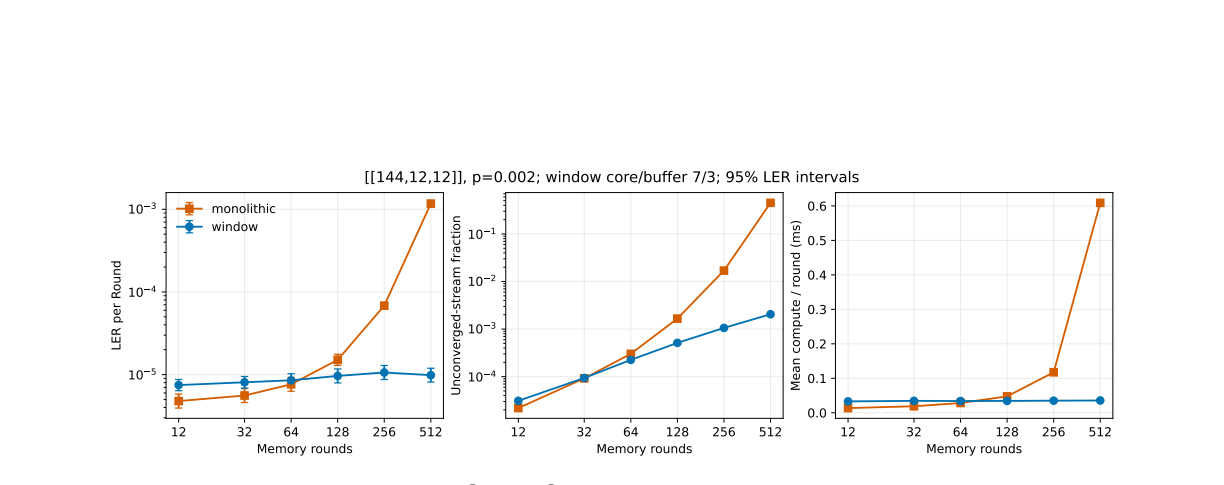
The windowed-versus-monolithic comparison allocates retry budgets asymmetrically: 100 retries per window (about 74 windows at 512 rounds, up to roughly 7,400 retries total) versus 100 retries for the entire monolithic experiment. With 9,245 of 9,246 monolithic failures at 512 rounds being non-convergences, the flat-LER and 17.1x-speedup claims conflate graph-size control with budget disparity.
more of objection 2
The asymmetry is disclosed in the text, but the 'windowing mitigates the convergence degradation' claim should be supported by at least one sensitivity point at matched total retry consumption (for example, monolithic decoding with a budget scaled to roughly 7,400, or windowed decoding with a cap on total retries across windows) so that the reader can separate the two effects.
The paper says, at Section 5
The review did not quote this passage.
Pith says: Objection 3 of 3 · major
The text states 'The source code is available at GitHub(TBD).' The timing and LER claims are specific to this CUDA implementation and the RTX 5060 Ti environment, so the empirical results cannot be independently verified without the artifact. A concrete repository (or an anonymized review copy) should be supplied before acceptance.
6 minor objections
The paper says, at Section 6.2 / Fig. 6(c)
Pith says: minor objection 1 of 6
The 13.15x p99.9 latency reduction is reported on the conditioned initial-failure population only; an additional all-sample latency comparison would help readers assess the end-to-end impact, since the headline figure is easy to misread as unconditional.
The paper says, at Fig. 7 caption / Section 6.3
Pith says: minor objection 2 of 6
The sentence 'Only compute time is recorded and syndrome lookahead time are excluded' is ungrammatical, and the caption should state explicitly that lookahead wait is excluded from compute time but included in release age.
show 4 more
The paper says, at Section 6.4 / Appendix A.2
Pith says: minor objection 3 of 6
The abbreviation 'ind.128' should be expanded and defined at its first occurrence in the main text, with a forward pointer to Appendix A.2 where the independent-layer schedule is specified.
The paper says, at Section 6.2
Pith says: minor objection 4 of 6
The LER ratios (83x and 2.83x reductions relative to BP1000 and BP1000-OSD10) are quoted without uncertainty, whereas the LER points themselves carry nominal 95% Wilson intervals; the ratios should be accompanied by intervals or by the interval endpoints.
The paper says, at Section 6.4
Pith says: minor objection 5 of 6
The 2.97-ms syndrome arrival period drives the queuing results in Fig. 8(c), but it is not stated whether this is a measured extraction period or an assumed system parameter; one sentence clarifying this would help the reader calibrate the streaming conclusions.
The paper says, at Table 1 / Section 6.3
Pith says: minor objection 6 of 6
The headline window geometry (7,3) is selected from a sweep on the same benchmark that later produces the 512-round claims; the sweeps are reported transparently, but a sentence noting that the headline configuration is tuned on the evaluation distribution would guard against over-reading of the speedup and LER figures.
What would settle it
One experiment settles the concern: modify Algorithm 1 so that, instead of the global first-converged return, all N_tr trials run to completion and the decoder selects the syndrome-valid estimate of minimum mechanism weight (tie-broken by summed LLR), then maps back and scores with the paper's full-frame rule (Appendix A.1, Eq. 20). Run both acceptance rules on the [[144,12,12]] and [[288,12,18]] codes at the paper's tested error rates with the paper's retry budgets and 80/60 iteration limits, tagging each converged trial with its true logical coset.
from the skeptic's reading
How the review went
4 readings by deepseek-v4-flash · 12 Oct 2026
- Reader holds up, with conditions
- Skeptic agrees
- Editor wrote the verdict above
- Referee major revision: 3 major objections, 6 minor
Not run on this paper: the simulated authors' defence.
Pith did not check this review's objections against the paper.
The review in full
The review in brief, machine-written
Quick take: this is a real engineering contribution, not a decoder-theory advance. The new material is the CUDA implementation of BP-SF with posterior-initialized DMem-BP retries, sliding-window operation, and the full-frame comparison of DXYZ, GARI, and separate-sector decoding. On the [[144,12,12]] code at p=0.002 the main numbers are believable and carefully conditioned: 13.15x p99.9 latency reduction on 100,000 matched samples where all initial BP stages fail, LER held near 1e-5 through 512 rounds with roughly constant per-round compute, and a 36.25 ms versus 166.29 ms p99.9 release age for GARI ind.128 (20 retries) against DXYZ flooding (100 retries). The paper earns credit for scoring against true logical labels, reporting Wilson intervals, using matched samples, and saying plainly that Relay-BP remains more accurate on [[288,12,18]]. It also tests the oscillation-selection heuristic against random selection rather than assuming it.
The main soft spot is the first-valid acceptance rule. Section 4 gives a data-qubit argument that two syndrome-consistent estimates differ by a stabilizer or a weight-at-least-d logical operator. That argument does not transfer to the circuit-level detector-mechanism graph the decoder actually processes: a two-qubit-gate fault can create two data errors and a measurement fault creates none, so syndrome validity over detectors does not certify closeness to the correct logical coset. The authors call this a motivation, not a proof, and the measured LERs stand for the tested code. But the [[288,12,18]] results, 18-31x above Relay-BP, show the rule is code-dependent, and the streaming headline leans on "similar accuracy" between two configurations that share the same rule. I would like the paper to state outright that first-valid stopping is an empirical heuristic validated on one code, and ideally to add a cheap logical-coset check.
Minor but real: the code link is a placeholder, and the 7/3 window geometry is chosen from the same 128-round benchmark that motivates the long-memory results, so those point estimates carry some selection optimism. Both are fixable.
The math in the decoder and graph constructions is standard; I did not find a load-bearing error. The citation pattern looks straight, with self-citation to [42] appropriate because BP-SF originates there. This paper is for people building real-time qLDPC decoders and for the decoding community. It deserves a serious referee and, after the acceptance-rule wording and code link are cleaned up, publication.
The strongest objection
Algorithm 1 returns the first trial whose estimate satisfies the syndrome, with no logical-coset check and no likelihood comparison among converged trials; because trials run concurrently, 'first' is effectively whichever block finishes first. Section 4 motivates this by the data-qubit-Pauli argument that two syndrome-consistent estimates differ by a stabilizer or a logical operator of weight at least d. That argument is true in the data-qubit picture but does not transfer to the graph the decoder actually processes: in the circuit-level detector-mechanism graph (Section 2.2), variables are fault mechanisms, whose correspondence to data-qubit weight is not one-to-one (a single two-qubit-gate fault can create two data errors, and a measurement fault creates none), and syndrome validity over detectors does not certify that an accepted estimate is within d of the most likely error class. The decoder therefore enforces the syndrome but never verifies the premise the argument requires; the passage is explicitly a motivation, not a proof. A similar first-convergence rule appears in the published GARI ensemble [25], which is precedent but not a proof. What remains unresolved is transfer: the [[288,12,18]] results show BP-SF's LER is 18-31x above Relay-BP (Section 6.2), consistent with the trial ensemble settling into wrong cosets on other codes, a failure mode the first-valid rule cannot detect. The streaming headline rests on the 'similar accuracy' of GARI ind.128 (20 retries) versus DXYZ flooding (100 retries); both arms share the first-valid rule, so if wrong-coset acceptance rates differ between the two graph configurations, the claimed accuracy equivalence could be an artifact of coset selection rather than genuine logical fidelity. All reported LERs are scored against true logical labels (Appendix A.1, Eq. 20), so the measured numbers stand for the tested configurations; the unsecured, load-bearing step is the general safety of the acceptance rule.
The reader's weakest assumption and my most load-bearing concern coincide: the safety of first-syndrome-valid stopping in Algorithm 1. I agree with CONDITIONAL and find no additional defect that would change it. The headline claims are engineering measurements on one code and are honestly conditioned: the 13.15x latency reduction is restricted to 100,000 matched samples whose initial BP stage fails within 80 iterations, and the 17.1x speedup compares windowed decoding with a monolithic decoder whose 512-round failures are almost all non-convergence (9,245 of 9,246). Every LER figure is scored against true logical labels via Stim annotations (Appendix A.1), so the reported values stand for the tested configuration regardless of the acceptance rule's heuristic status. What Section 4 is asked to carry is the general correctness of the rule: the argument is stated in the data-qubit Pauli picture, while the decoded graph has fault mechanisms as variables and the decoder never verifies the 'within d of the most likely error' premise. The paper's own [[288,12,18]] accuracy gap is the concrete evidence that the decoder's coset-finding behavior is code-dependent, which is precisely where an unproven acceptance rule matters. I set aside alternative concerns: the same-benchmark window-geometry sweep is transparent, and the 512-round flatness is a measurement beyond the 128-round tuning length; the streaming queue comparison is dominated by decoder service-time differences but is explicitly an operating-point comparison with measured, plausibly overlapping LER intervals; the limited failure counts (30-50) suffice for the coarse 'similar accuracy' claim; and the placeholder code link (GitHub TBD) is a reproducibility gap, not a correctness defect. The proposed test, comparing first-valid against coset-aware minimum-weight selection on the 144 and 288 codes with per-trial coset tagging, would settle whether the assumption holds in the regimes the paper exercises; until then, the transferred claims rest on single-code empirical support, and the conditional verdict stands.
The referee's report
If the measurements are taken at face value, this is a solid systems contribution: it demonstrates that parallel BP post-processing, sliding-window decoding, and graph/schedule co-design can reduce the latency tail of qLDPC decoding and shift correction release earlier in streaming memory. The empirical methodology is careful: the timing comparison is a matched-sample design; LER points carry nominal 95% Wilson intervals; the full-frame protocol scores all 24 logical labels; the oscillation-selection heuristic is tested against random selection (Fig. 5) rather than assumed; and the per-window versus per-experiment retry budgets are disclosed. The authors also report the [[288,12,18]] counterpoint to their 144-code accuracy claims and explicitly state in the conclusion that the timing gains are conditional and do not imply uniform accuracy superiority. The main unresolved question is the generality of the first-syndrome-valid acceptance rule, which the paper treats as empirically validated on the tested code; a direct diagnostic of wrong-coset acceptance would materially strengthen the transferability of the LER and streaming claims.
Pith's reading of the paper (a machine's summary, not the authors')
Keeping a quantum memory alive means extracting error syndromes round after round and decoding each one before the next arrives, so both accuracy and latency matter. This paper claims that a failed belief-propagation (BP) decoding pass is not wasted work: the bits that kept flipping between zero and one during the failure point to where the real errors are, far better than random guessing. New trials aimed at those positions, run in parallel on perturbed syndromes, form the BP-SF decoder, and the paper shows the same recipe survives GPU execution, sliding-window decoding over 512 rounds, and full-frame recovery through a correlation-aware graph transformation. On the [[144,12,12]] bivariate bicycle code at $p = 0.002$ it reports a 13.15x reduction in 99.9th-percentile call latency on hard samples versus the Relay-BP GPU baseline, a logical error rate that stays near $10^{-5}$ per round at 17.1x lower compute cost than monolithic decoding, and a drop in worst-case streaming correction-release age from 166.29 ms to 36.25 ms.
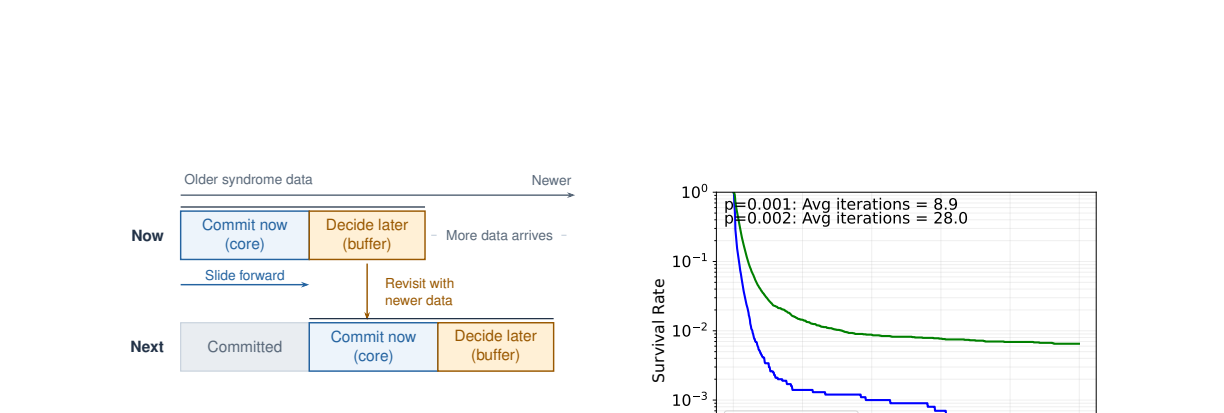
What carries the argument. The load-bearing object is the oscillation-guided syndrome-flip ensemble: the oscillation score that counts hard-decision flips per bit over the initial BP run, the top-$K$ candidate set drawn from it, and the parallel trial loop that samples sparse vectors supported on the set, runs independent trials on shifted syndromes, and returns the first syndrome-valid result after undoing the shift. This ensemble is carried by two empirical links the paper measures: the precision of the candidate set against the true error support is far above the physical error rate, and oscillation-guided candidate selection beats random selection at equal trial budgets. The extensions run on two further structures: the GARI-transformed joint graph, which keeps the same decoding problem while removing four-cycles that mix $X/Y/Z$ error mechanisms and cuts the edge count 51.4 percent relative to the joint $D_{XYZ}$ matrix, and the sliding window with a core of $C$ blocks and a buffer of $B$ blocks, which bounds the temporally growing graph so that per-round compute stays nearly constant.
Core claim. The central claim is that oscillations in a failed BP run are a usable error-location signal, and that turning that signal into many parallel, perturbed, independent trials changes the accuracy-latency trade-off of quantum-LDPC decoding. BP-SF records, for each bit, how often its hard decision flips between successive iterations, keeps the top-$K$ oscillators as a candidate set, samples sparse trial vectors supported on those positions, and runs each trial on a syndrome shifted by the trial vector while retaining the original channel LLRs; the first trial whose estimate satisfies its shifted syndrome is accepted, and its trial vector is XOR-ed back so the returned correction is consistent with the original syndrome. The paper justifies accepting the first consistent trial by an equivalence-class argument: in the data-qubit Pauli picture, two estimates with the same syndrome differ by a stabilizer or by an error of weight at least the code distance $d$, so a low-weight consistent estimate implements the same logical correction. The reported results show this rule surviving contact with a CUDA implementation whose retries use posterior-initialized disordered-memory BP, with a sliding window of seven core and three buffer rounds that keeps the decoding graph bounded, and with the GARI joint graph under layered scheduling for full Pauli-frame recovery; on the tested code the combination keeps measured LER near $10^{-5}$ per round through 512 rounds while cutting the latency tail, per-round compute, and correction-release age.
The premise it rests on. The decoder accepts the first trial whose correction satisfies the measured syndrome without checking its logical effect, and the paper's equivalence-class argument for why that is safe is made in the data-qubit Pauli picture, not for the circuit-level mechanism graph actually decoded, where two syndrome-consistent estimates can differ by an error that changes logical information without exceeding the code distance $d$ — so the reported error rates rest on that first-convergence rule holding for the tested code and noise model.
If the paper is right (Pith's inferences, not the authors')
On 100,000 matched samples where every tested method's initial BP stage fails within 80 iterations, all-concurrent BP-SF cuts mean call latency to 1.081 ms (6.28x) and the 99.9th-percentile latency to 7.039 ms (13.15x) versus the eight-chain Relay-BP implementation on the same GPU.
Sliding-window decoding with a 7-round core and 3-round buffer keeps per-round compute between 0.033 and 0.036 ms from 12 to 512 rounds while LER stays near $10^{-5}$, a 17.1x compute-time speedup over monolithic decoding at 512 rounds, where non-convergence accounts for 9,245 of 9,246 monolithic failures.
Graph and schedule choice can substitute for retry budget: layered GARI with 20 retries matches flooding $D_{XYZ}$ with 100 retries in measured full-frame LER while reducing mean latency 19.3x and p99.9 latency 3.85x.
In streaming memory with 2.97 ms syndrome arrivals over 512 rounds, the p99.9 correction-release age falls from 166.29 ms to 36.25 ms, and the fraction of arrivals that queue falls from 67.9 percent to 0.40 percent.
The operating point is tied to the [[144,12,12]] code: on the [[288,12,18]] code the paper measures BP-SF 18-31x worse per-round LER than Relay-BP, so the latency wins do not imply uniform accuracy superiority.
Because first-convergence safety is only empirically validated on the tested code, the natural robustness test the paper does not run is a coset-checking variant that verifies the logical frame before accepting; agreement between the two versions would certify the rule, and disagreement would mean the LER figures need re-derivation per code.
The oscillation heuristic is not inherently tied to BP: any iterative decoder that records a hard-decision history could feed the candidate set, so the fail-locate-perturb-parallelize recipe could be lifted onto other message-passing or matching-based quantum decoders.
The timing numbers leave headroom: with 2.97 ms between arrivals and a mean GARI decode time near 1.6 ms at 20 retries, the tested pipeline runs under roughly half duty cycle, suggesting spare capacity for tighter arrivals or larger codes, though queue stability beyond 512 rounds is not settled here.
The streaming comparison bundles graph choice with trial budget, since GARI at 20 retries is measured against $D_{XYZ}$ at 100 retries; logging the logical labels of every accepted trial would separate genuine speedup from retries wasted on syndrome-valid but logically wrong convergences.
Check this review
Pith stored no record of this review's passes and took no fingerprint of it. Reviews made by code from 13 Nov 2026 on carry both.
How often reviews like this one are right
Reviews like this one: written by deepseek-v4-flash, where what was read was not recorded.
How often objections from reviews like this one are right: not yet measured
Reviews by people
This review was written by a machine. No person has reviewed this paper on Pith yet. A scientist listed on Pith can review it for a fee, and their review is published here whatever it concludes.
The paper
Abstract
Quantum low-density parity-check (qLDPC) decoding requires reliable corrections and low latency over long syndrome histories. We extend BP-SF, an oscillation-guided belief-propagation (BP) decoder with independent syndrome-flip trials, by introducing windowed and streaming operations. Our CUDA implementation combines disordered-memory retries, sliding windows, correlation-aware graphs, and layered scheduling. Circuit-level simulations test fixed-basis memory and complete logical Pauli-frame recovery. On the [[144,12,12]] bivariate bicycle code at physical error rate p = 0.002, parallel BP-SF reduces 99.9th-percentile call latency by a factor of 13.15 relative to an eight-chain Relay-BP GPU baseline on 100,000 matched samples for which every tested method's initial BP stage fails within 80 iterations. Windowed BP-SF maintains a flat logical error rate and nearly constant per-round compute time through 512 rounds, reaching a 17.1-fold speedup over monolithic decoding. In 512-round full-frame streaming decoding with 2.97-ms syndrome arrivals, layered BP-SF on a transformed joint graph with 20 retries reduces 99.9th-percentile correction-release age from 166.29 to 36.25 ms relative to the joint graph with flooding updates and 100 retries. These results connect parallel BP post-processing to lower decoding costs and earlier correction release in streaming quantum memory.
The paper's own sentences, arranged, kept beside the review and separate from it. Each label is drawn from a closed vocabulary; the number beside it is the probability the classifier gave that label. No sentence in this record was written by a model.
abstract compiled · 2026-10-12
The authors' main claim, as the classifier picked it out 1.00
“These results connect parallel BP post-processing to lower decoding costs and earlier correction release in streaming quantum memory.”
How the main claim is stated: asserted 0.91
What the abstract itself states, as probabilities: claims first 0.04 · states limitation 0.37 · human participants 0.01 · controlled comparison 0.97 · randomized assignment 0.02 · states quantitative result 0.99 · compares with prior results 0.98 · mentions code or data availability 0.03
The abstract, sentence by sentence
This table labels the abstract only (arXiv listing abstract v1). The number is the probability the classifier gave the label.
| Sentence | Role | The authors' own work | States the main conclusion | Strength |
|---|---|---|---|---|
| Quantum low-density parity-check (qLDPC) decoding requires reliable corrections and low latency over long syndrome histories. | background 1.00 | 0.05 | 0.03 | asserted 1.00 |
| We extend BP-SF, an oscillation-guided belief-propagation (BP) decoder with independent syndrome-flip trials, by introducing windowed and streaming operations. | contribution 0.96 | 0.92 | 0.05 | asserted 1.00 |
| Our CUDA implementation combines disordered-memory retries, sliding windows, correlation-aware graphs, and layered scheduling. | method 0.88 | 0.93 | 0.04 | asserted 0.98 |
| Circuit-level simulations test fixed-basis memory and complete logical Pauli-frame recovery. | method 0.96 | 0.89 | 0.03 | asserted 0.80 |
| On the [[144,12,12]] bivariate bicycle code at physical error rate p = 0.002, parallel BP-SF reduces 99.9th-percentile call latency by a factor of 13.15 relative to an eight-chain Relay-BP GPU baseline on 100,000 matched samples for which every tested method's initial BP stage fails within 80 iterations. | result 1.00 | 0.95 | 0.30 | asserted 1.00 |
| Windowed BP-SF maintains a flat logical error rate and nearly constant per-round compute time through 512 rounds, reaching a 17.1-fold speedup over monolithic decoding. | result 1.00 | 0.96 | 0.18 | asserted 1.00 |
| In 512-round full-frame streaming decoding with 2.97-ms syndrome arrivals, layered BP-SF on a transformed joint graph with 20 retries reduces 99.9th-percentile correction-release age from 166.29 to 36.25 ms relative to the joint graph with flooding updates and 100 retries. | result 1.00 | 0.96 | 0.17 | asserted 1.00 |
| These results connect parallel BP post-processing to lower decoding costs and earlier correction release in streaming quantum memory. | interpretation 1.00 | 0.61 | 0.83 | asserted 0.91 |
What kind of paper the classifier reports this is: method or tool 0.96 · evidence from simulation or computation 1.00
What was examined, and what was not
Sources read
- arXiv listing abstract v1
Not examined
- full text
- figures and tables
- references and citing sentences
- relations to other papers
Levels run
- P abstract
Not run
- S sections
- T body sentences
- C citations
- R cross-paper relations
How the labels were made
Compiled by classifier-1.13.0 via TypeSafe API, question bank abstract-p1-20260923, 2026-10-12: 1 request, 6,521 input tokens.
Every quoted sentence on this record is the authors'. Every label is from Pith's closed vocabulary, with the probability shown beside it. This record as JSON
Figures (8)




Showing 6 of the paper's 8 figures. Figures are the authors', reproduced from the paper.
References (50)
- [42] Ming Wang, Ang Li, and Frank Mueller. 2026. Fully Parallelized BP Decoding for Quantum LDPC Codes Can Outperform BP-OSD. In2026 IEEE International Symposium on High Performance Computer Architecture (HPCA). 1–14. doi:10. 1109/HPCA68181.2026.11408621 on Pith
- [1] Daniel Báscones, Arshpreet Singh Maan, Valentin Savin, and Francisco Garcia- Herrero. 2026. A Scalable FPGA Architecture for Real-Time Decoding of Quantum LDPC Codes Using GARI.arXiv preprint arXiv:2605.01035(2026). doi:10.48550/ arXiv.2605.01035 on PithPith's reviewarXivdoi:10.48550/arxiv.2605.01035
- [2] E. Berlekamp, R. McEliece, and H. van Tilborg. 1978. On the inherent intractability of certain coding problems (Corresp.).IEEE Transactions on Information Theory 24, 3 (1978), 384–386. doi:10.1109/TIT.1978.1055873 on Pithdoi:10.1109/tit.1978.1055873
- [3] Sergey Bravyi, Andrew W. Cross, Jay M. Gambetta, Dmitri Maslov, Patrick Rall, and Theodore J. Yoder. 2024. High-threshold and low-overhead fault-tolerant quantum memory.Nature627, 8005 (March 2024), 778–782. doi:10.1038/s41586- 024-07107-7 on Pithdoi:10.1038/s41586-
- [4] D. Chase. 1972. Class of algorithms for decoding block codes with channel measurement information.IEEE Transactions on Information Theory18, 1 (1972), 170–182. doi:10.1109/TIT.1972.1054746 on Pithdoi:10.1109/tit.1972.1054746
- [5] Jiahan Chen, Zhengzhong Yi, Zhipeng Liang, and Xuan Wang. 2025. Improved Belief Propagation Decoding Algorithms for Surface Codes .IEEE Transactions on Quantum Engineering6, 01 (Jan. 2025), 1–16. doi:10.1109/TQE.2025.3577769 on Pithdoi:10.1109/tqe.2025.3577769
- [6] Dimitris Chytas, Michele Pacenti, Nithin Raveendran, Mark F. Flanagan, and Bane Vasić. 2024. Enhanced Message-Passing Decoding of Degenerate Quantum Codes Utilizing Trapping Set Dynamics.IEEE Communications Letters28, 3 (2024), 444–448. doi:10.1109/LCOMM.2024.3356312 on Pithdoi:10.1109/lcomm.2024.3356312
- [7] Dimitris Chytas, Nithin Raveendran, and Bane Vasić. 2025. Enhanced Min-Sum Decoding of Quantum Codes with Iteration Dynamics Memory. In2025 IEEE International Symposium on Information Theory (ISIT). 1–6. doi:10.1109/ISIT63088. 2025.11195509 on Pithdoi:10.1109/isit63088
- [8] Jingxin Dai, Hang Yin, Yansong Lv, Weizhang Xu, and Zhanxin Yang. 2022. Multi-Gbps LDPC Decoder on GPU Devices.Electronics11, 21 (2022), 3447. doi:10.3390/electronics11213447 on Pithdoi:10.3390/electronics11213447
- [9] Poulami Das, Aditya Locharla, and Cody Jones. 2022. LILLIPUT: a lightweight low-latency lookup-table decoder for near-term Quantum error correction. In Proceedings of the 27th ACM International Conference on Architectural Support for Programming Languages and Operating Systems... on Pith
- [10] Poulami Das, Christopher A. Pattison, Srilatha Manne, Douglas M. Carmean, Krysta M. Svore, Moinuddin Qureshi, and Nicolas Delfosse. 2022. AFS: Accurate, Fast, and Scalable Error-Decoding for Fault-Tolerant Quantum Computers. In 2022 IEEE International Symposium on High-Perform... on Pithdoi:10.1109/hpca53966.2022.00027
- [11] Nicolas Delfosse and Jean-Pierre Tillich. 2014. A decoding algorithm for CSS codes using the X/Z correlations. In2014 IEEE International Symposium on Infor- mation Theory (ISIT). 1071–1075. doi:10.1109/ISIT.2014.6874997 on Pithdoi:10.1109/isit.2014.6874997
- [12] Antonio deMarti iOlius, Imanol Etxezarreta Martinez, Joschka Roffe, and Josu Etxezarreta Martinez. 2026. An almost-linear time decoding algorithm for quan- tum LDPC codes under circuit-level noise.npj Quantum Information(2026). doi:10.1038/s41534-026-01292-1 on Pithdoi:10.1038/s41534-026-01292-1
- [13] J. Dielissen, A. Hekstra, and V. Berg. 2006. Low cost LDPC decoder for DVB-S2. InProceedings of the Design Automation & Test in Europe Conference, Vol. 2. 1–6. doi:10.1109/DATE.2006.243816 on Pithdoi:10.1109/date.2006.243816
- [14] Ilan Dimnik and Yair Be’ery. 2009. Improved random redundant iterative HDPC decoding.Trans. Comm.57, 7 (July 2009), 1982–1985. doi:10.1109/TCOMM.2009. 07.070621 on Pithdoi:10.1109/tcomm.2009
- [15] Julien du Crest, Francisco Garcia-Herrero, Mehdi Mhalla, Valentin Savin, and Javier Valls. 2024. Check-Agnosia based Post-Processor for Message-Passing Decoding of Quantum LDPC Codes.Quantum8 (2024), 1334. doi:10.22331/q- 2024-05-02-1334 on Pithdoi:10.22331/q-
- [16] Julien du Crest, Mehdi Mhalla, and Valentin Savin. 2022. Stabilizer Inactivation for Message-Passing Decoding of Quantum LDPC Codes. In2022 IEEE Information Theory Workshop (ITW). 488–493. doi:10.1109/ITW54588.2022.9965902 on Pithdoi:10.1109/itw54588.2022.9965902
- [17] Oscar Ferraz, Bruno Coutinho, Gabriel Falcao, Marco Gomes, Francisco A. Mon- teiro, and Vitor Silva. 2025. GPU-Accelerated Syndrome Decoding for Quantum LDPC Codes below the 63𝜇s Latency Threshold.arXiv preprint arXiv:2508.07879 (2025). doi:10.48550/arXiv.2508.07879 on PithPith's reviewarXivdoi:10.48550/arxiv.2508.07879
- [18] Craig Gidney. 2021. Stim: a fast stabilizer circuit simulator.Quantum5 (2021), 497 on Pith
- [19] Anqi Gong, Sebastian Cammerer, and Joseph M Renes. 2024. Toward low-latency iterative decoding of QLDPC codes under circuit-level noise.arXiv preprint arXiv:2403.18901(2024) on PithPith's reviewarXiv
show 30 more
- [20] Thomas R. Halford and Keith M. Chugg. 2006. Random Redundant Soft-In Soft- Out Decoding of Linear Block Codes. In2006 IEEE International Symposium on Information Theory. 2230–2234. doi:10.1109/ISIT.2006.261947 on Pithdoi:10.1109/isit.2006.261947
- [21] Timo Hillmann, Lucas Berent, Armanda O Quintavalle, Jens Eisert, Robert Wille, and Joschka Roffe. 2024. Localized statistics decoding: A parallel de- coding algorithm for quantum low-density parity-check codes.arXiv preprint arXiv:2406.18655(2024) on PitharXiv
- [22] Shilin Huang and Shruti Puri. 2024. Increasing memory lifetime of quantum low-density parity check codes with sliding-window noisy syndrome decoding. Physical Review A110, 1 (2024), 012453. doi:10.1103/PhysRevA.110.012453 on Pithdoi:10.1103/physreva.110.012453
- [23] Pavithran Iyer and David Poulin. 2015. Hardness of Decoding Quantum Stabilizer Codes.IEEE Trans. Inf. Theor.61, 9 (Sept. 2015), 5209–5223. doi:10.1109/TIT.2015. 2422294 on Pithdoi:10.1109/tit.2015
- [24] Stergios Koutsioumpas, Hasan Sayginel, Mark Webster, and Dan E Browne. 2025. Automorphism Ensemble Decoding of Quantum LDPC Codes.arXiv preprint arXiv:2503.01738(2025). 12 on PithPith's reviewarXiv
- [25] Arshpreet Singh Maan, Francisco Miguel Garcia Herrero, Alexandru Paler, and Valentin Savin. 2026. Decoding correlated errors in quantum LDPC codes.Nature Communications17 (2026), 3965. doi:10.1038/s41467-026-70556-3 on Pithdoi:10.1038/s41467-026-70556-3
- [26] Thilo Maurer, Markus Bühler, Michael Kröner, Frank Haverkamp, Tristan Müller, Drew Vandeth, and Blake R. Johnson. 2025. Real-time decoding of the gross code memory with FPGAs.arXiv preprint arXiv:2510.21600(2025). doi:10.48550/arXiv. 2510.21600 on Pithdoi:10.48550/arxiv.2510.21600
- [27] Tristan Müller, Thomas Alexander, Michael E Beverland, Markus Bühler, Blake R Johnson, Thilo Maurer, and Drew Vandeth. 2025. Improved belief propaga- tion is sufficient for real-time decoding of quantum memory.arXiv preprint arXiv:2506.01779(2025) on PithPith's reviewarXiv
- [28] Pavel Panteleev and Gleb Kalachev. 2021. Degenerate quantum LDPC codes with good finite length performance.Quantum5 (2021), 585. doi:10.22331/q-2021-11- 22-585 on Pithdoi:10.22331/q-2021-11-
- [29] David Poulin and Yeojin Chung. 2008. On the iterative decoding of sparse quantum codes.arXiv preprint arXiv:0801.1241(2008) on PithPith's reviewarXiv
- [30] Sheida Rabeti and Hessam Mahdavifar. 2025. List Decoding and New Bicycle Code Constructions for Quantum LDPC Codes.arXiv preprint arXiv:2511.02951 (2025). doi:10.48550/arXiv.2511.02951 on Pithdoi:10.48550/arxiv.2511.02951
- [31] Nithin Raveendran and Bane Vasić. 2021. Trapping sets of quantum LDPC codes. Quantum5 (2021), 562 on Pith
- [32] T.J. Richardson, M.A. Shokrollahi, and R.L. Urbanke. 2001. Design of capacity- approaching irregular low-density parity-check codes.IEEE Transactions on Information Theory47, 2 (2001), 619–637. doi:10.1109/18.910578 on Pithdoi:10.1109/18.910578
- [33] Joschka Roffe, David R. White, Simon Burton, and Earl Campbell. 2020. Decoding across the quantum low-density parity-check code landscape.Phys. Rev. Res.2 (Dec 2020), 043423. Issue 4. doi:10.1103/PhysRevResearch.2.043423 on PithPith's reviewdoi:10.1103/physrevresearch.2.043423
- [34] Stim developers. [n. d.]. Stim gate reference: OBSERVABLE_INCLUDE. https: //github.com/quantumlib/Stim/blob/main/doc/gates.md. Pauli-target logical- observable annotations; accessed September 16, 2026 on Pith
- [35] Bei-Sheng Su, Chia-Heng Lee, and Tzi-Dar Chiueh. 2022. A 58.6/91.3 pJ/b dual- mode belief-propagation decoder for LDPC and polar codes in the 5G communi- cations standard.IEEE Solid-State Circuits Letters5 (2022), 98–101 on Pith
- [36] Barbara M. Terhal. 2015. Quantum error correction for quantum memories.Rev. Mod. Phys.87 (Apr 2015), 307–346. Issue 2. doi:10.1103/RevModPhys.87.307 on Pithdoi:10.1103/revmodphys.87.307
- [37] The CUDA-Q development team. 2024. CUDA-Q. https://github.com/NVIDIA/ cuda-quantum. https://github.com/NVIDIA/cuda-quantum on Pith
- [38] Jean-Pierre Tillich and Gilles Zémor. 2014. Quantum LDPC Codes With Positive Rate and Minimum Distance Proportional to the Square Root of the Blocklength. IEEE Transactions on Information Theory60, 2 (2014), 1193–1202. doi:10.1109/ TIT.2013.2292061 on Pith
- [39] Joshua Viszlai, Jason D. Chadwick, Sarang Joshi, Gokul Subramanian Ravi, Yanjing Li, and Frederic T. Chong. 2025. SWIPER: Minimizing Fault-Tolerant Quantum Program Latency via Speculative Window Decoding. InProceedings of the 52nd Annual International Symposium on Computer Arc... on Pithdoi:10.1145/3695053.3731022
- [40] Suhas Vittal, Poulami Das, and Moinuddin Qureshi. 2023. Astrea: Accurate Quantum Error-Decoding via Practical Minimum-Weight Perfect-Matching. In Proceedings of the 50th Annual International Symposium on Computer Architecture (Orlando, FL, USA)(ISCA ’23). Association for Compu... on Pithdoi:10.1145/3579371.3589037
- [41] Suhas Vittal, Ali Javadi-Abhari, Andrew W. Cross, Lev S. Bishop, and Moinuddin Qureshi. 2024. Flag-Proxy Networks: Overcoming the Architectural, Scheduling and Decoding Obstacles of Quantum LDPC Codes . In2024 57th IEEE/ACM International Symposium on Microarchitecture (MICRO).... on Pithdoi:10.1109/micro61859.2024.00059
- [43] Ming Wang, Yong Li, Jianqing Liu, Taolin Guo, Huihui Wu, and Francis C.M. Lau on Pith
- [44] Stasiu Wolanski and Ben Barber. 2024. Ambiguity Clustering: an accurate and efficient decoder for qLDPC codes.arXiv preprint arXiv:2406.14527(2024) on PithPith's reviewarXiv
- [45] Hanwen Yao, Waleed Abu Laban, Christian Häger, Alexandre Graell i Amat, and Henry D. Pfister. 2024. Belief Propagation Decoding of Quantum LDPC Codes with Guided Decimation. In2024 IEEE International Symposium on Information Theory (ISIT). 2478–2483. doi:10.1109/ISIT57864.2024... on Pithdoi:10.1109/isit57864.2024.10619083
- [46] Min Ye, Dave Wecker, and Nicolas Delfosse. 2026. Beam Search Decoder for Quantum Low-Density Parity-Check Codes.PRX Quantum7 (2026), 033002. doi:10.1103/6k5x-ztqt on Pithdoi:10.1103/6k5x-ztqt
- [47] Keyi Yin, Xiang Fang, Jixuan Ruan, Hezi Zhang, Dean Tullsen, Andrew Sorn- borger, Chenxu Liu, Ang Li, Travis Humble, and Yufei Ding. 2024. SymBreak: Mitigating Quantum Degeneracy Issues in QLDPC Code Decoders by Breaking Symmetry.arXiv preprint arXiv:2412.02885(2024) on PithPith's reviewarXiv
- [48] Zhengya Zhang, Venkat Anantharam, Martin J. Wainwright, and Borivoje Nikolic on Pith
- [2010] An Efficient 10GBASE-T Ethernet LDPC Decoder Design With Low Error Floors.IEEE Journal of Solid-State Circuits45, 4 (2010), 843–855. doi:10.1109/ JSSC.2010.2042255 A Additional Experimental Details A.1 Full-Frame Protocol and Scoring For a syndrome-consistent correction under ... on Pith
- [2023] Neural layered min-sum decoders for cyclic codes.Physical Communication 61 (2023), 102194. doi:10.1016/j.phycom.2023.102194 on Pithdoi:10.1016/j.phycom.2023.102194
Cited by 3 Pith papers
Reviewed papers on Pith that cite this one. The full citation record
- Accurate qLDPC decoding under real-time constraints quant-ph · Nov 2026
- PriorTilt: Decoding quantum LDPC codes with sparse perturbations of belief propagation priors quant-ph · Nov 2026
- Engineering Low-Latency, High-Throughput Quantum Decoders on NVIDIA GPUs cs.DC · Oct 2026
Challenges and discussion
Disagree with the review, or know something it missed? Leave a comment, or challenge this review formally: a challenge becomes a permanent entry in this paper's record, and its decision is published here.
Come back by email
A short list of the week's newly reviewed papers. Nothing is sent until you confirm from your inbox, and every email has a link that stops it. No account.
No comments yet.
Sign in to comment