Artificial Intelligence · arXiv:2610.20312 v1 · submitted 14 Oct 2026 · 14 references
Reflect After Failure: Brain-Inspired Self-Evolving Agents for Embodied Spatial Intelligence
The paper says
“Vision-Language Models (VLMs) have made substantial progress in spatial reasoning, and self-evolving agents further extend these capabilities to embodied environments by learning from interactions.”
more of the abstract
However, current self-evolution remains particularly challenging in embodied spatial tasks, complex and multi-step decisions from partial visual evidence making it difficult to determine why an execution fails. The failure may stem from misperception, insufficient exploration, or incorrect planning, yet execution feedback alone rarely reveals which component is responsible. As a result, simply accumulating interaction experience can reinforce ineffective strategies. To address this, we propose HiMeco, a brain-inspired self-evolving agent for embodied spatial intelligence, inspired by metacognitive monitoring and hippocampal memory consolidation. Through Hippocampal-Metacognitive Reflection, HiMeco diagnoses failures in perception-exploration-planning (PEP), then compares execution attempts to derive reusable strategies and guidance for avoiding recurring errors. It also abstracts interaction programs into parameterized skills, using evidence contracts and execution-based validation to determine their retention and reuse. These strategies and skills guide subsequent interactions, with memory updated only between rounds and model parameters kept frozen. HiMeco achieves state-of-the-art performance on ESI-Bench, and it also improves accuracy on EmbSpatial-Bench by 3.94 percentage points without evolution.
from the abstract
Pith says
Machine review · deepseek-v4-flash · 15 Oct 2026 · what was read was not recorded · not checked by a person
It can be wrong. Challenge this review or reply to it.
Holds up, with conditions. The internal result is credible — PEP diagnosis plus evidence-gated skill memory improves a frozen planner on repeated episodes — but the SOTA headline outruns the paper's own protocol. This line is wrong
3 major objections · 9 minor
How often objections from reviews like this one are right: not yet measured
Not checked: figures, code, what the 14 references say.
The paper says, at §4.2 / Table 1 / Appendix C
The review did not quote this passage.
Pith says: Objection 1 of 3 · major
Section 4.2, Table 1: the claim that HIMECO achieves state-of-the-art average accuracy of 69.19% (repeated without qualification in the abstract and in the conclusion, Section 5) is not supported by a like-for-like comparison. HIMECO's number is produced by the four-round repeated-episode protocol of Algorithm 1 and Table 4: rounds 0-2 run 1+3+3 attempts per episode (1,664 planned executions on the same 208 episodes), memory is updated from rounds 0-2, and final accuracy is measured on those same episodes.
more of objection 1
The comparison rows are heterogeneous: the GPT-5* and Gemini-3.1* rows are full-dataset numbers from Hong et al. [2026] (Section C.1) covering the benchmark categories, whereas HIMECO's block reports one selected subtask per category; the SHAPER row carries its own task-wise sample counts (summing to 210); and ParallelWorld's episode list, feedback protocol, and compute budget are not specified. Even at face value the margin is thin: the 3.47 pp gap over ParallelWorld (69.19 vs 65.72) is of the same order as one binomial standard error for a 208-episode proportion (about 3.2 pp), and HIMECO is below ParallelWorld on five of the nine task rows, so the macro-average depends heavily on task mix. Because the appendix itself labels the main experiment as adaptation on repeated episodes (Section C.1) and the cross-episode evidence as qualitative (Section C.5), the quantitative SOTA statement overreaches its own evaluation. Please either re-scope the claim or add a matched evaluation with identical episode lists, task definitions, feedback availability, and compute budgets.
The paper says, at §C.4 / §F.2 / §G.5
The review did not quote this passage.
Pith says: Objection 2 of 3 · major
Section C.4, F.2, G.5: the internal ESI-Bench gains (GPT-5.6: 56.89 to 69.19; Gemini-3-Flash: 54.74 to 62.51) measure adaptation to the evaluation episodes, not generalization, because the memory that conditions the final-round execution was built from, and selected on, those very episodes.
more of objection 2
Answer feedback is used for memory updates (Section C.4); the perception and exploration diagnostics consume privileged simulator metadata, including reference camera positions and simulator-spawned target counts (Sections C.4, F.1, F.2); skill retention, suspension, and final-round eligibility are decided from support counts accumulated on the 208 evaluation episodes (Algorithm 3, Sections G.3-G.5), where support itself counts episode-round observations rather than distinct episodes (Section G.3). I acknowledge that the paper states this transparently: Section C.2 calls the main experiment adaptation on the same selected episodes, and Section C.5 calls the cross-episode transfer qualitative evidence. The unresolved problem is the mismatch between that evidence base and the unqualified SOTA wording in the abstract, Section 4.2, and Section 5. To support a generalization claim, the paper needs a quantitative evaluation with memory frozen before target episodes are executed; the three action-count examples in Figure 5 do not substantiate one.
The paper says, at Table 2
The review did not quote this passage.
Pith says: Objection 3 of 3 · major
Table 2: as printed, the ablation matrix cannot be verified. The header row (E K U Evo.) is followed by three rows that display an identical triple-check pattern yet report different accuracies (65/55/80/74.1, 70/45/76/70.4, and 65/45/80/74.1), so the mapping to the conditions described in the text (removing the strategy bank E, removing the skill library K, replacing structured PEP-guided reflection with generic reflection, Section 4.2) cannot be read from the table.
more of objection 3
Since these ablations are the only quantitative evidence for the three component contributions claimed in the introduction, each row needs an explicit label (such as Round-0 baseline, w/o E, w/o K, generic U, full), the backbone should be stated in the caption (comparison with Table 1 suggests GPT-5.6), and per-cell uncertainty should be given for the four tasks, whose episode counts range from 20 to 27.
9 minor objections
The paper says, at §3.1, Eq. (1)
Pith says: minor objection 1 of 9
The displayed definition of ℓ(τ) is garbled (ℓ(τ) = ( 1[ContractValid(τ, q)], 1, s(τ) = ...): please reformulate it as the evidence-eligibility indicator and state the two-task exception (Action Order Inference, Physical Contact) in the main text rather than only in Appendix E.2.
The paper says, at §4.1 / §D.2 / Table 3
Pith says: minor objection 2 of 9
The EmbSpatial-Bench comparison is under-specified because the paper does not state whether HIMECO without evolution and direct Gemini-3-Flash API inference use identical prompts, output schemas, and task policies (cf. Prompt 4 and Section E); as written, the +3.94 pp gain could stem from the static HIMECO prompt configuration rather than from the proposed framework.
show 7 more
The paper says, at Table 1
Pith says: minor objection 3 of 9
The two per-task n-rows (the HIMECO block summing to 208 and the ParallelWorld row 21/17/49/5/51/20/18/19/10) are easy to misassign; please make explicit which rows share the episode lists of Table 5 and note that task definitions differ (full benchmark categories vs selected subtasks).
The paper says, at Algorithm 1 / Table 4
Pith says: minor objection 4 of 9
The round-index mapping r = t+1 in Section C.2 is hard to follow; aligning the algorithm loop indices with the displayed execution rounds 0-3 would help.
The paper says, at Figure 4(c)
Pith says: minor objection 5 of 9
The caption should explain the color scale based on the |Δt| thresholds (< 15%, 15-30%, > 30%) that appear in the legend.
The paper says, at Throughout
Pith says: minor objection 6 of 9
The method name appears as both HIMECO (main text) and HiMeco (abstract); please unify the spelling.
The paper says, at §4.2
Pith says: minor objection 7 of 9
The closing sentence of the first Results paragraph (These improvements demonstrate the effectiveness of diagnosis-guided evolution) is stronger than a repeated-episode adaptation result can support; diagnosis-guided adaptation would match the protocol.
The paper says, at Appendix H
Pith says: minor objection 8 of 9
The surveyed stereo-matching and continual-memory works are not connected to any design choice or experiment in the paper; either relate them to HIMECO or remove the section.
The paper says, at §I.1
Pith says: minor objection 9 of 9
Final-round generation uses temperature 0.7 with no seed and a single execution per episode; a few repeated runs or bootstrap confidence intervals would let the reader assess the stability of the reported accuracies.
What would settle it
Run a matched evaluation: (i) build HIMECO's strategies and skills on a disjoint 208-episode training list from the same nine tasks and freeze memory; (ii) evaluate HIMECO once per episode on the Table 5 episodes with memory frozen; (iii) run ParallelWorld and SHAPER on the same Table 5 list under their published settings with one attempt per episode; (iv) report the nine-task macro average and a bootstrap 95% confidence interval for the HIMECO-minus-ParallelWorld gap on identical episodes. If the gap is not positive with a CI excluding zero, the state-of-the-art claim must be re-scoped to repeated-episode adaptation.
from the skeptic's reading
How the review went
4 readings by deepseek-v4-flash · 15 Oct 2026
- Reader holds up, with conditions
- Skeptic agrees
- Editor wrote the verdict above
- Referee major revision: 3 major objections, 9 minor
Not run on this paper: the simulated authors' defence.
Pith did not check this review's objections against the paper.
The review in full
The review in brief, machine-written
Two things to know before you read it. First, the internal result is credible: on the same 208 ESI-Bench episodes, diagnosis-guided memory takes the frozen GPT-5.6 planner from 56.89 to 69.19 (Gemini from 54.74 to 62.51), and the ablations cutting the strategy bank, the skill library, and structured PEP reflection all hurt in the expected direction. Second, the headline is the problem: "state-of-the-art on ESI-Bench" (abstract, Section 4.2, conclusion) is supported only by a repeated-episode adaptation score, not by a comparison the protocol can bear.
What's actually new: the perception-exploration-planning failure diagnosis. Prior self-evolving agents (VOYAGER, SHAPER, EmbodiSkill, Spatial Memory Agent) mostly reflect on outcomes or skill content; separating misperception, insufficient exploration, and bad planning before deciding what to retain is a real step forward. The evidence-contract gating for skill retention — support/success thresholds plus execution-based validation before reuse, with suspension — is a useful mechanism for keeping a frozen planner's memory honest. The appendix is a genuine asset: diagnostic rules, update algorithms, thresholds, and episode IDs are all visible, so a reader can see exactly what is being claimed.
The load-bearing soft spot is the evaluation protocol. The authors are honest about it inside the appendix: Section C.1 labels the main experiment "adaptation on repeated episodes," and Section C.5 labels the cross-episode evidence as qualitative. But memory is built from rounds 0-2 using answer feedback and privileged simulator metadata (reference camera poses, spawned-object counts) on the same 208 episodes whose final-round accuracy is reported, and then Table 1 compares that score against rows on other episode sets and protocols — full-dataset reference rows, SHAPER with its own sample counts, ParallelWorld unspecified. A skill that survives to the final round has been selected for success on those very episodes. So 69.19% is a repeated-episode adaptation number, and the quantitative SOTA statement overreaches what the evaluation supports. The margin over the nearest listed row is also within roughly one binomial standard error, and no per-seed variance is reported.
Smaller things: many thresholds are hand-set without sensitivity analysis (reward weights, exploration penalties, diversity thresholds, evidence replacement margin), and code is promised but not shipped. The EmbSpatial-Bench gain is a static prompting comparison with mixed direction — the paper reports the Left/Right/Close losses, so that's fine, just modest. One oddity: Section H and the reference list carry a block of the corresponding author's own stereo-matching papers; they are published and real, just tangential.
Who this is for: anyone working on self-evolving agents or memory-augmented frozen LLM planners. The mechanism deserves scrutiny, and the appendix makes scrutiny possible. It deserves a serious referee who will demand matched baselines on identical episode sets, held-out generalization with numbers, error bars, and a SOTA claim pulled back to what the protocol supports.
The strongest objection
The central claim (abstract b9; Section 4.2 b127; conclusion b162) is state-of-the-art accuracy on ESI-Bench, but Table 1 does not compare like for like. HIMECO's 69.19% comes from the four-round protocol of Appendix C: rounds 0-2 run seven attempts per episode (1+3+3; 1,664 planned executions on the 208 test episodes), and the memory applied in the final round is built from and selected on those same episodes. Section C.4 states that answer feedback is used for memory updates and that the verifier and diagnostic rules consume privileged simulator metadata (reference camera positions, spawned-object counts); skill lifecycle decisions (Algorithm 3, Section G.5), namely support counts, suspension, and final-round eligibility, are made from execution outcomes accumulated on the 208 evaluation episodes. A routine that survives to the final round has therefore been empirically selected for success on the very episodes whose final accuracy is then reported. The comparison rows are not matched: the SHAPER row carries its own task-wise sample counts (summing to 210 episodes), the GPT-5* and Gemini-3.1* rows are full-dataset numbers from Hong et al. [2026], and ParallelWorld's episode list and protocol are not specified. The paper honestly labels the main experiment as adaptation on repeated episodes (Section C.1) and its cross-episode evidence as qualitative (Section C.5), so the quantitative SOTA statement overreaches its own evaluation. The margin over the nearest listed row (69.19 vs 65.72, about 3.5 points) is also within roughly one binomial standard error of a 208-episode macro mean, and no per-seed variance is reported. The internal result, that diagnosis-guided memory improves repeated-episode accuracy with directionally consistent ablations (Table 2) and reduced failure scores (Figure 4), is credible; what fails is the inference from that result to state-of-the-art performance on ESI-Bench.
The paper's internal evidence is genuine and unusually transparent: full episode IDs (Table 5), hand-specified thresholds and prompts (Appendix I/J), and ablations (Table 2) in which removing the strategy bank, the skill library, or the structured PEP reflection degrades accuracy directionally across the four tested tasks. The paper also states the scope of its main experiment honestly ('the main ESI-Bench experiment measures adaptation on the same selected episodes,' Section C.1) and labels the cross-episode evidence qualitative (Section C.5), so the absence of a quantitative transfer benchmark is not a hidden flaw. The load-bearing problem is narrower: the abstract and Section 4.2 state-of-the-art claim (b9, b127, b162) requires Table 1's rows to be mutually comparable, and they are not. HIMECO's row is the product of a protocol in which the 208 episodes that define the final score were each executed up to eight times; the memory that produced the final attempt was constructed from those same episodes using ground-truth answer feedback and privileged simulator metadata (C.4), and skills were promoted or suspended based on outcomes on those same episodes (G.5). That measures adaptation to the test set, while ParallelWorld, SHAPER, and the Hong et al. reference rows measure something else on other episode sets. The 3.47-point margin over the nearest row is near one binomial standard error, and no seed variance is given. This is the single most load-bearing concern because it attacks the headline inference directly while leaving the defensible core, a frozen-parameter agent that improves on repeated episodes through diagnosis-guided consolidation, intact. The reader's weakest assumption identifies the same issue; my formulation adds the answer-feedback and privileged-metadata mechanics that make the final-round score an adaptation score rather than an evaluation score. Verdict unchanged: CONDITIONAL, pending matched-episode, matched-protocol, or quantitative held-out evidence.
The referee's report
If read as a study of repeated-episode adaptation, this is a well-specified and interesting systems contribution. The paper ships unusually complete methodological detail (Algorithms 1-3, prompt templates, hyperparameters in Section I), and its internal comparison holds episode set, backbone, seeds, and scoring fixed, isolating the effect of memory evolution: +12.30 pp (GPT-5.6) and +7.77 pp (Gemini-3-Flash) over matched active baselines on the identical 208 episodes. Credit is also due for disclosing that the main experiment measures adaptation on the same episodes (Section C.2), that cross-episode evidence is qualitative (Section C.5), and that evidence contracts check format rather than scene geometry (Section E). The PEP-attribution design with execution-validated skills is a plausible answer to the failure-diagnosis bottleneck in embodied self-evolution. However, the headline SOTA claim is not supported: 69.19% is an adaptation score obtained with answer feedback and privileged simulator metadata on the very episodes used for memory updates, compared with rows that differ in episode sets, task definitions, and protocols.
Pith's reading of the paper (a machine's summary, not the authors')
This paper argues that embodied agents fail to improve from experience because they cannot tell why an execution went wrong, and it builds a system that closes that gap. HIMECO, a "Hippocampal-Metacognitive Reflection" agent, diagnoses every attempt after the fact along three axes — perception, exploration, and planning — using execution traces and simulator metadata, then, between rounds, distills the lessons into a strategy bank and a library of parameterized, execution-validated skills. Model weights stay frozen throughout; only memory changes. On the interactive ESI-Bench the agent reports 69.19% average accuracy, up from 56.89% for the same active baseline, and on the passive EmbSpatial-Bench it reports a 3.94-point gain with no evolution at all. If the results hold, failure attribution rather than more computation or bigger models is the lever that turns interaction experience into spatial competence.
What carries the argument. The load-bearing mechanism is the coupling of a perception-exploration-planning (PEP) diagnostic module with round-boundary memory consolidation — the paper's "Hippocampal-Metacognitive Reflection," named for the analogy that one component monitors the agent's own thinking while the other converts experience into stored routines between rounds. The diagnostic module assigns each trajectory a primary failure label $f^*(\tau)$ from the three PEP scores; the candidate reward $R(\tau)=2r_{\mathrm{task}}(\tau)-0.75\bar{u}(\tau)+0.1\eta(\tau)$ and the relative advantage $\mathrm{Adv}(\tau)$ decide which attempt's lesson is worth abstracting; and the learning-success gate $s(\tau)=r_{\mathrm{task}}(\tau)\ell(\tau)$, with $\ell(\tau)$ an evidence-contract check, keeps reward alone from admitting a memory example. Skills abstracted from recurring program patterns enter a trial state and are promoted, kept, or suspended on smoothed rates of execution reliability, evidence compliance, and task success, $Q(k)=w_s\rho(N_{\mathrm{succ}},N_{\mathrm{valid}})+w_c\rho(N_{\mathrm{valid}},N_{\mathrm{exec}})+w_e\rho(N_{\mathrm{exec}},N_{\mathrm{use}})+w_a\tilde{\eta}(k)$. Because model parameters never change, the reported accuracy gains are attributed entirely to what the strategy bank and skill library add to the planner's prompts.
Core claim. The paper's central claim is that the stagnation of self-evolving agents on embodied spatial tasks is caused by coarse failure attribution, and that a diagnose-then-consolidate cycle repairs it. After each execution, a diagnostic module assigns scores $u_{\mathrm{per}}$, $u_{\mathrm{exp}}$, $u_{\mathrm{pla}}$ in $[0,1]$ for perception, exploration, and planning failure, using the trajectory, the task outcome, and privileged simulator metadata that the online planner never sees; trajectories are ranked by $R(\tau)=2r_{\mathrm{task}}(\tau)-0.75\bar{u}(\tau)+0.1\eta(\tau)$, and by their relative advantage within the same episode's candidate group. At the round boundary the agent consolidates: the highest-advantage eligible success becomes a reusable strategy, candidate collapse on a shared wrong answer triggers a corrective rule, a frozen LLM reflector compares candidate bundles and proposes lessons, and recurring program patterns that clear support and success thresholds ($m=2$ episodes, $\theta_{\mathrm{syn}}=0.6$) are parameterized into skills whose retention is governed by execution-based validation and evidence contracts. Over four rounds on 208 ESI-Bench episodes, the paper reports average accuracy rising from 56.89% to 69.19% with GPT-5.6-Terra and from 54.74% to 62.51% with Gemini-3-Flash, perception-primary failures falling from 37.0% to 26.4% of episodes, and mean wall-clock time dropping 14.9% across tasks. Without any evolution, the same system improves EmbSpatial-Bench accuracy from 75.61% to 79.56%.
The premise it rests on. The state-of-the-art claim rests on treating a four-round repeated-episode protocol, in which memory built on rounds 0–2 is applied to the same 208 episodes in the final round, as a fair basis for comparison against methods reported on other episode sets; if held-out evaluation is required, the 69.19% average is not evidence of superiority on unseen episodes.
If the paper is right (Pith's inferences, not the authors')
A frozen-weight VLM can gain 12.30 points (GPT-5.6-Terra) or 7.77 points (Gemini-3-Flash) on active embodied spatial reasoning purely from round-boundary memory updates.
Structured failure attribution is doing real work: swapping PEP-guided reflection for generic reflection costs 3.7–20.0 percentage points on the four ablated tasks, and dropping the strategy bank costs 7.4–15.0 points.
Evolution changes behavior, not just scores: perception-primary failures fall from 37.0% to 26.4% of episodes, planning-primary failures fall to zero, and mean wall-clock time drops 14.9%, with seven of nine tasks faster.
The consolidated components transfer to passive settings: with no evolution and no interaction feedback, HIMECO improves EmbSpatial-Bench by 3.94 points, concentrated in the Above, Under, and Far relations.
Both memory stores carry part of the effect: removing the strategy bank reduces accuracy on all four ablation tasks, and removing the skill library costs up to 20.0 points on Spatial Distance.
My inference: because evidence contracts check format and internal consistency rather than ground-truth geometry (the paper says so explicitly), the memory could lock in consistently wrong perceptual habits; a stress test with adversarial but visually plausible distractors would reveal whether the system learns task geometry or the benchmark's answer patterns.
My inference: the reported margins come from a repeated-episode protocol where memory built on rounds 0–2 is applied to the same 208 episodes in round 3, and the only disjoint-episode evidence is three qualitative cases; quantifying transfer on a held-out episode set of the same size would presumably shrink the headline gap, and the paper does not report by how much.
My inference: the diagnosis leans on privileged simulator metadata such as reference viewpoints and spawned-object counts, so porting the pipeline to physical robots requires a proxy for those signals, and the degradation from substituting a learned verifier is an untested, testable question.
My inference: skill promotion and suspension is effectively a bandit over routines, and replacing the threshold rules with a confidence-bound policy is a natural extension that would likely make validation more sample-efficient.
Check this review
Pith stored no record of this review's passes and took no fingerprint of it. Reviews made by code from 13 Nov 2026 on carry both.
How often reviews like this one are right
Reviews like this one: written by deepseek-v4-flash, where what was read was not recorded.
How often objections from reviews like this one are right: not yet measured
Reviews by people
This review was written by a machine. No person has reviewed this paper on Pith yet. A scientist listed on Pith can review it for a fee, and their review is published here whatever it concludes.
The paper
Abstract
Vision-Language Models (VLMs) have made substantial progress in spatial reasoning, and self-evolving agents further extend these capabilities to embodied environments by learning from interactions. However, current self-evolution remains particularly challenging in embodied spatial tasks, complex and multi-step decisions from partial visual evidence making it difficult to determine why an execution fails. The failure may stem from misperception, insufficient exploration, or incorrect planning, yet execution feedback alone rarely reveals which component is responsible. As a result, simply accumulating interaction experience can reinforce ineffective strategies. To address this, we propose HiMeco, a brain-inspired self-evolving agent for embodied spatial intelligence, inspired by metacognitive monitoring and hippocampal memory consolidation. Through Hippocampal-Metacognitive Reflection, HiMeco diagnoses failures in perception-exploration-planning (PEP), then compares execution attempts to derive reusable strategies and guidance for avoiding recurring errors. It also abstracts interaction programs into parameterized skills, using evidence contracts and execution-based validation to determine their retention and reuse. These strategies and skills guide subsequent interactions, with memory updated only between rounds and model parameters kept frozen. HiMeco achieves state-of-the-art performance on ESI-Bench, and it also improves accuracy on EmbSpatial-Bench by 3.94 percentage points without evolution.
The paper's own sentences, arranged, kept beside the review and separate from it. Each label is drawn from a closed vocabulary; the number beside it is the probability the classifier gave that label. No sentence in this record was written by a model.
abstract compiled · 2026-10-15
The authors' main claim, as the classifier picked it out 1.00
“HiMeco achieves state-of-the-art performance on ESI-Bench, and it also improves accuracy on EmbSpatial-Bench by 3.94 percentage points without evolution.”
How the main claim is stated: asserted 1.00
What the abstract itself states, as probabilities: claims first 0.06 · states limitation 0.27 · human participants 0.03 · controlled comparison 0.42 · randomized assignment 0.01 · states quantitative result 0.98 · compares with prior results 0.85 · mentions code or data availability 0.03
The abstract, sentence by sentence
This table labels the abstract only (arXiv listing abstract v1). The number is the probability the classifier gave the label.
| Sentence | Role | The authors' own work | States the main conclusion | Strength |
|---|---|---|---|---|
| Vision-Language Models (VLMs) have made substantial progress in spatial reasoning, and self-evolving agents further extend these capabilities to embodied environments by learning from interactions. | background 1.00 | 0.05 | 0.03 | asserted 1.00 |
| However, current self-evolution remains particularly challenging in embodied spatial tasks, complex and multi-step decisions from partial visual evidence making it difficult to determine why an execution fails. | gap 0.68 | 0.06 | 0.03 | asserted 1.00 |
| The failure may stem from misperception, insufficient exploration, or incorrect planning, yet execution feedback alone rarely reveals which component is responsible. | background 0.68 | 0.10 | 0.02 | hedged possibility 0.93 |
| As a result, simply accumulating interaction experience can reinforce ineffective strategies. | background 0.65 | 0.10 | 0.03 | asserted 0.87 |
| To address this, we propose HiMeco, a brain-inspired self-evolving agent for embodied spatial intelligence, inspired by metacognitive monitoring and hippocampal memory consolidation. | contribution 0.94 | 0.80 | 0.08 | asserted 0.99 |
| Through Hippocampal-Metacognitive Reflection, HiMeco diagnoses failures in perception-exploration-planning (PEP), then compares execution attempts to derive reusable strategies and guidance for avoiding recurring errors. | method 0.93 | 0.88 | 0.18 | asserted 1.00 |
| It also abstracts interaction programs into parameterized skills, using evidence contracts and execution-based validation to determine their retention and reuse. | method 0.98 | 0.86 | 0.05 | asserted 1.00 |
| These strategies and skills guide subsequent interactions, with memory updated only between rounds and model parameters kept frozen. | method 1.00 | 0.78 | 0.06 | asserted 1.00 |
| HiMeco achieves state-of-the-art performance on ESI-Bench, and it also improves accuracy on EmbSpatial-Bench by 3.94 percentage points without evolution. | result 1.00 | 0.95 | 0.62 | asserted 1.00 |
What kind of paper the classifier reports this is: method or tool 1.00 · evidence from observation or experiment 0.86
What was examined, and what was not
Sources read
- arXiv listing abstract v1
Not examined
- full text
- figures and tables
- references and citing sentences
- relations to other papers
Levels run
- P abstract
Not run
- S sections
- T body sentences
- C citations
- R cross-paper relations
How the labels were made
Compiled by classifier-1.13.0 via TypeSafe API, question bank abstract-p1-20260923, 2026-10-15: 1 request, 6,933 input tokens.
Every quoted sentence on this record is the authors'. Every label is from Pith's closed vocabulary, with the probability shown beside it. This record as JSON
Figures (6)


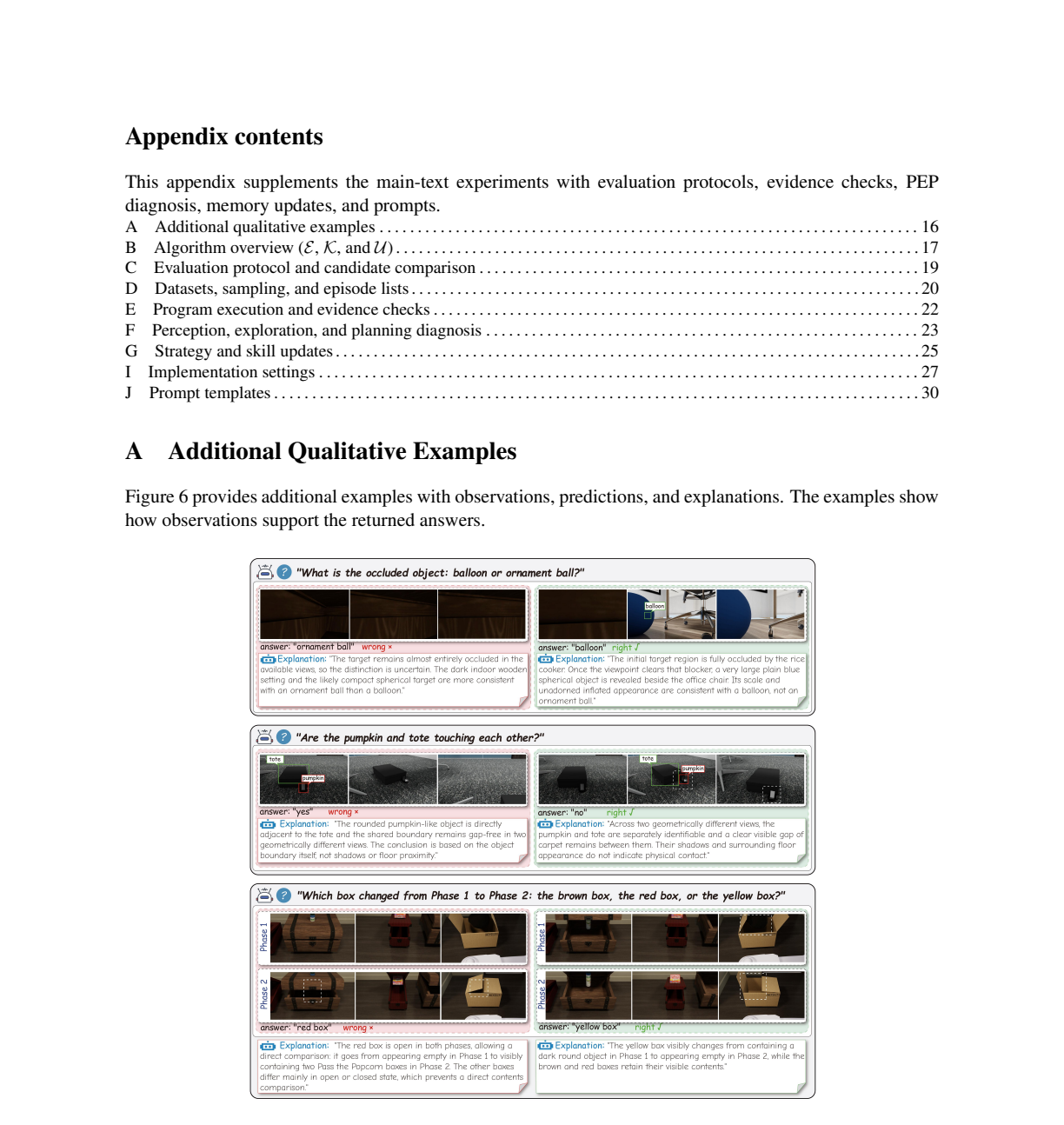
Figures are the authors', reproduced from the paper.
References (14)
- [2026] Yining Hong, Jiageng Liu, Han Yin, Manling Li, Leonidas Guibas, Li Fei-Fei, Jiajun Wu, and Yejin Choi. ESI-BENCH: Towards embodied spatial intelligence that closes the perception-action loop.arXiv preprint arXiv:2605.18746, on PithPith's reviewarXiv
- [1] Min Chen, Shengjun Zhang, Yuxin Li, Zhang Zhang, Xin Fei, Chong Xia, and Yueqi Duan. Parallelworld: Test-time scaling for embodied reasoning.arXiv preprint arXiv:2608.22971, on PithPith's reviewarXiv
- [3] Herec r is the candidate count. In the reported evaluation, the planner generates each candidate from the round’s memory snapshot. Algorithm 1Four-round execution and memory updates Require:EpisodesD; frozen plannerΦand reflectorΨ; diagnosisU; task budgetsT max(q) Ensure:Round... on Pith
- [5] Guanzhi Wang, Yuqi Xie, Yunfan Jiang, Ajay Mandlekar, Chaowei Xiao, Yuke Zhu, Linxi Fan, and Anima Anandkumar. VOY AGER: An open-ended embodied agent with large language models.arXiv preprint arXiv:2305.16291, on PithPith's reviewarXiv
- [8] doi: 10.1109/TIP.2024.3484251. Yun Wang, Kunhong Li, Longguang Wang, Junjie Hu, Dapeng Oliver Wu, and Yulan Guo. ADStereo: Efficient stereo matching with adaptive downsampling and disparity alignment.IEEE Transactions on Image Processing, 34:1204–1218, 2025b. doi: 10.1109/TIP.... on PithPith's reviewarXiv
- [9] 14 Youtu-Agent Team. Training-free group relative policy optimization.arXiv preprint arXiv:2510.08191, on PitharXiv
- [10] Guibin Zhang, Muxin Fu, and Shuicheng Yan. MemGen: Weaving generative latent memory for self- evolving agents. InInternational Conference on Learning Representations, 2026a. Haokai Zhang, Yuhang Ding, Yunshu Zhou, Xinze Du, Shengtao Zhang, Zhiyue Zhao, Yuling Xi, and Hao Chen.... on PithPith's reviewarXiv
- [11] doi: 10.1007/978-3-031-72946-1_9. Qi Zheng, Daqing Liu, Chaoyue Wang, Jing Zhang, Dadong Wang, and Dacheng Tao. ESceme: Vision- and-language navigation with episodic scene memory.International Journal of Computer Vision, 133: 254–274, on Pithdoi:10.1007/978-3-031-72946-1_9
- [12] doi: 10.1007/s11263-024-02159-8. Chenming Zhu, Tai Wang, Wenwei Zhang, Jiangmiao Pang, and Xihui Liu. LLaV A-3D: A simple yet effec- tive pathway to empowering LMMs with 3D capabilities. InProceedings of the IEEE/CVF International Conference on Computer Vision, on Pithdoi:10.1007/s11263-024-02159-8
- [14] For an incorrect answer, the verifier considers successfully executed visual calls, their contract flags, any output from the symboliccount_uniqueprimitive, and the exploration score. Table 7 lists the rules in evaluation order; the first applicable rule is used. Table 7: Orde... on Pith
- [2022] doi: 10.1109/LRA. 2022.3164755. Yun Wang, Longguang Wang, Kunhong Li, Yongjian Zhang, Dapeng Oliver Wu, and Yulan Guo. Cost vol- ume aggregation in stereo matching revisited: A disparity classification perspective.IEEE Transactions on Image Processing, 33:6425–6438, on Pithdoi:10.1109/lra
- [2023] Peidong Wang, Zhiming Ma, Ying Chang, Xufang Luo, Xiaocui Yang, Shi Feng, Yuqing Yang, and Dong- sheng Li. Self-evolving embodied agents via skill-harness evolution.arXiv preprint arXiv:2608.11350, 2026a. Weizhen Wang, Chenda Duan, Zhenghao Peng, Yuxin Liu, and Bolei Zhou. Emb... on PithPith's reviewarXiv
- [2024] Ruofei Ju, Xinrui Wang, Xin Ding, Yifan Yang, Hao Wu, Shiqi Jiang, Qianxi Zhang, Hao Wen, Xiangyu Li, Weijun Wang, Kun Li, Yunxin Liu, Haipeng Dai, Wei Wang, and Ting Cao. EmbodiSkill: Skill-aware reflection for self-evolving embodied agents.arXiv preprint arXiv:2605.10332, on PithPith's reviewarXiv
- [2025] Shi-Yu Tian, Zhuo-Xia Wang, Xuan-Yi Zhu, Zhi Zhou, Xinwei Yang, Kun-Yang Yu, Ming Yang, Yang Chen, and Yu-Feng Li. Self-evolving neuro-symbolic skills for tool-augmented spatial reasoning.arXiv preprint arXiv:2608.07955, on PithPith's reviewarXiv
Cited by 1 Pith paper
Reviewed papers on Pith that cite this one. The full citation record
Challenges and discussion
Disagree with the review, or know something it missed? Leave a comment, or challenge this review formally: a challenge becomes a permanent entry in this paper's record, and its decision is published here.
Come back by email
A short list of the week's newly reviewed papers. Nothing is sent until you confirm from your inbox, and every email has a link that stops it. No account.
No comments yet.
Sign in to comment