Quantum Physics · arXiv:2610.20591 v1 · submitted 14 Oct 2026 · 77 references
Logical CCZ state cultivation
The paper says
“Logical CCZ states enable Toffoli gates, a central building block of fault-tolerant quantum arithmetic. We introduce an end-to-end protocol for direct CCZ-state preparation on bivariate tricycle and bicycle (BT/BB) codes.”
more of the abstract
Our factory combines the cup-product CCZ gates native to BT codes with two novel ingredients, both enabled by engineering the logical coupling between BT and BB codes through projection-preserving lifts. Index-2 lifted BB ancillas enable selective Z-basis initialization, allowing the native cup-product gates to directly prepare two disjoint logical CCZ states. The prepared CCZ states are faithfully transferred to index-3 lifted BB memories with high code distance. We use decoder-based postselection to obtain high-fidelity output states with low overhead. We perform exact simulations of our factory under a circuit-level noise model motivated by neutral-atom hardware, obtaining joint infidelities of 1.84 × 10⁻⁵ at 21.94% acceptance and 4.10 × 10⁻⁷ at 8.89% acceptance for single-qubit, CZ, and CCZ error rates of 0.01%, 0.1%, and 0.5%, respectively. At the output-infidelity target of our smallest factory, its estimated spacetime cost per CCZ state is lower than that of T-state cultivation followed by CCZ conversion, providing an efficient route to logical CCZ states for fault-tolerant quantum computation.
from the abstract
Pith says
Machine review · deepseek-v4-flash · 15 Oct 2026 · what was read was not recorded · not checked by a person
It can be wrong. Challenge this review or reply to it.
Holds up, with conditions. Direct CCZ cultivation on BT/BB codes, with a plausible 1.6x spacetime win at df=3, is real engineering progress; the load-bearing lifted-BB claims are explicit but rest on an unpublished preprint and deserve verification before the numbers are trusted. This line is wrong
4 major objections · 5 minor
How often objections from reviews like this one are right: not yet measured
Not checked: figures, code, what the 77 references say.
The paper says, at Sec. III.B, Eq. (20), Table IV, App. D.2
The review did not quote this passage.
Pith says: Objection 1 of 4 · major
The two novel stages, selective initialization and escape, are engineered through projection-preserving lifts whose logical images and distances are imported from Ref. [32], a same-author arXiv preprint. The manuscript asserts that the index-2 composite image is im(\hat{ι}_1 ∘ \hat{p}_1) = ⟨Z_α⟩, ⟨Z_β⟩, or ⟨Z_γ⟩, and that the index-3 lifts have surjective projection onto the retained two-dimensional logical space and distances [[54,2,9]], [[90,2,13]], and [[162,2,18]].
more of objection 1
These properties are load-bearing: Eq. (4) and the output fidelities in Table I inherit any error in the composite logical maps, and the memory errors in Fig. 3 are controlled by the listed escape-code distances. The exact simulations do not certify these assumptions because they start from the claimed maps, and finite-shot memory runs do not certify distances. The polynomials in Table IV make the claims directly checkable, but the verification is not included in this manuscript. Please provide an independent computation or proof of the composite logical images and minimum distances, or clearly label the protocol as conditional on the companion lifting construction.
The paper says, at App. A8 and Table I
The review did not quote this passage.
Pith says: Objection 2 of 4 · major
The reported acceptance/infidelity tradeoff is produced by a decoder-based postselection scheme with several benchmark-specific choices: the df=3 benchmark disables vetoes (3)–(5), the df=5 benchmark omits the BT X-check postselection and uses only two reweighting passes, the BB Z-check correction-weight threshold is two, the BT Z-syndrome correction threshold is one for df=4 and df=5, and the decoding windows (w_c,w_b) differ across dfs.
more of objection 2
The text says these relaxations were guided by the observed error mechanisms at p=0.1%. Because the acceptance rate and spacetime volume are central to the main comparison, post hoc tuning of these thresholds can inflate the apparent performance. I am not objecting to decoder-based postselection as a method, but the manuscript should either fix one protocol that is not adapted per benchmark or report a sensitivity analysis over the thresholds and window sizes that are not forced by fault-distance requirements.
The paper says, at App. C.3 and Sec. II
The review did not quote this passage.
A classifier read this sentence of the paper as acknowledging the concern (probability 0.71):
“These estimates include the conversion circuit and its syndrome-extraction rounds, assume independently re- tried and pooledTstates, and exclude additional input- buffer storage and conversion-induced infidelity.”
Pith says: Objection 3 of 4 · major
The headline factor-1.6 volume reduction is obtained by comparing a direct factory whose volume includes retries, storage, and its own output infidelity with a T-cultivation route whose conversion-induced logical infidelity is excluded from the comparison and whose target is set using the first-order approximation 1−F^{(4T)}_{CCZ} ≃ 4(1−F_T).
more of objection 3
The exclusion is stated explicitly, but no quantitative bound is given for the omitted conversion-induced error or input-buffer storage. If the conversion circuit contributes even a small logical error, matching the df=3 target would require a lower T-state infidelity and therefore a higher T-route volume than the quoted 9.06e4. This asymmetry affects the central quantitative claim, so the paper should either quantify the omitted terms or soften the abstract and conclusion claims to state the comparison is under the stated accounting assumptions.
The paper says, at Sec. IV, App. B
The review did not quote this passage.
Pith says: Objection 4 of 4 · major
The exact-simulation claim is well supported for the propagation of Pauli faults and the stabilizer-decomposition update, but the Monte Carlo estimates in Table I are reported without confidence intervals. Given that the df=4 infidelity is 4.10e-7 and the df=5 row has zero observed corrupted outputs in 19,581,407 accepted attempts, the sampling uncertainty is material. Please report one-sided confidence bounds for the infidelities and acceptance rates, especially for the df=5 row where the joint infidelity is shown as a dash.
5 minor objections
The paper says, at Table I
Pith says: minor objection 1 of 5
The df=5 row reports 0/19,581,407 corrupted outputs but leaves the joint infidelity as a dash; a one-sided 95% upper bound would be more informative than a dash.
The paper says, at Abstract and Conclusion
Pith says: minor objection 2 of 5
The phrase 'lower than that of T-state cultivation followed by CCZ conversion' should be qualified with the accounting assumptions in App. C, since conversion-induced logical infidelity and input-buffer storage are excluded from the T-route estimate.
show 3 more
The paper says, at App. A8, Eq. (A6)
Pith says: minor objection 3 of 5
The argument-reweighting exponent 1.2 appears arbitrary; the paper should either justify it, cite a prior use, or report how sensitive the accepted logical classes are to this exponent.
The paper says, at App. C.3
Pith says: minor objection 4 of 5
The statement that the lowest available f=3 infidelity, 1.08e-7, agrees with the target 1.03e-7 within sampling uncertainty should be accompanied by the relevant confidence intervals, since the volume comparison depends on this agreement.
The paper says, at App. A3
Pith says: minor objection 5 of 5
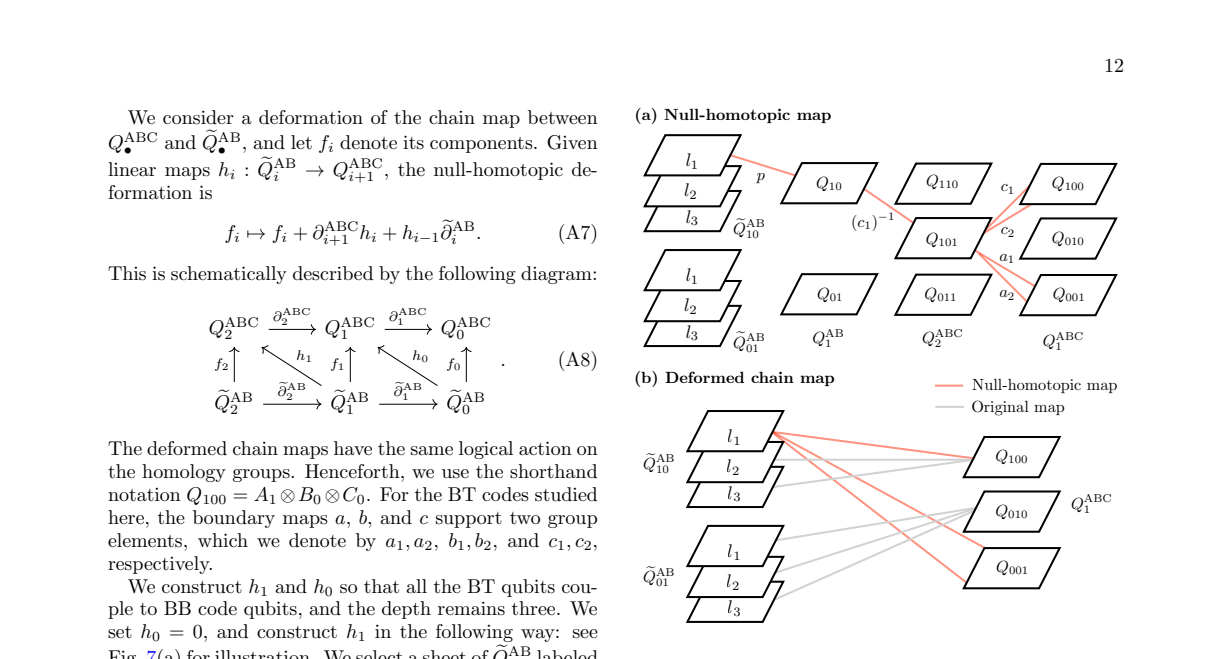
The paragraph introducing the chain-map deformation contains a duplicated sentence: 'We consider a deformation of the chain map' appears twice with slightly different notation and should be merged.
What would settle it
For each row of Table IV, construct the BT, BB, and lifted-BB chain complexes over F2[x,y]/(x^3−1, y^m−1) with the Table V projections, compute H_1 and the induced composite map f̂1 = ι̂1 ∘ p̂1 (including the App. A.3 deformation for escape) by Smith normal form over F2, and verify that im f̂1 is exactly the stated ⟨α⟩, ⟨β⟩, or ⟨γ⟩ for initialization and the stated two-dimensional image for escape. Separately, run a minimum-weight logical-operator search on the three escape codes with n = 54, 90, 162 to confirm (d_X, d_Z) = (9,9), (13,13), (18,18) or determine the true distances. If both checks pass, the load-bearing premise is settled; if either fails, selective initialization or the high-distance escape stage is invalidated.
from the skeptic's reading
How the review went
4 readings by deepseek-v4-flash · 15 Oct 2026
- Reader holds up, with conditions
- Skeptic agrees
- Editor wrote the verdict above
- Referee major revision: 4 major objections, 5 minor
Not run on this paper: the simulated authors' defence.
Pith did not check this review's objections against the paper.
The review in full
The review in brief, machine-written
The thing to know: this is the first end-to-end factory I've seen that cultivates logical CCZ states directly on BT/BB codes, bypassing the 4T-to-CCZ conversion route. The new ingredients are index-2 lifted BB ancillas, engineered to have rank-one logical image for selective Z-initialization, and index-3 lifted BB escape codes that carry the states to higher distance. The cup-product CCZ gate and the homomorphic measurement machinery are published ground; the lift construction is not, and that is where the caveats live.
What the paper does well: exact circuit-level simulation with transparent failure counts (86/4,388,724 at df=3, 6/14,619,194 at df=4); honest reporting that only the df=3 operating point beats the T-route on volume (1.6x, 5.54e4 per CCZ) while df=4 comes out slightly worse; and resource accounting that states its exclusions up front — no input-buffer storage, no conversion-induced infidelity, and the T-cultivation schedules were not recompiled under the new timing convention. The CCZ pair in Eq. (4) is derived from the cup-product action and the chosen initial states, so there is no circularity: the target is not assumed, it is produced.
Soft spots, in proportion. The load-bearing lifted-BB properties — the rank-one logical images for initialization and the [[54,2,9]], [[90,2,13]], [[162,2,18]] escape distances — are asserted and cited to [32], an unpublished self-authored preprint. The exact simulations do not certify them because they begin after the assumed maps. This is the paper's real gap, and it is a narrow one: Table IV gives explicit polynomials and Table V the projection homomorphisms, so the logical-image claims are directly checkable, and Fig. 3 partially supports the escape distances. A referee should ask for that verification, or the script that does it.
The postselection rules are tuned per benchmark — df=3 disables three of the five vetoes, df=5 omits the BT X-check postselection — and the decoder has free parameters (reweighting exponent 1.2, windows (wc,wb)). This is disclosed, but a sensitivity analysis would show how much the operating points depend on those choices. The df=5 row is a zero-event result: no corrupted output in 19.6M attempts, so the infidelity is an upper bound. The authors use one-sided limits correctly in Fig. 3 for the memory experiments; the Table I entry should say the same. No simulation code or data artifact is provided.
Who this is for: people building qLDPC magic-state factories and costing fault-tolerant arithmetic. It deserves a serious referee. My recommendation: send it to review, and require the lifted-BB verification, the simulation artifact, and a sensitivity check on the postselection rules before acceptance.
The strongest objection
The protocol's two novel ingredients are controlled by the composite logical maps of the lifted BB codes in Eq. (20) and App. D.2. Selective initialization requires im(ι̂1 ∘ p̂1) = ⟨Z_α⟩, ⟨Z_β⟩, or ⟨Z_γ⟩, otherwise the homomorphic measurement collapses an un-targeted logical qubit and the input state in Eq. (3), and therefore the two-CCZ output in Eq. (4), is not produced. Escape similarly requires the composite image to be the stated two-dimensional space and the memory codes to have the distances listed in Table II. The paper asserts these properties: Sec. III.B says an index-2 lift is constructed with composite image ⟨Z_α⟩, and the Table IV caption says the escape polynomials project exactly onto the indicated BT factors, but the supporting lifting, fiber-sum transfer, and distance claims are cited to [32], an unpublished arXiv preprint, and no independent computation or artifact is provided. The exact simulations do not certify these assumptions because they begin after the assumed initialization and escape maps. If an escape code has lower distance than the listed [[54,2,9]], [[90,2,13]], or [[162,2,18]] parameters, the memory-error contribution to the reported infidelities is underestimated. Because the defining polynomials are fully explicit, this gap is directly checkable and is the premise that all downstream simulation numbers inherit.
I agree with the reader that the load-bearing premise is the unpublished lifted-BB construction: the explicit polynomials in Table IV and the logical images in Table II are asserted, while their proof is delegated to the self-cited preprint [32]. This matters because the protocol's two claimed innovations, selective logical initialization and high-distance escape, are exactly the properties of these concrete lifted code instances. If an index-2 image were not rank-one, Eq. (3) would not be prepared and the depth-two cup-product circuit would produce a different state than the two disjoint CCZ states in Eq. (4). If an escape code distance were lower than listed, the memory stage would contribute more error than the reported infidelities assume. I found no stronger internal inconsistency: the simulation method of App. B is coherent with the cited low-rank stabilizer decomposition technique, the decoder approximation does not affect exactness of the noisy-circuit simulation because the decoder only defines a classical postselection function, and the resource comparison against T-cultivation is explicitly qualified by its stated exclusions. The concern is therefore a verification gap rather than a demonstrated error, and the proposed check can settle it directly. Since the reader already rated the paper CONDITIONAL on essentially this premise, my read does not move the verdict; the missing verification strengthens the condition but does not change the recommended decision.
The referee's report
If correct, the protocol is a meaningful step toward low-overhead logical CCZ states: it avoids the 4T-to-CCZ conversion overhead, generates two CCZ states per attempt, and is backed by exact circuit-level simulations with transparent failure counts rather than only analytical estimates. The strength of the paper is the concreteness of the construction: explicit code parameters and polynomials are supplied, the circuit-level noise model is stated, and the reported fidelities are obtained by exact simulation of the stated protocol. The two novel ingredients, selective initialization and high-distance escape, are both conceptually clean and potentially reusable beyond this specific factory. However, the core algebraic properties of the lifted BB codes are imported from a same-author companion preprint, and the numerical performance is partly determined by benchmark-specific postselection choices; both points need to be resolved before the quantitative claims can be taken as established.
Pith's reading of the paper (a machine's summary, not the authors')
This paper claims that logical CCZ states, the resource states that supply Toffoli gates for fault-tolerant quantum arithmetic, can be grown directly on bivariate tricycle/bicycle (BT/BB) codes, bypassing the usual route of cultivating T states and converting four of them into one CCZ state. The obstacle it removes is that applying the native cup-product CCZ gate of a BT code to logical |+> states produces a hypergraph state rather than independent CCZ states; the authors show that selectively initializing one logical qubit per block in |0> reduces the logical action to exactly two disjoint CCZ gates. Two engineered ingredients make this work, both built from projection-preserving lifts of BB codes: an index-2 lifted ancilla with rank-one logical image for selective Z-basis initialization, and an index-3 lifted BB memory with higher code distance for the escape stage. Under a neutral-atom circuit-level noise model, exact simulations give joint infidelities of 1.84e-5 at 21.94% acceptance (distance-3 factory) and 4.10e-7 at 8.89% acceptance (distance-4 factory). At the distance-3 target the estimated spacetime volume per CCZ is 5.54e4, a factor 1.6 below T-cultivation-plus-conversion, suggesting direct cultivation is a viable replacement in this regime.
What carries the argument. The load-bearing object is the projection-preserving lift of a BB code by a cyclic group (index nu=2 or 3), composed with the inclusion chain map into a BT code; the composed chain map f=iota composed with p determines, through homological algebra, which logical operators of the BT code couple to the lifted BB block and which logical-Z subspace a homomorphic measurement extracts. An index-2 lift has a non-surjective induced homology map whose image can be carved down to a single logical-Z class (alpha, beta, or gamma), so the ancilla readout addresses exactly the targeted logical qubit while the uncoupled qubit is treated as gauge. An index-3 lift keeps the projection surjective and the fiber-sum transfer injective, so the full two-dimensional logical space of the base BB code is preserved while the distance grows, enabling faithful teleportation of the prepared CCZ states into memories of distance 9, 13, or 18 with check weight 8. The three stages (selective initialization, the depth-two cup-product CCZ circuit, and the escape) are tied together by decoder-based postselection: the telescoping decoder with argument reweighting and auxiliary BB-only decoders rejects shots whose syndromes are consistent with dangerous correlated faults. Exactness of the simulation is carried by the observation that the ideal target |CCZ> tensor itself admits a four-term stabilizer decomposition that stays four-term under propagated Clifford errors, so each trajectory can be simulated with at most 64 complex amplitudes on a six-qubit residual subsystem.
Core claim. The central claim is that an end-to-end CCZ-state cultivation factory can be built by engineering the logical coupling between BT and BB codes through projection-preserving lifts, so that the native cup-product CCZ gate produces exactly two disjoint logical CCZ states, which are then transferred to higher-distance BB memories. The cup-product gate acts as six logical CCZ interactions across three BT blocks, but preparing one logical qubit per block (alpha_1, beta_2, gamma_3) in the |0> state trivializes four of them, leaving CCZ(beta_1,gamma_2,alpha_3) times CCZ(gamma_1,alpha_2,beta_3): two independent CCZ states. Index-2 lifts give homomorphic measurements with rank-one logical image, so each targeted logical Z can be read out without touching the other qubits; index-3 lifts keep the logical projection surjective onto the full two-dimensional logical space of the memory codes, with check weight rising from 4 to 8 to reach distances 9, 13, and 18. Decoder-based postselection rejects shots whose syndromes are consistent with dangerous correlated faults, including correlated CZ errors produced when X errors pass through CCZ gates and correlated Z errors backpropagating through the non-transversal homomorphic CNOT. This yields the reported joint infidelities of 1.84e-5 at 21.94% acceptance (d_f=3) and 4.10e-7 at 8.89% acceptance (d_f=4), with the d_f=3 factory requiring spacetime volume 5.54e4 per CCZ, a factor 1.6 below the T-cultivation-plus-conversion baseline.
The premise it rests on. The load-bearing premise is that the lifting theorem from the authors' prior work, cited to an unpublished preprint rather than proved here, guarantees that each index-2 lift has rank-one logical image hitting exactly the targeted BT logical-Z operator and that each index-3 lift projects surjectively while genuinely reaching distances 9, 13, and 18; if those logical images or distances are wrong, the selective initialization and the escape stage both fail.
If the paper is right (Pith's inferences, not the authors')
If the lifting-based construction holds, logical CCZ states can be produced directly at an estimated spacetime cost of 5.54e4 per CCZ at the d_f=3 target, a factor 1.6 below cultivating T states and converting four into one CCZ.
CCZ resources for quantum arithmetic no longer need to carry the T-to-CCZ conversion overhead, and each accepted attempt yields two CCZ states at once.
The d_f=4 factory reaches 4.10e-7 joint infidelity, and the d_f=5 factory observed zero corrupted outputs among roughly 19.6 million accepted attempts, suggesting the postselection scheme suppresses undetected logical errors as distance grows.
Selective logical initialization via lifted ancillas is a transferable capability: any code whose native gates produce entangled non-Clifford resources could be repurposed into a resource factory by measuring away the unwanted logical degrees of freedom.
Because the paper finds escape-stage decoding currently limits output fidelity rather than undetected pre-escape logical-Z errors, joint optimization of decoding and postselection should improve the acceptance-versus-infidelity tradeoff at fixed hardware.
The rank-one-image construction suggests a general recipe the paper does not itself develop: for any product-code family with native non-Clifford gates, the lift index selects which logical resource to zero out, so the same machinery could turn other cup-product-capable codes into CCZ or CS factories.
The paper's own failure analysis implies a testable prediction: the d_f=4 target could be met at higher acceptance with better decoders alone, before any hardware improvement, since escape-stage decoding rather than physical noise is reported as the current limiter.
Because the two output CCZ states carry correlated errors (the joint infidelity exceeds each individual infidelity), downstream resource accounting must treat the pair as a correlated resource rather than two independent states — a caveat the paper flags for distillation and that matters for naive per-gate cost estimates.
Reducing physical gate error rates should shrink spacetime volume faster than the error rate itself, since rejected attempts dominate the overhead; the paper states the direction of this effect but does not quantify the curve.
Check this review
Pith stored no record of this review's passes and took no fingerprint of it. Reviews made by code from 13 Nov 2026 on carry both.
How often reviews like this one are right
Reviews like this one: written by deepseek-v4-flash, where what was read was not recorded.
How often objections from reviews like this one are right: not yet measured
Reviews by people
This review was written by a machine. No person has reviewed this paper on Pith yet. A scientist listed on Pith can review it for a fee, and their review is published here whatever it concludes.
The paper
Abstract
Logical CCZ states enable Toffoli gates, a central building block of fault-tolerant quantum arithmetic. We introduce an end-to-end protocol for direct CCZ-state preparation on bivariate tricycle and bicycle (BT/BB) codes. Our factory combines the cup-product CCZ gates native to BT codes with two novel ingredients, both enabled by engineering the logical coupling between BT and BB codes through projection-preserving lifts. Index-2 lifted BB ancillas enable selective Z-basis initialization, allowing the native cup-product gates to directly prepare two disjoint logical CCZ states. The prepared CCZ states are faithfully transferred to index-3 lifted BB memories with high code distance. We use decoder-based postselection to obtain high-fidelity output states with low overhead. We perform exact simulations of our factory under a circuit-level noise model motivated by neutral-atom hardware, obtaining joint infidelities of 1.84 × 10⁻⁵ at 21.94% acceptance and 4.10 × 10⁻⁷ at 8.89% acceptance for single-qubit, CZ, and CCZ error rates of 0.01%, 0.1%, and 0.5%, respectively. At the output-infidelity target of our smallest factory, its estimated spacetime cost per CCZ state is lower than that of T-state cultivation followed by CCZ conversion, providing an efficient route to logical CCZ states for fault-tolerant quantum computation.
The paper's own sentences, arranged, kept beside the review and separate from it. Each label is drawn from a closed vocabulary; the number beside it is the probability the classifier gave that label. No sentence in this record was written by a model.
abstract compiled · 2026-10-15
The authors' main claim, as the classifier picked it out 1.00
“At the output-infidelity target of our smallest factory, its estimated spacetime cost per CCZ state is lower than that of $T$-state cultivation followed by CCZ conversion, providing an efficient route to logical CCZ states for fault-tolerant quantum computation.”
How the main claim is stated: asserted 0.94
What the abstract itself states, as probabilities: claims first 0.10 · states limitation 0.34 · human participants 0.02 · controlled comparison 0.64 · randomized assignment 0.01 · states quantitative result 0.99 · compares with prior results 0.94 · mentions code or data availability 0.03
The abstract, sentence by sentence
This table labels the abstract only (arXiv listing abstract v1). The number is the probability the classifier gave the label.
| Sentence | Role | The authors' own work | States the main conclusion | Strength |
|---|---|---|---|---|
| Logical CCZ states enable Toffoli gates, a central building block of fault-tolerant quantum arithmetic. | background 1.00 | 0.04 | 0.04 | asserted 1.00 |
| We introduce an end-to-end protocol for direct CCZ-state preparation on bivariate tricycle and bicycle (BT/BB) codes. | contribution 1.00 | 0.94 | 0.10 | asserted 1.00 |
| Our factory combines the cup-product CCZ gates native to BT codes with two novel ingredients, both enabled by engineering the logical coupling between BT and BB codes through projection-preserving lifts. | method 0.79 | 0.87 | 0.07 | asserted 1.00 |
| Index-2 lifted BB ancillas enable selective $Z$-basis initialization, allowing the native cup-product gates to directly prepare two disjoint logical CCZ states. | method 0.95 | 0.83 | 0.05 | asserted 1.00 |
| The prepared CCZ states are faithfully transferred to index-3 lifted BB memories with high code distance. | method 0.91 | 0.89 | 0.06 | asserted 1.00 |
| We use decoder-based postselection to obtain high-fidelity output states with low overhead. | method 0.97 | 0.94 | 0.05 | asserted 1.00 |
| We perform exact simulations of our factory under a circuit-level noise model motivated by neutral-atom hardware, obtaining joint infidelities of $1.84\times10^{-5}$ at $21.94\%$ acceptance and $4.10\times10^{-7}$ at $8.89\%$ acceptance for single-qubit, CZ, and CCZ error rates of $0.01\%$, $0.1\%$, and $0.5\%$, respectively. | result 0.96 | 0.97 | 0.10 | asserted 1.00 |
| At the output-infidelity target of our smallest factory, its estimated spacetime cost per CCZ state is lower than that of $T$-state cultivation followed by CCZ conversion, providing an efficient route to logical CCZ states for fault-tolerant quantum computation. | interpretation 0.68 | 0.87 | 0.79 | asserted 0.94 |
What kind of paper the classifier reports this is: method or tool 1.00 · evidence from simulation or computation 1.00
What was examined, and what was not
Sources read
- arXiv listing abstract v1
Not examined
- full text
- figures and tables
- references and citing sentences
- relations to other papers
Levels run
- P abstract
Not run
- S sections
- T body sentences
- C citations
- R cross-paper relations
How the labels were made
Compiled by classifier-1.13.0 via TypeSafe API, question bank abstract-p1-20260923, 2026-10-15: 1 request, 6,474 input tokens.
Every quoted sentence on this record is the authors'. Every label is from Pith's closed vocabulary, with the probability shown beside it. This record as JSON
Figures (9)
Showing 1 of the paper's 9 figures. Figures are the authors', reproduced from the paper.
References (77)
- [32] Y. Hirasaki and J. Y. Lee, Lifting lifted product codes (2026), arXiv:2607.28621 [quant-ph] on PithPith's reviewarXiv
- [1] B. Eastin and E. Knill, Restrictions on transversal en- coded quantum gate sets, Phys. Rev. Lett.102, 110502 (2009) on Pith
- [2] S. Bravyi and A. Kitaev, Universal quantum computa- tion with ideal clifford gates and noisy ancillas, Physical Review A71, 022316 (2005) on Pith
- [3] S. Bravyi and J. Haah, Magic-state distillation with low overhead, Phys. Rev. A86, 052329 (2012) on Pith
- [4] C. Jones, Multilevel distillation of magic states for quan- tum computing, Phys. Rev. A87, 042305 (2013) on Pith
- [5] J. Haah, M. B. Hastings, D. Poulin, and D. Wecker, Magic state distillation with low space overhead and op- timal asymptotic input count, Quantum1, 31 (2017) on Pith
- [6] M. B. Hastings and J. Haah, Distillation with subloga- rithmic overhead, Phys. Rev. Lett.120, 050504 (2018) on Pith
- [7] A. Krishna and J.-P. Tillich, Towards low overhead magic state distillation, Phys. Rev. Lett.123, 070507 (2019) on Pith
- [8] D. Litinski, Magic State Distillation: Not as Costly as You Think, Quantum3, 205 (2019) on Pith
- [9] L. Golowich and V. Guruswami, Asymptotically good quantum codes with transversal non-clifford gates, in Proceedings of the 57th Annual ACM Symposium on The- ory of Computing, STOC ’25 (Association for Computing Machinery, New York, NY, USA, 2025) p. 707–717 on Pith
- [10] Q. T. Nguyen, Good binary quantum codes with transversal ccz gate, inProceedings of the 57th Annual ACM Symposium on Theory of Computing, STOC ’25 (Association for Computing Machinery, New York, NY, USA, 2025) p. 697–706 on Pith
- [11] A. M. Meier, B. Eastin, and E. Knill, Magic-state distil- lation with the four-qubit code, Quantum Info. Comput. 13, 195–209 (2013) on Pith
- [12] Q. T. Nguyen and C. A. Pattison, Quantum fault tol- erance with constant-space and logarithmic-time over- heads, inProceedings of the 57th Annual ACM Sympo- sium on Theory of Computing, STOC ’25 (Association for Computing Machinery, New York, NY, USA, 2025) p. 730–737 on Pith
- [13] S. Xu, K. Liu, P. Rall, Z. He, and Y. Ding, Dis- tilling magic states in the bicycle architecture (2026), arXiv:2602.20546 [quant-ph] on PithPith's reviewarXiv
- [14] M. J. Cervia, H. Lamm, D. Liu, E. M. Murairi, and S. Zhu, Magic state distillation using asymptotically good codes on qudits (2025), arXiv:2512.21874 [quant-ph] on PitharXiv
- [15] C. Gidney, N. Shutty, and C. Jones, Magic state culti- vation: growing t states as cheap as cnot gates (2024), arXiv:2409.17595 [quant-ph] on PithPith's reviewarXiv
- [16] T. Itogawa, Y. Takada, Y. Hirano, and K. Fujii, Efficient magic state distillation by zero-level distillation, PRX Quantum6, 020356 (2025) on Pith
- [17] Z.-H. Chen, M.-C. Chen, C.-Y. Lu, and J.-W. Pan, Efficient magic state cultivation onRP 2 (2025), arXiv:2503.18657 [quant-ph] on PithPith's reviewarXiv
- [18] J. Claes, Cultivating t states on the surface code with only two-qubit gates (2025), arXiv:2509.05232 [quant- ph] on PitharXiv
- [19] K. Sahay, P.-K. Tsai, K. K. Chang, Q. Su, T. B. Smith, S. Singh, and S. Puri, Fold-transversal surface code cul- tivation, PRX Quantum7, 033006 (2026) on Pith
show 57 more
- [20] Y. Vaknin, S. Jacoby, A. Grimsmo, and A. Retzker, Effi- cient magic state cultivation on the surface code (2026), arXiv:2502.01743 [quant-ph] on PitharXiv
- [21] Y. Hirano, R. Toshio, T. Itogawa, and K. Fujii, Effi- cient magic state cultivation with lattice surgery (2026), arXiv:2510.24615 [quant-ph] on PithPith's reviewarXiv
- [22] B. Het´ enyi, B. J. Brown, and D. J. Williamson, Constant- depth magic state cultivation with clifford measurements by gauging, Phys. Rev. Lett.137, 140601 (2026) on Pith
- [23] C. Gidney, Halving the cost of quantum addition, Quan- tum2, 74 (2018) on Pith
- [24] C. Gidney, How to factor 2048 bit rsa integers with less than a million noisy qubits (2025), arXiv:2505.15917 [quant-ph] on PithPith's reviewarXiv
- [25] C. Gidney and A. G. Fowler, Efficient magic state fac- tories with a catalyzed|CCZ⟩to 2|T⟩transformation, Quantum3, 135 (2019) on Pith
- [26] N. P. Breuckmann, M. Davydova, J. N. Eberhardt, and N. Tantivasadakarn, Cups and gates i: Cohomology in- variants and logical quantum operations, Communica- tions in Mathematical Physics407, 86 (2026) on Pith
- [27] V. Menon, J. P. Bonilla Ataides, R. Mehta, A. Gu, D. B. Tan, and M. D. Lukin, Magic tricycles: Efficient magic- state generation with finite block-length quantum ldpc codes, Phys. Rev. X16, 021014 (2026) on Pith
- [28] P.-S. Hsin, R. Kobayashi, and G. Zhu, Classifying logical gates in quantum codes via cohomology operations and symmetry (2025), arXiv:2411.15848 [quant-ph] on PithPith's reviewarXiv
- [29] S. J. S. Tan, Y. Hong, T.-C. Lin, M. J. Gullans, and M.- H. Hsieh, Single-shot universality in quantum ldpc codes via code-switching (2025), arXiv:2510.08552 [quant-ph] on PitharXiv
- [30] C. Li, J. Preskill, and Q. Xu, Transversal dimension jump for product qldpc codes (2026), arXiv:2510.07269 [quant- ph] on PitharXiv
- [31] M. Rossi, M. Huber, D. Bruß, and C. Macchiavello, Quantum hypergraph states, New Journal of Physics15, 113022 (2013) on Pith
- [33] S. Huang, T. Jochym-O’Connor, and T. J. Yoder, Homo- morphic logical measurements, PRX Quantum4, 030301 (2023) on Pith
- [34] Q. Xu, H. Zhou, G. Zheng, D. Bluvstein, J. P. B. Ataides, M. D. Lukin, and L. Jiang, Fast and parallelizable logical computation with homological product codes, Phys. Rev. X15, 021065 (2025) on Pith
- [35] G. Zhu, Transversal non-clifford gates on qldpc codes breaking the √ Ndistance barrier and quantum- inspired geometry withZ 2 systolic freedom (2025), arXiv:2507.15056 [quant-ph] on PithPith's reviewarXiv
- [36] G. Zhu, A topological theory for qldpc: non-clifford gates and magic state fountain on homological product codes with constant rate and beyond then 1/3 distance barrier (2025), arXiv:2501.19375 [quant-ph] on PitharXiv
- [37] G. Zhu, S. Sikander, E. Portnoy, A. W. Cross, and B. J. Brown, Non-clifford and parallelizable fault-tolerant logi- cal gates on constant and almost-constant rate homolog- ical quantum low-density parity-check codes via higher symmetries, PRX Quantum6, 040361 (2025) on Pith
- [38] N. P. Breuckmann, M. Davydova, J. N. Eberhardt, L. F. Hallwirth, and N. Tantivasadakarn, Cups and gates ii: Operads, twists, and addressable intra-code gates (2026), arXiv:2610.05214 [quant-ph]. 18 on PithPith's reviewarXiv
- [39] L. Daguerre and I. H. Kim, Code switching revisited: Low-overhead magic state preparation using color codes, Phys. Rev. Res.7, 023080 (2025) on Pith
- [40] L. Daguerre, R. Blume-Kohout, N. C. Brown, D. Hayes, and I. H. Kim, Experimental demonstration of high- fidelity logical magic states from code switching, Phys. Rev. X15, 041008 (2025) on Pith
- [41] G. Min and J. Heo, Coded clifford measurements for mul- tiqubit magic-state cultivation (2026), arXiv:2609.09994 [quant-ph] on PithPith's reviewarXiv
- [42] T. Itogawa, Y. Hirano, Y. Akahoshi, and K. Fujii, Zero- levelcczdistillation (2026), arXiv:2605.21867 [quant-ph] on PithPith's reviewarXiv
- [43] G. Min and J. Heo, Direct cultivation of entangled|cs⟩ magic states (2026), arXiv:2609.09993 [quant-ph] on PithPith's reviewarXiv
- [44] D. J. Williamson and T. J. Yoder, Low-overhead fault- tolerant quantum computation by gauging logical opera- tors, Nature Physics22, 598 (2026) on Pith
- [45] V. Guemard, Lifts of quantum css codes (2024), arXiv:2404.16736 [quant-ph] on PithPith's reviewarXiv
- [46] V. Gu´ emard and G. Z´ emor, Moderate-length lifted quan- tum tanner codes (2025), arXiv:2502.20297 [quant-ph] on PitharXiv
- [47] B. C. B. Symons, A. Rajput, and D. E. Browne, Se- quences of bivariate bicycle codes from covering graphs (2026), arXiv:2511.13560 [quant-ph] on PithPith's reviewarXiv
- [48] V. Guemard, Lifting a css code via its handlebody real- ization (2025), arXiv:2505.14327 [quant-ph] on PithPith's reviewarXiv
- [49] L. Wang, A. Z. Liu, R. Li, A. Kubica, and S. Gu, Check- weight-constrained quantum codes: Bounds and exam- ples (2026), arXiv:2601.15446 [quant-ph] on PitharXiv
- [50] J. Y. Lee, K. Okada, N. Maskara, K. Kasai, and H. Zhou, Design principles for ultra-high-rate quantum codes (2026), arXiv:2609.30069 [quant-ph] on PithPith's reviewarXiv
- [51] J. Y. Lee, Designing group-valued codes with full regular low-weight bases (2026), arXiv:2610.06820 [quant-ph] on PithPith's reviewarXiv
- [52] A. Bhardwaj, M. Ma, N. Meister, R. King, D. Bluvstein, J. Preskill, M. Cain, Q. Xu, and H.-Y. Huang, High-rate qldpc processors (2026), arXiv:2607.28795 [quant-ph] on PithPith's reviewarXiv
- [53] S. Surti, L. Daguerre, and I. H. Kim, Efficient simula- tion of logical magic state preparation protocols, PRX Quantum7, 020329 (2026) on Pith
- [54] S. Bravyi, D. Browne, P. Calpin, E. Campbell, D. Gosset, and M. Howard, Simulation of quantum circuits by low- rank stabilizer decompositions, Quantum3, 181 (2019) on Pith
- [55] H. Zhou, C. Duckering, C. Zhao, D. Bluvstein, M. Cain, A. Kubica, S.-T. Wang, and M. D. Lukin, Resource anal- ysis of low-overhead transversal architectures for recon- figurable atom arrays, inProceedings of the 52nd An- nual International Symposium on Computer Architec- ture,... on Pith
- [56] L. A. Beni, O. Higgott, and N. Shutty, Tesseract: A search-based decoder for quantum error correction (2025), arXiv:2503.10988 [quant-ph] on PithPith's reviewarXiv
- [57] A. Leverrier and R. Urbanke, Approximating optimal decoding of quantum ldpc codes with narrow frontiers (2026), arXiv:2606.20513 [quant-ph] on PithPith's reviewarXiv
- [58] A. Wills, T. J. Yoder, and I. Chuang, Forced gap post- selection for quantum ldpc codes and their operations (2026), arXiv:2605.20346 [quant-ph] on PithPith's reviewarXiv
- [59] A. Gong, C. A. Pattison, P. Rall, and A. Wills, Magic state distillation via codes over binary extension fields (2026), arXiv:2608.09727 [quant-ph] on PithPith's reviewarXiv
- [60] R. Pordes, D. Petravick, B. Kramer, D. Olson, M. Livny, A. Roy, P. Avery, K. Blackburn, T. Wenaus, F. W¨ urthwein, I. Foster, R. Gardner, M. Wilde, A. Blate- cky, J. McGee, and R. Quick, The open science grid, Jour- nal of Physics: Conference Series78, 012057 (2007) on Pith
- [61] I. Sfiligoi, D. C. Bradley, B. Holzman, P. Mhashilkar, S. Padhi, and F. Wurthwein, The pilot way to grid re- sources using glideinWMS, in2009 WRI World Congress on Computer Science and Information Engineering, Vol. 2 (2009) pp. 428–432 on Pith
- [62] OSG, OSPool, OSG (2006) on Pith
- [63] OSG, Open Science Data Federation, OSG (2015) on Pith
- [64] T. M¨ uller, T. Alexander, M. E. Beverland, M. B¨ uhler, B. R. Johnson, T. Maurer, and D. Vandeth, Improved belief propagation is sufficient for real-time decoding of quantum memory (2025), arXiv:2506.01779 [quant-ph] on PithPith's reviewarXiv
- [65] A. Bauer and J. C. Magdalena de la Fuente, Planar fault- tolerant circuits for non-clifford gates on the 2d color code, PRX Quantum7, 020367 (2026) on Pith
- [66] M. Davydova, A. Bauer, J. C. Magdalena de la Fuente, M. Webster, D. J. Williamson, and B. J. Brown, Univer- sal fault-tolerant quantum computation in 2d without getting tied in knots, Phys. Rev. X16, 031001 (2026) on Pith
- [67] A. S. Maan, F. M. Garcia Herrero, A. Paler, and V. Savin, Decoding correlated errors in quantum ldpc codes, Na- ture Communications17, 10.1038/s41467-026-70556-3 (2026) on Pithdoi:10.1038/s41467-026-70556-3
- [68] H. Xie, N. Yoshioka, K. Tsubouchi, and Y. Li, Simple, efficient, and generic postselection decoding for qldpc codes, Phys. Rev. Lett.137, 110601 (2026) on Pith
- [69] R. Sahay, D. M. Long, and V. Khemani, Computing with qldpc codes by climbing the chain map hierarchy (2026), arXiv:2609.02999 [quant-ph] on PithPith's reviewarXiv
- [70] L. Berent, L. Z. Cohen, and A. O. Quintavalle, Lifted surgery: Fast processing with qldpc codes (2026), arXiv:2609.11723 [quant-ph] on PithPith's reviewarXiv
- [71] C. Weibel,An Introduction to Homological Algebra, Cam- bridge Studies in Advanced Mathematics (Cambridge University Press, 1994) on Pith
- [72] A. Hatcher,Algebraic topology(Cambridge University Press, 2002) on Pith
- [73] S. Aaronson and D. Gottesman, Improved simulation of stabilizer circuits, Phys. Rev. A70, 052328 (2004) on Pith
- [74] R. Mehta, V. Menon, H. Zhou, M. D. Lukin, and J. P. B. Ataides, The practical cost of magic state cultivation (2026), arXiv:2610.06828 [quant-ph] on PithPith's reviewarXiv
- [75] M. Cain, C. Zhao, H. Zhou, N. Meister, J. P. B. Ataides, A. Jaffe, D. Bluvstein, and M. D. Lukin, Correlated de- coding of logical algorithms with transversal gates, Phys. Rev. Lett.133, 240602 (2024) on Pith
- [76] H. Zhou, C. Zhao, M. Cain, D. Bluvstein, N. Maskara, C. Duckering, H.-Y. Hu, S.-T. Wang, A. Kubica, and M. D. Lukin, Low-overhead transversal fault tolerance for universal quantum computation, Nature646, 303 (2025) on Pith
- [77] Z.-H. Chen, M.-C. Chen, C.-Y. Lu, and J.-W. Pan, Transversal logical clifford gates on rotated surface codes with reconfigurable neutral atom arrays (2024), arXiv:2412.01391 [quant-ph] on PithPith's reviewarXiv
Cited by 2 Pith papers
Reviewed papers on Pith that cite this one. The full citation record
- The limits of magic-state cultivation quant-ph · Nov 2026
- QEDist: Practical Exact Distance Certification for Stabilizer Codes quant-ph · Nov 2026
Challenges and discussion
Disagree with the review, or know something it missed? Leave a comment, or challenge this review formally: a challenge becomes a permanent entry in this paper's record, and its decision is published here.
Come back by email
A short list of the week's newly reviewed papers. Nothing is sent until you confirm from your inbox, and every email has a link that stops it. No account.
No comments yet.
Sign in to comment