Quantum Physics · arXiv:2610.06828 v1 · submitted 5 Oct 2026 · 109 references
The practical cost of magic state cultivation
The paper says
“Magic state cultivation is a promising method for preparing high-fidelity non-Clifford resource states - a central component of fault-tolerant quantum computing - with low spacetime overhead.”
more of the abstract
In benchmarking cultivation, existing resource estimates assume access to noiseless transversal measurement of the output magic state to allow for postselection during the final escape stage of the cultivation process. However, such measurements would destroy the magic state and are therefore unavailable during computation. We develop an open-boundary postselection method, Caliper, that uses only nondestructive mid-circuit syndrome information and substantially outperforms existing methods operating under these constraints. In some regimes, our postselection method uniquely recovers the resource efficiency of prior estimates. However, in other cases, we observe a tradeoff. At spacetime costs reported in previous works, the achievable logical error rates can be orders of magnitude higher, and recovering the reported logical error rate requires substantially larger codes and longer escape stages. Our results highlight how practical considerations involving mid-circuit postselection can impact the design and performance of magic state cultivation protocols.
from the abstract
Pith says
Machine review · deepseek-v4-flash · 6 Oct 2026 · what was read was not recorded · not checked by a person
It can be wrong. Challenge this review or reply to it.
Holds up, with conditions. Genuinely new decoder, benchmarked the right way; the cost-revision figures are real but Y-state-proxy estimates, and the unresolved T-state question is what keeps the paper's headline from being settled. This line is wrong
2 major objections · 5 minor
How often objections from reviews like this one are right: not yet measured
Not checked: figures, code, what the 109 references say.
The paper says, at Fig. 3; SM §5; Abstract
The review did not quote this passage.
A classifier read this sentence of the paper as acknowledging the concern (probability 0.85):
“It is possible that an exact simulation of| ¯T⟩cultivation with our open-boundary postselection method will reveal additional spacetime costs to recovering the performance of magic-state cultivation, and is thus an important direction for future work. 25 6.”
Pith says: Objection 1 of 2 · major
The absolute resource-cost headlines for f=5 color-code cultivation, namely the 10% overhead at 10^-7 and the 6.4% acceptance / ~3.7x spacetime volume at 10^-9 (reported near the end of Fig. 3 and in the surrounding text), are obtained entirely from |Y-bar> cultivation circuits.
more of objection 1
The authors themselves state in SM §5 that exact |T-bar> cultivation with open-boundary postselection is unresolved and that Refs. [69,70,73] find roughly 15x higher logical error rates for f=5 color-code T-state cultivation at the cultivation stage, attributed to hook errors. Since the Letter's stated purpose is to determine 'the practical cost of magic state cultivation', these numbers should either be supported by an exact T-state open-boundary simulation using the recently available methods cited in SM §5, or the abstract and main-text conclusions should be reframed explicitly as Y-proxy bounds and reference benchmarks whose absolute values may shift under exact T-state simulation. As written, the central quantitative claim overstates the confidence that can currently be placed in the practical-cost figures.
The paper says, at End Matter, Calibration; Eq. (5)
The review did not quote this passage.
Pith says: Objection 2 of 2 · major
The erosion model used to explain the open-boundary calibration curves is fit to the same calibration data it is then used to interpret, with free parameters T, c_0, A, B, and kappa, and it is not tested out-of-sample or against an independent prediction (e.g., a predicted scaling of kappa and E_infty with escape-stage geometry that is checked against Fig.
more of objection 2
S4 rather than extracted from it). This does not affect the central Caliper-versus-baseline comparison, which is grounded directly in simulated logical error rates, but the theoretical-language claims that erosion 'explains' the open-boundary gap should be labeled as post-hoc phenomenology unless some predictive validation is supplied.
5 minor objections
The paper says, at End Matter, Eq. (5); Algorithm 1
Pith says: minor objection 1 of 5
The symbol B is used both for the erosion amplitude in Eq. (5) and for the expansion budget in Algorithm 1 (line 3); renaming one of them would remove a genuine notational collision in an otherwise carefully written paper.
The paper says, at End Matter, Calibration; Fig. 6
Pith says: minor objection 2 of 5
Using T for the effective dimensionless temperature is easy to confuse with T states, which are the subject of the paper; a symbol such as tau or t_eff would be clearer.
show 3 more
The paper says, at Fig. 3
Pith says: minor objection 3 of 5
The plotted curves are asserted to support an ordering 'at any fixed discard rate,' but no statistical uncertainty is shown on the individual data points in Fig. 3. Given the asymptotic tails being compared, adding error bars or shaded confidence regions would make the claim easier to audit.
The paper says, at SM §1; footnote 56
Pith says: minor objection 4 of 5
The f=5 surface-code circuit is reconstructed by the authors because the original is not public. Since a central part of the comparison depends on this reconstruction, the reconstructed circuit should be deposited with the data, and any assumptions made in reconstructing it should be stated explicitly.
The paper says, at SM §4, Theorem 4.1
Pith says: minor objection 5 of 5
The low-noise optimality bound is used in the main text to suggest that the f=3 surface-code separation reflects fundamental information limits. The theorem's own caveats (g(v)=g(0) cases and near-threshold behavior) are acknowledged, but the main text could state more prominently that the bound is asymptotic and does not certify optimality at p=10^-3.
What would settle it
Run an exact non-Clifford simulation of the f=5 color code cultivation escape stage with Caliper's open-boundary postselection at p=10^-3, using the exact T-state methods of Refs [69], [70], or [73], and read off the acceptance fraction and expected spacetime volume per accepted state required to reach 10^-9 LER. Compare with the Y-state-derived 6.4% acceptance and 3.7x volume (b91, b92): if the T-state acceptance at 10^-9 is more than ~1.5x worse (acceptance <=4%) or the volume ratio exceeds ~5x, the headline practical-cost figures need re-derivation. A cheaper intermediate check: rerun the Y-state escape-stage simulation with the input error rate to the escape stage scaled by the ~15x T/Y factor observed at the cultivation stage, and test whether the 10^-9 tail — governed by the erosion model, Eq.
from the skeptic's reading
How the review went
4 readings by deepseek-v4-flash · 6 Oct 2026
- Reader holds up, with conditions
- Skeptic partly agrees
- Editor wrote the verdict above
- Referee major revision: 2 major objections, 5 minor
Not run on this paper: the simulated authors' defence.
Pith did not check this review's objections against the paper.
The review in full
The review in brief, machine-written
The short version: this is a real contribution, not a resource-estimation rounding exercise. Caliper is a new open-boundary postselection decoder — it searches the space of hidden future syndromes using precomputed matching distances — and the central comparison claim holds up. On identical circuits, it matches or beats string splitting, frozen gap, and cluster metric at every discard rate tested, and the Stim work reproduces the closed-boundary baselines of Refs [26,28] within error bars. That external grounding is exactly what makes the method-comparison half of the paper solid. The tradeoff finding is also worthwhile on its own terms: for f=5 color code cultivation, open-boundary postselection reaches 10−7 at ~1.1x closed-boundary volume, but 10−9 costs 6.4% acceptance versus 23.7% and roughly 3.7x the spacetime volume (b89, b91, b92). Anyone costing cultivation-based architectures should care.
My disagreement with the reader is narrower than their conditional verdict. The main soft spot is the one the authors themselves flag: all open-boundary numerics use Y-state cultivation as the Clifford proxy for the T states people actually consume (SM section 5). The comparison half of the claim is immune to this — every method sees the same circuit. But the absolute figures inherit the Y/T uncertainty. Refs [69,70,73] find f=5 color-code T-state cultivation roughly 15x worse than the Y proxy at the cultivation stage, attributed to hook errors, and the paper states plainly at b455-b456 that how this carries into the open-boundary escape stage is untested. Since the escape stage is the most expensive component and the deep tail is set by the erosion phenomenology of Eq. (5), a differently structured input could move the 6.4%-acceptance and 3.7x-volume numbers materially. I do not treat this as an error — the paper could not have done the exact-T open-boundary simulation and says so — but it is the load-bearing assumption behind the "practical cost" headline. Those figures should be read as Y-proxy resource estimates, not settled T-state costs.
Two lesser points. First, the interpretation that the open/closed separation is a fundamental information limit leans on Theorem 4.1, which the authors themselves qualify (g(v)=g(0) degeneracies, near-threshold regimes, b445). Fine as a labeled hypothesis; not proven. Second, the f=5 surface-code circuit is reconstructed rather than public, a minor reproducibility caveat the paper discloses. The calibration/erosion model is phenomenological with several fitted parameters, but it is not where the headline claims live, and the circularity concern does not bite: the central claims are anchored to simulation against external baselines.
Who this is for: decoder designers and anyone costing fault-tolerant architectures whose overheads are dominated by magic state preparation. It deserves a serious referee. I would send it out, and I would ask the authors to state in the abstract or conclusions that the cost-revision numbers are Y-proxy estimates until exact-T open-boundary simulation lands. The data are on GitHub; the immediate next paper — exact T-state cultivation with open-boundary postselection — is sitting right there waiting to be written.
The strongest objection
The paper's marquee result is quantitative: for f=5 color code cultivation, open-boundary postselection reaches 10^-7 at ~1.1x closed-boundary volume but 10^-9 at only 6.4% acceptance versus 23.7%, roughly 3.7x the volume (b89, b91, b92). All of these numbers come from Stim simulation of |Y-bar> cultivation as a Clifford proxy for the |T-bar> states that architectures actually consume (Supplementary Material section 5). The method-comparison half of the central claim — Caliper's equal-or-lower LER at any fixed discard rate versus other open-boundary methods (b81) — is robust to this proxy: all methods face identical circuits, and the result is bracketed from below by the full-error-detection saturation at 1.4x10^-5 for f=3 surface code together with Theorem 4.1's low-noise bound (whose acknowledged g(v)=g(0) and near-threshold caveats are at b445), indicating the open-boundary separation is an information limit rather than a Caliper-search deficiency. The absolute-cost half enjoys no such protection. Refs [69,70,73] find f=5 color code T-state cultivation LER roughly 15x higher than Y proxies at the cultivation stage, attributed to hook errors in the non-Clifford circuit. Whether that factor carries into the open-boundary escape stage — where postselection is information-limited, and the deep tail LER is set by the erosion phenomenology of Eq. (5) — is untested; the paper states exactly this at b455, b456 and SM section 5. Because the Letter's entire point is the 'practical cost' of cultivation, and the escape stage is the most expensive component, a 15x-worse, differently-structured (correlated hook-error) input to that stage could materially move the 6.4%-acceptance and 3.7x-volume figures. This is an acknowledged limitation, but it is precisely the load-bearing one for the quantitative headline, and it remains unresolved.
The reader's CONDITIONAL verdict points at the Y/T proxy as the weakest assumption, and that is indeed the soft spot, but the diagnosis can be sharpened. The concern does not touch the method-comparison half of the central claim: Caliper's equal-or-lower LER at fixed discard rate versus the tested open-boundary methods rests on direct Stim simulation where all methods share the same circuits, and it is bracketed from below by the full-error-detection saturation and Theorem 4.1's low-noise bound (with its acknowledged caveats), so the Fig. 3 comparison is credible even if Caliper's search is heuristic (b368, b369). The concern lands specifically on the absolute resource figures — the practical-cost headline that drives the title and abstract. For f=5 color code cultivation, exact-T LER is already ~15x the Y proxy at the cultivation stage (Refs [69,70,73]), and whether that inflates the open-boundary escape-stage cost (6.4% acceptance, ~3.7x volume at 10^-9) is genuinely untested; the authors say so explicitly (b455, b456, SM section 5). The quantitative claims are therefore conditional on an unresolved transfer. This confirms rather than moves the CONDITIONAL verdict: the method-level claims are solid, but the specific numbers that an architect would quote need the T-state check. I did not find an independent defect the reader missed. The reconstructed f=5 surface code circuit (b56) is a real but secondary concern since the marquee figures are color-code, and the latency and erosion analyses are acknowledged (End Matter) and do not underpin the central claims. I partially agree with the reader because I would route the concern through the absolute-cost claims specifically rather than the whole resource estimate.
The referee's report
If the method-comparison results are taken at face value, this is a significant contribution: it provides a fast, practical mid-circuit postselection metric for matchable codes, benchmarks it fairly against several existing heuristics, reproduces the closed-boundary baselines of Refs. [26,28] to within error bars, and gives concrete matching lemmas plus latency measurements that are relevant to real decoder implementations. The finding that some cultivation protocols lose orders of magnitude in achievable logical error rate under open-boundary postselection, while others are nearly unaffected, is an important and non-obvious protocol-dependent message for the resource-estimation community. However, the paper's marquee absolute-cost figures for f=5 color-code cultivation are computed with a Clifford Y-state proxy for the non-Clifford T states that architectures actually consume, and the authors explicitly leave the exact-T open-boundary simulation to future work.
Pith's reading of the paper (a machine's summary, not the authors')
Magic state cultivation refines noisy starting states into high-fidelity non-Clifford resources by measuring Clifford stabilizers and discarding bad attempts, with the final "escape" stage dominating the cost. Prior resource estimates assumed a noiseless transversal readout of the output state could inform this postselection, but such a measurement would destroy the magic state, so a real processor must decide using only mid-circuit syndrome information. The paper introduces Caliper, a soft-output decoder that approximates the open-boundary logical failure probability by searching over possible hidden syndromes, and shows it dominates existing open-boundary methods at every fixed discard rate. The consequence is protocol-dependent: Caliper reaches a $10^{-7}$ logical error rate at roughly $1.1\times$ the closed-boundary spacetime volume for $f=5$ color code cultivation, but reaching $10^{-9}$ costs about $3.7\times$ the volume, and for $f=3$ surface code cultivation even the best visible-syndrome postselection sits at least an order of magnitude above the closed-boundary curve. These numbers matter because magic state preparation dominates the resource budget of fault-tolerant algorithms, so practical postselection constraints can change architecture-level cost estimates.
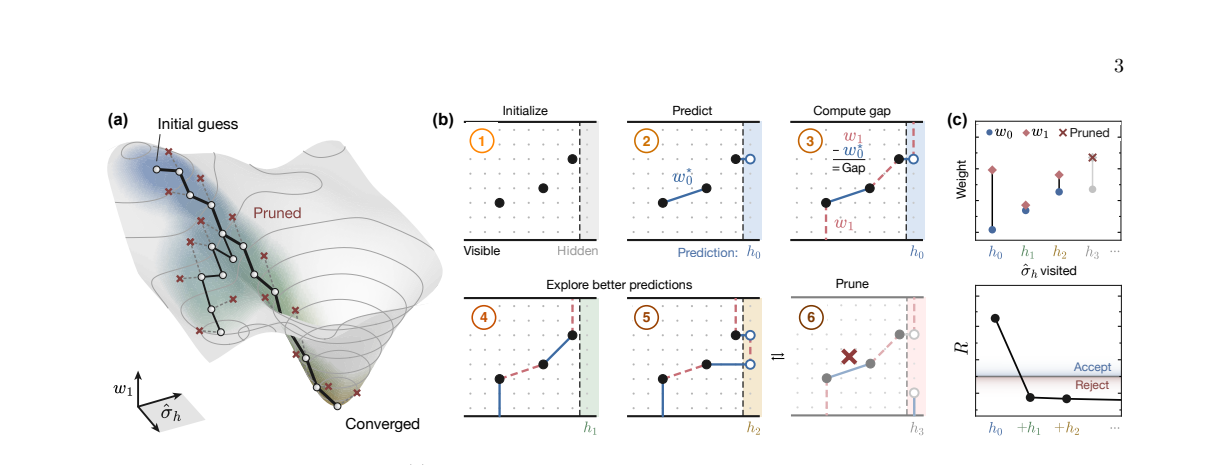
What carries the argument. The complementary gap $G=w_1-w_0$, the difference between the minimum-weight error consistent with a syndrome and the minimum-weight complementary error in the other logical class, is the standard postselection score, but it requires a closed temporal boundary from a terminal measurement. To apply it mid-circuit, Caliper treats the unseen future syndrome as hidden and approximates the open-boundary failure probability by a beam search over likely hidden syndromes, computing $\tilde P_L(\sigma_v) = \sum_{\hat\sigma_h} P(\hat\sigma_h|\sigma_v)P_L(\sigma_v\oplus\hat\sigma_h)$. The search is made tractable by the observation that relocating a syndrome defect from $u$ to $v$ changes any matching weight by at most the precomputed shortest-path distance $d(u,v)$, so unexplored hidden syndromes can be bounded without decoding each one; minimum-weight perfect matching is called only to resolve the smallest competing weights. An exact-update lemma certifies when a local reconnection of the matching is optimal, and a cancellation lemma shows that modifications away from the distinguishing region $M_0\oplus M_1$ leave the gap unchanged. The result is a score $R\approx -\log \hat P_L^{(S)}$ whose latency is within a factor of two of the closed-boundary gap.
Core claim. Caliper achieves an equal or lower logical error rate at any fixed discard rate than all other open-boundary postselection methods tested (Fig. 3), using only visible mid-circuit syndrome information. For $f=5$ color code cultivation it reaches a $10^{-7}$ logical error rate with only about 10% more spacetime volume than closed-boundary postselection, a regime where the frozen-gap method requires roughly $7\times$ the volume. The stricter $10^{-9}$ target tells a different story: Caliper requires an escape-stage acceptance fraction of 6.4% versus 23.7% closed-boundary, an expected spacetime volume about $3.7\times$ larger. For $f=3$ surface code cultivation, the performance of all visible-syndrome methods, Caliper included, plateaus at least an order of magnitude above the closed-boundary curve, and the authors' low-noise bound on full error detection (Theorem 4.1, claiming $g(v)\leq g(0)$ for every visible syndrome $v$) suggests this separation reflects a fundamental information limit rather than a deficiency of Caliper. The paper traces part of the open-closed gap to "erosion": rare shots in which the hidden syndrome degrades the closed-boundary gap, a phenomenon exponentially suppressed in the shortfall $\Delta$ but present in every protocol.
The premise it rests on. All quantitative resource claims are computed from $|\bar Y\rangle$ cultivation, a Clifford simulation used as a stand-in for the non-Clifford $|\bar T\rangle$ states real architectures consume; if the discrepancy already measured between them at the cultivation stage (roughly $15\times$ in the cited exact-simulation works) persists or grows under open-boundary postselection, the reported spacetime costs would need to be re-derived.
If the paper is right (Pith's inferences, not the authors')
Closed-boundary resource estimates that assume a noiseless terminal readout describe an upper bound on postselection quality that a real processor cannot reach; for a $10^{-9}$ target in $f=5$ color code cultivation, the practical spacetime cost is about $3.7\times$ the reported figure.
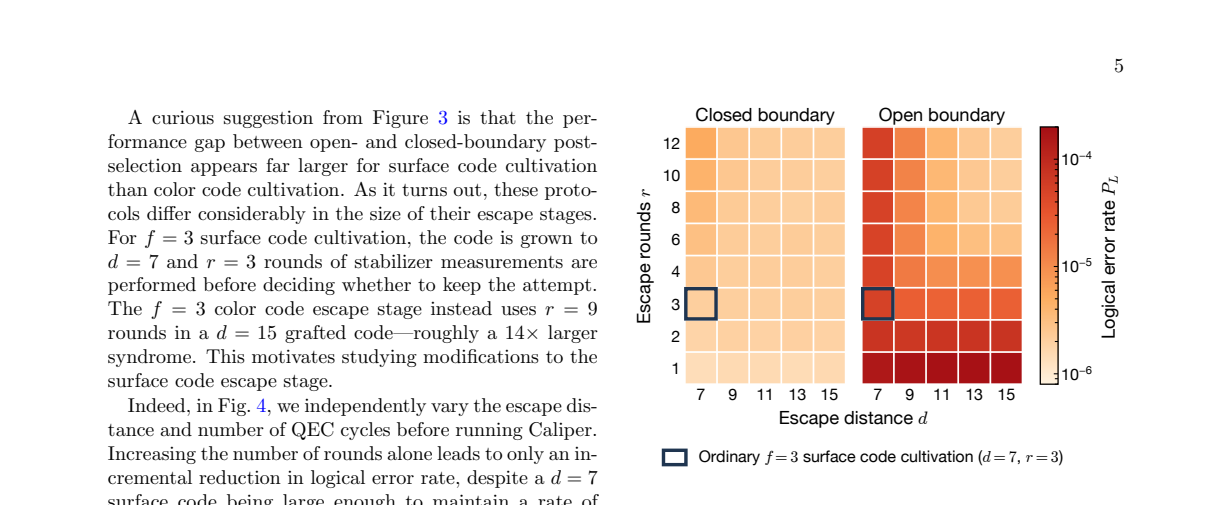
For $f=3$ surface code cultivation, recovering the reported $2\times 10^{-6}$ logical error rate requires roughly a $5\times$ larger escape stage (distance 11, six rounds, 50% acceptance versus the published distance 7, three rounds), because adding rounds alone barely helps.
Caliper gives architectures a fast, calibrated mid-circuit score, tens of microseconds per shot for the $f=3$ protocols, within a factor of two of the closed-boundary gap, fast enough for neutral-atom cycle times without additional idling.
The erosion model, with failure probability $[1-E_R]c_0 e^{-(1-T)R} + Be^{-\kappa R}$, ties open-boundary cost to the exponential suppression of erosion, implying that escape stages should be co-designed to suppress erosion rather than tuned only for raw error rate.
Because magic state preparation dominates the non-Clifford resource budget, the added escape-stage volume directly raises the estimated cost of fault-tolerant algorithms, so architectural proposals built on closed-boundary performance should be re-examined at their actual target error rates.
If the roughly $15\times$ discrepancy between $|\bar Y\rangle$ and $|\bar T\rangle$ cultivation at the cultivation stage, reported in the cited exact-simulation works, persists under open-boundary postselection, the quantified ratios here (10% and $3.7\times$) could shift upward considerably; the paper leaves this as future work, and it is the single number to watch.
Caliper's search-with-bounds decoding is a general template for any decoding decision that must be made without a terminal measurement, such as mid-circuit measurement operations and concatenated code growth, not just cultivation escape stages.
The adaptive escape protocols sketched in the supplement, which reserve large escape stages for rare high-risk shots, could plausibly reclaim a substantial fraction of the $3.7\times$ overhead; quantifying that recovery is a natural next step the paper does not take.
Caliper's open-boundary score provides a concrete target function against which learned or neural decoders could be trained, turning open-boundary postselection into a well-posed learning task where the latent "true" gap is inherently unknowable.
Check this review
Pith stored no record of this review's passes and took no fingerprint of it. Reviews made by code from 13 Nov 2026 on carry both.
How often reviews like this one are right
Reviews like this one: written by deepseek-v4-flash, where what was read was not recorded.
How often objections from reviews like this one are right: not yet measured
Reviews by people
This review was written by a machine. No person has reviewed this paper on Pith yet. A scientist listed on Pith can review it for a fee, and their review is published here whatever it concludes.
The paper
Abstract
Magic state cultivation is a promising method for preparing high-fidelity non-Clifford resource states - a central component of fault-tolerant quantum computing - with low spacetime overhead. In benchmarking cultivation, existing resource estimates assume access to noiseless transversal measurement of the output magic state to allow for postselection during the final escape stage of the cultivation process. However, such measurements would destroy the magic state and are therefore unavailable during computation. We develop an open-boundary postselection method, Caliper, that uses only nondestructive mid-circuit syndrome information and substantially outperforms existing methods operating under these constraints. In some regimes, our postselection method uniquely recovers the resource efficiency of prior estimates. However, in other cases, we observe a tradeoff. At spacetime costs reported in previous works, the achievable logical error rates can be orders of magnitude higher, and recovering the reported logical error rate requires substantially larger codes and longer escape stages. Our results highlight how practical considerations involving mid-circuit postselection can impact the design and performance of magic state cultivation protocols.
The paper's own sentences, arranged, kept beside the review and separate from it. Each label is drawn from a closed vocabulary; the number beside it is the probability the classifier gave that label. No sentence in this record was written by a model.
abstract compiled · 2026-10-06
The authors' main claim, as the classifier picked it out 0.86
“Our results highlight how practical considerations involving mid-circuit postselection can impact the design and performance of magic state cultivation protocols.”
How the main claim is stated: asserted 0.77
What the abstract itself states, as probabilities: claims first 0.09 · states limitation 0.85 · human participants 0.02 · controlled comparison 0.71 · randomized assignment 0.01 · states quantitative result 0.35 · compares with prior results 0.98 · mentions code or data availability 0.04
The abstract, sentence by sentence
This table labels the abstract only (arXiv listing abstract v1). The number is the probability the classifier gave the label.
| Sentence | Role | The authors' own work | States the main conclusion | Strength |
|---|---|---|---|---|
| Magic state cultivation is a promising method for preparing high-fidelity non-Clifford resource states - a central component of fault-tolerant quantum computing - with low spacetime overhead. | background 1.00 | 0.07 | 0.04 | asserted 0.65 |
| In benchmarking cultivation, existing resource estimates assume access to noiseless transversal measurement of the output magic state to allow for postselection during the final escape stage of the cultivation process. | background 0.88 | 0.06 | 0.04 | asserted 1.00 |
| However, such measurements would destroy the magic state and are therefore unavailable during computation. | background 0.57 | 0.11 | 0.07 | asserted 1.00 |
| We develop an open-boundary postselection method, Caliper, that uses only nondestructive mid-circuit syndrome information and substantially outperforms existing methods operating under these constraints. | contribution 0.84 | 0.95 | 0.24 | asserted 1.00 |
| In some regimes, our postselection method uniquely recovers the resource efficiency of prior estimates. | result 1.00 | 0.92 | 0.14 | asserted 0.70 |
| However, in other cases, we observe a tradeoff. | result 0.83 | 0.78 | 0.08 | asserted 0.94 |
| At spacetime costs reported in previous works, the achievable logical error rates can be orders of magnitude higher, and recovering the reported logical error rate requires substantially larger codes and longer escape stages. | result 0.99 | 0.85 | 0.38 | asserted 1.00 |
| Our results highlight how practical considerations involving mid-circuit postselection can impact the design and performance of magic state cultivation protocols. | interpretation 1.00 | 0.48 | 0.58 | asserted 0.77 |
What kind of paper the classifier reports this is: method or tool 1.00 · evidence from simulation or computation 0.98
What was examined, and what was not
Sources read
- arXiv listing abstract v1
Not examined
- full text
- figures and tables
- references and citing sentences
- relations to other papers
Levels run
- P abstract
Not run
- S sections
- T body sentences
- C citations
- R cross-paper relations
How the labels were made
Compiled by classifier-1.13.0 via TypeSafe API, question bank abstract-p1-20260923, 2026-10-06: 1 request, 6,208 input tokens.
Every quoted sentence on this record is the authors'. Every label is from Pith's closed vocabulary, with the probability shown beside it. This record as JSON
Figures (6)




Figures are the authors', reproduced from the paper.
References (109)
- [1] It then iteratively explores the syndrome space (steps 4-6), preferentially expanding predictions with loww 1, until the frontier is exhausted or the expansion limit is reached. (c) The weights of the corrections for each prediction (top) contribute to the scoreR(bottom). A pr... on Pith
- [2] P. W. Shor, Physical Review A52, R2493 (1995) on Pith
- [3] A. M. Steane, Physical Review Letters77, 793 (1996) on Pith
- [4] E. Knill, R. Laflamme, and W. H. Zurek, Proceedings of the Royal Society A: Mathematical, Physical and En- gineering Sciences454, 365 (1998) on Pith
- [5] D. Aharonov and M. Ben-Or, SIAM Journal on Com- puting38, 1207 (2008) on Pith
- [6] A. Y. Kitaev, Annals of Physics303, 2 (2003), arXiv:quant-ph/9707021 on PithPith's reviewarXiv
- [7] B. M. Terhal, Reviews of Modern Physics87, 307 (2015) on Pith
- [8] A. G. Fowler, M. Mariantoni, J. M. Martinis, and A. N. Cleland, Physical Review A86, 032324 (2012) on Pith
- [9] D. Bluvstein, S. J. Evered, A. A. Geim, S. H. Li, H. Zhou, T. Manovitz, S. Ebadi, M. Cain, M. Kalinowski, D. Hangleiter, J. P. Bonilla Ataides, N. Maskara, I. Cong, X. Gao, P. Sales Ro- driguez, T. Karolyshyn, G. Semeghini, M. J. Gullans, M. Greiner, V. Vuleti´ c, and M. D. Lu... on Pith
- [10] D. Bluvstein, A. A. Geim, S. H. Li, S. J. Ev- ered, J. P. Bonilla Ataides, G. Baranes, A. Gu, T. Manovitz, M. Xu, M. Kalinowski, S. Majidy, C. Kokail, N. Maskara, E. C. Trapp, L. M. Stew- art, S. Hollerith, H. Zhou, M. J. Gullans, S. F. Yelin, M. Greiner, V. Vuleti´ c, M. Cain... on Pith
- [11] B. W. Reichardtet al., Fault-tolerant quantum com- putation with a neutral atom processor (2025), arXiv:2411.11822 [quant-ph] on PithPith's reviewarXiv
- [12] Atom Computing and Collaborators, Quantum error correction with the toric code (2026), arXiv:2606.04079 [quant-ph] on PithPith's reviewarXiv
- [13] Google Quantum AI, Nature614, 676 (2023) on Pith
- [14] Google Quantum AI and Collaborators, Nature638, 920 (2025) on Pith
- [15] S. Krinner, N. Lacroix, A. Remm, A. Di Paolo, E. Genois, C. Leroux, C. Hellings, S. Lazar, F. Swiadek, J. Herrmann, G. J. Norris, C. K. Andersen, M. M¨ uller, A. Blais, C. Eichler, and A. Wallraff, Nature605, 669 (2022) on Pith
- [16] C. Ryan-Anderson, J. G. Bohnet, K. Lee, D. Gresh, A. Hankin, J. P. Gaebler, D. Francois, A. Chernogu- zov, D. Lucchetti, N. C. Brown, T. M. Gatterman, S. K. Halit, K. Gilmore, J. A. Gerber, B. Neyenhuis, D. Hayes, and R. P. Stutz, Physical Review X11, 041058 (2021) on Pith
- [17] L. Postler, S. Heußen, I. Pogorelov, M. Rispler, T. Feld- ker, M. Meth, C. D. Marciniak, R. Stricker, M. Ring- bauer, R. Blatt, P. Schindler, M. M¨ uller, and T. Monz, Nature605, 675 (2022) on Pith
- [18] A. Paetznicket al., Demonstration of logical qubits and repeated error correction with better-than-physical er- ror rates (2024) on Pith
- [19] M. H. Abobeih, Y. Wang, J. Randall, S. J. H. Loenen, C. E. Bradley, M. Markham, D. J. Twitchen, B. M. Terhal, and T. H. Taminiau, Nature606, 884 (2022) on Pith
- [20] D. Gottesman, The Heisenberg Representation of Quan- tum Computers (1998), arXiv:quant-ph/9807006 on PithPith's reviewarXiv
show 80 more
- [21] E. Knill, Fault-Tolerant Postselected Quantum Com- putation: Schemes (2004), arXiv:quant-ph/0402171 [quant-ph], arXiv:quant-ph/0402171 on PithPith's reviewarXiv
- [22] S. Bravyi and A. Kitaev, Physical Review A71, 022316 (2005) on Pith
- [23] B. Eastin and E. Knill, Physical Review Letters102, 110502 (2009) on Pith
- [24] B. Zeng, A. Cross, and I. L. Chuang, IEEE Trans- actions on Information Theory57, 6272 (2011), arXiv:0706.1382, arXiv:0706.1382 on PithPith's reviewarXiv
- [25] C. Chamberland and K. Noh, npj Quantum Information 6, 91 (2020), arXiv:2003.03049 [quant-ph] on PithPith's reviewarXiv
- [26] T. Itogawa, Y. Takada, Y. Hirano, and K. Fujii, PRX Quantum6, 020356 (2025), arXiv:2403.03991 [quant- ph] on PithPith's reviewarXiv
- [27] C. Gidney, N. Shutty, and C. Jones, Magic state cultiva- tion: growing T states as cheap as CNOT gates (2024), arXiv:2409.17595 [quant-ph] on PithPith's reviewarXiv
- [28] Google Quantum AI and Collaborators, Magic state cultivation on a superconducting quantum processor (2025), arXiv:2512.13908 [quant-ph] on PitharXiv
- [29] K. Sahay, P.-K. Tsai, K. K. Chang, Q. Su, T. B. Smith, S. Singh, and S. Puri, PRX Quantum7, 033006 (2026) on Pith
- [30] Y. Vaknin, S. Jacoby, A. Grimsmo, and A. Retzker, PRX Quantum7, 010353 (2026) on Pith
- [31] J. Claes, Cultivating T states on the surface code with only two-qubit gates (2025), arXiv:2509.05232 [quant- ph] on PitharXiv
- [32] Z.-H. Chen, M.-C. Chen, C.-Y. Lu, and J.-W. Pan, Ef- ficient Magic State Cultivation on$\mathbb{RP}ˆ2$ (2025), arXiv:2503.18657 [quant-ph] on PithPith's reviewarXiv
- [33] Y. Hirano, R. Toshio, T. Itogawa, and K. Fujii, Effi- cient magic state cultivation with lattice surgery (2026), arXiv:2510.24615 [quant-ph] on PithPith's reviewarXiv
- [34] D. Gottesman and I. L. Chuang, Nature402, 390 (1999) on Pith
- [35] X. Zhou, D. W. Leung, and I. L. Chuang, Physical Re- view A62, 052316 (2000), arXiv:quant-ph/0002039 on PithPith's reviewarXiv
- [36] D. Litinski, Quantum3, 205 (2019), arXiv:1905.06903 [quant-ph] on PithPith's reviewarXiv
- [37] Y. Li, New Journal of Physics17, 023037 (2015), arXiv:1410.7808 [quant-ph] on PithPith's reviewarXiv
- [38] C. Gidney, Cleaner magic states with hook injection (2023), arXiv:2302.12292 [quant-ph] on PithPith's reviewarXiv
- [39] C. Chamberland and A. W. Cross, Quantum3, 143 (2019), arXiv:1811.00566, arXiv:1811.00566 on PithPith's reviewarXiv
- [40] H. Bomb´ ın, M. Pant, S. Roberts, and K. I. Seetharam, PRX Quantum5, 010302 (2024) on Pith
- [41] S. C. Smith, B. J. Brown, and S. D. Bartlett, Com- munications Physics7, 386 (2024), arXiv:2405.03766, arXiv:2405.03766 on PithPith's reviewarXiv
- [42] L. H. English, D. J. Williamson, and S. D. Bartlett, 7 Physical Review Letters135, 120603 (2025) on Pith
- [43] N. Meister, C. A. Pattison, and J. Preskill, Effi- cient soft-output decoders for the surface code (2024), arXiv:2405.07433 [quant-ph] on PithPith's reviewarXiv
- [44] S.-H. Lee, L. H. English, and S. D. Bartlett, npj Quantum Information12, 96 (2026), arXiv:2510.05795 [quant-ph] on PithPith's reviewarXiv
- [45] H. Xie, N. Yoshioka, K. Tsubouchi, and Y. Li, Sim- ple, Efficient, and Generic Post-Selection Decoding for qLDPC codes (2026), arXiv:2601.17757 [quant-ph] on PithPith's reviewarXiv
- [46] A. Wills, T. J. Yoder, and I. Chuang, Forced Gap Post- Selection for Quantum LDPC Codes and their Opera- tions (2026), arXiv:2605.20346 [quant-ph] on PithPith's reviewarXiv
- [47] C. Gidney, M. Newman, P. Brooks, and C. Jones, Yoked surface codes (2023), arXiv:2312.04522 [quant-ph] on PithPith's reviewarXiv
- [48] H. Chen, D. Xu, G. M. Sommers, D. A. Huse, J. D. Thompson, and S. Gopalakrishnan, Scalable accuracy gains from postselection in quantum error correcting codes (2026), arXiv:2510.05222 [cond-mat.stat-mech] on PithPith's reviewarXiv
- [49] J. W. Staples, W. Fu, and J. D. Thompson, Scal- able Postselection of Quantum Resources (2026), arXiv:2603.08697 [quant-ph] on PitharXiv
- [50] P. Birchall, J. Bridgeman, C. Dawson, T. Far- relly, Y. Liu, N. Nickerson, M. Pant, S. Roberts, K. Seetharam, and D. Tuckett, Macromux: scalable postselection for high-threshold fault-tolerant quantum computation (2026), arXiv:2603.04875 [quant-ph] on PitharXiv
- [51] E. Dennis, A. Kitaev, A. Landahl, and J. Preskill, Jour- nal of Mathematical Physics43, 4452 (2002) on Pith
- [52] O. Higgott, ACM Transactions on Quantum Computing 3, 1 (2022), arXiv:2105.13082, arXiv:2105.13082 on PithPith's reviewarXiv
- [53] O. Higgott and C. Gidney, Quantum9, 1600 (2025), arXiv:2303.15933 [quant-ph] on PithPith's reviewarXiv
- [54] A. Hutter, J. R. Wootton, and D. Loss, Physical Review A89, 022326 (2014) on Pith
- [55] We optimize the frozen gap parameterφvia a parameter sweep on Pith
- [56] We employ the LLR 2-norm instance of the metric on Pith
- [57] The color code cultivation circuits we simulate are sourced from the Zenodo associated with [26]. Thef= 3 surface code cultivation circuits are from the GitHub repository for Ref. [28]. Thef= 5 circuit, however, we reconstruct following [28] and matching the noise conventions ... on Pith
- [58] C. Gidney, Quantum5, 497 (2021), arXiv:2103.02202 [quant-ph] on PithPith's reviewarXiv
- [59] H. Zhou, C. Duckering, C. Zhao, D. Bluvstein, M. Cain, A. Kubica, S.-T. Wang, and M. D. Lukin, inPro- ceedings of the 52nd Annual International Sympo- sium on Computer Architecture(2025) pp. 1432–1448, arXiv:2505.15907, arXiv:2505.15907 on PitharXiv
- [60] Z. Sun and Z. Cai, A folded surface code architecture for 2d quantum hardware (2026), arXiv:2601.19823 [quant- ph] on PitharXiv
- [61] N. Fazio, M. Webster, and Z. Cai, Low-overhead magic state circuits with transversal cnots (2025), arXiv:2501.10291 [quant-ph] on PitharXiv
- [62] A. Khalid, A. Silva, G. A. Dagnew, T. Dvir, O. Wertheim, M. Gruda, X. Kong, M. Kramer, Z. Webb, A. Scherer, M. Mohseni, Y. Cohen, and P. Ronagh, Im- pacts of decoder latency on a utility-scale quantum com- puter architecture (2026), arXiv:2511.10633 [quant-ph] on PithPith's reviewarXiv
- [63] In reality, this protocol only has fault distance 4, as was noted in [28] on Pith
- [64] C. Gidney, How to factor 2048 bit rsa integers with less than a million noisy qubits (2025), arXiv:2505.15917 [quant-ph] on PithPith's reviewarXiv
- [65] M. Cain, Q. Xu, R. King, L. R. B. Picard, H. Levine, M. Endres, J. Preskill, H.-Y. Huang, and D. Blu- vstein, Shor’s algorithm is possible with as few as 10,000 reconfigurable atomic qubits (2026), arXiv:2603.28627 [quant-ph] on PithPith's reviewarXiv
- [66] P. Webster, L. Berent, O. Chandra, E. T. Hockings, N. Baspin, F. Thomsen, S. C. Smith, and L. Z. Cohen, arXiv preprint arXiv:2602.11457 (2026) on PithPith's reviewarXiv
- [67] T. Xue and J. P. Covey, arXiv preprint arXiv:2605.03951 (2026) on PithPith's reviewarXiv
- [68] S. Khan, S. Sethi, K. Sahay, Y. Lin, J. Alnas, S. Kura- pati, A. Anand, J. M. Baker, and K. R. Brown, arXiv preprint arXiv:2604.19735 (2026) on PithPith's reviewarXiv
- [69] T. J. Yoder, E. Schoute, P. Rall, E. Pritchett, J. M. Gambetta, A. W. Cross, M. Carroll, and M. E. Bever- land, arXiv preprint arXiv:2506.03094 (2025) on PithPith's reviewarXiv
- [70] R. Li, K. Zheng, Y. Zhang, H. Lou, S. Ying, K. Liu, and X. Sun, arXiv preprint arXiv:2512.23037 (2025) on PitharXiv
- [71] B. A. Chase and F. Labib, Clifft: Fast Exact Sim- ulation of Near-Clifford Quantum Circuits (2026), arXiv:2604.27058 [quant-ph] on PithPith's reviewarXiv
- [72] Y. Takada, S. D. Bartlett, and D. J. Williamson, Exact efficient simulation of noisy logical magic states using clifford stabilizers (2026), arXiv:2609.16929 [quant-ph] on PithPith's reviewarXiv
- [73] T. Hartweg and A. P. Orioli, Comparing magic state cultivation methods using matrix product states (2026), arXiv:2609.19116 [quant-ph] on PithPith's reviewarXiv
- [74] K. H. Wan and A. Zapirain, Exact logical error rates for magic state cultivation (2026), arXiv:2609.18922 [quant- ph] on PithPith's reviewarXiv
- [75] T. Chan, A. Strikis, Z. Sun, and Z. Cai, Diagnosing and Restoring the Degraded Fault Distance of Magic State Cultivation (2026), arXiv:2609.17706 [quant-ph] on PithPith's reviewarXiv
- [76] T. Tuloup and T. Ayral, Computing logical error thresh- olds with the Pauli Frame Sparse Representation (2026), arXiv:2603.14670 [quant-ph], arXiv:2603.14670 on PithPith's reviewarXiv
- [77] M. Mishima, R. Toshio, K. Kishi, J. Fujisaki, H. Os- hima, S. Sato, and K. Fujii, Adaptive window decod- ing based on spatiotemporal complementary gap (2026), arXiv:2605.14637 [quant-ph] on PithPith's reviewarXiv
- [78] N. Shutty, M. Newman, and B. Villalonga, Physical Re- view Letters136, 070603 (2026) on Pith
- [79] A. Gu, J. P. B. Ataides, M. D. Lukin, and S. F. Yelin, Scalable neural decoders for practical fault-tolerant quantum computation (2026), arXiv:2604.08358 [quant- ph] on PithPith's reviewarXiv
- [80] J. P. Bonilla Ataides, A. Gu, S. F. Yelin, and M. D. Lukin, PRX Intelligence1, 013008 (2026) on Pith
- [81] D. Dentelski, Neural network decoder confidence as a learned proxy for the logical gap (2026), arXiv:2606.08758 [quant-ph] on PithPith's reviewarXiv
- [82] J. Blue, H. Avlani, Z. He, L. Ziyin, and I. L. Chuang, Quantum10, 2149 (2026) on Pith
- [83] P. Baireuther, T. E. O’Brien, B. Tarasinski, and C. W. J. Beenakker, Machine-learning-assisted correc- tion of correlated qubit errors in a topological code (2017) on Pith
- [84] P. Baireuther, M. D. Caio, B. Criger, C. W. J. Beenakker, and T. E. O’Brien, New Journal of Physics 21, 013003 (2019). 8 on Pith
- [85] N. Lacroixet al., Nature645, 614 (2025) on Pith
- [86] J. Bausch, A. W. Senior, F. J. H. Heras, T. Edlich, A. Davies, M. Newman, C. Jones, K. Satzinger, M. Y. Niu, S. Blackwell, G. Holland, D. Kafri, J. Atalaya, C. Gidney, D. Hassabis, S. Boixo, H. Neven, and P. Kohli, Nature635, 834 (2024) on Pith
- [87] K. Meinerz, C.-Y. Park, and S. Trebst, Physical Review Letters128, 080505 (2022) on Pith
- [88] M. Lange, P. Havstr¨ om, B. Srivastava, I. Bengtsson, V. Bergentall, K. Hammar, O. Heuts, E. van Nieuwen- burg, and M. Granath, Physical Review Research7, 023181 (2025) on Pith
- [89] H. Cao, F. Pan, D. Feng, Y. Wang, and P. Zhang, Gen- erative Decoding for Quantum Error-correcting Codes (2025), arXiv:2503.21374 [quant-ph] on PithPith's reviewarXiv
- [90] Z. Liu, A. Gong, and B. K. Clark, Decoding quantum low density parity check codes with diffusion (2025) on Pith
- [91] G. Hu, W. Ouyang, C.-Y. Lu, C. Lin, and H.-S. Zhong, Efficient and universal neural-network decoder for stabilizer-based quantum error correction (2025), arXiv:2502.19971 [quant-ph] on PithPith's reviewarXiv
- [92] K. Zhang, S. Wang, L. Kong, F. Zhang, Z. Ji, and J. Chen, Learning neural decoding with parallelism and self-coordination for quantum error correction (2025), arXiv:2509.03815 [quant-ph] on PithPith's reviewarXiv
- [93] V. Menon, J. P. Bonilla Ataides, R. Mehta, A. Gu, D. B. Tan, and M. D. Lukin, Physical Review X16, 021014 (2026), arXiv:2508.10714, arXiv:2508.10714 on PithPith's reviewarXiv
- [94] A. Jacob, C. McLauchlan, and D. E. Browne, Single- Shot Decoding and Fault-tolerant Gates with Trivariate Tricycle Codes (2025), arXiv:2508.08191 [quant-ph] on PithPith's reviewarXiv
- [95] C. Li, J. Preskill, and Q. Xu, Transversal di- mension jump for product qLDPC codes (2025), arXiv:2510.07269 [quant-ph] on PitharXiv
- [96] B. Het´ enyi, B. J. Brown, and D. J. Williamson, Con- stant depth magic state cultivation with clifford mea- surements by gauging (2026), arXiv:2603.05429 [quant- ph] on PithPith's reviewarXiv
- [97] A. G. Fowler, Time-optimal quantum computation (2013), arXiv:1210.4626 [quant-ph], arXiv:1210.4626 on PithPith's reviewarXiv
- [98] C. Gidney and A. G. Fowler, Flexible layout of sur- face code computations using AutoCCZ states (2019), arXiv:1905.08916 [quant-ph], arXiv:1905.08916 on PithPith's reviewarXiv
- [99] P. Das, C. A. Pattison, S. Manne, D. Carmean, K. Svore, M. Qureshi, and N. Delfosse, in2022 IEEE International Symposium on High-Performance Computer Architecture (HPCA)(2022) pp. 259–273, arXiv:2001.06598, arXiv:2001.06598 on PithPith's reviewarXiv
- [100] A. Holmes, M. R. Jokar, G. Pasandi, Y. Ding, M. Pe- dram, and F. T. Chong, in2020 ACM/IEEE 47th Annual International Symposium on Computer Archi- tecture (ISCA)(2020) pp. 556–569, arXiv:2004.04794, arXiv:2004.04794 on PithPith's reviewarXiv
The first 100 of 109 references are listed here. All of them are in this paper's citation record.
Cited by 3 Pith papers
Reviewed papers on Pith that cite this one. The full citation record
- The limits of magic-state cultivation quant-ph · Nov 2026
- Ancilla-free randomized Toffoli gates and the T-count of Boolean oracles quant-ph · Oct 2026
- Logical CCZ state cultivation quant-ph · Oct 2026
Challenges and discussion
Disagree with the review, or know something it missed? Leave a comment, or challenge this review formally: a challenge becomes a permanent entry in this paper's record, and its decision is published here.
Come back by email
A short list of the week's newly reviewed papers. Nothing is sent until you confirm from your inbox, and every email has a link that stops it. No account.
No comments yet.
Sign in to comment