Computation and Language · arXiv:2610.22984 v1 · submitted 16 Oct 2026 · 83 references
Self-Evolving Agents Can Repair Failures but Struggle to Generalize from Them
The paper says
“Experience-driven self-evolution offers a promising path for large language model (LLM) agents to continually improve through interaction.”
more of the abstract
Yet existing approaches often rely on successful trajectories or external evaluation signals, leaving unclear whether agents can evolve when such positive anchors are unavailable. We study this question through Cold-Start Failure-Only Evolution (CFOE), where agents start without accumulated experience and learn only from failed interactions without privileged guidance. Across three self-evolving paradigms, multiple LLM backbones, and four interactive environments, we uncover a consistent repair-generalization gap: failure-derived experience can help repair previously failed tasks, but rarely yields sustained improvements on unseen tasks. Further analysis shows that agents often misinterpret failures, while even verified-correct experience remains difficult to transfer. Relaxing CFOE reveals that verifier feedback and additional interaction provide limited gains, whereas successful trajectories substantially improve transfer. These findings suggest that current self-evolving agents are better at repairing observed failures than building generalizable capabilities from failure.
from the abstract
Pith says
Machine review · deepseek-v4-flash · 19 Oct 2026 · what was read was not recorded · not checked by a person
It can be wrong. Challenge this review or reply to it.
Holds up. Clean empirical study showing that LLM agents can patch observed failures but cannot generalize from them; the method is sound but the threshold for failure selection needs a sensitivity check. This line is wrong
3 major objections · 5 minor
How often objections from reviews like this one are right: not yet measured
Not checked: figures, code, what the 83 references say.
The paper says, at §3.1, Appendix C.2
The review did not quote this passage.
Pith says: Objection 1 of 3 · major
The construction of failure-dense online evolution streams selects tasks that consistently fail in three independent preliminary rollouts. This threshold assumes that three failures indicate a genuine capability limit rather than stochastic variation. If failures are partly stochastic, the observed repair could reflect regression to the mean, and the measured gap might be an artifact of the construction.
more of objection 1
Although the cross-model and cross-environment consistency reduces this risk, the paper would benefit from a direct sensitivity analysis (e.g., comparing thresholds of 2, 4, or 5 consecutive failures) or an explicit discussion of this assumption. Without such analysis, a reader cannot assess how robust the central claim is to the arbitrary threshold choice.
The paper says, at §3.2, Figure 2
The review did not quote this passage.
Pith says: Objection 2 of 3 · major
The held-out evaluation curves appear to be based on single runs per checkpoint; no confidence intervals or multiple seeds are reported. Given the potential stochasticity in LLM outputs and environment dynamics, repeated seeds would help establish the reliability of the observed held-out trajectories. The paper should state whether each curve is a single run or aggregated, and if single, add an explicit limitation or replicate with at least 3 seeds.
The paper says, at §4.1, Table 1
The review did not quote this passage.
Pith says: Objection 3 of 3 · major
The manual annotation of failure modes (M1-M4) is inherently subjective. The paper reports percentage of reviewed updates exhibiting each mode but does not provide inter-annotator agreement metrics (e.g., Cohen's kappa or Fleiss' kappa). Given that annotation criteria involve interpretive judgments, reporting agreement would strengthen the credibility of the error taxonomy. Please report agreement statistics or state the number of annotators and how disagreements were resolved.
5 minor objections
The paper says, at Abstract
Pith says: minor objection 1 of 5
The term 'Cold-Start Failure-Only Evolution (CFOE)' is used in the abstract but not defined until §2. Consider defining the acronym upon first use in the abstract or ensuring the abstract is self-contained.
The paper says, at Figure 2 caption
Pith says: minor objection 2 of 5
The abbreviation 'TSR' is used in the y-axis label but not defined in the caption; it is defined in the main text but unclear to a reader scanning figures. Please add 'TSR: Task Success Rate' to the caption.
show 3 more
The paper says, at §3.3, Figure 3
Pith says: minor objection 3 of 5
The long-horizon results (800 tasks) are shown for only three backbones and one environment (ALFWorld). While this is acknowledged as a scaling experiment, the paper would benefit from a brief note about whether similar trends were observed in preliminary long-horizon tests on other environments (if available) to clarify generalizability.
The paper says, at §4.2, Figure 4
Pith says: minor objection 4 of 5
In the caption, 'Full experience Verified experience No experience' appears as a run-on fragment. Please use punctuation (e.g., 'Full experience, verified experience, and no experience') for clarity.
The paper says, at Appendix D.3, Figure 8
Pith says: minor objection 5 of 5
The comparison of Resume budgets (5, 10, 20 turns) is informative, but the figure could be improved by adding a legend that distinguishes line styles or colors for each budget, as the current labeling in the caption may be hard to follow in black-and-white print.
What would settle it
Re-run CFOE on ALFWorld with Qwen3.5-27B and ReasoningBank using task streams built with 1-failure, 3-failure (original), and 5-failure thresholds. Compare held-out TSR trends and source-task recovery rates. If the gap narrows significantly under the 1-failure threshold, the original conclusion is sensitive to the selection criterion; if it persists, the assumption is not load-bearing.
from the skeptic's reading
How the review went
4 readings by deepseek-v4-flash · 19 Oct 2026
- Reader holds up
- Skeptic agrees
- Editor wrote the verdict above
- Referee minor revision: 3 major objections, 5 minor
Not run on this paper: the simulated authors' defence.
Pith did not check this review's objections against the paper.
The review in full
The review in brief, machine-written
The key thing to know about this paper is that it systematically demonstrates a basic limitation of current self-evolving agents: they can repair tasks they have failed on before, but this does not translate to better performance on new tasks. This is a clean, controlled finding that refines the narrative around self-improving agents.
What is new: the authors introduce a well-designed setting (Cold-Start Failure-Only Evolution) that isolates learning from failure alone, and they test this across three paradigms, ten LLMs, and four environments. The consistency of the repair–generalization gap across this wide slice of configurations is the real contribution. The manual error analysis and the controlled relaxations (adding success trajectories, verifier feedback, extra interaction) are thorough and give a clear picture of what helps and what does not. The authors are also honest about limitations.
The soft spots are methodological. First, the construction of failure-dense streams uses three independent preliminary rollouts, but this threshold is arbitrary. A direct sensitivity test—trying two or four failures instead of three—would strengthen the central claim. Second, the held-out evaluation curves in the main figures are single runs per checkpoint, with no confidence intervals or multiple seeds. Given the variance you would expect from LLM rollouts, this is a notable omission. The manual error annotation is detailed but without inter-annotator agreement numbers, its reliability is unknown. None of these are fatal—the results are consistent across many variations—but they weaken absolute certainty.
Bottom line: this is a serious empirical contribution that deserves peer review. I would assign a reviewer who asks for (a) a sensitivity test on the failure threshold and (b) multi-run evaluation with confidence intervals. The core claim holds up, but these additions would make it airtight.
Who is this for: researchers working on agentic self-improvement, lifelong learning, and failure recovery. A clear signal that success trajectories are essential for generalization—a useful reminder.
The strongest objection
The central claim depends on constructing task streams that isolate genuine capability limits from stochastic variation. The authors use three independent preliminary rollouts and select tasks that fail all three, but this threshold is arbitrary. If failures are partly stochastic, the observed repair may reflect regression to the mean, and the measured gap could be an artifact. The authors provide evidence across many models and environments, which reduces this risk, but a direct sensitivity test on the threshold would establish how robust the gap is. Without such a test, the conclusion depends on an unexamined criterion.
The reader identified the weakest assumption correctly. My stress test elaborates that assumption into a testable sensitivity check. The paper's multi-environment, multi-model evidence already makes the conclusion robust, so I do not propose changing the verdict. A threshold-sensitivity experiment would further strengthen the claim by ruling out an artifact, but its absence does not invalidate the current results.
The referee's report
If the reported repair–generalization gap is robust and general, it has significant implications for the design of autonomous LLM agents that must improve without external supervision. The paper provides a systematic, controlled evaluation across multiple frameworks, models, and environments, which strengthens the empirical foundation. The finding that successful trajectories are far more effective than richer failure analysis for transfer is a practical insight that could guide future learning architectures. The manual error annotation also offers qualitative evidence for why failure-driven learning falters.
Pith's reading of the paper (a machine's summary, not the authors')
The paper investigates whether LLM agents can improve their capabilities by learning exclusively from failed interactions, without access to successful trajectories, verifier feedback, or ground-truth answers. Across three distinct self-evolving frameworks, multiple language model backbones, and four interactive environments, the authors uncover a consistent repair–generalization gap: failure-derived experience helps agents recover from previously failed tasks, but these gains do not transfer to unseen tasks and may even degrade held-out performance. This finding challenges the assumption that self-evolution can bootstrap from failure alone, and suggests that current agents are better at repairing observed mistakes than building generalizable skills.
What carries the argument. The central mechanism is the Cold-Start Failure-Only Evolution (CFOE) setting, which isolates self-evolution to failure-derived experience by starting agents with an empty external state and allowing updates only from failed trajectories, with all verifier feedback hidden. The paper tests this setting using three representative self-evolving paradigms: ReasoningBank (reasoning-memory evolution), SkillOpt (skill evolution), and Evo-Harness (runtime harness evolution), across multiple frozen LLM backbones. These paradigms differ in how they represent and update the external state (memory entries, skill documents, or harness guidance), but all rely on failure-only trajectories under CFOE, enabling a controlled comparison of repair versus generalization.
Core claim. The paper's central claim is that under Cold-Start Failure-Only Evolution (CFOE), where agents start with no accumulated experience and learn only from failed interactions without privileged guidance, a consistent repair–generalization gap emerges: failure-derived experience can partially recover performance on previously failed tasks, yet it rarely yields sustained improvements on unseen tasks. This gap persists across three self-evolving paradigms (reasoning-memory, skill, and harness evolution), multiple LLM families and scales, and four interactive environments (embodied task execution, long-horizon tool use, online shopping, and web navigation). Further analysis reveals that agents often misinterpret failures—attributing them incorrectly or consolidating distorted rules—and even when the extracted experience is correct, it remains tied to the source trajectory and fails to transfer. Relaxing CFOE shows that verifier feedback and additional interaction provide limited gains, whereas access to successful trajectories substantially improves transfer, suggesting that positive behavioral evidence carries information that failure analysis alone cannot recover.
The premise it rests on. The failure-dense task streams are constructed by selecting tasks that failed in three independent preliminary rollouts, which assumes that consistent failure reflects genuine capability limits rather than stochastic variation; if failures were largely due to chance, the observed repair and generalization patterns might not generalize to other task distributions.
If the paper is right (Pith's inferences, not the authors')
Self-evolving agents deployed in environments where successful examples are rare may need to incorporate successful trajectories from other sources (e.g., initial exploration or demonstrations) to achieve transferable improvement.
Failure-only learning can produce erroneous experience that misattributes causes or consolidates harmful rules, suggesting that diagnostic mechanisms or external validation are necessary to filter out corrupt experience.
The repair–generalization gap implies that current agents treat failures as local corrections rather than learning opportunities for general principles, pointing toward a need for meta-learning or causal abstraction methods.
The limited transfer even from verified-correct experience suggests that the form of experience storage (e.g., memory items tied to specific steps) may lack the abstraction necessary for generalization, indicating a design space for more compositional or principle-based representations.
The repair–generalization gap may extend beyond LLM agents to any system that learns from error signals alone without positive examples, such as reinforcement learning from sparse negative rewards or debugging with only error messages.
The misattribution and distorted consolidation patterns observed in the paper (e.g., treating budget-wasting exhaustive search as a success) suggest that current agents lack robust causal reasoning, which could be addressed by architectures that explicitly model task structure or simulate alternative outcomes.
The result that successful trajectories provide substantially stronger transfer than richer failure diagnosis implies that positive examples supply not just correctness but also demonstration of valid action sequences and compositional procedures—information that failure traces cannot reconstruct.
The paper's finding that even verified-correct experience fails to generalize suggests that the bottleneck is not just in extraction but also in retrieval and application; future work could explore dynamic retrieval that adapts experience to the current task context rather than relying on static memory items.
Check this review
Pith stored no record of this review's passes and took no fingerprint of it. Reviews made by code from 13 Nov 2026 on carry both.
How often reviews like this one are right
Reviews like this one: written by deepseek-v4-flash, where what was read was not recorded.
How often objections from reviews like this one are right: not yet measured
Reviews by people
This review was written by a machine. No person has reviewed this paper on Pith yet. A scientist listed on Pith can review it for a fee, and their review is published here whatever it concludes.
The paper
Abstract
Experience-driven self-evolution offers a promising path for large language model (LLM) agents to continually improve through interaction. Yet existing approaches often rely on successful trajectories or external evaluation signals, leaving unclear whether agents can evolve when such positive anchors are unavailable. We study this question through Cold-Start Failure-Only Evolution (CFOE), where agents start without accumulated experience and learn only from failed interactions without privileged guidance. Across three self-evolving paradigms, multiple LLM backbones, and four interactive environments, we uncover a consistent repair-generalization gap: failure-derived experience can help repair previously failed tasks, but rarely yields sustained improvements on unseen tasks. Further analysis shows that agents often misinterpret failures, while even verified-correct experience remains difficult to transfer. Relaxing CFOE reveals that verifier feedback and additional interaction provide limited gains, whereas successful trajectories substantially improve transfer. These findings suggest that current self-evolving agents are better at repairing observed failures than building generalizable capabilities from failure.
The paper's own sentences, arranged, kept beside the review and separate from it. Each label is drawn from a closed vocabulary; the number beside it is the probability the classifier gave that label. No sentence in this record was written by a model.
abstract compiled · 2026-10-20
The authors' main claim, as the classifier picked it out 0.59
“These findings suggest that current self-evolving agents are better at repairing observed failures than building generalizable capabilities from failure.”
How the main claim is stated: hedged possibility 0.97
What the abstract itself states, as probabilities: claims first 0.06 · states limitation 0.65 · human participants 0.05 · controlled comparison 0.47 · randomized assignment 0.02 · states quantitative result 0.07 · compares with prior results 0.77 · mentions code or data availability 0.02
The abstract, sentence by sentence
This table labels the abstract only (arXiv listing abstract v1). The number is the probability the classifier gave the label.
| Sentence | Role | The authors' own work | States the main conclusion | Strength |
|---|---|---|---|---|
| Experience-driven self-evolution offers a promising path for large language model (LLM) agents to continually improve through interaction. | background 1.00 | 0.05 | 0.02 | hedged possibility 0.75 |
| Yet existing approaches often rely on successful trajectories or external evaluation signals, leaving unclear whether agents can evolve when such positive anchors are unavailable. | gap 0.99 | 0.05 | 0.03 | asserted 0.89 |
| We study this question through Cold-Start Failure-Only Evolution (CFOE), where agents start without accumulated experience and learn only from failed interactions without privileged guidance. | method 0.61 | 0.76 | 0.03 | asserted 0.93 |
| Across three self-evolving paradigms, multiple LLM backbones, and four interactive environments, we uncover a consistent repair-generalization gap: failure-derived experience can help repair previously failed tasks, but rarely yields sustained improvements on unseen tasks. | result 1.00 | 0.97 | 0.91 | asserted 1.00 |
| Further analysis shows that agents often misinterpret failures, while even verified-correct experience remains difficult to transfer. | result 0.95 | 0.91 | 0.06 | asserted 0.97 |
| Relaxing CFOE reveals that verifier feedback and additional interaction provide limited gains, whereas successful trajectories substantially improve transfer. | result 1.00 | 0.93 | 0.09 | asserted 1.00 |
| These findings suggest that current self-evolving agents are better at repairing observed failures than building generalizable capabilities from failure. | interpretation 1.00 | 0.85 | 0.91 | hedged possibility 0.97 |
What kind of paper the classifier reports this is: empirical study 1.00 · evidence from observation or experiment 0.98
What was examined, and what was not
Sources read
- arXiv listing abstract v1
Not examined
- full text
- figures and tables
- references and citing sentences
- relations to other papers
Levels run
- P abstract
Not run
- S sections
- T body sentences
- C citations
- R cross-paper relations
How the labels were made
Compiled by classifier-1.13.0 via TypeSafe API, question bank abstract-p1-20260923, 2026-10-20: 1 request, 5,576 input tokens.
Every quoted sentence on this record is the authors'. Every label is from Pith's closed vocabulary, with the probability shown beside it. This record as JSON
Figures (9)


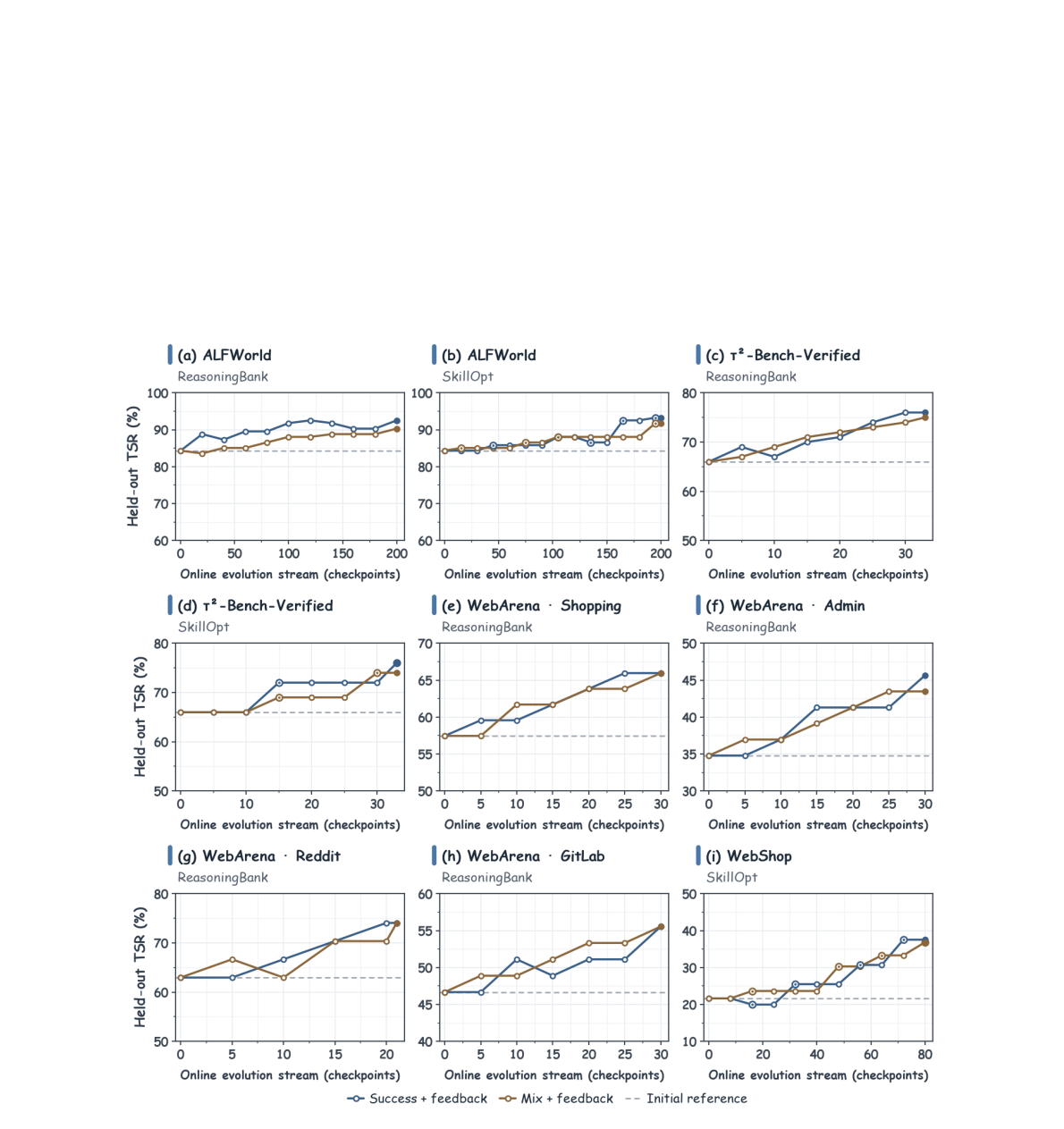
Figures are the authors', reproduced from the paper.
References (83)
- [1] Aho, Alfred V. and Ullman, Jeffrey D. , title =. 1972 , publisher = on Pith
- [2] Publication Manual of the American Psychological Association , year = on Pith
- [3] Ashok K. Chandra and Dexter C. Kozen and Larry J. Stockmeyer , year =. Alternation , journal = on Pith
- [4] Andrew, Galen and Gao, Jianfeng , booktitle =. Scalable Training of. 2007 , publisher =. doi:10.1145/1273496.1273501 , url = on Pithdoi:10.1145/1273496.1273501
- [5] Gusfield, Dan , title =. 1997 , publisher =. doi:10.1017/CBO9780511574931 , url = on Pithdoi:10.1017/cbo9780511574931
- [6] Rasooli, Mohammad Sadegh and Tetreault, Joel , title =. 2015 , eprint =. doi:10.48550/arXiv.1503.06733 , url = on PithPith's reviewarXivdoi:10.48550/arxiv.1503.06733
- [7] Ando, Rie Kubota and Zhang, Tong , title =. Journal of Machine Learning Research , volume =. 2005 , month = on Pith
- [8] Shridhar, Mohit and Yuan, Xingdi and C. International Conference on Learning Representations , year = on Pith
- [9] Cuadron, Alejandro and Yu, Pengfei and Liu, Yang and Gupta, Arpit , booktitle =. 2026 , url = on Pith
- [10] El Hattami, Amine and Thakkar, Megh and Chapados, Nicolas and Pal, Christopher , booktitle =. 2025 , url = on Pith
- [11] Yao, Shunyu and Chen, Howard and Yang, John and Narasimhan, Karthik , booktitle =. doi:10.52202/068431-1508 , editor = on Pithdoi:10.52202/068431-1508
- [12] Siru Ouyang and Jun Yan and I-Hung Hsu and Yanfei Chen and Ke Jiang and Zifeng Wang and Rujun Han and Long T. Le and Samira Daruki and Xiangru Tang and Vishy Tirumalashetty and George Lee and Mahsan Rofouei and Hangfei Lin and Jiawei Han and Chen-Yu Lee and Tomas Pfister , boo... on Pith
- [13] Yang, Yifan and Gong, Ziyang and Huang, Weiquan and Yang, Qihao and Zhou, Ziwei and Huang, Zisu and Li, Yan and Gao, Xuemei and Dai, Qi and Liu, Bei and Qiu, Kai and Yang, Yuqing and Chen, Dongdong and Yang, Xue and Luo, Chong , journal =. 2026 , url = on Pith
- [14] Wei, Tianxin and Shi, Zhan and Lin, Minhua and He, Bing and Liu, Zewen and Sang, Yisi and Bei, Yuanchen and Ning, Xuying and Zou, Jiaru and Li, Ting-Wei and Lin, Xiao and Zhao, Yanjun and Wang, Chi and Dumoulin, Benoit and Wang, Dakuo and He, Jingrui and Lu, Hanqing , journal ... on PithPith's reviewarXivdoi:10.48550/arxiv.2608.15071
- [15] Cheng, Zihao and Liu, Zeming and Shan, Yingyu and Wang, Xinyi and Zhu, Xiangrong and Ma, Yunpu and Wang, Hongru and Guo, Yuhang and Lin, Wei and Wang, Yunhong , booktitle =. doi:10.18653/v1/2026.acl-long.952 , year = on Pithdoi:10.18653/v1/2026.acl-long.952
- [16] Zhang, Hangfan and Zhang, Shao and Li, Kangcong and Zhang, Chen and Chen, Yang and Zhang, Yiqun and Bai, Lei and Hu, Shuyue , journal =. 2026 , url = on Pith
- [17] Self-Improvements in Modern Agentic Systems: A Survey , author =. arXiv preprint arXiv:2607.13104 , year = on PithPith's reviewarXiv
- [18] Agent Workflow Memory , author =. Proceedings of the 42nd International Conference on Machine Learning , pages =. 2025 , volume = on Pith
- [19] Ji, Shuo and Li, Yibo and Hooi, Bryan , booktitle =. Memory is Reconstructed, Not Retrieved: Graph Memory for. 2026 , url = on Pith
- [20] Ferraz, Thomas Palmeira and Deffayet, Romain and Nikoulina, Vassilina and D. Retrieval-Augmented. arXiv preprint arXiv:2603.18272 , year =. doi:10.48550/arXiv.2603.18272 , note = on PithPith's reviewarXivdoi:10.48550/arxiv.2603.18272
show 63 more
- [21] Wang, Zhaoyang and Wu, Qianhui and Zhang, Xuchao and Zhang, Chaoyun and Yao, Wenlin and Faisal, Fazle Elahi and Peng, Baolin and Qin, Si and Nath, Suman and Lin, Qingwei and Bansal, Chetan and Zhang, Dongmei and Rajmohan, Saravan and Gao, Jianfeng and Yao, Huaxiu , journal =. ... on PithPith's reviewarXivdoi:10.48550/arxiv.2604.13318
- [22] Jiang, Wen and Chu, Mingmin and Tian, Yimeng and Zhang, Qianxin and Yang, Haofei and Yang, Rui and Liu, Yang and Lv, Tao and Li, Fangming , journal =. 2026 , url = on Pith
- [23] Dynamic Cheatsheet: Test-Time Learning with Adaptive Memory , author =. Proceedings of the 19th Conference of the European Chapter of the Association for Computational Linguistics (Volume 1: Long Papers) , year = on Pith
- [24] He, Yufei and Liu, Juncheng and Liu, Yue and Li, Yibo and Cao, Tri and Hu, Zhiyuan and Xu, Xinxing and Hooi, Bryan , booktitle =. 2026 , url = on Pith
- [25] Nie, Jun and Zhang, Yonggang and Song, Jun and Cai, Qianshu and Yu, Dahai and Guo, Yike and Tian, Xinmei and Han, Bo , journal =. 2026 , url = on Pith
- [26] Miao, Ning and Teh, Yee Whye and Rainforth, Tom , booktitle =. 2024 , url = on Pith
- [27] Kamoi, Ryo and Zhang, Yusen and Zhang, Nan and Han, Jiawei and Zhang, Rui , journal =. When Can. 2024 , doi = on Pith
- [28] Madaan, Aman and Tandon, Niket and Gupta, Prakhar and Hallinan, Skyler and Gao, Luyu and Wiegreffe, Sarah and Alon, Uri and Dziri, Nouha and Prabhumoye, Shrimai and Yang, Yiming and Gupta, Shashank and Majumder, Bodhisattwa Prasad and Hermann, Katherine and Welleck, Sean and Y... on Pithdoi:10.52202/075280-2019
- [29] Gou, Zhibin and Shao, Zhihong and Gong, Yeyun and Shen, Yelong and Yang, Yujiu and Duan, Nan and Chen, Weizhu , booktitle =. 2024 , url = on Pith
- [30] Large Language Models Cannot Self-Correct Reasoning Yet , author =. International Conference on Learning Representations , year = on Pith
- [31] Zhang, Guibin and Wang, Junhao and Chen, Junjie and Zhou, Wangchunshu and Wang, Kun and Yan, Shuicheng , booktitle =. 2026 , url = on Pith
- [32] Zhu, Kunlun and Liu, Zijia and Li, Bingxuan and Tian, Muxin and Yang, Yingxuan and Zhang, Jiaxun and Han, Pengrui and Xie, Qipeng and Cui, Fuyang and Zhang, Weijia and Ma, Xiaoteng and Yu, Xiaodong and Ramesh, Gowtham and Wu, Jialian and Liu, Zicheng and Lu, Pan and Zou, James... on Pith
- [33] Yuan, Xiaoyang and Liu, Qi and Ruan, Yubin and Mou, Xinyi and Zhang, Zhuomeng and Wang, Wenjin and Jiao, Hanying and Wu, Di and Xu, Mingye and Bin, Yi and Feng, Ke and Sun, Zixun , journal =. 2026 , url = on Pith
- [34] Barke, Shraddha and Goyal, Arnav and Khare, Alind and Singh, Avaljot and Nath, Suman and Bansal, Chetan , journal =. 2026 , url = on Pith
- [35] Lin, Xiaofeng and Wang, Yingxu and Kwok, Tung Sum Thomas and Guo, Daniel and Nale, Sahil Arun and Fleming, Charles and Cheng, Guang , journal =. 2026 , url = on Pith
- [36] Bonagiri, Akash and Borkar, Devang and Anderias, Gerard Janno and Rafatirad, Setareh and Homayoun, Houman , journal =. doi:10.48550/arXiv.2605.25338 , year = on PithPith's reviewarXivdoi:10.48550/arxiv.2605.25338
- [37] Le, Hung and Wang, Yue and Gotmare, Akhilesh Deepak and Savarese, Silvio and Hoi, Steven Chu Hong , booktitle =. doi:10.52202/068431-1549 , pages = on Pithdoi:10.52202/068431-1549
- [38] Shinn, Noah and Cassano, Federico and Gopinath, Ashwin and Narasimhan, Karthik and Yao, Shunyu , booktitle =. doi:10.52202/075280-0377 , pages = on Pithdoi:10.52202/075280-0377
- [39] Sarch, Gabriel and Jang, Lawrence and Tarr, Michael J. and Cohen, William W. and Marino, Kenneth and Fragkiadaki, Katerina , booktitle =. doi:10.52202/079017-2418 , pages = on Pithdoi:10.52202/079017-2418
- [40] Zhou, Huichi and Chen, Yihang and Guo, Siyuan and Yan, Xue and Lee, Kin Hei and Wang, Zihan and Lee, Ka Yiu and Zhang, Guchun and Shao, Kun and Yang, Linyi and Wang, Jun , journal =. Memento: Fine-tuning. doi:10.48550/arXiv.2508.16153 , year = on PithPith's reviewarXivdoi:10.48550/arxiv.2508.16153
- [41] Co-Evolving Agents: Learning from Failures as Hard Negatives , author =. arXiv preprint arXiv:2511.22254 , doi =. 2026 , url = on PithPith's reviewarXiv
- [42] Lin, Jianbo and Yu, Xiaomin and Xin, Yi and Guo, Yifu and Jiang, Zhuosong and Yue, Zhongqi and Wang, Weishi and Zou, Heqing and Qin, Chengwei and Xiong, Hui , journal =. doi:10.48550/arXiv.2605.15224 , year = on PithPith's reviewarXivdoi:10.48550/arxiv.2605.15224
- [43] Learning from Failure: Inference-Time Self-improvement for Computer-Use Agents , author =. Computer Vision -- ECCV 2026 , series =. 2026 , doi = on Pith
- [44] Zelikman, Eric and Wu, Yuhuai and Mu, Jesse and Goodman, Noah D. , booktitle =. doi:10.52202/068431-1126 , pages = on Pithdoi:10.52202/068431-1126
- [45] Kumar, Aviral and Zhuang, Vincent and Agarwal, Rishabh and Su, Yi and Co-Reyes, John D. and Singh, Avi and Baumli, Kate and Iqbal, Shariq and Bishop, Colton and Roelofs, Rebecca and Zhang, Lei M. and McKinney, Kay and Shrivastava, Disha and Paduraru, Cosmin and Tucker, George ... on Pith
- [46] Deng, Bo and Zheng, Xinlei and Wei, Yi and Zhou, Kang and Tao, Chongyang and Liang, Renzhao and Chen, Xuanren and Guo, Lifan and Zhang, Chi , journal =. doi:10.48550/arXiv.2610.01256 , year = on PithPith's reviewarXivdoi:10.48550/arxiv.2610.01256
- [47] Cheng, Yu and Hu, Yongkang and Zhou, Jiuan and Zhang, Yushuo and Chen, Yihang and Zhou, Huichi and Chen, Mingang and Zhang, Zhizhong and Shao, Kun and Xie, Yuan and Yin, Zhaoxia , journal =. 2026 , url =. doi:10.48550/arXiv.2602.03224 , note = on PithPith's reviewarXivdoi:10.48550/arxiv.2602.03224
- [48] Asadolahi, Mohammad and Amini, Amir and Talebi, Samira and Farhadi, Amirfarhad and Zamanifar, Azadeh , journal =. Memory Reward Inflation in Self-Improving. doi:10.48550/arXiv.2608.00017 , year = on PithPith's reviewarXivdoi:10.48550/arxiv.2608.00017
- [49] Wang, Yihao and Xia, Linhan and Liu, Rui and Zhang, Zhaofeng and Wu, Hongyu and Yang, Yang and He, Jinglu and Guo, Yu and Lei, Kai , journal =. doi:10.48550/arXiv.2609.36043 , year = on PithPith's reviewarXivdoi:10.48550/arxiv.2609.36043
- [50] Who Verifies the Verifier? Co-Evolving Inspectable Graders with Self-Improving Agents , author =. arXiv preprint arXiv:2610.11464 , year = on PithPith's reviewarXiv
- [51] A Verifier Can Leak the Answer: Diagnosability Before Optimization in Closed-Loop Agent Debugging , author =. arXiv preprint arXiv:2610.00126 , year = on PithPith's reviewarXiv
- [52] Fu, Yao and Kim, Dong-Ki and Kim, Jaekyeom and Sohn, Sungryull and Logeswaran, Lajanugen and Bae, Kyunghoon and Lee, Honglak , booktitle =. doi:10.52202/079017-3811 , pages = on Pithdoi:10.52202/079017-3811
- [53] Yan, Ao and Zhang, Xin and Du, Jiawei and Zhou, Joey Tianyi , journal =. 2026 , url = on Pith
- [54] Lin, Minhua and Wu, Juncheng and Wang, Zijun and Shi, Zhan and Sang, Yisi and He, Bing and Liu, Zewen and Wei, Tianxin and Wu, Zongyu and Zhang, Zhiwei and Wang, Dakuo and Zhang, Xiang and Dumoulin, Benoit and Xie, Cihang and Zhou, Yuyin and Wang, Suhang and Lu, Hanqing , jour... on PithPith's reviewarXivdoi:10.48550/arxiv.2605.30621
- [55] Shang, Linfang and Xu, Ming and Sun, Yiding and Xia, Tianle and Hu, Lingxiang and Xu, Lan and Zheng, Ning , journal =. When Self-Evolution Backfires: Pre-Commit Gating against Skill Contamination in. 2026 , url = on Pith
- [56] On Safety Risks in Experience-Driven Self-Evolving Agents , author =. Findings of the Association for Computational Linguistics: ACL 2026 , year =. doi:10.18653/v1/2026.findings-acl.2091 , url = on Pithdoi:10.18653/v1/2026.findings-acl.2091
- [57] Gao, Haowen and Chen, Haoran and Wang, Can and Guo, Shasha and Pang, Liang and Liu, Zhaoyang and Shen, Huawei and Cheng, Xueqi , journal =. 2026 , url = on Pith
- [58] Lei, Yingtie and Wan, Zhongwei and Zhang, Jiankun and Alam, Samiul and Zhong, Zixuan and Huang, Peizhou and Wang, Xin and Zhang, Jingxuan and Zhou, Donghao and Hsieh, Yunta and Dou, Zhihao and Shen, Hui and Xu, Yan and Dimitriadis, Dimitrios and Zhang, Tuo and Zhang, Mi , jour... on Pith
- [59] Guan, Tianyi and Wang, Yiding and Yang, Haotong and Cao, Siyuan and Liu, Shirui and Hu, Yi and Li, Jiaqi and Zhang, Muhan , journal =. 2026 , url = on Pith
- [60] Beyond Endpoint Performance: Process-Level Evaluation of Self-Evolving Agents , author =. arXiv preprint arXiv:2609.24663 , year = on PithPith's reviewarXiv
- [61] Yan, Dong and Liang, Jian and Hu, Dapeng and He, Ran and Yuan, Nicholas Jing and Zhang, Qi and Tan, Tieniu , journal =. 2026 , url = on Pith
- [62] Jingwei Ni and Yihao Liu and Xinpeng Liu and Yutao Sun and Mengyu Zhou and Pengyu Cheng and Dexin Wang and Erchao Zhao and Xiaoxi Jiang and Guanjun Jiang , year =. doi:10.48550/arXiv.2603.25158 , note =. 2603.25158 , archiveprefix = on PithPith's reviewarXivdoi:10.48550/arxiv.2603.25158
- [63] 2026 , eprint =. doi:10.48550/arXiv.2606.19348 , url = on Pithdoi:10.48550/arxiv.2606.19348
- [64] Woosuk Kwon and Zhuohan Li and Siyuan Zhuang and Ying Sheng and Lianmin Zheng and Cody Hao Yu and Joseph E. Gonzalez and Hao Zhang and Ion Stoica , booktitle =. Efficient Memory Management for Large Language Model Serving with. 2023 , pages =. doi:10.1145/3600006.3613165 , url = on Pithdoi:10.1145/3600006.3613165
- [65] Barres, Victor and Dong, Honghua and Ray, Soham and Si, Xujie and Narasimhan, Karthik R , booktitle =. 2026 , editor = on Pith
- [66] 2026 , month = jul, url = on Pith
- [67] Introducing. 2026 , month = apr, url = on Pith
- [68] Welcome to the Era of Experience , author =. 2025 , note = on Pith
- [69] A Survey of Self-Evolving Agents: What, When, How, and Where to Evolve on the Path to Artificial Super Intelligence , author =. 2026 , url = on Pith
- [70] Dou, Shihan and Zhang, Ming and Huang, Chenhao and Chen, Jiayi and Chen, Feng and Liu, Shichun and Liu, Yan and Liu, Chenxiao and Zhong, Cheng and Zhang, Zongzhang and Gui, Tao and Xin, Chao and Wei, Chengzhi and Yan, Lin and Zhang, Qi and Huang, Xuanjing , booktitle =. doi:10... on Pithdoi:10.52202/085713-4197
- [71] Building Self-Evolving Agents via Experience-Driven Lifelong Learning: A Framework and Benchmark , author =. 2026 , eprint =. doi:10.48550/arXiv.2508.19005 , note = on Pithdoi:10.48550/arxiv.2508.19005
- [72] The Future of Continual Learning in the Era of Foundation Models: Three Key Directions , author =. Proceedings of the Workshops at the Fourth International Conference on Hybrid Human-Artificial Intelligence , series =. 2025 , url = on Pith
- [73] Zhao, Andrew and Huang, Daniel and Xu, Quentin and Lin, Matthieu and Liu, Yong-Jin and Huang, Gao , title =. Proceedings of the AAAI Conference on Artificial Intelligence , volume =. 2024 , doi = on Pith
- [74] Marc-Antoine Allard and Arnaud Teinturier and Victor Xing and Gautier Viaud , year =. Experiential Reflective Learning for Self-Improving on Pith
- [75] Mengzhuo Chen and Junjie Wang and Zhe Liu and Yawen Wang and Haiming Zheng and Qing Wang , year =. From Failed Trajectories to Reliable. 2606.06324 , archiveprefix = on PithPith's reviewarXiv
- [76] Changxiu Ji and Amy Lu and Qizheng Zhang and Kunle Olukotun , year =. 2610.02994 , archiveprefix = on PithPith's reviewarXiv
- [77] Yao, Shunyu and Zhao, Jeffrey and Yu, Dian and Du, Nan and Shafran, Izhak and Narasimhan, Karthik and Cao, Yuan , booktitle =. 2023 , url = on Pith
- [78] Shridhar, Mohit and Thomason, Jesse and Gordon, Daniel and Bisk, Yonatan and Han, Winson and Mottaghi, Roozbeh and Zettlemoyer, Luke and Fox, Dieter , title =. 2020 IEEE/CVF Conference on Computer Vision and Pattern Recognition (CVPR) , month =. 2020 , pages = on Pith
- [79] C\^ot\'e, Marc-Alexandre and K\'ad\'ar, \'Akos and Yuan, Xingdi and Kybartas, Ben and Barnes, Tavian and Fine, Emery and Moore, James and Hausknecht, Matthew and El Asri, Layla and Adada, Mahmoud and Tay, Wendy and Trischler, Adam , title =. Computer Games , editor =. 2019 , p... on Pithdoi:10.1007/978-3-030-24337-1_3
- [80] Wang, Guanzhi and Xie, Yuqi and Jiang, Yunfan and Mandlekar, Ajay and Xiao, Chaowei and Zhu, Yuke and Fan, Linxi and Anandkumar, Anima , journal =. 2024 , url = on Pith
- [81] Chen, Minghao and Li, Yihang and Yang, Yanting and Yu, Shiyu and Lin, Binbin and He, Xiaofei , booktitle =. doi:10.52202/079017-0019 , pages = on Pithdoi:10.52202/079017-0019
- [82] Agentic Context Engineering: Evolving Contexts for Self-Improving Language Models , author =. International Conference on Learning Representations , year = on Pith
- [83] Yang, Shidong and Ma, Ziyu and Huang, Tongwen and Wang, Xucong and Li, Renda and Hu, Yiming and Wang, Yong and Chu, Xiangxiang , year =. doi:10.48550/arXiv.2608.24747 , url =. 2608.24747 , archiveprefix = on PithPith's reviewarXivdoi:10.48550/arxiv.2608.24747
Cited by 1 Pith paper
Reviewed papers on Pith that cite this one. The full citation record
Challenges and discussion
Disagree with the review, or know something it missed? Leave a comment, or challenge this review formally: a challenge becomes a permanent entry in this paper's record, and its decision is published here.
Come back by email
A short list of the week's newly reviewed papers. Nothing is sent until you confirm from your inbox, and every email has a link that stops it. No account.
No comments yet.
Sign in to comment