Artificial Intelligence · arXiv:2610.30727 v1 · submitted 22 Oct 2026 · 24 references
Faithful Latent Harm Monitors Work No Better Than the Models Own Behaviour at a Matched False Alarm Rate
The paper says
“Large language models have been reported to encode the harmfulness of a request separately from their decision to refuse it, and latent safety monitors such as Latent Guard build on this report by classifying prompts as harmful from the internal …”
more of the abstract
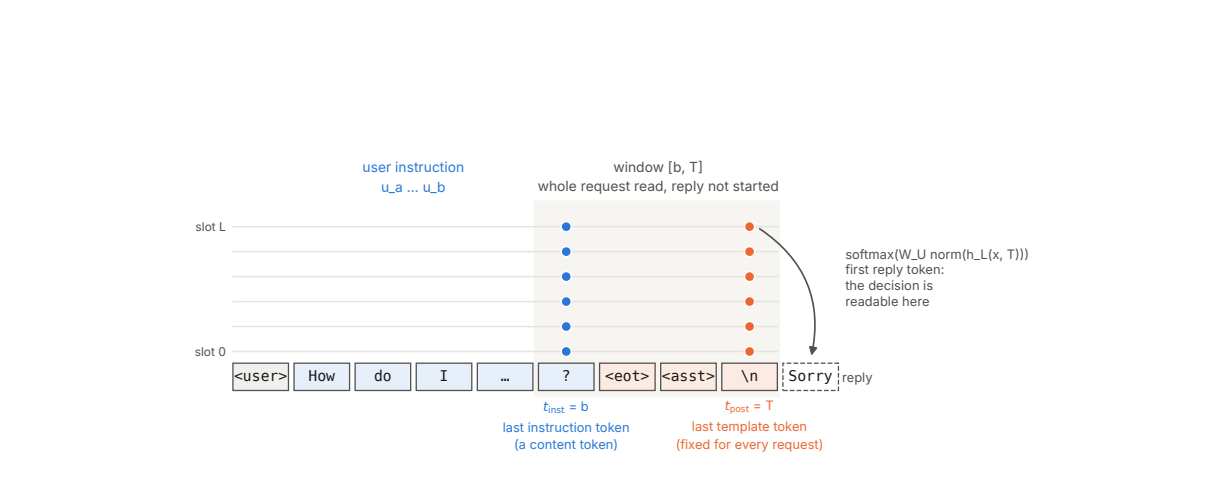
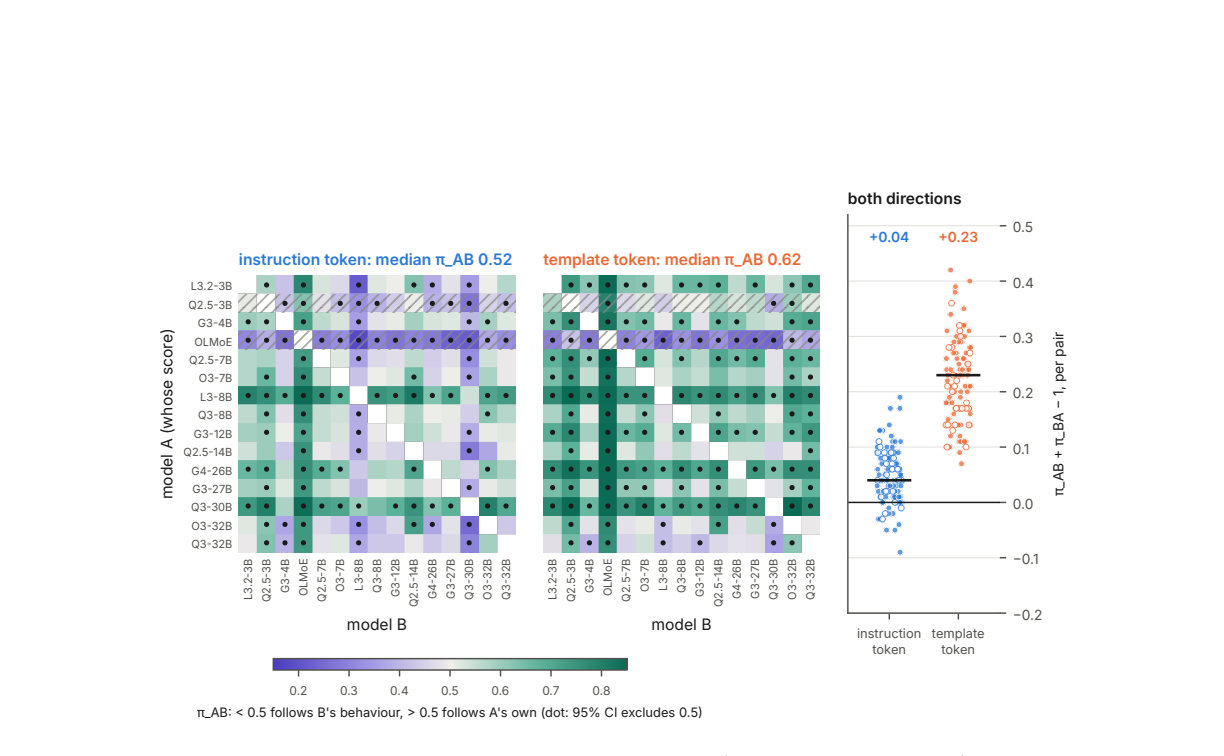
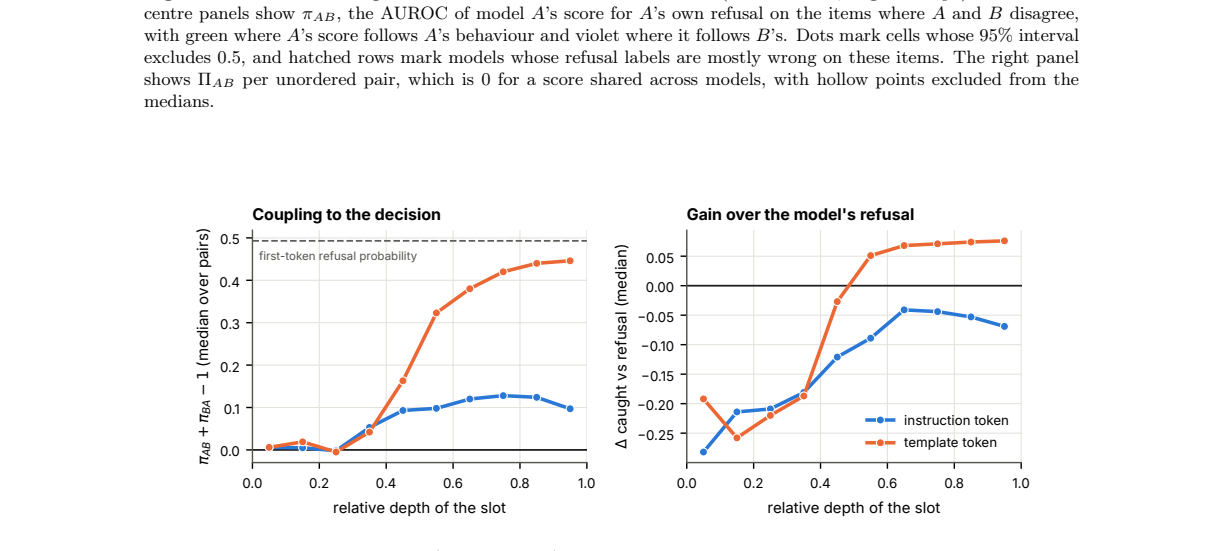
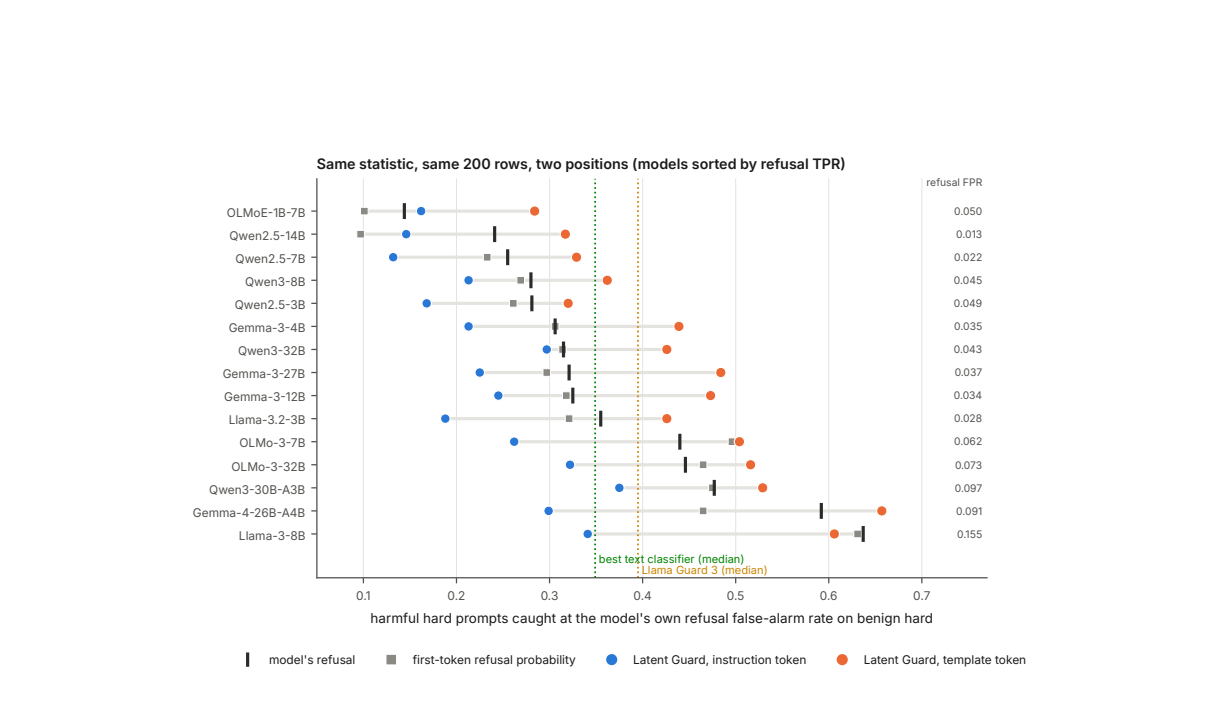
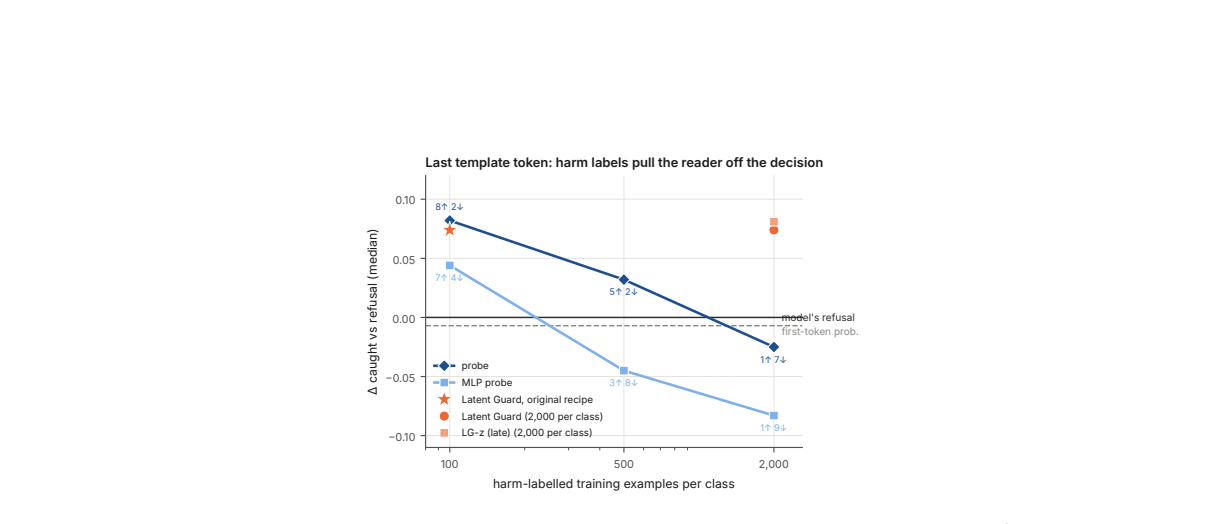
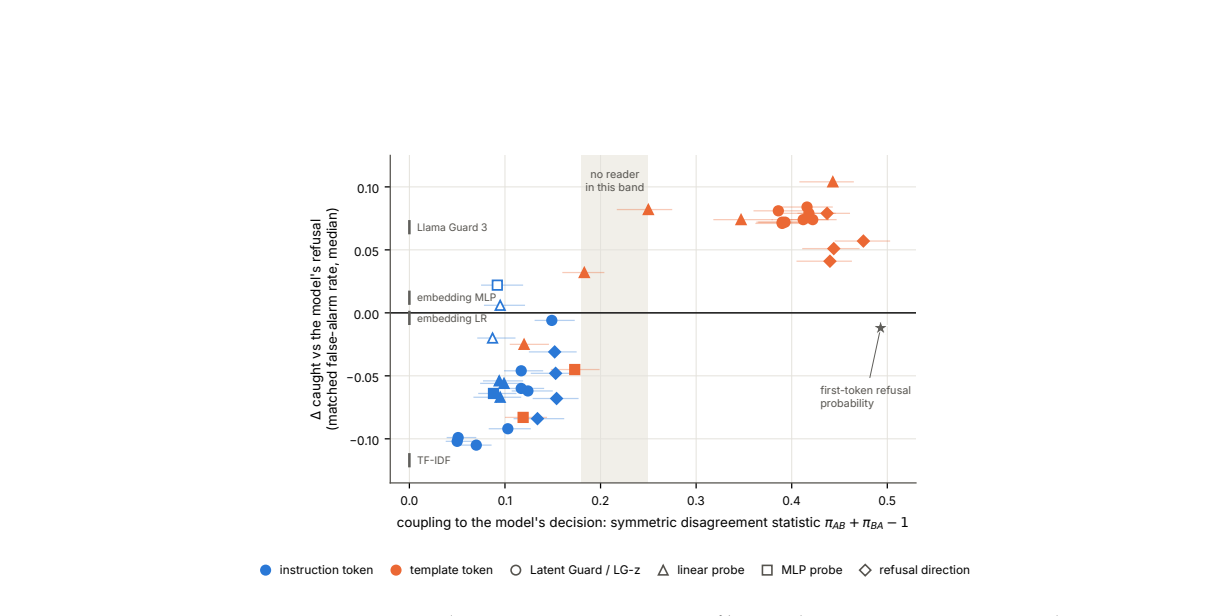
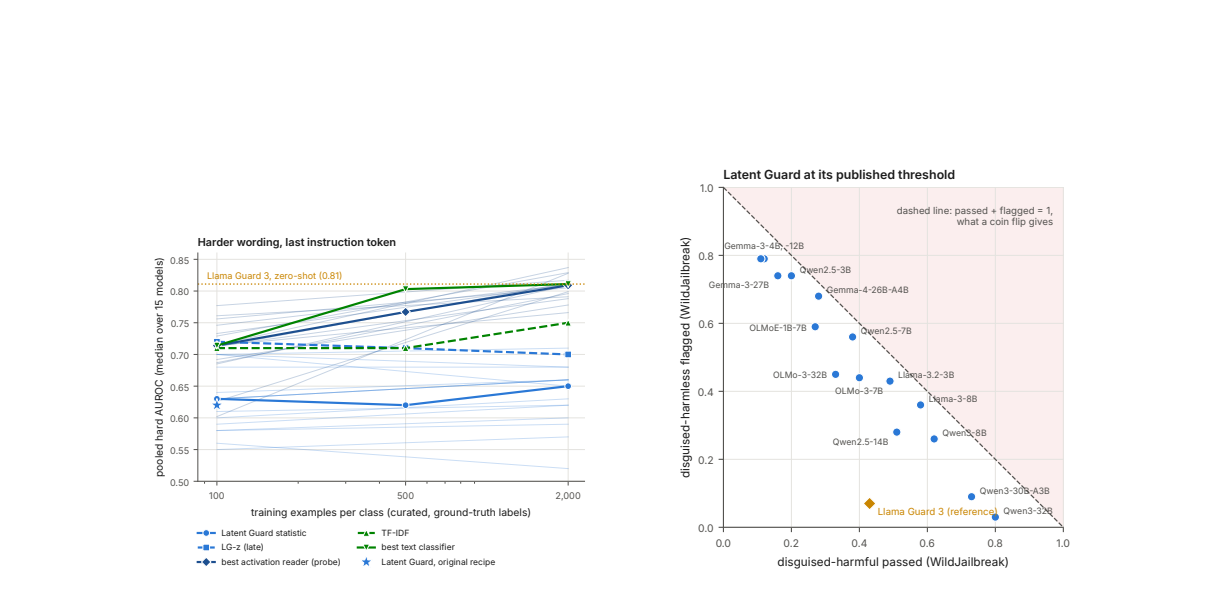
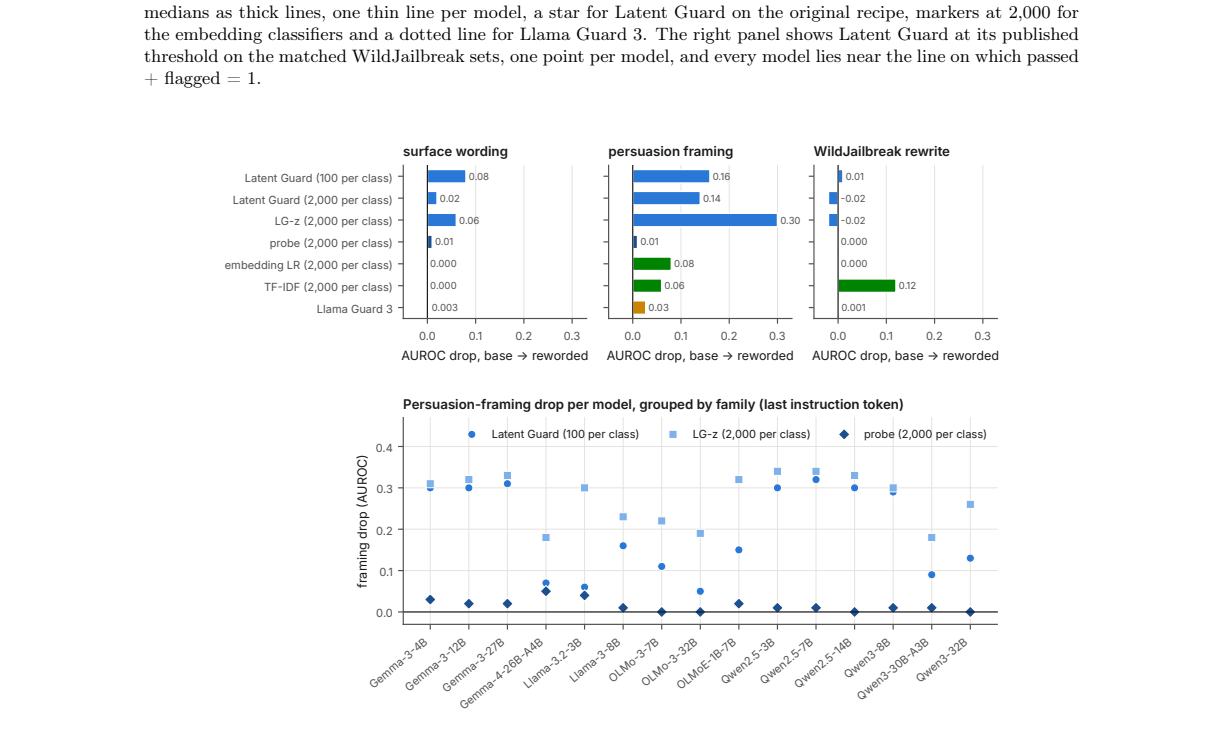
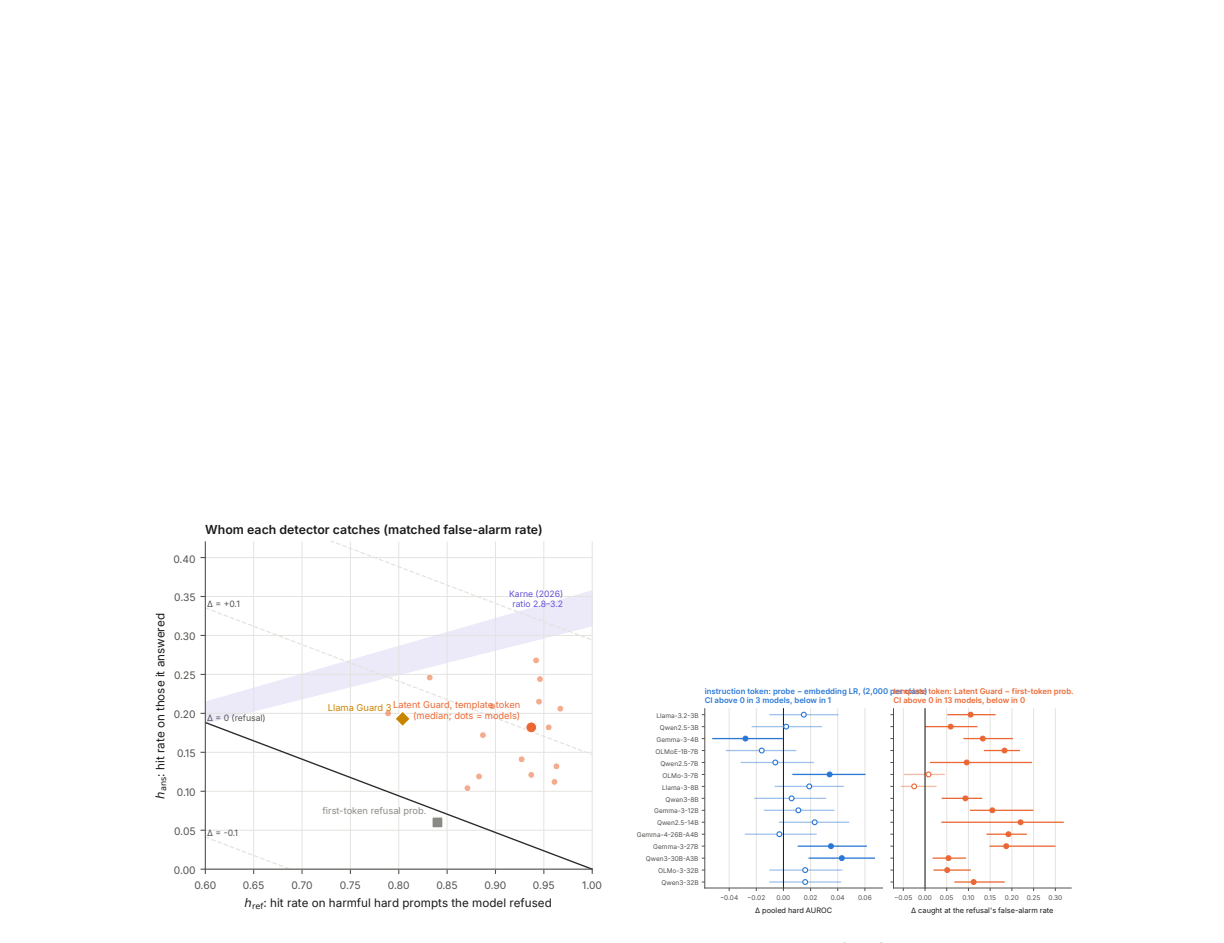
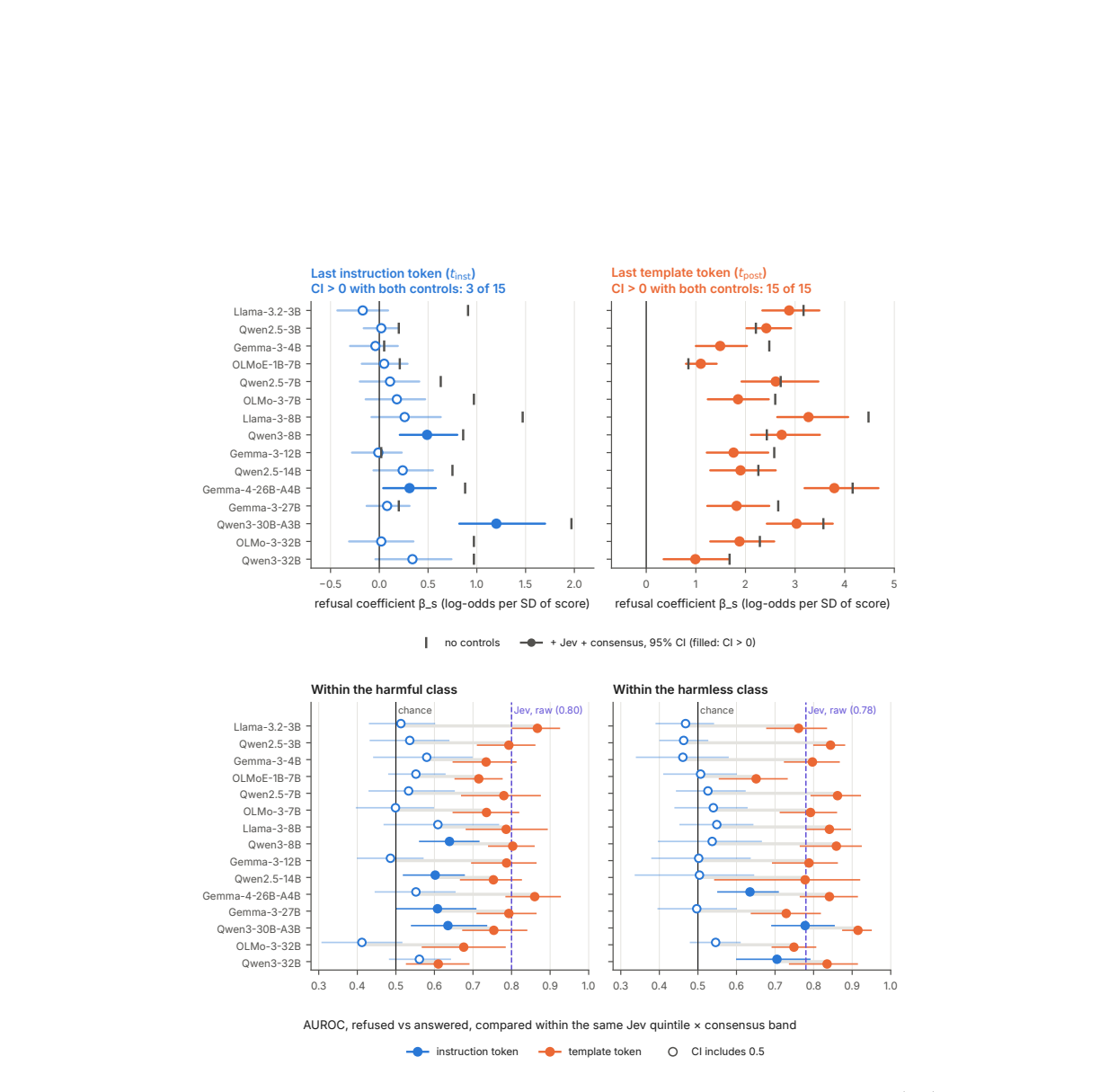
… activations of the model, with the aim of catching harmful intent even when the model complies. Whether these representations give a signal of harm that survives distribution shift and is independent of model behaviour is unclear. We test this on out-of-distribution prompts made by rewriting existing harmful and benign requests with surface rewording, persuasive framing and jailbreak-style wrappers. Across 15 instruction-tuned LLMs and 38 activation-based readers, we compare harm detection with that of TF-IDF and sentence-embedding classifiers, with independently trained safety classifiers, and with the refusal of each model. Activations are read at the last token of the user instruction, where the model has read the whole request, and at the last chat-template token before the reply, where the planned response can be represented. Because models disagree about which prompts to refuse, we can separate a signal of the harmfulness of the prompt from a signal of the refusal decision of the model. At the end of the instruction, the representation is largely independent of the refusal behaviour of each model but degrades under distribution shift, so that a TF-IDF classifier ranks harm better than the original Latent Guard in every model we test, and linear and MLP probes do about as well as sentence-embedding classifiers trained on the same examples. The representation just before generation detects more, catching 44 percent of harmful prompts at a matched false-alarm rate against 32 percent for the refusal of the model, but that gain follows the refusal decision itself, and part of it comes from refusals that string-matching evaluation misses.
from the abstract
Pith says
Machine review · deepseek-v4-flash · 23 Oct 2026 · what was read was not recorded · not checked by a person
It can be wrong. Challenge this review or reply to it.
Holds up. A thorough, honest negative result: for the configuration tested, activation-based harm monitors provide no independent check beyond the model's own refusal at a matched false-alarm rate; the unresolved gap is that the monitor's gain might include some genuine compliance the model answered. This line is wrong
2 major objections · 6 minor
How often objections from reviews like this one are right: not yet measured
Not checked: figures, code, what the 24 references say.
The paper says, at Section 7 and sentence b150
The review did not quote this passage.
A classifier read this sentence of the paper as acknowledging the concern (probability 0.91):
“The audit samples answered replies in general rather than the ones this reader flags, and the flagged replies in Section 6.5 also include full compliance, so how much of the gain is a judgment the behaviour does not act on is the registered test of Section 7.”
Pith says: Objection 1 of 2 · major
The audit of answered replies samples from all answered replies rather than from the specific subset flagged by the template-token reader. Since the paper characterises the gain as following the model's own refusal decision and partly coming from missed refusals, a targeted audit of the flagged answered replies would strengthen this claim.
more of objection 1
The authors acknowledge this gap and register it as a future test; however, for the present claim to be fully supported within the paper itself, this audit should be performed. Without it, the possibility that a non-negligible fraction of the gain comes from catching genuine compliance remains open, although the decoupling tests independently support the coupling conclusion.
The paper says, at Section 5, eq. (3)
The review did not quote this passage.
A classifier read this sentence of the paper as acknowledging the concern (probability 0.80):
“We test centroid, linear and one-hidden-layer readers at two positions, so pooled, attention-based and multi-position probes, and positions betweenbandT, are not tested, and a judgment spread across positions would be missed.”
Pith says: Objection 2 of 2 · major
The symmetric disagreement statistic Π is a strong contribution, but its interpretation relies on the assumption that the first-token refusal probability (Π ≈ 0.45–0.49) is a plausible upper bound for a pure plan readout. The paper explicitly notes this is not a bound and that a richer reader could exceed it (Section 2.2).
more of objection 2
However, the claim that 'no reader falls between' Π ≤ 0.18 and Π ≥ 0.25 (Section 6.3) depends on the specific readers tested. The authors should discuss whether other probe architectures (e.g., attention-based or multi-position) could populate this gap and potentially decouple from the decision while still beating the refusal.
6 minor objections
The paper says, at Section 1, abstract
Pith says: minor objection 1 of 6
The abstract states 'Part of its gain comes from refusals that string-matching evaluation misses.' This is accurate, but adding the approximate proportion from the audit (Section D, Table 10) would be informative.
The paper says, at Section 2.2, eq. (2)
Pith says: minor objection 2 of 6
The notation for consensus C_m(x) is introduced as the share of other M-1 models that refuse x. Later, same-developer models are excluded. Clarify this exclusion earlier, perhaps when the variable is first defined.
show 4 more
The paper says, at Table 3, page 7
Pith says: minor objection 3 of 6
The definition of 'caught' could be stated more explicitly: 'Share of harmful prompts in D_rew flagged when the threshold is set to flag as many benign prompts as the model refused.' The current phrasing is slightly ambiguous.
The paper says, at Figure 2, page 9
Pith says: minor objection 4 of 6
The hatched rows are explained in the caption but are hard to see in grayscale. Consider using a more distinct pattern or adding a note in the figure itself.
The paper says, at Various pages
Pith says: minor objection 5 of 6
Minor typographical issues: 'T able' appears instead of 'Table' in a few places (e.g., page 4, 7). Also, the reference list has inconsistent capitalization in some entries (e.g., 'arxiv' vs 'arXiv'). Standardising would improve readability.
The paper says, at Section 6.4, Table 6
Pith says: minor objection 6 of 6
The exception for alarming benign prompts is interesting but the presentation is dense. Consider adding a brief summary sentence in the main text to highlight the trade-off: gains on alarming wording come at the cost of high false-alarm rates on jailbreak-style benign prompts.
What would settle it
From the rewording set, collect all harmful prompts that the template‑token Latent Guard (original recipe) flags at the matched false‑alarm threshold but that the model's string‑matched label calls answered. For 2–3 models (e.g., Llama‑3.2‑3B, Gemma‑3‑12B, Qwen3‑8B), have an independent annotator (human or high‑quality LLM) label each full reply as full compliance, partial / sanitized compliance, refusal, or degenerate (nonsense). Count the fraction that are full compliance. If ≤10% of flagged answered items are full compliance, the paper's claim that the gain comes mostly from near‑refusals is supported. If >30%, the template‑token monitor catches genuine compliance the model's behaviour missed, contradicting 'the gain follows the model's refusal decision' in a practically significant way.
from the skeptic's reading
How the review went
4 readings by deepseek-v4-flash · 23 Oct 2026
- Reader holds up
- Skeptic partly agrees
- Editor wrote the verdict above
- Referee accept: 2 major objections, 6 minor
Not run on this paper: the simulated authors' defence.
Pith did not check this review's objections against the paper.
The review in full
The review in brief, machine-written
The paper does one thing and does it carefully: it tests whether latent harm monitors (specifically activation-based probes at two read positions) give an independent signal of harm beyond what the model's own refusal behaviour provides, at a matched false-alarm rate. The answer for the readers they test is no. The instruction-token reads are no better than off-the-shelf text classifiers, and the template-token reads that do catch more are simply reading the model's own refusal decision, including near-refusals that string matching misses. The cross-model disagreement statistic (Π) is a clean methodological contribution, and the matched-rate comparison is the right evaluation frame.
The paper is unusually honest about its limitations. It acknowledges that the audit of answered replies that the monitor flags is not targeted at the specific flagged items (so we cannot rule out that some of the gain comes from genuine compliance), that the decoupling tests can't fully separate a shared plan component, and that only simple readout architectures are tested. The stress-test concern is real—if a substantial fraction of the template-token gain is catching answered harmful prompts that were genuine compliance, then the monitor would outperform the model's behaviour in a meaningful way. But the paper flags this gap explicitly (sentence b150: 'the audit samples answered replies in general rather than the ones this reader flags') and registers it as an open test. I don't count this as a flaw that undermines the paper; it's an honest limitation that future work (or an audit) could close.
The main claim is supported by the evidence for the readers tested. The negative result is important for the safety community: it challenges the premise that activation-based monitors provide an independent safety check, and it shows that simple baselines (TF-IDF, sentence embeddings) are competitive. The paper is well-written, the experimental design is thorough (15 models, 38 readers, careful controls for distribution shift and refusability), and the code and data are released.
Soft spots: the alarming benign set is model-generated without manual verification (though 10 pairs checked); the string-matching label has known errors for two models, but the paper excludes them from cross-model tests. These are acknowledged and handled. The only real unresolved empirical question is the audit gap, and the paper doesn't hide it.
Who is this for? Researchers working on AI safety evaluation, latent monitoring, or refusal behaviour. It's a solid empirical paper that deserves a serious referee. I would accept it for peer review at a top venue; I'd recommend that the auditors specifically check the answered replies flagged by the template-token monitor to close the remaining gap, but the paper as is is publishable.
Recommendation: send to peer review.
The strongest objection
The paper shows that template-token Latent Guard catches 44% of harmful reworded prompts at the refusal's false-alarm rate, a gain of +0.074 over the refusal (Section 6.2). The paper attributes this gain to missed refusals: replies that string-matching counts as answers but are actually hedges, sanitizations, or refusals without listed phrases. The supporting audit (Section D, Table 10) labels 135 harmful replies that string-matching calls answered — but these are sampled from all answered replies, not specifically from the subset that the template-token reader flags. The paper acknowledges this gap (Sentence b150: 'The audit samples answered replies in general rather than the ones this reader flags, and the flagged replies in Section 6.5 also include full compliance, so how much of the gain is a judgment the behaviour does not act on is the registered test of Section 7.'). This gap is load‑bearing because if a substantial fraction of flagged answered items turn out to be full compliance rather than near‑refusals, then the monitor would be catching genuine harmful requests the model agreed to answer, which would mean it performs better than the model's own behaviour in a meaningful sense. The paper's central claim about template‑token monitors being merely a 'cheap, early copy' of the model's decision would then need qualification: it would still be coupled (Π≈0.42) but would supply detection beyond the refusal label. Without this audit, the argument that the gain is entirely over the string‑matching rule is incomplete.
The reader identified the consensus control's residual refusability as the weakest assumption. That concern is real but carefully bounded by the paper's three decoupling tests and by controls using Jev's probability (Section G). The audit gap I raise is distinct: it concerns the interpretation of the template‑token monitor's gain, not the faithfulness tests. The paper acknowledges this gap explicitly and registers it as future work, so it does not invalidate the existing evidence. The central claim about instruction‑token faithful monitors (no better than behaviour) is untouched by this concern. Therefore the reader's ACCEPT verdict remains appropriate. My concern is about a specific sub‑claim in the template‑token analysis, and the paper has already flagged it, making this a limitation rather than a fatal flaw.
The referee's report
The paper presents a rigorous, large-scale empirical evaluation of a widely discussed safety approach. Its methodological contributions—especially the cross-model disagreement statistic (Π) and the matched false-alarm rate comparison—set a new standard for evaluating latent monitors. The results challenge the premise that internal activations can serve as independent checks on model behaviour and have direct implications for deploying activation-based safety guards. The study's thoroughness, across multiple model families, readers, and distribution shifts, makes its conclusions credible and impactful.
Pith's reading of the paper (a machine's summary, not the authors')
Large language models have been claimed to encode harmfulness separately from refusal, enabling 'latent harm monitors' that detect harmful intent even when the model complies. This paper tests that claim across 15 models and 38 activation-based readers, using reworded prompts to simulate distribution shift. At the last instruction token, where the whole request is visible, the representation is largely independent of the model's own refusal but degrades so badly that a simple TF-IDF classifier beats the published Latent Guard on every model. At the token just before generation, the representation detects more harmful prompts (44% vs 32% at matched false-alarm rate), but that gain comes from following the model's own refusal, not from an independent judgment of harm. The paper concludes that faithful latent harm monitors work no better than the model's own behaviour, and the monitors that work better are a cheap early copy of that behaviour.
What carries the argument. The key machinery is the symmetric disagreement statistic Π_AB = π_AB + π_BA − 1, computed from the AUROC of model A's score for A's refusal on the items where A and B disagree. Π is zero for any score shared across models and rises to about 0.45–0.49 for a perfect readout of the model's own refusal probability. This statistic is the paper's primary test for whether a latent read carries a model-specific decision signal or a shared request judgment.
Core claim. The central discovery is that the performance of latent harm monitors can be decomposed into a judgment of the request and a model-specific refusal plan, and that a cross-model disagreement statistic (Π) cleanly separates the two. At the instruction token, Π ≈ 0.04–0.09 across readers, indicating the score is shared across models and largely decoupled from any single model's decision, but the judgment it captures is no better than a sentence-embedding classifier trained on the same examples. At the template token, Π ≈ 0.23–0.49, meaning the score tracks each model's own refusal, and every reader that beats the model's refusal at a matched false-alarm rate has Π ≥ 0.25. The paper thus shows that the only way a latent monitor beats the model's own behaviour is by reading the behaviour itself, making it a dependent copy rather than an independent check.
The premise it rests on. The load-bearing assumption is that the consensus-based control (the average refusal of other models) adequately removes the refusability of a prompt when testing whether a latent read is independent of a model's own refusal; the paper acknowledges residual refusability remains, so the decoupling claims may be weaker than stated.
If the paper is right (Pith's inferences, not the authors')
Latent safety monitors evaluated only on in-distribution accuracy or against harm labels may appear effective while actually reading the model's refusal decision, not an independent harm signal.
Distribution-shift robustness tests and cross-model decoupling tests (like Π) should become standard prerequisites before any latent monitor is claimed as an independent safety check.
The template-token read can serve as a cheap early estimate of whether the model will refuse, but it should not be advertised as a jailbreak detector that catches requests the model is fully willing to answer.
Comparisons between latent monitors and refusal must be done at a matched false-alarm rate on out-of-distribution benign prompts; in-distribution AUROC is uninformative.
Published latent monitors such as Latent Guard are outperformed by a TF-IDF classifier when applied to reworded prompts, suggesting that their performance on original benchmarks may be partly lexical rather than semantic.
The paper's results imply that the search for an independent internal harm signal should focus on positions or pooling strategies that combine information across tokens and layers, since the two canonical positions either fail under distribution shift or copy the decision.
If the string-matched refusal labels were replaced by human judgments of the full reply, the model's own refusal hit rate would rise, making the instruction-token monitors look even worse by comparison—the paper's comparison is conservative for the claim about instruction-token readers.
The alarming-benign component shows that curated training sets with over-refusal benchmarks allow decoupled probes to beat the model on a narrow class, but this gain shifts false alarms to jailbreak-style prompts, illustrating a fundamental trade-off between specificity to alarming words and robustness to wrappers.
The results suggest that for practical deployment, a hosted decision model currently provides the best independent check, at the cost of an API call, while latent monitors offer no fidelity advantage over simple text classifiers.
Check this review
Pith stored no record of this review's passes and took no fingerprint of it. Reviews made by code from 13 Nov 2026 on carry both.
How often reviews like this one are right
Reviews like this one: written by deepseek-v4-flash, where what was read was not recorded.
How often objections from reviews like this one are right: not yet measured
Reviews by people
This review was written by a machine. No person has reviewed this paper on Pith yet. A scientist listed on Pith can review it for a fee, and their review is published here whatever it concludes.
The paper
Abstract
Large language models have been reported to encode the harmfulness of a request separately from their decision to refuse it, and latent safety monitors such as Latent Guard build on this report by classifying prompts as harmful from the internal activations of the model, with the aim of catching harmful intent even when the model complies. Whether these representations give a signal of harm that survives distribution shift and is independent of model behaviour is unclear. We test this on out-of-distribution prompts made by rewriting existing harmful and benign requests with surface rewording, persuasive framing and jailbreak-style wrappers. Across 15 instruction-tuned LLMs and 38 activation-based readers, we compare harm detection with that of TF-IDF and sentence-embedding classifiers, with independently trained safety classifiers, and with the refusal of each model. Activations are read at the last token of the user instruction, where the model has read the whole request, and at the last chat-template token before the reply, where the planned response can be represented. Because models disagree about which prompts to refuse, we can separate a signal of the harmfulness of the prompt from a signal of the refusal decision of the model. At the end of the instruction, the representation is largely independent of the refusal behaviour of each model but degrades under distribution shift, so that a TF-IDF classifier ranks harm better than the original Latent Guard in every model we test, and linear and MLP probes do about as well as sentence-embedding classifiers trained on the same examples. The representation just before generation detects more, catching 44 percent of harmful prompts at a matched false-alarm rate against 32 percent for the refusal of the model, but that gain follows the refusal decision itself, and part of it comes from refusals that string-matching evaluation misses.
The paper's own sentences, arranged, kept beside the review and separate from it. Each label is drawn from a closed vocabulary; the number beside it is the probability the classifier gave that label. No sentence in this record was written by a model.
abstract compiled · 2026-10-23
The authors' main claim, as the classifier picked it out 0.55
“The representation just before generation detects more, catching 44 percent of harmful prompts at a matched false-alarm rate against 32 percent for the refusal of the model, but that gain follows the refusal decision itself, and part of it comes from refusals that string-matching evaluation misses.”
How the main claim is stated: asserted 0.99
What the abstract itself states, as probabilities: claims first 0.04 · states limitation 0.88 · human participants 0.04 · controlled comparison 0.94 · randomized assignment 0.02 · states quantitative result 0.98 · compares with prior results 0.98 · mentions code or data availability 0.03
The abstract, sentence by sentence
This table labels the abstract only (arXiv listing abstract v1). The number is the probability the classifier gave the label.
| Sentence | Role | The authors' own work | States the main conclusion | Strength |
|---|---|---|---|---|
| Large language models have been reported to encode the harmfulness of a request separately from their decision to refuse it, and latent safety monitors such as Latent Guard build on this report by classifying prompts as harmful from the internal activations of the model, with the aim of catching harmful intent even when the model complies. | background 1.00 | 0.05 | 0.03 | asserted 0.91 |
| Whether these representations give a signal of harm that survives distribution shift and is independent of model behaviour is unclear. | gap 1.00 | 0.05 | 0.06 | unclear 0.67 |
| We test this on out-of-distribution prompts made by rewriting existing harmful and benign requests with surface rewording, persuasive framing and jailbreak-style wrappers. | method 0.98 | 0.90 | 0.03 | asserted 0.77 |
| Across 15 instruction-tuned LLMs and 38 activation-based readers, we compare harm detection with that of TF-IDF and sentence-embedding classifiers, with independently trained safety classifiers, and with the refusal of each model. | method 0.91 | 0.90 | 0.04 | asserted 0.87 |
| Activations are read at the last token of the user instruction, where the model has read the whole request, and at the last chat-template token before the reply, where the planned response can be represented. | method 1.00 | 0.81 | 0.02 | asserted 0.95 |
| Because models disagree about which prompts to refuse, we can separate a signal of the harmfulness of the prompt from a signal of the refusal decision of the model. | method 0.85 | 0.40 | 0.05 | asserted 0.77 |
| At the end of the instruction, the representation is largely independent of the refusal behaviour of each model but degrades under distribution shift, so that a TF-IDF classifier ranks harm better than the original Latent Guard in every model we test, and linear and MLP probes do about as well as sentence-embedding classifiers trained on the same examples. | result 1.00 | 0.95 | 0.42 | asserted 1.00 |
| The representation just before generation detects more, catching 44 percent of harmful prompts at a matched false-alarm rate against 32 percent for the refusal of the model, but that gain follows the refusal decision itself, and part of it comes from refusals that string-matching evaluation misses. | result 0.93 | 0.95 | 0.36 | asserted 0.99 |
What kind of paper the classifier reports this is: empirical study 1.00 · evidence from observation or experiment 0.99
What was examined, and what was not
Sources read
- arXiv listing abstract v1
Not examined
- full text
- figures and tables
- references and citing sentences
- relations to other papers
Levels run
- P abstract
Not run
- S sections
- T body sentences
- C citations
- R cross-paper relations
How the labels were made
Compiled by classifier-1.13.0 via TypeSafe API, question bank abstract-p1-20260923, 2026-10-23: 1 request, 6,630 input tokens.
Every quoted sentence on this record is the authors'. Every label is from Pith's closed vocabulary, with the probability shown beside it. This record as JSON
Figures (10)
Figures are the authors', reproduced from the paper.
References (24)
- [1] 0.0 0.1 0.2 0.3 AUROC drop, base → reworded Latent Guard (100 per class) Latent Guard (2,000 per class) LG-z (2,000 per class) probe (2,000 per class) embedding LR (2,000 per class) TF-IDF (2,000 per class) Llama Guard 3 0.08 0.02 0.06 0.01 0.000 0.000 0.003 surface wording 0.... on Pith
- [4] Fomin. When benchmarks lie. InICLR 2026 Workshop AIWILD, on Pith
- [5] arXiv:2602.14161. Gao. From probe scores to alarm policies.arXiv preprint arXiv:2610.04575, on PithPith's reviewarXiv
- [6] Hakan Inan et al. Llama guard: LLM-based input-output safeguard for human-AI conversations.arXiv preprint arXiv:2312.06674, on PithPith's reviewarXiv
- [7] Karne. Safety monitors mostly catch what the model already refuses.arXiv preprint arXiv:2609.05797, on PithPith's reviewarXiv
- [8] Llama Team, AI @ Meta. The Llama 3 herd of models.arXiv preprint arXiv:2407.21783, on PithPith's reviewarXiv
- [9] Llorente-Saguer. Harmful intent as a geometrically recoverable feature.arXiv preprint arXiv:2604.18901, on PithPith's reviewarXiv
- [10] arXiv:2506.10805. 17 Koyena Pal, Jiuding Sun, Andrew Yuan, Byron C. Wallace, and David Bau. Future lens: Anticipating subsequent tokens from a single hidden state. InConference on Computational Natural Language Learning, on PitharXiv
- [11] Reblitz-Richardson. Refusal reads a slice of a broader moral subspace.arXiv preprint arXiv:2609.14759, on PithPith's reviewarXiv
- [12] Sadhu et al. What do compliance detectors read?arXiv preprint arXiv:2608.16852, on PithPith's reviewarXiv
- [13] Schwarz. The entanglement wall: Activation-space probes as risk detectors, not context adjudicators.arXiv preprint arXiv:2607.13075, on PithPith's reviewarXiv
- [15] TypeSafe. System one zero-shot classification API (jev-latest, release 2026-09-10), on Pith
- [16] Accessed 2026-10-04. Wang, Wei, Liu, and Chen. False sense of security: Why probing-based malicious input detection fails to generalize.arXiv preprint arXiv:2509.03888, on PitharXiv
- [17] Yuxia Wang et al. Do-Not-Answer: A dataset for evaluating safeguards in LLMs.arXiv preprint arXiv:2308.13387, on PithPith's reviewarXiv
- [18] Wenjun Zeng et al. ShieldGemma: Generative AI content moderation based on Gemma.arXiv preprint arXiv:2407.21772, 2024a. Yi Zeng et al. AIR-Bench 2024: A safety benchmark based on risk categories from regulations and policies. arXiv preprint arXiv:2407.17436, 2024b. Yi Zeng et ... on PithPith's reviewarXiv
- [19] Jiachen Zhao et al. LLMs encode harmfulness and refusal separately.arXiv preprint arXiv:2507.11878, on PithPith's reviewarXiv
- [20] 18 Andy Zou, Zifan Wang, J. Zico Kolter, and Matt Fredrikson. Universal and transferable adversarial attacks on aligned language models.arXiv preprint arXiv:2307.15043, 2023a. Andy Zou et al. Representation engineering: A top-down approach to AI transparency.arXiv preprint arX... on PithPith's reviewarXiv
- [21] LGpooled AUROC 0.628 0.625 0.624 0.626 LG-zpooled AUROC 0.717 0.724 0.725 0.731 LGframing drop 0.157 0.142 0.129 0.128 LGjailbreak passed / flagged 0.39 / 0.43 0.38 / 0.45 0.22 / 0.67 0.26 / 0.65 Zhao et al. (2025) label the instruction-token population by behaviour in a run w... on Pith
- [24] Its intervals come from a bootstrap separate from that of Table 13, so model counts for the same reader can differ by one. 27 T able 14:All readers on the rewording set.Πis the symmetric disagreement statistic, median over 78 model pairs with its 95% interval, which is 0 for a... on Pith
- [236] The rewriting instructions above (one or two words, a length limit, words that fit the subject) were set because unconstrained rewriting stacked violent words into every request or changed the request itself. Reading 10 pairs of the final set found about two weak rewrites, and... on Pith
show 4 more
- [2023] GitHub repository. Henk Tillman and Dan Mossing. Investigating task-specific prompts and sparse autoencoders for activation monitoring.arXiv preprint arXiv:2504.20271, on PithPith's reviewarXiv
- [2024] Amanda Askell, Yuntao Bai, Anna Chen, et al. A general language assistant as a laboratory for alignment. arXiv preprint arXiv:2112.00861, on PithPith's reviewarXiv
- [2025] Feng et al. A refusal-cue shortcut in guard models.arXiv preprint arXiv:2608.03201, on PithPith's reviewarXiv
- [2026] arXiv:2412.09565. Balani and Panda. Hard negatives reveal what easy negatives hide.arXiv preprint arXiv:2609.27758, on PithPith's reviewarXiv
Challenges and discussion
Disagree with the review, or know something it missed? Leave a comment, or challenge this review formally: a challenge becomes a permanent entry in this paper's record, and its decision is published here.
Come back by email
A short list of the week's newly reviewed papers. Nothing is sent until you confirm from your inbox, and every email has a link that stops it. No account.
No comments yet.
Sign in to comment