Machine Learning · arXiv:2609.14759 v1 · submitted 13 Sep 2026 · 18 references
Refusal Reads Only a Slice of What the Model Knows: Harm-Keyed Routing and Its Exceptions Across Model Families
The paper says
“Alignment applied after pretraining is shallow in a measurable way: a single direction in a model's residual stream can be edited out, and the model stops refusing harmful requests.”
more of the abstract
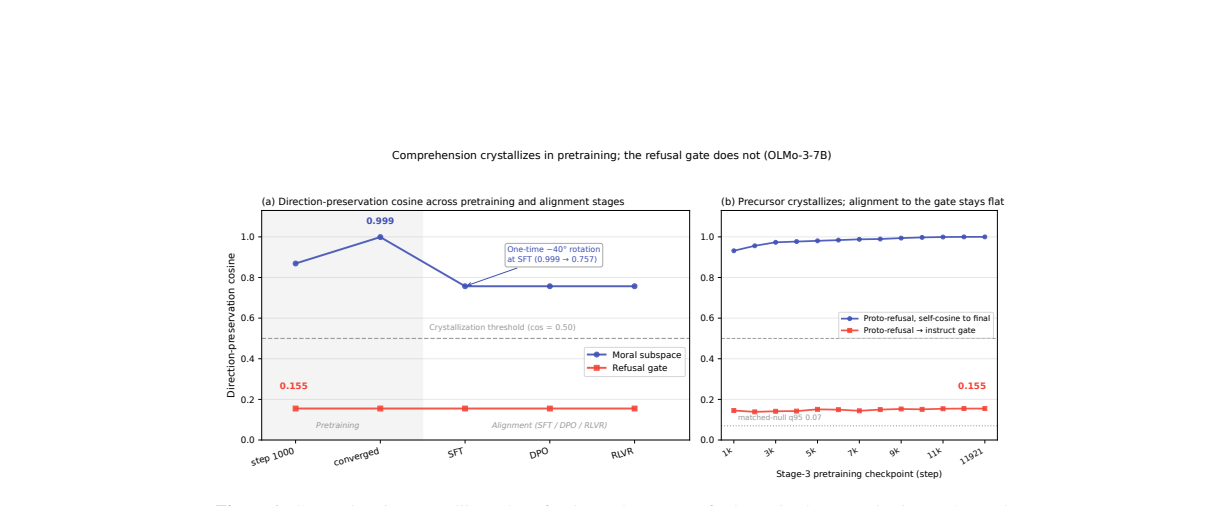
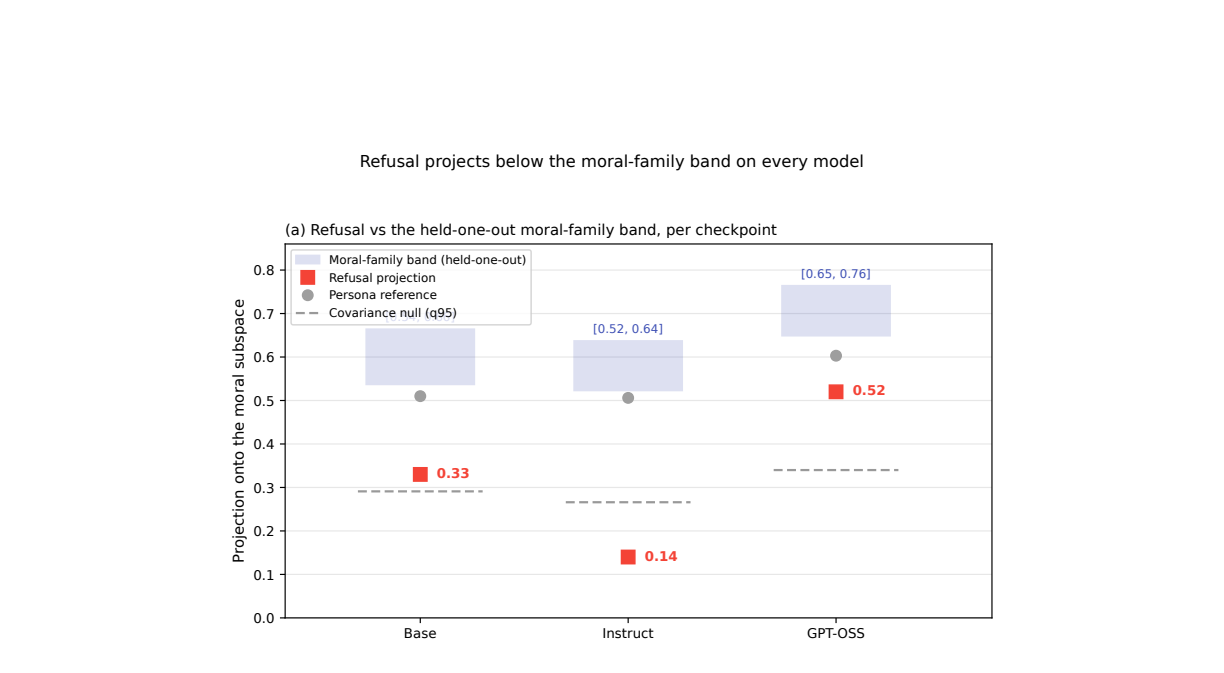
That fact says how easily refusal can be removed, not what the refusal decision was reading in the first place. We ask what it reads, and we separate that from what the model comprehends. Across four open-weight models spanning three families, moral comprehension is native to pretraining: a low-rank moral subspace crystallizes during pretraining, and alignment rotates it once without rebuilding it. The refusal gate, in contrast, is a fresh post-training construction with only a weak pretraining precursor, written into a narrow control-token channel where the refusal decision is orthogonal to the moral-judgment decision. The central result is causal and comes from one model, OLMo-3. A nested interchange rank sweep patches successively larger slices of the moral subspace between matched requests and reads how much of refusal's response transfers: as the basis widens, moral judgment keeps reading more of it, while refusal levels off at the level of a single harm direction, and about three-quarters of refusal's causal input lies outside the moral subspace altogether. Refusal reads the harm percept, not the moral content that judgment reads on the same patches. The picture is not uniform across families. Llama reads broad moral content; Qwen reads beyond the single harm cue but is unresolved at our sample size; GPT-OSS reads harm, and its refusals can be argued in either direction by its own reasoning trace. Where refusal reads only a low-rank slice and routes around the bulk of what the model knows, a rank-one edit removes it. Whether widening what refusal reads would also deepen the behavior is the open question this raises.
from the abstract
Pith says
Machine review · deepseek-v4-flash · 15 Sep 2026 · what was read was not recorded · not checked by a person
It can be wrong. Challenge this review or reply to it.
The passes disagreed. Reader: holds up. Skeptic: agrees with the reader. Referee: major revision.
A careful mechanistic paper showing that LLM refusal reads a narrow harm signal, not moral understanding, but the central causal claim rests on one model with a thin behavioral band. This line is wrong
3 major objections · 7 minor
How often objections from reviews like this one are right: not yet measured
Not checked: figures, code, what the 18 references say.
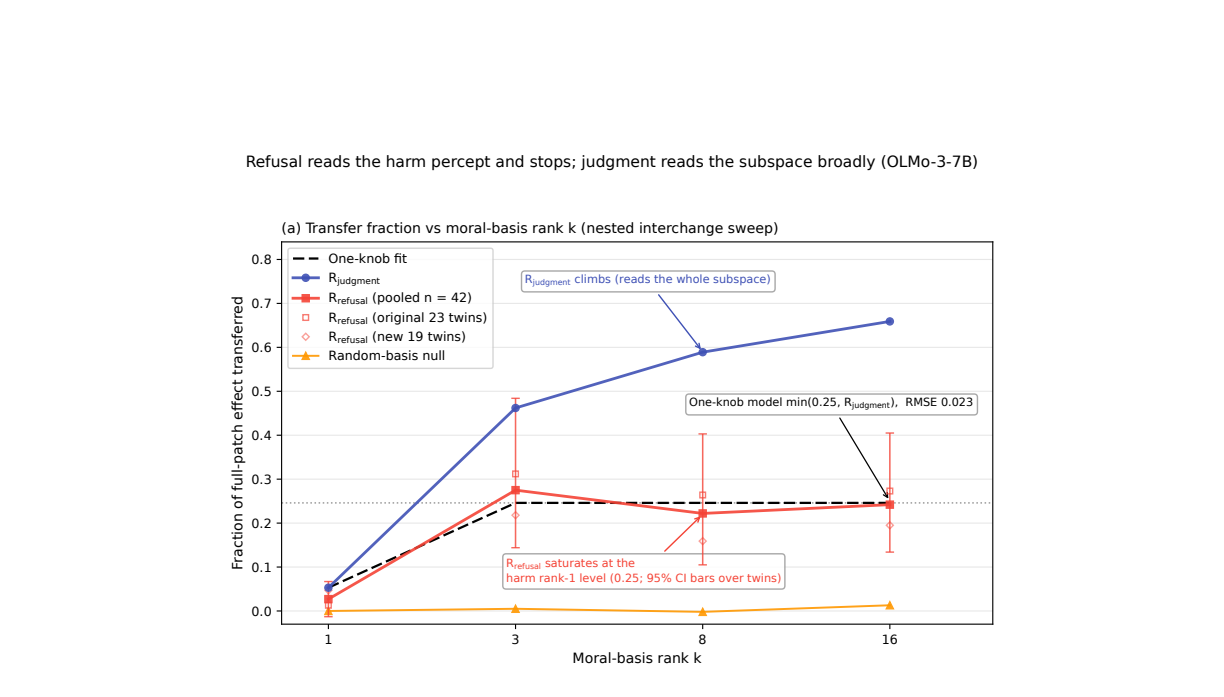
The paper says, at §7 and Figure 4
The review did not quote this passage.
Pith says: Objection 1 of 3 · major
The central rank-sweep result uses projection of patched activations onto a fixed refusal direction as the readout, not the actual binary refusal decision. The paper acknowledges this gap in Section 10 ('Readout versus behavior scope differs by cell') but does not close it for the rank sweep.
more of objection 1
The effects are small (R_refusal(16)=0.24, CI [0.13, 0.41]) and OLMo-3's behavioral refusal rate is only ~17% at top severity (Section 10), so the behavioral dynamic range is nearly empty. Without behavioral validation that the projection-based transfer coefficients correspond to changes in actual refusal behavior, the plateau could reflect properties of the linear readout (e.g., misalignment under distribution shift from patching) rather than a genuine feature of what the refusal decision reads. The authors should either (a) decode outputs for patched twins at the key ranks (k=1,3,8,16) to compute a behavioral transfer coefficient, or (b) provide a principled argument—supported by calibration data—for why the projection readout is a faithful proxy for the binary decision.
The paper says, at §7, Table 6
The review did not quote this passage.
Pith says: Objection 2 of 3 · major
The harm-partialed patch moves refusal by −0.0133 with a bootstrap CI that excludes 0, but this point estimate is below the refusal interchange minimum detectable effect (MDE) of 0.0238. The paper calls this a 'boundary result' but does not discuss the statistical validity of reporting effects below the pre-registered MDE.
more of objection 2
Since the MDE was set before the experiment, post-hoc interpreting a CI-excluding-zero effect that does not meet the planning bar risks capitalizing on the bootstrap's different stopping rule. The authors should either pre-register a separate sensitivity analysis for sub-MDE effects or state more cautiously that the non-harm residual is not robustly detectable by the study's own standard.
The paper says, at §8.1 and Appendix D.2
The review did not quote this passage.
Pith says: Objection 3 of 3 · major
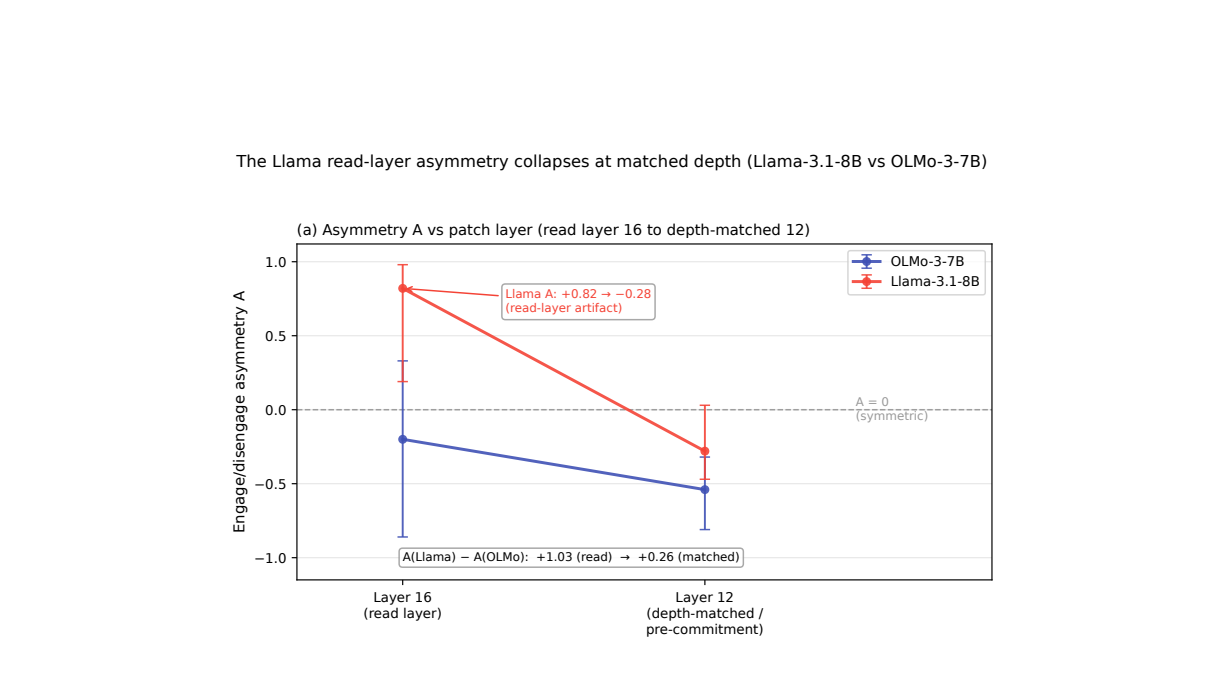
The Llama depth-matched comparison is taken at layer 12, chosen because it lies inside Llama's 'pre-commitment coherent band (8–14).' The paper notes this is a 'researcher degree of freedom.' To address concerns about layer selection driving the result, the authors should provide a sensitivity analysis showing that the reads-broad verdict (refusal transfer ≈ judgment transfer) holds at other layers within the coherent band (e.g., layers 8, 10, 14) and not only at layer 12.
more of objection 3
A layer-sweep plot analogous to Figure 5 but for transfer coefficients would be appropriate.
7 minor objections
The paper says, at §2.2
Pith says: minor objection 1 of 7
The description of the moral subspace construction would benefit from stating explicitly that the three source directions are mean-difference vectors between moral and neutral stimuli, and that the subspace is the orthonormalized span of these three vectors. Currently this is spread across §2.2 and Appendix A.1; a one-sentence summary in the main text would aid readability.
The paper says, at §3, Figure 1
Pith says: minor objection 2 of 7
Please clarify whether the crystallization cosine (0.999) is the cosine between the direction extracted at each checkpoint and the direction at the final pretraining checkpoint, or between the subspace (rank-3) at each checkpoint and the final subspace. The prose and caption should be explicit.
show 5 more
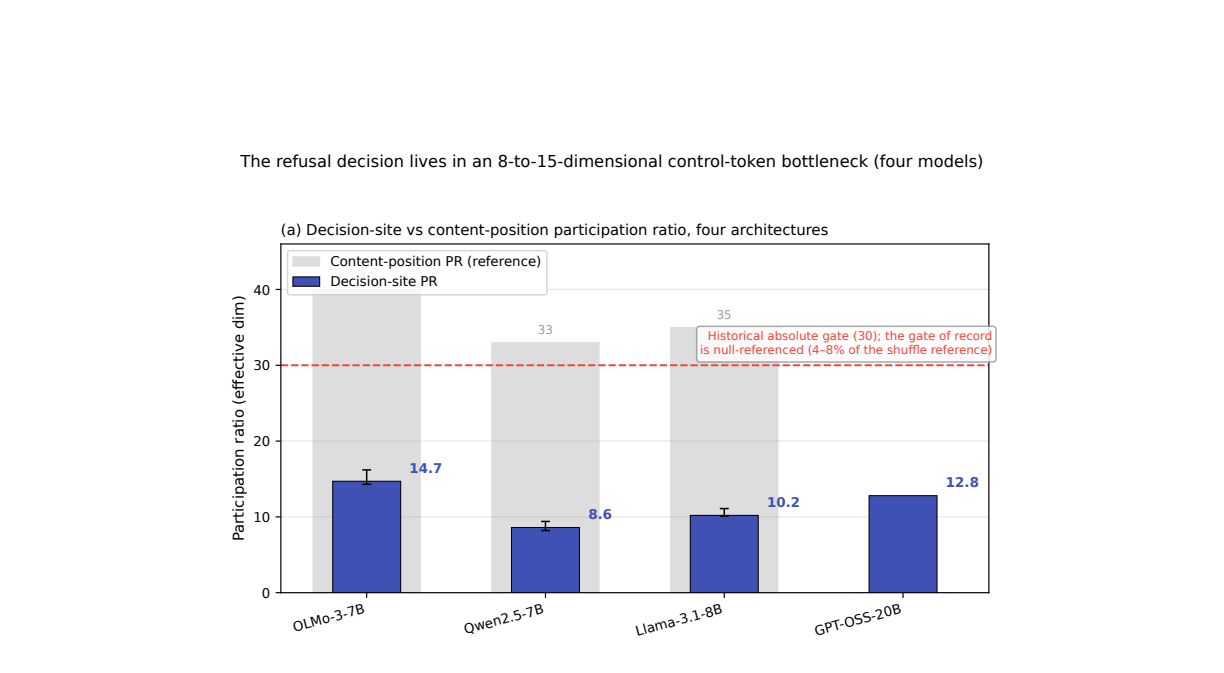
The paper says, at §5, Figure 3
Pith says: minor objection 3 of 7
The participation ratio values are reported as point estimates (14.7, 8.6, 10.2, 12.8). For at least the two non-Llama models, report 95% confidence intervals (or subsampling intervals) over texts, as is done for Llama in Appendix D.1. This would strengthen the claim that the bottleneck spans 8–15 effective dimensions across architectures.
The paper says, at §7, §C.5
Pith says: minor objection 4 of 7
The one-knob model fit has one free parameter (harm ceiling = 0.25) fitted to four data points. Report the number of parameters explicitly, and consider providing an AIC or BIC comparison against a constant model (R_refusal = constant) to give the reader a quantitative sense of whether the one-knob model is meaningfully better than a null.
The paper says, at §10, last paragraph
Pith says: minor objection 5 of 7
The paper notes that OLMo's weak behavioral coupling means commitment-axis and severity-graded cells are measured on Llama and GPT-OSS. This is an important limitation for the cross-model synthesis. It would strengthen the paper to state explicitly in the main conclusion (Section 11) that the central causal claim (rank sweep on OLMo) relies on projection readouts, while the commitment-axis claims rest on behavioral data from other models, so the two axes are not established at the same level of evidence.
The paper says, at §7 and Appendix A.4
Pith says: minor objection 6 of 7
The harm direction is extracted at the instruction token. For OLMo-3, report the cosine between the harm direction and the refusal direction at the decision token. Currently only GPT-OSS values are given (cosine 0.16). This overlap is directly relevant to interpreting the harm-keyed read on the model that carries the causal result.
The paper says, at §8.2 and Appendix D.1, Table 10
Pith says: minor objection 7 of 7
GPT-OSS is the only model where the held-one-out moral band survives above the covariance-matched null at the decision site (0.53 vs 0.48). This exception is mentioned in a table footnote but deserves discussion in the main text: it suggests that the bottleneck structure—and therefore the read-vs-comprehension separation—may differ qualitatively on reasoning models. The paper should address whether this undermines the claim that the bottleneck is a general property.
What would settle it
Run the nested interchange rank sweep (k in {1, 3, 8, 16}) on a model with higher behavioral refusal rate (e.g., Qwen2.5-7B or Llama-3.1-8B) where the behavioral dynamic range is sufficient. For each patch, decode the model's generated output as 'refuse' or 'comply' and compute a behavioral transfer coefficient (fraction of the full behavioral interchange effect reproduced by the restricted patch). If the behavioral transfer curve replicates the projection-based plateau (R_refusal(k) flat at the harm-rank-1 level while R_judgment(k) continues to climb), the central claim passes this check. If the behavioral transfer continues to climb with k (i.e., no plateau), the projection-based result is not behaviorally meaningful. The paper's existing projection-based results on these models could be used as a reference.
from the skeptic's reading
How the review went
4 readings by deepseek-v4-flash · 15 Sep 2026
- Reader holds up
- Skeptic partly agrees
- Editor wrote the verdict above
- Referee major revision: 3 major objections, 7 minor
Not run on this paper: the simulated authors' defence.
Pith did not check this review's objections against the paper.
The review in full
The review in brief, machine-written
The paper's core finding—that refusal on OLMo-3 reads a low-rank harm slice while judgment reads broad moral content—is genuinely novel and well-supported by a careful interchange rank sweep with calibration, positive controls, and replication. The two-axis framework (what refusal reads vs. how it commits) is a useful organizing hypothesis. The reproducibility is excellent: code, data, pre-registration, and committed figure CSVs. On OLMo-3, the causal claim is convincing: judgment transfer climbs to 0.66 while refusal saturates at 0.24, and a one-knob fit with harm ceiling at 0.25 gives RMSE 0.023. Credit where due—this is solid mechanistic science on that model.
The soft spots are in the generalization and in the readout-behavior gap. First, only OLMo-3 has causal evidence; the other three models are correlational (GPT-OSS) or indeterminate (Qwen) or read broad moral content (Llama), so the central narrative ('refusal reads harm') is a single-model result. Second, and more load-bearing: the rank sweep on OLMo-3 uses a fixed refusal-projection readout, and OLMo-3's behavioral refusal rate is only ~17% at top severity. The paper acknowledges this (Section 10) but does not validate that the projection changes correspond to actual binary refusal flips. The stress-test note is right: without a behavioral transfer coefficient for the same patches, the plateau could reflect a misaligned readout under distribution shift, not a genuine property of the refusal decision. The small effect sizes (R_refusal(16)=0.24, CI [0.13,0.41]) and thin behavioral band make this a real concern.
The cross-model panel is also confounded (three resolved points, differing in lineage, scale, and training), so the dimensionality-to-reversibility hypothesis remains speculative. The paper is transparent about this, which I respect.
Bottom line: this is a serious, well-executed paper that makes a genuine contribution to understanding shallow alignment on one model. The OLMo-3 result is important and likely correct, but the behavioral validation gap keeps me from fully endorsing it without a fix. For peer review, I would accept but require either a behavioral transfer coefficient on the rank sweep (even a small-n demonstration) or a much more explicit caveat that the projection-based result may not reflect actual refusal decisions. The paper deserves a serious referee; my letter would be ACCEPT pending that validation.
The strongest objection
The central result of the paper is Figure 4: the nested interchange rank sweep on OLMo-3 showing that refusal transfer R_refusal(k) saturates at the harm-rank-1 level (~0.25) while judgment transfer continues to climb to 0.66. This result uses the projection of the patched activation onto a fixed refusal direction as the readout. However, the paper does not validate that these projection changes correspond to changes in the actual binary refusal behavior (refuse vs comply) for the same patches. The effects are small (R_refusal(16)=0.24, CI [0.13, 0.41]), and the paper acknowledges that OLMo-3's behavioral refusal rate is only ~17% at top severity (Section 10), meaning the behavioral dynamic range is nearly empty. Without behavioral validation of the projection-based transfer coefficients, it is possible that the plateau reflects properties of the linear readout (e.g., the fixed refusal direction becoming misaligned under distribution shift from patching) rather than a genuine feature of what the refusal decision reads. The paper's own limitation statement (Section 10: 'Readout versus behavior scope differs by cell') flags this gap but does not close it for the rank sweep. A concrete test would be to decode the actual generated output for each patched twin at rank k and compute a behavioral transfer coefficient; if it replicates the plateau, the claim is robust.
The reader's weakest assumption focused on the representational adequacy of the extracted directions (moral subspace, refusal direction, harm direction). My concern is more specific and technical: it targets the readout methodology of the interchange rank sweep itself—using a fixed refusal projection without behavioral validation—rather than the construction of the directions. I agree with the reader that the direction construction is a plausible weakness, but I find the leap from projection changes to claims about the refusal 'decision' to be the more load-bearing gap, especially given the small effect sizes and acknowledged weak behavioral coupling on OLMo-3. The paper is transparent about this limitation in Section 10, and the projection readout is standard in the field, so the concern does not warrant a verdict change. However, it is the single most load-bearing vulnerability because the entire causal claim rests on the rank sweep, and the sweep's readout is one step removed from behavior. The reader's verdict of ACCEPT is reasonable given the paper's strengths (reproducibility, calibration, replication) and transparency about limitations. I leave the verdict unchanged because the concern, though real, is a known limitation that the paper acknowledges and does not claim to have resolved.
The referee's report
If the central causal claim holds, the paper provides a mechanistic explanation for why alignment is shallow and removable: refusal sits on a narrow, harm-keyed gate rather than reading the model's rich moral understanding. This could guide future alignment efforts toward widening what refusal reads. The methodological contributions—calibrated ladders, position-validity gates, pre-registration, reproducibility infrastructure—are substantial and set a high standard for interpretability work. The cross-model panel, while confounded, provides a useful two-axis framework for comparing refusal across model families.
Pith's reading of the paper (a machine's summary, not the authors')
The paper sets out to establish what the refusal behavior installed by post-training actually reads inside a language model. On the one model tested causally, OLMo-3, refusal reads a low-rank "harm percept," a narrow slice of moral content, while the model's broad moral understanding lives in a separate subspace that refusal mostly ignores; moral judgment reads that subspace broadly on the same patches, and refusal does not. The paper argues that this geometry is why alignment is shallow: the refusal gate is a fresh post-training construction in a narrow control-token channel, orthogonal to the moral representations underneath, so a rank-one edit removes the behavior without touching comprehension. Across the four-model panel the picture varies by family, with one model reading broad moral content and one deliberating model reading harm while remaining open to argument. A sympathetic reader would care because the result converts the known fact that refusal is cheap to remove into a mechanistic statement about what the decision reads, and locates where a deeper alignment would have to write.
What carries the argument. The central instrument is the nested interchange rank sweep at the decision-token bottleneck, an 8-to-15 effective-dimensional channel at the position where the chat template hands off to the answer. Three extracted objects carry the comparison: a rank-3 moral subspace built by mean-difference between moral and neutral stimuli from three datasets; a refusal direction from refused-versus-complied requests; and a moral-judgment direction from approving-versus-disapproving judgments at the same token, with a separate harm direction from harmful-harmless request twins. By patching the moral basis at ranks $k\in\{1,3,8,16\}$ between matched requests and reading transfer coefficients $R_{\text{refusal}}(k)$ and $R_{\text{judgment}}(k)$, the sweep separates what refusal reads from what judgment reads. Calibrated nulls, positive-control bands, and a position-validity gate convert raw projection sizes into stated bars rather than impressions.
Core claim. On OLMo-3, the central causal claim is that the refusal decision reads the harm percept, not the broad moral content the model has available. In a nested interchange rank sweep over request twins, patching successively larger slices of the moral subspace transfers more and more of the full effect to moral judgment ($0.05 \to 0.46 \to 0.59 \to 0.66$ as the basis rank grows $1,3,8,16$), while refusal transfer climbs to $0.27$ at rank 3 and then plateaus at $0.22$–$0.24$, within tolerance of the harm-rank-1 level. About 76% of refusal's causal input lies outside the rank-16 moral basis, and the whole sweep is fit by a one-parameter clipped curve, $R_{\text{refusal}}(k) \approx \min(0.25, R_{\text{judgment}}(k))$. The paper reads the larger picture as: moral comprehension crystallizes during pretraining and survives alignment as one rigid rotation, the refusal gate is built fresh in post-training inside a narrow decision-token channel, and the gate reads a small separable harm feature — which is why refusal is cheap to ablate while comprehension survives.
The premise it rests on. The load-bearing premise is that the extracted directions — a rank-3 moral subspace from three datasets, a refusal direction from refused-versus-complied requests, and a harm direction from harmful-harmless twins — truly stand for the concepts the model uses, so the OLMo-3 interchange transfer coefficients measure what refusal reads rather than how the directions happened to be constructed.
If the paper is right (Pith's inferences, not the authors')
On the harm-keyed model, a rank-one refusal ablation should leave moral comprehension and behavioral judgment essentially intact, because the gate reads a feature outside the moral subspace.
A deeper alignment would have to widen what the heads that write the decision channel read, making refusal transfer follow the judgment curve instead of clipping at the harm ceiling, starting from the small non-harm residual the sweep detects.
Refusal geometry varies by family: a model that reads broad moral content and commits early entangles refusal with judgment, which explains why ablating its refusal degrades moral judgment, unlike the harm-keyed readers.
The panel raises, without establishing, a falsifiable ordering: the effective dimensionality of the refusal read may predict how the model commits — at the read layer, early, or reversibly.
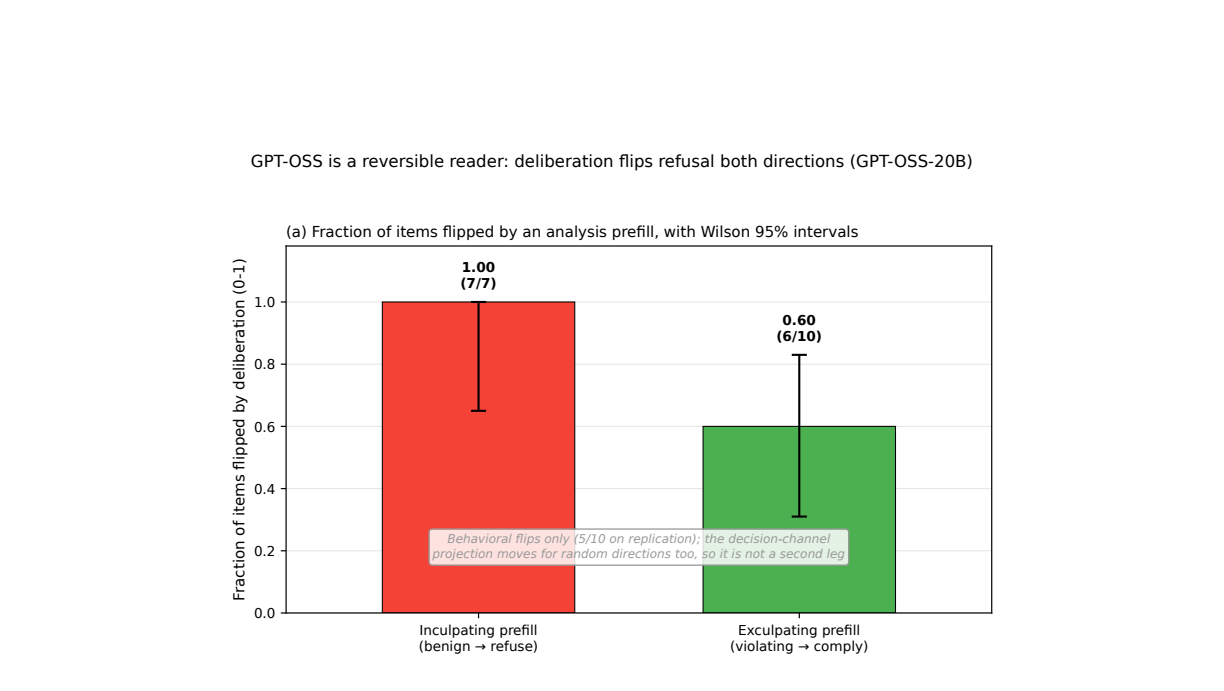
A deliberating model can read harm and still reverse both ways under argument, showing that a harm-keyed gate is not the only way to build refusal.
The paper's causal claim is single-model, so the natural next test is the same nested rank sweep on a model whose refusal has more behavioral dynamic range, and on a deliberation-trained checkpoint sharing a base model, to separate read width from lineage.
If read width is the binding constraint, a model engineered so that refusal transfer tracks judgment should refuse more consistently across severity and resist a rank-one edit; if it does not, then widening the read is not sufficient to deepen the behavior.
The same geometry predicts that automated tools which erase refusal succeed because they cancel a small, low-variance feature rather than because the model lacks understanding; a safety intervention should target what the writing heads read, not merely restore the removed direction.
Moral judgment reading most of the patch effect while refusal saturates suggests the decision site has unused capacity for moral content, which invites a test of whether direction-steering interventions can push the writing heads to use it.
Check this review
Pith stored no record of this review's passes and took no fingerprint of it. Reviews made by code from 13 Nov 2026 on carry both.
How often reviews like this one are right
Reviews like this one: written by deepseek-v4-flash, where what was read was not recorded.
How often objections from reviews like this one are right: not yet measured
Reviews by people
This review was written by a machine. No person has reviewed this paper on Pith yet. A scientist listed on Pith can review it for a fee, and their review is published here whatever it concludes.
The paper
Abstract
Alignment applied after pretraining is shallow in a measurable way: a single direction in a model's residual stream can be edited out, and the model stops refusing harmful requests. That fact says how easily refusal can be removed, not what the refusal decision was reading in the first place. We ask what it reads, and we separate that from what the model comprehends. Across four open-weight models spanning three families, moral comprehension is native to pretraining: a low-rank moral subspace crystallizes during pretraining, and alignment rotates it once without rebuilding it. The refusal gate, in contrast, is a fresh post-training construction with only a weak pretraining precursor, written into a narrow control-token channel where the refusal decision is orthogonal to the moral-judgment decision. The central result is causal and comes from one model, OLMo-3. A nested interchange rank sweep patches successively larger slices of the moral subspace between matched requests and reads how much of refusal's response transfers: as the basis widens, moral judgment keeps reading more of it, while refusal levels off at the level of a single harm direction, and about three-quarters of refusal's causal input lies outside the moral subspace altogether. Refusal reads the harm percept, not the moral content that judgment reads on the same patches. The picture is not uniform across families. Llama reads broad moral content; Qwen reads beyond the single harm cue but is unresolved at our sample size; GPT-OSS reads harm, and its refusals can be argued in either direction by its own reasoning trace. Where refusal reads only a low-rank slice and routes around the bulk of what the model knows, a rank-one edit removes it. Whether widening what refusal reads would also deepen the behavior is the open question this raises.
The paper's own sentences, arranged, kept beside the review and separate from it. Each label is drawn from a closed vocabulary; the number beside it is the probability the classifier gave that label. No sentence in this record was written by a model.
abstract compiled · 2026-09-23
The authors' main claim, as the classifier picked it out 0.79
“Refusal reads the harm percept, not the moral content that judgment reads on the same patches.”
How the main claim is stated: asserted 1.00
What the abstract itself states, as probabilities: claims first 0.05 · states limitation 0.95 · human participants 0.04 · controlled comparison 0.28 · randomized assignment 0.02 · states quantitative result 0.97 · compares with prior results 0.40 · mentions code or data availability 0.04
The abstract, sentence by sentence
This table labels the abstract only (arXiv listing abstract v1). The number is the probability the classifier gave the label.
| Sentence | Role | The authors' own work | States the main conclusion | Strength |
|---|---|---|---|---|
| Alignment applied after pretraining is shallow in a measurable way: a single direction in a model's residual stream can be edited out, and the model stops refusing harmful requests. | background 0.88 | 0.51 | 0.08 | asserted 1.00 |
| That fact says how easily refusal can be removed, not what the refusal decision was reading in the first place. | interpretation 0.49 | 0.20 | 0.05 | asserted 0.96 |
| We ask what it reads, and we separate that from what the model comprehends. | contribution 0.49 | 0.34 | 0.04 | asserted 0.51 |
| Across four open-weight models spanning three families, moral comprehension is native to pretraining: a low-rank moral subspace crystallizes during pretraining, and alignment rotates it once without rebuilding it. | result 0.97 | 0.85 | 0.16 | asserted 1.00 |
| The refusal gate, in contrast, is a fresh post-training construction with only a weak pretraining precursor, written into a narrow control-token channel where the refusal decision is orthogonal to the moral-judgment decision. | result 0.76 | 0.82 | 0.29 | asserted 1.00 |
| The central result is causal and comes from one model, OLMo-3. | limitation 0.83 | 0.88 | 0.13 | asserted 1.00 |
| A nested interchange rank sweep patches successively larger slices of the moral subspace between matched requests and reads how much of refusal's response transfers: as the basis widens, moral judgment keeps reading more of it, while refusal levels off at the level of a single harm direction, and about three-quarters of refusal's causal input lies outside the moral subspace altogether. | result 0.78 | 0.95 | 0.51 | asserted 1.00 |
| Refusal reads the harm percept, not the moral content that judgment reads on the same patches. | result 0.58 | 0.89 | 0.43 | asserted 1.00 |
| The picture is not uniform across families. | result 0.80 | 0.76 | 0.03 | asserted 1.00 |
| Llama reads broad moral content; Qwen reads beyond the single harm cue but is unresolved at our sample size; GPT-OSS reads harm, and its refusals can be argued in either direction by its own reasoning trace. | result 0.97 | 0.86 | 0.05 | asserted 0.87 |
| Where refusal reads only a low-rank slice and routes around the bulk of what the model knows, a rank-one edit removes it. | interpretation 0.67 | 0.68 | 0.22 | asserted 0.96 |
| Whether widening what refusal reads would also deepen the behavior is the open question this raises. | future work 0.99 | 0.11 | 0.05 | unclear 0.40 |
What kind of paper the classifier reports this is: empirical study 1.00 · evidence from observation or experiment 0.96
What was examined, and what was not
Sources read
- arXiv listing abstract v1
Not examined
- full text
- figures and tables
- references and citing sentences
- relations to other papers
Levels run
- P abstract
Not run
- S sections
- T body sentences
- C citations
- R cross-paper relations
How the labels were made
Compiled by classifier-1.13.0 via TypeSafe API, question bank abstract-p1-20260923, 2026-09-23: 1 request, 8,944 input tokens.
Every quoted sentence on this record is the authors'. Every label is from Pith's closed vocabulary, with the probability shown beside it. This record as JSON
Figures (6)
Figures are the authors', reproduced from the paper.
References (18)
- [4] Its value is construct diversity, verified source distinguishability, and resistance to single-source contamination, not extra dimensions. On a contamination check the moral direction reads structure and not memorized surface text: on the Moral Stories narrative slice, surface... on Pith
- [6] URL https://arxiv.org/abs/2407. 21783. Ryan Greenblatt et al. Alignment faking in large language models.arXiv:2412.14093, on PithPith's reviewarXiv
- [9] URLhttps://arxiv.org/abs/2202.05262. 15 OpenAI. gpt-oss-120b & gpt-oss-20b model card, on PithPith's reviewarXiv
- [11] URL https://arxiv.org/ abs/2311.03658. Qwen Team. Qwen2.5 technical report, on PithPith's reviewarXiv
- [12] URLhttps://arxiv.org/abs/2412.15115. Rafael Rafailov et al. Direct preference optimization: Your language model is secretly a reward model. InNeurIPS, on PithPith's reviewarXiv
- [13] Orion Reblitz-Richardson. When probing accuracy saturates, fragility resolves: A complementary metric for LLM pre-training analysis.arXiv preprint arXiv:2606.11375, 2026a. URL https: //arxiv.org/abs/2606.11375. Orion Reblitz-Richardson. How language models organize and structu... on PithPith's reviewarXiv
- [14] URL https://arxiv.org/abs/ 2512.13961. Jiachen Zhao, Jing Huang, Zhengxuan Wu, David Bau, and Weiyan Shi. LLMs encode harmfulness and refusal separately. InAdvances in Neural Information Processing Systems (NeurIPS), on PithPith's reviewarXiv
- [15] URLhttps://arxiv.org/abs/2507.11878. arXiv:2507.11878. Andy Zou, Long Phan, Sarah Chen, James Campbell, Phillip Guo, Richard Ren, Alexander Pan, Xuwang Yin, Mantas Mazeika, et al. Representation engineering: A top-down approach to AI transparency.arXiv preprint arXiv:2310.01405, on PithPith's reviewarXiv
- [16] URL https://arxiv.org/abs/2310. 01405. 16 Appendices Supplementary material. Sections referenced from the main paper as “Appendix A”–“Appendix H”. A Directions, subspaces, and stimulus sets This appendix gives the extraction detail the main text hands off: how each direction a... on Pith
- [18] On the base model we also extract a proto-refusaldirection from the same harmful-versus-harmless contrast, to test whether the aligned gate has a pretraining precursor. It has only a weak one: the cosine between the base proto-refusal and the aligned refusal gate at the layer ... on Pith
- [20] Variance is not causal relevance; the harm read is a rank-1 causal object that is not the rank-1 variance object. k MeasuredR refusal(k), pooled One-knob prediction Residual 1 0.027 0.053−0.026 3 0.275 0.246+0.029 8 0.222 0.246−0.024 16 0.242 0.246−0.004 C.6 The harm-partialed... on Pith
- [21] 16 (read layer)−0.014no The boundary-band bidirectional cell (36 micro-graded twins at Llama’s roughly 0.5-refusal severity, all three sub-levels inside the [0.4, 0.7] unsaturated band) shows the directional asymmetry directly: engage (add harmful content) moves refusal+0.142(... on Pith
- [788] holding 32%, against OLMo-3’s top dimension at 1.4%. GPT-OSS’s content-position sample shows the same pattern (top-dimension variance share 0.699). Geometry on these models is therefore computed after per- dimension standardization (dividing each dimension by its standard devi... on PitharXiv
- [2013] doi: 10.1016/B978-0-12-407236-7.00002-4. Aaron Grattafiori et al. The llama 3 herd of models, on Pithdoi:10.1016/b978-0-12-407236-7.00002-4
- [2021] URL https://arxiv.org/abs/2008.02275. Evan Hubinger, Carson Denison, Jesse Mu, Mike Lambert, Meg Tong, Monte MacDiarmid, Tamera Lanham, Daniel M. Ziegler, et al. Sleeper agents: Training deceptive LLMs that persist through safety training.arXiv preprint arXiv:2401.05566, on PithPith's reviewarXiv
- [2022] URLhttps://arxiv.org/abs/2212.08073. Nora Belrose, David Schneider-Joseph, Shauli Ravfogel, Ryan Cotterell, Edward Raff, and Stella Biderman. LEACE: Perfect linear concept erasure in closed form.Advances in Neural Information Processing Systems, 36, on PithPith's reviewarXiv
- [2023] URLhttps://arxiv.org/abs/2306.03819. Jesse Graham, Jonathan Haidt, Sena Koleva, Matt Motyl, Ravi Iyer, Sean P. Wojcik, and Peter H. Ditto. Moral foundations theory: The pragmatic validity of moral pluralism.Advances in Experimental Social Psychology, 47:55–130, on PithPith's reviewarXiv
- [2024] URLhttps://arxiv.org/abs/2406.11717. Yuntao Bai et al. Constitutional AI: Harmlessness from AI feedback.arXiv preprint arXiv:2212.08073, on PithPith's reviewarXiv
Cited by 2 Pith papers
Reviewed papers on Pith that cite this one. The full citation record
Challenges and discussion
Disagree with the review, or know something it missed? Leave a comment, or challenge this review formally: a challenge becomes a permanent entry in this paper's record, and its decision is published here.
Come back by email
A short list of the week's newly reviewed papers. Nothing is sent until you confirm from your inbox, and every email has a link that stops it. No account.
No comments yet.
Sign in to comment