Artificial Intelligence · arXiv:2610.31274 v1 · submitted 22 Oct 2026 · 20 references
PointerBench: A Diagnostic Benchmark for Fine-Grained GUI Grounding
The paper says
“Multimodal Large Language Models have shown promising performance in computer-use tasks, from planning user workflows to grounding natural-language actions to precise UI targets.”
more of the abstract
Existing end-to-end benchmarks primarily emphasize long-horizon task completion, while GUI grounding benchmarks remain focused on conventional controls and a limited set of professional interfaces. We introduce POINTERBENCH, a diagnostic suite of 1,500 screenshot-instruction pairs probing three complementary capabilities: thin sub-element identification and geometric grounding in spreadsheets (POINTERBENCH-Sheets), character-level grounding in long-text documents (POINTERBENCH-Text), and mixed GUI grounding across 100 professional applications (POINTERBENCH-Pro). We carefully curate each task with pixel-exact target geometry and evaluate both general-purpose multimodal models and 39 specialist GUI grounding configurations. We find text grounding to be the most challenging setting, with Claude Fable 5, GPT-5.6 Sol, and the leading native specialist UI-Venus-2-9B achieving 69.6%, 53.4%, and 25.8% success on POINTERBENCH-Text despite respective 83.2%, 77.7%, and 54.5% average success across POINTERBENCH. These results reveal substantial headroom in fine-grained GUI grounding across frontier and specialist models. We publicly release the benchmark and evaluation code at https://github.com/warmwindOS/pointerbench.
from the abstract
Pith says
Machine review · deepseek-v4-flash · 23 Oct 2026 · what was read was not recorded · not checked by a person
It can be wrong. Challenge this review or reply to it.
Holds up, with conditions. PointerBench is a clean, genuinely useful diagnostic for fine-grained GUI grounding, and its text-bottleneck finding holds up on the evidence shown, but the Gemini/Qwen coordinate-frame story has a reporting gap you should know about before quoting the frontier numbers. This line is wrong
3 major objections · 5 minor
How often objections from reviews like this one are right: not yet measured
Not checked: figures, code, what the 20 references say.
The paper says, at Section 3.3, Tables 13-14; abstract
The review did not quote this passage.
Pith says: Objection 1 of 3 · major
The coordinate-frame conversion for Gemini 3.7 Flash, Qwen3.8 Max, and Qwen3.6 Flash is reported only at the level of overall accuracy (78.1%, 55.4%, 31.9%). Because the paper's central claim, that fine-grained text grounding is the main bottleneck even for frontier models, is stated without qualification in the abstract and conclusion, and because the official Text scores for these models (1.2%, …
more of objection 1
… 0.2%, and 0.0% in Table 14) are dominated by the 0-1000 versus 1024x768 mismatch, the absence of converted per-suite Text numbers leaves open a concrete alternative reading: that these low Text scores are mostly a format artifact rather than a grounding deficit. The authors disclose the issue and label converted scores as diagnostic only, which is to their credit, but the disclosure is incomplete at exactly the level where the claim is made. Please report converted per-suite scores, at minimum for Text and preferably per objective, for the three non-compliant models, or alternatively restrict the frontier-model generalization to prompt-compliant families.
The paper says, at Sections 3.2-3.3, Table 3; abstract
The review did not quote this passage.
Pith says: Objection 2 of 3 · major
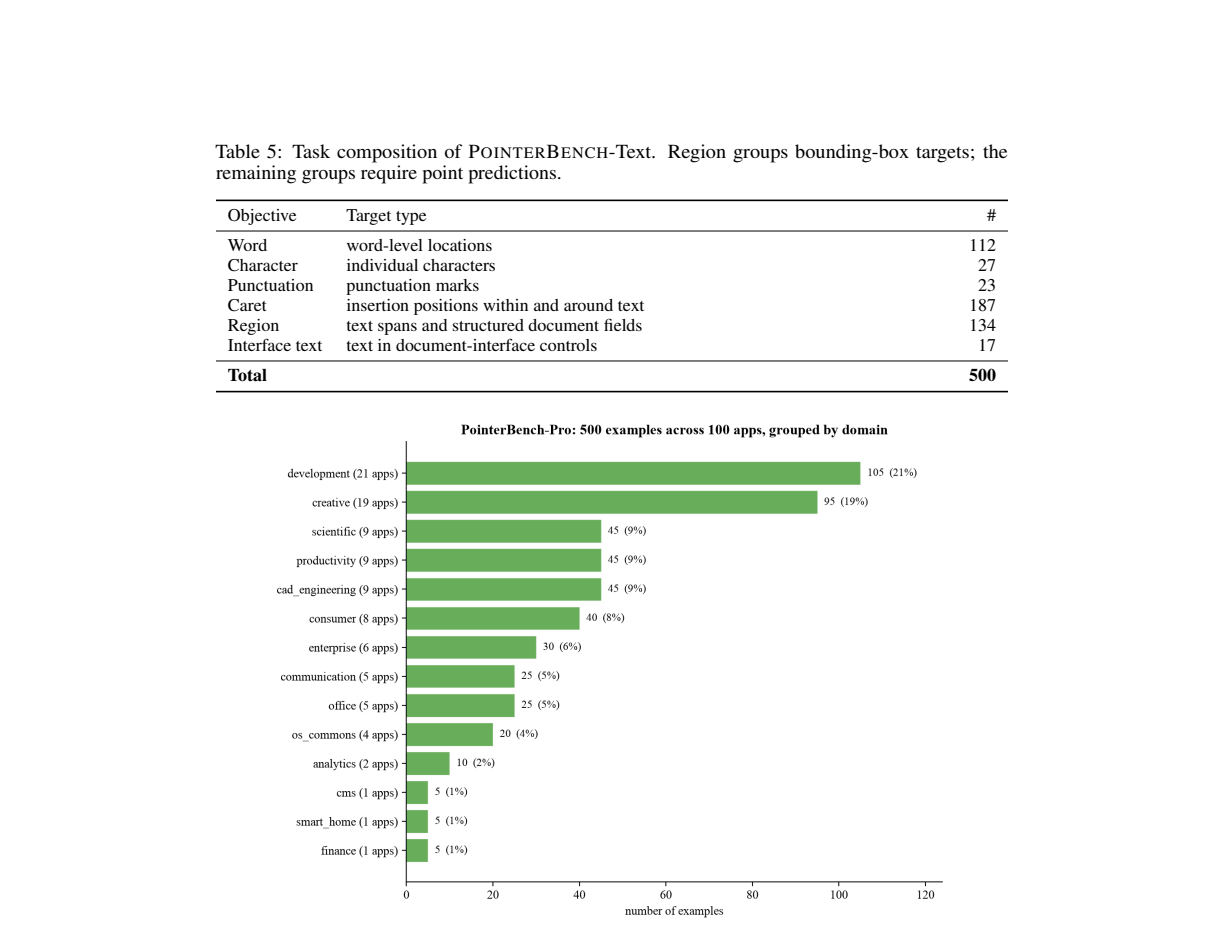
Point-native specialists are scored 0.0% on all 134 Region targets (Table 3), so the abstract's headline 25.8% Text for UI-Venus-2-9B conflates grounding ability with output modality. The mechanism is disclosed in Section 3.3, but the paper never reports the region-excluded point-task rate, which is needed to interpret the specialist bottleneck.
more of objection 2
Reconstructing it from Tables 3 and 5 gives approximately 35.3% for UI-Venus-2-9B on the 366 point targets, still far below its 73.6% on Pro, so the bottleneck claim survives this correction, but the reader should not have to recompute this, and the correction may differ across the other specialists. Please report Text accuracy on the point-only subset alongside the full-suite number for all specialist configurations.
The paper says, at Table 3, Figure 2
The review did not quote this passage.
Pith says: Objection 3 of 3 · major
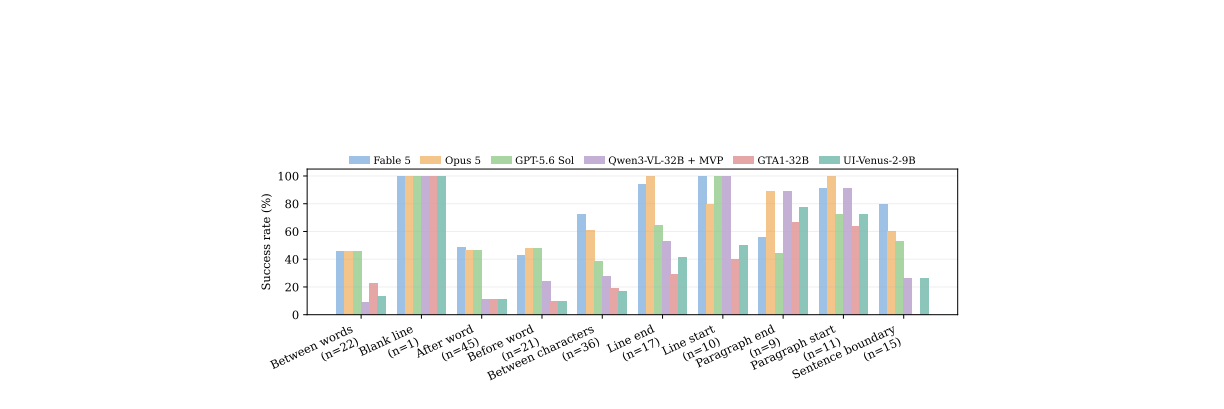
Several subgroup results that carry part of the granularity-gradient claim rest on small samples reported without uncertainty: the Character (n=27) and Punctuation (n=23) columns of Table 3, the Interface text column (n=17, where GPT-5.6 Sol scores 100.0%), and the caret subgroups of Figure 2, which range from n=9 to n=45 plus a Blank line bar with n=1.
more of objection 3
The aggregate gradient (words easier than characters, carets, and regions) is supported by the full 500-example suite and the n=187 caret aggregate, so this does not threaten the central claim, but statements such as no frontier model exceeding 50% accuracy on before-, after-, and between-word carets should be accompanied by exact counts, confidence intervals, or pooling of the smallest groups.
5 minor objections
The paper says, at Table 1
Pith says: minor objection 1 of 5
The column header of Table 1 is ambiguous in the rendered text, for example Grok 4.5 and Kimi K2.5 appear to share a header cell; please format the header so that each of the ten model columns is unambiguously labeled.
The paper says, at Figure 2
Pith says: minor objection 2 of 5
The Blank line (n=1) bar cannot support any comparative statement; drop it or mark it explicitly as anecdotal, and add per-bar counts or confidence intervals to the remaining caret subgroups.
show 3 more
The paper says, at Appendix A and Appendix H
Pith says: minor objection 3 of 5
The text-uniqueness filter, whereby Text examples are retained only when they identify a unique target, is a design choice that likely makes the Text suite easier than real documents with ambiguous or repeated references; the limitations discussion in Appendix H does not mention this and it deserves a sentence.
The paper says, at Section 3.3 and Table 10
Pith says: minor objection 4 of 5
The claim that icons account for 57.3% of pooled failures does not state the pool; Table 10 shows 215 of 375 failures pooled across Fable, Opus, Sol, and Luna, and the main text should say so.
The paper says, at Abstract and Appendix G
Pith says: minor objection 5 of 5
The abstract states that 39 specialist GUI grounding configurations are evaluated while Appendix G says these span 35 checkpoints; a one-sentence clarification of the configuration-versus-checkpoint distinction would avoid confusion.
What would settle it
Apply the 0-1000 to 1024x768 transformation used in Table 13 to every parseable Gemini 3.7 Flash and Qwen3.8 Max prediction and recompute (i) Sheets/Text/Pro suite scores and (ii) the Table 3 Text categories (Word, Character, Punctuation, Caret, Interface text, Region). If converted Text remains at or below roughly 55% and converted caret accuracy at or below roughly 50%, the frontier-model text-bottleneck claim survives; if converted Text approaches Fable's 69.6% or caret accuracy exceeds the reported 64.7% frontier maximum, the abstract and Section 3.1 should be qualified to models that comply with the unified coordinate frame.
from the skeptic's reading
How the review went
4 readings by deepseek-v4-flash · 23 Oct 2026
- Reader holds up, with conditions
- Skeptic agrees
- Editor wrote the verdict above
- Referee major revision: 3 major objections, 5 minor
Not run on this paper: the simulated authors' defence.
Pith did not check this review's objections against the paper.
The review in full
The review in brief, machine-written
PointerBench is worth your time. It builds a clean diagnostic that separates fine-grained geometric grounding — thin spreadsheet boundaries, character- and caret-level text targets, tight text spans — from the conventional controls that ScreenSpot, UI-Vision, and FineState-Bench already cover. The three 500-example suites are generated deterministically with pixel-exact targets, the scoring protocol is stated precisely, and the released metadata and evaluator make the measurement reproducible in principle. The main finding, that fine-grained text grounding is the hardest setting for every compliant model family and degrades word → character → caret → region, is well supported on the evidence presented.
Credit where due: the coordinate-frame problem is handled honestly. Gemini 3.7 Flash and Qwen3.8 Max return 0–1000 coordinates, score 3.1% and 2.8% officially, and jump to 78.1% and 55.4% under a fixed conversion, which the paper labels diagnostic-only and keeps off the leaderboard. The reasoning-budget study with paired McNemar tests is careful, and the contamination and resolution limits are stated in Appendix H rather than buried. Circularity burden is near zero: targets are generated before any model runs, and the thresholds are hand-set, not fit to models.
Soft spots, in proportion. First, the converted Gemini/Qwen numbers have no per-suite or category-level breakdown (Section 3.3, Table 13, Appendix E). Gemini's official Text score is 1.2%, and no converted Text figure is reported. A linear conversion would probably keep Text as Gemini's hardest suite — every compliant family shows the same pattern — but the paper should report the breakdown rather than leave the generality of its frontier-model claim to inference. Reporting gap, not a fatal flaw: the Fable-versus-Sol gap and the uniform text-worst pattern across all measurable families are unaffected.
Second, subgroup claims run on small samples: Character n=27, Punctuation n=23, and the Figure 2 caret categories range from n=9 to n=45, with no error bars. The qualitative gradient is robust; the fine-grained cross-model differences within those columns are noise-level.
Third, point-native specialists score 0 on all 134 Region targets — disclosed in Section 3.2 and Appendix G, but never offset by region-excluded point-task rates, so UI-Venus-2-9B's 25.8% Text headline partly measures output modality. Moderate, disclosed, fixable.
Who this is for: anyone evaluating or training GUI grounding models, especially for fine-grained control. It deserves a serious referee. The main asks would be converted per-suite scores for Gemini/Qwen and confidence intervals on the small cells.
The strongest objection
Section 3.3 and Table 13 disclose the coordinate-frame non-compliance and give converted overall scores (3.1% to 78.1% for Gemini 3.7 Flash, 2.8% to 55.4% for Qwen3.8 Max), but no converted per-suite or category-level breakdown is reported. Since the central claim (abstract, sentence b4; Section 3.1) is that fine-grained text grounding is the main bottleneck even for frontier models, and Gemini's official Text score is 1.2% (Table 14), the absence of a converted Text score leaves a concrete alternative reading: Gemini's low Text number may be mostly a 0-1000 versus 1024x768 output-format mismatch rather than a grounding deficit. If a uniform conversion lifts Gemini's Text and caret scores toward or above the reported frontier values (Fable 69.6% Text, 64.7% caret), then "frontier models remain challenged by text" holds only for prompt-compliant model families, not as a general statement. A second, acknowledged but unquantified confound affects the specialist comparison: point-native specialists are scored 0 on all 134 Region targets (Section 3.2), so UI-Venus-2-9B's 25.8% Text headline partly reflects output modality; the paper never reports region-excluded point-task rates. Neither confound invalidates the Fable-versus-Sol gap, but both mean the benchmark measures grounding under a fixed output protocol, not grounding alone.
The reader's weakest assumption identifies the same protocol-fairness concern. This stress-test agrees and sharpens it: the paper's own converted diagnostics stop at overall accuracy, and the overall conversion is so large (Gemini 3.1% to 78.1%) that it cannot be dismissed as irrelevant to the claim that text grounding is unsolved for frontier models. Gemini is a frontier model; its official Text score is 1.2%, and without a converted Text breakdown the paper cannot show whether that 1.2% is a grounding failure or a coordinate-frame failure. The proposed check settles this directly and cheaply because the released artifacts are stated to include per-example outputs. The specialist point-native region penalty is secondary: even a region-excluded recomputation (roughly UI-Venus point-only about 35%, Fable point-only about 75%) preserves the central gap, so it supports the conditional verdict rather than overturning it. The coordinate-frame gap is also disclosed, and the strongest pairwise evidence (Fable vs. Opus vs. Sol) uses compliant outputs; therefore no rejection or new condition beyond the reader's CONDITIONAL verdict is warranted. UNCHANGED is appropriate: the paper should report converted per-suite and category-level scores and qualify the frontier-model wording, which is exactly the kind of condition the reader already attached.
The referee's report
If the findings hold, PointerBench is a useful diagnostic that separates fine-grained grounding from planning and documents a consistent granularity gradient across model families. The paper's strengths are genuine: deterministic pixel-exact target generation, a released scoring harness, a center-click baseline (0.3%) confirming non-trivial targets, internally consistent headline numbers, and candid disclosure of the coordinate-frame non-compliance and of the point-native-specialist artifact. The Text gap between Claude Fable 5 and GPT-5.6 Sol (16.2 percentage points on 500 examples) is large relative to sampling error, and the text bottleneck appears in every prompt-compliant family evaluated. Two qualifications temper the generality of the central claim: text-specific scores for the non-compliant Gemini and Qwen families are uninterpretable without the frame conversion, which is not reported per suite; and point-native specialists accumulate zeros on all 134 Region targets, so their Text figures mix grounding ability with output modality. Neither qualification overturns the Fable-versus-Sol comparison, but both should be quantified before the claims are stated without caveat.
Pith's reading of the paper (a machine's summary, not the authors')
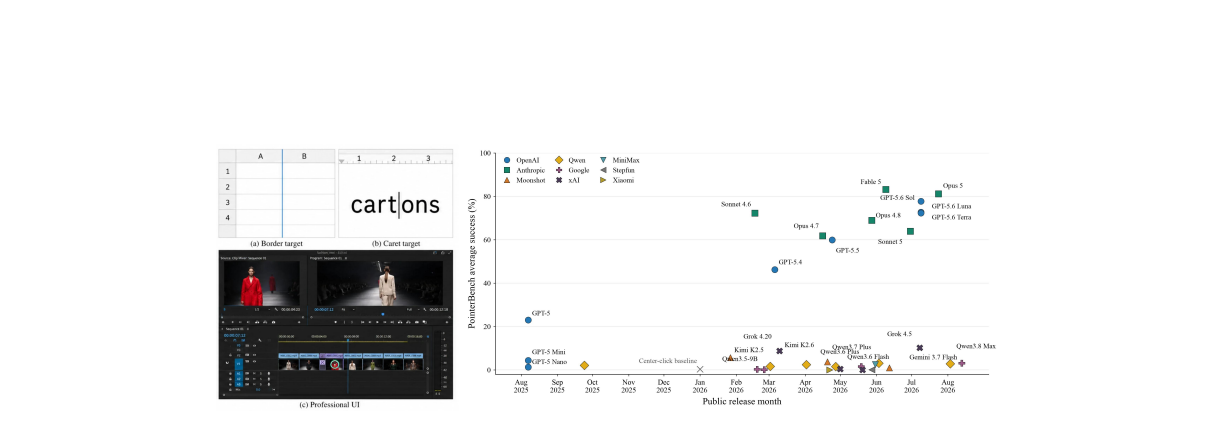
PointerBench is a diagnostic benchmark that tries to isolate one step of computer use — pointing at the right pixel — from planning, tool use, and environment control. It contains 1,500 screenshot–instruction pairs across three suites: spreadsheet geometry, long-text documents, and professional applications, each with pixel-exact target coordinates. The paper's central finding is that fine-grained text grounding is the hardest capability: the best general-purpose model reaches 69.6% and the best specialist 34.0% on the text suite, well below their averages on the other two. Accuracy falls steadily as targets shrink from words to characters, punctuation marks, insertion carets, and tightly bounded text regions, a pattern the paper argues end-to-end benchmarks hide. If correct, the benchmark shows that sub-element and character-level localization is the concrete bottleneck computer-use agents must overcome next.
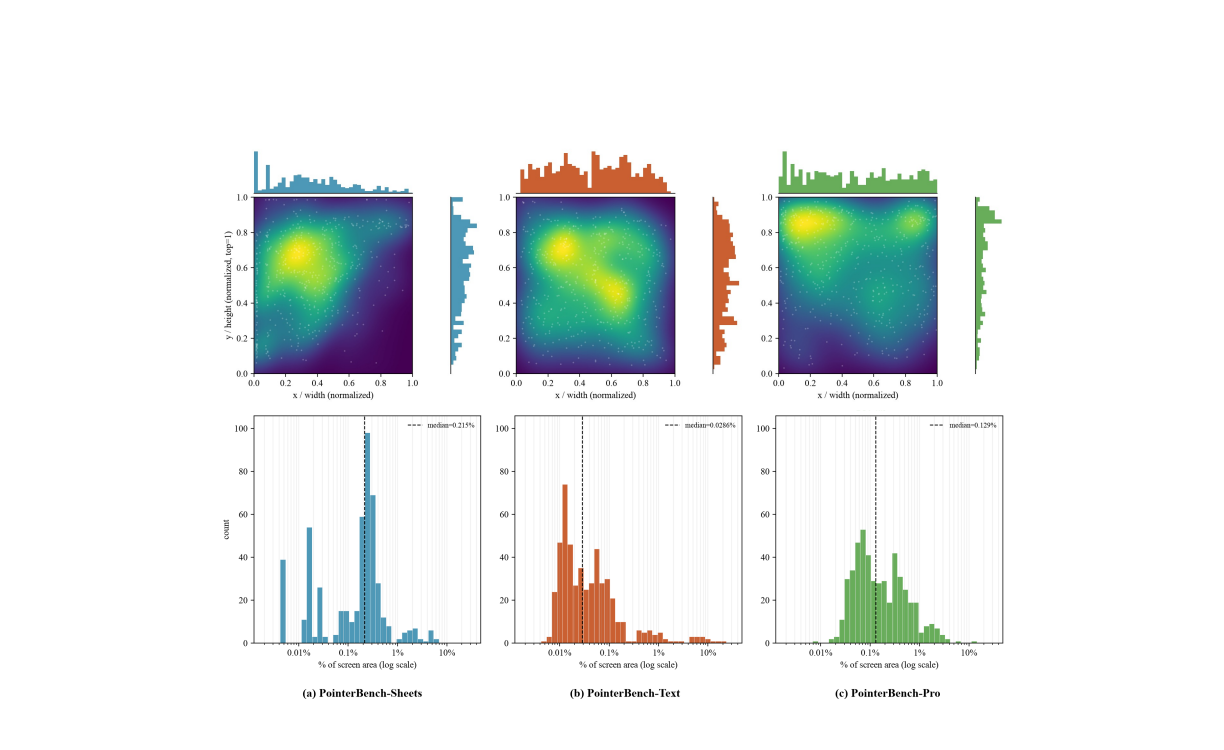
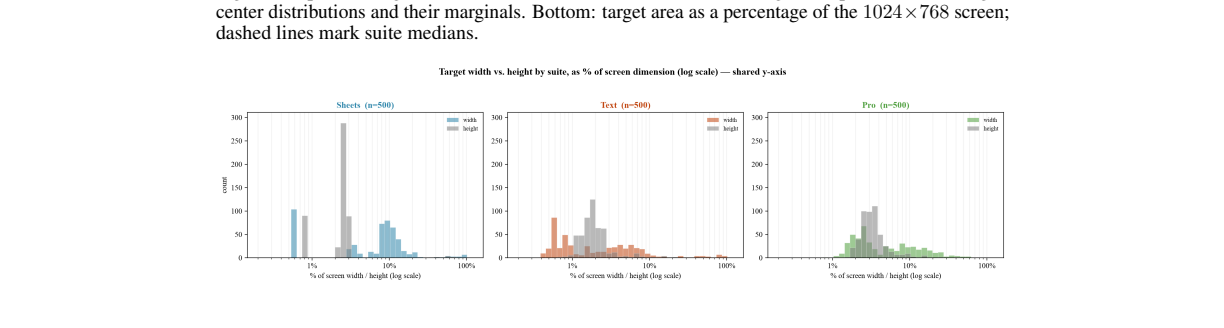
What carries the argument. The carrying object is the benchmark's task interface: three 500-example suites that all share the same input format — a 1024×768 screenshot, a natural-language instruction, and a target given in absolute pixel coordinates, either as a point or a bounding box. Scoring is strict by design: a point is correct only if it falls inside the annotated region, and a box is correct only if it satisfies coverage $\ge 0.90$ and precision $\ge 0.70$, with malformed outputs counted as failures. Every image is programmatically rendered with controlled geometry — dividers a few pixels wide, inter-character caret positions, exact glyph locations — so a lucky guess at a conventional control cannot produce a correct answer. Because each task is a single, planning-free step, the design attributes every error to grounding itself, which is the work the machinery performs.
Core claim. The authors claim that text grounding, not planning or coarse element recognition, is the load-bearing weakness of current GUI agents. On PointerBench-Text, Claude Fable 5, GPT-5.6 Sol, and the leading native specialist UI-Venus-2-9B score 69.6%, 53.4%, and 25.8%, against 83.2%, 77.7%, and 54.5% averages across the full benchmark, and no specialist configuration exceeds 34.0%. The decisive gradient is target granularity: word localization is comparatively easy (Fable at 90.2%), while character targets fall to 51.9% for the best frontier model and 11.1–18.5% for specialists, no frontier model exceeds 50% on carets placed before, after, or between words, and tight bounding boxes over text spans succeed only about half the time even for the best models. The same pattern appears in the other suites: near-perfect spreadsheet performance (up to 98.8%) still drops to 78.1% on row-resize handles, and icons cause 57.3% of professional-interface failures while making up only 38.0% of those examples. The paper further reports that Gemini 3.7 Flash and Qwen3.8 Max score 3.1% and 2.8% officially but 78.1% and 55.4% after a mechanical conversion of their 0–1000 coordinate output to the requested 1024×768 frame, a diagnostic the authors read as evidence that leaderboard rank partly measures output-format compliance.
The premise it rests on. The load-bearing premise is that one fixed protocol — a 1024×768 frame, absolute pixel coordinates, a single JSON prompt, and the coverage $\ge 0.90$, precision $\ge 0.70$ thresholds — measures grounding ability fairly for every model, even though the paper itself shows the protocol is not neutral: Gemini 3.7 Flash and Qwen3.8 Max jump from 3.1% and 2.8% to 78.1% and 55.4% once their 0–1000 coordinate outputs are mechanically converted to the benchmark frame.
If the paper is right (Pith's inferences, not the authors')
Improving grounding at character, caret, and tight-region granularity is the concrete headroom for computer-use agents: no evaluated system approaches ceiling on those primitives, so gains there should transfer to real interactions.
Aggregate accuracy can hide large errors on thin targets: near-perfect Sheets scores (up to 98.8%) coexist with 78.1% on row-resize handles, so progress should be tracked by target type rather than by headline average.
Icon grounding is the dominant professional-interface failure — 57.3% of pooled errors come from the 38.0% of examples that are icons — marking icon and UI-semantic understanding as a specific training target.
Coordinate-convention compliance is entangled with grounding ability: official scores for two models rise from 3.1% and 2.8% to 78.1% and 55.4% after a mechanical frame conversion, motivating normalized output representations in future evaluations.
The text bottleneck is not a language effect: leading models score nearly identically on English and non-English examples, so the limiting factor is spatial granularity rather than multilingual coverage.
My inference: the benchmark's primitive structure suggests a training curriculum — decompose grounding into word, character, caret, edge, and icon sub-skills, score each separately, and optimize the weak primitives; this may raise end-to-end computer-use ability more efficiently than optimizing task completion directly.
My inference: because the Gemini/Qwen frame conversion lifts those models to 78.1% and 55.4%, re-running the full leaderboard under normalized coordinate output would probably reorder the middle of the table and could narrow the reported gap between frontier and specialist systems.
My inference: the two distinct text-region failure modes — oversized boxes for some models, clipped boxes for others — imply that no single box post-processing rule can fix region grounding across model families; the correction would have to be per-model.
My inference: a direct causal test of the paper's diagnosis would be training a specialist on character- and caret-level supervision while holding word-level data constant; if its Text score rises toward its word score, the bottleneck is training signal and representation, and if it does not, the limits are more basic.
Check this review
Pith stored no record of this review's passes and took no fingerprint of it. Reviews made by code from 13 Nov 2026 on carry both.
How often reviews like this one are right
Reviews like this one: written by deepseek-v4-flash, where what was read was not recorded.
How often objections from reviews like this one are right: not yet measured
Reviews by people
This review was written by a machine. No person has reviewed this paper on Pith yet. A scientist listed on Pith can review it for a fee, and their review is published here whatever it concludes.
The paper
Abstract
Multimodal Large Language Models have shown promising performance in computer-use tasks, from planning user workflows to grounding natural-language actions to precise UI targets. Existing end-to-end benchmarks primarily emphasize long-horizon task completion, while GUI grounding benchmarks remain focused on conventional controls and a limited set of professional interfaces. We introduce POINTERBENCH, a diagnostic suite of 1,500 screenshot-instruction pairs probing three complementary capabilities: thin sub-element identification and geometric grounding in spreadsheets (POINTERBENCH-Sheets), character-level grounding in long-text documents (POINTERBENCH-Text), and mixed GUI grounding across 100 professional applications (POINTERBENCH-Pro). We carefully curate each task with pixel-exact target geometry and evaluate both general-purpose multimodal models and 39 specialist GUI grounding configurations. We find text grounding to be the most challenging setting, with Claude Fable 5, GPT-5.6 Sol, and the leading native specialist UI-Venus-2-9B achieving 69.6%, 53.4%, and 25.8% success on POINTERBENCH-Text despite respective 83.2%, 77.7%, and 54.5% average success across POINTERBENCH. These results reveal substantial headroom in fine-grained GUI grounding across frontier and specialist models. We publicly release the benchmark and evaluation code at https://github.com/warmwindOS/pointerbench.
The paper's own sentences, arranged, kept beside the review and separate from it. Each label is drawn from a closed vocabulary; the number beside it is the probability the classifier gave that label. No sentence in this record was written by a model.
abstract compiled · 2026-10-23
The authors' main claim, as the classifier picked it out 1.00
“These results reveal substantial headroom in fine-grained GUI grounding across frontier and specialist models.”
How the main claim is stated: asserted 0.99
What the abstract itself states, as probabilities: claims first 0.09 · states limitation 0.19 · human participants 0.07 · controlled comparison 0.24 · randomized assignment 0.02 · states quantitative result 0.99 · compares with prior results 0.79 · mentions code or data availability 0.98
The abstract, sentence by sentence
This table labels the abstract only (arXiv listing abstract v1). The number is the probability the classifier gave the label.
| Sentence | Role | The authors' own work | States the main conclusion | Strength |
|---|---|---|---|---|
| Multimodal Large Language Models have shown promising performance in computer-use tasks, from planning user workflows to grounding natural-language actions to precise UI targets. | background 1.00 | 0.05 | 0.02 | asserted 0.85 |
| Existing end-to-end benchmarks primarily emphasize long-horizon task completion, while GUI grounding benchmarks remain focused on conventional controls and a limited set of professional interfaces. | gap 0.96 | 0.05 | 0.03 | asserted 1.00 |
| We introduce POINTERBENCH, a diagnostic suite of 1,500 screenshot-instruction pairs probing three complementary capabilities: thin sub-element identification and geometric grounding in spreadsheets (POINTERBENCH-Sheets), character-level grounding in long-text documents (POINTERBENCH-Text), and mixed GUI grounding across 100 professional applications (POINTERBENCH-Pro). | contribution 0.99 | 0.94 | 0.06 | asserted 1.00 |
| We carefully curate each task with pixel-exact target geometry and evaluate both general-purpose multimodal models and 39 specialist GUI grounding configurations. | method 0.96 | 0.97 | 0.03 | asserted 0.99 |
| We find text grounding to be the most challenging setting, with Claude Fable 5, GPT-5.6 Sol, and the leading native specialist UI-Venus-2-9B achieving 69.6%, 53.4%, and 25.8% success on POINTERBENCH-Text despite respective 83.2%, 77.7%, and 54.5% average success across POINTERBENCH. | result 1.00 | 0.97 | 0.24 | asserted 1.00 |
| These results reveal substantial headroom in fine-grained GUI grounding across frontier and specialist models. | interpretation 1.00 | 0.80 | 0.69 | asserted 0.99 |
| We publicly release the benchmark and evaluation code at https://github.com/warmwindOS/pointerbench. | contribution 0.97 | 0.80 | 0.03 | asserted 0.97 |
What kind of paper the classifier reports this is: dataset or benchmark 1.00 · evidence from observation or experiment 1.00
What was examined, and what was not
Sources read
- arXiv listing abstract v1
Not examined
- full text
- figures and tables
- references and citing sentences
- relations to other papers
Levels run
- P abstract
Not run
- S sections
- T body sentences
- C citations
- R cross-paper relations
How the labels were made
Compiled by classifier-1.13.0 via TypeSafe API, question bank abstract-p1-20260923, 2026-10-23: 1 request, 5,863 input tokens.
Every quoted sentence on this record is the authors'. Every label is from Pith's closed vocabulary, with the probability shown beside it. This record as JSON
Figures (5)
Figures are the authors', reproduced from the paper.
References (20)
- [4] doi: 10.1609/aaai.v40i36.40314. Lutfi Eren Erdogan, Nicholas Lee, Sehoon Kim, Suhong Moon, Hiroki Furuta, Gopala Anu- manchipalli, Kurt Keutzer, and Amir Gholami. Plan-and-act: Improving planning of agents for long-horizon tasks. In Aarti Singh, Maryam Fazel, Daniel Hsu, Simon... on Pithdoi:10.1609/aaai.v40i36.40314
- [6] Fengxian Ji, Jingpu Yang, Zirui Song, Yuanxi Wang, Zhexuan Cui, Yuke Li, Qian Jiang, and Xiuying Chen. FineState-bench: Benchmarking state-conditioned grounding for fine-grained GUI state setting. In Maria Liakata, Viviane P. Moreira, Jiajun Zhang, and David Jurgens, editors, ... on Pith
- [7] Association for Computational Linguistics. ISBN 979-8-89176-395-1. doi: 10.18653/v1/2026.findings-acl.2136. Qing Jiang, Junan Huo, Xingyu Chen, Yuda Xiong, Zhaoyang Zeng, Yihao Chen, Tianhe Ren, Junzhi Yu, and Lei Zhang. Detect anything via next point prediction. InProceedings... on Pithdoi:10.18653/v1/2026.findings-acl.2136
- [8] URLhttps://arxiv.org/abs/2510.12798. Kaixin Li, Ziyang Meng, Hongzhan Lin, Ziyang Luo, Yuchen Tian, Jing Ma, Zhiyong Huang, and Tat-Seng Chua. Screenspot-pro: Gui grounding for professional high-resolution computer use. In Proceedings of the 33rd ACM International Conference o... on PitharXiv
- [9] ISBN 9798400720352. doi: 10.1145/3746027.3755688. Yuhang Liu, Zeyu Liu, Shuanghe Zhu, Pengxiang Li, Congkai Xie, Jiasheng Wang, Xueyu Hu, Xiaotian Han, Jianbo Yuan, Xinyao Wang, Shengyu Zhang, Hongxia Yang, and Fei Wu. InfiGUI- G1: Advancing GUI grounding with adaptive explora... on Pithdoi:10.1145/3746027.3755688
- [10] URL https://arxiv.org/ abs/2601.03928. Yujia Qin, Shihao Liang, Yining Ye, Kunlun Zhu, Lan Yan, Yaxi Lu, Yankai Lin, Xin Cong, Xiangru Tang, Bill Qian, Sihan Zhao, Lauren Hong, Runchu Tian, Ruobing Xie, Jie Zhou, Mark Gerstein, Dahai Li, Zhiyuan Liu, and Maosong Sun. Toolllm: ... on PitharXiv
- [11] Yujia Qin, Yining Ye, Junjie Fang, Haoming Wang, Shihao Liang, Shizuo Tian, Junda Zhang, Jiahao Li, Yunxin Li, Shijue Huang, et al. UI-TARS: Pioneering automated GUI interaction with native agents.arXiv preprint arXiv:2501.12326, on PithPith's reviewarXiv
- [12] doi: 10.52202/075280-2997. Fei Tang, Zhangxuan Gu, Zhengxi Lu, Xuyang Liu, Shuheng Shen, Changhua Meng, Wen Wang, Wenqi Zhang, Yongliang Shen, Weiming Lu, Jun Xiao, and Yueting Zhuang. GUI-G2: Gaussian reward modeling for GUI grounding. InProceedings of the AAAI Conference on ... on Pithdoi:10.52202/075280-2997
- [13] doi: 10.1609/aaai.v40i39.40606. Venus Team. Ui-venus-2 technical report.arXiv preprint arXiv:2609.00028, 2026a. Venus Team. Ui-venus-1.5 technical report, 2026b. Xinyuan Wang, Bowen Wang, Dunjie Lu, Junlin Yang, Tianbao Xie, Junli Wang, Jiaqi Deng, Xiaole Guo, Yiheng Xu, Henry... on PithPith's reviewarXiv
- [14] doi: 10.52202/085713-0508. Tianbao Xie, Danyang Zhang, Jixuan Chen, Xiaochuan Li, Siheng Zhao, Ruisheng Cao, Toh Jing Hua, Zhoujun Cheng, Dongchan Shin, Fangyu Lei, Yitao Liu, Yiheng Xu, Shuyan Zhou, Silvio Savarese, Caiming Xiong, Victor Zhong, and Tao Yu. Osworld: Benchmarki... on Pithdoi:10.52202/085713-0508
- [15] doi: 10.52202/079017-1650. 7 Tianbao Xie, Jiaqi Deng, Xiaochuan Li, Junlin Yang, Haoyuan Wu, Jixuan Chen, Wenjing Hu, Xinyuan Wang, Yuhui Xu, Zekun Wang, Yiheng Xu, Junli Wang, Doyen Sahoo, Tao Yu, and Caim- ing Xiong. Scaling computer-use grounding via user interface decompos... on Pithdoi:10.52202/079017-1650
- [16] doi: 10.52202/085713-0817. Tianci Xue, Weijian Qi, Tianneng Shi, Chan Hee Song, Boyu Gou, Dawn Song, Huan Sun, and Yu Su. An illusion of progress? assessing the current state of web agents. InSecond Conference on Language Modeling, on Pithdoi:10.52202/085713-0817
- [17] Yan Yang, Dongxu Li, Yutong Dai, Yuhao Yang, Ziyang Luo, Zirui Zhao, Zhiyuan Hu, Junzhe Huang, Amrita Saha, Zeyuan Chen, et al. GTA1: GUI test-time scaling agent.arXiv preprint arXiv:2507.05791, on PithPith's reviewarXiv
- [18] URLhttps://arxiv.org/abs/2505.12370. Yunzhu Zhang, Zeyu Pan, Zhengwen Zeng, Shuheng Shen, Changhua Meng, and Linchao Zhu. Mvp: Multiple view prediction improves gui grounding. InProceedings of the IEEE/CVF Conference on Computer Vision and Pattern Recognition, pages 27482–27492, on PithPith's reviewarXiv
- [19] Hanzhang Zhou, Xu Zhang, Panrong Tong, Jianan Zhang, Liangyu Chen, Quyu Kong, Chenglin Cai, Chen Liu, Yue Wang, Jingren Zhou, et al. Mai-ui technical report: Real-world centric foundation gui agents.arXiv preprint arXiv:2512.22047, on PitharXiv
- [20] A Benchmark Construction and Reproducibility POINTERBENCHcontains three 500-example suites with a shared interface: a 1024×768 screenshot, a natural-language instruction, and pixel-exact target geometry. Sheets and Text are generated programmatically from controlled interface ... on Pith
- [2023] doi: 10.52202/075280-1220. Yong Du, Yuchen Yan, Fei Tang, Zhengxi Lu, Chang Zong, Weiming Lu, Shengpei Jiang, and Yongliang Shen. Test-time reinforcement learning for GUI grounding via region consistency. In Proceedings of the AAAI Conference on Artificial Intelligence, volume... on Pithdoi:10.52202/075280-1220
- [2024] Association for Computational Linguistics. doi: 10.18653/v1/2024.acl-long.505. Xiang Deng, Yu Gu, Boyuan Zheng, Shijie Chen, Sam Stevens, Boshi Wang, Huan Sun, and Yu Su. Mind2web: Towards a generalist agent for the web. InAdvances in Neural Information Processing Systems, volume 36, on Pithdoi:10.18653/v1/2024.acl-long.505
- [2025] Zhangxuan Gu, Zhengwen Zeng, Zhenyu Xu, Xingran Zhou, Shuheng Shen, Yunfei Liu, Beitong Zhou, Changhua Meng, Tianyu Xia, Weizhi Chen, et al. Ui-venus technical report: Building high-performance ui agents with rft.arXiv preprint arXiv:2508.10833, on PithPith's reviewarXiv
- [2026] URL https://proceedings.iclr.cc/paper_files/paper/2026/hash/ 5965f3a748a8d41415db2bfa44635cc3-Abstract-Conference.html. Kanzhi Cheng, Qiushi Sun, Yougang Chu, Fangzhi Xu, Yantao Li, Jianbing Zhang, and Zhiyong Wu. SeeClick: Harnessing GUI grounding for advanced visual GUI agen... on Pith
Challenges and discussion
Disagree with the review, or know something it missed? Leave a comment, or challenge this review formally: a challenge becomes a permanent entry in this paper's record, and its decision is published here.
Come back by email
A short list of the week's newly reviewed papers. Nothing is sent until you confirm from your inbox, and every email has a link that stops it. No account.
No comments yet.
Sign in to comment