Artificial Intelligence · arXiv:2610.34836 v1 · submitted 26 Oct 2026 · 47 references
Collective Emergent Alignment: Measuring and Amplifying Interaction-Induced Reasoning Alignment in Multi-Agent LLMs
The paper says
“Multi-agent large language model (LLM) systems can exhibit emergent behaviors through interaction, yet whether a similar phenomenon exists for reasoning alignment remains largely unexplored.”
more of the abstract
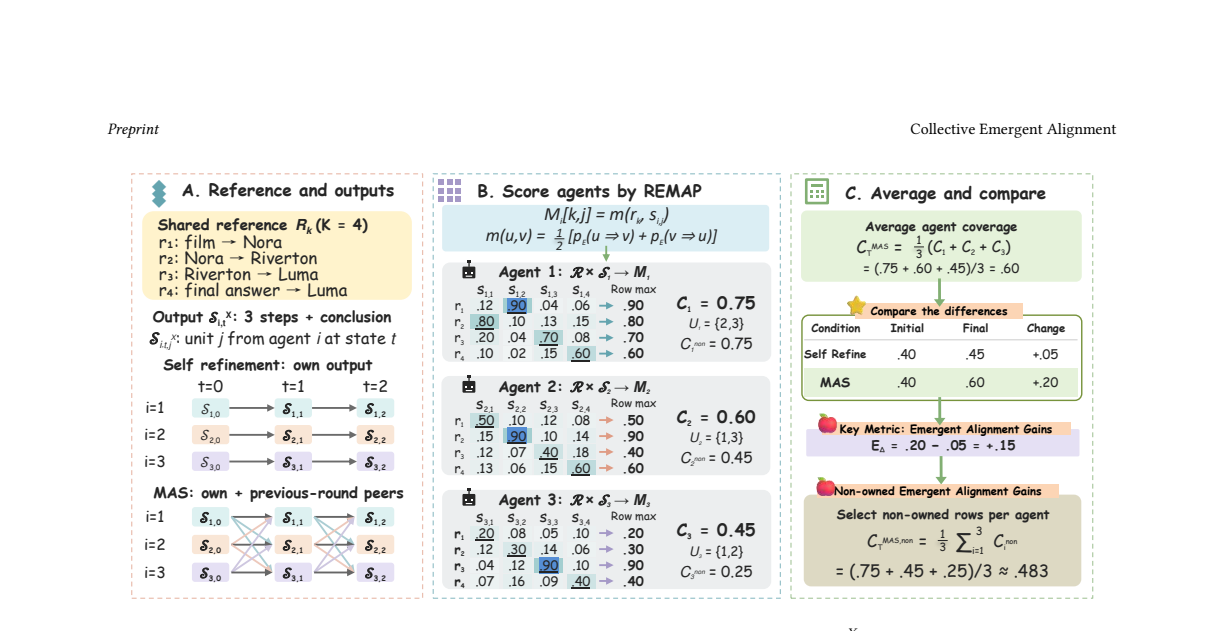
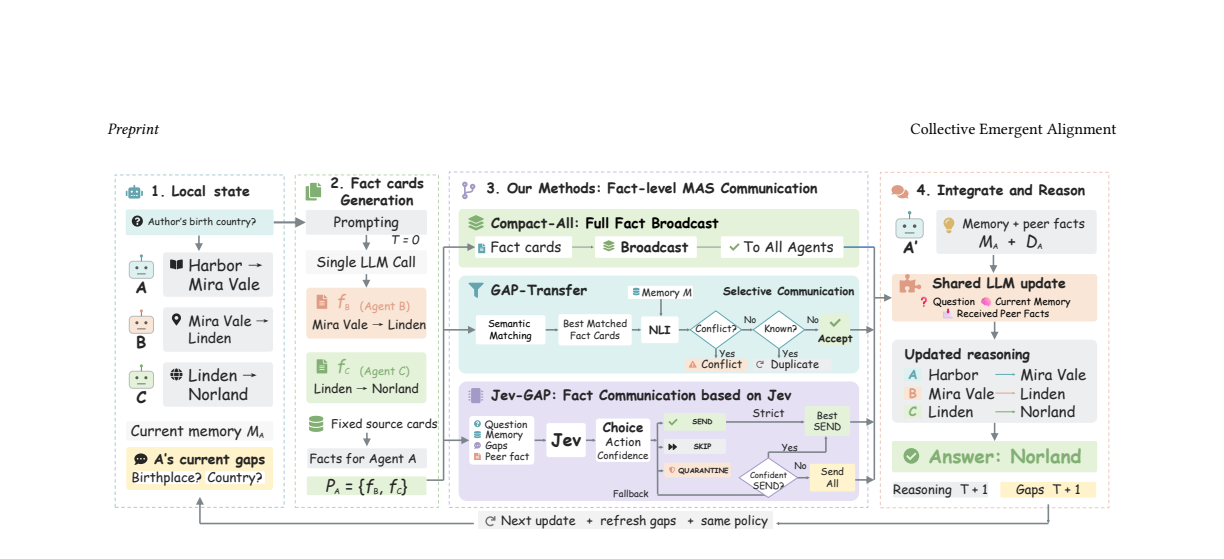
We study whether agent interaction produces additional reference-grounded reasoning alignment beyond matched individual self-refinement, and introduce REMAP (Reference-Entailment-Matrix for Agentic Process), a framework that quantifies this effect through Semantic Coverage and interaction-specific alignment gains. Across diverse model families and two multi-hop reasoning benchmarks, we observe broadly positive interaction gains, particularly on reasoning content that depends on integrating evidence distributed across agents. These gains are consistently associated with independently measured peer-information recovery, while further analysis reveals composition-dependent heterogeneity effects and asymmetric information transfer across agent capability levels. Motivated by these findings, we further introduce a fact-level multi-agent communication framework that replaces full reasoning-trace exchange with compact, gap-aware, and selectively routed information. Our experiments show that compact fact exchange improves reasoning alignment and task performance while reducing communication overhead, whereas more selective communication exposes a trade-off between acquiring distributed information, retaining local content, and communication efficiency. Overall, our results show that collective emergent alignment can be quantified, linked to information-transfer patterns, and used to guide more effective multi-agent communication.
from the abstract
Pith says
Machine review · deepseek-v4-flash · 27 Oct 2026 · what was read was not recorded · not checked by a person
It can be wrong. Challenge this review or reply to it.
Holds up, with conditions. Solid measurement framework for interaction-specific reasoning alignment; the central result holds up despite a few confounds in the exploratory analyses. This line is wrong
3 major objections · 7 minor
How often objections from reviews like this one are right: not yet measured
Not checked: figures, code, what the 47 references say.
The paper says, at §4.2.2, Table 2
The review did not quote this passage.
Pith says: Objection 1 of 3 · major
The saturated 2Wiki F1 for Terra and DeepSeek (100% MAS, 0% self-refinement) produces zero-variance F1 measures. While the paper correctly attributes this to floor-ceiling saturation under the complementary-evidence protocol, the E_Δ values for these models are among the largest reported.
more of objection 1
The manuscript should add an explicit statement that E_Δ in these saturated cases reflects pure acquisition from peers (since self-refinement gain is negative or zero) and that Semantic Coverage remains meaningful because it tracks intermediate reasoning content, not just the final answer. The current text (b173–b175) is clear but could be expanded to preempt confusion about the coexistence of large E_Δ and saturated F1.
The paper says, at Appendix L, §4.3.2–§4.3.3
The review did not quote this passage.
A classifier read this sentence of the paper as acknowledging the concern (probability 0.89):
“We report these composition and directional results as exploratory.”
Pith says: Objection 2 of 3 · major
The source-trace audit (b210–b212) reveals context mismatches on 69 MuSiQue and 29 2Wiki questions, and a serving-backend change for Mistral mixtures. The paper flags the heterogeneity and directional analyses as exploratory and notes that sensitivity testing on a clean common subset is pending.
more of objection 2
Given that these analyses support claims about composition effects and asymmetric information transfer (RQ2), the paper should either (a) complete the clean-subset analysis before publication, or (b) state more prominently in the main text (not only in Appendix L) that the compositional and directional estimates are preliminary and subject to these confounds. Currently Tables 4 and 5 present these results alongside a brief caveat, but the exploratory status should be reinforced in §4.3.
The paper says, at §3.2 (Eq. 1) and Appendix A.3
The review did not quote this passage.
Pith says: Objection 3 of 3 · major
The REMAP score relies on a single NLI model (roberta-large-mnli). The sensitivity bound (Eq. 8) is derived, but there is no empirical validation that the main conclusions (positive E_Δ, correlations with gold recovery) are robust to the choice of NLI model.
more of objection 3
The paper would be strengthened by a small ablation using one or two alternative NLI models on a subset of questions. This is not a fatal flaw but would increase confidence that the reported patterns are not artifacts of a specific NLI model.
7 minor objections
The paper says, at §3.2 (Eq. 1–3)
Pith says: minor objection 1 of 7
The indices k, i, t, j are defined inline, but a single consolidated notation table or forward reference to Appendix A.1 would improve readability for the first-time reader.
The paper says, at Table 2
Pith says: minor objection 2 of 7
The normalized bar lengths are visually useful, but the scales differ between MuSiQue and 2Wiki. Consider adding the absolute numerical values in brackets or a note explaining the normalization baseline.
show 5 more
The paper says, at §4.3.2 (Table 4)
Pith says: minor objection 3 of 7
The tier assignments (W1 = Mistral Small 3.2, etc.) are based on frozen MuSiQue self-refinement F1. This should be stated explicitly in the main text, not only in Appendix L.
The paper says, at Appendix B.2
Pith says: minor objection 4 of 7
The sentence 'The initial zero-answer result was therefore retained as a pipeline diagnostic, outside the scientific generalization results' is ambiguous. Please clarify what the diagnostic showed and why it does not affect the reported results.
The paper says, at Throughout
Pith says: minor objection 5 of 7
'self refinement' is used as a noun phrase; consider hyphenating to 'self-refinement' for consistency with standard usage, although this is a minor style issue.
The paper says, at Appendix M, §5
Pith says: minor objection 6 of 7
The code and data are described as pending release (Appendix M). This statement should appear in the main conclusion or acknowledgements to inform readers about reproducibility expectations.
The paper says, at Table 6 caption
Pith says: minor objection 7 of 7
The Δ rows subtract Full-MAS from the named method, but some readers may misinterpret the direction. Consider adding an explicit formula or sign convention in the caption.
What would settle it
Recompute Table 2 cross-model EΔ using a different NLI backbone (e.g., microsoft/deberta-v3-base-mnli) and compare the sign and ordering of gains. If all positive EΔ values remain positive and the pattern of larger gains on 2Wiki holds, the central claim is further validated against NLI model sensitivity.
from the skeptic's reading
How the review went
4 readings by deepseek-v4-flash · 27 Oct 2026
- Reader holds up, with conditions
- Skeptic disagrees
- Editor wrote the verdict above
- Referee minor revision: 3 major objections, 7 minor
Not run on this paper: the simulated authors' defence.
Pith did not check this review's objections against the paper.
The review in full
The review in brief, machine-written
The paper introduces REMAP, which is a sensible and well-motivated framework for quantifying whether multi-agent interaction produces reference-grounded reasoning alignment beyond what matched self-refinement alone gives. The core idea—matched trajectory comparison with an NLI-based semantic coverage matrix and ownership decomposition—is genuinely new in the MAS evaluation literature. The empirical work is broad: seven model families, two benchmarks, three seeds, bootstrap intervals, multiple validation checks including independent gold-recovery. The authors are transparent about their limitations: the 2Wiki floor-ceiling saturation is analyzed and attributed to controlled evidence integration, the compositional heterogeneity and directional analyses are flagged as exploratory with known confounds, and the free parameter theta is stated. That kind of honesty is rare and should be credited.
The central claim that interaction yields positive alignment gains on non-owned content is robustly supported. The convergent evidence from the lexical gold-recovery check makes the NLI-based result less fragile. The fact-level communication architecture is a nice application of the measurement insights, though the Jev-GAP results are only a modest improvement over simple compact broadcast.
Soft spots: (1) The compositional heterogeneity and directional results are genuinely exploratory—the serving-backend change in Mistral mixtures and context mismatches in reused traces are real confounds, and the authors rightly say sensitivity analysis is pending. (2) Code and raw data are not released, so exact reproduction is impossible. That is a significant practical limitation for a claim about a new measurement framework. (3) The gold-recovery lexical matcher is acknowledged to undercount paraphrases, and the fallback threshold adds a minor free parameter. These do not undermine the main result but do temper the confidence in fine-grained quantitative comparisons.
Overall: This is a serious, well-executed paper that advances the evaluation of multi-agent LLM reasoning. It deserves a thorough peer review. I would probably cite the REMAP framework in my own work on MAS evaluation, and I would bring it to a reading group focused on LLM agents or evaluation methodology.
The strongest objection
After careful reading, the central claim that multi-agent interaction produces additional reference-grounded reasoning alignment beyond matched self-refinement is well supported. The evidence includes positive EΔ across seven model families on two benchmarks, consistent associations with independently measured gold recovery, and controlled experiments in the communication architecture study. The paper transparently acknowledges key limitations: reference units are deterministic and may miss alternative reasoning paths (Appendix B), the gold-recovery lexical matcher may undercount paraphrases (Appendix D), the heterogeneity and directional analyses are exploratory with known confounds (Appendix L), and code/data are not yet released. None of these undermines the primary finding that interaction yields positive alignment gains on non-owned content; in fact, the convergent evidence from the alternative lexical match makes the core result robust. The reader's verdict of CONDITIONAL is appropriate given the pending code release and sensitivity analyses, but no single additional concern emerges that would warrant rejection or a major revision of the central argument.
The reader's weakest assumption focused on reference completeness, which is a valid concern but is partially mitigated by the independent gold-recovery diagnostic (which shares gold targets but uses a different matching method) and by the paper's own acknowledgments. The central claim itself does not hinge on perfect reference completeness because the interaction contrast EΔ compares two conditions using the same reference, so systematic undercoverage cancels out as long as it does not differentially affect MAS and self-refinement. Given the breadth of convergent evidence (positive gains across models, correlation with gold recovery, controlled experiments), I do not find a single load-bearing concern that threatens the main conclusion. The paper's limitations, while real, are openly stated and do not invalidate the primary finding. Therefore the stress-test yields no significant objection, and the reader's CONDITIONAL verdict is appropriate and unchanged.
The referee's report
This work fills a clear gap: existing metrics evaluate individual reasoning traces or final answer quality, but no method isolates the contribution of interaction to reference-grounded reasoning alignment. REMAP's matched-trajectory contrast is conceptually clean and the ownership decomposition provides actionable diagnostics for communication design. The experimental design is robust—matched trajectories, three seeds, bootstrap intervals, multiple model families, alternative scorers—and the main finding (positive interaction-specific alignment gains) holds across diverse models and tasks. The fact-level communication experiments demonstrate practical utility, connecting measurement to design. The paper is unusually transparent about limitations (deterministic reference units, lexical matcher undercounting, exploratory status of heterogeneity analyses, pending code release). If the central claims hold, the framework provides a principled basis for evaluating and steering emergent reasoning in multi-agent LLM systems.
Pith's reading of the paper (a machine's summary, not the authors')
The paper introduces REMAP, a framework that measures whether multi-agent interaction produces additional reference-grounded reasoning alignment beyond what the same agents achieve through individual self-refinement. REMAP constructs a bidirectional NLI matrix between reference reasoning units and each agent's emitted steps, producing a semantic coverage score, then computes the interaction contrast: the MAS coverage change minus the self-refinement coverage change. Across seven model families and two multi-hop reasoning benchmarks, the framework finds broadly positive interaction gains, especially on reasoning content that depends on evidence distributed across agents. These gains correlate with independently measured peer-information recovery, and the analysis reveals composition-dependent heterogeneity and asymmetric information transfer across capability levels. Guided by these findings, the authors design compact fact-level communication policies that improve reasoning alignment and task accuracy while reducing communication overhead, showing that collective emergent alignment can be quantified and used to design more effective multi-agent systems.
What carries the argument. The REMAP (Reference-Entailment-Matrix for Agentic Process) framework, which scores each agent's reasoning by computing a bidirectional NLI entailment matrix between fixed reference units (constructed from annotated sub-answers or evidence triples) and the agent's generated reasoning steps and conclusion. The score is the average over reference rows of the best match per row. The interaction contrast $E_\Delta = G_{\text{MAS}} - G_{\text{SELF}}$ isolates the contribution of communication by subtracting the matched self-refinement coverage change from the MAS coverage change. The non-owned variant $E^{\text{non}}_\Delta$ computes this contrast only on reference rows that correspond to evidence not initially held by the agent.
Core claim. The paper establishes that multi-agent interaction yields additional reference-grounded reasoning alignment beyond matched individual self-refinement, and that this collective emergent alignment can be quantified through the REMAP interaction contrast $E_\Delta = G_{\text{MAS}} - G_{\text{SELF}}$, where each $G_X$ is the initial-to-final change in average semantic coverage. An ownership-aware variant $E^{\text{non}}_\Delta$ isolates changes on peer-supported reference units, distinguishing between acquisition of distributed information and retention of local content. The framework is validated across seven model families on MuSiQue and corrected 2Wiki, with positive interaction gains observed consistently on non-owned content, and a strong association between these gains and deterministic gold-item recovery. Furthermore, the paper shows that these quantitative insights can guide the design of fact-level communication protocols: compact broadcast of initial peer facts improves alignment and task performance while delivering substantially fewer tokens, whereas selective routing exposes a trade-off between information acquisition, local retention, and communication efficiency.
The premise it rests on. The reference reasoning units are constructed deterministically from annotated sub-answers or evidence triples and are assumed to be a complete and faithful representation of the reasoning that agents should align with; if these references miss plausible alternative reasoning paths or contain ambiguities, the REMAP score may penalize equally valid reasoning.
If the paper is right (Pith's inferences, not the authors')
REMAP provides a quantitative method for diagnosing whether multi-agent interaction genuinely improves the reasoning expressed by each agent, beyond what could be achieved by individual iteration alone.
The ownership-aware decomposition separates peer-information acquisition from local-content retention, enabling targeted analysis of communication effectiveness.
The demonstrated correlation between non-owned coverage gains and independent gold-item recovery suggests REMAP can serve as a proxy for information transfer in settings without explicit gold annotations.
Compact fact-level communication (broadcasting initial peer facts) consistently improves alignment and answer accuracy while reducing token usage, providing a practical design principle for multi-agent LLM systems.
The composition-dependent heterogeneity and asymmetric information transfer (stronger agents disproportionately benefit weaker ones) can inform the design of heterogeneous agent teams and routing policies.
If REMAP generalizes beyond factual multi-hop QA to open-ended reasoning or creative tasks, the concept of a fixed reference would need replacement by a more flexible notion of ground-truth reasoning content, possibly derived from expert human traces or consensus across models.
The finding that compact fact exchange outperforms full reasoning-trace exchange suggests that many benefits of multi-agent debate may come from surfacing missing facts rather than from dialectical refinement of reasoning steps; this could be tested by ablating the reasoning content in peer messages.
The Jev-based selective routing shows that a lightweight semantic controller can approach the alignment gains of full broadcast with minimal tokens, but at the cost of reduced local retention on some tasks; hybrid policies that adaptively switch between broadcast and selection based on gap confidence may yield better trade-offs.
Check this review
Pith stored no record of this review's passes and took no fingerprint of it. Reviews made by code from 13 Nov 2026 on carry both.
How often reviews like this one are right
Reviews like this one: written by deepseek-v4-flash, where what was read was not recorded.
How often objections from reviews like this one are right: not yet measured
Reviews by people
This review was written by a machine. No person has reviewed this paper on Pith yet. A scientist listed on Pith can review it for a fee, and their review is published here whatever it concludes.
The paper
Abstract
Multi-agent large language model (LLM) systems can exhibit emergent behaviors through interaction, yet whether a similar phenomenon exists for reasoning alignment remains largely unexplored. We study whether agent interaction produces additional reference-grounded reasoning alignment beyond matched individual self-refinement, and introduce REMAP (Reference-Entailment-Matrix for Agentic Process), a framework that quantifies this effect through Semantic Coverage and interaction-specific alignment gains. Across diverse model families and two multi-hop reasoning benchmarks, we observe broadly positive interaction gains, particularly on reasoning content that depends on integrating evidence distributed across agents. These gains are consistently associated with independently measured peer-information recovery, while further analysis reveals composition-dependent heterogeneity effects and asymmetric information transfer across agent capability levels. Motivated by these findings, we further introduce a fact-level multi-agent communication framework that replaces full reasoning-trace exchange with compact, gap-aware, and selectively routed information. Our experiments show that compact fact exchange improves reasoning alignment and task performance while reducing communication overhead, whereas more selective communication exposes a trade-off between acquiring distributed information, retaining local content, and communication efficiency. Overall, our results show that collective emergent alignment can be quantified, linked to information-transfer patterns, and used to guide more effective multi-agent communication.
The paper's own sentences, arranged, kept beside the review and separate from it. Each label is drawn from a closed vocabulary; the number beside it is the probability the classifier gave that label. No sentence in this record was written by a model.
abstract compiled · 2026-10-27
The authors' main claim, as the classifier picked it out 1.00
“Overall, our results show that collective emergent alignment can be quantified, linked to information-transfer patterns, and used to guide more effective multi-agent communication.”
How the main claim is stated: asserted 1.00
What the abstract itself states, as probabilities: claims first 0.12 · states limitation 0.70 · human participants 0.03 · controlled comparison 0.89 · randomized assignment 0.02 · states quantitative result 0.09 · compares with prior results 0.84 · mentions code or data availability 0.03
The abstract, sentence by sentence
This table labels the abstract only (arXiv listing abstract v1). The number is the probability the classifier gave the label.
| Sentence | Role | The authors' own work | States the main conclusion | Strength |
|---|---|---|---|---|
| Multi-agent large language model (LLM) systems can exhibit emergent behaviors through interaction, yet whether a similar phenomenon exists for reasoning alignment remains largely unexplored. | gap 0.89 | 0.06 | 0.03 | asserted 0.66 |
| We study whether agent interaction produces additional reference-grounded reasoning alignment beyond matched individual self-refinement, and introduce REMAP (Reference-Entailment-Matrix for Agentic Process), a framework that quantifies this effect through Semantic Coverage and interaction-specific alignment gains. | contribution 1.00 | 0.94 | 0.12 | asserted 0.61 |
| Across diverse model families and two multi-hop reasoning benchmarks, we observe broadly positive interaction gains, particularly on reasoning content that depends on integrating evidence distributed across agents. | result 1.00 | 0.96 | 0.23 | asserted 0.99 |
| These gains are consistently associated with independently measured peer-information recovery, while further analysis reveals composition-dependent heterogeneity effects and asymmetric information transfer across agent capability levels. | result 0.94 | 0.95 | 0.10 | asserted 0.99 |
| Motivated by these findings, we further introduce a fact-level multi-agent communication framework that replaces full reasoning-trace exchange with compact, gap-aware, and selectively routed information. | contribution 0.67 | 0.79 | 0.05 | asserted 0.92 |
| Our experiments show that compact fact exchange improves reasoning alignment and task performance while reducing communication overhead, whereas more selective communication exposes a trade-off between acquiring distributed information, retaining local content, and communication efficiency. | result 0.99 | 0.97 | 0.14 | asserted 1.00 |
| Overall, our results show that collective emergent alignment can be quantified, linked to information-transfer patterns, and used to guide more effective multi-agent communication. | interpretation 0.88 | 0.95 | 0.89 | asserted 1.00 |
What kind of paper the classifier reports this is: method or tool 0.57 · evidence from observation or experiment 0.99
What was examined, and what was not
Sources read
- arXiv listing abstract v1
Not examined
- full text
- figures and tables
- references and citing sentences
- relations to other papers
Levels run
- P abstract
Not run
- S sections
- T body sentences
- C citations
- R cross-paper relations
How the labels were made
Compiled by classifier-1.13.0 via TypeSafe API, question bank abstract-p1-20260923, 2026-10-27: 1 request, 5,734 input tokens.
Every quoted sentence on this record is the authors'. Every label is from Pith's closed vocabulary, with the probability shown beside it. This record as JSON
Figures (3)

Figures are the authors', reproduced from the paper.
References (47)
- [1] Aharon Azulay, Jan Dubiński, Zhuoyun Li, et al . 2026. Jailbreaking Vision- Language Models Through the Visual Modality. InProc. ICML. https:// openreview.net/forum?id=4VuMV9beC1 on Pith
- [2] Mert Cemri, Melissa Z Pan, Shuyi Yang, et al. 2025. Why Do Multi-Agent LLM Systems Fail?. InAdvances in Neural Information Processing Systems, Vol. 38, Main Conference. Curran Associates, Inc. doi:10.52202/085713-4082 on Pithdoi:10.52202/085713-4082
- [3] Weize Chen, Yusheng Su, Jingwei Zuo, et al . 2024. AgentVerse: Facilitating Multi-Agent Collaboration and Exploring Emergent Behaviors. InThe Twelfth International Conference on Learning Representations. https://openreview.net/ forum?id=EHg5GDnyq1 on Pith
- [4] Tobias Deußer, Lorenz Sparrenberg, and Rafet Sifa. 2026. Evaluating and Benchmarking the System One Model Jev. arXiv:2609.37647 [cs.CL] https: //arxiv.org/abs/2609.37647 on PithPith's reviewarXiv
- [5] Yilun Du, Shuang Li, Antonio Torralba, et al . 2024. Improving factuality and reasoning in language models through multiagent debate. InProceedings of the 41st International Conference on Machine Learning(Vienna, Austria)(ICML’24). JMLR.org, Article 467, 31 pages on Pith
- [6] Yang Feng, Ziwei Xu, Xia Hu, et al . 2026. PEAR: Permutation-Equivariant Adaptive Routing Multi-Agent Debate. arXiv:2606.20621 [cs.AI] https://arxiv. org/abs/2606.20621 on PithPith's reviewarXiv
- [7] Olga Golovneva, Moya Peng Chen, Spencer Poff, et al. 2023. ROSCOE: A Suite of Metrics for Scoring Step-by-Step Reasoning. InThe Eleventh International Confer- ence on Learning Representations. https://openreview.net/forum?id=xYlJRpzZtsY on Pith
- [8] Xanh Ho, Anh-Khoa Duong Nguyen, Saku Sugawara, et al. 2020. Constructing A Multi-hop QA Dataset for Comprehensive Evaluation of Reasoning Steps. In Proceedings of the 28th International Conference on Computational Linguistics. In- ternational Committee on Computational Linguis... on Pithdoi:10.18653/v1/2020.coling-main.580
- [9] Sirui Hong, Mingchen Zhuge, Jiaqi Chen, et al. 2024. MetaGPT: Meta Program- ming for A Multi-Agent Collaborative Framework. arXiv:2308.00352 [cs.AI] https://arxiv.org/abs/2308.00352 on PithPith's reviewarXiv
- [10] Jinwei Hu, Yi Dong, Shuang Ao, et al . 2025. Position: Towards a Responsible LLM-empowered Multi-Agent Systems. arXiv:2502.01714 https://arxiv.org/abs/ 2502.01714 on PithPith's reviewarXiv
- [11] Alon Jacovi, Yonatan Bitton, Bernd Bohnet, et al. 2024. A Chain-of-Thought Is as Strong as Its Weakest Link: A Benchmark for Verifiers of Reasoning Chains. InProceedings of the 62nd Annual Meeting of the Association for Computational Linguistics (Volume 1: Long Papers). Associ... on Pithdoi:10.18653/v1/2024.acl-long.254
- [12] Dongming Jiang, Yi Li, and Bingzhe Li. 2026. Jev-Mem: System-One-Controlled Agentic Memory for Efficient AI Agents. arXiv:2609.23986 [cs.AI] https://arxiv. org/abs/2609.23986 on PithPith's reviewarXiv
- [13] junyou li, Qin Zhang, Yangbin Yu, et al . 2024. More Agents Is All You Need. Transactions on Machine Learning Research(2024). https://openreview.net/ forum?id=bgzUSZ8aeg on Pith
- [14] Guneet Singh Kohli, Yuxiang Zhou, Michael Sejr Schlichtkrull, et al . 2026. Reference-Free Evaluation of Reasoning in Open-Ended Question Answering. arXiv:2607.19678 [cs.CL] https://arxiv.org/abs/2607.19678 on PithPith's reviewarXiv
- [15] Guohao Li, Hasan Hammoud, Hani Itani, et al. 2023. CAMEL: Communicative Agents for "Mind" Exploration of Large Language Model Society. InAdvances in Neural Information Processing Systems, Vol. 36. Curran Associates, Inc., 51991– 52008. doi:10.52202/075280-2264 on Pithdoi:10.52202/075280-2264
- [16] Yunxuan Li, Yibing Du, Jiageng Zhang, et al. 2024. Improving Multi-Agent Debate with Sparse Communication Topology. InFindings of the Association for Com- putational Linguistics: EMNLP 2024. Association for Computational Linguistics, Miami, Florida, USA, 7281–7294. doi:10.1865... on Pithdoi:10.18653/v1/2024.findings-emnlp.427
- [17] Zhuoyun Li, Boxuan Wang, Jinwei Hu, et al . 2026. FragileFlow: Spectral Control of Correct-but-Fragile Predictions for Foundation Model Robustness. arXiv:2605.08896 https://arxiv.org/abs/2605.08896 on PithPith's reviewarXiv
- [18] Zhuoyun Li, Boxuan Wang, Jinwei Hu, et al. 2026. Where Do Prompt Perturba- tions Break Generation? A Segment-Level View of Robustness in LoRA-Tuned Language Models. arXiv:2605.01605 https://arxiv.org/abs/2605.01605 on PithPith's reviewarXiv
- [19] Zhuoyun Li, Boxuan Wang, Xiaowei Huang, et al . 2026. Same evidence, dif- ferent judgments: Evidence noncommutative in vision/speech-text conflicts. arXiv:2609.26986 https://arxiv.org/abs/2609.26986 on PithPith's reviewarXiv
- [20] Zhuoyun Li, Boxuan Wang, Changshun Wu, et al . 2026. SCOPE: Sequential Conformal Probing for Reliable OOD Rejection in LLM Services. arXiv:2606.21255 https://arxiv.org/abs/2606.21255 on PithPith's reviewarXiv
show 27 more
- [21] Tian Liang, Zhiwei He, Wenxiang Jiao, et al . 2024. Encouraging Divergent Thinking in Large Language Models through Multi-Agent Debate. InProceedings of the 2024 Conference on Empirical Methods in Natural Language Processing. Association for Computational Linguistics, Miami, F... on Pithdoi:10.18653/v1/2024.emnlp-main.992
- [22] Aman Madaan, Niket Tandon, Prakhar Gupta, et al. 2023. SELF-REFINE: iterative refinement with self-feedback. InProceedings of the 37th International Conference on Neural Information Processing Systems(New Orleans, LA, USA)(NIPS ’23). Curran Associates Inc., Red Hook, NY, USA, ... on Pith
- [23] Joon Sung Park, Joseph O’Brien, Carrie Jun Cai, et al. 2023. Generative Agents: Interactive Simulacra of Human Behavior. InProceedings of the 36th Annual ACM Symposium on User Interface Software and Technology(San Francisco, CA, USA) (UIST ’23). Association for Computing Machi... on Pithdoi:10.1145/3586183.3606763
- [24] Archiki Prasad, Swarnadeep Saha, Xiang Zhou, et al. 2023. ReCEval: Evaluating Reasoning Chains via Correctness and Informativeness. InProceedings of the 2023 Conference on Empirical Methods in Natural Language Processing. Association for Computational Linguistics, Singapore, 1... on Pithdoi:10.18653/v1/2023.emnlp-
- [25] Chen Qian, Wei Liu, Hongzhang Liu, et al . 2024. ChatDev: Communicative Agents for Software Development. InProceedings of the 62nd Annual Meeting of the Association for Computational Linguistics (Volume 1: Long Papers). Association for Computational Linguistics, Bangkok, Thail... on Pith
- [26] Noah Shinn, Federico Cassano, Edward Berman, et al. 2023. Reflexion: Language Agents with Verbal Reinforcement Learning. arXiv:2303.11366 [cs.AI] https: //arxiv.org/abs/2303.11366 on PithPith's reviewarXiv
- [27] Andries Smit, Nathan Grinsztajn, Paul Duckworth, et al . 2024. Should we be going MAD? a look at multi-agent debate strategies for LLMs. InProceedings of the 41st International Conference on Machine Learning(Vienna, Austria)(ICML’24). JMLR.org, Article 1866, 23 pages on Pith
- [28] Harsh Trivedi, Niranjan Balasubramanian, Tushar Khot, et al. 2022. MuSiQue: Multihop Questions via Single-hop Question Composition.Transactions of the Association for Computational Linguistics10 (2022), 539–554. doi:10.1162/tacl_a_ 00475 on Pithdoi:10.1162/tacl_a_
- [29] Miles Turpin, Julian Michael, Ethan Perez, et al. 2023. Language models don’t always say what they think: unfaithful explanations in chain-of-thought prompt- ing. InProceedings of the 37th International Conference on Neural Information Processing Systems(New Orleans, LA, USA)(... on Pith
- [30] TypeSafe AI. 2026. Confidence. TypeSafe AI Documentation. Accessed: 2026-10- on Pith
- [31] https://docs.typesafe.ai/confidence on Pith
- [32] TypeSafe AI. 2026. Introduction. TypeSafe AI Documentation. Accessed: 2026- 10-07. https://docs.typesafe.ai/introduction on Pith
- [33] Boxuan Wang, Zhuoyun Li, Xiaowei Huang, et al . 2025. Rethinking Multi- Agent Intelligence Through the Lens of Small-World Networks. arXiv:2512.18094 https://arxiv.org/abs/2512.18094 on PitharXiv
- [34] Boxuan Wang, Zhuoyun Li, Xinmiao Huang, et al. 2026. Chain-of-Thought as a Lens: Evaluating Structured Reasoning Alignment between Human Preferences and Large Language Models. InProceedings of the 64th Annual Meeting of the Association for Computational Linguistics (Volume 1: ... on Pithdoi:10.18653/v1/2026.acl-long.1834
- [35] Boxuan Wang, Zhuoyun Li, Xiaowei Huang, et al. 2026. Dive into Ambiguity: A*-Inspired Multi-Agents Commonsense Obfuscation Attack on LLM Prompts. arXiv:2606.01441 https://arxiv.org/abs/2606.01441 on PithPith's reviewarXiv
- [36] Boxuan Wang, Zhuoyun Li, Xiaowei Huang, et al. 2026. Do We Need Complex Topology Control? Distinct-Peer Random Routing Improves Cost-Efficiency in Sparse Multi-Agent Debate. arXiv:2609.27150 https://arxiv.org/abs/2609.27150 on PithPith's reviewarXiv
- [37] Xuezhi Wang, Jason Wei, Dale Schuurmans, et al. 2023. Self-Consistency Im- proves Chain of Thought Reasoning in Language Models. InThe Eleventh Inter- national Conference on Learning Representations. https://openreview.net/forum? 9 Preprint Collective Emergent Alignment id=1PL1NIMMrw on Pith
- [38] Xiaoyang Wang and Christopher C. Yang. 2026. The Consistency Illusion: How Multi-Agent Debate Hides Reasoning Misalignment. arXiv:2606.08457 [cs.MA] https://arxiv.org/abs/2606.08457 on PithPith's reviewarXiv
- [39] Zhexuan Wang, Yutong Wang, Xuebo Liu, et al. 2025. AgentDropout: Dynamic Agent Elimination for Token-Efficient and High-Performance LLM-Based Multi- Agent Collaboration. InProceedings of the 63rd Annual Meeting of the Association for Computational Linguistics (Volume 1: Long P... on Pithdoi:10.18653/v1/2025.acl-
- [40] Adina Williams, Nikita Nangia, and Samuel R. Bowman. 2018. A Broad-Coverage Challenge Corpus for Sentence Understanding through Inference. InProceedings of the 2018 Conference of the North American Chapter of the Association for Computational Linguistics: Human Language Techno... on PithPith's reviewdoi:10.18653/v1/n18-1101
- [41] Qingyun Wu, Gagan Bansal, Jieyu Zhang, et al. 2023. AutoGen: Enabling Next- Gen LLM Applications via Multi-Agent Conversation. arXiv:2308.08155 [cs.AI] https://arxiv.org/abs/2308.08155 on PithPith's reviewarXiv
- [42] Shijie Xia, Xuefeng Li, Yixin Liu, et al. 2025. Evaluating mathematical reasoning beyond accuracy. InProceedings of the Thirty-Ninth AAAI Conference on Arti- ficial Intelligence and Thirty-Seventh Conference on Innovative Applications of Artificial Intelligence and Fifteenth S... on Pithdoi:10.1609/aaai.v39i26.34987
- [43] Guibin Zhang, Yanwei Yue, Zhixun Li, et al. 2025. Cut the Crap: An Economical Communication Pipeline for LLM-based Multi-Agent Systems. InThe Thirteenth International Conference on Learning Representations. https://openreview.net/ forum?id=LkzuPorQ5L on Pith
- [44] Shaokun Zhang, Ming Yin, Jieyu Zhang, et al . 2025. Which Agent Causes Task Failures and When? On Automated Failure Attribution of LLM Multi- Agent Systems. InForty-second International Conference on Machine Learning. https://openreview.net/forum?id=GazlTYxZss on Pith
- [45] Chenyang Zhu, Spencer Hong, Jingyu Wu, et al. 2026. RAFFLES: Reasoning-based Attribution of Faults for LLM Systems. InProceedings of the 19th Conference of the European Chapter of the Association for Computational Linguistics (Volume 1: Long Papers). Association for Computatio... on Pithdoi:10.18653/v1/2026.eacl-long.359
- [46] Kunlun Zhu, Hongyi Du, Zhaochen Hong, et al. 2025. MultiAgentBench : Evalu- ating the Collaboration and Competition of LLM agents. InProceedings of the 63rd Annual Meeting of the Association for Computational Linguistics (Volume 1: Long Papers). Association for Computational L... on Pithdoi:10.18653/v1/2025.acl-long.421
- [47] Liu Zhuang, Lin Wayne, Shi Ya, et al. 2021. A Robustly Optimized BERT Pre- training Approach with Post-training. InProceedings of the 20th Chinese National Conference on Computational Linguistics. Chinese Information Processing Society of China, Huhhot, China, 1218–1227. https... on Pith
Challenges and discussion
Disagree with the review, or know something it missed? Leave a comment, or challenge this review formally: a challenge becomes a permanent entry in this paper's record, and its decision is published here.
Come back by email
A short list of the week's newly reviewed papers. Nothing is sent until you confirm from your inbox, and every email has a link that stops it. No account.
No comments yet.
Sign in to comment