Artificial Intelligence · arXiv:2610.35193 v1 · submitted 26 Oct 2026 · 13 references
Trustworthy Recursive Self-Improvement in the Era of Large Models: Foundation, Risks, Evaluation and Open Challenges
The paper says
“AI systems built around large models increasingly use experience and feedback to make persistent changes to models, prompts, memories, tools, and workflows.”
more of the abstract
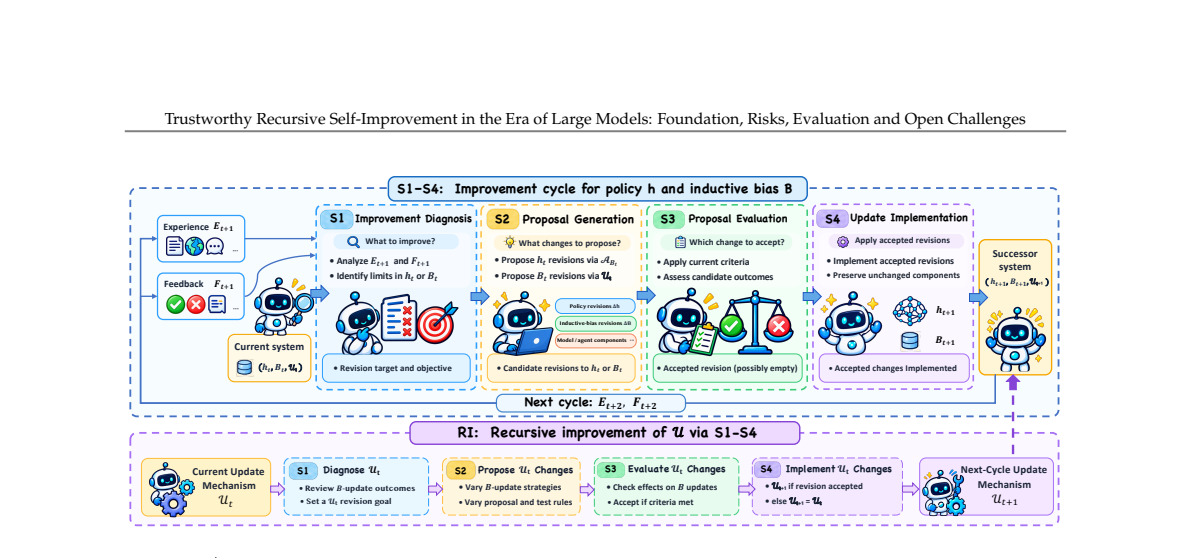
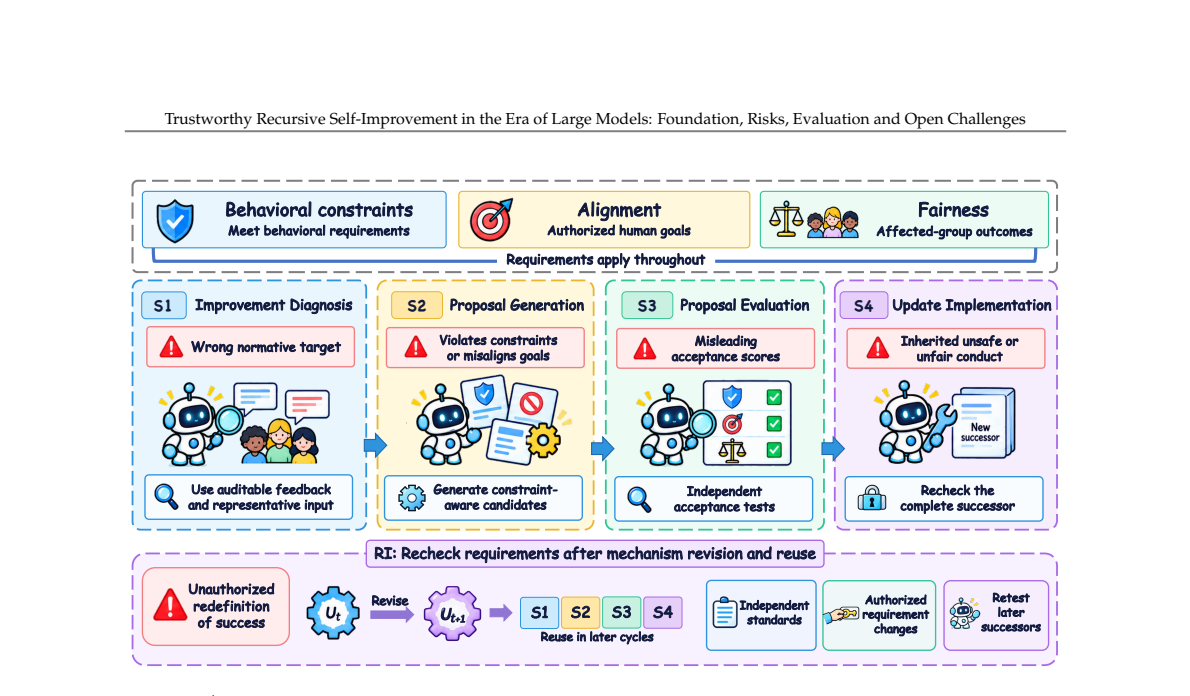
Recursive self-improvement (RSI) extends this process to inductive biases and to the mechanisms that govern future updates, which can themselves be revised and reused across improvement cycles. Yet self-modification alone does not guarantee trustworthy improvement. Reported gains may reflect flawed evaluations, previously acquired capabilities may deteriorate, and compliance with behavioral constraints may weaken. Compromised artifacts or sensitive information may also persist in successor systems. Changes to improvement mechanisms may invalidate earlier verification results and make human oversight less effective. This survey presents an operational definition and process framework for RSI and organizes the requirements for trustworthy RSI into four interconnected themes: genuine and sustained improvement; behavioral constraints, alignment, and fairness; system security and privacy; and transparency and controllability. We examine these themes from three perspectives: Improvement Validity, Constraint Preservation, and Effective Oversight. This analysis covers improvement diagnosis, proposal generation, proposal evaluation, and update implementation (S1–S4), including the recursive application of these stages to improvement mechanisms (RI). We review risks, safeguards, and evaluation evidence for individual updates, effects inherited by successor systems, and revisions to improvement mechanisms, while distinguishing direct RSI findings from evidence in related systems. Finally, we examine evaluation settings, identify requirements for independent and longitudinal assessment, and discuss applications and open research problems.
from the abstract
Pith says
Machine review · deepseek-v4-flash · 27 Oct 2026 · what was read was not recorded · not checked by a person
It can be wrong. Challenge this review or reply to it.
Holds up. A well-organized survey that gives the RSI community a much-needed common vocabulary and framework, even if most of the empirical evidence it draws on comes from non-recursive settings. This line is wrong
5 minor
How often objections from reviews like this one are right: not yet measured
Not checked: figures, code, what the 13 references say.
5 minor objections
The paper says, at §1.2 / §7.1
Pith says: minor objection 1 of 5
The evidence coverage matrix (Figure 8) is informative but its coding criteria would benefit from a brief in-text summary rather than relying solely on Appendix A.4. Consider adding a short legend or example row to make the study-level coding transparent to the reader at a glance.
The paper says, at §2.1.2
Pith says: minor objection 2 of 5
The three coding-agent variants illustrating S1–S4/RI are helpful. Consider adding a sentence explicitly mapping the fixed components (e.g., task objective, external criteria, budget) to the formal notation (h_t, B_t, U_t) to reinforce the functional distinction.
show 3 more
The paper says, at §3.4.2 / Table 4
Pith says: minor objection 3 of 5
Table 4 lists horizons and resource evidence but uses study-specific units (self-edits, rounds, cycles). A footnote clarifying that these are not directly comparable and are meant to illustrate typical evidence lengths rather than to support cross-study ranking would reduce potential misinterpretation.
The paper says, at §7.2 / Figure 9
Pith says: minor objection 4 of 5
The three-level comparison design diagram is clear. The text could briefly note that the paired-continuation design for meta-improvement comparisons is inspired by the fixed-meta ablation in Hyperagents (Zhang et al., 2026g) and encouraged in the open problems (§8.3.2). A cross-reference would tie the evaluation design back to an existing implementation.
The paper says, at General
Pith says: minor objection 5 of 5
The survey is thorough and well-cited. A glossary or abbreviation table (e.g., S1–S4, RI, h, B, U, Ft, Et) would help readers unfamiliar with the notation, especially given the length of the manuscript.
What would settle it
Apply the proposed framework to a documented RSI system (e.g., Hyperagents, Zhang et al., 2026g) by constructing an evidence map covering all four themes (improvement validity, behavioral constraints, security/privacy, transparency/controllability) at the update, successor, and meta-improvement levels. If a theme or claim level cannot be assessed with existing published results, that gap supports the survey's call for more joint evidence. The test verifies that the framework is operational and identifies concrete missing evidence.
from the skeptic's reading
How the review went
4 readings by deepseek-v4-flash · 27 Oct 2026
- Reader holds up
- Skeptic agrees
- Editor wrote the verdict above
- Referee accept: 5 minor
Not run on this paper: the simulated authors' defence.
Pith did not check this review's objections against the paper.
The review in full
The review in brief, machine-written
This paper is worth reading if you work on self-improving systems. It provides an operational definition of RSI (Eqs. 2-3) and a process framework (S1–S4 plus RI) that cleanly separates what changes from how the change mechanism itself evolves. The real contribution is the joint-evidence framework across three claim levels (update, successor, meta-improvement) and four trustworthiness themes. That structure clarifies what evidence is still missing and why endpoint-only capability gains are not enough.
The authors are honest about the central limitation: almost all reviewed risks and safeguards come from non-recursive settings. They flag this repeatedly (§1.2, §7.1, §8.1.2) and call for direct evidence. I appreciate that they distinguish direct RSI findings from evidence in related systems rather than conflating them.
What the paper does well: the taxonomy is coherent, the coverage of recent literature is broad, and the evaluation design in §7 (paired continuations, matched budgets, joint assessment) is a concrete proposal that future work can adopt. The versioned evidence map (Figure 8) usefully shows where the field has evidence and where it does not.
Soft spots: the framework itself is the main contribution, but it is a taxonomy, not a proof or an experiment. The weakest assumption—that failure modes from non-recursive settings carry over to fully recursive systems—is acknowledged but not formally justified. The paper is also long, and some sections read more like annotated bibliographies than synthesis. That is forgivable in a survey, but a tighter summary of what is actually known about RSI versus what is hypothesized would help.
My take: this is a valuable reference and a roadmap. It deserves a serious referee and will be cited. I would bring it to a reading group and would cite the framework for defining and evaluating trustworthy RSI. The authors have done the field a service by organizing the landscape and making the gaps explicit.
The strongest objection
The paper is a survey that presents a framework for assessing trustworthy recursive self-improvement. It does not make novel empirical claims, and its central argument—that trustworthy RSI requires joint evidence across four themes and three claim levels—is logically coherent and well-supported by the reviewed literature. The authors explicitly acknowledge the principal limitation identified by the Reader: that most findings come from non-recursive systems and may not fully transfer to recursive settings (see §1.2, §7.1, and §8.1.2). They also repeatedly flag gaps in direct RSI evidence (e.g., §3.4.2, §4.4.2). There is no internal inconsistency, missing logical step, or unstated assumption that undermines the framework. The survey provides a valuable organizing lens for future work; its limitations are stated, not hidden.
The Reader identifies the transfer assumption as the weakest point, and the paper acknowledges this gap explicitly. The survey does not rely on this assumption as a premise for its framework; rather, it uses evidence from related systems illustratively and calls for direct RSI studies. The central claim is about required assessment dimensions, not about empirical results. Thus, the Reader's concern does not weaken the paper's contribution. The stress test finds no additional load-bearing concern. The verdict remains ACCEPT (UNCHANGED).
The referee's report
The survey provides a much-needed unifying framework for evaluating trustworthiness in recursive self-improving AI systems, a topic that is both timely and under-explored. By systematically mapping risks, safeguards, and evidence gaps to a structured process model (S1–S4/RI) and three claim levels, it clarifies what evidence is required and where existing evaluations fall short. The clear separation of update-level, successor-level, and meta-improvement claims, together with the proposed paired-continuation comparison designs, offers actionable guidance for future empirical work. The paper will serve as a valuable reference for researchers and practitioners working on safe and reliable self-improving systems.
Pith's reading of the paper (a machine's summary, not the authors')
This survey argues that recursive self-improvement (RSI) — where an AI system can revise the very mechanism that governs its future updates — introduces trustworthiness challenges that cannot be addressed by checking single updates in isolation. The authors propose an operational framework that decomposes RSI into a four-stage cycle (diagnosis, proposal, evaluation, implementation) with a recursive loop that revises the update function itself. They then organize trustworthiness requirements into four themes under three analytical roles: Improvement Validity (whether gains are real and persistent), Constraint Preservation (whether behavioral, security, and fairness requirements hold across versions), and Effective Oversight (whether changes remain transparent, auditable, and correctable). The central message is that trustworthy RSI demands joint evidence — capability gains, constraint satisfaction, and intervention effectiveness must be measured on the same evolving system trajectory. The survey finds that existing studies mostly report capability gains at the update level, while joint evidence for constraint preservation and effective oversight across successors and mechanism revisions remains sparse, outlining a concrete agenda for future evaluation.
What carries the argument. The formal definition of recursive self-improvement: a learning system with state $(h_t, B_t, U_t)$ where $h_t$ is the learned policy, $B_t$ the inductive bias, and $U_t$ the bias update function. RSI updates $h_{t+1} = A_{B_t}(h_t, E_{t+1})$ and $(B_{t+1}, U_{t+1}) = U_t(B_t, h_{t+1}, F_{t+1})$, where $U_t$ can itself be revised and reused. This definition provides the central object that carries the argument: it separates what changes (policy, bias, update mechanism) and specifies the feedback loops that must be evaluated for trustworthiness.
Core claim. The paper claims that evaluating recursive self-improvement requires three distinct levels of trustworthiness claims: update-level (is a single accepted change beneficial and safe?), successor-level (do those properties persist when the change is inherited and reused?), and meta-improvement level (does revising the update mechanism produce better subsequent updates?). It introduces a process framework (S1–S4/RI) that locates where failures can occur — biased diagnosis, shortcut search, misleading acceptance scores, ineffective implementation, and risks from revising the improvement procedure itself. The authors map these stages to four trustworthiness themes (genuine improvement, behavioral constraints, security/privacy, transparency/controllability) and three analytical roles (Improvement Validity, Constraint Preservation, Effective Oversight). The core claim is that trustworthy RSI requires aligning evidence across all three roles at every claim level, and that current evaluations predominantly cover Improvement Validity at the update level, leaving a significant gap in joint longitudinal evidence.
The premise it rests on. The survey's framework assumes that findings about risks, safeguards, and evaluation methods from systems that make persistent updates but do not revise their improvement mechanism can be transferred to fully recursive settings where the update function itself changes.
If the paper is right (Pith's inferences, not the authors')
Future RSI evaluations must report joint trajectories: capability gains, constraint violations, and intervention outcomes on the same sequence of system versions.
Claims that a revised update mechanism improves performance require controlled comparisons with the unchanged mechanism starting from the same inherited state and matched resource budgets.
Constraint preservation must be reassessed after each update and after each revision to the update mechanism, because failure modes can compositionally carry over or interact.
Effective oversight demands independent verification channels that cannot be modified by the improved system; otherwise, reported gains may reflect shifted evaluation criteria rather than genuine improvement.
Longitudinal benchmarks should separate development feedback from protected reporting tests and track retention of previously acquired capabilities across successor systems.
The framework suggests that a single deployed RSI system should maintain a versioned "trustworthiness case" that documents, for each revision, the evidence for improvement, constraint preservation, and oversight effectiveness, with gaps explicitly marked.
Because the weakest assumption is that failure modes transfer from non-recursive settings, a critical test would be to deliberately inject a subtle behavioral constraint violation in an early update and observe whether later recursive revisions remove, preserve, or amplify it under the framework's evaluation protocol.
The three-level claim structure implies that existing RLHF or safety fine-tuning studies, which only assess single-update effects, cannot guarantee safety under recursive self-improvement unless the update mechanism itself is frozen or independently verified at each revision.
Check this review
Pith stored no record of this review's passes and took no fingerprint of it. Reviews made by code from 13 Nov 2026 on carry both.
How often reviews like this one are right
Reviews like this one: written by deepseek-v4-flash, where what was read was not recorded.
How often objections from reviews like this one are right: not yet measured
Reviews by people
This review was written by a machine. No person has reviewed this paper on Pith yet. A scientist listed on Pith can review it for a fee, and their review is published here whatever it concludes.
The paper
Abstract
AI systems built around large models increasingly use experience and feedback to make persistent changes to models, prompts, memories, tools, and workflows. Recursive self-improvement (RSI) extends this process to inductive biases and to the mechanisms that govern future updates, which can themselves be revised and reused across improvement cycles. Yet self-modification alone does not guarantee trustworthy improvement. Reported gains may reflect flawed evaluations, previously acquired capabilities may deteriorate, and compliance with behavioral constraints may weaken. Compromised artifacts or sensitive information may also persist in successor systems. Changes to improvement mechanisms may invalidate earlier verification results and make human oversight less effective. This survey presents an operational definition and process framework for RSI and organizes the requirements for trustworthy RSI into four interconnected themes: genuine and sustained improvement; behavioral constraints, alignment, and fairness; system security and privacy; and transparency and controllability. We examine these themes from three perspectives: Improvement Validity, Constraint Preservation, and Effective Oversight. This analysis covers improvement diagnosis, proposal generation, proposal evaluation, and update implementation (S1–S4), including the recursive application of these stages to improvement mechanisms (RI). We review risks, safeguards, and evaluation evidence for individual updates, effects inherited by successor systems, and revisions to improvement mechanisms, while distinguishing direct RSI findings from evidence in related systems. Finally, we examine evaluation settings, identify requirements for independent and longitudinal assessment, and discuss applications and open research problems.
The paper's own sentences, arranged, kept beside the review and separate from it. Each label is drawn from a closed vocabulary; the number beside it is the probability the classifier gave that label. No sentence in this record was written by a model.
abstract compiled · 2026-10-27
The authors' main claim, as the classifier picked it out 0.88
“Yet self-modification alone does not guarantee trustworthy improvement.”
How the main claim is stated: asserted 1.00
What the abstract itself states, as probabilities: claims first 0.04 · states limitation 0.32 · human participants 0.08 · controlled comparison 0.04 · randomized assignment 0.01 · states quantitative result 0.03 · compares with prior results 0.09 · mentions code or data availability 0.02
The abstract, sentence by sentence
This table labels the abstract only (arXiv listing abstract v1). The number is the probability the classifier gave the label.
| Sentence | Role | The authors' own work | States the main conclusion | Strength |
|---|---|---|---|---|
| AI systems built around large models increasingly use experience and feedback to make persistent changes to models, prompts, memories, tools, and workflows. | background 1.00 | 0.07 | 0.03 | asserted 0.99 |
| Recursive self-improvement (RSI) extends this process to inductive biases and to the mechanisms that govern future updates, which can themselves be revised and reused across improvement cycles. | background 1.00 | 0.07 | 0.05 | asserted 1.00 |
| Yet self-modification alone does not guarantee trustworthy improvement. | background 0.72 | 0.12 | 0.23 | asserted 1.00 |
| Reported gains may reflect flawed evaluations, previously acquired capabilities may deteriorate, and compliance with behavioral constraints may weaken. | background 0.92 | 0.09 | 0.10 | hedged possibility 0.98 |
| Compromised artifacts or sensitive information may also persist in successor systems. | background 0.95 | 0.06 | 0.04 | hedged possibility 0.99 |
| Changes to improvement mechanisms may invalidate earlier verification results and make human oversight less effective. | background 0.95 | 0.09 | 0.07 | hedged possibility 0.75 |
| This survey presents an operational definition and process framework for RSI and organizes the requirements for trustworthy RSI into four interconnected themes: genuine and sustained improvement; behavioral constraints, alignment, and fairness; system security and privacy; and transparency and controllability. | contribution 1.00 | 0.89 | 0.18 | asserted 0.98 |
| We examine these themes from three perspectives: Improvement Validity, Constraint Preservation, and Effective Oversight. | method 0.52 | 0.76 | 0.06 | asserted 0.93 |
| This analysis covers improvement diagnosis, proposal generation, proposal evaluation, and update implementation (S1--S4), including the recursive application of these stages to improvement mechanisms (RI). | method 0.58 | 0.75 | 0.05 | asserted 0.98 |
| We review risks, safeguards, and evaluation evidence for individual updates, effects inherited by successor systems, and revisions to improvement mechanisms, while distinguishing direct RSI findings from evidence in related systems. | contribution 0.83 | 0.61 | 0.08 | asserted 0.91 |
| Finally, we examine evaluation settings, identify requirements for independent and longitudinal assessment, and discuss applications and open research problems. | future work 0.70 | 0.79 | 0.08 | asserted 0.76 |
What kind of paper the classifier reports this is: review 1.00 · evidence from literature 0.99
What was examined, and what was not
Sources read
- arXiv listing abstract v1
Not examined
- full text
- figures and tables
- references and citing sentences
- relations to other papers
Levels run
- P abstract
Not run
- S sections
- T body sentences
- C citations
- R cross-paper relations
How the labels were made
Compiled by classifier-1.13.0 via TypeSafe API, question bank abstract-p1-20260923, 2026-10-27: 1 request, 8,153 input tokens.
Every quoted sentence on this record is the authors'. Every label is from Pith's closed vocabulary, with the probability shown beside it. This record as JSON
Figures (10)





Figures are the authors', reproduced from the paper.
References (13)
- [3] doi: 10.52202/085713-1213. URL https://proceedings.neurips.cc/paper_files/paper/ 2025/hash/3380e8116452e0efbf36f35d95e88c94-Abstract-Conference.html. X. Fu, A. Kulanthaivelu, and Y. Yamada. Self Improvement via Fast Tree-search, 2026. URL https://arxiv.org/abs/2609.19526. Prep... on PithPith's reviewarXiv
- [5] doi: 10.52202/085713-2064. URL https://proceedings.neurips.cc/paper_files/paper/ 2025/hash/590a0cc0306c1c63e2d66a51a407718f-Abstract-Conference.html. Y. Kim, W. Seo, M. Kim, S. Oh, M. Lee, D. Kim, H. I. Koo, J. Kim, and W. Kang. Elicitation or expansion? demystifying gains fro... on PithPith's reviewarXiv
- [6] URLhttps://arxiv.org/abs/2606.21090. Preprint. J. Lin, S. Liu, C. Pan, L. Lin, S. Dou, Z. Xi, X. Huang, H. Yan, Z. Han, T. Gui, and Y.-G. Jiang. Agentic Harness Engineering: Observability-Driven Automatic Evolution of Coding-Agent Harnesses, 2026b. URLhttps://arxiv.org/abs/260... on PithPith's reviewarXiv
- [7] URLhttps://arxiv.org/abs/2604.09747. A. Makelov, G. Lange, A. Geiger, and N. Nanda. Is This the Subspace You Are Looking for? An In- terpretability Illusion for Subspace Activation Patching. InInternational Conference on Learning Rep- resentations, volume 2024, pages 26486–265... on PithPith's reviewarXiv
- [9] URLhttps://arxiv.org/abs/2606.28374. Preprint. Y. Nian, A. Yuan, H. Zhang, J. Li, L. Li, X. Hu, H. Wei, X. Xiao, C. Xiao, and Y. Zhao. Auditable Agents, 2026. URLhttps://arxiv.org/abs/2604.05485. 67 Trustworthy Recursive Self-Improvement in the Era of Large Models: Foundation,... on PithPith's reviewarXiv
- [11] URLhttps://arxiv.org/abs/2610.08902. J. Skalse, N. H. R. Howe, D. Krasheninnikov, and D. Krueger. Defining and Characterizing Reward Hacking, 2022. URLhttps://arxiv.org/abs/2209.13085. Preprint. N. Soares, B. Fallenstein, E. Yudkowsky, and S. Armstrong. Corrigibility. InWorksh... on PithPith's reviewarXiv
- [2018] URLhttps://mitpress.mit.edu/9780262039246/reinforcement-learning/. R. Tamirisa, B. Bharathi, L. Phan, A. Zhou, A. Gatti, T. Suresh, M. Lin, J. Wang, R. Wang, R. Arel, A. Zou, D. Song, B. Li, D. Hendrycks, and M. Mazeika. Tamper-Resistant Safeguards for Open-Weight LLMs. InInte... on PithPith's reviewarXiv
- [2021] URLhttps://arxiv.org/abs/1908.04734. B. Fallenstein and N. Soares. Vingean reflection: Reliable reasoning for self-improving agents. Technical report, Machine Intelligence Research Institute, 2015. URL https://intelligence.org/ files/VingeanReflection.pdf. Z. Fan, W. Jin, F. Z... on PithPith's reviewarXiv
- [2023] URLhttps://doi.org/10.6028/NIST.AI.100-1. M. Nguyen, Q. Nguyen, and P . Vuong. Recursive Self-Evolving Agents via Held-Out Selection, on Pithdoi:10.6028/nist.ai.100-1
- [2024] URLhttps://arxiv.org/abs/2412.17646. Preprint. 71 Trustworthy Recursive Self-Improvement in the Era of Large Models: Foundation, Risks, Evaluation and Open Challenges R. S. Sutton and A. G. Barto.Reinforcement Learning: An Introduction. The MIT Press, 2nd edition, on PithPith's reviewarXiv
- [2025] doi: 10.52202/085713-1554. URL https://proceedings.neurips.cc/paper_files/paper/ 2025/hash/42a97bbd9844d2bf68596730af80bcdf-Abstract-Conference.html. j. drori, L. Marks, B. Woodworth, A. Cloud, and A. Turner. Output Supervision Can Obfuscate the Chain of Thought. InInternation... on PithPith's reviewarXiv
- [2026] URLhttps://proceedings.mlr.press/v306/hudson26a.html. A. Iacob, A. Jovanovi´ c, W. F. Shen, D. Burkhardt, M. Kurmanji, N. Tastan, L. Sani, N. A. E. Venanzi, J. Nie, A. Odonnat, Z. Cao, B. Marino, X. Qiu, R. Antonova, and N. D. Lane. The red queen gödel machine: Co-evolving age... on PithPith's reviewarXiv
- [5309] Preprint. E. F. Schumacher.Small Is Beautiful: Economics as if People Mattered. Blond & Briggs, London, 1973. B. Sengupta. Self-Evolving Agents with Anytime-Valid Certificates, 2026. URL https://arxiv.org/ abs/2607.00871. Preprint. W. Seo, S. Han, J. Jung, B. Newman, S. Lim, S... on PithPith's reviewarXiv
Cited by 2 Pith papers
Reviewed papers on Pith that cite this one. The full citation record
- A Cross-Scenario Survey and Analysis of Self-Evolving Multimodal Agents cs.AI · Nov 2026
- A Survey on RLOps for Large Language Models cs.SE · Nov 2026
Challenges and discussion
Disagree with the review, or know something it missed? Leave a comment, or challenge this review formally: a challenge becomes a permanent entry in this paper's record, and its decision is published here.
Come back by email
A short list of the week's newly reviewed papers. Nothing is sent until you confirm from your inbox, and every email has a link that stops it. No account.
No comments yet.
Sign in to comment