Software Engineering · arXiv:2611.23357 v1 · submitted 17 Nov 2026 · 244 references
A Survey on RLOps for Large Language Models
The paper says
“Reinforcement learning (RL) has become increasingly important for improving the reasoning, instruction-following, and task-solving capabilities of large language models (LLMs).”
more of the abstract
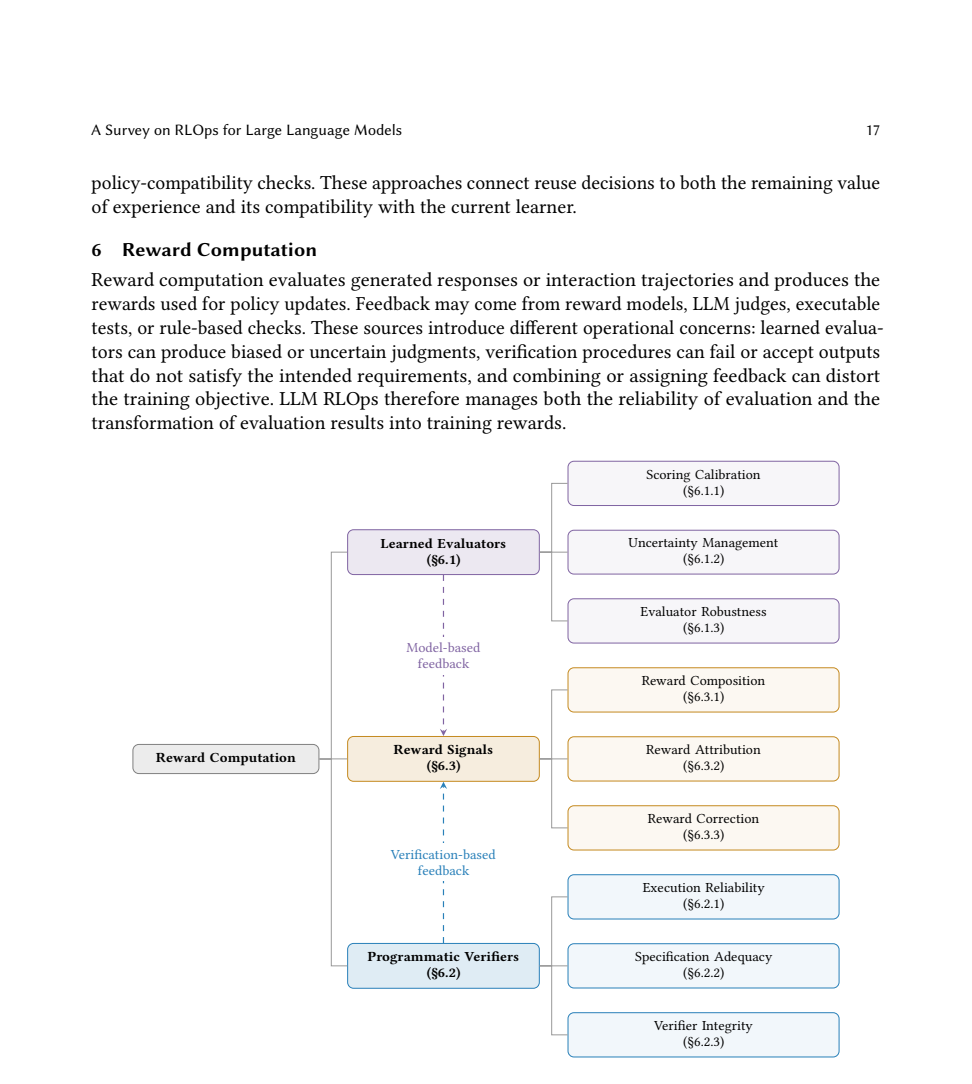
However, scaling RL training exposes failures in distributed execution, feedback computation, and learning dynamics that can waste computational resources, slow training, and undermine model improvements. These challenges have motivated a growing body of techniques for LLM RLOps, which manages the efficiency and reliability of operations throughout the LLM reinforcement learning training lifecycle. Despite growing interest, these techniques remain scattered across research areas, with limited synthesis of their operational roles and interactions. To bridge this gap, we present a systematic survey of LLM RLOps methods. We organize existing approaches into five stages: Training Setup, Experience Collection, Reward Computation, Policy Optimization, and Model Evaluation. Within each stage, we examine operational concerns, management techniques, and evaluation evidence. Building on this taxonomy, we identify open challenges and future directions in training process observability, cross-stage coordination, generalizable RLOps, multi-run management, and RLOps for recursive self-improvement. These directions extend operational management from individual training runs to diverse training settings, shared infrastructure, and successive improvement cycles. We maintain a GitHub repository indexing relevant papers and open resources at https://github.com/zhanglingzhe0820/Awesome-RLOps.
from the abstract
Pith says
Machine review · deepseek-v4-flash · 19 Nov 2026 · read the full text (196,741 characters) · not checked by a person
It can be wrong. Challenge this review or reply to it.
Holds up. A systematic survey that organizes the scattered literature on operational management of RL for LLMs into a five-stage taxonomy, with 301 reviewed papers and a clear-eyed discussion of open challenges. This line is wrong
4 minor
How often objections from reviews like this one are right: not yet measured
The paper, first character to last
The reviewer was given the whole text, 196,741 characters. Not checked: figures, code, what the 244 references say.
4 minor objections
The paper says, at 3.1 Search Strategy
Pith says: minor objection 1 of 4
The survey does not report the dates of the search rounds ('Records are collected through multiple search rounds'), so readers cannot determine the corpus vintage or the recency cutoff of the literature reviewed. Adding the month(s) of the last search would clarify the coverage period.
The paper says, at 1.3 Why a Survey for LLM RLOps?
Pith says: minor objection 2 of 4
The publication-trend claims, most prominently that LLM RLOps publications 'have increased substantially since 2025,' are supported only by figures (Figure 1) that I could not view in the supplied text. Since these claims frame the survey's motivation, the underlying counts (for example, per-quarter publication numbers) should be reported in the text or in a table so readers can inspect the trend rather than only the rendered plot.
show 2 more
The paper says, at 3.3 Overview of Selected Publications
Pith says: minor objection 3 of 4
The relationship between the 301-study corpus and the 234 entries in the bibliography is not stated. Readers cannot tell how many of the 301 selected studies are actually cited and discussed in the review versus indexed only in the companion GitHub repository. A sentence stating how many corpus papers appear in the reference list, and how many are cited in each taxonomy section, would help readers gauge coverage depth per topic.
The paper says, at 2.2 Taxonomy
Pith says: minor objection 4 of 4
Table 1's entries are attributed to a judgment that a framework 'provides a concrete management mechanism,' but the operationalization of that judgment (what counts as a mechanism, and how backend-integrated mechanisms were identified) is not documented beyond the prose in Section 2.2. Because several entries (for example, AgentRL's empty Training Setup and Reward Computation cells) are checkable claims about specific systems, a short note on how the coverage judgment was made would strengthen the table's reliability.
What would settle it
A subsequent systematic review using a different search strategy or screening method (e.g., without LLM-based initial filtering) that identifies a substantial body of relevant LLM RLOps techniques that do not fit into the proposed five-stage, 18-topic taxonomy would falsify the claim that the taxonomy provides a comprehensive and structured basis for comparing existing techniques.
from Pith's summary of the paper
How the review went
5 passes by deepseek-v4-flash · 19 Nov 2026
- Reader holds up
- Skeptic concern withdrawn: Pith's reviewer misread the paper
- Referee 4 minor
- Check against the paper kept 0 of 4 objections
- Editor wrote the verdict above
Not run on this paper: the simulated authors' defence.
Pith's passes raised 4 objections. A check against the paper's text kept 0 and withdrew 4 (4 Pith's reviewer misread the paper).
The review in full
The review in brief, machine-written
This paper does what a good survey should: it identifies a growing but fragmented area—operational management of reinforcement learning runs for LLM post-training—and gives it a coherent structure. The five-stage taxonomy (Training Setup, Experience Collection, Reward Computation, Policy Optimization, Model Evaluation) is sensible and well-motivated. The authors review 301 papers, describe their search methodology in reasonable detail, and connect the taxonomy to concrete mechanisms in existing training frameworks via a coverage table. The discussion of open challenges is thoughtful and grounded in the reviewed literature rather than speculative.
The soft spots are mostly about the survey methodology. The initial title/abstract screening relied on an LLM, which could introduce systematic bias; the authors acknowledge this but do not evaluate its impact. The search strategy uses four sources and a specific query string, but the paper lacks a PRISMA diagram and does not report inter-reviewer agreement. The exclusion criteria are necessarily subjective, and the reader should be aware that the corpus composition depends on those judgments. These are common limitations in survey work, and the authors are transparent about their process.
The paper does not present new experimental results, so there is no risk of overclaiming. Its value is in synthesis and framing. Researchers new to LLM RLOps will find a useful entry point; practitioners will appreciate the structured comparison of framework capabilities. The paper deserves a serious referee and, after addressing the methodological transparency concerns, publication.
The stress test's concern
Withdrawn: Pith's reviewer misread the paper.
The paper says
“We initially use an LLM to screen titles and abstracts against the selection criteria. These preliminary decisions guide subsequent reviewer assessment rather than determine final inclusion.”
The referee's report
Not published. Pith's referee wrote this assessment before its objections were checked against the paper, and 3 of its 3 major objections did not survive that check.
Pith's reading of the paper (a machine's summary, not the authors')
The paper argues that the operational management of reinforcement learning (RL) runs for LLM post-training—which it calls LLM RLOps—is a coherent and important research area that has not been systematically synthesized. The authors organize the growing but scattered literature into five stages (Training Setup, Experience Collection, Reward Computation, Policy Optimization, Model Evaluation) and 18 operational topics, providing a structured basis for comparing techniques and identifying open challenges. If the taxonomy is adopted, it could help practitioners coordinate interventions across stages, reduce wasted computation, and make training more reliable and reproducible. The survey covers 301 papers and includes a comparison of how 14 popular RL training frameworks support the identified operational topics.
What carries the argument. The central object is the taxonomy itself: a five-stage, 18-topic classification of LLM RLOps methods. The stages are Training Setup, Experience Collection, Reward Computation, Policy Optimization, and Model Evaluation. The taxonomy is built from a systematic literature review of 301 papers and is used to compare 14 representative RL training frameworks. The taxonomy does the work of bringing together previously scattered techniques under a common vocabulary and identifying which operational concerns are well-supported and which remain open.
Core claim. The paper's central claim is that LLM RLOps—defined as the operational management of reinforcement learning runs for LLM post-training—can be systematically organized into five stages (Training Setup, Experience Collection, Reward Computation, Policy Optimization, Model Evaluation) and 18 operational topics, and that this taxonomy provides a structured basis for comparing existing techniques and identifying open challenges. The authors assert that 'despite growing interest, these techniques remain scattered across research areas, with limited synthesis of their operational roles and interactions' and that the survey 'bridges this gap' (abstract). The strongest specific claim is that the reviewed frameworks 'commonly support rollout execution, distributed policy updates, policy consistency, and training-state recovery' while 'support for resource planning and evaluation-based version selection is established in a smaller subset' (Section 2.2).
The premise it rests on. The 301 papers selected through the described search and screening process are representative and sufficient to support the taxonomy and conclusions, despite the use of an LLM for initial title and abstract screening which could introduce systematic bias.
If the paper is right (Pith's inferences, not the authors')
Practitioners can use the taxonomy to audit their own RL training pipelines for missing operational capabilities, such as policy consistency checks or trajectory freshness control.
Researchers can situate new techniques within the taxonomy, making it easier to identify which stage or topic a contribution addresses and how it relates to existing work.
The comparison of 14 frameworks reveals that rollout execution, distributed policy updates, policy consistency, and training-state recovery are commonly supported, while resource planning and evaluation-based version selection are less established, pointing to areas where framework development is needed.
The five open challenges identified—training process observability, cross-stage coordination, generalizable RLOps, multi-run management, and RLOps for recursive self-improvement—provide a research agenda for the field.
The taxonomy could serve as a checklist for evaluating the operational maturity of LLM RL training systems, analogous to how MLOps maturity models are used for supervised learning pipelines.
The finding that 'support for resource planning and evaluation-based version selection is established in a smaller subset' of frameworks suggests that these are bottlenecks for scaling RL training reliably, and tooling in these areas could have outsized impact.
The paper's emphasis on cross-stage coordination implies that future RL training frameworks may need to expose explicit interfaces for operational controls (e.g., a 'staleness budget' that rollout scheduling must respect) rather than treating each stage independently.
The discussion of RLOps for recursive self-improvement connects to broader concerns about AI safety: if models help design their own training procedures, the operational controls described here become part of the safety infrastructure.
Check this review
What was read
The passes were given all 196,741 characters of the paper's LaTeX source.
Fingerprint of that text (SHA-256): 8f0edd891e1773c99413f13d99532f06c39536bb7784800c4138caba990bd799
Pith does not keep that text. Rebuilt from the paper's source or PDF by the same code, it has this fingerprint if it is the same text. From a copy of Pith's code:
PYTHONPATH=. python scripts/review_input_check.py 2611.23357
The passes, in the order they ran
- Reader deepseek-v4-flash · medium effort · $0.0056 · instructions of the Reader, fingerprint f9ead7300382…
- Skeptic deepseek-v4-flash · medium effort · $0.0049 · instructions of the Skeptic, fingerprint 8f88c0f61488…
- Referee deepseek-v4-flash · medium effort · $0.0099 · instructions of the Referee, fingerprint a852d99aea0d…
- Check against the paper deepseek-v4-flash · medium effort · $0.0053 · instructions of the Check against the paper, fingerprint 6c7a6883d551…
- Editor deepseek-v4-flash · medium effort · $0.0059 · instructions of the Editor, fingerprint e7211f6a3d27…
- Circularity check deepseek-v4-flash · medium effort · $0.0047 · instructions of the Circularity check, fingerprint e9946e39d67b…
- Summary for the page deepseek-v4-flash · medium effort · temperature 0.2 · $0.0050 · instructions of the Summary for the page, fingerprint e4f56bf568e7…
The passes cost $0.041 in model calls together.
Version stamped on this review: pith-pipeline@v1.4.1-daily-deepseek-or-medium+deepseek/deepseek-v4-flash+p.d60f54226f00
Each link opens a pass's instructions as plain text, the exact bytes its fingerprint was taken over. Every stored set of instructions.
curl -s https://pith.science/methodology/prompts/f9ead730038216984cfb56d7cb34332bdf691828296a1de4245f3d6667d4bf56 | sha256sum
prints the fingerprint of the reader's instructions. The same works for every pass.
The receipt
The review's fingerprint was taken on 19 Nov 2026. The review you are reading still matches it.
Fingerprint of the review (SHA-256): 6cc2424245df111639cfb5eb40ba8f3c14e265a5afd86280966938ed644d3be6
curl -s 'https://pith.science/api/v1/verdicts/2611.23357?form=canonical' | sha256sum
prints the fingerprint of the review as it stands now. The rule, in four steps.
A matching fingerprint shows the review has not changed since that date. It does not show that the review is right.
How often reviews like this one are right
Reviews like this one: written by deepseek-v4-flash, from the paper's LaTeX source.
How often objections from reviews like this one are right: not yet measured
Reviews by people
This review was written by a machine. No person has reviewed this paper on Pith yet. A scientist listed on Pith can review it for a fee, and their review is published here whatever it concludes.
The paper
Abstract
Reinforcement learning (RL) has become increasingly important for improving the reasoning, instruction-following, and task-solving capabilities of large language models (LLMs). However, scaling RL training exposes failures in distributed execution, feedback computation, and learning dynamics that can waste computational resources, slow training, and undermine model improvements. These challenges have motivated a growing body of techniques for LLM RLOps, which manages the efficiency and reliability of operations throughout the LLM reinforcement learning training lifecycle. Despite growing interest, these techniques remain scattered across research areas, with limited synthesis of their operational roles and interactions. To bridge this gap, we present a systematic survey of LLM RLOps methods. We organize existing approaches into five stages: Training Setup, Experience Collection, Reward Computation, Policy Optimization, and Model Evaluation. Within each stage, we examine operational concerns, management techniques, and evaluation evidence. Building on this taxonomy, we identify open challenges and future directions in training process observability, cross-stage coordination, generalizable RLOps, multi-run management, and RLOps for recursive self-improvement. These directions extend operational management from individual training runs to diverse training settings, shared infrastructure, and successive improvement cycles. We maintain a GitHub repository indexing relevant papers and open resources at https://github.com/zhanglingzhe0820/Awesome-RLOps.
The paper's own sentences, arranged, kept beside the review and separate from it. Each label is drawn from a closed vocabulary; the number beside it is the probability the classifier gave that label. No sentence in this record was written by a model.
abstract compiled · 2026-11-19
The authors' main claim, as the classifier picked it out 0.76
“Building on this taxonomy, we identify open challenges and future directions in training process observability, cross-stage coordination, generalizable RLOps, multi-run management, and RLOps for recursive self-improvement.”
How the main claim is stated: asserted 1.00
What the abstract itself states, as probabilities: claims first 0.07 · states limitation 0.11 · human participants 0.04 · controlled comparison 0.03 · randomized assignment 0.01 · states quantitative result 0.07 · compares with prior results 0.06 · mentions code or data availability 0.78
The abstract, sentence by sentence
This table labels the abstract only (arXiv listing abstract v1). The number is the probability the classifier gave the label.
| Sentence | Role | The authors' own work | States the main conclusion | Strength |
|---|---|---|---|---|
| Reinforcement learning (RL) has become increasingly important for improving the reasoning, instruction-following, and task-solving capabilities of large language models (LLMs). | background 1.00 | 0.05 | 0.03 | asserted 1.00 |
| However, scaling RL training exposes failures in distributed execution, feedback computation, and learning dynamics that can waste computational resources, slow training, and undermine model improvements. | background 0.96 | 0.08 | 0.04 | asserted 0.97 |
| These challenges have motivated a growing body of techniques for LLM RLOps, which manages the efficiency and reliability of operations throughout the LLM reinforcement learning training lifecycle. | background 0.99 | 0.06 | 0.05 | asserted 0.99 |
| Despite growing interest, these techniques remain scattered across research areas, with limited synthesis of their operational roles and interactions. | gap 1.00 | 0.13 | 0.03 | asserted 1.00 |
| To bridge this gap, we present a systematic survey of LLM RLOps methods. | contribution 1.00 | 0.88 | 0.06 | asserted 0.98 |
| We organize existing approaches into five stages: Training Setup, Experience Collection, Reward Computation, Policy Optimization, and Model Evaluation. | contribution 0.57 | 0.89 | 0.08 | asserted 0.99 |
| Within each stage, we examine operational concerns, management techniques, and evaluation evidence. | method 0.63 | 0.84 | 0.04 | asserted 0.95 |
| Building on this taxonomy, we identify open challenges and future directions in training process observability, cross-stage coordination, generalizable RLOps, multi-run management, and RLOps for recursive self-improvement. | future work 0.90 | 0.91 | 0.27 | asserted 1.00 |
| These directions extend operational management from individual training runs to diverse training settings, shared infrastructure, and successive improvement cycles. | future work 0.72 | 0.42 | 0.14 | asserted 0.98 |
| We maintain a GitHub repository indexing relevant papers and open resources at https://github.com/zhanglingzhe0820/Awesome-RLOps. | contribution 0.96 | 0.89 | 0.03 | asserted 0.99 |
What kind of paper the classifier reports this is: review 1.00 · evidence from literature 1.00
What was examined, and what was not
Sources read
- arXiv listing abstract v1
Not examined
- full text
- figures and tables
- references and citing sentences
- relations to other papers
Levels run
- P abstract
Not run
- S sections
- T body sentences
- C citations
- R cross-paper relations
How the labels were made
Compiled by classifier-1.13.0 via TypeSafe API, question bank abstract-p1-20260923, 2026-11-19: 1 request, 7,519 input tokens.
Every quoted sentence on this record is the authors'. Every label is from Pith's closed vocabulary, with the probability shown beside it. This record as JSON
Figures (10)




Figures are the authors', reproduced from the paper.
References (244)
- [1] AgentCPM Team. 2026. AgentCPM-Explore: Realizing Long-Horizon Deep Exploration for Edge-Scale Agents.arXiv preprint arXiv:2602.06485(2026) on PitharXiv
- [2] Anthropic. 2026. Introducing Claude Opus 5.5. https://www.anthropic.com/claude-opus-5-5 on Pith
- [3] Siddharth Aphale and Kelly Liu. 2026. SFT Overtraining Predicts Rank Inversion via Entropy Collapse Under RLVR. arXiv preprint arXiv:2606.18487(2026) on PithPith's reviewarXiv
- [4] Charles Arnal, Vivien Cabannes, Taco Cohen, Julia Kempe, and Remi Munos. 2026. Efficient RL Training for LLMs with Experience Replay.arXiv preprint arXiv:2604.08706(2026) on PithPith's reviewarXiv
- [5] Yuntao Bai, Andy Jones, Kamal Ndousse, Amanda Askell, Anna Chen, Nova DasSarma, Dawn Drain, Stanislav Fort, Deep Ganguli, Tom Henighan, et al. 2022. Training a Helpful and Harmless Assistant with Reinforcement Learning from Human Feedback.arXiv preprint arXiv:2204.05862(2022).... on PithPith's reviewarXiv
- [6] Ömer Veysel Çağatan and Barış Akgün. 2025. Failure Modes of Maximum Entropy RLHF.arXiv preprint arXiv:2509.20265(2025). https://arxiv.org/abs/2509.20265 on PithPith's reviewarXiv
- [7] Xin-Qiang Cai, Wei Wang, Feng Liu, Tongliang Liu, Gang Niu, and Masashi Sugiyama. 2025. Reinforcement Learning with Verifiable yet Noisy Rewards under Imperfect Verifiers.arXiv preprint arXiv:2510.00915(2025) on PithPith's reviewarXiv
- [8] Shiyi Cao, Dacheng Li, Fangzhou Zhao, Shuo Yuan, Sumanth R. Hegde, Connor Chen, Charlie Ruan, Tyler Griggs, Shu Liu, Eric Tang, et al . 2025. SkyRL-Agent: Efficient RL Training for Multi-turn LLM Agent.arXiv preprint arXiv:2511.16108(2025) on PitharXiv
- [9] Jiajun Chai, Guojun Yin, Zekun Xu, Chuhuai Yue, Yi Jia, Siyu Xia, Xiaohan Wang, Jiwen Jiang, Xiaoguang Li, Chengqi Dong, et al. 2025. RLFactory: A Plug-and-Play Reinforcement Learning Post-Training Framework for LLM Multi-Turn Tool-Use.arXiv preprint arXiv:2509.06980(2025) on PithPith's reviewarXiv
- [10] Guhong Chen, Yingcheng Shi, Yongbin Li, Binhua Li, Xander Xu, Hu Wei, Shiwen Ni, Min Yang, and Jieping Ye. 2026. EvoTrainer: Co-Evolving LLM Policies and Training Harnesses for Autonomous Agentic Reinforcement Learning. arXiv preprint arXiv:2606.03108(2026). https://arxiv.org/... on PithPith's reviewarXiv
- [11] Jiahao Chen, Zhou Feng, Oubo Ma, Yichen Yan, Ruixiao Lin, Hangtao Zhang, Linkang Du, Hengyu An, Yong Yang, Jun Liu, et al. 2026. Safety in Self-Evolving Agents: A Survey.arXiv preprint arXiv:2610.00093(2026) on PithPith's reviewarXiv
- [12] Lichang Chen, Chen Zhu, Davit Soselia, Jiuhai Chen, Tianyi Zhou, Tom Goldstein, Heng Huang, Mohammad Shoeybi, and Bryan Catanzaro. 2024. ODIN: Disentangled Reward Mitigates Hacking in RLHF.arXiv preprint arXiv:2402.07319 (2024) on PithPith's reviewarXiv
- [13] Minping Chen, Bowen Xiao, Du Liang, Chuxuan Zeng, and Zeyi Wen. 2026. Efficient Hyperparameter Optimization for LLM Reinforcement Learning. InProceedings of the 64th Annual Meeting of the Association for Computational Linguistics (Volume 1: Long Papers). 27540–27552 on Pith
- [14] Qiaoling Chen, Zijun Liu, Peng Sun, Shenggui Li, Guoteng Wang, Ziming Liu, Yonggang Wen, Siyuan Feng, and Tianwei Zhang. 2025. ReSpec: Towards Optimizing Speculative Decoding in Reinforcement Learning Systems.arXiv preprint arXiv:2510.26475(2025) on PitharXiv
- [15] Wanyi Chen, Xiao Yang, Xu Yang, Tianming Sha, Qizheng Li, Zhuo Wang, Bowen Xian, Fang Kong, Weiqing Liu, and Jiang Bian. 2026. Agent 2 RL-Bench: Can LLM Agents Engineer Agentic RL Post-Training?arXiv preprint arXiv:2604.10547(2026). https://arxiv.org/abs/2604.10547 on PithPith's reviewarXiv
- [16] Zhenqian Chen, Baoquan Zhong, Xiang Li, Qing Dai, Xinkui Zhao, Miao Ye, Ren Cheng, Lufei Zhang, and Jianwei Yin. 2025. Role-Based Fault Tolerance System for LLM RL Post-Training.arXiv preprint arXiv:2512.22492(2025). https://arxiv.org/abs/2512.22492 on PitharXiv
- [17] Jie Cheng, Ruixi Qiao, Lijun Li, Chao Guo, Junle Wang, Gang Xiong, Yisheng Lv, and Fei-Yue Wang. 2025. Stop Summa- tion: Min-Form Credit Assignment Is All Process Reward Model Needs for Reasoning.arXiv preprint arXiv:2504.15275 (2025) on PitharXiv
- [18] Mingyue Cheng, Shuo Yu, Daoyu Wang, Qingchuan Li, Xiaoyu Tao, Jie Ouyang, Yucong Luo, Yitong Zhou, Qi Liu, and Enhong Chen. 2025. Agent-R1: A Unified and Modular Framework for Agentic Reinforcement Learning.arXiv preprint arXiv:2511.14460(2025) on PithPith's reviewarXiv
- [19] Qianjia Cheng, Yuchen Zhang, Zhilin Wang, Yuxin Zuo, Shunkai Zhang, Yuchen Fan, Yu Qiao, Bowen Zhou, Ning Ding, Yu Cheng, et al. 2026. Teaching Thinking Models to Reason with Tools: A Full-Pipeline Recipe for Tool-Integrated Reasoning.arXiv preprint arXiv:2605.06326(2026) on PithPith's reviewarXiv
- [20] Zhoujun Cheng, Yutao Xie, Yuxiao Qu, Amrith Setlur, Shibo Hao, Varad Pimpalkhute, Tongtong Liang, Feng Yao, Zhengzhong Liu, Eric Xing, et al. 2026. IsoCompute Playbook: Optimally Scaling Sampling Compute for LLM RL. arXiv preprint arXiv:2603.12151(2026) on PitharXiv
show 80 more
- [21] Zheng Chu, Xiao Wang, Jack Hong, Huiming Fan, Yuqi Huang, Yue Yang, Guohai Xu, Chenxiao Zhao, Cheng Xiang, Shengchao Hu, et al. 2026. Redsearcher: A scalable and cost-efficient framework for long-horizon search agents. arXiv preprint arXiv:2602.14234(2026) on PitharXiv
- [22] Channe Chwa, Xinle Wu, and Yao Lu. 2026. Automatic Configuration of LLM Post-Training Pipelines.arXiv preprint arXiv:2603.18773(2026) on PithPith's reviewarXiv
- [23] Thomas Coste, Usman Anwar, Robert Kirk, and David Krueger. 2023. Reward Model Ensembles Help Mitigate Overoptimization.arXiv preprint arXiv:2310.02743(2023) on PithPith's reviewarXiv
- [24] Josef Dai, Xuehai Pan, Ruiyang Sun, Jiaming Ji, Xinbo Xu, Mickel Liu, Yizhou Wang, and Yaodong Yang. 2023. Safe RLHF: Safe Reinforcement Learning from Human Feedback.arXiv preprint arXiv:2310.12773(2023) on PithPith's reviewarXiv
- [25] Yuyang Ding, Chi Zhang, Juntao Li, Haibin Lin, and Min Zhang. 2025. FAPO: Flawed-Aware Policy Optimization for Efficient and Reliable Reasoning.arXiv preprint arXiv:2510.22543(2025) on PitharXiv
- [26] Konstantin Dobler, Federico Scozzafava, Jonathan Janke, Mohamed Ali, and Simon Lehnerer. 2026. GRPO Beyond English: A Large-Scale Study of GRPO in Non-English and Multilingual Settings.arXiv preprint arXiv:2608.13698 (2026). https://arxiv.org/abs/2608.13698 ACM Trans. Softw. E... on PithPith's reviewarXiv
- [27] Yiming Dong, Kun Fu, Haoyu Li, Xinyuan Zhu, Yurou Liu, Lijing Shao, Jieping Ye, and Zheng Wang. 2026. Probing RLVR training instability through the lens of objective-level hacking.arXiv preprint arXiv:2602.01103(2026) on PithPith's reviewarXiv
- [28] Yunpeng Dong, Jingkai He, Shiqi Liu, Yuze Hou, Dong Du, Zhonghu Xu, Si Yu, Baochuan Yang, Yubin Xia, and Haibo Chen. 2026. DeltaBox: Scaling Stateful AI Agents with Millisecond-Level Sandbox Checkpoint/Rollback.arXiv preprint arXiv:2605.22781(2026) on PithPith's reviewarXiv
- [29] Hanlin Du, Zhiyuan Yan, Yungang Bao, and Sa wang. 2026. DynaResize: Runtime GPU Reallocation for Disaggregated LLM Post-Training.arXiv preprint arXiv:2607.22614(2026) on PithPith's reviewarXiv
- [30] Yiming Du, Yuxin Jiang, Tao Yuan, Jianbo Dai, Shaowei Wang, Jierun Chen, Chaofan Tao, Xianzhi Yu, Lifeng Shang, Kam-Fai Wong, Xiaohui Li, and Haoli Bai. 2026. LEGO-RL: Harness-Native Reinforcement Learning for Coding Agents.arXiv preprint arXiv:2608.17393(2026). https://arxiv.... on PithPith's reviewarXiv
- [31] James Elcock, William F. Shen, Xinchi Qiu, and Nicholas D. Lane. 2026. How LLM Task-Adaptation Reshapes Alignment: A Multi-dimensional Study of Behavioral and Representational Drift.arXiv preprint arXiv:2607.22676 (2026). https://arxiv.org/abs/2607.22676 on PithPith's reviewarXiv
- [32] Laingjun Feng, Chenyi Pan, Xinjie Guo, Fei Mei, Benzhe Ning, Jianxiang Zhang, Xinyang Liu, Beirong Zhou, Zeng Shu, Chang Liu, et al. 2025. MindSpeed RL: Distributed Dataflow for Scalable and Efficient RL Training on Ascend NPU Cluster.arXiv preprint arXiv:2507.19017(2025) on PithPith's reviewarXiv
- [33] Lang Feng, Longtao Zheng, Shuo He, Fuxiang Zhang, and Bo An. 2026. Dr. MAS: Stable Reinforcement Learning for Multi-Agent LLM Systems.arXiv preprint arXiv:2602.08847(2026). https://arxiv.org/abs/2602.08847 on PithPith's reviewarXiv
- [34] Wei Fu, Jiaxuan Gao, Xujie Shen, Chen Zhu, Zhiyu Mei, Chuyi He, Shusheng Xu, Guo Wei, Jun Mei, Jiashu Wang, et al. 2026. Areal: A large-scale asynchronous reinforcement learning system for language reasoning.Advances in Neural Information Processing Systems38 (2026), 36256–36282 on Pith
- [35] Wei Gao, Yuheng Zhao, Dakai An, Tianyuan Wu, Lunxi Cao, Shaopan Xiong, Ju Huang, Weixun Wang, Siran Yang, Wenbo Su, et al. 2025. RollPacker: Mitigating Long-Tail Rollouts for Fast, Synchronous RL Post-Training.arXiv preprint arXiv:2509.21009(2025) on PitharXiv
- [36] Wei Gao, Yuheng Zhao, Dilxat Muhtar, Dakai An, Xuchun Shang, Tianyuan Wu, Lunxi Cao, Shaopan Xiong, Weixun Wang, Ju Huang, et al. 2026. ROSE: Rollout On Serving GPUs via Cooperative Elasticity for Agentic RL.arXiv preprint arXiv:2605.06534(2026) on PithPith's reviewarXiv
- [37] Zhaolin Gao, Joongwon Kim, Wen Sun, Thorsten Joachims, Sid Wang, Richard Yuanzhe Pang, and Liang Tan. 2026. Prompt curriculum learning for efficient llm post-training. InInternational Conference on Learning Representations, Vol. 2026. 58614–58652 on Pith
- [38] Chang Gong, Jingping Bi, Di Yao, Xinjian Liang, Chao Xiang, and Ruijie Guo. 2026. Evolutionary Safety of Recursive Self-Improving AI: Taxonomy, Risk Discovery, and Evaluation.arXiv preprint arXiv:2609.31186(2026) on PithPith's reviewarXiv
- [39] Daniel Thi Graviet, Lovre Pesut, Ivan Dagelic, Vedran Jukic, and Ivan Burazin. 2026. The Rollout Infrastructure Tax in Coding-Agent Reinforcement Learning.arXiv preprint arXiv:2607.01415(2026) on PithPith's reviewarXiv
- [40] Tyler Griggs, Sumanth Hegde, Eric Tang, Shu Liu, Shiyi Cao, Dacheng Li, Charlie Ruan, Philipp Moritz, Kourosh Hakhamaneshi, Richard Liaw, Akshay Malik, Matei Zaharia, Joseph E. Gonzalez, and Ion Stoica. 2025. Evolving SkyRL into a Highly-Modular RL Framework. https://novasky-a... on Pith
- [41] Hao Gu, Hao Wang, Jiacheng Liu, Lujun Li, Qiyuan Zhu, Bei Liu, Binxing Xu, Lei Wang, Xintong Yang, Sida Lin, Sirui Han, and Yike Guo. 2026. QaRL: Rollout-Aligned Quantization-Aware RL for Fast and Stable Training under Training–Inference Mismatch.arXiv preprint arXiv:2604.0785... on PithPith's reviewarXiv
- [42] Zhong Guan, Yongjian Guo, Haoran Sun, Wen Huang, Shuai Di, Likang Wu, Xiong Jun Wu, and Hongke Zhao. 2026. Missing Old Logits in Asynchronous Agentic RL: Semantic Mismatch and Repair Methods for Off-Policy Correction. arXiv preprint arXiv:2605.12070(2026). https://arxiv.org/ab... on PithPith's reviewarXiv
- [43] Eric Han, Jun Chen, Karthik Abinav Sankararaman, Xiaoliang Peng, Tengyu Xu, Eryk Helenowski, Kaiyan Peng, Mrinal Kumar, Sinong Wang, Han Fang, and Arya Talebzadeh. 2025. Reinforcement Learning from User Feedback. arXiv preprint arXiv:2505.14946(2025) on PithPith's reviewarXiv
- [44] Zhenyu Han, Ansheng You, Haibo Wang, Kui Luo, Guang Yang, Wenqi Shi, Menglong Chen, Sicheng Zhang, Zeshun Lan, Chunshi Deng, et al. 2025. AsyncFlow: An Asynchronous Streaming RL Framework for Efficient LLM Post- Training.arXiv preprint arXiv:2507.01663(2025) on PithPith's reviewarXiv
- [45] Qiaobo Hao, Yangqian Wu, Shunyi Wang, Zhongjian Zhang, Ziqun Li, Yayin He, Muqing Li, and Chen Zhong. 2026. NebulaExp-8B: An Empirical Post-Training Pipeline via Full-Scale Ablation Research.arXiv preprint arXiv:2606.26671 (2026) on PithPith's reviewarXiv
- [46] Md Rezwanul Haque, Md Milon Islam, and Fakhri Karray. 2026. Towards Robust Reinforcement Learning for Small-Scale Language Model Agents.arXiv preprint arXiv:2607.25091(2026) on PithPith's reviewarXiv
- [47] Jackson Harmon, Andreas Hochlehnert, Matthias Bethge, and Ameya Prabhu. 2025. Mapping Post-Training Forgetting in Language Models at Scale.arXiv preprint arXiv:2510.17776(2025). https://arxiv.org/abs/2510.17776 ACM Trans. Softw. Eng. Methodol., Vol. 1, No. 1, Article . Publica... on PitharXiv
- [48] Alexander Havrilla, Maksym Zhuravinskyi, Duy Phung, Aman Tiwari, Jonathan Tow, Stella Biderman, Quentin Anthony, and Louis Castricato. 2023. trlX: A Framework for Large Scale Reinforcement Learning from Human Feedback. InProceedings of the 2023 Conference on Empirical Methods ... on Pithdoi:10.18653/v1/2023.emnlp-main.530
- [49] Bingxiang He, Zekai Qu, Zeyuan Liu, Yinghao Chen, Yuxin Zuo, Cheng Qian, Kaiyan Zhang, Weize Chen, Chaojun Xiao, Ganqu Cui, et al. 2025. Justrl: Scaling a 1.5 b llm with a simple rl recipe.arXiv preprint arXiv:2512.16649(2025) on PitharXiv
- [50] Jingkai He, Tianjian Li, Erhu Feng, Dong Du, Qian Liu, Tao Liu, Yubin Xia, and Haibo Chen. 2025. History Rhymes: Accelerating LLM Reinforcement Learning with RhymeRL.arXiv preprint arXiv:2508.18588(2025) on PithPith's reviewarXiv
- [51] Xixiang He, Qiyao Sun, Ao Cheng, Xingming Li, Xuanyu Ji, Hailun Lu, Runke Huang, and Qingyong Hu. 2026. Advantage Collapse in Group Relative Policy Optimization: Diagnosis and Mitigation.arXiv preprint arXiv:2605.21125 (2026). https://arxiv.org/abs/2605.21125 on PithPith's reviewarXiv
- [52] Yongjun He, Shuai Zhang, Jiading Gai, Xiyuan Zhang, Boran Han, Bernie Wang, Huzefa Rangwala, and George Karypis. 2025. HetRL: Efficient Reinforcement Learning for LLMs in Heterogeneous Environments.arXiv preprint arXiv:2512.12476(2025). https://arxiv.org/abs/2512.12476 on PithPith's reviewarXiv
- [53] Zhiyuan He, Siwei Zhang, Zhiwen Zhou, Yuqing Yang, Yu Kang, Yuge Zhang, Luna K. Qiu, Tin Yan Tsui, Jiahang Xu, and Chong Luo. 2026. Agent Lightning v1.0: Towards Harnessed Agentic RL.arXiv preprint arXiv:2608.17528(2026) on PithPith's reviewarXiv
- [54] Lukas Helff, Quentin Delfosse, David Steinmann, Ruben Härle, Hikaru Shindo, Patrick Schramowski, Wolfgang Stammer, Kristian Kersting, and Felix Friedrich. 2026. LLMs Gaming Verifiers: RLVR can Lead to Reward Hacking. arXiv preprint arXiv:2604.15149(2026) on PithPith's reviewarXiv
- [55] Andreas Hochlehnert, Hardik Bhatnagar, Vishaal Udandarao, Samuel Albanie, Ameya Prabhu, and Matthias Bethge on Pith
- [56] Zhenyu Hou, Pengfan Du, Yilin Niu, Zhengxiao Du, Aohan Zeng, Xiao Liu, Minlie Huang, Hongning Wang, Jie Tang, and Yuxiao Dong. 2024. Does rlhf scale? exploring the impacts from data, model, and method.arXiv preprint arXiv:2412.06000(2024) on PithPith's reviewarXiv
- [57] Zhenyu Hou, Yilin Niu, Zhengxiao Du, Xiaohan Zhang, Xiao Liu, Aohan Zeng, Qinkai Zheng, Minlie Huang, Hongning Wang, Jie Tang, and Yuxiao Dong. 2024. ChatGLM-RLHF: Practices of Aligning Large Language Models with Human Feedback.arXiv preprint arXiv:2404.00934(2024). https://ar... on PithPith's reviewarXiv
- [58] Jian Hu, Xibin Wu, Wei Shen, Jason Klein Liu, Zilin Zhu, Weixun Wang, Songlin Jiang, Haoran Wang, Hao Chen, Bin Chen, et al. 2024. OpenRLHF: An Easy-to-use, Scalable and High-performance RLHF Framework.arXiv preprint arXiv:2405.11143(2024) on PithPith's reviewarXiv
- [59] Tianhao Hu, Xiangcheng Liu, Yuchun Miao, Youshao Xiao, Hongyu Zang, Yang Zheng, Xuan Huang, Jinrui Ding, Yufei Zhang, Yu Yang, et al. 2026. DORA: A Scalable Asynchronous Reinforcement Learning System for Language Model Training.arXiv preprint arXiv:2604.26256(2026) on PithPith's reviewarXiv
- [60] Yuzheng Hu, Fan Wu, Haotian Ye, David Forsyth, James Zou, Nan Jiang, Jiaqi W. Ma, and Han Zhao. 2025. A Snapshot of Influence: A Local Data Attribution Framework for Online Reinforcement Learning.Advances in Neural Information Processing Systems38 (2025). doi:10.52202/085713-1303 on Pithdoi:10.52202/085713-1303
- [61] Zhengding Hu, Hehua Ouyang, Chang Chen, Zaifeng Pan, Yue Guan, Zhongkai Yu, Zhen Wang, Steven Swanson, and Yufei Ding. 2026. JigsawRL: Assembling RL Pipelines for Efficient LLM Post-Training.arXiv preprint arXiv:2604.23838 (2026) on PithPith's reviewarXiv
- [62] Jialiang Huang, Hongxuan Tang, Jingchang Chen, Yuxuan Liu, Yixiao Chen, Yuan Cheng, Yi Tao, Jingli Zhou, Yupeng Chen, Haoyu Chen, et al. 2026. DeepSeek Elastic Compute (DSec): A Sandbox Infrastructure for Effective Agentic Training at Scale.arXiv preprint arXiv:2609.22978(2026) on PithPith's reviewarXiv
- [63] Wei Huang, Yi Ge, Shuai Yang, Yicheng Xiao, Huizi Mao, Yujun Lin, Hanrong Ye, Sifei Liu, Ka Chun Cheung, Hongxu Yin, et al. 2025. QeRL: Beyond Efficiency—Quantization-enhanced Reinforcement Learning for LLMs.arXiv preprint arXiv:2510.11696(2025) on PitharXiv
- [64] Zeyu Huang, Zihan Qiu, Zili Wang, Edoardo M. Ponti, and Ivan Titov. 2024. Post-hoc Reward Calibration: A Case Study on Length Bias.arXiv preprint arXiv:2409.17407(2024) on PitharXiv
- [65] Hamish Ivison, Yizhong Wang, Jiacheng Liu, Zeqiu Wu, Valentina Pyatkin, Nathan Lambert, Noah A Smith, Yejin Choi, and Hannaneh Hajishirzi. 2024. Unpacking dpo and ppo: Disentangling best practices for learning from preference feedback.Advances in neural information processing ... on Pith
- [66] Heyang Jiang, Henry Liu, and Baharan Mirzasoleiman. 2026. Learning as reasoning unfolds: Progressive rollout allocation for efficient reinforcement learning.arXiv preprint arXiv:2607.22002(2026) on PithPith's reviewarXiv
- [67] Hao Jiang, Gangtao Xin, Yingdi Huang, Guojie Zhu, Jiangshan Zhang, Xinyuan Lin, Yunkun Xu, Chengyu Shen, Wenlong Fei, Jiawei Li, Yujie Fu, Sichen Kang, Tingyu Xie, Yedi Hu, Jingren Zhang, Hongcheng Gao, Jianshu Zeng, Chong Chen, Chang Guo, Chao Feng, Feng Wang, Fulin Lin, Jinc... on PithPith's reviewarXiv
- [68] Songlin Jiang, Tuo Shi, Sitong Zhang, Zeke Wang, Mario Di Francesco, and Bo Zhao. 2026. Nereus: Adaptive Parallelism for LLM Post-Training.arXiv preprint arXiv:2609.34645(2026) on PithPith's reviewarXiv
- [69] Xuanlin Jiang, Samuel Hsia, Michael Kuchnik, Zachary DeVito, Minlan Yu, and Carole-Jean Wu. 2026. WeightBridge: An Efficient Weight Transfer Library for Reinforcement Learning.arXiv preprint arXiv:2609.25442(2026). https: //arxiv.org/abs/2609.25442 on PithPith's reviewarXiv
- [70] Chao Jin, Xinming Wei, Yinmin Zhong, Chengxu Yang, Bingyang Wu, Ruidong Zhu, Zili Zhang, Yuliang Liu, and Xin Jin. 2026. ReLibra: Routing-Replay-Guided Load Balancing for MoE Training in Reinforcement Learning.arXiv preprint arXiv:2605.08639(2026). https://arxiv.org/abs/2605.08639 on PithPith's reviewarXiv
- [71] Yi Jing, Zao Dai, Jinwu Hu, Zijun Yao, Lei Hou, Juanzi Li, and Xiaozhi Wang. 2026. Guiding LLM Post-training Data Engineering with Model Internals from Sparse Autoencoders.arXiv preprint arXiv:2605.27354(2026) on PithPith's reviewarXiv
- [72] Feiyang Kang, Michael Kuchnik, Karthik Padthe, Marin Vlastelica, Ruoxi Jia, Carole-Jean Wu, and Newsha Ardalani on Pith
- [73] Oğuzhan Fatih Kar, Roman Bachmann, Yuanzheng Gong, Anders Boesen Lindbo Larsen, and Afshin Dehghan. 2026. Weblica: Scalable and Reproducible Training Environments for Visual Web Agents.arXiv preprint arXiv:2605.06761 (2026) on PithPith's reviewarXiv
- [74] Constantinos Karouzos, Xingwei Tan, and Nikolaos Aletras. 2026. Where does output diversity collapse in post- training?arXiv preprint arXiv:2604.16027(2026). https://arxiv.org/abs/2604.16027 on PithPith's reviewarXiv
- [75] Muhammad Khalifa, Zohaib Khan, Omer Tafveez, Hao Peng, and Lu Wang. 2026. Countdown-Code: A Testbed for Studying the Emergence and Generalization of Reward Hacking in RLVR.arXiv preprint arXiv:2603.07084(2026) on PithPith's reviewarXiv
- [76] Khalid S Khan, Regina Kunz, Jos Kleijnen, and Gerd Antes. 2003. Five steps to conducting a systematic review.Journal of the royal society of medicine96, 3 (2003), 118–121 on Pith
- [77] Devvrit Khatri, Lovish Madaan, Rishabh Tiwari, Rachit Bansal, Venkata Sai Surya Subramanyam Duvvuri, Manzil Zaheer, Inderjit Dhillon, David Brandfonbrener, and Rishabh Agarwal. 2026. The art of scaling reinforcement learning compute for llms. InInternational Conference on Lear... on Pith
- [78] Woojeong Kim, Ziyi Yang, Jing Nathan Yan, and Jialu Liu. 2026. Spend Your Rollouts Where It Counts: Rollout Allocation for Group-Based RL Post-Training.arXiv preprint arXiv:2605.26606(2026) on PithPith's reviewarXiv
- [79] Kimi Team, Angang Du, Bofei Gao, Bowei Xing, Changjiu Jiang, Cheng Chen, Cheng Li, Chenjun Xiao, Chenzhuang Du, Chonghua Liao, et al. 2025. Kimi k1.5: Scaling Reinforcement Learning with LLMs.arXiv preprint arXiv:2501.12599 (2025) on PithPith's reviewarXiv
- [80] Barbara Kitchenham, O Pearl Brereton, David Budgen, Mark Turner, John Bailey, and Stephen Linkman. 2009. Systematic literature reviews in software engineering–a systematic literature review.Information and software technology51, 1 (2009), 7–15 on Pith
- [81] Quy Minh Le, Minh Sao Khue Luu, Khanh-Tung Tran, Duc-Hai Nguyen, Hoang-Quoc-Viet Pham, Quan Le, Hoang Thanh Lam, and Hoang D. Nguyen. 2025. ToolBrain: A Flexible Reinforcement Learning Framework for Agentic Tools.arXiv preprint arXiv:2510.00023(2025) on PitharXiv
- [82] Chenliang Li, Neiwen Ling, Zijun Wei, and Alfredo Garcia. 2026. Where Does Staleness Accumulate? Pool Aware Effective Staleness Control for Asynchronous RL in LLM Post-Training.arXiv preprint arXiv:2609.36830(2026) on PithPith's reviewarXiv
- [83] Haoyang Li, Sheng Lin, Fangcheng Fu, Yuming Zhou, Xiaodong Ji, Yanfeng Zhao, Lefeng Wang, Jie Jiang, and Bin Cui. 2026. StaleFlow: Staleness-Aware Data Management for Mitigating Data Skewness in Fully Disaggregated RL Post-Training.arXiv preprint arXiv:2601.12784(2026) on PithPith's reviewarXiv
- [84] Kuan Li, Zhongwang Zhang, Huifeng Yin, Rui Ye, Yida Zhao, Liwen Zhang, Litu Ou, Dingchu Zhang, Xixi Wu, Jialong Wu, et al. 2025. WebSailor-V2: Bridging the Chasm to Proprietary Agents via Synthetic Data and Scalable Reinforcement Learning.arXiv preprint arXiv:2509.13305(2025) on PitharXiv
- [85] Peizheng Li, Jonathan Thomas, Xiaoyang Wang, Ahmed Khalil, Abdelrahim Ahmad, Rui Inacio, Shipra Kapoor, Arjun Parekh, Angela Doufexi, Arman Shojaeifard, et al. 2022. Rlops: Development life-cycle of reinforcement learning aided open ran.IEEE Access10 (2022), 113808–113826 on Pith
- [86] Pengbo Li, Feiyuan Zhang, Guangming Sheng, Guangxin He, Di Chai, Ziniu Li, Taiqiang Wu, Han Tian, Wenyu Mao, Binhang Yuan, et al. 2026. PrefixFlow: Training-Time KV Caching for Schedule-Level Prefix Reuse in LLM RL Training.arXiv preprint arXiv:2606.01143(2026) on PithPith's reviewarXiv
- [87] Shenshen Li, Xing Xu, Kaiyuan Deng, Lei Wang, Heng Tao Shen, and Fumin Shen. 2025. Truth in the few: High-value data selection for efficient multi-modal reasoning.arXiv preprint arXiv:2506.04755(2025) on PitharXiv
- [88] Yuhang Li, Reena Elangovan, Xin Dong, Priyadarshini Panda, and Brucek Khailany. 2026. QuRL: Efficient Reinforce- ment Learning with Quantized Rollout.arXiv preprint arXiv:2602.13953(2026). https://arxiv.org/abs/2602.13953 ACM Trans. Softw. Eng. Methodol., Vol. 1, No. 1, Articl... on PitharXiv
- [89] Ziniu Li, Jinbo Wang, Guanhua Huang, Feiyuan Zhang, Pengbo Li, and Alex Chen. 2026. When Do Larger Batches Help Scale LLM Reinforcement Learning?arXiv preprint arXiv:2608.29296(2026) on PithPith's reviewarXiv
- [90] Hao Liang, Mingrui Chen, Hengyi Feng, Meiyi Qiang, and Wentao Zhang. 2026. DataFlex-RL: An Evaluation Platform for RLVR Data Policies.arXiv preprint arXiv:2609.06107(2026). https://arxiv.org/abs/2609.06107 on PithPith's reviewarXiv
- [91] Jiacheng Liang, Yao Ma, Tharindu Kumarage, Satyapriya Krishna, Rahul Gupta, Kai-Wei Chang, Aram Galstyan, and Charith Peris. 2026. ARES: Adaptive Red-Teaming and End-to-End Repair of Policy-Reward System.arXiv preprint arXiv:2604.18789(2026) on PithPith's reviewarXiv
- [92] Jianzhe Lin. 2026. Self-Improvement Can Self-Regress: The Rise-and-Collapse Failure Mode of LLM Self-Training. arXiv preprint arXiv:2606.21090(2026). https://arxiv.org/abs/2606.21090 on PithPith's reviewarXiv
- [93] Bryce Little. 2026. Length Penalties Make Chain-of-Thought Less Monitorable.arXiv preprint arXiv:2607.09786(2026). https://arxiv.org/abs/2607.09786 on PithPith's reviewarXiv
- [94] Bingshuai Liu, Ante Wang, Zijun Min, Liang Yao, Haibo Zhang, Yang Liu, Xu Han, Peng Li, Anxiang Zeng, and Jinsong Su. 2025. SPEC-RL: Accelerating On-Policy Reinforcement Learning with Speculative Rollouts.arXiv preprint arXiv:2509.23232(2025) on PitharXiv
- [95] Mingjie Liu, Shizhe Diao, Jian Hu, Ximing Lu, Xin Dong, Hao Zhang, et al. 2025. Scaling Up RL: Unlocking Diverse Reasoning in LLMs via Prolonged Training.arXiv preprint arXiv:2507.12507(2025). https://arxiv.org/abs/2507.12507 on PithPith's reviewarXiv
- [96] Runze Liu, Jiashun Liu, Xu Wan, Yuqian Fu, and Ling Pan. 2026. When RL Fails after SFT: Rejuvenating Model Plasticity for Robust SFT-to-RL Handoff.arXiv preprint arXiv:2606.09932(2026) on PithPith's reviewarXiv
- [97] Tian-Shuo Liu, Chengxing Jia, Haoyu Liu, Pengyuan Wang, Shiyuan Zhang, Jie Fu, and Yang Yu. [n. d.]. Clipping Low-Probability Tokens in SFT Yields a Generalizable Initialization for RL. InForty-third International Conference on Machine Learning on Pith
- [98] Xuan Liu and Jingbin Qian. 2026. Reach or Solve? Attributing Agentic RL Gains with Checkpoint Handoffs.arXiv preprint arXiv:2609.19636(2026). https://arxiv.org/abs/2609.19636 on PithPith's reviewarXiv
- [99] Yiyong Liu, Jun Sakuma, Michael Backes, and Rui Wen. 2026. No Free Efficiency: Revisiting the Trade-off Between Training Efficiency and Model Vulnerability.arXiv preprint arXiv:2609.33898(2026). https://arxiv.org/abs/2609.33898 on PithPith's reviewarXiv
- [100] Yule Liu, Heyi Zhang, Jinyi Zheng, Zhen Sun, Zifan Peng, Jiaheng Wei, Tianshuo Cong, Yilong Yang, and Xinlei He on Pith
The first 100 of 244 references are listed here. All of them are in this paper's citation record.
Challenges and discussion
Disagree with the review, or know something it missed? Leave a comment, or challenge this review formally: a challenge becomes a permanent entry in this paper's record, and its decision is published here.
Come back by email
A short list of the week's newly reviewed papers. Nothing is sent until you confirm from your inbox, and every email has a link that stops it. No account.
No comments yet.
Sign in to comment