Quantum Physics · arXiv:2610.41926 v1 · submitted 30 Oct 2026 · 66 references
Lifting the mixed to the pure: quantum phases of matter from canonical purification
The paper says
“Pure-state quantum phases are defined through finite-depth local unitary connections. This concept of phases has recently been generalized to mixed states in terms of locally reversible channels.”
more of the abstract
In this work, we establish a fundamental relation between mixed-state phases and pure-state phases. We show that a locally reversible channel between mixed states can be lifted to a local isometry between their canonical purifications; thus, if two mixed states are in the same phase, then their canonical purifications are in the same pure-state phase. Furthermore, an explicit construction of the lifting isometry is given by “half” of the Petz recovery map, suggesting that the Petz recovery map without rotation is enough to connect mixed state phases. We illustrate our results with two examples: toric code under bit flip noise and Chern insulator under fermion number noise.
from the abstract
Pith says
Machine review · deepseek-v4-flash · 2 Nov 2026 · what was read was not recorded · not checked by a person
It can be wrong. Challenge this review or reply to it.
Holds up, with conditions. The lifting theorem is right in spirit and the exact-Markov/Petz pieces hold, but Appendix A.4's misstated Lemma 16 leaves the arbitrary-channel proof of Corollary 4 incomplete until corrected. This line is wrong
2 major objections · 5 minor
How often objections from reviews like this one are right: not yet measured
Not checked: figures, code, what the 66 references say.
The paper says, at Appendix A.4, Lemma 16 and Eq. (A75)
The review did not quote this passage.
Pith says: Objection 1 of 2 · major
Lemma 16 is false as stated, and Theorem 2' is therefore not derived. With rho = sigma = I/d and N = id, one has D(rho||sigma) - D(N(rho)||N(sigma)) = 0, the universal recovery map is the identity, and f_2(rho^{1/2}, tilde R(sigma^{1/2}))^2 = ||rho^{1/2} sigma^{1/2}||_2^2 = Tr(rho sigma) = 1/d.
more of objection 1
The claimed inequality would read -log(1/d) <= 0, i.e. log d <= 0, which fails for every d > 1. Hence Eq. (A75) cannot hold as written: the squared quantity must be the Holevo/inner-product overlap |Tr(sqrt(rho) tilde R(sqrt(sigma)))|^2, or an equivalent normalized fidelity, rather than the Hilbert-Schmidt norm of a product of square roots. Since Corollary 4 invokes Theorem 2/2' as its quantitative engine, and Theorem 2' is proved only through this lemma, the central claim currently lacks a valid proof for arbitrary noncommuting channels. This is a proof gap rather than a counterexample to the stated result: the exact-Markov theorem, the commuting cases, and Lemma 1 are independent, and any corrected bound of the form overlap >= e^{-c epsilon} with a fixed constant c would suffice for the corollary because gate supports are finite and epsilon decays faster than any polynomial.
This review says the paper's mathematics is wrong. Pith did not check that against the paper's source.
The paper says, at Corollary 4, Eq. (14)
The review did not quote this passage.
Pith says: Objection 2 of 2 · major
The conversion from the trace-norm reversibility condition (12) to the mutual-information deficit epsilon is not actually shown: the sentence 'the standard entropy analysis gives epsilon ≲ epsilon log(1/epsilon) log d_B' is an assertion. The accumulation argument in Eq. (15) depends on this estimate being logarithmic in d_B, so the paper should state the precise continuity bound being used, with its hypotheses.
more of objection 2
I do not regard this as a fundamental obstruction: for finite-support gates log d_B is O(1), and if an e^{-c epsilon} overlap bound is restored in Theorem 2' the product over gates converges as claimed. However, if the proof is instead routed through Theorem 2, the factor d_* = min(d_A, d_C) in Eq. (8) must be tracked explicitly through the circuit; the informal remark that exponentially small epsilon makes the dimension factor negligible should be formalized in the proof, not left to the reader.
5 minor objections
The paper says, at Appendix A.2, proof of Corollary 10
Pith says: minor objection 1 of 5
There is a typo: 'Steinspring' should be 'Stinespring'.
The paper says, at Eq. (A28)
Pith says: minor objection 2 of 5
The notation 'tr_{BB'CC'}(|psi...>⟨|psi...|)' contains a misplaced vertical bar; it should be the partial trace of |psi>⟨psi|.
show 3 more
The paper says, at Fig. 2 caption and toric-code text
Pith says: minor objection 3 of 5
The text reports nu_log ≈ 1.493 but does not compare this value with the reference value; unlike nu_dis, only the latter is said to be close to the reported value. Please either give the reference exponent for nu_log or state that the discrepancy is due to finite-size effects.
The paper says, at Corollary 4 proof, ordering of unitaries
Pith says: minor objection 4 of 5
The product U = ∏ U_{t,x} is not ordered explicitly; since the circuit C = C_T ∘ ... ∘ C_1 has a definite composition order, the corresponding unitary product should be written in the matching order.
The paper says, at Definition 3
Pith says: minor objection 5 of 5
The definition of an LR channel circuit quantifies over gates but does not explicitly state how epsilon scales with the circuit depth T and system size L; for instance, whether the 'faster than any polynomial' condition is uniform in T. The later proof uses T and L in Eq. (15), so this should be stated as part of the definition.
What would settle it
Re-derive Eq. (A75) from Lemma 16 with the paper's definition of f_2: instantiate ρ=σ=I/d and N=id, evaluate f_2(ρ^{1/2},\tilde R(σ^{1/2}))^2, and check the claimed inequality; it fails by log d ≤ 0. Then consult [48, Cor. 6.1] for the intended definition of f_2. If the intended object is the inner-product fidelity Tr(√ρ√σ), replace the definition in Lemma 16 and verify that Eq. (A75) yields overlap ≥ e^{−cϵ} with the stated or a slightly adjusted constant. If [48] indeed uses the HS norm, Theorem 2′ is unsupported as written, and the authors should supply a correct proof or re-prove Corollary 4 using only Theorem 2 with the generalized-channel step written out in full.
from the skeptic's reading
How the review went
4 readings by deepseek-v4-flash · 2 Nov 2026
- Reader holds up, with conditions
- Skeptic partly agrees
- Editor wrote the verdict above
- Referee major revision: 2 major objections, 5 minor
Not run on this paper: the simulated authors' defence.
Pith did not check this review's objections against the paper.
The review in full
The review in brief, machine-written
Bottom line: this is the bridge result that the purification-based mixed-state diagnostics have been using on faith, and the main idea is right. The exact-Markov theorem (Appendix A.2), the antisymmetric-state sanity check, and the quantitative Petz bound in Lemma 1 are the durable pieces, and they check out. The load-bearing soft spot is Appendix A.4. Lemma 16 as stated is false. Take rho=sigma=I/d, N=id. The relative entropy difference is zero, the universal recovery map is the identity, and the claimed inequality would give -log(1/sqrt(d))<=0, i.e. log d<=0, which is wrong. The object whose square is bounded has to be the Holevo/inner-product overlap Tr(sqrt(rho) R~(sqrt(sigma))), not an HS norm of a product. As written, Theorem 2' therefore lacks a valid derivation, and Corollary 4's arbitrary-channel case currently rests on that lemma. This is a proof gap, not a counterexample: the exact-Markov direction, the antisymmetric check, and the Lemma 1 route are independent, and a corrected bound of the form overlap >= e−c epsilon would be enough because gate supports are finite and epsilon decays faster than any polynomial. The reader's worry about dimension dependence in Eq. (14) is secondary: log dB is O(1) for a finite gate, and any log dA from continuity is killed by epsilon*Poly(L)->0. Two smaller things. The two-sentence "generalization of Theorem 2 to arbitrary channels" is a sketch, not a proof; right now all the weight sits on Theorem 2'. And Eq. (8) looks typeset wrong: if delta(eta) really is eta2 pi2(... )2, that is not the epsilon2/2 bound that follows from Lemma 1. I assume a missing fraction, but it should be fixed. The numerics are credible: RBIM/matchgate Pfaffian for the toric code, Gaussian-trajectory sampling for the Chern state, and an honest discussion of the p=1 finite-size errors. No code or data shipped, which is a minor minus for a Letter. The side assignments p<pc and p>pc import the authors' own finite-Markov-length criterion, so this paper is not independent confirmation of purification probes; it is the rigorous link that makes those probes legible, which is the point. The reverse direction is honestly shown to fail with the GHZ/parity example, and the discussion says so. I would send this to a serious referee. The result is important, the core construction is sound in the cases that are fully proved, and the arbitrary-channel proof is fixable. Require a corrected Lemma 16/Eq. (A75), a real proof or explicit removal of the Stinespring generalization, and a clean Eq. (8), then accept.
The strongest objection
Corollary 4 is the central claim, and for arbitrary local channels its proof must go through either the two-sentence generalization of Theorem 2 or through Theorem 2′. The proof actually invokes Theorem 2/2′ as the quantitative engine, and Theorem 2′ is derived in Appendix A.4 from Lemma 16, restated from Junge–LaRacuente [48]. As stated in the paper, Lemma 16 is false. With f_2(ρ,σ):=||√ρ√σ||_2, take ρ=σ=I/d and N=id. Then D(ρ||σ)−D(N(ρ)||N(σ))=0, the universal recovery map is the identity, and f_2(ρ^{1/2}, \tilde R(σ^{1/2}))^2 = ||ρ^{1/2}σ^{1/2}||_2^2 = Tr(ρσ) = 1/d. The claimed inequality would read −log(1/d) ≤ 0, i.e. log d ≤ 0, which is false. Thus Eq. (A75) cannot be correct as written: the object whose square is bounded must be the Holevo/inner-product overlap Tr(√ρ \tilde R(√σ)) (or an equivalent quantity), not an HS norm of a product. Since Theorem 2′ is the load-bearing dimension-independent step for the gate-wise lifting, the proof of Corollary 4 is incomplete unless Lemma 16 is restated correctly and Eq. (A75) verified. This is a proof gap, not a counterexample to the result: the exact-Markov theorem, the antisymmetric-state check, and the Lemma 1 route are independent, and any corrected bound of the form overlap ≥ e^{−cϵ} with a fixed constant c would still suffice because gate supports are finite and ε decays faster than any polynomial. The reader's Eq. (14) dimension concern is secondary: log d_B is O(1) for finite-support gates, and even a log d_A term from continuity of mutual information is killed by ε·Poly(L)→0.
The paper's central idea is coherent: exact Markov chains lift to exact isometries, the antisymmetric-state example correctly shows the subtlety of approximate Markovianity, and the toric-code and Chern-insulator examples are sensible consistency checks for the claimed phase assignments. The reader's main worry was the dimension dependence in Eq. (14). That concern is not the most load-bearing: gates in a finite-depth local circuit have finite support, so log d_B is O(1), and even if the standard continuity argument adds log d_A ~ L, the hypothesis ε·Poly(L)→0 absorbs it. The more serious issue found in this pass is internal to the proof of Theorem 2′: Lemma 16, as restated with f_2=||√ρ√σ||_2, is false at exact recovery, so Eq. (A75) does not establish the claimed overlap bound. This matters because Theorem 2′ is the dimension-independent result used in Corollary 4, and the direct generalization of Theorem 2 to arbitrary channels is only sketched in two sentences. The gap is fixable: the intended f_2 is almost certainly a fidelity-type inner product, and the exact-Markov and Lemma 1 routes provide independent support for the qualitative statement. Accordingly, the verdict should remain CONDITIONAL rather than ACCEPT: the technical derivation of the central quantitative step needs correction or a cross-check against the source before unconditional acceptance.
The referee's report
If the proof is completed, the result is significant: it gives a general mechanism by which mixed-state phase transitions can be probed by canonical purification, and it supplies a recovery bound, Lemma 1, whose dimension dependence is only logarithmic and therefore potentially useful beyond the phase-classification context. The paper is also strong on explicit checks: the exact-Markov derivation, the antisymmetric-state example, and the detailed matching/free-fermion numerics are careful and reproducible in structure. The numerical toric-code data collapse at p_c about 0.109 and the Chern-number stability across 0.1 <= p <= 0.9 are concrete, falsifiable predictions that support the phenomenological application.
Pith's reading of the paper (a machine's summary, not the authors')
This paper's central claim is that mixed-state quantum phases are faithfully reflected in their canonical purifications: if two density matrices $\rho$ and $\sigma$ are connected by a finite-depth circuit of locally reversible channels, with per-gate error decaying faster than any polynomial in system size, then their canonical purifications are connected by a finite-depth local unitary circuit with overlap tending to 1. This matters because it builds a concrete bridge between the recently developed theory of mixed-state phases and the mature classification of pure-state phases: phase structure created or destroyed by decoherence leaves a visible trace in the doubled Hilbert space. The engine of the argument is a new quantitative bound showing that half of the Petz recovery map, built from $\rho^{1/2}_{AB}\rho^{-1/2}_{B}\rho^{1/2}_{BC}$, approximately sends one canonical purification to the other whenever the conditional mutual information $I(A:C|B)$ is small, with an error growing only logarithmically in the local dimension. Two worked examples, the toric code under bit-flip noise and a Chern insulator under flagged fermion-number dephasing, confirm that purified-state observables reproduce the phase structure on their own.
What carries the argument. The canonical purification $|\psi_\rho\rangle = (\sqrt{\rho}\otimes I_{\bar{H}})|\Omega\rangle$ fixes a doubled representative of any mixed state, and it is the object whose pure-state phase the paper attaches to the mixed-state phase. The specific operator carrying the lifting is half of the unrotated Petz recovery map: the isometry $W_{B\to BCC'} = \rho^{1/2}_{BC}(\rho^{-1/2}_B \otimes I_{CC'})(I_B \otimes |\Omega_{CC'}\rangle)$, whose associated amplitude $\rho^{1/2}_{AB}\rho^{-1/2}_B\rho^{1/2}_{BC}$ is compared with $\sqrt{\rho}$ in Lemma 1. The argument works because the error bound depends on the conditional mutual information $\eta$ and only logarithmically on the minimal local dimension $d_*$; a second, dimension-independent bound comes from the rotated-Petz universal recovery map. At the phase level the same isometry is applied gate by gate: each $\varepsilon$-locally reversible gate is converted by the Fawzi–Renner entropy analysis into a small conditional-mutual-information deficit, Theorems 2 and 2' turn that deficit into a local unitary on the doubled space with overlap $e^{-\epsilon/2}$ per gate, and the ordered product of these unitaries is the finite-depth local unitary circuit connecting the two canonical purifications.
Core claim. The paper proves a lifting theorem: if two density matrices belong to the same mixed-state phase, in the sense of being connected by a finite-depth circuit of $\varepsilon$-locally reversible channels whose per-gate error $\varepsilon$ decays faster than any polynomial in system size, then their canonical purifications $|\psi_\rho\rangle = (\sqrt{\rho}\otimes I)|\Omega\rangle$ are connected by a finite-depth local unitary circuit, meaning the purified states lie in the same pure-state phase. The quantitative engine is Lemma 1: for a tripartite state with $\eta = I(A:C|B)$, the Hilbert–Schmidt distance between $\sqrt{\rho}$ and the half-Petz amplitude $\rho^{1/2}_{AB}\rho^{-1/2}_{B}\rho^{1/2}_{BC}$ is at most $(\sqrt{\eta}/\pi)(2 + \sqrt{2\log(16d_*/\eta)})$, where $d_*$ is the smaller of the two side dimensions. This bound avoids the exponentially large inverse-eigenvalue factors of earlier Petz recovery estimates, and it upgrades to a dimension-independent overlap at least $e^{-\epsilon/2}$ through the rotated-Petz universal recovery map. Applying the isometry gate by gate, extending each to a unitary on the doubled space, yields the finite-depth local unitary circuit of Corollary 4; in the exact case $\eta = 0$ the isometry is exact, and the paper further proves that exact local reversibility of a channel is equivalent to an exact isometry between canonical purifications.
The premise it rests on. The construction depends on the conversion of each gate's trace-norm reversibility error $\varepsilon$ into a conditional-mutual-information deficit of order $\varepsilon\log(1/\varepsilon)\log d_B$ with at most logarithmic dependence on the local dimension, so that exponentially small per-gate errors still accumulate into a genuine finite-depth local unitary circuit; the examples additionally assume every intermediate state has finite Markov length.
If the paper is right (Pith's inferences, not the authors')
For the toric code under bit-flip noise, the canonical purification is connected by a finite-depth local unitary to two copies of the toric code for $p < p_c \approx 0.109$ and to the $p = 1/2$ limit, which has a single copy's topological order, for $p > p_c$; string-operator data collapse in the doubled space gives the same $p_c$.
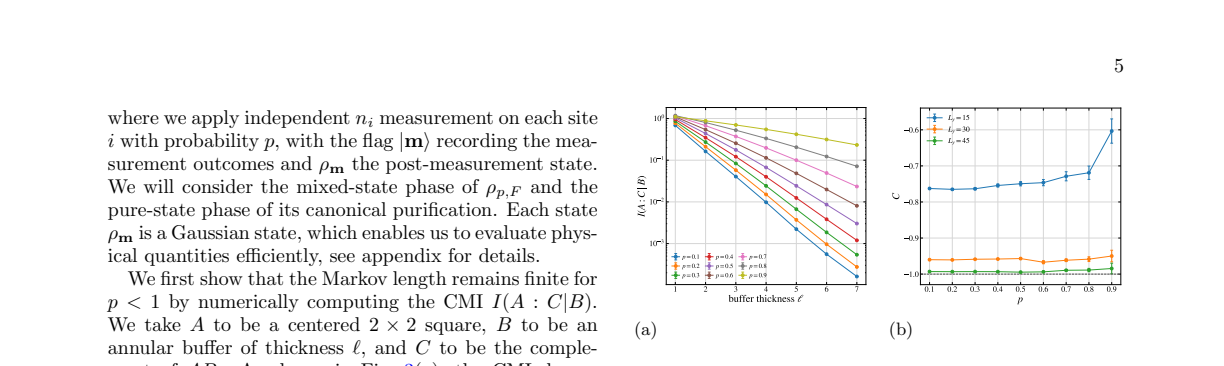
For the Chern insulator under flagged fermion-number dephasing, the conditional mutual information decays exponentially and the canonical purification keeps a quantized spin-Hall response for every $p < 1$, with both the mixed state and its purification becoming critical at $p = 1$.
Canonical purification, and its cheaper Rényi-2 proxies such as the Choi state, is validated as a diagnostic of mixed-state phase structure: phase transitions driven by local noise remain visible in the purified (doubled) system.
A small conditional mutual information is enough for an approximate isometry between canonical purifications even when the state stays far from every exact quantum Markov chain, as the antisymmetric-state family shows.
The converse direction fails without extra structure: a finite-depth local unitary connecting canonical purifications does not imply the mixed states are in the same phase, as the parity-state counterexample demonstrates.
My extension: the same gate-by-gate argument should apply to continuous local Lindblad evolution with finite Markov length, producing a quasi-local purification flow between canonical purifications; a Lieb-Robinson speed for that flow is a measurable prediction in analog or digital quantum simulators.
My extension: the logarithmic dimension dependence in the entropy conversion is the most fragile link, and a direct numerical measurement of the conditional-mutual-information deficit generated by a random $\varepsilon$-reversible gate as a function of $d_B$ would test whether the accumulation argument survives far from the two examples studied here.
My extension: because the lifting preserves the doubled system's symmetries, mixed-state phases with average or strong-to-weak symmetries could be classified by computing pure-state invariants of the canonical purification, unifying existing doubled-space probes.
Check this review
Pith stored no record of this review's passes and took no fingerprint of it. Reviews made by code from 13 Nov 2026 on carry both.
How often reviews like this one are right
Reviews like this one: written by deepseek-v4-flash, where what was read was not recorded.
How often objections from reviews like this one are right: not yet measured
Reviews by people
This review was written by a machine. No person has reviewed this paper on Pith yet. A scientist listed on Pith can review it for a fee, and their review is published here whatever it concludes.
The paper
Abstract
Pure-state quantum phases are defined through finite-depth local unitary connections. This concept of phases has recently been generalized to mixed states in terms of locally reversible channels. In this work, we establish a fundamental relation between mixed-state phases and pure-state phases. We show that a locally reversible channel between mixed states can be lifted to a local isometry between their canonical purifications; thus, if two mixed states are in the same phase, then their canonical purifications are in the same pure-state phase. Furthermore, an explicit construction of the lifting isometry is given by “half” of the Petz recovery map, suggesting that the Petz recovery map without rotation is enough to connect mixed state phases. We illustrate our results with two examples: toric code under bit flip noise and Chern insulator under fermion number noise.
The paper's own sentences, arranged, kept beside the review and separate from it. Each label is drawn from a closed vocabulary; the number beside it is the probability the classifier gave that label. No sentence in this record was written by a model.
abstract compiled · 2026-11-02
The authors' main claim, as the classifier picked it out 0.98
“We show that a locally reversible channel between mixed states can be lifted to a local isometry between their canonical purifications; thus, if two mixed states are in the same phase, then their canonical purifications are in the same pure-state phase.”
How the main claim is stated: asserted 1.00
What the abstract itself states, as probabilities: claims first 0.06 · states limitation 0.09 · human participants 0.01 · controlled comparison 0.02 · randomized assignment 0.01 · states quantitative result 0.04 · compares with prior results 0.51 · mentions code or data availability 0.02
The abstract, sentence by sentence
This table labels the abstract only (arXiv listing abstract v1). The number is the probability the classifier gave the label.
| Sentence | Role | The authors' own work | States the main conclusion | Strength |
|---|---|---|---|---|
| Pure-state quantum phases are defined through finite-depth local unitary connections. | background 1.00 | 0.05 | 0.02 | asserted 1.00 |
| This concept of phases has recently been generalized to mixed states in terms of locally reversible channels. | background 1.00 | 0.04 | 0.03 | asserted 1.00 |
| In this work, we establish a fundamental relation between mixed-state phases and pure-state phases. | contribution 0.99 | 0.87 | 0.22 | asserted 1.00 |
| We show that a locally reversible channel between mixed states can be lifted to a local isometry between their canonical purifications; thus, if two mixed states are in the same phase, then their canonical purifications are in the same pure-state phase. | result 0.97 | 0.94 | 0.85 | asserted 1.00 |
| Furthermore, an explicit construction of the lifting isometry is given by ``half'' of the Petz recovery map, suggesting that the Petz recovery map \emph{without rotation} is enough to connect mixed state phases. | interpretation 0.57 | 0.90 | 0.20 | hedged possibility 0.82 |
| We illustrate our results with two examples: toric code under bit flip noise and Chern insulator under fermion number noise. | contribution 0.70 | 0.87 | 0.03 | asserted 0.95 |
What kind of paper the classifier reports this is: theoretical result 1.00 · evidence from proof or derivation 1.00
What was examined, and what was not
Sources read
- arXiv listing abstract v1
Not examined
- full text
- figures and tables
- references and citing sentences
- relations to other papers
Levels run
- P abstract
Not run
- S sections
- T body sentences
- C citations
- R cross-paper relations
How the labels were made
Compiled by classifier-1.13.0 via TypeSafe API, question bank abstract-p1-20260923, 2026-11-02: 1 request, 4,906 input tokens.
Every quoted sentence on this record is the authors'. Every label is from Pith's closed vocabulary, with the probability shown beside it. This record as JSON
Figures (5)




Figures are the authors', reproduced from the paper.
References (66)
- [43] Li Gao and Mark M. Wilde, “Recoverability for opti- mized quantumf-divergences,” J. Phys. A: Math. Theor. 54, 385302 (2021), arXiv:2008.01668 [quant-ph] on PithPith's reviewarXiv
- [48] Marius Junge and Nicholas LaRacuente, “Multivariate trace inequalities,p-fidelity, and universal recovery be- yond tracial settings,” Journal of Mathematical Physics 63, 122204 (2022) on Pith
- [1] M. B. Hastings and Xiao-Gang Wen, “Quasiadiabatic continuation of quantum states: The stability of topo- logical ground-state degeneracy and emergent gauge in- variance,” Phys. Rev. B72, 045141 (2005), arXiv:cond- mat/0503554 [cond-mat.str-el] on Pith
- [2] Xie Chen, Zheng-Cheng Gu, and Xiao-Gang Wen, “Lo- cal unitary transformation, long-range quantum entan- glement, wave function renormalization, and topological order,” Phys. Rev. B82, 155138 (2010), arXiv:1004.3835 [cond-mat.str-el] on PithPith's reviewarXiv
- [3] Yijian Zou, Shengqi Sang, and Timothy H. Hsieh, “Channeling quantum criticality,” Phys. Rev. Lett.130, 250403 (2023), arXiv:2301.07141 on PithPith's reviewarXiv
- [4] Ruihua Fan, Yimu Bao, Ehud Altman, and Ashvin Vish- wanath, “Diagnostics of mixed-state topological order and breakdown of quantum memory,” PRX Quantum5, 020343 (2024), arXiv:2301.05689 on PithPith's reviewarXiv
- [5] Andrea Coser and David P´ erez-Garc´ia, “Classification of phases for mixed states via fast dissipative evolution,” Quantum3, 174 (2019), arXiv:1810.05092 [quant-ph] on PithPith's reviewarXiv
- [6] Shengqi Sang, Yijian Zou, and Timothy H. Hsieh, “Mixed-state quantum phases: Renormalization and quantum error correction,” Phys. Rev. X14, 031044 (2024), arXiv:2310.08639 [quant-ph] on PitharXiv
- [7] Ruochen Ma and Chong Wang, “Average symmetry- protected topological phases,” Phys. Rev. X13, 031016 (2023), arXiv:2209.02723 on PithPith's reviewarXiv
- [8] Tibor Rakovszky, Sarang Gopalakrishnan, and Curt von Keyserlingk, “Defining stable phases of open quan- tum systems,” Phys. Rev. X14, 041031 (2024), arXiv:2308.15495 on PithPith's reviewarXiv
- [9] Leonardo A. Lessa, Shengqi Sang, Tsung-Cheng Lu, Timothy H. Hsieh, and Chong Wang, “Higher-form anomaly and long-range entanglement of mixed states,” (2025), arXiv:2503.12792 on PithPith's reviewarXiv
- [10] Zijian Wang, Zhengzhi Wu, and Zhong Wang, “Intrinsic mixed-state topological order,” PRX Quantum6, 010314 (2025), arXiv:2307.13758 [quant-ph] on PithPith's reviewarXiv
- [11] Leonardo A. Lessa, Ruochen Ma, Jian-Hao Zhang, Zhen Bi, Meng Cheng, and Chong Wang, “Strong- to-weak spontaneous symmetry breaking in mixed quantum states,” PRX Quantum6, 010344 (2025), arXiv:2405.03639 [quant-ph] on PithPith's reviewarXiv
- [12] Ruochen Ma, Jian-Hao Zhang, Zhen Bi, Meng Cheng, and Chong Wang, “Topological phases with average sym- metries: The decohered, the disordered, and the intrin- sic,” Phys. Rev. X15, 021062 (2025), arXiv:2305.16399 on PithPith's reviewarXiv
- [13] Tyler D. Ellison and Meng Cheng, “Toward a classifica- tion of mixed-state topological orders in two dimensions,” PRX Quantum6, 010315 (2025), arXiv:2405.02390 on PithPith's reviewarXiv
- [14] Leonardo A. Lessa, Meng Cheng, and Chong Wang, “Mixed-state quantum anomaly and multipar- tite entanglement,” Phys. Rev. X15, 011069 (2025), arXiv:2401.17357 on PithPith's reviewarXiv
- [15] Xiaoyang Huang, Marvin Qi, Jian-Hao Zhang, and An- drew Lucas, “Hydrodynamics as the effective field the- ory of strong-to-weak spontaneous symmetry breaking,” Phys. Rev. B111, 125147 (2025), arXiv:2407.08760 on PithPith's reviewarXiv
- [16] Chong Wang, “Strong-to-Weak Spontaneous Symme- try Breaking,” arXiv e-prints , arXiv:2606.02555 (2026), arXiv:2606.02555 [quant-ph] on PithPith's reviewarXiv
- [17] Shengqi Sang, Leonardo A. Lessa, Roger S. K. Mong, Tarun Grover, Chong Wang, and Timothy H. Hsieh, “Mixed-state phases from local reversibility,” Phys. Rev. X16, 041014 (2026), arXiv:2507.02292 [quant-ph] on PithPith's reviewarXiv
- [18] Shengqi Sang and Timothy H. Hsieh, “Stability of mixed- state quantum phases via finite markov length,” Phys. Rev. Lett.134, 070403 (2025), arXiv:2404.07251 [quant- ph] on PitharXiv
show 46 more
- [19] Jinmin Yi, Kangle Li, Chuan Liu, Zixuan Li, and Liujun Zou, “Universal decay of mutual information and condi- tional mutual information in gapped pure- and mixed- state quantum matter,” Phys. Rev. Lett.136, 116604 (2026) on Pith
- [20] Shuangyuan Lu, Penghao Zhu, and Yuan-Ming Lu, “Bilayer construction for mixed state phenomena with strong, weak symmetries and symmetry breakings,” (2024), arXiv:2411.07174 on PithPith's reviewarXiv
- [21] Ran Luo, Yi-Nan Wang, and Zhen Bi, “Topolog- ical holography for mixed-state phases and phase transitions,” PRX Quantum6, 040358 (2025), arXiv:2507.06218 on PithPith's reviewarXiv
- [22] Souvik Dutta and Thomas Faulkner, “A canonical pu- rification for the entanglement wedge cross-section,” J. High Energy Phys.2021, 178 (2021), arXiv:1905.00577 [hep-th] on PithPith's reviewarXiv
- [23] Pablo Sala, Sarang Gopalakrishnan, Masaki Oshikawa, and Yizhi You, “Spontaneous strong symmetry breaking in open systems: Purification perspective,” Phys. Rev. B 110, 155150 (2024), arXiv:2405.02402 [quant-ph] on PithPith's reviewarXiv
- [24] Zack Weinstein, “Efficient detection of strong-to- weak spontaneous symmetry breaking via the r´ enyi- 1 correlator,” Phys. Rev. Lett.134, 150405 (2025), arXiv:2410.23512 [quant-ph] on PithPith's reviewarXiv
- [25] Jian-Hao Zhang, Yang Qi, and Zhen Bi, “Fidelity strange correlators for average symmetry-protected topo- logical phases,” Science Bulletin71, 688–691 (2026), arXiv:2210.17485 on PitharXiv
- [26] Yuhan Liu and Yijian Zou, “Polynomial-time certifica- tion of fidelity for many-body mixed states and mixed- state universality classes,” (2026), arXiv:2601.13333 on PitharXiv
- [27] Francisco Divi, Leonardo A. Lessa, and Chong Wang, “Local strong-to-weak spontaneous symmetry breaking,” (2026), arXiv:2605.28967 on PithPith's reviewarXiv
- [28] Ruizhi Liu, Jinmin Yi, and Dominic V. Else, “A local de- scription of strong symmetries and strong-to-weak sym- metry breaking in quantum many-body systems,” arXiv e-prints , arXiv:2605.28925 (2026), arXiv:2605.28925 [quant-ph] on PithPith's reviewarXiv
- [29] Carolyn Zhang, “Local diagnostics for strong-to-weak spontaneous symmetry breaking and non-equilibrium phase transitions,” arXiv e-prints , arXiv:2605.29113 7 (2026), arXiv:2605.29113 [quant-ph] on PithPith's reviewarXiv
- [30] Zhi Li, Raz Firanko, and Timothy H. Hsieh, “A unified framework for locally stable phases,” (2026), arXiv:2605.00088 [quant-ph] on PithPith's reviewarXiv
- [31] Patrick Hayden, Richard Jozsa, D´ enes Petz, and An- dreas Winter, “Structure of states which satisfy strong subadditivity of quantum entropy with equality,” Com- munications in Mathematical Physics246, 359–374 (2004) on Pith
- [32] D. Petz, “Sufficient subalgebras and the relative entropy of states of a von Neumann algebra,” Commun. Math. Phys.105, 123–131 (1986) on Pith
- [33] D. Petz, “Sufficiency of channels over von Neumann al- gebras,” Q. J. Math.39, 97–108 (1988) on Pith
- [34] Zeyu Liu, Langxuan Chen, Yuke Zhang, Shuyan Zhou, and Pengfei Zhang, “Diagnosing strong-to-weak symme- try breaking via Wightman correlators,” Communica- tions Physics8, 274 (2025), arXiv:2410.09327 [quant-ph] on PithPith's reviewarXiv
- [35] Jong Yeon Lee, Yi-Zhuang You, and Cenke Xu, “Symmetry protected topological phases under deco- herence,” arXiv e-prints , arXiv:2210.16323 (2022), arXiv:2210.16323 [cond-mat.str-el] on PithPith's reviewarXiv
- [36] Jong Yeon Lee, Chao-Ming Jian, and Cenke Xu, “Quan- tum Criticality Under Decoherence or Weak Measure- ment,” PRX Quantum4, 030317 (2023) on Pith
- [37] Ruochen Ma and Alex Turzillo, “Symmetry-protected topological phases of mixed states in the doubled space,” PRX Quantum6, 010348 (2025) on Pith
- [38] Ramanjit Sohal and Abhinav Prem, “Noisy Approach to Intrinsically Mixed-State Topological Order,” PRX Quantum6, 010313 (2025), arXiv:2403.13879 [cond- mat.str-el] on PithPith's reviewarXiv
- [39] Carolyn Zhang, Yichen Xu, Jian-Hao Zhang, Cenke Xu, Zhen Bi, and Zhu-Xi Luo, “Strong-to-weak spontaneous breaking of 1-form symmetry and intrinsically mixed topological order,” Phys. Rev. B111, 115137 (2025) on Pith
- [40] Sakura Schafer-Nameki, Apoorv Tiwari, Alison Warman, and Carolyn Zhang, “SymTFT Approach for Mixed States with Non-Invertible Symmetries,” arXiv e-prints , arXiv:2507.05350 (2025), arXiv:2507.05350 [quant-ph] on PithPith's reviewarXiv
- [41] Marvin Qi, Ramanjit Sohal, Xie Chen, David T. Stephen, and Abhinav Prem, “The Symmetry Taco: Equivalences between Gapped, Gapless, and Mixed- State SPTs,” arXiv e-prints , arXiv:2507.05335 (2025), arXiv:2507.05335 [cond-mat.str-el] on PitharXiv
- [42] Naren Manjunath, Alex Turzillo, and Chong Wang, “De- tection of 2D SPT phases under decoherence,” (2025), arXiv:2507.00127 on PithPith's reviewarXiv
- [44] Mark M. Wilde, “Recoverability for holevo’s just-as-good fidelity,” in2018 IEEE International Symposium on In- formation Theory (ISIT)(2018) pp. 2331–2335 on Pith
- [45] Eric A. Carlen and Anna Vershynina, “Recovery and the data processing inequality for quasi-entropies,” IEEE Trans. Inf. Theory64, 6929–6938 (2018), arXiv:1710.08080 on PithPith's reviewarXiv
- [46] Eric A. Carlen and Anna Vershynina, “Recovery map stability for the data processing inequality,” J. Phys. A: Math. Theor.53, 035204 (2020), arXiv:1710.02409 on PithPith's reviewarXiv
- [47] Matthias Christandl, Norbert Schuch, and Andreas Win- ter, “Entanglement of the antisymmetric state,” Commu- nications in Mathematical Physics311, 397–422 (2012) on Pith
- [49] Ruochen Ma, Vedika Khemani, and Shengqi Sang, “Circuit-based characterization of finite-temperature quantum phases and self-correcting quantum mem- ory,” PRX Quantum7, 033052 (2026), arXiv:2509.15204 [quant-ph] on PithPith's reviewarXiv
- [50] Omar Fawzi and Renato Renner, “Quantum condi- tional mutual information and approximate markov chains,” Commun. Math. Phys.340, 575–611 (2015), arXiv:1410.0664 [quant-ph] on PithPith's reviewarXiv
- [51] Eric Dennis, Alexei Kitaev, Andrew Landahl, and John Preskill, “Topological quantum memory,” Journal of Mathematical Physics43, 4452–4505 (2002) on Pith
- [52] P. Jouzdani, E. Novais, and E. R. Mucciolo, “Fidelity of the surface code in the presence of a bosonic bath,” Phys. Rev. A88, 012336 (2013), arXiv:1304.2975 [quant-ph] on PithPith's reviewarXiv
- [53] Florian Merz, “Negative scaling dimensions and confor- mal invariance at the±Jrandom-bond Ising model,” Physical Review B66, 054413 (2002) on Pith
- [54] F. Merz and J. T. Chalker, “Two-dimensional random- bond Ising model, free fermions, and the network model,” Physical Review B65, 054425 (2002) on Pith
- [55] Ryohei Kobayashi, Taige Wang, Tomohiro Soejima, Roger S. K. Mong, and Shinsei Ryu, “Higher hall conductivity from a single wave function: Obstruc- tions to symmetry-preserving gapped edge of (2+1)- dimensional topological order,” Physical Review B111 (2025), 10.1103/qm19-45vy on Pithdoi:10.1103/qm19-45vy
- [56] Tyler D. Ellison, Dongjin Lee, Zhi Li, Amin Mohar- ramipour, Yasamin Panahi, and Beni Yoshida, “Many- body chirality of topological stabilizer states,” (2026), arXiv:2606.20472 [quant-ph] on PithPith's reviewarXiv
- [57] R. N. Bhatt and A. P. Young, “Numerical studies of Ising spin glasses in two, three, and four dimensions,” Physical Review B37, 5606–5614 (1988) on Pith
- [58] A. K. Hartmann and A. P. Young, “Lower critical dimen- sion of Ising spin glasses,” Physical Review B64, 180404 (2001) on Pith
- [59] Helmut G. Katzgraber, L. W. Lee, and A. P. Young, “Correlation length of the two-dimensional Ising spin glass with Gaussian interactions,” Physical Review B70, 014417 (2004) on Pith
- [60] Gesualdo Delfino, “Critical exponents at the Nishi- mori point,” J. Stat. Mech.2025, 043203 (2025), arXiv:2412.07383 on PithPith's reviewarXiv
- [61] P. W. Kasteleyn, “The statistics of dimers on a lattice: I. the number of dimer arrangements on a quadratic lat- tice,” Physica27, 1209–1225 (1961) on Pith
- [62] H. N. V. Temperley and Michael E. Fisher, “Dimer prob- lem in statistical mechanics—an exact result,” Philosoph- ical Magazine6, 1061–1063 (1961) on Pith
- [63] Michael E. Fisher, “On the dimer solution of planar ising models,” Journal of Mathematical Physics7, 1776–1781 (1966) on Pith
- [64] Jin-Yi Cai, Vinay Choudhary, and Pinyan Lu, “On the theory of matchgate computations,” Theory of Comput- ing Systems45, 108–132 (2009) on Pith
- [65] Sergey Bravyi, “Contraction of matchgate tensor net- works on non-planar graphs,” inQuantum Information and Computation, Contemporary Mathematics, Vol. 482 (American Mathematical Society, 2009) pp. 179–211, 8 arXiv:0801.2989 [quant-ph] on PithPith's reviewarXiv
- [66] Dmitry Chelkak, David Cimasoni, and Adrien Kas- sel, “Revisiting the combinatorics of the 2D Ising model,” Ann. Inst. Henri Poincar´ e D4, 309–385 (2017), arXiv:1507.08242 [math.PR]. Appendix A: Proofs of the main results A.1. Ordered Petz amplitude bound We prove Lemma 1 usin... on PithPith's reviewarXiv
Challenges and discussion
Disagree with the review, or know something it missed? Leave a comment, or challenge this review formally: a challenge becomes a permanent entry in this paper's record, and its decision is published here.
Come back by email
A short list of the week's newly reviewed papers. Nothing is sent until you confirm from your inbox, and every email has a link that stops it. No account.
No comments yet.
Sign in to comment