Computer Vision and Pattern Recognition · arXiv:2611.07711 v1 · submitted 5 Nov 2026 · 64 references
Fast and Accurate Hand Estimation in Pixels, Interaction and World Space
The paper says
“Monocular hand mesh estimators commonly predict rig parameters and project the mesh to obtain 2D keypoints. We find that directly predicted 3D joints agree better with 2D predictions, and fitting a mesh to predicted points reduces mesh error.”
more of the abstract
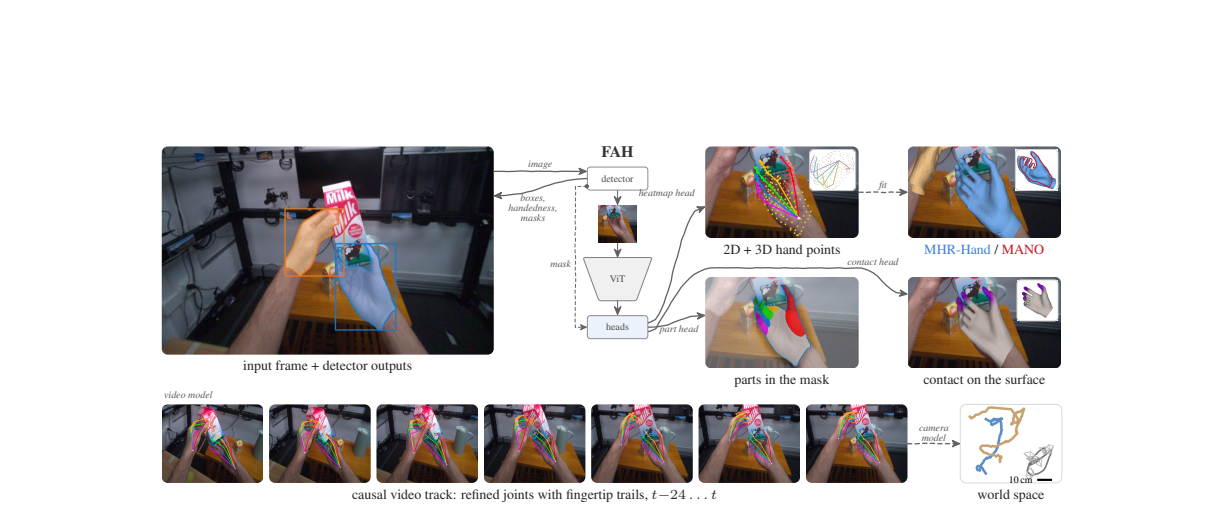
We present FAH (Fast and Accurate Hand Estimation), a family of models built on SAM 3D Body's hand branch through fine-tuning and feature distillation. The models predict corresponding 2D and 3D joints and surface points, fit MANO or MHR-Hand, and optionally estimate anatomical parts and contact without object geometry at inference. Causal refinement reduces acceleration error, and camera estimation places the hands in world space. Experiments show improvements in image-space alignment, hand geometry, contact estimation and world-space tracking over the evaluated baselines. The default ViT-L model runs at 65 fps with mesh fitting on an RTX 4070 Ti SUPER, or 49 fps with parts and contact enabled. The smallest ViT-S model reaches 125 fps without mesh fitting, parts or contact. Code: https://github.com/noahcao/FAH.
from the abstract
Pith says
Machine review · deepseek-v4-flash · 6 Nov 2026 · what was read was not recorded · not checked by a person
It can be wrong. Challenge this review or reply to it.
Holds up. A solid engineering paper that validates a simple but effective architectural change (predict corresponding 2D/3D points then fit mesh) with thorough experiments and transparent limitations; minor test-set exposure and teacher dependence are acknowledged. This line is wrong
2 major objections · 7 minor
How often objections from reviews like this one are right: not yet measured
Not checked: figures, code, what the 64 references say.
The paper says, at Sec. A.11 and Sec. 5
The review did not quote this passage.
A classifier read this sentence of the paper as acknowledging the concern (probability 0.88):
“Earlier configurations were also evaluated on EgoStandard test before the development split existed, so these are not untouched-test estimates.”
Pith says: Objection 1 of 2 · major
The authors note that 'Earlier configurations were also evaluated on EgoStandard test before the development split existed, so these are not untouched-test estimates.' This is an important caveat that should be more prominently discussed in the main paper (e.g., in Section 5 Limitations).
more of objection 1
While the core HOT3D results are not affected, the claim of state-of-the-art on EgoStandard should be clearly qualified. I recommend adding a sentence in the conclusion or limitations explicitly stating which results are on truly held-out test sets and which may be influenced by test set exposure.
The paper says, at Sec. A.6
The review did not quote this passage.
Pith says: Objection 2 of 2 · major
The authors state that 'Test scores therefore inform model selection' for the contact head. This is a potential overfitting risk. While the authors mitigate this by requiring no significant loss on test sets before selection, it would be stronger to have a separate validation set or to clarify that the reported contact results on HOT3D and DexYCB are not independent of model choice. This should be acknowledged in the contact section of the main paper.
7 minor objections
The paper says, at Tables 1-4
Pith says: minor objection 1 of 7
The notation 'fps' is used but the hardware and conditions are given in the caption; for clarity, consider including the measurement conditions (e.g., 'on RTX 4070 Ti SUPER with WSL2') directly in each table caption.
The paper says, at Abstract
Pith says: minor objection 2 of 7
The phrase 'SAM 3D Body's hand branch' could be clarified the first time it appears (SAM 3D Body is a model, not a body part). It is defined in the introduction, but consider a brief clarification in the abstract.
show 5 more
The paper says, at Sec. 3.2, Equation (1)
Pith says: minor objection 3 of 7
Define ρ_β explicitly as smooth-L1 loss with threshold β (probably clear from context, but adding a short definition would help readability).
The paper says, at Sec. 3.3
Pith says: minor objection 4 of 7
'Horn's quaternion method' is correctly cited but could benefit from a brief explanation of how it is applied to hand parts for initialization.
The paper says, at Figure 3
Pith says: minor objection 5 of 7
The labels for contact examples could be slightly larger or use a different color for easier reading.
The paper says, at General
Pith says: minor objection 6 of 7
The paper uses both 'bench2d v2' and 'Bench2D v2' inconsistently; unify capitalization.
The paper says, at References
Pith says: minor objection 7 of 7
Reference [56] (DINOv3) is a preprint; consider updating if a published version is available.
What would settle it
To further strengthen the evidence, one could train a variant where the MANO-parameter head also receives surface-point supervision (e.g., a reprojection loss between the rendered mesh and predicted dense points). If the parameter head then approaches the dense+fit accuracy (PA-MPVPE gap in Tab. 5 narrows from 2.70 mm to, say, <1 mm), the advantage would be partly attributable to richer supervision rather than the output representation alone. This test would clarify the robustness of the central comparison.
from the skeptic's reading
How the review went
4 readings by deepseek-v4-flash · 6 Nov 2026
- Reader holds up
- Skeptic partly agrees
- Editor wrote the verdict above
- Referee minor revision: 2 major objections, 7 minor
Not run on this paper: the simulated authors' defence.
Pith did not check this review's objections against the paper.
The review in full
The review in brief, machine-written
The central claim is that predicting corresponding 2D and 3D joints and surface points before mesh fitting beats direct rig-parameter regression. The controlled comparison in Table 5 is clean and directly supports it. The paper builds a complete real-time system (detection, pose, parts, contact, video, world-space) that runs at 27–101 fps and beats strong baselines like WiLoR and HaWoR on multiple benchmarks. That alone is a useful engineering achievement.
What I like: the experiments are extensive and careful—multiple datasets, controlled ablations (backbone, resolution, points vs parameters), and the authors are transparent about where they used test data (EgoStandard for camera config, contact head selection). The stress-test results (low light, shadows, hard poses) show real robustness. The code and models are released.
Soft spots: the EgoStandard test set was used during development for camera and label-convention choices, so those numbers are not completely fresh. The contact head selects its learning rate based on test scores (Sec. A.6), though the authors check that no statistically significant loss occurs on HOT3D/DexYCB. The teacher model and SAM pseudo-masks are a dependency—acknowledged in the limitations—but the paper does show the student can improve without the teacher at inference. The world-space results are dominated by camera error, which the authors note, and the camera pipeline itself has several hand-tuned heuristics.
Who this is for: anyone working on real-time hand mesh estimation for AR/VR or teleoperation. The main insight—point prediction then fit—is simple and could be adopted by other systems. The paper is well-written and the evidence is solid enough for a top conference. It deserves a serious referee; most concerns can be addressed in discussion.
The strongest objection
The central claim—that predicting corresponding 2D and 3D joints and surface points then fitting a mesh outperforms direct rig-parameter regression—is supported by a controlled within-network comparison (Tab. 5) and by consistent state-of-the-art results on multiple independent benchmarks. The paper acknowledges the primary risk (teacher and pseudo-mask supervision quality, Sec. 5) and provides mitigating losses (reprojection consistency, Eq. 2; teacher priors). Benchmarks with held-out test sets (HOT3D, bench2d v2) show substantial gains over strong baselines. The EgoStandard test set was used during development (Sec. A.11), but the core pose and mesh results on HOT3D are from a truly held-out split. Given the breadth of supporting evidence and the transparency about limitations, I find no load-bearing concern that would threaten the validity of the main conclusion.
The reader correctly flags pseudo-mask supervision as a potential weakness, but the paper provides multiple compensating mechanisms (reprojection loss, teacher priors, spectral smoothness) and achieves strong results across domains. My read finds no fatal flaw; the evidence for the central claim is well-supported. I keep the verdict unchanged, agreeing with the reader's overall assessment while noting that the weakest assumption is adequately mitigated in practice.
The referee's report
The central claim—that predicting corresponding 2D and 3D points before mesh fitting improves accuracy—is convincingly supported by a controlled within-network comparison (Table 5) and by consistent state-of-the-art results across multiple independent benchmarks. The paper provides a thorough empirical evaluation, including ablation studies, video refinement, contact estimation, and world-space placement. The release of code and demonstration of real-time performance on consumer hardware make the work practically useful. The paper is transparent about limitations (teacher supervision quality, EgoStandard test exposure, contact ambiguity), which adds credibility. Overall, if the results hold, this is a solid contribution to the field of hand mesh estimation.
Pith's reading of the paper (a machine's summary, not the authors')
Monocular hand mesh estimators typically regress rig parameters and project the mesh to obtain 2D keypoints, but this can introduce error. This paper finds that directly predicting corresponding 2D and 3D joints and surface points, then fitting a mesh (MANO or MHR-Hand) in a separate stage, reduces mesh error compared to direct rig-parameter regression within the same network. The authors present FAH, a family of models built on SAM 3D Body's hand branch, that predict these points and optionally estimate anatomical parts and contact without object geometry at inference. FAH achieves state-of-the-art results on multiple benchmarks (HOT3D, EgoStandard, 2D pose, contact) while running at interactive rates: 65 fps with mesh fitting on a consumer GPU, or 125 fps for the smallest model without extra heads.
What carries the argument. The central mechanism is 'point prediction then mesh fitting': a stride-4 heatmap head on a DINOv3 ViT encoder predicts corresponding 2D (via soft-argmax) and root-relative 3D coordinates for hand joints, bone points, and 400 farthest-point samples of the MANO surface. These points are harmonized to kinematic MANO conventions across datasets. A separate mesh stage uses Horn's quaternion method for part-wise initialization, a learned MLP to predict MANO pose and shape, and one Gauss–Newton step for refinement. The surface points also define a spectral basis (lowest 200 Laplacian eigenfunctions) to reconstruct the full 778-vertex mesh. This decoupling allows direct 2D supervision (including reprojection consistency on 2D-only data) while avoiding the articulation errors of rig-parameter regression.
Core claim. The central claim is that decoupling point prediction from mesh fitting improves hand mesh accuracy. In a controlled comparison (Sec. 4.4, Tab. 5), a network that predicts 2D and root-relative 3D hand joints and surface points, then fits a MANO mesh separately, achieves lower PA-MPVPE (4.09 mm) than the same network's own MANO-parameter head (6.79 mm). The direct 3D points also agree better with the direct 2D predictions (1.43% of hand size disagreement vs 3.07% for the parameter head). This principle is instantiated in FAH, which uses a heatmap head on DINOv3 encoder tokens to predict 21 joints, 40 bone points, and 400 surface points, then fits MANO (or MHR-Hand) via a learned initializer and one Gauss–Newton step.
The premise it rests on. The paper assumes that SAM 2.1 pseudo-masks and the fine-tuned SAM 3D Body teacher provide sufficiently accurate 3D supervision for the student's surface point predictions, especially on datasets with only 2D labels where no ground-truth 3D is available.
If the paper is right (Pith's inferences, not the authors')
If correct, any hand mesh estimator using direct rig-parameter regression could be improved by switching to point prediction followed by a separate fitting stage, as demonstrated by the controlled ablation.
Real-time hand tracking (65 fps for ViT-L) becomes practical on consumer GPUs, enabling low-latency AR/VR and robotic teleoperation without cloud offloading.
Contact estimation without object geometry at inference (using learned features and predicted geometry) achieves competitive accuracy, simplifying deployment in unconstrained environments.
Causal video refinement with a transformer on 32-frame tracks reduces acceleration error by over 50%, improving temporal smoothness for continuous tracking.
World-space hand trajectories can be estimated causally at 38 fps by combining visual odometry, metric depth, and a learned motion head, outperforming offline SLAM-based methods on EgoStandard.
The point-prediction-first strategy is likely transferable to full-body mesh recovery, where direct regression of SMPL parameters currently dominates; a similar decoupling could improve pixel alignment for body joints.
Because the weakest assumption is the accuracy of SAM 2.1 pseudo-masks and teacher targets on 2D-only data, replacing these with high-quality ground-truth 3D (e.g., from multi-view capture) should yield further accuracy gains, especially on in-the-wild images.
The paper's own diagnostic (Sec. 4.4) shows that direct 2D points and projected 3D points disagree by 1.4–1.8%, suggesting there is remaining headroom to close via better camera depth or rotation estimation before fitting.
World-space error is dominated by camera estimation (Sec. 5); improving online SfM or integrating inertial data would likely impact trajectory accuracy more than further hand-pose refinements.
Check this review
Pith stored no record of this review's passes and took no fingerprint of it. Reviews made by code from 13 Nov 2026 on carry both.
How often reviews like this one are right
Reviews like this one: written by deepseek-v4-flash, where what was read was not recorded.
How often objections from reviews like this one are right: not yet measured
Reviews by people
This review was written by a machine. No person has reviewed this paper on Pith yet. A scientist listed on Pith can review it for a fee, and their review is published here whatever it concludes.
The paper
Abstract
Monocular hand mesh estimators commonly predict rig parameters and project the mesh to obtain 2D keypoints. We find that directly predicted 3D joints agree better with 2D predictions, and fitting a mesh to predicted points reduces mesh error. We present FAH (Fast and Accurate Hand Estimation), a family of models built on SAM 3D Body's hand branch through fine-tuning and feature distillation. The models predict corresponding 2D and 3D joints and surface points, fit MANO or MHR-Hand, and optionally estimate anatomical parts and contact without object geometry at inference. Causal refinement reduces acceleration error, and camera estimation places the hands in world space. Experiments show improvements in image-space alignment, hand geometry, contact estimation and world-space tracking over the evaluated baselines. The default ViT-L model runs at 65 fps with mesh fitting on an RTX 4070 Ti SUPER, or 49 fps with parts and contact enabled. The smallest ViT-S model reaches 125 fps without mesh fitting, parts or contact. Code: https://github.com/noahcao/FAH.
The paper's own sentences, arranged, kept beside the review and separate from it. Each label is drawn from a closed vocabulary; the number beside it is the probability the classifier gave that label. No sentence in this record was written by a model.
abstract compiled · 2026-11-06
The authors' main claim, as the classifier picked it out 0.98
“Experiments show improvements in image-space alignment, hand geometry, contact estimation and world-space tracking over the evaluated baselines.”
How the main claim is stated: asserted 1.00
What the abstract itself states, as probabilities: claims first 0.04 · states limitation 0.19 · human participants 0.10 · controlled comparison 0.89 · randomized assignment 0.01 · states quantitative result 0.98 · compares with prior results 0.96 · mentions code or data availability 0.98
The abstract, sentence by sentence
This table labels the abstract only (arXiv listing abstract v1). The number is the probability the classifier gave the label.
| Sentence | Role | The authors' own work | States the main conclusion | Strength |
|---|---|---|---|---|
| Monocular hand mesh estimators commonly predict rig parameters and project the mesh to obtain 2D keypoints. | background 1.00 | 0.05 | 0.03 | asserted 1.00 |
| We find that directly predicted 3D joints agree better with 2D predictions, and fitting a mesh to predicted points reduces mesh error. | result 0.95 | 0.94 | 0.31 | asserted 1.00 |
| We present FAH (Fast and Accurate Hand Estimation), a family of models built on SAM 3D Body's hand branch through fine-tuning and feature distillation. | contribution 0.72 | 0.90 | 0.08 | asserted 1.00 |
| The models predict corresponding 2D and 3D joints and surface points, fit MANO or MHR-Hand, and optionally estimate anatomical parts and contact without object geometry at inference. | method 0.83 | 0.86 | 0.11 | asserted 0.99 |
| Causal refinement reduces acceleration error, and camera estimation places the hands in world space. | method 0.89 | 0.85 | 0.08 | asserted 1.00 |
| Experiments show improvements in image-space alignment, hand geometry, contact estimation and world-space tracking over the evaluated baselines. | result 1.00 | 0.94 | 0.61 | asserted 1.00 |
| The default ViT-L model runs at 65 fps with mesh fitting on an RTX 4070 Ti SUPER, or 49 fps with parts and contact enabled. | result 1.00 | 0.94 | 0.04 | asserted 1.00 |
| The smallest ViT-S model reaches 125 fps without mesh fitting, parts or contact. | result 1.00 | 0.93 | 0.04 | asserted 1.00 |
| Code: https://github.com/noahcao/FAH. | contribution 0.88 | 0.45 | 0.02 | unclear 0.75 |
What kind of paper the classifier reports this is: method or tool 1.00 · evidence from observation or experiment 0.99
What was examined, and what was not
Sources read
- arXiv listing abstract v1
Not examined
- full text
- figures and tables
- references and citing sentences
- relations to other papers
Levels run
- P abstract
Not run
- S sections
- T body sentences
- C citations
- R cross-paper relations
How the labels were made
Compiled by classifier-1.13.0 via TypeSafe API, question bank abstract-p1-20260923, 2026-11-06: 1 request, 6,828 input tokens.
Every quoted sentence on this record is the authors'. Every label is from Pith's closed vocabulary, with the probability shown beside it. This record as JSON
Figures (7)



Figures are the authors', reproduced from the paper.
References (64)
- [1] Yuzhe Qin, Wei Yang, Binghao Huang, Karl Van Wyk, Hao Su, Xiaolong Wang, Yu-Wei Chao, and Dieter Fox. AnyTeleop: a general vision-based dexterous robot arm- hand teleoperation system. InRobotics: Science and Systems (RSS). 2023 on Pith
- [2] Chen Wang, Haochen Shi, Weizhuo Wang, Ruohan Zhang, Li Fei-Fei, and C. Karen Liu. DexCap: scalable and portable mocap data collection system for dexterous manipulation. In Robotics: Science and Systems (RSS). 2024 on Pith
- [3] Xuxin Cheng, Jialong Li, Shiqi Yang, Ge Yang, and Xi- aolong Wang. Open-TeleVision: teleoperation with im- mersive active visual feedback. InProceedings of The 8th Conference on Robot Learning, volume 270 of Pro- ceedings of Machine Learning Research, 2729–2749. 2025. URL:http... on Pith
- [4] Javier Romero, Dimitrios Tzionas, and Michael J. Black. 8 Embodied hands: modeling and capturing hands and bodies together.ACM TOG, 2017 on Pith
- [5] Aaron Ferguson, Ahmed A. A. Osman, Berta Bescos, Carsten Stoll, Chris Twigg, Christoph Lassner, David Otte, Eric Vignola, Fabian Prada, Federica Bogo, Igor Santeste- ban, Javier Romero, Jenna Zarate, Jeongseok Lee, Jinhyung Park, Jinlong Yang, John Doublestein, Kishore Venkate... on PitharXiv
- [6] Georgios Pavlakos, Dandan Shan, Ilija Radosavovic, Angjoo Kanazawa, David Fouhey, and Jitendra Malik. Reconstruct- ing hands in 3D with transformers. InCVPR. 2024 on Pith
- [7] Rolandos Alexandros Potamias, Jinglei Zhang, Jiankang Deng, and Stefanos Zafeiriou. WiLoR: end-to-end 3D hand localization and reconstruction in-the-wild. InCVPR. 2025 on Pith
- [8] Haoye Dong, Aviral Chharia, Wenbo Gou, Francisco Vi- cente Carrasco, and Fernando De la Torre. Hamba: single- view 3D hand reconstruction with graph-guided bi-scanning Mamba. InNeurIPS. 2024 on Pith
- [9] Chen Si, Yulin Liu, Bo Ai, Jianwen Xie, Rolandos Alexan- dros Potamias, Chuanxia Zheng, and Hao Su. AnyHand: a large-scale synthetic dataset for RGB(-D) hand pose estima- tion.arXiv preprint arXiv:2603.25726, 2026 on PithPith's reviewarXiv
- [10] Xitong Yang, Devansh Kukreja, Don Pinkus, Taosha Fan, Jinhyung Park, Soyong Shin, Jinkun Cao, Jia-Wei Liu, Nicolás Ugrinovic, Anushka Sagar, Jitendra Malik, Matt Feiszli, Piotr Dollár, and Kris Kitani. SAM 3D Body: robust full-body human mesh recovery. InPro- ceedings of the I... on Pith
- [11] Jinglei Zhang, Jiankang Deng, Chao Ma, and Rolan- dos Alexandros Potamias. HaWoR: world-space hand mo- tion reconstruction from egocentric videos. InCVPR. 2025 on Pith
- [12] Nikhila Ravi, Valentin Gabeur, Yuan-Ting Hu, Ronghang Hu, Chaitanya Ryali, Tengyu Ma, Haitham Khedr, Roman Rädle, Chloe Rolland, Laura Gustafson, Eric Mintun, Junting Pan, Kalyan Vasudev Alwala, Nicolas Carion, Chao-Yuan Wu, Ross Girshick, Piotr Dollár, and Christoph Feichtenh... on Pith
- [13] Nicolas Carion, Laura Gustafson, Yuan-Ting Hu, Shoubhik Debnath, Ronghang Hu, Didac Suris Coll-Vinent, Chaitanya Ryali, Kalyan Vasudev Alwala, Haitham Khedr, Andrew Huang, Jie Lei, Tengyu Ma, Baishan Guo, Arpit Kalla, Markus Marks, Joseph Greer, Meng Wang, Peize Sun, Roman Räd... on Pith
- [14] Christian Zimmermann, Duygu Ceylan, Jimei Yang, Bryan Russell, Max Argus, and Thomas Brox. FreiHAND: a dataset for markerless capture of hand pose and shape from single RGB images. InICCV. 2019 on Pith
- [15] Shreyas Hampali, Mahdi Rad, Markus Oberweger, and Vin- cent Lepetit. HOnnotate: a method for 3D annotation of hand and object poses. InCVPR. 2020 on Pith
- [16] Yu-Wei Chao, Wei Yang, Yu Xiang, Pavlo Molchanov, Ankur Handa, Jonathan Tremblay, Yashraj S. Narang, Karl Van Wyk, Umar Iqbal, Stan Birchfield, Jan Kautz, and Dieter Fox. DexYCB: a benchmark for capturing hand grasping of objects. InCVPR. 2021 on Pith
- [17] Prithviraj Banerjee, Sindi Shkodrani, Pierre Moulon, Shreyas Hampali, Shangchen Han, Fan Zhang, Linguang Zhang, Jade Fountain, Edward Miller, Selen Basol, Richard Newcombe, Robert Wang, Jakob Julian Engel, and Tomas Hodan. HOT3D: hand and object tracking in 3D from ego- centri... on Pith
- [18] Ryan Hoque, Peide Huang, David J. Yoon, Mouli Sivapu- rapu, and Jian Zhang. EgoDex: learning dexterous ma- nipulation from large-scale egocentric video. InInterna- tional Conference on Learning Representations. 2026. URL: https://arxiv.org/abs/2505.11709 on PithPith's reviewarXiv
- [19] Kevin Lin, Lijuan Wang, and Zicheng Liu. Mesh Graphormer. InICCV, 12939–12948. 2021 on Pith
- [20] Zhishan Zhou, Shihao Zhou, Zhi Lv, Minqiang Zou, Yao Tang, and Jiajun Liang. A simple baseline for efficient hand mesh reconstruction. InCVPR. 2024 on Pith
show 44 more
- [21] Hongwen Zhang, Yating Tian, Xinchi Zhou, Wanli Ouyang, Yebin Liu, Limin Wang, and Zhenan Sun. PyMAF: 3D hu- man pose and shape regression with pyramidal mesh align- ment feedback loop. InICCV, 11446–11456. 2021 on Pith
- [22] Aditya Prakash, Ruisen Tu, Matthew Chang, and Saurabh Gupta. 3D hand pose estimation in everyday egocentric im- ages. InECCV. 2024 on Pith
- [23] Zachary Teed and Jia Deng. DROID-SLAM: deep visual SLAM for monocular, stereo, and RGB-D cameras. In NeurIPS. 2021 on Pith
- [24] Mu Hu, Wei Yin, Chi Zhang, Zhipeng Cai, Xiaoxiao Long, Hao Chen, Kaixuan Wang, Gang Yu, Chunhua Shen, and Shaojie Shen. Metric3D v2: a versatile monocular geomet- 9 ric foundation model for zero-shot metric depth and surface normal estimation.IEEE TPAMI, 2024 on Pith
- [25] Yuxi Wang, Chengkai Jin, Yufei Liu, Wenqi Ouyang, Tianyi Wei, Zhiwei Zeng, Siyuan Huang, Zhiqi Shen, and Xin- gang Pan. The surprising effectiveness of video diffusion models for hand motion reconstruction.arXiv preprint arXiv:2606.30308, 2026 on PithPith's reviewarXiv
- [26] Géry Casiez, Nicolas Roussel, and Daniel V ogel. 1 euro fil- ter: a simple speed-based low-pass filter for noisy input in interactive systems. InCHI. 2012 on Pith
- [27] Ailing Zeng, Lei Yang, Xuan Ju, Jiefeng Li, Jianyi Wang, and Qiang Xu. SmoothNet: a plug-and-play network for refining human poses in videos. InECCV, 625–642. 2022 on Pith
- [28] Qichen Fu, Xingyu Liu, Ran Xu, Juan Carlos Niebles, and Kris M. Kitani. Deformer: dynamic fusion transformer for robust hand pose estimation. InICCV, 23600–23611. 2023 on Pith
- [29] Daniel Sungho Jung and Kyoung Mu Lee. Learning dense hand contact estimation from imbalanced data. InNeurIPS. 2025 on Pith
- [30] Chun-Hao P. Huang, Hongwei Yi, Markus Höschle, Matvey Safroshkin, Tsvetelina Alexiadis, Senya Polikovsky, Daniel Scharstein, and Michael J. Black. Capturing and inferring dense full-body human-scene contact. InCVPR. 2022 on Pith
- [31] Shashank Tripathi, Agniv Chatterjee, Jean-Claude Passy, Hongwei Yi, Dimitrios Tzionas, and Michael J. Black. DECO: dense estimation of 3D human-scene contact in the wild. InICCV. 2023 on Pith
- [32] Jyun-Ting Song, JungEun Kim, Jinkun Cao, Yu Lei, Takuma Yagi, and Kris Kitani. Contact4D: a video dataset for whole- body human motion and finger contact in dexterous oper- ations. InInternational Conference on 3D Vision (3DV), 904–914. 2026. URL:https://jyuntins.github. io/Contact4D/ on Pith
- [33] Zhe Cao, Ilija Radosavovic, Angjoo Kanazawa, and Jitendra Malik. Reconstructing hand-object interactions in the wild. InICCV. 2021 on Pith
- [34] Jinkun Cao, Jingyuan Liu, Kris Kitani, and Yi Zhou. Joint diffusion for universal hand-object grasp genera- tion.Transactions on Machine Learning Research, 2025. URL:https : / / openreview . net / forum ? id = TZ0ztsYR6x on Pith
- [35] Zhengyi Luo, Jinkun Cao, Sammy Christen, Alexander Winkler, Kris Kitani, and Weipeng Xu. Omnigrasp: grasping diverse objects with simulated humanoids. In Advances in Neural Information Processing Systems, volume 37. 2024. URL:https : / / proceedings . neurips . cc / paper _ fi... on Pithdoi:10.52202/079017-
- [36] Glenn Jocher, Ayush Chaurasia, and Jing Qiu. Ultralytics YOLOv8.https://github.com/ultralytics/ ultralytics, 2023. Software on Pith
- [37] Berthold K. P. Horn. Closed-form solution of absolute orien- tation using unit quaternions.Journal of the Optical Society of America A, 4(4):629–642, 1987 on Pith
- [38] Zicong Fan, Omid Taheri, Dimitrios Tzionas, Muhammed Kocabas, Manuel Kaufmann, Michael J. Black, and Otmar Hilliges. ARCTIC: a dataset for dexterous bimanual hand- object manipulation. InCVPR. 2023 on Pith
- [39] Yunze Liu, Yun Liu, Che Jiang, Kangbo Lyu, Weikang Wan, Hao Shen, Boqiang Liang, Zhoujie Fu, He Wang, and Li Yi. HOI4D: a 4D egocentric dataset for category-level human- object interaction. InCVPR. 2022 on Pith
- [40] Zachary Teed, Lahav Lipson, and Jia Deng. Deep patch vi- sual odometry. InNeurIPS. 2023 on Pith
- [41] Ruicheng Wang, Sicheng Xu, Yue Dong, Yu Deng, Jianfeng Xiang, Zelong Lv, Guangzhong Sun, Xin Tong, and Jiaolong Yang. MoGe-2: accurate monocular geometry with metric scale and sharp details. InNeurIPS. 2025 on Pith
- [42] Zachary Teed and Jia Deng. RAFT: recurrent all-pairs field transforms for optical flow. InECCV. 2020 on Pith
- [43] Lightwheel. EgoSuite-Open100K: a fully annotated open egocentric human dataset.https://huggingface. co / collections / LightwheelAI / egosuite - open100k, 2026. Dataset; EgoStandard subset. URL:https : / / huggingface . co / datasets / LightwheelAI/EgoStandard on Pith
- [44] Soyong Shin, Juyong Kim, Eni Halilaj, and Michael J. Black. WHAM: reconstructing world-grounded humans with accu- rate 3D motion. InCVPR. 2024 on Pith
- [45] Vickie Ye, Georgios Pavlakos, Jitendra Malik, and Angjoo Kanazawa. Decoupling human and camera motion from videos in the wild. InCVPR. 2023 on Pith
- [46] Fan Zhang, Valentin Bazarevsky, Andrey Vakunov, Andrei Tkachenka, George Sung, Chuo-Ling Chang, and Matthias Grundmann. MediaPipe Hands: on-device real-time hand tracking.arXiv preprint arXiv:2006.10214, 2020 on PithPith's reviewarXiv
- [47] Tao Jiang, Peng Lu, Li Zhang, Ningsheng Ma, Rui Han, Chengqi Lyu, Yining Li, and Kai Chen. RTMPose: real- time multi-person pose estimation based on MMPose.arXiv preprint arXiv:2303.07399, 2023 on PithPith's reviewarXiv
- [48] Tao Jiang, Xinchen Xie, and Yining Li. RTMW: real-time multi-person 2D and 3D whole-body pose estimation.arXiv preprint arXiv:2407.08634, 2024 on PithPith's reviewarXiv
- [49] Sheng Jin, Lumin Xu, Jin Xu, Can Wang, Wentao Liu, Chen Qian, Wanli Ouyang, and Ping Luo. Whole-body human pose estimation in the wild. InECCV. 2020 on Pith
- [50] Tomas Simon, Hanbyul Joo, Iain Matthews, and Yaser Sheikh. Hand keypoint detection in single images using mul- tiview bootstrapping. InCVPR. 2017 on Pith
- [51] Hao-Shu Fang, Jiefeng Li, Hongyang Tang, Chao Xu, Haoyi Zhu, Yuliang Xiu, Yong-Lu Li, and Cewu Lu. AlphaPose: whole-body regional multi-person pose estimation and track- ing in real-time.IEEE TPAMI, 45(6):7157–7173, 2023. doi:10.1109/TPAMI.2022.3222784 on Pithdoi:10.1109/tpami.2022.3222784
- [52] Ahmad Darkhalil, Dandan Shan, Bin Zhu, Jian Ma, Amlan Kar, Richard Higgins, Sanja Fidler, David Fouhey, and Dima Damen. EPIC-KITCHENS VISOR benchmark: VIdeo seg- mentations and object relations. InNeurIPS. 2022 on Pith
- [53] Gyeongsik Moon, Shoou-I Yu, He Wen, Takaaki Shiratori, and Kyoung Mu Lee. InterHand2.6M: a dataset and baseline for 3D interacting hand pose estimation from a single RGB image. InECCV. 2020. 10 on Pith
- [54] Xinyu Zhan, Lixin Yang, Yifei Zhao, Kangrui Mao, Han- lin Xu, Zenan Lin, Kailin Li, and Cewu Lu. OakInk2: a dataset of bimanual hands-object manipulation in complex task completion. InCVPR. 2024 on Pith
- [55] Christian Zimmermann, Max Argus, and Thomas Brox. Contrastive representation learning for hand shape estima- tion. InGCPR. 2021 on Pith
- [56] Oriane Siméoni, Huy V . V o, Maximilian Seitzer, Federico Baldassarre, Maxime Oquab, Cijo Jose, Vasil Khalidov, Marc Szafraniec, Seungeun Yi, Michaël Ramamonjisoa, Francisco Massa, Daniel Haziza, Luca Wehrstedt, Jianyuan Wang, Timothée Darcet, Théo Moutakanni, Leonel Sentana, ... on PithPith's reviewarXiv
- [57] Zhihao Li, Jianzhuang Liu, Zhensong Zhang, Songcen Xu, and Youliang Yan. CLIFF: carrying location information in full frames into human pose and shape estimation. InECCV. 2022 on Pith
- [58] Alexander Kapitanov, Karina Kvanchiani, Alexander Na- gaev, Roman Kraynov, and Andrei Makhliarchuk. HaGRID – HAnd gesture recognition image dataset. InWACV. 2024 on Pith
- [59] Alec Radford, Jong Wook Kim, Chris Hallacy, Aditya Ramesh, Gabriel Goh, Sandhini Agarwal, Girish Sastry, Amanda Askell, Pamela Mishkin, Jack Clark, Gretchen Krueger, and Ilya Sutskever. Learning transferable visual models from natural language supervision. InICML. 2021 on Pith
- [60] Binzhu Xie, Shi Qiu, Sicheng Zhang, Yinqiao Wang, Hao Xu, Muzammal Naseer, Chi-Wing Fu, and Pheng-Ann Heng. EgoHandICL: egocentric 3D hand reconstruction with in- context learning. InInternational Conference on Learning Representations. 2026. URL:https://proceedings. iclr . cc... on Pith
- [61] Zhengdi Yu, Stefanos Zafeiriou, and Tolga Birdal. Dyn- HaMR: recovering 4D interacting hand motion from a dy- namic camera. InCVPR. 2025 on Pith
- [62] Tianyi Cheng, Dandan Shan, Ayda Sultan Hassen, Richard Ely Locke Higgins, and David Fouhey. Towards a richer 2D understanding of hands at scale. InNeurIPS. 2023 on Pith
- [63] Dima Damen, Hazel Doughty, Giovanni Maria Farinella, Antonino Furnari, Evangelos Kazakos, Jian Ma, Davide Moltisanti, Jonathan Munro, Toby Perrett, Will Price, and Michael Wray. Rescaling egocentric vision: collection, pipeline and challenges for EPIC-KITCHENS-100.Inter- natio... on Pith
- [2025] URL:https : / / arxiv . org / abs / 2511 . 15586, doi:10.48550/arXiv.2511.15586 on Pithdoi:10.48550/arxiv.2511.15586
Cited by 2 Pith papers
Reviewed papers on Pith that cite this one. The full citation record
- HandRSI: Recursive Self-Improvement for Hand Pose Estimation cs.CV · Nov 2026
- Fast and Accurate Body Estimation in Pixels, World Space and Scenes cs.CV · Nov 2026
Challenges and discussion
Disagree with the review, or know something it missed? Leave a comment, or challenge this review formally: a challenge becomes a permanent entry in this paper's record, and its decision is published here.
Come back by email
A short list of the week's newly reviewed papers. Nothing is sent until you confirm from your inbox, and every email has a link that stops it. No account.
No comments yet.
Sign in to comment