Computation and Language · arXiv:2611.10974 v1 · submitted 7 Nov 2026 · 82 references
SWEET: Mitigating Spurious Feature Reliance in LLM Reasoning via Weight Editing
The paper says
“Reasoning in large language models can be disrupted by simple input perturbations (e.g. adding irrelevant distractors), suggesting reliance on spurious correlations. Identifying and suppressing the spurious features involved in long chain-of-thought reasoning remains challenging.”
more of the abstract
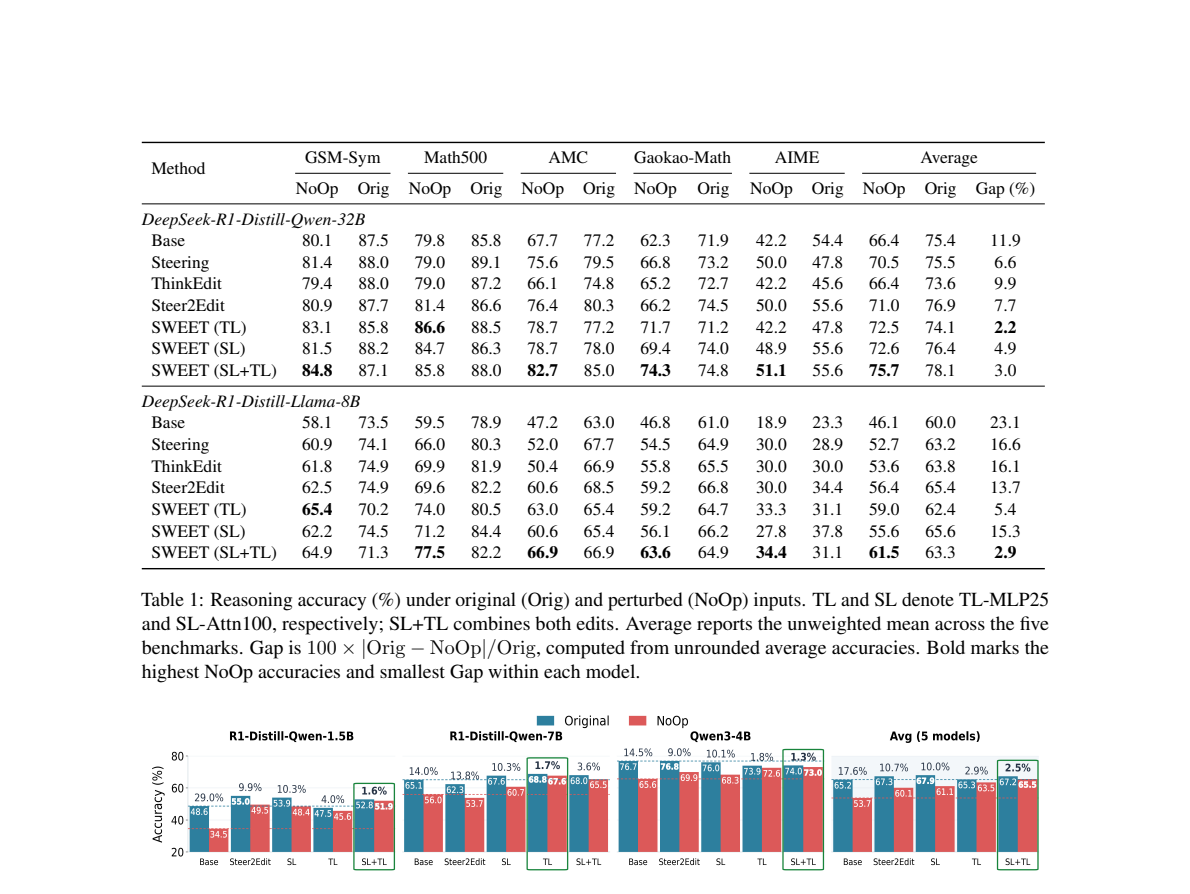
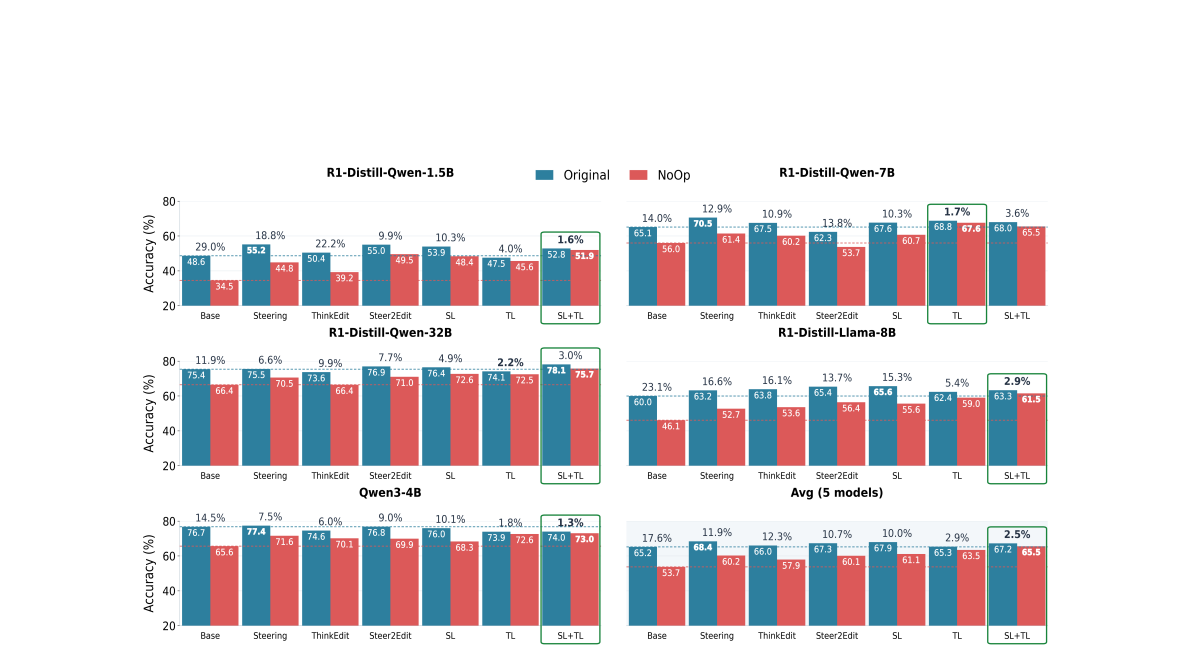
We introduce Spurious-feature WEight EdiTing (SWEET), a training-free method that combines counterfactual interventions with mechanistic interpretability to identify and suppress spurious-features. SWEET extracts token- and sequence-level behavioral directions from activation contrasts between original problems and their counterfactual variants - capturing local and global patterns of spurious reasoning. It then localizes the responsible MLP neurons and attention heads and suppresses their contributions along these directions through weight edits. Using only 20 original-counterfactual pairs for direction extraction, SWEET improves accuracy by an average of 11.8 percentage points on perturbed inputs and 2 points on original inputs across five open-weight reasoning models and five reasoning benchmarks. It also reduces the relative gap between original and perturbed accuracies from 17.6% to 2.5%. Analyses identify two recurring forms of spurious reasoning, i.e. over-integrating irrelevant conditions and overthinking, and provide mechanistic evidence that SWEET improves reasoning robustness by suppressing both behavioral directions.
from the abstract
Pith says
Machine review · deepseek-v4-flash · 10 Nov 2026 · what was read was not recorded · not checked by a person
It can be wrong. Challenge this review or reply to it.
Holds up. Solid, well-executed paper on training-free weight editing for spurious feature suppression in LLM reasoning; the empirical results are convincing and the limitations are transparently stated. This line is wrong
4 minor
How often objections from reviews like this one are right: not yet measured
Not checked: figures, code, what the 82 references say.
4 minor objections
The paper says, at Table 2 caption
Pith says: minor objection 1 of 4
The caption states 'Top four tokens' but the table shows tokens at 75% depth only; briefly note that these are from the primary readout depth and that 25%/50% depth results appear in Appendix G.
The paper says, at Table 3 caption
Pith says: minor objection 2 of 4
The notation 'Judge W/L (%) ↑/↓' is clear after reading Appendix E but could be defined in the main caption for quicker reference, e.g., 'Win/loss percentages (higher win and lower loss are better) over all evaluated NoOp trace pairs requiring agreement across both presentation orders.'
show 2 more
The paper says, at Figure 1 caption
Pith says: minor objection 3 of 4
The panel labels (a), (b), (c) are described in the caption but the subfigures themselves are not lettered in the text; adding visible panel letters to the figure would improve readability.
The paper says, at Appendix A
Pith says: minor objection 4 of 4
The calibration procedure is described clearly, but the use of 'mean regret' (Eq. 10) could be motivated more intuitively: its connection to the goal of achieving a single sparsity setting across models is well explained in the text, but a short remark in the main paper (Section 3.5) would help readers who skip appendices.
What would settle it
As a light verification of robustness, re-run the main comparison (Table 1) on the DS-32B and Llama-8B models while replacing the TL and SL directions with layer-wise shuffled versions of the same direction vectors. If the accuracy gain drops substantially (e.g., >3 pp difference in NoOp accuracy), the specific direction orientation carries additional information. If the gain is similar, the editing procedure itself (rather than the direction content) may be the primary driver, which would weaken the mechanistic interpretation but not the method's practical utility.
from the skeptic's reading
How the review went
4 readings by deepseek-v4-flash · 10 Nov 2026
- Reader holds up
- Skeptic partly agrees
- Editor wrote the verdict above
- Referee accept: 4 minor
Not run on this paper: the simulated authors' defence.
Pith did not check this review's objections against the paper.
The review in full
The review in brief, machine-written
This is a well-crafted paper that delivers on its central claim: a training-free weight editing method (SWEET) that improves reasoning accuracy on perturbed inputs by an average of 11.8 pp and reduces the original–perturbed gap from 17.6% to 2.5% across five models and five benchmarks. The core idea—combining token-level and sequence-level behavioral direction extraction from counterfactual activation contrasts, then editing weights to suppress those directions—is novel and clearly motivated. The authors identify two recurring patterns of spurious reasoning (over-integration and overthinking) and provide mechanistic evidence that the edits suppress both.
The experimental setup is thorough: five open-weight reasoning models, five benchmarks, multiple baselines (Steering, ThinkEdit, Steer2Edit), extensive ablations on component assignments, sparsity sweeps, and sensitivity analyses. The calibration procedure is pragmatic, and the results are consistent across model families and scales. The paper earns its core empirical claims.
The soft spots are mostly acknowledged by the authors themselves. The behavioral proxy measures for overthinking and over-integration rely on LLM judges with high order disagreement (Table 17) and on indirect lexical metrics; the SL direction readouts are noisy and less interpretable. The evaluation is limited to mathematical reasoning with distractor perturbations, so the generality to other tasks or perturbation types is unverified. The calibration procedure uses a single shared grid across models, which may not be optimal per model, though the paper tests sensitivity. None of these are load-bearing flaws given the transparency and the strength of the main results.
This paper will be valuable to anyone working on LLM robustness, mechanistic interpretability, or weight editing. It deserves a serious referee and, after addressing minor reviewer comments on the behavioral measures and calibration details, should be accepted. I would cite it in my own work on interpretability and robustness.
The strongest objection
After careful review, I do not find a load-bearing concern that threatens the central accuracy claim. The paper's core empirical result — an 11.8 pp average improvement on perturbed inputs across five models and five benchmarks — is supported by clean experimental design, appropriate baselines, thorough ablation studies, and sensitivity analyses. The weakest area identified by the reader (separability of TL and SL directions as distinct spurious patterns) is indeed the part with the most interpretive uncertainty, but it does not undercut the primary accuracy claim; the combined edit (SL+TL) works best regardless of perfect separation. The paper's own caution about SL readouts being noisy and the behavioral judge limitations (high order disagreement, Table 17) are transparently stated. The method's advantages over baselines are consistent, and the limitations (single perturbation type, calibration data requirements, occasional trade-offs) are acknowledged. The central argument holds under scrutiny.
The reader's weakest_assumption is accurate: the separability of TL and SL directions as distinct spurious patterns is the least secure part, resting on LLM judges with high order disagreement and noisy SL vocabulary readouts. However, this assumption is not load-bearing for the central claim about accuracy improvement. The paper's primary contribution is the empirical method and its results; the behavioral interpretation is supporting analysis. The accuracy gains are substantial and robust across models, benchmarks, and sensitivity checks. The baselines are fair and the method outperforms them. The paper acknowledges its limitations candidly, including the noisy SL readouts and high judge disagreement. The reader's ACCEPT verdict with medium correctness risk is well-calibrated. I find no reason to change it.
The referee's report
If the results hold, SWEET offers a practical, training-free method to improve reasoning robustness by directly intervening on internal model components. The method requires only 20 original–perturbed pairs for direction extraction, uses no additional training, and generalizes across model families (Qwen, DeepSeek, Llama) and scales (1.5B–32B). The identification of two distinct spurious reasoning patterns and the demonstration that suppressing them through targeted weight edits yields consistent accuracy gains is a valuable contribution to the mechanistic interpretability and robustness literature. The empirical evaluation is thorough: five models, five benchmarks, multiple baselines, extensive ablations, and transparent limitation statements.
Pith's reading of the paper (a machine's summary, not the authors')
SWEET is a training-free weight editing method that extracts behavioral directions from activation contrasts between correctly answered original problems and incorrectly answered perturbed variants, then suppresses contributions of specific attention heads and MLP neurons along those directions. The paper argues that LLM reasoning failures under simple perturbations arise from two separable spurious patterns: over-integration, where models treat irrelevant conditions as relevant, and overthinking, where reasoning repeats without progress. Using only 20 original–counterfactual pairs, SWEET improves perturbed-input accuracy by an average of 11.8 percentage points and original-input accuracy by 2 points, while shrinking the relative accuracy gap from 17.6% to 2.5%. If correct, SWEET provides a scalable, interpretable mechanism for improving reasoning robustness without retraining, and offers a causal decomposition of how models fail on distractor-augmented inputs.
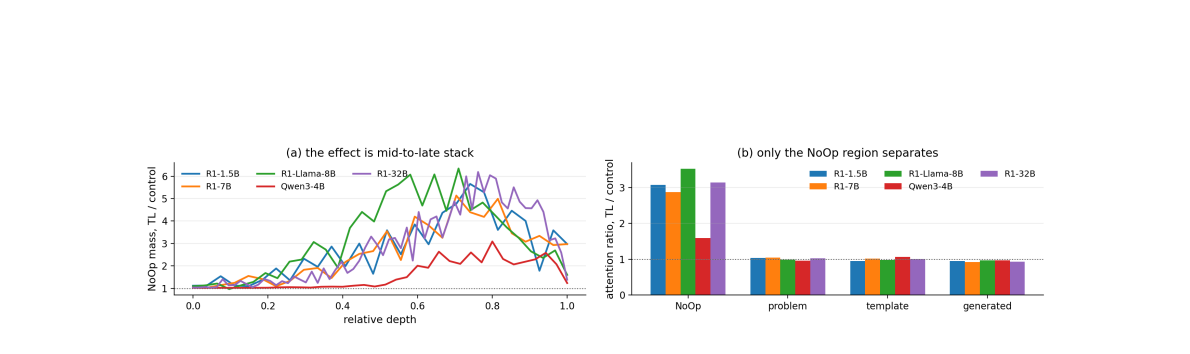
What carries the argument. The key machinery consists of two components: (1) variance-normalized contrastive extraction of token-level (TL) and sequence-level (SL) behavioral directions from residual-stream activations of original–perturbed response pairs, and (2) directional weight editing that zeroes out each selected unit's contribution along those directions by projecting its output weight matrix orthogonal to the direction. TL directions capture localized responses to inserted irrelevant conditions (over-integration), while SL directions capture broader trajectory-level changes (overthinking). The edits are applied to MLP neurons for TL and attention heads for SL.
Core claim. The central discovery is that spurious feature reliance in long chain-of-thought reasoning can be decomposed into two distinct behavioral patterns—over-integration and overthinking—each associated with a specific direction in the model's residual stream. By contrasting activations between correctly answered original problems and incorrectly answered perturbed variants at both the token level (TL) and the sequence level (SL), SWEET extracts directions that capture these patterns. It then localizes the attention heads and MLP neurons that contribute most to these directions and edits their output weights to remove the component along the spurious direction. The edited model shows substantially improved accuracy on perturbed inputs while maintaining or improving accuracy on original inputs, providing causal evidence that the identified directions indeed drive the spurious behavior.
The premise it rests on. The load-bearing premise is that the two behavioral directions extracted from only 20 original–perturbed pairs correspond to genuine and separable spurious reasoning patterns (over-integration and overthinking), and that editing weights along these directions suppresses those patterns without interfering with other reasoning capabilities.
If the paper is right (Pith's inferences, not the authors')
SWEET reduces the relative accuracy gap between original and perturbed inputs from 17.6% to 2.5% on average across five open-weight reasoning models and five reasoning benchmarks.
The method improves accuracy on perturbed inputs by 11.8 percentage points and on original inputs by 2 points, demonstrating that suppressing spurious features generally does not hurt and may help overall performance.
The two extracted directions (TL and SL) correspond to two distinct spurious reasoning patterns (over-integration and overthinking), providing a mechanistic decomposition of failure modes that can guide future robustness interventions.
SWEET requires only 20 original–perturbed pairs for direction extraction and no retraining, making it efficient for practical deployment across models.
The success of SWEET suggests that spurious patterns in LLM reasoning are mediated by low-dimensional directions in the residual stream, a property that may generalize to other types of input perturbations beyond irrelevant distractors.
Because SWEET edits weights permanently, it could be combined with other post-hoc interventions (e.g., pruning, quantization) without retraining, though cumulative trade-offs for other capabilities would need evaluation.
The 20-pair extraction requirement indicates that a very small number of counterfactual examples can reveal robust behavioral directions, which may enable similar analyses for other model behaviors such as safety biases or factual correctness.
The decomposition into over-integration and overthinking may apply to other transformer-based reasoning architectures, not only the five families tested, warranting broader empirical validation.
Check this review
Pith stored no record of this review's passes and took no fingerprint of it. Reviews made by code from 13 Nov 2026 on carry both.
How often reviews like this one are right
Reviews like this one: written by deepseek-v4-flash, where what was read was not recorded.
How often objections from reviews like this one are right: not yet measured
Reviews by people
This review was written by a machine. No person has reviewed this paper on Pith yet. A scientist listed on Pith can review it for a fee, and their review is published here whatever it concludes.
The paper
Abstract
Reasoning in large language models can be disrupted by simple input perturbations (e.g. adding irrelevant distractors), suggesting reliance on spurious correlations. Identifying and suppressing the spurious features involved in long chain-of-thought reasoning remains challenging. We introduce Spurious-feature WEight EdiTing (SWEET), a training-free method that combines counterfactual interventions with mechanistic interpretability to identify and suppress spurious-features. SWEET extracts token- and sequence-level behavioral directions from activation contrasts between original problems and their counterfactual variants - capturing local and global patterns of spurious reasoning. It then localizes the responsible MLP neurons and attention heads and suppresses their contributions along these directions through weight edits. Using only 20 original-counterfactual pairs for direction extraction, SWEET improves accuracy by an average of 11.8 percentage points on perturbed inputs and 2 points on original inputs across five open-weight reasoning models and five reasoning benchmarks. It also reduces the relative gap between original and perturbed accuracies from 17.6% to 2.5%. Analyses identify two recurring forms of spurious reasoning, i.e. over-integrating irrelevant conditions and overthinking, and provide mechanistic evidence that SWEET improves reasoning robustness by suppressing both behavioral directions.
The paper's own sentences, arranged, kept beside the review and separate from it. Each label is drawn from a closed vocabulary; the number beside it is the probability the classifier gave that label. No sentence in this record was written by a model.
abstract compiled · 2026-11-10
The authors' main claim, as the classifier picked it out 0.75
“Analyses identify two recurring forms of spurious reasoning, i.e. over-integrating irrelevant conditions and overthinking, and provide mechanistic evidence that SWEET improves reasoning robustness by suppressing both behavioral directions.”
How the main claim is stated: asserted 1.00
What the abstract itself states, as probabilities: claims first 0.05 · states limitation 0.23 · human participants 0.02 · controlled comparison 0.70 · randomized assignment 0.02 · states quantitative result 0.99 · compares with prior results 0.48 · mentions code or data availability 0.03
The abstract, sentence by sentence
This table labels the abstract only (arXiv listing abstract v1). The number is the probability the classifier gave the label.
| Sentence | Role | The authors' own work | States the main conclusion | Strength |
|---|---|---|---|---|
| Reasoning in large language models can be disrupted by simple input perturbations (e.g. adding irrelevant distractors), suggesting reliance on spurious correlations. | background 1.00 | 0.10 | 0.03 | hedged possibility 0.84 |
| Identifying and suppressing the spurious features involved in long chain-of-thought reasoning remains challenging. | gap 0.94 | 0.05 | 0.03 | asserted 1.00 |
| We introduce Spurious-feature WEight EdiTing (SWEET), a training-free method that combines counterfactual interventions with mechanistic interpretability to identify and suppress spurious-features. | contribution 0.91 | 0.93 | 0.19 | asserted 1.00 |
| SWEET extracts token- and sequence-level behavioral directions from activation contrasts between original problems and their counterfactual variants - capturing local and global patterns of spurious reasoning. | method 1.00 | 0.92 | 0.05 | asserted 1.00 |
| It then localizes the responsible MLP neurons and attention heads and suppresses their contributions along these directions through weight edits. | method 1.00 | 0.90 | 0.07 | asserted 1.00 |
| Using only 20 original-counterfactual pairs for direction extraction, SWEET improves accuracy by an average of 11.8 percentage points on perturbed inputs and 2 points on original inputs across five open-weight reasoning models and five reasoning benchmarks. | result 1.00 | 0.96 | 0.44 | asserted 1.00 |
| It also reduces the relative gap between original and perturbed accuracies from 17.6% to 2.5%. | result 1.00 | 0.94 | 0.17 | asserted 1.00 |
| Analyses identify two recurring forms of spurious reasoning, i.e. over-integrating irrelevant conditions and overthinking, and provide mechanistic evidence that SWEET improves reasoning robustness by suppressing both behavioral directions. | interpretation 0.70 | 0.95 | 0.40 | asserted 1.00 |
What kind of paper the classifier reports this is: method or tool 1.00 · evidence from observation or experiment 0.94
What was examined, and what was not
Sources read
- arXiv listing abstract v1
Not examined
- full text
- figures and tables
- references and citing sentences
- relations to other papers
Levels run
- P abstract
Not run
- S sections
- T body sentences
- C citations
- R cross-paper relations
How the labels were made
Compiled by classifier-1.13.0 via TypeSafe API, question bank abstract-p1-20260923, 2026-11-10: 1 request, 6,415 input tokens.
Every quoted sentence on this record is the authors'. Every label is from Pith's closed vocabulary, with the probability shown beside it. This record as JSON
Figures (4)

Figures are the authors', reproduced from the paper.
References (82)
- [3] Andy Arditi, Oscar Obeso, Aaquib Syed, Daniel Paleka, Nina Panickssery, Wes Gurnee, and Neel Nanda. 2024. Refusal in language models is mediated by a single direction. Advances in Neural Information Processing Systems, 37:136037--136083 on Pith
- [4] Nora Belrose, Igor Ostrovsky, Lev McKinney, Zach Furman, Logan Smith, Danny Halawi, Stella Biderman, and Jacob Steinhardt. 2023. https://doi.org/10.48550/arXiv.2303.08112 Eliciting latent predictions from transformers with the tuned lens . arXiv preprint arXiv:2303.08112 on PithPith's reviewarXivdoi:10.48550/arxiv.2303.08112
- [5] Qiguang Chen, Libo Qin, Jinhao Liu, Dengyun Peng, Jiannan Guan, Peng Wang, Mengkang Hu, Yuhang Zhou, Te Gao, and Wanxiang Che. 2026. Towards reasoning era: A survey of long chain-of-thought for reasoning large language models. Science China Information Sciences, 69(6):161101 on Pith
- [8] Nelson Elhage, Neel Nanda, Catherine Olsson, Tom Henighan, Nicholas Joseph, Ben Mann, Amanda Askell, Yuntao Bai, Anna Chen, Tom Conerly, et al. 2021. https://transformer-circuits.pub/2021/framework/index.html A mathematical framework for transformer circuits . Transformer Circ... on Pith
- [9] Zhizhang Fu, Guangsheng Bao, Hongbo Zhang, Chenkai Hu, and Yue Zhang. 2026. Correlation or causation: Analyzing the causal structures of llm and lrm reasoning process. IEEE Transactions on Audio, Speech and Language Processing on Pith
- [10] Robert Geirhos, J \"o rn-Henrik Jacobsen, Claudio Michaelis, Richard Zemel, Wieland Brendel, Matthias Bethge, and Felix A Wichmann. 2020. Shortcut learning in deep neural networks. Nature Machine Intelligence, 2(11):665--673 on Pith
- [11] Mor Geva, Roei Schuster, Jonathan Berant, and Omer Levy. 2021. Transformer feed-forward layers are key-value memories. In Proceedings of the 2021 conference on empirical methods in natural language processing, pages 5484--5495 on Pith
- [13] Yiju Guo, Wenkai Yang, Zexu Sun, Ning Ding, Zhiyuan Liu, and Yankai Lin. 2026. Learning to focus: Causal attention distillation via gradient-guided token pruning. Advances in Neural Information Processing Systems, 38:24921--24948 on Pith
- [14] Shulin Huang, Linyi Yang, Yan Song, Shawn Chen, Leyang Cui, Ziyu Wan, Qingcheng Zeng, Ying Wen, Kun Shao, Weinan Zhang, et al. 2026. Thinkbench: Dynamic out-of-distribution evaluation for robust llm reasoning. Advances in Neural Information Processing Systems, 38 on Pith
- [17] Woosuk Kwon, Zhuohan Li, Siyuan Zhuang, Ying Sheng, Lianmin Zheng, Cody Hao Yu, Joseph Gonzalez, Hao Zhang, and Ion Stoica. 2023. Efficient memory management for large language model serving with pagedattention. In Proceedings of the 29th symposium on operating systems princip... on Pith
- [18] Minpeng Liao, Chengxi Li, Wei Luo, Wu Jing, and Kai Fan. 2024. Mario: Math reasoning with code interpreter output-a reproducible pipeline. In Findings of the Association for Computational Linguistics: ACL 2024, pages 905--924 on Pith
- [19] Rabeeh Karimi Mahabadi, Yonatan Belinkov, and James Henderson. 2020. End-to-end bias mitigation by modelling biases in corpora. In Proceedings of the 58th annual meeting of the association for computational linguistics, pages 8706--8716 on Pith
- [20] Mathematical Association of America . n.d. a . American invitational mathematics examination ( AIME ). https://maa.org/maa-invitational-competitions/. Accessed September 18, 2026 on Pith
- [21] Mathematical Association of America . n.d. b . American mathematics competitions ( AMC ). https://maa.org/student-programs/amc/. Accessed September 18, 2026 on Pith
- [23] Iman Mirzadeh, Keivan Alizadeh-Vahid, Hooman Shahrokhi, Oncel Tuzel, Samy Bengio, and Mehrdad Farajtabar. 2025. Gsm-symbolic: Understanding the limitations of mathematical reasoning in large language models. In International Conference on Learning Representations, volume 2025,... on Pith
- [24] Niklas Muennighoff, Zitong Yang, Weijia Shi, Xiang Lisa Li, Li Fei-Fei, Hannaneh Hajishirzi, Luke Zettlemoyer, Percy Liang, Emmanuel Cand \`e s, and Tatsunori B Hashimoto. 2025. s1: Simple test-time scaling. In Proceedings of the 2025 Conference on Empirical Methods in Natural... on Pith
- [25] OpenAI. 2025. Introducing OpenAI o3 and o4-mini . https://openai.com/index/introducing-o3-and-o4-mini/ on Pith
- [26] Judea Pearl. 2009. Causality. Cambridge university press on Pith
- [27] Nina Rimsky, Nick Gabrieli, Julian Schulz, Meg Tong, Evan Hubinger, and Alexander Turner. 2024. Steering llama 2 via contrastive activation addition. In Proceedings of the 62nd Annual Meeting of the Association for Computational Linguistics (Volume 1: Long Papers), pages 15504--15522 on Pith
- [29] Chung-En Sun, Ge Yan, and Tsui-Wei Weng. 2025. Thinkedit: Interpretable weight editing to mitigate overly short thinking in reasoning models. In Proceedings of the 2025 Conference on Empirical Methods in Natural Language Processing, pages 17012--17036 on Pith
show 62 more
- [32] Martin Tutek, Fateme Hashemi Chaleshtori, Ana Marasovi \'c , and Yonatan Belinkov. 2025. Measuring chain of thought faithfulness by unlearning reasoning steps. In Proceedings of the 2025 Conference on Empirical Methods in Natural Language Processing, pages 9946--9971 on Pith
- [33] Ashish Vaswani, Noam Shazeer, Niki Parmar, Jakob Uszkoreit, Llion Jones, Aidan N Gomez, ukasz Kaiser, and Illia Polosukhin. 2017. Attention is all you need. Advances in neural information processing systems, 30 on Pith
- [34] Tianlu Wang, Rohit Sridhar, Diyi Yang, and Xuezhi Wang. 2022. Identifying and mitigating spurious correlations for improving robustness in nlp models. In Findings of the association for computational linguistics: NAACL 2022, pages 1719--1729 on Pith
- [36] Junda Wu, Tong Yu, Xiang Chen, Haoliang Wang, Ryan Rossi, Sungchul Kim, Anup Rao, and Julian McAuley. 2024. Decot: Debiasing chain-of-thought for knowledge-intensive tasks in large language models via causal intervention. In Proceedings of the 62nd Annual Meeting of the Associ... on Pith
- [40] Chenxu Yang, Qingyi Si, Yongjie Duan, Zheliang Zhu, Chenyu Zhu, Qiaowei Li, Minghui Chen, Zheng Lin, and Weipinng Wang. 2026. Dynamic early exit in reasoning models. In International Conference on Learning Representations, volume 2026, pages 88170--88210 on Pith
- [42] Yuqing Zhou and Ziwei Zhu. 2025. Fighting spurious correlations in text classification via a causal learning perspective. In Proceedings of the 2025 Conference of the Nations of the Americas Chapter of the Association for Computational Linguistics: Human Language Technologies ... on Pith
- [43] Bengio, Yoshua and LeCun, Yann , booktitle =. Scaling Learning Algorithms Towards on Pith
- [44] Hinton, Geoffrey E. and Osindero, Simon and Teh, Yee Whye , journal =. A Fast Learning Algorithm for Deep Belief Nets , volume = on Pith
- [45] Deep learning , author=. 2016 , publisher= on Pith
- [46] Thinkbench: Dynamic out-of-distribution evaluation for robust llm reasoning , author=. Advances in Neural Information Processing Systems , volume= on Pith
- [47] Gsm-symbolic: Understanding the limitations of mathematical reasoning in large language models , author=. International Conference on Learning Representations , volume= on Pith
- [48] End-to-end bias mitigation by modelling biases in corpora , author=. Proceedings of the 58th annual meeting of the association for computational linguistics , pages= on Pith
- [49] Identifying and mitigating spurious correlations for improving robustness in nlp models , author=. Findings of the association for computational linguistics: NAACL 2022 , pages= on Pith
- [50] Fighting spurious correlations in text classification via a causal learning perspective , author=. Proceedings of the 2025 Conference of the Nations of the Americas Chapter of the Association for Computational Linguistics: Human Language Technologies (Volume 1: Long Papers) , pages= on Pith
- [51] Learning to Focus: Causal Attention Distillation via Gradient-Guided Token Pruning , author=. Advances in Neural Information Processing Systems , volume= on Pith
- [52] Decot: Debiasing chain-of-thought for knowledge-intensive tasks in large language models via causal intervention , author=. Proceedings of the 62nd Annual Meeting of the Association for Computational Linguistics (Volume 1: Long Papers) , pages= on Pith
- [53] Kimi k3: Open frontier intelligence , author=. arXiv preprint arXiv:2607.24653 , year= on PitharXiv
- [54] System Card:. 2026 , month = sep, url = on Pith
- [55] Deepseek-v4: Towards highly efficient million-token context intelligence , author=. arXiv preprint arXiv:2606.19348 , year= on PitharXiv
- [56] Large language models can be easily distracted by irrelevant context , author=. International conference on machine learning , pages=. 2023 , organization= on Pith
- [57] How is llm reasoning distracted by irrelevant context? an analysis using a controlled benchmark , author=. Proceedings of the 2025 Conference on Empirical Methods in Natural Language Processing , pages= on Pith
- [58] Correlation or Causation: Analyzing the Causal Structures of LLM and LRM Reasoning Process , author=. IEEE Transactions on Audio, Speech and Language Processing , year= on Pith
- [59] Scaling Monosemanticity: Extracting Interpretable Features from Claude 3 Sonnet , author=. Transformer Circuits Thread , year= on Pith
- [60] Circuit Tracing: Revealing Computational Graphs in Language Models , author=. Transformer Circuits Thread , year= on Pith
- [61] Verbalizable Representations Form a Global Workspace in Language Models , author=. Transformer Circuits Thread , year= on Pith
- [62] Natural Language Autoencoders Produce Unsupervised Explanations of LLM Activations , author=. Transformer Circuits Thread , year= on Pith
- [63] Detecting and pruning prominent but detrimental neurons in large language models , author=. arXiv preprint arXiv:2507.09185 , year= on PithPith's reviewarXiv
- [64] Steering language models with activation engineering , author=. arXiv preprint arXiv:2308.10248 , year= on PithPith's reviewarXiv
- [65] Steering llama 2 via contrastive activation addition , author=. Proceedings of the 62nd Annual Meeting of the Association for Computational Linguistics (Volume 1: Long Papers) , pages= on Pith
- [66] Thinkedit: Interpretable weight editing to mitigate overly short thinking in reasoning models , author=. Proceedings of the 2025 Conference on Empirical Methods in Natural Language Processing , pages= on Pith
- [67] Assessing the brittleness of safety alignment via pruning and low-rank modifications , author=. arXiv preprint arXiv:2402.05162 , year= on PithPith's reviewarXiv
- [68] Measuring chain of thought faithfulness by unlearning reasoning steps , author=. Proceedings of the 2025 Conference on Empirical Methods in Natural Language Processing , pages= on Pith
- [69] Steer2Edit: From Activation Steering to Component-Level Editing , author=. arXiv preprint arXiv:2602.09870 , year= on PithPith's reviewarXiv
- [70] Michalis Korakakis and Andreas Vlachos and Adrian Weller , editor =. Mitigating Shortcut Learning with InterpoLated Learning , booktitle =. 2025 , url =. doi:10.18653/V1/2025.ACL-LONG.450 , timestamp = on Pithdoi:10.18653/v1/2025.acl-long.450
- [71] Uncovering latent chain of thought vectors in language models , author=. arXiv preprint arXiv:2409.14026 , year= on PithPith's reviewarXiv
- [72] A Mathematical Framework for Transformer Circuits , author =. Transformer Circuits Thread , year = on Pith
- [73] Transformer feed-forward layers are key-value memories , author=. Proceedings of the 2021 conference on empirical methods in natural language processing , pages= on Pith
- [74] Deepseek-r1: Incentivizing reasoning capability in llms via reinforcement learning , author=. arXiv preprint arXiv:2501.12948 , year= on PithPith's reviewarXiv
- [75] Efficient memory management for large language model serving with pagedattention , author=. Proceedings of the 29th symposium on operating systems principles , pages= on Pith
- [76] MARIO: MAth reasoning with code interpreter output-a reproducible pipeline , author=. Findings of the Association for Computational Linguistics: ACL 2024 , pages= on Pith
- [77] American Mathematics Competitions (. n.d. , howpublished = on Pith
- [78] American Invitational Mathematics Examination (. n.d. , howpublished = on Pith
- [79] Refusal in language models is mediated by a single direction , author=. Advances in Neural Information Processing Systems , volume= on Pith
- [80] Eliciting Latent Predictions from Transformers with the Tuned Lens , author =. arXiv preprint arXiv:2303.08112 , year = on PithPith's reviewarXiv
- [81] On layer normalization in the transformer architecture , author=. International conference on machine learning , pages=. 2020 , organization= on Pith
- [82] Attention is all you need , author=. Advances in neural information processing systems , volume= on Pith
- [83] Towards reasoning era: A survey of long chain-of-thought for reasoning large language models , author=. Science China Information Sciences , volume=. 2026 , publisher= on Pith
- [84] Persona vectors: Monitoring and controlling character traits in language models , author=. arXiv preprint arXiv:2507.21509 , year= on PithPith's reviewarXiv
- [85] Qwen3 technical report , author=. arXiv preprint arXiv:2505.09388 , year= on PithPith's reviewarXiv
- [86] Exploring and mitigating shortcut learning for generative large language models , author=. Proceedings of the 2024 joint international conference on computational linguistics, language resources and evaluation (LREC-COLING 2024) , pages= on Pith
- [87] Mitigating spurious correlations between question and answer via chain-of-thought correctness perception distillation , author=. arXiv preprint arXiv:2509.05602 , year= on PithPith's reviewarXiv
- [88] Causality , author=. 2009 , publisher= on Pith
- [89] Decomposing Reasoning Efficiency in Large Language Models , author=. arXiv preprint arXiv:2602.09805 , year= on PithPith's reviewarXiv
- [90] Do NOT Think That Much for 2+3=? On the Overthinking of o1-Like LLMs , author=. arXiv preprint arXiv:2412.21187 , year= on PithPith's reviewarXiv
- [91] Thinking Past the Answer: Evaluating Harmful Overthinking in Large Reasoning Models , author=. arXiv preprint arXiv:2606.02835 , year= on PithPith's reviewarXiv
- [92] Extreme Low-Bit Inference in Reasoning Models: Failure Modes and Targeted Recovery , author=. arXiv preprint arXiv:2606.02011 , year= on PithPith's reviewarXiv
- [93] s1: Simple test-time scaling , author=. Proceedings of the 2025 Conference on Empirical Methods in Natural Language Processing , pages= on Pith
- [94] Dynamic early exit in reasoning models , author=. International Conference on Learning Representations , volume= on Pith
- [95] Seal: Steerable reasoning calibration of large language models for free , author=. arXiv preprint arXiv:2504.07986 , year= on PitharXiv
- [96] Chain of draft: Thinking faster by writing less , author=. arXiv preprint arXiv:2502.18600 , year= on PithPith's reviewarXiv
- [97] Shortcut learning in deep neural networks , author=. Nature Machine Intelligence , volume=. 2020 , publisher= on Pith
- [98] Mendelson, Michael and Belinkov, Yonatan. Debiasing Methods in Natural Language Understanding Make Bias More Accessible. Proceedings of the 2021 Conference on Empirical Methods in Natural Language Processing. 2021. doi:10.18653/v1/2021.emnlp-main.116 on Pithdoi:10.18653/v1/2021.emnlp-main.116
Challenges and discussion
Disagree with the review, or know something it missed? Leave a comment, or challenge this review formally: a challenge becomes a permanent entry in this paper's record, and its decision is published here.
Come back by email
A short list of the week's newly reviewed papers. Nothing is sent until you confirm from your inbox, and every email has a link that stops it. No account.
No comments yet.
Sign in to comment