Machine Learning · arXiv:2611.11499 v1 · submitted 8 Nov 2026 · 21 references
JoMoHa: Joint Model–Harness Optimization with Reinforcement Learning
The paper says
“The performance of language agents depends jointly on model weights and the harness. Optimizing either alone can be constrained by the other component, limiting overall performance gains.”
more of the abstract
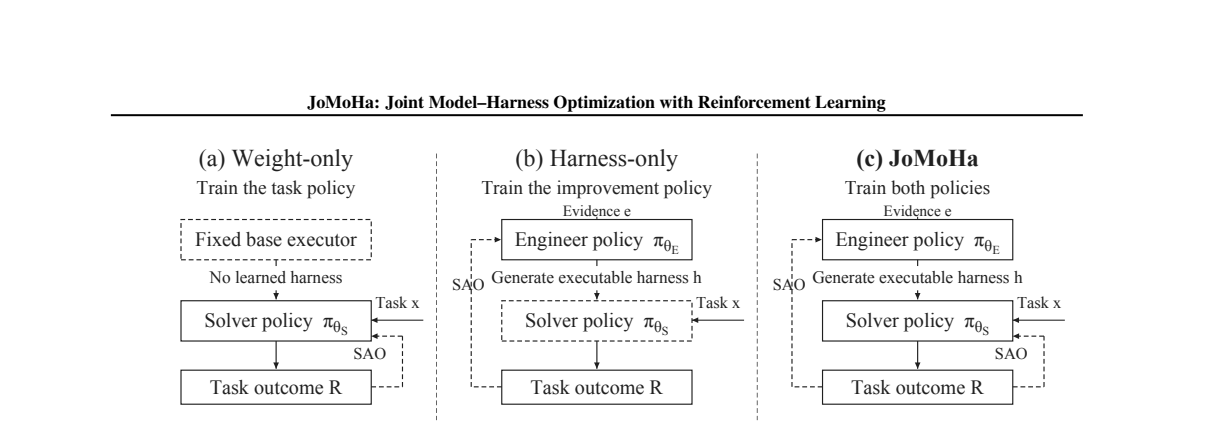
Our analysis of naive alternating training reveals progressive incompatibility between the model and harness, which increasingly interferes with task execution and may also undermine model training, leading to performance degradation. To coordinate the evolution of models and harnesses, we introduce JoMoHa, to our knowledge the first framework to jointly train an executable harness generation policy and a task execution policy through reinforcement learning. JoMoHa outperforms the evaluated weight-only and harness-only baselines and achieves the highest success rates among the evaluated methods on ALFWorld, WebShop, and DBBench, averaging 70.3% and reaching 97.0% on ALFWorld. By learning both task execution and runtime improvement from its own generated trajectories, JoMoHa performs recursive self-improvement (RSI).
from the abstract
Pith says
Machine review · deepseek-v4-flash · 10 Nov 2026 · what was read was not recorded · not checked by a person
It can be wrong. Challenge this review or reply to it.
Holds up, with conditions. JoMoHa's diagnosis of alternating training failure is its strongest contribution; the joint training idea is sound and well-tested on ALFWorld, but the headline multi-benchmark claim rests on thin margins without error bars on two of three environments. This line is wrong
2 major objections · 5 minor
How often objections from reviews like this one are right: not yet measured
Not checked: figures, code, what the 21 references say.
The paper says, at Table 4, Section 6.1
The review did not quote this passage.
Pith says: Objection 1 of 2 · major
All main results are reported as point estimates without any measure of variance (e.g., standard deviation, confidence intervals, or multiple-seed runs). On WebShop the margin over WHALE is 2.4 percentage points (45.8% vs 43.4%); on DBBench the margin is 2.7 points (68.0% vs 65.3%).
more of objection 1
These differences are small relative to the typical variance of language agent evaluations with moderate task counts. Without error bars or significance tests, the central claim that JoMoHa achieves the 'highest success rates among the evaluated methods on all three benchmarks' is not fully supported for WebShop and DBBench. The paper should provide either multiple independent runs, bootstrap confidence intervals, or a statistical test, and adjust the strength of the claim accordingly.
The paper says, at Section 6.2, Table 6
The review did not quote this passage.
Pith says: Objection 2 of 2 · major
The coordination-component ablation (Table 6) is conducted exclusively on ALFWorld. While ALFWorld is a suitable testbed, the generalization of the coordination mechanisms to WebShop and DBBench is unexamined. The main results on those environments use the full JoMoHa, so it is unclear whether the relative contributions of Schedule, Context, Peer, and ValueNorm hold in other settings. The paper should either extend the ablation to at least one additional environment or explicitly discuss this scope limitation.
5 minor objections
The paper says, at Abstract and Section 1
Pith says: minor objection 1 of 5
The phrase 'to our knowledge the first framework to jointly train an executable harness generation policy and a task execution policy through reinforcement learning' appears twice (abstract and introduction). This is acceptable but the paper could simply state the novelty once and reference it later.
The paper says, at Section 5.2, Eq. (4)
Pith says: minor objection 2 of 5
The ValueNorm equation writes the normalized target as (G_i,t - m_i) / sigma_i, but the running statistics m_i and sigma_i are not explicitly defined as mean and standard deviation. Clarify that these are the empirical mean and standard deviation of the critic targets for each role, and how they are updated (e.g., exponential moving average).
show 3 more
The paper says, at Table 4
Pith says: minor objection 3 of 5
The WebShop column includes both 'Score' and 'Succ.' but the average (Avg.) is computed from ALFWorld All, WebShop Succ., and DBBench Succ., excluding WebShop Score. This is reasonable but should be explicitly stated in the table caption for clarity.
The paper says, at Section 4.1, Table 3
Pith says: minor objection 4 of 5
The trajectory analysis (Case 1, bullet list) demonstrates the harness-state issue with a specific example. It would be helpful to report how many evaluation trajectories exhibit this pattern to contextualize the qualitative example.
The paper says, at Section 2
Pith says: minor objection 5 of 5
The related work discussion is thorough. However, the paper could briefly note that cooperative MARL methods (e.g., COMA, MAPPO) typically assume that all agents act directly in the environment, whereas JoMoHa’s Engineer influences the Solver only through generated code. This distinction is clear in the text but a brief summary would help readers.
What would settle it
Run the main experiments (Table 4) for JoMoHa and the closest competitor WHALE on WebShop and DBBench with 5 independent seeds each (different random seeds for training, keeping evaluation fixed). Report mean success rate ± 1 standard deviation over seeds. If the distributions overlap substantially (e.g., WHALE's mean + 1 sd exceeds JoMoHa's mean), the claim 'highest success rates' should be downgraded to 'competitive with'. Also report the exact number of evaluation episodes per benchmark to enable binomial confidence intervals. Code is already public, so this test is feasible without re-implementation.
from the skeptic's reading
How the review went
4 readings by deepseek-v4-flash · 10 Nov 2026
- Reader holds up, with conditions
- Skeptic partly agrees
- Editor wrote the verdict above
- Referee major revision: 2 major objections, 5 minor
Not run on this paper: the simulated authors' defence.
Pith did not check this review's objections against the paper.
The review in full
The review in brief, machine-written
JoMoHa does several things well. The central insight—that the harness and the model need to be trained jointly rather than independently or in alternating phases—is clearly motivated. The diagnosis of alternating training (Section 4) is genuinely useful: by isolating Solver degradation from harness incompatibility, the paper provides concrete evidence for why naive alternation fails. The design choices (Context, ValueNorm, Peer, Schedule) are adaptations of known cooperative RL ideas to a program-mediated setting, and the ablation study lands cleanly. The code is released. This is serious, reproducible work.
The main soft spot is statistical. On WebShop and DBBench, the margin over WHALE is 2.4 and 2.7 percentage points respectively. No error bars, confidence intervals, or multiple-seed runs are reported. The stress-test note reads the same concern I have: those gaps could easily be within noise, especially given moderate task counts. The paper does not acknowledge this limitation. On ALFWorld the margin is large (16.5 pts) and the claim there is solid. But the abstract and main text claim "the highest success rates among the evaluated methods on ALFWorld, WebShop, and DBBench" as a single statement. For two of those environments, the evidence is weaker than the writing suggests.
A secondary issue: the coordination ablation is only on ALFWorld. Generalization of those mechanisms to the other two environments is assumed but not tested.
Who should read this? Researchers working on agent architectures, especially those interested in learning harnesses rather than hand-designing them. The diagnosis of alternating failure is a nice cautionary tale.
Recommendation: peer review, with a required revision that adds uncertainty estimates (at least multiple seeds or confidence intervals) for the WebShop and DBBench results. The paper is otherwise well-constructed and worth engaging.
The strongest objection
The paper's central claim—that JoMoHa achieves the highest success rates on all three benchmarks—relies entirely on point estimates without any measure of variance, confidence intervals, or significance tests. No multiple-seed runs are reported. On WebShop, JoMoHa reports 45.8% vs WHALE's 43.4% (2.4 pt gap); on DBBench, 68.0% vs WHALE's 65.3% (2.7 pt gap). These margins are small enough that they could arise from random seed variation or evaluation set composition, especially given the moderate number of evaluation tasks (the paper does not specify). On ALFWorld, the margin over WHALE is large (97.0% vs 80.5%), making that result more robust, but the 'highest success rates' claim for all three environments is statistically unsubstantiated for WebShop and DBBench. The paper does not discuss this limitation; it is missing rather than acknowledged. Therefore, the central comparative claim is not fully supported for two of three environments.
The reader identified the reward-sparsity assumption as the weakest point, but the paper provides reasonable evidence that the Engineer learns effective harnesses from binary reward: cross-evaluation (Table 5) shows later programs improve fixed-Solver performance, and Frozen Engineer control (Figure 1) shows training the Engineer yields gains beyond just resampling. Thus, the reward-sparsity concern is partially mitigated. However, the paper lacks any statistical uncertainty quantification—no error bars, confidence intervals, or multiple-seed runs—which is a standard requirement for empirical claims of state-of-the-art performance. On WebShop and DBBench, the margins over WHALE are 2.4 and 2.7 points, which could easily be non-significant given typical variance in these benchmarks. The reader's verdict was CONDITIONAL with medium correctness risk, which is consistent with this concern. Therefore, I recommend keeping the CONDITIONAL verdict unchanged, with the additional condition that statistical reliability be demonstrated. The paper's strengths (code release, careful ablations, diagnostic experiments) remain intact, but the central forte claim requires more rigorous empirical backing.
The referee's report
If the reported results are robust, JoMoHa represents a meaningful advance by making both the harness generator and the task policy learnable from the same execution feedback, enabling recursive self-improvement within the agent system. The diagnosis of model-harness incompatibility in alternating training is well-conducted and provides practical motivation for joint training. The coordination mechanisms are principled and their individual contributions are ablated on ALFWorld. The work opens a new direction for jointly optimizing language model weights and their runtime harnesses.
Pith's reading of the paper (a machine's summary, not the authors')
Language agents consist of a model (weights) and a harness (the runtime program that orchestrates actions). Previous work optimizes either one alone, but the two interact: a mismatched harness can degrade task execution and distort the agent's training experience. JoMoHa is, to the authors' knowledge, the first framework that jointly trains both a harness-generation policy (the Engineer) and a task-execution policy (the Solver) using the same binary task reward. The paper diagnoses failure patterns in alternating updates — a harness that fails to track state, and a Solver that loses capability under an incompatible harness — then shows that joint training with coordination mechanisms (context-aware values, role-specific normalization, partner-trajectory weighting, and asymmetric schedules) avoids these pitfalls. On ALFWorld, WebShop, and DBBench, JoMoHa beats weight-only, harness-only, and previous joint approaches (e.g., WHALE), achieving 97.0%, 45.8%, and 68.0% success respectively.
What carries the argument. The central mechanism is a cooperative multi-agent RL setup with two policies (Engineer and Solver) and four coordination adaptations: (1) collaboration-aware value estimation (Context) — each critic sees a short summary of the partner's execution conditions; (2) role-specific return normalization (ValueNorm) — handling different return scales because the Engineer generates one program while the Solver takes many actions; (3) partner-trajectory weighting (Peer) — adjusting the influence of recorded experience by how likely it is under the current partner policy; and (4) asymmetric update schedules (Schedule) — giving the Solver extra adaptation steps after each joint round. The RL backbone is Single-Rollout Asynchronous Optimization (SAO), which uses one rollout per prompt and a learned critic.
Core claim. The paper shows that a language agent's model and its runtime harness must be trained together to maintain compatibility; separately updating either one leads to progressive degradation. JoMoHa, the proposed joint reinforcement-learning framework, trains both an Engineer (which generates an executable harness from feedback) and a Solver (which acts under that harness) on the same episodic reward. The authors demonstrate through controlled experiments that a fixed harness becomes increasingly harmful as the Solver changes (up to 13.0 percentage points of compatibility loss), and that the Solver's ability can decline even without the harness (a 34.5-point drop in no-harness condition). By learning both policies from shared trajectories, JoMoHa achieves recursive self-improvement: the system improves its own runtime environment as well as its task performance.
The premise it rests on. The Engineer policy learns to generate effective harnesses purely from the binary task success reward, without any additional reward shaping or supervision on harness quality (e.g., code correctness, state-tracking accuracy).
If the paper is right (Pith's inferences, not the authors')
Language-agent designs should treat the harness as a trainable component rather than a fixed template; joint optimization with the model can yield substantial gains over one-sided improvements.
The recursive self-improvement loop — where the system learns from its own generated harnesses and rollouts — provides a concrete path toward agents that autonomously upgrade their own runtime.
The diagnostic methodology (comparing fixed-harness vs. no-harness performance across checkpoints) offers a reusable tool for identifying compatibility failures in any two-component learning system.
The largest gains on ALFWorld occur on tasks requiring state tracking (Clean, Heat, Cool), suggesting that joint training helps the harness correctly reflect environment state, which is a common weakness in agent pipelines.
The coordination mechanisms (Context, ValueNorm, Peer, Schedule) each contribute modestly (1.5–4.0 points) individually, but together unlock an 8.5-point improvement over joint updates without coordination, indicating that the interaction of multiple techniques is crucial.
If the binary reward is sufficient to train both policies, similar joint-RL approaches could extend to other settings where one policy generates code or prompts that another policy executes (e.g., tool creation, data pipelines, game AI).
The paper's explicit coordination mechanisms may be necessary in any multi-policy RL system with shared reward but different output structures; the success on agentic tasks suggests these ideas could transfer to cooperative multi-agent domains beyond language.
A potential extension: adding a small amount of harness-quality supervision (e.g., code syntax or state-tracking accuracy) might accelerate Engineer learning without harming the joint optimization, though the current results show the binary signal already suffices.
The alternation failure analysis (Table 2) shows that performance can collapse after initial gains; this warns practitioners that naive two-phase training in agent systems can backfire, and a joint approach or careful checkpointing is advisable.
Check this review
Pith stored no record of this review's passes and took no fingerprint of it. Reviews made by code from 13 Nov 2026 on carry both.
How often reviews like this one are right
Reviews like this one: written by deepseek-v4-flash, where what was read was not recorded.
How often objections from reviews like this one are right: not yet measured
Reviews by people
This review was written by a machine. No person has reviewed this paper on Pith yet. A scientist listed on Pith can review it for a fee, and their review is published here whatever it concludes.
The paper
Abstract
The performance of language agents depends jointly on model weights and the harness. Optimizing either alone can be constrained by the other component, limiting overall performance gains. Our analysis of naive alternating training reveals progressive incompatibility between the model and harness, which increasingly interferes with task execution and may also undermine model training, leading to performance degradation. To coordinate the evolution of models and harnesses, we introduce JoMoHa, to our knowledge the first framework to jointly train an executable harness generation policy and a task execution policy through reinforcement learning. JoMoHa outperforms the evaluated weight-only and harness-only baselines and achieves the highest success rates among the evaluated methods on ALFWorld, WebShop, and DBBench, averaging 70.3% and reaching 97.0% on ALFWorld. By learning both task execution and runtime improvement from its own generated trajectories, JoMoHa performs recursive self-improvement (RSI).
The paper's own sentences, arranged, kept beside the review and separate from it. Each label is drawn from a closed vocabulary; the number beside it is the probability the classifier gave that label. No sentence in this record was written by a model.
abstract compiled · 2026-11-10
The authors' main claim, as the classifier picked it out 0.97
“JoMoHa outperforms the evaluated weight-only and harness-only baselines and achieves the highest success rates among the evaluated methods on ALFWorld, WebShop, and DBBench, averaging 70.3% and reaching 97.0% on ALFWorld.”
How the main claim is stated: asserted 1.00
What the abstract itself states, as probabilities: claims first 0.95 · states limitation 0.18 · human participants 0.03 · controlled comparison 0.95 · randomized assignment 0.02 · states quantitative result 0.99 · compares with prior results 0.97 · mentions code or data availability 0.03
The abstract, sentence by sentence
This table labels the abstract only (arXiv listing abstract v1). The number is the probability the classifier gave the label.
| Sentence | Role | The authors' own work | States the main conclusion | Strength |
|---|---|---|---|---|
| The performance of language agents depends jointly on model weights and the harness. | background 1.00 | 0.16 | 0.07 | asserted 1.00 |
| Optimizing either alone can be constrained by the other component, limiting overall performance gains. | background 0.88 | 0.13 | 0.05 | asserted 0.83 |
| Our analysis of naive alternating training reveals progressive incompatibility between the model and harness, which increasingly interferes with task execution and may also undermine model training, leading to performance degradation. | result 0.46 | 0.85 | 0.09 | hedged possibility 0.50 |
| To coordinate the evolution of models and harnesses, we introduce JoMoHa, to our knowledge the first framework to jointly train an executable harness generation policy and a task execution policy through reinforcement learning. | contribution 0.88 | 0.93 | 0.16 | asserted 1.00 |
| JoMoHa outperforms the evaluated weight-only and harness-only baselines and achieves the highest success rates among the evaluated methods on ALFWorld, WebShop, and DBBench, averaging 70.3% and reaching 97.0% on ALFWorld. | result 1.00 | 0.96 | 0.58 | asserted 1.00 |
| By learning both task execution and runtime improvement from its own generated trajectories, JoMoHa performs recursive self-improvement (RSI). | interpretation 0.41 | 0.88 | 0.12 | asserted 1.00 |
What kind of paper the classifier reports this is: method or tool 1.00 · evidence from observation or experiment 0.94
What was examined, and what was not
Sources read
- arXiv listing abstract v1
Not examined
- full text
- figures and tables
- references and citing sentences
- relations to other papers
Levels run
- P abstract
Not run
- S sections
- T body sentences
- C citations
- R cross-paper relations
How the labels were made
Compiled by classifier-1.13.0 via TypeSafe API, question bank abstract-p1-20260923, 2026-11-10: 1 request, 4,975 input tokens.
Every quoted sentence on this record is the authors'. Every label is from Pith's closed vocabulary, with the probability shown beside it. This record as JSON
Figures (3)


Figures are the authors', reproduced from the paper.
References (21)
- [3] URL https://arxiv.org/abs/ 2503.09516. Khattab, O., Singhvi, A., Maheshwari, P., Zhang, Z., San- thanam, K., Vardhamanan, S., Haq, S., Sharma, A., Joshi, T. T., Moazam, H., Miller, H., Zaharia, M., and Potts, C. DSPy: Compiling declarative language model calls into self-improv... on PithPith's reviewarXiv
- [7] URL https://arxiv.org/abs/ 2603.28052. Liu, X., Yu, H., Zhang, H., Xu, Y ., Lei, X., Lai, H., Gu, Y ., Ding, H., Men, K., Yang, K., Zhang, S., Deng, X., Zeng, A., Du, Z., Zhang, C., Shen, S., Zhang, T., Su, Y ., Sun, H., Huang, M., Dong, Y ., and Tang, J. AgentBench: Evaluatin... on PithPith's reviewarXiv
- [8] URL https:// arxiv.org/abs/2308.03688. Madaan, A., Tandon, N., Gupta, P., Hallinan, S., Gao, L., Wiegreffe, S., Alon, U., Dziri, N., Prabhumoye, S., Yang, Y ., Gupta, S., Majumder, B. P., Hermann, K., Welleck, S., Yazdanbakhsh, A., and Clark, P. Self-Refine: Iterative refineme... on PithPith's reviewarXiv
- [9] URL https:// arxiv.org/abs/2303.17651. Schulman, J., Moritz, P., Levine, S., Jordan, M. I., and Abbeel, P. High-dimensional continuous control us- ing generalized advantage estimation. InInternational Conference on Learning Representations, on PithPith's reviewarXiv
- [11] URLhttps://arxiv. org/abs/2608.02276. Shao, Z., Wang, P., Zhu, Q., Xu, R., Song, J., Bi, X., Zhang, H., Zhang, M., Li, Y . K., Wu, Y ., and Guo, D. DeepSeekMath: Pushing the limits of mathemat- ical reasoning in open language models, on PithPith's reviewarXiv
- [12] URL https://arxiv.org/abs/2402.03300. Shinn, N., Cassano, F., Berman, E., Gopinath, A., Narasimhan, K., and Yao, S. Reflexion: Language agents with verbal reinforcement learning, on PithPith's reviewarXiv
- [13] URL https://arxiv.org/abs/2303.11366. Shridhar, M., Yuan, X., C ˆot´e, M.-A., Bisk, Y ., Trischler, A., and Hausknecht, M. ALFWorld: Aligning text and embodied environments for interactive learning. InInter- national Conference on Learning Representations, on PithPith's reviewarXiv
- [14] URLhttps://arxiv.org/abs/2010.03768. Sutton, R. S. and Barto, A. G.Reinforcement Learning: An Introduction. MIT Press, 2 edition, on PithPith's reviewarXiv
- [15] URL https://arxiv.org/abs/ 1602.07714. Wang, Z., Wang, K., Wang, Q., Zhang, P., Li, L., Yang, Z., Jin, X., Yu, K., Nguyen, M. N., Liu, L., Gottlieb, E., Lu, Y ., Cho, K., Wu, J., Li, F.-F., Wang, L., Choi, Y ., and 9 JoMoHa: Joint Model–Harness Optimization with Reinforcement ... on PithPith's reviewarXiv
- [16] URL https://arxiv.org/abs/2504.20073. Yang, C., Wang, X., Lu, Y ., Liu, H., Le, Q. V ., Zhou, D., and Chen, X. Large language models as optimizers, on PithPith's reviewarXiv
- [17] URLhttps://arxiv.org/abs/2309.03409. Yao, S., Chen, H., Yang, J., and Narasimhan, K. Web- Shop: Towards scalable real-world web interaction with grounded language agents. InAdvances in Neural In- formation Processing Systems, volume 35, on PithPith's reviewarXiv
- [19] URL https: //arxiv.org/abs/2210.03629. Yu, C., Velu, A., Vinitsky, E., Gao, J., Wang, Y ., Bayen, A., and Wu, Y . The surprising effectiveness of PPO in cooperative, multi-agent games. InAdvances in Neural Information Processing Systems, volume 35, on PithPith's reviewarXiv
- [20] URL https://arxiv.org/abs/2103.01955. Zhang, J., Xiang, J., Yu, Z., Teng, F., Chen, X., Chen, J., Zhuge, M., Cheng, X., Hong, S., Wang, J., Zheng, B., Liu, B., Luo, Y ., and Wu, C. AFlow: Automating agentic workflow generation, on PithPith's reviewarXiv
- [21] URL https://arxiv. org/abs/2410.10762. 10 on PithPith's reviewarXiv
- [2016] URL https://arxiv.org/abs/1506.02438. Shao, S., Zhang, K., Li, Q., Wang, S., Wang, H., Jiao, W., Lu, Y ., Guo, Y ., Liu, W., and Zhang, W. Harness- R1: Learning to edit executable runtime harnesses from agent failure trajectories, on PithPith's reviewarXiv
- [2021] URL https:// arxiv.org/abs/2109.11251. Lee, Y ., Nair, R., Zhang, Q., Lee, K., Khattab, O., and Finn, C. Meta-Harness: End-to-end optimization of model harnesses, on PithPith's reviewarXiv
- [2022] URL https://arxiv.org/abs/2207.01206. Yao, S., Zhao, J., Yu, D., Du, N., Shafran, I., Narasimhan, K., and Cao, Y . ReAct: Synergizing reasoning and acting in language models. InInternational Confer- ence on Learning Representations, on PithPith's reviewarXiv
- [2023] URL https: //arxiv.org/abs/2310.03714. Kim, H., Lee, Y ., Lee, G., Finn, C., and Lee, K. WHALE: A simple recipe for joint harness-weight optimization, on PithPith's reviewarXiv
- [2024] URL https://arxiv.org/abs/ 2408.08435. Jin, B., Zeng, H., Yue, Z., Yoon, J., Arik, S., Wang, D., Zamani, H., and Han, J. Search-R1: Training LLMs to reason and leverage search engines with reinforcement learning, on PithPith's reviewarXiv
- [2025] URL https://arxiv.org/abs/2504.11536. Foerster, J., Farquhar, G., Afouras, T., Nardelli, N., and Whiteson, S. Counterfactual multi-agent policy gra- dients, 2017a. URL https://arxiv.org/abs/ 1705.08926. Foerster, J., Nardelli, N., Farquhar, G., Afouras, T., Torr, P. H. S., Koh... on PithPith's reviewarXiv
show 1 more
- [2026] URLhttps://arxiv.org/abs/2609.00196. Kuba, J. G., Chen, R., Wen, M., Wen, Y ., Sun, F., Wang, J., and Yang, Y . Trust region policy optimisation in multi- agent reinforcement learning, on PithPith's reviewarXiv
Challenges and discussion
Disagree with the review, or know something it missed? Leave a comment, or challenge this review formally: a challenge becomes a permanent entry in this paper's record, and its decision is published here.
Come back by email
A short list of the week's newly reviewed papers. Nothing is sent until you confirm from your inbox, and every email has a link that stops it. No account.
No comments yet.
Sign in to comment