Artificial Intelligence · arXiv:2611.13713 v1 · submitted 10 Nov 2026 · 46 references
Toward Autonomous RTL and Synthesis Optimization: Benchmarking and Self-Improving Agents
The paper says
“Recent advances in large language models (LLMs) and autonomous agents are creating new opportunities for hardware design optimization. This paper examines three connected directions toward autonomous RTL and synthesis optimization: (1) Realistic benchmarking.”
more of the abstract
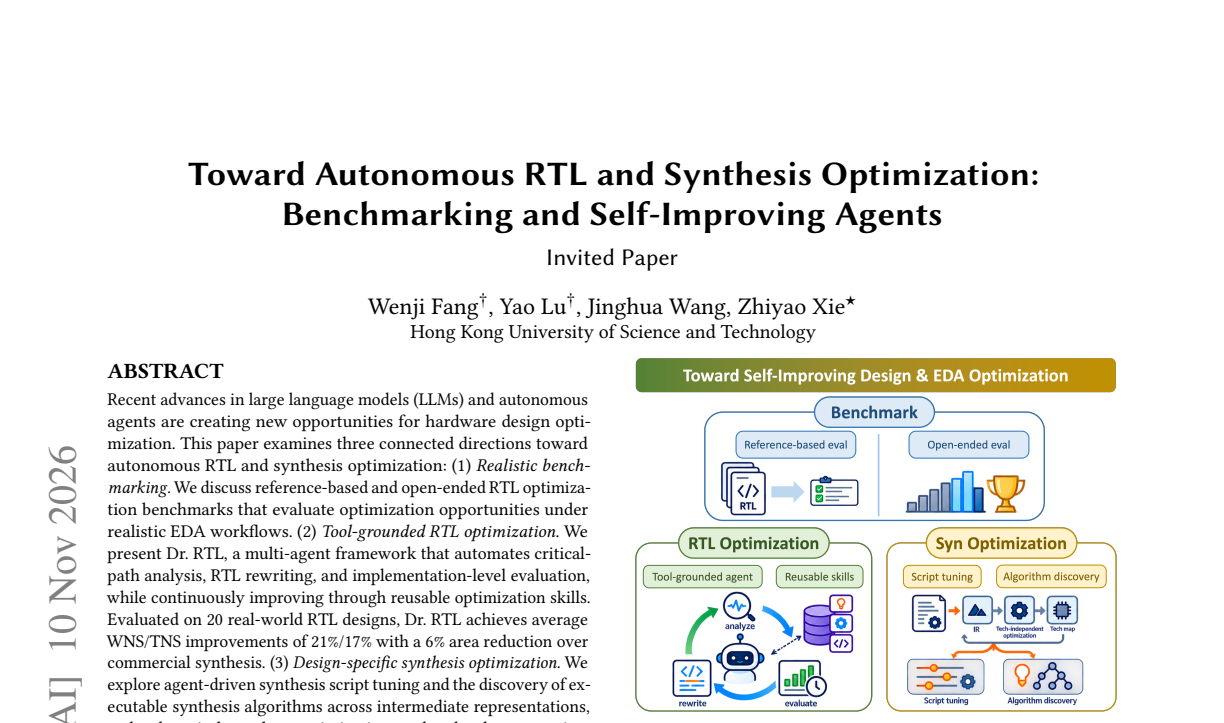
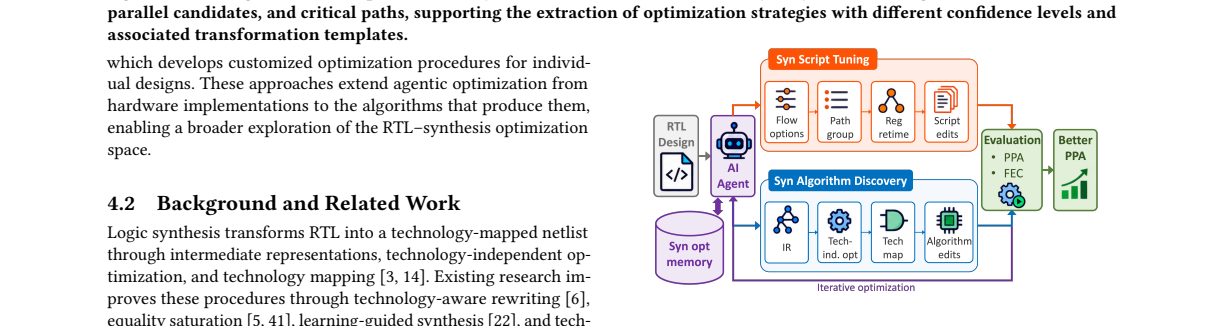
We discuss reference-based and open-ended RTL optimization benchmarks that evaluate optimization opportunities under realistic EDA workflows. (2) Tool-grounded RTL optimization. We present Dr. RTL, a multi-agent framework that automates critical-path analysis, RTL rewriting, and implementation-level evaluation, while continuously improving through reusable optimization skills. Evaluated on 20 real-world RTL designs, Dr. RTL achieves average WNS/TNS improvements of 21%/17% with a 6% area reduction over commercial synthesis. (3) Design-specific synthesis optimization. We explore agent-driven synthesis script tuning and the discovery of executable synthesis algorithms across intermediate representations, technology-independent optimization, and technology mapping. Finally, we envision AI-native design automation that jointly explores architectural, RTL, and EDA algorithm design spaces, guided by verification constraints and implementation feedback.
from the abstract
Pith says
Machine review · deepseek-v4-flash · 11 Nov 2026 · what was read was not recorded · not checked by a person
It can be wrong. Challenge this review or reply to it.
Holds up, with conditions. A useful invited consolidation whose Dr. RTL headline numbers are directionally sound but unanchored: the paper never reports the SDC constraints or per-design slacks behind its 21.3%/16.9% WNS/TNS claim. This line is wrong
3 major objections · 5 minor
How often objections from reviews like this one are right: not yet measured
Not checked: figures, code, what the 46 references say.
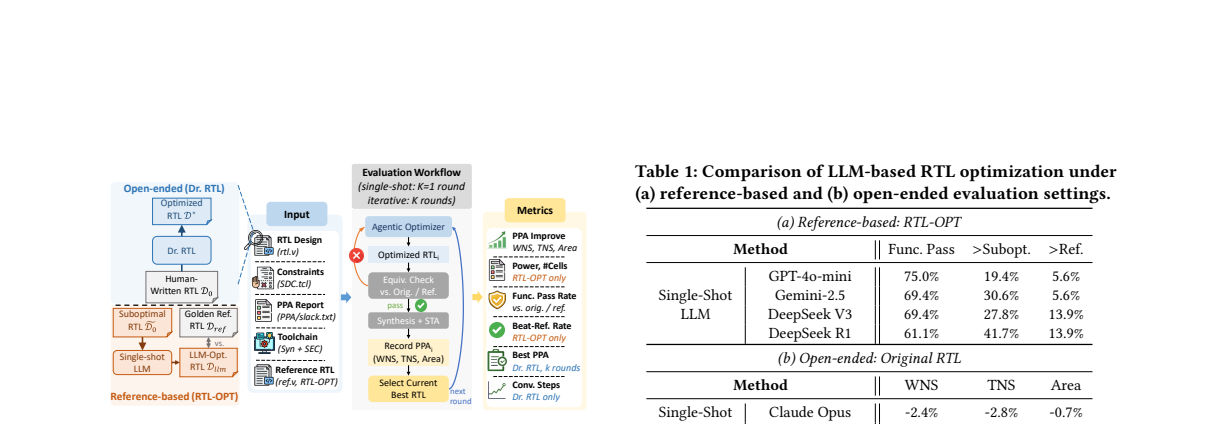
The paper says, at Section 3.4, Table 1(b)
The review did not quote this passage.
Pith says: Objection 1 of 3 · major
The headline open-ended results are not interpretable without the timing-constraint basis. A WNS/TNS percentage change is a ratio of slack delta to baseline negative slack, so its magnitude depends entirely on the SDC target clock periods and I/O delays; Section 3.4 specifies the tool, library, and SEC engine but reports no constraints for any of the 20 designs and no per-design baseline or optimized WNS, TNS, or slack values.
more of objection 1
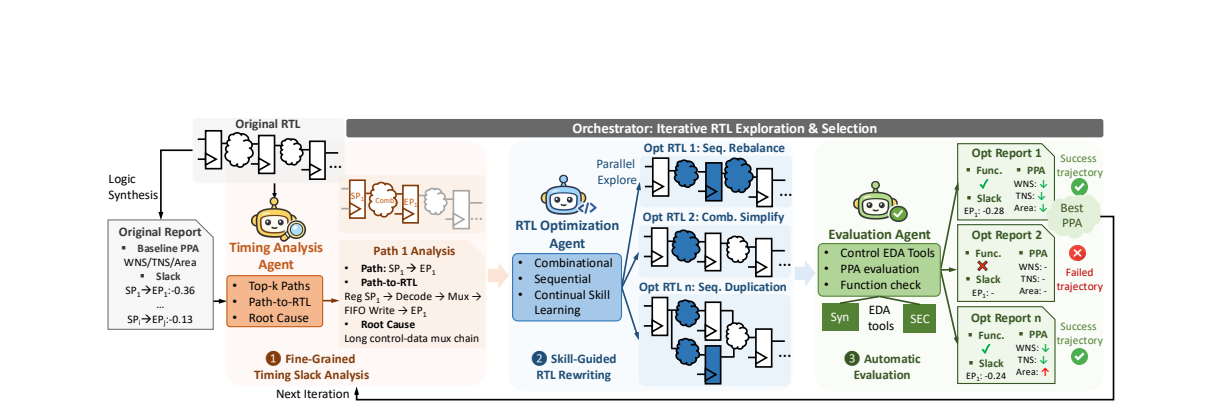
The paper's own Figure 3 example shows optimized endpoint slack on the order of -0.13 to -0.28 ns, i.e., fairly tight margins where STA noise and near-zero-slack amplification can dominate a percentage, so the reported 21.3%/16.9% averages are not anchored to any stated operating point and are not reproducible. The authors should report per-design slack values and the constraint sets used (or explicitly defer to the companion paper [12] where they appear) and discuss the operating point so the percentage magnitudes can be evaluated.
The paper says, at Section 3.4, Table 1(b)
The review did not quote this passage.
Pith says: Objection 2 of 3 · major
Only arithmetic means are reported for the 20-design open-ended evaluation, with no per-design table, no measure of spread, and no statement about run-to-run variance of the stochastic LLM-driven search. A few large relative wins can dominate a percentage mean, and the aggregation of per-design TNS percentages is not well defined because TNS is a path-weighted slack sum with design-dependent scales.
more of objection 2
The statements that timing improved on all 20 designs and that nine are Pareto-improved support the direction of the result, but the magnitude claims of 21.3%/16.9%/5.8% require the per-design values and, ideally, multiple independent runs to rule out outlier domination and sampling noise.
The paper says, at Section 4.3-4.4
The review did not quote this passage.
Pith says: Objection 3 of 3 · major
Neither the synthesis script-tuning nor the algorithm-discovery experiments report computational cost (number of synthesis invocations, wall-clock time, or LLM calls), even though the stated motivation for algorithm discovery is explicitly 'to trade additional optimization time for better PPA' (Section 4.3). Without this information the reader cannot assess the practical regime of the proposed approach, and the cost comparison between design-specific evolution and general-purpose flows is left open. Reporting per-design cost or a total budget would strengthen both contributions.
5 minor objections
The paper says, at Section 5
Pith says: minor objection 1 of 5
The Section 5 heading reads 'TOW ARD' and should read 'TOWARD'.
The paper says, at Section 3.4, Table 1(b)
Pith says: minor objection 2 of 5
The adaptation of the SOTA baselines RTLRewriter [40] and SymRTLo [35] to this evaluation flow is underspecified; stating that they 'use the same backbone LLM and optimization budget' does not by itself make the comparison reproducible, given the different original synthesis and verification setups of those works.
show 3 more
The paper says, at Section 4.4, Table 2(a)
Pith says: minor objection 3 of 5
The design-specific area regressions (e.g., ctrl -7.3%, arm_cpu2 -4.7%) are visible in the per-design rows, but the text could more explicitly juxtapose the -1.6% mean area overhead with these trade-offs when summarizing the script-tuning results.
The paper says, at Figure 5
Pith says: minor objection 4 of 5
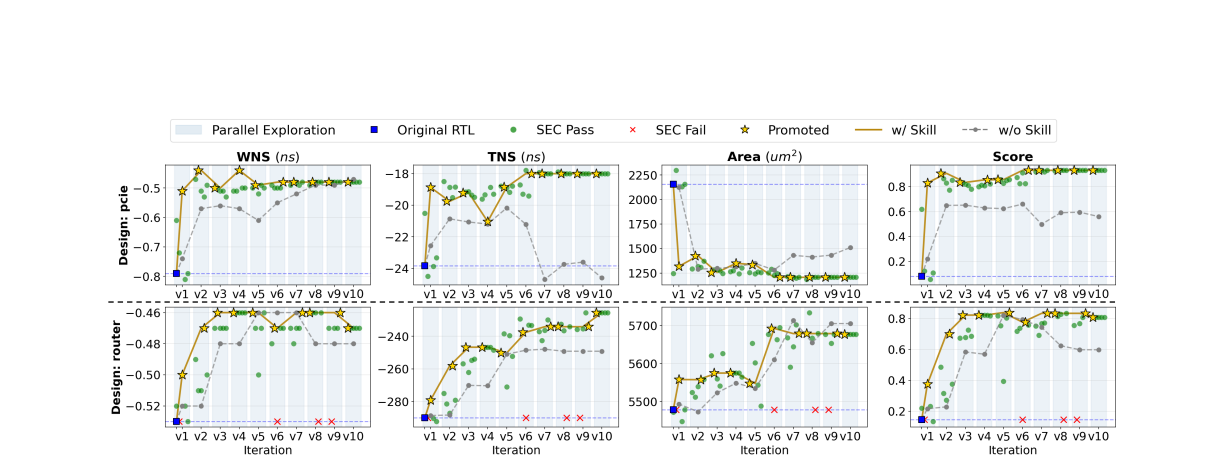
The 'optimization score' plotted in the trajectory figure is not defined in Section 2.4.2 or Section 3.4; a one-sentence definition in the caption would make the figure readable.
The paper says, at Section 2.4.3
Pith says: minor objection 5 of 5
The single-shot LLM rows in Table 1(b) (Claude Opus, GPT 5.3) report only percentages to two decimals inconsistently with the baseline rows; a consistent number format and a statement of the single-shot budget would improve readability.
What would settle it
Re-run the Section 3.4 evaluation on all 20 designs using the same SDC files but with each target clock period scaled by 0.9x and 1.1x, synthesizing both the original and the best Dr. RTL RTL per design, and recompute the mean WNS/TNS improvement percentages; from the original per-design results also compute the median and a bootstrap 95% CI of the mean. If the mean WNS improvement shifts by more than about 5 percentage points under either scaling, or the CI lower bound falls below about 10%, the 21.3% headline is constraint-dependent and/or outlier-dominated, and the paper should report the exact SDC settings together with per-design baseline and optimized slack values before the claim is used as stated.
from the skeptic's reading
How the review went
4 readings by deepseek-v4-flash · 11 Nov 2026
- Reader holds up, with conditions
- Skeptic partly agrees
- Editor wrote the verdict above
- Referee major revision: 3 major objections, 5 minor
Not run on this paper: the simulated authors' defence.
Pith did not check this review's objections against the paper.
The review in full
The review in brief, machine-written
Two things to know. The genuinely new results here are the synthesis script tuning (eight designs, Synopsys DC) and the design-specific algorithm discovery (eight designs, Yosys+ABC); Dr. RTL itself debuted in the group's ICCAD paper, and this invited paper re-presents it alongside those extensions. The headline Dr. RTL numbers are directionally solid but quantitatively unanchored: the 21.3%/16.9% WNS/TNS improvements are reported as means with no SDC constraints, no per-design slack values, and no spread.
What the paper does well. The evaluation design is mostly in good faith: the iterative baselines use the same backbone LLM and the same optimization budget; every candidate goes through commercial synthesis and sequential equivalence checking; and the skill-learning claim is tested with four-fold cross-validation rather than demonstrated on a friendly example. Table 2(a) reports per-design baseline WNS/TNS/area, which is exactly the detail the Dr. RTL table lacks. The algorithm discovery experiment verifies netlist equivalence for each evolved synthesis program, so those ADP gains are not free-floating. The survey coverage is solid across RTLRewriter, SymRTLo, AlphaEvolve, Self-Evolved ABC, and the flow-tuning literature, and the verified-invariants-versus-optimization-freedom framing in the vision section is the right scope for cross-layer agentic DSE.
Where the soft spots are. The stress-test note is correct and this is the main issue. A WNS/TNS percentage improvement is a ratio anchored to the target clock periods in the SDC files; with no constraints reported, the 21.3% mean is not reproducible, and near-zero-slack designs could inflate it. The authors do state timing improved on all 20 designs and nine are Pareto-improved, which supports the direction, and Figure 3 gives concrete per-path slack gains, but that is one design. This is a reporting fix, not a fatal flaw, and it is not among the limitations the paper acknowledges (b14, b63, b65, b165, b225 concern benchmark scope, not measurement anchoring). Related: no error bars or repeated runs anywhere in the agentic results. One seed is defensible given the compute, but a per-design table would let the reader judge whether the mean is representative. Minor items: K=10 and five parallel candidates are asserted without sensitivity analysis; the script tuning is a 4x4 search over two knobs, so the agentic framing is generous even though the wording stays exploratory; and the single 45nm node invites the usual generalization caveat.
Who it is for. Anyone tracking LLM agents for hardware design gets value here: it consolidates a fast-moving subfield and adds two small but real experimental probes. It deserves a serious referee — the claim that tool-grounded agentic search finds improvements beyond compile_ultra on original human-written RTL is supported; the magnitude is not yet. If I handled it, I would accept conditional on per-design timing data and the missing constraints.
The strongest objection
The central quantitative claim (Table 1, Section 3.4) is that Dr. RTL improves WNS by 21.3%, TNS by 16.9%, and area by 5.8% on average over 20 original human-written designs beyond Synopsys DC compile_ultra. For this claim to be interpretable, the baseline timing state must be fixed: a WNS/TNS percentage improvement is a ratio of slack change to baseline negative slack, so its magnitude is set by the target clock periods and I/O delays in the SDC files. Section 3.4 names the tool, library, and SEC engine but never reports the constraints for any design, nor per-design baseline/optimized WNS, TNS, or slack values. First failure mode: if target periods place designs near zero negative slack, modest absolute improvements become large percentages that STA noise can dominate; if targets are tighter, the same absolute gains look smaller, so the 21.3% figure is unanchored to any stated operating point. Second failure mode: with designs averaging 812 LOC and only the arithmetic mean reported, a few large relative wins can drive the average and there is no way to assess spread. The authors do state timing improved on all 20 designs [b141] and nine are Pareto-improved [b142], which supports the direction of the result, and Figure 3's example shows per-path slack gains of 0.08-0.12 ns; what is missing is evidence that these are representative. The constraint-reporting gap is not among the paper's acknowledged limitations (b14, b63, b65, b165, b225 concern benchmark design and search scope, not measurement anchoring).
The reader's verdict (CONDITIONAL, high confidence) centers on the Dr. RTL PPA result in Table 1, and I agree that the result is likely correct in direction but under-supported in magnitude. My stress-test refines the reader's weakest_assumption: instead of leading with generalizability to other tools and nodes (an external-validity question not fully resolvable in this paper), I press the more internal issue that the WNS/TNS percentage metric is unanchored because Section 3.4 omits the SDC target clocks and all per-design slack values. That omission, combined with reporting only the arithmetic mean, makes the headline figure non-reproducible and potentially inflated either by near-zero baseline slacks or by outlier designs. This is directly testable: a ±10% target-clock sweep plus a bootstrap CI on per-design results settles whether the 21.3%/16.9% averages are stable. I do not press the RTLRewriter/SymRTLo comparison: the paper states the iterative baselines use the same backbone LLM (Claude Opus) and the same optimization budget, which is a fair control for an invited summary. I also credit the paper's real strengths: SEC-based functional checking, explicit iteration and candidate budgets (10 iterations, five parallel candidates), the all-20-design timing improvement claim, and the honest framing of Sections 4.3-4.4 as exploration rather than final results. The four-fold cross-validation of skill transfer is claimed but no cross-validation numbers are reported (only Figure 5 for two designs); this weakens the 'self-improving' sub-claim but is secondary to the PPA headline. Because the concern is about how the headline is reported and supported rather than about the direction of the effect, the CONDITIONAL verdict should stand unchanged, with the requirement that the authors supply constraints, per-design data, and variance.
The referee's report
If the reported improvements hold, the paper makes a useful statement for AI-driven EDA: LLM agents guided by implementation feedback and equivalence checking can find meaningful RTL optimizations beyond a strong commercial synthesis flow on original human-written designs, rather than only recovering injected inefficiencies. The evaluation design has genuine strengths: an external baseline (Synopsys DC compile_ultra), independent SEC verification of correctness, a realistic 20-design set averaging 812 lines with hierarchy, absolute per-design values reported in Table 2(a) and (b), and a four-fold cross-validated skill-library assessment. The central results are improvements over an external synthesis baseline with independent verification, so circularity is not a concern. However, the headline timing percentages are not tied to any stated timing constraints or per-design slack values, which is the main risk to the central claim and is fixable within the manuscript's scope.
Pith's reading of the paper (a machine's summary, not the authors')
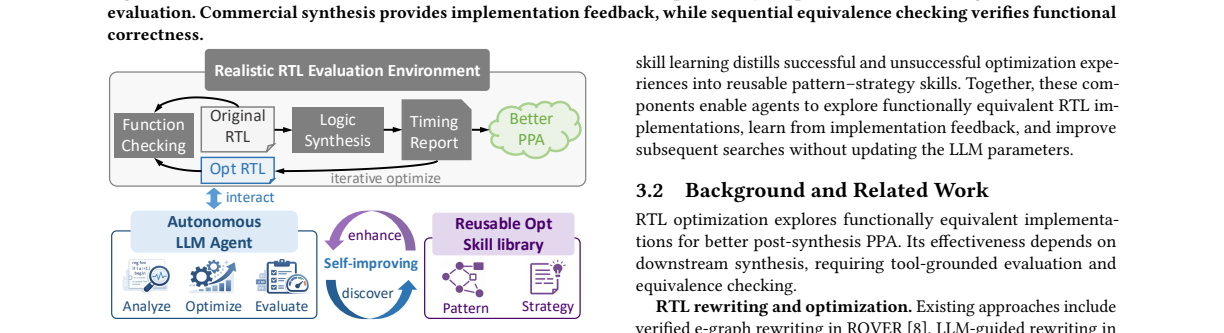
The paper argues that meaningful RTL optimization opportunities remain beyond what commercial synthesis tools can achieve, and that these opportunities can be systematically discovered by a tool-grounded, self-improving multi-agent framework called Dr. RTL. The authors present Dr. RTL, which combines fine-grained timing analysis, parallel RTL rewriting, sequential equivalence checking, and group-relative skill learning to iteratively improve power, performance, and area (PPA). They also extend this agentic approach to synthesis script tuning and design-specific algorithm discovery, showing further gains. If true, this work provides a path toward autonomous hardware design optimization that can continuously improve both RTL implementations and the EDA procedures that realize them.
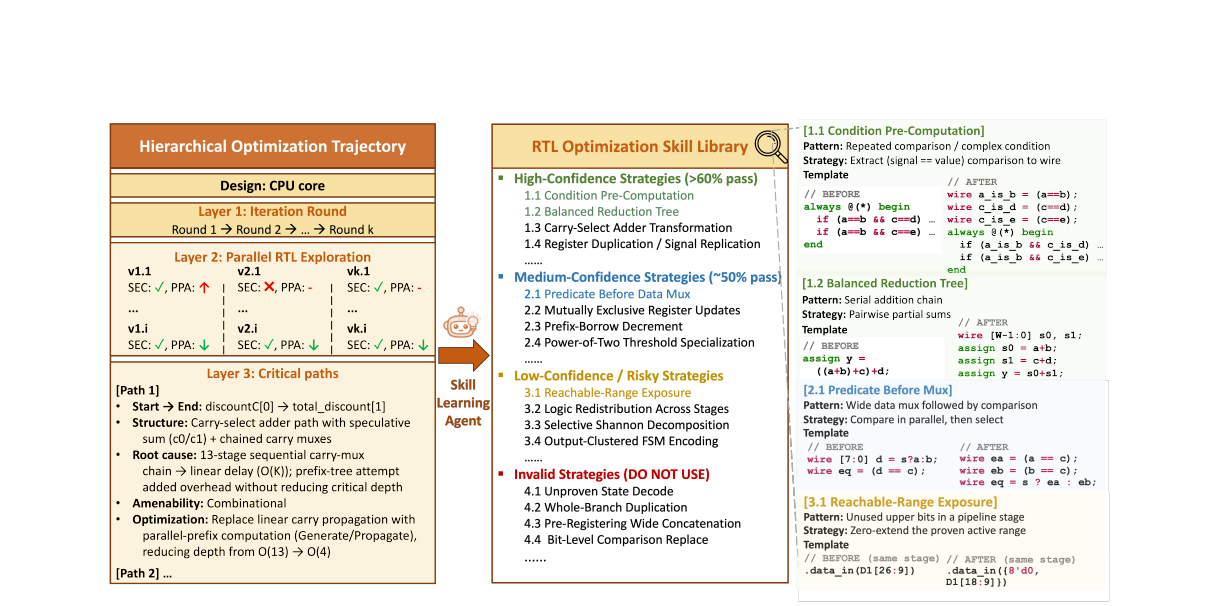
What carries the argument. The key machinery is Dr. RTL's multi-agent architecture: a timing analysis agent that maps post-synthesis critical paths to RTL structures, an RTL optimization agent that generates candidate transformations in parallel, an evaluation agent that runs commercial synthesis and sequential equivalence checking, and an orchestrator that coordinates iterative search. The framework's group-relative skill learning distills successful and unsuccessful optimization trajectories into reusable pattern–strategy pairs, stored in a confidence-aware library that guides future searches without parameter updates.
Core claim. The paper introduces Dr. RTL, a multi-agent framework that autonomously optimizes RTL designs beyond what commercial synthesis alone can achieve. On 20 real-world human-written RTL designs, Dr. RTL achieves average worst negative slack (WNS) and total negative slack (TNS) improvements of 21.3% and 16.9%, respectively, with a 5.8% reduction in cell area, while preserving functional equivalence. The framework learns reusable optimization skills from its own trajectories, enabling it to improve over time without updating LLM parameters. The authors also demonstrate that agentic synthesis script tuning and design-specific algorithm discovery can yield additional PPA improvements, with commercial synthesis tuning improving WNS/TNS by 7.4%/11.1% and open-source algorithm discovery reducing area-delay product by 18.7%.
The premise it rests on. The evaluation assumes that the commercial synthesis flow (Synopsys Design Compiler with compile_ultra) and the Nangate 45nm library represent a realistic and strong baseline, and that the 20 designs are representative of real-world RTL optimization challenges. The results may not generalize to other synthesis tools, technology nodes, or design types.
If the paper is right (Pith's inferences, not the authors')
Hardware design teams could use tool-grounded agents like Dr. RTL to automatically discover RTL transformations that commercial synthesis tools miss, reducing manual optimization effort and improving PPA.
The reusable skill library enables cross-design transfer of optimization knowledge, meaning that experience gained on one design can accelerate optimization of similar designs.
Agentic synthesis script tuning and algorithm discovery suggest that future EDA tools could be customized per design, potentially yielding better PPA than one-size-fits-all synthesis flows.
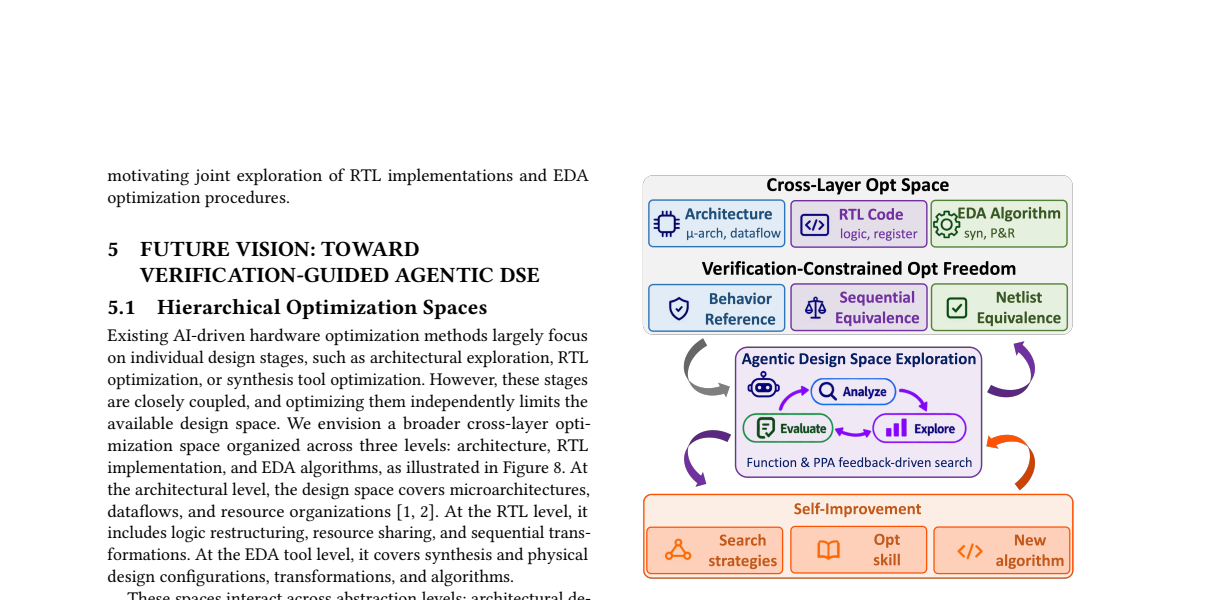
The verification-constrained optimization framework provides a principled way to explore cross-layer design spaces (architecture, RTL, EDA algorithms) while maintaining correctness guarantees.
If scaled, this paradigm could lead to self-improving AI-native EDA systems that jointly optimize hardware implementations and the tools that produce them.
The paper's results imply that current commercial synthesis tools leave significant optimization headroom on the table, especially for timing. This suggests that the gap between what synthesis can do and what a design-specific agent can achieve may be larger than previously assumed.
The group-relative skill learning approach, which compares candidates generated from the same parent RTL, is a clever way to extract transferable knowledge without needing a large dataset of diverse designs. This could be applied to other optimization domains where ground-truth optimal solutions are unknown.
The paper envisions cross-layer optimization spanning architecture, RTL, and EDA algorithms. A concrete next step would be to demonstrate an end-to-end agent that jointly explores microarchitecture choices and RTL implementations, using the same verification-constrained framework.
The reported improvements are on 20 designs with an average of 812 lines of RTL. An open question is whether these gains scale to larger, industrial-scale designs (tens of thousands of lines) where synthesis runtime and agent search cost become significant constraints.
Check this review
Pith stored no record of this review's passes and took no fingerprint of it. Reviews made by code from 13 Nov 2026 on carry both.
How often reviews like this one are right
Reviews like this one: written by deepseek-v4-flash, where what was read was not recorded.
How often objections from reviews like this one are right: not yet measured
Reviews by people
This review was written by a machine. No person has reviewed this paper on Pith yet. A scientist listed on Pith can review it for a fee, and their review is published here whatever it concludes.
The paper
Abstract
Recent advances in large language models (LLMs) and autonomous agents are creating new opportunities for hardware design optimization. This paper examines three connected directions toward autonomous RTL and synthesis optimization: (1) Realistic benchmarking. We discuss reference-based and open-ended RTL optimization benchmarks that evaluate optimization opportunities under realistic EDA workflows. (2) Tool-grounded RTL optimization. We present Dr. RTL, a multi-agent framework that automates critical-path analysis, RTL rewriting, and implementation-level evaluation, while continuously improving through reusable optimization skills. Evaluated on 20 real-world RTL designs, Dr. RTL achieves average WNS/TNS improvements of 21%/17% with a 6% area reduction over commercial synthesis. (3) Design-specific synthesis optimization. We explore agent-driven synthesis script tuning and the discovery of executable synthesis algorithms across intermediate representations, technology-independent optimization, and technology mapping. Finally, we envision AI-native design automation that jointly explores architectural, RTL, and EDA algorithm design spaces, guided by verification constraints and implementation feedback.
The paper's own sentences, arranged, kept beside the review and separate from it. Each label is drawn from a closed vocabulary; the number beside it is the probability the classifier gave that label. No sentence in this record was written by a model.
abstract compiled · 2026-11-11
The authors' main claim, as the classifier picked it out 0.65
“Evaluated on 20 real-world RTL designs, Dr.~RTL achieves average WNS/TNS improvements of 21\%/17\% with a 6\% area reduction over commercial synthesis.”
How the main claim is stated: asserted 1.00
What the abstract itself states, as probabilities: claims first 0.05 · states limitation 0.09 · human participants 0.04 · controlled comparison 0.84 · randomized assignment 0.01 · states quantitative result 0.99 · compares with prior results 0.92 · mentions code or data availability 0.04
The abstract, sentence by sentence
This table labels the abstract only (arXiv listing abstract v1). The number is the probability the classifier gave the label.
| Sentence | Role | The authors' own work | States the main conclusion | Strength |
|---|---|---|---|---|
| Recent advances in large language models (LLMs) and autonomous agents are creating new opportunities for hardware design optimization. | background 1.00 | 0.04 | 0.02 | asserted 0.69 |
| This paper examines three connected directions toward autonomous RTL and synthesis optimization: (1) Realistic benchmarking. | contribution 0.97 | 0.38 | 0.04 | asserted 0.82 |
| We discuss reference-based and open-ended RTL optimization benchmarks that evaluate optimization opportunities under realistic EDA workflows. | contribution 0.80 | 0.57 | 0.04 | asserted 0.92 |
| (2) Tool-grounded RTL optimization. We present Dr. | contribution 0.79 | 0.59 | 0.03 | unclear 0.56 |
| RTL, a multi-agent framework that automates critical-path analysis, RTL rewriting, and implementation-level evaluation, while continuously improving through reusable optimization skills. | method 0.69 | 0.88 | 0.19 | asserted 1.00 |
| Evaluated on 20 real-world RTL designs, Dr.~RTL achieves average WNS/TNS improvements of 21\%/17\% with a 6\% area reduction over commercial synthesis. | result 1.00 | 0.96 | 0.35 | asserted 1.00 |
| (3) Design-specific synthesis optimization. | contribution 0.94 | 0.23 | 0.03 | unclear 0.86 |
| We explore agent-driven synthesis script tuning and the discovery of executable synthesis algorithms across intermediate representations, technology-independent optimization, and technology mapping. | contribution 0.89 | 0.79 | 0.06 | asserted 0.74 |
| Finally, we envision AI-native design automation that jointly explores architectural, RTL, and EDA algorithm design spaces, guided by verification constraints and implementation feedback. | future work 1.00 | 0.09 | 0.29 | speculative 0.95 |
What kind of paper the classifier reports this is: method or tool 0.99 · evidence from observation or experiment 0.87
What was examined, and what was not
Sources read
- arXiv listing abstract v1
Not examined
- full text
- figures and tables
- references and citing sentences
- relations to other papers
Levels run
- P abstract
Not run
- S sections
- T body sentences
- C citations
- R cross-paper relations
How the labels were made
Compiled by classifier-1.13.0 via TypeSafe API, question bank abstract-p1-20260923, 2026-11-11: 1 request, 6,758 input tokens.
Every quoted sentence on this record is the authors'. Every label is from Pith's closed vocabulary, with the probability shown beside it. This record as JSON
Figures (8)
Figures are the authors', reproduced from the paper.
References (46)
- [12] Wenji Fang, Yao Lu, Shang Liu, Jing Wang, Ziyan Guo, Junxian He, Fengbin Tu, and Zhiyao Xie. 2026. Dr. RTL: Autonomous Agentic RTL Optimization through Tool-Grounded Self-Improvement. InInternational Conference on Computer-Aided Design (ICCAD) on Pith
- [1] Chen Bai, Jiayi Huang, Xuechao Wei, Yuzhe Ma, Sicheng Li, Hongzhong Zheng, Bei Yu, and Yuan Xie. 2023. ArchExplorer: Microarchitecture exploration via bottleneck analysis. InInternational Symposium on Microarchitecture (MICRO) on Pith
- [2] Chen Bai, Qi Sun, Jianwang Zhai, Yuzhe Ma, Bei Yu, and Martin DF Wong. 2021. BOOM-Explorer: RISC-V BOOM microarchitecture design space exploration framework. InInternational Conference on Computer-Aided Design (ICCAD) on Pith
- [3] Alan Brayton, Robert Mishchenko, and A Mishchenko. 2006. Scalable logic synthesis using a simple circuit structure. InInternational Workshop on Logic and Synthesis (IWLS) on Pith
- [4] Che-Ming Chang, Prashanth Vijayaraghavan, Ashutosh Jadhav, Charles Mackin, Hsinyu Tsai, Vandana Mukherjee, and Ehsan Degan. 2026. CODMAS: A Dialec- tic Multi-Agent Collaborative Framework for Structured RTL Optimization. In Proceedings of the 19th Conference of the European Ch... on Pith
- [5] Chen Chen, Guangyu Hu, Cunxi Yu, Yuzhe Ma, and Hongce Zhang. 2025. E- morphic: Scalable Equality Saturation for Structural Exploration in Logic Synthe- sis.arXiv preprint arXiv:2504.11574(2025) on PithPith's reviewarXiv
- [6] Chen Chen, Guangyu Hu, Dongsheng Zuo, Cunxi Yu, Yuzhe Ma, and Hongce Zhang. 2024. E-syn: E-graph rewriting with technology-aware cost functions for logic synthesis. InDesign Automation Conference (DAC) on Pith
- [7] Animesh Basak Chowdhury, Marco Romanelli, Benjamin Tan, Ramesh Karri, and Siddharth Garg. 2024. Retrieval-guided reinforcement learning for boolean circuit minimization. InInternational Conference on Learning Representations (ICLR) on Pith
- [8] Samuel Coward, Theo Drane, and George A Constantinides. 2024. Rover: Rtl optimization via verified e-graph rewriting.IEEE Transactions on Computer-Aided Design of Integrated Circuits and Systems(2024) on Pith
- [9] Chenhui Deng, Yun-Da Tsai, Guan-Ting Liu, Zhongzhi Yu, and Haoxing Ren. 2025. Scalertl: Scaling llms with reasoning data and test-time compute for accurate rtl code generation. In2025 ACM/IEEE 7th Symposium on Machine Learning for CAD (MLCAD). IEEE, 1–9 on Pith
- [10] Chenhui Deng, Zhongzhi Yu, Guan-Ting Liu, Nathaniel Pinckney, and Haoxing Ren. 2026. ACE-RTL: When Agentic Context Evolution Meets RTL-Specialized LLMs.arXiv preprint arXiv:2602.10218(2026) on PitharXiv
- [11] Wenji Fang, Shang Liu, Hongce Zhang, and Zhiyao Xie. 2024. Annotating Slack Directly on Your Verilog: Fine-Grained RTL Timing Evaluation for Early Opti- mization. InDesign Automation Conference (DAC) on Pith
- [13] Wenji Fang, Jing Wang, Yao Lu, Shang Liu, Yuchao Wu, Yuzhe Ma, and Zhiyao Xie. 2025. A survey of circuit foundation model: Foundation ai models for vlsi circuit design and eda.arXiv preprint arXiv:2504.03711(2025) on PithPith's reviewarXiv
- [14] Soha Hassoun and Tsutomu Sasao. 2012.Logic synthesis and verification. Vol. 654. Springer Science & Business Media on Pith
- [15] Wei-Po Hsin, Ren-Hao Deng, Yao-Ting Hsieh, En-Ming Huang, and Shih-Hao Hung. 2026. EvolVE: Evolutionary Search for LLM-based Verilog Generation and Optimization.arXiv preprint arXiv:2601.18067(2026) on PitharXiv
- [16] Rongjian Liang, Jinwook Jung, Hua Xiang, Lakshmi Reddy, Alexey Lvov, Jiang Hu, and Gi-Joon Nam. 2021. FlowTuner: A multi-stage EDA flow tuner exploiting parameter knowledge transfer. InInternational Conference on Computer-Aided Design (ICCAD) on Pith
- [17] Mingjie Liu, Nathaniel Pinckney, Brucek Khailany, and Haoxing Ren. 2023. Ver- ilogEval: Evaluating Large Language Models for Verilog Code Generation.arXiv preprint arXiv:2309.07544(2023) on PithPith's reviewarXiv
- [18] Shang Liu, Wenji Fang, Yao Lu, Qijun Zhang, Hongce Zhang, and Zhiyao Xie. 2024. RTLCoder: Fully Open-Source and Efficient LLM-Assisted RTL Code Generation Technique.IEEE Transactions on Computer-Aided Design of Integrated Circuits and Systems (TCAD)(2024) on Pith
- [19] Shang Liu, Yao Lu, Wenji Fang, Mengming Li, and Zhiyao Xie. 2024. OpenLLM- RTL: Open Dataset and Benchmark for LLM-Aided Design RTL Generation. In International Conference on Computer-Aided Design (ICCAD) on Pith
- [20] Yao Lu, Shang Liu, Qijun Zhang, and Zhiyao Xie. 2024. RTLLM: An Open-Source Benchmark for Design RTL Generation with Large Language Model. InAsia and South Pacific Design Automation Conference (ASP-DAC) on Pith
show 26 more
- [21] Yao Lu, Shang Liu, Hangan Zhou, Wenji Fang, Qijun Zhang, and Zhiyao Xie. 2026. A New Benchmark for the Appropriate Evaluation of RTL Code Optimization. arXiv preprint arXiv:2601.01765(2026) on PitharXiv
- [22] Walter Lau Neto, Max Austin, Scott Temple, Luca Amaru, Xifan Tang, and Pierre- Emmanuel Gaillardon. 2019. LSOracle: A logic synthesis framework driven by artificial intelligence. InInternational Conference on Computer-Aided Design (ICCAD) on Pith
- [23] Walter Lau Neto, Yingjie Li, Pierre-Emmanuel Gaillardon, and Cunxi Yu. 2022. Flowtune: End-to-end automatic logic optimization exploration via domain- specific multiarmed bandit.IEEE Transactions on Computer-Aided Design of Integrated Circuits and Systems (TCAD)(2022) on Pith
- [24] Walter Lau Neto, Matheus T Moreira, Yingjie Li, Luca Amarù, Cunxi Yu, and Pierre-Emmanuel Gaillardon. 2021. SLAP: A Supervised Learning Approach for Priority Cuts Technology Mapping. InDesign Automation Conference (DAC) on Pith
- [25] Alexander Novikov, Ngân V ˜u, Marvin Eisenberger, Emilien Dupont, Po-Sen Huang, Adam Zsolt Wagner, Sergey Shirobokov, Borislav Kozlovskii, Francisco J. R. Ruiz, Abbas Mehrabian, M. Pawan Kumar, Abigail See, Swarat Chaudhuri, George Holland, Alex Davies, Sebastian Nowozin, Push... on PithPith's reviewarXivdoi:10.48550/arxiv.2506.13131
- [26] Nathaniel Pinckney, Chenhui Deng, Chia-Tung Ho, Yun-Da Tsai, Mingjie Liu, Wenfei Zhou, Brucek Khailany, and Haoxing Ren. 2025. Comprehensive Verilog design problems: A next-generation benchmark dataset for evaluating large language models and agents on rtl design and verificat... on PithPith's reviewarXiv
- [27] Heng Ping, Peiyu Zhang, Zhenkun Wang, Shixuan Li, Anzhe Cheng, Wei Yang, Paul Bogdan, and Shahin Nazarian. 2026. POET: Power-Oriented Evolutionary Tuning for LLM-Based RTL PPA Optimization.arXiv preprint arXiv:2603.19333 (2026) on PitharXiv
- [28] Humza Sami, Pierre-Emmanuel Gaillardon, Valerio Tenace, et al. 2024. Aivril: Ai- driven rtl generation with verification in-the-loop.arXiv preprint arXiv:2409.11411 (2024) on PithPith's reviewarXiv
- [29] Si2. 2018. NanGate 45nm Open Cell Library on Pith
- [30] Cadence Design Systems. 2026. Cadence JasperGold Sequential Equiva- lence Checking App. https://www.cadence.com/en_US/home/tools/system- design-and-verification/formal-and-static-verification/jasper-verification- platform/jaspergold-sequential-equivalence-checking-app.html on Pith
- [31] Kimia Tasnia, Alexander Garcia, Tasnuva Farheen, and Sazadur Rahman. 2025. Veriopt: Ppa-aware high-quality verilog generation via multi-role llms. In2025 IEEE/ACM International Conference On Computer Aided Design (ICCAD). IEEE, 1–9 on Pith
- [32] Kiran Thorat, Jiahui Zhao, Yaotian Liu, Amit Hasan, Hongwu Peng, Xi Xie, Bin Lei, and Caiwen Ding. 2025. LLM-VeriPPA: Power, Performance, and Area Optimization aware Verilog Code Generation with Large Language Models. In 2025 ACM/IEEE 7th Symposium on Machine Learning for CAD ... on Pith
- [33] Kiran Thorat, Jiahui Zhao, Yaotian Liu, Hongwu Peng, Xi Xie, Bin Lei, Jeff Zhang, and Caiwen Ding. 2023. Advanced Large Language Model (LLM)-Driven Verilog Development: Enhancing Power, Performance, and Area Optimization in Code Synthesis.arXiv preprint arXiv:2312.01022(2023) on PithPith's reviewarXiv
- [34] Frank Vahid. 2010.Digital design with RTL design, VHDL, and Verilog. John Wiley & Sons on Pith
- [35] Yiting Wang, Wanghao Ye, Ping Guo, Yexiao He, Ziyao Wang, Bowei Tian, Shwai He, Guoheng Sun, Zheyu Shen, Sihan Chen, et al. 2025. Symrtlo: Enhancing rtl code optimization with llms and neuron-inspired symbolic reasoning. InAdvances in Neural Information Processing Systems (NeurIPS) on Pith
- [36] Peng Xia, Jianwen Chen, Hanyang Wang, Jiaqi Liu, Kaide Zeng, Yu Wang, Siwei Han, Yiyang Zhou, Xujiang Zhao, Haifeng Chen, et al. 2026. SkillRL: Evolving Agents via Recursive Skill-Augmented Reinforcement Learning.arXiv preprint arXiv:2602.08234(2026) on PithPith's reviewarXiv
- [37] Zhiyao Xie, Guan-Qi Fang, Yu-Hung Huang, Haoxing Ren, Yanqing Zhang, Brucek Khailany, Shao-Yun Fang, Jiang Hu, Yiran Chen, and Erick Carvajal Barboza. 2020. FIST: A feature-importance sampling and tree-based method for automatic design flow parameter tuning. InAsia and South P... on Pith
- [38] Wujiang Xu, Zujie Liang, Kai Mei, Hang Gao, Juntao Tan, and Yongfeng Zhang on Pith
- [39] Zhihao Xu, Bixin Li, and Lulu Wang. 2025. Rethinking LLM-Based RTL Code Optimization Via Timing Logic Metamorphosis.arXiv preprint arXiv:2507.16808 (2025) on PithPith's reviewarXiv
- [40] Xufeng Yao, Yiwen Wang, Xing Li, Yingzhao Lian, Ran Chen, Lei Chen, Mingxuan Yuan, Hong Xu, and Bei Yu. 2024. Rtlrewriter: Methodologies for large models aided rtl code optimization. InProceedings of IEEE/ACM International Conference on Computer-Aided Design (ICCAD) on Pith
- [41] Jiaqi Yin, Zhan Song, Chen Chen, Qihao Hu, and Cunxi Yu. 2025. Boole: Exact symbolic reasoning via boolean equality saturation. In2025 62nd ACM/IEEE Design Automation Conference (DAC). IEEE, 1–7 on Pith
- [42] Cunxi Yu and Haoxing Ren. 2026. Autonomous Evolution of EDA Tools: Multi- Agent Self-Evolved ABC. InProceedings of the 63rd ACM/IEEE Design Automation Conference. https://doi.org/10.1145/3770743.3804221 on Pithdoi:10.1145/3770743.3804221
- [43] Xinyu Zhang, Zhiteng Chao, Yonghao Wang, Bin Sun, Tianyun Ma, Tianmeng Yang, Jianan Mu, Jing Justin Ye, and Huawei Li. 2026. RTLSeek: Boosting the LLM-Based RTL Generation with Multi-Stage Diversity-Oriented Reinforcement Learning.arXiv preprint arXiv:2603.27630(2026) on PitharXiv
- [44] Yujie Zhao, Hejia Zhang, Hanxian Huang, Zhongming Yu, and Jishen Zhao. 2025. Mage: A multi-agent engine for automated rtl code generation. In2025 62nd ACM/IEEE Design Automation Conference (DAC). IEEE, 1–7 on Pith
- [45] Matthew M Ziegler, Hung-Yi Liu, George Gristede, Bruce Owens, Ricardo Ni- gaglioni, and Luca P Carloni. 2016. A synthesis-parameter tuning system for autonomous design-space exploration. In2016 Design, Automation & Test in Europe Conference & Exhibition (DATE). IEEE, 1148–1151 on Pith
- [2025] A-mem: Agentic memory for llm agents.arXiv preprint arXiv:2502.12110 (2025) on PithPith's reviewarXiv
Cited by 1 Pith paper
Reviewed papers on Pith that cite this one. The full citation record
- From Seed to BLOOM: Autonomously Growing a Better Out-of-Order Core cs.AR · Nov 2026
Challenges and discussion
Disagree with the review, or know something it missed? Leave a comment, or challenge this review formally: a challenge becomes a permanent entry in this paper's record, and its decision is published here.
Come back by email
A short list of the week's newly reviewed papers. Nothing is sent until you confirm from your inbox, and every email has a link that stops it. No account.
No comments yet.
Sign in to comment