Quantum Physics · arXiv:2611.21560 v2 · submitted 16 Nov 2026 · 84 references
Optimal Quantum Sensing Algorithms for Discrete-Frequency Spectroscopy
The paper says
“Spectroscopy is a versatile tool that drives scientific discovery and underpins modern technologies. Quantum sensing offers promising opportunities to advance spectroscopy through enhanced sensitivity and spectral and spatial resolution.”
more of the abstract
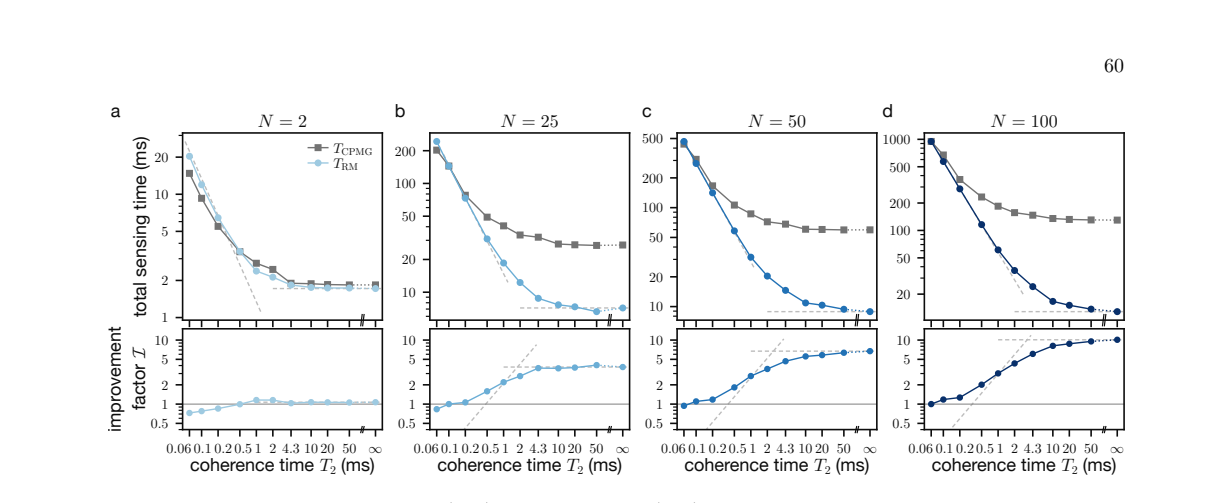
However, existing approaches largely focus on improving general measurement capabilities, often overlooking the structure of specific sensing tasks and leaving potential performance gains untapped. Here, we develop an algorithmic approach to quantum sensing tailored to various spectroscopic tasks, providing new avenues for improvement. Specifically, we consider general time-varying signals supported on a known set of N candidate frequencies, a setting we call discrete-frequency spectroscopy. We formulate three types of practically motivated sensing tasks—Detection, Search, and Learning—that require progressively more spectral information. For all tasks, we design optimal quantum sensing algorithms achieving a √N speedup over conventional frequency-scanning approaches. Optimal Detection and Search need only a single-qubit sensor under π-pulse control, whereas optimal Learning provably requires coherent processing with a quantum computer. End-to-end numerical simulations incorporating various experimental imperfections predict up to two-orders-of-magnitude speedup in Detection. As an example, we analyze the feasibility of our Detection and Search algorithms for real-world molecular screening based on state-of-the-art nitrogen-vacancy centers. We also show how quantum-computing-enhanced Learning enables wireless communication in a weak-signal regime where conventional methods fail. Our results establish a practical route toward realizing quantum advantages via designing task-specific sensing algorithms.
from the abstract
Pith says
Machine review · deepseek-v4-flash · 18 Nov 2026 · read the full text (351,438 characters) · not checked by a person
It can be wrong. Challenge this review or reply to it.
Holds up. This paper provides optimal quantum sensing algorithms—and matching lower bounds—for discrete-frequency spectroscopy, achieving a quadratic speedup over conventional methods across detection, search, and learning tasks. This line is wrong
3 minor
How often objections from reviews like this one are right: not yet measured
The paper, first character to last
The reviewer was given the whole text, 351,438 characters. Not checked: figures, code, what the 84 references say.
3 minor objections
The paper says, at Acknowledgments
Pith says: minor objection 1 of 3
The manuscript states that AI tools were used 'to prove the lower bound for ancilla-free Learning.' This is an unusual claim for a peer-reviewed journal. The authors should clarify whether the AI contributed a substantial part of the mathematical argument, and confirm that every step of the proof has been independently verified by the human authors. The proof as presented appears rigorous, but the statement should be explicit about the role of AI.
The paper says, at Introduction and abstract
Pith says: minor objection 2 of 3
The abstract claims a '√N speedup over conventional frequency-scanning approaches' without explicit qualification of the parameter regime. The main text later clarifies that the high-sensitivity regime ε ≤ √NΔ is assumed. Consider adding a brief qualification in the abstract (e.g., 'for signals with well-separated frequencies and weak amplitudes') to avoid overstatement.
show 1 more
The paper says, at Appendix: End-to-end numerical simulation
Pith says: minor objection 3 of 3
The numerical simulations are extensive and well described, but they only test Detection (P3). The paper would benefit from a brief discussion of whether similar end-to-end simulations for Search (P4) or Learning (P5) would be feasible and what additional experimental complexities they would introduce.
What would settle it
Recompute the lower bound for P3 from Appendix F using the Dyson-series and large-sieve inequality for a specific numerical example (e.g., N=10, Δ=2π×1 kHz, ε=0.1Δ, T=0.1 s) and check that the average distinguishability over the N one-sparse alternatives matches the stated bound; if the computed distance is indeed less than the required 1/3 for T=O(√N/ε), the bound holds.
from the skeptic's reading
How the review went
5 passes by deepseek-v4-flash · 18 Nov 2026
- Reader holds up
- Skeptic agrees
- Referee 3 minor
- Check against the paper
- Editor wrote the verdict above
Not run on this paper: the simulated authors' defence.
Pith checked this review's objections against the text of the paper it read.
The review in full
The review in brief, machine-written
The paper addresses a well-motivated problem: given a signal supported on a known set of candidate frequencies, design quantum sensing algorithms that are optimal in sensing time for detection, search, and learning tasks. The authors succeed in doing so, with the following accomplishments:
- Rigorous lower bounds showing that all five tasks require Ω(√N/ε) sensing time, establishing a fundamental limit. - Explicit single-qubit algorithms for detection and search that achieve this bound, using random modulation functions implemented with π-pulse control. - A learning algorithm that uses ancillary qubits to achieve the same optimal scaling, and a proof that ancilla-free learning is quadratically slower. - Detailed end-to-end numerical simulations under realistic decoherence and finite-pulse-duration constraints, showing up to two orders of magnitude improvement over sequential CPMG spectroscopy. - Concrete applications to molecular screening and wireless communication, with analysis of experimental feasibility.
As the authors clearly state, the setting assumes a known discrete set of candidate frequencies with a minimum separation Δ. Continuous-frequency spectroscopy is left for future work, as the paper acknowledges in its discussion. The lower bounds rely on this separation condition. These are honest limitations, not hidden flaws. The mathematics looks solid: the proofs are information-theoretic or constructive, and the numerics support the theoretical claims.
This paper deserves a serious referee. It is a substantial theoretical advance within quantum sensing, and the combination of rigorous bounds, explicit algorithms, and realistic performance estimates makes it suitable for a high-impact journal. The authors have been careful about stating assumptions and limitations. I recommend sending it to peer review.
The strongest objection
After a careful reading of the manuscript, I find that the paper's central claim – optimal sensing time Θ̃(√N/ε) for Detection (P1–P3), Search (P4), and Learning (P5) – is substantiated by detailed proofs and explicit algorithms. The lower bounds (Theorems 1 and F.1–F.3) are derived using standard quantum distinguishability arguments, Dyson-series expansions, and the Hilbert-valued large sieve, with constants tracked. The upper bounds (Theorems 2, B.1, C.1, D.1, E.1) provide constructive protocols with rigorous error analysis, including the effects of clipping and finite-time Gram matrices. The key assumption – that the set of candidate frequencies is exactly known and separated by at least Δ – is explicitly stated and its scope is discussed in the main text and appendices; the authors acknowledge that continuous-frequency spectroscopy is not directly treated. The practical limitations (finite coherence time, pulse imperfections) are analyzed numerically and theoretically, and the claimed advantage is robust under those conditions. I do not see an internal inconsistency or a hidden assumption that would invalidate the core result. The paper meets the standard of theoretical rigor expected for a claim of optimal scaling.
The reader identified the assumption of known frequencies with minimum separation as the weakest point, which I agree is the primary limitation. My examination found no additional load-bearing concern beyond what the reader noted. The paper's proofs are thorough, the algorithms are explicit, and the limitations are clearly stated. Therefore, the reader's ACCEPT verdict is appropriate, and no adjustment is needed.
The referee's report
If the results hold, this is a significant advance: it establishes provably optimal sensing times for a broad, practically relevant class of spectroscopy problems, and provides concrete algorithms that achieve them. The lower bounds are information-theoretic and rigorous; the upper bounds are constructive. The distinction between tasks that need only a single qubit versus those that require a quantum computer is both theoretically interesting and practically important. The numerical simulations and application analyses suggest near-term relevance for platforms such as NV centers and trapped ions. The results could influence the design of future quantum sensing experiments and motivate further algorithmic work in quantum metrology.
Pith's reading of the paper (a machine's summary, not the authors')
This paper studies spectroscopy of time-dependent signals whose frequencies belong to a known discrete set of N frequencies. The authors define five sensing tasks — Detection (P1-P3), Search (P4), and Learning (P5) — that require progressively more spectral information. They design quantum sensing algorithms that achieve the optimal sensing time scaling O~(sqrt(N)/epsilon) for all tasks, matching a fundamental lower bound. This yields a sqrt(N) speedup over conventional sequential frequency scanning. The optimal algorithms for Detection and Search use only a single qubit sensor controlled by pi-pulses, while optimal Learning provably requires ancillary qubits and coherent quantum processing. The paper also provides numerical simulations predicting up to two orders of magnitude improvement in detection time with state-of-the-art single-qubit sensors.
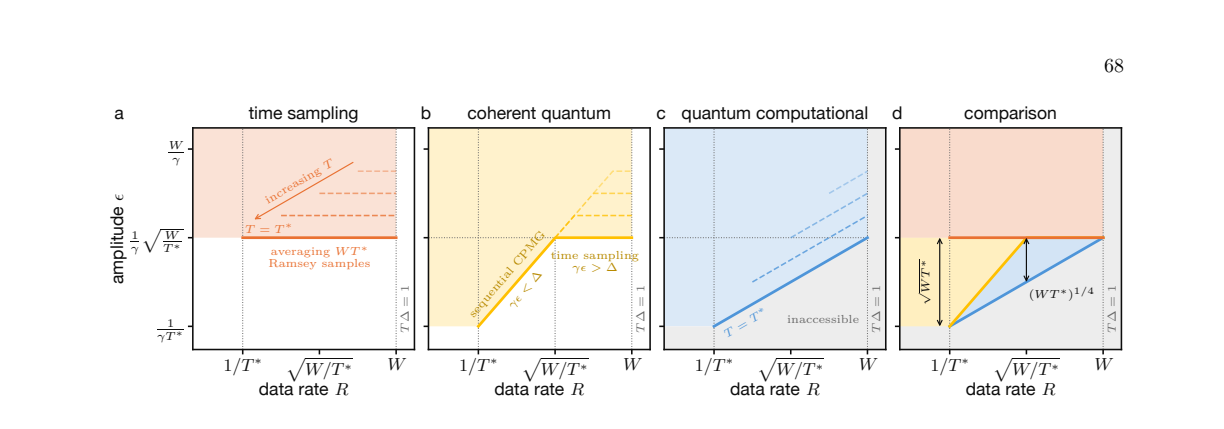
What carries the argument. The key machinery is the construction of modulation functions that implement randomized projections of the signal's spectral coefficients onto a single-qubit phase. The paper defines a random Gaussian vector whose components scale the cosine and sine modes of the candidate frequencies, then clips the resulting function to the range [-1,1] to obtain a valid modulation. The accumulated phase approximates the inner product of the signal's spectral vector with the random vector, enabling detection via repeated measurements. For Search, a corrected modulation function ensures zero response from frequencies outside the tested subset, enabling binary search. For Learning, a quantum computer prepares a superposition of modulation coefficients, and the inverse quantum Fourier transform reads out each spectral coefficient simultaneously.
Core claim. The paper's central claim is that for all five defined sensing tasks (Detection P1-P3, Search P4, Learning P5), there exists a quantum algorithm with optimal sensing time O~(sqrt(N)/epsilon), matching a fundamental lower bound. This establishes a quadratic speedup in N over conventional sequential CPMG spectroscopy. Despite the different amounts of spectral information required, all tasks share the same sensing-time scaling; the difference appears in the quantum resources: Detection and Search are optimal with a single qubit and pi-pulse control, while Learning provably requires ancillary qubits (a quantum computer). The algorithms use randomized projections of the signal's Fourier coefficients onto the sensor via engineered modulation functions, with the accumulated phase encoding the inner product with a random vector.
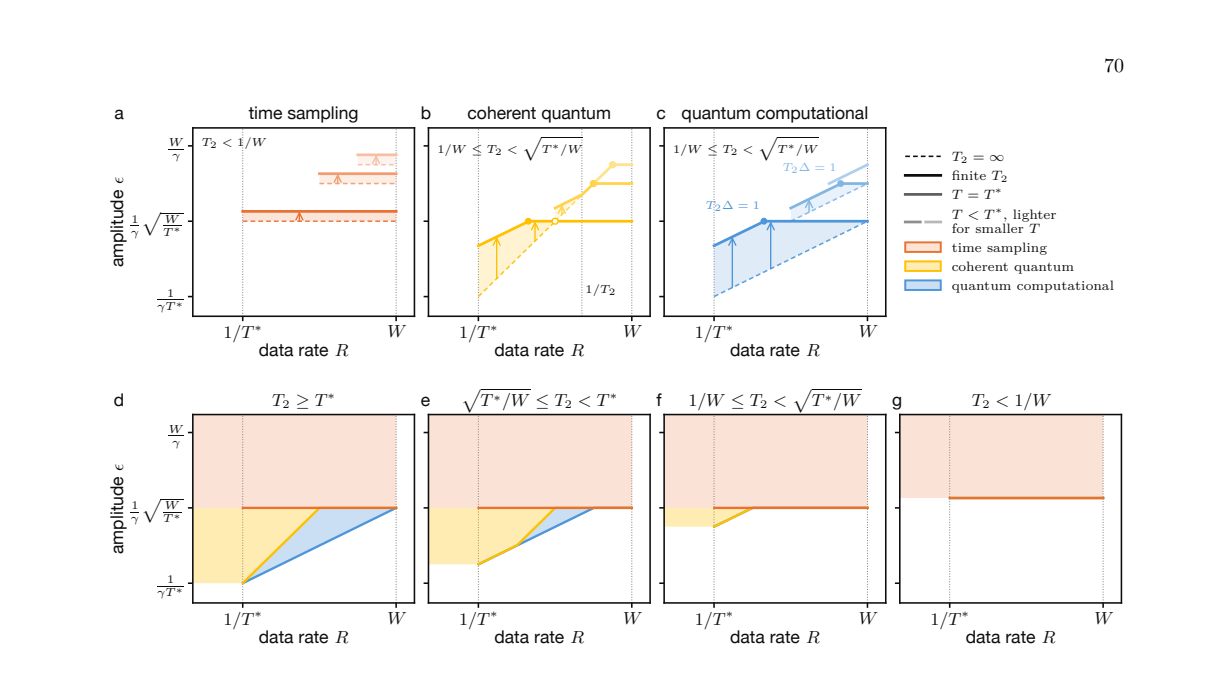
The premise it rests on. The central assumption is that the set of candidate frequencies is exactly known and that the frequencies are separated by at least $\Delta$. In practice, frequencies may have uncertainties or drift, and continuous-frequency spectroscopy is not directly addressed (the paper acknowledges this limitation in the Discussion).
If the paper is right (Pith's inferences, not the authors')
If the paper's claims are correct, any discrete-frequency spectroscopy task with N known candidate frequencies can be performed in time O~(sqrt(N)/epsilon), a sqrt(N) speedup over conventional methods.
Detection and Search tasks require only a single-qubit sensor with pi-pulse control, making them implementable on current NV center and trapped ion platforms.
Learning the full spectrum requires a quantum computer, but for periodic signals a simpler algorithm using SWAP gates and single-qubit measurements suffices.
The wireless communication analysis suggests that a quantum computational receiver could achieve higher data rates at weak signal strengths than any ancilla-free receiver.
The bosonic sensor analogue shows that the learning task can be implemented with a time-independent quadratic Hamiltonian and nearest-neighbor couplings.
The paper's framework suggests that many practical spectroscopy applications, such as molecular screening or NMR, could benefit from a sqrt(N) speedup using existing single-qubit sensors without requiring a full quantum computer.
The exponential separation in parity learning (Appendix H) indicates that for certain structured signals, the quantum advantage in sensing can be exponential, providing a strong motivation for building quantum computers.
The paper's assumption of exactly known frequencies with minimum separation Delta is restrictive; extending the algorithms to continuous-frequency settings or to frequencies with uncertainty would make them applicable to a wider range of problems, as the authors acknowledge.
Check this review
What was read
The passes were given all 351,438 characters of the paper's LaTeX source.
Fingerprint of that text (SHA-256): cdaf4f8d864617ad9a40d4c96e7cf7f4d8a96ad5f60a8cb7b7dff5ae2df1e4c7
Pith does not keep that text. Rebuilt from the paper's source or PDF by the same code, it has this fingerprint if it is the same text. From a copy of Pith's code:
PYTHONPATH=. python scripts/review_input_check.py 2611.21560
The passes, in the order they ran
- Reader deepseek-v4-flash · medium effort · $0.0055 · instructions of the Reader, fingerprint f9ead7300382…
- Skeptic deepseek-v4-flash · medium effort · $0.0054 · instructions of the Skeptic, fingerprint 8f88c0f61488…
- Referee deepseek-v4-flash · medium effort · $0.0054 · instructions of the Referee, fingerprint a852d99aea0d…
- Editor deepseek-v4-flash · medium effort · $0.0051 · instructions of the Editor, fingerprint e7211f6a3d27…
- Circularity check deepseek-v4-flash · medium effort · $0.0051 · instructions of the Circularity check, fingerprint e9946e39d67b…
- Summary for the page deepseek-v4-flash · medium effort · temperature 0.2 · $0.0055 · instructions of the Summary for the page, fingerprint e4f56bf568e7…
The passes cost $0.032 in model calls together.
Version stamped on this review: pith-pipeline@v1.4.1-daily-deepseek-or-medium+deepseek/deepseek-v4-flash+p.505d180dcaef
Each link opens a pass's instructions as plain text, the exact bytes its fingerprint was taken over. Every stored set of instructions.
curl -s https://pith.science/methodology/prompts/f9ead730038216984cfb56d7cb34332bdf691828296a1de4245f3d6667d4bf56 | sha256sum
prints the fingerprint of the reader's instructions. The same works for every pass.
The receipt
The review's fingerprint was taken on 18 Nov 2026. The review you are reading still matches it.
Fingerprint of the review (SHA-256): bcf14989bc646c094fda0e33220746c42c885bebf108a8b85f358b69a23f7749
curl -s 'https://pith.science/api/v1/verdicts/2611.21560?form=canonical' | sha256sum
prints the fingerprint of the review as it stands now. The rule, in four steps.
A matching fingerprint shows the review has not changed since that date. It does not show that the review is right.
How often reviews like this one are right
Reviews like this one: written by deepseek-v4-flash, from the paper's LaTeX source.
How often objections from reviews like this one are right: not yet measured
Reviews by people
This review was written by a machine. No person has reviewed this paper on Pith yet. A scientist listed on Pith can review it for a fee, and their review is published here whatever it concludes.
How Pith checks papers · The full audit of this paper · Review history (3 versions)
The paper
Abstract
Spectroscopy is a versatile tool that drives scientific discovery and underpins modern technologies. Quantum sensing offers promising opportunities to advance spectroscopy through enhanced sensitivity and spectral and spatial resolution. However, existing approaches largely focus on improving general measurement capabilities, often overlooking the structure of specific sensing tasks and leaving potential performance gains untapped. Here, we develop an algorithmic approach to quantum sensing tailored to various spectroscopic tasks, providing new avenues for improvement. Specifically, we consider general time-varying signals supported on a known set of N candidate frequencies, a setting we call discrete-frequency spectroscopy. We formulate three types of practically motivated sensing tasks—Detection, Search, and Learning—that require progressively more spectral information. For all tasks, we design optimal quantum sensing algorithms achieving a √N speedup over conventional frequency-scanning approaches. Optimal Detection and Search need only a single-qubit sensor under π-pulse control, whereas optimal Learning provably requires coherent processing with a quantum computer. End-to-end numerical simulations incorporating various experimental imperfections predict up to two-orders-of-magnitude speedup in Detection. As an example, we analyze the feasibility of our Detection and Search algorithms for real-world molecular screening based on state-of-the-art nitrogen-vacancy centers. We also show how quantum-computing-enhanced Learning enables wireless communication in a weak-signal regime where conventional methods fail. Our results establish a practical route toward realizing quantum advantages via designing task-specific sensing algorithms.
The paper's own sentences, arranged, kept beside the review and separate from it. Each label is drawn from a closed vocabulary; the number beside it is the probability the classifier gave that label. No sentence in this record was written by a model.
abstract compiled · 2026-11-17
The authors' main claim, as the classifier picked it out 0.97
“Our results establish a practical route toward realizing quantum advantages via designing task-specific sensing algorithms.”
How the main claim is stated: asserted 0.99
What the abstract itself states, as probabilities: claims first 0.08 · states limitation 0.39 · human participants 0.02 · controlled comparison 0.57 · randomized assignment 0.01 · states quantitative result 0.98 · compares with prior results 0.93 · mentions code or data availability 0.03
The abstract, sentence by sentence
This table labels the abstract only (arXiv listing abstract v1). The number is the probability the classifier gave the label.
| Sentence | Role | The authors' own work | States the main conclusion | Strength |
|---|---|---|---|---|
| Spectroscopy is a versatile tool that drives scientific discovery and underpins modern technologies. | background 1.00 | 0.03 | 0.01 | asserted 1.00 |
| Quantum sensing offers promising opportunities to advance spectroscopy through enhanced sensitivity and spectral and spatial resolution. | background 1.00 | 0.05 | 0.03 | hedged possibility 0.92 |
| However, existing approaches largely focus on improving general measurement capabilities, often overlooking the structure of specific sensing tasks and leaving potential performance gains untapped. | gap 1.00 | 0.06 | 0.03 | asserted 0.99 |
| Here, we develop an algorithmic approach to quantum sensing tailored to various spectroscopic tasks, providing new avenues for improvement. | contribution 1.00 | 0.95 | 0.15 | asserted 0.99 |
| Specifically, we consider general time-varying signals supported on a known set of $N$ candidate frequencies, a setting we call discrete-frequency spectroscopy. | contribution 0.48 | 0.74 | 0.03 | asserted 0.95 |
| We formulate three types of practically motivated sensing tasks---Detection, Search, and Learning---that require progressively more spectral information. | contribution 0.67 | 0.93 | 0.05 | asserted 0.99 |
| For all tasks, we design optimal quantum sensing algorithms achieving a $\sqrt{N}$ speedup over conventional frequency-scanning approaches. | result 0.94 | 0.96 | 0.53 | asserted 1.00 |
| Optimal Detection and Search need only a single-qubit sensor under $\pi$-pulse control, whereas optimal Learning provably requires coherent processing with a quantum computer. | result 0.91 | 0.93 | 0.19 | asserted 1.00 |
| End-to-end numerical simulations incorporating various experimental imperfections predict up to two-orders-of-magnitude speedup in Detection. | result 0.98 | 0.95 | 0.07 | asserted 0.58 |
| As an example, we analyze the feasibility of our Detection and Search algorithms for real-world molecular screening based on state-of-the-art nitrogen-vacancy centers. | contribution 0.81 | 0.92 | 0.04 | asserted 0.76 |
| We also show how quantum-computing-enhanced Learning enables wireless communication in a weak-signal regime where conventional methods fail. | result 0.82 | 0.94 | 0.08 | asserted 1.00 |
| Our results establish a practical route toward realizing quantum advantages via designing task-specific sensing algorithms. | interpretation 1.00 | 0.86 | 0.89 | asserted 0.99 |
What kind of paper the classifier reports this is: method or tool 1.00 · evidence from proof or derivation 0.60
What was examined, and what was not
Sources read
- arXiv listing abstract v1
Not examined
- full text
- figures and tables
- references and citing sentences
- relations to other papers
Levels run
- P abstract
Not run
- S sections
- T body sentences
- C citations
- R cross-paper relations
How the labels were made
Compiled by classifier-1.13.0 via TypeSafe API, question bank abstract-p1-20260923, 2026-11-17: 1 request, 8,770 input tokens.
Every quoted sentence on this record is the authors'. Every label is from Pith's closed vocabulary, with the probability shown beside it. This record as JSON
Figures (9)
Showing 3 of the paper's 9 figures. Figures are the authors', reproduced from the paper.
References (84)
- [1] Theory of. Physical Review X , author =. 2021 , pages =. doi:10.1103/PhysRevX.11.011020 , number = on Pithdoi:10.1103/physrevx.11.011020
- [2] Some trigonometrical inequalities with applications to the theory of series , volume =. Mathematische Zeitschrift , author =. 1936 , pages = on Pith
- [3] Quantum Computing Enhanced Sensing , author=. 2025 , eprint= on Pith
- [4] Trigonometric series , author=. 2002 , publisher= on Pith
- [5] Quantum sensing , author =. Rev. Mod. Phys. , volume =. 2017 , month =. doi:10.1103/RevModPhys.89.035002 , url = on PithPith's reviewdoi:10.1103/revmodphys.89.035002
- [6] Fundamental Quantum Limit to Waveform Estimation , author =. Phys. Rev. Lett. , volume =. 2011 , month =. doi:10.1103/PhysRevLett.106.090401 , url = on Pithdoi:10.1103/physrevlett.106.090401
- [7] Wavelet-based fast time-resolved magnetic sensing with electronic spins in diamond , author =. Phys. Rev. B , volume =. 2016 , month =. doi:10.1103/PhysRevB.93.161117 , url = on Pithdoi:10.1103/physrevb.93.161117
- [8] High-sensitivity diamond magnetometer with nanoscale resolution , author =. Nature Physics , volume =. 2008 , doi = on Pith
- [9] Azamat Mukhatov and Tuan. A Comprehensive Review on Magnetic Imaging Techniques for Biomedical Applications , journal =. 2023 , doi = on Pith
- [10] Laura Kreidberg , title =. Handbook of Exoplanets , editor =. 2018 , doi = on Pith
- [11] Nabeel Aslam and Hengyun Zhou and Elana K. Urbach and Matthew J. Turner and Ronald L. Walsworth and Mikhail D. Lukin and Hongkun Park , title =. Nature Reviews Physics , volume =. 2023 , doi = on Pith
- [12] Steven D. Bass and Michael Doser , title =. Nature Reviews Physics , volume =. 2024 , doi = on Pith
- [13] Time-Symmetric Quantum Theory of Smoothing , author =. Physical Review Letters , volume =. 2009 , doi = on Pith
- [14] Optimal Waveform Estimation for Classical and Quantum Systems via Time-Symmetric Smoothing , author =. Physical Review A , volume =. 2009 , doi = on Pith
- [15] Tsang, Mankei , journal =. Optimal Waveform Estimation for Classical and Quantum Systems via Time-Symmetric Smoothing. 2010 , doi = on Pith
- [16] Fundamental Quantum Limit to Waveform Estimation , author =. Physical Review Letters , volume =. 2011 , doi = on Pith
- [17] Richard Schreier and Shanthi Pavan and Gabor C. Temes , title =. 2017 , series = on Pith
- [18] Stochastic Waveform Estimation at the Fundamental Quantum Limit , author =. PRX Quantum , volume =. 2025 , month =. doi:10.1103/h91r-4ws9 , url = on Pithdoi:10.1103/h91r-4ws9
- [19] Compressing measurements in quantum dynamic parameter estimation , author =. Phys. Rev. A , volume =. 2013 , month =. doi:10.1103/PhysRevA.88.062109 , url = on Pithdoi:10.1103/physreva.88.062109
- [20] I. Lovchinsky and A. O. Sushkov and E. Urbach and N. P. de Leon and S. Choi and K. De Greve and R. Evans and R. Gertner and E. Bersin and C. M. Nuclear Magnetic Resonance Detection and Spectroscopy of Single Proteins Using Quantum Logic , journal =. 2016 , doi = on Pith
show 64 more
- [21] N. Aslam and M. Pfender and P. Neumann and R. Reuter and A. Zappe and F. Favaro de Oliveira and A. Denisenko and H. Sumiya and S. Onoda and J. Isoya and J. Wrachtrup , title =. Science , volume =. 2017 , doi = on Pith
- [22] Fast Quantum Algorithm for Numerical Gradient Estimation , author =. Phys. Rev. Lett. , volume =. 2005 , month =. doi:10.1103/PhysRevLett.95.050501 , url = on PithPith's reviewdoi:10.1103/physrevlett.95.050501
- [23] Achieving the Fundamental Quantum Limit of Linear Waveform Estimation , author =. Phys. Rev. Lett. , volume =. 2024 , month =. doi:10.1103/PhysRevLett.132.130801 , url = on Pithdoi:10.1103/physrevlett.132.130801
- [24] A Molecular Beam Resonance Method with Separated Oscillating Fields , author =. Phys. Rev. , volume =. 1950 , month =. doi:10.1103/PhysRev.78.695 , url = on Pithdoi:10.1103/physrev.78.695
- [25] Fundamental Quantum Limits to Waveform Detection , author =. Physical Review A , volume =. 2012 , doi = on Pith
- [26] Quantum Sensing of Fast Time-Varying Magnetic Field With Daubechies Wavelets , author =. IEEE Access , volume =. 2024 , doi = on Pith
- [27] Berry, Dominic W. and Tsang, Mankei and Hall, Michael J. W. and Wiseman, Howard M. , journal =. Quantum. 2015 , doi = on Pith
- [28] Broadband Quantum Enhancement of the LIGO Detectors with Frequency-Dependent Squeezing , author =. Phys. Rev. X , volume =. 2023 , month =. doi:10.1103/PhysRevX.13.041021 , url = on Pithdoi:10.1103/physrevx.13.041021
- [29] Xin Zheng and Jonathan Dolde and Matthew C. Cambria and Hong Ming Lim and Shimon Kolkowitz , title =. Nature Communications , volume =. 2023 , doi = on Pith
- [30] Aeppli, Alexander and Kim, Kyungtae and Warfield, William and Safronova, Marianna S. and Ye, Jun , journal =. Clock with 8. 2024 , month =. doi:10.1103/PhysRevLett.133.023401 , url = on Pithdoi:10.1103/physrevlett.133.023401
- [31] Diamond Magnetometry and Gradiometry Towards Subpicotesla dc Field Measurement , author =. Phys. Rev. Appl. , volume =. 2021 , month =. doi:10.1103/PhysRevApplied.15.064075 , url = on Pithdoi:10.1103/physrevapplied.15.064075
- [32] Nearly Optimal Quantum Algorithm for Estimating Multiple Expectation Values , author =. Phys. Rev. Lett. , volume =. 2022 , month =. doi:10.1103/PhysRevLett.129.240501 , url = on Pithdoi:10.1103/physrevlett.129.240501
- [33] Quantum metrology with nonclassical states of atomic ensembles , author =. Rev. Mod. Phys. , volume =. 2018 , month =. doi:10.1103/RevModPhys.90.035005 , url = on PithPith's reviewdoi:10.1103/revmodphys.90.035005
- [34] Quantum-Enhanced Measurements: Beating the Standard Quantum Limit , author =. Science , volume =. 2004 , doi = on Pith
- [35] Nitrogen-Vacancy Centers in Diamond: Nanoscale Sensors for Physics and Biology , author =. Annual Review of Physical Chemistry , volume =. 2014 , doi = on Pith
- [36] Barry, John F. and Schloss, Jennifer M. and Bauch, Erik and Turner, Matthew J. and Hart, Connor A. and Pham, Linh M. and Walsworth, Ronald L. , journal =. Sensitivity optimization for. 2020 , doi = on Pith
- [37] Time-resolved magnetic sensing with electronic spins in diamond , author =. Nature Communications , volume =. 2014 , doi = on Pith
- [38] A further note on trigonometrical inequalities , volume =. Mathematical Proceedings of the Cambridge Philosophical Society , author =. 1950 , pages =. doi:10.1017/S0305004100026098 , abstract = on Pithdoi:10.1017/s0305004100026098
- [39] Achieving the Heisenberg limit in quantum metrology using quantum error correction , author=. Nature Communications , volume=. 2018 , publisher= on Pith
- [40] Allert, Robin D. and Briegel, Karl D. and Bucher, Dominik B. , journal =. Advances in nano- and microscale. 2022 , doi = on Pith
- [41] Quantum Computational Sensing , author=. 2026 , eprint= on Pith
- [42] Cotler, Jordan and Danielson, Daine L. and Kannan, Ishaan , year=. Quantum Advantage for Sensing Properties of Classical Fields , volume=. Physical Review X , publisher=. doi:10.1103/6ps1-mw9l , number= on Pithdoi:10.1103/6ps1-mw9l
- [43] Exponential quantum advantage for learning signals with a single qubit , author=. 2026 , eprint= on Pith
- [44] Quantum Tomography Using State-Preparation Unitaries , author =. Proceedings of the 2023 Annual ACM-SIAM Symposium on Discrete Algorithms (SODA) , pages =. 2023 , publisher =. doi:10.1137/1.9781611977554.ch47 , eprint = on Pithdoi:10.1137/1.9781611977554.ch47
- [45] Heisenberg-Limited Adaptive Gradient Estimation for Multiple Observables , author =. PRX Quantum , volume =. 2025 , month =. doi:10.1103/PRXQuantum.6.020308 , url = on Pithdoi:10.1103/prxquantum.6.020308
- [46] Bernstein, Ethan and Vazirani, Umesh , title =. SIAM Journal on Computing , volume =. 1997 , doi = on Pith
- [47] Quantum Algorithmic Measurement , author =. Nature Communications , volume =. 2022 , doi = on Pith
- [48] Kotler, Shlomi and Akerman, Nitzan and Glickman, Yinnon and Keselman, Anna and Ozeri, Roee , title =. Nature , volume =. 2011 , doi = on Pith
- [49] Nanoscale NMR Spectroscopy Using Nanodiamond Quantum Sensors , author =. Phys. Rev. Appl. , volume =. 2020 , month =. doi:10.1103/PhysRevApplied.13.044004 , url = on Pithdoi:10.1103/physrevapplied.13.044004
- [50] The. Mathematische Annalen , author =. 2024 , note =. doi:10.1007/s00208-023-02692-w , abstract = on Pithdoi:10.1007/s00208-023-02692-w
- [51] From. Advances in Pure and Applied Mathematics , author =. 2024 , pages =. doi:10.21494/ISTE.OP.2024.1173 , abstract = on Pithdoi:10.21494/iste.op.2024.1173
- [52] Proton magnetic resonance imaging using a nitrogen--vacancy spin sensor , author =. Nature Nanotechnology , volume =. 2015 , doi = on Pith
- [53] Nanoscale Nuclear Magnetic Resonance with a Nitrogen-Vacancy Spin Sensor , author =. Science , volume =. 2013 , doi = on Pith
- [54] Entanglement Rates and Area Laws , author =. Physical Review Letters , volume =. 2013 , doi = on Pith
- [55] A quantum spectrum analyzer enhanced by a nuclear spin memory , author =. npj Quantum Information , volume =. 2017 , doi = on Pith
- [56] Nuclear Magnetic Resonance Spectroscopy on a (5-Nanometer) ^3 Sample Volume , author =. Science , volume =. 2013 , doi = on Pith
- [57] Atomic-scale imaging of a 27-nuclear-spin cluster using a quantum sensor , author =. Nature , volume =. 2019 , doi = on Pith
- [58] Chen, Sitan and Cotler, Jordan and Huang, Hsin-Yuan , month = oct, year =. Quantum. doi:10.48550/arXiv.2510.08499 , abstract = on Pithdoi:10.48550/arxiv.2510.08499
- [59] Kimmel, Shelby and Low, Guang Hao and Yoder, Theodore J. , year=. Robust calibration of a universal single-qubit gate set via robust phase estimation , volume=. Physical Review A , publisher=. doi:10.1103/physreva.92.062315 , number= on Pithdoi:10.1103/physreva.92.062315
- [60] Binas, Oliver and de Jesus, Vanessa and Landgraf, Tom and V. ChemBioChem , year = on Pith
- [61] Schmitt, Simon and Gefen, Tuvia and St. Submillihertz magnetic spectroscopy performed with a nanoscale quantum sensor , journal =. 2017 , volume = on Pith
- [62] Ariyasingha, Nuwandi M. and Lindale, Jacob R. and Eriksson, Shannon L. and Clark, Grayson P. and Theis, Thomas and Shchepin, Roman V. and Chukanov, Nikita V. and Kovtunov, Kirill V. and Koptyug, Igor V. and Warren, Warren S. and Chekmenev, Eduard Y. , title =. The Journal of P... on Pith
- [63] Bar-Gill, Nir and Pham, Linh M. and Jarmola, Andrejs and Budker, Dmitry and Walsworth, Ronald L. , title =. Nature Communications , year = on Pith
- [64] Tse, David and Viswanath, Pramod , title =. 2005 , doi = on Pith
- [65] Shuo Han and Xiangyu Ye and Xu Zhou and Zhaoxin Liu and Yuhang Guo and Mengqi Wang and Wentao Ji and Ya Wang and Jiangfeng Du , title =. Science Advances , volume =. 2025 , doi = on Pith
- [66] Single-Spin Magnetometry with Multipulse Sensing Sequences , author =. Phys. Rev. Lett. , volume =. 2011 , month =. doi:10.1103/PhysRevLett.106.080802 , url = on Pithdoi:10.1103/physrevlett.106.080802
- [67] High-Resolution Quantum Sensing with Shaped Control Pulses , author =. Phys. Rev. Lett. , volume =. 2017 , month =. doi:10.1103/PhysRevLett.119.260501 , url = on Pithdoi:10.1103/physrevlett.119.260501
- [68] Imaging of high-frequency electromagnetic field by multipulse sensing using nitrogen vacancy centers in diamond , author=. 2023 , eprint= on Pith
- [69] Gautschi, Walter , title =. 2004 , month =. doi:10.1093/oso/9780198506720.001.0001 , url = on Pithdoi:10.1093/oso/9780198506720.001.0001
- [70] Perfect State Transfer in Quantum Spin Networks , author =. Phys. Rev. Lett. , volume =. 2004 , month =. doi:10.1103/PhysRevLett.92.187902 , url = on PithPith's reviewdoi:10.1103/physrevlett.92.187902
- [71] Experimental realization of any discrete unitary operator , author =. Phys. Rev. Lett. , volume =. 1994 , month =. doi:10.1103/PhysRevLett.73.58 , url = on Pithdoi:10.1103/physrevlett.73.58
- [72] William R. Clements and Peter C. Humphreys and Benjamin J. Metcalf and W. Steven Kolthammer and Ian A. Walmsley , journal =. Optimal design for universal multiport interferometers , volume =. 2016 , url = on Pith
- [73] Gaussian quantum information , author =. Rev. Mod. Phys. , volume =. 2012 , month =. doi:10.1103/RevModPhys.84.621 , url = on Pithdoi:10.1103/revmodphys.84.621
- [74] Matrices, Moments and Quadrature with Applications , author =. 2010 , lastchecked =. doi:doi:10.1515/9781400833887 , isbn = on Pithdoi:10.1515/9781400833887
- [75] D Boley and G H Golub , title =. 1987 , month =. doi:10.1088/0266-5611/3/4/010 , url = on Pithdoi:10.1088/0266-5611/3/4/010
- [76] Storing quantum information for 30 seconds in a nanoelectronic device , author=. Nature Nanotechnology , volume=. 2014 , publisher= on Pith
- [77] Muhonen, J T and Laucht, A and Simmons, S and Dehollain, J P and Kalra, R and Hudson, F E and Freer, S and Itoh, K M and Jamieson, D N and McCallum, J C and Dzurak, A S and Morello, A , title =. 2015 , month =. doi:10.1088/0953-8984/27/15/154205 , url = on Pithdoi:10.1088/0953-8984/27/15/154205
- [78] A long-lived Zeeman trapped-ion qubit , author=. Applied Physics B , volume=. 2016 , publisher= on Pith
- [79] Fast, High-Fidelity Addressed Single-Qubit Gates Using Efficient Composite Pulse Sequences , author =. Phys. Rev. Lett. , volume =. 2023 , month =. doi:10.1103/PhysRevLett.131.120601 , url = on Pithdoi:10.1103/physrevlett.131.120601
- [80] Sensing of Arbitrary-Frequency Fields Using a Quantum Mixer , author =. Phys. Rev. X , volume =. 2022 , month =. doi:10.1103/PhysRevX.12.021061 , url = on Pithdoi:10.1103/physrevx.12.021061
- [81] Enhancing Optical Imaging via Quantum Computation , author =. PRX Quantum , volume =. 2026 , month =. doi:10.1103/s94k-929p , url = on Pithdoi:10.1103/s94k-929p
- [82] Exponential separation in sensing continuous signals via squeezing , author=. 2026 , eprint= on Pith
- [83] Super-Exponential Advantage of Squeezed Light in Phase Estimation under Discrete Phase Randomisation , author=. 2026 , eprint= on Pith
- [84] Quantum Fourier transform for nanoscale quantum sensing , author=. npj Quantum Information , volume=. 2021 , publisher= on Pith
Cited by 1 Pith paper
Reviewed papers on Pith that cite this one. The full citation record
- Algorithmic Quantum Sensing quant-ph · Nov 2026
Topics: The Measurement Problem
Challenges and discussion
Disagree with the review, or know something it missed? Leave a comment, or challenge this review formally: a challenge becomes a permanent entry in this paper's record, and its decision is published here.
Come back by email
A short list of the week's newly reviewed papers. Nothing is sent until you confirm from your inbox, and every email has a link that stops it. No account.
No comments yet.
Sign in to comment