Quantum Physics · arXiv:2611.25572 v1 · submitted 19 Nov 2026 · 161 references
Algorithmic Quantum Sensing
The paper says
“We introduce a unified framework for sensing time-dependent fields through the lens of classical and quantum algorithms.”
more of the abstract
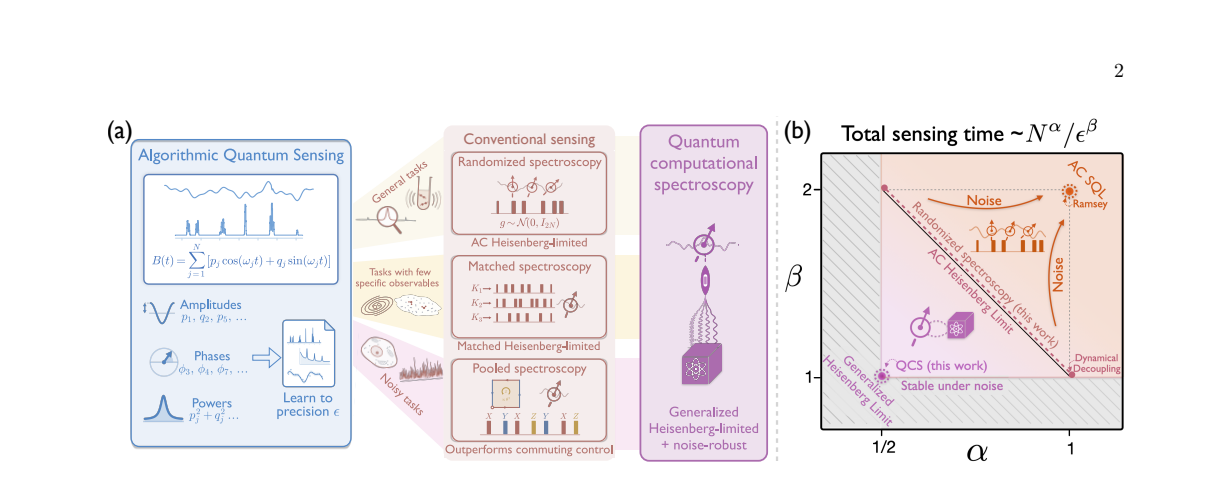
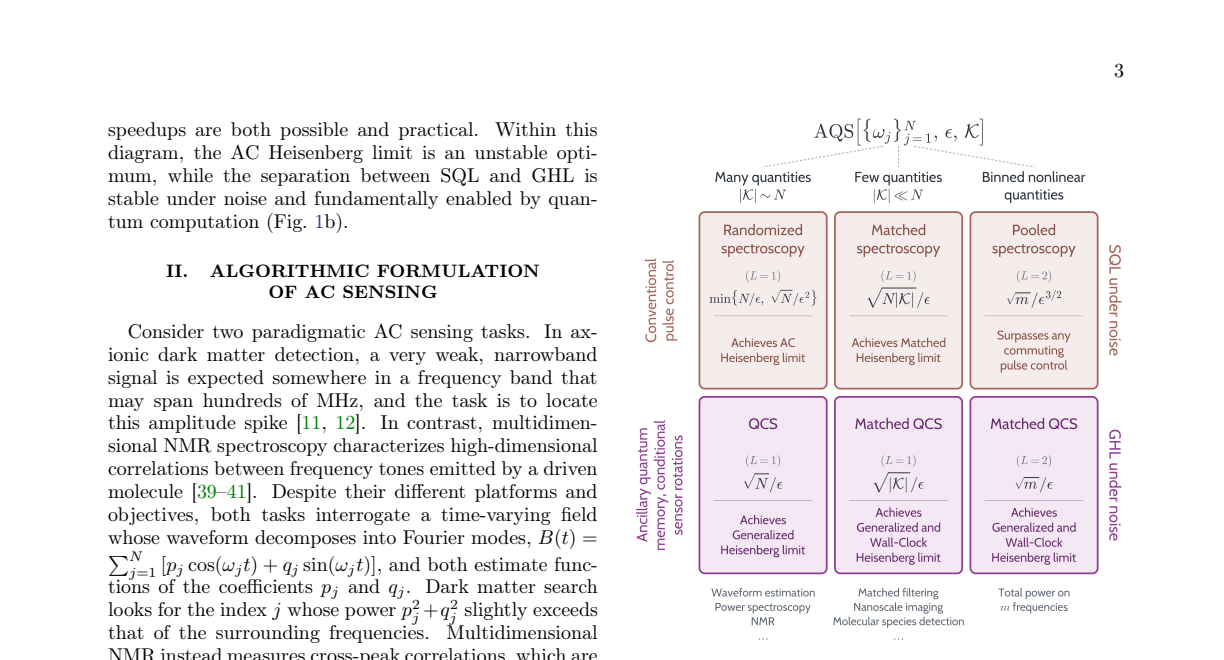
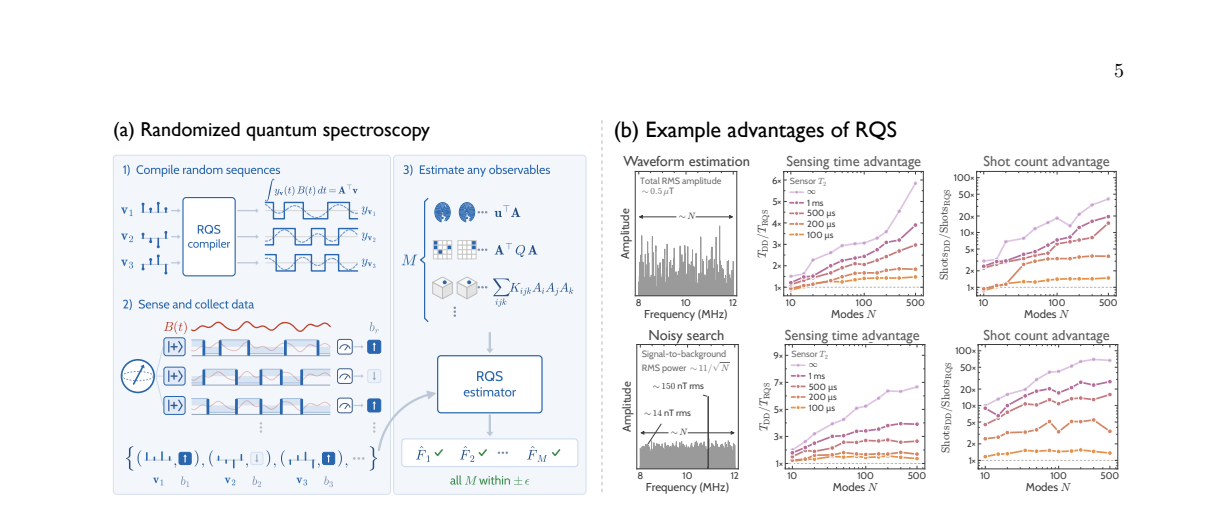
First, we develop three pulse sequence protocols, namely randomized, matched, and pooled spectroscopy, which outperform established approaches such as dynamical decoupling across a wide range of tasks. These protocols attain the optimal sensitivity for linear and nonlinear AC sensing on conventional spin or qubit platforms, improving existing devices by changing only their pulse sequences. We then introduce quantum computational spectroscopy (QCS), which couples quantum sensors to a quantum processor. QCS combines two new primitives: a quantum computational frequency comb that coherently converts any classical signal into a quantum oracle, and a family of quantum algorithms that use the oracle to extract signal information in superposition. Variations can be implemented on current platforms with only one memory ancilla. We show that the ultimate limit imposed by quantum mechanics lies polynomially beyond the Heisenberg limit, and that QCS achieves it. Attaining this new limit requires quantum computation, establishing a fundamental separation between conventional and quantum computational sensing. Moreover, QCS retains beyond-Heisenberg scaling for broadband signals under constant-strength sensor depolarization, while we prove that the same noise limits any protocol lacking quantum computation to standard-quantum-limit scaling. Our result provides the first asymptotic, beyond-quadratic quantum advantage in AC metrology when noise is aligned with the signal, proving that Lindblad span conditions do not apply to broadband quantum sensing. Our work builds an algorithmic theory for designing sensing protocols and establishes quantum sensing as a new frontier for quantum algorithms, with quantum advantages that surpass the Heisenberg limit and that persist under noise.
from the abstract
Pith says
Machine review · deepseek-v4-flash · 20 Nov 2026 · read 599,600 of 775,105 characters · not checked by a person
It can be wrong. Challenge this review or reply to it.
Holds up, with conditions. This paper introduces a unified framework for AC sensing that yields provably optimal conventional protocols and a quantum computational protocol that surpasses the AC Heisenberg limit, with the central claim that the ultimate quantum limit lies polynomially beyond the Heisenberg limit and requires quantum computation to achieve. This line is wrong
10 minor · 8 open questions
How often objections from reviews like this one are right: not yet measured
The paper, first character to last
Not given to the reviewer: 175,505 of the paper's 775,105 characters. Not checked: figures, code, what the 161 references say.
10 minor objections
The paper says, at §I, Introduction
Pith says: minor objection 1 of 10
The phrase 'polynomially beyond the Heisenberg limit' is ambiguous. The paper shows a $\sqrt{N}$ improvement in the $N$-dependence and a $1/\epsilon$ improvement in the precision dependence. It would be clearer to state the specific polynomial improvement (e.g., 'quadratically better in $N$ and $\epsilon$').
The paper says, at §II, Definition 1
Pith says: minor objection 2 of 10
The normalization $\|A\|_2 \leq 1$ is convenient but its physical meaning is not fully explained. The signal amplitude is absorbed into $\kappa$, but $\kappa$ is defined as the spectral norm of the tensor $K$, not the signal amplitude. This makes the relationship between $\epsilon$, $\kappa$, and the physical signal amplitude somewhat opaque. A brief clarification would help.
show 8 more
The paper says, at §III.A, Theorem 1 (Theorem \ref{thm:rqs_informal})
Pith says: minor objection 3 of 10
The theorem statement does not specify the success probability. The definition of AQS requires 'high success probability', but the theorem should state the dependence on the failure probability $\delta$ (which is logarithmic in $1/\delta$).
The paper says, at §III.B, Theorem 2 (Theorem \ref{thm:matched_heisenberg_informal})
Pith says: minor objection 4 of 10
The lower bound is stated as the 'Matched Heisenberg limit', but the proof is deferred to the appendix. The main text should at least sketch the proof idea or cite the relevant appendix section.
The paper says, at §IV, Figure 4 (Fig. \ref{fig:qcs_main})
Pith says: minor objection 5 of 10
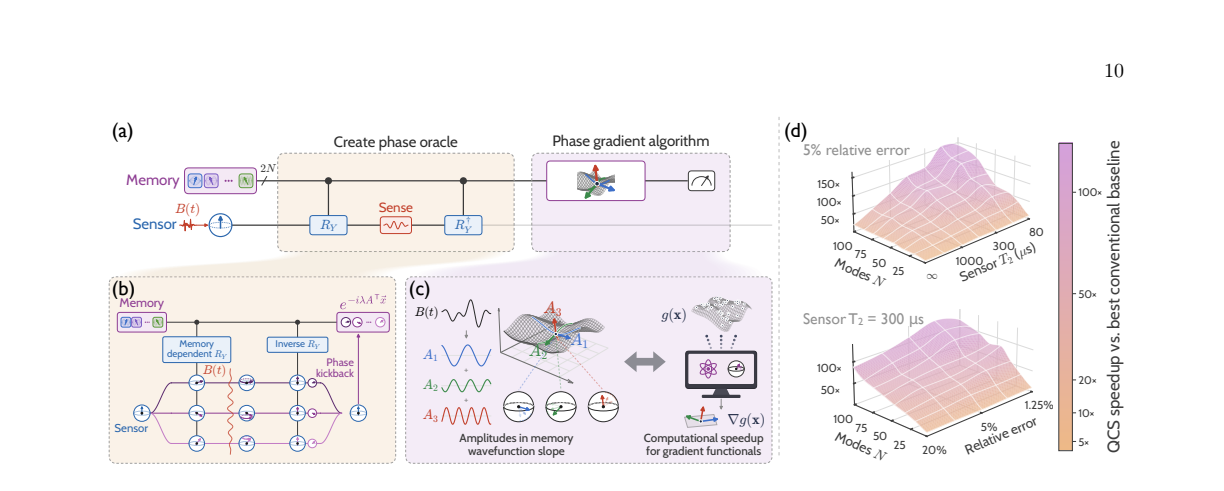
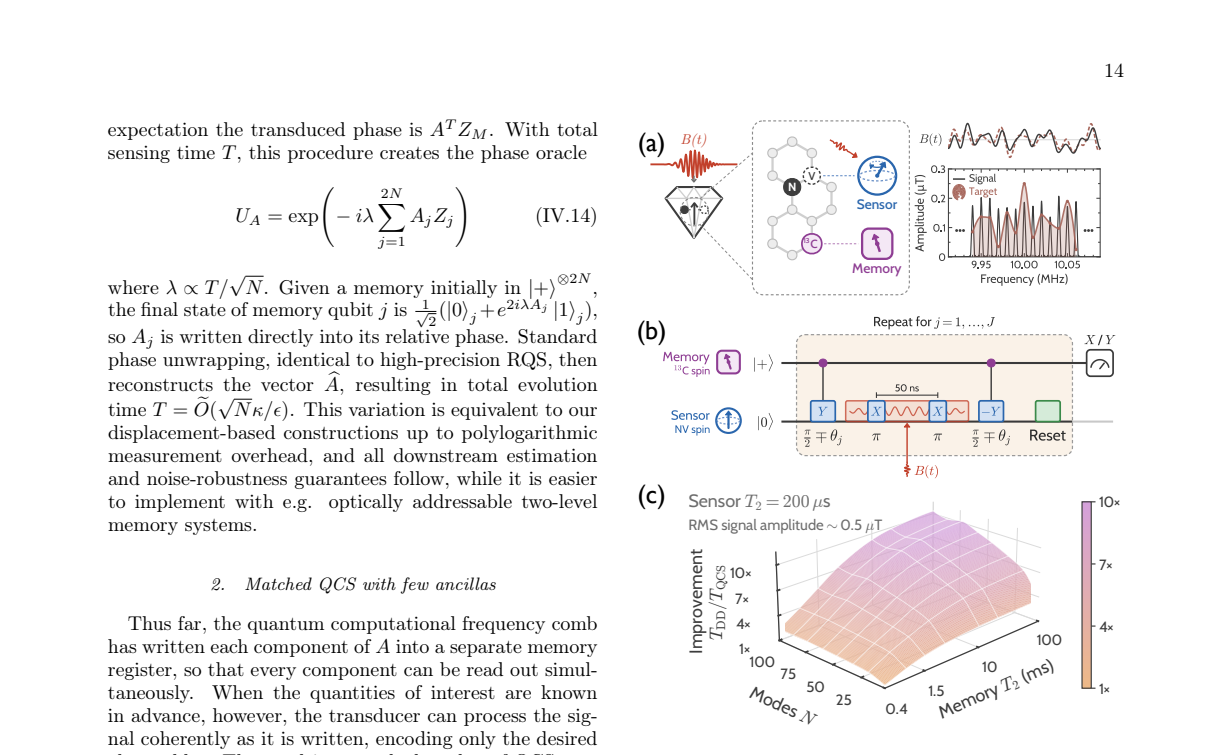
This is an important caveat. The simulations assume instantaneous control operations, which is unrealistic. The authors should discuss how finite-duration pulses and gate errors would affect the advantage.
The paper says, at §IV.C, Algorithm 4 (Algorithm \ref{alg:qcs_phase_oracle})
Pith says: minor objection 6 of 10
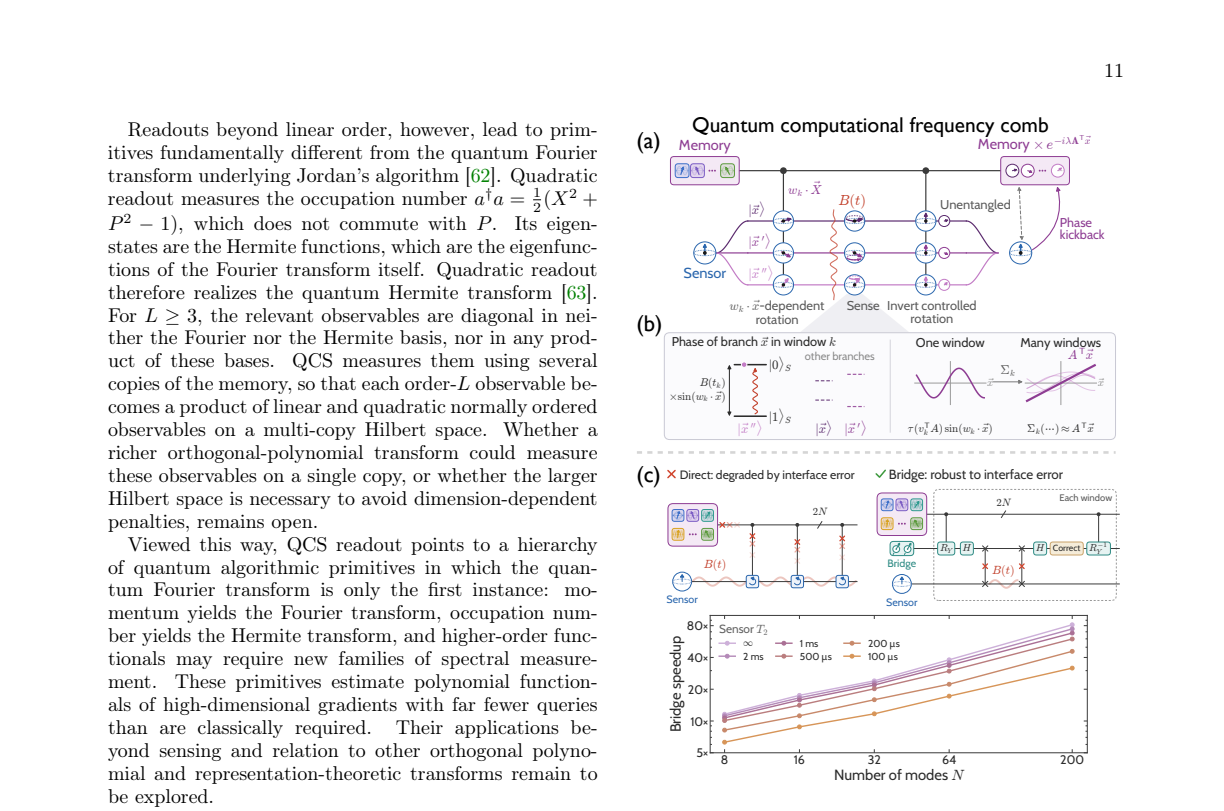
The algorithm requires sampling an odd integer harmonic $\ell_k$ with probability $|a_{\ell_k}|/s_0$. The coefficients $a_\ell$ come from the power series expansion of $\arcsin$. The paper should state how many terms are needed (the truncation cutoff $b$) and how it scales with the desired accuracy.
The paper says, at §IV.E, 'Gadget for correcting interface errors'
Pith says: minor objection 7 of 10
The bridge gadget is described but its analysis is deferred to the appendix. The main text should at least state the key result: that the bridge gadget corrects interface errors without asymptotically degrading the memory channel, and what the constant attenuation factor is.
The paper says, at §V, Figure 5 (Fig. \ref{fig:estimation_vs_learning})
Pith says: minor objection 8 of 10
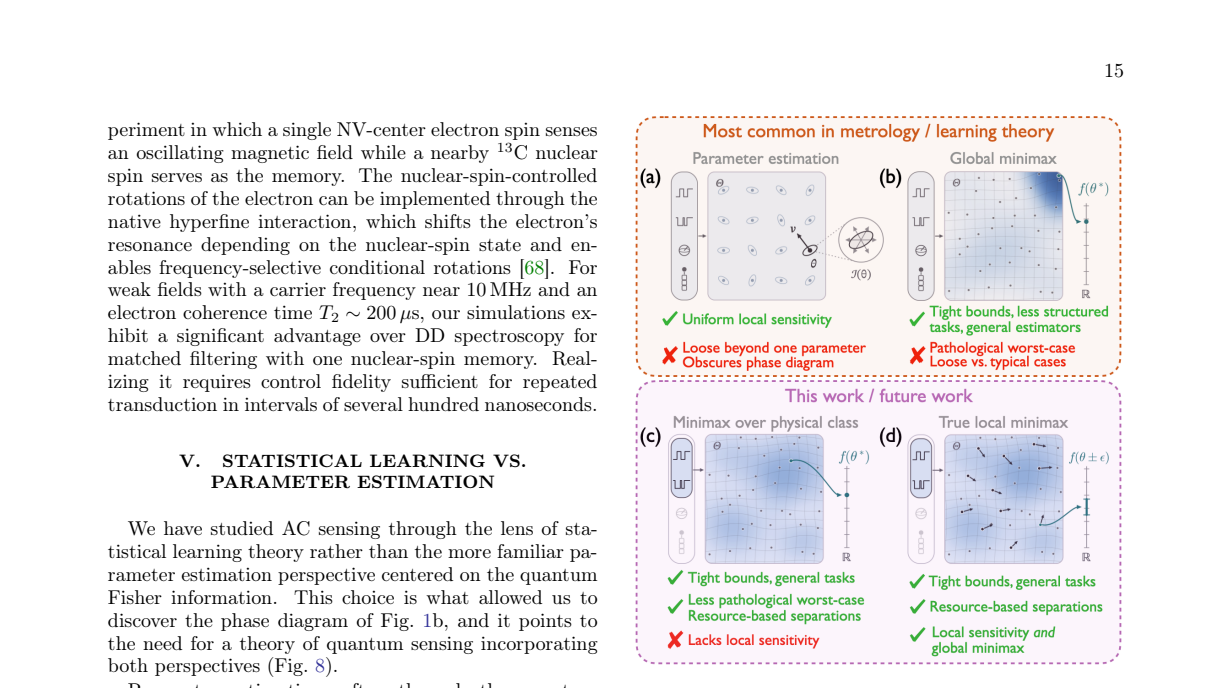
The figure is not visible. The caption describes the conceptual framework, but without the figure, the discussion in §V is difficult to follow. The authors should ensure the figure is self-explanatory or provide a more detailed description in the text.
The paper says, at §VI, Outlook
Pith says: minor objection 9 of 10
This claim should be supported by a more detailed discussion of the experimental requirements for each platform. For example, RQS requires the ability to compile Gaussian-random pulse sequences, which may not be straightforward on all platforms. The authors should provide a realistic assessment of the experimental challenges.
The paper says, at §VI, Outlook
Pith says: minor objection 10 of 10
The code repository is mentioned but not reviewed. The paper should state whether the code is open-source and provide a link (which it does). However, the code is not part of the manuscript and its correctness is not verified.
Open questions (8)
Pith raised these and could not confirm them against the text of the paper it read. They are questions for the authors, not findings.
- §IV, Theorem 4 (Theorem \ref{thm:qcs_main}) and §IV.D, Theorem 5 (Theorem \ref{thm:qcs_lb_main}) Can the authors provide a self-contained proof of the lower bound in Theorem 5 (the generalized Heisenberg limit) within the manuscript, or state the bound as a conjecture and adjust the claims accordingly?
- §IV.D, Theorem 5 (Theorem \ref{thm:qcs_lb_main}) Can the authors provide a self-contained proof of the lower bound in Theorem 5 (the generalized Heisenberg limit) within the manuscript, or clearly mark it as a conjecture?
- §IV.E, Theorem 6 (noise-robustness claim) Can the authors provide the proof that the bridge gadget corrects interface errors without degrading the memory channel, and the derivation of the key noise scaling (Eq. 4.2)?
- §III.C, Theorem 3 (Theorem \ref{thm:pooled_adv}) Can the authors provide the proof of the lower bound in Theorem 3 (the polynomial advantage for noncommuting control) within the manuscript?
- §II, Definition 1 (Definition \ref{def:aqs_problem}) Pith raised a concern here that it could not check against the text of the paper it was given, so it is not published as an objection.
- §IV.C, Algorithm 4 (Algorithm \ref{alg:qcs_phase_oracle}) Pith raised a concern here that it could not check against the text of the paper it was given, so it is not published as an objection.
- §IV.D, Theorem 4 (Theorem \ref{thm:qcs_main}) Pith raised a concern here that it could not check against the text of the paper it was given, so it is not published as an objection.
- §IV.E, Theorem 6 (noise-robustness claim) Pith raised a concern here that it could not check against the text of the paper it was given, so it is not published as an objection.
What would settle it
An experimental demonstration of QCS on a broadband signal with constant-strength sensor depolarization that fails to achieve beyond-Heisenberg scaling (e.g., scaling as $N\kappa^2/\epsilon^2$ rather than $\sqrt{N}\kappa/\epsilon$) would falsify the central claim. Alternatively, a rigorous proof that any protocol (including those with quantum memory) must obey the AC Heisenberg limit under constant-strength signal-aligned noise would falsify the claim that QCS surpasses it.
from Pith's summary of the paper
How the review went
5 passes by deepseek-v4-flash · 20 Nov 2026
- Reader holds up, with conditions
- Skeptic concern not confirmed: listed as an open question
- Referee 10 minor
- Check against the paper kept 0 of 9 objections
- Editor wrote the verdict above
Not run on this paper: the simulated authors' defence.
Pith's passes raised 9 objections. A check against the paper's text kept 0 and left 9 as questions.
The review in full
The review in brief, machine-written
This is an ambitious and technically rich paper that reframes AC sensing as a statistical learning problem and derives protocols that are provably optimal within their respective resource classes. The conventional protocols—randomized, matched, and pooled spectroscopy—are well-supported by rigorous analysis and appear to genuinely outperform existing approaches like dynamical decoupling across a range of tasks. The quantum computational spectroscopy (QCS) protocol is the most striking contribution: it claims a beyond-Heisenberg sensitivity that persists under constant-strength depolarizing noise, which would be a significant advance if the claims hold up.
The paper’s main soft spot is that the ultimate lower bound—the generalized Heisenberg limit that QCS is said to saturate—is not proven within this manuscript. It is cited as a companion paper “in preparation.” This means the central claim about optimality rests on an unpublished result. The authors acknowledge this, but it is a real limitation for a paper that makes such strong statements about fundamental limits. The practical feasibility of QCS also depends on assumptions about fault-tolerant memory and noiseless control that are not fully addressed; the authors note that “practical advantages must be benchmarked on real devices.”
The conventional protocols are solid and could be implemented on existing platforms today. The paper deserves a serious referee, but the referee should focus on whether the QCS claims can be evaluated without the companion paper, and whether the assumptions about memory and control are realistic enough to support the claimed noise-robust advantage.
The stress test's concern
Not confirmed. Pith could not check this concern against the text of the paper it was given; it is listed as an open question, not a finding.
The referee's report
Not published. Pith's referee wrote this assessment before its objections were checked against the paper, and 8 of its 8 major objections did not survive that check.
Pith's reading of the paper (a machine's summary, not the authors')
The paper introduces a unified framework for sensing time-varying fields, treating AC sensing as a statistical learning problem. It presents three conventional pulse-sequence protocols (randomized, matched, and pooled spectroscopy) that achieve optimal sensitivity for linear and nonlinear AC sensing on existing spin or qubit platforms by changing only their pulse sequences. The central advance is quantum computational spectroscopy (QCS), which couples a quantum sensor to a quantum processor. QCS uses a quantum computational frequency comb to convert any classical signal into a quantum oracle, then applies quantum algorithms to extract signal information in superposition. The authors claim that QCS solves AC sensing tasks polynomially faster than any protocol without ancillary quantum computation, surpassing the AC Heisenberg limit, and that no protocol allowed by quantum mechanics can do better. Moreover, they claim that QCS retains beyond-Heisenberg scaling for broadband signals under constant-strength sensor depolarization, while any protocol lacking quantum computation is limited to standard-quantum-limit scaling under the same noise. If true, this would establish a fundamental separation between conventional and quantum computational sensing and provide the first asymptotic, beyond-quadratic quantum advantage in AC metrology when noise is aligned with the signal.
What carries the argument. The central mechanism is the quantum computational frequency comb, which coherently converts any classical signal into a quantum oracle by coupling a sensor to a quantum memory. This oracle encodes the signal's spectral information into the memory's quantum state, allowing quantum algorithms (such as gradient estimation and higher-order functional estimation) to extract signal information in superposition. The key identity is that the transducer creates a phase oracle $\exp(-i\lambda A^T X)$ where $A$ is the unknown spectrum vector and $X$ are memory position operators, enabling simultaneous readout of all spectral components with a single oracle query. The noise robustness arises because sensor depolarization decoheres memory correlations at a rate $O(\gamma/N)$ while the signal phase grows as $T/\sqrt{N}$, so the signal couples to the memory quadratically more strongly than the noise does.
Core claim. The paper claims that quantum computational spectroscopy (QCS) achieves a sensitivity limit for AC sensing that lies polynomially beyond the Heisenberg limit, and that this limit is the ultimate quantum-mechanical bound. The authors argue that attaining this new limit requires ancillary quantum computation, establishing a fundamental separation between conventional and quantum computational sensing. They further claim that QCS retains this beyond-Heisenberg scaling for broadband signals under constant-strength sensor depolarization, while any protocol lacking quantum computation reverts to standard-quantum-limit scaling under the same noise. This is presented as the first asymptotic, beyond-quadratic quantum advantage in AC metrology when noise is aligned with the signal, proving that Lindblad span conditions do not apply to broadband quantum sensing.
The premise it rests on. The analysis assumes that sensor-memory interface gates (controlled rotations) can be implemented with constant error probability and that the memory can be treated as a fault-tolerant quantum register with no additional noise beyond the sensor depolarization, while the practical feasibility of the required control fidelity and memory coherence times is not fully addressed.
If the paper is right (Pith's inferences, not the authors')
If QCS is correct, conventional AC sensing protocols (including dynamical decoupling and Walsh-Hadamard sensing) are suboptimal by polynomial factors in both the number of frequencies $N$ and the precision $\epsilon$, and can be improved by switching to the paper's randomized, matched, or pooled spectroscopy protocols.
The claimed generalized Heisenberg limit (GHL) would replace the AC Heisenberg limit as the fundamental bound for broadband AC sensing, with the GHL being stable under noise while the Heisenberg limit is not.
Quantum computational sensing would offer a new type of metrological advantage that grows with signal bandwidth rather than sensor count, enabling speedups with modest hardware (e.g., one sensor plus one ancilla qubit).
The paper's noise-robustness result would imply that the Hamiltonian-not-in-Lindblad-span (HNLS) condition is not necessary for asymptotic quantum advantage in AC sensing, opening the door to other noise-robust quantum metrology protocols.
If the claimed noise-robust advantage holds, it suggests that quantum error correction is not the essential mechanism for protecting metrological gain against signal-aligned noise; instead, the key is to process information in superposition on a memory that is only weakly coupled to the noise.
The paper's framing of AC sensing as a statistical learning problem could be extended to other sensing tasks involving many unknown parameters, such as continuous frequency estimation, noise spectroscopy, or field imaging, potentially uncovering similar gains.
The quantum computational frequency comb concept may have applications beyond sensing, as a general method for converting classical signals into quantum oracles that can be processed by quantum algorithms.
The claimed separation between the AC Heisenberg limit and the generalized Heisenberg limit suggests that the phase diagram of quantum metrology has a richer structure than previously recognized, with computational resources providing a new axis of advantage.
Check this review
What was read
The passes were given 599,600 of the 775,105 characters of the paper's LaTeX source.
Fingerprint of that text (SHA-256): 7a52c6b71ecaace2a0e95274ac224b950f6c7ecec586f5aa9edd84e17bbf45fc
Pith does not keep that text. Rebuilt from the paper's source or PDF by the same code, it has this fingerprint if it is the same text. From a copy of Pith's code:
PYTHONPATH=. python scripts/review_input_check.py 2611.25572
The passes, in the order they ran
- Reader deepseek-v4-flash · medium effort · $0.017 · instructions of the Reader, fingerprint f9ead7300382…
- Skeptic deepseek-v4-flash · medium effort · $0.016 · instructions of the Skeptic, fingerprint 8f88c0f61488…
- Referee deepseek-v4-flash · medium effort · $0.017 · instructions of the Referee, fingerprint a852d99aea0d…
- Check against the paper deepseek-v4-flash · medium effort · $0.018 · instructions of the Check against the paper, fingerprint 6c7a6883d551…
- Editor deepseek-v4-flash · medium effort · $0.017 · instructions of the Editor, fingerprint e7211f6a3d27…
- Circularity check deepseek-v4-flash · medium effort · $0.016 · instructions of the Circularity check, fingerprint e9946e39d67b…
- Summary for the page deepseek-v4-flash · medium effort · temperature 0.2 · $0.017 · instructions of the Summary for the page, fingerprint e4f56bf568e7…
The passes cost $0.118 in model calls together.
Version stamped on this review: pith-pipeline@v1.4.1-daily-deepseek-or-medium+deepseek/deepseek-v4-flash+p.d60f54226f00
Each link opens a pass's instructions as plain text, the exact bytes its fingerprint was taken over. Every stored set of instructions.
curl -s https://pith.science/methodology/prompts/f9ead730038216984cfb56d7cb34332bdf691828296a1de4245f3d6667d4bf56 | sha256sum
prints the fingerprint of the reader's instructions. The same works for every pass.
The receipt
The review's fingerprint was taken on 20 Nov 2026. The review you are reading still matches it.
Fingerprint of the review (SHA-256): 5abf0039fb1caae15a2313cc79ba716598d05e6080764ea6729aa26a959278aa
curl -s 'https://pith.science/api/v1/verdicts/2611.25572?form=canonical' | sha256sum
prints the fingerprint of the review as it stands now. The rule, in four steps.
A matching fingerprint shows the review has not changed since that date. It does not show that the review is right.
How often reviews like this one are right
Reviews like this one: written by deepseek-v4-flash, from the paper's LaTeX source.
How often objections from reviews like this one are right: not yet measured
Reviews by people
This review was written by a machine. No person has reviewed this paper on Pith yet. A scientist listed on Pith can review it for a fee, and their review is published here whatever it concludes.
The paper
Abstract
We introduce a unified framework for sensing time-dependent fields through the lens of classical and quantum algorithms. First, we develop three pulse sequence protocols, namely randomized, matched, and pooled spectroscopy, which outperform established approaches such as dynamical decoupling across a wide range of tasks. These protocols attain the optimal sensitivity for linear and nonlinear AC sensing on conventional spin or qubit platforms, improving existing devices by changing only their pulse sequences. We then introduce quantum computational spectroscopy (QCS), which couples quantum sensors to a quantum processor. QCS combines two new primitives: a quantum computational frequency comb that coherently converts any classical signal into a quantum oracle, and a family of quantum algorithms that use the oracle to extract signal information in superposition. Variations can be implemented on current platforms with only one memory ancilla. We show that the ultimate limit imposed by quantum mechanics lies polynomially beyond the Heisenberg limit, and that QCS achieves it. Attaining this new limit requires quantum computation, establishing a fundamental separation between conventional and quantum computational sensing. Moreover, QCS retains beyond-Heisenberg scaling for broadband signals under constant-strength sensor depolarization, while we prove that the same noise limits any protocol lacking quantum computation to standard-quantum-limit scaling. Our result provides the first asymptotic, beyond-quadratic quantum advantage in AC metrology when noise is aligned with the signal, proving that Lindblad span conditions do not apply to broadband quantum sensing. Our work builds an algorithmic theory for designing sensing protocols and establishes quantum sensing as a new frontier for quantum algorithms, with quantum advantages that surpass the Heisenberg limit and that persist under noise.
The paper's own sentences, arranged, kept beside the review and separate from it. Each label is drawn from a closed vocabulary; the number beside it is the probability the classifier gave that label. No sentence in this record was written by a model.
abstract compiled · 2026-11-20
The authors' main claim, as the classifier picked it out 0.96
“Our work builds an algorithmic theory for designing sensing protocols and establishes quantum sensing as a new frontier for quantum algorithms, with quantum advantages that surpass the Heisenberg limit and that persist under noise.”
How the main claim is stated: asserted 1.00
What the abstract itself states, as probabilities: claims first 0.88 · states limitation 0.27 · human participants 0.02 · controlled comparison 0.59 · randomized assignment 0.04 · states quantitative result 0.72 · compares with prior results 0.96 · mentions code or data availability 0.02
The abstract, sentence by sentence
This table labels the abstract only (arXiv listing abstract v1). The number is the probability the classifier gave the label.
| Sentence | Role | The authors' own work | States the main conclusion | Strength |
|---|---|---|---|---|
| We introduce a unified framework for sensing time-dependent fields through the lens of classical and quantum algorithms. | contribution 0.99 | 0.89 | 0.06 | asserted 0.94 |
| First, we develop three pulse sequence protocols, namely randomized, matched, and pooled spectroscopy, which outperform established approaches such as dynamical decoupling across a wide range of tasks. | contribution 0.83 | 0.95 | 0.08 | asserted 1.00 |
| These protocols attain the optimal sensitivity for linear and nonlinear AC sensing on conventional spin or qubit platforms, improving existing devices by changing only their pulse sequences. | result 0.95 | 0.89 | 0.09 | asserted 1.00 |
| We then introduce quantum computational spectroscopy (QCS), which couples quantum sensors to a quantum processor. | contribution 0.87 | 0.94 | 0.05 | asserted 1.00 |
| QCS combines two new primitives: a quantum computational frequency comb that coherently converts any classical signal into a quantum oracle, and a family of quantum algorithms that use the oracle to extract signal information in superposition. | method 0.73 | 0.90 | 0.08 | asserted 1.00 |
| Variations can be implemented on current platforms with only one memory ancilla. | method 0.72 | 0.62 | 0.02 | asserted 0.67 |
| We show that the ultimate limit imposed by quantum mechanics lies polynomially beyond the Heisenberg limit, and that QCS achieves it. | result 0.99 | 0.91 | 0.32 | asserted 1.00 |
| Attaining this new limit requires quantum computation, establishing a fundamental separation between conventional and quantum computational sensing. | interpretation 0.92 | 0.81 | 0.29 | asserted 1.00 |
| Moreover, QCS retains beyond-Heisenberg scaling for broadband signals under constant-strength sensor depolarization, while we prove that the same noise limits any protocol lacking quantum computation to standard-quantum-limit scaling. | result 0.99 | 0.92 | 0.19 | asserted 1.00 |
| Our result provides the first asymptotic, beyond-quadratic quantum advantage in AC metrology when noise is aligned with the signal, proving that Lindblad span conditions do not apply to broadband quantum sensing. | result 0.71 | 0.92 | 0.27 | asserted 1.00 |
| Our work builds an algorithmic theory for designing sensing protocols and establishes quantum sensing as a new frontier for quantum algorithms, with quantum advantages that surpass the Heisenberg limit and that persist under noise. | interpretation 0.56 | 0.90 | 0.77 | asserted 1.00 |
What kind of paper the classifier reports this is: method or tool 0.95 · evidence from proof or derivation 1.00
What was examined, and what was not
Sources read
- arXiv listing abstract v1
Not examined
- full text
- figures and tables
- references and citing sentences
- relations to other papers
Levels run
- P abstract
Not run
- S sections
- T body sentences
- C citations
- R cross-paper relations
How the labels were made
Compiled by classifier-1.13.0 via TypeSafe API, question bank abstract-p1-20260923, 2026-11-20: 1 request, 8,294 input tokens.
Every quoted sentence on this record is the authors'. Every label is from Pith's closed vocabulary, with the probability shown beside it. This record as JSON
Figures (8)
Showing 7 of the paper's 8 figures. Figures are the authors', reproduced from the paper.
References (161)
- [2] Khan, Saeed A. and Prabhu, Sridhar and Wright, Logan G. and McMahon, Peter L. , month = aug, year =. Quantum. doi:10.48550/arXiv.2507.16918 , abstract = on PithPith's reviewarXivdoi:10.48550/arxiv.2507.16918
- [3] Quantum. Physical Review Letters , author =. 2024 , pages =. doi:10.1103/PhysRevLett.132.093401 , language = on Pithdoi:10.1103/physrevlett.132.093401
- [4] A fluorescent-protein spin qubit , author=. 2025 , eprint= on Pith
- [9] 2026 , howpublished = on Pith
- [10] Non-. Nature Communications , author =. 2019 , pages =. doi:10.1038/s41467-019-11699-4 , abstract = on Pithdoi:10.1038/s41467-019-11699-4
- [11] Qubit. Physical Review Letters , author =. 2016 , pages =. doi:10.1103/PhysRevLett.116.150503 , language = on Pithdoi:10.1103/physrevlett.116.150503
- [16] Optimal adaptive control for quantum metrology with time-dependent. Nature Communications , author =. 2017 , pages =. doi:10.1038/ncomms14695 , abstract = on Pithdoi:10.1038/ncomms14695
- [18] Fault-tolerant quantum processing of physical experiments , author=. 2026 , eprint= on Pith
- [24] Optimized dynamical decoupling in a model quantum memory , volume =. Nature , author =. 2009 , pages =. doi:10.1038/nature07951 , language = on Pithdoi:10.1038/nature07951
- [25] Measuring the. Physical Review Letters , author =. 2011 , pages =. doi:10.1103/PhysRevLett.107.230501 , language = on Pithdoi:10.1103/physrevlett.107.230501
- [31] Hunting for topological dark matter with atomic clocks , volume =. Nature Physics , author =. 2014 , pages =. doi:10.1038/nphys3137 , language = on Pithdoi:10.1038/nphys3137
- [32] Optimal Quantum Sensing Algorithms for Discrete-Frequency Spectroscopy , author=. 2026 , eprint= on Pith
- [33] Quantum Advantage in Sensing and Imaging through Coherent Nuisance Suppression , author=. 2026 , eprint= on Pith
- [34] Searching for dilaton dark matter with atomic clocks , volume =. Physical Review D , author =. 2015 , pages =. doi:10.1103/PhysRevD.91.015015 , language = on PithPith's reviewdoi:10.1103/physrevd.91.015015
- [38] Nanoscale. Science , author =. 2013 , pages =. doi:10.1126/science.1231540 , abstract = on Pithdoi:10.1126/science.1231540
- [39] Nuclear. Science , author =. 2013 , pages =. doi:10.1126/science.1231675 , abstract = on Pithdoi:10.1126/science.1231675
- [45] Quantum-mechanical noise in an interferometer , volume =. Physical Review D , author =. 1981 , pages =. doi:10.1103/PhysRevD.23.1693 , language = on Pithdoi:10.1103/physrevd.23.1693
- [47] High-sensitivity diamond magnetometer with nanoscale resolution , volume =. Nature Physics , author =. 2008 , pages =. doi:10.1038/nphys1075 , language = on Pithdoi:10.1038/nphys1075
- [51] in preparation , author = on Pith
- [53] Optical magnetometry , volume =. Nature Physics , author =. 2007 , pages =. doi:10.1038/nphys566 , language = on Pithdoi:10.1038/nphys566
show 80 more
- [55] A. Physical Review , author =. 1950 , pages =. doi:10.1103/PhysRev.78.695 , language = on Pithdoi:10.1103/physrev.78.695
- [57] Cotler, Jordan and Gong, Weiyuan and Kannan, Ishaan , month = jan, year =. Noisy. doi:10.48550/arXiv.2512.10929 , abstract = on Pithdoi:10.48550/arxiv.2512.10929
- [58] Jain, Siddhartha and Iyer, Vishnu and Somma, Rolando D. and Bao, Ning and Jordan, Stephen P. , month = oct, year =. Efficient. doi:10.48550/arXiv.2510.04929 , abstract = on Pithdoi:10.48550/arxiv.2510.04929
- [66] Engineering Spin Coherence in Core-Shell Diamond Nanocrystals , author=. 2023 , eprint= on Pith
- [68] Allen, Richard R. and Machado, Francisco and Chuang, Isaac L. and Huang, Hsin-Yuan and Choi, Soonwon , month = jan, year =. Quantum. doi:10.48550/arXiv.2501.07625 , abstract = on PithPith's reviewarXivdoi:10.48550/arxiv.2501.07625
- [71] Entanglement rates and area laws , volume =. Physical Review Letters , author =. 2013 , note =. doi:10.1103/PhysRevLett.111.170501 , abstract = on Pithdoi:10.1103/physrevlett.111.170501
- [77] Chen, Qi-Ming and Wu, Re-Bing and Rabitz, Herschel , year =. Pulse. doi:10.48550/ARXIV.1712.02211 , abstract = on PithPith's reviewarXivdoi:10.48550/arxiv.1712.02211
- [78] Holmes, D. Grahame and Lipo, T. A. , year =. Pulse width modulation for power converters: principles and practice , isbn = on Pith
- [80] New, compensated. Journal of Magnetic Resonance (1969) , author =. 1990 , pages =. doi:10.1016/0022-2364(90)90331-3 , language = on Pithdoi:10.1016/0022-2364(90)90331-3
- [83] Spurious harmonic response of multipulse quantum sensing sequences , volume =. Physical Review X , author =. 2015 , note =. doi:10.1103/PhysRevX.5.021009 , abstract = on Pithdoi:10.1103/physrevx.5.021009
- [84] Optimizing a. Physical Review B , author =. 2015 , note =. doi:10.1103/PhysRevB.92.060301 , abstract = on Pithdoi:10.1103/physrevb.92.060301
- [86] Quantum sensing , volume =. Reviews of Modern Physics , author =. 2017 , note =. doi:10.1103/RevModPhys.89.035002 , abstract = on PithPith's reviewdoi:10.1103/revmodphys.89.035002
- [88] Ying, Jinfa and Delaglio, Frank and Torchia, Dennis A. and Bax, Ad , title =. Journal of Biomolecular NMR , volume =. 2017 , month = jun, doi = on Pith
- [89] Pradenne, Constantin Cedillo Vayson de and Kannan, Ishaan and Putterman, Harald and Cotler, Jordan , month = jul, year =. Restrictions on non-. doi:10.48550/arXiv.2607.27342 , abstract = on PithPith's reviewarXivdoi:10.48550/arxiv.2607.27342
- [92] Ben-Aroya, Avraham and Regev, Oded and Wolf, Ronald de , month = oct, year =. A. 2008 49th. doi:10.1109/FOCS.2008.45 , abstract = on Pithdoi:10.1109/focs.2008.45
- [93] Bounds for the. Problems of Information Transmission , author =. 1973 , pages = on Pith
- [94] Learning. PRX Quantum , author =. 2024 , pages =. doi:10.1103/PRXQuantum.5.040306 , abstract = on Pithdoi:10.1103/prxquantum.5.040306
- [98] Probability. Journal of the American Statistical Association , author =. 1963 , pages =. doi:10.1080/01621459.1963.10500830 , language = on Pithdoi:10.1080/01621459.1963.10500830
- [99] Sen, Purnendu and Ouellet, Mathieu and Khan, Saeed A. and Wang, Wayne and Prabhu, Sridhar and Senanian, Alen and Banner, William P. and Oliver, William D. and McMahon, Peter L. , month = aug, year =. Quantum sensors that compute: quantum computational magnetic-field sensing us... on PithPith's reviewarXivdoi:10.48550/arxiv.2608.17400
- [100] Preparation of. npj Quantum Information , author =. 2022 , note =. doi:10.1038/s41534-022-00667-4 , abstract = on Pithdoi:10.1038/s41534-022-00667-4
- [101] Physical-. Physical Review X , author =. 2019 , note =. doi:10.1103/PhysRevX.9.041023 , abstract = on Pithdoi:10.1103/physrevx.9.041023
- [102] Kannan, Ishaan and Prabhu, Sridhar and Khan, Saeed A. and Sohoni, Mandar M. and Song, Xingrui and Roy, Saswata and Senanian, Alen and Fatemi, Valla and McMahon, Peter L. and Cotler, Jordan , month = aug, year =. Exponential quantum advantage for learning signals with a single ... on PithPith's reviewarXivdoi:10.48550/arxiv.2608.13521
- [103] Multi-qubit nanoscale sensing with entanglement as a resource , author=. 2025 , eprint= on Pith
- [105] Prabhu, Sridhar and Khan, Saeed A. and Song, Xingrui and Ouellet, Mathieu and Yanagimoto, Ryotatsu and Roy, Saswata and Senanian, Alen and Wright, Logan G. and Fatemi, Valla and McMahon, Peter L. , month = aug, year =. Quantum computational displacement sensing , url =. doi:10... on PithPith's reviewarXivdoi:10.48550/arxiv.2604.13177
- [106] Cornell, Eliza and Xu, Zhujing and Wang, Zhaoyou and Warner, Hana K. and Mann, Eliana and Haas, Michael and Maity, Smarak and Joe, Graham and Jiang, Liang and Rabl, Peter and Pingault, Benjamin and Lončar, Marko , month = aug, year =. All-mechanical coherence protection and fa... on PithPith's reviewarXivdoi:10.48550/arxiv.2508.13356
- [108] Choi, Joonhee and Zhou, Hengyun and Knowles, Helena S. and Landig, Renate and Choi, Soonwon and Lukin, Mikhail D. , year=. Robust Dynamic Hamiltonian Engineering of Many-Body Spin Systems , volume=. Physical Review X , publisher=. doi:10.1103/physrevx.10.031002 , number= on Pithdoi:10.1103/physrevx.10.031002
- [109] Zhou, Hengyun and Martin, Leigh S. and Tyler, Matthew and Makarova, Oksana and Leitao, Nathaniel and Park, Hongkun and Lukin, Mikhail D. , year=. Robust Higher-Order Hamiltonian Engineering for Quantum Sensing with Strongly Interacting Systems , volume=. Physical Review Letter... on Pithdoi:10.1103/physrevlett.131.220803
- [110] Van Trees, Harry L. , title = on Pith
- [111] Szczykulska, Magdalena and Baumgratz, Tillmann and Datta, Animesh , title =. Advances in Physics: X , volume = on Pith
- [112] Noise tailoring for scalable quantum computation via randomized compiling , author =. Physical Review A , volume =. 2016 , doi = on Pith
- [113] Randomization of Pulse Phases for Unambiguous and Robust Quantum Sensing , author =. Physical Review Letters , volume =. 2019 , doi = on Pith
- [116] Dob. Arbitrary accuracy iterative quantum phase estimation algorithm using a single ancillary qubit: A two-qubit benchmark , journal =. 2007 , doi = on Pith
- [117] Ragy, Sammy and Jarzyna, Marcin and Demkowicz-Dobrza. Compatibility in multiparameter quantum metrology , journal = on Pith
- [118] Albarelli, Francesco and Barbieri, Marco and Genoni, Marco G. and Gianani, Ilaria , title =. Physics Letters A , volume = on Pith
- [119] Demkowicz-Dobrza. Multi-parameter estimation beyond quantum. Journal of Physics A: Mathematical and Theoretical , volume = on Pith
- [120] Berry, Dominic W. and Tsang, Mankei and Hall, Michael J. W. and Wiseman, Howard M. , title =. Physical Review X , volume = on Pith
- [121] Tsybakov, Alexandre B. , title = on Pith
- [122] Single-shot. Quantum , author =. 2024 , note =. doi:10.22331/q-2024-07-30-1427 , abstract = on Pithdoi:10.22331/q-2024-07-30-1427
- [124] Exponential separations between learning with and without quantum memory , author=. 2021 , eprint= on Pith
- [126] Optimal. arXiv.org , author =. doi:10.1103/PhysRevLett.118.010501 , abstract = on Pithdoi:10.1103/physrevlett.118.010501
- [127] author author V. Giovannetti , author S. Lloyd ,\ and\ author L. Maccone ,\ title english title Quantum- Enhanced Measurements : Beating the Standard Quantum Limit ,\ https://doi.org/10.1126/science.1104149 journal journal Science \ volume 306 ,\ pages 1330 ( year 2004 ) NoStop on Pithdoi:10.1126/science.1104149
- [128] author author C. L. \ Degen , author F. Reinhard ,\ and\ author P. Cappellaro ,\ title title Quantum sensing ,\ https://doi.org/10.1103/RevModPhys.89.035002 journal journal Reviews of Modern Physics \ volume 89 ,\ pages 035002 ( year 2017 ) ,\ note arXiv:1611.02427 [quant-ph] NoStop on PithPith's reviewarXiv
- [129] author author A. D. \ Ludlow , author M. M. \ Boyd , author J. Ye , author E. Peik ,\ and\ author P. Schmidt ,\ title english title Optical atomic clocks ,\ https://doi.org/10.1103/RevModPhys.87.637 journal journal Reviews of Modern Physics \ volume 87 ,\ pages 637 ( year 2015... on PithPith's reviewdoi:10.1103/revmodphys.87.637
- [130] author author J. R. \ Maze , author P. L. \ Stanwix , author J. S. \ Hodges , author S. Hong , author J. M. \ Taylor , author P. Cappellaro , author L. Jiang , author M. V. G. \ Dutt , author E. Togan , author A. S. \ Zibrov , and others,\ title english title Nanoscale magneti... on Pithdoi:10.1038/nature07279
- [131] author author J. Bylander , author S. Gustavsson , author F. Yan , author F. Yoshihara , author K. Harrabi , author G. Fitch , author D. G. \ Cory , author Y. Nakamura , author J.-S. \ Tsai ,\ and\ author W. D. \ Oliver ,\ title english title Noise spectroscopy through dynamic... on Pithdoi:10.1038/nphys1994
- [132] author author J. Aasi , author J. Abadie , author B. P. \ Abbott , author R. Abbott , author T. D. \ Abbott , author M. R. \ Abernathy , author C. Adams , author T. Adams , author P. Addesso , author R. X. \ Adhikari , and others,\ title english title Enhanced sensitivity of t... on Pithdoi:10.1038/nphoton.2013.177
- [133] author author R. R. \ Ernst \ and\ author W. A. \ Anderson ,\ title english title Application of Fourier Transform Spectroscopy to Magnetic Resonance ,\ https://doi.org/10.1063/1.1719961 journal journal Review of Scientific Instruments \ volume 37 ,\ pages 93 ( year 1966 ) NoStop on Pithdoi:10.1063/1.1719961
- [134] author author D. R. \ Glenn , author D. B. \ Bucher , author J. Lee , author M. D. \ Lukin , author H. Park ,\ and\ author R. L. \ Walsworth ,\ title english title High-resolution magnetic resonance spectroscopy using a solid-state spin sensor ,\ https://doi.org/10.1038/nature... on Pithdoi:10.1038/nature25781
- [135] author author K. Wüthrich ,\ title english title Protein Structure Determination in Solution by Nuclear Magnetic Resonance Spectroscopy ,\ https://doi.org/10.1126/science.2911719 journal journal Science \ volume 243 ,\ pages 45 ( year 1989 ) NoStop on Pithdoi:10.1126/science.2911719
- [136] author author I. Lovchinsky , author A. O. \ Sushkov , author E. Urbach , author N. P. \ De Leon , author S. Choi , author K. De Greve , author R. Evans , author R. Gertner , author E. Bersin , author C. Müller , and others,\ title english title Nuclear magnetic resonance dete... on Pithdoi:10.1126/science.aad8022
- [137] author author D. Budker , author P. W. \ Graham , author M. Ledbetter , author S. Rajendran ,\ and\ author A. O. \ Sushkov ,\ title english title Proposal for a Cosmic Axion Spin Precession Experiment ( CASPEr ) ,\ https://doi.org/10.1103/PhysRevX.4.021030 journal journal Phys... on Pithdoi:10.1103/physrevx.4.021030
- [138] author author K. M. \ Backes , author D. A. \ Palken , author S. A. \ Kenany , author B. M. \ Brubaker , author S. B. \ Cahn , author A. Droster , author G. C. \ Hilton , author S. Ghosh , author H. Jackson , author S. K. \ Lamoreaux , and others,\ title english title A quantu... on Pithdoi:10.1038/s41586-021-03226-7
- [139] author author M. Kasevich \ and\ author S. Chu ,\ title english title Atomic interferometry using stimulated Raman transitions ,\ https://doi.org/10.1103/PhysRevLett.67.181 journal journal Physical Review Letters \ volume 67 ,\ pages 181 ( year 1991 ) NoStop on Pithdoi:10.1103/physrevlett.67.181
- [140] author author B. Abbott , author R. Abbott , author T. Abbott , author M. Abernathy , author F. Acernese , author K. Ackley , author C. Adams , author T. Adams , author P. Addesso , author R. Adhikari , and others,\ title english title Observation of Gravitational Waves from a... on Pithdoi:10.1103/physrevlett.116.061102
- [141] author author H. Y. \ Carr \ and\ author E. M. \ Purcell ,\ title english title Effects of Diffusion on Free Precession in Nuclear Magnetic Resonance Experiments ,\ https://doi.org/10.1103/PhysRev.94.630 journal journal Physical Review \ volume 94 ,\ pages 630 ( year 1954 ) NoStop on Pithdoi:10.1103/physrev.94.630
- [142] author author L. Viola \ and\ author S. Lloyd ,\ title english title Dynamical suppression of decoherence in two-state quantum systems ,\ https://doi.org/10.1103/PhysRevA.58.2733 journal journal Physical Review A \ volume 58 ,\ pages 2733 ( year 1998 ) NoStop on Pithdoi:10.1103/physreva.58.2733
- [143] author author G. De Lange , author D. Ristè , author V. V. \ Dobrovitski ,\ and\ author R. Hanson ,\ title english title Single- Spin Magnetometry with Multipulse Sensing Sequences ,\ https://doi.org/10.1103/PhysRevLett.106.080802 journal journal Physical Review Letters \ volu... on Pithdoi:10.1103/physrevlett.106.080802
- [144] author author S. Kotler , author N. Akerman , author Y. Glickman , author A. Keselman ,\ and\ author R. Ozeri ,\ title english title Single-ion quantum lock-in amplifier ,\ https://doi.org/10.1038/nature10010 journal journal Nature \ volume 473 ,\ pages 61 ( year 2011 ) NoStop on Pithdoi:10.1038/nature10010
- [145] author author E. Magesan , author A. Cooper ,\ and\ author P. Cappellaro ,\ title english title Compressing measurements in quantum dynamic parameter estimation ,\ https://doi.org/10.1103/PhysRevA.88.062109 journal journal Physical Review A \ volume 88 ,\ pages 062109 ( year 2... on Pithdoi:10.1103/physreva.88.062109
- [146] author author E. Magesan , author A. Cooper , author H. Yum ,\ and\ author P. Cappellaro ,\ title english title Reconstructing the profile of time-varying magnetic fields with quantum sensors ,\ https://doi.org/10.1103/PhysRevA.88.032107 journal journal Physical Review A \ vol... on Pithdoi:10.1103/physreva.88.032107
- [147] author author A. Cooper , author E. Magesan , author H. N. \ Yum ,\ and\ author P. Cappellaro ,\ title english title Time-resolved magnetic sensing with electronic spins in diamond ,\ https://doi.org/10.1038/ncomms4141 journal journal Nature Communications \ volume 5 ,\ pages ... on Pithdoi:10.1038/ncomms4141
- [148] author author F. Poggiali , author P. Cappellaro ,\ and\ author N. Fabbri ,\ title english title Optimal Control for One - Qubit Quantum Sensing ,\ https://doi.org/10.1103/PhysRevX.8.021059 journal journal Physical Review X \ volume 8 ,\ pages 021059 ( year 2018 ) NoStop on Pithdoi:10.1103/physrevx.8.021059
- [149] author author M. Tsang ,\ title title Quantum metrology with open dynamical systems ,\ https://doi.org/10.1088/1367-2630/15/7/073005 journal journal New Journal of Physics \ volume 15 ,\ pages 073005 ( year 2013 ) NoStop on Pithdoi:10.1088/1367-2630/15/7/073005
- [150] author author R. Demkowicz-Dobrzański , author J. Czajkowski ,\ and\ author P. Sekatski ,\ title title Adaptive quantum metrology under general markovian noise ,\ journal journal Physical Review X \ volume 7 ,\ https://doi.org/10.1103/physrevx.7.041009 10.1103/physrevx.7.04100... on Pithdoi:10.1103/physrevx.7.041009
- [151] author author S. Zhou , author M. Zhang , author J. Preskill ,\ and\ author L. Jiang ,\ title english title Achieving the Heisenberg limit in quantum metrology using quantum error correction ,\ https://doi.org/10.1038/s41467-017-02510-3 journal journal Nature Communications \ ... on Pithdoi:10.1038/s41467-017-02510-3
- [152] author author C. C. V. d. \ Pradenne , author I. Kannan , author H. Putterman ,\ and\ author J. Cotler ,\ title title Restrictions on non- Clifford fault tolerance and ruling out beyond- SQL quantum metrology ( year 2026 ),\ note arXiv:2607.27342 [quant-ph] ,\ http://arxiv.org... on PithPith's reviewarXiv
- [153] author author S. A. \ Khan , author S. Prabhu , author L. G. \ Wright ,\ and\ author P. L. \ McMahon ,\ title title Quantum Computational - Sensing Advantage ( year 2026 ),\ note arXiv:2507.16918 [quant-ph] ,\ http://arxiv.org/abs/2507.16918 NoStop on PithPith's reviewarXiv
- [154] author author Q. Zhuang \ and\ author Z. Zhang ,\ title title Physical- Layer Supervised Learning Assisted by an Entangled Sensor Network ,\ https://doi.org/10.1103/PhysRevX.9.041023 journal journal Physical Review X \ volume 9 ,\ pages 041023 ( year 2019 ) ,\ note arXiv:1901.... on PithPith's reviewarXiv
- [155] author author T.-X. \ Zheng , author A. Li , author J. Rosen , author S. Zhou , author M. Koppenhöfer , author Z. Ma , author F. T. \ Chong , author A. A. \ Clerk , author L. Jiang ,\ and\ author P. C. \ Maurer ,\ title title Preparation of Metrological States in Dipolar - Int... on PithPith's reviewarXiv
- [156] author author R. R. \ Allen , author F. Machado , author I. L. \ Chuang , author H.-Y. \ Huang ,\ and\ author S. Choi ,\ title title Quantum Computing Enhanced Sensing ( year 2025 ),\ note arXiv:2501.07625 [quant-ph] ,\ http://arxiv.org/abs/2501.07625 NoStop on PithPith's reviewarXiv
- [157] author author E. Cornell , author Z. Xu , author Z. Wang , author H. K. \ Warner , author E. Mann , author M. Haas , author S. Maity , author G. Joe , author L. Jiang , author P. Rabl , and others,\ title title All-mechanical coherence protection and fast control of a spin qub... on PithPith's reviewarXiv
- [158] author author J. Rovny , author S. Kolkowitz ,\ and\ author N. P. \ de Leon ,\ title title Multi-qubit nanoscale sensing with entanglement as a resource ( year 2025 ),\ https://arxiv.org/abs/2504.12533 arXiv:2504.12533 [quant-ph] NoStop on PithPith's reviewarXiv
- [159] author author S. Prabhu , author S. A. \ Khan , author X. Song , author M. Ouellet , author R. Yanagimoto , author S. Roy , author A. Senanian , author L. G. \ Wright , author V. Fatemi ,\ and\ author P. L. \ McMahon ,\ title title Quantum computational displacement sensing ( ... on PithPith's reviewarXiv
- [160] author author I. Kannan , author S. Prabhu , author S. A. \ Khan , author M. M. \ Sohoni , author X. Song , author S. Roy , author A. Senanian , author V. Fatemi , author P. L. \ McMahon ,\ and\ author J. Cotler ,\ title title Exponential quantum advantage for learning signals... on PithPith's reviewarXiv
- [161] author author P. Sen , author M. Ouellet , author S. A. \ Khan , author W. Wang , author S. Prabhu , author A. Senanian , author W. P. \ Banner , author W. D. \ Oliver ,\ and\ author P. L. \ McMahon ,\ title title Quantum sensors that compute: quantum computational magnetic-fi... on PithPith's reviewarXiv
- [162] author author M. Sirotin , author A. Mokeev , author I. Kannan , author J. C. \ Christou , author J. Rajagopal , author B. Saif , author M. D. \ Lukin ,\ and\ author J. Borregaard ,\ title title Quantum advantage in sensing and imaging through coherent nuisance suppression ( y... on PithPith's reviewarXiv
- [163] author author Y.-J. \ Liu , author R. R. \ Allen , author R. Shen , author B. Ye , author T. T. \ Chang , author J. Choi ,\ and\ author S. Choi ,\ title title Optimal quantum sensing algorithms for discrete-frequency spectroscopy ( year 2026 ),\ https://arxiv.org/abs/2611.2156... on PithPith's reviewarXiv
- [164] author author I. Kannan , author A. Venkatesh ,\ and\ author J. Cotler ,\ title in preparation NoStop on Pith
- [165] title author author A. Bax ,\ title english title Two-dimensional nmr and protein structure ,\ https://doi.org/10.1146/annurev.bi.58.070189.001255 journal journal Annual Review of Biochemistry \ volume 58 ,\ pages 223 ( year 1989 ) NoStop on Pithdoi:10.1146/annurev.bi.58.070189.001255
- [166] author author L. E. \ Kay , author M. Ikura , author R. Tschudin ,\ and\ author A. Bax ,\ title english title Three-dimensional triple-resonance NMR spectroscopy of isotopically enriched proteins ,\ https://doi.org/10.1016/0022-2364(90)90333-5 journal journal Journal of Magnet... on Pithdoi:10.1016/0022-2364(90)90333-5
The first 100 of 161 references are listed here. All of them are in this paper's citation record.
Challenges and discussion
Disagree with the review, or know something it missed? Leave a comment, or challenge this review formally: a challenge becomes a permanent entry in this paper's record, and its decision is published here.
Come back by email
A short list of the week's newly reviewed papers. Nothing is sent until you confirm from your inbox, and every email has a link that stops it. No account.
No comments yet.
Sign in to comment