Artificial Intelligence · arXiv:2611.23476 v1 · submitted 17 Nov 2026 · 63 references
GUARD: Stabilizing Recursive Self-Improvement with Regret Guidance
The paper says
“Autonomous AI agents pair a frozen base model with an editable harness of prompts, skills, tool rules, and memory.”
more of the abstract
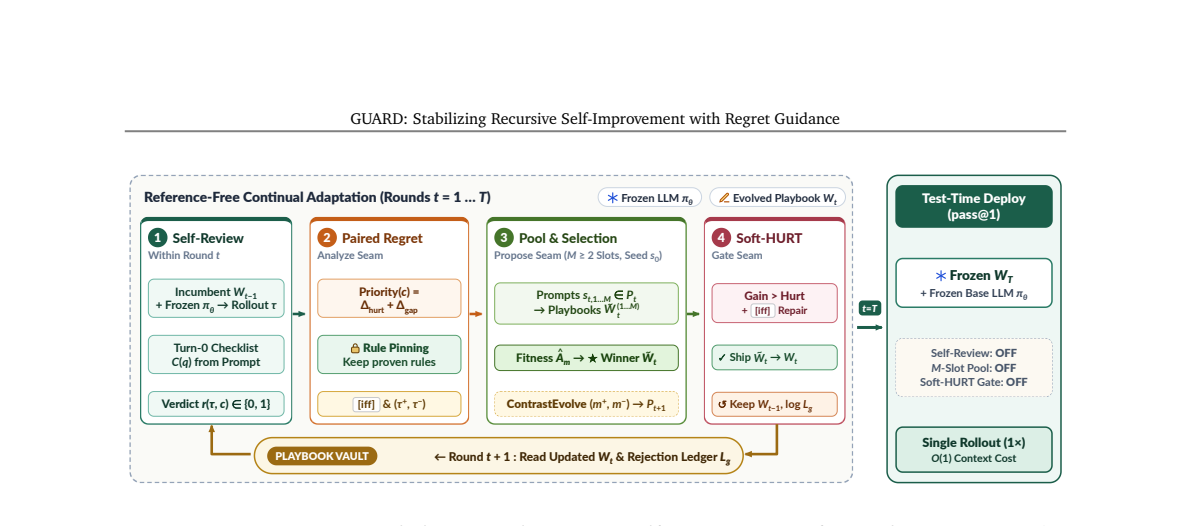
Recursive self-improvement (RSI) adapts this harness from experience without weight updates, yet self-editing without external graders often backfires: reflection and scalar scores conflate what an edit newly broke with what remains unsolved, causing local regressions, skill forgetting, and memory bloat. We introduce GUARD (Grader-free Unsupervised Environment Design [UED] with Adaptive Rule Distillation), a closed-loop framework for reference-free continual harness evolution. Our key insight is to decompose each task into pre-execution self-checks and guide harness updates via directional regret. Each round grades trajectories against these checks, pinning mastered rules while prioritizing newly broken behaviors, and selects among parallel candidate edits by critic-free group-relative fitness. A Soft-HURT gate then promotes an edit only when gains outweigh regressions, scoping specialized fixes to prevent over-triggering and guaranteeing non-regression on its gated buffer. At test time, one frozen harness runs in a single pass. Across benchmarks on memory, skill evolution, continual task streams, and domain reasoning, GUARD consistently improves performance without catastrophic forgetting or memory pollution while substantially cutting deployment token usage.
from the abstract
Pith says
Machine review · deepseek-v4-flash · 19 Nov 2026 · read the full text (202,705 characters) · not checked by a person
It can be wrong. Challenge this review or reply to it.
Holds up, with conditions.
no objections raised
How often objections from reviews like this one are right: not yet measured
The paper, first character to last
The reviewer was given the whole text, 202,705 characters. Not checked: figures, code, what the 63 references say.
What would settle it
If a held-out evaluation shows that a promoted harness (accepted by Soft-HURT based on self-review scores) decreases accuracy on the same task cohort compared to the incumbent, that would falsify the claim that the gate guarantees non-regression on held-out performance. The paper provides calibration evidence (Table 6) showing 19/19 execution-gated promotions have Δ_test ≥ 0, but a single counterexample would challenge the assumption that self-review scores track hidden verifiers well enough.
from Pith's summary of the paper
How the review went
4 passes by deepseek-v4-flash · 19 Nov 2026
- Reader holds up, with conditions
- Skeptic concern withdrawn: Pith's reviewer misread the paper
- Referee no objections raised
- Check against the paper kept 0 of 1 objection
Not run on this paper: the editor, the simulated authors' defence.
Pith's passes raised 1 objection. A check against the paper's text kept 0 and withdrew 1 (1 Pith's reviewer misread the paper).
The review in full
The stress test's concern
Withdrawn: Pith's reviewer misread the paper.
The paper says
“These results characterize the self-review objective on gated task buffers; held-out accuracy is evaluated empirically in \S\ref{sec:results}.”
The referee's report
If the results hold, GUARD addresses a key problem in autonomous agent improvement: how to continually update a persistent harness without external supervision while avoiding catastrophic forgetting and local overfitting. The combination of checklist-based self-review, paired regret ranking, group-relative candidate selection, and regression-aware gating is novel. The empirical evaluation is extensive across multiple benchmarks with careful baselines. The theoretical results provide formal guarantees on the self-review objective. The work is significant for the field of autonomous agents and continual learning.
Pith's reading of the paper (a machine's summary, not the authors')
The paper introduces GUARD, a closed-loop framework for reference-free continual evolution of agent harnesses (prompts, skills, tool rules, memory) around a frozen language model. The central problem is that self-editing without external graders often backfires because scalar scores conflate what an edit newly broke with what remains unsolved, causing regressions, forgetting, and memory bloat. GUARD addresses this by decomposing each task into pre-execution self-checks, ranking criteria by directional regret (separating new regressions from old gaps), sampling parallel candidate edits scored by group-relative fitness, and promoting only net-positive updates via a Soft-HURT gate that guarantees non-regression on its gated buffer. The authors claim that across benchmarks on memory, skill evolution, continual task streams, and domain reasoning, GUARD consistently improves performance without catastrophic forgetting or memory pollution while cutting deployment token usage.
What carries the argument. The central object is the paired directional regret decomposition for each criterion c: Priority_t(c) = Δ_hurt,t(c) + Δ_gap,t(c), where Δ_hurt,t(c) = max(0, obey(c; W_{t-2}) - obey(c; W_{t-1})) captures edit-induced regressions and Δ_gap,t(c) = 1 - obey(c; W_{t-1}) captures unresolved gaps. This ranking separates newly broken criteria from static gaps, pins mastered criteria (Priority=0), and feeds into the Soft-HURT gate which promotes a candidate only when net gain exceeds induced hurt. The group-relative candidate pooling (inspired by GRPO) samples M parallel harnesses, scores them on the same tasks, and selects by standardized fitness without a learned critic.
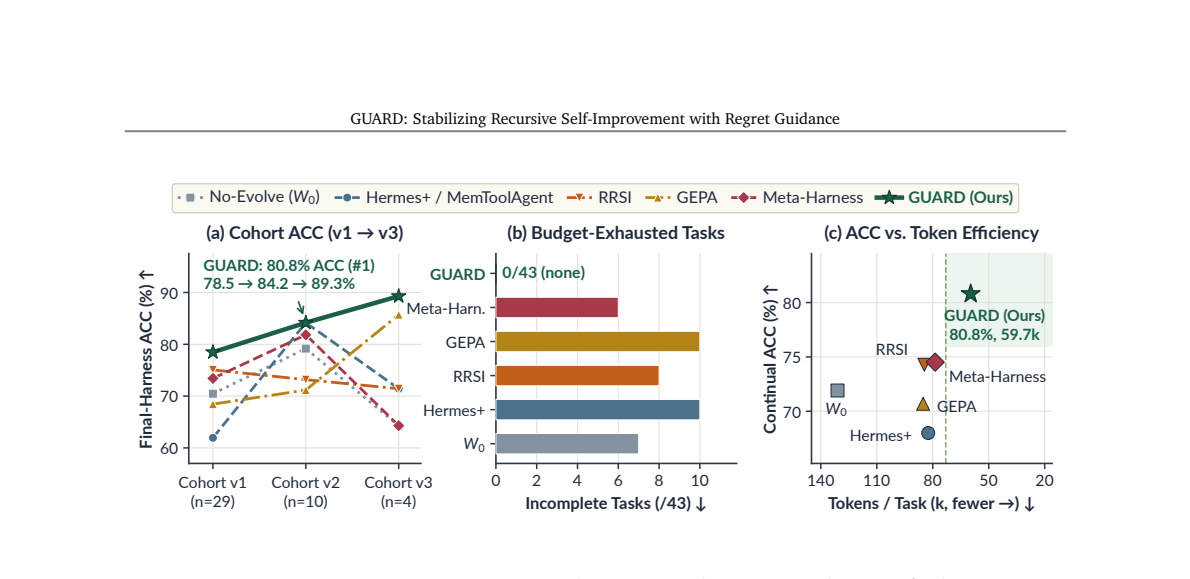
Core claim. The paper claims that by decomposing each task into pre-execution atomic binary checks (criteria) and guiding harness updates via paired directional regret—separating what an edit newly broke (Δ_hurt) from what remains unsolved (Δ_gap)—an agent can continually improve its persistent harness in a reference-free setting without interfering with or catastrophically forgetting previously learned skills. The key mechanism is a closed loop: Analyze (paired regret ranking pins mastered criteria and prioritizes regressions), Propose (parallel candidate harnesses scored by group-relative fitness, with contrastive prompt evolution), and Gate (Soft-HURT promotion that accepts an edit only when gains outweigh induced regressions, with [iff] precondition scoping). The authors report that this yields 19/19 non-regressive execution-gated promotions across EvoHarnessBench, Drift Gauntlet, and professional suites, zero post-block forgetting on all four Drift Gauntlet streams, and 54.5% fewer tokens per task on hosted EvoHarnessBench while improving accuracy.
The premise it rests on. The self-reviewer's checklist-based grading (Layer-1 sandbox checks plus Layer-2 semantic grading) provides a reliable proxy for the unobserved true task evaluator V*, and the Soft-HURT gate's decisions based on this self-review score generalize to held-out test accuracy.
If the paper is right (Pith's inferences, not the authors')
If GUARD's claims hold, autonomous agents could continually improve their behavior from experience without weight updates or external supervision, reducing the need for human prompt engineering and manual harness tuning.
The approach could enable agents to adapt to shifting tools, schemas, and user workflows over long deployments without catastrophic forgetting, addressing a key bottleneck in practical agent systems.
The 54.5% reduction in tokens per task on EvoHarnessBench suggests that compact, scoped rules (via [iff] preconditions) can replace verbose, unscoped instructions, lowering inference cost while improving accuracy.
The zero post-block forgetting on Drift Gauntlet implies that the Soft-HURT gate and signature-routed playbook sections can maintain performance across unannounced task distribution shifts, a common failure mode in continual learning.
The paper's reliance on a self-reviewer's checklist-based grading as a proxy for the unobserved true task evaluator V* is load-bearing; if the self-reviewer systematically misses or misjudges criteria, the gate's non-regression guarantee on the self-review objective may not translate to held-out accuracy. The authors provide calibration evidence (Table 6) but acknowledge this gap.
The approach could be extended to multi-agent settings where each agent maintains its own harness and shares regret bundles, potentially enabling collaborative skill discovery without centralized grading.
The contrastive prompt evolution (contrasting best and worst candidates) is a novel mechanism for iteratively improving proposal prompts; it would be interesting to test whether this technique generalizes to other domains like code generation or robotic policy search.
The paper's theoretical results (Theorem 1) guarantee non-regression on the self-review objective, not on held-out accuracy; a practical extension would be to bound the gap between self-review scores and true task performance under distribution shift.
Check this review
What was read
The passes were given all 202,705 characters of the paper's LaTeX source.
Fingerprint of that text (SHA-256): eaf1390e9c14609baeadd2de0991bea21519c2af94e143eb3963db83b75ef5f6
Pith does not keep that text. Rebuilt from the paper's source or PDF by the same code, it has this fingerprint if it is the same text. From a copy of Pith's code:
PYTHONPATH=. python scripts/review_input_check.py 2611.23476
The passes, in the order they ran
- Reader deepseek-v4-flash · medium effort · $0.0072 · instructions of the Reader, fingerprint f9ead7300382…
- Skeptic deepseek-v4-flash · medium effort · $0.0066 · instructions of the Skeptic, fingerprint 8f88c0f61488…
- Referee deepseek-v4-flash · medium effort · $0.0065 · instructions of the Referee, fingerprint a852d99aea0d…
- Check against the paper deepseek-v4-flash · medium effort · $0.0080 · instructions of the Check against the paper, fingerprint 6c7a6883d551…
- Circularity check deepseek-v4-flash · medium effort · $0.011 · instructions of the Circularity check, fingerprint e9946e39d67b…
- Summary for the page deepseek-v4-flash · medium effort · temperature 0.2 · $0.0069 · instructions of the Summary for the page, fingerprint e4f56bf568e7…
The passes cost $0.046 in model calls together.
Version stamped on this review: pith-pipeline@v1.4.1-daily-deepseek-or-medium+deepseek/deepseek-v4-flash+p.ce10e2b95288
Each link opens a pass's instructions as plain text, the exact bytes its fingerprint was taken over. Every stored set of instructions.
curl -s https://pith.science/methodology/prompts/f9ead730038216984cfb56d7cb34332bdf691828296a1de4245f3d6667d4bf56 | sha256sum
prints the fingerprint of the reader's instructions. The same works for every pass.
The receipt
The review's fingerprint was taken on 19 Nov 2026. The review you are reading still matches it.
Fingerprint of the review (SHA-256): d9fe4be8576d89901791ec863a64e6d52b4c1c8c1a25940d1329bbe1c0811859
curl -s 'https://pith.science/api/v1/verdicts/2611.23476?form=canonical' | sha256sum
prints the fingerprint of the review as it stands now. The rule, in four steps.
A matching fingerprint shows the review has not changed since that date. It does not show that the review is right.
How often reviews like this one are right
Reviews like this one: written by deepseek-v4-flash, from the paper's LaTeX source.
How often objections from reviews like this one are right: not yet measured
Reviews by people
This review was written by a machine. No person has reviewed this paper on Pith yet. A scientist listed on Pith can review it for a fee, and their review is published here whatever it concludes.
The paper
Abstract
Autonomous AI agents pair a frozen base model with an editable harness of prompts, skills, tool rules, and memory. Recursive self-improvement (RSI) adapts this harness from experience without weight updates, yet self-editing without external graders often backfires: reflection and scalar scores conflate what an edit newly broke with what remains unsolved, causing local regressions, skill forgetting, and memory bloat. We introduce GUARD (Grader-free Unsupervised Environment Design [UED] with Adaptive Rule Distillation), a closed-loop framework for reference-free continual harness evolution. Our key insight is to decompose each task into pre-execution self-checks and guide harness updates via directional regret. Each round grades trajectories against these checks, pinning mastered rules while prioritizing newly broken behaviors, and selects among parallel candidate edits by critic-free group-relative fitness. A Soft-HURT gate then promotes an edit only when gains outweigh regressions, scoping specialized fixes to prevent over-triggering and guaranteeing non-regression on its gated buffer. At test time, one frozen harness runs in a single pass. Across benchmarks on memory, skill evolution, continual task streams, and domain reasoning, GUARD consistently improves performance without catastrophic forgetting or memory pollution while substantially cutting deployment token usage.
The paper's own sentences, arranged, kept beside the review and separate from it. Each label is drawn from a closed vocabulary; the number beside it is the probability the classifier gave that label. No sentence in this record was written by a model.
abstract compiled · 2026-11-19
The authors' main claim, as the classifier picked it out 1.00
“Across benchmarks on memory, skill evolution, continual task streams, and domain reasoning, GUARD consistently improves performance without catastrophic forgetting or memory pollution while substantially cutting deployment token usage.”
How the main claim is stated: asserted 1.00
What the abstract itself states, as probabilities: claims first 0.08 · states limitation 0.21 · human participants 0.03 · controlled comparison 0.15 · randomized assignment 0.02 · states quantitative result 0.06 · compares with prior results 0.35 · mentions code or data availability 0.03
The abstract, sentence by sentence
This table labels the abstract only (arXiv listing abstract v1). The number is the probability the classifier gave the label.
| Sentence | Role | The authors' own work | States the main conclusion | Strength |
|---|---|---|---|---|
| Autonomous AI agents pair a frozen base model with an editable harness of prompts, skills, tool rules, and memory. | background 1.00 | 0.07 | 0.02 | asserted 1.00 |
| Recursive self-improvement (RSI) adapts this harness from experience without weight updates, yet self-editing without external graders often backfires: reflection and scalar scores conflate what an edit newly broke with what remains unsolved, causing local regressions, skill forgetting, and memory bloat. | background 0.82 | 0.12 | 0.04 | asserted 0.95 |
| We introduce GUARD (Grader-free Unsupervised Environment Design [UED] with Adaptive Rule Distillation), a closed-loop framework for reference-free continual harness evolution. | contribution 0.99 | 0.84 | 0.06 | asserted 0.98 |
| Our key insight is to decompose each task into pre-execution self-checks and guide harness updates via directional regret. | method 0.66 | 0.73 | 0.08 | asserted 1.00 |
| Each round grades trajectories against these checks, pinning mastered rules while prioritizing newly broken behaviors, and selects among parallel candidate edits by critic-free group-relative fitness. | method 1.00 | 0.84 | 0.05 | asserted 0.99 |
| A Soft-HURT gate then promotes an edit only when gains outweigh regressions, scoping specialized fixes to prevent over-triggering and guaranteeing non-regression on its gated buffer. | method 0.99 | 0.81 | 0.07 | asserted 1.00 |
| At test time, one frozen harness runs in a single pass. | method 0.95 | 0.41 | 0.03 | asserted 0.98 |
| Across benchmarks on memory, skill evolution, continual task streams, and domain reasoning, GUARD consistently improves performance without catastrophic forgetting or memory pollution while substantially cutting deployment token usage. | result 1.00 | 0.94 | 0.87 | asserted 1.00 |
What kind of paper the classifier reports this is: method or tool 1.00 · evidence from observation or experiment 0.91
What was examined, and what was not
Sources read
- arXiv listing abstract v1
Not examined
- full text
- figures and tables
- references and citing sentences
- relations to other papers
Levels run
- P abstract
Not run
- S sections
- T body sentences
- C citations
- R cross-paper relations
How the labels were made
Compiled by classifier-1.13.0 via TypeSafe API, question bank abstract-p1-20260923, 2026-11-19: 1 request, 6,341 input tokens.
Every quoted sentence on this record is the authors'. Every label is from Pith's closed vocabulary, with the probability shown beside it. This record as JSON
Figures (5)



Figures are the authors', reproduced from the paper.
References (63)
- [1] Lakshya A. Agrawal, Shangyin Tan, Dilara Soylu, Noah Ziems, Rishi Khare, Krista Opsahl-Ong, Arnav Singhvi, Herumb Shandilya, Michael J. Ryan, Meng Jiang, Christopher Potts, Koushik Sen, Alexandros G. Dimakis, Ion Stoica, Dan Klein, Matei Zaharia, and Omar Khattab. GEPA: Reflec... on PithPith's reviewarXiv
- [2] Afra Feyza Akyürek, Advait Gosai, Chen Bo Calvin Zhang, Vipul Gupta, Jaehwan Jeong, Anisha Gunjal, Tahseen Rabbani, Maria Mazzone, David Randolph, et al. PRBench: Large-scale expert rubrics for evaluat- ing high-stakes professional reasoning.arXiv preprint arXiv:2511.11562, 2025 on PitharXiv
- [3] Yuzheng Cai, Siqi Cai, Yuchen Shi, Zihan Xu, Lichao Chen, Yulei Qin, Xiaoyu Tan, Gang Li, Zongyi Li, Hao- jia Lin, Yong Mao, Ke Li, and Xing Sun. Training- 16 GUARD: Stabilizing Recursive Self-Improvement with Regret Guidance free group relative policy optimization.arXiv prepr... on PitharXiv
- [4] Minghao Chen, Yihang Li, Yanting Yang, Shiyu Yu, Binbin Lin, and Xiaofei He. AutoManual: Construct- ing instruction manuals by LLM agents via interactive environmental learning. InNeurIPS, 2024 on Pith
- [5] Xiaoyin Chen, Yizheng Huang, Yinglun Xu, Ziyun Zhao, Emmett McQuinn, Julie Liu, and Hope Yao. Are self-evolving agents continual learners?arXiv preprint arXiv:2610.25858, 2026 on PithPith's reviewarXiv
- [6] Jonathan Cook, Tim Rocktäschel, Jakob Foerster, Den- nis Aumiller, and Alex Wang. TICKing all the boxes: Generated checklists improve LLM evaluation and gen- eration.arXiv preprint arXiv:2410.03608, 2024 on PithPith's reviewarXiv
- [7] Michael Dennis, Natasha Jaques, Eugene Vinitsky, Alexandre Bayen, Stuart Russell, Andrew Critch, and Sergey Levine. Emergent complexity and zero-shot transfer via unsupervised environment design. In NeurIPS, 2020 on Pith
- [8] Chrisantha Fernando, Dylan Banarse, Henryk Michalewski, Simon Osindero, and Tim Rocktäschel. Promptbreeder: Self-referential self-improvement via prompt evolution.arXiv preprint arXiv:2309.16797, 2023 on PithPith's reviewarXiv
- [9] Yao Fu, Dong-Ki Kim, Jaekyeom Kim, Sungryull Sohn, Lajanugen Logeswaran, Kyunghoon Bae, and Honglak Lee. AutoGuide: Automated generation and selection of context-aware guidelines for large language model agents. InNeurIPS, 2024 on Pith
- [10] Lucheng Fu, Ye Yu, Yiyang Wang, Yiqiao Jin, Haibo Jin, B. Aditya Prakash, and Haohan Wang. Tex- tReg: Mitigating prompt distributional overfitting via regularized text-space optimization.arXiv preprint arXiv:2605.21318, 2026 on PithPith's reviewarXiv
- [11] Qingyan Guo, Rui Wang, Junliang Guo, Bei Li, Kaitao Song, Xu Tan, Guoqing Liu, Jiang Bian, and Yujiu Yang. EvoPrompt: Connecting LLMs with evolutionary algorithmsyieldspowerfulpromptoptimizers. InICLR, 2024 on Pith
- [12] Shengran Hu, Cong Lu, and Jeff Clune. Automated design of agentic systems. InICLR, 2025 on Pith
- [13] Chengsong Huang, Wenhao Yu, Xiaoyang Wang, Hongming Zhang, Zongxia Li, Ruosen Li, Jiaxin Huang,HaitaoMi,andDongYu. R-Zero: Self-evolving reasoning LLM from zero data. InICLR, 2026 on Pith
- [14] Minqi Jiang, Edward Grefenstette, and Tim Rock- täschel. Prioritized level replay. InICML, 2021 on Pith
- [15] Minqi Jiang, Michael Dennis, Jack Parker-Holder, Jakob Foerster, Edward Grefenstette, and Tim Rock- täschel. Replay-guided adversarial environment de- sign. InNeurIPS, 2021 on Pith
- [16] Yidong Jiang, Junrong Chen, Eftychia Makri, Jialin Chen, Peiwen Li, Ali Maatouk, Leandros Tassiulas, Eliot Brenner, Bing Xiang, and Rex Ying. Fin-RATE: A real-world financial analytics and tracking evaluation benchmark for LLMs on SEC filings.arXiv preprint arXiv:2602.07294, 2026 on PithPith's reviewarXiv
- [17] Zixuan Ke, Vaidehi Patil, Haizhou Shi, Yang Li, Ye Liu, SarathShekkizhar,AnuragKoul,JiayuWang,XuanPhi Nguyen, Semih Yavuz, Mohit Bansal, and Shafiq Joty. EvoHarnessBench: Can your agents keep pace with an evolving harness?arXiv preprint arXiv:2609.04280, 2026 on PithPith's reviewarXiv
- [18] Omar Khattab, Arnav Singhvi, Paridhi Maheshwari, ZhiyuanZhang, KeshavSanthanam, SriVardhamanan, SaifulHaq, AshutoshSharma, ThomasT.Joshi, Hanna Moazam, Heather Miller, Matei Zaharia, and Christo- pher Potts. DSPy: Compiling declarative language model calls into self-improving ... on Pith
- [19] Joel Lehman and Kenneth O. Stanley. Abandoning objectives: Evolution through the search for novelty alone.Evolutionary Computation, 19(2):189–223, 2011 on Pith
- [20] Yoonho Lee, Roshen Nair, Qizheng Zhang, Kangwook Lee, Omar Khattab, and Chelsea Finn. Meta-Harness: End-to-end optimization of model harnesses.arXiv preprint arXiv:2603.28052, 2026 on PithPith's reviewarXiv
show 43 more
- [21] David Lopez-Paz and Marc’Aurelio Ranzato. Gradient episodic memory for continual learning. InNeurIPS, 2017 on Pith
- [22] Xinghua Lou, Miguel Lázaro-Gredilla, Antoine Dedieu, Carter Wendelken, Wolfgang Lehrach, and Kevin P. Murphy. AutoHarness: Improving LLM agents by auto- matically synthesizing a code harness.arXiv preprint arXiv:2603.03329, 2026 on PitharXiv
- [23] Aman Madaan, Niket Tandon, Prakhar Gupta, Skyler Hallinan, Luyu Gao, Sarah Wiegreffe, Uri Alon, Nouha Dziri, Shrimai Prabhumoye, Yiming Yang, et al. Self- refine: Iterative refinement with self-feedback. In NeurIPS, 2023 on Pith
- [24] Bodhisattwa Prasad Majumder, Bhavana Dalvi Mishra, Peter Jansen, Oyvind Tafjord, Niket Tandon, Li Zhang, Chris Callison-Burch, and Peter Clark. CLIN: A contin- uallylearninglanguageagentforrapidtaskadaptation and generalization. InCOLM, 2024 on Pith
- [25] Fanqing Meng, Lingxiao Du, Qiguang Chen, Ziqi Zhao, Haocheng Lu, Mengkang Hu, and Michael Qizhe Shieh. RSIBench-Data: Benchmarking data-centric re- search for recursive self-improvement.arXiv preprint arXiv:2607.25886, 2026 on PithPith's reviewarXiv
- [26] Fanqing Meng, Lingxiao Du, Haocheng Lu, Qiguang Chen, Ziqi Zhao, Zijian Wu, Jiayuan Zhuo, Mengkang Hu, and Michael Qizhe Shieh. RSIGym: A flexible environment for recursive self-improvement.arXiv preprint arXiv:2610.10310, 2026 on PithPith's reviewarXiv
- [27] Charles Moslonka, Amaury de Vitry, Arthur Garnier, Hicham Randrianarivo, and Emmanuel Malherbe. LEDGER: A long-context benchmark of corporate an- nual reports.arXiv preprint arXiv:2606.13100, 2026 on PithPith's reviewarXiv
- [28] Jean-Baptiste Mouret and Jeff Clune. Illuminat- ing search spaces by mapping elites.arXiv preprint arXiv:1504.04909, 2015 on PithPith's reviewarXiv
- [29] Deepak Nathani, Lovish Madaan, Nicholas Roberts, Nikolay Bashlykov, Ajay Menon, Vincent Moens, Amar Budhiraja, Despoina Magka, Vladislav Vorotilov, Gaurav Chaurasia, Dieuwke Hupkes, Ricardo Sil- veira Cabral, Tatiana Shavrina, Jakob Foerster, Yoram Bachrach, William Yang Wang,... on PithPith's reviewarXiv
- [30] Siru Ouyang, Jun Yan, I-Hung Hsu, Yanfei Chen, Ke Jiang, Zifeng Wang, Rujun Han, Long T. Le, Samira Daruki, Xiangru Tang, Vishy Tirumalashetty, George Lee, Mahsan Rofouei, Hangfei Lin, Jiawei Han, Chen- Yu Lee, and Tomas Pfister. ReasoningBank: Scaling agent self-evolving with... on PithPith's reviewarXiv
- [31] CharlesPacker, SarahWooders, KevinLin, VivianFang, Shishir G. Patil, Ion Stoica, and Joseph E. Gonzalez. MemGPT: Towards LLMs as operating systems.arXiv preprint arXiv:2310.08560, 2023 on PithPith's reviewarXiv
- [32] Jack Parker-Holder, Minqi Jiang, Michael Dennis, Mikayel Samvelyan, Jakob Foerster, Edward Grefen- stette, and Tim Rocktäschel. Evolving curricula with regret-based environment design. InICML, 2022 on Pith
- [33] Yiwei Qin, Kaiqiang Song, Yebowen Hu, Wenlin Yao, Sangwoo Cho, Xiaoyang Wang, Xuansheng Wu, Fei Liu, Pengfei Liu, and Dong Yu. InFoBench: Evaluating instruction following ability in large language models. InFindings of ACL, 2024 on Pith
- [34] Ben Rank, Hardik Bhatnagar, Ameya Prabhu, Shira Eisenberg, Karina Nguyen, Matthias Bethge, and Maksym Andriushchenko. PostTrainBench: Can LLM agents automate LLM post-training?arXiv preprint arXiv:2603.08640, 2026 on PitharXiv
- [35] Alexander Rutherford, Michael Beukman, Timon Willi, Bruno Lacerda, Nick Hawes, and Jakob Foerster. No regrets: Investigating and improving regret approxi- mations for curriculum discovery. InNeurIPS, 2024 on Pith
- [36] Rulin Shao, Shannon Zejiang Shen, Junjie Oscar Yin, Yuetai Li, Minheng Wang, Hamish Ivison, Radha Poovendran, Nathan Lambert, Teng Xiao, Mike Lewis, Wen-tau Yih, Luke Zettlemoyer, and Pang Wei Koh. Context language models.arXiv preprint arXiv:2609.37725, 2026 on PithPith's reviewarXiv
- [37] Zhihong Shao, Peiyi Wang, Qihao Zhu, Runxin Xu, Junxiao Song, Xiao Bi, Haowei Zhang, Mingchuan Zhang, Y. K. Li, Y. Wu, and Daya Guo. DeepSeekMath: Pushing the limits of mathematical reasoning in open language models.arXiv preprint arXiv:2402.03300, 2024 on PithPith's reviewarXiv
- [38] Noah Shinn, Federico Cassano, Edward Berman, Ash- win Gopinath, Karthik Narasimhan, and Shunyu Yao. Reflexion: Language agents with verbal reinforcement learning. InNeurIPS, 2023 on Pith
- [39] Mirac Suzgun, Mert Yuksekgonul, Federico Bianchi, Dan Jurafsky, and James Zou. Dynamic cheatsheet: Test-time learning with adaptive memory.arXiv preprint arXiv:2504.07952, 2025 on PithPith's reviewarXiv
- [40] Liyan Tang, Cyrus Rashtchian, Chun-Sung Ferng, An- drew Tomkins, Da-Cheng Juan, and Tu Vu. WikiSkill: Compiling agent experience into persistent knowledge for skill evolution.arXiv preprint arXiv:2608.27454, 2026 on PithPith's reviewarXiv
- [41] Vijay Viswanathan, Yanchao Sun, Shuang Ma, Xiang Kong, Meng Cao, Graham Neubig, and Tongshuang Wu. Checklists are better than reward models for aligning language models. InNeurIPS, 2025 on Pith
- [42] Guanzhi Wang, Yuqi Xie, Yunfan Jiang, Ajay Man- dlekar, Chaowei Xiao, Yuke Zhu, Linxi Fan, and Anima Anandkumar. Voyager: An open-ended embodied agent with large language models.arXiv preprint arXiv:2305.16291, 2023 on PithPith's reviewarXiv
- [43] Zora Zhiruo Wang, Jiayuan Mao, Daniel Fried, and Graham Neubig. Agent workflow memory.arXiv preprint arXiv:2409.07429, 2024 on PithPith's reviewarXiv
- [44] Lei Wang, Chen Ma, Xueyang Feng, Zeyu Zhang, Hao Yang, Jingsen Zhang, Zhiyuan Chen, Jiakai Tang, Xu Chen, Yankai Lin, et al. A survey on large lan- guage model based autonomous agents.Frontiers of Computer Science, 18(6):186345, 2024 on Pith
- [45] Peng Xia, Rujun Han, Zifeng Wang, Yanfei Chen, Yu- fan Zhuang, Yoonho Lee, Chengsong Huang, Han Yu, Zhongying CuiZhu, Yifei Ming, Huaxiu Yao, Burak Gokturk, Tomas Pfister, and Chen-Yu Lee. RRSI: Regu- larized recursive self-improvement of agent harnesses. arXiv preprint arXiv:... on PithPith's reviewarXiv
- [46] Peng Xia, Kaide Zeng, Jiaqi Liu, Can Qin, Fang Wu, YiyangZhou, CaimingXiong, andHuaxiuYao. Agent0: Unleashing self-evolving agents from zero data via tool-integrated reasoning. InCOLM, 2026 on Pith
- [47] Yuqing Xie, Yi-An Lai, Yuanjun Xiong, Yi Zhang, and Stefano Soatto. Regression bugs are in your model! Measuring, reducing and analyzing regressions in NLP model updates. InACL, 2021 on Pith
- [48] Can Xu, Qingfeng Sun, Kai Zheng, Xiubo Geng, Pu Zhao, Jiazhan Feng, Chongyang Tao, Qingwei Lin, and Daxin Jiang. WizardLM: Empowering large pre- trained language models to follow complex instruc- tions. InICLR, 2024 on Pith
- [49] Ruiyao Xu, Yanfei Chen, Zhongying CuiZhu, Bhavana Dalvi Mishra, Yifei Ming, Han Yu, Rujun Han, Chen- Yu Lee, and Tomas Pfister.Harness 2: Recursive agent harnessing for an open world.arXiv preprint arXiv:2610.14224, 2026 on PithPith's reviewarXiv
- [50] Shuhan Xue, Zixin Ding, Yichen Shen, Yinjie Wang, Zhenfei Yin, Yingcheng Wu, Yuxin Chen, Mengdi Wang, and Ling Yang. PAST-Bench: Benchmarking the foundations of recursive self-improvement in personal agents.arXiv preprint arXiv:2608.04003, 2026 on PithPith's reviewarXiv
- [51] Chengrun Yang, Xuezhi Wang, Yifeng Lu, Hanxiao Liu, Quoc V. Le, Denny Zhou, and Xinyun Chen. Large language models as optimizers. InICLR, 2024 on Pith
- [52] John Yang, Carlos E. Jimenez, Alexander Wettig, Kil- ian Lieret, Shunyu Yao, Karthik Narasimhan, and Ofir Press. SWE-agent: Agent-computer interfaces enable automated software engineering. InNeurIPS, 2024 on Pith
- [53] Mert Yuksekgonul, Federico Bianchi, Joseph Boen, Sheng Liu, Zhi Huang, Carlos Guestrin, and James Zou. TextGrad: Automatic “differentiation” via text. arXiv preprint arXiv:2406.07496, 2024 on PithPith's reviewarXiv
- [54] Eric Zelikman, Yuhuai Wu, Jesse Mu, and Noah D. Goodman. STaR: Bootstrapping reasoning with rea- soning. InNeurIPS, 2022 on Pith
- [55] Jiayi Zhang, Jinyu Xiang, Zhaoyang Yu, Fengwei Teng, Xionghui Chen, Jiaqi Chen, Mingchen Zhuge, Xin Cheng, Sirui Hong, Jinlin Wang, Bingnan Zheng, Bang Liu, Yuyu Luo, and Chenglin Wu. AFlow: Automating agentic workflow generation. InICLR, 2025 on Pith
- [56] Qizheng Zhang, Changran Hu, Shubhangi Upasani, Boyuan Ma, Fenglu Hong, Vamsidhar Kamanuru, Jay Rainton, Chen Wu, Mengmeng Ji, Hanchen Li, Urmish 18 GUARD: Stabilizing Recursive Self-Improvement with Regret Guidance Thakker, JamesZou, andKunleOlukotun. Agenticcon- text engineer... on PithPith's reviewarXiv
- [57] Hangfan Zhang, Shao Zhang, Kangcong Li, Chen Zhang, Yang Chen, Yiqun Zhang, Lei Bai, and Shuyue Hu. Self-Harness: Harnesses that improve themselves. arXiv preprint arXiv:2606.09498, 2026 on PithPith's reviewarXiv
- [58] Jenny Zhang, Shengran Hu, Cong Lu, Robert Lange, and Jeff Clune. Darwin Gödel machine: Open-ended evolution of self-improving agents. InICLR, 2026 on Pith
- [59] Andrew Zhao, Daniel Huang, Quentin Xu, Matthieu Lin, Yong-Jin Liu, and Gao Huang. ExpeL: LLM agents are experiential learners. InAAAI, 2024 on Pith
- [60] Andrew Zhao, Yiran Wu, Tong Wu, Quentin Xu, Yang Yue,MatthieuLin,ShenzhiWang,QingyunWu,Zilong Zheng, and Gao Huang. Absolute zero: Reinforced self-play reasoning with zero data. InNeurIPS, 2025 on Pith
- [61] Jeffrey Zhou, Tianjian Lu, Swaroop Mishra, Sid- dhartha Brahma, Sujoy Basu, Yi Luan, Denny Zhou, and Le Hou. Instruction-following evaluation for large language models.arXiv preprint arXiv:2311.07911, 2023 on PithPith's reviewarXiv
- [62] Yifei Zhou, Sergey Levine, Jason Weston, Xian Li, and Sainbayar Sukhbaatar. Self-challenging language model agents. InNeurIPS, 2025. 19 GUARD: Stabilizing Recursive Self-Improvement with Regret Guidance Supplementary Material & Technical Appendix GUARD: Stabilizing Recursive S... on Pith
- [63] (single-model Gemini 4 , seed42), every task exposes a pre-execution observable environ- ment/schema signature (bfcl, sciworld, orbird:<db_id>) without any hidden block index or group label; each signature’s section is bounded to3,800characters and placed at both the start and... on Pith
Challenges and discussion
Disagree with the review, or know something it missed? Leave a comment, or challenge this review formally: a challenge becomes a permanent entry in this paper's record, and its decision is published here.
Come back by email
A short list of the week's newly reviewed papers. Nothing is sent until you confirm from your inbox, and every email has a link that stops it. No account.
No comments yet.
Sign in to comment