Artificial Intelligence · arXiv:2611.25534 v1 · submitted 19 Nov 2026 · 60 references
How Feedback-Free Self-Evolution Reshapes Agent Skills: A Systematic Study
The paper says
“Agent skills are documents in which experts write down procedural knowledge, and models increasingly maintain them by rewriting them without feedback.”
more of the abstract
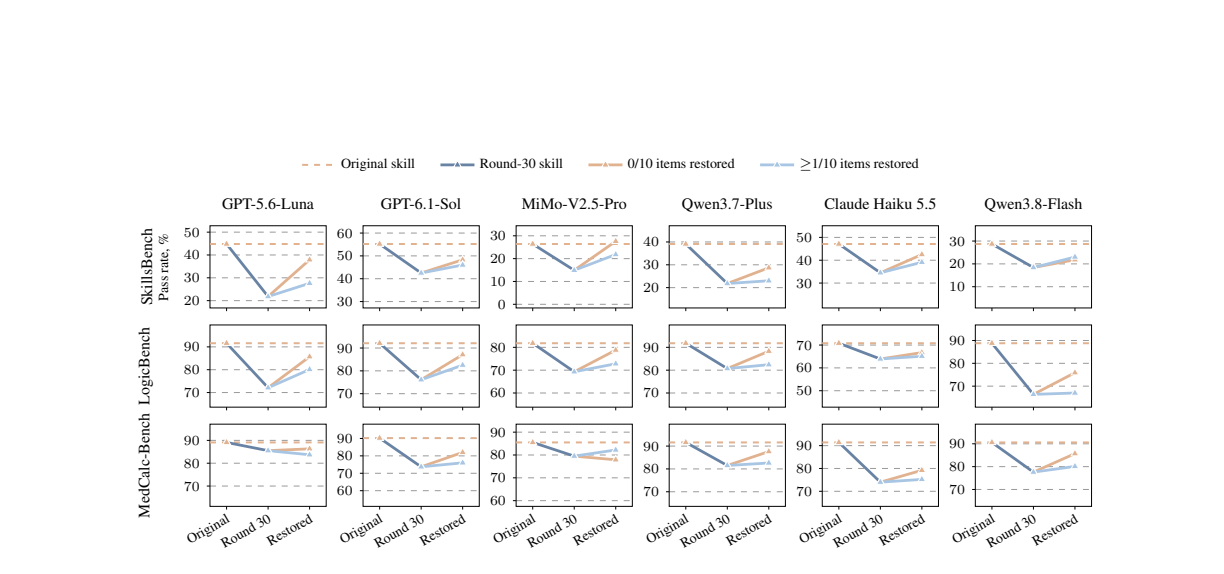
Such rewriting could adapt a skill to the model that uses it or erode the expert knowledge that makes it useful, yet how skills evolve under this feedback-free self-evolution has not been studied. We let models rewrite expert skills round after round without any task, run or judgment and run agents built on the same models with the rewritten skills. Our experiments show that the skills lose value rather than improve, as every model we test performs worse with them on every benchmark, by 15 points on average on SkillsBench after thirty rounds. Sampling each model's prior with skills it writes from the topic alone, we find that rewriting pulls skills toward this prior and gives up first the knowledge outside it. Putting this knowledge back recovers much of the lost pass rate, so an expert's skill is valuable largely for what the model does not write on its own. Building on this insight, SkillDiff marks this knowledge in place and raises the pass rate on SkillsBench by 4.8 points on average without feedback or any change to the skill's text. Project repository: https://github.com/LitaoGuo/How-Self-Evolution-Reshapes-Skills.
from the abstract
Pith says
Machine review · deepseek-v4-flash · 20 Nov 2026 · read the full text (117,049 characters) · not checked by a person
It can be wrong. Challenge this review or reply to it.
Holds up. This paper systematically shows that feedback-free self-evolution of agent skills degrades performance, identifies the mechanism as drift toward the model's prior and loss of rare content, and validates the causal link through restoration experiments. This line is wrong
3 minor
How often objections from reviews like this one are right: not yet measured
The paper, first character to last
The reviewer was given the whole text, 117,049 characters. Not checked: figures, code, what the 60 references say.
3 minor objections
The paper says, at §3.1, Table 1 caption
Pith says: minor objection 1 of 3
The caption of Table 1 (tab:distance) says 'units of the mean distance between two self-written skills'. The main text should clarify why the scale is meaningful and state that a value of 1 means a skill is as close to the self-written skills as they are to each other. While the supplementary calibrates this, a brief sentence in §3.1 would improve reader understanding.
The paper says, at §3.2, paragraph on judging
Pith says: minor objection 2 of 3
The paper states that the LLM judge labels items as 'kept' only when 'preserves its full meaning' and 'lost' when 'absent, incomplete or changed'. This is a semantic judgment that could vary with the judge's interpretation. The authors provide reliability checks (a second judge, a rerun) and report good agreement.
more of objection 2
However, the main text could briefly note that the judgment relies on an LLM and that the checks confirm robustness, to preempt concerns even though the supplementary covers this in detail.
show 1 more
The paper says, at §2.2, Table 1 (tab:decline)
Pith says: minor objection 3 of 3
The table shows that MiMo-V2.5-Pro on SkillsBench gains 2.3 points after round 1 but then declines. The text in §2.2 says 'Even the first rewrite lowers the SkillsBench pass rate by 7.1 points on average across agents', which is correct on average, but a reader might notice the outlier. A brief comment acknowledging the exception and noting that the overall trend is consistent would be helpful.
What would settle it
If a self-writing and rewriting experiment on a different benchmark (e.g., another set of expert-written agent policies) showed that rewriting either improves performance or that the lost items are not primarily those outside the model's prior, the paper's core causal claim would be contradicted. A direct test would be to run the same procedure on a benchmark where the expert skills contain mostly content that the model can generate on its own — the paper predicts little or no degradation.
from Pith's summary of the paper
How the review went
5 passes by deepseek-v4-flash · 20 Nov 2026
- Reader holds up
- Skeptic concern not confirmed: listed as an open question
- Referee 3 minor
- Check against the paper kept 0 of 1 objection
- Editor wrote the verdict above
Not run on this paper: the simulated authors' defence.
Pith's passes raised 1 objection. A check against the paper's text kept 0 and left 1 as a question.
The review in full
The review in brief, machine-written
This paper asks a practical question: what happens when an LLM rewrites an expert skill over and over without any task feedback? The answer is clear and consistent across six models and three benchmarks—the skill degrades, losing 15 points on SkillsBench after thirty rounds. The paper does not stop at documenting the decline. It traces the mechanism to the item level, showing that rewriting selectively preserves content the model already generates on its own while dropping content outside that prior. A restoration experiment confirms that putting the lost items back recovers most of the lost pass rate. Finally, the proposed method SkillDiff marks exactly these items in the original skill and raises the pass rate by 4.8 points without any rewriting or feedback.
The experiments are thorough: judge reliability checks, repeated evaluation runs, multiple rewriting chains, a deletion ablation, and a cross-model swap all support the central claims. The writing is clear and the conclusions follow from the data.
Soft spots are present but acknowledged. The item classification depends on an LLM judge, though the paper tests alternative judges and finds agreement. The model's prior is sampled from ten self-written skills; the supplementary material checks stability with forty and gets consistent results. The study rewrites only the skill document, not accompanying scripts, and uses one preselected skill per task—limitations the authors state explicitly.
This paper deserves a serious referee. It identifies a real degradation mechanism for a widely used practice (feedback-free skill rewriting), explains why it happens, and proposes a lightweight fix. Anyone working on self-evolving agents, skill maintenance, or agent deployment will find the results directly useful. I recommend engaging with the work in peer review.
The stress test's concern
Not confirmed. Pith could not check this concern against the text of the paper it was given; it is listed as an open question, not a finding.
The referee's report
The paper provides the first systematic study of feedback-free self-evolution of agent skills, a setting that arises naturally when feedback is unavailable. The findings are important for practitioners who rely on skill repositories and for researchers developing self-evolving agents: they show that without external verification, rewriting erodes expert knowledge, and they identify what makes expert skills valuable (content outside the model's prior). The causal restoration experiments and the simple, inexpensive SkillDiff method are practical contributions. The empirical work is thorough, covering multiple models, benchmarks, controls (judge reliability, multiple chains, repeated evaluations), and the supplementary extends the results to additional benchmarks and ablations. If the results hold, they have direct implications for how skill maintenance should be designed to avoid degradation.
Pith's reading of the paper (a machine's summary, not the authors')
The paper studies what happens when language models rewrite expert-written agent skills without any task feedback, round after round. Across six models and three benchmarks, the rewritten skills consistently lower task pass rates, by 15 points on average on SkillsBench after thirty rounds. The authors trace the cause: rewriting pulls the skill text toward what the model would write on its own, which they call the model's prior, and preferentially discards knowledge that only the expert supplied. Restoring that discarded knowledge recovers much of the lost performance. Based on this diagnosis, the authors propose SkillDiff, which marks items outside the model's prior in the original skill and directs the agent to attend to them, raising the pass rate by 4.8 points without changing any text.
What carries the argument. The key machinery is the model's prior for each skill, sampled by having the model write ten skills from only the topic sentence (self-written skills). Each item of the original expert skill is then categorized by how many of those ten self-written skills state it (0/10 to 10/10). Items with a low count are considered outside the prior. The paper shows that rewriting preferentially loses items with low counts, and restoring only those items recovers more performance than restoring other lost content.
Core claim. The paper's central discovery is that feedback-free self-evolution of agent skills causes systematic degradation: rewriting moves the skill toward the model's own content (its prior), and the knowledge that the model rarely writes on its own is lost first and fastest. This selective loss is causally responsible for the performance decline. The paper establishes this by sampling each model's prior with ten self-written skills per topic, tracking item-level retention across thirty rewriting rounds, and restoring lost items to confirm the causal link.
The premise it rests on. The paper's analysis assumes that the LLM judge (GPT-5.6-Luna) can reliably determine whether an item from an original skill is stated by a self-written skill or retained in a rewritten skill — a classification that supports both the item-level diagnosis and the restoration experiments. The paper validates this with alternative judges and finds agreement, but the core result depends on that judgment being accurate.
If the paper is right (Pith's inferences, not the authors')
Agent skill maintainers should expect performance to drop when skills are repeatedly rewritten without feedback, even if the model appears to be adapting the skill.
Methods for self-evolving agents should incorporate mechanisms to preserve knowledge outside the model's prior, for example by guarding those items during rewrites.
SkillDiff provides a lightweight, zero-feedback way to improve the practical value of existing skills by highlighting content the model would not produce on its own.
The item-level analysis offers a reusable diagnostic for understanding what a given model contributes to versus what it erodes from a skill document.
Benchmarks for agent skills should report not only average pass rates but also the prior-overlap composition of skill items, to explain why certain skills help certain models.
The paper's finding that loss of prior-outside knowledge causes performance decline suggests that skill curation efforts should prioritize content that models collectively do not generate, rather than content that is widely available in model training data.
If the same drift occurs in other forms of agent memory (e.g., action templates, workflow files), then feedback-free self-evolution may be harmful for any agent component that relies on expert-provided information not present in the model's prior.
The SkillDiff method, by incurring only one-time marker cost per skill and model, could be integrated into agent skill pipelines at scale, potentially improving performance on tasks where models tend to ignore critical procedural steps.
Check this review
What was read
The passes were given all 117,049 characters of the paper's LaTeX source.
Fingerprint of that text (SHA-256): 58f29c0c400ee04b6c24689bbde2d6ef08dbc2a17837632c48790d698ad7f60d
Pith does not keep that text. Rebuilt from the paper's source or PDF by the same code, it has this fingerprint if it is the same text. From a copy of Pith's code:
PYTHONPATH=. python scripts/review_input_check.py 2611.25534
The passes, in the order they ran
- Reader deepseek-v4-flash · medium effort · $0.0023 · instructions of the Reader, fingerprint f9ead7300382…
- Skeptic deepseek-v4-flash · medium effort · $0.0020 · instructions of the Skeptic, fingerprint 8f88c0f61488…
- Referee deepseek-v4-flash · medium effort · $0.0019 · instructions of the Referee, fingerprint a852d99aea0d…
- Check against the paper deepseek-v4-flash · medium effort · $0.0021 · instructions of the Check against the paper, fingerprint 6c7a6883d551…
- Editor deepseek-v4-flash · medium effort · $0.0019 · instructions of the Editor, fingerprint e7211f6a3d27…
- Circularity check deepseek-v4-flash · medium effort · $0.0018 · instructions of the Circularity check, fingerprint e9946e39d67b…
- Summary for the page deepseek-v4-flash · medium effort · temperature 0.2 · $0.0019 · instructions of the Summary for the page, fingerprint e4f56bf568e7…
The passes cost $0.014 in model calls together.
Version stamped on this review: pith-pipeline@v1.4.1-daily-deepseek-or-medium+deepseek/deepseek-v4-flash+p.d60f54226f00
Each link opens a pass's instructions as plain text, the exact bytes its fingerprint was taken over. Every stored set of instructions.
curl -s https://pith.science/methodology/prompts/f9ead730038216984cfb56d7cb34332bdf691828296a1de4245f3d6667d4bf56 | sha256sum
prints the fingerprint of the reader's instructions. The same works for every pass.
The receipt
The review's fingerprint was taken on 20 Nov 2026. The review you are reading still matches it.
Fingerprint of the review (SHA-256): 6d2849ccf84e15c05fc6120b16251aa872d0579577283e0307e12a52981cff23
curl -s 'https://pith.science/api/v1/verdicts/2611.25534?form=canonical' | sha256sum
prints the fingerprint of the review as it stands now. The rule, in four steps.
A matching fingerprint shows the review has not changed since that date. It does not show that the review is right.
How often reviews like this one are right
Reviews like this one: written by deepseek-v4-flash, from the paper's LaTeX source.
How often objections from reviews like this one are right: not yet measured
Reviews by people
This review was written by a machine. No person has reviewed this paper on Pith yet. A scientist listed on Pith can review it for a fee, and their review is published here whatever it concludes.
The paper
Abstract
Agent skills are documents in which experts write down procedural knowledge, and models increasingly maintain them by rewriting them without feedback. Such rewriting could adapt a skill to the model that uses it or erode the expert knowledge that makes it useful, yet how skills evolve under this feedback-free self-evolution has not been studied. We let models rewrite expert skills round after round without any task, run or judgment and run agents built on the same models with the rewritten skills. Our experiments show that the skills lose value rather than improve, as every model we test performs worse with them on every benchmark, by 15 points on average on SkillsBench after thirty rounds. Sampling each model's prior with skills it writes from the topic alone, we find that rewriting pulls skills toward this prior and gives up first the knowledge outside it. Putting this knowledge back recovers much of the lost pass rate, so an expert's skill is valuable largely for what the model does not write on its own. Building on this insight, SkillDiff marks this knowledge in place and raises the pass rate on SkillsBench by 4.8 points on average without feedback or any change to the skill's text. Project repository: https://github.com/LitaoGuo/How-Self-Evolution-Reshapes-Skills.
The paper's own sentences, arranged, kept beside the review and separate from it. Each label is drawn from a closed vocabulary; the number beside it is the probability the classifier gave that label. No sentence in this record was written by a model.
abstract compiled · 2026-11-20
The authors' main claim, as the classifier picked it out 0.86
“Our experiments show that the skills lose value rather than improve, as every model we test performs worse with them on every benchmark, by 15 points on average on SkillsBench after thirty rounds.”
How the main claim is stated: asserted 1.00
What the abstract itself states, as probabilities: claims first 0.48 · states limitation 0.29 · human participants 0.08 · controlled comparison 0.84 · randomized assignment 0.02 · states quantitative result 0.99 · compares with prior results 0.73 · mentions code or data availability 0.95
The abstract, sentence by sentence
This table labels the abstract only (arXiv listing abstract v1). The number is the probability the classifier gave the label.
| Sentence | Role | The authors' own work | States the main conclusion | Strength |
|---|---|---|---|---|
| Agent skills are documents in which experts write down procedural knowledge, and models increasingly maintain them by rewriting them without feedback. | background 1.00 | 0.06 | 0.03 | asserted 1.00 |
| Such rewriting could adapt a skill to the model that uses it or erode the expert knowledge that makes it useful, yet how skills evolve under this feedback-free self-evolution has not been studied. | gap 0.99 | 0.05 | 0.03 | hedged possibility 0.97 |
| We let models rewrite expert skills round after round without any task, run or judgment and run agents built on the same models with the rewritten skills. | method 0.98 | 0.96 | 0.03 | asserted 0.87 |
| Our experiments show that the skills lose value rather than improve, as every model we test performs worse with them on every benchmark, by 15 points on average on SkillsBench after thirty rounds. | result 1.00 | 0.97 | 0.79 | asserted 1.00 |
| Sampling each model's prior with skills it writes from the topic alone, we find that rewriting pulls skills toward this prior and gives up first the knowledge outside it. | result 0.67 | 0.94 | 0.12 | asserted 1.00 |
| Putting this knowledge back recovers much of the lost pass rate, so an expert's skill is valuable largely for what the model does not write on its own. | interpretation 0.94 | 0.92 | 0.32 | asserted 1.00 |
| Building on this insight, SkillDiff marks this knowledge in place and raises the pass rate on SkillsBench by 4.8 points on average without feedback or any change to the skill's text. | contribution 0.59 | 0.96 | 0.18 | asserted 1.00 |
| Project repository: https://github.com/LitaoGuo/How-Self-Evolution-Reshapes-Skills. | contribution 0.46 | 0.31 | 0.02 | unclear 0.94 |
What kind of paper the classifier reports this is: empirical study 0.99 · evidence from observation or experiment 0.99
What was examined, and what was not
Sources read
- arXiv listing abstract v1
Not examined
- full text
- figures and tables
- references and citing sentences
- relations to other papers
Levels run
- P abstract
Not run
- S sections
- T body sentences
- C citations
- R cross-paper relations
How the labels were made
Compiled by classifier-1.13.0 via TypeSafe API, question bank abstract-p1-20260923, 2026-11-20: 1 request, 6,321 input tokens.
Every quoted sentence on this record is the authors'. Every label is from Pith's closed vocabulary, with the probability shown beside it. This record as JSON
Figures (12)




Figures are the authors', reproduced from the paper.
References (60)
- [1] Alberto Acerbi and Joseph M. Stubbersfield. Large language models show human-like content biases in transmission chain experiments.Proceedings of the National Academy of Sci- ences, 120(44):e2313790120, 2023. 9 on Pith
- [2] Lakshya A Agrawal, Shangyin Tan, Dilara Soylu, Noah Ziems, Rishi Khare, Krista Opsahl-Ong, Arnav Singhvi, Herumb Shandilya, Michael J Ryan, Meng Jiang, Christo- pher Potts, Koushik Sen, Alex Dimakis, Ion Stoica, Dan Klein, Matei Zaharia, and Omar Khattab. GEPA: Reflective prom... on Pith
- [3] Anthropic. System card: Claude Haiku 5.5. https://www. anthropic . com / claude - haiku - 5 - 5 - system - card, 2026. Published October 7, 2026. 3 on Pith
- [4] Victor Barres, Honghua Dong, Soham Ray, Xujie Si, and Karthik R Narasimhan. τ 2-bench: Evaluating conversational agents in a dual-control environment. InInternational Con- ference on Machine Learning, 2026. 18 on Pith
- [5] Chenle Chen, Yangbo Wei, Chao Yao, Shaoqiang Lu, Junhong Qian, Chen Wu, and Lei He. Competence, not accuracy: A diagnostic for reference-free judge gates in skill optimization. arXiv preprint arXiv:2608.18719, 2026. 2, 8 on PithPith's reviewarXiv
- [6] Mark Chen, Jerry Tworek, Heewoo Jun, Qiming Yuan, Hen- rique Ponde de Oliveira Pinto, Jared Kaplan, Harri Ed- wards, Yuri Burda, Nicholas Joseph, Greg Brockman, Alex Ray, Raul Puri, Gretchen Krueger, Michael Petrov, Heidy Khlaaf, Girish Sastry, Pamela Mishkin, Brooke Chan, Sco... on PithPith's reviewarXiv
- [7] Minghao Chen, Yihang Li, Yanting Yang, Shiyu Yu, Binbin Lin, and Xiaofei He. AutoManual: Constructing instruction manuals by LLM agents via interactive environmental learn- ing. InAdvances in Neural Information Processing Systems, on Pith
- [8] Giuseppe Destefanis, Daniel Graziotin, Matteo Vaccargiu, and Marco Ortu. GitSkills: A dataset of agent skills on GitHub. arXiv preprint arXiv:2608.10906, 2026. 2 on PithPith's reviewarXiv
- [9] Chenyuan Duan, Ge Shi, Zineng Mao, Ge Zhang, Hao Liang, Yinzhu Piao, Yuchen Wu, Zhixin Yao, Kaiyu Huang, Wen- hao Huang, Linzhuang Sun, Shen Yan, and Wentao Zhang. 9 Repo2Skill-Evo: Repository skills go stale in silence. arXiv preprint arXiv:2608.21964, 2026. 2, 8 on PithPith's reviewarXiv
- [10] Haowen Gao, Haoran Chen, Can Wang, Shasha Guo, Liang Pang, Zhaoyang Liu, Huawei Shen, and Xueqi Cheng. Self- EvoSkill: Paired execution audits for skill revision without ex- ternal outcome supervision. arXiv preprint arXiv:2606.14239, on PithPith's reviewarXiv
- [11] Huan-ang Gao, Jiayi Geng, Wenyue Hua, Mengkang Hu, Xinzhe Juan, Hongzhang Liu, Shilong Liu, Jiahao Qiu, Xuan Qi, Qihan Ren, Yiran Wu, Hongru Wang, Han Xiao, Yuhang Zhou, Shaokun Zhang, Jiayi Zhang, Jinyu Xiang, Yixiong Fang, Qiwen Zhao, Dongrui Liu, Cheng Qian, Zhenhailong Wan... on Pith
- [12] Yudong Gao, Zongjie Li, Yuanyuan Yuan, Zimo Ji, Pingchuan Ma, and Shuai Wang. SkillReducer: Optimizing LLM agent skills for token efficiency. arXiv preprint arXiv:2603.29919, on PithPith's reviewarXiv
- [13] Srishti Gautam, Arjun Radhakrishna, and Sumit Gul- wani. SkillAxe: Sharpening LLM-authored agent skills through evaluation-guided self-refinement. arXiv preprint arXiv:2606.10546, 2026. 2, 9 on PithPith's reviewarXiv
- [14] Thomas L. Griffiths and Michael L. Kalish. Language evo- lution by iterated learning with Bayesian agents.Cognitive Science, 31(3):441–480, 2007. 9 on Pith
- [15] Jie Huang, Xinyun Chen, Swaroop Mishra, Huaixiu Steven Zheng, Adams Wei Yu, Xinying Song, and Denny Zhou. Large language models cannot self-correct reasoning yet. In International Conference on Learning Representations, 2024. 2 on Pith
- [16] Wei-Jung Huang. Do LLM-generated skills make better AI data scientists? A component ablation across data-science workflows. arXiv preprint arXiv:2607.07504, 2026. 9 on PithPith's reviewarXiv
- [17] Zhiyuan Jiang, Fangrui Huang, Hanwen Xing, Xander Wu, Yipeng Gao, Rui Cao, Mengdi Wang, Shilong Liu, and Yi- jiang Li. Demystifying agent skills: Why they work—until they don’t. arXiv preprint arXiv:2608.14036, 2026. 9 on PithPith's reviewarXiv
- [18] Michael L. Kalish, Thomas L. Griffiths, and Stephan Lewandowsky. Iterated learning: Intergenerational knowl- edge transmission reveals inductive biases.Psychonomic Bulletin & Review, 14(2):288–294, 2007. 9 on Pith
- [19] Nikhil Khandekar, Qiao Jin, Guangzhi Xiong, Soren Dunn, Serina S Applebaum, Zain Anwar, Maame Sarfo-Gyamfi, Conrad W Safranek, Abid A Anwar, Andrew Zhang, Aidan Gilson, Maxwell B Singer, Amisha Dave, Andrew Taylor, Aidong Zhang, Qingyu Chen, and Zhiyong Lu. MedCalc- Bench: Eva... on Pith
- [20] Qinfeng Li, Dalin He, Yuntai Bao, Ying Yang, Ruoxi Chen, Xinyan Yu, Lizhou Liang, Ge Su, Wenqi Zhang, and Xuhong Zhang. SkillAligner: Treating retrieved skills as adaptable drafts at execution time. arXiv preprint arXiv:2608.06880, on PithPith's reviewarXiv
show 40 more
- [21] Tao Li, Junfeng Liu, Qinghua Zhao, Yifan Li, Lei Wang, Bo Shao, Xuejun Liu, and Linjun Shou. What is a skill worth? Structure-aware Shapley valuation of agent skills. arXiv preprint arXiv:2608.04562, 2026. 9 on PithPith's reviewarXiv
- [22] Xiangyi Li, Yimin Liu, Wenbo Chen, Bingran You, Zonglin Di, Yifeng He, Shenghan Zheng, Kyoung Whan Choe, Jiankai Sun, Shuyi Wang, Chujun Tao, Binxu Li, Xuandong Zhao, Hejia Geng, Xiaojun Wu, Junwei Zhou, Xiaokun Chen, Han- wen Xing, Yubo Li, Qunhong Zeng, Di Wang, Yuanli Wang,... on PithPith's reviewarXiv
- [23] Chang Liu, Yuqi Zhang, Yiman Zhong, Boyi Liu, Hengjun Wang, and Shuyue Wei. SkillShapley: Boundary-adaptive Shapley valuation for skill step attribution in LLM agents. arXiv preprint arXiv:2608.13173, 2026. 9 on PithPith's reviewarXiv
- [24] Aman Madaan, Niket Tandon, Prakhar Gupta, Skyler Hallinan, Luyu Gao, Sarah Wiegreffe, Uri Alon, Nouha Dziri, Shrimai Prabhumoye, Yiming Yang, Shashank Gupta, Bodhisattwa Prasad Majumder, Katherine Hermann, Sean Welleck, Amir Yazdanbakhsh, and Peter Clark. Self-Refine: Iterativ... on Pith
- [25] Nous Research. Skills system. Hermes Agent documen- tation, https : / / hermes - agent . nousresearch . com/docs/user-guide/features/skills , 2026. Accessed 2026-10-14. 9 on Pith
- [26] OpenAI. GPT-5.6 system card. OpenAI Deployment Safety Hub, https://deploymentsafety.openai.com/ gpt-5-6, 2026. Published July 9, 2026. 3 on Pith
- [27] OpenAI. Addendum to GPT-6 Astra system card: GPT- 6.1 Sol. OpenAI Deployment Safety Hub, https:// deploymentsafety.openai.com/gpt-6-1-sol , on Pith
- [28] Yipeng Ouyang, Yi Xiao, Yuhao Gu, and Xianwei Zhang. SkCC: Portable and secure skill compilation for cross- framework LLM agents. arXiv preprint arXiv:2605.03353, on PithPith's reviewarXiv
- [29] Mihir Parmar, Nisarg Patel, Neeraj Varshney, Mutsumi Naka- mura, Man Luo, Santosh Mashetty, Arindam Mitra, and Chitta Baral. LogicBench: Towards systematic evaluation of logical reasoning ability of large language models. InAnnual Meet- ing of the Association for Computational... on Pith
- [30] Siran Peng, Cuiyu Yang, Tianyu Fu, Tianshuo Zhang, Haoyuan Zhang, Weisong Zhao, Anyang Su, Minghui 10 Wu, Huiying Li, Xiangyu Zhu, Chenxu Zhao, and Zhen Lei. Self-supervised skill optimization. arXiv preprint arXiv:2607.28777, 2026. 2, 9 on PithPith's reviewarXiv
- [31] J´er´emy Perez, Grgur Kovaˇc, Corentin L ´eger, C´edric Colas, Gaia Molinaro, Maxime Derex, Pierre-Yves Oudeyer, and Cl´ement Moulin-Frier. When LLMs play the telephone game: Cultural attractors as conceptual tools to evaluate LLMs in multi-turn settings. InInternational Confe... on Pith
- [32] Qwen Team. Qwen3.8-Flash-Next: A new architecture, towards ultimate cost-efficiency. https://qwen.ai/ blog?id=qwen3.8-flash-next, 2026. 3 on Pith
- [33] Qwen Team. Qwen3.7-Plus: Multimodal agent intelli- gence. https://qwen.ai/blog?id=qwen3.7- plus, 2026. 3 on Pith
- [34] Yi Ren, Shangmin Guo, Linlu Qiu, Bailin Wang, and Danica J. Sutherland. Bias amplification in language model evolution: An iterated learning perspective. InAdvances in Neural In- formation Processing Systems, 2024. 9 on Pith
- [35] Shuaike Shen, Wenduo Cheng, Mingqian Ma, Alistair Turcan, Martin Jinye Zhang, and Jian Ma. SkillFoundry: Building self- evolving agent skill libraries from heterogeneous scientific resources. InConference on Language Modeling, 2026. 2, 8 on Pith
- [36] Noah Shinn, Federico Cassano, Ashwin Gopinath, Karthik Narasimhan, and Shunyu Yao. Reflexion: Language agents with verbal reinforcement learning. InAdvances in Neural Information Processing Systems, 2023. 8 on Pith
- [37] Ilia Shumailov, Zakhar Shumaylov, Yiren Zhao, Nicolas Pa- pernot, Ross Anderson, and Yarin Gal. AI models collapse when trained on recursively generated data.Nature, 631: 755–759, 2024. 9 on Pith
- [38] Weihang Su, Jianming Long, Qingyao Ai, Qiaozhi He, Yichen Tang, Changyue Wang, Yiteng Tu, Yingbo Wang, and Yiqun Liu. Skill retrieval augmentation for agentic AI. arXiv preprint arXiv:2604.24594, 2026. 2, 3, 8 on PithPith's reviewarXiv
- [39] Guanzhi Wang, Yuqi Xie, Yunfan Jiang, Ajay Mandlekar, Chaowei Xiao, Yuke Zhu, Linxi Fan, and Anima Anandkumar. V oyager: An open-ended embodied agent with large language models.Transactions on Machine Learning Research, 2024. 8 on Pith
- [40] Jiajie Wang, Yutong Zhao, Tianlin Li, Huashan Chen, Jinfu Chen, Kebin Peng, and Sen He. Agent skill evolution: How re- visions affect coding agents. arXiv preprint arXiv:2610.04832, on PithPith's reviewarXiv
- [41] Xingyao Wang, Boxuan Li, Yufan Song, Frank F. Xu, Xian- gru Tang, Mingchen Zhuge, Jiayi Pan, Yueqi Song, Bowen Li, Jaskirat Singh, Hoang H. Tran, Fuqiang Li, Ren Ma, Mingzhang Zheng, Bill Qian, Yanjun Shao, Niklas Muen- nighoff, Yizhe Zhang, Binyuan Hui, Junyang Lin, Robert Br... on Pith
- [42] Zefeng Wang, Minxi Yan, Jinhe Bi, Sikuan Yan, V olker Tresp, and Yunpu Ma. MetaSkill-Evolve: Recursive self- improvement of LLM agents via two-timescale meta-skill evolution. arXiv preprint arXiv:2607.05297, 2026. 2, 8 on PithPith's reviewarXiv
- [43] Zora Zhiruo Wang, Apurva Gandhi, Graham Neubig, and Daniel Fried. Inducing programmatic skills for agentic tasks. InConference on Language Modeling, 2025. 8 on Pith
- [44] Zora Zhiruo Wang, Jiayuan Mao, Daniel Fried, and Graham Neubig. Agent workflow memory. InInternational Confer- ence on Machine Learning, 2025. 8 on Pith
- [45] Xinjian Wu, Jingzhi Gong, Gunel Jahangirova, Zhenpeng Chen, and Jie M. Zhang. An empirical study of downstream adaptation for agent skills. arXiv preprint arXiv:2607.03238, on PithPith's reviewarXiv
- [46] Xiaomi MiMo Team. MiMo-V2.5-Pro. https : //huggingface.co/collections/XiaomiMiMo/ mimo-v25, 2026. 3 on Pith
- [47] Qinghua Xing, Yinda Chen, Yaping Jin, Zhenhe Wu, Bohan Lin, Hang Zhou, Xinghao Chen, Hanting Chen, and Zhiwei Xiong. What should a skill remember? quality–cost trade-offs in cost-aware skill rewriting for language model agents. arXiv preprint arXiv:2606.09421, 2026. 2, 8, 23 on PithPith's reviewarXiv
- [48] Chengrun Yang, Xuezhi Wang, Yifeng Lu, Hanxiao Liu, Quoc V Le, Denny Zhou, and Xinyun Chen. Large lan- guage models as optimizers. InInternational Conference on Learning Representations, 2024. 8 on Pith
- [49] Yifan Yang, Ziyang Gong, Weiquan Huang, Qihao Yang, Ziwei Zhou, Zisu Huang, Yan Li, Xuemei Gao, Qi Dai, Bei Liu, Kai Qiu, Yuqing Yang, Dongdong Chen, Xue Yang, and Chong Luo. SkillOpt: Executive strategy for self-evolving agent skills. InAdvances in Neural Information Processi... on Pith
- [50] Jianxiang Yu, Jiapeng Zhu, Bochen Lin, Qier Cui, Zichen Ding, and Xiang Li. Skill is not one-size-fits-all: Model- aware skill alignment for LLM agents. arXiv preprint arXiv:2605.30723, 2026. 2, 8 on PithPith's reviewarXiv
- [51] Yang Yue, Zhiqi Chen, Rui Lu, Andrew Zhao, Zhaokai Wang, Yang Yue, Shiji Song, and Gao Huang. Does reinforcement learning really incentivize reasoning capacity in LLMs be- yond the base model? InAdvances in Neural Information Processing Systems, 2025. 18 on Pith
- [52] Barry Zhang, Keith Lazuka, and Mahesh Murag. Equip- ping agents for the real world with Agent Skills. https: //www.anthropic.com/research/equipping- agents - for - the - real - world - with - agent - skills, 2025. Published October 16, 2025. 2, 8 on Pith
- [53] Jenny Zhang, Shengran Hu, Cong Lu, Robert Tjarko Lange, and Jeff Clune. Darwin G ¨odel machine: Open-ended evolu- tion of self-improving agents. InInternational Conference on Learning Representations, 2026. 8 on Pith
- [54] Qizheng Zhang, Changran Hu, Shubhangi Upasani, Boyuan Ma, Fenglu Hong, Vamsidhar Kamanuru, Jay Rainton, Chen Wu, Mengmeng Ji, Hanchen Li, Urmish Thakker, James Zou, and Kunle Olukotun. Agentic context engineering: Evolving contexts for self-improving language models. InInterna... on Pith
- [55] Xing Zhang, Guanghui Wang, Yanwei Cui, Wei Qiu, Ziyuan Li, Bing Zhu, and Peiyang He. Guardrails beat guidance: A large-scale study of rules, skills, and persistent configuration for coding agents. arXiv preprint arXiv:2604.11088, 2026. 9 on PithPith's reviewarXiv
- [56] Yanzhao Zhang, Mingxin Li, Dingkun Long, Xin Zhang, Huan Lin, Baosong Yang, Pengjun Xie, An Yang, Dayiheng 11 Liu, Junyang Lin, Fei Huang, and Jingren Zhou. Qwen3 Em- bedding: Advancing text embedding and reranking through foundation models. arXiv preprint arXiv:2506.05176, 2025. 17 on PithPith's reviewarXiv
- [57] Andrew Zhao, Daniel Huang, Quentin Xu, Matthieu Lin, Yong-Jin Liu, and Gao Huang. ExpeL: LLM agents are expe- riential learners. InAAAI Conference on Artificial Intelligence, pages 19632–19642, 2024. 8 on Pith
- [58] Boyuan Zheng, Michael Y . Fatemi, Xiaolong Jin, Zora Zhiruo Wang, Apurva Gandhi, Yueqi Song, Yu Gu, Jayanth Srinivasa, Gaowen Liu, Graham Neubig, and Yu Su. SkillWeaver: Web agents can self-improve by discovering and honing skills. arXiv preprint arXiv:2504.07079, 2025. 8 on PithPith's reviewarXiv
- [59] Shanshan Zhong, Yi Lu, Jingjie Ning, Yibing Wan, Lihan Feng, Yuyi Ao, Leonardo F. R. Ribeiro, Markus Dreyer, Sean Ammirati, and Chenyan Xiong. SkillLearnBench: Bench- marking continual learning methods for agent skill generation on real-world tasks. arXiv preprint arXiv:2604.2... on PithPith's reviewarXiv
- [2026] Published September 29, 2026. 3 on Pith
Challenges and discussion
Disagree with the review, or know something it missed? Leave a comment, or challenge this review formally: a challenge becomes a permanent entry in this paper's record, and its decision is published here.
Come back by email
A short list of the week's newly reviewed papers. Nothing is sent until you confirm from your inbox, and every email has a link that stops it. No account.
No comments yet.
Sign in to comment