Computation and Language · arXiv:2611.33823 v1 · submitted 25 Nov 2026 · 87 references
Pitfalls of Dependency-Ready Decoding for Masked Diffusion Language Models
The paper says
“Masked diffusion models (MDMs) have shown strong performance on structured reasoning tasks such as Sudoku, Trip Planning, and Countdown.”
more of the abstract
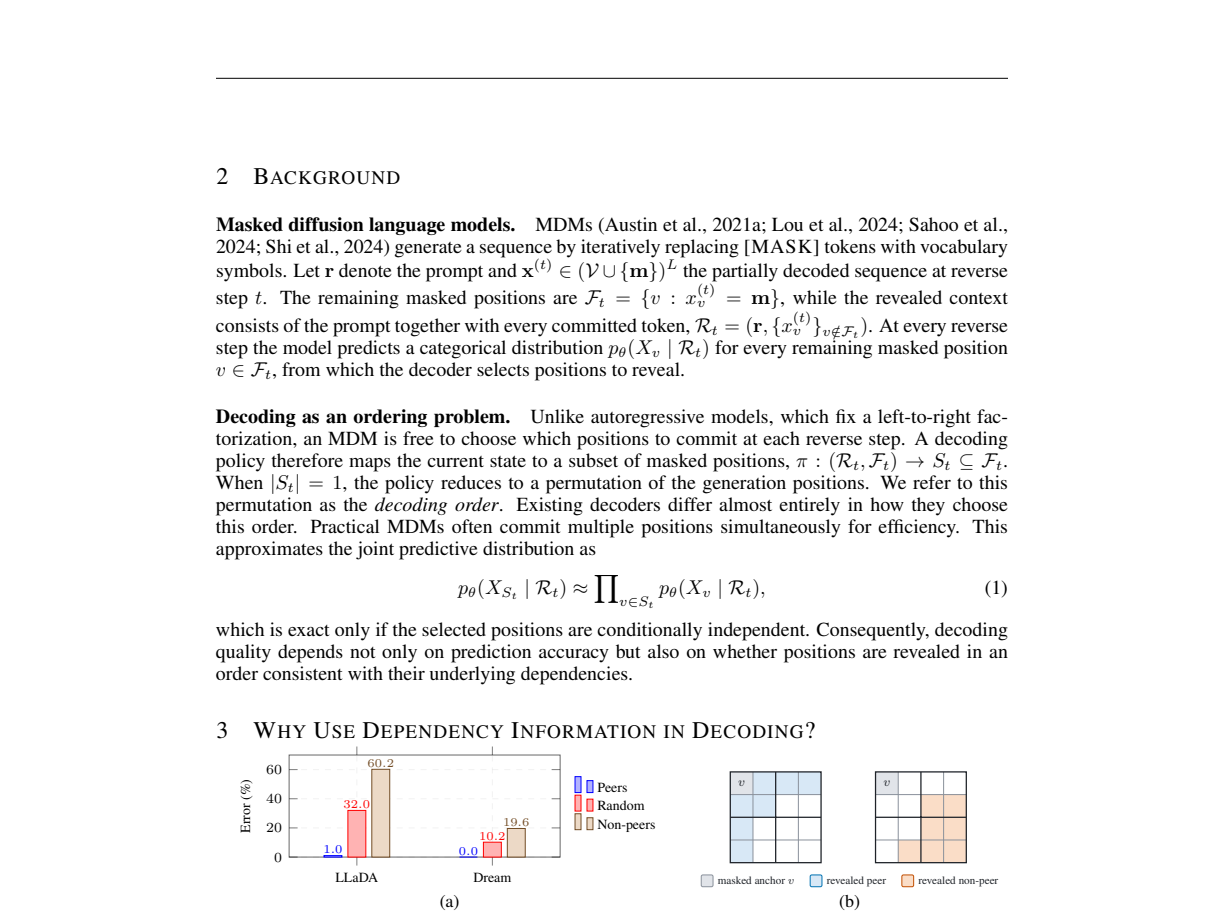
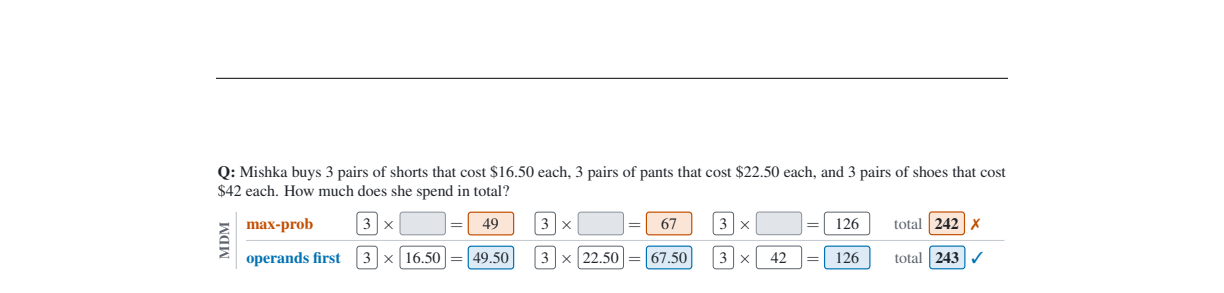
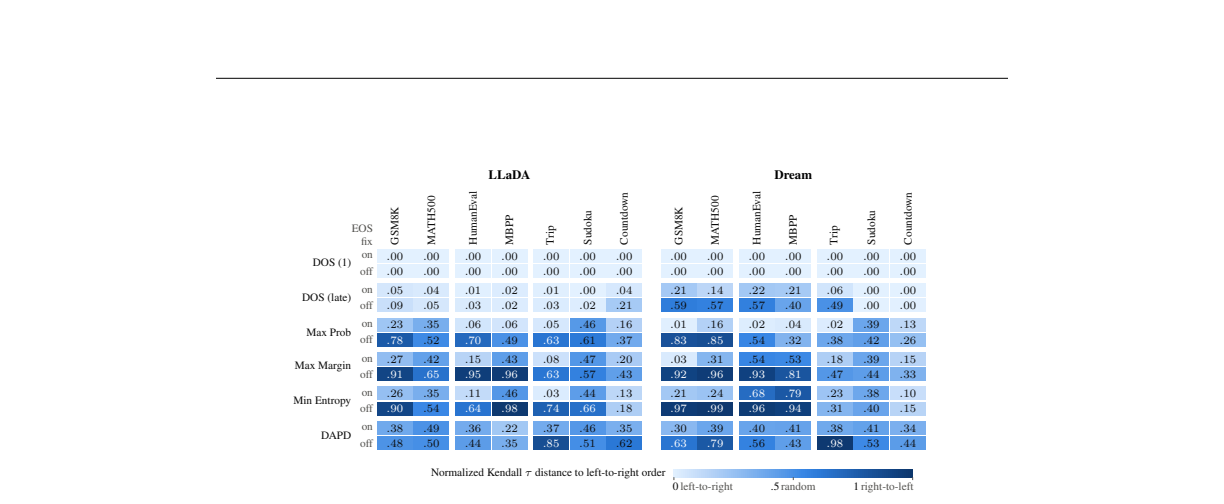
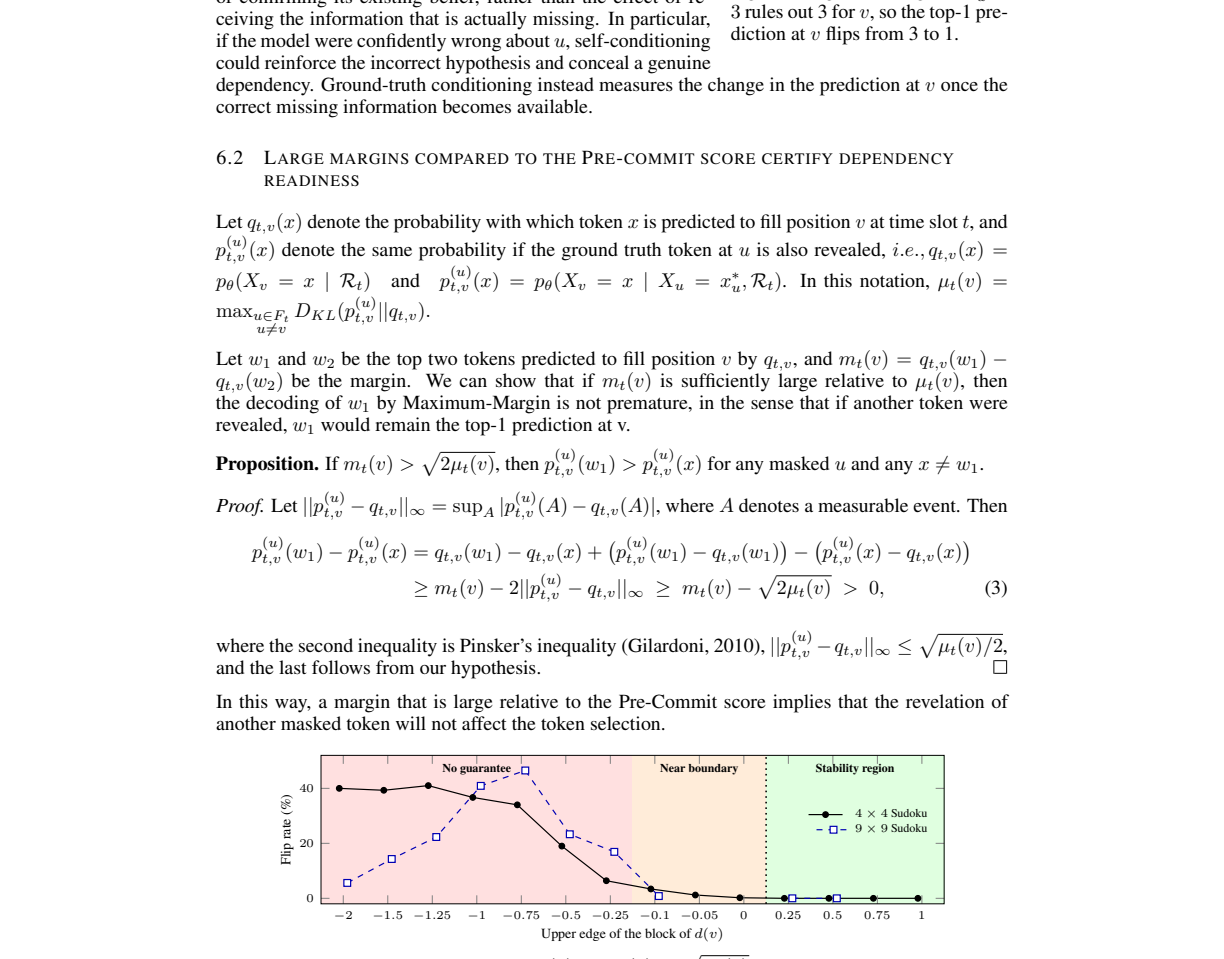
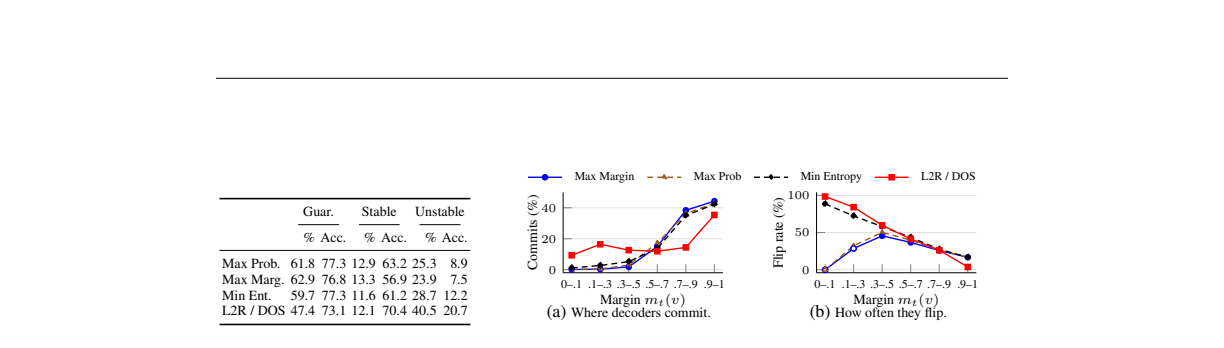
MDMs introduce a freedom in the order in which tokens may be unmasked, and to exercise this freedom for good accuracy, early decoding strategies relied on signals of confidence or the downstream impact of decoding a token. However, simple examples seem to illustrate that resolving a token's dependencies before unmasking it should be important. Therefore, we examine whether this principle, which we call dependency-ready decoding, would contribute to better accuracy, from a practical and a theoretical perspective. We examine a recent decoder that implements dependency-readiness through attention, and generally find that when it performs better than confidence-based or future utility baselines, its decoding order collapses to left-to-right decoding. For theoretical analysis, we establish a definition of dependency without resorting to attention, measured by an information-theoretic score of how much revealing a single masked token (or a set) would shift the model's prediction for another. We prove that when the margin is large relative to this score, no such revelation can change the top prediction, so in this regime Maximum-Margin decoding already commits dependency-ready tokens. These findings leave only a narrow scope for future dependency-ready decoders: their potential benefit is limited to positions with margins smaller than the information-theoretic sensitivity, and reliance on attention should be questioned.
from the abstract
Pith says
Machine review · deepseek-v4-flash · 26 Nov 2026 · read the full text (103,224 characters) · not checked by a person
It can be wrong. Challenge this review or reply to it.
Holds up. Attention-based dependency-ready decoding in masked diffusion language models collapses to left-to-right order, and confidence-based methods already capture dependency readiness when margins are large. This line is wrong
4 minor
How often objections from reviews like this one are right: not yet measured
The paper, first character to last
The reviewer was given the whole text, 103,224 characters. Not checked: figures, code, what the 87 references say.
4 minor objections
The paper says, at 4.2
Pith says: minor objection 1 of 4
The proposition in Section 4.2 is not numbered. Consider numbering it for easier reference.
The paper says, at 3.2
Pith says: minor objection 2 of 4
In Tables 1 and 2, the left-to-right row is identical to DOS (1) with EOS fix on for most entries. This could be noted explicitly in the caption or text to highlight the collapse.
show 2 more
The paper says, at 1
Pith says: minor objection 3 of 4
The paper uses 'rev' markup for revised text. This is fine for the manuscript but may be distracting in the final version; consider removing the markup.
The paper says, at 4.2
Pith says: minor objection 4 of 4
The caption of Figure 4 (flip rate boundary) mentions 'Max-Margin, exact sweeps, LLaDA-8B-Instruct' but the text in Section 4.3 uses Dream for the stability analysis. Clarify which model is used in each part.
What would settle it
Replicate the stability analysis of Section 5.3 on a different MDM architecture (e.g., one using learned absolute positional embeddings instead of RoPE) to test whether the collapse to left-to-right and the margin condition generalize beyond LLaDA and Dream.
from the skeptic's reading
How the review went
5 passes by deepseek-v4-flash · 26 Nov 2026
- Reader holds up
- Skeptic agrees
- Referee 4 minor
- Check against the paper kept 0 of 2 objections
- Editor wrote the verdict above
Not run on this paper: the simulated authors' defence.
Pith's passes raised 2 objections. A check against the paper's text kept 0 and withdrew 2 (1 the paper already says; 1 Pith's reviewer misread the paper).
The review in full
The review in brief, machine-written
This paper is a careful empirical and theoretical analysis of dependency-ready decoding for masked diffusion language models (MDMs). The main finding is that the Dependency-Oriented Sampler (DOS), which uses attention as a proxy for dependency, decodes in nearly the same order as left-to-right generation—even on tasks like Sudoku where dependencies are not sequential. When DOS outperforms confidence-based or future-utility baselines, it does so only because its order coincides with left-to-right. The paper also shows that a previously reported advantage of DOS over confidence methods largely disappears once the end-of-sequence (EOS) fix is applied, a detail earlier work omitted. These are useful corrections to the literature. The paper also contributes a theoretical definition of dependency readiness: the Pre-Commit score, which measures how much revealing a masked token would shift the model's prediction for another. The authors prove that when the margin (difference between top-two probabilities) exceeds sqrt(2 * Pre-Commit score), revealing any single masked token cannot change the top prediction, so Maximum-Margin decoding already commits dependency-ready tokens in that regime. The proof uses Pinsker's inequality and is validated on Sudoku, where the condition never fails. The paper acknowledges that the Pre-Commit score is an oracle measure (it requires ground-truth tokens) and that the empirical validation is limited to Sudoku. These are honest limitations, not flaws. The paper is well-written, the experiments are thorough (two models, multiple benchmarks, controlled comparisons), and the theoretical contribution is clean. The main soft spot is that the practical scope for future dependency-ready decoders is narrowed but not eliminated: the paper leaves open the regime where margins are small relative to the Pre-Commit score, and it does not propose a practical alternative to attention. Still, this is a solid piece of work that clarifies an important issue in MDM decoding. It deserves a serious referee and will be of value to researchers working on diffusion language models and decoding strategies.
The strongest objection
The paper is a thorough empirical and theoretical analysis of dependency-ready decoding in masked diffusion language models. It clearly demonstrates that the attention-based DOS collapses to left-to-right decoding, that an EOS fix resolves previous apparent advantages of DOS over confidence methods, and that Maximum-Margin decoding already satisfies a formal dependency-readiness condition when margins are large relative to an information-theoretic Pre-Commit score. The theoretical proposition is correctly proved using Pinsker's inequality, and the empirical validation on Sudoku confirms that no top-1 flips occur when the condition holds. The paper acknowledges its limitations (oracle nature of the Pre-Commit score, validation on two model families, single-token-per-step setting). All claims are supported by the presented evidence, and no internal inconsistency or unsupported leap is apparent. Therefore, no load-bearing concern that would alter the verdict is identified.
The reader's verdict is ACCEPT with high confidence, and the paper's evidence matches that assessment. The central claim—that attention-based dependency-ready decoding collapses to left-to-right and that confidence methods already capture dependency readiness when margins are large—is well supported by tables, figures, and a formal proposition. The weakest assumption identified by the reader (attention as a proxy for dependency) is precisely what the paper tests and finds problematic; the paper does not rely on that assumption but rather demonstrates its failure. The theoretical contribution (Pre-Commit score and margin condition) is correctly derived and empirically validated. The paper states its limitations clearly. No additional load-bearing concern emerges from a careful reading.
The referee's report
Not published. Pith's referee wrote this assessment before its objections were checked against the paper, and 2 of its 2 major objections did not survive that check.
Pith's reading of the paper (a machine's summary, not the authors')
The paper examines whether the principle of dependency-ready decoding (delaying token commitment until its dependencies are resolved) improves accuracy in masked diffusion language models. It studies an attention-based implementation (DOS) and finds that when it outperforms baselines, its decoding order is essentially left-to-right. The paper also provides a theoretical definition of dependency-readiness via a Pre-Commit score and proves that Maximum-Margin decoding already satisfies it when margins are large. The authors conclude that future dependency-ready decoders have limited potential benefit and should not rely on attention.
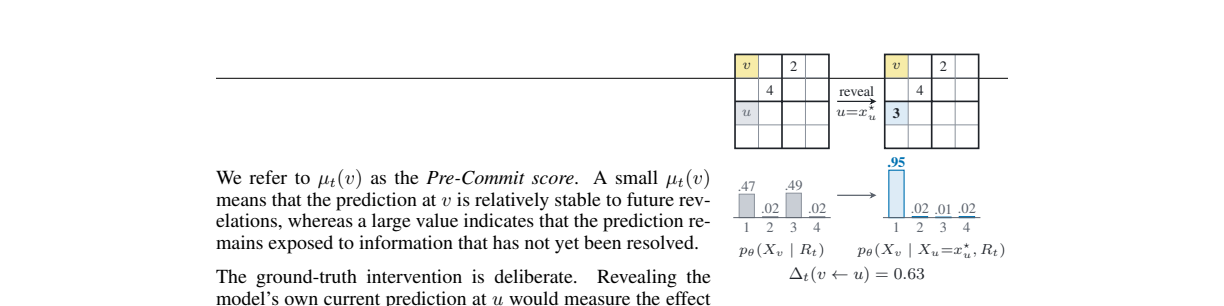
What carries the argument. The central object is the Pre-Commit score $mu_t(v) = max_{u eq v} D_{KL}(p_theta(X_v mid X_u=x_u^star, R_t) parallel p_theta(X_v mid R_t))$, an information-theoretic measure of how much revealing a single masked token at its ground-truth value would shift the prediction at another masked token. The paper also uses the groundedness score $Gr(v) = sum_{u in R_t} Attn(v,u)$ from DOS, which sums attention from a masked position to already revealed tokens. The Pre-Commit score defines dependency-readiness without attention, and a proposition links margin to stability: if $m_t(v) > sqrt{2mu_t(v)}$, then revealing any other masked token cannot change the top-1 prediction.
Core claim. The paper claims that attention-based dependency-ready decoding (DOS) for masked diffusion language models collapses to left-to-right order, and that its reported advantages over confidence-based methods shrink or disappear after applying the EOS fix. Theoretically, it defines a Pre-Commit score measuring how much revealing another token at ground truth changes the prediction at a target, and proves that when the margin is large relative to this score, Maximum-Margin decoding already commits dependency-ready tokens. The paper concludes that the potential benefit of future dependency-ready decoders is limited to positions with small margins relative to the Pre-Commit score, and that reliance on attention as a proxy for dependency should be questioned.
The premise it rests on. The use of attention as a proxy for dependency, specifically the groundedness score based on first-layer attention, which the paper shows leads to left-to-right order due to RoPE's decaying inter-token dependency with distance.
If the paper is right (Pith's inferences, not the authors')
Attention-based dependency-ready decoders like DOS should not be expected to outperform left-to-right decoding on tasks where dependencies are not left-to-right.
The EOS fix is crucial for fair comparison of decoding strategies; previous comparisons may have been confounded by its absence.
Maximum-Margin decoding is already dependency-ready for high-margin positions, so future work should focus on low-margin positions where the guarantee does not apply.
The Pre-Commit score provides a theoretical framework for evaluating decoding order, but requires ground truth, so it is only for analysis, not practical use.
Reliance on attention as a proxy for dependency should be reconsidered in future decoder designs.
The collapse to left-to-right may be inherent to any decoder that uses a positional bias like RoPE, not just attention-based ones, suggesting that alternative position encodings might yield different behavior.
The Pre-Commit score could be approximated during inference by using the model's own predictions as a proxy for ground truth, potentially enabling a practical dependency-ready decoder that does not rely on attention.
The findings suggest that for structured tasks like Sudoku, a decoder that explicitly uses the known dependency structure (e.g., peers) could outperform generic attention-based methods, but such task-specific decoders are not the focus of this paper.
Check this review
What was read
The passes were given all 103,224 characters of the paper's LaTeX source.
Fingerprint of that text (SHA-256): 74d098a2397c40ab2040c5fd904c85710e3b25e51a76e562d4bdb6d21c494e07
Pith does not keep that text. Rebuilt from the paper's source or PDF by the same code, it has this fingerprint if it is the same text. From a copy of Pith's code:
PYTHONPATH=. python scripts/review_input_check.py 2611.33823
The passes, in the order they ran
- Reader deepseek-v4-flash · medium effort · $0.0034 · instructions of the Reader, fingerprint f9ead7300382…
- Skeptic deepseek-v4-flash · medium effort · $0.0032 · instructions of the Skeptic, fingerprint 8f88c0f61488…
- Referee deepseek-v4-flash · medium effort · $0.0032 · instructions of the Referee, fingerprint a852d99aea0d…
- Check against the paper deepseek-v4-flash · medium effort · $0.0035 · instructions of the Check against the paper, fingerprint 6c7a6883d551…
- Editor deepseek-v4-flash · medium effort · $0.0030 · instructions of the Editor, fingerprint e7211f6a3d27…
- Circularity check deepseek-v4-flash · medium effort · $0.0029 · instructions of the Circularity check, fingerprint e9946e39d67b…
- Summary for the page deepseek-v4-flash · medium effort · temperature 0.2 · $0.0033 · instructions of the Summary for the page, fingerprint e4f56bf568e7…
The passes cost $0.022 in model calls together.
Version stamped on this review: pith-pipeline@v1.4.1-daily-deepseek-or-medium+deepseek/deepseek-v4-flash+p.d60f54226f00
Each link opens a pass's instructions as plain text, the exact bytes its fingerprint was taken over. Every stored set of instructions.
curl -s https://pith.science/methodology/prompts/f9ead730038216984cfb56d7cb34332bdf691828296a1de4245f3d6667d4bf56 | sha256sum
prints the fingerprint of the reader's instructions. The same works for every pass.
The receipt
The review's fingerprint was taken on 26 Nov 2026. The review you are reading still matches it.
Fingerprint of the review (SHA-256): 07d2f20811e9e05dce8a2d40d0ed5985455dbfb5c589dd27b845616252617363
curl -s 'https://pith.science/api/v1/verdicts/2611.33823?form=canonical' | sha256sum
prints the fingerprint of the review as it stands now. The rule, in four steps.
A matching fingerprint shows the review has not changed since that date. It does not show that the review is right.
How often reviews like this one are right
Reviews like this one: written by deepseek-v4-flash, from the paper's LaTeX source.
How often objections from reviews like this one are right: not yet measured
Reviews by people
This review was written by a machine. No person has reviewed this paper on Pith yet. A scientist listed on Pith can review it for a fee, and their review is published here whatever it concludes.
The paper
Abstract
Masked diffusion models (MDMs) have shown strong performance on structured reasoning tasks such as Sudoku, Trip Planning, and Countdown. MDMs introduce a freedom in the order in which tokens may be unmasked, and to exercise this freedom for good accuracy, early decoding strategies relied on signals of confidence or the downstream impact of decoding a token. However, simple examples seem to illustrate that resolving a token's dependencies before unmasking it should be important. Therefore, we examine whether this principle, which we call dependency-ready decoding, would contribute to better accuracy, from a practical and a theoretical perspective. We examine a recent decoder that implements dependency-readiness through attention, and generally find that when it performs better than confidence-based or future utility baselines, its decoding order collapses to left-to-right decoding. For theoretical analysis, we establish a definition of dependency without resorting to attention, measured by an information-theoretic score of how much revealing a single masked token (or a set) would shift the model's prediction for another. We prove that when the margin is large relative to this score, no such revelation can change the top prediction, so in this regime Maximum-Margin decoding already commits dependency-ready tokens. These findings leave only a narrow scope for future dependency-ready decoders: their potential benefit is limited to positions with margins smaller than the information-theoretic sensitivity, and reliance on attention should be questioned.
The paper's own sentences, arranged, kept beside the review and separate from it. Each label is drawn from a closed vocabulary; the number beside it is the probability the classifier gave that label. No sentence in this record was written by a model.
abstract compiled · 2026-11-26
The authors' main claim, as the classifier picked it out 1.00
“These findings leave only a narrow scope for future dependency-ready decoders: their potential benefit is limited to positions with margins smaller than the information-theoretic sensitivity, and reliance on attention should be questioned.”
How the main claim is stated: asserted 0.86
What the abstract itself states, as probabilities: claims first 0.05 · states limitation 0.86 · human participants 0.02 · controlled comparison 0.88 · randomized assignment 0.01 · states quantitative result 0.17 · compares with prior results 0.95 · mentions code or data availability 0.02
The abstract, sentence by sentence
This table labels the abstract only (arXiv listing abstract v1). The number is the probability the classifier gave the label.
| Sentence | Role | The authors' own work | States the main conclusion | Strength |
|---|---|---|---|---|
| Masked diffusion models (MDMs) have shown strong performance on structured reasoning tasks such as Sudoku, Trip Planning, and Countdown. | background 1.00 | 0.08 | 0.01 | asserted 1.00 |
| MDMs introduce a freedom in the order in which tokens may be unmasked, and to exercise this freedom for good accuracy, early decoding strategies relied on signals of confidence or the downstream impact of decoding a token. | background 1.00 | 0.07 | 0.02 | asserted 0.95 |
| However, simple examples seem to illustrate that resolving a token's dependencies before unmasking it should be important. | background 0.52 | 0.19 | 0.03 | hedged possibility 0.85 |
| Therefore, we examine whether this principle, which we call dependency-ready decoding, would contribute to better accuracy, from a practical and a theoretical perspective. | contribution 0.94 | 0.32 | 0.05 | hedged possibility 0.63 |
| We examine a recent decoder that implements dependency-readiness through attention, and generally find that when it performs better than confidence-based or future utility baselines, its decoding order collapses to left-to-right decoding. | result 0.99 | 0.94 | 0.28 | asserted 0.99 |
| For theoretical analysis, we establish a definition of dependency without resorting to attention, measured by an information-theoretic score of how much revealing a single masked token (or a set) would shift the model's prediction for another. | method 0.79 | 0.95 | 0.04 | asserted 1.00 |
| We prove that when the margin is large relative to this score, no such revelation can change the top prediction, so in this regime Maximum-Margin decoding already commits dependency-ready tokens. | result 0.93 | 0.94 | 0.15 | asserted 1.00 |
| These findings leave only a narrow scope for future dependency-ready decoders: their potential benefit is limited to positions with margins smaller than the information-theoretic sensitivity, and reliance on attention should be questioned. | interpretation 0.96 | 0.93 | 0.88 | asserted 0.86 |
What kind of paper the classifier reports this is: theoretical result 0.84 · evidence from proof or derivation 0.69
What was examined, and what was not
Sources read
- arXiv listing abstract v1
Not examined
- full text
- figures and tables
- references and citing sentences
- relations to other papers
Levels run
- P abstract
Not run
- S sections
- T body sentences
- C citations
- R cross-paper relations
How the labels were made
Compiled by classifier-1.13.0 via TypeSafe API, question bank abstract-p1-20260923, 2026-11-26: 1 request, 6,386 input tokens.
Every quoted sentence on this record is the authors'. Every label is from Pith's closed vocabulary, with the probability shown beside it. This record as JSON
Figures (6)
Figures are the authors', reproduced from the paper.
References (87)
- [1] Bengio, Yoshua and LeCun, Yann , booktitle =. Scaling Learning Algorithms Towards on Pith
- [2] Hinton, Geoffrey E. and Osindero, Simon and Teh, Yee Whye , journal =. A Fast Learning Algorithm for Deep Belief Nets , volume = on Pith
- [3] Deep learning , author=. 2016 , publisher= on Pith
- [4] Denoising Diffusion Probabilistic Models , author=. Advances in Neural Information Processing Systems (NeurIPS) , year= on Pith
- [5] Structured Denoising Diffusion Models in Discrete State-Spaces , author=. Advances in Neural Information Processing Systems (NeurIPS) , year= on Pith
- [6] Jacob Austin and Daniel D. Johnson and Jonathan Ho and Daniel Tarlow and Rianne van den Berg , editor =. Structured Denoising Diffusion Models in Discrete State-Spaces , booktitle =. 2021 , url = on Pith
- [7] Discrete Diffusion Modeling by Estimating the Ratios of the Data Distribution , author=. International Conference on Machine Learning (ICML) , year= on Pith
- [8] Aaron Lou and Chenlin Meng and Stefano Ermon , editor =. Discrete Diffusion Modeling by Estimating the Ratios of the Data Distribution , booktitle =. 2024 , url = on Pith
- [9] Simple and Effective Masked Diffusion Language Models , author=. Advances in Neural Information Processing Systems (NeurIPS) , year= on Pith
- [10] Subham S. Sahoo and Marianne Arriola and Yair Schiff and Aaron Gokaslan and Edgar Marroquin and Justin T. Chiu and Alexander M. Rush and Volodymyr Kuleshov , editor =. Simple and Effective Masked Diffusion Language Models , booktitle =. 2024 , url = on Pith
- [11] Simplified and Generalized Masked Diffusion for Discrete Data , author=. Advances in Neural Information Processing Systems (NeurIPS) , year= on Pith
- [12] Jiaxin Shi and Kehang Han and Zhe Wang and Arnaud Doucet and Michalis K. Titsias , editor =. Simplified and Generalized Masked Diffusion for Discrete Data , booktitle =. 2024 , url = on Pith
- [13] Block Diffusion: Interpolating Between Autoregressive and Diffusion Language Models , author=. The Thirteenth International Conference on Learning Representations , year= on Pith
- [14] Marianne Arriola and Aaron Gokaslan and Justin T. Chiu and Zhihan Yang and Zhixuan Qi and Jiaqi Han and Subham Sekhar Sahoo and Volodymyr Kuleshov , title =. The Thirteenth International Conference on Learning Representations,. 2025 , url = on Pith
- [15] Gandhi, Kanishk and Lee, Denise and Grand, Gabriel and Liu, Muxin and Cheng, Winson and Sharma, Archit and Goodman, Noah D. , booktitle=. Stream of Search ( on Pith
- [16] Dream 7B: Diffusion Large Language Models , author=. 2025 , eprint= on Pith
- [17] Jiacheng Ye and Zhihui Xie and Lin Zheng and Jiahui Gao and Zirui Wu and Xin Jiang and Zhenguo Li and Lingpeng Kong , title =. CoRR , volume =. 2025 , url =. doi:10.48550/ARXIV.2508.15487 , eprinttype =. 2508.15487 , timestamp = on PithPith's reviewarXivdoi:10.48550/arxiv.2508.15487
- [18] DreamOn: Diffusion Language Models For Code Infilling Beyond Fixed-size Canvas , author=. The Fourteenth International Conference on Learning Representations , year= on Pith
- [19] Chengyue Wu and Hao Zhang and Shuchen Xue and Zhijian Liu and Shizhe Diao and Ligeng Zhu and Ping Luo and Song Han and Enze Xie , booktitle=. Fast-d. 2026 , url= on Pith
- [20] Chengyue Wu and Hao Zhang and Shuchen Xue and Zhijian Liu and Shizhe Diao and Ligeng Zhu and Ping Luo and Song Han and Enze Xie , title =. CoRR , volume =. 2025 , url =. doi:10.48550/ARXIV.2505.22618 , eprinttype =. 2505.22618 , timestamp = on PithPith's reviewarXivdoi:10.48550/arxiv.2505.22618
show 67 more
- [21] Accelerated Sampling from Masked Diffusion Models via Entropy Bounded Unmasking , author=. The Thirty-ninth Annual Conference on Neural Information Processing Systems , year= on Pith
- [22] Heli Ben. Accelerated Sampling from Masked Diffusion Models via Entropy Bounded Unmasking , booktitle =. 2025 , url = on Pith
- [23] BumJun Kim and Dongjae Jeon and Moongyu Jeon and Albert No , booktitle=. 2026 , url= on Pith
- [24] Seo Hyun Kim and Sunwoo Hong and Hojung Jung and Youngrok Park and Se-Young Yun , booktitle=. 2025 , url= on Pith
- [25] Seo Hyun Kim and Sunwoo Hong and Hojung Jung and Youngrok Park and Se. Advances in Neural Information Processing Systems 38: Annual Conference on Neural Information Processing Systems 2025, NeurIPS 2025, San Diego, CA, USA, December 2-7, 2025 / Mexico City, Mexico, November 30... on Pith
- [26] Improved Large Language Diffusion Models , author=. 2026 , eprint= on Pith
- [27] Shen Nie and Qiyang Min and Shaoxuan Xu and Zihao Huang and Yuxuan Song and Yong Shan and Yankai Lin and Wayne Xin Zhao and Chongxuan Li and Ji. Improved Large Language Diffusion Models , journal =. 2026 , url =. doi:10.48550/ARXIV.2606.25331 , eprinttype =. 2606.25331 , timestamp = on PithPith's reviewarXivdoi:10.48550/arxiv.2606.25331
- [28] DiffuCoder: Understanding and Improving Masked Diffusion Models for Code Generation , author=. The Fourteenth International Conference on Learning Representations , year= on Pith
- [29] Shansan Gong and Ruixiang Zhang and Huangjie Zheng and Jiatao Gu and Navdeep Jaitly and Lingpeng Kong and Yizhe Zhang , title =. CoRR , volume =. 2025 , url =. doi:10.48550/ARXIV.2506.20639 , eprinttype =. 2506.20639 , timestamp = on PithPith's reviewarXivdoi:10.48550/arxiv.2506.20639
- [30] Dream-Coder 7B: An Open Diffusion Language Model for Code , author=. 2025 , eprint= on Pith
- [31] Zhihui Xie and Jiacheng Ye and Lin Zheng and Jiahui Gao and Jingwei Dong and Zirui Wu and Xueliang Zhao and Shansan Gong and Xin Jiang and Zhenguo Li and Lingpeng Kong , title =. CoRR , volume =. 2025 , url =. doi:10.48550/ARXIV.2509.01142 , eprinttype =. 2509.01142 , timestamp = on PithPith's reviewarXivdoi:10.48550/arxiv.2509.01142
- [32] Measuring Massive Multitask Language Understanding , author=. Proceedings of the International Conference on Learning Representations (ICLR) , year= on Pith
- [33] Aligning AI With Shared Human Values , author=. Proceedings of the International Conference on Learning Representations (ICLR) , year= on Pith
- [34] Suzgun, Mirac and Scales, Nathan and Sch. Challenging BIG -Bench Tasks and Whether Chain-of-Thought Can Solve Them. Findings of the Association for Computational Linguistics: ACL 2023. 2023. doi:10.18653/v1/2023.findings-acl.824 on Pithdoi:10.18653/v1/2023.findings-acl.824
- [35] Let's Verify Step by Step , author=. 2023 , eprint= on Pith
- [36] Train for the Worst, Plan for the Best: Understanding Token Ordering in Masked Diffusions , author=. Forty-second International Conference on Machine Learning , year= on Pith
- [37] Jaeyeon Kim and Kulin Shah and Vasilis Kontonis and Sham M. Kakade and Sitan Chen , editor =. Train for the Worst, Plan for the Best: Understanding Token Ordering in Masked Diffusions , booktitle =. 2025 , url = on Pith
- [38] Jianlin Su and Murtadha Ahmed and Yu Lu and Shengfeng Pan and Wen Bo and Yunfeng Liu , keywords =. RoFormer: Enhanced transformer with Rotary Position Embedding , journal =. 2024 , issn =. doi:https://doi.org/10.1016/j.neucom.2023.127063 , url = on Pithdoi:10.1016/j.neucom.2023.127063
- [39] M. G. Kendall , journal =. A New Measure of Rank Correlation , urldate = on Pith
- [40] BumJun Kim and Dongjae Jeon and Dueun Kim and Wonje Jeung and Albert No , booktitle=. Rainbow Padding: Mitigating Early Termination in Instruction-Tuned Diffusion. 2026 , url= on Pith
- [41] Reasoning with Latent Tokens in Diffusion Language Models , author=. arXiv preprint arXiv:2602.03769 , year= on PitharXiv
- [42] Thinking Out of Order: When Output Order Stops Reflecting Reasoning Order in Diffusion Language Models , author=. arXiv preprint arXiv:2601.22035 , year= on PitharXiv
- [43] VoidPadding: Let [VOID] Handle Padding in Masked Diffusion Language Models so that [EOS] Can Focus on Semantic Termination , author=. 2026 , eprint= on Pith
- [44] Mercury: Ultra-Fast Language Models Based on Diffusion , author=. 2025 , eprint= on Pith
- [45] Samar Khanna and Siddhant Kharbanda and Shufan Li and Harshit Varma and Eric Wang and Sawyer Birnbaum and Ziyang Luo and Yanis Miraoui and Akash Palrecha and Stefano Ermon and Aditya Grover and Volodymyr Kuleshov , title =. CoRR , volume =. 2025 , url =. doi:10.48550/ARXIV.250... on PithPith's reviewarXivdoi:10.48550/arxiv.2506.17298
- [46] Gemini Diffusion , year = on Pith
- [47] Fine-tuning masked diffusion for provable self-correction , author=. arXiv preprint arXiv:2510.01384 , year= on PithPith's reviewarXiv
- [48] A Continuous Time Framework for Discrete Denoising Models , author=. Advances in Neural Information Processing Systems , editor=. 2022 , url= on Pith
- [49] Discrete Predictor-Corrector Diffusion Models for Image Synthesis , author=. The Eleventh International Conference on Learning Representations , year= on Pith
- [50] Remasking discrete diffusion models with inference-time scaling , author=. Advances in Neural Information Processing Systems , volume= on Pith
- [51] Generalized Interpolating Discrete Diffusion , author=. Forty-second International Conference on Machine Learning , year= on Pith
- [52] Path planning for masked diffusion model sampling , author=. arXiv preprint arXiv:2502.03540 , year= on PitharXiv
- [54] Karl Cobbe and Vineet Kosaraju and Mohammad Bavarian and Mark Chen and Heewoo Jun and Lukasz Kaiser and Matthias Plappert and Jerry Tworek and Jacob Hilton and Reiichiro Nakano and Christopher Hesse and John Schulman , title =. CoRR , volume =. 2021 , url =. 2110.14168 , timestamp = on PithPith's reviewarXiv
- [55] Causal Language Modeling Can Elicit Search and Reasoning Capabilities on Logic Puzzles , author =. Advances in Neural Information Processing Systems (NeurIPS) , volume = on Pith
- [56] 3 Million Sudoku Puzzles with Ratings , author =. 2020 , howpublished =. doi:10.34740/kaggle/dsv/1495975 , url = on Pithdoi:10.34740/kaggle/dsv/1495975
- [57] Gao, Leo and Tow, Jonathan and Abbasi, Baber and Biderman, Stella and Black, Sid and DiPofi, Anthony and Foster, Charles and Golding, Laurence and Hsu, Jeffrey and Le Noac'h, Alain and Li, Haonan and McDonell, Kyle and Muennighoff, Niklas and Ociepa, Chris and Phang, Jason and... on Pithdoi:10.5281/zenodo.12608602
- [58] Solving Quantitative Reasoning Problems with Language Models , author=. 2022 , eprint= on Pith
- [59] Where-to-unmask: Ground-truth-guided unmasking order learning for masked diffusion language models , author=. arXiv preprint arXiv:2602.09501 , year= on PitharXiv
- [60] Hikaru Asano and Tadashi Kozuno and Kuniaki Saito and Yukino Baba , title =. CoRR , volume =. 2026 , url =. doi:10.48550/ARXIV.2602.09501 , eprinttype =. 2602.09501 , timestamp = on Pithdoi:10.48550/arxiv.2602.09501
- [61] Pc-sampler: Position-aware calibration of decoding bias in masked diffusion models , author=. arXiv e-prints , pages= on Pith
- [62] Pengcheng Huang and Tianming Liu and Zhenghao Liu and Yukun Yan and Shuo Wang and Tong Xiao and Zulong Chen and Maosong Sun , editor =. Empirical Analysis of Decoding Biases in Masked Diffusion Models , booktitle =. 2026 , url =. doi:10.18653/V1/2026.ACL-LONG.311 , timestamp = on Pithdoi:10.18653/v1/2026.acl-long.311
- [63] Causal Language Modeling Can Elicit Search and Reasoning Capabilities on Logic Puzzles , author=. 2024 , eprint= on Pith
- [64] Kulin Shah and Nishanth Dikkala and Xin Wang and Rina Panigrahy , editor =. Causal language modeling can elicit search and reasoning capabilities on logic puzzles , booktitle =. 2024 , url = on Pith
- [65] Beyond Autoregression: Discrete Diffusion for Complex Reasoning and Planning , author=. 2025 , eprint= on Pith
- [66] Beyond Autoregression: Discrete Diffusion for Complex Reasoning and Planning , author=. The Thirteenth International Conference on Learning Representations , year= on Pith
- [67] Jiacheng Ye and Jiahui Gao and Shansan Gong and Lin Zheng and Xin Jiang and Zhenguo Li and Lingpeng Kong , title =. The Thirteenth International Conference on Learning Representations,. 2025 , url = on Pith
- [68] Improving Sampling for Masked Diffusion Models via Information Gain , author=. Forty-third International Conference on Machine Learning , year= on Pith
- [70] Xueyu Zhou and Yangrong Hu and Jian Huang , editor =. Findings of the Association for Computational Linguistics,. 2026 , url =. doi:10.18653/V1/2026.FINDINGS-ACL.861 , timestamp = on Pithdoi:10.18653/v1/2026.findings-acl.861
- [71] Gilardoni, Gustavo L. , journal=. On. 2010 , volume= on Pith
- [72] Training Verifiers to Solve Math Word Problems , author=. 2021 , eprint= on Pith
- [73] Large Language Diffusion Models , author=. The Thirty-ninth Annual Conference on Neural Information Processing Systems , year= on Pith
- [74] Shen Nie and Fengqi Zhu and Zebin You and Xiaolu Zhang and Jingyang Ou and Jun Hu and Jun Zhou and Yankai Lin and Ji. Large Language Diffusion Models , booktitle =. 2025 , url = on Pith
- [75] Search or Accelerate: Confidence-Switched Position Beam Search for Diffusion Language Models , author=. Forty-third International Conference on Machine Learning , year= on Pith
- [76] Diffusion Language Model Knows the Answer Before It Decodes , author=. The Fourteenth International Conference on Learning Representations , year= on Pith
- [77] Jacob Austin and Augustus Odena and Maxwell I. Nye and Maarten Bosma and Henryk Michalewski and David Dohan and Ellen Jiang and Carrie J. Cai and Michael Terry and Quoc V. Le and Charles Sutton , title =. CoRR , volume =. 2021 , url =. 2108.07732 , timestamp = on PithPith's reviewarXiv
- [78] Mark Chen and Jerry Tworek and Heewoo Jun and Qiming Yuan and Henrique Pond. Evaluating Large Language Models Trained on Code , journal =. 2021 , url =. 2107.03374 , timestamp = on PithPith's reviewarXiv
- [79] Huaixiu Steven Zheng and Swaroop Mishra and Hugh Zhang and Xinyun Chen and Minmin Chen and Azade Nova and Le Hou and Heng. CoRR , volume =. 2024 , url =. doi:10.48550/ARXIV.2406.04520 , eprinttype =. 2406.04520 , timestamp = on PithPith's reviewarXivdoi:10.48550/arxiv.2406.04520
- [80] Mingyu Cao and Alvaro H. C. Correia and Christos Louizos and Shiwei Liu and Lu Yin , title =. CoRR , volume =. 2026 , url =. doi:10.48550/ARXIV.2602.10953 , eprinttype =. 2602.10953 , biburl = on Pithdoi:10.48550/arxiv.2602.10953
- [81] Yusuf Sahin and Ahmed Rockey Saikia and Volkan Cevher and Paolo Favaro , title =. CoRR , volume =. 2026 , url =. doi:10.48550/ARXIV.2606.10829 , eprinttype =. 2606.10829 , timestamp = on PithPith's reviewarXivdoi:10.48550/arxiv.2606.10829
- [82] Dan Hendrycks and Collin Burns and Saurav Kadavath and Akul Arora and Steven Basart and Eric Tang and Dawn Song and Jacob Steinhardt , editor =. Measuring Mathematical Problem Solving With the. Proceedings of the Neural Information Processing Systems Track on Datasets and Benc... on Pith
- [83] Feng Hong and Geng Yu and Yushi Ye and Haicheng Huang and Huangjie Zheng and Ya Zhang and Yanfeng Wang and Jiangchao Yao , booktitle=. Wide-In, Narrow-Out: Revokable Decoding for Efficient and Effective. 2026 , url= on Pith
- [84] Wooje Park and Insu Lee and Minyoung Noh and Jaeyun Jang and Sungmin Lee and Kyuhong Shim and Byonghyo Shim , title =. CoRR , volume =. 2026 , url =. doi:10.48550/ARXIV.2608.26574 , eprinttype =. 2608.26574 , timestamp = on PithPith's reviewarXivdoi:10.48550/arxiv.2608.26574
- [85] Lizhuo Luo and Zhuoran Shi and Jiajun Luo and Zhi Wang and Shen Ren and Wenya Wang and Tianwei Zhang , title =. CoRR , volume =. 2026 , url =. doi:10.48550/ARXIV.2602.06953 , eprinttype =. 2602.06953 , timestamp = on PithPith's reviewarXivdoi:10.48550/arxiv.2602.06953
- [86] Qi, Heqiang and Huang, Wei and Bai, Mingyuan and Meng, Xiangming. Cluster-Level Attention-Guided Parallel Decoding for Masked Diffusion Language Models. Findings of the A ssociation for C omputational L inguistics: EMNLP 2026. 2026. doi:10.18653/2026.findings-emnlp.275 on Pithdoi:10.18653/2026.findings-emnlp.275
- [87] Tiwei Bie and Maosong Cao and Kun Chen and Lun Du and Mingliang Gong and Zhuochen Gong and Yanmei Gu and Jiaqi Hu and Zenan Huang and Zhenzhong Lan and Chengxi Li and Chongxuan Li and Jianguo Li and Zehuan Li and Huabin Liu and Lin Liu and Guoshan Lu and Xiaocheng Lu and Yuxin... on PithPith's reviewarXivdoi:10.48550/arxiv.2512.15745
- [88] Tiwei Bie and Maosong Cao and Xiang Cao and Bingsen Chen and Fuyuan Chen and Kun Chen and Lun Du and Daozhuo Feng and Haibo Feng and Mingliang Gong and Zhuocheng Gong and Yanmei Gu and Jian Guan and Kaiyuan Guan and Hongliang He and Zenan Huang and Juyong Jiang and Zhonghui Ji... on Pithdoi:10.48550/arxiv.2602.08676
- [89] InclusionAI , title = on Pith
Challenges and discussion
Disagree with the review, or know something it missed? Leave a comment, or challenge this review formally: a challenge becomes a permanent entry in this paper's record, and its decision is published here.
Come back by email
A short list of the week's newly reviewed papers. Nothing is sent until you confirm from your inbox, and every email has a link that stops it. No account.
No comments yet.
Sign in to comment