REVIEW 5 major objections 5 minor 5 cited by
Enhancing Auto-regressive Chain-of-Thought through Loop-Aligned Reasoning
T0 review · 5 major / 5 minor · reviewed 2026-08-08 · deepseek-v4-flash
Pith's one-line read RELAY trains a looped Transformer with per-iteration CoT supervision so it can generate correct reasoning chains beyond training length, and uses those chains to fine-tune an autoregressive CoT model, improving its accuracy on longer…
desk verdict Novel loop-to-CoT alignment with a solid loop-side result, but the AR length-generalization claim is not actually tested—the fine-tuning and evaluation lengths are identical. read the letter →
The pith
A machine-rendered reading of the paper's core claim, the machinery that carries it, and where it could break.
The reading
What carries the argument
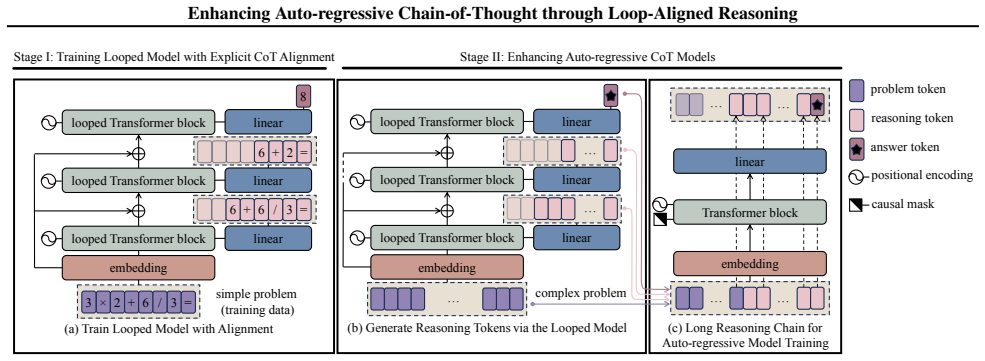
The central mechanism is loop-aligned intermediate supervision, realized through right-aligned padding: for each iteration $t$, the ground-truth reasoning tokens of round $t$ are placed in a fixed-length sequence of the input problem length, padded on the left with $\langle\text{pad}\rangle$, and a binary mask $M_t$ restricts the cross-entropy loss to valid tokens plus the last pad token. A per-iteration prediction head $P(\tilde{z}_t \mid e_t; \theta_{\text{pred-cot}})$ and a final-answer head define the total loss $L = L_{\text{ans}} + \lambda L_{\text{iter}}$. This alignment is what gives the looped model the new ability to output explicit, reliable CoT tokens while retaining length generalization, and it is what makes the generated chains usable as fine-tuning data in Stage II.
What would settle it
Run Stage I on a task whose CoT chain has a natural round longer than the input problem, such as multi-digit multiplication where the partial-product round exceeds the operand token count; if the aligned looped model's generated chains show low token-level accuracy on out-of-training-length problems, the fixed-length round assumption fails.
Extended reading notes
Core claim
The central discovery is that a looped Transformer can act as a teacher for autoregressive CoT models if its iterations are forced to correspond to CoT rounds. During Stage I, each iteration $t$ is trained to predict the $t$-th round of ground-truth reasoning tokens, right-aligned to a fixed length with a mask so only valid tokens and the last pad token contribute loss; the final iteration also predicts the answer. The paper reports that this aligned looped model generalizes to longer problems on Arithmetic, Edit Distance, and LIS, and that the CoT chains it generates for those longer problems are reliable enough that fine-tuning an autoregressive model on them yields accuracy close to and sometimes above the looped teacher, while self-generated chains from the autoregressive model do not. The paper's own framing is that the bridge between the two paradigms works because the looped model's implicit iterative computation and CoT's explicit stepwise reasoning share a round structure.
Load-bearing premise
The framework assumes every reasoning problem can be split into as many rounds as the looped model has iterations, with each round short enough to fit in the original problem's token length, and that looped Transformers actually extrapolate to longer problems.
Editorial extensions
If this is right
- A single looped Transformer trained with RELAY can handle multiple reasoning tasks at once while keeping near-perfect accuracy on training lengths and substantially higher accuracy than the autoregressive baseline beyond training lengths.
- An autoregressive CoT model fine-tuned on RELAY-generated chains can match or slightly surpass the aligned looped teacher on out-of-training-length problems, even though its architecture is unchanged.
- Filtering self-generated CoT data by final-answer correctness, whether with a looped verifier or with ground truth, gives only a slight gain, so the reliability of intermediate reasoning steps is what makes generated data useful.
- RELAY reduces the human effort of synthetic CoT data creation from problem construction plus solution-strategy design to mainly length-extended problem construction.
Reading between the lines
- The paper does not test RELAY on natural-language reasoning; a reader-visible consequence is that the method's reach is exactly the set of tasks whose CoT chains can be segmented into rounds no longer than the input problem, so failure to segment is a testable boundary.
- Because Stage II is just token-level supervised fine-tuning on generated chains, RELAY is orthogonal to positional-encoding fixes for length generalization and could plausibly be combined with them, although the paper does not explore that combination.
- The high token accuracy of RELAY-generated chains even beyond training length suggests a bootstrap loop — use the looped teacher to extend one length increment, retrain the autoregressive model, then repeat — that the paper does not run.
Signed reviews
Editorial analysis
A structured set of objections, weighed in public.
Referee Report
Summary. The paper introduces RELAY, a two-stage framework that aims to transfer the length-generalization ability of looped Transformers to standard autoregressive Chain-of-Thought (CoT) models. In Stage I, a looped Transformer is trained with an auxiliary loss that supervises each loop iteration to predict the tokens of the corresponding CoT round, aligned via a hand-crafted round-to-iteration mapping and right-aligned padding. In Stage II, this looped model generates CoT reasoning chains for problems longer than the original training length, and these chains are merged with the original training data to fine-tune an autoregressive CoT model. The paper reports experiments on three synthetic tasks (Arithmetic, Edit Distance, Longest Increasing Subsequence) showing that the looped model with CoT alignment maintains high final-answer accuracy beyond the training length and that the fine-tuned autoregressive model improves on the lengths covered by the generated data.
Significance. If fully substantiated, the core idea of aligning loop iterations with CoT rounds to produce interpretable, reliable reasoning chains for out-of-length problems is a novel and potentially useful bridge between looped and autoregressive architectures. The paper includes a useful hit-matrix analysis of reasoning-step quality and compares against self-generated chains filtered by final-answer verification, which is a reasonable baseline. However, the headline claim that RELAY 'enhances auto-regressive chain-of-thought' in the sense of length generalization is not yet established, because the fine-tuned autoregressive model is evaluated only on the same lengths that appear in its fine-tuning data. The evidence base is also narrow (three synthetic algorithmic tasks) for the 'general reasoner' claim. The manuscript is clearly early in development and would benefit from additional experiments and more careful framing.
major comments (5)
- [Section 4.2, Figure 4] The RELAY-enhanced autoregressive model is fine-tuned on generated CoT chains for problem lengths [15,25], [30,40], and [100,120] for Arithmetic, ED, and LIS, respectively, and Figure 4 evaluates accuracy only within these exact ranges. No experiment tests the fine-tuned model on longer, held-out lengths (e.g., Arithmetic 26–30, ED 41–45, LIS 121–130). Consequently, the observed improvement over the baseline may reflect direct supervised learning on the target length distribution rather than improved length generalization beyond the fine-tuning distribution. This is load-bearing because the paper's stated motivation is the autoregressive model's inability to extrapolate to longer reasoning chains. I request either (a) new experiments that evaluate the RELAY-enhanced model on lengths beyond the fine-tuning range, or (b) an explicit reframing of the contribution as 'length extension via generated data' rather than 'length generalization.'
- [Section 3.3, Eq. (10)] The total loss is defined as L = L_ans + λL_iter, where λ is a hyperparameter balancing final-answer supervision and intermediate CoT-token supervision. The value of λ is never reported anywhere in the paper, including in the hyperparameter tables in Appendix D.1. This omission makes the Stage I training non-reproducible and prevents readers from understanding the trade-off between answer accuracy and CoT-token accuracy. Please report the exact value(s) of λ used for each task and, ideally, a small sensitivity study over λ.
- [Section 3.3 and Section 4.2, Eq. (11)] The generation procedure for Stage II is underspecified. The looped model predicts all tokens of a reasoning round in parallel through the intermediate head P(z̃_t | e_t), but the paper does not explain how these per-round predictions are assembled into a single sequential CoT chain z, whether decoding uses argmax or sampling, or how the final answer token y is included in the generated demonstration. Without this algorithmic detail, the data-generation step cannot be reproduced, and potential inconsistencies between independently predicted rounds cannot be assessed. Please provide a precise step-by-step description of how (z, y) is obtained from the trained looped model.
- [Section 4.1 and Section 4.2] The claim that a single looped Transformer serves as a 'general reasoning engine' or 'general-purpose reasoner' is supported by only three synthetic algorithmic tasks (Arithmetic, ED, LIS), all of which require structured multi-step computation and have hand-crafted round-to-iteration alignments. This is too narrow a basis for the term 'general.' In addition, the evaluation of the autoregressive model's improvement lacks an oracle-teacher baseline fine-tuned on ground-truth CoT chains for the long problem lengths. The existing baselines 'AR-CoT + Self Chains & GT Answers' use self-generated intermediate tokens with only the final answer verified; they do not provide ground-truth CoT. Adding a ground-truth-CoT fine-tuning baseline would directly measure how much utility the RELAY-generated chains provide relative to the gold standard. Please either expand the task suite or temper the generality claims.
- [Section 4.1–4.3, Figures 2, 4, 7] All accuracy, bit-accuracy, and hit-matrix results are reported as single curves or matrices without error bars, confidence intervals, or multiple seeds. Several quantitative claims (e.g., that RELAY-enhanced CoT 'approaches and even slightly surpasses' the looped model, and that self-generated chains with GT answer filtering show only 'slight improvement') depend on small or visible differences that could vary with initialisation. Without variance estimates, the statistical significance and stability of the reported improvements cannot be assessed. Please run at least three seeds for each reported condition and report means with standard deviations or confidence intervals.
minor comments (5)
- [Section 3.1] There are typographical issues: 'comlexity' should be 'complexity' in the paragraph after Eq. (5), and 'denote asx = ...' and 'denote asz = ...' are missing spaces between 'as' and the variable.
- [Section 3.3, Eq. (8)] The notation for the round tokens is inconsistent: the text defines z[kt:kt+1−1] but Eq. (8) uses z̃_t without explicitly connecting the two. Clarify the relationship between the round index t and the token positions k_t.
- [Appendix D.1, Table 1] The task weights in the multitask loss differ between the looped model with CoT alignment (all weights equal to 1) and the autoregressive CoT and vanilla looped models (weights 10 for ED and 5 for LIS). The authors should justify this discrepancy, as it may affect the comparability of the multitask results.
- [Abstract and Introduction] The wording 'extensive experiments' and 'general reasoner' overstates the scope of the evaluation, which uses only three synthetic tasks. Consider adopting more measured language, such as 'experiments on three representative synthetic reasoning tasks' and 'multi-task reasoner for the studied tasks.'
- [Related Work] The references to 'OpenAI O11' and 'Qwen QwQ 2' appear as footnotes; please include full bibliographic entries for these models in the reference list.
Circularity Check
No significant circularity: the looped model is trained on ground-truth CoT tokens, its extrapolation is measured on held-out lengths, and the AR enhancement is an evaluation-range gap rather than a circular reduction.
full rationale
The paper's derivation chain is not circular. In Stage I, the looped transformer is trained with two genuine objectives: an intermediate CoT-token prediction loss (Eq. 8) and a final-answer loss (Eq. 9). Neither objective is defined in terms of the quantities later claimed as predictions; the ground-truth CoT tokens are external supervision, not fitted parameters. The length-generalization evidence for the looped model is an in-paper empirical result (Figure 2) on test lengths beyond the training range, and the reliability of generated chains is checked against ground-truth tokens via hit matrices and bit accuracy (Section 4.3, Figures 5-7). Stage II fine-tunes the autoregressive model on RELAY-generated chains for lengths [16,25], [31,40], and [101,120] and then evaluates on the same length intervals. This means the experiment does not demonstrate extrapolation beyond the fine-tuned length distribution, but it is not a circular reduction: the test examples are held out, accuracy is not guaranteed by the training objective, and the improvement could be real in-distribution learning rather than construction. The only overlapping-author citation is Feng et al. (2024), used for task definitions and as one of two references for the polynomial-growth observation; it is not load-bearing for the central claim, and the same observation is also supported by Merrill & Sabharwal (2024). No fitted constant is relabeled as a prediction, no uniqueness theorem is imported from the authors' prior work, and no ansatz is smuggled in via citation. The paper is self-contained in its empirical evaluation, so the circularity score is 0.
Assumptions & free parameters
free parameters (2)
- lambda (intermediate loss weight)
- Task weights in multitask loss =
ARI=1, ED=10, LIS=5
assumptions (3)
- domain assumption Loop iterations T equal the number of CoT reasoning rounds for each problem
- domain assumption Each CoT round's token length does not exceed the problem token length n
- domain assumption Looped transformers generalize to longer input lengths for these tasks
Cite this review
Pith. "Pith review of Enhancing Auto-regressive Chain-of-Thought through Loop-Aligned Reasoning." pith.science (2026). https://pith.science/paper/2JA5AUR3
@misc{pith2026250208482,
  author       = {Pith},
  title        = {Pith review of: Enhancing Auto-regressive Chain-of-Thought through Loop-Aligned Reasoning},
  year         = {2026},
  howpublished = {\url{https://pith.science/paper/2JA5AUR3}},
  note         = {Machine review of arXiv:2502.08482}
}
read the original abstract
Chain-of-Thought (CoT) prompting has emerged as a powerful technique for enhancing language model's reasoning capabilities. However, generating long and correct CoT trajectories is challenging. Recent studies have demonstrated that Looped Transformers possess remarkable length generalization capabilities, but their limited generality and adaptability prevent them from serving as an alternative to auto-regressive solutions. To better leverage the strengths of Looped Transformers, we propose RELAY (REasoning through Loop Alignment iterativelY). Specifically, we align the steps of Chain-of-Thought (CoT) reasoning with loop iterations and apply intermediate supervision during the training of Looped Transformers. This additional iteration-wise supervision not only preserves the Looped Transformer's ability for length generalization but also enables it to predict CoT reasoning steps for unseen data. Therefore, we leverage this Looped Transformer to generate accurate reasoning chains for complex problems that exceed the training length, which will then be used to fine-tune an auto-regressive model. We conduct extensive experiments, and the results demonstrate the effectiveness of our approach, with significant improvements in the performance of the auto-regressive model. Code will be released at https://github.com/qifanyu/RELAY.
Figures


Figures from the paper (4 more)


Forward citations
Cited by 5 Pith papers
-
When Does Recurrence Become an Algorithm? Convergence Selection in Weight-Tied Looped Transformers
Weight-tied looped transformers on group prefix products implement a linear computation frontier whose speed matches the training loop budget, and a new convergence-time instrument reveals it.
-
Implicit Reasoning in Large Language Models: A Comprehensive Survey
A survey organizing implicit (silent) reasoning in LLMs into three execution paradigms, plus evidence, benchmarks, and challenges.
-
A Survey on Latent Reasoning
A survey that organizes latent reasoning methods into vertical recurrence, horizontal recurrence, and infinite-depth diffusion, arguing that silent reasoning can beat explicit chain-of-thought.
-
Towards Concise and Adaptive Thinking in Large Reasoning Models: A Survey
A comprehensive review that categorizes methods for shortening and adaptively triggering chain-of-thought reasoning in large language models.
-
A Survey of Slow Thinking-based Reasoning LLMs using Reinforced Learning and Inference-time Scaling Law
A structured survey of reasoning LLMs that use reinforcement learning and inference-time scaling to achieve slow, deliberate thought, organized into three method categories.
Reference graph
Works this paper leans on
-
[1]
Arithmetic. This task involves computing the answer of arithmetic expressions containing numbers, basic operations (+, −, ×, ÷, =), and brackets. For example: • Input: (6 + 9)÷ (7 + 2× 5 − 4 × 3) = • CoT Steps: 15 ÷ (7 + 2× 5 − 4 × 3) = 15 ÷ (7 + 10− 4 × 3) = 15 ÷ (17 − 4 × 3) = 15 ÷ (17 − 12) = 15 ÷ 5 = • Answer: 3
-
[2]
Edit Distance (ED). This task requires computing the minimum number of operations (insert, delete, or replace) needed to transform one sequence into another. The input consists of two sequences separated by a delimiter |: • Input: o t m l | o t t m l <sep> • CoT Steps: 0 2 4 6 7 , 2 0 2 4 6 , 4 2 3 2 4 , 6 4 5 4 2 , • Answer: 2 Each row corresponds to the...
-
[3]
This task identifies the length of longest strictly increasing subsequence in a numerical sequence
Longest Increasing Subsequence (LIS). This task identifies the length of longest strictly increasing subsequence in a numerical sequence. The input is a sequence of integers followed by a delimiter <sep>: • Input: 103 110 145 217 233 18 30 82 141 150 159 161 167 239 <sep> • CoT Steps: 1 2 3 4 5 1 2 3 4 5 <sep> 6 7 8 9 9 9 9 9 9 9 <sep> • Answer: 9 Here, e...
-
[6]
URL https://openreview.net/forum? id=rR03qFesqk. Lightman, H., Kosaraju, V ., Burda, Y ., Edwards, H., Baker, B., Lee, T., Leike, J., Schulman, J., Sutskever, I., and Cobbe, K. Let’s verify step by step. In The Twelfth International Conference on Learning Representations,
-
[7]
Mao, Y ., Li, J., Meng, F., Xiong, J., Zheng, Z., and Zhang, M
URL https://openreview.net/forum? id=v8L0pN6EOi. Mao, Y ., Li, J., Meng, F., Xiong, J., Zheng, Z., and Zhang, M. Lift: Improving long context understanding through long input fine-tuning. arXiv preprint arXiv:2412.13626, 2024. Merrill, W. and Sabharwal, A. The expressive power of transformers with chain of thought. In The Twelfth International Conference ...
arXiv 2024
-
[8]
Conditions for Length Generalization in Learning Reasoning Skills
URL https://openreview.net/forum? id=NjNGlPh8Wh. Paul, D., West, R., Bosselut, A., and Faltings, B. Making reasoning matter: Measuring and improving faithfulness of chain-of-thought reasoning. In Find- ings of the Association for Computational Linguistics: EMNLP 2024, pp. 15012–15032, Miami, Florida, USA, November 2024. Association for Computational Lingu...
work page Pith review arXiv 2024
-
[9]
Zelikman, E., Wu, Y ., Mu, J., and Goodman, N
URL https://openreview.net/forum? id=cijO0f8u35. Zelikman, E., Wu, Y ., Mu, J., and Goodman, N. STar: Bootstrapping reasoning with reasoning. In Oh, A. H., Agarwal, A., Belgrave, D., and Cho, K. (eds.), Ad- vances in Neural Information Processing Systems ,
-
[11]
11 Enhancing Auto-regressive Chain-of-Thought through Loop-Aligned Reasoning A
URL https://openreview.net/forum? id=3Z1gxuAQrA. 11 Enhancing Auto-regressive Chain-of-Thought through Loop-Aligned Reasoning A. Task Descriptions Below, we present the detailed descriptions of each task from Feng et al. (2024), including examples of inputs, expected answers, and the corresponding Chain-of-Thought (CoT) reasoning steps used to derive the ...
work page 2024
Show all 14 references
-
[2019]
Fan, Y ., Du, Y ., Ramchandran, K., and Lee, K
URL https://openreview.net/forum? id=HyzdRiR9Y7. Fan, Y ., Du, Y ., Ramchandran, K., and Lee, K. Looped transformers for length generalization. arXiv preprint arXiv:2409.15647, 2024. Feng, G., Zhang, B., Gu, Y ., Ye, H., He, D., and Wang, L. Towards revealing the mystery behin...
2024 arXiv
-
[2020]
Li, S., You, C., Guruganesh, G., Ainslie, J., Ontanon, S., Zaheer, M., Sanghai, S., Yang, Y ., Kumar, S., and Bho- janapalli, S
URL https://openreview.net/forum? id=H1eA7AEtvS. Li, S., You, C., Guruganesh, G., Ainslie, J., Ontanon, S., Zaheer, M., Sanghai, S., Yang, Y ., Kumar, S., and Bho- janapalli, S. Functional interpolation for relative posi- tions improves long context transformers. In The Twelft...
-
[2021]
9 Enhancing Auto-regressive Chain-of-Thought through Loop-Aligned Reasoning Hosseini, A., Yuan, X., Malkin, N., Courville, A., Sor- doni, A., and Agarwal, R
URL https://openreview.net/forum? id=7Bywt2mQsCe. 9 Enhancing Auto-regressive Chain-of-Thought through Loop-Aligned Reasoning Hosseini, A., Yuan, X., Malkin, N., Courville, A., Sor- doni, A., and Agarwal, R. V-STar: Training verifiers for self-taught reasoners. In First Confer...
2024 arXiv
-
[2022]
Zhou, C., Liu, P., Xu, P., Iyer, S., Sun, J., Mao, Y ., Ma, X., Efrat, A., Yu, P., YU, L., Zhang, S., Ghosh, G., Lewis, M., Zettlemoyer, L., and Levy, O
URL https://openreview.net/forum? id=_3ELRdg2sgI. Zhou, C., Liu, P., Xu, P., Iyer, S., Sun, J., Mao, Y ., Ma, X., Efrat, A., Yu, P., YU, L., Zhang, S., Ghosh, G., Lewis, M., Zettlemoyer, L., and Levy, O. LIMA: Less is more for alignment. In Thirty-seventh Conference on Neural ...
2023
-
[2023]
Hendrycks, D., Burns, C., Kadavath, S., Arora, A., Basart, S., Tang, E., Song, D., and Steinhardt, J
URL https://proceedings.mlr.press/ v202/giannou23a.html. Hendrycks, D., Burns, C., Kadavath, S., Arora, A., Basart, S., Tang, E., Song, D., and Steinhardt, J. Measuring mathematical problem solving with the MATH dataset. In Thirty-fifth Conference on Neural Information Process...
-
[2024]
DeepSeek-AI, Guo, D., Yang, D., Zhang, H., Song, J., Zhang, R., Xu, R., Zhu, Q., Ma, S., Wang, P., Bi, X., Zhang, X., Yu, X., Wu, Y ., Wu, Z
URL https://openreview.net/forum? id=aA2326y3hf. DeepSeek-AI, Guo, D., Yang, D., Zhang, H., Song, J., Zhang, R., Xu, R., Zhu, Q., Ma, S., Wang, P., Bi, X., Zhang, X., Yu, X., Wu, Y ., Wu, Z. F., Gou, Z., Shao, Z., Li, Z., Gao, Z., Liu, A., Xue, B., Wang, B., Wu, B., Feng, B., ...
2025 arXiv
Reviewed August 8, 2026 · model on record in the stance chip above.
Discussion (0). Continue with ORCID to comment.