Self-interacting dark matter promotes bar formation in disk galaxies
Pith reviewed 2026-06-29 01:26 UTC · model grok-4.3
The pith
Self-interacting dark matter causes bars to form earlier and grow larger in disk galaxies than collisionless dark matter.
A machine-rendered reading of the paper's core claim, the machinery that carries it, and where it could break.
Core claim
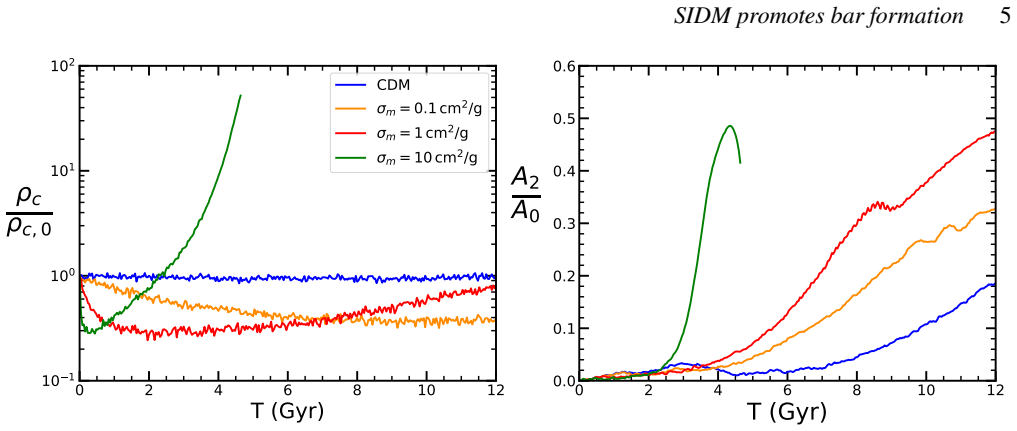
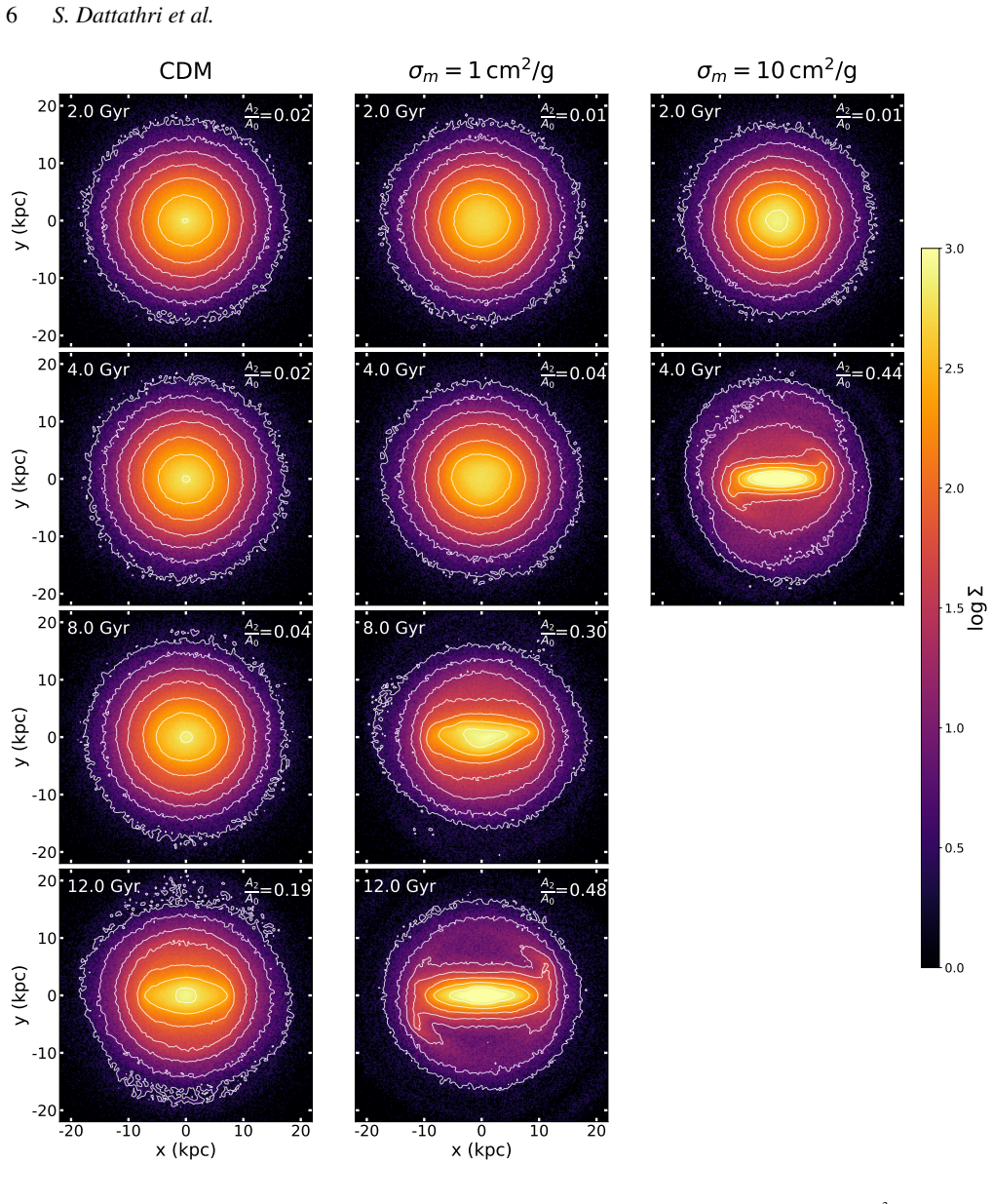
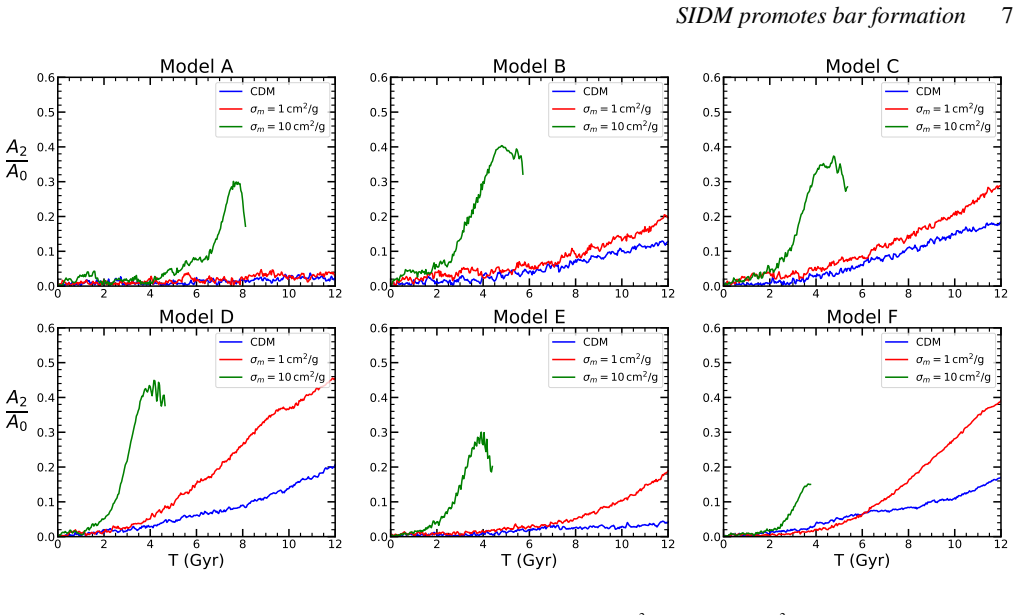
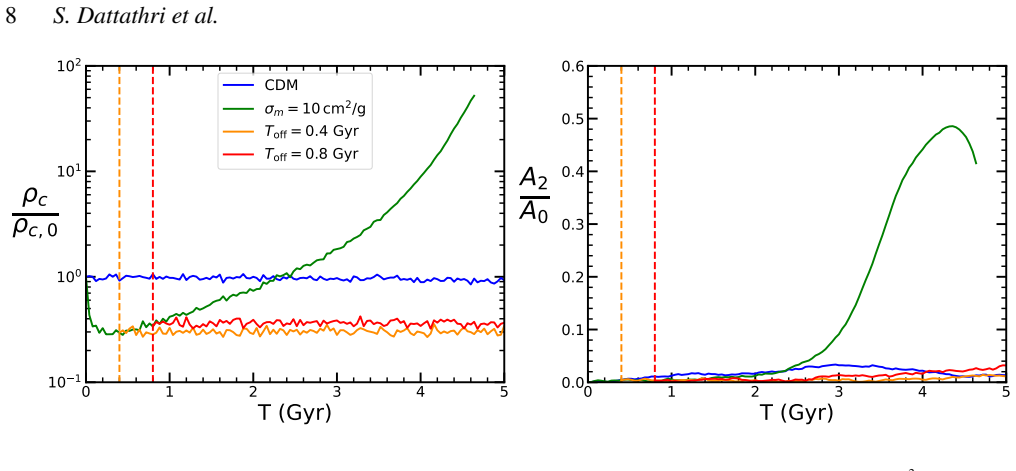
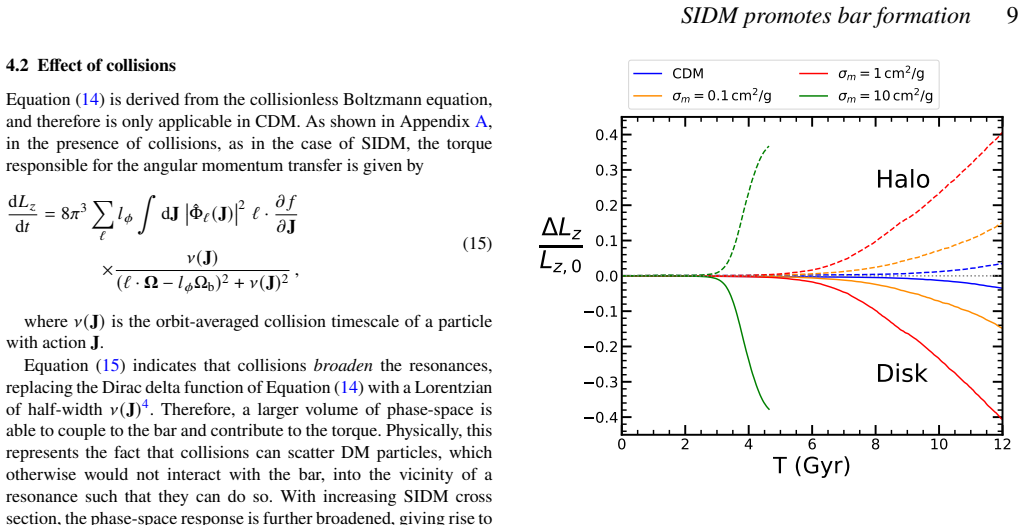
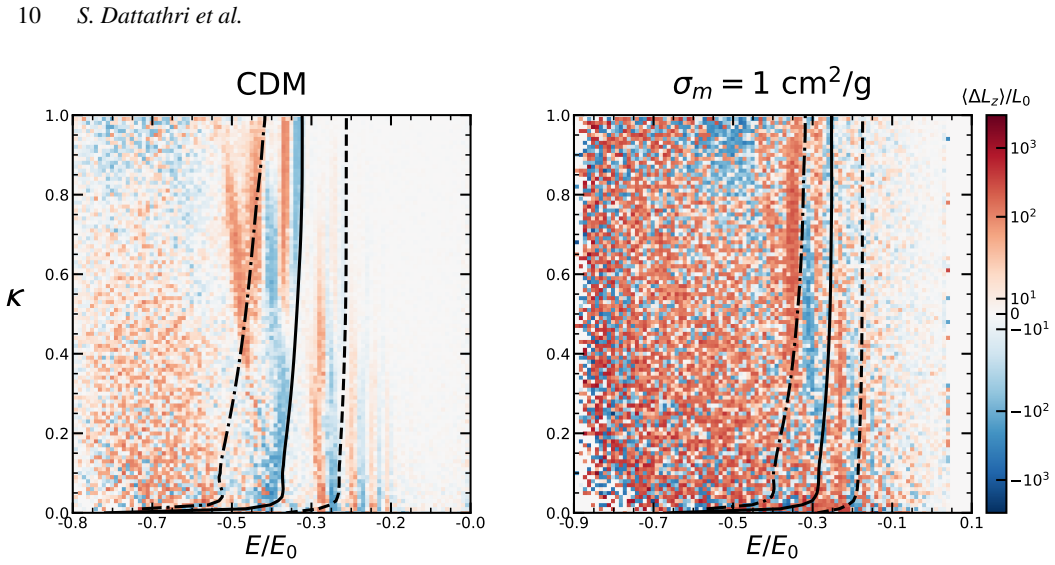
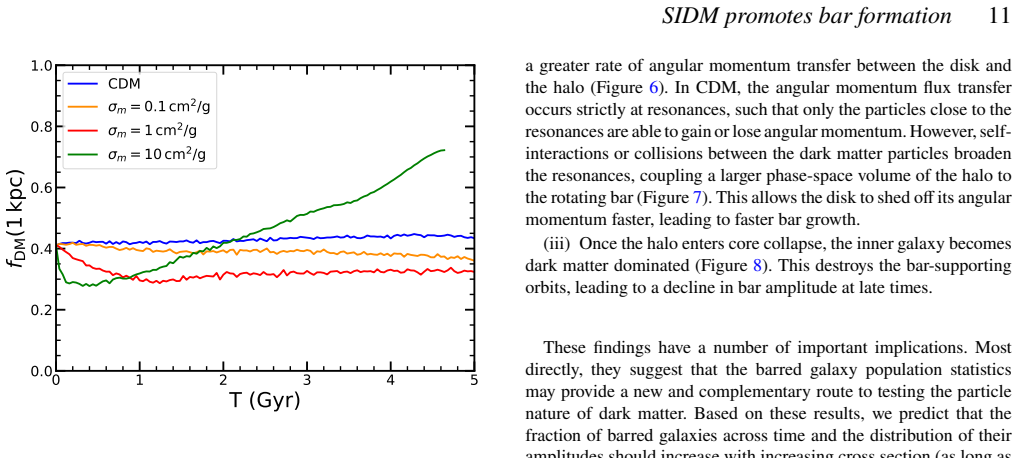
Compared with collisionless CDM, SIDM produces bars that form earlier and grow to larger amplitudes, even for modest self-interaction cross sections, because self-interactions broaden the bar-halo resonances and enhance angular momentum transfer from the stellar disk to the halo. Disks that remain stable in CDM, including kinematically hot and dark-matter-dominated disks, develop strong bars in SIDM. This phenomenon is not related to core formation in SIDM halos. At late times, gravothermal core collapse can raise the central dark matter density enough to weaken or dissolve the bar.
What carries the argument
Broadening of bar-halo resonances by dark matter self-interactions, which increases angular momentum transfer from the stellar disk to the halo.
If this is right
- Bars form earlier and reach higher amplitudes in SIDM than in CDM.
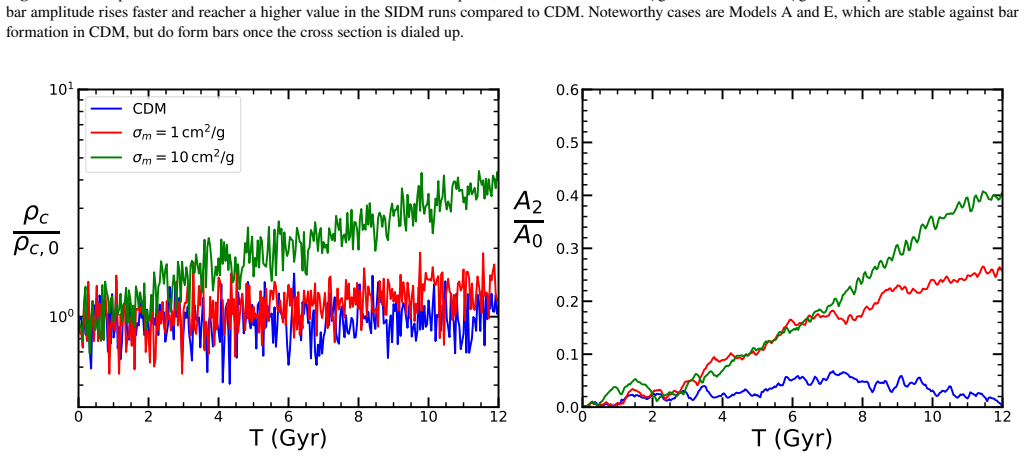
- Kinematically hot and dark-matter-dominated disks that stay stable in CDM form strong bars once self-interactions are present.
- The bar acceleration occurs independently of core formation in the halo.
- Late-time gravothermal collapse can weaken or dissolve bars by raising central density.
- The abundance, strength, and redshift evolution of bars can constrain the dark matter self-interaction cross section.
Where Pith is reading between the lines
- Surveys of bar fractions across redshift could provide an independent test of SIDM parameter space.
- Adding gas and star formation to the simulations would test whether the resonance-broadening effect survives realistic baryonic physics.
- The same resonance-broadening mechanism might alter the evolution of other non-axisymmetric structures such as spirals or lopsidedness.
- Morphological statistics from large galaxy samples offer a complementary route to direct detection or other small-scale probes of dark matter interactions.
Load-bearing premise
The idealized N-body setup assumes a collisionless stellar disk with no gas or star formation, and that kinetic theory correctly describes the resonance-broadening process.
What would settle it
High-resolution simulations that find no difference in bar formation time or final amplitude between SIDM and CDM halos, or observations showing that the fraction of barred galaxies at high redshift matches CDM predictions without any acceleration.
Figures
read the original abstract
Despite its remarkable success on large scales, the standard $\Lambda$CDM paradigm faces persistent small-scale challenges that have motivated alternative models for the dark sector. Self-interacting dark matter (SIDM) offers a compelling possibility, in which dark matter particles can scatter off each other. Stellar bars are a ubiquitous feature of disk galaxies across cosmic time. Bars are dynamically coupled to their host galaxy's dark matter halo, and therefore their properties provide a powerful probe of the nature and distribution of dark matter. In this paper, we use idealized, high-resolution $N$-body simulations and analytic calculations based on kinetic theory to study bar formation and evolution in disk galaxies embedded in SIDM halos. We find that compared with collisionless CDM, SIDM produces bars that form earlier and grow to larger amplitudes, even for modest self-interaction cross sections. In several cases, disks that remain stable in CDM, including kinematically hot and dark-matter-dominated disks, develop strong bars in SIDM. This accelerated bar growth occurs because self-interactions broaden the bar-halo resonances and enhance angular momentum transfer from the stellar disk to the halo. We explicitly show that this phenomenon is not related to core formation in SIDM halos. At late times, gravothermal core collapse can raise the central dark matter density enough to weaken or dissolve the bar. These results suggest that the abundance, strength, and redshift evolution of barred galaxies offer a promising observational route to constraining dark matter self-interactions, particularly in light of the growing sample of high-redshift bars revealed by JWST.
Editorial analysis
A structured set of objections, weighed in public.
Referee Report
Summary. The manuscript uses idealized high-resolution N-body simulations of stellar disks embedded in SIDM halos together with analytic kinetic-theory calculations to argue that, relative to collisionless CDM, even modest self-interaction cross sections cause bars to form earlier and reach larger amplitudes. The mechanism is identified as self-interaction-induced broadening of bar-halo resonances that enhances angular-momentum transfer from the disk to the halo; the effect is stated to be independent of core formation. Late-time gravothermal collapse is shown to raise central density and can weaken or dissolve bars. The results are presented as a potential observational constraint on SIDM via the statistics and redshift evolution of barred galaxies.
Significance. If the resonance-broadening channel is confirmed to dominate, the work supplies a concrete, falsifiable link between a microscopic dark-matter property and a macroscopic galactic morphology observable, complementing existing SIDM tests and timely with JWST high-redshift bar detections. The dual use of forward N-body integrations and analytic kinetic theory is a methodological strength.
major comments (3)
- [§4] §4 (kinetic-theory section): the mapping from the analytic scattering operator to the simulated torque integrals and resonance widths is asserted but not demonstrated by direct extraction of resonance widths or angular-momentum flux spectra from the particle data; without this quantitative comparison the attribution of the bar-growth difference to resonance broadening remains an assumption rather than a verified result.
- [§3] §3 (simulation setup): the idealized collisionless stellar disk (no gas, no star formation) leaves the central claim vulnerable to the possibility that baryonic processes alter disk velocity dispersion or halo response enough to erase or reverse the reported SIDM acceleration; a controlled comparison run including gas would be required to establish robustness.
- [Results] Results (e.g., Figures 3–5 and associated text): the statement that the bar-growth difference is independent of core formation needs an explicit control showing that the same cross-section values produce the reported effect even when core size is held fixed or minimized; the current separation of the two phenomena is stated but not quantitatively isolated.
minor comments (2)
- [Abstract] Abstract: the phrase 'in several cases' for disks that remain stable in CDM should be replaced by an explicit count or fraction of the simulated suite.
- [Figures] Figure captions: cross-section values (in cm² g⁻¹) should be stated explicitly in every panel or caption rather than referenced only in the text.
Simulated Author's Rebuttal
We thank the referee for their constructive and detailed comments. We address each major point below and indicate where revisions will be made to strengthen the manuscript.
read point-by-point responses
-
Referee: [§4] §4 (kinetic-theory section): the mapping from the analytic scattering operator to the simulated torque integrals and resonance widths is asserted but not demonstrated by direct extraction of resonance widths or angular-momentum flux spectra from the particle data; without this quantitative comparison the attribution of the bar-growth difference to resonance broadening remains an assumption rather than a verified result.
Authors: We agree that a direct quantitative link would strengthen the attribution. In the revised manuscript we will extract resonance widths and angular-momentum flux spectra directly from the simulation particle data and compare them to the analytic predictions, adding this comparison as a new figure and subsection in §4. revision: yes
-
Referee: [§3] §3 (simulation setup): the idealized collisionless stellar disk (no gas, no star formation) leaves the central claim vulnerable to the possibility that baryonic processes alter disk velocity dispersion or halo response enough to erase or reverse the reported SIDM acceleration; a controlled comparison run including gas would be required to establish robustness.
Authors: Our study deliberately employs an idealized collisionless setup to isolate the SIDM-driven dynamical mechanism. While baryonic processes could modulate the outcome, the resonance-broadening channel is a dark-matter effect whose qualitative impact should persist. We will add an expanded discussion of this limitation and possible baryonic influences in the revised text. revision: partial
-
Referee: [Results] Results (e.g., Figures 3–5 and associated text): the statement that the bar-growth difference is independent of core formation needs an explicit control showing that the same cross-section values produce the reported effect even when core size is held fixed or minimized; the current separation of the two phenomena is stated but not quantitatively isolated.
Authors: The existing suite already includes runs at early times and modest cross sections where core formation is negligible. To make the separation fully quantitative we will add a dedicated control set with parameters chosen to suppress core growth while retaining self-interactions, demonstrating that the bar-acceleration effect remains. revision: yes
- Request for new controlled simulations that include gas and star formation, which would require substantial additional model development and computational resources outside the present scope.
Circularity Check
No circularity; results from direct N-body integrations and independent kinetic theory
full rationale
The paper derives its claims from forward N-body simulations initialized with standard disk+halo conditions and from separate analytic kinetic-theory estimates of resonance broadening; neither step fits parameters to the bar-formation outcomes and then re-labels them as predictions, nor does any load-bearing step reduce to a self-citation or self-defined quantity. The headline attribution of accelerated bar growth to resonance broadening is therefore an output of the integrations rather than an input by construction.
Axiom & Free-Parameter Ledger
free parameters (1)
- self-interaction cross section per unit mass
axioms (2)
- standard math Newtonian gravity and collisionless stellar dynamics govern the disk and halo particles
- domain assumption Kinetic theory provides an accurate description of the broadened bar-halo resonances under self-interactions
Reference graph
Works this paper leans on
-
[1]
AGAMA: Action-based galaxy modelling architecture
AGAMA: action-based galaxy modelling architecture. , keywords =. doi:10.1093/mnras/sty2672 , archivePrefix =. 1802.08239 , primaryClass =
work page internal anchor Pith review Pith/arXiv arXiv doi:10.1093/mnras/sty2672
-
[2]
Bars within bars: A mechanism for fuelling active galactic nuclei , journal =
-
[3]
The Fueling and Evolution of AGN: Internal and External Triggers , journal =
-
[4]
How do massive black holes get their gas? , journal =
-
[5]
Coevolution (Or Not) of Supermassive Black Holes and Host Galaxies , journal =
-
[6]
A Universal Density Profile from Hierarchical Clustering
A Universal Density Profile from Hierarchical Clustering. , keywords =. doi:10.1086/304888 , archivePrefix =. astro-ph/9611107 , primaryClass =
work page internal anchor Pith review Pith/arXiv arXiv doi:10.1086/304888
-
[7]
Journal of Computational Physics , keywords =
A Hierarchical <E10>O</E10>(N) Force Calculation Algorithm. Journal of Computational Physics , keywords =. doi:10.1006/jcph.2002.7026 , archivePrefix =. astro-ph/0202512 , primaryClass =
-
[8]
A Quantitative Study of Interacting Dark Matter in Halos
A Quantitative Study of Interacting Dark Matter in Halos. , keywords =. doi:10.1086/317149 , archivePrefix =. astro-ph/0003483 , primaryClass =
work page internal anchor Pith review Pith/arXiv arXiv doi:10.1086/317149
-
[9]
The Open Journal of Astrophysics , keywords =
Dynamics in the Cores of Self-Interacting Dark Matter Halos: Reduced Stalling and Accelerated Core Collapse. The Open Journal of Astrophysics , keywords =. doi:10.33232/001c.157701 , archivePrefix =. 2511.14912 , primaryClass =
-
[10]
2012, MNRAS, 425, 1068, doi:10.1111/j.1365-2966.2012.21439.x
Subhaloes in self-interacting galactic dark matter haloes. , keywords =. doi:10.1111/j.1365-2966.2012.21182.x10.1002/asna.19141991009 , archivePrefix =. 1201.5892 , primaryClass =
work page doi:10.1111/j.1365-2966.2012.21182.x10.1002/asna.19141991009 2012
-
[11]
The Rapid Onset of Stellar Bars in the Baryon-dominated Centers of Disk Galaxies. , keywords =. doi:10.3847/1538-4357/acc469 , archivePrefix =. 2303.05574 , primaryClass =
-
[12]
The Dependency of Bar Formation Timescale on Disk Mass Fraction, Toomre Q, and Scale Height. , keywords =. doi:10.3847/1538-4357/adf966 , archivePrefix =. 2510.13152 , primaryClass =
-
[13]
Dependency of the Bar Formation Timescale on the Halo Spin. , keywords =. doi:10.3847/1538-4357/ae13a6 , archivePrefix =. 2510.13153 , primaryClass =
-
[14]
Constraints from Dynamical Friction on the Dark Matter Content of Barred Galaxies
Constraints from Dynamical Friction on the Dark Matter Content of Barred Galaxies. , keywords =. doi:10.1086/317148 , archivePrefix =. astro-ph/0006275 , primaryClass =
work page internal anchor Pith review Pith/arXiv arXiv doi:10.1086/317148
-
[15]
The NewHorizon simulation - to bar or not to bar. , keywords =. doi:10.1093/mnras/stac494 , archivePrefix =. 2106.02622 , primaryClass =
-
[16]
, year = 1972, month = jan, volume =
On the generating mechanism of spiral structure. , year = 1972, month = jan, volume =. doi:10.1093/mnras/157.1.1 , adsurl =
-
[17]
Dynamical friction in spherical systems. , keywords =. doi:10.1093/mnras/209.4.729 , adsurl =
-
[18]
, year = 1973, month = dec, volume =
A Numerical Study of the Stability of Flattened Galaxies: or, can Cold Galaxies Survive?. , year = 1973, month = dec, volume =. doi:10.1086/152513 , adsurl =
-
[19]
The stability and masses of disc galaxies. , keywords =. doi:10.1093/mnras/199.4.1069 , adsurl =
-
[20]
Bar-Halo Interaction and Bar Growth
Bar-Halo Interaction and Bar Growth. , keywords =. doi:10.1086/340784 , archivePrefix =. astro-ph/0203368 , primaryClass =
work page internal anchor Pith review Pith/arXiv arXiv doi:10.1086/340784
-
[21]
The formation of galactic discs. , keywords =. doi:10.1046/j.1365-8711.1998.01227.x , archivePrefix =. astro-ph/9707093 , primaryClass =
-
[22]
Galaxy formation spanning cosmic history. , keywords =. doi:10.1111/j.1365-2966.2010.16592.x , archivePrefix =. 1003.0011 , primaryClass =
-
[23]
The Formation of Disk-Bulge-Halo Systems and the Origin of the Hubble Sequence
The Formation of Disk-Bulge-Halo Systems and the Origin of the Hubble Sequence. , keywords =. doi:10.1086/306354 , archivePrefix =. astro-ph/9805113 , primaryClass =
work page internal anchor Pith review Pith/arXiv arXiv doi:10.1086/306354
-
[24]
Dynamical Friction and the Distribution of Dark Matter in Barred Galaxies
Dynamical Friction and the Distribution of Dark Matter in Barred Galaxies. , keywords =. doi:10.1086/311118 , archivePrefix =. astro-ph/9710039 , primaryClass =
work page internal anchor Pith review Pith/arXiv arXiv doi:10.1086/311118
-
[25]
Bar-driven dark halo evolution: a resolution of the cusp--core controversy
Bar-driven Dark Halo Evolution: A Resolution of the Cusp-Core Controversy. , keywords =. doi:10.1086/343847 , archivePrefix =. astro-ph/0110632 , primaryClass =
work page internal anchor Pith review Pith/arXiv arXiv doi:10.1086/343847
-
[26]
The bar-halo interaction - I. From fundamental dynamics to revised N-body requirements. , keywords =. doi:10.1111/j.1365-2966.2006.11306.x , archivePrefix =. astro-ph/0508166 , primaryClass =
-
[27]
The bar-halo interaction - II. Secular evolution and the religion of N-body simulations. , keywords =. doi:10.1111/j.1365-2966.2006.11307.x , archivePrefix =. astro-ph/0601138 , primaryClass =
-
[28]
Bar-Spheroid Interaction in Galaxies. , keywords =. doi:10.1086/171975 , adsurl =
-
[29]
2005, MNRAS, 364, 1105, doi:10.1111/j.1365-2966.2005.09655.x —
Bar-induced evolution of dark matter cusps. , keywords =. doi:10.1111/j.1365-2966.2005.09501.x , archivePrefix =. astro-ph/0306374 , primaryClass =
-
[30]
Dark Matter Trapping by Stellar Bars: The Shadow Bar
Dark matter trapping by stellar bars: the shadow bar. , keywords =. doi:10.1093/mnras/stw2141 , archivePrefix =. 1602.04826 , primaryClass =
work page internal anchor Pith review Pith/arXiv arXiv doi:10.1093/mnras/stw2141
-
[31]
Dynamical friction and feedback on galactic bars in the general fast-slow regime. , keywords =. doi:10.1093/mnras/stad2324 , archivePrefix =. 2305.00022 , primaryClass =
-
[32]
Evolution of barred galaxies by dynamical friction. , keywords =. doi:10.1093/mnras/213.3.451 , adsurl =
-
[33]
Galactic Bar Resonances with Diffusion: An Analytic Model with Implications for Bar-Dark Matter Halo Dynamical Friction. , keywords =. doi:10.3847/1538-4357/acd69b , archivePrefix =. 2208.03855 , primaryClass =
-
[34]
Oscillating dynamical friction on galactic bars by trapped dark matter. , keywords =. doi:10.1093/mnras/stac697 , archivePrefix =. 2109.10910 , primaryClass =
-
[35]
Loss of halo triaxiality due to bar formation. , keywords =. doi:10.1111/j.1365-2966.2010.16890.x , archivePrefix =. 1004.3874 , primaryClass =
-
[36]
Stellar Bar Evolution in Cuspy and Flat-Cored Triaxial CDM Halos
Stellar Bar Evolution in Cuspy and Flat-cored Triaxial CDM Halos. , keywords =. doi:10.1086/498493 , archivePrefix =. astro-ph/0501352 , primaryClass =
work page internal anchor Pith review Pith/arXiv arXiv doi:10.1086/498493
-
[37]
Spinning dark matter halos promote bar formation
Spinning dark matter haloes promote bar formation. , keywords =. doi:10.1093/mnras/stt1088 , archivePrefix =. 1304.1667 , primaryClass =
work page internal anchor Pith review Pith/arXiv arXiv doi:10.1093/mnras/stt1088
-
[38]
Can A Kinematically Hot and Thick Disk Form A Bar? : Role of Highly Spinning Dark Matter Halos. arXiv e-prints , keywords =. doi:10.48550/arXiv.2512.21632 , archivePrefix =. 2512.21632 , primaryClass =
-
[39]
Unveiling the origins of galactic bars: insights from barred and unbarred galaxies. , keywords =. doi:10.1093/mnras/stae576 , archivePrefix =. 2403.13061 , primaryClass =
-
[40]
Bar formation and evolution in disc galaxies with gas and a triaxial halo: morphology, bar strength and halo properties. , keywords =. doi:10.1093/mnras/sts452 , archivePrefix =. 1211.6754 , primaryClass =
work page internal anchor Pith review Pith/arXiv arXiv doi:10.1093/mnras/sts452
-
[41]
Secular evolution of isolated barred galaxies. I. Gravitational coupling between stellar bars and interstellar medium. , keywords =
-
[42]
Stellar Bars in Isolated Gas-rich Spiral Galaxies Do Not Slow Down. , keywords =. doi:10.3847/1538-4357/ace2b9 , archivePrefix =. 2209.03364 , primaryClass =
-
[43]
Black Hole Growth in Disk Galaxies Mediated by the Secular Evolution of Short Bars
Black Hole Growth in Disk Galaxies Mediated by the Secular Evolution of Short Bars. , keywords =. doi:10.3847/2041-8213/aa7ecb , archivePrefix =. 1707.03537 , primaryClass =
work page internal anchor Pith review Pith/arXiv arXiv doi:10.3847/2041-8213/aa7ecb 2041
-
[44]
The Destruction of Bars by Central Mass Concentrations
The Destruction of Bars by Central Mass Concentrations. , keywords =. doi:10.1086/382124 , archivePrefix =. astro-ph/0310194 , primaryClass =
work page internal anchor Pith review Pith/arXiv arXiv doi:10.1086/382124
-
[45]
Early-growing Supermassive Black Holes Strengthen Bars and Boxy/Peanut Bulges. , keywords =. doi:10.3847/1538-4357/ace962 , archivePrefix =. 2306.07424 , primaryClass =
-
[46]
Barred Galaxies in the Illustris-1 and TNG100 Simulations: A Comparison Study. , keywords =. doi:10.3847/1538-4357/ab8d32 , archivePrefix =. 2004.11620 , primaryClass =
-
[47]
Fast galaxy bars continue to challenge standard cosmology. , keywords =. doi:10.1093/mnras/stab2553 , archivePrefix =. 2106.10304 , primaryClass =
-
[48]
A JWST investigation into the bar fraction at redshifts 1 z 3. , keywords =. doi:10.1093/mnras/stae921 , archivePrefix =. 2309.10038 , primaryClass =
-
[49]
The Abundance and Properties of Barred Galaxies out to z 4 Using JWST CEERS Data. , keywords =. doi:10.3847/1538-4357/adc8a7 , archivePrefix =. 2409.06100 , primaryClass =
-
[50]
First Look at z > 1 Bars in the Rest-frame Near-infrared with JWST Early CEERS Imaging. , keywords =. doi:10.3847/2041-8213/acacfb , archivePrefix =. 2210.08658 , primaryClass =
-
[51]
The evolution of the bar fraction and bar lengths in the last 12 billion years. , keywords =. doi:10.1093/mnras/staf2010 , archivePrefix =. 2510.07407 , primaryClass =
-
[52]
Galaxy Zoo CEERS: Bar Fractions Up to z 4.0. , keywords =. doi:10.3847/1538-4357/add7d0 , archivePrefix =. 2505.01421 , primaryClass =
-
[53]
A Milky Way-like barred spiral galaxy at a redshift of 3. , keywords =. doi:10.1038/s41586-023-06636-x , archivePrefix =. 2311.04283 , primaryClass =
-
[54]
Small-Scale Challenges to the CDM Paradigm. , keywords =. doi:10.1146/annurev-astro-091916-055313 , archivePrefix =. 1707.04256 , primaryClass =
-
[55]
Observational evidence for self-interacting cold dark matter
Observational Evidence for Self-Interacting Cold Dark Matter. , keywords =. doi:10.1103/PhysRevLett.84.3760 , archivePrefix =. astro-ph/9909386 , primaryClass =
work page internal anchor Pith review Pith/arXiv arXiv doi:10.1103/physrevlett.84.3760
-
[56]
How the Self-Interacting Dark Matter Model Explains the Diverse Galactic Rotation Curves
Self-Interacting Dark Matter Can Explain Diverse Galactic Rotation Curves. , keywords =. doi:10.1103/PhysRevLett.119.111102 , archivePrefix =. 1611.02716 , primaryClass =
work page internal anchor Pith review Pith/arXiv arXiv doi:10.1103/physrevlett.119.111102
-
[57]
2025, ApJ, 978, 38, doi:10.3847/1538-4357/ad9b09
Self-interacting Dark Matter, Core Collapse, and the Galaxy Galaxy Strong-lensing Discrepancy. , keywords =. doi:10.3847/1538-4357/ad9b09 , archivePrefix =. 2406.17024 , primaryClass =
-
[58]
Supermassive Black Holes from Ultra-Strongly Self-Interacting Dark Matter
Supermassive Black Holes from Ultra-strongly Self-interacting Dark Matter. , keywords =. doi:10.1088/0004-637X/804/2/131 , archivePrefix =. 1501.00017 , primaryClass =
work page internal anchor Pith review Pith/arXiv arXiv doi:10.1088/0004-637x/804/2/131
-
[59]
Formation of the Little Red Dots from the Core Collapse of Self-interacting Dark Matter Halos. , keywords =. doi:10.3847/2041-8213/ae247a , archivePrefix =. 2503.23710 , primaryClass =
-
[60]
Gravothermal collapse and the diversity of galactic rotation curves. , keywords =. doi:10.1103/PhysRevD.111.103041 , archivePrefix =. 2407.15005 , primaryClass =
-
[61]
Self-interacting dark matter in the center of a Local Group dwarf galaxy and its satellites. arXiv e-prints , keywords =. doi:10.48550/arXiv.2510.05258 , archivePrefix =. 2510.05258 , primaryClass =
-
[62]
Diversity and universality: Evolution of dwarf galaxies with self-interacting dark matter. , keywords =. doi:10.1103/x9t4-3zy7 , archivePrefix =. 2412.14621 , primaryClass =
-
[63]
Tidal deformation of a disc galaxy stabilized by massive halo
Close encounter between galaxies - II. Tidal deformation of a disc galaxy stabilized by massive halo. , keywords =. doi:10.1093/mnras/228.3.635 , adsurl =
-
[64]
, keywords =
The influence of galaxy interactions on stellar bars. , keywords =
-
[65]
The Metamorphosis of Tidally Stirred Dwarf Galaxies
The Metamorphosis of Tidally Stirred Dwarf Galaxies. , keywords =. doi:10.1086/322356 , archivePrefix =. astro-ph/0103430 , primaryClass =
work page internal anchor Pith review Pith/arXiv arXiv doi:10.1086/322356
-
[66]
Cold Dark Matter Substructure and Galactic Disks. I. Morphological Signatures of Hierarchical Satellite Accretion. , keywords =. doi:10.1086/591958 , archivePrefix =. 0708.1949 , primaryClass =
work page internal anchor Pith review Pith/arXiv arXiv doi:10.1086/591958 1949
-
[67]
The mass distribution and gravitational potential of the Milky Way
The mass distribution and gravitational potential of the Milky Way. , keywords =. doi:10.1093/mnras/stw2759 , archivePrefix =. 1608.00971 , primaryClass =
work page internal anchor Pith review Pith/arXiv arXiv doi:10.1093/mnras/stw2759
-
[68]
The impact of baryonic potentials on the gravothermal evolution of self-interacting dark matter haloes. , keywords =. doi:10.1093/mnras/stad2765 , archivePrefix =. 2306.08028 , primaryClass =
-
[69]
On the gravitational stability of a disk of stars. , year = 1964, month = may, volume =. doi:10.1086/147861 , adsurl =
-
[70]
Numerical challenges in modeling gravothermal collapse in Self-Interacting Dark Matter halos. , keywords =. doi:10.1088/1475-7516/2024/09/074 , archivePrefix =. 2402.12452 , primaryClass =
-
[71]
Evaporating the Milky Way halo and its satellites with inelastic self-interacting dark matter
Evaporating the Milky Way halo and its satellites with inelastic self-interacting dark matter. , keywords =. doi:10.1093/mnras/stz340 , archivePrefix =. 1805.03203 , primaryClass =
work page internal anchor Pith review Pith/arXiv arXiv doi:10.1093/mnras/stz340
-
[72]
Convergence tests of self-interacting dark matter simulations. , keywords =. doi:10.1103/PhysRevD.110.123024 , archivePrefix =. 2402.01604 , primaryClass =
-
[73]
Gas Feedback on Stellar Bar Evolution
Gas Feedback on Stellar Bar Evolution. , keywords =. doi:10.1086/520531 , archivePrefix =. astro-ph/0703028 , primaryClass =
work page internal anchor Pith review Pith/arXiv arXiv doi:10.1086/520531
-
[74]
Dark Matter Halos and Evolution of Bars in Disk Galaxies: Varying Gas Fraction and Gas Spatial Resolution. , keywords =. doi:10.1088/0004-637X/719/2/1470 , archivePrefix =. 1004.4899 , primaryClass =
work page internal anchor Pith review Pith/arXiv arXiv doi:10.1088/0004-637x/719/2/1470
-
[75]
The Open Journal of Astrophysics , keywords =
The Impact of Feedback-driven Outflows on Bar Formation. The Open Journal of Astrophysics , keywords =. doi:10.33232/001c.138494 , archivePrefix =. 2403.12138 , primaryClass =
-
[76]
Dynamics of barred galaxies: effects of disc height. , keywords =. doi:10.1111/j.1365-2966.2009.15187.x , archivePrefix =. 0808.3422 , primaryClass =
-
[77]
The effects of AGN feedback on the structural and dynamical properties of Milky Way-mass galaxies in cosmological simulations. , keywords =. doi:10.1093/mnras/stac1143 , archivePrefix =. 2110.11368 , primaryClass =
-
[78]
Adventures of a tidally induced bar
Adventures of a tidally induced bar. , keywords =. doi:10.1093/mnras/stu1846 , archivePrefix =. 1404.1211 , primaryClass =
work page internal anchor Pith review Pith/arXiv arXiv doi:10.1093/mnras/stu1846
-
[79]
Time-dependent secular evolution in galaxies
Time-dependent secular evolution in galaxies. arXiv e-prints , keywords =. doi:10.48550/arXiv.astro-ph/0404169 , archivePrefix =. astro-ph/0404169 , primaryClass =
work page internal anchor Pith review Pith/arXiv arXiv doi:10.48550/arxiv.astro-ph/0404169
-
[80]
Bars and secular evolution in disk galaxies: Theoretical input
Bars and secular evolution in disk galaxies: Theoretical input. Secular Evolution of Galaxies , year = 2013, editor =. doi:10.48550/arXiv.1211.6752 , adsurl =
work page internal anchor Pith review Pith/arXiv arXiv doi:10.48550/arxiv.1211.6752 2013
discussion (0)
Sign in with ORCID, Apple, or X to comment. Anyone can read and Pith papers without signing in.