REVIEW 4 major objections 6 minor 86 references
Hypertriton production in small heavy-ion systems favors a wave function with more short-distance d–Λ probability than a Gaussian form can supply while still matching the binding energy.
Reviewed by Pith at T0; open to challenge. T0 means a machine referee read the full paper against a public rubric. the ladder, T0–T4 →
T0 review · grok-4.5
2026-07-31 17:28 UTC pith:2V2XRC37
load-bearing objection Solid new isobar (hyper)nuclei data that cleanly rule out thermal models and show Gaussian ^{3}_ΛH wave functions cannot jointly fit S3 and B_Λ; the short-distance inference is real but stays conditional on coalescence+source assumptions. the 4 major comments →
Probing (Hyper)Nuclei Wave Functions and Production Mechanisms in sqrt{s_{rm{NN}}}=200 GeV Isobar Collisions at RHIC
The pith
A machine-rendered reading of the paper's core claim, the machinery that carries it, and where it could break.
Core claim
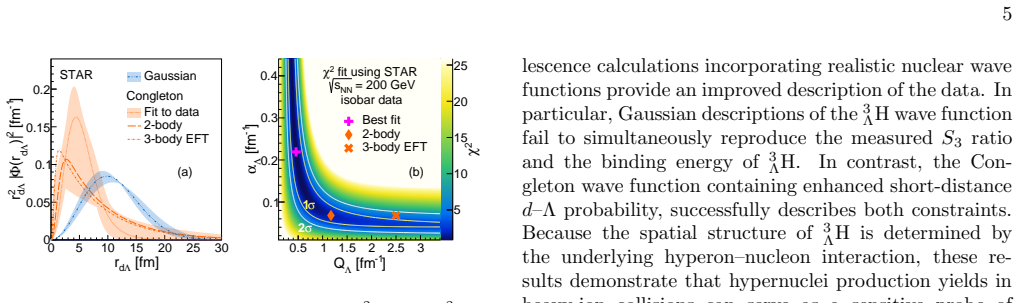
In isobar collisions the measured S3 ratio shows no strong multiplicity-driven suppression, contrary to coalescence with a large-radius Gaussian hypertriton wave function fixed by the world-average binding energy. Congleton wave functions that keep a similar mean d–Λ separation but raise the short-distance probability describe S3; a free Gaussian fit can match S3 only by forcing an unrealistically compact size incompatible with the binding energy. The data therefore require larger short-distance d–Λ weight than a Gaussian ansatz implies.
What carries the argument
The ratio S3 = (N_hypertriton / N_He3) / (N_Λ / N_p), interpreted in Wigner-function coalescence as the overlap of the nucleon-emitting source with the hypertriton wave function; that overlap is especially sensitive to short-distance structure when the source is only a few femtometers across.
Load-bearing premise
The claim rests on coalescence models that treat the emitting source as roughly Gaussian with a radius taken from femtoscopy and that map the yield ratio cleanly onto the short-distance shape of the hypertriton wave function.
What would settle it
A simultaneous description of the isobar S3 points and the world-average binding energy by a Gaussian hypertriton wave function inside the same coalescence framework, or new small-system S3 data that restore the strong suppression expected for a large Gaussian radius, would overturn the central inference.
If this is right
- Heavy-ion (hyper)nuclei yields become a practical observable for testing hypernuclear wave functions, not only production mechanisms.
- Thermal equilibrium alone is insufficient to explain light (hyper)nuclei yields across system size at RHIC energies.
- Realistic non-Gaussian forms (Hulthén for the deuteron, Congleton-type for the hypertriton) are required for quantitative coalescence comparisons in small systems.
- Constraints on short-distance d–Λ probability feed into models of the hyperon–nucleon interaction relevant for neutron-star matter.
Where Pith is reading between the lines
- If short-distance d–Λ weight is genuinely enhanced, precision few-body calculations of the hypertriton should prefer potentials or three-body forces that raise the wave function near the origin without spoiling the tiny binding energy.
- The same S3-versus-multiplicity test in high-multiplicity pp or p–A collisions would extend the source-size lever arm and further separate Gaussian from Congleton-like forms.
- Once the wave-function shape is fixed by yields, residual discrepancies in absolute coalescence parameters could isolate source non-Gaussianity or final-state interactions in small systems.
Editorial analysis
A structured set of objections, weighed in public.
Referee Report
Summary. This STAR letter reports mid-rapidity yields of ³_ΛH (³_¯Λ¯H), ³He (³¯He), and t in Ru+Ru and Zr+Zr collisions at √s_NN = 200 GeV versus centrality, constructing the multiplicity-dependent ratios N_t N_p / N_d² and S_3 = (N_³_ΛH / N_³He) / (N_Λ / N_p). Both ratios lie well below Thermal-FIST expectations. Within analytical and hybrid coalescence frameworks, a Gaussian ³_ΛH wave function fixed to the world-average B_Λ (⟨r_dΛ⟩ ≈ 9.8 fm) underpredicts S_3, while Congleton forms (and a free Congleton fit) that enhance short-distance d–Λ probability describe the isobar S_3 data; a free Gaussian width that fits S_3 alone yields ⟨r_dΛ⟩ ≈ 4.7 fm, incompatible with B_Λ at ~4.2σ inside the same framework. The authors conclude that ³_ΛH contains larger short-distance d–Λ probability than a Gaussian ansatz implies and that heavy-ion yields can probe hypernuclear wave functions and the YN interaction.
Significance. The isobar data fill a genuine gap: high-statistics (hyper)nuclei yields in intermediate/small systems at RHIC, where source size becomes comparable to the hypertriton size and coalescence is expected to resolve wave-function structure. The joint S_3 + B_Λ test against Gaussian versus non-Gaussian (Congleton/Hulthén) ansätze is a clean, falsifiable way to expose the short-distance content of the ³_ΛH wave function. If the coalescence mapping holds, the result is directly relevant to hypernuclear structure and to the YN interaction that enters the neutron-star EoS. Experimental methods (KFParticle+XGBDT, Geant4 absorption, feed-down, Blast-Wave plus alternate extrapolations, full systematics including the 13% B.R.) are standard and carefully documented; the ratios are constructed to cancel baryon-density and isospin effects to first order.
major comments (4)
- [Coalescence discussion; Supplemental analytical-model section] The central wave-function claim rests on the analytical (and hybrid) coalescence mapping of S_3 onto the short-distance content of Φ(r_dΛ) (main text coalescence discussion; Supplemental “Analytical coalescence model calculations”). That mapping assumes an approximately Gaussian nucleon source whose R_inv is taken from an LHC femtoscopy parameterization (R_inv = 0.428⟨dN_ch/dη⟩^{1/3} − 0.05, 20% uncertainty), momentum-independent B_A ratios, and a fixed chaoticity λ = 0.73 for uncorrected Σ⁰ → Λ feed-down. The paper already notes that a Gaussian source neglects nucleon momentum correlations that may matter at low multiplicity (Hulthén underprediction of N_t N_p / N_d² for dN_ch/dη < 80). A quantitative robustness check—varying source non-Gaussianity, allowing mild p_T dependence of the ratios, or scanning the Σ⁰ chaoticity—should be shown (or its absence stated as a limitation) before th
- [Supplemental: Fit to isobar S_3 using a Gaussian ³_ΛH wave function; main-text S_3 discussion] Supplemental free Gaussian fit to isobar S_3 yields ⟨r_dΛ⟩ = 4.69^{+0.56}_{-0.44} fm (B_Λ ≈ 1.28 MeV) and a 4.2σ tension with the world-average B_Λ when the binding-energy constraint is imposed (Δχ² = 17.7). This tension is framework-internal. The letter should state explicitly that the incompatibility is obtained inside the Wigner-function coalescence model with the stated source assumptions, not as a model-independent exclusion of a large-radius Gaussian ³_ΛH, and should quote the corresponding χ² profile (Supplemental Fig. 3) or its essential numbers in the main text.
- [Fig. 3; abstract and final paragraph] The free Congleton fit (Q_Λ, α_Λ) = (0.46 fm^{-1}, 0.22 fm^{-1}) that best describes S_3 lies well away from both the two-body and three-body EFT literature points; the 1σ contour is L-shaped and permits ⟨r_dΛ⟩ spanning 6.3^{+11.1}_{-1.3} fm (Fig. 3b). While all allowed shapes share enhanced small-r probability relative to the B_Λ-constrained Gaussian (Fig. 3a), the data do not yet tightly constrain the overall size or the microscopic YN parameters. The abstract/conclusion phrasing (“contains larger short-distance d–Λ probability than implied by a Gaussian ansatz”) is supported by the radial distributions, but should be qualified by the breadth of the allowed (Q_Λ, α_Λ) family and by the fact that the best-fit point is not the literature Congleton/EFT point.
- [Fig. 2a and associated hybrid-model paragraph] The same hybrid MUSIC+UrQMD+coalescence framework that is used for S_3 overestimates the isobar N_t N_p / N_d² data at low multiplicity (χ²/NDF = 124.6/4 with Gaussian d/t wave functions; main text and Supplemental Table III), even though it described Au+Au data across 7.7–200 GeV. This tension should be discussed: if the dynamical source or the coalescence implementation is incomplete for isobar/small systems, the quantitative S_3-to-wave-function mapping inherits the same uncertainty. At minimum, the letter should note that the hybrid S_3 underprediction (Gaussian ³_ΛH) and the analytical results are only directionally consistent.
minor comments (6)
- [Fig. 2 caption] The 13% ³_ΛH branching-ratio uncertainty is fully correlated across points and is correctly omitted from the vertical error bars, but a brief statement in the Fig. 2 caption (or a shaded band) of how a ±13% coherent shift moves S_3 relative to the model curves would help the reader.
- [Supplemental: (Hyper)nuclei p_T distributions] Ru+Ru and Zr+Zr are combined with equal weights for hypernuclei (and for nuclei with fully correlated systematics). A short check that the two isobars are consistent within uncertainties, or an explicit statement that no significant isobar difference is observed, would strengthen the combination.
- [Supplemental p_T spectra and Table I] Extrapolation fractions are large (43–73% for nuclei dN/dy, 30–70% for hypernuclei). The alternate-function envelope is given; quoting the default Blast-Wave T_kin and β_s (or noting they are in the Supplemental tables) would improve reproducibility.
- [Fig. 2b] For √s_NN = 7.7–27 GeV the paper shows (³_ΛH/t)/(Λ/p) instead of S_3 (footnote [79]). Marking those points with a distinct symbol or an open marker in Fig. 2b would avoid any visual conflation with true S_3.
- [Page 1; Figs. 2–3] Typographical/notation nits: “tyields” → “t yields” (page 1); consistent use of ³_¯Λ¯H vs ³_¯Λ H-bar; “Congleton (fit to data)” vs “Fit to data” legend labels in Fig. 2b/Fig. 3 could be unified.
- [References; ratio construction paragraph] Ref. [62] is listed as “Manuscript in preparation” for p and Λ yields used in the ratios. Ensure the companion paper is submitted/available or provide the essential p and Λ dN/dy values in the Supplemental material so the ratios are reproducible.
Circularity Check
No significant circularity: S3 and binding-energy tension is a genuine external comparison; free Congleton/Gaussian fits are exploratory and not load-bearing.
full rationale
The paper’s central claim is that a Gaussian ³_ΛH wave function constrained by the external world-average B_Λ underpredicts the newly measured isobar S3 (and a free-Gaussian fit to S3 yields a compact size incompatible with that B_Λ at ~4.2σ), whereas literature Congleton forms (two-body and 3-body EFT parameter sets fixed independently of these data) describe S3 without refitting. Thermal-model overprediction and the directional failure of Gaussian coalescence are likewise comparisons to external benchmarks, not identities. The coalescence-inspired (p0,p1) source-size fit to NtNp/Nd² and the free (Q_Λ,α_Λ) Congleton fit to S3 are explicitly exploratory shape exercises; the paper itself caveats that free R_inv may distort the physical source and presents literature Congleton sets as the successful non-fitted descriptions. No step reduces a claimed first-principles prediction to its own fitted input by construction, and no load-bearing uniqueness theorem is imported via self-citation. Residual model dependence of the S3→wave-function map is a correctness/assumption issue, not circularity.
Axiom & Free-Parameter Ledger
free parameters (6)
- Congleton (Q_Λ, α_Λ) best-fit pair =
(0.46 fm⁻¹, 0.22 fm⁻¹)
- Free Gaussian ³_ΛH width b_dΛ / ⟨r_dΛ⟩ =
⟨r_dΛ⟩=4.69^{+0.56}_{-0.44} fm
- Coalescence-inspired source R_inv = p1 (dNch/dη)^{1/3} and p0 =
p0=0.38±0.007, p1=0.81±0.043
- Blast-Wave and alternate spectral extrapolation parameters
- ³_ΛH branching ratio =
23±3%
- Analytical R_inv parameterization from femtoscopy =
20% uncertainty band
axioms (7)
- domain assumption Wigner-function coalescence: formation probability is the overlap of the nucleon/hyperon source phase-space distribution with the bound-state wave function.
- domain assumption Nucleon emitting source can be approximated as Gaussian in the analytical model, with R_inv from charged-multiplicity scaling / femtoscopy.
- domain assumption World-average B_Λ=0.163±0.036 MeV implies ⟨r_dΛ⟩≈9.8 fm for use as external constraint on Gaussian ³_ΛH size.
- domain assumption Congleton two-body form ϕ(q)∝exp(−q²/Q_Λ²)/(q²+α_Λ²) is an adequate flexible family for ³_ΛH spatial structure.
- domain assumption Ratios NtNp/Nd² and S3 cancel baryon density and isospin to first order, enabling system-size comparison.
- domain assumption Thermal-FIST ideal HRG with canonical charges and parameters fit to light hadrons predicts (hyper)nuclei yields without nuclear-structure sensitivity.
- domain assumption Standard experimental corrections (embedding efficiencies, TOF PID efficiency, weak-decay feed-down, Geant4 absorption scaling) recover primordial mid-rapidity yields.
read the original abstract
The study of nuclei and hypernuclei production is a powerful tool to investigate the formation mechanism of loosely bound states in high-energy heavy-ion collisions. A key prediction from coalescence models is a strong suppression of the hypertriton (${}^{3}_{\Lambda}\rm{H}$) compared to ${}^{3}\rm{He}$ production in small collision systems due to the larger radius of ${}^{3}_{\Lambda}\rm{H}$. In this letter, the STAR collaboration reports measurements on (hyper)nuclei ($^{3}_{\Lambda}\rm{H}, {}^{3}_{\bar{\Lambda}}\rm{\bar{H}}, {}^{3}\rm{He}, {}^{3}\rm{\overline{He}}, t$) production at mid-rapidity in Ru+Ru and Zr+Zr collisions at $\sqrt{s_{\rm{NN}}}=200$ GeV as a function of collision centrality. We find that the ratios $N_{t}N_{p}/N_{d}^{2}$ and $S_{3} =(N_{{}^{3}_{\Lambda}\rm{H}}/N_{{}^{3}_{}\rm{He}})/(N_{\Lambda}/N_{p})$ deviate significantly from thermal model expectations. Coalescence calculations incorporating realistic non-Gaussian wave functions for the $d$ and ${}^{3}_{\Lambda}\rm{H}$ provide an improved description of the data, while Gaussian descriptions of the ${}^{3}_{\Lambda}\rm{H}$ wave function fail to simultaneously reproduce the measured $S_{3}$ and the binding energy of ${}^{3}_{\Lambda}\rm{H}$. These results suggest that the ${}^{3}_{\Lambda}\rm{H}$ wave function contains larger short-distance $d$--$\Lambda$ probability than implied by a Gaussian ansatz, demonstrating the potential of heavy-ion production measurements as a probe of hypernuclear wave functions and the underlying hyperon--nucleon interaction.
Figures




Reference graph
Works this paper leans on
-
[1]
Nagamiya, M
S. Nagamiya, M. C. Lemaire, E. Moller, S. Schnetzer, G. Shapiro, H. Steiner, and I. Tanihata, Phys. Rev. C 24, 971 (1981)
1981
-
[2]
H. H. Gutbrod, A. Sandoval, P. J. Johansen, A. M. Poskanzer, J. Gosset, W. G. Meyer, G. D. Westfall, and R. Stock, Phys. Rev. Lett.37, 667 (1976)
1976
-
[3]
Gosset, H
J. Gosset, H. H. Gutbrod, W. G. Meyer, A. M. Poskanzer, A. Sandoval, R. Stock, and G. D. Westfall, Phys. Rev. C 16, 629 (1977)
1977
-
[4]
Barrette et al
J. Barrette et al. (E814), Phys. Rev. C50, 1077 (1994)
1994
-
[5]
T. A. Armstrong et al. (E864), Phys. Rev. C61, 064908 (2000), nucl-ex/0003009
Pith/arXiv arXiv 2000
-
[6]
Saito et al
N. Saito et al. (E886), Phys. Rev. C49, 3211 (1994)
1994
- [7]
- [8]
-
[9]
B. I. Abelev et al. (STAR), Science328, 58 (2010), 6 1003.2030
Pith/arXiv arXiv 2010
- [10]
-
[11]
T. A. Armstrong et al. (E864), Phys. Rev. C70, 024902 (2004), nucl-ex/0211010
Pith/arXiv arXiv 2004
-
[14]
S. Acharya et al. (ALICE), Phys. Rev. C107, 064904 (2023), 2211.14015
Pith/arXiv arXiv 2023
-
[15]
S. Acharya et al. (A Large Ion Collider Experiment, AL- ICE), Phys. Rev. Lett.128, 252003 (2022), 2107.10627
Pith/arXiv arXiv 2022
- [16]
-
[17]
A. Andronic, P. Braun-Munzinger, J. Stachel, and H. Stocker, Phys. Lett. B697, 203 (2011), 1010.2995
Pith/arXiv arXiv 2011
-
[18]
T. Reichert, J. Steinheimer, V. Vovchenko, B. D¨ onigus, and M. Bleicher, Phys. Rev. C107, 014912 (2023), 2210.11876
Pith/arXiv arXiv 2023
-
[19]
R. Scheibl and U. W. Heinz, Phys. Rev. C59, 1585 (1999), nucl-th/9809092
Pith/arXiv arXiv 1999
-
[20]
J. Steinheimer, K. Gudima, A. Botvina, I. Mishustin, M. Bleicher, and H. Stocker, Phys. Lett. B714, 85 (2012), 1203.2547
Pith/arXiv arXiv 2012
-
[21]
J. Aichelin, E. Bratkovskaya, A. Le F` evre, V. Kireyeu, V. Kolesnikov, Y. Leifels, V. Voronyuk, and G. Coci, Phys. Rev. C101, 044905 (2020), 1907.03860
Pith/arXiv arXiv 2020
- [22]
-
[23]
R. Wang, Y.-G. Ma, L.-W. Chen, C. M. Ko, K.-J. Sun, and Z. Zhang, Phys. Rev. C108, L031601 (2023), 2305.02988
Pith/arXiv arXiv 2023
- [24]
- [25]
-
[26]
E. Braaten, K. Ingles, and J. Pickett, Phys. Rev. Lett. 134, 252301 (2025), 2408.03935
Pith/arXiv arXiv 2025
-
[27]
M. Mahlein, L. Barioglio, F. Bellini, L. Fabbietti, C. Pinto, B. Singh, and S. Tripathy, Eur. Phys. J. C 83, 804 (2023), 2302.12696
Pith/arXiv arXiv 2023
-
[28]
M. Mahlein, B. Singh, M. Viviani, F. Bellini, L. Fabbietti, A. Kievsky, and L. E. Marcucci (2025), 2504.02491
arXiv 2025
- [31]
-
[32]
S. Acharya et al. (ALICE), Phys. Rev. Lett.131, 102302 (2023), 2209.07360
Pith/arXiv arXiv 2023
- [33]
-
[34]
K. N. Chaudhari, S. N. Ganguli, N. K. K. Rao, M. S. R. Swami, A. Gurtu, J. M. Kohli, and M. B. Singh, Proc. Indian Acad. Sci. A68, 228 (1968)
1968
-
[35]
Juric et al., Nucl
M. Juric et al., Nucl. Phys. B52, 1 (1973)
1973
-
[36]
Mayeur, J
C. Mayeur, J. Sacton, P. Vilain, G. Wilquet, D. Stan- ley, P. Allen, D. Davis, E. Fletcher, D. A. Garbutt, M. Shaukat, et al., Il Nuovo Cimento A43, 180 (1966)
1966
-
[37]
R. G. Ammar, W. Dunn, and M. Holland, Il Nuovo Ci- mento26, 840 (1962)
1962
-
[38]
Prakash, P
Y. Prakash, P. H. Steinberg, D. Chandler, and R. J. Prem, Il Nuovo Cimento21, 235 (1961)
1961
-
[40]
S. Zhang, J. H. Chen, H. Crawford, D. Keane, Y. G. Ma, and Z. B. Xu, Phys. Lett. B684, 224 (2010), 0908.3357
Pith/arXiv arXiv 2010
-
[41]
K.-J. Sun, C. M. Ko, and B. D¨ onigus, Phys. Lett. B792, 132 (2019), 1812.05175
Pith/arXiv arXiv 2019
-
[42]
D. Gerstung, N. Kaiser, and W. Weise, Eur. Phys. J. A 56, 175 (2020), 2001.10563
Pith/arXiv arXiv 2020
- [43]
-
[44]
S. Acharya et al. (ALICE), Phys. Lett. B860, 139066 (2025), 2405.19839
Pith/arXiv arXiv 2025
-
[45]
W. J. Llope et al., Nucl. Instrum. Meth. A759, 23 (2014), 1403.6855
Pith/arXiv arXiv 2014
-
[46]
M. Anderson et al., Nucl. Instrum. Meth. A499, 659 (2003), nucl-ex/0301015
Pith/arXiv arXiv 2003
- [47]
-
[48]
M. L. Miller, K. Reygers, S. J. Sanders, and P. Stein- berg, Ann. Rev. Nucl. Part. Sci.57, 205 (2007), nucl- ex/0701025
arXiv 2007
-
[49]
W. J. Llope et al., Nucl. Instrum. Meth. A522, 252 (2004), nucl-ex/0308022
Pith/arXiv arXiv 2004
-
[50]
Bichsel, Nucl
H. Bichsel, Nucl. Instrum. Meth. A562, 154 (2006)
2006
-
[51]
Ju et al., Nucl
X.-Y. Ju et al., Nucl. Sci. Tech.34, 158 (2023)
2023
-
[52]
G. Kornakov and T. Galatyuk, Eur. Phys. J. A55, 204 (2019), 1808.05466
Pith/arXiv arXiv 2019
- [53]
-
[54]
R. Brun, F. Bruyant, M. Maire, A. C. McPherson, and P. Zanarini, GEANT 3: user’s guide Geant 3.10, Geant 3.11; rev. version (CERN, Geneva, 1987), URLhttps://cds.cern.ch/ record/1119728
arXiv 1987
-
[55]
C. Adler et al. (STAR), Phys. Rev. Lett.87, 262301 (2001), [Erratum: Phys.Rev.Lett. 87, 279902 (2001)], nucl-ex/0108022
Pith/arXiv arXiv 2001
-
[56]
L. Adamczyk et al. (STAR), Phys. Rev. C96, 044904 (2017), 1701.07065
Pith/arXiv arXiv 2017
- [57]
-
[58]
See Supplemental Material at [URL] for details of the pT spectra, systematic uncertainties, model implementa- tions, andχ 2 fit to theS 3 data using the Gaussian wave function for the 3 ΛH
-
[59]
E. Schnedermann, J. Sollfrank, and U. W. Heinz, Phys. Rev. C48, 2462 (1993), nucl-th/9307020
Pith/arXiv arXiv 1993
-
[61]
K.-J. Sun, L.-W. Chen, C. M. Ko, and Z. Xu, Phys. Lett. B774, 103 (2017), 1702.07620
Pith/arXiv arXiv 2017
-
[62]
(STAR), --, (2026), Manuscript in preparation
2026
-
[63]
B. Abelev et al. (ALICE), Phys. Rev. C88, 044910 (2013), 1303.0737
Pith/arXiv arXiv 2013
-
[64]
J. Adam et al. (ALICE Collaboration), Phys. Rev. C93, 024917 (2016), 1506.08951
Pith/arXiv arXiv 2016
-
[65]
S. Acharya et al. (ALICE), Phys. Rev. C101, 044906 (2020), 1910.14401
Pith/arXiv arXiv 2020
-
[66]
S. Acharya et al. (ALICE), Phys. Lett. B800, 135043 (2020), 1906.03136
Pith/arXiv arXiv 2020
-
[70]
M. A. Lisa, S. Pratt, R. Soltz, and U. Wiedemann, Ann. 7 Rev. Nucl. Part. Sci.55, 357 (2005), nucl-ex/0505014
Pith/arXiv arXiv 2005
-
[71]
G. S. Denicol, C. Gale, S. Jeon, A. Monnai, B. Schenke, and C. Shen, Phys. Rev. C98, 034916 (2018), 1804.10557
Pith/arXiv arXiv 2018
- [72]
- [73]
-
[74]
Hulth´ en and M
L. Hulth´ en and M. Sugawara, The Two-Nucleon Problem (Springer Berlin Heidel- berg, Berlin, Heidelberg, 1957), pp. 1–143, ISBN 978-3-642-45872-9, URLhttps://doi.org/10.1007/ 978-3-642-45872-9_1
1957
-
[75]
Pratt, Phys
S. Pratt, Phys. Rev. C56, 1095 (1997)
1997
-
[76]
Lamia, M
L. Lamia, M. La Cognata, C. Spitaleri, B. Irgaziev, and R. G. Pizzone, Phys. Rev. C85, 025805 (2012)
2012
-
[77]
J. G. Congleton, J. Phys. G18, 339 (1992)
1992
-
[79]
For the √sN N= 7.7–27 GeV measurements, we show the ratio (3 ΛH/t)/(Λ/p) instead, due to the lack of 3He data. Supplementary Material: Probing (Hyper)Nuclei Wave Functions and Production Mechanisms in √sNN = 200 GeV Isobar Collisions at RHIC The STAR Collaboration (Dated: July 30, 2026) (HYPER)NUCLEI pT DISTRIBUTIONS Figure 1 shows the pT spectra for t, 3...
2026
-
[80]
(STAR), Placeholder, - -, (2026), Manuscript in prepara- tion
2026
-
[81]
J. Adam et al. (STAR), Tracking the baryon number with nuclear collisions, (2024), arXiv:2408.15441 [nucl-ex]
Pith/arXiv arXiv 2024
-
[82]
Eckert et al., Systematic treatment of hypernu- clear data and application to the hypertriton, Rev
P. Eckert et al., Systematic treatment of hypernu- clear data and application to the hypertriton, Rev. Mex. Fis. Suppl. 3, 0308069 (2022), arXiv:2201.02368 [physics.data-an]
Pith/arXiv arXiv 2022
-
[83]
V. Vovchenko and H. Stoecker, Thermal-FIST: A pack- age for heavy-ion collisions and hadronic equation of state, Comput. Phys. Commun. 244, 295 (2019), arXiv:1901.05249 [nucl-th]
Pith/arXiv arXiv 2019
-
[84]
W. Zhao, K.-j. Sun, C. M. Ko, and X. Luo, Multi- plicity scaling of light nuclei production in relativistic heavy-ion collisions, Phys. Lett. B 820, 136571 (2021), arXiv:2105.14204 [nucl-th]
Pith/arXiv arXiv 2021
-
[85]
M. Abdulhamid et al. (STAR), Beam Energy Depen- dence of Triton Production and Yield Ratio (Nt×Np/N2 d) in Au+Au Collisions at RHIC, Phys. Rev. Lett. 130, 202301 (2023), arXiv:2209.08058 [nucl-ex]
arXiv 2023
-
[86]
F. Bellini, K. Blum, A. P. Kalweit, and M. Puccio, Examination of coalescence as the origin of nuclei in hadronic collisions, Phys. Rev. C 103, 014907 (2021), arXiv:2007.01750 [nucl-th]
Pith/arXiv arXiv 2021
-
[87]
Y. H. Leung, Y. Zhou, and N. Herrmann, Data- guided coalescence model for production of light nu- clei and hypernuclei in relativistic heavy-ion collisions at sNN=3–200GeV, Phys. Rev. C 113, 034912 (2026), arXiv:2510.06758 [nucl-th]
arXiv 2026
-
[88]
S. Acharya et al. (ALICE), Search for a common baryon source in high-multiplicity pp collisions at the LHC, Phys. Lett. B 811, 135849 (2020), arXiv:2004.08018 [nucl-ex]
Pith/arXiv arXiv 2020
-
[89]
S. Acharya et al. (ALICE), Femtoscopic study of the proton-proton and proton-deuteron systems in heavy-ion collisions at the LHC, Phys. Lett. B 871, 139921 (2025), arXiv:2505.01061 [nucl-ex]
arXiv 2025
-
[90]
J. Adam et al. (ALICE), One-dimensional pion, kaon, and proton femtoscopy in Pb-Pb collisions at√sNN =2.76 TeV, Phys. Rev. C 92, 054908 (2015), arXiv:1506.07884 [nucl-ex]
Pith/arXiv arXiv 2015
discussion (0)
Sign in with ORCID, Apple, or X to comment. Anyone can read and Pith papers without signing in.