REVIEW 3 major objections 4 minor 50 references
An X-shaped Majorana interferometer makes finite DC conductance itself a signature of Ising anyon non-Abelian statistics.
Reviewed by Pith at T0; open to challenge. T0 means a machine referee read the full paper against a public rubric. the ladder, T0–T4 →
T0 review · grok-4.5
2026-07-31 21:56 UTC pith:2Z24CTWW
load-bearing objection Clean extension of their two-arm work: the X geometry opens the fermionic fusion channel and gives a finite isotropic DC conductance with a topological-spin offset—useful theory, oversold as “direct evidence.” the 3 major comments →
DC Conductance of X-shaped Majorana Interferometer reveals Non-Abelian Anyon Statistics
The pith
A machine-rendered reading of the paper's core claim, the machinery that carries it, and where it could break.
Core claim
In the symmetric X-shaped chiral Majorana interferometer the linear-response DC conductance tensor is completely isotropic, G = G̃ times the all-ones matrix, and G̃ is nonzero only when simultaneous edge-vortex tunneling and Majorana tunneling activate the fermionic fusion channel of Ising anyons; the oscillations of G̃ versus gate charge display a π/4 offset fixed by the anyon topological spin.
What carries the argument
The composite edge-vortex operators HEV (vacuum channel) and H̃EV (fermionic channel) that appear in the chiral-bosonized low-energy Hamiltonian; renormalization-group flow dynamically generates a finite H̃EV rate from the product of ordinary edge-vortex tunneling and Majorana tunneling, which alone produces the finite isotropic DC conductance.
Load-bearing premise
Above-gap quasiparticles created by phase slips on the floating island can be neglected because charging energy suppresses them, so the low-energy bosonized theory remains valid at the scales that control DC transport.
What would settle it
Fabricate the symmetric X-shaped device, tune into the regime where both edge-vortex and Majorana tunneling are present, and measure whether a finite isotropic low-energy DC conductance appears that oscillates with gate charge at a π/4 offset; absence of that conductance (or of the offset) falsifies the claim.
If this is right
- A finite low-energy DC conductance in this geometry is already a positive signature of non-Abelian Ising statistics.
- The conductance tensor must be completely isotropic (all four matrix elements equal), providing an immediate experimental consistency check.
- Gate-voltage oscillations of the conductance must carry a π/4 phase offset equal to twice the Ising topological spin.
- Two-arm interferometers remain blind to the fermionic channel and therefore cannot show the same DC signature.
Where Pith is reading between the lines
- The same multi-terminal logic may generalize to other non-Abelian anyon platforms once flying anyons and multiple fusion channels can be engineered.
- Residual quasiparticle poisoning would primarily suppress the dynamically generated fermionic-channel rate, offering a diagnostic for island coherence.
- Because the strong-coupling conductance becomes independent of gate charge, the topological-spin offset is visible only in the weak-coupling window, setting a practical temperature and length-scale target.
Editorial analysis
A structured set of objections, weighed in public.
Referee Report
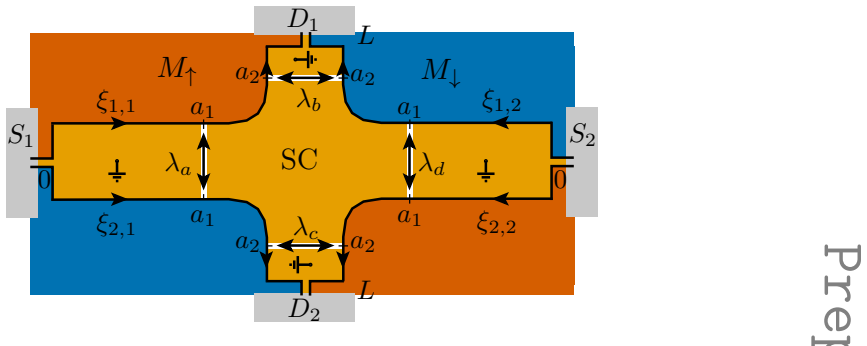
Summary. The manuscript proposes a symmetric four-terminal, X-shaped chiral Majorana interferometer containing a floating superconducting island and Josephson line junctions that nucleate edge vortices. Bosonization separates the theory into independent ϕ± sectors; the ϕ− sector gives no DC response, while the ϕ+ sector contains vacuum-channel edge-vortex tunneling Γ, Majorana tunneling δλ, and a fermionic-channel composite process Γ̃. A one-loop RG calculation shows that Γ and δλ generate Γ̃. Kubo theory then yields the rank-one tensor G=G̃[[1,1],[1,1]], with weak-coupling conductance oscillations in Eq. (3.12) offset by π/4 and a finite strong-coupling result in Eq. (3.21). The authors conclude that finite low-energy DC conductance, especially with the gate offset, provides direct evidence for non-Abelian Ising statistics.
Significance. If the result holds, it would provide a comparatively accessible DC-transport probe of Ising-anyon fusion, avoiding the more demanding AC, noise, or anyon-collision measurements. The paper offers an explicit effective-theory derivation rather than a fit to data, and supplies several falsifiable signatures: a rank-one conductance tensor, joint activation by edge-vortex and antisymmetric Majorana tunneling, the 1/8 gate-charge offset, and distinctive temperature and junction-separation dependences. Its impact nevertheless depends on establishing the experimental exclusivity of the zero-conductance theorem, justifying the no-quasiparticle window, and correcting the strong-coupling calculation.
major comments (3)
- [Sec. 3, Eqs. (3.8)-(3.10); Sec. 4] §3, Eqs. (3.8)–(3.10), and §4: The inference “finite low-energy conductance ⇒ non-Abelian statistics” is not shown to be exclusive. The zero-conductance argument assumes unit Dirac–Majorana conversion, ideal co-propagating Majorana edges, fixed parity, no bulk defects or quasiparticles, and exact device symmetry. Normal reflection/leakage at the converters, trivial subgap Andreev occupation, or residual parity switching can produce a finite DC background; in a symmetric device such a background could potentially mimic the rank-one form. §4 acknowledges the ng→ng+1/2 ambiguity but does not analyze the associated transport background. Please either derive bounds on these alternatives or moderate the sufficiency claim and specify discriminating controls: independent suppression of Γ and δλ, the 1/8 gate offset, predicted T and δa dependences, and an above-gap/normal-leakage baseline.
- [Sec. 2.4, after Eq. (2.18)] §2.4, after Eq. (2.18): The operating assumption ωp≫Δ appears to give an instanton sufficient energy to create above-gap quasiparticles, yet the text only states that EC suppresses such effects “in practice.” EC enters the phase-slip rate, but it is not obvious that it eliminates the available energy or guarantees relaxation before the next slip. The fixed-parity bosonized theory, generation of Γ̃, and zero-conductance theorem all require quasiparticle poisoning to be negligible on the measurement time scale. A quantitative window is needed—for example, poisoning probability per phase slip, relaxation rate versus Γ and T, and thermal exp(−Δ/T) population—together with an estimate of how a residual poisoning rate modifies G.
- [Sec. 3.2, Eqs. (3.14), (3.16)-(3.21)] §3.2, Eqs. (3.14), (3.16)–(3.19): The strong-coupling algebra is internally inconsistent. From the action term −(2δλ/lc)∫dτ sin(√2w2−φ+), one obtains ∂lnZ/∂δλ=2⟨sin⟩/(lcT), hence ⟨ID+⟩=(evT/2)∂lnZ/∂δλ, not Eq. (3.14) as written. Moreover, minimizing Vn+ in Eq. (3.16) gives ρ+=δλ/(lcΓ)+eV/(8πΓ), while Eq. (3.18) has δλ/(2lcΓ); the Θ-dependent part of ρ− also differs by a factor of two. The quoted Vmin has corresponding factor-of-two and eV-coefficient discrepancies. Since Eqs. (3.20)–(3.21) inherit Eq. (3.18), the strong-coupling conductance requires a full rederivation.
minor comments (4)
- [Eq. (3.9)] Eq. (3.9): Calling G “completely isotropic” is potentially confusing. The matrix has eigenvalues 2G̃ and 0 and is therefore rank one rather than proportional to the identity; “fully symmetric rank-one conductance tensor” would be more precise.
- [Figure 3] Figure 3: Please state the numerical values of Γ/Δ, δλ/v (or φbc), and φ+ used in the plot and include the color scale. Because Eq. (3.12) is valid only under Eq. (2.38), the plotted region approaching strong coupling should also be clearly distinguished.
- [Eq. (2.37)] Eq. (2.37): Writing the OPE with H̃EV(τ)/Γ̃ is awkward and formally ill-defined for the stated bare value Γ̃(0)≃0. Please express the generated operator and its OPE coefficient directly, including the sign and short-time convention.
- [Secs. 2.5 and 3.1] In the paragraph below Eq. (3.12), “v/δ” should presumably be “v/δa.” There is also a typo (“accomodate”) in Sec. 2.5.
Circularity Check
No significant circularity: DC conductance formulas are derived from the effective bosonized Hamiltonian and RG/OPE, not forced by definition or by a load-bearing self-citation chain.
specific steps
-
self citation load bearing
[Sec. 2.4, Eqs. (2.16)–(2.20) and estimate (2.18)]
"Using the bosonization rules (2.6) with the chiral boson fields ϕ1(x) and ϕ2(x), bosonized expressions for Ta and Td have previously been established: With isospin operators S±=Sx±iSy, one finds Ta∝∑±S∓e±i2ϕ1(a1) and Td∝∑±S±e±i2ϕ2(a1) [19, 25]. ... The composite EV creation or annihilation rate Γ is estimated along the lines of Refs. [25, 46], Γ≃ωp(E∗J/2EC)1/4 e−√8E∗J/EC"
Elementary EV tunneling operators and the bare rate Γ are taken from the authors’ prior two-arm work [25] (and [19,46]). This is ordinary technical reuse, not a load-bearing circularity: the present paper’s central claim—that the multi-terminal geometry activates ˜Γ and yields a finite isotropic DC tensor with π/4 offset—is a new calculation that does not follow by definition from those inputs (in [25] the corresponding DC contribution vanishes).
full rationale
This is a self-contained theoretical proposal. The isotropic tensor G = G̃[[1,1],[1,1]], the necessity of simultaneous Γ and δλ (via dynamically generated ˜Γ), and the π/4 gate offset are obtained by explicit calculation: chiral bosonization of the four-terminal model (Sec. 2), one-loop RG/OPE generation of the fermionic-channel operator (Eqs. 2.35–2.39), and Kubo evaluation of the current–current correlator in weak and strong coupling (Sec. 3, Eqs. 3.9–3.12 and 3.21). None of these steps reduces by construction to an input parameter or to a fitted quantity. Self-citations to the authors’ two-arm AC paper [25] supply the elementary EV operators Ta,d, the rate estimate Γ, and the instanton technique; those are standard building blocks for an extension and do not dictate the new result that DC conductance is finite only when the ψ fusion channel opens in the X geometry (the two-arm geometry of [25] has vanishing DC). The topological-spin phase enters from the bosonic commutator algebra and the double-pair structure of ˜HEV, not from an imported uniqueness theorem. No data fits, no renaming of known empirical patterns, and no self-definitional loop. Score 1 only for ordinary, non-load-bearing reliance on prior same-author technical machinery.
Axiom & Free-Parameter Ledger
free parameters (3)
- bare EV tunneling rate Γ (and generated Γ̃)
- Majorana tunneling combination δλ = λb − λc (and φbc, φ±)
- junction separation δa = a2 − a1 relative to v/Δ
axioms (7)
- domain assumption Chiral Majorana edge modes exist at SC–magnet interfaces on a 3D TI surface and convert to Dirac channels with unit probability.
- domain assumption Ising anyon fusion rule σ × σ ∼ I + ψ and topological spin sσ = 1/16.
- standard math Chiral bosonization dictionary (2.6)–(2.12) correctly represents the four Majorana modes and Dirac–Majorana matching.
- domain assumption Regime EJ ≫ EC with rare, simultaneous quantum phase slips on the floating island, giving the composite rate Γ in (2.18).
- ad hoc to paper Above-gap quasiparticles generated by instantons are negligible at the working temperature because EC suppresses them.
- ad hoc to paper Device is geometrically symmetric (equal lengths, equal EJ, equal velocities) so that H = H(+) + H(−) decouples and the conductance tensor is isotropic.
- domain assumption No unpaired localized MZMs inside the interferometer (or their only effect is an ng → ng + 1/2 shift).
invented entities (2)
-
X-shaped four-terminal chiral Majorana interferometer with central floating SC island
no independent evidence
-
Composite EV tunneling operator H̃EV in the fermionic fusion channel
no independent evidence
read the original abstract
We propose a four-terminal, X-shaped chiral Majorana interferometer with a central floating superconducting island, enabling the direct detection of the non-Abelian statistics of Ising anyons via the linear-response DC conductance tensor in charge transport experiments. Here, Ising anyons are realizable as edge vortices nucleated at Josephson line junctions defining the superconducting island, where both edge-vortex and Majorana-fermion tunneling processes can occur. We show that in such a multi-terminal Majorana interferometer, both the vacuum and the fermionic fusion channel for Ising anyons are possible. This is in contrast to two-arm interferometers, where only the vacuum fusion channel is accessible and the DC conductance contribution from edge vortices always vanishes. Using a low-energy effective theory derived via chiral bosonization, we find that in the X-shaped interferometer, the DC conductance tensor is completely isotropic, yielding a non-zero conductance when simultaneous edge-vortex and Majorana tunneling activates the fermionic fusion channel. Apart from conductance oscillations in a gate-tunable charge parameter, which display an offset related to the anyon topological spin, measuring a finite conductance can already provide direct evidence for non-Abelian statistics in this geometry.
Figures


Reference graph
Works this paper leans on
-
[1]
Bartolomei, M
H. Bartolomei, M. Kumar, R. Bisognin, A. Marguerite, J.-M. Berroir, E. Bocquillon et al., Fractional statistics in anyon collisions,Science368(2020) 173, DOI
2020
-
[2]
Nakamura, S
J. Nakamura, S. Liang, G.C. Gardner and M. Manfra,Direct observation of anyonic braiding statistics,Nature Physics16(2020) 931, DOI
2020
-
[3]
Nayak, S.H
C. Nayak, S.H. Simon, A. Stern, M. Freedman and S. Das Sarma,Non-Abelian anyons and topological quantum computation,Rev. Mod. Phys.80(2008) 1083, DOI
2008
-
[4]
Beenakker,Search for non-Abelian Majorana braiding statistics in superconductors, SciPost Phys
C.W.J. Beenakker,Search for non-Abelian Majorana braiding statistics in superconductors, SciPost Phys. Lect. Notes(2020) 15, DOI
2020
-
[5]
Barkeshli, P
M. Barkeshli, P. Bonderson, M. Cheng and Z. Wang,Symmetry fractionalization, defects, and gauging of topological phases,Phys. Rev. B100(2019) 115147, DOI
2019
-
[6]
T. Dvir, G. Wang, N. van Loo, C.-X. Liu, G.P. Mazur, A. Bordin et al.,Realization of a minimal Kitaev chain in coupled quantum dots,Nature614(2023) 445, DOI. [7]Microsoft Quantumcollaboration,InAs-Al hybrid devices passing the topological gap protocol,Phys. Rev. B107(2023) 245423, DOI
2023
-
[8]
ten Haaf, Q
S.L.D. ten Haaf, Q. Wang, A.M. Bozkurt, C.-X. Liu, I. Kulesh, P. Kim et al.,A two-site Kitaev chain in a two-dimensional electron gas,Nature630(2024) 329, DOI
2024
-
[9]
Aghaee, A
M. Aghaee, A. Alcaraz Ramirez, Z. Alam, R. Ali, M. Andrzejczuk, A. Antipov et al., Interferometric single-shot parity measurement in InAs–Al hybrid devices,Nature638 (2025) 651, DOI. 18 Prepared for submission (JQuant)
2025
-
[10]
van Loo, F
N. van Loo, F. Zatelli, G.O. Steffensen, B. Roovers, G. Wang, T. Van Caekenberghe et al., Single-shot parity readout of a minimal Kitaev chain,Nature650(2026) 334, DOI
2026
-
[11]
M. Aghaee, Z. Alam, M. Andrzejczuk, A. Antipov, T. Asimakidis, M. Astafev et al.,20 Second Parity Lifetime in an InAs–Pb Tetron Device, (2026) URL [2606.03884]
Pith/arXiv arXiv 2026
-
[12]
F. Zatelli, B. Roovers, N. van Loo, A. Lombardi, J.D.T. Luna, S. Miles et al.,Majorana parity qubit in coupled minimal Kitaev chains, (2026) URL [2607.09511]
Pith/arXiv arXiv 2026
-
[13]
Stenger, N.T
J.P.T. Stenger, N.T. Bronn, D.J. Egger and D. Pekker,Simulating the dynamics of braiding of Majorana zero modes using an IBM quantum computer,Phys. Rev. Res.3(2021) 033171, DOI
2021
-
[14]
Harle, O
N. Harle, O. Shtanko and R. Movassagh,Observing and braiding topological Majorana modes on programmable quantum simulators,Nature Communications14(2023) 2286, DOI
2023
-
[15]
Prada, P
E. Prada, P. San-Jose, M.W.A. de Moor, A. Geresdi, E.J.H. Lee, J. Klinovaja et al.,From Andreev to Majorana bound states in hybrid superconductor–semiconductor nanowires, Nature Reviews Physics2(2019) 575, DOI
2019
-
[16]
Bonderson, A
P. Bonderson, A. Kitaev and K. Shtengel,Detecting Non-Abelian Statistics in theν= 5/2 Fractional Quantum Hall State,Phys. Rev. Lett.96(2006) 016803, DOI
2006
-
[17]
Bonderson,Non-Abelian Anyons and Interferometry(2007), DOI
P. Bonderson,Non-Abelian Anyons and Interferometry(2007), DOI
2007
-
[18]
Fendley, M.P
P. Fendley, M.P. Fisher and C. Nayak,Boundary conformal field theory and tunneling of edge quasiparticles in non-Abelian topological states,Annals of Physics324(2009) 1547, DOI
2009
-
[19]
Fendley, M.P.A
P. Fendley, M.P.A. Fisher and C. Nayak,Edge states and tunneling of non-Abelian quasiparticles in theν= 5/2quantum Hall state andp+ipsuperconductors,Phys. Rev. B 75(2007) 045317, DOI
2007
-
[20]
Beenakker, P
C.W.J. Beenakker, P. Baireuther, Y. Herasymenko, İ. Adagideli, L. Wang and A.R. Akhmerov,Deterministic Creation and Braiding of Chiral Edge Vortices,Phys. Rev. Lett.122(2019) 146803, DOI
2019
-
[21]
Beenakker, A
C.W.J. Beenakker, A. Grabsch and Y. Herasymenko,Electrical detection of the Majorana fusion rule for chiral edge vortices in a topological superconductor,SciPost Phys.6(2019) 022, DOI
2019
-
[22]
Hassler, A
İnanç Adagideli, F. Hassler, A. Grabsch, M. Pacholski and C.W.J. Beenakker,Time-resolved electrical detection of chiral edge vortex braiding,SciPost Phys.8(2020) 013, DOI
2020
-
[23]
Hassler, A
F. Hassler, A. Grabsch, M.J. Pacholski, D.O. Oriekhov, O. Ovdat, I. Adagideli et al., Half-integer charge injection by a Josephson junction without excess noise,Phys. Rev. B 102(2020) 045431, DOI
2020
-
[24]
I.M. Flór, A. Donís-Vela, C.W.J. Beenakker and G. Lemut,Dynamical simulation of the injection of vortices into a Majorana edge mode,Phys. Rev. B108(2023) 235309, DOI
2023
-
[25]
A. Nava, R. Egger, F. Hassler and D. Giuliano,Non-Abelian Anyon Statistics through ac Conductance of a Majorana Interferometer,Phys. Rev. Lett.133(2024) 146604, DOI
2024
-
[26]
Nilsson and A.R
J. Nilsson and A.R. Akhmerov,Theory of non-Abelian Fabry-Perot interferometry in topological insulators,Phys. Rev. B81(2010) 205110, DOI
2010
-
[27]
Clarke and K
D.J. Clarke and K. Shtengel,Improved phase-gate reliability in systems with neutral Ising anyons,Phys. Rev. B82(2010) 180519, DOI
2010
-
[28]
C.-Y. Hou, F. Hassler, A.R. Akhmerov and J. Nilsson,Probing Majorana edge states with a flux qubit,Phys. Rev. B84(2011) 054538, DOI
2011
-
[29]
Grosfeld and A
E. Grosfeld and A. Stern,Observing Majorana bound states of Josephson vortices in topological superconductors,Proceedings of the National Academy of Sciences108(2011) 11810, DOI. 19 Prepared for submission (JQuant)
2011
-
[30]
Ariad and E
D. Ariad and E. Grosfeld,Signatures of the topological spin of Josephson vortices in topological superconductors,Phys. Rev. B95(2017) 161401, DOI
2017
-
[31]
Kitaev,Anyons in an exactly solved model and beyond,Ann
A. Kitaev,Anyons in an exactly solved model and beyond,Ann. Phys. (N. Y.)321(2006) 2, DOI
2006
-
[32]
Fu and C.L
L. Fu and C.L. Kane,Probing Neutral Majorana Fermion Edge Modes with Charge Transport,Phys. Rev. Lett.102(2009) 216403, DOI
2009
-
[33]
Akhmerov, J
A.R. Akhmerov, J. Nilsson and C.W.J. Beenakker,Electrically Detected Interferometry of Majorana Fermions in a Topological Insulator,Phys. Rev. Lett.102(2009) 216404, DOI
2009
-
[34]
Røising and S.H
H.S. Røising and S.H. Simon,Size constraints on a Majorana beam-splitter interferometer: Majorana coupling and surface-bulk scattering,Phys. Rev. B97(2018) 115424, DOI
2018
-
[35]
Shapiro, A.D
D.S. Shapiro, A.D. Mirlin and A. Shnirman,Microwave response of a chiral Majorana interferometer,Phys. Rev. B104(2021) 035434, DOI
2021
-
[36]
Huang, D
L. Huang, D. Qian and J. Wang,Revealing superconducting chiral edge modes via resistance distributions,Phys. Rev. B113(2026) 014503, DOI
2026
-
[37]
Amet, C.T
F. Amet, C.T. Ke, I.V. Borzenets, J. Wang, K. Watanabe, T. Taniguchi et al.,Supercurrent in the quantum Hall regime,Science352(2016) 966, DOI
2016
-
[38]
Lee, K.-F
G.-H. Lee, K.-F. Huang, D.K. Efetov, D.S. Wei, S. Hart, T. Taniguchi et al.,Inducing superconducting correlation in quantum Hall edge states,Nature Physics13(2017) 693, DOI
2017
-
[39]
A. Uday, G. Lippertz, K. Moors, H.F. Legg, R. Joris, A. Bliesener et al.,Induced superconducting correlations in a quantum anomalous Hall insulator,Nature Physics20 (2024) 1589, DOI
2024
-
[40]
Lee and H.-S
J.-Y.M. Lee and H.-S. Sim,Non-Abelian anyon collider,Nature Communications13(2022) 6660, DOI
2022
-
[41]
J. Tang and G. v. Chen,Non-Abelian Anyon Braiding with Quantum-Antidot Interferometry, (2026) URL [2606.24930]
Pith/arXiv arXiv 2026
- [42]
-
[43]
Gogolin, A.A
A.O. Gogolin, A.A. Nersesyan and A.M. Tsvelik,Bosonization and Strongly Correlated Systems, Cambridge University Press (1998)
1998
-
[44]
Hasan and C.L
M.Z. Hasan and C.L. Kane,Topological insulators,Rev. Mod. Phys.82(2010) 3045, DOI
2010
-
[45]
von Delft and H
J. von Delft and H. Schoeller,Bosonization for beginners — refermionization for experts, Annalen der Physik510(1998) 225, DOI
1998
-
[46]
Schön and A
G. Schön and A. Zaikin,Quantum coherent effects, phase transitions, and the dissipative dynamics of ultra small tunnel junctions,Physics Reports198(1990) 237, DOI
1990
-
[47]
J. Li, G. Fleury and M. Büttiker,Scattering theory of chiral Majorana fermion interferometry,Phys. Rev. B85(2012) 125440, DOI
2012
-
[48]
Strübi, W
G. Strübi, W. Belzig, M.-S. Choi and C. Bruder,Interferometric and Noise Signatures of Majorana Fermion Edge States in Transport Experiments,Phys. Rev. Lett.107(2011) 136403, DOI
2011
-
[49]
Altland and B.D
A. Altland and B.D. Simons,Condensed Matter Field Theory, Cambridge University Press (2010), [ISBN 9780521845083], DOI
2010
-
[50]
J. Cardy,Conformal Field Theory and Statistical Mechanics, in theLes Houches Summer School: Session 89: Exacts Methods in Low-Dimensional Statistical Physics and Quantum Computing, (2008) [0807.3472]
Pith/arXiv arXiv 2008
-
[51]
Campagnano, P
G. Campagnano, P. Lucignano and D. Giuliano,Chirality and current-current correlation in fractional quantum Hall systems,Phys. Rev. B93(2016) 075441, DOI. 20
2016
discussion (0)
Sign in with ORCID, Apple, or X to comment. Anyone can read and Pith papers without signing in.