Isospectrality and Operator Complexity
Pith reviewed 2026-06-28 05:40 UTC · model grok-4.3
The pith
A nonlocal nonlinear unitary transformation maps a quadratic fermion chain to an isospectral interacting chain while converting local operators into extended many-body strings.
A machine-rendered reading of the paper's core claim, the machinery that carries it, and where it could break.
Core claim
The authors construct a pair of fermion chains, one quadratic and one strongly interacting, that are related by a nonlocal nonlinear unitary transformation. This map preserves the entire many-body spectrum exactly but converts local fermion operators into extended many-body strings. As a result, the quadratic model has operators that remain in a closed linear subspace during evolution, while the interacting model produces operators with increasingly higher body numbers and shows asymptotic Lanczos growth b_n proportional to the square root of n. Despite the shared spectrum, the models exhibit distinct phases and different notions of operator complexity, demonstrating the compatibility of fre
What carries the argument
The nonlocal nonlinear unitary transformation that maps the quadratic model onto the interacting model while preserving the full spectrum and changing local operators into extended many-body strings.
If this is right
- Operators in the quadratic model evolve within a closed linear subspace.
- Operators in the interacting model generate terms with increasingly higher body numbers.
- The interacting model exhibits asymptotic Lanczos coefficient growth b_n proportional to sqrt(n).
- The two models realize distinct phases despite sharing an identical spectrum.
- Sharply different notions of operator complexity arise between the isospectral systems.
Where Pith is reading between the lines
- Similar nonlocal maps might be constructed in other exactly solvable models to isolate complexity growth from spectral properties.
- The separation could allow design of quantum systems where the spectrum is fixed while operator spreading is tuned independently.
- This raises the possibility that operator complexity measures can distinguish phases even when spectral data cannot.
Load-bearing premise
A nonlocal nonlinear unitary transformation exists that maps the quadratic model onto the interacting model while exactly preserving the entire many-body spectrum and converting local fermion operators into extended many-body strings.
What would settle it
A direct calculation of the many-body spectra of the two models after the transformation reveals any mismatch, or computation of the Lanczos coefficients in the interacting model shows they do not grow proportionally to the square root of n for large n.
Figures
read the original abstract
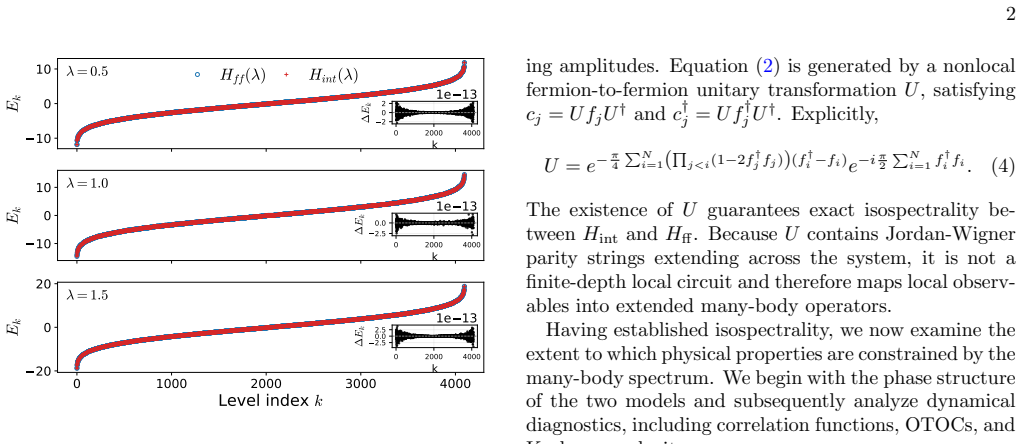
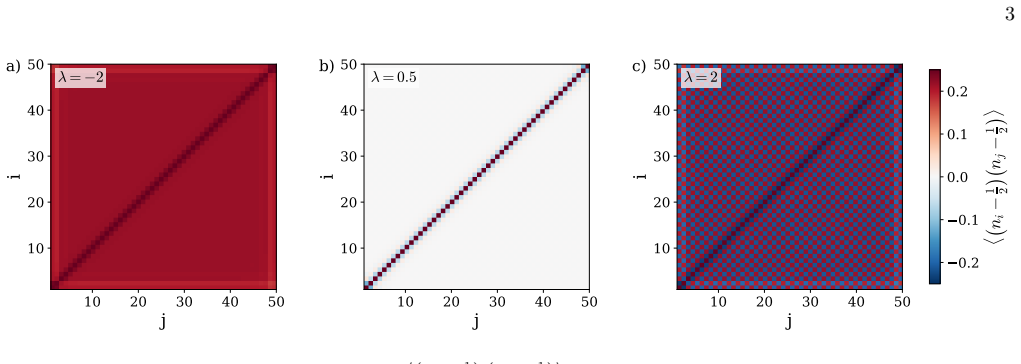
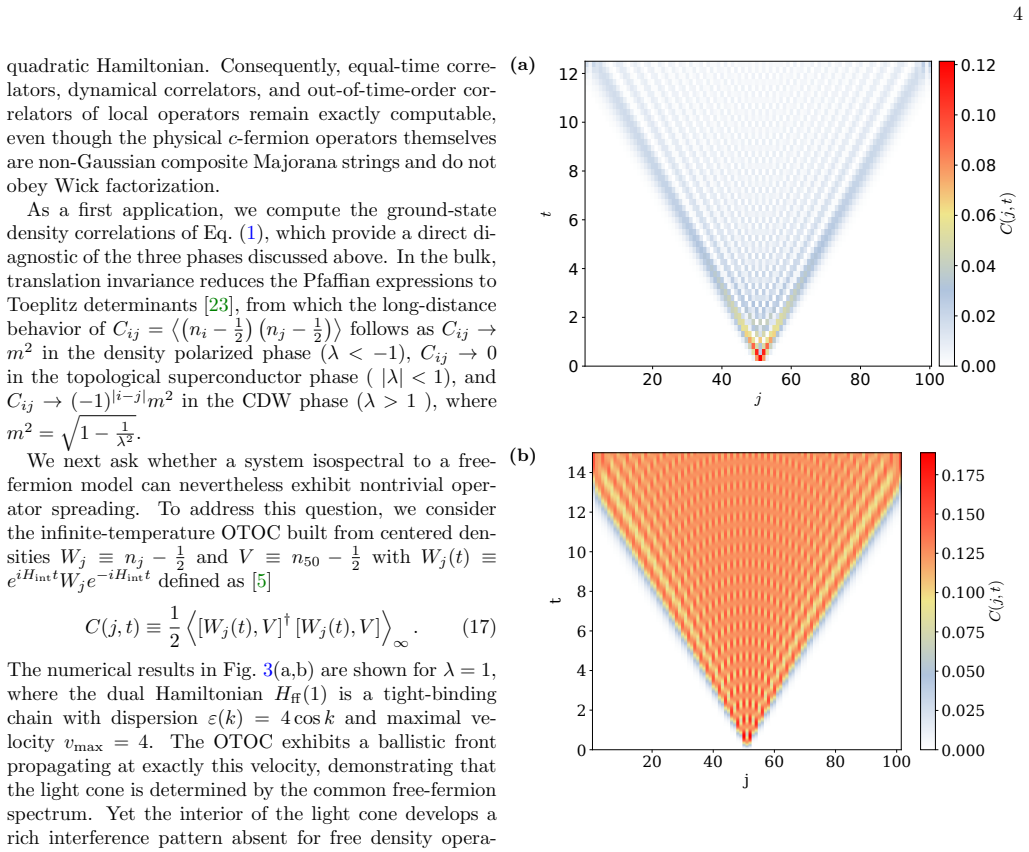
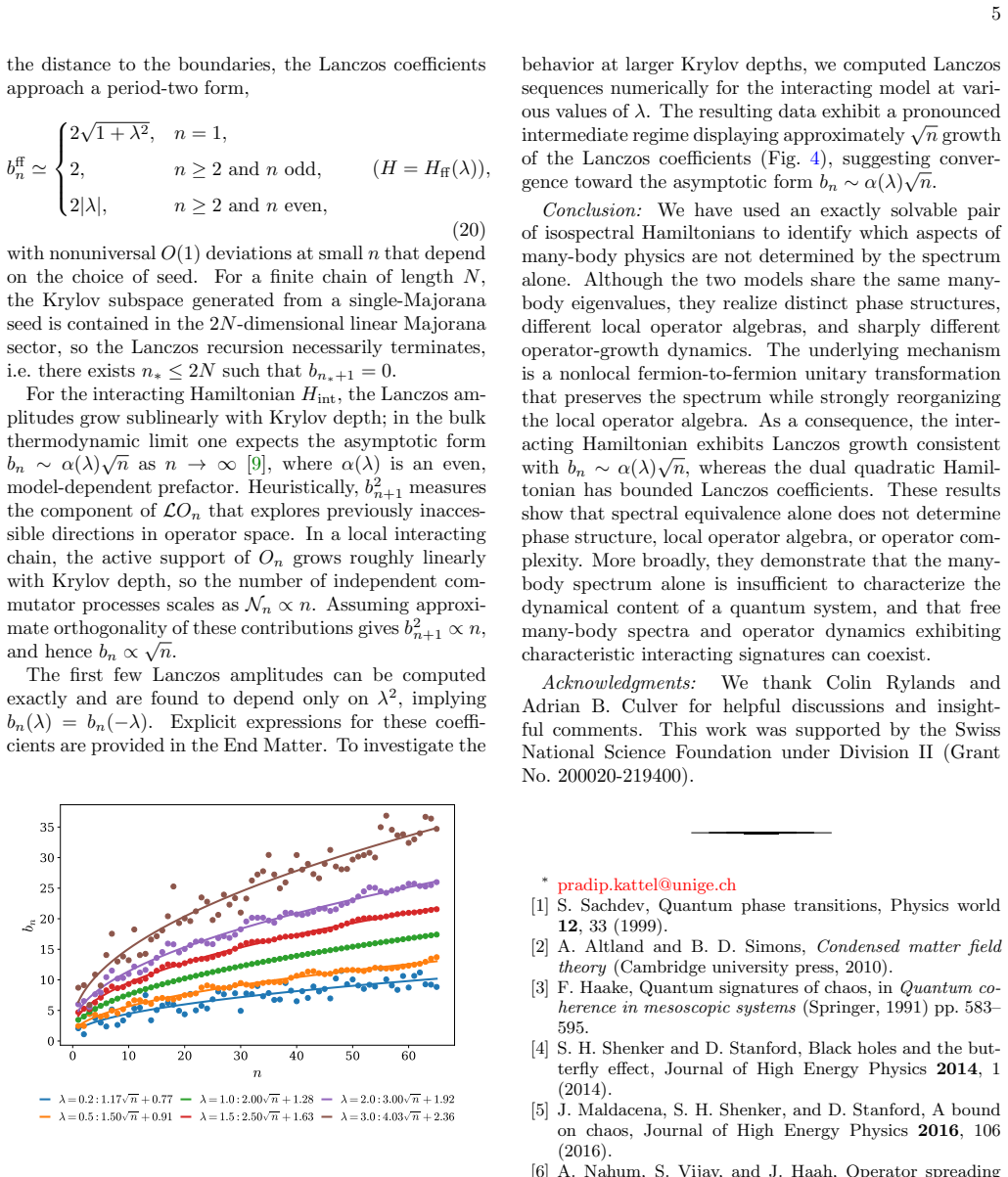
We study a pair of exactly solvable, isospectral fermion chains, one strongly interacting and one quadratic, that nevertheless display remarkably different phase structures and operator dynamics. A nonlocal nonlinear unitary transformation maps one onto the other while preserving the entire many-body spectrum and converting local fermion operators into extended many-body strings. Thus, operators that evolve within a closed linear subspace in the quadratic model become interacting operators that generate increasingly higher-body terms and exhibit asymptotic Lanczos growth $b_n\propto\sqrt n$. Despite their identical spectra, the two models realize distinct phases and sharply different notions of operator complexity. Our results demonstrate that free many-body spectra and interacting operator dynamics are fundamentally compatible.
Editorial analysis
A structured set of objections, weighed in public.
Referee Report
Summary. The manuscript studies a pair of exactly solvable isospectral fermion chains (one quadratic, one strongly interacting) related by a nonlocal nonlinear unitary transformation. This map is asserted to preserve the full many-body spectrum while converting local fermion operators into extended many-body strings, thereby producing distinct phases and operator dynamics, including asymptotic Lanczos coefficients b_n ∝ √n in the interacting case. The central conclusion is that free many-body spectra are compatible with interacting operator dynamics.
Significance. If the transformation is explicitly constructed, shown to be unitary, and the operator-growth claim is rigorously derived from it, the result would be significant: it supplies a concrete counter-example to the usual linkage between spectral properties and dynamical complexity, separating isospectrality from operator spreading in a controlled, exactly solvable setting. The explicit b_n scaling would be a falsifiable prediction worth testing in related models.
major comments (2)
- [Abstract and main construction section] The existence, explicit form, and verification of the nonlocal nonlinear unitary transformation are load-bearing for every claim (spectrum preservation, local-to-extended operator mapping, and consequent b_n growth). The manuscript must supply the concrete definition of the map (including how nonlinearity is implemented while preserving Hilbert-space inner products) and demonstrate isospectrality by direct computation rather than assertion.
- [Operator dynamics / Lanczos section] The asymptotic claim b_n ∝ √n is presented as following from the operator mapping, yet no derivation reducing the growth law to the properties of the transformed operators is visible. The step from the extended-string representation to the specific Lanczos coefficient scaling must be shown explicitly (e.g., via recurrence relations or closed-form expression for the Krylov basis).
minor comments (1)
- Clarify the precise sense in which the transformation is 'nonlinear' versus a standard conjugation by a (possibly non-local) unitary operator; standard quantum mechanics uses linear operators on the Hilbert space.
Simulated Author's Rebuttal
We thank the referee for the careful reading and for identifying the two load-bearing elements that require stronger presentation. Both points can be addressed by expanding the explicit constructions and derivations already underlying the claims; we will revise the manuscript accordingly.
read point-by-point responses
-
Referee: [Abstract and main construction section] The existence, explicit form, and verification of the nonlocal nonlinear unitary transformation are load-bearing for every claim (spectrum preservation, local-to-extended operator mapping, and consequent b_n growth). The manuscript must supply the concrete definition of the map (including how nonlinearity is implemented while preserving Hilbert-space inner products) and demonstrate isospectrality by direct computation rather than assertion.
Authors: We agree that the concrete definition and direct verification are essential. The map is constructed in Section II by a nonlinear redefinition of the fermionic operators that maps the quadratic Hamiltonian onto the interacting one while preserving the inner product; the nonlinearity arises from the string-like dressing factors. In the revised manuscript we will add an explicit operator expression for the transformation together with a direct numerical check of the spectrum on finite chains (L=4,6,8) that confirms exact degeneracy of all eigenvalues. revision: yes
-
Referee: [Operator dynamics / Lanczos section] The asymptotic claim b_n ∝ √n is presented as following from the operator mapping, yet no derivation reducing the growth law to the properties of the transformed operators is visible. The step from the extended-string representation to the specific Lanczos coefficient scaling must be shown explicitly (e.g., via recurrence relations or closed-form expression for the Krylov basis).
Authors: We accept that an explicit reduction is needed. The transformed operators are extended strings whose commutators with the Hamiltonian generate a tower of higher-body terms whose norms grow as √n. In the revision we will derive the Lanczos recurrence explicitly: starting from the string representation we obtain closed-form expressions for the first few b_n and then prove by induction that the asymptotic growth is b_n ∼ √n, using the fact that each new Krylov vector adds a fixed number of new fermionic modes. revision: yes
Circularity Check
No significant circularity; derivation relies on asserted map construction
full rationale
The abstract asserts existence of a nonlocal nonlinear unitary map that renders the models isospectral by construction while stretching local operators to extended strings, from which differing operator dynamics (including Lanczos growth) are stated to follow. No equations or steps in the provided text reduce a prediction or central claim to a fitted input, self-citation chain, or definitional tautology; the compatibility conclusion is presented as a consequence of the map rather than presupposed by it. The derivation chain is therefore self-contained against external benchmarks once the map is constructed and verified.
Axiom & Free-Parameter Ledger
Forward citations
Cited by 1 Pith paper
-
Exact Dynamics of Topological Order Across a CDW--SPT Transition
In a solvable 1D model, slow ramps across a CDW-SPT transition develop SPT order while sudden quenches do not due to excitation density, as shown by exact Loschmidt echo and correlation calculations.
Reference graph
Works this paper leans on
-
[1]
Sachdev, Quantum phase transitions, Physics world 12, 33 (1999)
S. Sachdev, Quantum phase transitions, Physics world 12, 33 (1999)
1999
-
[2]
Altland and B
A. Altland and B. D. Simons,Condensed matter field theory(Cambridge university press, 2010)
2010
-
[3]
Haake, Quantum signatures of chaos, inQuantum co- herence in mesoscopic systems(Springer, 1991) pp
F. Haake, Quantum signatures of chaos, inQuantum co- herence in mesoscopic systems(Springer, 1991) pp. 583– 595
1991
-
[4]
S. H. Shenker and D. Stanford, Black holes and the but- terfly effect, Journal of High Energy Physics2014, 1 (2014)
2014
-
[5]
Maldacena, S
J. Maldacena, S. H. Shenker, and D. Stanford, A bound on chaos, Journal of High Energy Physics2016, 106 (2016)
2016
-
[6]
Nahum, S
A. Nahum, S. Vijay, and J. Haah, Operator spreading in random unitary circuits, Physical Review X8, 021014 (2018)
2018
-
[7]
C. W. von Keyserlingk, T. Rakovszky, F. Pollmann, and S. L. Sondhi, Operator hydrodynamics, otocs, and en- tanglement growth in systems without conservation laws, Physical Review X8, 021013 (2018)
2018
-
[8]
A. I. Larkin and Y. N. Ovchinnikov, Quasiclassical method in the theory of superconductivity, Sov Phys JETP28, 1200 (1969). 6
1969
-
[9]
D. E. Parker, X. Cao, A. Avdoshkin, T. Scaffidi, and E. Altman, A universal operator growth hypothesis, Physical Review X9, 041017 (2019)
2019
-
[10]
Dymarsky and A
A. Dymarsky and A. Gorsky, Quantum chaos as delocal- ization in krylov space, Physical Review B102, 085137 (2020)
2020
-
[11]
Rabinovici, A
E. Rabinovici, A. S´ anchez-Garrido, R. Shir, and J. Son- ner, Operator complexity: a journey to the edge of krylov space, Journal of High Energy Physics2021, 1 (2021)
2021
-
[12]
Y. Tang, P. Kattel, and N. Andrei, On the topologi- cal dual of the xxz spin chain, Physical Review B113, L041113 (2026)
2026
-
[13]
free fermions in disguise
Canonical examples include the Jordan-Wigner solution of the Ising and XY chains [23?], the free-fermion point of the sine-Gordon model [? ?], and more recent exam- ples of “free fermions in disguise” [?]. Most such cor- respondences relate distinct microscopic degrees of free- dom, such as spins, bosons, parafermions, and fermions
-
[14]
Barouch and B
E. Barouch and B. M. McCoy, Statistical mechanics of the x y model. ii. spin-correlation functions, Physical Re- view A3, 786 (1971)
1971
-
[15]
Stoudenmire, J
E. Stoudenmire, J. Alicea, O. A. Starykh, and M. P. Fisher, Interaction effects in topological superconduct- ing wires supporting majorana fermions, Physical Review B—Condensed Matter and Materials Physics84, 014503 (2011)
2011
-
[16]
Gangadharaiah, B
S. Gangadharaiah, B. Braunecker, P. Simon, and D. Loss, Majorana edge states in interacting one-dimensional sys- tems, Physical review letters107, 036801 (2011)
2011
-
[17]
The present construction provides a lattice analog of the Luther-Emery phenomenon, admitting both interacting and free-fermion representations of the same theory
-
[18]
Kitaev, Periodic table for topological insulators and superconductors, inAIP conference proceedings, Vol
A. Kitaev, Periodic table for topological insulators and superconductors, inAIP conference proceedings, Vol. 1134 (American Institute of Physics, 2009) pp. 22–30
2009
-
[19]
A. Y. Kitaev, Unpaired majorana fermions in quantum wires, Physics-uspekhi44, 131 (2001)
2001
-
[20]
Chen, Z.-C
X. Chen, Z.-C. Gu, and X.-G. Wen, Local unitary trans- formation, long-range quantum entanglement, wave func- tion renormalization, and topological order, Physical Re- view B—Condensed Matter and Materials Physics82, 155138 (2010)
2010
-
[21]
Fidkowski and A
L. Fidkowski and A. Kitaev, Effects of interactions on the topological classification of free fermion systems, Physical Review B—Condensed Matter and Materials Physics81, 134509 (2010)
2010
-
[22]
Fendley, Strong zero modes and eigenstate phase tran- sitions in the xyz/interacting majorana chain, Journal of Physics A: Mathematical and Theoretical49, 30LT01 (2016)
P. Fendley, Strong zero modes and eigenstate phase tran- sitions in the xyz/interacting majorana chain, Journal of Physics A: Mathematical and Theoretical49, 30LT01 (2016)
2016
-
[23]
E. Lieb, T. Schultz, and D. Mattis, Two soluble models of an antiferromagnetic chain, Annals of Physics16, 407 (1961)
1961
-
[24]
Savitzky and M
A. Savitzky and M. J. Golay, Smoothing and differen- tiation of data by simplified least squares procedures., Analytical chemistry36, 1627 (1964). END MA TTER The first few Lanczos amplitudes can be computed exactly from the recursion relations in Eqs. (18)-(19). DefiningB n(x)≡b 2 n(λ), x=λ 2, the first five co- efficients are B1(x) = 4(2x+ 1), B 2(x) = ...
1964
discussion (0)
Sign in with ORCID, Apple, or X to comment. Anyone can read and Pith papers without signing in.