Primordial Black Holes: A Review of Formation and Evolution
Pith reviewed 2026-06-26 07:11 UTC · model grok-4.3
The pith
Dynamic FLRW backgrounds and quantum memory burden halt primordial black hole evaporation at Planck scale.
A machine-rendered reading of the paper's core claim, the machinery that carries it, and where it could break.
Core claim
By incorporating the dynamic nature of FLRW backgrounds, higher curvature corrections, and quantum backreaction via the memory burden effect, we challenge the standard hawking evaporation and show that extreme-curvature environments halt evaporation entirely, leaving Planck-scale relics that evade current extragalactic bounds.
What carries the argument
The memory burden effect arising from quantum backreaction, which, together with higher-curvature corrections in a dynamic FLRW background, prevents complete evaporation of primordial black holes.
If this is right
- Planck-scale relics remain viable as a dark matter component without conflicting with extragalactic bounds.
- Sub-solar-mass primordial black hole binaries become detectable targets for next-generation gravitational-wave observatories.
- Primordial black holes can serve as laboratories for high-energy physics and quantum-gravity effects.
- The standard Hawking evaporation rate must be modified in the early-universe setting.
Where Pith is reading between the lines
- The same backreaction mechanism may alter the late-time evolution of astrophysical black holes formed in strong-curvature environments.
- Stable relics could leave distinct imprints on the cosmic microwave background or large-scale structure that differ from particle dark matter.
- Multimessenger searches combining gravitational waves and gamma rays could distinguish relic black holes from other candidates.
Load-bearing premise
The memory burden effect from quantum backreaction combined with higher curvature corrections applies directly to PBH evaporation in the dynamic FLRW early-universe background and is sufficient to halt evaporation completely.
What would settle it
Detection of gamma-ray emission from evaporating primordial black holes at the expected Hawking temperature, or the absence of any stable Planck-mass relics in future cosmological surveys, would falsify the claim.
Figures
read the original abstract
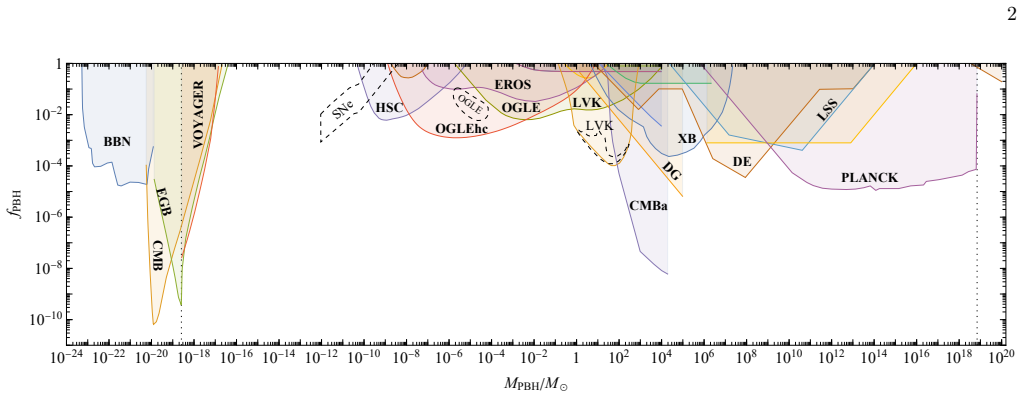
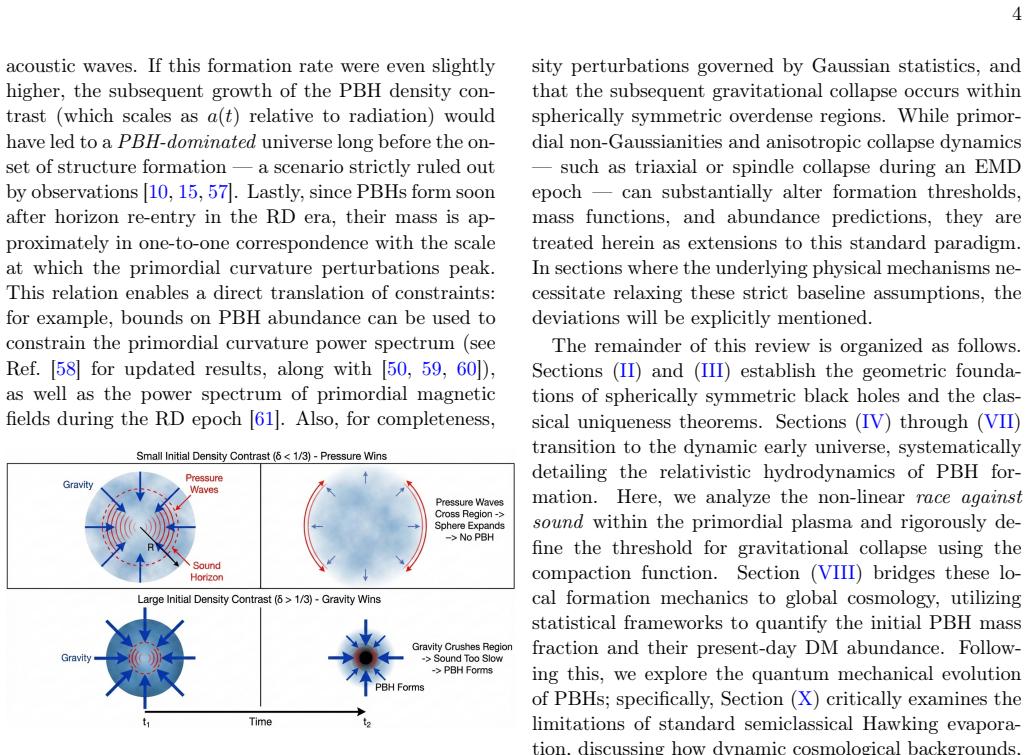
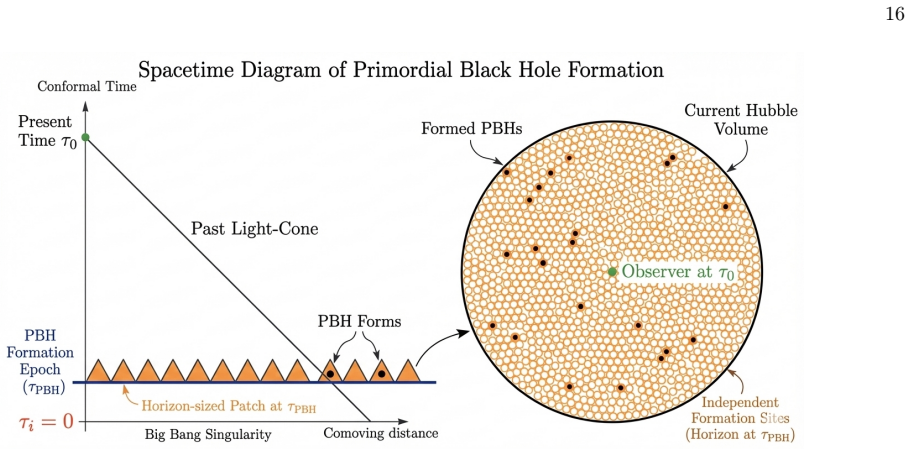
Primordial Black Holes (PBHs) have emerged as a leading non-particulate candidate for dark matter and a unique cosmological probe, a paradigm shift accelerated by the detection of anomalous binary mergers by the LIGO-Virgo-KAGRA (LVK) collaboration. While the literature is rich with phenomenological constraints, the fundamental quantum and relativistic underpinnings governing PBH genesis and evolution often receive comparatively less emphasis. This review aims to bridge that gap by systematically detailing the physics of PBH formation and their subsequent evolutionary trajectory. We critically examine the hydrodynamic complexity of the early universe, establishing the relativistic thresholds for collapse, the non-linear race against sound in the primordial plasma, and the rigorous mathematical utility of the compaction function. Furthermore, by incorporating the dynamic nature of FLRW backgrounds, higher curvature corrections, and quantum backreaction via the memory burden effect, we challenge the standard hawking evaporation and show that extreme-curvature environments halt evaporation entirely, leaving Planck-scale relics that evade current extragalactic bounds. Finally, we map the multimessenger observational landscape, highlighting how the imminent search for sub-solar mass inspirals by next-generation gravitational wave observatories -- such as the Einstein Telescope and Cosmic Explorer -- could yield smoking-gun evidence for the PBH paradigm, ultimately transforming these primordial relics into unparalleled laboratories for high-energy physics.
Editorial analysis
A structured set of objections, weighed in public.
Referee Report
Summary. This review examines PBH formation via relativistic collapse thresholds and the compaction function in the early universe's hydrodynamic environment, then addresses PBH evolution by incorporating FLRW dynamics, higher-curvature corrections, and quantum backreaction through the memory burden effect. The central claim is that these elements halt standard Hawking evaporation in extreme-curvature settings, producing stable Planck-scale relics that evade current extragalactic constraints; the paper concludes by outlining multimessenger prospects, especially sub-solar-mass inspirals detectable by Einstein Telescope and Cosmic Explorer.
Significance. If the halted-evaporation claim is substantiated, the work would be significant for reframing PBHs as viable dark-matter candidates and for linking quantum-gravity backreaction to observable cosmology. The review format usefully assembles formation physics with evolutionary implications, though its impact hinges on whether the memory-burden argument is merely cited or adapted to the PBH context.
major comments (1)
- [Abstract] Abstract: the assertion that 'extreme-curvature environments halt evaporation entirely' via the memory burden effect plus higher-curvature terms is the load-bearing claim that challenges standard Hawking evaporation, yet the manuscript provides no explicit derivation or adaptation of the memory-burden effect to the time-dependent FLRW metric, the compaction-function threshold, or the Planck-regime transition; the sufficiency is therefore asserted by reference rather than demonstrated internally.
Simulated Author's Rebuttal
We thank the referee for their thorough review and valuable feedback on our manuscript. We address the major comment point by point below and outline the revisions we plan to make.
read point-by-point responses
-
Referee: [Abstract] Abstract: the assertion that 'extreme-curvature environments halt evaporation entirely' via the memory burden effect plus higher-curvature terms is the load-bearing claim that challenges standard Hawking evaporation, yet the manuscript provides no explicit derivation or adaptation of the memory-burden effect to the time-dependent FLRW metric, the compaction-function threshold, or the Planck-regime transition; the sufficiency is therefore asserted by reference rather than demonstrated internally.
Authors: We appreciate the referee's observation. The manuscript is structured as a review paper, and the memory burden effect is a concept drawn from the quantum gravity literature (as cited in the relevant sections). Our presentation summarizes how this effect, combined with FLRW dynamics and curvature corrections, leads to halted evaporation for PBHs. We acknowledge that an explicit step-by-step adaptation within the text would enhance the manuscript's self-containment. Accordingly, we will revise the evolution section to include a concise outline of the memory burden mechanism adapted to the PBH context in FLRW spacetime, referencing the compaction function and Planck-scale transition. This addition will clarify the argument without altering the review format. revision: yes
Circularity Check
Review synthesizes external literature without internal reductions or self-referential derivations
full rationale
This is a review paper whose central sections on PBH formation thresholds, compaction functions, and evolutionary trajectories summarize results from the broader gr-qc literature rather than presenting a new derivation chain. The claim that extreme-curvature environments halt evaporation via memory burden and higher-curvature corrections is asserted by reference to prior external work on quantum backreaction, not derived internally or reduced to any fitted parameter, self-citation chain, or definitional equivalence within the manuscript. No equations or steps are shown that rename known results, smuggle ansatze, or force predictions by construction from the paper's own inputs; the synthesis remains self-contained against external benchmarks.
Axiom & Free-Parameter Ledger
axioms (2)
- domain assumption FLRW metric describes the background spacetime for PBH formation
- domain assumption Compaction function provides rigorous threshold for gravitational collapse
Reference graph
Works this paper leans on
-
[1]
Fudge Factor
The Excursion Set and the “Fudge Factor" In the literature, Eq. (71) is frequently multiplied by an empirical factor of 2 (e.g., Refs. [51, 145–147]). This factor originates from the direct application of the Press- Schechter formalism developed for DM halo formation. In standard structure formation, the “cloud-in-cloud" problem arises when small underden...
-
[2]
kinetic stiff- ness
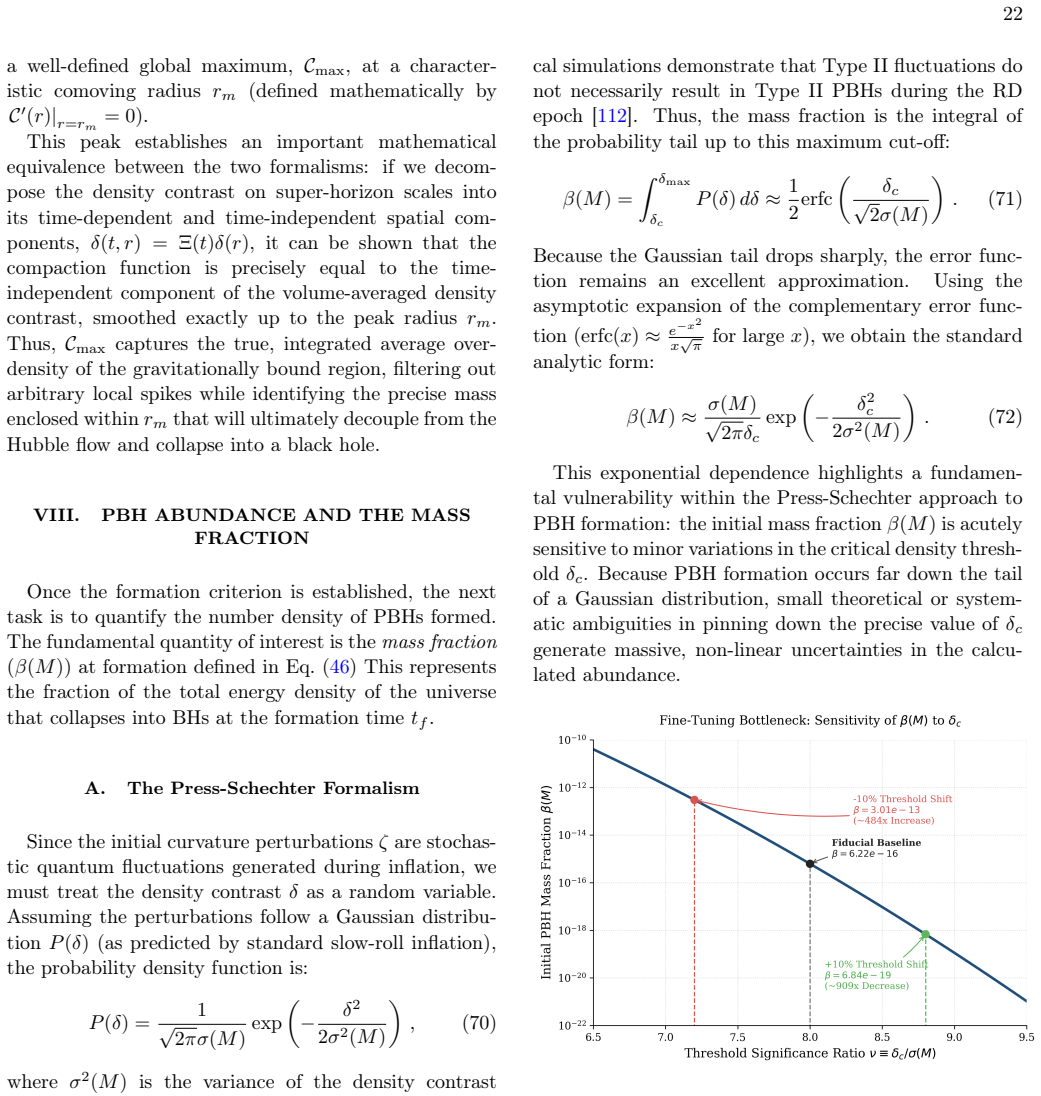
Physical Implication: Exponential Sensitivity Eq. (72) reveals why PBH formation is highly sensi- tive to the physics of the early universe. The abundance depends exponentially on the ratioδ c/σand two spe- cific events play a crucial role: First, during the QCD phase transition (t∼10 −5 s), the equation of state soft- ens (w <1/3), lowering the pressure ...
2025
-
[3]
Substituting these into Eq
Background Solution We first define a homogeneous and isotropic back- ground where the background density¯ρdepends only on time, and the velocity follows the Hubble flow: ¯ρ= ¯ρ(t),¯p= ¯p(t), ¯v=H(t)X.(B4) whereH(t)≡˙a/ais the Hubble parameter anda(t)is the scale factor. Substituting these into Eq. (B1), we get: ˙¯ρ+ ¯ρH(∇ ·X) =˙¯ρ+ 3H¯ρ= 0.(B5) This lead...
-
[4]
(B16) We substitute these into the fundamental equations and keep only first-order terms
Linear Perturbations We introduce small perturbations: ρ= ¯ρ+δρ,v= ¯v+δv, ϕ= ¯ϕ+δϕ, p= ¯p+δp . (B16) We substitute these into the fundamental equations and keep only first-order terms. The continuity equation (B1) becomes ∂(¯ρ+δρ) ∂t +∇ ·[(¯ρ+δρ)( ¯v+δv)] = 0.(B17) Using∇ · ¯v= 3Hand subtracting the background equa- tion: ˙δρ+ 3Hδρ+ ¯v· ∇δρ+ ¯ρ∇ ·δv= 0.(B...
-
[5]
Separate Universe
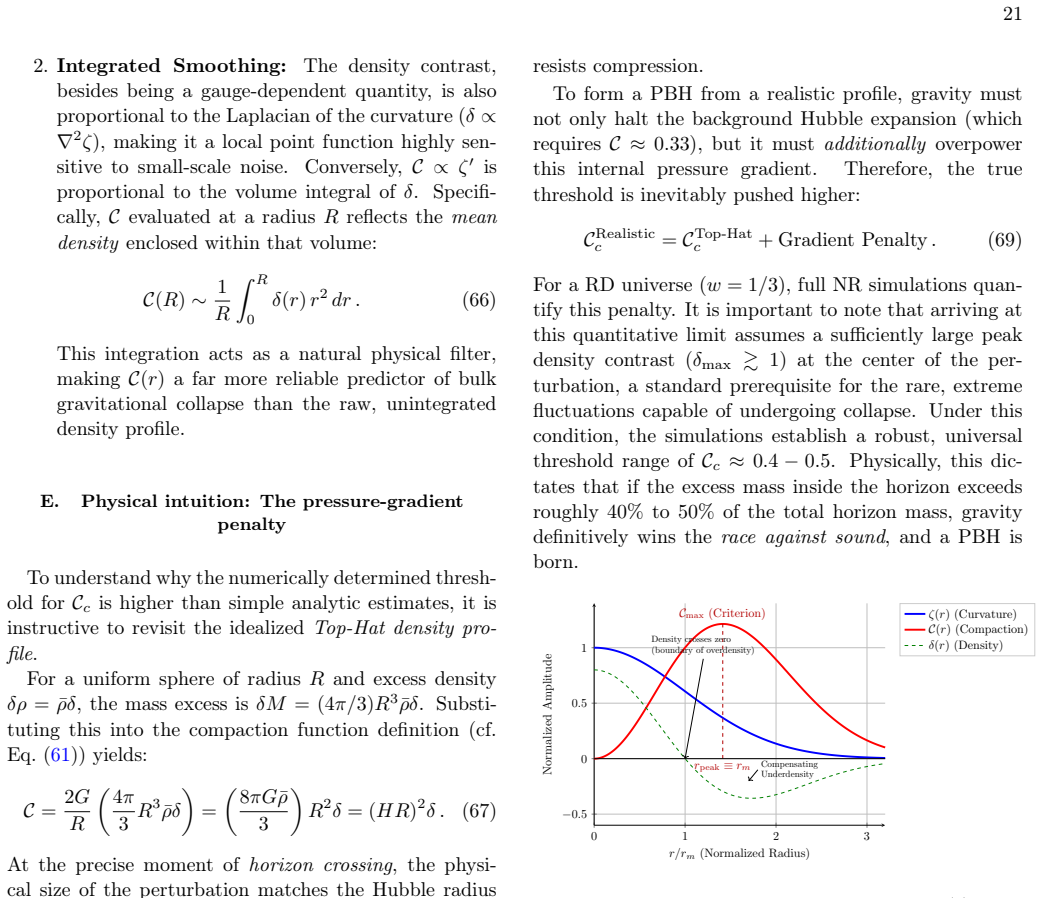
The Top-Hat Analytical Model A simple analytic estimate for the collapse threshold can be derived using the “Separate Universe" approach, discussed in detailed in Appendix (C). Consider a spher- ical overdensity (Top-Hat profile) evolving as a closed FLRWuniverse(K= +1)embeddedinaflatbackground (K= 0). The Friedmann equation for the overdense region (scal...
-
[6]
misalignment
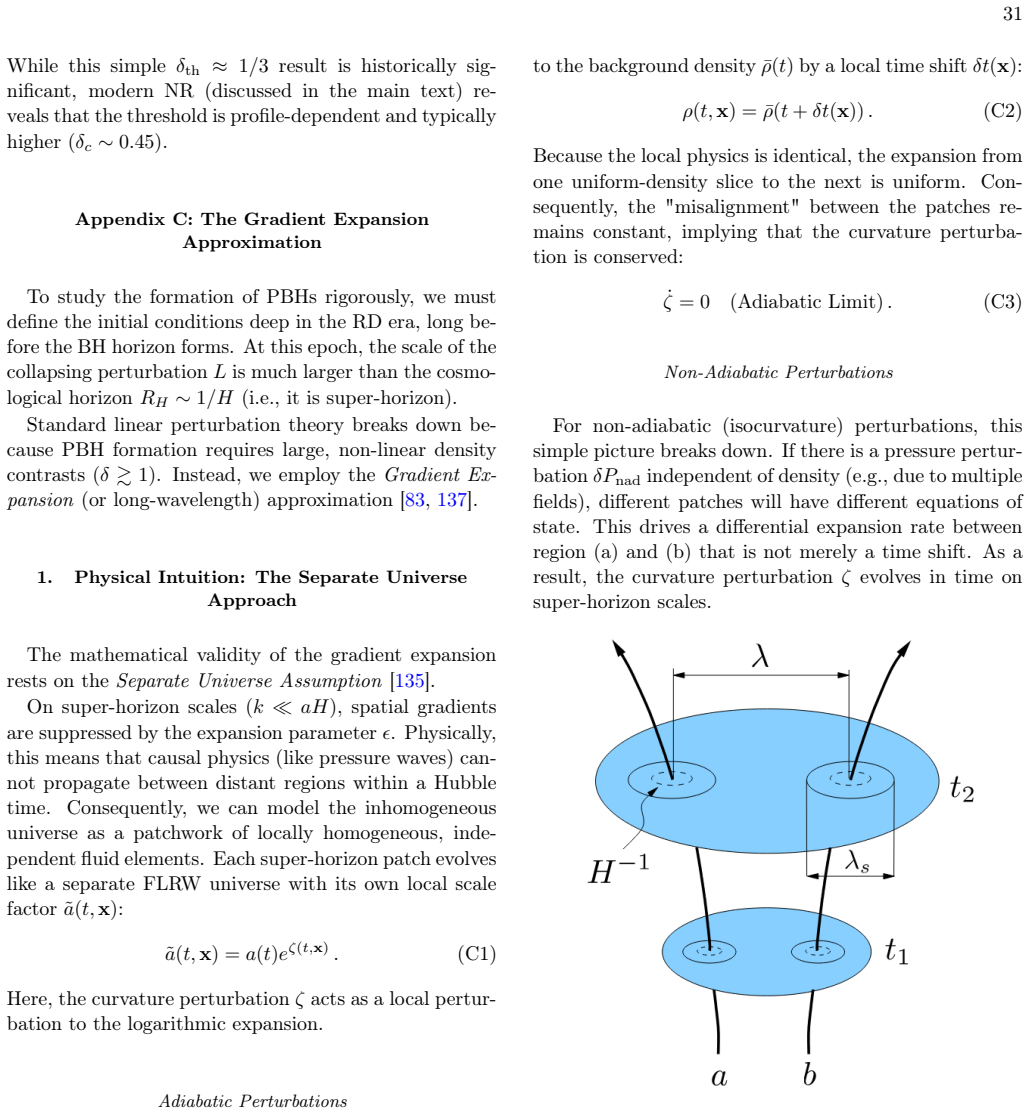
Physical Intuition: The Separate Universe Approach The mathematical validity of the gradient expansion rests on theSeparate Universe Assumption[135]. On super-horizon scales (k≪aH), spatial gradients are suppressed by the expansion parameterϵ. Physically, this means that causal physics (like pressure waves) can- not propagate between distant regions withi...
-
[7]
Separate Universe
The Expansion Parameter The approximation relies on the smallness of spatial gradients compared to time derivatives. We define a 32 small parameterϵ: ϵ≡ RH L ∼ k aH ≪1.(C4) We expand the Einstein equations in powers ofϵ. •At zeroth order (ϵ0), the spatial gradients vanish. Each local patch of the universe evolves indepen- dently as a separate FLRW univers...
-
[8]
initial condition
on super-horizon scales [136, 137]. This allows us to specifyζ(r)as a time-independent "initial condition" set by inflation. 3.Asymptotic Behavior:Asr→ ∞, we require ζ(r)→0, ensuring the metric asymptotically ap- proaches the background FLRW universe
-
[9]
potential
Derivation of Density Contrast The relation between the curvature perturbationζand the density contrastδarises directly from the Einstein Field Equations, specifically the time-time component (the Hamiltonian Constraint). In the Arnowitt–Deser–Misner (ADM) formulation (or 3+1 decomposition of General Relativity), the Hamilto- nian constraint is given by t...
-
[10]
G. Bertone and D. Hooper, History of dark matter, Rev. Mod. Phys.90, 045002 (2018), arXiv:1605.04909 [astro- ph.CO]
Pith/arXiv arXiv 2018
-
[11]
L. Roszkowski, E. M. Sessolo, and S. Trojanowski, WIMP dark matter candidates and searches—current status and future prospects, Rept. Prog. Phys.81, 066201 (2018), arXiv:1707.06277 [hep-ph]
Pith/arXiv arXiv 2018
-
[12]
Billardet al., Direct detection of dark mat- ter—APPEC committee report*, Rept
J. Billardet al., Direct detection of dark mat- ter—APPEC committee report*, Rept. Prog. Phys.85, 056201 (2022), arXiv:2104.07634 [hep-ex]
arXiv 2022
-
[13]
Y. Kahn and T. Lin, Searches for light dark matter us- ing condensed matter systems, Rept. Prog. Phys.85, 066901 (2022), arXiv:2108.03239 [hep-ph]
arXiv 2022
-
[14]
C. Pérez de los Heros, Status, Challenges and Directions in Indirect Dark Matter Searches, Symmetry12, 1648 (2020), arXiv:2008.11561 [astro-ph.HE]
arXiv 2020
-
[15]
M. Misiaszek and N. Rossi, Direct Detection of Dark Matter: A Critical Review, Symmetry16, 201 (2024), arXiv:2310.20472 [hep-ph]
arXiv 2024
-
[16]
Y. B. Zel’dovich and I. D. Novikov, The Hypothesis of Cores Retarded during Expansion and the Hot Cosmo- logical Model, Sov. Astron.10, 602 (1967)
1967
-
[17]
Hawking, Gravitationally collapsed objects of very low mass, Mon
S. Hawking, Gravitationally collapsed objects of very low mass, Mon. Not. Roy. Astron. Soc.152, 75 (1971)
1971
-
[18]
B. J. Carr and S. W. Hawking, Black holes in the early Universe, Mon. Not. Roy. Astron. Soc.168, 399 (1974)
1974
-
[19]
B. J. Carr, The Primordial black hole mass spectrum, Astrophys. J.201, 1 (1975)
1975
-
[20]
D. K. Nadezhin, I. D. Novikov, and A. G. Polnarev, The hydrodynamics of primordial black hole formation, Sov. Astronomy22, 129 (1978)
1978
-
[21]
B. Carr and F. Kuhnel, Primordial black holes as dark matter candidates, SciPost Phys. Lect. Notes48, 1 (2022), arXiv:2110.02821 [astro-ph.CO]
arXiv 2022
-
[23]
B. Carr, A. J. Iovino, G. Perna, V. Vaskonen, and H. Veermäe, Primordial black holes: constraints, poten- tial evidence and prospects, Riv. Nuovo Cim.49, 225 (2026), arXiv:2601.06024 [astro-ph.CO]
arXiv 2026
-
[24]
A. M. Green and B. J. Kavanagh, Primordial Black Holes as a dark matter candidate, J. Phys. G48, 043001 (2021), arXiv:2007.10722 [astro-ph.CO]
Pith/arXiv arXiv 2021
-
[25]
A. Escrivà, F. Kuhnel, and Y. Tada, Primordial Black Holes, Arxiv 10.1016/B978-0-32-395636-9.00012- 8 (2022), arXiv:2211.05767 [astro-ph.CO]
-
[26]
I. Musco, Threshold for primordial black holes: Depen- dence on the shape of the cosmological perturbations, Phys. Rev. D100, 123524 (2019), arXiv:1809.02127 [gr- qc]
arXiv 2019
-
[27]
A. Escrivà, C. Germani, and R. K. Sheth, Universal threshold for primordial black hole formation, Phys. Rev. D101, 044022 (2020), arXiv:1907.13311 [gr-qc]
arXiv 2020
-
[28]
A. M. Green and A. R. Liddle, Constraints on the den- sity perturbation spectrum from primordial black holes, Phys. Rev. D56, 6166 (1997), arXiv:astro-ph/9704251
Pith/arXiv arXiv 1997
-
[29]
M. Sasaki, T. Suyama, T. Tanaka, and S. Yokoyama, Primordial black holes—perspectives in gravitational wave astronomy, Class. Quant. Grav.35, 063001 (2018), arXiv:1801.05235 [astro-ph.CO]
Pith/arXiv arXiv 2018
-
[30]
C. T. Byrnes, M. Hindmarsh, S. Young, and M. R. S. Hawkins, Primordial black holes with an accurate QCD equation of state, JCAP08, 041, arXiv:1801.06138 [astro-ph.CO]
- [31]
-
[32]
M. Sasaki, T. Suyama, T. Tanaka, and S. Yokoyama, Primordial Black Hole Scenario for the Gravitational- Wave Event GW150914, Phys. Rev. Lett.117, 061101 (2016), [Erratum: Phys.Rev.Lett. 121, 059901 (2018)], arXiv:1603.08338 [astro-ph.CO]
Pith/arXiv arXiv 2016
-
[33]
S. Bird, I. Cholis, J. B. Muñoz, Y. Ali-Haïmoud, M. Kamionkowski, E. D. Kovetz, A. Raccanelli, and A. G. Riess, Did LIGO detect dark matter?, Phys. 36 Rev. Lett.116, 201301 (2016), arXiv:1603.00464 [astro- ph.CO]
Pith/arXiv arXiv 2016
-
[34]
S. Clesse and J. García-Bellido, The clustering of mas- sive Primordial Black Holes as Dark Matter: measur- ing their mass distribution with Advanced LIGO, Phys. Dark Univ.15, 142 (2017), arXiv:1603.05234 [astro- ph.CO]
Pith/arXiv arXiv 2017
-
[35]
B. P. Abbottet al.(LIGO Scientific, Virgo), Obser- vation of Gravitational Waves from a Binary Black Hole Merger, Phys. Rev. Lett.116, 061102 (2016), arXiv:1602.03837 [gr-qc]
Pith/arXiv arXiv 2016
-
[36]
N. Fernandez and S. Profumo, Unraveling the origin of black holes from effective spin measurements with LIGO-Virgo, JCAP08, 022, arXiv:1905.13019 [astro- ph.HE]
arXiv 1905
-
[37]
G. Franciolini, V. Baibhav, V. De Luca, K. K. Y. Ng, K. W. K. Wong, E. Berti, P. Pani, A. Riotto, and S. Vitale, Searching for a subpopulation of primor- dial black holes in LIGO-Virgo gravitational-wave data, Phys. Rev. D105, 083526 (2022), arXiv:2105.03349 [gr- qc]
arXiv 2022
-
[38]
S. S. Bavera, T. Fragos, Y. Qin, E. Zapartas, C. J. Neijs- sel, I. Mandel, A. Batta, S. M. Gaebel, C. Kimball, and S. Stevenson, The origin of spin in binary black holes: Predicting the distributions of the main observables of Advanced LIGO, Astron. Astrophys.635, A97 (2020), arXiv:1906.12257 [astro-ph.HE]
arXiv 2020
-
[39]
D. Gerosa and M. Fishbach, Hierarchical mergers of stellar-massblackholesandtheirgravitational-wavesig- natures,NatureAstron.5,749(2021),arXiv:2105.03439 [astro-ph.HE]
arXiv 2021
-
[40]
R. Abbottet al.(LIGO Scientific, Virgo), GW190814: Gravitational Waves from the Coalescence of a 23 Solar Mass Black Hole with a 2.6 Solar Mass Compact Object, Astrophys. J. Lett.896, L44 (2020), arXiv:2006.12611 [astro-ph.HE]
Pith/arXiv arXiv 2020
-
[41]
R. Abbottet al.(LIGO Scientific, Virgo), Properties and Astrophysical Implications of the 150 M⊙ Binary Black Hole Merger GW190521, Astrophys. J. Lett.900, L13 (2020), arXiv:2009.01190 [astro-ph.HE]
arXiv 2020
-
[42]
A. G. Abacet al.(LIGO Scientific, Virgo, KAGRA), GW250114: Testing Hawking’s Area Law and the Kerr Nature of Black Holes, Phys. Rev. Lett.135, 111403 (2025), arXiv:2509.08054 [gr-qc]
Pith/arXiv arXiv 2025
-
[43]
S. Stevenson, A. Vigna-Gómez, I. Mandel, J. W. Bar- rett, C. J. Neijssel, D. Perkins, and S. E. de Mink, For- mation of the first three gravitational-wave observations through isolated binary evolution, Nature Commun.8, 14906 (2017), arXiv:1704.01352 [astro-ph.HE]
Pith/arXiv arXiv 2017
-
[44]
H. Niikuraet al., Microlensing constraints on primordial black holes with Subaru/HSC Andromeda observations, Nature Astron.3, 524 (2019), arXiv:1701.02151 [astro- ph.CO]
Pith/arXiv arXiv 2019
-
[45]
P. Tisserandet al.(EROS-2), Limits on the Macho Con- tent oftheGalactic HalofromtheEROS-2Surveyofthe Magellanic Clouds, Astron. Astrophys.469, 387 (2007), arXiv:astro-ph/0607207
Pith/arXiv arXiv 2007
-
[46]
R. A. Allsmanet al.(Macho), MACHO project limits on black hole dark matter in the 1-30 solar mass range, Astrophys. J. Lett.550, L169 (2001), arXiv:astro- ph/0011506
arXiv 2001
-
[47]
A. Katz, J. Kopp, S. Sibiryakov, and W. Xue, Fem- tolensing by Dark Matter Revisited, JCAP12, 005, arXiv:1807.11495 [astro-ph.CO]
- [48]
-
[49]
Y. Ali-Haïmoud and M. Kamionkowski, Cosmic mi- crowave background limits on accreting primordial black holes, Phys. Rev. D95, 043534 (2017), arXiv:1612.05644 [astro-ph.CO]
Pith/arXiv arXiv 2017
-
[50]
B. P. Abbottet al.(LIGO Scientific, Virgo), Search for Subsolar Mass Ultracompact Binaries in Advanced LIGO’s Second Observing Run, Phys. Rev. Lett.123, 161102 (2019), arXiv:1904.08976 [astro-ph.CO]
arXiv 2019
-
[51]
B. Carr, K. Kohri, Y. Sendouda, and J. Yokoyama, Con- straints on primordial black holes, Rept. Prog. Phys.84, 116902 (2021), arXiv:2002.12778 [astro-ph.CO]
Pith/arXiv arXiv 2021
-
[52]
Tinyakov, Primordial black holes (Springer, 2025) Chap
P. Tinyakov, Primordial black holes (Springer, 2025) Chap. The Asteroid Mass Window, arXiv:2406.03114 [astro-ph.CO]
arXiv 2025
-
[53]
S. Wang, T. Terada, and K. Kohri, Prospective con- straints on the primordial black hole abundance from thestochasticgravitational-wavebackgroundsproduced by coalescing events and curvature perturbations, Phys. Rev. D99, 103531 (2019), [Erratum: Phys.Rev.D 101, 069901 (2020)], arXiv:1903.05924 [astro-ph.CO]
arXiv 2019
-
[54]
Afzalet al.(NANOGrav), The NANOGrav 15 yr Data Set: Search for Signals from New Physics, As- trophys
A. Afzalet al.(NANOGrav), The NANOGrav 15 yr Data Set: Search for Signals from New Physics, As- trophys. J. Lett.951, L11 (2023), [Erratum: Astro- phys.J.Lett. 971, L27 (2024), Erratum: Astrophys.J. 971, L27 (2024)], arXiv:2306.16219 [astro-ph.HE]
Pith/arXiv arXiv 2023
-
[55]
M. G. Santos, S. Camera, Z. Chen, S. Cunnington, and J. Fonseca, Cosmology with ESO-SKAO Synergies (2025) arXiv:2503.03915 [astro-ph.IM]
arXiv 2025
- [56]
-
[57]
R. Abbottet al.(LIGO Scientific, VIRGO, KAGRA), Search for Subsolar-Mass Binaries in the First Half of Advanced LIGO’s and Advanced Virgo’s Third Ob- serving Run, Phys. Rev. Lett.129, 061104 (2022), arXiv:2109.12197 [astro-ph.CO]
arXiv 2022
-
[58]
Aggarwalet al., Challenges and opportunities of gravitational-wave searches above 10 kHz, Living Rev
N. Aggarwalet al., Challenges and opportunities of gravitational-wave searches above 10 kHz, Living Rev. Rel.28, 10 (2025), arXiv:2501.11723 [gr-qc]
arXiv 2025
-
[59]
A. D. Gow, C. T. Byrnes, P. S. Cole, and S. Young, Thepowerspectrumonsmallscales: Robustconstraints and comparing PBH methodologies, JCAP02, 002, arXiv:2008.03289 [astro-ph.CO]
arXiv 2008
-
[60]
J. Garcia-Bellido and E. Ruiz Morales, Primordial black holes from single field models of inflation, Phys. Dark 37 Univ.18, 47 (2017), arXiv:1702.03901 [astro-ph.CO]
Pith/arXiv arXiv 2017
-
[61]
H. Motohashi and W. Hu, Primordial Black Holes and Slow-Roll Violation, Phys. Rev. D96, 063503 (2017), arXiv:1706.06784 [astro-ph.CO]
Pith/arXiv arXiv 2017
-
[62]
K. Inomata, M. Kawasaki, K. Mukaida, Y. Tada, and T. T. Yanagida, Inflationary primordial black holes for the LIGO gravitational wave events and pulsar timing array experiments, Phys. Rev. D95, 123510 (2017), arXiv:1611.06130 [astro-ph.CO]
Pith/arXiv arXiv 2017
-
[63]
J. Garcia-Bellido, M. Peloso, and C. Unal, Gravita- tional Wave signatures of inflationary models from Primordial Black Hole Dark Matter, JCAP09, 013, arXiv:1707.02441 [astro-ph.CO]
-
[64]
G. Domènech, Scalar Induced Gravitational Waves Re- view, Universe7, 398 (2021), arXiv:2109.01398 [gr-qc]
Pith/arXiv arXiv 2021
-
[65]
I. Musco, J. C. Miller, and L. Rezzolla, Computations of primordial black hole formation, Class. Quant. Grav. 22, 1405 (2005), arXiv:gr-qc/0412063
Pith/arXiv arXiv 2005
-
[66]
B. J. Carr, K. Kohri, Y. Sendouda, and J. Yokoyama, New cosmological constraints on primordial black holes, Phys. Rev. D81, 104019 (2010), arXiv:0912.5297 [astro- ph.CO]
Pith/arXiv arXiv 2010
-
[67]
A. Kushwaha and T. Suyama, Revisiting Constraints on Primordial Curvature Power Spectrum from PBH Abundances, arXiv (2026), arXiv:2603.23025 [astro- ph.CO]
arXiv 2026
-
[68]
G. Sato-Polito, E. D. Kovetz, and M. Kamionkowski, Constraints on the primordial curvature power spec- trum from primordial black holes, Phys. Rev. D100, 063521 (2019), arXiv:1904.10971 [astro-ph.CO]
arXiv 2019
- [69]
-
[70]
A. Kushwaha and T. Suyama, Constraining small-scale primordial magnetic fields from the abundance of pri- mordial black holes, JCAP12, 012, arXiv:2405.19693 [astro-ph.CO]
-
[71]
M. Y. Khlopov and A. G. Polnarev, PRIMORDIAL BLACK HOLES AS A COSMOLOGICAL TEST OF GRAND UNIFICATION, Phys. Lett. B97, 383 (1980)
1980
-
[72]
T. Harada, C.-M. Yoo, K. Kohri, K.-i. Nakao, and S. Jhingan, Primordial black hole formation in the matter-dominated phase of the Universe, Astrophys. J. 833, 61 (2016), arXiv:1609.01588 [astro-ph.CO]
Pith/arXiv arXiv 2016
-
[73]
Dvali, A Microscopic Model of Holography: Survival by the Burden of Memory, Fortsch
G. Dvali, A Microscopic Model of Holography: Survival by the Burden of Memory, Fortsch. Phys.69, 2000091 (2021),foundationaltheoreticalframeworkforthemem- ory burden effect., arXiv:1810.02336 [hep-th]
Pith/arXiv arXiv 2021
-
[74]
G.Dvali, O.Kaikov,andJ.S.V.Bermúdez,Howspecial are black holes? Correspondence with objects saturat- ing unitarity bounds in generic theories, Phys. Rev. D 105, 056013 (2022), arXiv:2112.00551 [hep-th]
arXiv 2022
-
[75]
R. M. Wald,General Relativity(Chicago Univ. Pr., Chicago, USA, 1984)
1984
-
[76]
S. Shankaranarayanan and J. P. Johnson, Modified the- ories of gravity: Why, how and what?, Gen. Rel. Grav. 54, 44 (2022), arXiv:2204.06533 [gr-qc]
arXiv 2022
-
[77]
S. Mandal and S. Shankaranarayanan, Modified theories of gravity at different curvature scales, arXiv (2025), 2502.07437 [gr-qc]
arXiv 2025
-
[78]
Calmet, B
X. Calmet, B. Carr, and E. Winstanley,Quantum Black Holes,SpringerBriefsinPhysics(Springer,Berlin, 2014)
2014
- [79]
-
[80]
T. Parvez and S. Shankaranarayanan, Exact, non- singular black holes from a phantom DBI Field as pri- mordial dark matter, arXiv (2025), 2511.14047 [gr-qc]
Pith/arXiv arXiv 2025
- [81]
discussion (0)
Sign in with ORCID, Apple, or X to comment. Anyone can read and Pith papers without signing in.