Neural posterior estimation of Galactic Binary signals for the LISA mission
Pith reviewed 2026-06-30 08:02 UTC · model grok-4.3
The pith
A conditional normalizing flow trained on LISA simulations generates thousands of galactic binary posterior samples per second without likelihood evaluations.
A machine-rendered reading of the paper's core claim, the machinery that carries it, and where it could break.
Core claim
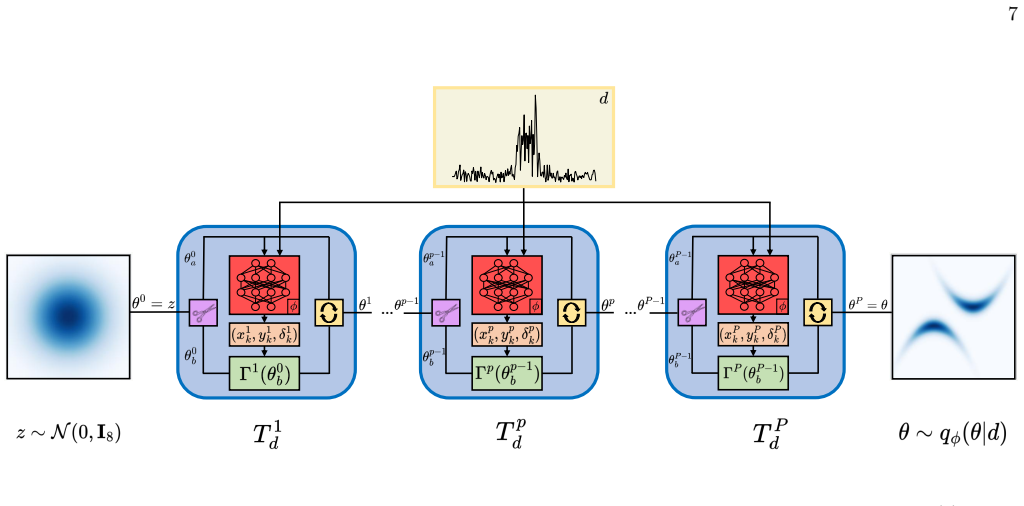
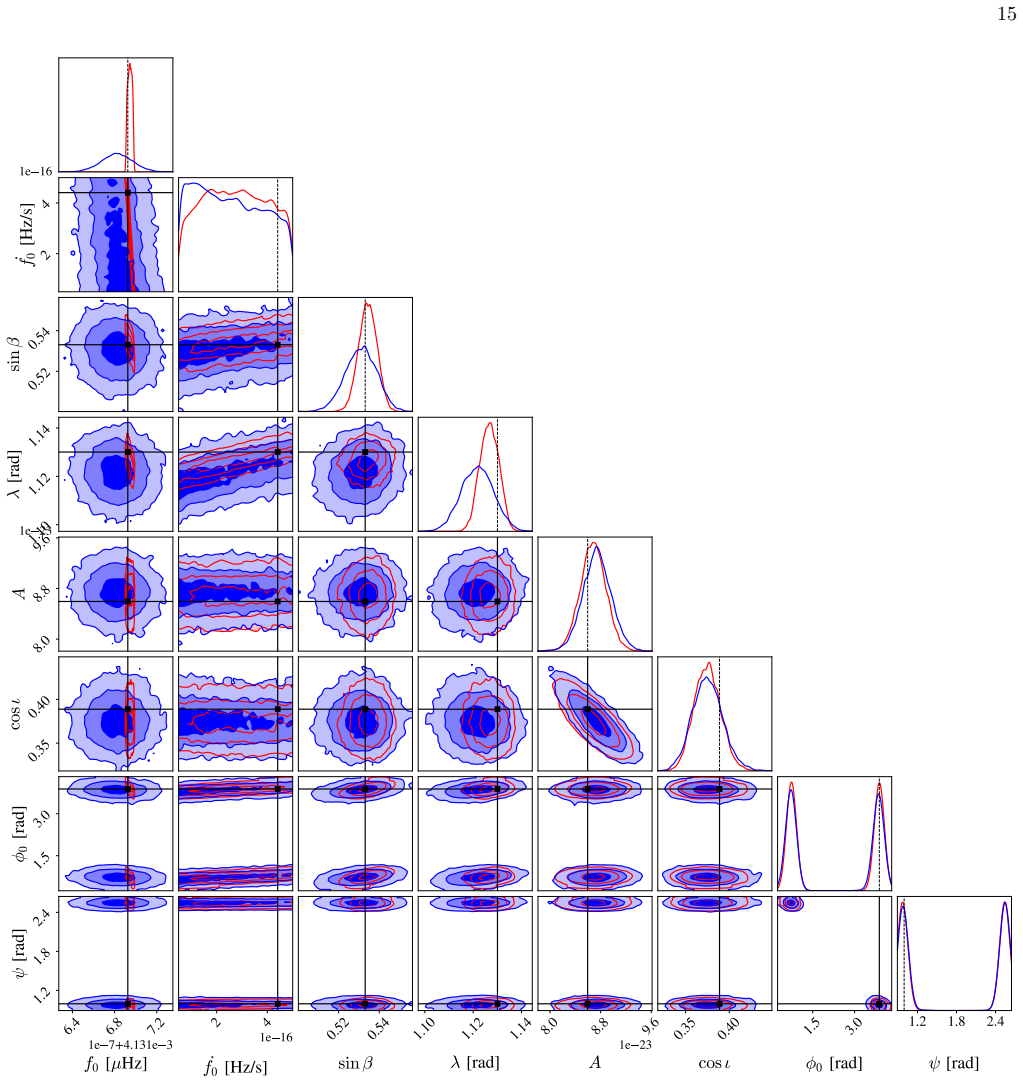
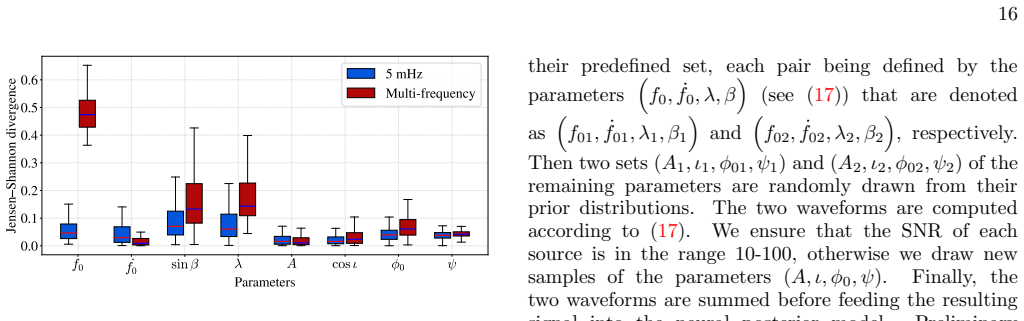
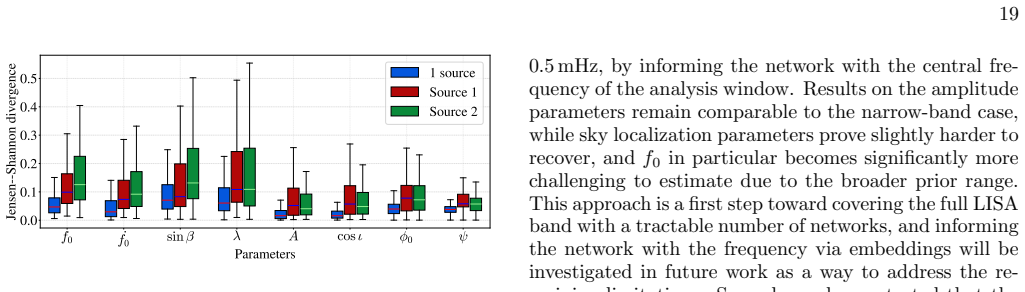
A conditional normalizing flow can be trained as a neural posterior estimator using samples from a dedicated LISA simulation framework that requires no likelihood computation; once trained, it produces thousands of posterior samples per second for galactic binary parameters without any explicit likelihood evaluation, and this holds for single sources in narrow or wider bands as well as for two overlapping sources.
What carries the argument
Conditional normalizing flow acting as a neural posterior estimator, trained on simulated data without likelihood computation.
If this is right
- Thousands of posterior samples can be drawn per second after a single training phase.
- The method avoids explicit likelihood evaluations during both training and inference.
- Analysis extends from narrow-band single sources to wider frequency ranges.
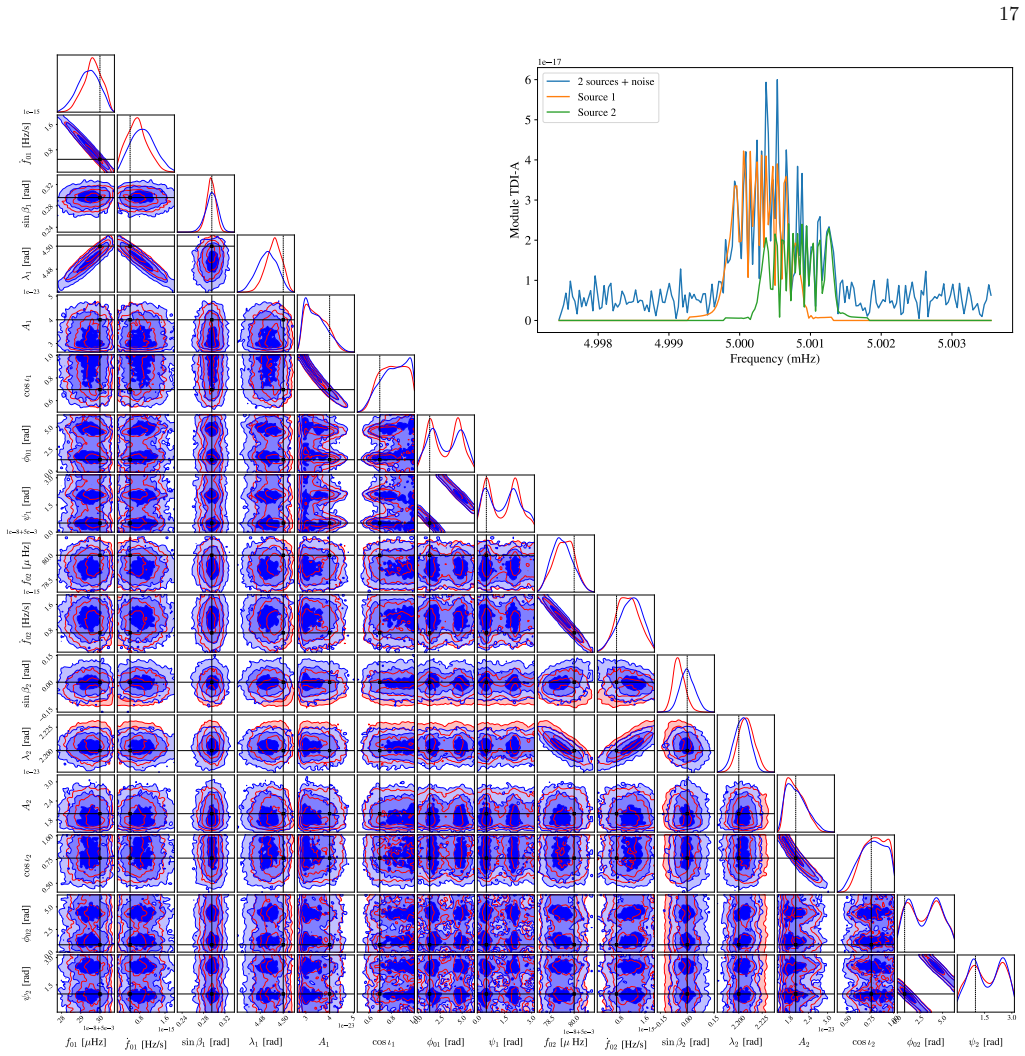
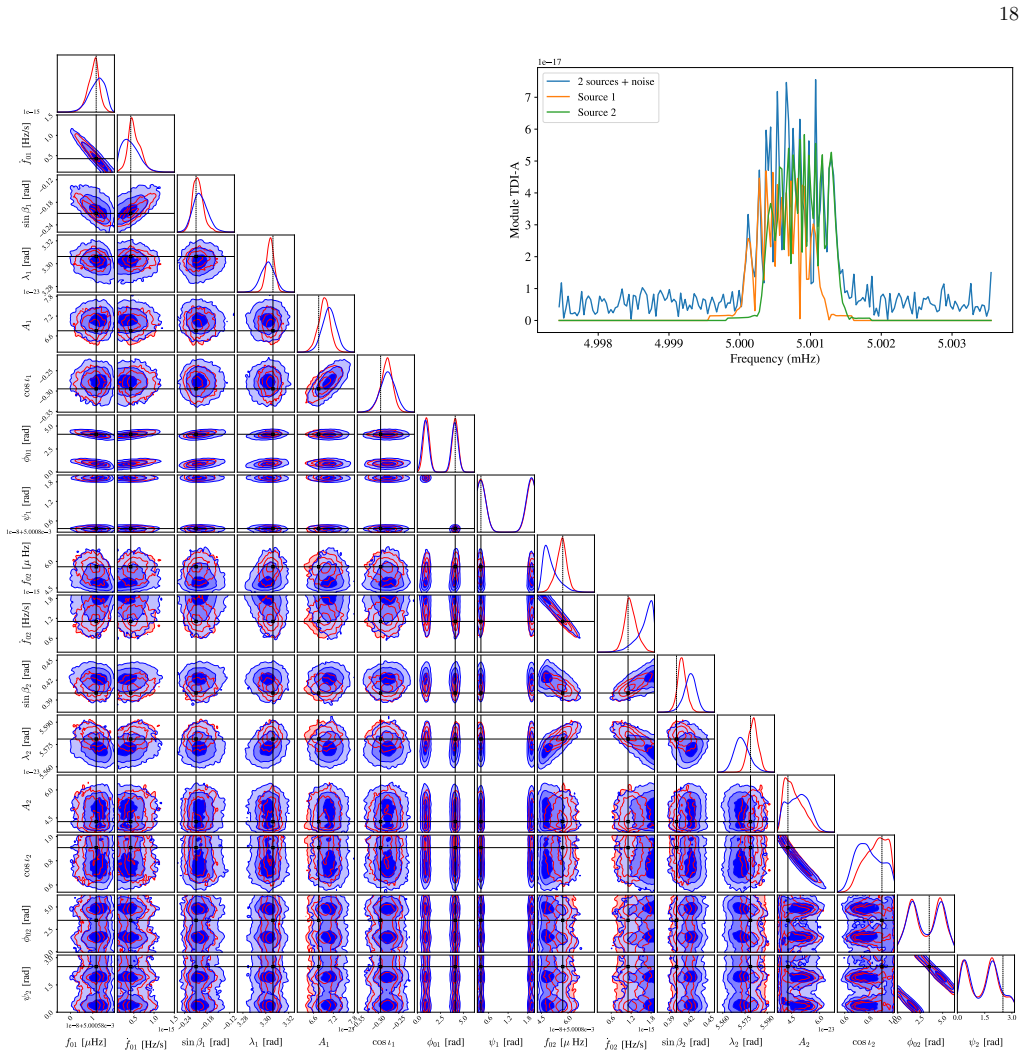
- The framework serves as a proof of concept for handling two overlapping galactic binary signals.
- It offers a scalable alternative to MCMC for high-dimensional LISA galactic binary problems.
Where Pith is reading between the lines
- If the simulation-to-reality gap can be closed, the same architecture could be retrained on catalogs containing many more overlapping sources.
- The speed of sampling might enable joint inference over larger numbers of binaries than MCMC currently allows.
- One could test whether the flow architecture generalizes across different LISA noise realizations by retraining on varied simulation ensembles.
Load-bearing premise
The simulation framework must generate training data whose statistical properties match real LISA observations closely enough for the trained model to generalize.
What would settle it
Applying the trained estimator to actual LISA data segments and finding that the resulting parameter distributions systematically disagree with independent MCMC results on the same segments would falsify the claim.
Figures
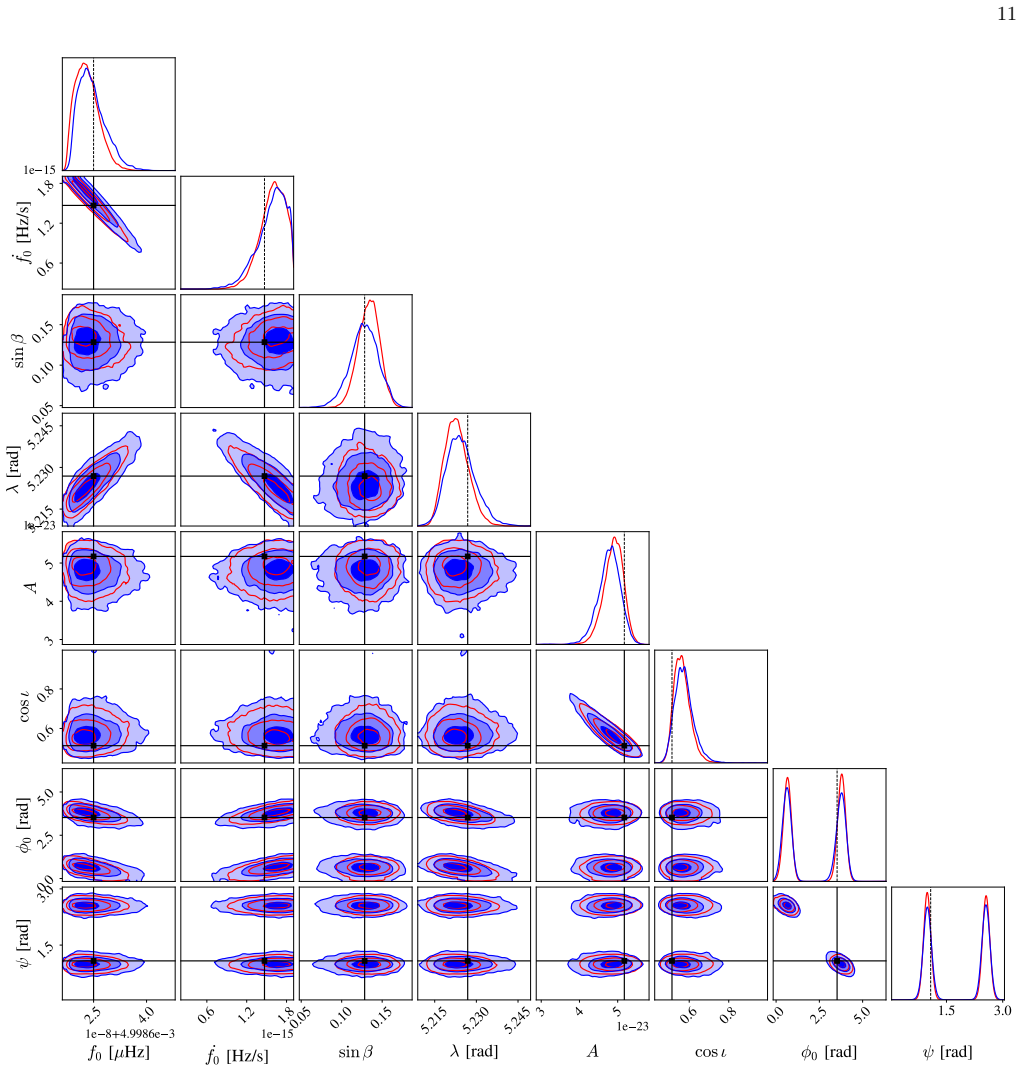
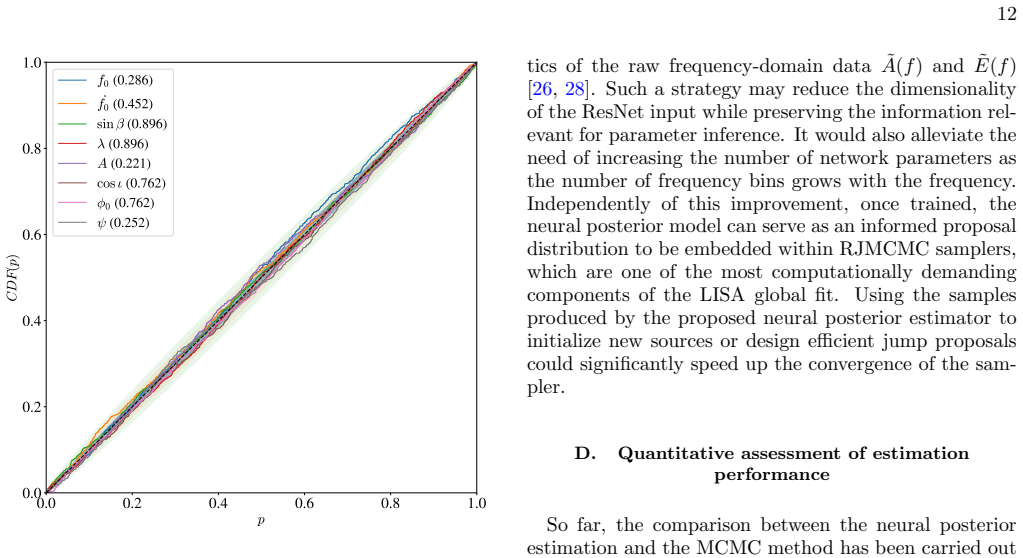
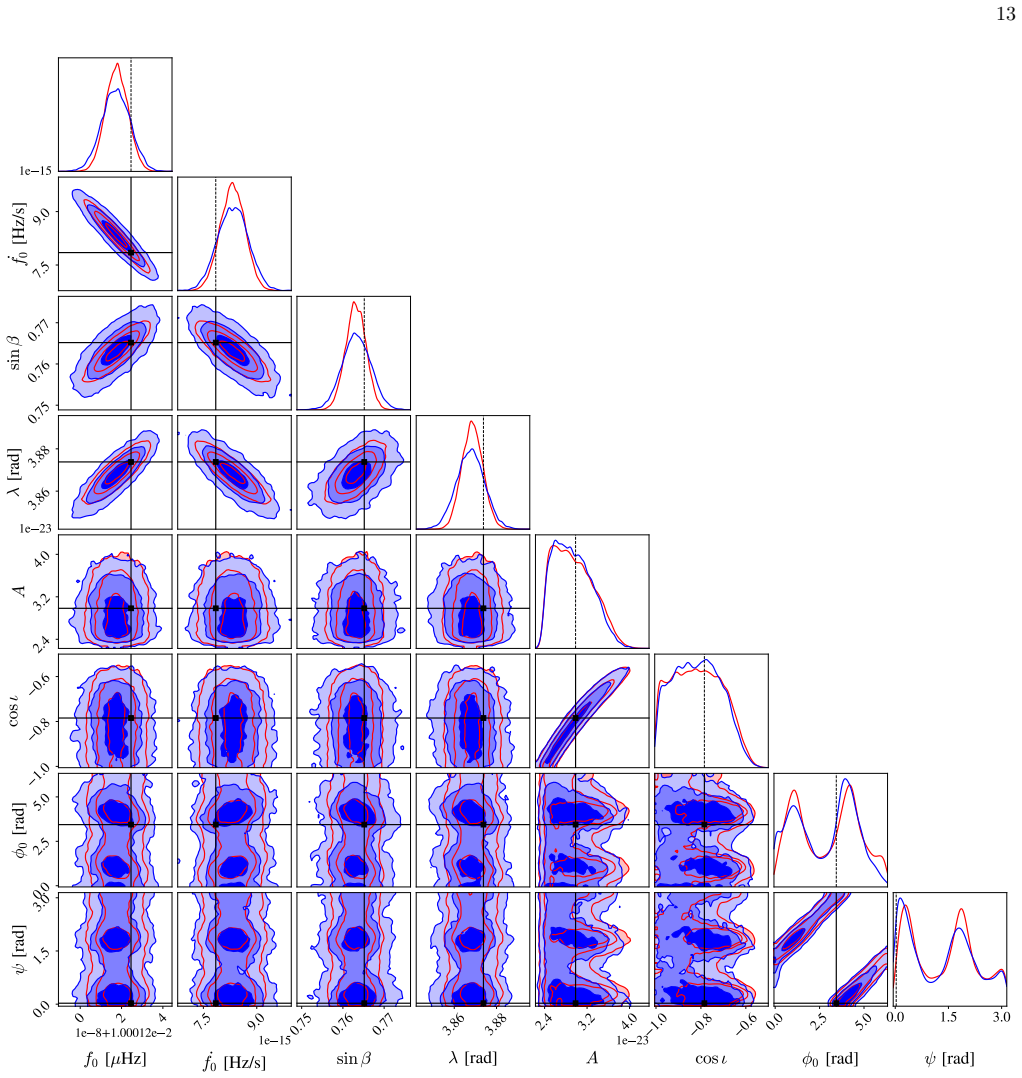
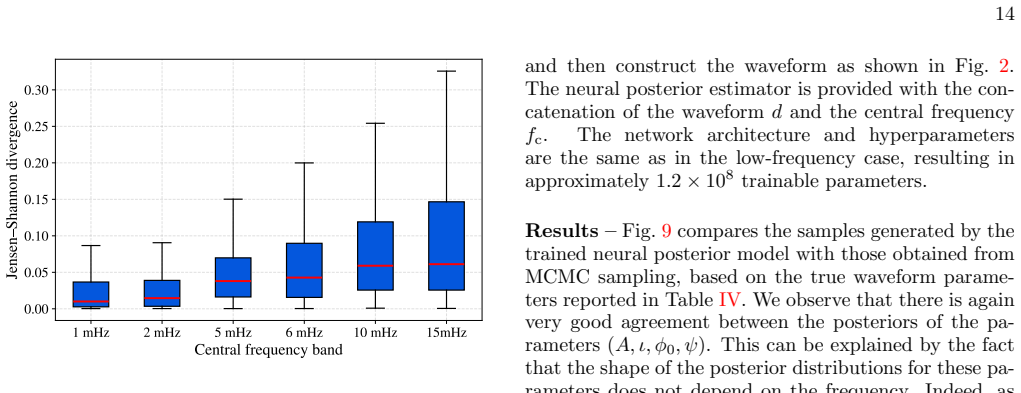
read the original abstract
ESA's LISA mission will open a new window onto the gravitational-wave sky by detecting signals from a wide variety of sources in the millihertz frequency band. Among these, galactic binaries are expected to be the most numerous sources observable by LISA. Their analysis and parameter estimation represent a significant challenge, as the signals are expected to strongly overlap in both the time and frequency domains. Conventional Bayesian inference approaches, such as Markov Chain Monte Carlo sampling, are difficult to scale to this setting due to the high dimensionality of the problem and the complicated likelihood landscape which can hinder convergence. In this work, we explore simulation-based inference as a means to perform efficient parameter estimation for single galactic binaries, with a potential extension to the analysis of multiple overlapping sources. Our approach relies on a conditional normalizing flow acting as a neural posterior estimator. The model is trained using samples generated according to a dedicated simulation framework that does not require any likelihood computation. Once trained, the neural posterior estimator enables the generation of thousands of posterior samples per second, again without explicit likelihood evaluation. We first present results for a single source in a narrow frequency band, and then extend the analysis to wider frequency ranges. As a proof of concept, we further investigate the more challenging case of two overlapping sources. These results demonstrate the potential of likelihood-free inference as a scalable alternative to conventional Markov chain Monte Carlo sampling for the analysis of LISA galactic binaries.
Editorial analysis
A structured set of objections, weighed in public.
Referee Report
Summary. The paper proposes simulation-based inference via a conditional normalizing flow as a neural posterior estimator for parameter estimation of Galactic Binary signals in LISA data. The model is trained on samples from a dedicated simulation framework without likelihood evaluations and, once trained, generates thousands of posterior samples per second without explicit likelihoods. Results are presented first for single sources in narrow then wider frequency bands, followed by a proof-of-concept demonstration for two overlapping sources, positioning the method as a scalable alternative to MCMC.
Significance. If the posteriors prove well-calibrated on data whose statistical properties match real LISA observations, the approach could enable efficient analysis of the large number of overlapping Galactic Binaries expected in LISA, addressing the scalability limitations of conventional sampling methods in high-dimensional, multi-source settings.
major comments (2)
- [Abstract / Results (single-source and two-source cases)] The central claim that the trained normalizing flow produces calibrated posteriors on unseen data rests on the assumption that the dedicated simulation framework matches real LISA observations in noise, instrumental response, and source overlaps (Abstract). No held-out validation on mismatched noise models, coverage diagnostics, or explicit statement of the precise noise/instrumental assumptions is supplied, so the reported speed and accuracy cannot be assessed for transfer to actual data.
- [Results section (narrow/wide frequency bands and overlapping sources)] No quantitative validation metrics (e.g., posterior coverage probabilities, credible-interval calibration, or direct comparison of error bars to MCMC on the same realizations) are reported for the single-source or two-source cases, leaving the claim that the method is a scalable alternative without supporting evidence in the presented results.
minor comments (1)
- [Abstract] The abstract states the simulation framework 'does not require any likelihood computation' but does not clarify whether the training data generation itself incorporates any approximate likelihood or forward-model assumptions that could affect generalization.
Simulated Author's Rebuttal
We thank the referee for their constructive comments. We respond to each major comment below, indicating where we will revise the manuscript to address the concerns.
read point-by-point responses
-
Referee: [Abstract / Results (single-source and two-source cases)] The central claim that the trained normalizing flow produces calibrated posteriors on unseen data rests on the assumption that the dedicated simulation framework matches real LISA observations in noise, instrumental response, and source overlaps (Abstract). No held-out validation on mismatched noise models, coverage diagnostics, or explicit statement of the precise noise/instrumental assumptions is supplied, so the reported speed and accuracy cannot be assessed for transfer to actual data.
Authors: We agree that the applicability of the results depends on the fidelity of the simulation framework, and that an explicit statement of assumptions is required. In the revised manuscript we will add a dedicated subsection in the Methods section that precisely documents the noise model, instrumental response, and source-overlap assumptions employed. We will also report coverage diagnostics (posterior coverage probabilities at nominal credible levels) evaluated on held-out simulations drawn from the same distribution. Held-out tests on deliberately mismatched noise models lie outside the scope of the present proof-of-concept study and are noted as future work; the current claims are therefore restricted to data generated under the stated simulation assumptions. revision: partial
-
Referee: [Results section (narrow/wide frequency bands and overlapping sources)] No quantitative validation metrics (e.g., posterior coverage probabilities, credible-interval calibration, or direct comparison of error bars to MCMC on the same realizations) are reported for the single-source or two-source cases, leaving the claim that the method is a scalable alternative without supporting evidence in the presented results.
Authors: We acknowledge that the Results section would be strengthened by the inclusion of quantitative calibration metrics. In the revision we will add posterior coverage probabilities and credible-interval calibration plots for the single-source narrow- and wide-band cases. For the two-source demonstration we will report analogous coverage diagnostics. Where computational resources permit, we will also include a side-by-side comparison of posterior marginal widths against MCMC results obtained on identical simulated realizations. revision: yes
- Validation against actual LISA flight data, because the mission has not yet launched and no such data exist.
Circularity Check
No significant circularity; derivation is self-contained
full rationale
The paper applies conditional normalizing flows for simulation-based inference on LISA galactic binary signals, training exclusively on synthetic draws from a dedicated simulation framework and reporting speed/accuracy on those same synthetic cases. No equations, parameter fits, or self-citations are shown that reduce the central performance claims to tautological inputs by construction. The speed advantage (thousands of samples per second without likelihood evaluation) follows directly from the NPE architecture rather than from any fitted or self-referential step. The simulation-to-real generalization is an external assumption, not a circularity within the derivation chain. This is the standard non-circular outcome for an applied ML methods paper.
Axiom & Free-Parameter Ledger
Reference graph
Works this paper leans on
-
[1]
The convergence re- quired approximately one week for each training on a NVIDIA A100 GPU
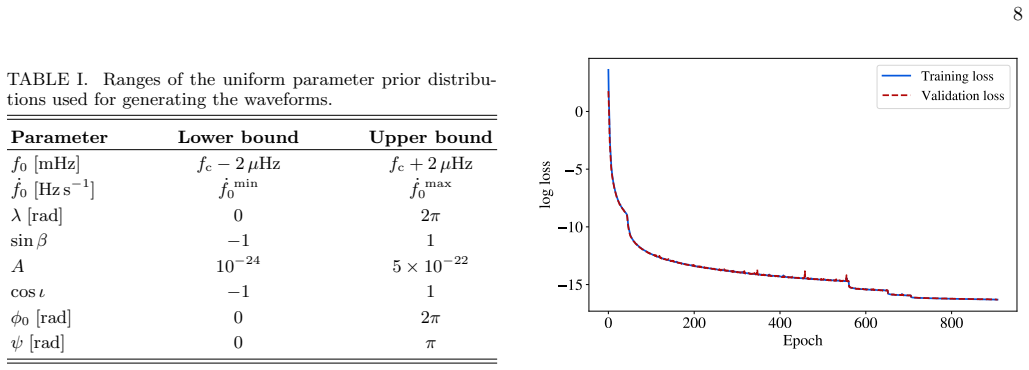
The learning rate was set to 2×10 −4 and sub- sequently reduced by a factor two once the validation loss had not decreased after 10 epochs thanks to the ReduceLROnPlateauscheduler [52]. The convergence re- quired approximately one week for each training on a NVIDIA A100 GPU. We used the validation dataset to monitor the overfitting of the network on the t...
2030
-
[2]
We denote byn ij (i, j∈ {1,2,3}) the unit vector along the arm of LISA between the space- craftsiandj, andL ij the length of the arm between the spacecraftiandj
LISA response The GW tensor in equation (9) is projected on the three arms of LISA. We denote byn ij (i, j∈ {1,2,3}) the unit vector along the arm of LISA between the space- craftsiandj, andL ij the length of the arm between the spacecraftiandj. The LISA response [31–33] is constructed from single- link observablesy ij, which represent the relative distan...
-
[3]
To suppress this noise, LISA employs TDI [34–37]
Time-Delay Interferometry The single-link observablesy ij (31) are dominated by the laser frequency noise, which is several orders of mag- nitude larger than the expected gravitational-wave signal [34]. To suppress this noise, LISA employs TDI [34–37]. TDI consists in constructing specific linear combinations of delayed single-link measurements such that ...
-
[4]
A useful technique for the acceleration of waveform generation relies on heterodyning
Waveform implementation The GB signal is composed of a slow part,∼1/T obs, from the LISA response and a fast part,∼f 0, from the GW frequency. A useful technique for the acceleration of waveform generation relies on heterodyning. From equa- tion (38), we can decompose analyticallyy ij(t) as [31] yij(t) =ℜ yslow ij (t)e 2πif∗t ,(41) wheref ∗ =k ∗∆fis the h...
-
[5]
Jaranowski–Kr´ olak–Schutz parametrization development Here we provide the explicit expressions for the JKS coefficientsA µ and basis functions ˜Aµ, ˜Eµ introduced in subsection II E. Using the shorthand notationA + = A(1 + cos2 ι) andA × = 2Acosι, the four amplitude co- efficients are given by A1 =A + cos 2ψcosϕ 0 −A × sin 2ψsinϕ 0 , A2 =A + sin 2ψcosϕ 0...
-
[6]
As seen previously in Sections IV and V, the posterior distribution of the parameters (A, ι, ϕ 0, ψ) has a complicated structure, notably exhibiting bimodalities
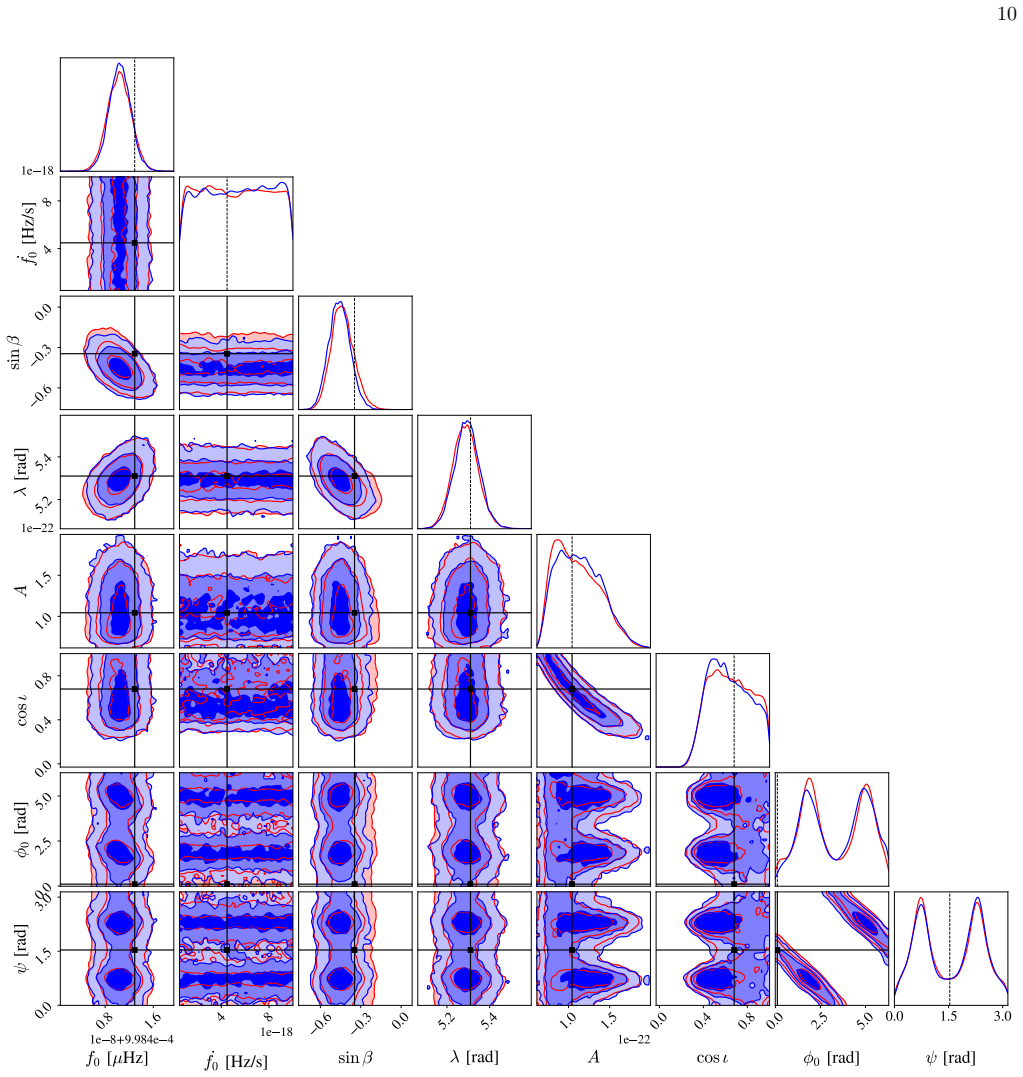
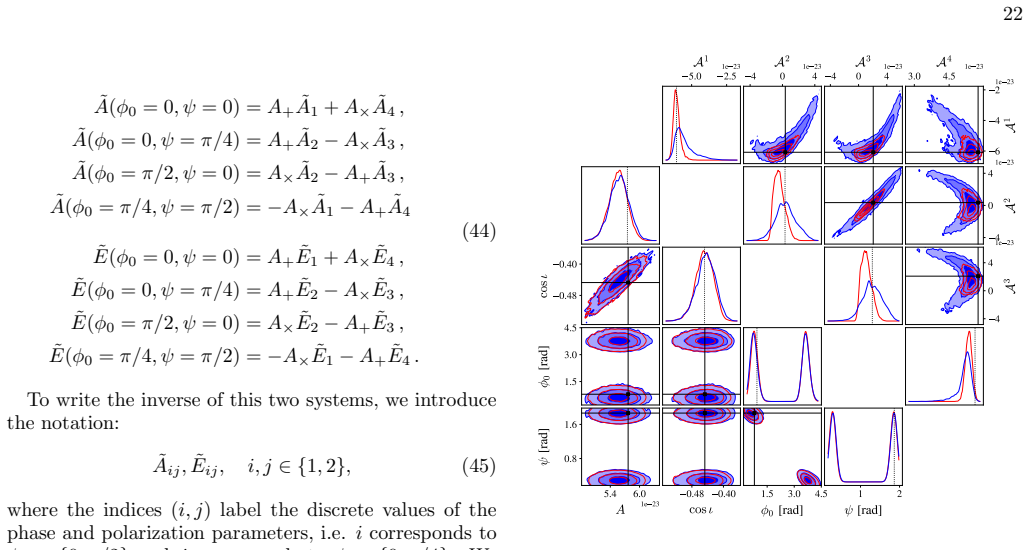
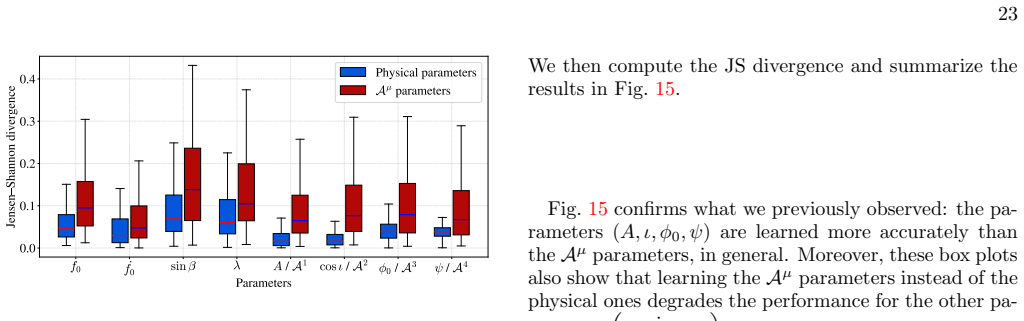
NPE with the JKS parametrization Since there exists an invertible transformation be- tween the physical parameters (A, ι, ϕ 0, ψ) and the am- plitude parametersA µ defined in equation (43), either parametrization can in principle be used for parameter estimation. As seen previously in Sections IV and V, the posterior distribution of the parameters (A, ι, ...
-
[7]
B. P. Abbottet al.(LIGO Scientific Collaboration and Virgo Collaboration), Phys. Rev. Lett.116, 061102 (2016), arXiv:1602.03837 [gr-qc]
work page internal anchor Pith review Pith/arXiv arXiv 2016
-
[8]
B. P. Abbottet al., Classical and Quantum Gravity32, 074001 (2015), arXiv:1411.4547 [gr-qc]
work page internal anchor Pith review Pith/arXiv arXiv 2015
-
[9]
Acerneseet al., Classical and Quantum Gravity32, 024001 (2014), arXiv:1408.3978 [gr-qc]
work page internal anchor Pith review Pith/arXiv arXiv 2014
-
[10]
Y. Aso, Y. Michimura, K. Somiya, M. Ando, O. Miyakawa, T. Sekiguchi, D. Tatsumi, and H. Ya- mamoto (The KAGRA Collaboration), Phys. Rev. D88, 043007 (2013), arXiv:1306.6747 [gr-qc]
work page internal anchor Pith review Pith/arXiv arXiv 2013
-
[11]
M. Colpiet al.(LISA), LISA Definition Study Report (2024), arXiv:2402.07571 [astro-ph.CO]
work page internal anchor Pith review Pith/arXiv arXiv 2024
-
[12]
Laser Interferometer Space Antenna
P. Amaro-Seoaneet al., Laser Interferometer Space An- tenna (2017), arXiv:1702.00786 [astro-ph.IM]
work page internal anchor Pith review Pith/arXiv arXiv 2017
-
[13]
Science with the space-based interferometer eLISA. I: Supermassive black hole binaries
A. Klein, E. Barausse, A. Sesana, A. Petiteau, E. Berti, S. Babak, J. Gair, S. Aoudia, I. Hinder, F. Ohme, and B. Wardell, Phys. Rev. D93, 024003 (2016), arXiv:1511.05581 [gr-qc]
work page internal anchor Pith review Pith/arXiv arXiv 2016
-
[14]
Science with the space-based interferometer LISA. V: Extreme mass-ratio inspirals
S. Babak, J. Gair, A. Sesana, E. Barausse, C. F. Sop- uerta, C. P. L. Berry, E. Berti, P. Amaro-Seoane, A. Pe- titeau, and A. Klein, Phys. Rev. D95, 103012 (2017), arXiv:1703.09722 [gr-qc]
work page internal anchor Pith review Pith/arXiv arXiv 2017
-
[15]
Cosmological Backgrounds of Gravitational Waves
C. Caprini and D. G. Figueroa, Classical and Quan- tum Gravity35, 163001 (2018), arXiv:1801.04268 [astro- ph.CO]
work page internal anchor Pith review Pith/arXiv arXiv 2018
-
[16]
Korol, E
V. Korol, E. M. Rossi, and E. Barausse, Monthly Notices of the Royal Astronomical Society483, 5518 (2019), https://academic.oup.com/mnras/article- pdf/483/4/5518/27496911/sty3440.pdf
2019
-
[17]
A. J. Ruiter, K. Belczynski, M. Benacquista, S. L. Lar- son, and G. Williams, The Astrophysical Journal717, 1006 (2010), arXiv:0705.3272 [gr-qc]
work page internal anchor Pith review Pith/arXiv arXiv 2010
- [18]
-
[19]
Nelemans, G., Yungelson, L. R., and Portegies Zwart, S. F., A&A375, 890 (2001), arXiv:astro-ph/0105221
work page internal anchor Pith review Pith/arXiv arXiv 2001
-
[20]
O. Hartwig, M. Lilley, M. Muratore, and M. Pieroni, Phys. Rev. D107, 123531 (2023), arXiv:2303.15929 [gr- qc]
- [21]
- [22]
-
[23]
M. Muratore, J. Gair, O. Hartwig, M. L. Katz, and A. Toubiana, Phys. Rev. D112, 063041 (2025), arXiv:2505.19870 [gr-qc]
-
[24]
E. Castelli, Q. Baghi, J. G. Baker, J. Slutsky, J. Bobin, N. Karnesis, A. Petiteau, O. Sauter, P. Wass, and W. J. Weber, Classical and Quantum Gravity42, 065018 (2025), arXiv:2411.13402 [gr-qc]
- [25]
- [26]
- [27]
-
[28]
P. J. GREEN, Biometrika82, 711 (1995), https://academic.oup.com/biomet/article- pdf/82/4/711/699533/82-4-711.pdf
1995
- [29]
- [30]
- [31]
- [32]
-
[33]
I. Mart´ ın V´ ılchez and C. F. Sopuerta, Journal of Cosmology and Astroparticle Physics2025(04), 022, arXiv:2406.00565 [gr-qc]
-
[34]
A. Spadaro, J. Gair, D. Gerosa, S. R. Green, R. Busci- cchio, N. Gupte, R. Tenorio, S. Clyne, M. P¨ urrer, and N. Korsakova, arXiv e-prints , arXiv:2603.20431 (2026), arXiv:2603.20431 [astro-ph.HE]
- [35]
-
[36]
Maggiore,Gravitational Waves: Volume 1: Theory and Experiments(Oxford University Press, 2007)
M. Maggiore,Gravitational Waves: Volume 1: Theory and Experiments(Oxford University Press, 2007)
2007
-
[37]
N. J. Cornish and L. J. Rubbo, Phys. Rev. D67, 022001 (2003), arXiv:0704.1808 [gr-qc]
work page internal anchor Pith review Pith/arXiv arXiv 2003
-
[38]
N. J. Cornish and L. J. Rubbo, Phys. Rev. D67, 022001 (2003), arXiv:gr-qc/0209011 [gr-qc]
work page internal anchor Pith review Pith/arXiv arXiv 2003
-
[39]
Fourier-domain modulations and delays of gravitational-wave signals
S. Marsat and J. G. Baker, arXiv e-print (2018), arXiv:1806.10734 [gr-qc], arXiv:1806.10734 [gr-qc]
work page internal anchor Pith review Pith/arXiv arXiv 2018
-
[40]
Tinto and J
M. Tinto and J. W. Armstrong, Phys. Rev. D59, 102003 (1999)
1999
-
[41]
N. J. Cornish and R. W. Hellings, Classical and Quantum Gravity20, 4851 (2003), arXiv:gr-qc/0306096 [gr-qc]
work page internal anchor Pith review Pith/arXiv arXiv 2003
-
[42]
Time Delay Interferometry with Moving Spacecraft Arrays
M. Tinto, F. B. Estabrook, and J. W. Armstrong, Phys. Rev. D69, 082001 (2004), arXiv:gr-qc/0310017 [gr-qc]
work page internal anchor Pith review Pith/arXiv arXiv 2004
- [43]
- [44]
- [45]
-
[46]
C., A&A692, A165 (2024), arXiv:2403.16867 [astro- ph.SR]
Toubiana, A., Karnesis, N., Lamberts, A., and Miller, M. C., A&A692, A165 (2024), arXiv:2403.16867 [astro- ph.SR]
-
[47]
J. T. Whelan, R. Prix, C. J. Cutler, and J. L. Willis, Classical and Quantum Gravity31, 065002 (2014), arXiv:1311.0065 [gr-qc]
work page internal anchor Pith review Pith/arXiv arXiv 2014
-
[48]
W. K. Hastings, Biometrika57, 97 (1970)
1970
-
[49]
Skilling, Bayesian Analysis1, 833 (2006)
J. Skilling, Bayesian Analysis1, 833 (2006)
2006
-
[50]
Rezende and S
D. Rezende and S. Mohamed, inProceedings of the 32nd International Conference on Machine Learning, Proceed- ings of Machine Learning Research, Vol. 37, edited by F. Bach and D. Blei (PMLR, Lille, France, 2015) pp. 1530–1538
2015
-
[51]
L. Dinh, J. Sohl-Dickstein, and S. Bengio (2017) arXiv:1605.08803 [cs.LG]
work page internal anchor Pith review Pith/arXiv arXiv 2017
-
[52]
Durkan, A
C. Durkan, A. Bekasov, I. Murray, and G. Papamakar- ios, Neural spline flows, inProceedings of the 33rd In- ternational Conference on Neural Information Processing Systems(Curran Associates Inc., Red Hook, NY, USA,
- [53]
-
[54]
K. He, X. Zhang, S. Ren, and J. Sun, in2016 IEEE Conference on Computer Vision and Pattern Recognition (CVPR)(2016) pp. 770–778, arXiv:1512.03385 [cs.CV]
work page internal anchor Pith review Pith/arXiv arXiv 2016
-
[55]
M. L. Katz, C. Danielski, N. Karnesis, V. Korol, N. Tamanini, N. J. Cornish, and T. B. Littenberg, Monthly Notices of the Royal Astronomical Society517, 697 (2022)
2022
-
[56]
Code will be made public soon
-
[57]
Goodfellow, Y
I. Goodfellow, Y. Bengio, and A. Courville,Deep Learn- ing(MIT Press, 2016)http://www.deeplearningbook. org
2016
-
[58]
D. P. Kingma and J. Ba, inInternational Conference on Learning Representations (ICLR)(2015)
2015
-
[59]
A. Paszkeet al., Pytorch: an imperative style, high- performance deep learning library, inProceedings of the 33rd International Conference on Neural Information Processing Systems(Curran Associates Inc., Red Hook, NY, USA, 2019) arXiv:1912.01703 [cs.LG]
work page internal anchor Pith review Pith/arXiv arXiv 2019
-
[60]
D. Foreman-Mackey, D. W. Hogg, D. Lang, and J. Good- man, Publications of the Astronomical Society of the Pa- cific125, 306 (2013), arXiv:1202.3665 [astro-ph.IM]
work page internal anchor Pith review Pith/arXiv arXiv 2013
-
[61]
W. D. Vousden, W. M. Farr, and I. Mandel, Monthly Notices of the Royal Astronomical Society455, 1919 (2016), arXiv:https://academic.oup.com/mnras/article- pdf/455/2/1919/18514064/stv2422.pdf [astro-ph.IM]
1919
-
[62]
Lin, IEEE Transactions on Information Theory37, 145 (1991)
J. Lin, IEEE Transactions on Information Theory37, 145 (1991)
1991
discussion (0)
Sign in with ORCID, Apple, or X to comment. Anyone can read and Pith papers without signing in.