REVIEW 1 major objections 1 minor 73 references
Exact calculation of entanglement negativity for a 1+1D massless scalar field using phase space methods
T0 review · 1 major / 1 minor · reviewed 2026-06-30 · grok-4.3
Pith's one-line read The entanglement negativity between any two compact regions in the 1+1D massless scalar vacuum is exactly calculable along with its carrying modes.
desk verdict The paper extends the Kähler framework with a basis-independent transpose and a complex-plane BVP reformulation to target exact negativity for arbitrary regions, but the explicit closed-form claim for generic compact regions looks shaky. read the letter →
The pith
A machine-rendered reading of the paper's core claim, the machinery that carries it, and where it could break.
The reading
What carries the argument
Reformulation of the eigenvalue problem for the partially-transposed restricted linear complex structure as a boundary value problem in the complex plane, which enables the diagonalization and identification of negativity cores.
What would settle it
A direct comparison of the logarithmic negativity computed by this method for two specific intervals against results from the replica trick in conformal field theory; mismatch for compact regions would show the diagonalization is not exact.
Extended reading notes
Core claim
The eigenvalue problem for the partially-transposed restricted linear complex structure is reformulated as a boundary value problem in the complex plane. This reformulation yields an explicit exact diagonalization for arbitrary compact regions, fully characterizing the entanglement negativity between two arbitrary compact spacelike-separated regions together with the negativity cores.
Load-bearing premise
The reformulation of the eigenvalue problem for the partially-transposed restricted linear complex structure as a boundary value problem in the complex plane yields an explicit exact diagonalization for arbitrary compact regions.
Editorial extensions
If this is right
- The logarithmic negativity is obtained exactly for any pair of compact spacelike-separated regions.
- The modes carrying the negativity, called negativity cores, are explicitly identified.
- A basis-independent definition of the transpose operation extends the Kähler structure framework for Gaussian states.
- The results indicate possible extensions of the method to higher dimensions and to fermionic fields.
Reading between the lines
- The boundary-value reformulation could be adapted to check scaling of negativity with region separation or size against known conformal field theory formulas.
- The identified negativity cores might be used to construct explicit field configurations that saturate the negativity bound in lattice simulations of the same system.
- The phase-space approach may allow direct comparison of negativity with other Gaussian-state quantities like mutual information without switching formalisms.
Signed reviews
Editorial analysis
A structured set of objections, weighed in public.
Referee Report
Summary. The manuscript claims to fully characterize the entanglement negativity between two arbitrary compact spacelike-separated regions of a 1+1D massless scalar field vacuum by computing the logarithmic negativity and identifying the associated modes (negativity cores). This is achieved via a phase space framework based on the Kähler structure of Gaussian states, including a basis-independent definition of the transpose, and by reformulating the eigenvalue problem for the partially-transposed restricted linear complex structure as a boundary value problem in the complex plane to obtain an explicit diagonalization.
Significance. Should the method deliver exact results for arbitrary regions as claimed, the work would represent a notable advance in the study of entanglement in quantum field theory. Exact results for negativity in general geometries are rare, and the identification of negativity cores provides new insight into the structure of distillable entanglement. The extension of the phase space methods and suggestion for higher-dimensional and fermionic generalizations add to its potential impact.
major comments (1)
- [Abstract and method outline] Abstract and method outline: The central claim rests on the reformulation of the eigenvalue problem for the partially-transposed restricted linear complex structure as a complex-plane boundary value problem yielding an explicit exact diagonalization for arbitrary compact regions. For generic compact intervals, such BVPs typically do not admit known closed-form solutions due to variable coefficients or complex boundaries; the manuscript must demonstrate the specific technique that guarantees explicit solvability in the general case, as this is load-bearing for the 'exact calculation' assertion.
minor comments (1)
- The abstract is dense; consider expanding slightly on how the BVP is solved to aid readability.
Simulated Author's Rebuttal
We thank the referee for their positive evaluation of the work's significance and for the detailed comment. We respond point-by-point below.
read point-by-point responses
-
Referee: [Abstract and method outline] Abstract and method outline: The central claim rests on the reformulation of the eigenvalue problem for the partially-transposed restricted linear complex structure as a complex-plane boundary value problem yielding an explicit exact diagonalization for arbitrary compact regions. For generic compact intervals, such BVPs typically do not admit known closed-form solutions due to variable coefficients or complex boundaries; the manuscript must demonstrate the specific technique that guarantees explicit solvability in the general case, as this is load-bearing for the 'exact calculation' assertion.
Authors: We thank the referee for highlighting this point. The reformulation yields a BVP with piecewise constant coefficients on the real-line segments corresponding to the two regions and their complement, because the Kähler structure of the massless scalar is translation-invariant and the partial transpose acts by sign flip on one region's modes. This structure reduces the problem to a Riemann-Hilbert problem with constant jumps, which is solved exactly by the Plemelj-Sokhotski formula; the eigenvalues are the roots of an explicit transcendental equation whose coefficients depend on the endpoint positions. The eigenvectors are then constructed algebraically from the boundary values. The method is therefore closed-form for arbitrary compact intervals and is derived in detail in Sections 3–4. We do not believe additional demonstration is required, but would be happy to add an appendix with the explicit characteristic equation if the referee wishes. revision: no
Circularity Check
No circularity: derivation presented as independent reformulation and diagonalization
full rationale
The abstract and provided text describe a direct calculation of logarithmic negativity via diagonalization of the partially-transposed restricted linear complex structure, enabled by reformulating the eigenvalue problem as a complex-plane boundary value problem and extending the framework with a basis-independent transpose definition. No quoted steps reduce the claimed explicit diagonalization or negativity cores to fitted inputs, self-definitions, or self-citation chains by construction. The central result is framed as a self-contained extension of phase-space methods for Gaussian states, with no load-bearing reliance on prior author work that itself assumes the target quantities. This is the expected non-finding for a paper whose method is presented as yielding exact results from the reformulation alone.
Assumptions & free parameters
Cite this review
Pith. "Pith review of Exact calculation of entanglement negativity for a 1+1D massless scalar field using phase space methods." pith.science (2026). https://pith.science/paper/6NBBOB7Y
@misc{pith2026260630231,
  author       = {Pith},
  title        = {Pith review of: Exact calculation of entanglement negativity for a 1+1D massless scalar field using phase space methods},
  year         = {2026},
  howpublished = {\url{https://pith.science/paper/6NBBOB7Y}},
  note         = {Machine review of arXiv:2606.30231}
}
read the original abstract
Quantum fields exhibit a rich entanglement structure which is still not fully understood. In this work, we study the entanglement structure of the vacuum state of a massless scalar field in (1+1)-dimensions -- a paradigmatic case for both high energy and condensed matter physics. We fully characterize the entanglement negativity between two arbitrary compact spacelike-separated regions of the field by calculating the logarithmic negativity along with the modes carrying it, called negativity cores. We achieve this using a framework based on the K\"ahler structure of Gaussian states, wherein we calculate the diagonalization of the operator associated with the partially-transposed restricted linear complex structure. In doing so, we extend the methods of this framework by proposing a basis-independent definition of the transpose operation. The explicit diagonalization we perform is enabled by a reformulation of the eigenvalue problem as a boundary value problem in the complex plane. Our results also suggest extensions to higher dimensions and fermionic fields.
Figures
Figures from the paper (7 more)
Reference graph
Works this paper leans on
-
[1]
negativity cores
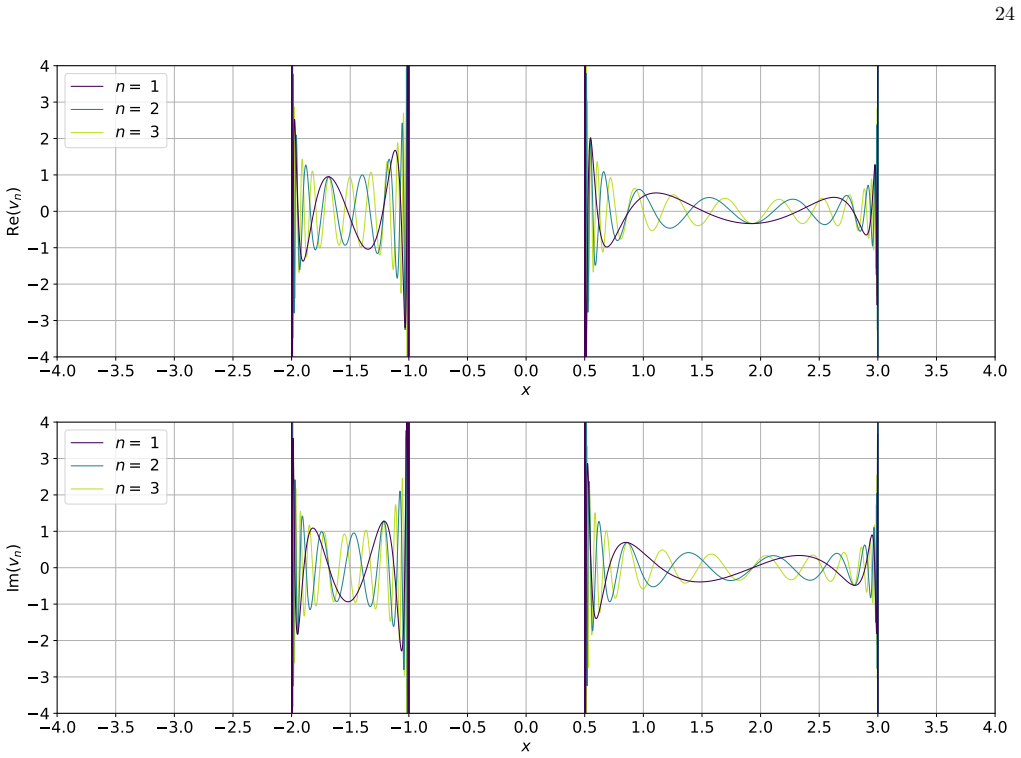
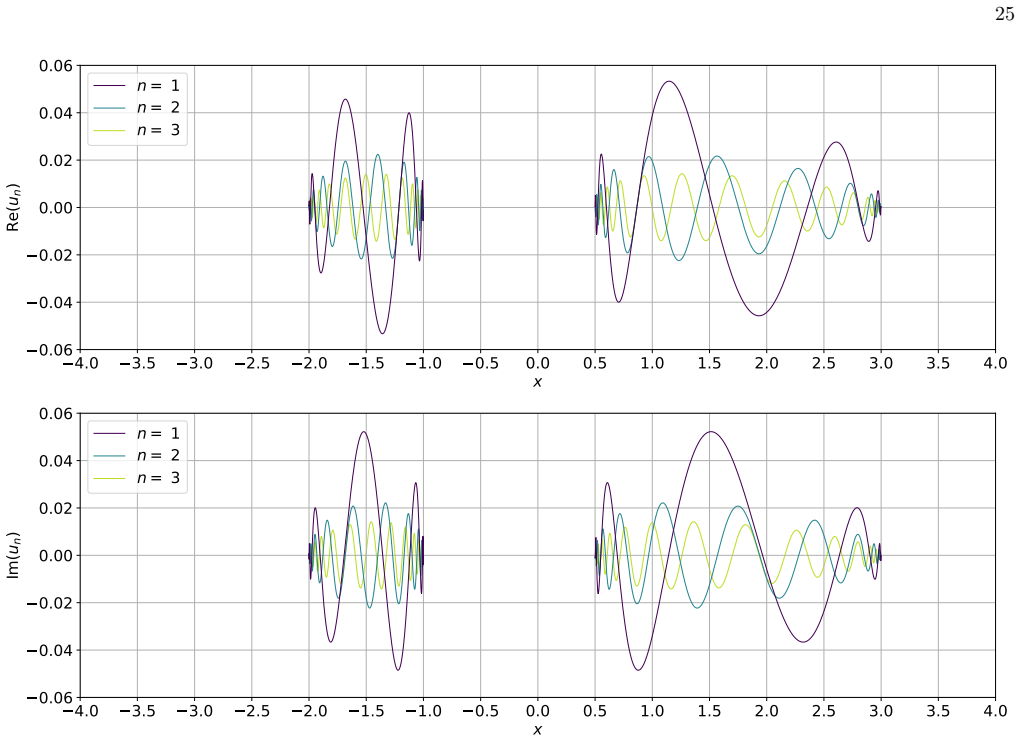
and (˜u′ 1,˜u′∗ 1 ), i.e., they are uncorre- lated. Therefore, ˜ν1 is indeed a symplectic eigenvalue of GΓ 1 . Note that, sinceG 1 is the covariance matrix for a single pair of modes, the second symplectic eigenvalue from the mode (˜u′ 1,˜u′∗ 1 ) must be larger than one, hence does not contribute to the logarithmic negativity. To summarize, we have shown ...
-
[2]
Our functionM(z) is thus meromorphic with (possi- bly) simple poles ata 1 andb 2
Hence,M(z) does not have an essential singularity, but may have a simple pole at these points. Our functionM(z) is thus meromorphic with (possi- bly) simple poles ata 1 andb 2. Using the Mittag-Leffler expansion, one can conclude thatM(z) must be of the form, M(z) = p(z) (z−a 1)(z−b 2) ,(116) for some entire functionp(z). Now we constrain the func- tionp(...
-
[3]
Based on the observations from Fig
Large separation regime We will now find analytical approximations of the zeros ofP −is−1/2(coshρ) in the regime where the intervals are widely separated compared to their sizes, i.e.,η→0 or ρ→0. Based on the observations from Fig. 2, we seek to approximateP −is−1/2(coshρ) whenρis small ands is large. We will use the leading order term in a series expansi...
-
[4]
Beyond this, the expansion can still be used as an asymptotic series ass→ ∞
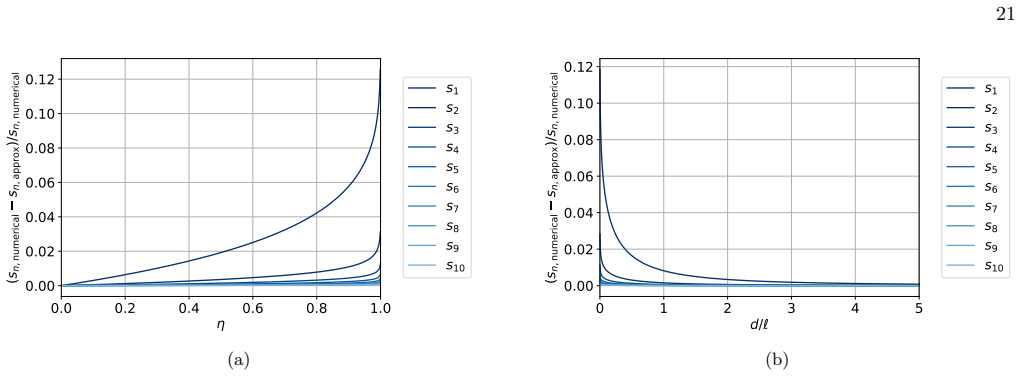
Note that the convergence criterion is equivalent toη⪅ 0.99999032 or, when the sizes of the intervals are equal, d/ℓ⪆4.84×10 −6. Beyond this, the expansion can still be used as an asymptotic series ass→ ∞. We will approximate the (non-negative) zeros of P−is−1/2(coshρ) using the zeros of the first term in the series. If we denote the zeros ofJ 0 byj 0,n w...
-
[5]
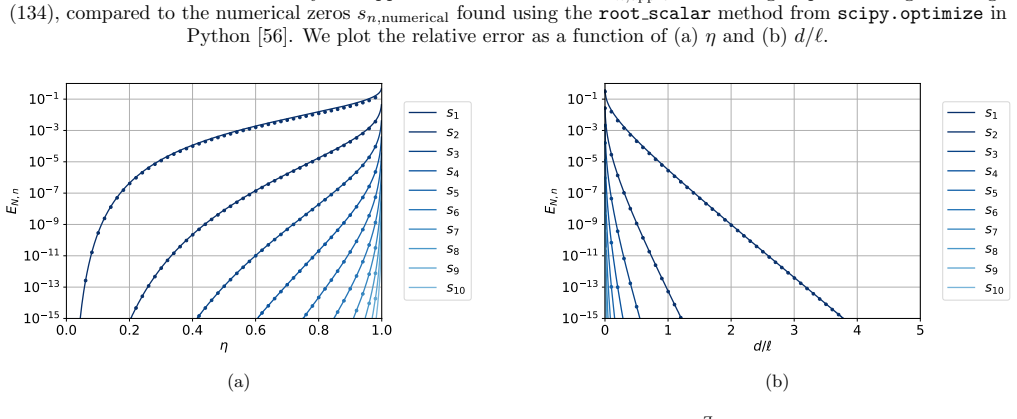
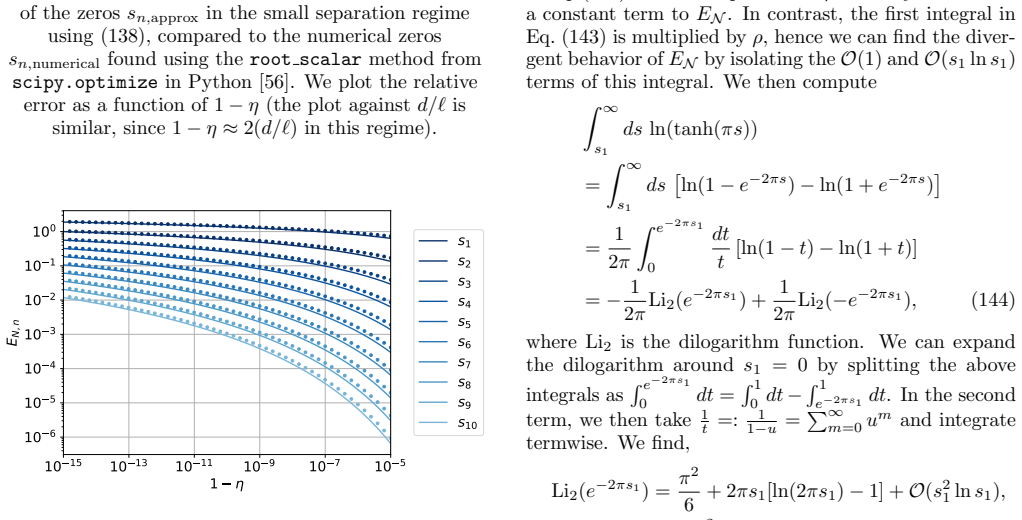
Small separation regime Now we will proceed to approximate the zeros of P−is−1/2(coshρ) when the two intervals are close com- pared to their sizes, i.e.,η→1 orρ→ ∞. For large values ofρ, the zeros of the conical functions can be approximated by [54, 57], ρsn ≈nπ+ arctan Im[B( 1 2 , 1 2 +is n)] Re[B( 1 2 , 1 2 +is n)] , n∈N, (137) whereBis the beta functio...
-
[6]
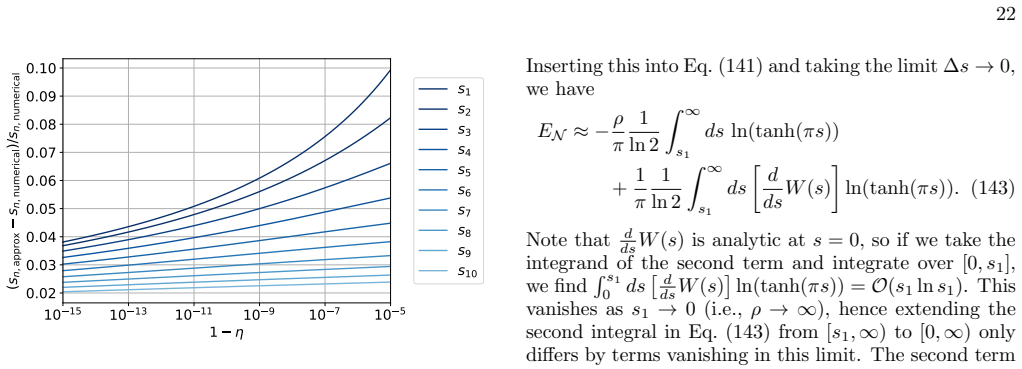
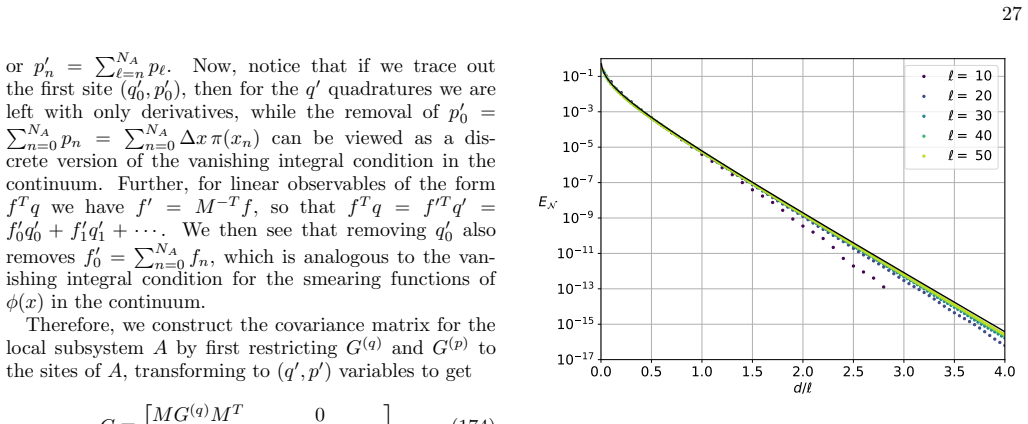
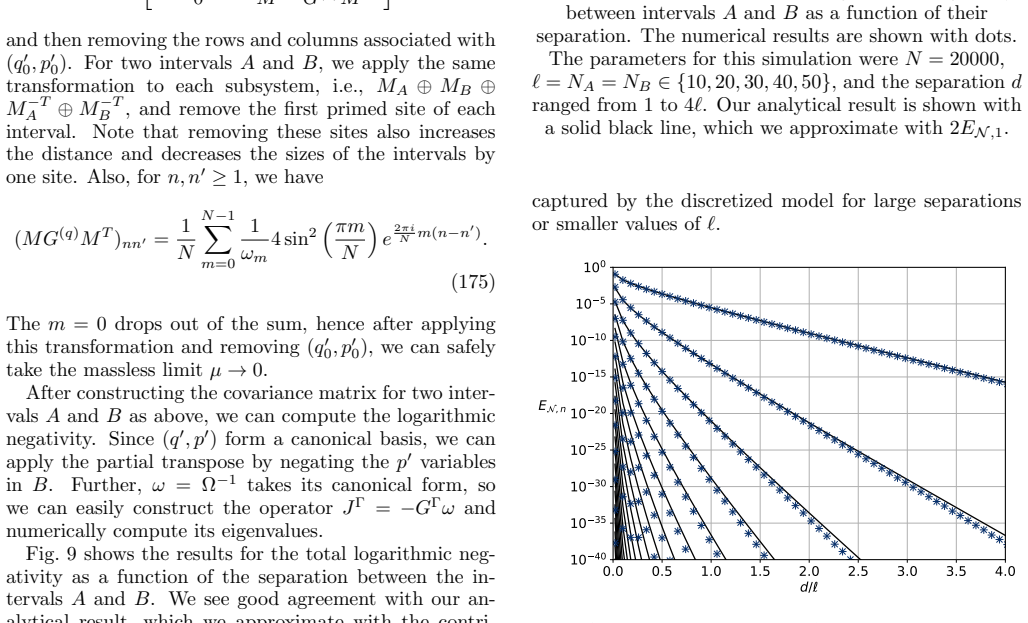
Universal CFT leading order divergence We can also reproduce the universal 1+1D conformal field theory prediction for the leading order divergence of the total logarithmic negativity as the two intervals approach one another [36, 37, 42]. The total logarithmic negativity is EN =− ∞X n=1 log2(tanh(πsn)).(141) 22 10 15 10 13 10 11 10 9 10 7 10 5 1 0.02 0.03...
-
[7]
We can make this a symplectic transformation if we also apply ⃗p′ =M −T ⃗ p, which is given by (M −T )nn′ = NAX ℓ=n δℓn′,(173) 27 orp ′ n = PNA ℓ=n pℓ. Now, notice that if we trace out the first site (q ′ 0, p′ 0), then for theq ′ quadratures we are left with only derivatives, while the removal ofp ′ 0 =PNA n=0 pn = PNA n=0 ∆x π(xn) can be viewed as a dis...
-
[8]
using Eq. (20). Since the expressions for the neg- ativity Hamiltonian are much simpler for the fermionic field, comparisons could be done more explicitly. Note that for fermions there are inequivalent definitions of par- tial transposition [63], and thus one would need to care- fully consider how the complex boundary value problem should be modified to i...
Show all 73 references
-
[9]
Calabrese and J
P. Calabrese and J. Cardy, Entanglement entropy and quantum field theory, J. Stat. Mech.: Th. Exp.2004, P06002 (2004)
2004
-
[10]
Calabrese and J
P. Calabrese and J. Cardy, Entanglement entropy and conformal field theory, J. Phys. A: Math. Th.42, 504005 (2009)
2009
-
[11]
Casini and M
H. Casini and M. Huerta, Entanglement entropy in free quantum field theory, J. Phys. A: Math. Th.42, 504007 (2009)
2009
-
[12]
Casini and M
H. Casini and M. Huerta, Lectures on entanglement in quantum field theory, arXiv:2201.13310 (2022), arXiv:2201.13310
2022
-
[13]
Bianchi and A
E. Bianchi and A. Satz, Entropy of a subalgebra of ob- servables and the geometric entanglement entropy, Phys. Rev. D99, 085001 (2019)
2019
-
[14]
R. D. Sorkin, On the entropy of the vacuum outside a horizon, inTenth International Conference on Gen- eral Relativity and Gravitation (held Padova, 4-9 July, 1983), Contributed Papers, Vol. 2 (1983) pp. 734–736, arXiv:1402.3589 [gr-qc]
1983 arXiv
-
[15]
Bombelli, R
L. Bombelli, R. K. Koul, J. Lee, and R. D. Sorkin, Quan- tum source of entropy for black holes, Phys. Rev. D34, 373 (1986)
1986
-
[16]
Srednicki, Entropy and area, Phys
M. Srednicki, Entropy and area, Phys. Rev. Lett.71, 666 (1993)
1993
-
[17]
Callan and F
C. Callan and F. Wilczek, On geometric entropy, Phys. Lett. B333, 55 (1994)
1994
-
[18]
S. N. Solodukhin, Entanglement entropy of black holes, Liv. Rev. Rel.14, 8 (2011)
2011
-
[19]
Eisert, M
J. Eisert, M. Cramer, and M. B. Plenio, Colloquium: Area laws for the entanglement entropy, Rev. Mod. Phys. 82, 277 (2010)
2010
-
[20]
Amico, R
L. Amico, R. Fazio, A. Osterloh, and V. Vedral, Entan- glement in many-body systems, Rev. Mod. Phys.80, 517 (2008)
2008
-
[21]
Ryu and T
S. Ryu and T. Takayanagi, Holographic derivation of entanglement entropy from the anti–de sitter space/conformal field theory correspondence, Phys. Rev. Lett.96, 181602 (2006)
2006
-
[22]
Swingle, Entanglement renormalization and hologra- phy, Phys
B. Swingle, Entanglement renormalization and hologra- phy, Phys. Rev. D86, 065007 (2012)
2012
-
[23]
Almheiri, N
A. Almheiri, N. Engelhardt, D. Marolf, and H. Maxfield, The entropy of bulk quantum fields and the entanglement wedge of an evaporating black hole, JHEP2019(12), 63
-
[24]
Penington, Entanglement wedge reconstruction and the information paradox, JHEP2020(9), 2
G. Penington, Entanglement wedge reconstruction and the information paradox, JHEP2020(9), 2
-
[25]
Van Raamsdonk, Building up spacetime with quan- tum entanglement, Gen
M. Van Raamsdonk, Building up spacetime with quan- tum entanglement, Gen. Rel. and Grav.42, 2323 (2010)
2010
-
[26]
Jacobson, Entanglement equilibrium and the einstein equation, Phys
T. Jacobson, Entanglement equilibrium and the einstein equation, Phys. Rev. Lett.116, 201101 (2016)
2016
-
[27]
C. Cao, S. M. Carroll, and S. Michalakis, Space from hilbert space: recovering geometry from bulk entangle- ment, Phys. Rev. D95, 024031 (2017)
2017
-
[28]
Botero and B
A. Botero and B. Reznik, Mode-Wise Entanglement of Gaussian States, Phys. Rev. A67, 10.1103/Phys- RevA.67.052311 (2003)
2003 doi
-
[29]
Botero and B
A. Botero and B. Reznik, Spatial structures and local- ization of vacuum entanglement in the linear harmonic chain, Phys. Rev. A70, 052329 (2004)
2004
-
[30]
Hackl and R
L. Hackl and R. H. Jonsson, Minimal energy cost of en- tanglement extraction, Quantum3, 165 (2019)
2019
-
[31]
Agullo, E
I. Agullo, E. Mart´ ın-Mart´ ınez, S. Nadal-Gisbert, P. Ribes-Metidieri, and K. Yamaguchi, Correlation and entanglement partners in gaussian systems, arXiv:2512.11055 (2025), arXiv:2512.11055
2025
-
[32]
N. D. Birrell and P. C. W. Davies,Quantum Fields in Curved Space(Cambridge University Press, 1982)
1982
-
[33]
S. J. Summers and R. Werner, Maximal violation of bell’s inequalities is generic in quantum field theory, Comm. Math. Phys.110, 247 (1987)
1987
-
[34]
Verch and R
R. Verch and R. F. Werner, Distillability and positivity of partial transposes in general quantum field systems, Rev. Math. Phys.17, 545 (2005)
2005
-
[35]
Redhead, More ado about nothing, Found
M. Redhead, More ado about nothing, Found. Phys.25, 123 (1995)
1995
-
[36]
Witten, Aps medal for exceptional achievement in research: Invited article on entanglement properties of quantum field theory, Rev
E. Witten, Aps medal for exceptional achievement in research: Invited article on entanglement properties of quantum field theory, Rev. Mod. Phys.90, 045003 (2018)
2018
-
[37]
Valentini, Non-local correlations in quantum electro- dynamics, Phys
A. Valentini, Non-local correlations in quantum electro- dynamics, Phys. Lett. A153, 321 (1991)
1991
-
[38]
Reznik, Entanglement from the Vacuum, Found
B. Reznik, Entanglement from the Vacuum, Found. Phys. 33, 167 (2003)
2003
-
[39]
G. V. Steeg and N. C. Menicucci, Entangling power of an expanding universe, Phys. Rev. D79, 044027 (2009)
2009
-
[40]
Mart´ ın-Mart´ ınez and N
E. Mart´ ın-Mart´ ınez and N. C. Menicucci, Entanglement in curved spacetimes and cosmology, Class. Quant. Grav. 31, 214001 (2014)
2014
-
[41]
J. G. A. Carib´ e, R. H. Jonsson, M. Casals, A. Kempf, and E. Mart´ ın-Mart´ ınez, Lensing of vacuum entangle- ment near Schwarzschild black holes, Phys. Rev. D108, 025016 (2023)
2023
-
[42]
Horodecki, P
R. Horodecki, P. Horodecki, M. Horodecki, and K. Horodecki, Quantum entanglement, Rev. Mod. Phys. 81, 865 (2009)
2009
-
[43]
Serafini,Quantum continuous variables: a primer of theoretical methods, 2nd ed
A. Serafini,Quantum continuous variables: a primer of theoretical methods, 2nd ed. (CRC press, 2023)
2023
-
[44]
Calabrese, J
P. Calabrese, J. Cardy, and E. Tonni, Entanglement neg- ativity in quantum field theory, Phys. Rev. Lett.109, 130502 (2012)
2012
-
[45]
Calabrese, J
P. Calabrese, J. Cardy, and E. Tonni, Entanglement neg- ativity in extended systems: A field theoretical approach, J. Stat. Mech.: Th. Exp.2013, P02008 (2013)
2013
-
[46]
Marcovitch, A
S. Marcovitch, A. Retzker, M. B. Plenio, and B. Reznik, Critical and noncritical long-range entanglement in Klein-Gordon fields, Phys. Rev. A80, 012325 (2009)
2009
-
[47]
Klco and M
N. Klco and M. J. Savage, Entanglement spheres and a uv-ir connection in effective field theories, Phys. Rev. Lett.127, 211602 (2021)
2021
-
[48]
M. Zych, F. Costa, J. Kofler, and C. Brukner, Entangle- ment between smeared field operators in the klein-gordon vacuum, Phys. Rev. D81, 125019 (2010)
2010
-
[49]
Agullo, B
I. Agullo, B. Bonga, E. Mart´ ın-Mart´ ınez, S. Nadal- Gisbert, T. R. Perche, J. Polo-G´ omez, P. Ribes-Metidieri, and B. d. S. Torres, Multimode nature of spacetime en- tanglement in qft, Phys. Rev. D111, 085013 (2025)
2025
-
[50]
Arias, M
M. Arias, M. Huerta, A. Rotaru, and E. Tonni, En- tanglement negativity for a free scalar chiral current, arXiv:2601.04995 (2026), arXiv:2601.04995
2026
-
[51]
N. Klco, D. H. Beck, and M. J. Savage, Entanglement structures in quantum field theories: Negativity cores and bound entanglement in the vacuum, Phys. Rev. A 30 107, 012415 (2023)
2023
-
[52]
Gao and N
B. Gao and N. Klco, Partial-transpose-guided entangle- ment classes and minimum noise filtering in many-body gaussian quantum systems, Phys. Rev. A109, 062413 (2024)
2024
-
[53]
Gao and N
B. Gao and N. Klco, Detecting spacelike vacuum entan- glement at all distances and promoting negativity to a necessary and sufficient entanglement measure in many- body regimes, Phys. Rev. A112, 012430 (2025)
2025
-
[54]
R. E. Arias, H. Casini, M. Huerta, and D. Pontello, En- tropy and modular hamiltonian for a free chiral scalar in two intervals, Phys. Rev. D98, 125008 (2018)
2018
-
[55]
Hackl and E
L. Hackl and E. Bianchi, Bosonic and fermionic Gaussian states from K¨ ahler structures, SciPost Physics Core4, 025 (2021)
2021
-
[56]
J. Pye, A. Hingane, and R. H. Jonsson, The nega- tivity core of a 1+ 1d massless scalar quantum field, arXiv:2605.23824 (2026), arXiv:2605.23824
2026 arXiv
-
[57]
Murciano, V
S. Murciano, V. Vitale, M. Dalmonte, and P. Calabrese, Negativity hamiltonian: an operator characterization of mixed-state entanglement, Phys. Rev. Lett.128, 140502 (2022)
2022
-
[58]
Rudin,Real and Complex Analysis, 3rd ed
W. Rudin,Real and Complex Analysis, 3rd ed. (McGraw– Hill, 1987)
1987
-
[59]
De la Madrid, The role of the rigged hilbert space in quantum mechanics, Eur
R. De la Madrid, The role of the rigged hilbert space in quantum mechanics, Eur. J. Phys.26, 287 (2005)
2005
-
[60]
Dennery and A
P. Dennery and A. Krzywicki,Mathematics for physicists (Dover Publications, 1996) reprint of Harper & Row 1967 edition
1996
-
[61]
I. S. Gradshteyn and I. M. Ryzhik,Table of Integrals, Series, and Products, 7th ed. (Academic Press, 2007)
2007
-
[62]
M. I. Zhurina and L. N. Karmazina,Tables and formulae for the spherical functionsP m −1/2+iτ(z) (Pergamon Press, 1966)
1966
-
[63]
mpmath development team,mpmath: a Python library for arbitrary-precision floating-point arithmetic (version 1.3.0)(2023),http://mpmath.org/
T. mpmath development team,mpmath: a Python library for arbitrary-precision floating-point arithmetic (version 1.3.0)(2023),http://mpmath.org/
2023
-
[64]
Virtanenet al., SciPy 1.0: Fundamental Algorithms for Scientific Computing in Python, Nature Methods17, 261 (2020)
P. Virtanenet al., SciPy 1.0: Fundamental Algorithms for Scientific Computing in Python, Nature Methods17, 261 (2020)
2020
-
[65]
E. W. Hobson,The theory of spherical and ellipsoidal harmonics(Cambridge University Press, 1931)
1931
-
[66]
Mallayya, R
K. Mallayya, R. Tibrewala, S. Shankaranarayanan, and T. Padmanabhan, Zero modes and divergence of entan- glement entropy, Phys. Rev. D90, 044058 (2014)
2014
-
[67]
J. Pye, W. Donnelly, and A. Kempf, Locality and entan- glement in bandlimited quantum field theory, Phys. Rev. D92, 105022 (2015)
2015
-
[68]
Y. K. Yazdi, Zero modes and entanglement entropy, JHEP2017(4), 1
-
[69]
P. Jain, S. M. Chandran, and S. Shankaranarayanan, Log to log-log crossover of entanglement in a (1 + 1)- dimensional massive scalar field, Phys. Rev. D103, 125008 (2021)
2021
-
[70]
R. E. Arias, H. Casini, M. Huerta, and D. Pontello, Anisotropic unruh temperatures, Phys. Rev. D96, 105019 (2017)
2017
-
[71]
Shapourian, P
H. Shapourian, P. Ruggiero, S. Ryu, and P. Cal- abrese, Twisted and untwisted negativity spectrum of free fermions, SciPost Phys.7, 037 (2019)
2019
-
[72]
Gao and N
B. Gao and N. Klco, Finite gaussian assistance proto- cols and a conic metric for extremizing spacelike vacuum entanglement, Phys. Rev. A113, 012430 (2026)
2026
-
[73]
M. M. Wolf, Not-So-Normal Mode Decomposition, Phys. Rev. Lett.100, 070505 (2008)
2008
Reviewed June 30, 2026 · model on record in the stance chip above.
Discussion (0). Continue with ORCID to comment.