Scalarization of dark matter stars
Pith reviewed 2026-06-29 20:43 UTC · model grok-4.3
The pith
Scalarization occurs in dark matter stars for most negative values of the coupling parameter β_d, spanning a wider range than in neutron stars.
A machine-rendered reading of the paper's core claim, the machinery that carries it, and where it could break.
Core claim
Within scalar-tensor theories, models in which the scalar field couples to self-interacting dark matter allow compact star formation. Scalarization is triggered by the effective mass generated through this coupling and occurs over most of the parameter region with negative β_d. This range is broader than the corresponding region for scalarization in conventional neutron stars.
What carries the argument
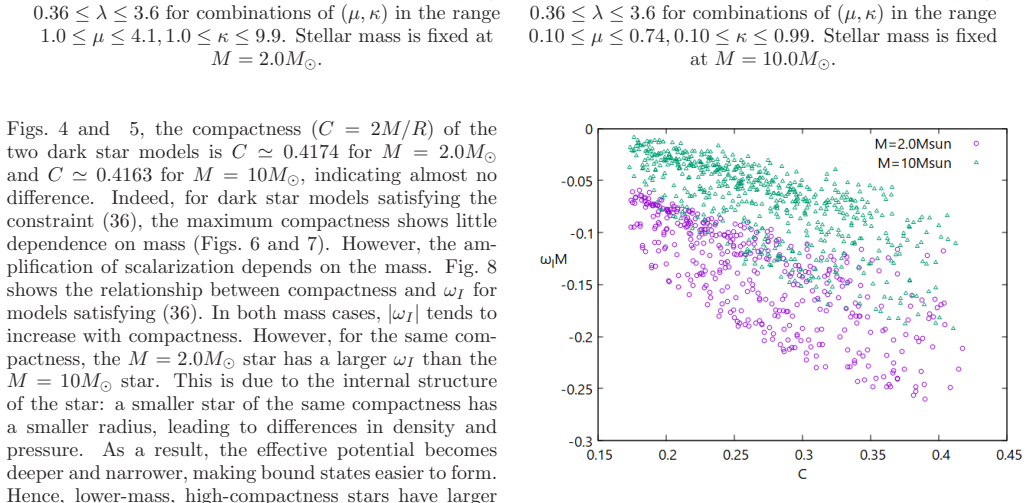
Spontaneous scalarization driven by the effective mass of the scalar field arising from its coupling to self-interacting dark matter.
If this is right
- Dark matter stars with the considered self-interacting parameters would exhibit scalarization for most negative β_d values.
- Such stars could serve as astrophysical probes of the scalar field–dark matter interaction.
- The allowed parameter space for scalarization exceeds that found for neutron stars under the same coupling assumptions.
Where Pith is reading between the lines
- If dark matter stars are observed, their scalarization signatures might distinguish self-interacting dark matter models from other candidates.
- The broader scalarization range suggests that dark matter objects could reveal scalar effects even in regimes where baryonic stars do not.
- Future gravitational-wave or electromagnetic observations of exotic compact objects could test the coupling form assumed here.
Load-bearing premise
The scalar field couples to dark matter with the same functional form used for ordinary matter, and the chosen self-interacting dark matter parameters allow both resolution of galaxy formation problems and formation of compact stars.
What would settle it
Detection or non-detection of scalar-field-induced modifications to the structure or gravitational wave emission from a compact dark matter star with the modeled self-interaction parameters would confirm or rule out the predicted scalarization.
Figures
read the original abstract
We investigated scalarization in dark matter stars. In scalar tensor theories, the coupling between matter and a scalar field generates an effective mass, which is known to trigger the growth of the scalar field in stars and black holes (spontaneous scalarization). On the other hand, models in which the scalar field couples not only to baryonic matter but also to dark matter have been discussed in the literature. Moreover, in models with self interacting dark matter, it is known that dark matter can form compact objects. Within the framework of scalar tensor theories, we studied the parameter ranges in which the growth of the scalar field occurs in compact stars formed by self interacting dark matter. As a result, we found that scalarization occurs over most of the parameter region with a negative coupling parameter $\beta_d$. This parameter range is broader than that for scalarization in conventional neutron stars. Since the dark matter parameters considered correspond to those in which self-interacting dark matter resolves problems in galaxy formation, if dark matter stars actually exist, they could serve as probes for investigating the relationship between the scalar field and dark matter.
Editorial analysis
A structured set of objections, weighed in public.
Referee Report
Summary. The manuscript investigates spontaneous scalarization of compact stars formed from self-interacting dark matter (SIDM) in scalar-tensor theories where the scalar couples to both baryonic matter and dark matter via the same exponential form. Numerical solutions of the modified Tolman-Oppenheimer-Volkoff equations are used to map the parameter space in the coupling strength β_d; the central result is that scalarized solutions exist over most of the region with negative β_d and that this interval is wider than the corresponding interval for neutron-star scalarization. The SIDM parameters are fixed to values taken from the galaxy-formation literature.
Significance. If the numerical survey is robust, the result supplies a concrete, falsifiable prediction that DM stars (if they exist) would scalarize more readily than neutron stars under the same coupling, offering a potential observational discriminant between scalar-tensor models with and without DM coupling. The explicit linkage to SIDM parameters already motivated by galactic dynamics is a positive feature that ties the calculation to an independent astrophysical context.
major comments (2)
- [§4] §4 (results): the statement that the allowed β_d interval is 'broader than that for scalarization in conventional neutron stars' is central to the abstract claim, yet the manuscript does not specify which neutron-star equation of state, central density range, or coupling implementation was used for the comparison; without this, the quantitative breadth cannot be verified.
- [§3.1] §3.1 (field equations): the effective mass term for the scalar field inside the DM fluid is written with the same β_d that appears for baryons; the text should explicitly confirm that no additional DM-specific rescaling or velocity dispersion correction is introduced, because any such factor would alter the reported scalarization threshold.
minor comments (2)
- [§3.2] The numerical integration scheme, grid resolution, and convergence tolerance are not stated; these details are needed to assess the reliability of the 'most of the parameter region' statement.
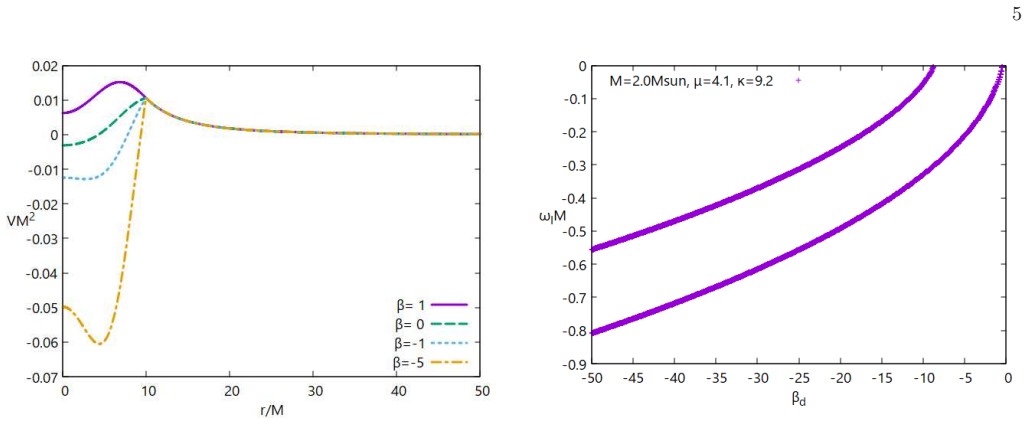
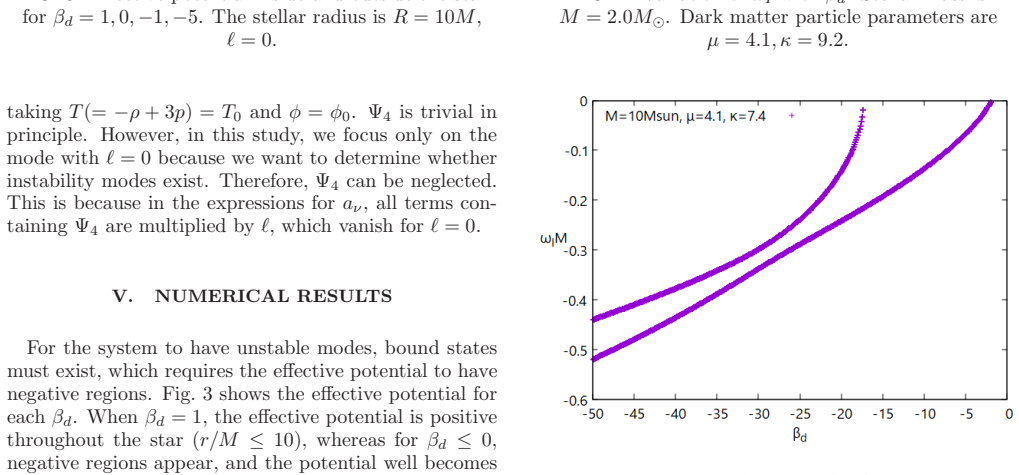
- [Figure 3] Figure 3 (or equivalent) should include the neutron-star comparison curve on the same axes so that the breadth claim can be read directly from the plot.
Simulated Author's Rebuttal
We thank the referee for the positive assessment and the recommendation for minor revision. We address each major comment below.
read point-by-point responses
-
Referee: [§4] §4 (results): the statement that the allowed β_d interval is 'broader than that for scalarization in conventional neutron stars' is central to the abstract claim, yet the manuscript does not specify which neutron-star equation of state, central density range, or coupling implementation was used for the comparison; without this, the quantitative breadth cannot be verified.
Authors: We agree the comparison lacks explicit specification in the current text. The benchmark was drawn from standard results in the scalar-tensor literature (exponential coupling with the same β form) for neutron stars using polytropic EOS with indices typical of nuclear matter and central densities near saturation density. In the revised manuscript we add a clarifying sentence in §4 that cites the relevant reference and states the EOS and density range employed, allowing direct verification of the broader interval for SIDM stars. revision: yes
-
Referee: [§3.1] §3.1 (field equations): the effective mass term for the scalar field inside the DM fluid is written with the same β_d that appears for baryons; the text should explicitly confirm that no additional DM-specific rescaling or velocity dispersion correction is introduced, because any such factor would alter the reported scalarization threshold.
Authors: The effective mass term is constructed with exactly the same β_d for the DM fluid as for baryons, with no additional rescaling or velocity-dispersion correction applied. The model assumes a uniform conformal coupling to the trace of the energy-momentum tensor for both sectors. We have inserted an explicit confirmation sentence in §3.1 stating that the implementation introduces no DM-specific factors beyond the shared β_d. revision: yes
Circularity Check
No significant circularity; result is numerical output of model equations
full rationale
The paper performs a numerical study of spontaneous scalarization in self-interacting dark-matter stars within scalar-tensor gravity. The central claim—that scalarized solutions exist for most negative values of the DM coupling parameter β_d and that this interval is wider than the corresponding neutron-star interval—is obtained by solving the coupled Einstein-scalar-fluid equations for the chosen exponential coupling and SIDM equation of state. No step in the provided abstract or description reduces the reported range to a fitted input, a self-citation chain, or a definitional identity; the coupling form and SIDM parameters are stated as modeling assumptions, and the scalarization threshold emerges from the boundary-value problem rather than being presupposed. The derivation is therefore self-contained against external benchmarks and receives the default non-circularity finding.
Axiom & Free-Parameter Ledger
free parameters (1)
- β_d
axioms (2)
- domain assumption The scalar field couples to dark matter with the same effective mass generation mechanism used for baryonic matter.
- domain assumption Self-interacting dark matter with parameters that resolve galaxy formation problems can form compact stars.
Reference graph
Works this paper leans on
-
[1]
1 ≤ σ mX ≤ 1 (cm 2g− 1), (30) which can be rewritten as follows:
-
[2]
36 ≤ ( α X 10− 2 ) 2 ( mX 100mφ ) 4 ( mX 1GeV ) − 3 ≤ 3. 6. (31) Here, the two parameters µ and κ are defined as µ ≡ ( mX 1GeV ) , (32) and κ ≡ ( mX 100mφ ) 2 α X 10− 2., (33) then the constraint (31) is rewritten as
-
[3]
36 ≤ µ − 3κ 2 ≤ 3. 6.. (34) For convenience, we define λ ≡ µ − 3κ 2, (35) the constraint is
-
[4]
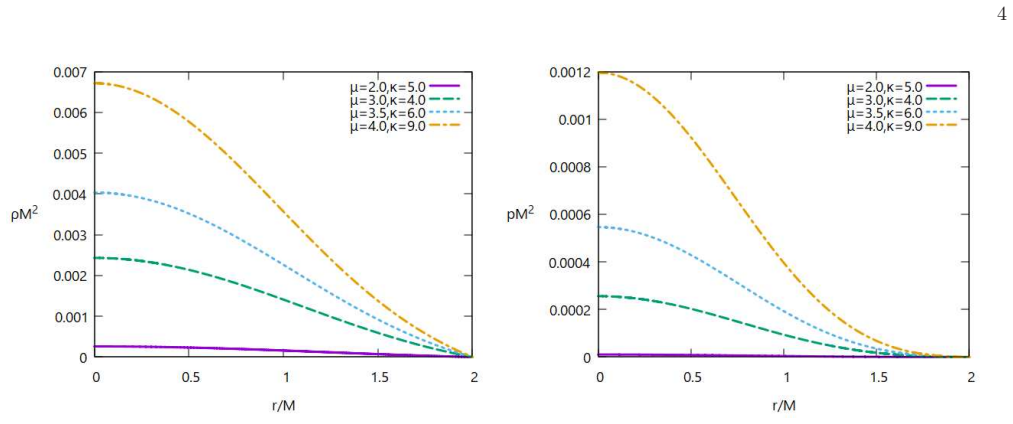
36 ≤ λ ≤ 3. 6. (36) 4 FIG. 1: Energy density profiles for each ( µ,κ ). All stars have a radius of R = 2. 0M . FIG. 2: Pressure profiles of stars at each ( µ,κ ). All stellar radii are R = 2. 0M . The equilibrium structure of a dark matter star is de- termined by the above equation of state (EOS), together with the equation for the metric function, dν dr = ...
-
[6]
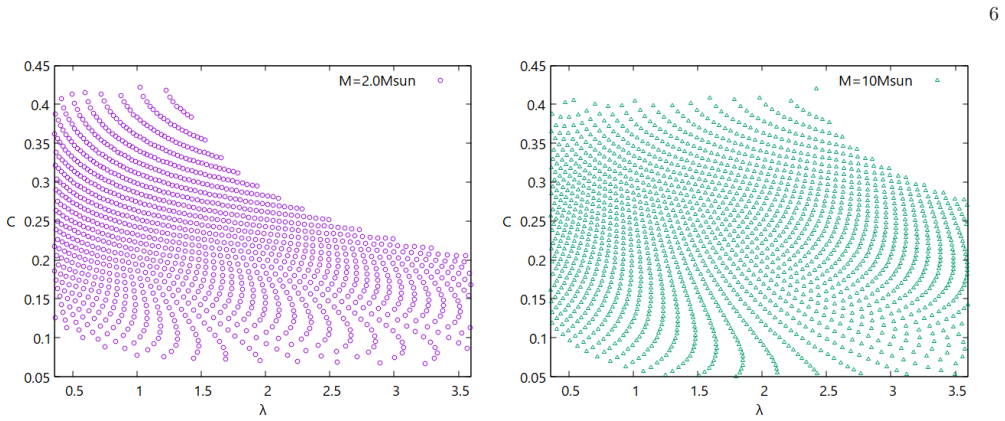
0 ≤ µ ≤ 4. 1, 1. 0 ≤ κ ≤ 9. 9. Stellar mass is fixed at M = 2. 0M⊙ . FIG. 7: Compactness of dark matter stars satisfying
-
[7]
6 for combinations of ( µ,κ ) in the range
36 ≤ λ ≤ 3. 6 for combinations of ( µ,κ ) in the range
-
[8]
10 ≤ µ ≤ 0. 74, 0. 10 ≤ κ ≤ 0. 99. Stellar mass is fixed at M = 10. 0M⊙ . Figs. 4 and 5, the compactness ( C = 2 M/R ) of the two dark star models is C ≃ 0. 4174 for M = 2. 0M⊙ and C ≃ 0. 4163 for M = 10M⊙ , indicating almost no difference. Indeed, for dark star models satisfying the constraint (36), the maximum compactness shows little dependence on mass (...
-
[9]
Fujii and K
Y. Fujii and K. Maeda, The scalar-tensor theory of gravi- tation, Cambridge Monographs on Mathematical Physics (Cambridge University Press, 2007)
2007
-
[10]
Brans and R
C. Brans and R. H. Dicke, Mach’s principle and a rela- tivistic theory of gravitation, Phys. Rev. 124, 925 (1961)
1961
-
[11]
Ratra and P
B. Ratra and P. J. E. Peebles, Cosmological Conse- quences of a Rolling Homogeneous Scalar Field, Phys. Rev. D 37, 3406 (1988)
1988
-
[12]
J. Khoury and A. Weltman, Chameleon cosmology, Phys- ical Review D 69, 044026 (2004), arXiv:astro-ph/0309411 [astro-ph]
work page internal anchor Pith review Pith/arXiv arXiv 2004
-
[13]
Chameleon Fields: Awaiting Surprises for Tests of Gravity in Space
J. Khoury and A. Weltman, Chameleon Fields: Await- ing Surprises for Tests of Gravity in Space, Physical Re- view Letters 93, 171104 (2004), arXiv:astro-ph/0309300 [astro-ph]
work page internal anchor Pith review Pith/arXiv arXiv 2004
-
[14]
P. J. E. Peebles, Large-scale background temperature an d mass fluctuations due to scale-invariant primeval per- turbations, The Astrophysical Journal Letters 263, L1 (1982)
1982
-
[15]
G. R. Blumenthal, S. M. Faber, J. R. Primack, and M. J. Rees, Formation of galaxies and large-scale struc- ture with cold dark matter., Nature 311, 517 (1984)
1984
-
[16]
Davis, G
M. Davis, G. Efstathiou, C. S. Frenk, and S. D. M. White, The evolution of large-scale structure in a universe dom- inated by cold dark matter, Astrophysical Journal 292, 371 (1985)
1985
-
[17]
S. D. M. White and M. J. Rees, Core condensation in heavy halos: a two-stage theory for galaxy formation and clustering., Monthly Notices of the Royal Astronomical Society 183, 341 (1978)
1978
- [18]
-
[19]
C. S. Frenk and S. D. M. White, Dark matter and cosmic structure, Annalen der Physik 524, 507 (2012), arXiv:1210.0544 [astro-ph.CO]
work page internal anchor Pith review Pith/arXiv arXiv 2012
-
[20]
Damour, G
T. Damour, G. W. Gibbons, and C. Gundlach, Dark mat- ter, time-varying g, and a dilaton field, Phys. Rev. Lett. 64, 123 (1990)
1990
-
[21]
L. Amendola, Coupled quintessence, Physical Review D 62, 043511 (2000), arXiv:astro-ph/9908023 [astro-ph]
work page internal anchor Pith review Pith/arXiv arXiv 2000
-
[22]
G. R. Farrar and P. J. E. Peebles, Interacting Dark Mat- ter and Dark Energy, The Astrophysical Journal 604, 1 (2004), arXiv:astro-ph/0307316 [astro-ph]
work page internal anchor Pith review Pith/arXiv arXiv 2004
-
[23]
V. Folomeev, A. Aringazin, and V. Dzhunushaliev, Chameleon dark matter stars, Physical Review D 88, 063005 (2013), arXiv:1305.1087 [astro-ph.SR]
work page internal anchor Pith review Pith/arXiv arXiv 2013
-
[24]
Indications of a late-time interaction in the dark sector
V. Salvatelli, N. Said, M. Bruni, A. Melchiorri, and D. Wands, Indications of a Late-Time Interaction in the Dark Sector, Physical Review Letters 113, 181301 (2014), arXiv:1406.7297 [astro-ph.CO]
work page internal anchor Pith review Pith/arXiv arXiv 2014
- [25]
-
[26]
E. J. Copeland, M. Sami, and S. Tsujikawa, Dynamics of Dark Energy, International Journal of Modern Physics D 15, 1753 (2006), arXiv:hep-th/0603057 [hep-th]
work page internal anchor Pith review Pith/arXiv arXiv 2006
-
[27]
Damour and G
T. Damour and G. Esposito-Far` ese, Nonperturbative strong-field effects in tensor-scalar theories of gravitati on, Phys. Rev. Lett. 70, 2220 (1993). 9
1993
-
[28]
Tensor-scalar gravity and binary-pulsar experiments
T. Damour and G. Esposito-Far` ese, Tensor-scalar grav ity and binary-pulsar experiments, Physical Review D 54, 1474 (1996), arXiv:gr-qc/9602056 [gr-qc]
work page internal anchor Pith review Pith/arXiv arXiv 1996
- [29]
-
[30]
D. N. Spergel and P. J. Steinhardt, Observational Ev- idence for Self-Interacting Cold Dark Matter, Physical Review Letters 84, 3760 (2000), arXiv:astro-ph/9909386 [astro-ph]
work page internal anchor Pith review Pith/arXiv arXiv 2000
-
[31]
M. Rocha, A. H. G. Peter, J. S. Bullock, M. Kaplinghat, S. Garrison-Kimmel, J. O˜ norbe, and L. A. Moustakas, Cosmological simulations with self-interacting dark mat- ter - I. Constant-density cores and substructure, Monthly Notices of the Royal Astronomical Society 430, 81 (2013), arXiv:1208.3025 [astro-ph.CO]
work page internal anchor Pith review Pith/arXiv arXiv 2013
-
[32]
Dark Matter Self-interactions and Small Scale Structure
S. Tulin and H.-B. Yu, Dark matter self-interactions an d small scale structure, Physics Reports 730, 1 (2018), arXiv:1705.02358 [hep-ph]
work page internal anchor Pith review Pith/arXiv arXiv 2018
-
[33]
D. E. Kaplan, M. A. Luty, and K. M. Zurek, Asymmet- ric dark matter, Physical Review D 79, 115016 (2009), arXiv:0901.4117 [hep-ph]
work page internal anchor Pith review Pith/arXiv arXiv 2009
-
[34]
Review of asymmetric dark matter
K. Petraki and R. R. Volkas, Review of Asymmetric Dark Matter, International Journal of Modern Physics A 28, 1330028 (2013), arXiv:1305.4939 [hep-ph]
work page internal anchor Pith review Pith/arXiv arXiv 2013
-
[35]
K. M. Zurek, Asymmetric Dark Matter: Theories, signa- tures, and constraints, Physics Reports 537, 91 (2014), arXiv:1308.0338 [hep-ph]
work page internal anchor Pith review Pith/arXiv arXiv 2014
-
[36]
C. Kouvaris and N. G. Nielsen, Asymmetric dark matter stars, Physical Review D 92, 063526 (2015), arXiv:1507.00959 [hep-ph]
work page internal anchor Pith review Pith/arXiv arXiv 2015
-
[37]
Damour and G
T. Damour and G. Esposito-Farese, Tensor-multi-scala r theories of gravitation, Classical and Quantum Gravity 9, 2093 (1992)
2093
-
[38]
Stability Analysis of Spherically Symmetric Star in Scalar-Tensor Theories of Gravity
T. Harada, Stability Analysis of Spherically Symmetri c Star in Scalar-Tensor Theories of Gravity, Progress of Theoretical Physics 98, 359 (1997), arXiv:gr-qc/9706014 [gr-qc]
work page internal anchor Pith review Pith/arXiv arXiv 1997
-
[39]
M. Markevitch, A. H. Gonzalez, D. Clowe, A. Vikhlinin, W. Forman, C. Jones, S. Murray, and W. Tucker, Direct Constraints on the Dark Matter Self-Interaction Cross Section from the Merging Galaxy Cluster 1E 0657-56, The Astrophysical Journal 606, 819 (2004), arXiv:astro- ph/0309303 [astro-ph]
-
[40]
S. W. Randall, M. Markevitch, D. Clowe, A. H. Gonza- lez, and M. Bradaˇ c, Constraints on the Self-Interaction Cross Section of Dark Matter from Numerical Simula- tions of the Merging Galaxy Cluster 1E 0657-56, The Astrophysical Journal 679, 1173 (2008), arXiv:0704.0261 [astro-ph]
work page internal anchor Pith review Pith/arXiv arXiv 2008
-
[41]
M. Kaplinghat, S. Tulin, and H.-B. Yu, Dark Matter Halos as Particle Colliders: Unified Solution to Small- Scale Structure Puzzles from Dwarfs to Clusters, Physi- cal Review Letters 116, 041302 (2016), arXiv:1508.03339 [astro-ph.CO]
work page internal anchor Pith review Pith/arXiv arXiv 2016
discussion (0)
Sign in with ORCID, Apple, or X to comment. Anyone can read and Pith papers without signing in.