GJ 3929 b as the First Complete Rocky Worlds DDT Data Set
Pith reviewed 2026-06-27 20:47 UTC · model grok-4.3
The pith
Combined JWST eclipse data for GJ 3929 b stays consistent with bare rock while still permitting thin atmospheres.
A machine-rendered reading of the paper's core claim, the machinery that carries it, and where it could break.
Core claim
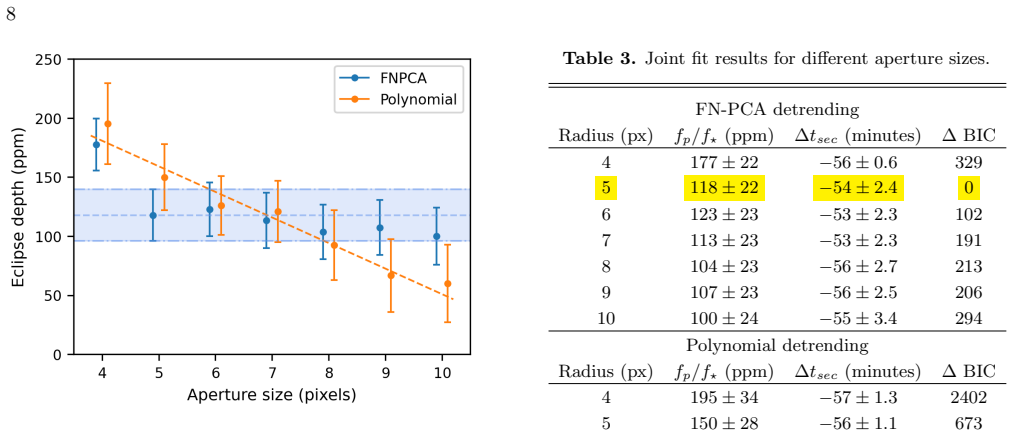
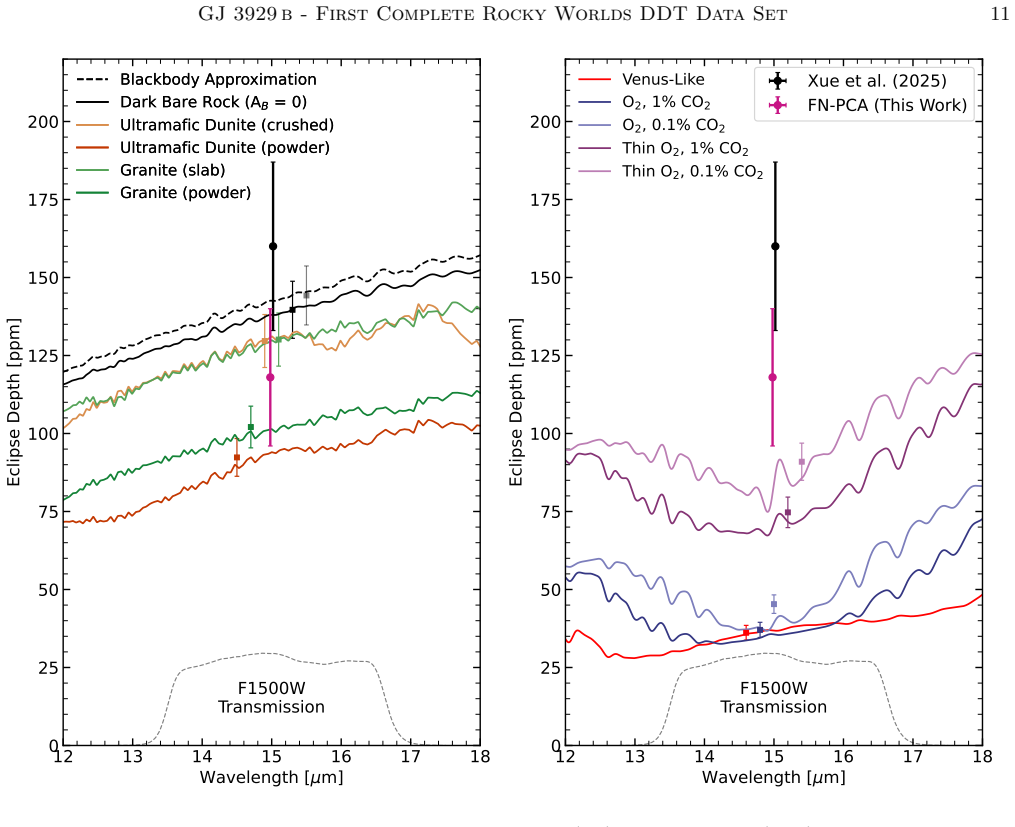
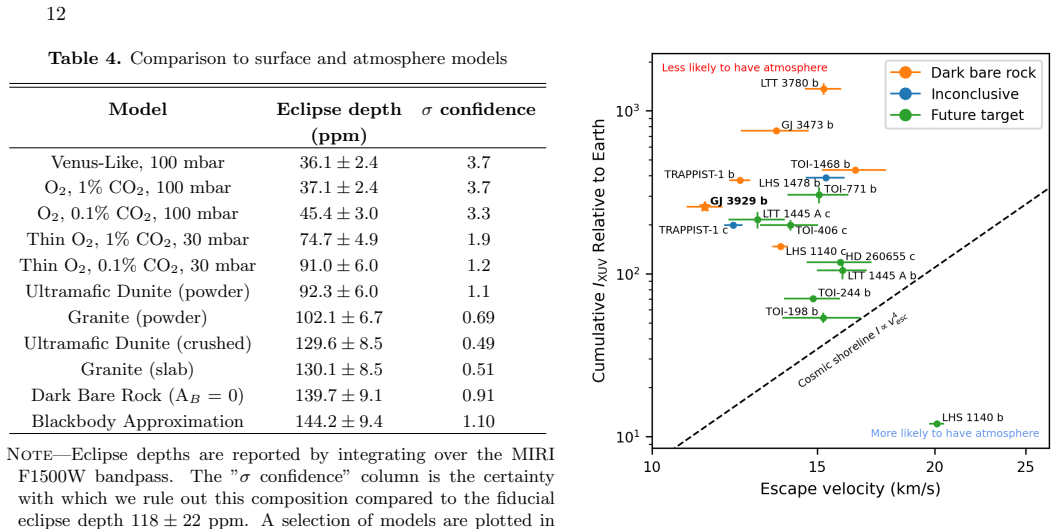
Analysis of the full four-observation data set for GJ 3929 b yields a secondary eclipse depth of 118 plus or minus 22 ppm and a dayside surface brightness temperature of 641 plus 59 minus 64 K. This value is lower than the depth obtained from the first two observations alone. The measurements remain consistent with bare-rock scenarios and leave additional room for thin-atmosphere models, while only thick CO2 atmospheres without thermal inversion are ruled out at greater than 3 sigma. The Frame Normalized Principal Component Analysis method for removing systematics proves more stable against extraction aperture size than standard polynomial detrending.
What carries the argument
The 15 micron secondary eclipse depth obtained with JWST/MIRI and its direct comparison to forward models of bare-rock surfaces versus CO2 atmospheres with and without thermal inversion.
If this is right
- Only thick CO2 atmospheres without thermal inversion remain excluded at greater than 3 sigma.
- The measured dayside temperature is consistent with little or no heat redistribution to the nightside.
- Thin atmospheres on GJ 3929 b remain possible and will require additional observations or wavelengths to confirm or exclude.
- Data-reduction method choice can shift the inferred eclipse depth enough to alter the atmospheric interpretation.
Where Pith is reading between the lines
- If FN-PCA robustness holds for other targets, the Rocky Worlds survey could systematically favor this approach for the remaining M-dwarf rocky planets.
- Similar complete data sets on additional survey targets may reveal whether atmosphere retention correlates with instellation or planetary mass.
- Multi-band eclipse observations at wavelengths outside 15 microns could separate bare-rock thermal emission from possible thin-atmosphere absorption features.
Load-bearing premise
The Frame Normalized Principal Component Analysis reduction removes systematics without introducing biases that change the inferred eclipse depth when compared to atmospheric models.
What would settle it
An independent measurement of the 15 micron eclipse depth with substantially smaller uncertainty that falls well above the bare-rock prediction but inside the thin-atmosphere model band would falsify the current consistency with bare rock.
Figures
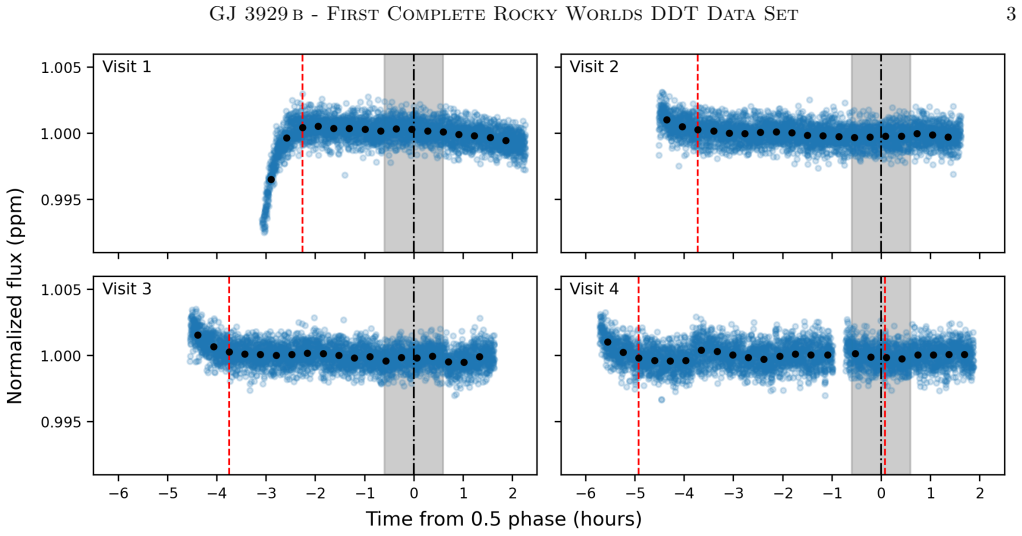
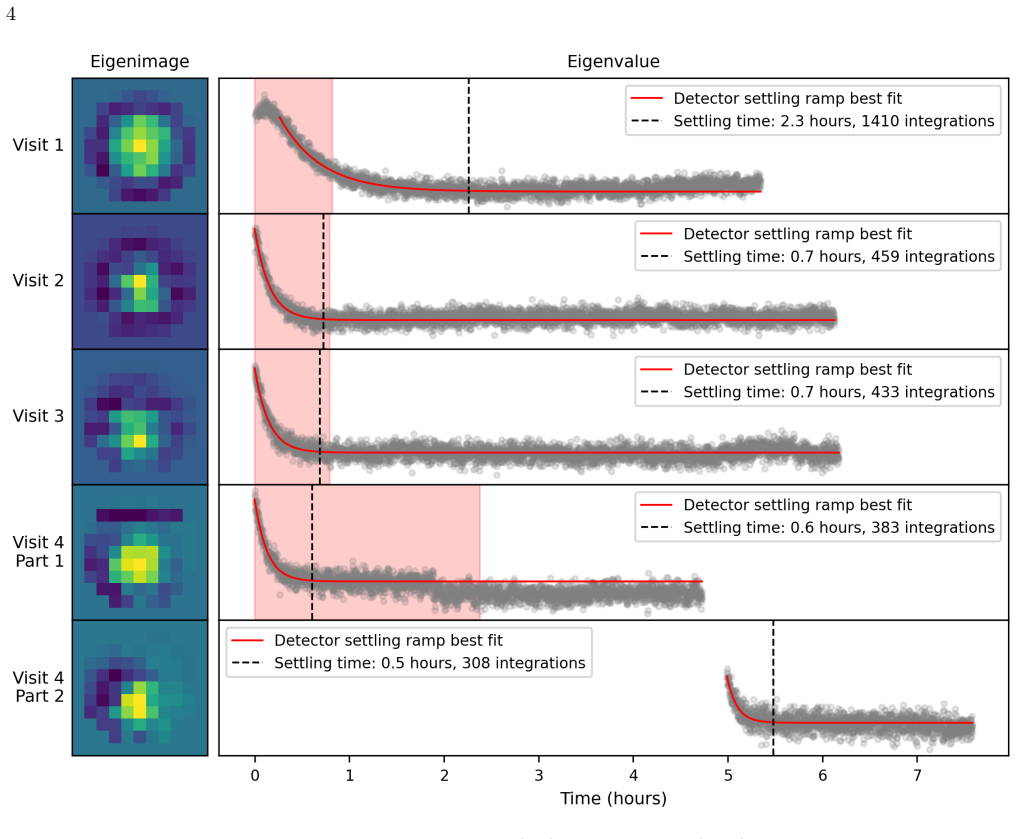
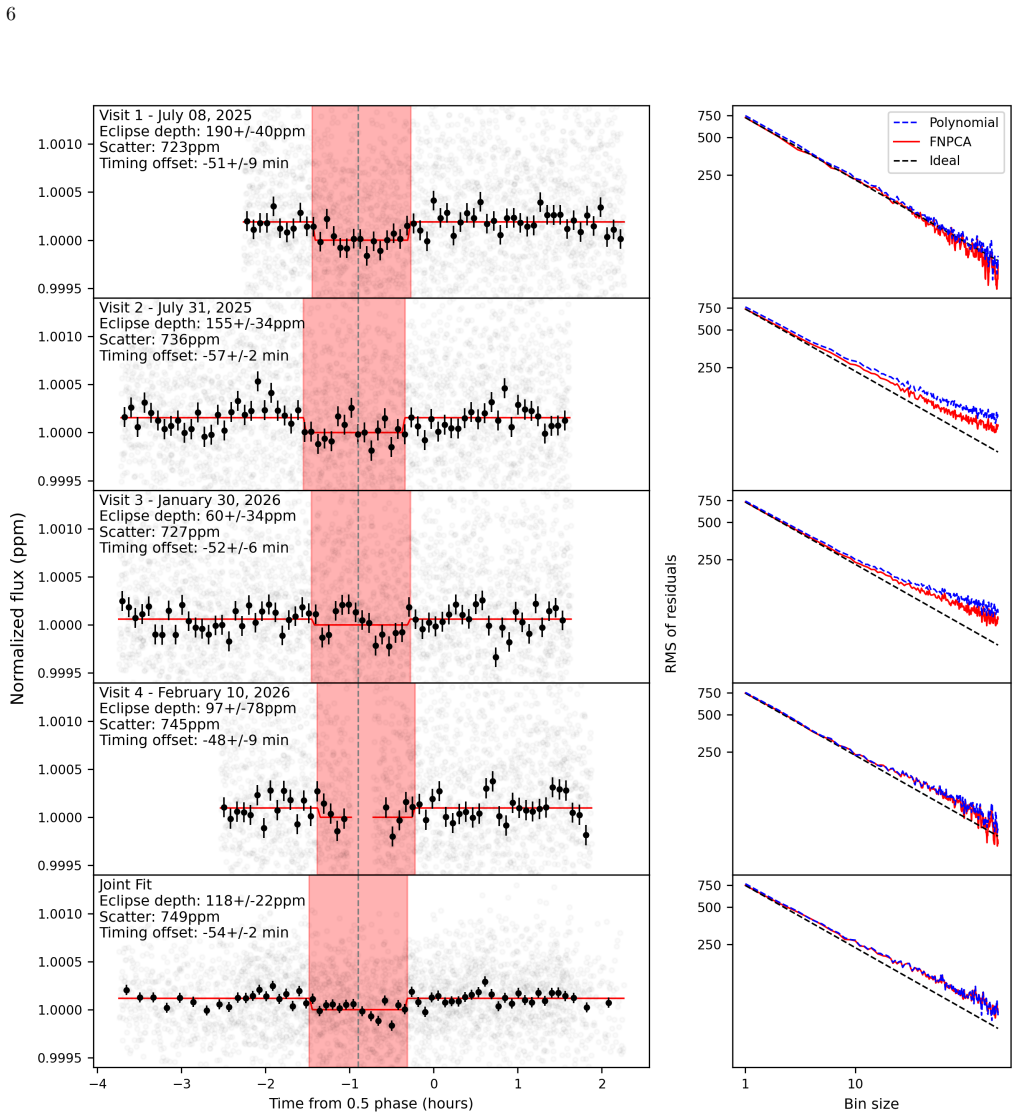
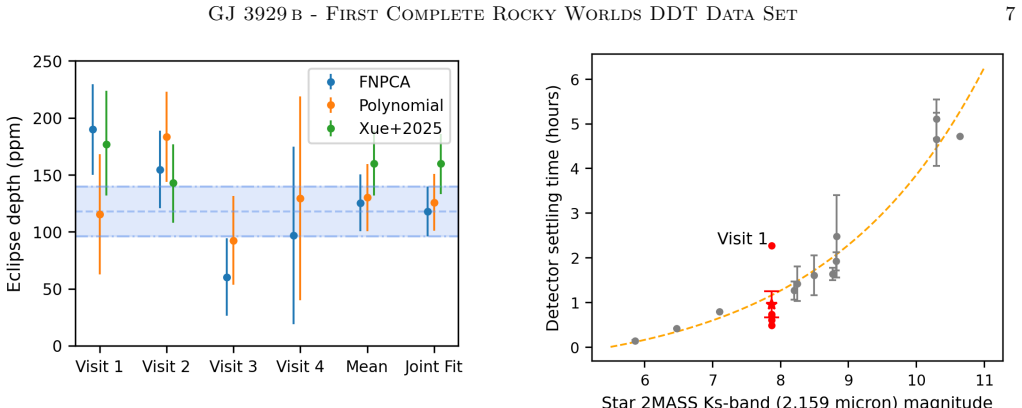
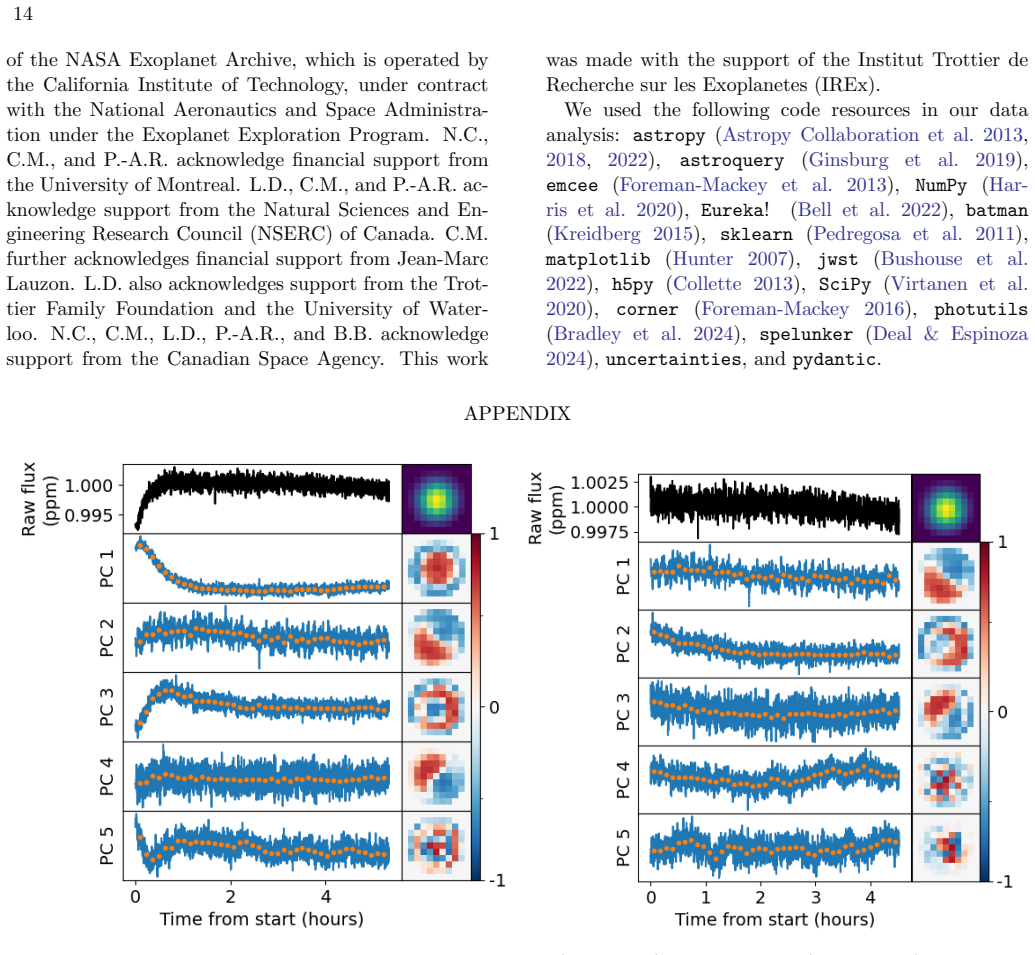
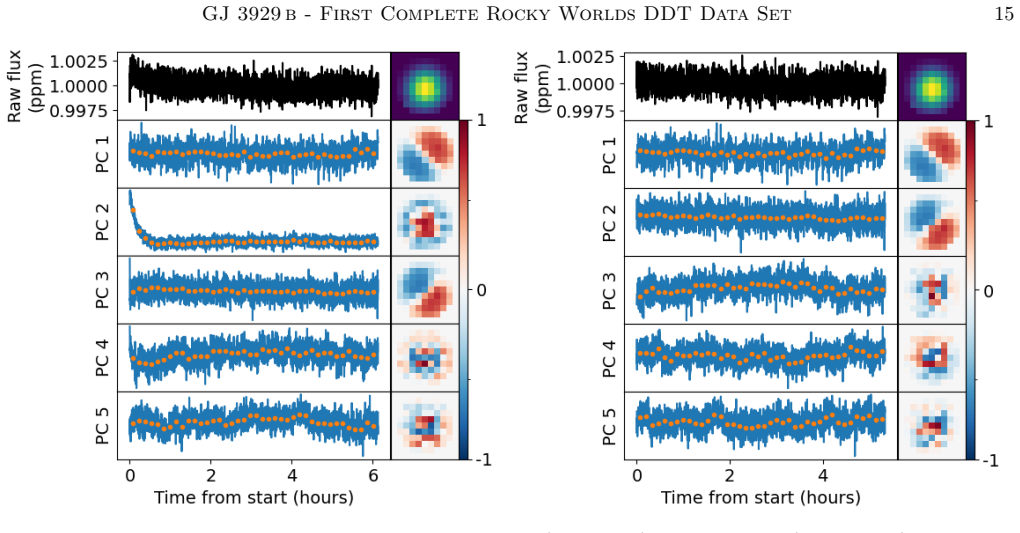
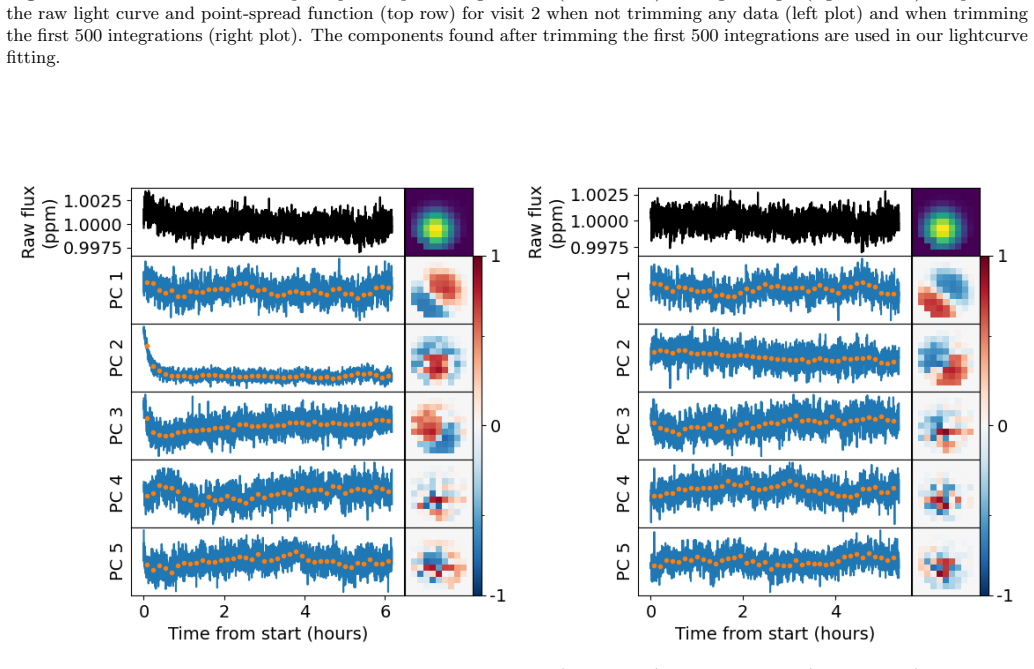
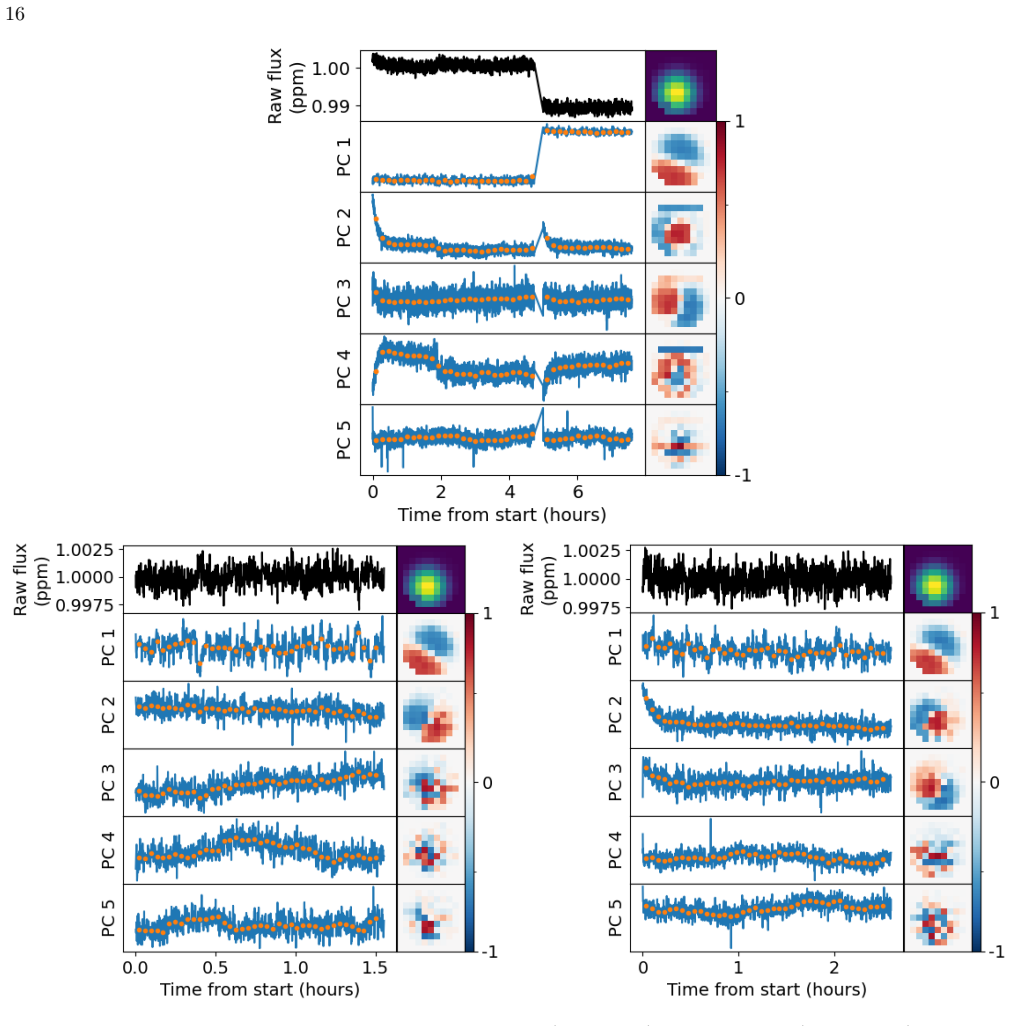
read the original abstract
Despite their large abundance, it is still unknown whether and under what conditions rocky planets around M dwarf stars can host atmospheres. This open question motivated the on-going Rocky Worlds DDT survey focused on searching for atmospheres on relatively low-temperature rocky exoplanets by systematically probing for the presence of day-night heat redistribution and CO2 absorption through JWST/MIRI 15 $\mu$m eclipse observations. Here we present the analysis of the first full data set from this survey, consisting of four observations of the warm Earth-size exoplanet GJ 3929 b, with a planetary mass of 1.75+0.44-0.45 M$_\oplus$ and instellation flux of 17.3+/-0.7 S$_\oplus$. In our analysis, we include two previously unpublished eclipse observations and find an overall eclipse depth of 118+/-22 ppm and a dayside surface brightness temperature of 641+59-64 K. This is marginally lower than the eclipse depth of 160+26-27 ppm previously reported based on only the first two observations. While the full data set remains consistent with bare rock scenarios, it also leaves more room for thin atmosphere scenarios. Only thick CO2 atmospheres without thermal inversion remain ruled out at greater than 3$\sigma$. We also continue with lessons-learned in robustly analyzing these kind of high-precision JWST/MIRI 15 $\mu$m eclipse observations. Notably, we find that the Frame Normalized Principal Component Analysis (FN-PCA) method appears more robust against the choice of extraction aperture size, which otherwise can have a significant impact on the inferred eclipse depth and scientific conclusions when using a standard polynomial baseline detrending method.
Editorial analysis
A structured set of objections, weighed in public.
Referee Report
Summary. The manuscript presents the analysis of four JWST/MIRI 15 μm eclipse observations of the rocky exoplanet GJ 3929 b (including two previously unpublished), reporting a combined eclipse depth of 118 ± 22 ppm and dayside brightness temperature of 641 K. The full data set is found to be consistent with bare-rock scenarios while allowing more room for thin atmospheres; only thick CO2 atmospheres without thermal inversion are ruled out at >3σ. The work emphasizes that the Frame Normalized Principal Component Analysis (FN-PCA) reduction method yields more stable eclipse depths across aperture sizes than standard polynomial detrending.
Significance. This constitutes the first complete data set from the Rocky Worlds DDT survey and supplies empirical constraints on atmospheric retention for warm rocky planets around M dwarfs. The direct comparison of reduction methods and the reporting of the full observational data set are strengths that aid reproducibility and community lessons for high-precision MIRI eclipse work.
major comments (2)
- [Data Reduction] Data Reduction section: The demonstration that FN-PCA produces more stable depths across aperture sizes addresses only one class of systematic. No signal-injection and recovery tests with the actual MIRI ramp, background, and pointing noise properties are described, leaving open the possibility of a ~20 ppm bias in the reported 118 ppm depth that would alter the >3σ exclusion of thick CO2 models.
- [Results] Results section: The manuscript reports the eclipse depth and model-comparison significances but provides insufficient detail on data-exclusion criteria, the exact number and choice of principal components in FN-PCA, and the full systematic error budget from baseline fitting. These omissions prevent independent assessment of whether the quoted ±22 ppm uncertainty fully captures reduction-induced contributions.
minor comments (1)
- [Abstract] Abstract: The statement that FN-PCA 'appears more robust' would benefit from a one-sentence quantification of the aperture-induced scatter for both methods.
Simulated Author's Rebuttal
We thank the referee for their constructive review of our manuscript on the complete GJ 3929 b JWST/MIRI dataset. We address each major comment below and have revised the manuscript where appropriate to enhance clarity and reproducibility.
read point-by-point responses
-
Referee: [Data Reduction] Data Reduction section: The demonstration that FN-PCA produces more stable depths across aperture sizes addresses only one class of systematic. No signal-injection and recovery tests with the actual MIRI ramp, background, and pointing noise properties are described, leaving open the possibility of a ~20 ppm bias in the reported 118 ppm depth that would alter the >3σ exclusion of thick CO2 models.
Authors: We thank the referee for this comment. Our primary validation for the FN-PCA method was its superior stability in eclipse depth across a range of aperture sizes compared to polynomial detrending. This addresses a major potential source of systematic error in the data reduction. We did not include signal-injection and recovery tests in this study. We acknowledge that such tests could help quantify any residual bias at the level discussed. We will add a discussion in the revised manuscript of this limitation and its potential implications for the model comparisons. We consider this a partial revision. revision: partial
-
Referee: [Results] Results section: The manuscript reports the eclipse depth and model-comparison significances but provides insufficient detail on data-exclusion criteria, the exact number and choice of principal components in FN-PCA, and the full systematic error budget from baseline fitting. These omissions prevent independent assessment of whether the quoted ±22 ppm uncertainty fully captures reduction-induced contributions.
Authors: We agree with the referee that more transparency is needed. In the revised version, we will include additional details in the Methods and Results sections on the data-exclusion criteria, the exact number and choice of principal components in FN-PCA, and the full systematic error budget from baseline fitting. This will allow independent assessment of the uncertainty. revision: yes
Circularity Check
No significant circularity; purely observational eclipse depth measurement
full rationale
The paper's central result is a direct measurement of eclipse depth (118±22 ppm) from four JWST/MIRI 15 μm observations of GJ 3929 b, obtained via FN-PCA data reduction and compared to separate atmospheric models. No load-bearing step derives a 'prediction' from fitted inputs by construction, renames a known result, or relies on self-citation chains for uniqueness or ansatz. The FN-PCA robustness test (stability across apertures) is an internal empirical check on the reduction pipeline, not a self-referential derivation of the depth itself. The model comparisons (ruling out thick CO2 at >3σ while allowing bare rock or thin atmospheres) use external forward models. The analysis is self-contained against external benchmarks with no circular reduction.
Axiom & Free-Parameter Ledger
free parameters (1)
- baseline detrending coefficients
axioms (1)
- domain assumption Standard assumptions in JWST/MIRI eclipse photometry hold, including accurate removal of instrumental systematics.
Reference graph
Works this paper leans on
-
[1]
Agol, E., Dorn, C., Grimm, S. L., et al. 2021, The Planetary Science Journal, 2, 1, doi: 10.3847/PSJ/abd022
-
[2]
Allen, N. H., Espinoza, N., Diamond-Lowe, H., et al. 2025, Hot Rocks Survey IV: Emission from LTT 3780 b is consistent with a bare rock. https://arxiv.org/abs/2508.14210 Astropy Collaboration, Robitaille, T. P., Tollerud, E. J., et al. 2013, A&A, 558, A33, doi: 10.1051/0004-6361/201322068 Astropy Collaboration, Price-Whelan, A. M., Sip˝ ocz, B. M., et al....
-
[3]
August, P. C., Buchhave, L. A., Diamond-Lowe, H., et al. 2024, Hot Rocks Survey I : A shallow eclipse for LHS 1478 b, arXiv. http://arxiv.org/abs/2410.11048
arXiv 2024
-
[4]
C., Buchhave, L
August, P. C., Buchhave, L. A., Rathcke, A., et al. 2025, Confirming a Tentative Terrestrial Atmosphere Detection on LHS 1478 b with JWST/MIRI, JWST Proposal. Cycle 4, ID. #7675
2025
-
[5]
Bazinet, L., Pelletier, S., Benneke, B., Salinas, R., & Mace, G. N. 2024, The Astronomical Journal, 167, 206, doi: 10.3847/1538-3881/ad3071
-
[7]
2022, ApJ, 936, 55, doi: 10.3847/1538-4357/ac8480
Beard, C., Robertson, P., Kanodia, S., et al. 2022, ApJ, 936, 55, doi: 10.3847/1538-4357/ac8480
-
[8]
The Journal of Open Source Software , keywords =
Bell, T. J., Ahrer, E.-M., Brande, J., et al. 2022, Journal of Open Source Software, 7, 4503, doi: 10.21105/joss.04503
-
[9]
Benneke, B. 2015, Strict Upper Limits on the Carbon-to-Oxygen Ratios of Eight Hot Jupiters from Self-Consistent Atmospheric Retrieval. https://arxiv.org/abs/1504.07655
Pith/arXiv arXiv 2015
-
[10]
2012, ApJ, 753, 100, doi: 10.1088/0004-637X/753/2/100 —
Benneke, B., & Seager, S. 2012, ApJ, 753, 100, doi: 10.1088/0004-637X/753/2/100 —. 2013, ApJ, 778, 153, doi: 10.1088/0004-637X/778/2/153
-
[11]
Benneke, B., Wong, I., Piaulet, C., et al. 2019a, ApJL, 887, L14, doi: 10.3847/2041-8213/ab59dc
-
[12]
Benneke, B., Knutson, H. A., Lothringer, J., et al. 2019b, Nature Astronomy, 3, 813, doi: 10.1038/s41550-019-0800-5
-
[13]
Benneke, B., Roy, P.-A., Coulombe, L.-P., et al. 2024, JWST Reveals CH 4, CO2, and H 2O in a Metal-rich Miscible Atmosphere on a Two-Earth-Radius Exoplanet. https://arxiv.org/abs/2403.03325
arXiv 2024
-
[14]
K., Wachiraphan, P., & Murray, C
Berta-Thompson, Z. K., Wachiraphan, P., & Murray, C. 2025, The 3D Cosmic Shoreline for Nurturing Planetary Atmospheres. https://arxiv.org/abs/2507.02136
arXiv 2025
-
[15]
Bochanski, J. J., Hawley, S. L., Covey, K. R., et al. 2010, AJ, 139, 2679, doi: 10.1088/0004-6256/139/6/2679
-
[16]
Bonfanti, A., Brady, M., Wilson, T. G., et al. 2024, A&A, 682, A66, doi: 10.1051/0004-6361/202348180
-
[17]
2024, astropy/photutils: 2.0.2, 2.0.2, Zenodo, doi: 10.5281/zenodo.13989456
Bradley, L., Sip˝ ocz, B., Robitaille, T., et al. 2024, astropy/photutils: 2.0.2, 2.0.2, Zenodo, doi: 10.5281/zenodo.13989456
-
[18]
2022, JWST Calibration Pipeline, 1.8.2, Zenodo, doi: 10.5281/zenodo.7229890
Bushouse, H., Eisenhamer, J., Dencheva, N., et al. 2022, JWST Calibration Pipeline, 1.8.2, Zenodo, doi: 10.5281/zenodo.7229890
-
[19]
2024, ApJL, 960, L3, doi: 10.3847/2041-8213/ad1691 Castro-Gonz´ alez, A., Demangeon, O
Cadieux, C., Plotnykov, M., Doyon, R., et al. 2024, ApJL, 960, L3, doi: 10.3847/2041-8213/ad1691 Castro-Gonz´ alez, A., Demangeon, O. D. S., Lillo-Box, J., et al. 2023, A&A, 675, A52, doi: 10.1051/0004-6361/202346550
-
[20]
2013, Python and HDF5 (O’Reilly)
Collette, A. 2013, Python and HDF5 (O’Reilly)
2013
-
[21]
J., Monaghan, C., Benneke, B., & Dang, L
Connors, N. J., Monaghan, C., Benneke, B., & Dang, L. 2025, ApJL, 989, L11, doi: 10.3847/2041-8213/adee0d
-
[22]
Coy, B. P., Ih, J., Kite, E. S., et al. 2025, Population-level Hypothesis Testing with Rocky Planet Emission Data: A Tentative Trend in the Brightness Temperatures of M-Earths. https://arxiv.org/abs/2412.06573
arXiv 2025
-
[23]
2024, Journal of Open Source Software, 9, 6202, doi: 10.21105/joss.06202
Deal, D., & Espinoza, N. 2024, Journal of Open Source Software, 9, 6202, doi: 10.21105/joss.06202
-
[24]
2025, Nature Astronomy, 9, 358–369, doi: 10.1038/s41550-024-02428-z
Ducrot, E., Lagage, P.-O., Min, M., et al. 2025, Nature Astronomy, 9, 358–369, doi: 10.1038/s41550-024-02428-z
-
[25]
Fauchez, T. J., Ducrot, E., Rackham, B. V., et al. 2025, The Astrophysical Journal, 989, 170, doi: 10.3847/1538-4357/adf068
-
[26]
Foreman-Mackey, D. 2016, Journal of Open Source Software, 1, 24, doi: 10.21105/joss.00024
-
[27]
and Lang, Dustin and Goodman, Jonathan , year=
Foreman-Mackey, D., Hogg, D. W., Lang, D., & Goodman, J. 2013, Publications of the Astronomical Society of the Pacific, 125, 306–312, doi: 10.1086/670067
-
[28]
Fortune, M., Gibson, N. P., Diamond-Lowe, H., et al. 2025, Hot Rocks Survey III: A deep eclipse for LHS 1140c and a new Gaussian process method to account for correlated noise in individual pixels. https://arxiv.org/abs/2505.22186
arXiv 2025
-
[29]
Gelman, A., & Rubin, D. B. 1992, Statistical Science, 7, 457, doi: 10.1214/ss/1177011136
-
[30]
Gillon, M., Ducrot, E., Bell, T. J., et al. 2025, arXiv e-prints, arXiv:2509.02128, doi: 10.48550/arXiv.2509.02128
-
[31]
Ginsburg, A., Sip˝ ocz, B. M., Brasseur, C. E., et al. 2019, AJ, 157, 98, doi: 10.3847/1538-3881/aafc33
-
[32]
Gordon, K. D., Sloan, G. C., Garcia Marin, M., et al. 2024, The Astronomical Journal, 169, 6, doi: 10.3847/1538-3881/ad8cd4 GJ 3929 b - First Complete Rocky Worlds DDT Data Set19
-
[33]
Greene, T. P., Bell, T. J., Ducrot, E., et al. 2023, Nature, 618, 39, doi: 10.1038/s41586-023-05951-7
-
[34]
Hansen, B. M. S. 2008, ApJS, 179, 484, doi: 10.1086/591964
-
[35]
Harris, C. R., Millman, K. J., van der Walt, S. J., et al. 2020, Nature, 585, 357, doi: 10.1038/s41586-020-2649-2
-
[36]
2023, ApJL, 956, L20, doi: 10.3847/2041-8213/acfe05
Heng, K. 2023, ApJL, 956, L20, doi: 10.3847/2041-8213/acfe05
-
[37]
Holmberg, M., Diamond-Lowe, H., Mendon¸ ca, J. M., et al. 2026, AJ, 171, 251, doi: 10.3847/1538-3881/ae4c45
-
[38]
Hunter, J. D. 2007, Computing in Science & Engineering, 9, 90, doi: 10.1109/MCSE.2007.55
-
[39]
Ingalls, J. G., Krick, J. E., Carey, S. J., et al. 2016, AJ, 152, 44, doi: 10.3847/0004-6256/152/2/44
-
[40]
2024, in AAS/Division for Extreme Solar Systems Abstracts, Vol
Gharib-Nezhad, E. 2024, in AAS/Division for Extreme Solar Systems Abstracts, Vol. 56, AAS/Division for Extreme Solar Systems Abstracts, 631.03
2024
-
[41]
2024, in AASTCS10, Extreme Solar Systems V, Vol
Gharib-Nezhad, E. 2024, in AASTCS10, Extreme Solar Systems V, Vol. 56, 631.03. https://ui.adsabs.harvard.edu/abs/2024ESS.....563103I
2024
-
[42]
2023, The Astrophysical Journal, 944, 41, doi: 10.3847/1538-4357/acabc2
Gharib-Nezhad, E. 2023, The Astrophysical Journal, 944, 41, doi: 10.3847/1538-4357/acabc2
-
[43]
Ji, X., Chatterjee, R. D., Coy, B. P., & Kite, E. S. 2025, The Cosmic Shoreline Revisited: A Metric for Atmospheric Retention Informed by Hydrodynamic Escape. https://arxiv.org/abs/2504.19872
arXiv 2025
-
[44]
Kemmer, J., Stock, S., Kossakowski, D., et al. 2020, A&A, 642, A236, doi: 10.1051/0004-6361/202038967
-
[45]
2022, A&A, 659, A17, doi: 10.1051/0004-6361/202142653
Kemmer, J., Dreizler, S., Kossakowski, D., et al. 2022, A&A, 659, A17, doi: 10.1051/0004-6361/202142653
-
[46]
Koll, D. D. B. 2022, The Astrophysical Journal, 924, 134, doi: 10.3847/1538-4357/ac3b48
-
[47]
2015, PASP, 127, 1161, doi: 10.1086/683602
Kreidberg, L. 2015, PASP, 127, 1161, doi: 10.1086/683602
work page internal anchor Pith review doi:10.1086/683602 2015
-
[48]
2024, arXiv e-prints, arXiv:2409.11083, doi: 10.48550/arXiv.2409.11083
Lacedelli, G., Pall` e, E., Luque, R., et al. 2024, arXiv e-prints, arXiv:2409.11083, doi: 10.48550/arXiv.2409.11083
-
[49]
2015, Astrobiology, 15, 119, doi: 10.1089/ast.2014.1231
Luger, R., & Barnes, R. 2015, Astrobiology, 15, 119, doi: 10.1089/ast.2014.1231
-
[50]
Luque, R., Fulton, B. J., Kunimoto, M., et al. 2022, A&A, 664, A199, doi: 10.1051/0004-6361/202243834 Meier Vald´ es, E. A., Demory, B.-O., Diamond-Lowe, H., et al. 2025, A&A, 698, A68, doi: 10.1051/0004-6361/202453449
-
[51]
J., Coulombe, L.-P., & Roy, P.-A
Monaghan, C., Benneke, B., Connors, N. J., Coulombe, L.-P., & Roy, P.-A. 2026, arXiv e-prints, arXiv:2604.15421. https://arxiv.org/abs/2604.15421
Pith/arXiv arXiv 2026
-
[52]
2025, The Astronomical Journal, 169, 239, doi: 10.3847/1538-3881/adbe75
Monaghan, C., Roy, P.-A., Benneke, B., et al. 2025, The Astronomical Journal, 169, 239, doi: 10.3847/1538-3881/adbe75
-
[53]
2016, The Astrophysical Journal, 830, 159, doi: 10.3847/0004-637X/830/2/159
Nakajima, T., & Sorahana, S. 2016, The Astrophysical Journal, 830, 159, doi: 10.3847/0004-637X/830/2/159
-
[54]
2008, PASP, 120, 317, doi: 10.1086/533420
Nutzman, P., & Charbonneau, D. 2008, PASP, 120, 317, doi: 10.1086/533420
-
[55]
2023, AJ, 165, 134, doi: 10.3847/1538-3881/acb4e3
Oddo, D., Dragomir, D., Brandeker, A., et al. 2023, AJ, 165, 134, doi: 10.3847/1538-3881/acb4e3
-
[56]
Paragas, K., Knutson, H. A., Hu, R., et al. 2025, The Astrophysical Journal, 981, 130, doi: 10.3847/1538-4357/ada9eb
-
[57]
K., Charbonneau, D., & Vanderburg, A
Pass, E. K., Charbonneau, D., & Vanderburg, A. 2025, The Receding Cosmic Shoreline of Mid-to-Late M Dwarfs: Measurements of Active Lifetimes Worsen Challenges for Atmosphere Retention by Rocky Exoplanets. https://arxiv.org/abs/2504.01182
arXiv 2025
-
[58]
Pass, E. K., Winters, J. G., Charbonneau, D., et al. 2023, AJ, 166, 171, doi: 10.3847/1538-3881/acf561
-
[59]
A., Brandeker, A., Kitzmann, D., et al
Patel, J. A., Brandeker, A., Kitzmann, D., et al. 2024, A&A, 690, A159, doi: 10.1051/0004-6361/202450748
-
[60]
2011, Journal of Machine Learning Research, 12, 2825
Pedregosa, F., Varoquaux, G., Gramfort, A., et al. 2011, Journal of Machine Learning Research, 12, 2825
2011
-
[61]
Pelletier, S., Benneke, B., Darveau-Bernier, A., et al. 2021, AJ, 162, 73, doi: 10.3847/1538-3881/ac0428
-
[62]
2025, AJ, 169, 10, doi: 10.3847/1538-3881/ad8b28
Pelletier, S., Benneke, B., Chachan, Y., et al. 2024, The Astronomical Journal, 169, 10, doi: 10.3847/1538-3881/ad8b28
-
[63]
2024, ApJL, 974, L10, doi: 10.3847/2041-8213/ad6f00
Piaulet-Ghorayeb, C., Benneke, B., Radica, M., et al. 2024, The Astrophysical Journal Letters, 974, L10, doi: 10.3847/2041-8213/ad6f00
-
[64]
Rackham, B. V., Apai, D., & Giampapa, M. S. 2018, ApJ, 853, 122, doi: 10.3847/1538-4357/aaa08c
-
[65]
2024, arXiv e-prints, arXiv:2404.02932, doi: 10.48550/arXiv.2404.02932
Redfield, S., Batalha, N., Benneke, B., et al. 2024, arXiv e-prints, arXiv:2404.02932, doi: 10.48550/arXiv.2404.02932
-
[66]
Rieke, G. H., Wright, G. S., B¨ oker, T., et al. 2015, PASP, 127, 584, doi: 10.1086/682252
-
[67]
2026, ApJL, 998, L39, doi: 10.3847/2041-8213/ae3da3
Rochon, A., Artigau, ´E., Weisserman, D., et al. 2026, ApJL, 998, L39, doi: 10.3847/2041-8213/ae3da3
-
[68]
2022, The Astrophysical Journal, 941, 89, doi: 10.3847/1538-4357/ac9f18 —
Roy, P.-A., Benneke, B., Piaulet, C., et al. 2022, The Astrophysical Journal, 941, 89, doi: 10.3847/1538-4357/ac9f18 —. 2023, The Astrophysical Journal Letters, 954, L52, doi: 10.3847/2041-8213/acebf0
-
[69]
Efron, Bootstrap methods: Another look at the jackknife
Schwarz, G. 1978, The Annals of Statistics, 6, 461, doi: 10.1214/aos/1176344136
-
[70]
2010, ARA&A, 48, 631, doi: 10.1146/annurev-astro-081309-130837 20
Seager, S., & Deming, D. 2010, ARA&A, 48, 631, doi: 10.1146/annurev-astro-081309-130837 20
-
[71]
Soto, M. G., Anglada-Escud´ e, G., Dreizler, S., et al. 2021, A&A, 649, A144, doi: 10.1051/0004-6361/202140618
-
[72]
Stassun, K. G., Oelkers, R. J., Paegert, M., et al. 2019, AJ, 158, 138, doi: 10.3847/1538-3881/ab3467
-
[73]
2014, PASJ, 66, 98, doi: 10.1093/pasj/psu078 —
Tsuji, T., & Nakajima, T. 2014, PASJ, 66, 98, doi: 10.1093/pasj/psu078 —. 2016, PASJ, 68, 13, doi: 10.1093/pasj/psv119
-
[74]
2015, PASJ, 67, 26, doi: 10.1093/pasj/psu160 Vald´ es, E
Tsuji, T., Nakajima, T., & Takeda, Y. 2015, PASJ, 67, 26, doi: 10.1093/pasj/psu160 Vald´ es, E. A. M., Demory, B. O., Diamond-Lowe, H., et al. 2025, Hot Rocks Survey II: The thermal emission of TOI-1468 b reveals a hot bare rock. https://arxiv.org/abs/2503.19772
-
[75]
Virtanen, P., Gommers, R., Oliphant, T. E., et al. 2020, Nature Methods, 17, 261, doi: 10.1038/s41592-019-0686-2
-
[76]
Winters, J. G., Cloutier, R., Medina, A. A., et al. 2022, AJ, 163, 168, doi: 10.3847/1538-3881/ac50a9
- [77]
-
[78]
Zahnle, K. J., & Catling, D. C. 2017, ApJ, 843, 122, doi: 10.3847/1538-4357/aa7846 Zapatero Osorio, M. R., Tabernero, H., Su´ arez Mascare˜ no, A., et al. 2026, A&A, 706, A166, doi: 10.1051/0004-6361/202449545
-
[79]
Zieba, S., Kreidberg, L., Ducrot, E., et al. 2023, Nature, 620, 746, doi: 10.1038/s41586-023-06232-z
discussion (0)
Sign in with ORCID, Apple, or X to comment. Anyone can read and Pith papers without signing in.