Optical observations of candidate host galaxies of eight fast X-ray transients
Pith reviewed 2026-06-26 03:42 UTC · model grok-4.3
The pith
Fast X-ray transients detected by Chandra and XMM-Newton arise from a variety of origins unlike those seen by Einstein Probe.
A machine-rendered reading of the paper's core claim, the machinery that carries it, and where it could break.
Core claim
We identify candidate host galaxies for six of the eight FXTs. Assuming association, all are consistent with a non-relativistic WD-IMBH TDE and a BNS merger; two are also consistent with a supernova shock breakout and only EP240708a with cocoon emission from a long gamma-ray burst. We re-identify XRT191223 as a Galactic stellar flare. We conclude that FXTs detected by Chandra and XMM-Newton are likely to arise from a variety of origins, and we discuss that part of this population differs from FXTs detected by Einstein Probe many of which appear consistent with a collapsar scenario.
What carries the argument
Identification of candidate host galaxies combined with BAGPIPES spectral energy distribution fitting to extract redshift, stellar mass, star-formation rate, metallicity and stellar-population age.
If this is right
- All candidate hosts remain consistent with both white-dwarf tidal disruption by an intermediate-mass black hole and binary neutron-star merger.
- Two events additionally satisfy the conditions for a supernova shock-breakout origin.
- Only one event satisfies the conditions for cocoon emission from a long gamma-ray burst.
- Chandra and XMM-Newton fast X-ray transients form a heterogeneous population unlike the collapsar-like sample reported by Einstein Probe.
- Some host galaxies may simply lie below the detection threshold of the observations.
Where Pith is reading between the lines
- If the associations hold, deeper or higher-resolution imaging could reveal whether undetected hosts are faint low-mass galaxies or lie at higher redshift.
- Multi-messenger detections such as gravitational-wave coincidences would help separate the binary neutron-star channel from the tidal-disruption channel.
- Surveys with different X-ray sensitivities may continue to select distinct subpopulations of fast X-ray transients.
Load-bearing premise
That one of the optically identified candidate galaxies is the true physical host of each fast X-ray transient.
What would settle it
Precise spectroscopic redshifts placing none of the candidate galaxies at the same distance as the transient would show the associations are incorrect.
Figures
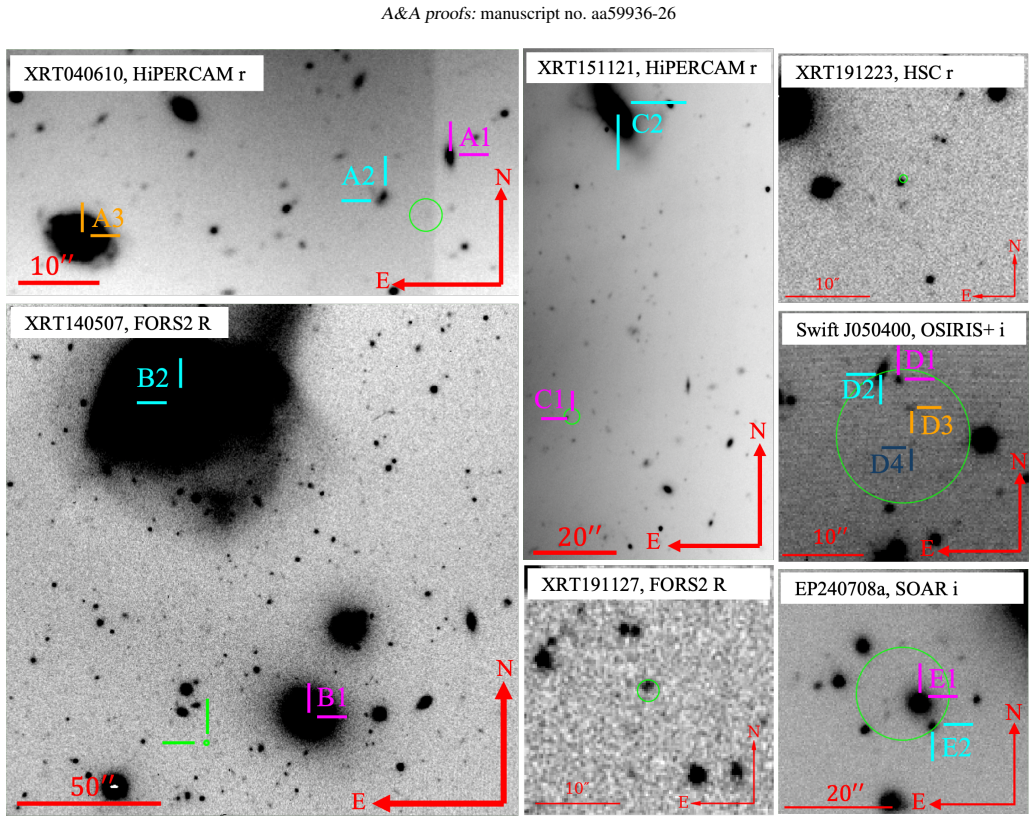
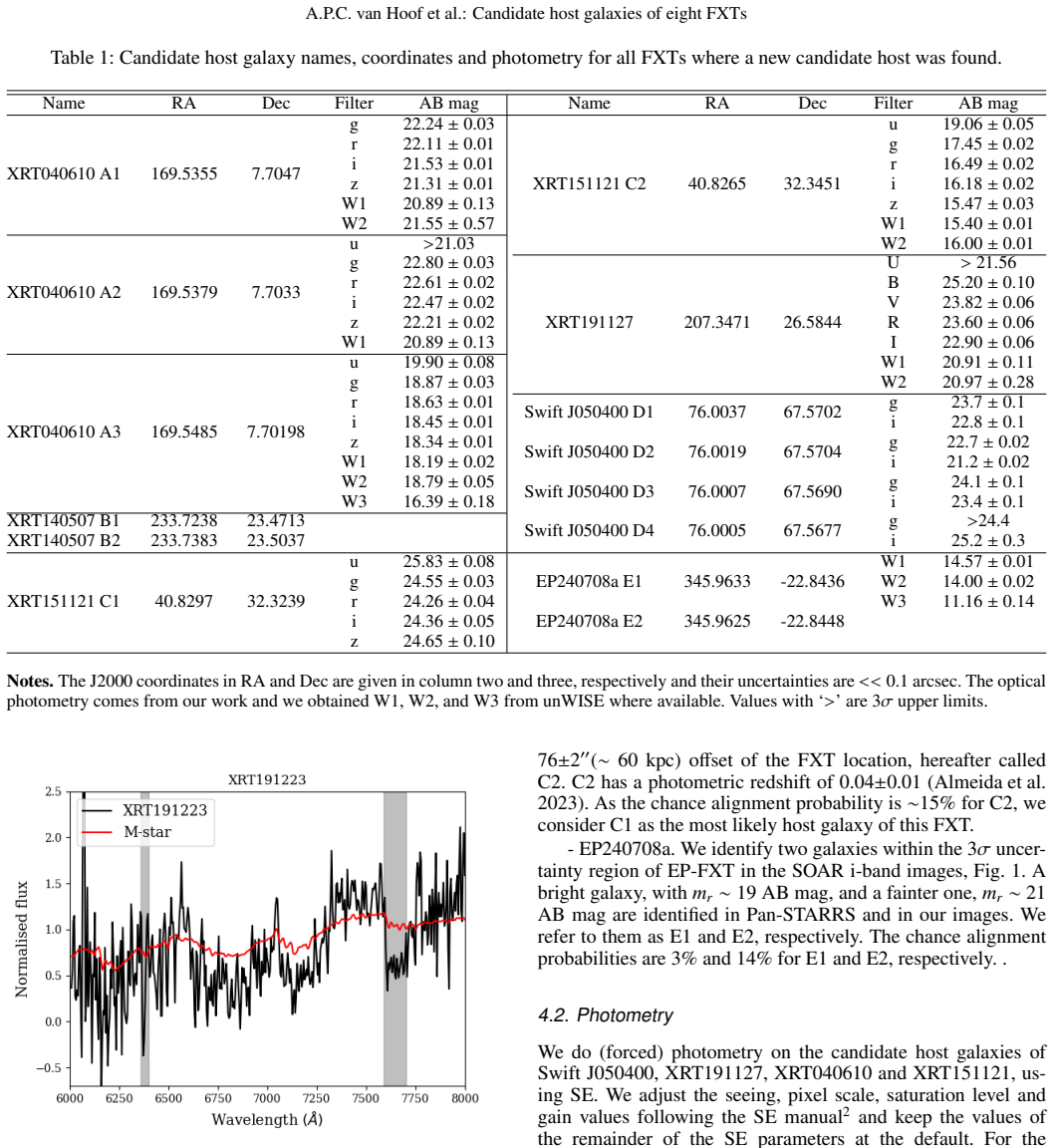
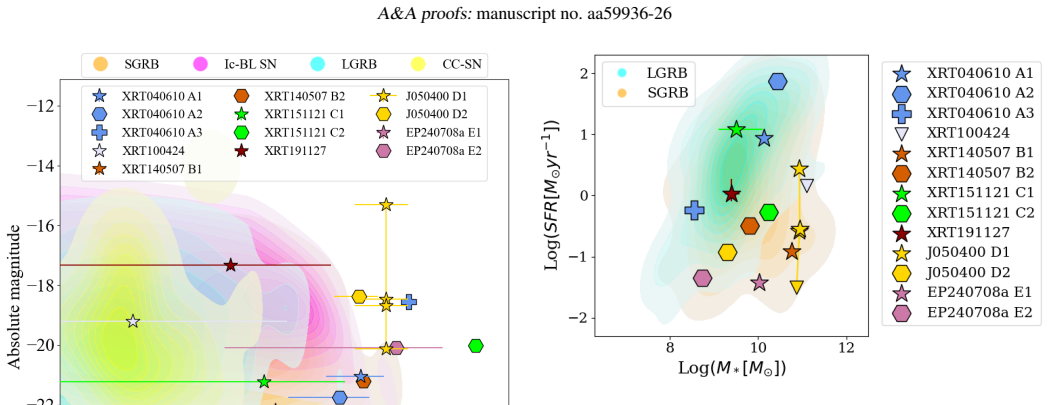
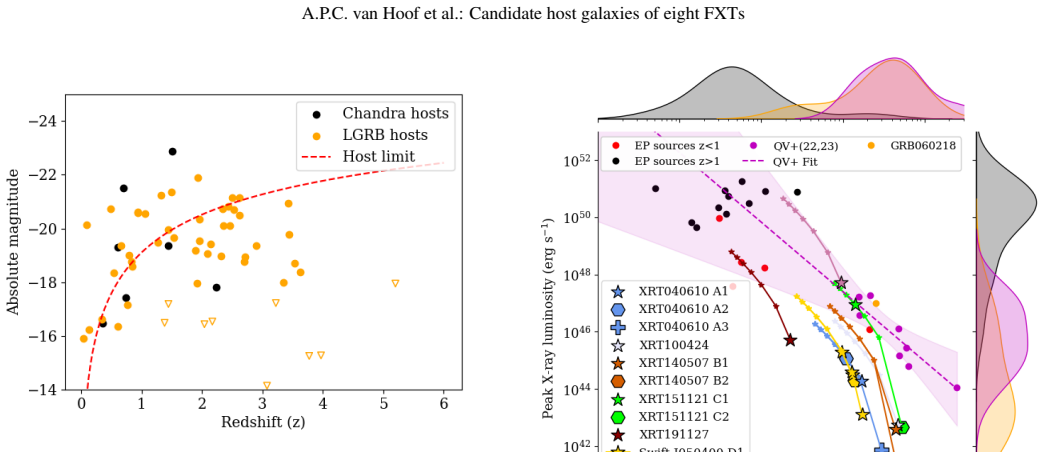
read the original abstract
Fast X-ray transients (FXTs) are extragalactic flashes of X-rays with a typical duration of minutes to hours for which a variety of origins has been proposed and observed. To decipher the origin of FXTs, particularly those lacking multi-wavelength counterparts, we aim to understand their energetics and environments. We present deep optical ground-based observations of the positions of eight FXTs in order to try and identify and characterize candidate host galaxies. We use their properties to discriminate between possible progenitor scenarios. We identify candidate host galaxies for Swift~J050400.2+673405, XRT140507, XRT040610, XRT151121, XRT191127 and EP240708a. For each candidate, we infer the spectroscopic or photometric redshift, stellar mass, star formation rate, metallicity and stellar population age by fitting our data with the spectral energy distribution fitting code BAGPIPES. We re-identify XRT191223 as a Galactic stellar flare. For several FXTs, there are multiple candidate host galaxies, which complicates deriving constraints on the origin of the FXT. Assuming association with (one of) those candidates, all are consistent with a (non-)relativistic white dwarf - intermediate mass black hole tidal disruption event (WD-IMBH TDE) and a binary neutron star (BNS) merger. Two are consistent with a supernova shock breakout and only EP240708a with cocoon emission from a long gamma-ray burst. We also discuss the possibility that the host galaxies remain undetected in our observations. We conclude that FXTs detected by Chandra and XMM-Newton are likely to arise from a variety of origins, and we discuss that part of this population differs from FXTs detected by Einstein Probe many of which appear consistent with a collapsar scenario.
Editorial analysis
A structured set of objections, weighed in public.
Referee Report
Summary. The manuscript reports deep optical ground-based observations targeting the positions of eight fast X-ray transients (FXTs). Candidate host galaxies are identified for six events (Swift J050400.2+673405, XRT140507, XRT040610, XRT151121, XRT191127 and EP240708a); XRT191223 is reclassified as a Galactic stellar flare. For each candidate, BAGPIPES SED fitting is used to derive spectroscopic or photometric redshift, stellar mass, star-formation rate, metallicity and stellar-population age. Under the assumption of physical association (noted as complicated by multiple candidates in several cases), the derived properties are compared to expectations for WD-IMBH TDEs, BNS mergers, supernova shock breakouts and cocoon emission. The authors conclude that Chandra/XMM-Newton FXTs arise from a variety of origins and differ from the Einstein Probe population, many of which appear consistent with collapsars.
Significance. If the host associations are robust, the work supplies useful environmental constraints on FXT progenitors and documents apparent diversity between detection instruments. The application of standard BAGPIPES modeling to deep optical data adds concrete host-property measurements that can be tested against theoretical predictions for the listed scenarios.
major comments (2)
- [Abstract] Abstract: the central claim that the FXTs arise from a variety of origins (and differ from Einstein Probe events) rests on the assumption that at least one of the listed candidate hosts is physically associated. The abstract explicitly flags the complication of multiple candidates yet provides no quantitative chance-alignment probabilities (surface density, magnitude limits, redshift priors), which directly limits the reliability of the progenitor-scenario discrimination.
- [Abstract] Abstract and results description: the BAGPIPES-derived host properties (stellar mass, SFR, metallicity, age) are presented without reported uncertainties, error bars or tabulated values, and no explicit exclusion criteria for candidate selection are stated. These omissions make it impossible to assess the statistical significance of the claimed consistencies with specific scenarios such as WD-IMBH TDE or BNS merger.
minor comments (1)
- [Abstract] Abstract: the re-identification of XRT191223 as a Galactic flare is stated without reference to the specific optical photometry or light-curve features that support the classification.
Simulated Author's Rebuttal
We thank the referee for their constructive comments, which help clarify the presentation of our results on the host galaxies of fast X-ray transients. We respond to each major comment below.
read point-by-point responses
-
Referee: [Abstract] Abstract: the central claim that the FXTs arise from a variety of origins (and differ from Einstein Probe events) rests on the assumption that at least one of the listed candidate hosts is physically associated. The abstract explicitly flags the complication of multiple candidates yet provides no quantitative chance-alignment probabilities (surface density, magnitude limits, redshift priors), which directly limits the reliability of the progenitor-scenario discrimination.
Authors: We agree that quantitative chance-alignment probabilities would strengthen the assessment of host associations. In the revised manuscript we will calculate and report these probabilities for each candidate, using the surface density of galaxies brighter than the observed magnitude limits together with standard redshift priors from the literature. This will be added to the abstract and results sections to support the claimed consistencies with WD-IMBH TDE and BNS merger scenarios. revision: yes
-
Referee: [Abstract] Abstract and results description: the BAGPIPES-derived host properties (stellar mass, SFR, metallicity, age) are presented without reported uncertainties, error bars or tabulated values, and no explicit exclusion criteria for candidate selection are stated. These omissions make it impossible to assess the statistical significance of the claimed consistencies with specific scenarios such as WD-IMBH TDE or BNS merger.
Authors: The manuscript contains tables reporting the BAGPIPES-derived parameters together with their uncertainties. We will revise the abstract to reference these tables explicitly and will add a concise statement of the candidate selection and exclusion criteria in the results section. Error bars will be confirmed on all relevant figures. These changes will allow direct evaluation of the statistical significance of the scenario comparisons. revision: yes
Circularity Check
No circularity: purely observational analysis with external tools
full rationale
The paper reports direct observations of FXT positions, candidate host identification, and application of the external BAGPIPES code for SED fitting to derive stellar mass, SFR, metallicity and age. Conclusions on progenitor scenarios rest on consistency under assumed associations, without any derivation, prediction or first-principles result that reduces by construction to the paper's own inputs, fitted parameters or self-citations. No load-bearing self-citation, uniqueness theorem, or ansatz smuggling is present. This is the expected outcome for an observational study whose central claims are data-driven interpretations rather than closed mathematical loops.
Axiom & Free-Parameter Ledger
axioms (1)
- domain assumption Standard stellar population synthesis and dust attenuation models underlying the BAGPIPES code
Reference graph
Works this paper leans on
-
[1]
J. Quirola-V\'asquez and F. E. Bauer and P. G. Jonker and W. N. Brandt and G. Yang and A. J. Levan and Y. Q. Xue and D. Eappachen and E. Camacho and M. E. Ravasio and X. C. Zheng and B. Luo , title =. A. doi:10.1051/0004-6361/202345912 , url =
-
[2]
PyRAF: Python alternative for IRAF
-
[4]
Cosmic-Ray Rejection by Laplacian Edge Detection
Cosmic-Ray Rejection by Laplacian Edge Detection. , keywords =. doi:10.1086/323894 , archivePrefix =. astro-ph/0108003 , primaryClass =
work page internal anchor Pith review Pith/arXiv arXiv doi:10.1086/323894
-
[5]
Astrometry.net: Blind astrometric calibration of arbitrary astronomical images
Astrometry.net: Blind Astrometric Calibration of Arbitrary Astronomical Images. , keywords =. doi:10.1088/0004-6256/139/5/1782 , archivePrefix =. 0910.2233 , primaryClass =
work page internal anchor Pith review Pith/arXiv arXiv doi:10.1088/0004-6256/139/5/1782
-
[6]
doi:10.5281/zenodo.7776065 , url =
Kathleen Labrie and Chris Simpson and James Turner and Bruno Quint and Simon Conseil and Oliver Oberdorf and Monika Soraisam and Vinicius Placco and Olesja Smirnova and Daniel Berke and William Vacca , title =. doi:10.5281/zenodo.7776065 , url =
-
[7]
K. Labrie and C. Simpson and R. Cardenes and J. Turner and M. Soraisam and B. Quint and O. Oberdorf and V. M. Placco and D. Berke and O. Smirnova and S. Conseil and W. D. Vacca and J. Thomas-Osip , title =. 2023 , month =. doi:10.3847/2515-5172/ad0044 , url =
-
[8]
J. Quirola-V. Extragalactic fast X-ray transient candidates discovered by Chandra (2000. A. doi:10.1051/0004-6361/202243047 , url =
-
[9]
P. G. Jonker and A. Glennie and M. Heida and T. Maccarone and S. Hodgkin and G. Nelemans and J. C. A. Miller-Jones and M. A. P. Torres and R. Fender , title =. 2013 , month =. doi:10.1088/0004-637X/779/1/14 , url =
-
[10]
Glennie, A. and Jonker, P. G. and Fender, R. P. and Nagayama, T. and Pretorius, M. L. , title = ". MNRAS , volume =. 2015 , month =. doi:10.1093/mnras/stv801 , url =
-
[11]
Irwin, Jimmy A. and Maksym, W. Peter and Sivakoff, Gregory R. and Romanowsky, Aaron J. and Lin, Dacheng and Speegle, Tyler and Prado, Ian and Mildebrath, David and Strader, Jay and Liu, Jifeng and Miller, Jon M. , year=. Ultraluminous X-ray bursts in two ultracompact companions to nearby elliptical galaxies , volume=. Nat. Astron , publisher=. doi:10.1038...
-
[12]
and Treister, Ezequiel and Schawinski, Kevin and Schulze, Steve and Luo, Bin and Alexander, David M
Bauer, Franz E. and Treister, Ezequiel and Schawinski, Kevin and Schulze, Steve and Luo, Bin and Alexander, David M. and Brandt, William N. and Comastri, Andrea and Forster, Francisco and Gilli, Roberto and Kann, David Alexander and Maeda, Keiichi and Nomoto, Ken’ichi and Paolillo, Maurizio and Ranalli, Piero and Schneider, Donald P. and Shemmer, Ohad and...
-
[13]
Xue, Y. Q. and Zheng, X. C. and Li, Y. and Brandt, W. N. and Zhang, B. and Luo, B. and Zhang, B.-B. and Bauer, F. E. and Sun, H. and Lehmer, B. D. and Wu, X.-F. and Yang, G. and Kong, X. and Li, J. Y. and Sun, M. Y. and Wang, J.-X. and Vito, F. , year=. A magnetar-powered X-ray transient as the aftermath of a binary neutron-star merger , volume=. Nat. Ast...
-
[15]
Alp, D. and Larsson, J. , year=. Blasts from the Past: Supernova Shock Breakouts among X-Ray Transients in the XMM-Newton Archive , volume=. ApJ , publisher=. doi:10.3847/1538-4357/ab91ba , number=
-
[16]
Novara, Giovanni and Esposito, Paolo and Tiengo, Andrea and Vianello, Giacomo and Salvaterra, Ruben and Belfiore, Andrea and Luca, Andrea De and D’Avanzo, Paolo and Greiner, Jochen and Scodeggio, Marco and Rosen, Simon and Delvaux, Corentin and Pian, Elena and Campana, Sergio and Lisini, Gianni and Mereghetti, Sandro and Israel, G. L. , year=. A Supernova...
-
[17]
Soderberg, A. M. and Berger, E. and Page, K. L. and Schady, P. and Parrent, J. and Pooley, D. and Wang, X.-Y. and Ofek, E. O. and Cucchiara, A. and Rau, A. and Waxman, E. and Simon, J. D. and Bock, D. C.-J. and Milne, P. A. and Page, M. J. and Barentine, J. C. and Barthelmy, S. D. and Beardmore, A. P. and Bietenholz, M. F. and Brown, P. and Burrows, A. an...
-
[18]
Signatures of magnetar central engines in short GRB lightcurves
Signatures of magnetar central engines in short GRB light curves. , keywords =. doi:10.1093/mnras/sts683 , archivePrefix =. 1301.0629 , primaryClass =
work page internal anchor Pith review Pith/arXiv arXiv doi:10.1093/mnras/sts683
-
[19]
Short-duration gamma-ray bursts with extended emission from protomagnetar spin-down. , keywords =. doi:10.1111/j.1365-2966.2008.12923.x , archivePrefix =. 0712.1233 , primaryClass =
-
[20]
Bright ``Merger-nova'' from the Remnant of a Neutron Star Binary Merger: A Signature of a Newly Born, Massive, Millisecond Magnetar. , keywords =. doi:10.1088/2041-8205/776/2/L40 , archivePrefix =. 1308.0876 , primaryClass =
work page internal anchor Pith review Pith/arXiv arXiv doi:10.1088/2041-8205/776/2/l40 2041
-
[21]
Black Hole Mergers from an Evolving Population of Globular Clusters , author =. PRL , volume =. 2018 , month =. doi:10.1103/PhysRevLett.121.161103 , url =
-
[22]
Beckmann, R S and Dubois, Y and Volonteri, M and Dong-Páez, C A and Trebitsch, M and Devriendt, J and Kaviraj, S and Kimm, T and Peirani, S , year=. Population statistics of intermediate-mass black holes in dwarf galaxies using the <scp>newhorizon</scp> simulation , volume=. MNRAS , publisher=. doi:10.1093/mnras/stad1544 , number=
-
[23]
Neal A. Miller and Frazer N. Owen , title =. 2001 , month =. doi:10.1086/320924 , url =
-
[24]
The Swift Gamma-Ray Burst Mission
The Swift Gamma-Ray Burst Mission. ApJ , keywords =. doi:10.1086/422091 , archivePrefix =. astro-ph/0405233 , primaryClass =
work page internal anchor Pith review Pith/arXiv arXiv doi:10.1086/422091
-
[25]
A real-time transient detector and the living Swift-XRT point source catalogue. MNRAS , keywords =. doi:10.1093/mnras/stac2937 , archivePrefix =. 2208.14478 , primaryClass =
-
[26]
Astrophys
OSIRIS Imaging and Spectroscopy for the GTC , author=. Astrophys. Space Sci. , volume=. 1998 , publisher=
1998
-
[27]
SExtractor: Software for source extraction. , keywords =. doi:10.1051/aas:1996164 , adsurl =
-
[28]
pypeit/PypeIt: Release 1.0.0 , publisher =. 2020 , copyright =. doi:10.5281/ZENODO.3743493 , url =
-
[29]
molly: 1D astronomical spectra analyzer
-
[30]
MNRAS , eprint =
Full spectrum fitting with photometry in PPXF: stellar population versus dynamical masses, non-parametric star formation history and metallicity for 3200 LEGA-C galaxies at redshift z 0.8. MNRAS , eprint =
-
[31]
A C Carnall and R J McLure and J S Dunlop and R Dav. Inferring the star formation histories of massive quiescent galaxies with bagpipes: evidence for multiple quenching mechanisms , journal =. doi:10.1093/mnras/sty2169 , url =
work page internal anchor Pith review doi:10.1093/mnras/sty2169
-
[32]
and Khullar, Gourav and Labbé, Ivo and Price, Sedona H
Wang , Bingjie and Leja, Joel and Bezanson, Rachel and Johnson, Benjamin D. and Khullar, Gourav and Labbé, Ivo and Price, Sedona H. and Weaver, John R. and Whitaker, Katherine E. , year=. Inferring More from Less: Prospector as a Photometric Redshift Engine in the Era of JWST , volume=. ApJL , publisher=. doi:10.3847/2041-8213/acba99 , number=
-
[33]
Measuring Reddening with SDSS Stellar Spectra and Recalibrating SFD
Measuring Reddening with Sloan Digital Sky Survey Stellar Spectra and Recalibrating SFD. ApJ , keywords =. doi:10.1088/0004-637X/737/2/103 , archivePrefix =. 1012.4804 , primaryClass =
work page internal anchor Pith review Pith/arXiv arXiv doi:10.1088/0004-637x/737/2/103
-
[34]
Phillips, M. W. and Tremblin, P. and Baraffe, I. and Chabrier, G. and Allard, N. F. and Spiegelman, F. and Goyal, J. M. and Drummond, B. and Hébrard, E. , year=. A new set of atmosphere and evolution models for cool T–Y brown dwarfs and giant exoplanets , volume=. doi:10.1051/0004-6361/201937381 , journal=
-
[35]
A Stellar Spectral Flux Library: 1150-25000 A. PASP , keywords =. doi:10.1086/316197 , adsurl =
-
[36]
Galbany, L. and Stanishev, V. and Mourão, A. M. and Rodrigues, M. and Flores, H. and García-Benito, R. and Mast, D. and Mendoza, M. A. and Sánchez, S. F. and Badenes, C. and Barrera-Ballesteros, J. and Bland-Hawthorn, J. and Falcón-Barroso, J. and García-Lorenzo, B. and Gomes, J. M. and González Delgado, R. M. and Kehrig, C. and Lyubenova, M. and López-Sá...
-
[37]
Decker and Wevers, Thomas and Law-Smith, Jamie and Graur, Or and Zabludoff, Ann I
French, K. Decker and Wevers, Thomas and Law-Smith, Jamie and Graur, Or and Zabludoff, Ann I. , year=. The Host Galaxies of Tidal Disruption Events , volume=. Space Sci. Rev. , publisher=. doi:10.1007/s11214-020-00657-y , number=
-
[38]
and Lunnan, Ragnhild and Gal-Yam, Avishay and Ofek, Eran O
Schulze, Steve and Yaron, Ofer and Sollerman, Jesper and Leloudas, Giorgos and Gal, Amit and Wright, Angus H. and Lunnan, Ragnhild and Gal-Yam, Avishay and Ofek, Eran O. and Perley, Daniel A. and Filippenko, Alexei V. and Kasliwal, Mansi M. and Kulkarni, Shrinivas R. and Neill, James D. and Nugent, Peter E. and Quimby, Robert M. and Sullivan, Mark and Str...
-
[39]
Im, Myungshin and Yoon, Yongmin and Lee, Seong-Kook J. and Lee, Hyung Mok and Kim, Joonho and Lee, Chung-Uk and Kim, Seung-Lee and Troja, Eleonora and Choi, Changsu and Lim, Gu and Ko, Jongwan and Shim, Hyunjin , year=. Distance and Properties of NGC 4993 as the Host Galaxy of the Gravitational-wave Source GW170817 , volume=. ApJL , publisher=. doi:10.384...
-
[40]
The Close Stellar Companions to Intermediate Mass Black Holes
The Close Stellar Companions to Intermediate-mass Black Holes. , keywords =. doi:10.3847/0004-637X/819/1/70 , archivePrefix =. 1508.07000 , primaryClass =
work page internal anchor Pith review Pith/arXiv arXiv doi:10.3847/0004-637x/819/1/70
-
[41]
and Arcavi, Iair and Tal, David and Sullivan, Mark and Gal-Yam, Avishay and Kulkarni, Shrinivas R
Ofek, Eran O. and Arcavi, Iair and Tal, David and Sullivan, Mark and Gal-Yam, Avishay and Kulkarni, Shrinivas R. and Nugent, Peter E. and Ben-Ami, Sagi and Bersier, David and Cao, Yi and Cenko, S. Bradley and De Cia, Annalisa and Filippenko, Alexei V. and Fransson, Claes and Kasliwal, Mansi M. and Laher, Russ and Surace, Jason and Quimby, Robert and Yaron...
-
[42]
Low-energy Explosions in a Gravitational Field: Implications for Sub-energetic Supernovae and Fast X-Ray Transients. , keywords =. doi:10.3847/1538-4357/ad11f4 , archivePrefix =. 2310.10713 , primaryClass =
-
[43]
Mass and Environment as Drivers of Galaxy Evolution in SDSS and zCOSMOS and the Origin of the Schechter Function. ApJ , keywords =. doi:10.1088/0004-637X/721/1/193 , archivePrefix =. 1003.4747 , primaryClass =
work page internal anchor Pith review Pith/arXiv arXiv doi:10.1088/0004-637x/721/1/193
-
[44]
Short-Duration Gamma-Ray Bursts , volume=
Berger, Edo , year=. Short-Duration Gamma-Ray Bursts , volume=. A&A Rev. , publisher=. doi:10.1146/annurev-astro-081913-035926 , number=
-
[45]
and MacLeod, Morgan and Rosswog, Stephan , year=
Maguire, Kate and Eracleous, Michael and Jonker, Peter G. and MacLeod, Morgan and Rosswog, Stephan , year=. Tidal Disruptions of White Dwarfs: Theoretical Models and Observational Prospects , volume=. Space Sci. Rev. , publisher=. doi:10.1007/s11214-020-00661-2 , number=
-
[46]
Waxman, Eli and Katz, Boaz , year=. Shock Breakout Theory , url=. doi:10.1007/978-3-319-21846-5_33 , booktitle=
-
[47]
and Jiang, Yan-Fei and Bildsten, Lars , year=
Goldberg, Jared A. and Jiang, Yan-Fei and Bildsten, Lars , year=. Shock Breakout in Three-dimensional Red Supergiant Envelopes , volume=. ApJ , publisher=. doi:10.3847/1538-4357/ac75e3 , number=
-
[48]
Toonen, S. and Nelemans, G. and Portegies Zwart, S. , year=. Supernova Type Ia progenitors from merging double white dwarfs: Using a new population synthesis model , volume=. doi:10.1051/0004-6361/201218966 , journal=
-
[49]
Stellar Masses and SFRs for 1M Galaxies from SDSS and WISE
Stellar Masses and Star Formation Rates for 1M Galaxies from SDSS+WISE. ApJS , keywords =. doi:10.1088/0067-0049/219/1/8 , archivePrefix =. 1506.00648 , primaryClass =
work page internal anchor Pith review Pith/arXiv arXiv doi:10.1088/0067-0049/219/1/8
-
[50]
A COMPARATIVE STUDY OF LONG AND SHORT GRBS
Li, Ye and Zhang, Bing and Lü, Hou-Jun , year=. A COMPARATIVE STUDY OF LONG AND SHORT GRBS. I. OVERLAPPING PROPERTIES , volume=. ApJS , publisher=. doi:10.3847/0067-0049/227/1/7 , number=
-
[51]
Izzo, L. and Auchettl, K. and Hjorth, J. and De Colle, F. and Gall, C. and Angus, C. R. and Raimundo, S. I. and Ramirez-Ruiz, E. , year=. Broad-line type Ic SN 2020bvc: Signatures of an off-axis gamma-ray burst afterglow , volume=. doi:10.1051/0004-6361/202038152 , journal=
-
[52]
Ho, Anna Y. Q. and Kulkarni, S. R. and Perley, Daniel A. and Cenko, S. Bradley and Corsi, Alessandra and Schulze, Steve and Lunnan, Ragnhild and Sollerman, Jesper and Gal-Yam, Avishay and Anand, Shreya and Barbarino, Cristina and Bellm, Eric C. and Bruch, Rachel J. and Burns, Eric and De, Kishalay and Dekany, Richard and Delacroix, Alexandre and Duev, Dmi...
-
[53]
Short GRB Host Galaxies. II. A Legacy Sample of Redshifts, Stellar Population Properties, and Implications for Their Neutron Star Merger Origins. ApJ , keywords =. doi:10.3847/1538-4357/ac91d1 , archivePrefix =. 2206.01764 , primaryClass =
-
[54]
Probing for the host galaxies of the fast X-ray transients XRT 000519 and XRT 110103 , volume=
Eappachen, D and Jonker, P G and Fraser, M and Torres, M A P and Dhillon, V S and Marsh, T and Littlefair, S P and Quirola-Vásquez, J and Maguire, K and Mata Sánchez, D and Cannizzaro, G and Kostrzewa-Rutkowska, Z and Wevers, T and Onori, F and Inkenhaag, Anne and Brennan, S J , year=. Probing for the host galaxies of the fast X-ray transients XRT 000519 ...
-
[55]
Eappachen, D. and Jonker, P. G. and Levan, A. J. and Quirola-Vásquez, J. and Torres, M. A. P. and Bauer, F. E. and Dhillon, V. S. and Marsh, T. and Littlefair, S. P. and Ravasio, M. E. and Fraser, M. , year=. The Fast X-Ray Transient XRT 210423 and Its Host Galaxy , volume=. ApJ , publisher=. doi:10.3847/1538-4357/acc184 , number=
-
[56]
Fong, Wen-fai and Nugent, Anya E. and Dong, Yuxin and Berger, Edo and Paterson, Kerry and Chornock, Ryan and Levan, Andrew and Blanchard, Peter and Alexander, Kate D. and Andrews, Jennifer and Cobb, Bethany E. and Cucchiara, Antonino and Fox, Derek and Fryer, Chris L. and Gordon, Alexa C. and Kilpatrick, Charles D. and Lunnan, Ragnhild and Margutti, Raffa...
-
[57]
Lyman, J. D. and Levan, A. J. and Tanvir, N. R. and Fynbo, J. P. U. and McGuire, J. T. W. and Perley, D. A. and Angus, C. R. and Bloom, J. S. and Conselice, C. J. and Fruchter, > A. S. and Hjorth, J. and Jakobsson, P. and Starling, R. L. C. , year=. The host galaxies and explosion sites of long-duration gamma ray bursts: Hubble Space Telescope near-infrar...
-
[58]
Uddin, Syed A and Burns, Christopher R. and Phillips, M. M. and Suntzeff, Nicholas B. and Contreras, Carlos and Hsiao, Eric Y. and Morrell, Nidia and Galbany, Lluís and Stritzinger, Maximilian and Hoeflich, Peter and Ashall, Chris and Piro, Anthony L. and Freedman, Wendy L. and Persson, S. E. and Krisciunas, Kevin and Brown, Peter , year=. The Carnegie Su...
-
[59]
Kelly, Patrick L. and Kirshner, Robert P. , year=. CORE-COLLAPSE SUPERNOVAE AND HOST GALAXY STELLAR POPULATIONS , volume=. ApJ , publisher=. doi:10.1088/0004-637x/759/2/107 , number=
-
[60]
Suzuki, T. L. and Kodama, T. and Sobral, D. and Khostovan, A. A. and Hayashi, M. and Shimakawa, R. and Koyama, Y. and Tadaki, K.-i. and Tanaka, I. and Minowa, Y. and Yamamoto, M. and Smail, I. and Best, P. N. , year=. [Oiii] emission line as a tracer of star-forming galaxies at high redshifts: comparison between H and [Oiii] emitters at z=2.23 in HiZELS ,...
-
[61]
Torrealba, G. and Koposov, S. E. and Belokurov, V. and Irwin, M. and Collins, M. and Spencer, M. and Ibata, R. and Mateo, M. and Bonaca, A. and Jethwa, P. , year=. At the survey limits: discovery of the Aquarius 2 dwarf galaxy in the VST ATLAS and the SDSS data , volume=. MNRAS , publisher=. doi:10.1093/mnras/stw2051 , number=
-
[62]
2022 , eprint=
Chemical and stellar properties of early-type dwarf galaxies around the Milky Way , author=. 2022 , eprint=
2022
-
[63]
2019, A&A Rv, 27, 3, doi: 10.1007/s00159-018-0112-2
Maiolino, R. and Mannucci, F. , year=. De re metallica: the cosmic chemical evolution of galaxies , volume=. A&AR , publisher=. doi:10.1007/s00159-018-0112-2 , number=
-
[64]
Carnall, A C and McLure, R J and Dunlop, J S and Cullen, F and McLeod, D J and Wild, V and Johnson, B D and Appleby, S and Davé, R and Amorin, R and Bolzonella, M and Castellano, M and Cimatti, A and Cucciati, O and Gargiulo, A and Garilli, B and Marchi, F and Pentericci, L and Pozzetti, L and Schreiber, C and Talia, M and Zamorani, G , year=. The VANDELS...
-
[65]
F. Feroz and M. P. Hobson and M. Bridges , title =. doi:10.1111/j.1365-2966.2009.14548.x , url =
-
[66]
Parametrising Star Formation Histories
Parametrising Star Formation Histories. arXiv e-prints , keywords =. doi:10.48550/arXiv.1404.0402 , archivePrefix =. 1404.0402 , primaryClass =
work page internal anchor Pith review Pith/arXiv arXiv doi:10.48550/arxiv.1404.0402
-
[67]
The Dust Content and Opacity of Actively Star-forming Galaxies. ApJ , keywords =. doi:10.1086/308692 , archivePrefix =. astro-ph/9911459 , primaryClass =
work page internal anchor Pith review Pith/arXiv arXiv doi:10.1086/308692
-
[68]
Classification parameters for the emission-line spectra of extragalactic objects. PASP , keywords =. doi:10.1086/130766 , adsurl =
-
[69]
Parametric Recovery of Line-of-Sight Velocity Distributions from Absorption-Line Spectra of Galaxies via Penalized Likelihood. PASP , keywords =. doi:10.1086/381875 , archivePrefix =. astro-ph/0312201 , primaryClass =
work page internal anchor Pith review Pith/arXiv arXiv doi:10.1086/381875
-
[70]
Improving the full spectrum fitting method: accurate convolution with Gauss-Hermite functions
Improving the full spectrum fitting method: accurate convolution with Gauss-Hermite functions. MNRAS , keywords =. doi:10.1093/mnras/stw3020 , archivePrefix =. 1607.08538 , primaryClass =
work page internal anchor Pith review Pith/arXiv arXiv doi:10.1093/mnras/stw3020
-
[71]
The Propagation of Uncertainties in Stellar Population Synthesis Modeling. III. Model Calibration, Comparison, and Evaluation. ApJ , keywords =. doi:10.1088/0004-637X/712/2/833 , archivePrefix =. 0911.3151 , primaryClass =
work page internal anchor Pith review Pith/arXiv arXiv doi:10.1088/0004-637x/712/2/833
-
[72]
The Propagation of Uncertainties in Stellar Population Synthesis Modeling. I. The Relevance of Uncertain Aspects of Stellar Evolution and the Initial Mass Function to the Derived Physical Properties of Galaxies. ApJ , keywords =. doi:10.1088/0004-637X/699/1/486 , archivePrefix =. 0809.4261 , primaryClass =
work page internal anchor Pith review Pith/arXiv arXiv doi:10.1088/0004-637x/699/1/486
-
[73]
Lmfit: Non-Linear Least-Square Minimization and Curve-Fitting for Python
-
[74]
The Einstein Probe Mission , ISBN=
Yuan, Weimin and Zhang, Chen and Chen, Yong and Ling, Zhixing , year=. The Einstein Probe Mission , ISBN=. doi:10.1007/978-981-16-4544-0_151-1 , booktitle=
-
[75]
2015 , eprint=
Einstein Probe - a small mission to monitor and explore the dynamic X-ray Universe , author=. 2015 , eprint=
2015
-
[76]
Inkenhaag, Anne and Jonker, Peter G. and Levan, Andrew J. and Quirola-Vásquez, Jonathan and Bauer, Franz E. and Eappachen, Deepak , year=. Redshifts of candidate host galaxies of four fast X-ray transients using VLT/MUSE , volume=. doi:10.1051/0004-6361/202450249 , journal=
-
[77]
GRB Coordinates Network , year = 2024, month = jul, volume =
EP240708a: EP-WXT detection of a fast X-ray transient. GRB Coordinates Network , year = 2024, month = jul, volume =
2024
-
[78]
GRB Coordinates Network , year = 2024, month = jul, volume =
EP240708a: X-ray follow-up observations with EP/FXT and Swift/XRT. GRB Coordinates Network , year = 2024, month = jul, volume =
2024
-
[79]
HiPERCAM: A high-speed, quintuple-beam CCD camera for the study of rapid variability in the Universe
HiPERCAM: a high-speed quintuple-beam CCD camera for the study of rapid variability in the universe. Ground-based and Airborne Instrumentation for Astronomy VI , year = 2016, editor =. doi:10.1117/12.2229055 , archivePrefix =. 1606.09214 , primaryClass =
work page internal anchor Pith review Pith/arXiv arXiv doi:10.1117/12.2229055 2016
-
[80]
First light with HiPERCAM on the GTC
First light with HiPERCAM on the GTC. Ground-based and Airborne Instrumentation for Astronomy VII , year = 2018, editor =. doi:10.1117/12.2312041 , archivePrefix =. 1807.00557 , primaryClass =
work page internal anchor Pith review Pith/arXiv arXiv doi:10.1117/12.2312041 2018
-
[81]
HiPERCAM: a quintuple-beam, high-speed optical imager on the 10.4-m Gran Telescopio Canarias. , keywords =. doi:10.1093/mnras/stab2130 , archivePrefix =. 2107.10124 , primaryClass =
-
[82]
, archivePrefix = "arXiv", eprint =
Vernet, J. and Dekker, H. and D’Odorico, S. and Kaper, L. and Kjaergaard, P. and Hammer, F. and Randich, S. and Zerbi, F. and Groot, P. J. and Hjorth, J. and Guinouard, I. and Navarro, R. and Adolfse, T. and Albers, P. W. and Amans, J.-P. and Andersen, J. J. and Andersen, M. I. and Binetruy, P. and Bristow, P. and Castillo, R. and Chemla, F. and Christens...
discussion (0)
Sign in with ORCID, Apple, or X to comment. Anyone can read and Pith papers without signing in.