REVIEW 1 major objections 7 minor 54 references
Low error can hide broken physics in AI-discovered surrogates
Reviewed by Pith at T0; open to challenge. T0 means a machine referee read the full paper against a public rubric. the ladder, T0–T4 →
A verification-first agentic workflow for SciML surrogate discovery adds per-candidate, machine-checkable physics audits that expose a causality failure an error-only baseline misses.
T0 review reviewed 2026-07-09 challenge →
load-bearing objection The paper's headline causality evidence comes from a post-hoc reclassification, not the live verification layer. The framework idea is sound and the gap is real, but the evidence structure undercuts the central claim. the 1 major comments →
Physics-Audited Agentic Discovery in Scientific Machine Learning
The pith
A machine-rendered reading of the paper's core claim, the machinery that carries it, and where it could break.
The reading
Core claim
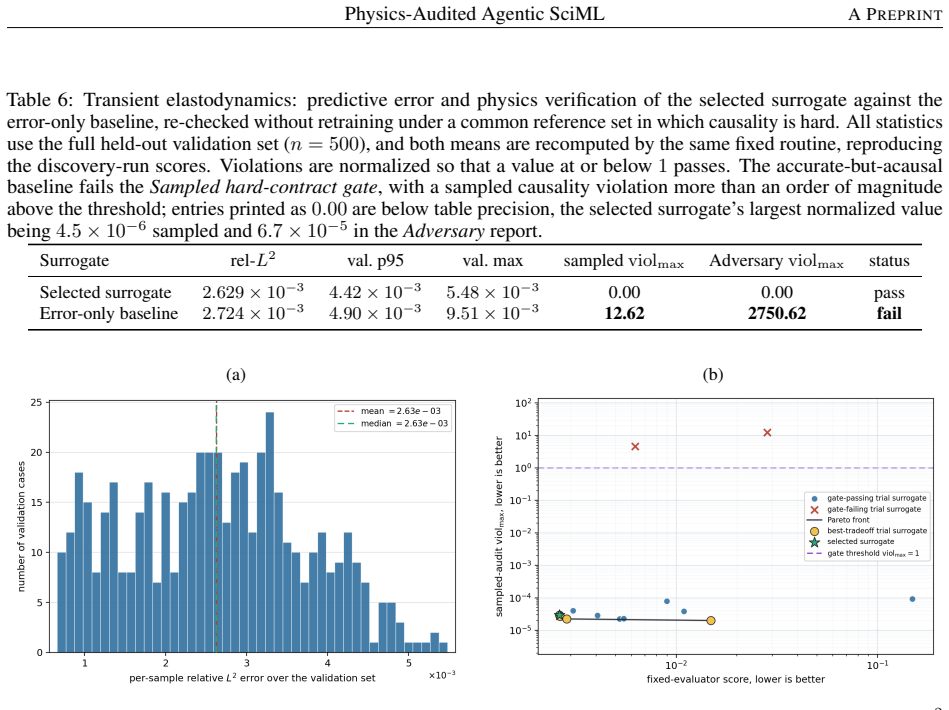
The paper's central discovery is that two surrogate models with nearly indistinguishable predictive error can differ decisively on a physically essential property that the error metric does not measure. In the transient elastodynamics example, the error-only baseline responds to future parts of the loading history, making it an invalid forward model despite having a mean relative L2 error within 3.5% of the audit-selected surrogate. The causality check, applied directly to the surrogate's predicted fields without reference solutions, exposes this failure. The audit-selected surrogate avoids it by construction through a causal convolution branch that the candidate search introduced on its own
What carries the argument
The central machinery is the contract file: a typed, reviewable specification of physics checks (linearity, scaling, symmetry, boundary consistency, causality, etc.) with parameters, tolerances, and hard/soft labels, drafted by an LLM-mediated setup role called the Mechanician and then executed by fixed routines against each trained candidate's predicted outputs. The Sampled hard-contract gate uses the maximum tolerance-normalized violation across active hard contracts to gate verified reporting. A separate Adversary routine searches admissible inputs for worst-case violations without reference solution fields.
Load-bearing premise
The framework depends on the LLM-mediated Mechanician correctly identifying and parameterizing the physically relevant checks before candidate search begins. If a critical check is omitted or a tolerance is set too loosely, the framework provides a false sense of verification. In the live transient run, causality was classified as a soft diagnostic rather than a hard gate; it only became disqualifying in the post-run reference audit when the authors reclassified it. The value
What would settle it
If, across repeated runs and diverse mechanics problems, error-only selection consistently produces surrogates that also pass all physically relevant checks under a common reference audit, then the per-candidate physics audit adds documentation but does not change selection outcomes. The transient example's single-run causality failure would need to be shown as a systematic pattern rather than a one-run artifact for the framework's value proposition to hold.
If this is right
- Engineering adoption of LLM-discovered surrogate models could require physics-audit evidence as a precondition, not just low validation error, because the transient example shows that near-identical error can mask a causality violation that makes a model unsuitable for real-time control or what-if prediction.
- The contract-file approach generalizes to other physics regimes: any problem where a governing principle can be expressed as a machine-checkable input-output property (conservation, positivity, monotonicity, thermodynamic consistency) could be audited the same way, extending beyond solid mechanics to fluid dynamics, heat transfer, or electromagnetics.
- The fact that the candidate search independently introduced causally-structured architectures (causal convolution, discrete superposition representations) suggests that physics-check signals during search may steer LLM agents toward architectures a domain expert would recognize as principled, even without being told the structure in advance.
- The separation of error evidence from physics-check evidence means that a surrogate can be reported with a graded status: accurate, verified under named checks, or unverified, rather than a single scalar score collapsing all information.
- The Adversary's no-reference violation search could be applied to already-deployed surrogates as a post-hoc audit tool, potentially catching physics violations in models selected by purely error-driven pipelines.
Editorial analysis
A structured set of objections, weighed in public.
Referee Report
Summary. This paper introduces Physics-Audited Agentic SciML (PA-SciML), a workflow that augments LLM-driven surrogate model discovery with per-candidate, machine-checkable physics audits on predicted fields. The framework fixes a scoring evaluator before search, derives reviewable physics contracts (hard/soft checks with tolerances), applies sampled physics checks to each trained candidate's outputs, and optionally runs a no-reference adversarial input search for high-violation cases. Two numerical examples in computational solid mechanics are presented: (1) parametric linear elasticity, where the audit-enabled run selects a more accurate surrogate while both selected and baseline models pass common linear-elastic checks, and (2) transient elastodynamics, where an error-only baseline with similar mean error (rel-L2 2.724e-3 vs. 2.629e-3) fails a causality check under a post-run reference audit, while the audit-selected surrogate passes by construction. The central claim is that per-candidate physics evidence on predicted fields provides information that error-only selection cannot.
Significance. The paper addresses a genuine gap in agentic SciML: existing systems select surrogates by aggregate scores without checking each candidate's predicted fields against machine-checkable physical requirements. The framework is carefully specified, with clear separation between LLM-mediated design roles and fixed-code verification routines. The adversarial input search is a notable strength—it operates without reference solutions and provides a falsifiable probe. The isolated-edit attribution analysis (Eq. 2) and method-card saving rule add a useful mechanism for accumulating reusable design knowledge. The transient elastodynamics example provides a concrete, compelling demonstration that two surrogates with near-identical mean error can differ decisively on a causality requirement. The paper is transparent about its limitations, including single-seed comparisons and the LLM-mediated origin of contract files.
major comments (1)
- §4.3, paragraph on 'Physics checks' (page 18–19): The paper's headline causality evidence comes from a post-run reference audit in which causality was reclassified as a hard check. In the live transient run, the Mechanician classified causality as a soft diagnostic, so the in-run Sampled hard-contract gate would not have disqualified the acausal error-only baseline. The paper acknowledges this ('In the live run, causality was recorded but did not disqualify candidates. In the post-run comparison, both selected surrogates are checked again with causality treated as a hard requirement'), but the abstract frames the result as evidence that the workflow works ('an error-only baseline with similar mean error fails a stricter causality check'). The 'stricter' check was not part of the live workflow that the paper proposes. This is a load-bearing concern because the central claim—that per-cand/
minor comments (7)
- §3.2, Eq. (1): The notation H for the set of active hard contracts is introduced but the relationship between H and the full contract file could be stated more explicitly for readers unfamiliar with the framework.
- Table 9: The model identifiers 'Claude Sonnet 4.6' and 'GPT-5.4' are unusual; please verify these are the correct model version names as of the submission date.
- Figure 2: The workflow diagram is dense and could benefit from larger font sizes or simplification to improve readability.
- §4.2, Table 4: The entry for '1/E scaling' for the selected surrogate shows '0 / 0' while the error-only baseline shows '1.080×10^-3 / 2.582×10^-3'. A brief note explaining why the selected surrogate's violation is exactly zero (by construction) would help readers.
- Appendix B, Table 10: The 'bound' check type description mentions a 'configured interval' but the interval is not specified in the main text for either example. Please clarify.
- §4.3: The transient example uses 500 validation histories. A brief note on how these were generated (random boundary motion histories, structured sampling, etc.) would improve reproducibility.
- §3.3, Eq. (2): The definition of phi_i could benefit from a concrete numerical example showing how values exceeding 100% arise, beyond the brief parenthetical already provided.
Simulated Author's Rebuttal
The referee raises one major comment concerning the framing of the transient elastodynamics result: the headline causality failure was exposed by a post-run reference audit in which causality was reclassified as a hard check, not by the live in-run Sampled hard-contract gate (which had causality as a soft diagnostic). The referee argues this undercuts the paper's central claim that per-candidate physics evidence provides information that error-only selection cannot. We agree that the abstract and framing overstate what the live workflow demonstrated in the transient example. The core framework and the static elasticity example are not affected, but the transient example's presentation must be revised to accurately distinguish what the live gate did and did not catch, and to reframe the contribution accordingly.
read point-by-point responses
-
Referee: §4.3, paragraph on 'Physics checks' (page 18–19): The paper's headline causality evidence comes from a post-run reference audit in which causality was reclassified as a hard check. In the live transient run, the Mechanician classified causality as a soft diagnostic, so the in-run Sampled hard-contract gate would not have disqualified the acausal error-only baseline. The paper acknowledges this, but the abstract frames the result as evidence that the workflow works. The 'stricter' check was not part of the live workflow that the paper proposes. This is a load-bearing concern because the central claim—that per-candidate physics evidence during selection provides information that error-only selection cannot—is not supported by the transient example as run.
Authors: The referee is correct on the factual point: in the live transient run, the Mechanician classified causality as a soft diagnostic, so the in-run Sampled hard-contract gate did not gate on it. The causality failure was exposed by a post-run reference audit with causality reclassified as hard. The abstract's current phrasing ('an error-only baseline with similar mean error fails a stricter causality check') does not make clear that this stricter check was not part of the live workflow, and this is a genuine framing problem. We will revise the manuscript as follows: (1) The abstract will be rewritten to accurately state that the live in-run gate caught two physically inadmissible candidates (nonzero response to zero input) but did not gate on causality; the causality failure was exposed by a post-run reference audit under a stricter verification setting. (2) Section 4.3 will be reorganized to separate three distinct findings: (a) the live gate removed two candidates with nonzero zero-input response during Candidate search, demonstrating in-run physics gating; (b) the selected surrogate is causal by construction and passes the reference causality check; (c) the error-only baseline fails the reference causality check, demonstrating that error-only selection can miss a causality failure—but this finding comes from a post-run audit, not the live gate. (3) The central claim of the paper will be reframed: the framework's contribution is that it produces and reports per-candidate physics evidence at all, making such audits possible; the transient example shows both that the live gate can catch some failures and that a stricter post-run contract can expose failures the live contract missed. The fact that the live contract classified causality as soft is itself evidence for the框架's revision: no
Circularity Check
No significant circularity found. The physics checks are defined independently of the surrogates and the error metric; the central causality evidence is not circular.
full rationale
The paper's central claim is that per-candidate physics audits provide evidence that error-only selection cannot. Walking the derivation chain: (1) The causality check (Appendix B, Table 10) is defined independently: it builds two input histories that agree through a cut time and differ only later, then measures the relative L2 difference of pre-cut-time responses. This definition references only the surrogate's input-output map, not the surrogate's architecture, training, or error metric. (2) The selected surrogate passes causality because the search discovered a causal-convolution architecture (left-padded, bias-free), not because causality was defined to pass. The paper is explicit: 'None of this structure was prescribed: the problem specification fixes only the operator's input-output form... and the candidate search introduced the causal branch.' (3) The error-only baseline fails because it uses a bidirectional branch; the causality check catches this independently. (4) The Adversary search holds the trained surrogate fixed and varies only admissible inputs, using no reference solutions. (5) The paper is transparent that the selected surrogates satisfy checks 'by construction' and frames the audit's role as confirming the exported model preserves intended structure, not as discovering new violations in the selected model. The decisive failure (acausal baseline) is found in a model that was independently selected by error-only search. The authors cite their own prior work [31-34] in related work for context, but these citations are not load-bearing for the framework's central claims or the verification logic. The post-hoc reclassification of causality from soft to hard is a methodological limitation the paper acknowledges, but it is not circularity: the check itself is the same; only its gating severity changed. No step in the derivation chain reduces to its own inputs by construction. Score 1 reflects the minor self-citations in related work that are not load-bearing for the central verification argument.
Axiom & Free-Parameter Ledger
free parameters (5)
- Contract tolerances (τ_c) =
5% normalized for transient hard checks; ≥3× calibration residual for static
- Hard/soft check labels =
Varies by verification setting (e.g., causality was soft in live run, hard in reference audit)
- Admissible input domain Z =
E∈[5,20], ν∈[0.15,0.35], loads∈[-0.3,0.3] for static; prescribed motion histories for transient
- Adversary search budget and parameterization =
Not numerically specified
- Method-card saving threshold (dominant edit share) =
0.5
axioms (5)
- domain assumption The physics checks selected by the Mechanician are physically valid for the governing regime, inputs, and outputs being audited.
- domain assumption The Fixed evaluator provides a meaningful predictive comparison metric.
- domain assumption Sampled audit probes are representative of the admissible input domain.
- domain assumption The LLM-mediated roles (Proposer, Critic, Engineer, etc.) can produce runnable, trainable surrogate implementations.
- standard math Single-precision arithmetic noise floor is an acceptable reference for zero-violation checks.
invented entities (4)
-
PA-SciML workflow
independent evidence
-
Mechanician role
no independent evidence
-
Adversary (no-reference high-violation input search)
independent evidence
-
Method card
no independent evidence
Cite this review
Pith. "Pith review of Physics-Audited Agentic Discovery in Scientific Machine Learning." pith.science (2026). https://pith.science/paper/AIXSHRP2
@misc{pith2026260707379,
  author       = {Pith},
  title        = {Pith review of: Physics-Audited Agentic Discovery in Scientific Machine Learning},
  year         = {2026},
  howpublished = {\url{https://pith.science/paper/AIXSHRP2}},
  note         = {Machine review of arXiv:2607.07379}
}
read the original abstract
In agentic scientific machine learning (SciML), large language model (LLM) agents can discover surrogate models and select one by an automated score, typically an error metric. A low error, however, does not establish that the predicted fields satisfy the physics that matter for mechanics, such as boundary conditions, superposition, stiffness scaling, or causality. We introduce Physics-Audited Agentic SciML (PA-SciML), a verification-first workflow for agentic SciML discovery. The workflow fixes a scoring evaluator before search, derives reviewable machine-checkable physics requirements, checks each trained candidate on its outputs, and separately searches prescribed input ranges or measured load-history spans for high-violation cases without reference solution fields. A surrogate is reported as verified only under the stated checks. When enabled, the workflow also adds advisory numerical probes before training and tests one modeling change at a time to record which isolated edits are associated with score gains before reuse. In the reported computational-solid-mechanics numerical examples, the static elasticity run selects a surrogate with lower validation error than the error-only baseline while both selected models pass the common linear-elastic checks. In the transient elastodynamics run, an error-only baseline with similar mean error fails a stricter causality check by responding to future parts of the loading history, while the selected surrogate passes the stated checks. The main distinction is per-candidate physics evidence on predicted fields, not a richer aggregate score.
Figures



Reference graph
Works this paper leans on
- [1]
-
[2]
Kevrekidis, Lu Lu, Paris Perdikaris, Sifan Wang, and Liu Yang
George Em Karniadakis, Ioannis G. Kevrekidis, Lu Lu, Paris Perdikaris, Sifan Wang, and Liu Yang. Physics- informed machine learning.Nature Reviews Physics, 3(6):422–440, 2021
work page 2021
-
[3]
Lu Lu, Pengzhan Jin, Guofei Pang, Zhongqiang Zhang, and George Em Karniadakis. Learning nonlinear operators via DeepONet based on the universal approximation theorem of operators.Nature Machine Intelligence, 3(3): 218–229, 2021
work page 2021
-
[4]
Fourier neural operator for parametric partial differential equations
Zongyi Li, Nikola Borislavov Kovachki, Kamyar Azizzadenesheli, Burigede Liu, Kaushik Bhattacharya, An- drew Stuart, and Anima Anandkumar. Fourier neural operator for parametric partial differential equations. In International Conference on Learning Representations (ICLR), 2021
work page 2021
-
[5]
Bo Ni and Markus J. Buehler. MechAgents: Large language model multi-agent collaborations can solve mechanics problems, generate new data, and integrate knowledge.Extreme Mechanics Letters, 67:102131, 2024
work page 2024
-
[6]
Sayan Adhikari, Gulshan Noorsumar, and Øyvind Jensen. PDE-Agents: An LLM-orchestrated multi-agent framework for automated finite element simulations with knowledge graph-augmented reasoning. arXiv preprint arXiv:2606.07850, 2026
work page internal anchor Pith review Pith/arXiv arXiv 2026
-
[7]
Rushikesh Deotale, Adithya Srinivasan, Mahmoud Golestanian, Yuan Tian, Tianyi Zhang, Pavlos Vlachos, and Hector Gomez. ALL-FEM: Agentic large language models fine-tuned for finite element methods.Computer Methods in Applied Mechanics and Engineering, 457:118985, 2026
work page 2026
-
[8]
Sandeep Pandey, Ran Xu, Wenkang Wang, and Xu Chu. OpenFOAMGPT: A retrieval-augmented large language model (LLM) agent for OpenFOAM-based computational fluid dynamics.Physics of Fluids, 37(3):035120, 2025
work page 2025
-
[9]
Toward autonomous engineering design: A knowledge-guided multi-agent framework
Varun Kumar and George Em Karniadakis. Toward autonomous engineering design: A knowledge-guided multi-agent framework. arXiv preprint arXiv:2511.03179, 2025
-
[10]
Qile Jiang and George Karniadakis. AgenticSciML: collaborative multi-agent systems for emergent discovery in scientific machine learning.npj Artificial Intelligence, 2026
work page 2026
-
[11]
ATHENA: Agentic Team for Hierarchical Evolutionary Numerical Algorithms
Juan Diego Toscano, Daniel T. Chen, and George Em Karniadakis. ATHENA: Agentic team for hierarchical evolutionary numerical algorithms. arXiv preprint arXiv:2512.03476, 2025
work page internal anchor Pith review Pith/arXiv arXiv 2025
-
[12]
Juan Diego Toscano, Zhaojie Chai, and George Em Karniadakis. GRAFT-ATHENA: Self-improving agentic teams for autonomous discovery and evolutionary numerical algorithms. arXiv preprint arXiv:2605.11117, 2026
work page internal anchor Pith review Pith/arXiv arXiv 2026
-
[13]
PINNsAgent: Automated PDE surrogation with large language models
Qingpo Wuwu, Chonghan Gao, Tianyu Chen, Yihang Huang, Yuekai Zhang, Jianing Wang, Jianxin Li, Haoyi Zhou, and Shanghang Zhang. PINNsAgent: Automated PDE surrogation with large language models. In Proceedings of the 42nd International Conference on Machine Learning, volume 267 ofProceedings of Machine Learning Research, pages 68143–68165. PMLR, 2025
work page 2025
-
[14]
Lang-PINN: From language to physics-informed neural networks via a multi-agent framework
Xin He, Liangliang You, Hongduan Tian, Bo Han, Ivor Tsang, and Yew-Soon Ong. Lang-PINN: From language to physics-informed neural networks via a multi-agent framework. arXiv preprint arXiv:2510.05158, 2025
-
[15]
Tianping Chen and Hong Chen. Universal approximation to nonlinear operators by neural networks with arbitrary activation functions and its application to dynamical systems.IEEE Transactions on Neural Networks, 6(4): 911–917, 1995
work page 1995
-
[16]
Neural Operator: Learning Maps Between Function Spaces With Applications to PDEs
Nikola Kovachki, Zongyi Li, Burigede Liu, Kamyar Azizzadenesheli, Kaushik Bhattacharya, Andrew Stuart, and Anima Anandkumar. Neural Operator: Learning Maps Between Function Spaces With Applications to PDEs. Journal of Machine Learning Research, 24(89):1–97, 2023
work page 2023
-
[17]
Samuel Lanthaler, Siddhartha Mishra, and George E. Karniadakis. Error estimates for DeepONets: a deep learning framework in infinite dimensions.Transactions of Mathematics and Its Applications, 6(1), 2022. Article tnac001
work page 2022
-
[18]
Sifan Wang, Hanwen Wang, and Paris Perdikaris. Learning the solution operator of parametric partial differential equations with physics-informed DeepONets.Science Advances, 7(40), 2021. Article eabi8605
work page 2021
-
[19]
Zongyi Li, Hongkai Zheng, Nikola Kovachki, David Jin, Haoxuan Chen, Burigede Liu, Kamyar Azizzadenesheli, and Anima Anandkumar. Physics-Informed Neural Operator for Learning Partial Differential Equations.ACM/IMS Journal of Data Science, 1(3):1–27, 2024. Article 9. 25 Physics-Audited Agentic SciMLA PREPRINT
work page 2024
-
[20]
Pengzhan Jin, Shuai Meng, and Lu Lu. MIONet: Learning multiple-input operators via tensor product.SIAM Journal on Scientific Computing, 44(6):A3490–A3514, 2022
work page 2022
-
[21]
Lu Lu, Xuhui Meng, Shengze Cai, Zhiping Mao, Somdatta Goswami, Zhongqiang Zhang, and George Em Karniadakis. A comprehensive and fair comparison of two neural operators (with practical extensions) based on FAIR data.Computer Methods in Applied Mechanics and Engineering, 393, 2022. Article 114778
work page 2022
-
[22]
Zongyi Li, Daniel Zhengyu Huang, Burigede Liu, and Anima Anandkumar. Fourier Neural Operator with Learned Deformations for PDEs on General Geometries.Journal of Machine Learning Research, 24(388):1–26, 2023
work page 2023
-
[23]
Gege Wen, Zongyi Li, Kamyar Azizzadenesheli, Anima Anandkumar, and Sally M. Benson. U-FNO—An enhanced Fourier neural operator-based deep-learning model for multiphase flow.Advances in Water Resources, 163, 2022. Article 104180
work page 2022
-
[24]
Diab W. Abueidda, Seid Koric, Nahil A. Sobh, and Huseyin Sehitoglu. Deep learning for plasticity and thermo- viscoplasticity.International Journal of Plasticity, 136, 2021. Article 102852
work page 2021
-
[25]
Abueidda, Syed Bahauddin Alam, and Seid Koric
Jaewan Park, Kazuma Kobayashi, Qibang Liu, Amar Alem Koric, Diab W. Abueidda, Syed Bahauddin Alam, and Seid Koric. Sequential deep operator neural networks for plastic and thermo-viscoplastic transient material behavior.International Journal of Plasticity, 201, 2026. Article 104689
work page 2026
-
[26]
Zhenguo Nie, Haoliang Jiang, and Levent Burak Kara. Stress Field Prediction in Cantilevered Structures Using Convolutional Neural Networks.Journal of Computing and Information Science in Engineering, 20(1), 2020. Article 011002
work page 2020
-
[27]
Vien Minh Nguyen-Thanh, Xiaoying Zhuang, and Timon Rabczuk. A deep energy method for finite deformation hyperelasticity.European Journal of Mechanics - A/Solids, 80, 2020. Article 103874
work page 2020
-
[28]
Somdatta Goswami, Minglang Yin, Yue Yu, and George Em Karniadakis. A physics-informed variational DeepONet for predicting crack path in quasi-brittle materials.Computer Methods in Applied Mechanics and Engineering, 391, 2022. Article 114587
work page 2022
-
[29]
Kaushik Bhattacharya, Bamdad Hosseini, Nikola B. Kovachki, and Andrew M. Stuart. Model Reduction and Neural Networks for Parametric PDEs.The SMAI Journal of Computational Mathematics, 7:121–157, 2021
work page 2021
-
[30]
Huaiqian You, Yue Yu, Marta D’Elia, Tian Gao, and Stewart Silling. Nonlocal kernel network (NKN): A stable and resolution-independent deep neural network.Journal of Computational Physics, 469, 2022. Article 111536
work page 2022
-
[31]
Abueidda, Mbebo Nonna, Panos Pantidis, and Mostafa E
Diab W. Abueidda, Mbebo Nonna, Panos Pantidis, and Mostafa E. Mobasher. Time resolution independent operator learning.Computer Methods in Applied Mechanics and Engineering, 450, 2026. Article 118586
work page 2026
-
[32]
Junyan He, Seid Koric, Diab Abueidda, Ali Najafi, and Iwona Jasiuk. Geom-DeepONet: A point-cloud-based deep operator network for field predictions on 3D parameterized geometries.Computer Methods in Applied Mechanics and Engineering, 429, 2024. Article 117130
work page 2024
- [33]
-
[34]
Fouad M. Amin, Diab W. Abueidda, Panos Pantidis, and Mostafa E. Mobasher. I-FENN with DeepONets: Accelerating simulations in coupled multiphysics problems.Computer Methods in Applied Mechanics and Engineering, 451, 2026. Article 118645
work page 2026
-
[35]
Frederic E. Bock, Roland C. Aydin, Christian J. Cyron, Norbert Huber, Surya R. Kalidindi, and Benjamin Klusemann. A Review of the Application of Machine Learning and Data Mining Approaches in Continuum Materials Mechanics.Frontiers in Materials, 6, 2019. Article 110
work page 2019
-
[36]
Auto-PINN: Understanding and Optimizing Physics-Informed Neural Architecture
Yicheng Wang, Xiaotian Han, Chia-Yuan Chang, Daochen Zha, Ulisses Braga-Neto, and Xia Hu. Auto-PINN: Understanding and Optimizing Physics-Informed Neural Architecture. arXiv preprint arXiv:2205.13748, 2022
work page internal anchor Pith review Pith/arXiv arXiv 2022
-
[37]
Boiko, Robert MacKnight, Ben Kline, and Gabe Gomes
Daniil A. Boiko, Robert MacKnight, Ben Kline, and Gabe Gomes. Autonomous chemical research with large language models.Nature, 624(7992):570–578, 2023
work page 2023
-
[38]
Bran, Sam Cox, Oliver Schilter, Carlo Baldassari, Andrew D
Andres M. Bran, Sam Cox, Oliver Schilter, Carlo Baldassari, Andrew D. White, and Philippe Schwaller. Aug- menting large language models with chemistry tools.Nature Machine Intelligence, 6(5):525–535, 2024
work page 2024
-
[39]
Towards end-to-end automation of AI research.Nature, 651(8107):914–919, 2026
Chris Lu, Cong Lu, Robert Tjarko Lange, Yutaro Yamada, Shengran Hu, Jakob Foerster, David Ha, and Jeff Clune. Towards end-to-end automation of AI research.Nature, 651(8107):914–919, 2026
work page 2026
-
[40]
Shunyu Yao, Jeffrey Zhao, Dian Yu, Nan Du, Izhak Shafran, Karthik R. Narasimhan, and Yuan Cao. ReAct: Synergizing reasoning and acting in language models. InInternational Conference on Learning Representations, 2023. 26 Physics-Audited Agentic SciMLA PREPRINT
work page 2023
-
[41]
Yilun Du, Shuang Li, Antonio Torralba, Joshua B. Tenenbaum, and Igor Mordatch. Improving Factuality and Reasoning in Language Models through Multiagent Debate. InProceedings of the 41st International Conference on Machine Learning, volume 235 ofProceedings of Machine Learning Research, pages 11733–11763. PMLR, 2024
work page 2024
-
[42]
CAMEL: Communicative Agents for “Mind” Exploration of Large Language Model Society
Guohao Li, Hasan Hammoud, Hani Itani, Dmitrii Khizbullin, and Bernard Ghanem. CAMEL: Communicative Agents for “Mind” Exploration of Large Language Model Society. InAdvances in Neural Information Processing Systems, volume 36, pages 51991–52008. Curran Associates, Inc., 2023
work page 2023
-
[43]
White, Doug Burger, and Chi Wang
Qingyun Wu, Gagan Bansal, Jieyu Zhang, Yiran Wu, Beibin Li, Erkang Zhu, Li Jiang, Xiaoyun Zhang, Shaokun Zhang, Jiale Liu, Ahmed Hassan Awadallah, Ryen W. White, Doug Burger, and Chi Wang. AutoGen: Enabling Next-Gen LLM Applications via Multi-Agent Conversations. InFirst Conference on Language Modeling, 2024
work page 2024
-
[44]
MetaGPT: Meta programming for A multi-agent collaborative framework
Sirui Hong, Mingchen Zhuge, Jonathan Chen, Xiawu Zheng, Yuheng Cheng, Jinlin Wang, Ceyao Zhang, Zili Wang, Steven Ka Shing Yau, Zijuan Lin, Liyang Zhou, Chenyu Ran, Lingfeng Xiao, Chenglin Wu, and Jürgen Schmidhuber. MetaGPT: Meta programming for A multi-agent collaborative framework. InInternational Conference on Learning Representations, 2024
work page 2024
-
[45]
Reflexion: Language Agents with Verbal Reinforcement Learning
Noah Shinn, Federico Cassano, Ashwin Gopinath, Karthik Narasimhan, and Shunyu Yao. Reflexion: Language Agents with Verbal Reinforcement Learning. InAdvances in Neural Information Processing Systems, volume 36, pages 8634–8652. Curran Associates, Inc., 2023
work page 2023
-
[46]
Lianmin Zheng, Wei-Lin Chiang, Ying Sheng, Siyuan Zhuang, Zhanghao Wu, Yonghao Zhuang, Zi Lin, Zhuohan Li, Dacheng Li, Eric P. Xing, Hao Zhang, Joseph E. Gonzalez, and Ion Stoica. Judging LLM-as-a-Judge with MT-Bench and Chatbot Arena. InAdvances in Neural Information Processing Systems, volume 36, pages 46595–46623. Curran Associates, Inc., 2023
work page 2023
-
[47]
Yinhao Zhu, Nicholas Zabaras, Phaedon-Stelios Koutsourelakis, and Paris Perdikaris. Physics-constrained deep learning for high-dimensional surrogate modeling and uncertainty quantification without labeled data.Journal of Computational Physics, 394:56–81, 2019
work page 2019
-
[48]
Lu Lu, Raphaël Pestourie, Wenjie Yao, Zhicheng Wang, Francesc Verdugo, and Steven G. Johnson. Physics- Informed Neural Networks with Hard Constraints for Inverse Design.SIAM Journal on Scientific Computing, 43 (6):B1105–B1132, 2021
work page 2021
-
[49]
Tom Beucler, Michael Pritchard, Stephan Rasp, Jordan Ott, Pierre Baldi, and Pierre Gentine. Enforcing Analytic Constraints in Neural Networks Emulating Physical Systems.Physical Review Letters, 126(9), 2021. Article 098302
work page 2021
-
[50]
Dill, Kyle Julian, and Mykel J
Guy Katz, Clark Barrett, David L. Dill, Kyle Julian, and Mykel J. Kochenderfer. Reluplex: An Efficient SMT Solver for Verifying Deep Neural Networks. InComputer Aided Verification (CAV), volume 10426 ofLecture Notes in Computer Science, pages 97–117, 2017
work page 2017
-
[51]
Guy Katz, Derek A. Huang, Duligur Ibeling, Kyle Julian, Christopher Lazarus, Rachel Lim, Parth Shah, Shantanu Thakoor, Haoze Wu, Aleksandar Zelji´c, David L. Dill, Mykel J. Kochenderfer, and Clark Barrett. The Marabou Framework for Verification and Analysis of Deep Neural Networks. InComputer Aided Verification (CAV), volume 11561 ofLecture Notes in Compu...
work page 2019
-
[52]
Goodfellow, Jonathon Shlens, and Christian Szegedy
Ian J. Goodfellow, Jonathon Shlens, and Christian Szegedy. Explaining and Harnessing Adversarial Examples. In International Conference on Learning Representations (ICLR), 2015
work page 2015
-
[53]
Towards Deep Learning Models Resistant to Adversarial Attacks
Aleksander Madry, Aleksandar Makelov, Ludwig Schmidt, Dimitris Tsipras, and Adrian Vladu. Towards Deep Learning Models Resistant to Adversarial Attacks. InInternational Conference on Learning Representations (ICLR), 2018
work page 2018
-
[54]
Psaros, Xuhui Meng, Zongren Zou, Ling Guo, and George Em Karniadakis
Apostolos F. Psaros, Xuhui Meng, Zongren Zou, Ling Guo, and George Em Karniadakis. Uncertainty quantification in scientific machine learning: Methods, metrics, and comparisons.Journal of Computational Physics, 477, 2023. Article 111902. A Reproducibility A.1 Data availability The code and data supporting this study will be made publicly available upon pub...
work page 2023
This paper was first reviewed by glm-5.2 on July 9, 2026.
discussion (0)
Sign in with ORCID, Apple, or X to comment. Anyone can read and Pith papers without signing in.