REVIEW 4 major objections 6 minor 1 cited by
Are LLMs Prescient? A Continuous Evaluation using Daily News as the Oracle
T0 review · 4 major / 6 minor · reviewed 2026-08-12 · deepseek-v4-flash
Pith's one-line read LLMs lose forecasting accuracy as their training data ages.
desk verdict Useful new continuous forecasting benchmark, but the headline claim about outdated pretraining data is confounded by item difficulty and weak filtering reliability. read the letter →
The pith
A machine-rendered reading of the paper's core claim, the machinery that carries it, and where it could break.
The reading
What carries the argument
The load-bearing object is the Daily Oracle pipeline: each day, a set of news articles is summarized, and an LLM generates two True/False and two Multiple Choice questions per article, with the article's publication date treated as the resolution date, so each question is a genuine forecast only if it is not answerable from pre-publication information. A seven-principle filter scores every candidate question on correctness, non-answerability before publication, absence of leakage, objectivity, clear temporal element, public interest, and non-obviousness, keeping items that score at least 13 out of 14. The evaluation machinery is the temporal axis: each model's knowledge cutoff is compared against each question's resolution date, and accuracy is plotted over time; the constrained open-book setting adds a RAG cutoff that limits retrieval to articles before a chosen date, isolating the effect of information recency. A word-frequency recurrence analysis inspired by a classic memory study shows that the knowledge demands of the benchmark follow a stable temporal structure, which supports interpreting the accuracy decline as a temporal-generalization effect.
What would settle it
If a random sample of Daily Oracle questions were reviewed by independent human forecasters with forecasting expertise, and the accuracy-over-time curve computed only on the subset they unanimously classify as unanswerable before publication showed no decline, the paper's claim of smooth degradation would be falsified.
Extended reading notes
Core claim
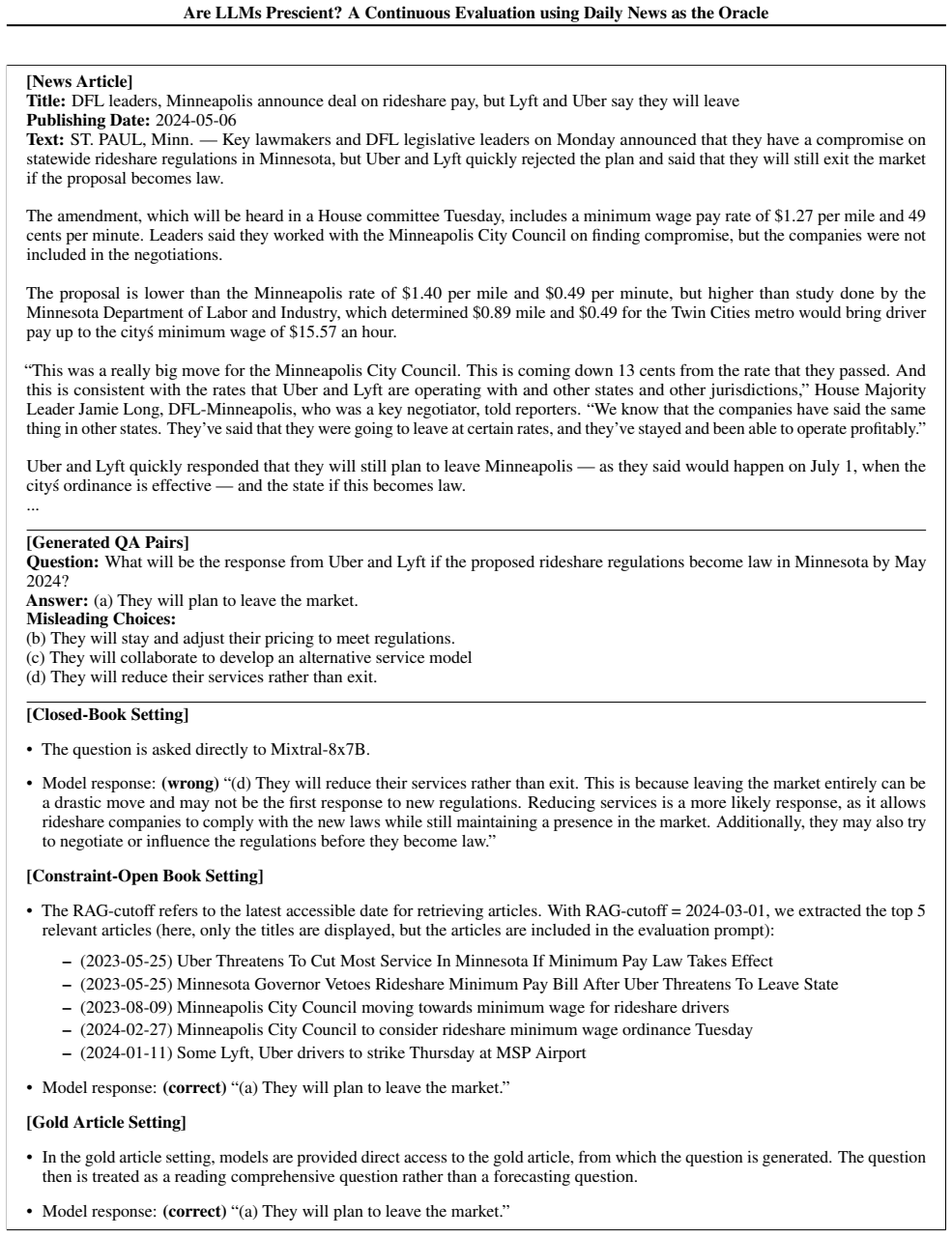
The central discovery is that an LLM's accuracy on forecast-style questions about recent events decreases smoothly and substantially as the interval between the model's knowledge cutoff and the question's resolution date grows. In the closed-book setting, accuracy on True/False questions falls on average from 64.68% to 50.74%, and on Multiple Choice questions from 58.30% to 51.69% between 2020 and 2024; year-over-year declines accelerate after the knowledge cutoff, with GPT-4 dropping 18.54% per year on MC questions in the post-cutoff period versus 4.23% before it. The same downward pattern persists when BM25 retrieval supplies up to five recent articles (constrained open-book), and even when the gold article containing the answer is given, most models still show declining accuracy. The paper interprets this as evidence that part of the loss comes from outdated internal representations, not just missing facts, and argues that continuous pre-training or model updating is needed to keep forecasting performance stable.
Load-bearing premise
The benchmark's questions are genuine forecasts only if they cannot be answered from information published before the article's publication date, but human raters essentially disagree on that judgment (Fleiss' Kappa 0.02), so the central degradation result depends on the LLM filter's ability to enforce a standard humans cannot reliably apply.
Editorial extensions
If this is right
- Static benchmarks that predate a model's training data cannot measure forecasting or temporal generalization; Daily Oracle provides a continuously refreshed alternative.
- Outdated pretraining data alone causes measurable accuracy loss on forecasting questions, even when the model can retrieve up-to-date documents.
- Performance declines both before and after the knowledge cutoff, but faster after the cutoff, so knowledge-cutoff dates are visible in accuracy curves.
- Because even gold-article reading comprehension degrades over time, retrieval cannot fully repair the loss; models need updated internal representations, i.e., continuous pre-training.
- The gold-article setting reaches roughly 90% accuracy, showing the benchmark questions are answerable and the decline is not simply unanswerable trivia.
Reading between the lines
- A testable extension is to apply a small rolling continuous-pre-training update to each model and measure whether the slope of the accuracy decline flattens on Daily Oracle.
- Given the near-zero human agreement on non-answerability, the benchmark may be more defensibly read as a measure of recency-weighted memory than of strict forecasting skill.
- The same daily pipeline could be run with resolved forecasting-market events as a human-verified control set, separating question-generation artifacts from genuine temporal-generalization effects.
Signed reviews
Editorial analysis
A structured set of objections, weighed in public.
Referee Report
Summary. The paper proposes Daily Oracle, a continuously updated forecasting benchmark in which QA pairs (True/False and Multiple Choice) are automatically generated from daily news articles and filtered by an LLM judge against seven quality principles. The authors use a static subset of 31,510 questions (16,783 TF, 14,727 MC) spanning January 2020 to December 2024, with publication date treated as the resolution date, and evaluate eight LLMs in three settings: closed-book, constrained open-book with BM25 retrieval under varying RAG cutoffs, and gold-article reading comprehension. The central empirical claim is that forecasting accuracy degrades as the gap between a model's knowledge cutoff and the question date grows, with average relative drops of 21.55% on TF and 11.33% on MC questions from the start to the end of the evaluation period; the degradation persists under retrieval and, surprisingly, when the gold article containing the answer is provided. The paper interprets the residual decline as evidence of outdated internal representations and argues for continuous model updating.
Significance. If the causal claim were established, the paper would make a meaningful contribution: Daily Oracle is one of the largest continuously generated forecasting benchmarks, it anchors answers to real news outcomes rather than synthetic labels, it evaluates multiple model families, and it includes retrieval and gold-article controls that go beyond prior temporal-generalization work. The public release of code and data is a concrete asset. The paper's honest reporting of human evaluation, including the very low agreement on the key filtering criterion, is also a strength. However, the central claim that accuracy falls because pretraining data becomes outdated is not yet supported: the temporal axis is confounded with possible changes in intrinsic item difficulty, and the paper's own gold-article control exhibits the same declining trend that the knowledge-staleness story is meant to explain.
major comments (4)
- [Section 3.3 / Table 4] The decisive filter for a 'genuine forecast' is 'Non-answerability Before the Publication Date', yet Table 4 reports Fleiss Kappa 0.02 for this principle among four human annotators, i.e., essentially no agreement. Because every question's status as a forecast depends on this criterion, the closed-book decline in Table 3 could be driven by a changing fraction of items that are actually answerable from pre-publication information, rather than by the staleness of model knowledge. Please provide an analysis restricted to items on which annotators (or a more reliable procedure) agree that the question is non-answerable before the resolution date, and report whether the temporal decline persists on that subset.
- [Section 4.2 / Figure 5] The gold-article setting is introduced as a control that should demonstrate answerability and remove missing-knowledge effects, but Figure 5 shows the same downward trend for most models even when the answer is present in the prompt. The paper attributes this to 'outdated internal representations,' but an equally parsimonious explanation is that later-generated questions are intrinsically harder to read or answer, independent of knowledge cutoff. To support the causal interpretation, the authors should hold the item set fixed and compare models (or checkpoints with different knowledge cutoffs) on those same items, or alternatively regress out a per-item difficulty measure (e.g., a strong model's gold-article accuracy) and show that a significant temporal decline remains.
- [Section 4.1 / Table 3 / Figure 3] The paper reports yearly averages and year-over-year accuracy changes as point estimates without confidence intervals or significance tests. Several models show small average yearly declines (e.g., Gemma-2-2B TF at -1.04%), and Figure 3 displays single moving-average trajectories. Please provide bootstrap confidence intervals clustered by month, or formal trend tests (e.g., Mann-Kendall), and state for which models the decline is statistically distinguishable from noise. Without this, the smoothness and universality of the degradation is asserted rather than demonstrated.
- [Section 3.1 / Footnote 6] The dataset generation and filtering pipeline changed from GPT-3.5/GPT-4 to GPT-4o-mini/GPT-4o after October 2024, while the evaluation window extends through December 2024. Because the final months' questions are produced by a different generator, the observed decline could partly reflect a shift in question difficulty rather than model knowledge staleness. Please analyze the effect of this generator change, for example by measuring question difficulty before and after the switch under a fixed reference model, or by repeating the main analysis on only the pre-switch period.
minor comments (6)
- [Abstract / Section 4.2] The 21.55% TF and 11.33% MC drops are relative declines (from 64.68% to 50.74%, and 58.30% to 51.69%, respectively); please state explicitly that these are relative percentages to avoid the reader interpreting them as absolute percentage-point changes.
- [Section 4.2 / Figure 4] The main-text open-book figure shows only Mixtral-8x7B (TF) and Llama-3-8B (MC); please state in the caption that other models appear in Appendix B.4 and list the specific RAG cutoff dates shown in the figure.
- [Section 3.3] The human evaluation sample is only 60 QA pairs, and the average Fleiss Kappa of 0.26 conceals a wide range (0.02 to 0.66). The near-zero agreement on the most important principle deserves discussion in the main text rather than only in the appendix.
- [Appendix B.2 / Figure 9] Counting refusals as incorrect mechanically drives some models below the random baseline (e.g., Mistral-7B and Mixtral-8x7B on TF). Please present the refusal-excluded accuracy more prominently in the main text, since it is the more informative measure of forecasting ability.
- [Appendix figures] Several appendix figure captions and axis labels appear corrupted with 'gid' strings (e.g., Figures 9-11); the final version should ensure proper rendering of these labels.
- [Section 4.3 / Limitations] The Limitations paragraph states that the trend is 'weak within the time horizon available,' which is in tension with the conclusion's claim of a 'significant smooth decline.' Please reconcile these statements, ideally by adding the statistical analysis requested above.
Circularity Check
No significant circularity: Daily Oracle is anchored to external news ground truth, and the degradation claim is a direct measurement rather than a derived or fitted result.
full rationale
The paper's central claim is an empirical measurement, not a derivation: accuracy is scored against answers extracted directly from real news articles, so the evaluation is anchored to external ground truth rather than to the authors' own equations or fitted values. No parameter is fitted to the target finding; knowledge cutoffs are taken from public model cards, and the only regression in the paper (Figure 2, word frequency against future occurrence) is a descriptive replication of Anderson and Schooler, not an input to the accuracy results. The constrained open-book and gold-article settings provide independent controls, and the RAG cutoff is varied explicitly rather than tuned to produce the decline. The LLM-based generation and filtering pipeline could imprint LLM priors onto item difficulty, and the near-zero human agreement on the 'Non-answerability Before the Publication Date' criterion (Fleiss Kappa 0.02, Table 4) weakens construct validity as a forecasting benchmark, but these are measurement-validity concerns, not circular reductions: no equation or fitted parameter makes the performance degradation equal to the benchmark's construction, and no self-citation carries the argument. The paper is therefore self-contained as an evaluation study, with the noted confounding risks belonging to correctness, not circularity.
Assumptions & free parameters
free parameters (4)
- QA filtering score threshold =
13 out of 14
- Daily article selection count =
6 articles per day (3 random, 3 hot-topic)
- BM25 top-k retrieved articles =
5
- Retrieved article truncation length =
512 words
assumptions (4)
- domain assumption The five selected news sources and the Common Crawl News corpus provide a representative and correct oracle for event outcomes.
- domain assumption The LLM-based QA filtering reliably enforces the seven quality criteria, especially non-answerability before publication.
- domain assumption The stated knowledge cutoff dates from model cards reflect the actual end of training data, so post-cutoff questions are unseen.
- standard math Linear regression with exponential weighing is a valid way to summarize changing trends in noisy monthly accuracy.
Cite this review
Pith. "Pith review of Are LLMs Prescient? A Continuous Evaluation using Daily News as the Oracle." pith.science (2026). https://pith.science/paper/AOD3BX2J
@misc{pith2026241108324,
  author       = {Pith},
  title        = {Pith review of: Are LLMs Prescient? A Continuous Evaluation using Daily News as the Oracle},
  year         = {2026},
  howpublished = {\url{https://pith.science/paper/AOD3BX2J}},
  note         = {Machine review of arXiv:2411.08324}
}
read the original abstract
Many existing evaluation benchmarks for Large Language Models (LLMs) quickly become outdated due to the emergence of new models and training data. These benchmarks also fall short in assessing how LLM performance changes over time, as they consist of a static set of questions without a temporal dimension. To address these limitations, we propose using future event prediction as a continuous evaluation method to assess LLMs' temporal generalization and forecasting abilities. Our benchmark, Daily Oracle, automatically generates question-answer (QA) pairs from daily news, challenging LLMs to predict "future" event outcomes. Our findings reveal that as pre-training data becomes outdated, LLM performance degrades over time. While Retrieval Augmented Generation (RAG) has the potential to enhance prediction accuracy, the performance degradation pattern persists, highlighting the need for continuous model updates. Code and data are available at https://agenticlearning.ai/daily-oracle.
Figures


Figures from the paper (34 more)




Forward citations
Cited by 1 Pith paper
-
Pitfalls in Evaluating Language Model Forecasters
A systematic critique showing temporal leakage and extrapolation flaws can undermine claims that LLM forecasters match or beat humans.
Reference graph
Works this paper leans on
-
[1]
Article Summary2. QA Generation MCQ: What will …?a) …b) Answerc) …3. Misleading Choices Generation TFQ: Will …?A: Yes4. QA Filtering … … … MC TF MC TF MC TF Day 1Day 2 Day n Figure 7. Data Construction Process of Daily Oracle. A.2. Details for Article Selection We select daily articles that generate the QA pairs in two ways: (1) Random Selection: We rando...
work page 2024
-
[2]
Provide a comprehensive summary of the entire article in one paragraph, ensuring that all essential aspects are addressed. Your summary should include key statistics, notable dates, and any significant statements to fully convey the context and content of the news story
-
[3]
Please provide one keypoint that summarizes the new event from the article with the following rules: - Focus specifically on events that are newly occurring on the publication date of the article. If the article does not introduce a new event but instead discusses ongoing topics or is about non-news content like advertisements, state ‘No new event reporte...
work page 2024
-
[4]
Please provide the question that can be answered on {}, but only guessable not answerable before {}
The question should challenge the person to predict an outcome or development related to the article’s content as if they were being asked one week or one month ago. Please provide the question that can be answered on {}, but only guessable not answerable before {}
-
[5]
Ensure that the answers do not predict outcomes that have not been explicitly stated in the article
The answer MUST be based on factual information from the article. Ensure that the answers do not predict outcomes that have not been explicitly stated in the article. [Rules:] Article: {}. Publishing date: {} Please generate four questions about the above article, along with answers. You should follow the instructions below:
-
[6]
Please turn the key point “{}” into the question, with focusing more on whether the event will happen
-
[7]
Please focus more on what happened rather than the implications after the event
The question should NOT be designed for reading comprehension. Please focus more on what happened rather than the implications after the event
-
[8]
Will”, with the answer as “Yes
The question MUST be in future tense. - Start the first question with “Will”, with the answer as “Yes”. - Start the second question with “Will”, with the answer as “No”. - Start the third and fourth questions with a phrase like “What will”, “Who will”, “Where will”, “Which xxx will”, “How much will”, or “How many will”
Show all 18 references
-
[9]
In {}
There must be a time element in the question. It can be phrases like “In {} ...”, “By {}, ...”, “... in {}?”
-
[10]
in the future
You MUST NOT use unclear implicit time element phrases like “in the future” or “in the upcoming weeks”
-
[11]
You should avoid: questions that require numerical reasoning; questions that require substantial world knowledge
-
[12]
The answer MUST be short and concise, avoiding using redundant words or repeating the information in the question
-
[13]
he, she, they, it, them, etc
The question must be grammatically correct and contain the information required to answer. NO “he, she, they, it, them, etc” allowed. Please clearly write out the entity you are referencing in the question
-
[14]
The question MUST be able to be answered by the article
-
[15]
How will
The question MUST NOT include the information that came out just now. It should be understandable to people from the past. Avoid using “How will” or “Why will” questions, as they imply that the event has already occurred. [Suggested questions and questions to avoid are detaile...
2024
-
[16]
Make sure you only return one of the options from the option list
-
[17]
Only output the category, and do not output any other words in your response
-
[18]
Answer: Figure 37
You have to pick a string from the above categories. Answer: Figure 37. Prompt to categorize the generated questions, taken from Halawi et al. (2024). 35
2024
Reviewed August 12, 2026 · model on record in the stance chip above.
Discussion (0). Continue with ORCID to comment.