Dependence of two-particle azimuthal correlations on the forward rapidity gap width in pPb collisions at sqrt{s_NN} = 8.16 TeV
Pith reviewed 2026-06-28 19:55 UTC · model grok-4.3
The pith
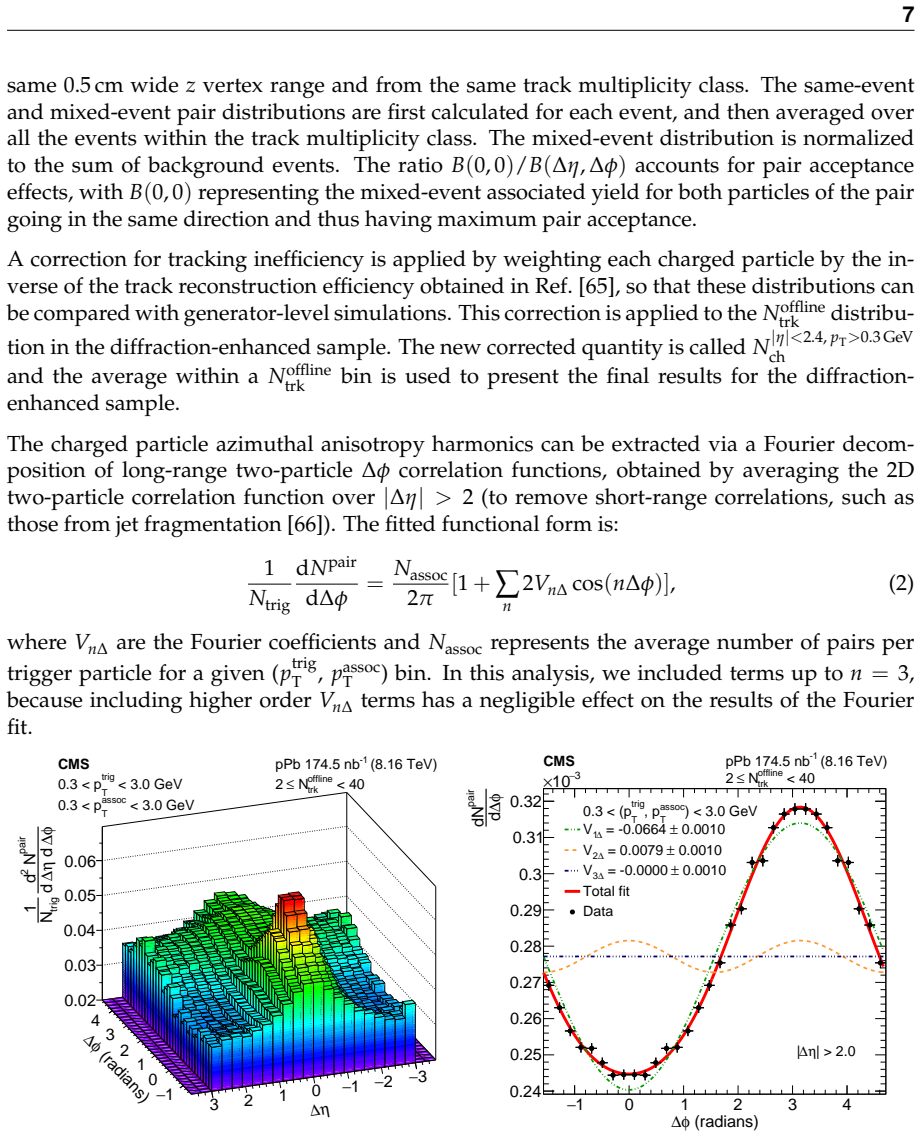
pPb events selected by forward rapidity gaps exhibit non-zero V_nΔ coefficients with standard dependence on pT and multiplicity.
A machine-rendered reading of the paper's core claim, the machinery that carries it, and where it could break.
Core claim
The measurements establish that V_nΔ remain non-zero in the gap-selected pPb sample and display similar dependence on gap width, pT, and multiplicity as seen in other small collision systems.
What carries the argument
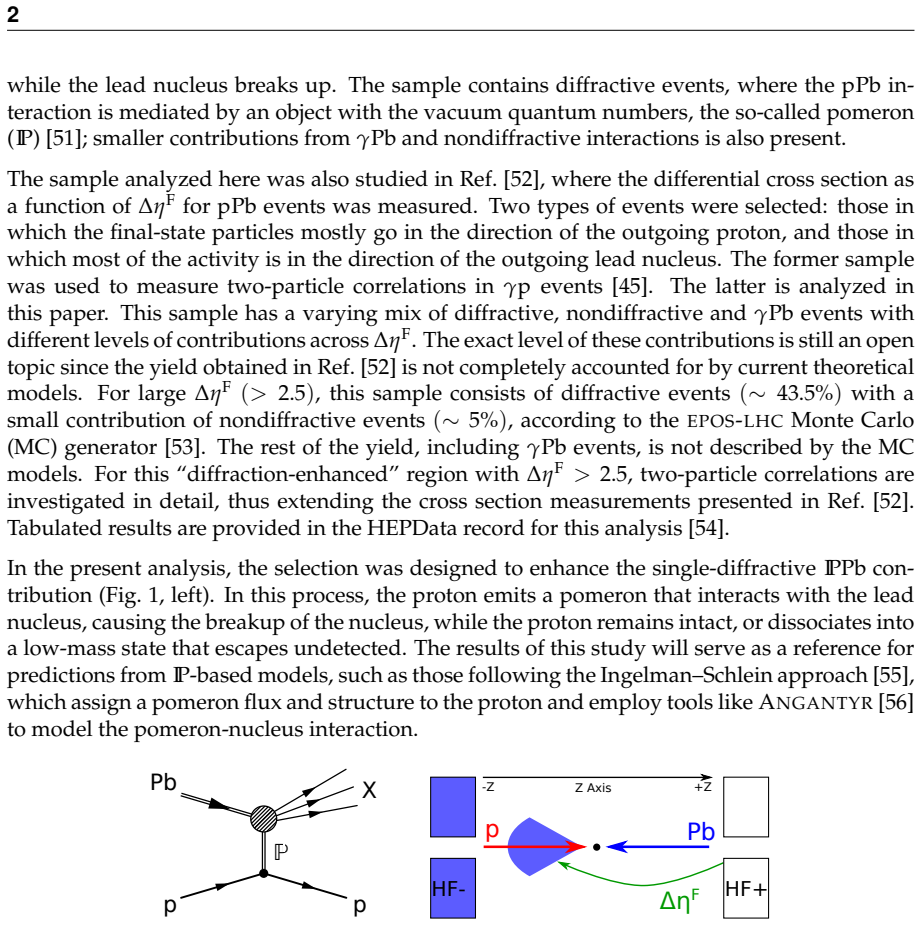
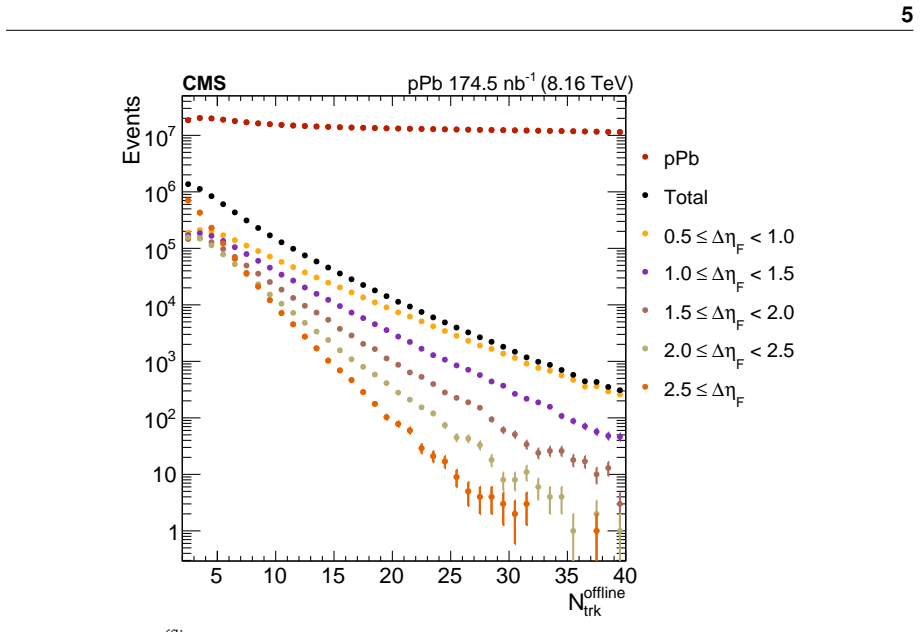
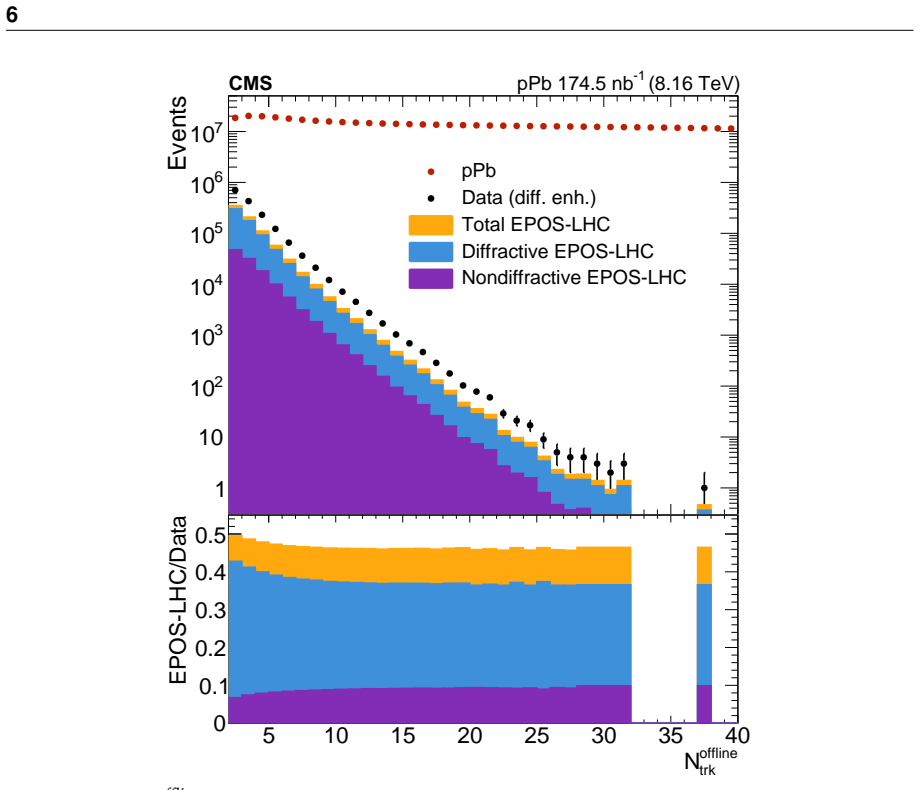
The forward rapidity gap width, the rapidity interval containing no detected particles, used to enrich the pPb sample for γPb and IP Pb interactions.
If this is right
- V_nΔ dependence on gap width, pT, and multiplicity can be compared directly to results from hadronic and photon-induced collisions.
- Similarity to previous small-system data suggests the correlations are not unique to standard hadronic pPb interactions.
- Discrepancies with event generators point to needed refinements in modeling azimuthal correlations in photon- and pomeron-induced processes.
- The data constrain models that attribute the correlations to collective flow versus other mechanisms.
Where Pith is reading between the lines
- If the gap selection isolates γPb and IP Pb events as intended, collective-like azimuthal correlations can appear even when one participant is a photon or pomeron rather than a full proton.
- Varying the gap width offers a handle on the longitudinal extent of the interaction region that could be tested in future analyses.
- Repeating the measurement at different center-of-mass energies would test whether the observed patterns scale with available phase space.
Load-bearing premise
Requiring no particles in the proton-going region successfully enriches the pPb sample in photon-lead and pomeron-lead interactions.
What would settle it
If V_nΔ values in the largest-gap events fall to zero while remaining finite in smaller-gap or inclusive events, the claim of persistent correlations in the enriched sample would be falsified.
Figures
read the original abstract
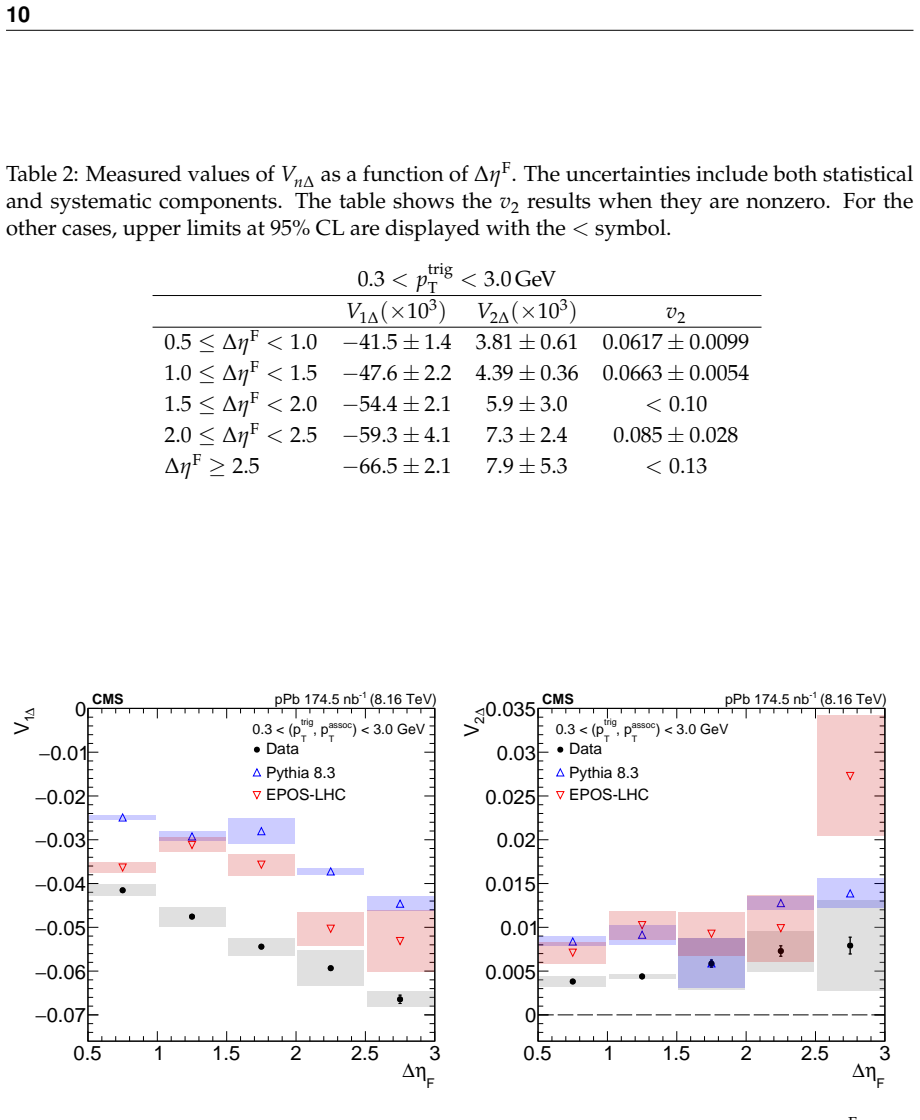
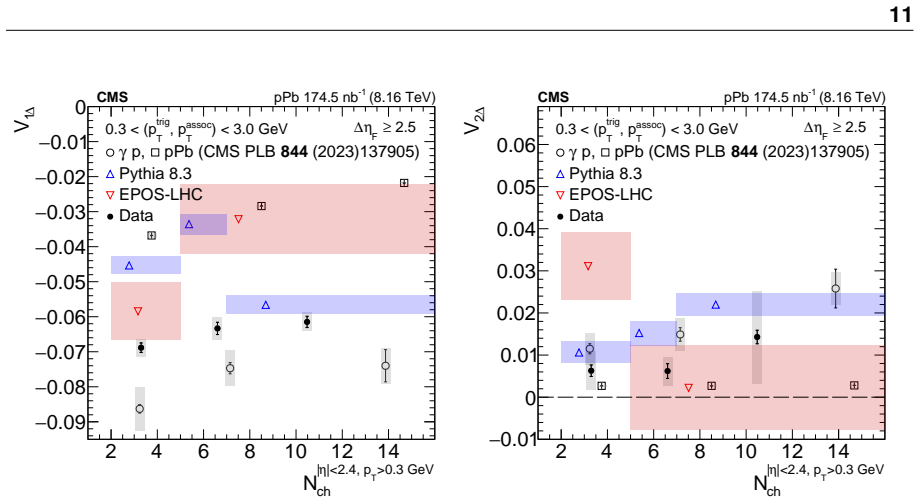
One of the most striking features of relativistic heavy ion collisions is the presence of collective flow of thousands of produced particles. This flow can be characterized by the Fourier coefficients (${V_{n\Delta}}$) of the azimuthal angular distributions of charged particles, and its existence can be explained by the formation of a quark gluon plasma, which behaves as a fluid. Surprisingly, the angular distributions of particles from very small systems such as proton-lead (pPb), proton-proton (pp), electron-positron, and photon-proton ($\gamma$p) collisions also exhibit non-zero Fourier coefficients, raising the question of whether collective flow is present. This paper presents measurements of $V_{n\Delta}$ from a sample of pPb events at $\sqrt{s_\mathrm{NN}}$ = 8.16 TeV that are enriched in photon-lead ($\gamma$Pb) and pomeron-lead ($\mathrm{{\!I\!P}}$Pb) interactions by requiring no particles in the proton-going region. Measurements are made as a function of the forward rapidity gap width (the rapidity range in which no particles are found), the transverse momentum of the particles, and the multiplicity of particles in the event. The results are compared to previous measurements of pp, pPb, and $\gamma$p+$\mathrm{\!I\!P}$p events as well as modern event generators.
Editorial analysis
A structured set of objections, weighed in public.
Referee Report
Summary. The manuscript reports measurements of two-particle azimuthal Fourier coefficients V_nΔ in pPb collisions at √s_NN = 8.16 TeV. Events are selected by requiring no particles in the proton-going region to enrich the sample for photon-lead (γPb) and pomeron-lead (IP Pb) interactions. Results are shown versus forward rapidity gap width, particle p_T, and event multiplicity, with comparisons to prior pp, pPb, and γp+IPp data plus modern event generators.
Significance. If the enrichment procedure is validated, the measurements would help clarify whether azimuthal correlations observed in small systems arise in photon-induced or diffractive processes, thereby constraining models of collectivity. Direct comparisons to other collision systems and generators provide additional context for the field.
major comments (1)
- [Event selection and sample enrichment (abstract and corresponding methods section)] The central analysis relies on the assumption that the 'no particles in the proton-going region' requirement successfully enriches the sample in γPb and IP Pb interactions. However, no purity, efficiency, or residual hadronic pPb contamination fractions are reported as a function of gap width (or versus multiplicity). This directly affects the interpretation of the reported V_nΔ(p_T, multiplicity, gap width) values and the comparisons to γp+IPp data.
Simulated Author's Rebuttal
We thank the referee for their careful reading of the manuscript and for identifying this key point regarding sample enrichment. We address the comment below.
read point-by-point responses
-
Referee: [Event selection and sample enrichment (abstract and corresponding methods section)] The central analysis relies on the assumption that the 'no particles in the proton-going region' requirement successfully enriches the sample in γPb and IP Pb interactions. However, no purity, efficiency, or residual hadronic pPb contamination fractions are reported as a function of gap width (or versus multiplicity). This directly affects the interpretation of the reported V_nΔ(p_T, multiplicity, gap width) values and the comparisons to γp+IPp data.
Authors: We agree that explicit quantification of purity, efficiency, and residual hadronic contamination would strengthen the interpretation. The manuscript does not currently report these fractions. The forward rapidity gap selection is presented as a function of gap width to show the evolution of the measured V_nΔ, serving as an indirect indicator of enrichment. In the revised manuscript, we will add Monte Carlo-based estimates of the sample composition, including residual contamination levels as a function of gap width (and, where feasible, multiplicity) to the methods section, along with a discussion of how this affects the comparisons to γp+IPp data. revision: yes
Circularity Check
No circularity: direct experimental measurements only
full rationale
This is a pure experimental measurement paper reporting V_nΔ from selected pPb events. No derivation chain, fitted parameters, or predictions exist that reduce by the paper's own equations to prior inputs. The gap-based event selection is an experimental cut whose purity is not claimed to be derived internally; comparisons to other data and generators are external benchmarks. No self-citation load-bearing theorems or ansatze are invoked. The result is self-contained against external data.
Axiom & Free-Parameter Ledger
axioms (1)
- domain assumption Standard assumptions in heavy-ion collision data analysis such as detector efficiency corrections and background subtraction hold.
Reference graph
Works this paper leans on
-
[1]
Observation of Long-Range Near-Side Angular Correlations in Proton-Proton Collisions at the LHC
CMS Collaboration, “Observation of long-range, near-side angular correlations in proton-proton collisions at the LHC”,JHEP09(2010) 091, doi:10.1007/JHEP09(2010)091,arXiv:1009.4122
work page internal anchor Pith review Pith/arXiv arXiv doi:10.1007/jhep09(2010)091 2010
-
[2]
ATLAS Collaboration, “Observation of long-range elliptic azimuthal anisotropies in√s=13 and 2.76 TeV pp collisions with the ATLAS detector”,Phys. Rev. Lett.116(2016) 172301,doi:10.1103/PhysRevLett.116.172301,arXiv:1509.04776
work page internal anchor Pith review Pith/arXiv arXiv doi:10.1103/physrevlett.116.172301 2016
-
[3]
CMS Collaboration, “Measurement of long-range near-side two-particle angular correlations in pp collisions at √s=13 TeV”,Phys. Rev. Lett.116(2015) 172302, doi:10.1103/PhysRevLett.116.172302,arXiv:1510.03068
work page internal anchor Pith review Pith/arXiv arXiv doi:10.1103/physrevlett.116.172302 2015
-
[4]
Evidence for collectivity in pp collisions at the LHC
CMS Collaboration, “Evidence for collectivity in pp collisions at the LHC”,Phys. Lett. B 765(2017) 193,doi:10.1016/j.physletb.2016.12.009,arXiv:1606.06198
work page internal anchor Pith review Pith/arXiv arXiv doi:10.1016/j.physletb.2016.12.009 2017
-
[5]
ATLAS Collaboration, “Measurement of azimuthal anisotropy of muons from charm and bottom hadrons in pp collisions at √s=13 TeV with the ATLAS detector”,Phys. Rev. Lett.124(2020) 082301,doi:10.1103/PhysRevLett.124.082301, arXiv:1909.01650
-
[6]
PHENIX Collaboration, “Measurement of long-range angular correlations and azimuthal anisotropies in high-multiplicity pAu collisions at √sNN = 200 GeV”,Phys. Rev. C95 (2017) 034910,doi:10.1103/PhysRevC.95.034910,arXiv:1609.02894
-
[7]
Creation of quark-gluon plasma droplets with three distinct geometries
PHENIX Collaboration, “Creation of quark-gluon plasma droplets with three distinct geometries”,Nature Phys.15(2019) 214,doi:10.1038/s41567-018-0360-0, arXiv:1805.02973
-
[8]
Observation of long-range near-side angular correlations in proton-lead collisions at the LHC
CMS Collaboration, “Observation of long-range near-side angular correlations in pPb collisions at the LHC”,Phys. Lett. B718(2013) 795, doi:10.1016/j.physletb.2012.11.025,arXiv:1210.5482
work page internal anchor Pith review Pith/arXiv arXiv doi:10.1016/j.physletb.2012.11.025 2013
-
[9]
ATLAS Collaboration, “Observation of associated near-side and away-side long-range correlations in √sNN = 5.02 TeV proton-lead collisions with the ATLAS detector”,Phys. Rev. Lett.110(2013) 182302,doi:10.1103/PhysRevLett.110.182302, arXiv:1212.5198
work page internal anchor Pith review Pith/arXiv arXiv doi:10.1103/physrevlett.110.182302 2013
-
[10]
ATLAS Collaboration, “Measurement with the ATLAS detector of multi-particle azimuthal correlations in pPb collisions at √sNN = 5.02 TeV”,Phys. Lett. B725(2013) 60, doi:10.1016/j.physletb.2013.06.057,arXiv:1303.2084
work page internal anchor Pith review Pith/arXiv arXiv doi:10.1016/j.physletb.2013.06.057 2013
-
[11]
ALICE Collaboration, “Long-range angular correlations on the near and away side in p−Pb collisions at √sNN = 5.02 TeV”,Phys. Lett. B719(2013) 29, doi:10.1016/j.physletb.2013.01.012,arXiv:1212.2001. References 15
work page internal anchor Pith review Pith/arXiv arXiv doi:10.1016/j.physletb.2013.01.012 2013
-
[12]
LHCb Collaboration, “Measurements of long-range near-side angular correlations in√sNN = 5 TeV proton-lead collisions in the forward region”,Phys. Lett. B762(2016) 473, doi:10.1016/j.physletb.2016.09.064,arXiv:1512.00439
work page internal anchor Pith review Pith/arXiv arXiv doi:10.1016/j.physletb.2016.09.064 2016
-
[13]
ALICE Collaboration, “Long-range angular correlations ofπ, K and p in pPb collisions at√sNN = 5.02 TeV”,Phys. Lett. B726(2013) 164, doi:10.1016/j.physletb.2013.08.024,arXiv:1307.3237
work page internal anchor Pith review Pith/arXiv arXiv doi:10.1016/j.physletb.2013.08.024 2013
-
[14]
Evidence for collective multi-particle correlations in pPb collisions
CMS Collaboration, “Evidence for collective multiparticle correlations in p-Pb collisions”,Phys. Rev. Lett.115(2015) 012301, doi:10.1103/PhysRevLett.115.012301,arXiv:1502.05382
work page internal anchor Pith review Pith/arXiv arXiv doi:10.1103/physrevlett.115.012301 2015
-
[15]
CMS Collaboration, “Long-range two-particle correlations of strange hadrons with charged particles in pPb and PbPb collisions at LHC energies”,Phys. Lett. B742(2015) 200,doi:10.1016/j.physletb.2015.01.034,arXiv:1409.3392
work page internal anchor Pith review Pith/arXiv arXiv doi:10.1016/j.physletb.2015.01.034 2015
-
[16]
ATLAS Collaboration, “Measurement of multi-particle azimuthal correlations in pp, pPb and low multiplicity PbPb collisions with the ATLAS detector”,Eur. Phys. J. C.77(2017) 428,doi:10.1140/epjc/s10052-017-4988-1,arXiv:1705.04176
work page internal anchor Pith review Pith/arXiv arXiv doi:10.1140/epjc/s10052-017-4988-1 2017
-
[17]
ATLAS Collaboration, “Measurement of long-range multiparticle azimuthal correlations with the subevent cumulant method in pp and pPb collisions with the ATLAS detector at the CERN large hadron collider”,Phys. Rev. C97(2018) 024904, doi:10.1103/PhysRevC.97.024904,arXiv:1708.03559
work page internal anchor Pith review Pith/arXiv arXiv doi:10.1103/physrevc.97.024904 2018
-
[18]
Studies of charm and beauty hadron long-range correlations in pp and pPb collisions at LHC energies
CMS Collaboration, “Studies of charm and beauty hadron long-range correlations in pp and pPb collisions at LHC energies”,Phys. Lett. B813(2021) 136036, doi:10.1016/j.physletb.2020.136036,arXiv:2009.07065
-
[19]
Elliptic flow in Au+Au collisions at sqrt(s_NN) = 130 GeV
STAR Collaboration, “Elliptic flow in AuAu collisions at √sNN = 130 GeV”,Phys. Rev. Lett.86(2001) 402,doi:10.1103/PhysRevLett.86.402, arXiv:nucl-ex/0009011
work page internal anchor Pith review Pith/arXiv arXiv doi:10.1103/physrevlett.86.402 2001
-
[20]
PHOBOS Collaboration, “System size dependence of cluster properties from two-particle angular correlations in CuCu and AuAu collisions at √sNN = 200 GeV”,Phys. Rev. C81 (2010) 024904,doi:10.1103/PhysRevC.81.024904,arXiv:0812.1172
-
[21]
CMS Collaboration, “Long-range and short-range dihadron angular correlations in central PbPb collisions at a nucleon-nucleon center of mass energy of 2.76 TeV”,JHEP10 (2011) 076,doi:10.1007/JHEP07(2011)076,arXiv:1105.2438
work page internal anchor Pith review Pith/arXiv arXiv doi:10.1007/jhep07(2011)076 2011
-
[22]
CMS Collaboration, “Centrality dependence of dihadron correlations and azimuthal anisotropy harmonics in PbPb collisions at √sNN = 2.76 TeV”,Eur. Phys. J. C72(2012) 2012,doi:10.1140/epjc/s10052-012-2012-3,arXiv:1201.3158
work page internal anchor Pith review Pith/arXiv arXiv doi:10.1140/epjc/s10052-012-2012-3 2012
-
[23]
Long range rapidity correlations and jet production in high energy nuclear collisions
STAR Collaboration, “Long range rapidity correlations and jet production in high energy nuclear collisions”,Phys. Rev. C80(2009) 064912, doi:10.1103/PhysRevC.80.064912,arXiv:0909.0191
work page internal anchor Pith review Pith/arXiv arXiv doi:10.1103/physrevc.80.064912 2009
-
[24]
STAR Collaboration, “Three-particle coincidence of the long range pseudorapidity correlation in high energy nucleus-nucleus collisions”,Phys. Rev. Lett.105(2010) 022301, doi:10.1103/PhysRevLett.105.022301,arXiv:0912.3977. 16
work page internal anchor Pith review Pith/arXiv arXiv doi:10.1103/physrevlett.105.022301 2010
-
[25]
PHENIX Collaboration, “Formation of dense partonic matter in relativistic nucleus-nucleus collisions at RHIC: experimental evaluation by the PHENIX collaboration”,Nucl. Phys. A757(2005) 184, doi:10.1016/j.nuclphysa.2005.03.086,arXiv:nucl-ex/0410003
work page internal anchor Pith review Pith/arXiv arXiv doi:10.1016/j.nuclphysa.2005.03.086 2005
-
[26]
STAR Collaboration, “Beam-energy dependence of identified two-particle angular correlations in √sNN = 7.7–200 GeV AuAu collisions”,Phys. Rev. C101(2020) 014916, doi:10.1103/PhysRevC.101.014916,arXiv:1906.09204
-
[27]
Correlation Measurements Between Flow Harmonics in Au+Au Collisions at RHIC
STAR Collaboration, “Correlation measurements between flow harmonics in AuAu collisions at RHIC”,Phys. Lett. B783(2018) 459, doi:10.1016/j.physletb.2018.05.076,arXiv:1803.03876
work page internal anchor Pith review Pith/arXiv arXiv doi:10.1016/j.physletb.2018.05.076 2018
-
[28]
Overview of high-density QCD studies with the CMS experiment at the LHC
CMS Collaboration, “Overview of high-density QCD studies with the CMS experiment at the LHC”,Phys. Rept.1115(2025) 219,doi:10.1016/j.physrep.2024.11.007, arXiv:2405.10785
-
[29]
S. Voloshin and Y. Zhang, “Flow study in relativistic nuclear collisions by fourier expansion of azimuthal particle distributions”,Z. Phys. C70(1996) 665, doi:10.1007/s002880050141,arXiv:hep-ph/9407282
work page internal anchor Pith review Pith/arXiv arXiv doi:10.1007/s002880050141 1996
-
[30]
Collision geometry fluctuations and triangular flow in heavy-ion collisions
B. Alver and G. Roland, “Collision geometry fluctuations and triangular flow in heavy-ion collisions”,Phys. Rev. C81(2010) 054905, doi:10.1103/PhysRevC.82.039903,arXiv:1003.0194
work page internal anchor Pith review Pith/arXiv arXiv doi:10.1103/physrevc.82.039903 2010
-
[31]
Triangular flow in hydrodynamics and transport theory
B. H. Alver, C. Gombeaud, M. Luzum, and J.-Y. Ollitrault, “Triangular flow in hydrodynamics and transport theory”,Phys. Rev. C82(2010) 034913, doi:10.1103/PhysRevC.82.034913,arXiv:1007.5469
work page internal anchor Pith review Pith/arXiv arXiv doi:10.1103/physrevc.82.034913 2010
-
[32]
Elliptic and triangular flow in event-by-event (3+1)D viscous hydrodynamics
B. Schenke, S. Jeon, and C. Gale, “Elliptic and triangular flow in event-by-event D=3+1 viscous hydrodynamics”,Phys. Rev. Lett.106(2011) 042301, doi:10.1103/PhysRevLett.106.042301,arXiv:1009.3244
work page internal anchor Pith review Pith/arXiv arXiv doi:10.1103/physrevlett.106.042301 2011
-
[33]
Hydrodynamic elliptic and triangular flow in Pb-Pb collisions at sqrt(s)=2.76ATeV
C. S. Z. Qiu and U. Heinz, “Hydrodynamic elliptic and triangular flow in Pb-Pb collisions at √sNN = 2.76 TeV”,Phys. Lett. B707(2012) 151, doi:10.1016/j.physletb.2011.12.041,arXiv:1110.3033
work page internal anchor Pith review Pith/arXiv arXiv doi:10.1016/j.physletb.2011.12.041 2012
-
[34]
CMS Collaboration, “Elliptic flow of charm and strange hadrons in high-multiplicity pPb collisions at √sNN = 8.16 TeV”,Phys. Rev. Lett.121(2018) 082301, doi:10.1103/PhysRevLett.121.082301,arXiv:1804.09767
work page internal anchor Pith review Pith/arXiv arXiv doi:10.1103/physrevlett.121.082301 2018
-
[35]
CMS Collaboration, “Centrality and pseudorapidity dependence of the transverse energy density in pPb collisions at √sNN = 5.02 TeV”,Phys. Rev. C100(2019) 024902, doi:10.1103/PhysRevC.100.024902,arXiv:1810.05745
-
[36]
Multi-strange baryon production in p-Pb collisions at $\sqrt{s_\mathbf{NN}}=5.02$ TeV
ALICE Collaboration, “Multi-strange baryon production in pPb collisions at √sNN = 5.02 TeV”,Phys. Lett. B758(2016) 389,doi:10.1016/j.physletb.2016.05.027, arXiv:1512.07227
work page internal anchor Pith review Pith/arXiv arXiv doi:10.1016/j.physletb.2016.05.027 2016
-
[37]
Elliptic Flow of Identified Hadrons in Au+Au Collisions at sqrt(s_NN) = 200 GeV
PHENIX Collaboration, “Elliptic flow of identified hadrons in AuAu collisions at √sNN = 200 GeV”,Phys. Rev. Lett.91(2003) 182301, doi:10.1103/PhysRevLett.91.182301,arXiv:nucl-ex/0305013. References 17
work page internal anchor Pith review Pith/arXiv arXiv doi:10.1103/physrevlett.91.182301 2003
-
[38]
STAR Collaboration, “Distributions of charged hadrons associated with high transverse momentum particles in pp and AuAu collisions at √sNN = 200 GeV”,Phys. Rev. Lett.95 (2005) 152301,doi:10.1103/PhysRevLett.95.152301, arXiv:nucl-ex/0501016
work page internal anchor Pith review Pith/arXiv arXiv doi:10.1103/physrevlett.95.152301 2005
-
[39]
Measurement of two-particle correlations of hadrons in e +e− collisions at Belle
Belle Collaboration, “Measurement of two-particle correlations of hadrons in e +e− collisions at Belle”,Phys. Rev. Lett.128(2022) 142005, doi:10.1103/PhysRevLett.128.142005,arXiv:2201.01694
-
[40]
Novel Collective Phenomena in High-Energy Proton-Proton and Proton-Nucleus Collisions
K. Dusling, W. Li, and B. Schenke, “Novel collective phenomena in high-energy proton–proton and proton–nucleus collisions”,Int. J. Mod. Phys. E25(2016) 1630002, doi:10.1142/S0218301316300022,arXiv:1509.07939
work page internal anchor Pith review Pith/arXiv arXiv doi:10.1142/s0218301316300022 2016
-
[41]
J. L. Nagle and J. Orjuela Koop, “A quasiparticle transport explanation for collectivity in the smallest of collision systems (pp and e+e−)”,Nucl. Phys. A982(2019) 455, doi:10.1016/j.nuclphysa.2018.09.005,arXiv:1807.04619
work page internal anchor Pith review Pith/arXiv arXiv doi:10.1016/j.nuclphysa.2018.09.005 2019
-
[42]
Measurements of two-particle correlations ine +e− collisions at 91 GeV with ALEPH archived data
A. Badea et al., “Measurements of two-particle correlations ine +e− collisions at 91 GeV with ALEPH archived data”,Phys. Rev. Lett.123(2019) 212002, doi:10.1103/PhysRevLett.123.212002,arXiv:1906.00489
-
[43]
Long-range near-side correlation in e +e− collisions at 183-209 GeV with ALEPH archived data
Electron-Positron Alliance Collaboration, “Long-range near-side correlation in e +e− collisions at 183-209 GeV with ALEPH archived data”,Phys. Lett. B856(2024) 138957, doi:10.1016/j.physletb.2024.138957,arXiv:2312.05084
-
[44]
ZEUS Collaboration, “Two-particle azimuthal correlations as a probe of collective behaviour in deep inelasticepscattering at HERA”,JHEP04(2020) 070, doi:10.1007/JHEP04(2020)070,arXiv:1912.07431
-
[45]
Two-particle azimuthal correlations inγp interactions using pPb collisions at √sNN = 8.16 TeV
CMS Collaboration, “Two-particle azimuthal correlations inγp interactions using pPb collisions at √sNN = 8.16 TeV”,Phys. Lett. B844(2023) 137905, doi:10.1016/j.physletb.2023.137905,arXiv:2204.13486
-
[46]
ALICE Collaboration, “First observation of ultra-long-range azimuthal correlations in low multiplicity pp and p-Pb collisions at the LHC”, 4, 2025.arXiv:2504.02359
-
[47]
ATLAS Collaboration, “Two-particle azimuthal correlations in photonuclear ultraperipheral PbPb collisions at 5.02 TeV with ATLAS”,Phys. Rev. C104(2021) 014903, doi:10.1103/PhysRevC.104.014903,arXiv:2101.10771
-
[48]
CMS Collaboration, “Observation of long-range collective flow in OO and NeNe collisions and implications for nuclear structure studies”, 10, 2025.arXiv:2510.02580
-
[49]
CMS Collaboration, “Observation of enhanced long-range elliptic anisotropies inside high-multiplicity jets in pp collisions at √sNN = 13 TeV”,Phys. Rev. Lett.133(2024) 142301,doi:10.1103/PhysRevLett.133.142301,arXiv:2312.17103
-
[50]
The CMS experiment at the CERN LHC
CMS Collaboration, “The CMS experiment at the CERN LHC”,JINST3(2008) S08004, doi:10.1088/1748-0221/3/08/S08004
-
[51]
Introduction to complex orbital momenta
T. Regge, “Introduction to complex orbital momenta”,Nuovo Cim.14(1959) 951, doi:10.1007/BF02728177. 18
-
[52]
First measurement of the forward rapidity gap distribution in pPb collisions at √sNN = 8.16 TeV
CMS Collaboration, “First measurement of the forward rapidity gap distribution in pPb collisions at √sNN = 8.16 TeV”,Phys. Rev. D108(2023) 092004, doi:10.1103/PhysRevD.108.092004,arXiv:2301.07630
-
[53]
EPOS LHC : test of collective hadronization with LHC data
T. Pierog et al., “EPOS LHC: test of collective hadronization with data measured at the CERN large hadron collider”,Phys. Rev. C92(2015) 034906, doi:10.1103/PhysRevC.92.034906,arXiv:1306.0121
work page internal anchor Pith review Pith/arXiv arXiv doi:10.1103/physrevc.92.034906 2015
-
[54]
HEPData record for this analysis, 2025.doi:10.17182/hepdata.156188
-
[55]
Jet structure in high mass diffractive scattering
G. Ingelman and P . E. Schlein, “Jet structure in high mass diffractive scattering”,Phys. Lett. B152(1985) 256,doi:10.1016/0370-2693(85)91181-5
-
[56]
The Angantyr model for Heavy-Ion Collisions in PYTHIA8
C. Bierlich, G. Gustafson, L. L ¨onnblad, and H. Shah, “The Angantyr model for heavy-ion collisions in PYTHIA8”,JHEP10(2018) 134,doi:10.1007/JHEP10(2018)134, arXiv:1806.10820
work page internal anchor Pith review Pith/arXiv arXiv doi:10.1007/jhep10(2018)134 2018
-
[57]
CMS technical design report for the phase 1 upgrade of the hadron calorimeter
CMS Collaboration, “CMS technical design report for the phase 1 upgrade of the hadron calorimeter”, technical report, 9, 2012.doi:10.2172/1151651
-
[58]
Particle-flow reconstruction and global event description with the CMS detector
CMS Collaboration, “Particle-flow reconstruction and global event description with the CMS detector”,JINST12(2017) P10003,doi:10.1088/1748-0221/12/10/P10003, arXiv:1706.04965
work page internal anchor Pith review Pith/arXiv arXiv doi:10.1088/1748-0221/12/10/p10003 2017
-
[59]
CMS luminosity measurement using 2016 proton-nucleus collisions at nucleon-nucleon center-of-mass energy of 8.16 TeV
CMS Collaboration, “CMS luminosity measurement using 2016 proton-nucleus collisions at nucleon-nucleon center-of-mass energy of 8.16 TeV”, CMS Physics Analysis Summary CMS-PAS-LUM-17-002, 2018
2016
-
[60]
Observation of correlated azimuthal anisotropy Fourier harmonics in pp and pPb collisions at the LHC
CMS Collaboration, “Observation of correlated azimuthal anisotropy fourier harmonics in pp and pPb collisions at the LHC”,Phys. Rev. Lett.120(2018) 092301, doi:10.1103/PhysRevLett.120.092301,arXiv:1709.09189
work page internal anchor Pith review Pith/arXiv arXiv doi:10.1103/physrevlett.120.092301 2018
-
[61]
CMS Collaboration, “The CMS trigger system”,JINST12(2017) P01020, doi:10.1088/1748-0221/12/01/P01020,arXiv:1609.02366
work page internal anchor Pith review Pith/arXiv arXiv doi:10.1088/1748-0221/12/01/p01020 2017
-
[62]
A comprehensive guide to the physics and usage of PYTHIA 8.3
C. Bierlich et al., “A comprehensive guide to the physics and usage of PYTHIA 8.3”, SciPost Phys. Codeb.2022(2022) 8,doi:10.21468/SciPostPhysCodeb.8, arXiv:2203.11601
work page internal anchor Pith review Pith/arXiv arXiv doi:10.21468/scipostphyscodeb.8 2022
-
[63]
doi:10.1016/S0168-9002(03)01368-8
GEANT4 Collaboration, “GEANT4—a simulation toolkit”,Nucl. Instrum. Meth. A506 (2003) 250,doi:10.1016/S0168-9002(03)01368-8
-
[64]
Description and performance of track and primary-vertex reconstruction with the CMS tracker
CMS Collaboration, “Description and performance of track and primary-vertex reconstruction with the CMS tracker”,JINST9(2014) P10009, doi:10.1088/1748-0221/9/10/P10009,arXiv:1405.6569
work page internal anchor Pith review Pith/arXiv arXiv doi:10.1088/1748-0221/9/10/p10009 2014
-
[65]
Measurement of tracking efficiency
CMS Collaboration, “Measurement of tracking efficiency”, CMS Physics Analysis Summary CMS-PAS-TRK-10-002, 2010
2010
-
[66]
ALICE Collaboration, “Anomalous evolution of the near-side jet peak shape in Pb-Pb collisions at √sNN = 2.76 TeV”,Phys. Rev. Lett.119(2017) 102301, doi:10.1103/PhysRevLett.119.102301,arXiv:1609.06643
work page internal anchor Pith review Pith/arXiv arXiv doi:10.1103/physrevlett.119.102301 2017
-
[67]
Systematic Errors: facts and fictions
R. Barlow, “Systematic errors: facts and fictions”, inConference on Advanced Statistical T echniques in Particle Physics, p. 134. 2002.arXiv:hep-ex/0207026. 19 A The CMS Collaboration Yerevan Physics Institute, Yerevan, Armenia A. Hayrapetyan, A. Tumasyan1 Institut f ¨ ur Hochenergiephysik, Vienna, Austria W. Adam , J.W. Andrejkovic, L. Benato , T. Bergau...
work page internal anchor Pith review Pith/arXiv arXiv 2002
discussion (0)
Sign in with ORCID, Apple, or X to comment. Anyone can read and Pith papers without signing in.