Revealing the high redshift host galaxy of the short GRB 061201 with JWST
Pith reviewed 2026-06-28 13:22 UTC · model grok-4.3
The pith
Deep JWST imaging identifies a galaxy at redshift 1.2 as the host of short GRB 061201.
A machine-rendered reading of the paper's core claim, the machinery that carries it, and where it could break.
Core claim
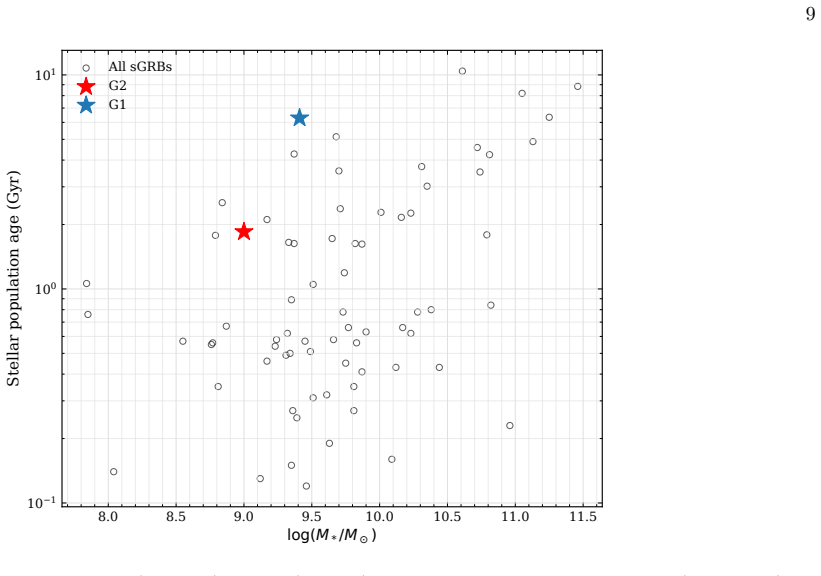
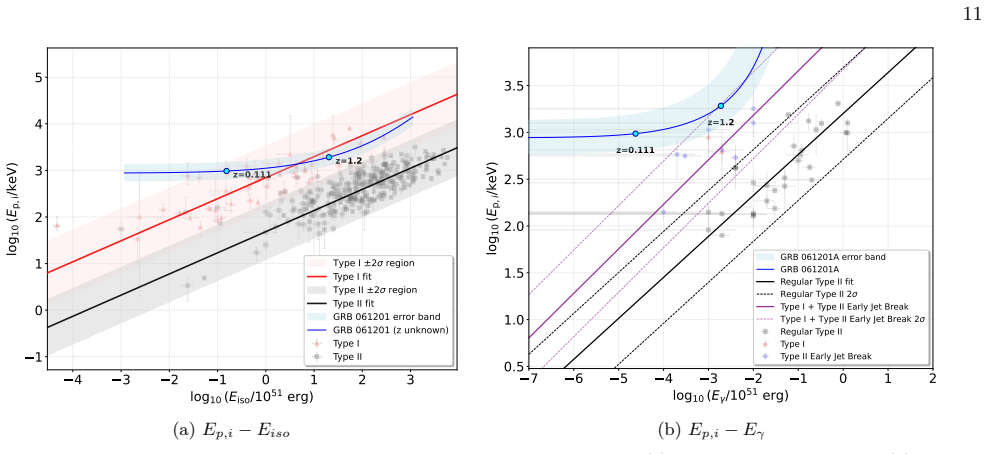
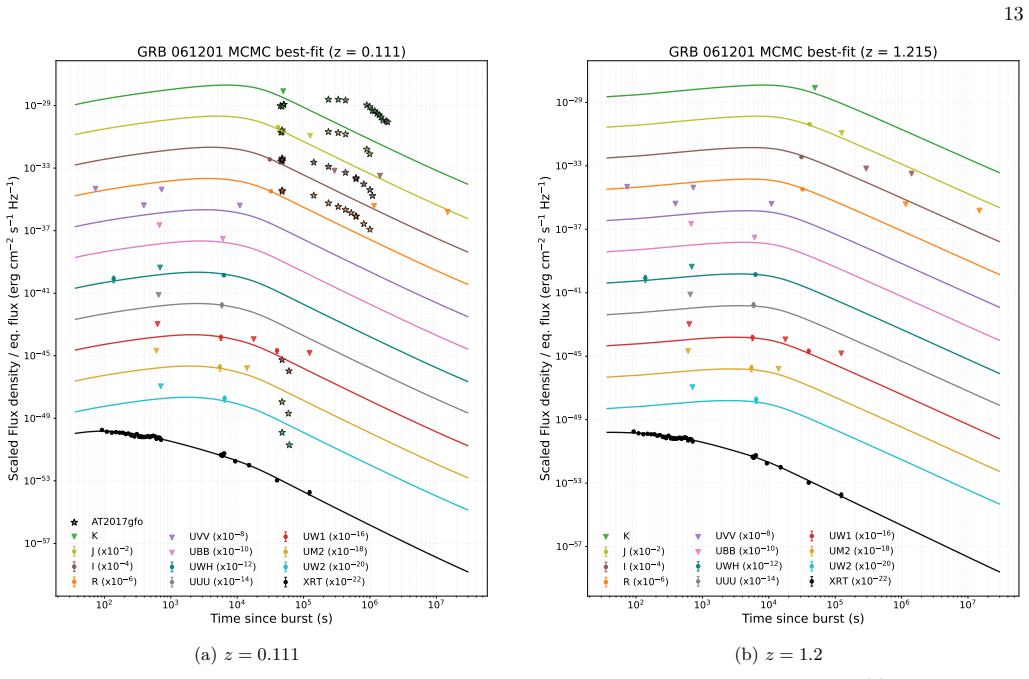
GRB 061201 originates from a moderately high-redshift host at z~1.2. This conclusion follows from three lines of evidence: the burst energy lies on the Amati relation at z=1.2 but is an outlier in the Ghirlanda relation at z=0.111; deep near-infrared data exclude a kilonova like AT2017gfo at the low redshift; and afterglow modeling yields Delta AIC = 16.35 favoring the high-redshift case. The new host candidate has P_cc = 0.18 yet is accepted given JWST depth, yields a physical offset of 16.4-16.9 kpc, and a stellar age of ~2 Gyr, both consistent with the short-GRB population.
What carries the argument
Photometric redshift fitting of a new galaxy candidate identified in deep JWST near-infrared images, cross-checked against afterglow model selection via AIC and kilonova non-detection limits.
If this is right
- At z=1.2 the burst energy is consistent with the Amati relation while at z=0.111 it violates the Ghirlanda relation for short GRBs.
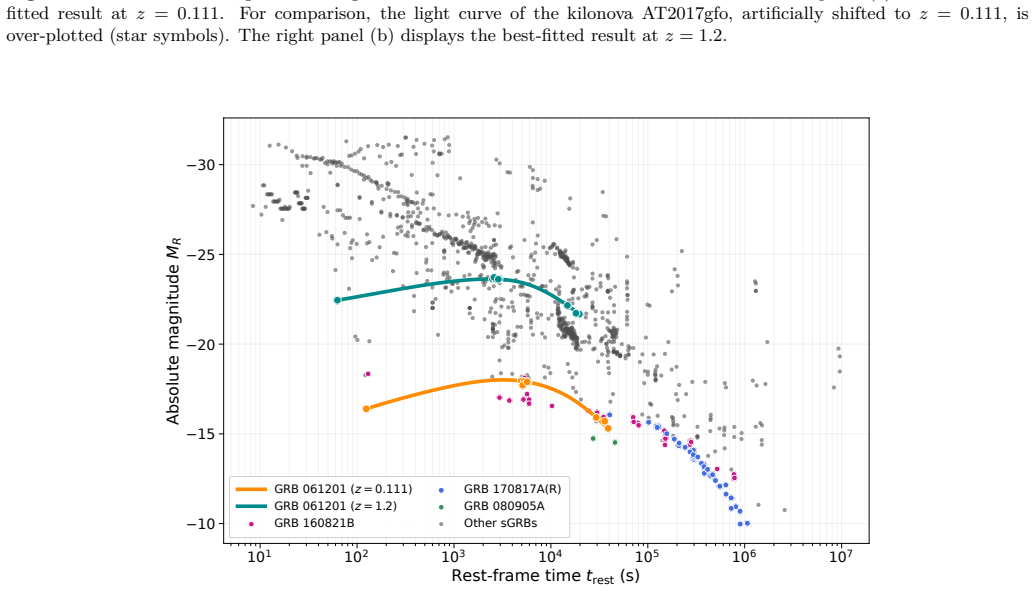
- The absence of a detectable kilonova rules out the low-redshift host under the observed depth.
- Afterglow modeling provides strong statistical preference (Delta AIC=16.35) for the high-redshift solution.
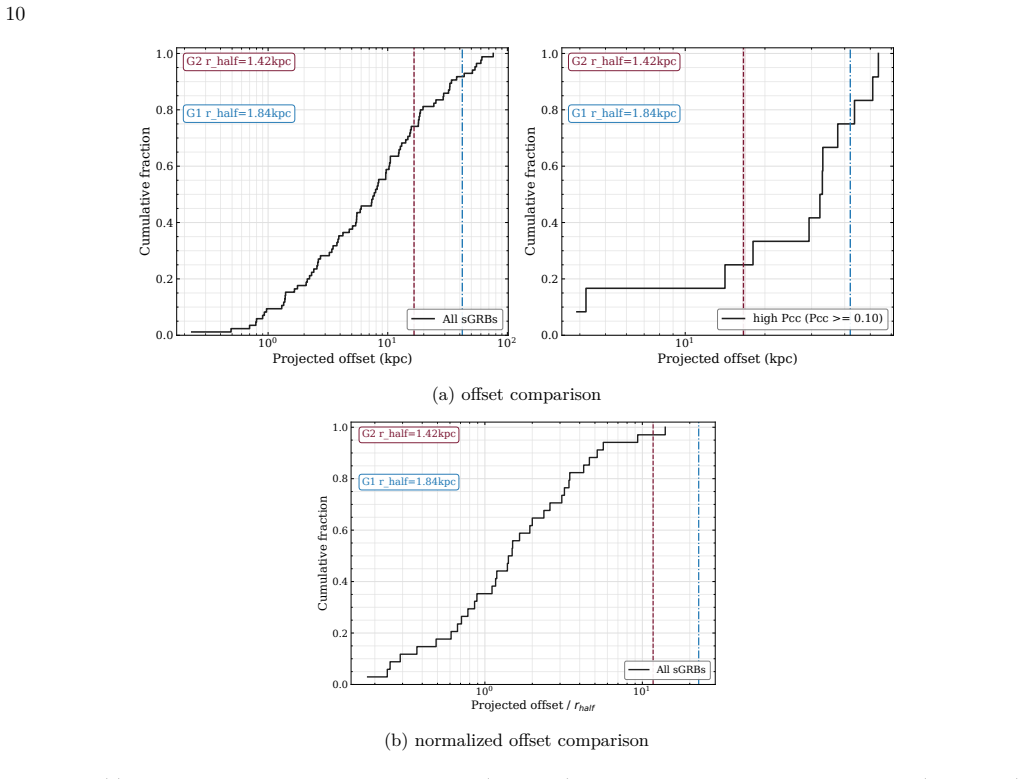
- The physical offset drops from ~42 kpc to 16.4-16.9 kpc and the host age of ~2 Gyr matches the short-GRB population.
- The implied binary neutron star merger rate falls from ~1400 Gpc^{-3} yr^{-1} to a value compatible with gravitational-wave constraints.
Where Pith is reading between the lines
- Spectroscopic follow-up of the candidate would provide the decisive test of association.
- The same depth strategy may assign hosts to other short GRBs currently listed as hostless.
- Some apparent outliers among short GRBs in energy relations could reflect incorrect low-redshift assignments.
Load-bearing premise
The new galaxy at 2 arcsec offset is the physical host of the burst even though its chance-coincidence probability of 0.18 exceeds the usual 0.1 threshold.
What would settle it
A spectroscopic redshift for the candidate galaxy that is inconsistent with z~1.2, or the detection of a kilonova light curve matching the luminosity expected at z=0.111.
Figures
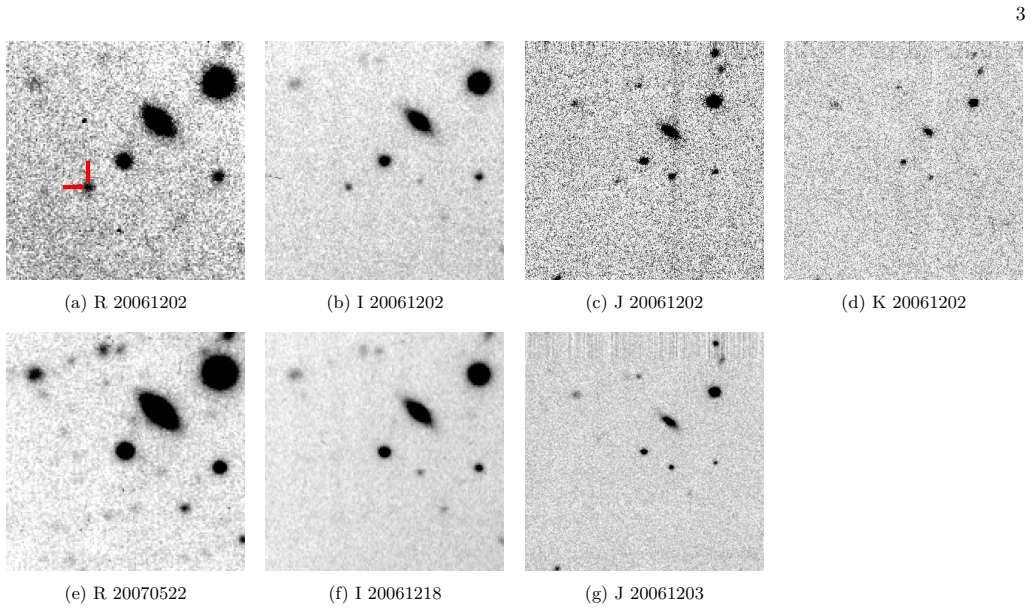
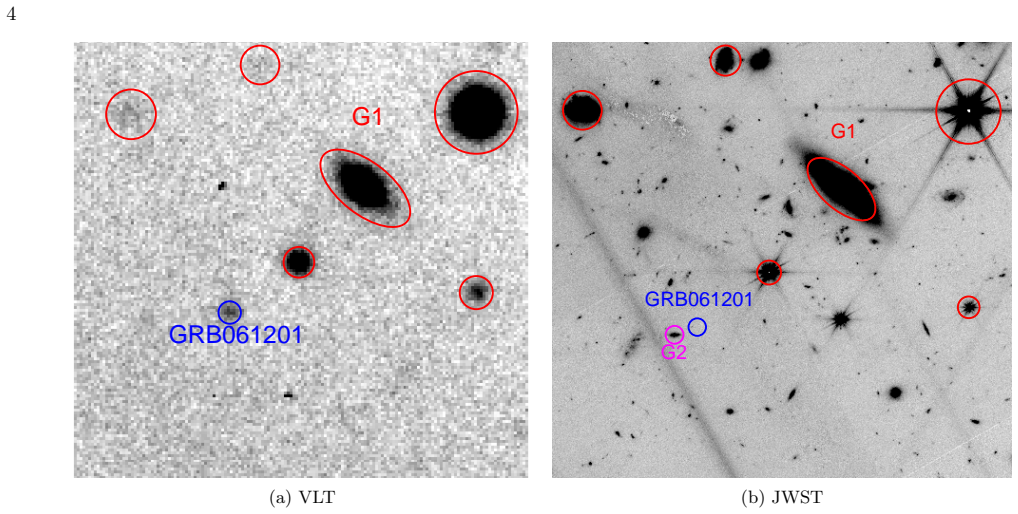
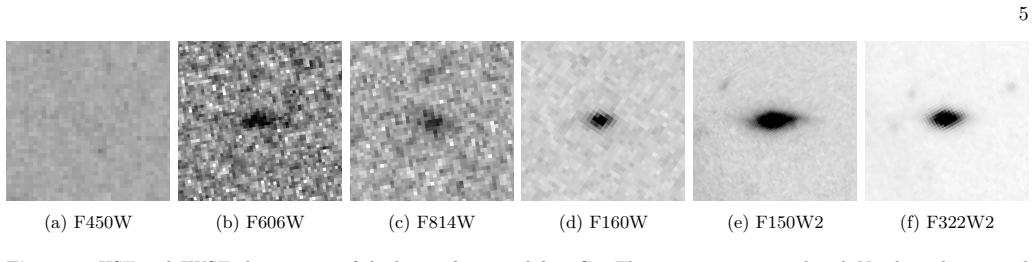
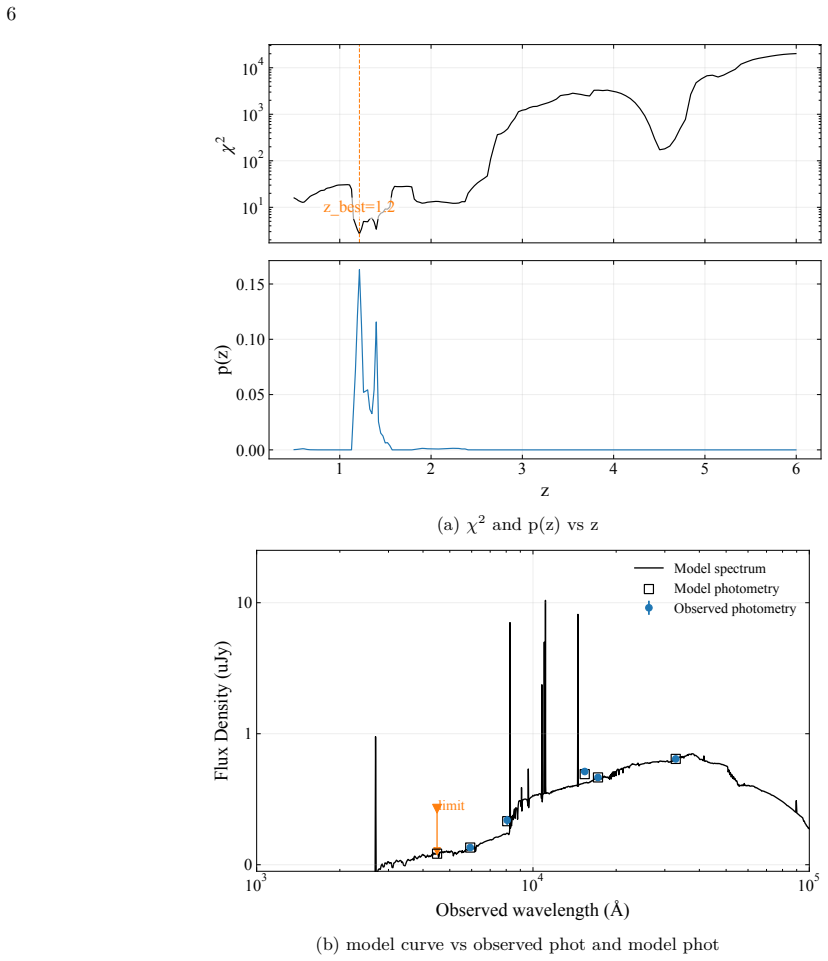
read the original abstract
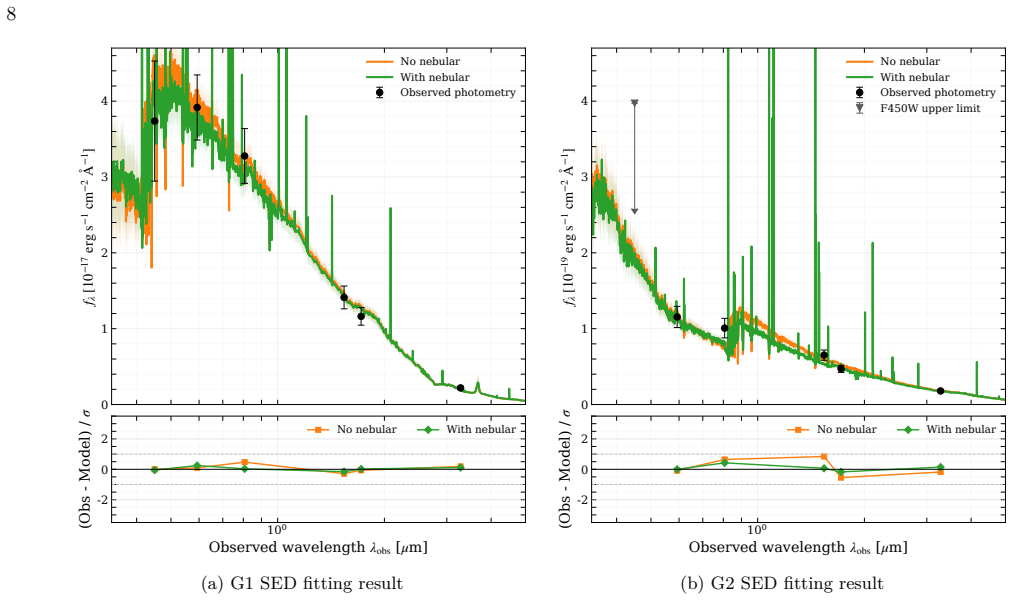
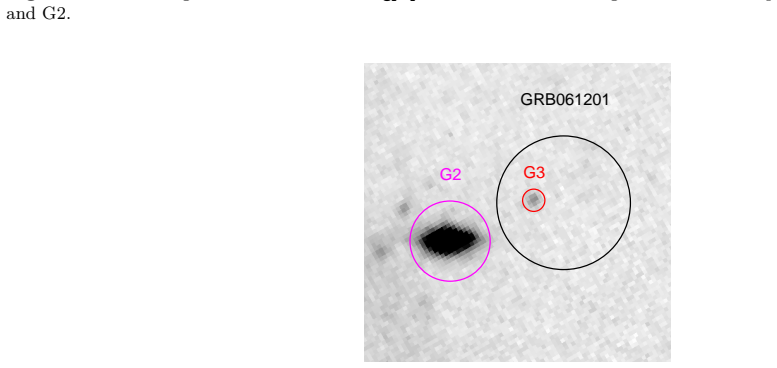
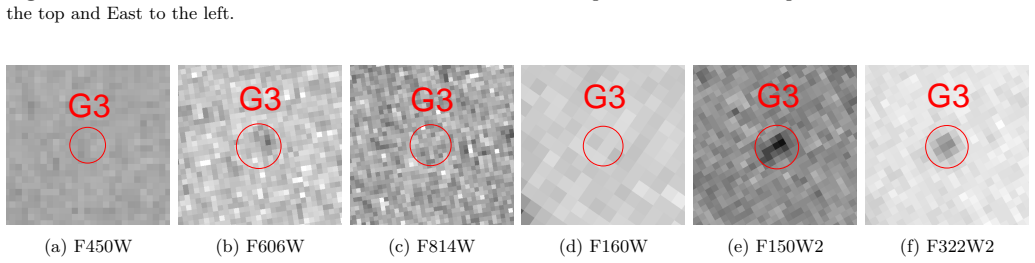
Using deep near-infrared and optical images from JWST and HST, we identify a new host galaxy candidate for GRB 061201. It lies ~2" from the optical afterglow position. Photometric redshift fitting yields z~1.2. We compare the previously proposed host at z=0.111 with the new candidate. The chance-coincidence probability is $P_{cc}=0.18$, above the classical threshold of 0.1 but consistent with a physical association given the extreme depth of JWST imaging. In contrast, evaluated with corresponding JWST observations, the previously claimed host has a lower $P_{cc}=0.11$, which is driven primarily by bright-tail statistics rather than a more plausible association. A high-z origin is favored by three independent lines of evidence. First, for the z=0.111 scenario, the beaming-corrected energy shows GRB 061201 is an outlier of the Ghirlanda ($E_{p,i}-E_\gamma$) relation for short GRBs, while for the z=1.2 scenario, it is well consistent with the Amati relation. Second, deep near-infrared observations rule out a kilonova similar to AT2017gfo at z=0.111. Third, afterglow modeling yields an AIC criterion of $\Delta$AIC=16.35, providing strong evidence for the high-redshift scenario. Assuming the host candidate is the actual host galaxy of GRB 061201, the physical offset is 16.4-16.9 kpc (substantially reduced from ~42 kpc) and the host stellar age is ~2 Gyr, which are consistent with the host population of short GRBs. A low-redshift origin would lead to a very high binary neutron star merger rate of ~1400 Gpc$^{-3}$ yr$^{-1}$, which is contradictory to the gravitational-wave constraint. We suggest that GRB 061201 originates from a moderately high-redshift (z~1.2) host, significantly alleviating this apparent merger rate discrepancy. This case demonstrates the power of deep JWST exposures in revealing the host galaxies of historically hostless GRBs.
Editorial analysis
A structured set of objections, weighed in public.
Referee Report
Summary. The paper reports deep JWST and HST imaging that identifies a new candidate host galaxy for short GRB 061201 at ~2 arcsec offset with photometric redshift z~1.2. It compares this to the previously proposed z=0.111 host, reports P_cc=0.18 (vs. 0.11 for the low-z candidate under JWST limits), and argues for the high-z association on the basis of consistency with the Amati relation, non-detection of a kilonova like AT2017gfo, and afterglow modeling with ΔAIC=16.35. Adopting the new host yields a physical offset of 16.4-16.9 kpc and host age ~2 Gyr, while a low-z origin would imply an unrealistically high BNS merger rate of ~1400 Gpc^{-3} yr^{-1}.
Significance. If the host association holds, the result would meaningfully reduce the apparent tension between short-GRB-inferred BNS merger rates and gravitational-wave constraints, while illustrating JWST's capability to resolve historically hostless events. The work also supplies concrete numbers (offsets, ages, rate implications) that could be tested with future observations or refined modeling.
major comments (3)
- [Abstract] Abstract: the association rests on P_cc=0.18 exceeding the classical 0.1 threshold; the justification is qualitative (extreme JWST depth) without a revised magnitude-dependent prior, updated threshold, or Bayesian posterior odds that fold in the photometric-redshift likelihood.
- [Abstract] Abstract: the reported ΔAIC=16.35 favoring the high-z afterglow model is presented without the explicit model parameterizations, number of free parameters, or the functional forms being compared, preventing assessment of whether the difference is driven by the redshift assumption itself.
- [Abstract] Abstract: the three supporting arguments (Ghirlanda/Amati consistency, kilonova non-detection, AIC) each presuppose a redshift value and therefore cannot independently validate the host identification; a quantitative test that does not condition on redshift (e.g., direct posterior odds) is needed.
minor comments (1)
- [Abstract] The abstract states P_cc=0.11 for the z=0.111 galaxy under JWST limits but does not clarify whether this uses the same magnitude limit or surface-density model as the new candidate.
Simulated Author's Rebuttal
We thank the referee for their careful review and constructive comments on our manuscript. We address each major comment point by point below, providing clarifications and indicating where revisions will be made to improve the presentation.
read point-by-point responses
-
Referee: [Abstract] Abstract: the association rests on P_cc=0.18 exceeding the classical 0.1 threshold; the justification is qualitative (extreme JWST depth) without a revised magnitude-dependent prior, updated threshold, or Bayesian posterior odds that fold in the photometric-redshift likelihood.
Authors: We agree that the justification for adopting P_cc=0.18 could be made more quantitative. In the revised manuscript we will add an explicit discussion of magnitude-dependent priors appropriate to JWST depths, together with a brief calculation of Bayesian posterior odds that incorporate the photometric-redshift likelihood for the new candidate. revision: yes
-
Referee: [Abstract] Abstract: the reported ΔAIC=16.35 favoring the high-z afterglow model is presented without the explicit model parameterizations, number of free parameters, or the functional forms being compared, preventing assessment of whether the difference is driven by the redshift assumption itself.
Authors: We acknowledge that the AIC comparison requires additional detail for full reproducibility. The revised manuscript will include the explicit functional forms of the afterglow models, the number of free parameters in each, and the precise parameterization of the redshift-dependent components so that readers can evaluate the origin of the ΔAIC value. revision: yes
-
Referee: [Abstract] Abstract: the three supporting arguments (Ghirlanda/Amati consistency, kilonova non-detection, AIC) each presuppose a redshift value and therefore cannot independently validate the host identification; a quantitative test that does not condition on redshift (e.g., direct posterior odds) is needed.
Authors: The AIC comparison is performed between two explicit afterglow models that differ in their assumed redshift; it therefore constitutes a direct, quantitative test that does not presuppose which redshift is correct. The Amati and kilonova arguments are presented as consistency checks once each redshift is assumed. We will clarify this distinction in the revised abstract and main text, but we maintain that the current set of tests already provides independent lines of evidence. revision: no
Circularity Check
No significant circularity; derivation relies on external relations and direct observations
full rationale
The paper's central claim (high-z host at z~1.2) rests on photometric redshift fitting from JWST/HST imaging, standard P_cc calculations, and consistency checks against external literature relations (Amati, Ghirlanda) plus afterglow model comparison via AIC and kilonova non-detection limits. These elements draw on independent data and published calibrations rather than reducing to self-referential fits, definitions, or self-citation chains within the manuscript. The qualitative discussion of the P_cc=0.18 threshold exceeding 0.1 does not create a definitional loop or force the result by construction. The derivation chain is self-contained against external benchmarks.
Axiom & Free-Parameter Ledger
free parameters (2)
- photometric redshift =
~1.2
- afterglow model parameters
axioms (2)
- standard math Standard flat Λ CDM cosmology for luminosity distances and physical offsets
- domain assumption The Amati and Ghirlanda relations apply to short GRBs and can be used to discriminate redshift scenarios
Reference graph
Works this paper leans on
-
[1]
, archivePrefix = "arXiv", eprint =
Abbott, B. P., Abbott, R., Abbott, T. D., et al. 2017, ApJL, 848, L12, doi: 10.3847/2041-8213/aa91c9
-
[2]
2002, A&A, 390, 81, doi: 10.1051/0004-6361:20020722 Astropy Collaboration, Robitaille, T
Amati, L., Frontera, F., Tavani, M., et al. 2002, A&A, 390, 81, doi: 10.1051/0004-6361:20020722 Astropy Collaboration, Robitaille, T. P., Tollerud, E. J., et al. 2013, A&A, 558, A33, doi: 10.1051/0004-6361/201322068 Astropy Collaboration, Price-Whelan, A. M., Sipőcz, B. M., et al. 2018, AJ, 156, 123, doi: 10.3847/1538-3881/aabc4f Astropy Collaboration, Pr...
-
[3]
2013, ApJ, 775, 18, doi: 10.1088/0004-637X/775/1/18
Barnes, J., & Kasen, D. 2013, ApJ, 775, 18, doi: 10.1088/0004-637X/775/1/18
-
[4]
D., Chincarini, G., Burrows, D
Barthelmy, S. D., Chincarini, G., Burrows, D. N., et al. 2005, Nature, 438, 994, doi: 10.1038/nature04392
-
[5]
Bennett, C. L., Larson, D., Weiland, J. L., & Hinshaw, G. 2014, ApJ, 794, 135, doi: 10.1088/0004-637X/794/2/135
-
[6]
2010, ApJ, 722, 1946, doi: 10.1088/0004-637X/722/2/1946
Berger, E. 2010, ApJ, 722, 1946, doi: 10.1088/0004-637X/722/2/1946
-
[7]
Bertin, E., & Arnouts, S. 1996, A&AS, 117, 393, doi: 10.1051/aas:1996164
-
[8]
Bloom, J. S., Kulkarni, S. R., & Djorgovski, S. G. 2002, AJ, 123, 1111, doi: 10.1086/338893
-
[9]
Bloom, J. S., Sigurdsson, S., & Pols, O. R. 1999, MNRAS, 305, 763, doi: 10.1046/j.1365-8711.1999.02437.x
-
[10]
Bloom, J. S., Perley, D. A., Chen, H.-W., et al. 2007, ApJ, 654, 878, doi: 10.1086/509114
-
[11]
EAZY: A Fast, Public Photometric Redshift Code
Brammer, G. B., van Dokkum, P. G., & Coppi, P. 2008, ApJ, 686, 1503, doi: 10.1086/591786
work page internal anchor Pith review doi:10.1086/591786 2008
-
[12]
P., & Anderson, D
Burnham, K. P., & Anderson, D. R. 2002, Model selection and multimodel inference: a practical information-theoretic approach (Springer)
2002
-
[13]
Carnall, A. C., McLure, R. J., Dunlop, J. S., & Davé, R. 2018, MNRAS, 480, 4379, doi: 10.1093/mnras/sty2169
work page internal anchor Pith review doi:10.1093/mnras/sty2169 2018
-
[14]
Cobb, B. E., & Bailyn, C. D. 2008, ApJ, 677, 1157, doi: 10.1086/533427
-
[15]
J., Berry, D
Currie, M. J., Berry, D. S., Jenness, T., et al. 2014, in Astronomical Society of the Pacific Conference Series, Vol. 485, Astronomical Data Analysis Software and Systems XXIII, ed. N. Manset & P. Forshay, 391
2014
-
[16]
G., De Simone, B., Mohideen Malik, R
Dainotti, M. G., De Simone, B., Mohideen Malik, R. F., et al. 2024, MNRAS, 533, 4023, doi: 10.1093/mnras/stae1484
-
[17]
Drout, M. R., Piro, A. L., Shappee, B. J., et al. 2017, Science, 358, 1570, doi: 10.1126/science.aaq0049
-
[18]
Eichler, D., Livio, M., Piran, T., & Schramm, D. N. 1989, Nature, 340, 126, doi: 10.1038/340126a0
-
[19]
Evans, P. A., Cenko, S. B., Kennea, J. A., et al. 2017, Science, 358, 1565, doi: 10.1126/science.aap9580
-
[20]
2013, ApJ, 776, 18, doi: 10.1088/0004-637X/776/1/18
Fong, W., & Berger, E. 2013, ApJ, 776, 18, doi: 10.1088/0004-637X/776/1/18
-
[21]
Fong, W., Berger, E., & Fox, D. B. 2010, ApJ, 708, 9, doi: 10.1088/0004-637X/708/1/9
-
[22]
Fong, W., Berger, E., Margutti, R., & Zauderer, B. A. 2015, ApJ, 815, 102, doi: 10.1088/0004-637X/815/2/102
-
[23]
Fong, W.-f., Nugent, A. E., Dong, Y., et al. 2022, ApJ, 940, 56, doi: 10.3847/1538-4357/ac91d0
-
[24]
Foreman-Mackey, D., Hogg, D. W., Lang, D., & Goodman, J. 2013, PASP, 125, 306, doi: 10.1086/670067
-
[25]
2004, ApJ, 616, 331, doi: 10.1086/424913
Ghirlanda, G., Ghisellini, G., & Lazzati, D. 2004, ApJ, 616, 331, doi: 10.1086/424913
-
[26]
Nature , year = 2020, volume = 585, pages =
Harris, C. R., Millman, K. J., van der Walt, S. J., et al. 2020, Nature, 585, 357, doi: 10.1038/s41586-020-2649-2
-
[27]
Holtzman, J. A., Hester, J. J., Casertano, S., et al. 1995, PASP, 107, 156, doi: 10.1086/133533
-
[28]
Hunter, J. D. 2007, Computing in Science and Engineering, 9, 90, doi: 10.1109/MCSE.2007.55
-
[29]
Jin, Z.-P., Wang, Y.-Z., Li, Y.-J., et al. 2026, Neutron Star Merger Rates from Multi-messenger Observations: Clues to the Physical Origin of the Short and Long-short Gamma-ray Bursts, doi: 10.48550/arXiv.2604.06772 16
work page internal anchor Pith review Pith/arXiv arXiv doi:10.48550/arxiv.2604.06772 2026
-
[30]
2018, ApJ, 857, 128, doi: 10.3847/1538-4357/aab76d
Jin, Z.-P., Li, X., Wang, H., et al. 2018, ApJ, 857, 128, doi: 10.3847/1538-4357/aab76d
-
[31]
A., & Mandel, E
Joye, W. A., & Mandel, E. 2003, in Astronomical Society of the Pacific Conference Series, Vol. 295, Astronomical Data Analysis Software and Systems XII, ed. H. E
2003
-
[32]
Kasliwal, M. M., Nakar, E., Singer, L. P., et al. 2017, Science, 358, 1559, doi: 10.1126/science.aap9455
-
[33]
Townsend, J. A. 2008, in Society of Photo-Optical Instrumentation Engineers (SPIE) Conference Series, Vol. 7010, Space Telescopes and Instrumentation 2008:
2008
-
[34]
Optical, Infrared, and Millimeter, ed. J. M. Oschmann, Jr., M. W. M. de Graauw, & H. A. MacEwen, 70101E, doi: 10.1117/12.789581
-
[35]
, year = 1973, month = jun, volume =
Klebesadel, R. W., Strong, I. B., & Olson, R. A. 1973, ApJL, 182, L85, doi: 10.1086/181225
-
[36]
The Physics of Gamma-Ray Bursts and Relativistic Jets
Kumar, P., & Zhang, B. 2015, PhR, 561, 1, doi: 10.1016/j.physrep.2014.09.008
work page internal anchor Pith review doi:10.1016/j.physrep.2014.09.008 2015
-
[37]
1998, ApJL, 507, L59, doi: 10.1086/311680
Li, L.-X., & Paczyński, B. 1998, ApJL, 507, L59, doi: 10.1086/311680
-
[38]
E., Perri, M., Stratta, G., et al
Marshall, F. E., Perri, M., Stratta, G., et al. 2006, Swift Observations of the Short/Hard Burst GRB 061201„ GCN Report 18.1 https://gcn.nasa.gov/reports/report_18_1.pdf
2006
-
[39]
, archivePrefix = "arXiv", eprint =
Metzger, B. D., Martínez-Pinedo, G., Darbha, S., et al. 2010, MNRAS, 406, 2650, doi: 10.1111/j.1365-2966.2010.16864.x
-
[40]
1992, ApJL, 395, L83, doi: 10.1086/186493
Narayan, R., Paczynski, B., & Piran, T. 1992, ApJL, 395, L83, doi: 10.1086/186493 Nicuesa Guelbenzu, A. M., Klose, S., Schady, P., et al. 2021, ApJ, 923, 38, doi: 10.3847/1538-4357/ac2faa
-
[41]
E., Fong, W.-F., Dong, Y., et al
Nugent, A. E., Fong, W.-F., Dong, Y., et al. 2022, ApJ, 940, 57, doi: 10.3847/1538-4357/ac91d1 O’Connor, B., Troja, E., Dichiara, S., et al. 2022, MNRAS, 515, 4890, doi: 10.1093/mnras/stac1982
-
[42]
Pian, E., D’A vanzo, P., Benetti, S., et al. 2017, Nature, 551, 67, doi: 10.1038/nature24298
-
[43]
Rieke, M. J., Kelly, D. M., Misselt, K., et al. 2023, PASP, 135, 028001, doi: 10.1088/1538-3873/acac53
-
[44]
, archivePrefix = "arXiv", eprint =
Rowlinson, A., Wiersema, K., Levan, A. J., et al. 2010, MNRAS, 408, 383, doi: 10.1111/j.1365-2966.2010.17115.x
-
[45]
, archivePrefix = "arXiv", eprint =
Salvaterra, R., Devecchi, B., Colpi, M., & D’A vanzo, P. 2010, MNRAS, 406, 1248, doi: 10.1111/j.1365-2966.2010.16752.x
-
[46]
Schlafly, E. F., & Finkbeiner, D. P. 2011, ApJ, 737, 103, doi: 10.1088/0004-637X/737/2/103
work page internal anchor Pith review doi:10.1088/0004-637x/737/2/103 2011
-
[47]
Sirianni, M., Jee, M. J., Benítez, N., et al. 2005, PASP, 117, 1049, doi: 10.1086/444553
-
[48]
J., Chen, T.-W., Jerkstrand, A., et al
Smartt, S. J., Chen, T.-W., Jerkstrand, A., et al. 2017, Nature, 551, 75, doi: 10.1038/nature24303
-
[49]
2007, A&A, 474, 827, doi: 10.1051/0004-6361:20078006
Stratta, G., D’A vanzo, P., Piranomonte, S., et al. 2007, A&A, 474, 827, doi: 10.1051/0004-6361:20078006
-
[50]
Tanvir, N. R., Levan, A. J., González-Fernández, C., et al. 2017, ApJL, 848, L27, doi: 10.3847/2041-8213/aa90b6
-
[51]
Villar, V. A., Guillochon, J., Berger, E., et al. 2017, ApJL, 851, L21, doi: 10.3847/2041-8213/aa9c84
-
[52]
Virtanen, P., Gommers, R., Oliphant, T. E., et al. 2020, Nature Medicine, 17, 261, doi: 10.1038/s41592-019-0686-2
-
[53]
Wang, Y., Chen, C., & Zhang, B. 2026, Journal of High Energy Astrophysics, 50, 100490, doi: 10.1016/j.jheap.2025.100490
discussion (0)
Sign in with ORCID, Apple, or X to comment. Anyone can read and Pith papers without signing in.