REVIEW 4 major objections 5 minor 1 cited by
Transformer-based detector spots falsified platoon data in under a millisecond.
Reviewed by Pith at T0; open to challenge. T0 means a machine referee read the full paper against a public rubric. the ladder, T0–T4 →
T0 review · deepseek-v4-flash
2026-08-03 15:45 UTC pith:BUMMYWMW
load-bearing objection Useful edge-deployment study for transformer-based platoon misbehavior detection, but the headline AUC/F1 numbers likely rest on temporal leakage from a non-causal attention mask; the real-time claim needs a re-run with causal masking or last-position scoring. the 4 major comments →
Attention in Motion: Secure Platooning via Transformer-based Misbehavior Detection
The pith
A machine-rendered reading of the paper's core claim, the machinery that carries it, and where it could break.
Core claim
The central claim is that a transformer encoder, augmented with a global positional encoding that uses vehicle-specific time offsets, can jointly learn intra-vehicle temporal dynamics and inter-vehicle spatial correlations from a window of Cooperative Awareness Messages, and thereby detect kinematic falsification attacks with AUC 96–99% across PATH, Ploeg, Consensus, and Flatbed controllers. The paper introduces a loss function (PFBCE) that penalizes false positives more than false negatives, which is argued to be the right error asymmetry for safety-critical platooning. The key quantitative result is sub-millisecond inference on edge hardware after integer quantization, with a minimal accur
What carries the argument
The central object is a transformer encoder whose self-attention operates over a sequence of kinematic observations (position, velocity, acceleration) from one or more vehicles. Two input reshapings are explored: one processes each vehicle's time series independently (B·V), and one concatenates vehicles and time into a single sequence (V·T) so attention can capture cross-vehicle coordination. The second is claimed to improve precision and enable attack localization. Global positional encoding with per-vehicle temporal offsets aligns asynchronous entry/exit times. A custom loss, PFBCE, applies a multiplicative penalty to confident false positives while upweighting positive samples, decoupling
Load-bearing premise
The evaluation assumes that SUMO-generated mobility traces with the paper's sensor-error and attack-injection models are representative enough that a model trained on them will detect real-world falsified CAMs on actual platoons.
What would settle it
Run the trained AIMFORMER (especially the V·T global variant) on a real testbed with CACC-equipped vehicles, genuine sensor noise, and a known attacker broadcasting constant-offset speed or position falsifications; if the per-vehicle AUC falls below roughly 0.8 or the false-alarm rate disrupts normal join/exit maneuvers, the claimed simulation-to-deployment transfer fails.
If this is right
- If the AUC and latency claims hold in practice, a single quantized transformer can screen every CAM in real time on current embedded hardware, leaving a large margin under the typical 100 ms V2X safety budget.
- The V·T variant's higher precision suggests that platoon-wide observations at a roadside unit could reduce false alerts that would otherwise disrupt legitimate join and exit maneuvers.
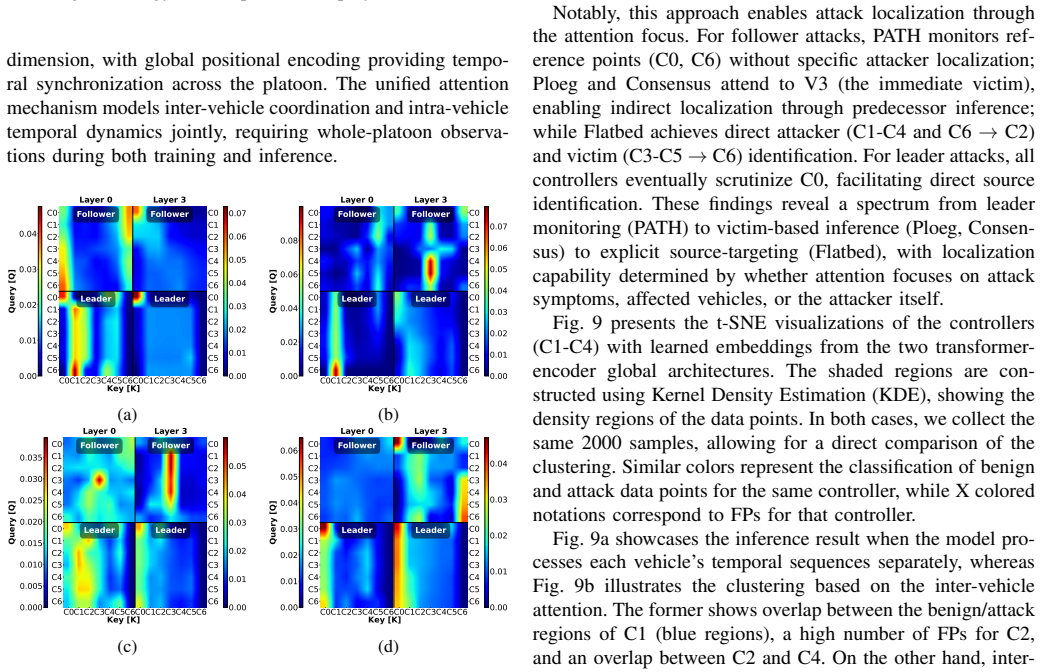
- Attention-weight analysis across controllers shows distinct monitoring patterns (leader-focused for PATH, victim-focused for Ploeg/Consensus, attacker-focused for Flatbed), implying the model may double as an attacker-localization tool, not just a binary alarm.
- The global model's performance parity with per-vehicle models, per the paper's PG analysis, means a single roadside unit could serve heterogeneous platoons without per-controller retraining, provided the training data covers the controller types.
Where Pith is reading between the lines
- A plausible extension is to use the attention maps as a 'misbehavior localization' output: the same forward pass that flags an attack could also point to the most suspicious vehicle, which would make incident response faster—though the paper only hints at this via attention visualization, not a formal localization metric.
- The PFBCE loss's decoupled false-positive penalty is a generic idea; it could be transferred to other safety-critical anomaly detection tasks (e.g., intrusion detection in CAN bus or industrial control) where false alarms are costlier than missed events.
- The paper compares against a single-window Transformer and recurrent baselines, but does not test a temporal-convolutional or state-space model; a natural next experiment is to see whether the attention mechanism's advantage persists against such modern sequence models on the same data.
- The simulation-to-reality gap is the main risk: the reported numbers are on SUMO traces with a specific sensor-error model. A field test with real CACC platoons and realistic GPS/IMU noise would likely show lower AUC; the magnitude of that drop determines whether the sub-millisecond advantage still makes AIMFORMER the preferred choice.
Editorial analysis
A structured set of objections, weighed in public.
Referee Report
Summary. The paper proposes AIMformer, a transformer-encoder-based misbehavior detection framework for vehicular platoons. Inputs are 10-message windows of kinematic data from one or more vehicles; global positional encoding with vehicle-specific temporal offsets is used, and a Precision-Focused BCE (PFBCE) loss penalizes false positives. The authors evaluate against LSTM/BiLSTM/GRU/CNN/CNN-LSTM/MLP/Transformer baselines on simulated SUMO CACC traces under 4 controllers and multiple falsification attacks, reporting F1 >= 0.93 and AUC 96-99%, and measure sub-millisecond inference after TFLite/ONNX/TensorRT optimization on a Jetson platform. A spatio-temporal variant (V*T reshaping) is also presented in Section V-D.
Significance. If the reported numbers withstand scrutiny, the contribution is meaningful: a platoon-specific transformer MDS with an explicit precision-focused loss and a concrete edge-deployment analysis, including quantization, latency, and energy on representative hardware. The breadth of controllers, maneuvers, attack vectors, and baseline architectures is a strength, as is the inclusion of deployment measurements. However, the paper's central real-time claim currently rests on an evaluation setup that appears to allow future context, and the main architecture does not actually perform cross-vehicle attention. The contributions are plausible but need re-evaluation before the results can be accepted at face value.
major comments (4)
- [Section IV-B, Eqs. (11)-(13); Section IV-A step 2] The masking strategy defines M_causal in Eq. (12) but then sets M = M_pad in Eq. (13); the causal mask is never applied. Self-attention in Eq. (10) is therefore bidirectional over the 10-message window. Since the model outputs predictions for every timestep (Eq. 20) and loss/metrics aggregate over all valid positions (Eqs. 21 and 26), each CAM receives predictions from up to ten overlapping windows, nine of which include future CAMs as context. This contradicts the 'inference after each disseminated CAM' claim and would inflate the reported AUC/F1 values. Please re-run the evaluation with a causal mask, or by scoring only the last position of each window, and compare the resulting metrics.
- [Section IV-B, Eqs. (5)-(10); Section V-D] The base AIMformer reshapes input to B*V x T x F and applies self-attention over T independently for each vehicle; no cross-vehicle attention occurs. Inter-vehicle 'spatio-temporal' modeling is introduced only in Section V-D by reshaping to B x (V*T) x F, presented as an optional variant and evaluated with limited metrics. The abstract and conclusion nonetheless state that AIMformer 'simultaneously captures' intra-vehicle and inter-vehicle correlations. This overstates the main architecture. Either reposition the claims or move the V*T variant into the core evaluation with full metrics.
- [Section V, Tables III-VII and Figs. 3-10] All reported metrics are single point estimates from a private SUMO-based pipeline; no code, data, or trained models are released, and no confidence intervals or seed variance are given. Since the attack and sensor models come from prior work [7] and are not publicly documented in full here, the external validity of the AUC/F1 values cannot be assessed. At minimum, provide multi-seed statistics and a reproducibility statement; ideally release data and code. Also clarify Section IV-A step 4's 'iterative refinement'—if any refinement used the test set, the metrics are not honest test-set numbers.
- [Section IV-C, Table VI] The baseline Transformer is much smaller than AIMformer (0.4 MB vs 6.2 MB individual; 1.6 MB vs 12.3 MB global) and PFBCE is applied only to AIMformer. It is not clear whether all baselines received the same hyperparameter tuning and the same loss configuration. If PFBCE, windowing, or tuning are used only for AIMformer, the claimed 'superior performance' may partly reflect loss/tuning differences rather than the architecture. Please clarify the training protocol for baselines and ideally include an ablation where AIMformer's loss is replaced by standard BCE.
minor comments (5)
- [Eq. (26)] The TP/FP/FN/TN formulas are written as sums over i only, but the mask term m_{i,j} involves both i and j; they should be double sums over (i,j).
- [Section IV-C] The phrase 'increasing attack threshold (0.5 -> 0.6)' is ambiguous: the PFBCE tau in Eq. (23) is the FP penalty threshold, not the final classification threshold. Please clarify what threshold was changed and how final decisions are made.
- [Section V-D] The V*T variant is reported only as an F1 heatmap in Fig. 10. For a complete comparison, include AUC, precision/recall, and inference latency for the V*T model as well.
- [Fig. 5] On the logarithmic y-axis the TFLite values (0.13-0.26 ms) are nearly invisible; annotate the bars directly or use a table for the small-latency regime.
- [References] Reference [38] is a non-archival blog post; replace it with a scholarly source for batch size/hyperparameter choices. Several related-work citations (e.g., [13], [31]) could also be updated to archival versions where available.
Circularity Check
No circular derivation: AIMFORMER's reported results are held-out empirical evaluations, not quantities forced by construction or by self-citation.
full rationale
The paper contains no formal derivation chain in which a predicted quantity reduces to an input by construction. The model is trained on labeled windows and evaluated on a held-out test split; hyperparameters (λFP, λpos, τ, encoder depth, dropout, learning rate) are tuned on validation via Keras Tuner, which is standard practice and does not make the test-set AUC/F1 a re-statement of the fit. The only substantive reliance on the authors' own prior work is [7] for the simulation, sensor-error, and attack models, and [5] as the prior transformer detector: Section IV-A states the mobility features 'are sourced from ego-vehicle sensors, each with its own sensor errors (as described in [7])', and Section III-B bases the nine attack types on [7]. This makes the benchmark self-supplied rather than externally validated, but it is not circular: the detector's outputs are not defined in terms of those prior results, and the paper itself flags the limitation in Section VI ('Our simulation-based evaluation could improve through real-world mobility testbed validation'). The non-causal mask M=M_pad (Eq. 13), with M_causal defined but unused, is a genuine temporal-leakage/correctness concern for the real-time claim, but it is not a circularity of the derivation. No quoted step exhibits Eq. X = Eq. Y by construction or a fitted parameter renamed as a prediction, so no circular step is reportable.
Axiom & Free-Parameter Ledger
free parameters (5)
- PFBCE false-positive penalty weight λFP =
1.7
- PFBCE positive-class weight λpos =
0.6
- PFBCE FP threshold τ =
0.6
- Architecture hyperparameters (hidden dim, heads, encoder blocks, dropout, learning rate) =
128, 2 heads, 4 blocks (global) / 2 blocks (individual), dropout 0.1, lr 1e-4
- Window length and step =
10 messages, 100 ms step
axioms (4)
- domain assumption SUMO/CACC mobility traces with sensor errors from [7] faithfully represent real platoon kinematics and attack-induced dynamics.
- domain assumption Attack labels and masks (Eq. 11) correctly define ground truth per timestep.
- standard math Standard transformer encoder building blocks (scaled dot-product attention, residual connections, LayerNorm, FFN) behave as specified in the literature.
- domain assumption Train/validation/test splits of windowed sequences are free of temporal leakage.
read the original abstract
Vehicular platooning promises transformative improvements in transportation efficiency and safety through the coordination of multi-vehicle formations enabled by Vehicle-to-Everything (V2X) communication. However, the distributed nature of platoon coordination creates security vulnerabilities, allowing authenticated vehicles to inject falsified kinematic data, compromise operational stability, and pose a threat to passenger safety. Traditional misbehaviour detection approaches, which rely on plausibility checks and statistical methods, suffer from high False Positive (FP) rates and cannot capture the complex temporal dependencies inherent in multi-vehicle coordination dynamics. We present Attention In Motion (AIMformer), a transformer-based framework specifically tailored for real-time misbehaviour detection in vehicular platoons with edge deployment capabilities. AIMformer leverages multi-head self-attention mechanisms to capture intra-vehicle temporal dynamics, with a spatio-temporal variant that further models inter-vehicle spatial correlations. It incorporates global positional encoding with vehicle-specific temporal offsets to handle join/exit maneuvers. We propose a Precision-Focused Binary Cross-Entropy (PFBCE) loss function that penalizes FPs to meet the requirements of safety-critical vehicular systems. Extensive evaluation across 4 platoon controllers, multiple attack vectors, and diverse mobility scenarios demonstrates superior performance ($\geq$ 0.93) compared to state-of-the-art baseline architectures. A comprehensive deployment analysis utilizing TensorFlow Lite (TFLite), Open Neural Network Exchange (ONNX), and TensorRT achieves sub-millisecond inference latency, making it suitable for real-time operation on resource-constrained edge platforms. Hence, validating AIMformer is viable for both in-vehicle and roadside deployment.
Figures




Forward citations
Cited by 1 Pith paper
-
PAMPOS: Causal Transformer-based Trajectory Prediction for Attack-Agnostic Misbehavior Detection in V2X Networks
PAMPOS detects unseen attacks in V2X networks by training a causal transformer on benign trajectories and identifying misbehavior as deviations from predicted kinematics.
Reference graph
Works this paper leans on
-
[1]
Secure Vehicular Communication Systems: Design and Architecture,
P. Papadimitratoset al., “Secure Vehicular Communication Systems: Design and Architecture,”IEEE Comm. Mag., Nov. 2008
2008
-
[2]
Platoon management with cooperative adaptive cruise control enabled by vanet,
Amoozadeh et al., “Platoon management with cooperative adaptive cruise control enabled by vanet,”Vehicular Communications, 2015. [Online]. Available: https://www.sciencedirect.com/science/article/pii/ S2214209615000145
2015
-
[3]
Security Vulnerabilities of Connected Vehicle Streams and Their Impact on Cooperative Driving,
——, “Security Vulnerabilities of Connected Vehicle Streams and Their Impact on Cooperative Driving,”IEEE Comm. Mag., Jun. 2015
2015
-
[4]
Prime: Platoon restructuring for incident mitigation and exclusion,
K. Kalogiannis, M. Hartmann, and P. Papadimitratos, “Prime: Platoon restructuring for incident mitigation and exclusion,” inInternational Conference on Wireless and Mobile Computing, Networking and Com- munications (WiMob), 2024
2024
-
[5]
Atten- tionGuard: Transformer-based Misbehavior Detection for Secure Vehic- ular Platoons,
H. Li, K. Kalogiannis, A. M. Hussain, and P. Papadimitratos, “Atten- tionGuard: Transformer-based Misbehavior Detection for Secure Vehic- ular Platoons,” inACM Workshop on Wireless Security and Machine Learning (WiseML), 2025
2025
-
[6]
Beyond the Attack: Strategies for Attack Endgame Mitigation in V ANETs,
M. A. Abdelmaguid, H. S. Hassanein, and M. Zulkernine, “Beyond the Attack: Strategies for Attack Endgame Mitigation in V ANETs,”IEEE TVT, 2025
2025
-
[7]
Attack impact and misbehavior detection in vehicular platoons,
K. Kalogiannis, M. Khodaei, W. M. N. M. Bayaa, and P. Papadimitratos, “Attack impact and misbehavior detection in vehicular platoons,” in Proceedings of the 15th ACM Conference on Security and Privacy in Wireless and Mobile Networks, 2022
2022
-
[8]
Analyzing Attacks on Cooperative Adaptive Cruise Control (CACC),
Heijden et al., “Analyzing Attacks on Cooperative Adaptive Cruise Control (CACC),” inIEEE VNC, Torino, Italy, Nov. 2017
2017
-
[9]
On the Performance of Secure Vehicular Commu- nication Systems,
Calandriello et al., “On the Performance of Secure Vehicular Commu- nication Systems,”IEEE TDSC, November 2011
2011
-
[10]
SECMACE: Scalable and Robust Identity and Credential Management Infrastructure in Vehicular Communication Sys- tems,
M. Khodaeiet al., “SECMACE: Scalable and Robust Identity and Credential Management Infrastructure in Vehicular Communication Sys- tems,”IEEE T-ITS, May 2018
2018
-
[11]
Scalable & Resilient Vehicle-Centric Certificate Revocation List Distribution in Vehicular Communication Systems,
M. Khodaei and P. Papadimitratos, “Scalable & Resilient Vehicle-Centric Certificate Revocation List Distribution in Vehicular Communication Systems,”IEEE TMC, 2021
2021
-
[12]
Machine learning approach for multiple misbehavior de- tection in vanet,
Grover et al., “Machine learning approach for multiple misbehavior de- tection in vanet,” inInternational conference on advances in computing and communications. Springer, 2011
2011
-
[13]
Advancing Intrusion Detection in V2X Networks: A Comprehensive Survey on Machine Learning, Federated Learning, and Edge AI for V2X Security,
S. A. Abdel Hakeem and H. Kim, “Advancing Intrusion Detection in V2X Networks: A Comprehensive Survey on Machine Learning, Federated Learning, and Edge AI for V2X Security,”IEEE T-ITS, 2025
2025
-
[14]
Investigating attacks on vehicular platooning and cooperative adaptive cruise control,
K. Kalogiannis, “Investigating attacks on vehicular platooning and cooperative adaptive cruise control,” 2020
2020
-
[15]
Vulnerability analysis of vehicular coordinated maneuvers,
K. Kalogiannis, A. Henriksson, and P. Papadimitratos, “Vulnerability analysis of vehicular coordinated maneuvers,” inIEEE EuroS&PW, 2023
2023
-
[16]
Replace: Real-time security assurance in vehicular platoons against v2v attacks,
Boddupalli et al., “Replace: Real-time security assurance in vehicular platoons against v2v attacks,” inIEEE ITSC, 2021
2021
-
[17]
Redem: Real-time detection and mitigation of communication attacks in connected autonomous vehicle applications,
S. Boddupalli and S. Ray, “Redem: Real-time detection and mitigation of communication attacks in connected autonomous vehicle applications,” inIFIP international Internet of Things conference. Springer, 2019
2019
-
[18]
Secure platooning control of automated vehicles under cyber attacks,
E. Mousavinejad and L. Vlacic, “Secure platooning control of automated vehicles under cyber attacks,”ISA transactions, 2022
2022
-
[19]
Deep-learning-based intrusion detection for autonomous vehicle-following systems,
Wang et al., “Deep-learning-based intrusion detection for autonomous vehicle-following systems,” inIEEE ITSC, 2021
2021
-
[20]
An approach to detecting malicious information attacks for platoon safety,
B. Ko and S. H. Son, “An approach to detecting malicious information attacks for platoon safety,”IEEE Access, 2021
2021
-
[21]
Attention is all you need,
Vaswani et al., “Attention is all you need,”Advances in neural informa- tion processing systems, 2017
2017
-
[22]
The architectural implications of autonomous driving: Constraints and acceleration,
Lin et al., “The architectural implications of autonomous driving: Constraints and acceleration,” ser. ASPLOS ’18. New York, NY , USA: Association for Computing Machinery, 2018. [Online]. Available: https://doi.org/10.1145/3173162.3173191
arXiv 2018
-
[23]
Mobile edge intelligence and computing for the Internet of Vehicles,
J. Zhang and K. B. Letaief, “Mobile edge intelligence and computing for the Internet of Vehicles,”Proceedings of the IEEE, 2020
2020
-
[24]
Platoon vulnerability due to network topology and targeted vehicle,
C. Hendrix and G. Bloom, “Platoon vulnerability due to network topology and targeted vehicle,” inIEEE CCNC, 2024
2024
-
[25]
A systematic literature review on distributed machine learning in edge computing,
Filho et al., “A systematic literature review on distributed machine learning in edge computing,”Sensors, 2022
2022
-
[26]
Machine learning at the network edge: A survey,
Murshed et al., “Machine learning at the network edge: A survey,”ACM Comput. Surv., Oct. 2021. [Online]. Available: https://doi.org/10.1145/3469029
doi:10.1145/3469029 2021
-
[27]
Jamming Detection in IoT Wireless Networks: An Edge-AI based Approach,
A. Hussain, N. Abughanam, J. Qadir, and A. Mohamed, “Jamming Detection in IoT Wireless Networks: An Edge-AI based Approach,” inProceedings of the 12th International Conference on the Internet of Things (IoT), 2022
2022
-
[28]
Edge AI- based Radio Frequency Fingerprinting for IoT Networks,
A. M. Hussain, N. Abughanam, and P. Papadimitratos, “Edge AI- based Radio Frequency Fingerprinting for IoT Networks,”arXiv preprint arXiv:2412.10553, 2024
Pith/arXiv arXiv 2024
-
[29]
Towards a Lightweight Edge AI-based Radio Frequency Fingerprinting,
A. Hussain, N. Abughanam, and P. Papadimitratos, “Towards a Lightweight Edge AI-based Radio Frequency Fingerprinting,” inInter- national Wireless Communications and Mobile Computing (IWCMC), Abu Dhabi, United Arab Emirates, May 2025
2025
-
[30]
Vehicular Communication Systems: Enabling Technologies, Applications, and Future Outlook on Intelligent Trans- portation,
Papadimitratos et al., “Vehicular Communication Systems: Enabling Technologies, Applications, and Future Outlook on Intelligent Trans- portation,”IEEE Communications Magazine, November 2009
2009
-
[31]
Ieee standard for wireless access in vehicular environments–security services for application and management messages,
“Ieee standard for wireless access in vehicular environments–security services for application and management messages,”IEEE Std 1609.2- 2022 (Revision of IEEE Std 1609.2-2016), 2023
2022
-
[32]
Secmace+: Upscaling pseudonymous authentication for large mobile systems,
M. Khodaei, H. Noroozi, and P. Papadimitratos, “Secmace+: Upscaling pseudonymous authentication for large mobile systems,”IEEE TCC, 2023
2023
-
[33]
Securing Vehicular Communications-Assumptions, Requirements, and Principles,
P. Papadimitratos, V . Gligor, and J.-P. Hubaux, “Securing Vehicular Communications-Assumptions, Requirements, and Principles,” inWork- shop on Embedded Security in Cars (ESCAR), November 2006. IEEE TRANSACTIONS ON INTELLIGENT TRANSPORTATION SYSTEMS 16
2006
-
[34]
A Formal Security Assessment Framework for Cooperative Adaptive Cruise Control,
Y . G. Dantas, V . Nigam, and C. Talcott, “A Formal Security Assessment Framework for Cooperative Adaptive Cruise Control,” inIEEE VNC, NY , USA, Dec. 2020
2020
-
[35]
IEEE 802.11 p and Visible Light Hybrid Communication Based Secure Autonomous Platoon,
S. Ucaret al., “IEEE 802.11 p and Visible Light Hybrid Communication Based Secure Autonomous Platoon,”IEEE TVT, May 2018
2018
-
[36]
Hyperband: A novel bandit-based approach to hyperparameter optimization,
Li et al., “Hyperband: A novel bandit-based approach to hyperparameter optimization,”Journal of Machine Learning Research, 2018
2018
-
[37]
Reevaluating the potential of a vanilla transformer encoder for unsupervised time series anomaly detection in sensor applications,
C. S. Han, H. Kim, and K. M. Lee, “Reevaluating the potential of a vanilla transformer encoder for unsupervised time series anomaly detection in sensor applications,”Sensors, 2025
2025
-
[38]
Hyperparameter tuning for trans- former models [online],
Restack, “Hyperparameter tuning for trans- former models [online],” https://www.restack.io/p/ hyperparameter-tuning-answer-transformer-models-cat-ai, 2024
2024
-
[39]
A survey on machine learning-based misbehavior detection systems for 5g and beyond vehicular networks,
A. Boualouache and T. Engel, “A survey on machine learning-based misbehavior detection systems for 5g and beyond vehicular networks,” IEEE Communications Surveys & Tutorials, 2023
2023
-
[40]
Deep learning in the fast lane: A survey on advanced intrusion detection systems for intelligent vehicle networks,
Almehdhar et al., “Deep learning in the fast lane: A survey on advanced intrusion detection systems for intelligent vehicle networks,”IEEE Open Journal of Vehicular Technology, 2024
2024
-
[41]
Veremi: A dataset for comparable evaluation of mis- behavior detection in vanets,
Heijden et al., “Veremi: A dataset for comparable evaluation of mis- behavior detection in vanets,” in14th International Conference, Se- cureComm 2018, Singapore, Singapore, August 8-10, 2018, 2018
2018
-
[42]
Securing the internet of vehicles: A deep learning-based classification framework,
Alladi et al., “Securing the internet of vehicles: A deep learning-based classification framework,”IEEE Networking Letters, 2021
2021
-
[43]
Simulation framework for misbehavior detection in vehicular networks,
Kamel et al., “Simulation framework for misbehavior detection in vehicular networks,”IEEE TVT, 2020
2020
-
[44]
A deep learning based misbehavior classification scheme for intrusion detection in cooperative intelligent transportation systems,
T. Alladi, V . Kohli, V . Chamola, and F. R. Yu, “A deep learning based misbehavior classification scheme for intrusion detection in cooperative intelligent transportation systems,”Digital Communications and Net- works, 2023
2023
-
[45]
Physical layer plausibility checks for misbehavior detection in V2X networks,
S. So, J. Petit, and D. Starobinski, “Physical layer plausibility checks for misbehavior detection in V2X networks,” inProceedings of the 12th Conference on Security and Privacy in Wireless and Mobile Networks, ser. WiSec ’19. ACM, 2019
2019
-
[46]
A deep learning-based integrated algorithm for misbehavior detection system in V ANETs,
C.-Y . Hsieh, Y .-L. Hsu, and J.-W. Perng, “A deep learning-based integrated algorithm for misbehavior detection system in V ANETs,” inProceedings of the ACM International Conference on Intelligent Computing and its Emerging Applications, ser. ICAISE. ACM, 2021
2021
-
[47]
Misbehavior Detection for Position Falsification Attacks in V ANETs Using Machine Learning,
S. Ercan, M. Ayaida, and N. Messai, “Misbehavior Detection for Position Falsification Attacks in V ANETs Using Machine Learning,” IEEE Access, 2022
2022
-
[48]
Federated learning-based mis- behavior classification system for V ANET intrusion detection,
D. Gurjar, J. Grover, V . Kheterpalet al., “Federated learning-based mis- behavior classification system for V ANET intrusion detection,”Journal of Intelligent Information Systems, 2025
2025
-
[49]
Machine learning and reputation based misbehavior detection in vehicular communication networks,
S. Gyawali, Y . Qian, and R. Q. Hu, “Machine learning and reputation based misbehavior detection in vehicular communication networks,” IEEE TVT, 2020
2020
-
[50]
Intrusion detection system using deep neural network for in-vehicle network security,
M.-J. Kang and J.-W. Kang, “Intrusion detection system using deep neural network for in-vehicle network security,”PLOS ONE, 2016
2016
-
[51]
Privacy preserving misbehavior detection in IoV using federated machine learning,
A. Uprety, D. B. Rawat, and J. Li, “Privacy preserving misbehavior detection in IoV using federated machine learning,” inIEEE 18th Annual Consumer Communications & Networking Conference (CCNC), 2021
2021
-
[52]
In-vehicle network intrusion detection using deep convolutional neural network,
H. M. Song, J. Woo, and H. K. Kim, “In-vehicle network intrusion detection using deep convolutional neural network,”Vehicular Commu- nications, 2020
2020
-
[53]
Deep neural networks for securing iot enabled vehicular ad-hoc networks,
Alladi et al., “Deep neural networks for securing iot enabled vehicular ad-hoc networks,” inIEEE ICC, 2021
2021
-
[54]
CANnolo: An anomaly detection system based on LSTM autoencoders for controller area network,
Longari et al., “CANnolo: An anomaly detection system based on LSTM autoencoders for controller area network,”IEEE Transactions on Network and Service Management, 2021
2021
-
[55]
Misbehavior Detection using Machine Learn- ing in Vehicular Communication Networks,
S. Gyawali and Y . Qian, “Misbehavior Detection using Machine Learn- ing in Vehicular Communication Networks,” inIEEE ICC, 2019
2019
-
[56]
CANintelliIDS: Detecting in-vehicle intrusion attacks on a controller area network using CNN and attention-based GRU,
Javed et al., “CANintelliIDS: Detecting in-vehicle intrusion attacks on a controller area network using CNN and attention-based GRU,”IEEE TNSE, 2021
2021
-
[57]
2-step prediction for detecting attacker in vehicle to vehicle communication,
N. C. Kushardianto, Y . E. Hillali, and C. Tatkeu, “2-step prediction for detecting attacker in vehicle to vehicle communication,” inIEEE VTC, 2021
2021
-
[58]
Anomaly detection for in-vehicle network using CNN-LSTM with attention mechanism,
Sun et al., “Anomaly detection for in-vehicle network using CNN-LSTM with attention mechanism,”IEEE TVT, 2021
2021
-
[59]
Mobile edge assisted literal multi-dimensional anomaly detection of in-vehicle network using LSTM,
Zhu et al., “Mobile edge assisted literal multi-dimensional anomaly detection of in-vehicle network using LSTM,”IEEE TVT, 2019
2019
-
[60]
A data-driven misbehavior detection system for connected autonomous vehicles,
A. Sarker and H. Shen, “A data-driven misbehavior detection system for connected autonomous vehicles,”Proc. ACM Interact. Mob. Wearable Ubiquitous Technol., Dec. 2018. [Online]. Available: https://doi.org/10.1145/3287065
-
[61]
Survey on misbehavior detection in cooperative in- telligent transportation systems,
Heijden et al., “Survey on misbehavior detection in cooperative in- telligent transportation systems,”IEEE Communications Surveys & Tutorials, 2019
2019
-
[62]
VeReMi extension: A dataset for comparable evaluation of misbehavior detection in V ANETs,
Kamel et al., “VeReMi extension: A dataset for comparable evaluation of misbehavior detection in V ANETs,” inIEEE ICC, 2020
2020
-
[63]
A machine-learning-based data-centric misbe- havior detection model for Internet of Vehicles,
P. Sharma and H. Liu, “A machine-learning-based data-centric misbe- havior detection model for Internet of Vehicles,”IEEE IoT-J, 2021
2021
-
[64]
Anomaly transformer: Time series anomaly detection with association discrepancy,
J. Xu, H. Wu, J. Wang, and M. Long, “Anomaly transformer: Time series anomaly detection with association discrepancy,” inInternational Con- ference on Learning Representations (ICLR), 2022, arXiv:2110.02642
Pith/arXiv arXiv 2022
-
[65]
TranAD: Deep transformer networks for anomaly detection in multivariate time series data,
S. Tuli, G. Casale, and N. R. Jennings, “TranAD: Deep transformer networks for anomaly detection in multivariate time series data,”Pro- ceedings of the VLDB Endowment, 2022, arXiv:2201.07284
Pith/arXiv arXiv 2022
-
[66]
Jeong et al., “AnomalyBERT: Self-supervised transformer for time series anomaly detection using data degradation scheme,”arXiv preprint arXiv:2305.04468, 2023
Pith/arXiv arXiv 2023
-
[67]
A transformer-based network intrusion detection approach for cloud security,
Long et al., “A transformer-based network intrusion detection approach for cloud security,”Journal of Cloud Computing, 2024
2024
-
[68]
Edge intelligence in intelligent transportation systems: A survey,
T. Gong, L. Zhu, F. R. Yu, and T. Tang, “Edge intelligence in intelligent transportation systems: A survey,”IEEE Transactions on Intelligent Transportation Systems, 2023
2023
-
[69]
Robustifying the deployment of tinyML models for autonomous mini-vehicles,
de Prado et al., “Robustifying the deployment of tinyML models for autonomous mini-vehicles,”Sensors, 2021
2021
-
[70]
TinyML: Enabling of inference deep learning models on ultra-low-power IoT edge devices for AI applications,
N. N. Alajlan and D. M. Ibrahim, “TinyML: Enabling of inference deep learning models on ultra-low-power IoT edge devices for AI applications,”Micromachines, 2022
2022
-
[71]
Accelerating DNN inference with reliability guarantee in vehicular edge computing,
Liu et al., “Accelerating DNN inference with reliability guarantee in vehicular edge computing,”IEEE/ACM Transactions on Networking, 2023
2023
-
[72]
DNN inference acceleration based on adaptive task partitioning and offloading in embedded VEC,
Li et al., “DNN inference acceleration based on adaptive task partitioning and offloading in embedded VEC,”ACM Transactions on Embedded Computing Systems, 2025
2025
-
[73]
Embedded federated learning for V ANET environments,
Valente et al., “Embedded federated learning for V ANET environments,” Applied Sciences, 2023
2023
-
[74]
Adaptive federated learning for resource-constrained IoT devices through edge intelligence and multi-edge clustering,
Mughal et al., “Adaptive federated learning for resource-constrained IoT devices through edge intelligence and multi-edge clustering,”Scientific Reports, 2024
2024
-
[75]
Resource constrained vehicular edge federated learning with highly mobile connected vehicles,
M. F. Pervej, R. Jin, and H. Dai, “Resource constrained vehicular edge federated learning with highly mobile connected vehicles,”IEEE Journal on Selected Areas in Communications, 2023. Konstantinos Kalogiannisis a PhD Candidate in the Networked Systems Security (NSS) Group at KTH Royal Institute of Technology, Stockholm, Sweden, where he also received his...
2023
discussion (0)
Sign in with ORCID, Apple, or X to comment. Anyone can read and Pith papers without signing in.