REVIEW 3 major objections 6 minor 7 cited by
Dissipation in the Broadband and Ultrastrong Coupling Regimes of Cavity Quantum Electrodynamics: An Ab Initio Quantized Quasinormal Mode Approach
T0 review · 3 major / 6 minor · reviewed 2026-08-06 · deepseek-v4-flash
Pith's one-line read The paper derives, from first principles, the correct system-reservoir coupling for photon loss in arbitrary three-dimensional lossy cavities, valid in ultrastrong coupling, and shows it depends on the complex phase of the quasinormal…
desk verdict A serious ab initio derivation of the phase-dependent single-mode QNM master equation, with an honest but incompletely supported numerical validation; deserves refereeing. read the letter →
The pith
A machine-rendered reading of the paper's core claim, the machinery that carries it, and where it could break.
The reading
What carries the argument
The load-bearing object is the quasinormal mode (QNM): a complex solution of the vector Helmholtz equation with outgoing radiation conditions, whose complex frequency $\tilde\omega_c=\omega_c-i\gamma_c$ encodes both the resonance frequency and its width. The derivation proceeds by projecting the continuum of medium-assisted polariton operators of macroscopic QED onto a discrete QNM subspace plus a residual reservoir, with a symmetrization matrix $S$ enforcing bosonic commutation relations between the discrete modes. The decisive step is the spatially specified representation: applying the Green-function identity $\int d^3r\,\epsilon_I(r)|\tilde f(r)|^2=\mathrm{Im}\{A_c e^{2i\phi_0}\}$ selects the phase $\phi_0$ of the QNM at the dipole and converts the spectral density from a Lorentzian into the phase-skewed form with $\zeta_c(\phi_0,\omega)$. This spatially dependent phase factor, not the bare linewidth $\kappa_c$, controls the frequency dependence of every dressed-state decay rate in the master equation.
What would settle it
Measure the spontaneous-emission rate of a dipole detuned several cavity linewidths from a high-quality dielectric cavity mode, without any fitted background subtraction, and compare with the predicted decay-rate ratio $\gamma(\omega_0)/L_c(\omega_0)=1-4Q_c\tan(2\phi_0)(\omega_0/\omega_c-1)$, where $L_c(\omega_0)$ is the Lorentzian normalization used in the paper. The claim is settled by whether the predicted asymmetric frequency dependence appears on its own, or only after an ad hoc background rate is subtracted.
Extended reading notes
Core claim
The central claim is that for a lossy quantized cavity the correct system-reservoir coupling is fixed by the quantized quasinormal-mode expansion of the transverse vector potential, and in the single-mode limit the decay rate of each dressed-state transition $\alpha$ is $\Gamma_\alpha = \kappa_c |c^c_\alpha|^2 (\omega_c/\omega_\alpha)\,\zeta_c(\phi_0,\omega_\alpha)$, where $\kappa_c$ is the empty-cavity decay rate, $c^c_\alpha$ is the dressed-state matrix element of the cavity annihilation operator, and $\zeta_c(\phi_0,\omega_\alpha)=1-2Q_c\tan(2\phi_0)(\omega_\alpha/\omega_c-1)$ encodes the phase $\phi_0$ of the quasinormal mode at the dipole. An equivalent statement is that the spectral density of the cavity reservoir is $\Lambda_c(\omega_\alpha)=\sqrt{\gamma_c/\pi}\,\sqrt{\omega_c/\omega_\alpha}\,\zeta_c(\phi_0,\omega_\alpha)$, reproducing a recently reported result for a weakly coupled dipole and showing that a spatially specified quantization, which keeps the phase at the emitter, is necessary to get the frequency dependence right. Because the derivation starts from the full electromagnetic Hamiltonian of a dispersive and absorbing medium and never assumes a flat or Lorentzian bath, the authors claim this is the first time the cavity system-reservoir coupling has been obtained from an ab initio perspective for general three-dimensional resonators, and that it remains valid in broadband and ultrastrong coupling regimes. They support the claim by matching full Maxwell simulations for plasmonic dimers, dielectric bowties, photonic-crystal cavities, and microdisks, and by showing that the many-dipole thermodynamic limit reproduces the classical scattered-field spectrum once the negative-frequency quasinormal mode is included.
Load-bearing premise
The calculation assumes the cavity response is entirely captured by its discrete quasinormal modes, with non-resonant background radiation neglected, and the numerical validations only agree after subtracting a fitted background decay constant for each cavity; if background coupling is substantial in the broadband or ultrastrong regime, the predicted decay-rate corrections would be incomplete.
Editorial extensions
If this is right
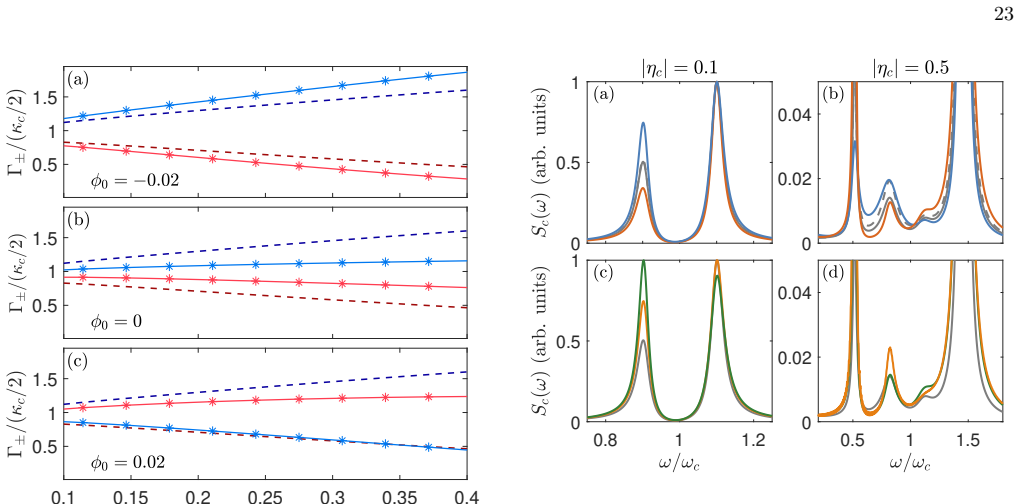
- For plasmonic dimers, the broadband dissipative regime coincides with ultrastrong coupling, so the single-mode quasinormal-mode master equation gives spectral predictions beyond phenomenological decay models in the ultrastrong regime.
- For several dielectric cavities (a three-dimensional bowtie, a two-dimensional photonic crystal), the corrections become observable at coupling strengths orders of magnitude below the usual ultrastrong-coupling threshold, placing the effects within reach of existing emitter-cavity platforms.
- The dimensionless criterion $\tilde\Omega_{\rm BB}=0.1\,\min\{1,|1-4Q_c\tan(2\phi_0)|^{-1}\}$ marks where phenomenological models break down, and the combination $Q_c\tan(2\phi_0)$ also bounds the validity of single-mode models.
- In one-dimensional and quasi-one-dimensional designs such as whispering-gallery-mode microdisks, the quasi-harmonic distribution of longitudinal modes prevents accurate single-mode calculations, indicating that multimode extensions are needed in those structures.
- In the many-dipole thermodynamic limit, the ab initio quantum spectrum agrees with the classical scattered-field spectrum only when the negative-frequency partner of the quasinormal mode is added to the classical Green function, showing how the single-mode approximation must be implemented differently in the two formalisms.
Reading between the lines
- Inference: the phase-controlled linewidth asymmetry $\Gamma_+ - \Gamma_- \propto \kappa_c|\eta_c|(1-4Q_c\tan(2\phi_0))$ could serve as a direct experimental signature of broadband dissipation, since it vanishes for flat phenomenological spectra and reverses sign as the emitter is displaced across the mode.
- Inference: engineered inverse-designed cavities that place emitters at a controlled nonzero phase could amplify the effect at fixed coupling strength; a testable extension is to map the predicted decay-rate correction across dipole positions in a single resonator and compare with full Maxwell simulations.
- Inference: because the validation required subtracting a fitted background rate for each cavity, a direct measurement of a dipole detuned far from the mode would quantify the non-resonant background contribution and show where the single-mode assumption starts to fail in realistic broadband experiments.
Editorial analysis
A structured set of objections, weighed in public.
Referee Report
Summary. The paper presents a derivation of a single-mode quantum master equation for a dipole coupled to a lossy, dispersive cavity, using a quantized quasinormal mode (QNM) approach combined with macroscopic QED. The central result is Eq. (78): polariton transition decay rates Gamma_alpha = kappa_c |c_alpha|^2 (omega_c/omega_alpha) zeta_c(phi_0, omega_alpha), where zeta_c contains the QNM phase at the dipole location. The authors show that this result recovers their earlier PRL spectral density, defines a 'broadband dissipative regime' via a dimensionless threshold Omega_BB, and demonstrates that phase-dependent corrections can be significant for dielectric cavities even below the USC threshold. The theory is validated in the weak-coupling regime by comparing QNM Purcell factors with full Maxwell simulations, after subtracting fitted background constants from the numerical decay rates. The authors also study USC dynamics in the quantum Rabi and Hopfield models, and show a classical-quantum correspondence once a negative-frequency QNM is added to the classical Green function.
Significance. If the central claim holds, this is an important step toward ab initio dissipative cavity-QED in regimes where phenomenological Lindblad terms fail: the master equation is gauge-invariant, uses no free parameters for the spectral density (only QNM parameters from standard mode solvers), recovers a known PRL limit, and makes falsifiable predictions (linewidth asymmetry, broadband threshold, and collapse-operator dependence). The numerical work covers several realistic cavity designs, and the appendices give detailed technical derivations (local-boson approximation, electric-field expansion, perturbative linewidths). However, the validation is currently indirect: agreement with full Maxwell simulations is obtained only after per-cavity fitted background subtractions, so the quantitative support for the phase-dependent correction itself is weaker than the 'ab initio/parameter-free' framing suggests.
major comments (3)
- [Sec. V; Figs. 4(e), 5(e), 6(e), 12(e)] The numerical validation compares the QNM decay rate of Eq. (87) with the full Maxwell result only after subtracting per-cavity fitted background constants (1.77 gamma_0 for the bowtie, 0.05 gamma_0^{2D} for the 2D PC, 0.5 gamma_0^{2D} for the microdisk, and 1.78 gamma_0 for the PC beam). Since the non-modal background is not computed from the ab initio theory, this procedure can absorb any slowly varying or even frequency-dependent background contribution that overlaps the spectral window where zeta_c(phi_0, omega) is claimed to produce the observed deviations from the Lorentzian L_c(omega). The agreement shown in these fits therefore does not directly test the QNM-only expansion that underlies Eq. (77). To support the 'ab initio and parameter-free' claim, the authors should show the raw full-Maxwell decay rate together with the fitted background, and ideally obtain the background from the full Green function by subtracting the QNM projection, rather than using a fitted constant.
- [Sec. II B; Eq. (77)] The central rate formula is derived by inserting the single-mode QNM expansion of the transverse Green function, Eqs. (12) and (14), into the exact Green-function identity Eq. (41). The identity is exact for the full transverse Green function, so the derivation assumes that the QNM expansion is complete in the relevant spectral window and that non-modal background terms are negligible. The paper states these terms are neglected (Sec. II B) and asserts they are small in USC, but the only evidence presented is the background-subtracted comparison of the previous comment, which is not a direct test of QNM completeness for the specific resonators. The claim that Eq. (78) is 'the first time the correct form of the cavity system-reservoir coupling' has been derived for general 3D resonators requires either a decomposition of the full numerical Green function into QNM and background parts over the relevant bandwidth for at least one example, or an explicit quantitative estimate of the non-modal contribution to the transition decay rates.
- [Sec. II C 3; Eqs. (45)-(46), (79)] The key replacement S_c approximately equals cos(2 phi_0) is obtained under a pole approximation and is acknowledged to be valid only for small projected QNM phase, |phi_0| much less than 1, with potentially unphysical negative decay rates otherwise. Since this replacement is used to obtain the master equation rates in Eq. (78), the claimed validity 'for general 3D resonators' should be stated with this domain restriction prominently included: the derived rates apply to dipole positions where the projected QNM phase is small. The heuristic bound of Eq. (79) is an upper limit and is not sufficient to guarantee positivity or single-mode accuracy, as the paper itself shows in Sec. V (deviations occur well below |eta_c^(1)|). The paper should either restrict the generality claim or provide a systematic procedure for checking the phase condition in a given resonator.
minor comments (6)
- [Sec. V] The fitted background values should be reported in the figure captions or in a table, since they are inputs to the validation and the paper does not state how they were determined (e.g., by a least-squares fit over which bandwidth).
- [Sec. II B] In the paragraph before Fig. 1, 'gaps less than 1-nm' should read 'gaps less than 1 nm'.
- [Sec. IV C] The phrase 'in the spatially unspecified form written' is awkward; consider 'in the spatially unspecified form as written'.
- [Eq. (22)] Equation (22a) omits the factor hbar in the definition of chi_mu nu, while Eq. (22c) and later Hamiltonians include hbar; the units of chi_mu nu should be stated explicitly to avoid confusion.
- [References] Reference list entries [19] and [20] are identical, and entry [84] duplicates entry [82]; these duplicates should be consolidated.
- [Sec. VI] The statement that the dropped bath counter-rotating terms 'do not notably modify the spectra' is not backed by any data; a brief appendix or figure showing this convergence check would strengthen the USC claims.
Circularity Check
No significant circularity: Eq. (78) is derived from the QNM quantization plus Green-function identity; the PRL spectral density is recovered as a consistency check, not assumed, and the fitted background subtraction is a validation limitation rather than a circular input.
full rationale
The central result, Eq. (78), is obtained by a self-contained derivation: the quantized QNM system-reservoir coupling of Sec. III is fed into the Born-Markov master equation of Sec. IV, and the single-mode decay rate is simplified using the exact macroscopic-QED Green identity (41), the single-mode QNM expansion (12)/(17), and the pole-approximated value S_c ≈ cos(2φ0). The target spectral density of the authors' PRL [18], Eq. (76), is not inserted as an input; it is introduced only after Eq. (78) as a comparison, and the sentence "we see that the ab initio quantized QNM theory within the spatially specified representation fully recovers the correct form of the spectral density" is a consistency check, not a premise. The QNM completeness expansion and the neglect of non-modal background terms are explicit approximations (Sec. II B) and are acknowledged in the conclusions as limitations; the per-cavity fitted background subtracted in Figs. 4-6 and 12 is applied to the full-Maxwell benchmark to isolate the QNM contribution, not to the QNM prediction itself, so the prediction is not statistically forced by the fit. Although the paper cites the authors' own prior work for the QNM quantization machinery and for the benchmark spectral density, those citations are not load-bearing in the sense of substituting for the derivation: Eqs. (74)-(78) follow from the projected QNM Hamiltonian of Secs. II-III and the Green identity, with no step that reduces to the PRL result by definition. The self-citations provide background methods and a known result to reproduce, but the ab initio derivation in this manuscript has independent mathematical content. Therefore no circular step meeting the required evidentiary standard is present.
Assumptions & free parameters
free parameters (3)
- Background subtraction scale factors (validation) =
1.77 for bowtie, 0.05 for 2D PC, 0.5 for microdisk, 1.78 for PC beam (multiples of free-space or 2D free-space decay…
- Incoherent excitation spectral density normalization =
Lambda^2_inc(omega_alpha) = kappa_c omega_c / (2 pi omega_alpha)
- Threshold constant in Omega_BB definition =
0.1
assumptions (6)
- domain assumption The transverse Green function can be expanded in a complete set of QNMs with the coefficient A_mu(omega_m) = omega_m / [2(omega_tilde_mu - omega_m)] (Eqs. 12-14).
- domain assumption Non-modal background terms in the Green function and field operators are negligible (they vanish for A_perp_B by construction).
- domain assumption QNMs are purely transverse; longitudinal QNM components and G_parallel contributions are neglected in the master equation.
- standard math Born-Markov approximation, RWA for bath coupling, and (for presentation) secular approximation are valid.
- ad hoc to paper The pole approximation gives S_c(n, r_1) approx cos(2 phi_0), valid for small QNM phase |phi_0| much less than 1.
- standard math Reservoir operators can be treated as locally bosonic in the Markov approximation.
Cite this review
Pith. "Pith review of Dissipation in the Broadband and Ultrastrong Coupling Regimes of Cavity Quantum Electrodynamics: An Ab Initio Quantized Quasinormal Mode Approach." pith.science (2026). https://pith.science/paper/COZCFYGC
@misc{pith2026250721408,
  author       = {Pith},
  title        = {Pith review of: Dissipation in the Broadband and Ultrastrong Coupling Regimes of Cavity Quantum Electrodynamics: An Ab Initio Quantized Quasinormal Mode Approach},
  year         = {2026},
  howpublished = {\url{https://pith.science/paper/COZCFYGC}},
  note         = {Machine review of arXiv:2507.21408}
}
read the original abstract
Phenomenological approaches to photon loss have long been the workhorse of cavity-QED, but prove inadequate in the presence of sufficiently broadband light-matter interactions. We present a rigorous and ab initio derivation of a quantum master equation for a quantized optical cavity mode coupled to a dipole, using a quasinormal mode (QNM) quantization procedure for plasmonic and dielectric open-system cavity-QED, which is valid in broadband light-matter interaction regimes, including ultrastrong coupling (USC). The theory supports general three-dimensional resonators with arbitrary dispersion and loss, and thus can be applied to a wide range of open cavities. Our ab initio and gauge-invariant approach fully recovers the recent result of Phys. Rev. Lett. 134, 123601 (2025) for the spectral density of a quantized cavity with a single dipole, exhibits a dissipative classical-quantum correspondence for bosonic Hopfield model systems, and reveals important departures from previous heuristic assumptions about system-bath coupling. We identify a new criterion for what we term the "broadband" dissipative regime of cavity-QED, where phenomenological models require corrections in accordance with the intrinsic and spatially-dependent complex phase of the QNM, and also shed light on fundamental limits to single-mode models in extreme coupling regimes. Using plasmonic and dielectric cavity examples, we show validity ranges of our QNM master equation and spectral USC calculations, and discuss prospects for near-term experimental observation of broadband dissipative effects.
Figures


Figures from the paper (8 more)




Forward citations
Cited by 7 Pith papers
-
Floquet Quasienergy-Resolved Dissipation, Dynamics, and Spectroscopy in Ultrastrong Cavity-QED
A nonsecular Floquet generalized master equation framework is developed for open ultrastrong cavity-QED, demonstrating that dissipation is governed by quasienergies rather than static dressed resonances.
-
Quantum Optical Soliton Dynamics Beyond Linearization: An Open-System Approach
Two open-system approaches using Lanczos supermode expansion and Markovian master equation are developed to capture quantum-induced phase shifts and photon loss in χ^(3) solitons without linearization.
-
Quantum Optical Soliton Dynamics Beyond Linearization: An Open-System Approach
Two new open-system approaches (Lanczos supermode expansion and Markovian master equation) model non-linear quantum soliton dynamics, capturing phase shifts and photon loss beyond linearization.
-
Dissipative Channels Determine Open Electromagnetic Quantization
A quantization scheme for open EM systems derives fluctuation channels from the dissipation geometry of the Maxwell operator, separating medium-assisted and boundary-assisted reservoirs to obtain general Green-functio...
-
Correlation functions for quantum dynamics of coupled quasinormal modes and quantum emitters interacting via finite-delay propagating photons
A new theoretical framework describes retarded interactions between quasinormal modes of separated lossy cavities and quantum emitters via a bath of propagating photons using system-bath correlation functions.
-
Correlation functions for quantum dynamics of coupled quasinormal modes and quantum emitters interacting via finite-delay propagating photons
QNM-QNM, QNM-emitter, and emitter-emitter correlation functions with finite photon delay are derived for spatially separated lossy cavities using a non-bosonic bath scattering expansion.
-
Characterization of errors in photon-heralded quantum operations between non-interacting quantum emitters
Develops a perturbative analytic framework extending ZPG to derive closed-form solutions for process matrices and Pauli error weights in photon-heralded gates between non-interacting emitters.
Reference graph
Works this paper leans on
-
[1]
Mabuchi and A
H. Mabuchi and A. C. Doherty, Cavity Quantum Elec- trodynamics: Coherence in Context, Science 298, 1372 (2002)
2002
-
[2]
Browne, S
D. Browne, S. Bose, F. Mintert, and M. Kim, From quantum optics to quantum technologies, Prog. Quan- tum Electron. 54, 2 (2017)
2017
-
[3]
Mandal, M
A. Mandal, M. A. Taylor, B. M. Weight, E. R. Koessler, X. Li, and P. Huo, Theoretical Advances in Polariton Chemistry and Molecular Cavity Quantum Electrody- namics, Chem. Rev. 123, 9786 (2023)
2023
-
[4]
S. J. van Enk, H. J. Kimble, and H. Mabuchi, Quantum Information Processing in Cavity-QED, Quantum Inf. Process. 3, 75 (2004)
2004
-
[5]
Metelmann and A
A. Metelmann and A. A. Clerk, Nonreciprocal Photon Transmission and Amplification via Reservoir Engineer- ing, Phys. Rev. X 5, 021025 (2015)
2015
-
[6]
Verstraete, M
F. Verstraete, M. M. Wolf, and J. Ignacio Cirac, Quan- tum computation and quantum-state engineering driven by dissipation, Nat. Phys. 5, 633 (2009)
2009
-
[7]
Gonz´ alez-Tudela, A
A. Gonz´ alez-Tudela, A. Reiserer, J. J. Garc ´ ıa-Ripoll, and F. J. Garc ´ ıa-Vidal, Light–matter interactions in quantum nanophotonic devices, Nat. Rev. Phys. 6, 166 (2024)
2024
-
[8]
Gardiner and P
C. Gardiner and P. Zoller, Quantum Noise: A Handbook of Markovian and Non-Markovian Quantum Stochastic Methods with Applications to Quantum Optics (Springer Science & Business Media, 2004)
2004
Show all 124 references
-
[9]
H. J. Carmichael, Statistical Methods in Quantum Op- tics 1: Master Equations and Fokker-Planck Equations (Springer Science & Business Media, 013)
-
[10]
H. J. Carmichael, Statistical Methods in Quantum Op- tics 2: Non-Classical Fields (Springer Science & Busi- ness Media, 2009)
2009
-
[11]
Breuer and F
H.-P. Breuer and F. Petruccione, The Theory of Open Quantum Systems (Oxford University Press on De- mand, 2002)
2002
-
[12]
Larson and T
J. Larson and T. Mavrogordatos, The Jaynes–Cummings Model and its Descendants (Second Edition): Modern research directions (IOP Publishing, 2024)
2024
-
[13]
R. H. Dicke, Coherence in Spontaneous Radiation Pro- cesses, Phys. Rev. 93, 99 (1954)
1954
-
[14]
Kirton, M
P. Kirton, M. M. Roses, J. Keeling, and E. G. Dalla Torre, Introduction to the Dicke Model: From Equilibrium to Nonequilibrium, and Vice Versa, Adv. Quantum Technol. 2, 1800043 (2019)
2019
-
[15]
C. W. Gardiner and M. J. Collett, Input and output in damped quantum systems: Quantum stochastic differ- ential equations and the master equation, Phys. Rev. A 31, 3761 (1985)
1985
-
[16]
Combes, K
J. Combes, K. Joseph, and M. Sarovar, The SLH frame- work for modeling quantum input-output networks, Adv. Phys.: X 2, 784 (2017)
2017
-
[17]
Lindblad, On the generators of quantum dynamical semigroups, Communications in Mathematical Physics 48, 119 (1976)
G. Lindblad, On the generators of quantum dynamical semigroups, Communications in Mathematical Physics 48, 119 (1976)
1976
-
[18]
Gustin, J
C. Gustin, J. Ren, and S. Hughes, What Is the Spectral Density of the Reservoir for a Lossy Quantized Cavity?, Phys. Rev. Lett. 134, 123601 (2025)
2025
-
[20]
Forn-D ´ ıaz, L
P. Forn-D ´ ıaz, L. Lamata, E. Rico, J. Kono, and E. Solano, Ultrastrong coupling regimes of light-matter interaction, Rev. Mod. Phys. 91, 025005 (2019)
2019
-
[21]
Frisk Kockum, A
A. Frisk Kockum, A. Miranowicz, S. De Liberato, S. Savasta, and F. Nori, Ultrastrong coupling between light and matter, Nat. Rev. Phys. 1, 19 (2019)
2019
-
[22]
Le Boit´ e, Theoretical Methods for Ultrastrong Light–Matter Interactions, Adv
A. Le Boit´ e, Theoretical Methods for Ultrastrong Light–Matter Interactions, Adv. Quantum Technol. 3, 1900140 (2020)
2020
-
[23]
E. M. Purcell, H. C. Torrey, and R. V. Pound, Reso- nance Absorption by Nuclear Magnetic Moments in a Solid, Phys. Rev. 69, 37 (1946)
1946
-
[24]
Ciuti, G
C. Ciuti, G. Bastard, and I. Carusotto, Quantum vac- uum properties of the intersubband cavity polariton field, Phys. Rev. B 72, 115303 (2005)
2005
-
[25]
A. A. Anappara, S. De Liberato, A. Tredicucci, C. Ciuti, G. Biasiol, L. Sorba, and F. Beltram, Signatures of the ultrastrong light-matter coupling regime, Phys. Rev. B 79, 201303(R) (2009)
2009
-
[26]
B. Zaks, D. Stehr, T.-A. Truong, P. M. Petroff, S. Hughes, and M. S. Sherwin, THz-driven quantum wells: Coulomb interactions and Stark shifts in the ul- trastrong coupling regime, New J. Phys. 13, 083009 (2011)
2011
-
[27]
Scarlino, J
P. Scarlino, J. H. Ungerer, D. J. van Woerkom, M. Mancini, P. Stano, C. M¨ uller, A. J. Landig, J. V. Koski, C. Reichl, W. Wegscheider, T. Ihn, K. Ensslin, and A. Wallraff, In situ Tuning of the Electric-Dipole Strength of a Double-Dot Charge Qubit: Charge-Noise Protection and...
2022
-
[28]
Scalari, C
G. Scalari, C. Maissen, D. Turˇ cinkov´ a, D. Hagenm¨ uller, S. De Liberato, C. Ciuti, C. Reichl, D. Schuh, W. Wegscheider, M. Beck, and J. Faist, Ultrastrong Coupling of the Cyclotron Transition of a 2D Electron Gas to a THz Metamaterial, Science 335, 1323 (2012)
2012
-
[29]
Rajabali, S
S. Rajabali, S. Markmann, E. J¨ ochl, M. Beck, C. A. Lehner, W. Wegscheider, J. Faist, and G. Scalari, An ultrastrongly coupled single terahertz meta-atom, Nat. Commun. 13, 2528 (2022)
2022
-
[30]
F. Tay, A. Mojibpour, S. Sanders, S. Liang, H. Xu, G. C. Gardner, A. Baydin, M. J. Manfra, A. Alabastri, D. Hagenm¨ uller, and J. Kono, Multimode ultrastrong coupling in three-dimensional photonic-crystal cavities, Nat. Commun. 16, 3603 (2025)
2025
-
[31]
X. Li, M. Bamba, Q. Zhang, S. Fallahi, G. C. Gard- ner, W. Gao, M. Lou, K. Yoshioka, M. J. Manfra, and J. Kono, Vacuum Bloch–Siegert shift in Landau polari- tons with ultra-high cooperativity, Nat. Photon.12, 324 (2018)
2018
-
[32]
N. S. Mueller, Y. Okamura, B. G. M. Vieira, S. Juer- gensen, H. Lange, E. B. Barros, F. Schulz, and S. Re- ich, Deep strong light–matter coupling in plasmonic nanoparticle crystals, Nature 583, 780 (2020)
2020
-
[33]
S. Hu, J. Huang, R. Arul, A. S´ anchez-Iglesias, Y. Xiong, L. M. Liz-Marz´ an, and J. J. Baumberg, Robust consis- tent single quantum dot strong coupling in plasmonic nanocavities, Nat. Commun. 15, 6835 (2024)
2024
-
[34]
W. J. Chang, B. J. Roman, T. Paul, Z. Sakotic, P. Vora, K. Kim, L. E. Hurst, D. Wasserman, T. M. Truskett, 33 and D. J. Milliron, Ultrastrong Coupling by Assembling Plasmonic Metal Oxide Nanocrystals in Open Cavities, ACS Nano 19, 12332 (2025)
2025
-
[35]
D. Yoo, F. de Le´ on-P´ erez, M. Pelton, I.-H. Lee, D. A. Mohr, M. B. Raschke, J. D. Caldwell, L. Mart ´ ın- Moreno, and S.-H. Oh, Ultrastrong plasmon–phonon coupling via epsilon-near-zero nanocavities, Nat. Pho- ton. 15, 125 (2021)
2021
-
[36]
Di Stefano, A
O. Di Stefano, A. Settineri, V. Macr ` ı, L. Garziano, R. Stassi, S. Savasta, and F. Nori, Resolution of gauge ambiguities in ultrastrong-coupling cavity quan- tum electrodynamics, Nat. Phys. 15, 803 (2019)
2019
-
[37]
Salmon, C
W. Salmon, C. Gustin, A. Settineri, O. Di Stefano, D. Zueco, S. Savasta, F. Nori, and S. Hughes, Gauge- independent emission spectra and quantum correla- tions in the ultrastrong coupling regime of open system cavity-QED, Nanophotonics 11, 1573 (2022)
2022
-
[38]
S. M. Dutra and G. Nienhuis, Derivation of a Hamilto- nian for photon decay in a, J. Opt. B: Quantum Semi- classical Opt. 2, 584 (2000)
2000
-
[39]
M. G. Raymer and C. J. McKinstrie, Quantum input- output theory for optical cavities with arbitrary cou- pling strength: Application to two-photon wave-packet shaping, Phys. Rev. A 88, 043819 (2013)
2013
-
[40]
Khanbekyan, L
M. Khanbekyan, L. Kn¨ oll, D.-G. Welsch, A. A. Se- menov, and W. Vogel, QED of lossy cavities: Operator and quantum-state input-output relations, Phys. Rev. A 72, 053813 (2005)
2005
-
[41]
Viviescas and G
C. Viviescas and G. Hackenbroich, Field quantization for open optical cavities, Phys. Rev. A 67, 013805 (2003)
2003
-
[42]
Lentrodt and J
D. Lentrodt and J. Evers, Ab Initio Few-Mode Theory for Quantum Potential Scattering Problems, Phys. Rev. X 10, 011008 (2020)
2020
-
[43]
Yuen and A
B. Yuen and A. Demetriadou, Exact Quantum Electro- dynamics of Radiative Photonic Environments, Phys. Rev. Lett. 133, 203604 (2024)
2024
-
[44]
Hughes, C
S. Hughes, C. Gustin, and F. Nori, Reconciling quantum and classical spectral theories of ultrastrong coupling: role of cavity bath coupling and gauge corrections, Opt. Quantum 2, 133 (2024)
2024
-
[45]
Lednev, F
M. Lednev, F. J. Garc ´ ıa-Vidal, and J. Feist, Lindblad Master Equation Capable of Describing Hybrid Quan- tum Systems in the Ultrastrong Coupling Regime, Phys. Rev. Lett. 132, 106902 (2024)
2024
-
[46]
Lentrodt, K
D. Lentrodt, K. P. Heeg, C. H. Keitel, and J. Evers, Ab initio quantum models for thin-film x-ray cavity QED, Phys. Rev. Res. 2, 023396 (2020)
2020
-
[47]
E. S. C. Ching, P. T. Leung, A. Maassen van den Brink, W. M. Suen, S. S. Tong, and K. Young, Quasinormal- mode expansion for waves in open systems, Rev. Mod. Phys. 70, 1545 (1998)
1998
-
[48]
P. T. Kristensen and S. Hughes, Modes and Mode Vol- umes of Leaky Optical Cavities and Plasmonic Nanores- onators, ACS Photonics 1, 2 (2014)
2014
-
[49]
Lalanne, W
P. Lalanne, W. Yan, K. Vynck, C. Sauvan, and J.- P. Hugonin, Light Interaction with Photonic and Plas- monic Resonances, Laser & Photonics Reviews 12, 1700113 (2018)
2018
-
[50]
P. T. Kristensen, K. Herrmann, F. Intravaia, and K. Busch, Modeling electromagnetic resonators using quasinormal modes, Adv. Opt. Photon. 12, 612 (2020)
2020
-
[51]
R.-C. Ge, P. T. Kristensen, J. F. Young, and S. Hughes, Quasinormal mode approach to modelling light-emission and propagation in nanoplasmonics, New J. Phys. 16, 113048 (2014)
2014
-
[52]
Franke, S
S. Franke, S. Hughes, M. K. Dezfouli, P. T. Kristensen, K. Busch, A. Knorr, and M. Richter, Quantization of Quasinormal Modes for Open Cavities and Plasmonic Cavity Quantum Electrodynamics, Phys. Rev. Lett. 122, 213901 (2019)
2019
-
[53]
Ge and S
R.-C. Ge and S. Hughes, Quantum dynamics of two quantum dots coupled through localized plasmons: An intuitive and accurate quantum optics approach using quasinormal modes, Phys. Rev. B 92, 205420 (2015)
2015
-
[54]
Meschede, D
L. Meschede, D. D. A. Clarke, and O. Hess, Quantum quasinormal mode theory for dissipative nano-optics and magnetodielectric cavity quantum electrodynamics (2025), arXiv:2507.05233 [physics.optics]
2025
-
[55]
Hughes, S
S. Hughes, S. Franke, C. Gustin, M. Kamandar Dez- fouli, A. Knorr, and M. Richter, Theory and Limits of On-Demand Single-Photon Sources Using Plasmonic Resonators: A Quantized Quasinormal Mode Approach, ACS Photonics 6, 2168 (2019)
2019
-
[56]
Franke, M
S. Franke, M. Richter, J. Ren, A. Knorr, and S. Hughes, Quantized quasinormal-mode description of nonlinear cavity-QED effects from coupled resonators with a Fano-like resonance, Phys. Rev. Res. 2, 033456 (2020)
2020
-
[57]
J. Ren, S. Franke, and S. Hughes, Connecting Classical and Quantum Mode Theories for Coupled Lossy Cavity Resonators Using Quasinormal Modes, ACS Photonics 9, 138 (2022)
2022
-
[58]
J. Ren, S. Franke, and S. Hughes, Quasinormal Mode Theory of Chiral Power Flow from Linearly Polarized Dipole Emitters Coupled to Index-Modulated Microring Resonators Close to an Exceptional Point, ACS Photon- ics 9, 1315 (2022)
2022
-
[59]
Franke, J
S. Franke, J. Ren, M. Richter, A. Knorr, and S. Hughes, Fermi’s Golden Rule for Spontaneous Emission in Ab- sorptive and Amplifying Media, Phys. Rev. Lett. 127, 013602 (2021)
2021
-
[60]
J. Ren, S. Franke, and S. Hughes, Quasinormal Modes, Local Density of States, and Classical Purcell Factors for Coupled Loss-Gain Resonators, Phys. Rev. X 11, 041020 (2021)
2021
-
[61]
Franke, J
S. Franke, J. Ren, and S. Hughes, Quantized quasinormal-mode theory of coupled lossy and ampli- fying resonators, Phys. Rev. A 105, 023702 (2022)
2022
-
[62]
VanDrunen, J
B. VanDrunen, J. Ren, S. Franke, and S. Hughes, Gain- compensated metal cavity modes and a million-fold improvement of Purcell factors, Opt. Quantum 2, 85 (2024)
2024
-
[63]
VanDrunen, J
B. VanDrunen, J. Ren, S. Franke, and S. Hughes, Gain- modified emission dynamics between two quantum emit- ters in a plasmonic gain cavity system, Phys. Rev. A 112, 013532 (2025)
2025
-
[64]
Medina, F
I. Medina, F. J. Garc ´ ıa-Vidal, A. I. Fern´ andez- Dom ´ ınguez, and J. Feist, Few-Mode Field Quantization of Arbitrary Electromagnetic Spectral Densities, Phys. Rev. Lett. 126, 093601 (2021)
2021
-
[65]
S´ anchez-Barquilla, F
M. S´ anchez-Barquilla, F. J. Garc ´ ıa-Vidal, A. I. Fern´ andez-Dom ´ ınguez, and J. Feist, Few-mode field quantization for multiple emitters, Nanophotonics 11, 4363 (2022)
2022
-
[66]
Gustin, S
C. Gustin, S. Franke, and S. Hughes, Gauge-invariant theory of truncated quantum light-matter interactions in arbitrary media, Phys. Rev. A 107, 013722 (2023)
2023
-
[67]
H. T. Dung, L. Kn¨ oll, and D.-G. Welsch, Three- 34 dimensional quantization of the electromagnetic field in dispersive and absorbing inhomogeneous dielectrics, Phys. Rev. A 57, 3931 (1998)
1998
-
[68]
Gruner and D.-G
T. Gruner and D.-G. Welsch, Green-function approach to the radiation-field quantization for homogeneous and inhomogeneous Kramers-Kronig dielectrics, Phys. Rev. A 53, 1818 (1996)
1996
-
[69]
L. G. Suttorp and A. J. van Wonderen, Fano diagonal- ization of a polariton model for an inhomogeneous ab- sorptive dielectric, EPL (Europhysics Letters) 67, 766 (2004)
2004
-
[70]
Vogel and D.-G
W. Vogel and D.-G. Welsch,Quantum Optics (John Wi- ley & Sons, 2006)
2006
-
[71]
T. G. Philbin, Canonical quantization of macroscopic electromagnetism, New J. Phys. 12, 123008 (2010)
2010
-
[72]
Franke, J
S. Franke, J. Ren, S. Hughes, and M. Richter, Fluctuation-dissipation theorem and fundamental pho- ton commutation relations in lossy nanostructures using quasinormal modes, Phys. Rev. Res. 2, 033332 (2020)
2020
-
[73]
M. K. Dezfouli, R. Gordon, and S. Hughes, Molec- ular Optomechanics in the Anharmonic Cavity-QED Regime Using Hybrid Metal–Dielectric Cavity Modes, ACS Photonics 6, 1400 (2019)
2019
-
[74]
M. K. Dezfouli, C. Tserkezis, N. A. Mortensen, and S. Hughes, Nonlocal quasinormal modes for arbitrarily shaped three-dimensional plasmonic resonators, Optica 4, 1503 (2017)
2017
-
[75]
Zschiedrich, F
L. Zschiedrich, F. Binkowski, N. Nikolay, O. Benson, G. Kewes, and S. Burger, Riesz-projection-based theory of light-matter interaction in dispersive nanoresonators, Phys. Rev. A 98, 043806 (2018)
2018
-
[76]
W. Li, Q. Zhou, P. Zhang, and X.-W. Chen, Bright Optical Eigenmode of 1 nm 3 Mode Volume, Phys. Rev. Lett. 126, 257401 (2021)
2021
-
[77]
K. M. Lee, P. T. Leung, and K. M. Pang, Dyadic for- mulation of morphology-dependent resonances. i. com- pleteness relation, JOSA B 16, 1409 (1999)
1999
-
[78]
P. T. Leung, S. Y. Liu, and K. Young, Completeness and orthogonality of quasinormal modes in leaky optical cavities, Phys. Rev. A 49, 3057 (1994)
1994
-
[80]
Kamandar Dezfouli, R
M. Kamandar Dezfouli, R. Gordon, and S. Hughes, Modal theory of modified spontaneous emission for a hybrid plasmonic photonic-crystal cavity system, Phys. Rev. A 95, 013846 (2017)
2017
-
[81]
Carlson and S
C. Carlson and S. Hughes, Dissipative modes, pur- cell factors, and directional beta factors in gold bowtie nanoantenna structures, Phys. Rev. B 102, 155301 (2020)
2020
-
[83]
Franke, J
S. Franke, J. Ren, and S. Hughes, Impact of mode regu- larization for quasinormal-mode perturbation theories, Phys. Rev. A 108, 043502 (2023)
2023
-
[84]
J. Ren, S. Franke, A. Knorr, M. Richter, and S. Hughes, Near-field to far-field transformations of optical quasi- normal modes and efficient calculation of quantized quasinormal modes for open cavities and plasmonic res- onators, Phys. Rev. B 101, 205402 (2020)
2020
-
[85]
Schelkunoff, Some equivalence theorems of electro- magnetics and their application to radiation problems, Bell Sys
S. Schelkunoff, Some equivalence theorems of electro- magnetics and their application to radiation problems, Bell Sys. Tech. J 15, 92 (1936)
1936
-
[86]
Scheel, L
S. Scheel, L. Kn¨ oll, and D.-G. Welsch, Spontaneous de- cay of an excited atom in an absorbing dielectric, Phys. Rev. A 60, 4094 (1999)
1999
-
[87]
V. S. C. Manga Rao and S. Hughes, Single quantum- dot Purcell factor and β factor in a photonic crystal waveguide, Phys. Rev. B 75, 205437 (2007)
2007
-
[88]
Ge and S
R.-C. Ge and S. Hughes, Design of an efficient single photon source from a metallic nanorod dimer: a quasi- normal mode finite-difference time-domain approach, Opt. Lett. 39, 4235 (2014)
2014
-
[89]
Savasta, O
S. Savasta, O. Di Stefano, A. Settineri, D. Zueco, S. Hughes, and F. Nori, Gauge principle and gauge in- variance in two-level systems, Phys. Rev. A103, 053703 (2021)
2021
-
[90]
Settineri, O
A. Settineri, O. Di Stefano, D. Zueco, S. Hughes, S. Savasta, and F. Nori, Gauge freedom, quantum mea- surements, and time-dependent interactions in cavity qed, Phys. Rev. Res. 3, 023079 (2021)
2021
-
[91]
W. E. Lamb, R. R. Schlicher, and M. O. Scully, Matter- field interaction in atomic physics and quantum optics, Phys. Rev. A 36, 2763 (1987)
1987
-
[92]
P. W. Milonni, R. J. Cook, and J. R. Ackerhalt, Natural line shape, Phys. Rev. A 40, 3764 (1989)
1989
-
[93]
De Bernardis, P
D. De Bernardis, P. Pilar, T. Jaako, S. De Liberato, and P. Rabl, Breakdown of gauge invariance in ultrastrong- coupling cavity QED, Phys. Rev. A 98, 053819 (2018)
2018
-
[94]
M. A. D. Taylor, A. Mandal, W. Zhou, and P. Huo, Resolution of Gauge Ambiguities in Molecular Cav- ity Quantum Electrodynamics, Phys. Rev. Lett. 125, 123602 (2020)
2020
-
[95]
M. A. D. Taylor, A. Mandal, P. Huo, and P. Huo, Re- solving ambiguities of the mode truncation in cavity quantum electrodynamics, Opt. Lett. 47, 1446 (2022)
2022
-
[96]
M. Wubs, L. G. Suttorp, and A. Lagendijk, Multipole interaction between atoms and their photonic environ- ment, Phys. Rev. A 68, 013822 (2003)
2003
-
[97]
Settineri, V
A. Settineri, V. Macr ´ ı, A. Ridolfo, O. Di Stefano, A. F. Kockum, F. Nori, and S. Savasta, Dissipation and ther- mal noise in hybrid quantum systems in the ultrastrong- coupling regime, Phys. Rev. A 98, 053834 (2018)
2018
-
[98]
Bamba and T
M. Bamba and T. Ogawa, Recipe for the Hamilto- nian of system-environment coupling applicable to the ultrastrong-light-matter-interaction regime, Phys. Rev. A 89, 023817 (2014)
2014
-
[99]
D. M. Toyli, A. W. Eddins, S. Boutin, S. Puri, D. Hover, V. Bolkhovsky, W. D. Oliver, A. Blais, and I. Sid- diqi, Resonance Fluorescence from an Artificial Atom in Squeezed Vacuum, Phys. Rev. X 6, 031004 (2016)
2016
-
[100]
H. J. Carmichael, A. S. Lane, and D. F. Walls, Reso- nance Fluorescence from an Atom in a Squeezed Vac- uum, Phys. Rev. Lett. 58, 2539 (1987)
1987
-
[101]
Mercurio, V
A. Mercurio, V. Macr ` ı, C. Gustin, S. Hughes, S. Savasta, and F. Nori, Regimes of cavity QED under incoherent excitation: From weak to deep strong coupling, Phys. Rev. Res. 4, 023048 (2022)
2022
-
[102]
Gustin, Gauge invariance of the natural lineshape and dissipative dynamics of a two-level atom (2025), arXiv:2501.06594
C. Gustin, Gauge invariance of the natural lineshape and dissipative dynamics of a two-level atom (2025), arXiv:2501.06594
2025 arXiv
-
[103]
T. V. Shahbazyan, Interacting quantum plasmons in metal-dielectric structures, Phys. Rev. B 103, 045421 35 (2021)
2021
-
[104]
T. V. Shahbazyan, Non-Markovian effects for hybrid plasmonic systems in the strong coupling regime, Phys. Rev. B 105, 245411 (2022)
2022
-
[105]
Kountouris, J
G. Kountouris, J. Mørk, E. V. Denning, and P. T. Kris- tensen, Modal properties of dielectric bowtie cavities with deep sub-wavelength confinement, Opt. Express 30, 40367 (2022)
2022
-
[106]
Kountouris, Quantum optics of structures with ex- treme dielectric confinement , Ph.D
G. Kountouris, Quantum optics of structures with ex- treme dielectric confinement , Ph.D. thesis, Technical University of Denmark (2024)
2024
-
[107]
Mercurio, S
A. Mercurio, S. Abo, F. Mauceri, E. Russo, V. Macr ` ı, A. Miranowicz, S. Savasta, and O. Di Stefano, Pure De- phasing of Light-Matter Systems in the Ultrastrong and Deep-Strong Coupling Regimes, Phys. Rev. Lett. 130, 123601 (2023)
2023
-
[108]
D. E. Reiter, T. Kuhn, and V. M. Axt, Distinctive characteristics of carrier-phonon interactions in opti- cally driven semiconductor quantum dots, Adv. Phys.: X 4, 1655478 (2019)
2019
-
[109]
Canales, T
A. Canales, T. Karmstrand, D. G. Baranov, T. J. An- tosiewicz, and T. O. Shegai, Polaritonic linewidth asym- metry in the strong and ultrastrong coupling regime, Nanophotonics 12, 4073 (2023)
2023
-
[110]
Garziano, A
L. Garziano, A. Settineri, O. Di Stefano, S. Savasta, and F. Nori, Gauge invariance of the Dicke and Hopfield models, Phys. Rev. A 102, 023718 (2020)
2020
-
[111]
Rajabali, E
S. Rajabali, E. Cortese, M. Beck, S. De Liberato, J. Faist, and G. Scalari, Polaritonic nonlocality in light–matter interaction, Nat. Photon. 15, 690 (2021)
2021
-
[112]
D. G. Baranov, B. Munkhbat, E. Zhukova, A. Bisht, A. Canales, B. Rousseaux, G. Johansson, T. J. An- tosiewicz, and T. Shegai, Ultrastrong coupling between nanoparticle plasmons and cavity photons at ambient conditions, Nat. Commun. 11, 2715 (2020)
2020
-
[113]
Holstein and H
T. Holstein and H. Primakoff, Field Dependence of the Intrinsic Domain Magnetization of a Ferromagnet, Phys. Rev. 58, 1098 (1940)
1940
-
[114]
Ressayre and A
E. Ressayre and A. Tallet, Holstein-Primakoff transfor- mation for the study of cooperative emission of radia- tion, Phys. Rev. A 11, 981 (1975)
1975
-
[115]
Lambert, C
N. Lambert, C. Emary, and T. Brandes, Entanglement and the Phase Transition in Single-Mode Superradiance, Phys. Rev. Lett. 92, 073602 (2004)
2004
-
[116]
Molesky, Z
S. Molesky, Z. Lin, A. Y. Piggott, W. Jin, J. Vuckovi´ c, and A. W. Rodriguez, Inverse design in nanophotonics, Nat. Photon. 12, 659 (2018)
2018
-
[117]
Albrechtsen, B
M. Albrechtsen, B. V. Lahijani, R. E. Christiansen, V. T. H. Nguyen, L. N. Casses, S. E. Hansen, N. Stenger, O. Simgund, H. Jansen, J. Mork, and S. Sto- bbe, Nanometer-scale photon confinement in topology- optimized dielectric cavities, Nat. Commun. 13, 6281 (2022)
2022
-
[118]
A. N. Babar, T. A. S. Weis, K. Tsoukalas, S. Kadkho- dazadeh, G. Arregui, B. Vosoughi Lahijani, and S. Sto- bbe, Self-assembled photonic cavities with atomic-scale confinement, Nature 624, 57 (2023)
2023
-
[119]
Xiong, R
M. Xiong, R. E. Christiansen, F. Schr¨ oder, Y. Yu, L. N. Casses, E. Semenova, K. Yvind, N. Stenger, O. Sigmund, and J. Mørk, Experimental realization of deep sub-wavelength confinement of light in a topology- optimized InP nanocavity, Opt. Mater. Express 14, 397 (2024)
2024
-
[120]
Nussbaum, N
E. Nussbaum, N. Rotenberg, and S. Hughes, Optimizing the chiral Purcell factor for unidirectional single-photon emitters in topological photonic crystal waveguides us- ing inverse design, Phys. Rev. A 106, 033514 (2022)
2022
-
[121]
Chikkaraddy, B
R. Chikkaraddy, B. De Nijs, F. Benz, S. J. Barrow, O. A. Scherman, E. Rosta, A. Demetriadou, P. Fox, O. Hess, and J. J. Baumberg, Single-molecule strong coupling at room temperature in plasmonic nanocavities, Nature 535, 127 (2016)
2016
-
[122]
H. Choi, M. Heuck, and D. Englund, Self-Similar Nanocavity Design with Ultrasmall Mode Volume for Single-Photon Nonlinearities, Phys. Rev. Lett. 118, 223605 (2017)
2017
-
[123]
J.-Y. Li, W. Li, J. Liu, J. Zhong, R. Liu, H. Chen, and X.-H. Wang, Room-Temperature Strong Coupling Between a Single Quantum Dot and a Single Plasmonic Nanoparticle, Nano Lett. 22, 4686 (2022)
2022
-
[124]
Kuisma, B
M. Kuisma, B. Rousseaux, K. M. Czajkowski, T. P. Rossi, T. Shegai, P. Erhart, and T. J. Antosiewicz, Ul- trastrong Coupling of a Single Molecule to a Plasmonic Nanocavity: A First-Principles Study, ACS Photonics 9, 1065 (2022)
2022
-
[125]
S´ aez-Bl´ azquez, D
R. S´ aez-Bl´ azquez, D. de Bernardis, J. Feist, and P. Rabl, Can We Observe Nonperturbative Vacuum Shifts in Cavity QED?, Phys. Rev. Lett. 131, 013602 (2023)
2023
-
[126]
S. R. Franke, Quantization of quasinormal modes in dissipative media, Ph.D. thesis, Technical University of Berlin (2020)
2020
-
[127]
Kamandar Dezfouli, R
M. Kamandar Dezfouli, R. Gordon, and S. Hughes, Modal theory of modified spontaneous emission of a quantum emitter in a hybrid plasmonic photonic-crystal cavity system, Phys. Rev. A 95, 013846 (2017)
2017
Reviewed August 6, 2026 · model on record in the stance chip above.
Discussion (0). Sign in to comment.