REVIEW 4 major objections 4 minor 7 cited by
Dark Energy in the DESI Era: A Brief Review of Evidence, Beyond-$\Lambda$CDM Interpretations, and Tensions
T0 review · 4 major / 4 minor · reviewed 2026-08-02 · deepseek-v4-flash
Pith's one-line read DESI-era data show an apparent preference for dark energy crossing the phantom divide, but the same expansion history can come from interactions, modified gravity, or non-standard dark matter, making the signal an indication, not a discover
desk verdict A competent, genuinely useful DESI-era review whose own section 2.3 undermines the opening claim; caveats about DDE are much sharper than caveats about the authors' own IDE alternatives. read the letter →
The pith
A machine-rendered reading of the paper's core claim, the machinery that carries it, and where it could break.
The reading
What carries the argument
The central object is the two-parameter CPL form of the dark energy equation of state, w(a) = w0 + wa(1−a), which converts distance measurements into a statement about dark energy's present value and time variation. The review's organizing mechanism is the background-level degeneracy of the expansion history: BAO and supernovae constrain the distance–redshift relation, not the microscopic equation of state, so the same H(z) can be reproduced by an evolving dark energy fluid, a dark-sector interaction (e.g., Q proportional to ρ_de or ρ_c), a scalar-tensor modification of gravity with a non-minimal coupling such as ξφ²R, or a dark matter component with non-zero effective pressure. Breaking thi
What would settle it
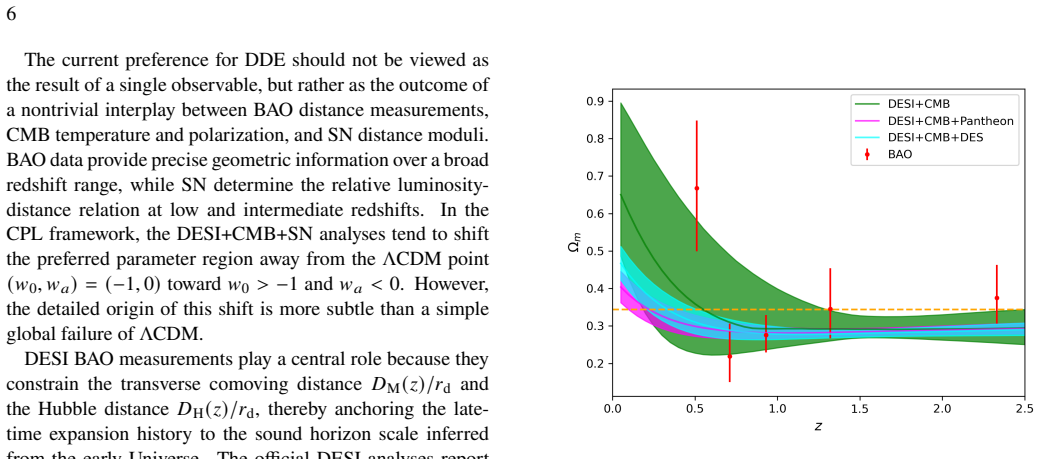
Re-analyze DESI DR2 BAO + Planck CMB + SN data after replacing the DESY5 low-redshift anchor with a recalibrated, homogeneous sample (as in the DES-Dovekie-style updating) and check whether the (w0, wa) contour still excludes (−1, 0) at more than 2σ; separately, remove the z_eff ≈ 0.51 LRG distance point and see whether the contour shifts to consistency with ΛCDM within 2σ, as one cited analysis reports.
Extended reading notes
Core claim
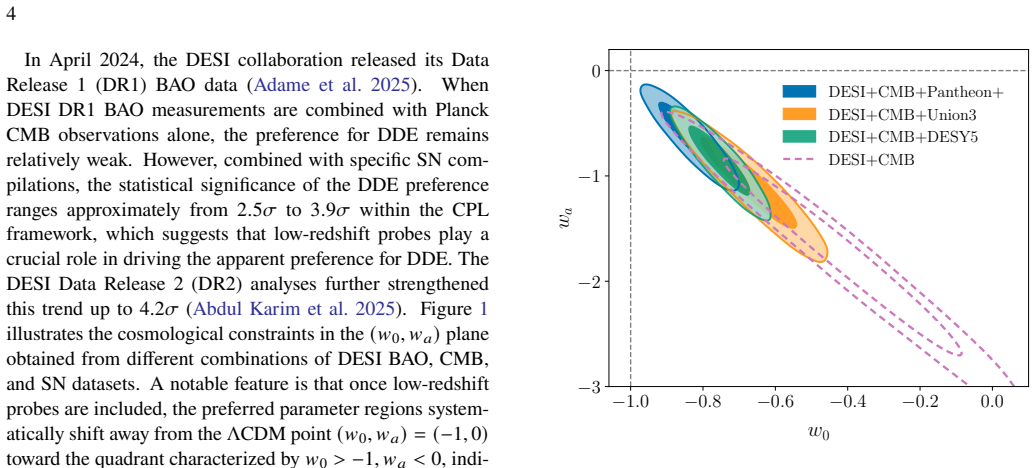
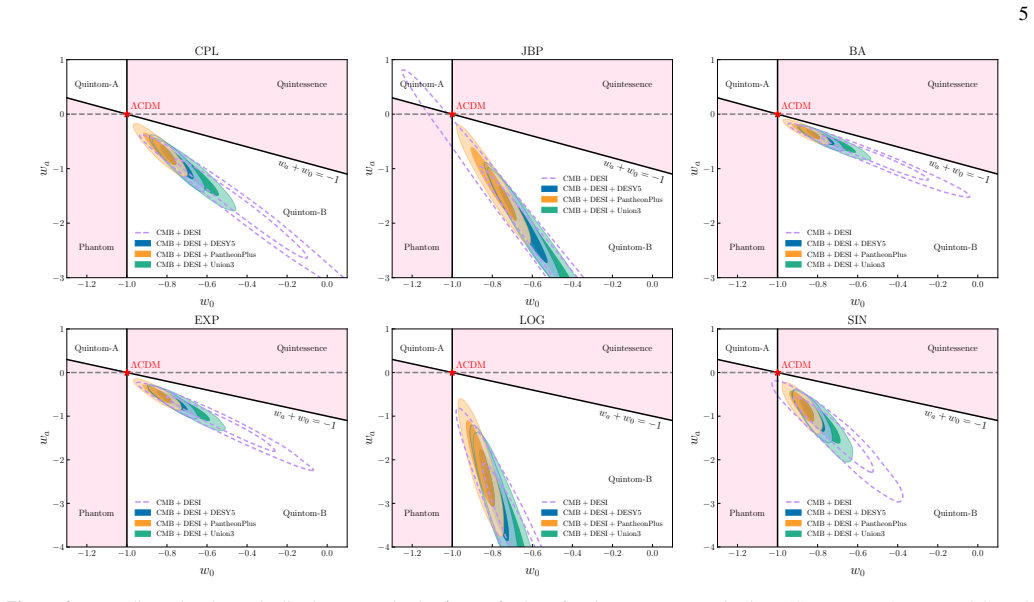
The central claim is that current DESI BAO data, combined with Planck CMB and type Ia supernova compilations, deviate from the cosmological constant in a consistent direction: within the Chevallier-Polarski-Linder type parametrization w(a) = w0 + wa(1−a), the preferred region lies at w0 > −1 and wa < 0, corresponding to an equation of state that was more phantom-like at intermediate redshifts and approaches quintessence today. The statistical significance of this deviation ranges from about 2.5σ to 4.2σ depending on the supernova sample, with the DESY5 compilation giving the strongest preference and PantheonPlus the weakest. The review argues, however, that this background-level departure do
Load-bearing premise
The load-bearing premise is that the DESI BAO likelihoods, Planck CMB likelihoods, and supernova compilations — especially the heterogeneous low-redshift anchor of DESY5 — encode the true distance–redshift relation closely enough that the inferred w0 > −1, wa < 0 trend reflects cosmology rather than a few-hundredths-of-a-magnitude calibration offset in the supernova sample (or an anomalous BAO bin near z ≈ 0.51).
Editorial extensions
If this is right
- If the DESI preference for w0 > −1, wa < 0 persists after supernova recalibration, the cosmological constant alone cannot describe the late-time expansion, and the first credible dynamical-dark-energy signature would be established.
- A phantom-divide crossing, if real, rules out single canonical scalar-field dark energy and requires either additional degrees of freedom, interactions, or modified gravity.
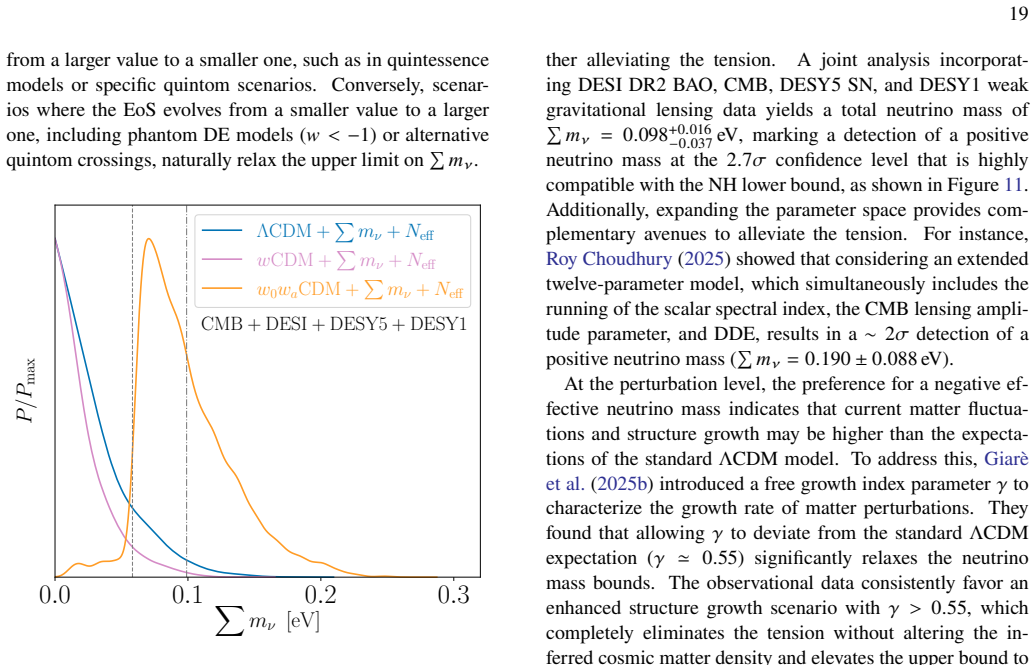
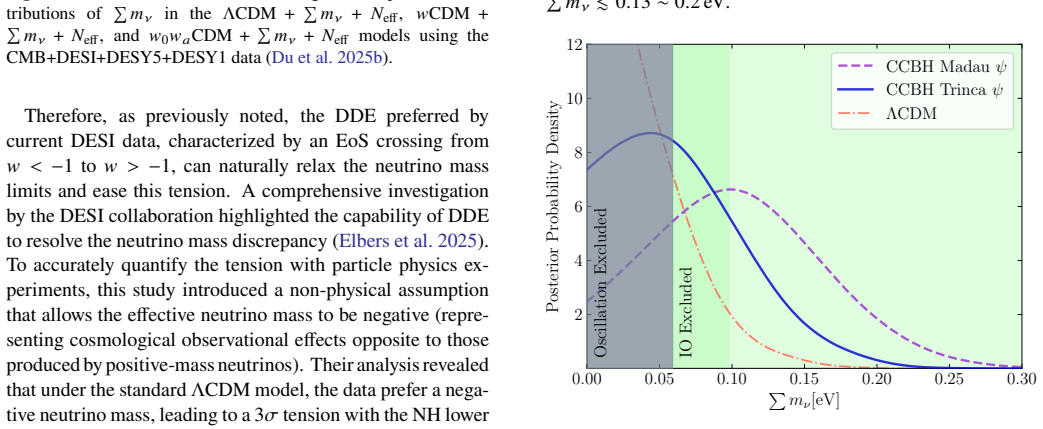
- The same dataset combination tightens the cosmological neutrino-mass bound to about 0.064 eV in ΛCDM, creating a tension with the normal-hierarchy lower limit; allowing dark energy to evolve relaxes this bound and can turn the neutrino-mass measurement into a positive detection.
- The DESI-preferred dark energy does not relieve the H0 tension — it tends to lower the inferred H0 — so a full resolution needs early-universe modifications or interacting dark sectors rather than late-time dynamics alone.
- Distinguishing the competing interpretations requires moving from background distances to growth-rate, lensing, and redshift-space-distortion measurements, which carry distinct perturbation-level signatures.
Reading between the lines
- A decisive test of the systematics interpretation would be to recompute the DESI+CMB+DESY5 contour using a recalibrated low-redshift supernova anchor; if the preference for w0>−1, wa<0 falls below about 2σ, the signal is a calibration artifact rather than cosmology.
- The review's degeneracy argument implies that a growth-rate measurement consistent with ΛCDM would simultaneously disfavor interacting dark energy and non-standard dark matter, leaving evolving dark energy or modified gravity as the remaining explanations — a testable prediction for upcoming redshift surveys.
- The neutrino-mass channel offers a cheap discriminator: if future data fix a positive neutrino mass above roughly 0.1 eV within the evolving-equation-of-state model, that supports the phantom-to-quintessence crossing interpretation; if instead the negative-mass anomaly persists, the deviation is more likely a systematic in the matter-power spectrum.
Editorial analysis
A structured set of objections, weighed in public.
Referee Report
Summary. This review synthesizes the post-DESI literature on the apparent preference for dynamical dark energy (DDE) with w0 > −1, wa < 0, and the possible beyond-ΛCDM interpretations. After summarizing the DESI DR1/DR2 BAO, CMB, and SN constraints, the paper discusses parameterization dependence, the impact of BAO redshift bins and SN calibration, and reconstruction techniques. It then reviews three classes of alternatives to DDE: interacting dark energy (IDE), non-minimally coupled gravity (including hilltop thawing gravity), and non-standard dark matter. A final section considers the implications for the H0, S8, and neutrino-mass tensions. The paper is explicitly hedged in places, but the abstract and conclusion present the DESI-motivated departure from ΛCDM as a robust indication, which is not fully supported by the body's own caveats.
Significance. If the review's central framing is accepted, it provides a timely and fairly comprehensive map of the current DESI-driven model space and usefully emphasizes the degeneracy between DDE, IDE, modified gravity, and non-standard dark matter. Its main strengths are the explicit treatment of parameterization dependence (§2.2), the detailed discussion of SN and BAO systematics (§2.3), and the inclusion of recent recalibrations such as DES-Dovekie. The paper is also well-referenced, though with a heavy concentration of citations to the authors' own program. For a review, the value would be higher if the abstract and conclusion consistently carried the body's caution that the evidence is a dataset-dependent preference rather than an established deviation. The paper does not provide machine-checked proofs or reproducible code, but for a review this is not expected.
major comments (4)
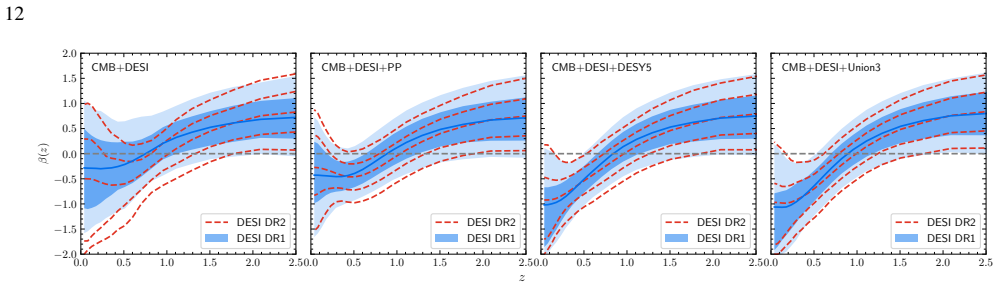
- [§1, §2.1, §2.3 [Eq. (1)]] The significance of the DDE preference is reported inconsistently. §1 states the range 2.8–3.8σ, §2.1 states 2.5–3.9σ for DR1 combinations and 'up to 4.2σ' for DR2, while §2.3 notes that DES-Dovekie recalibration reduces the DR2 value from about 4.2σ to about 3.2σ. The abstract and conclusion quote only the high end or the uncalibrated value. Please harmonize the numbers and, at the very least, headline the recalibrated range in the abstract and conclusion so that readers are not left with an inflated significance.
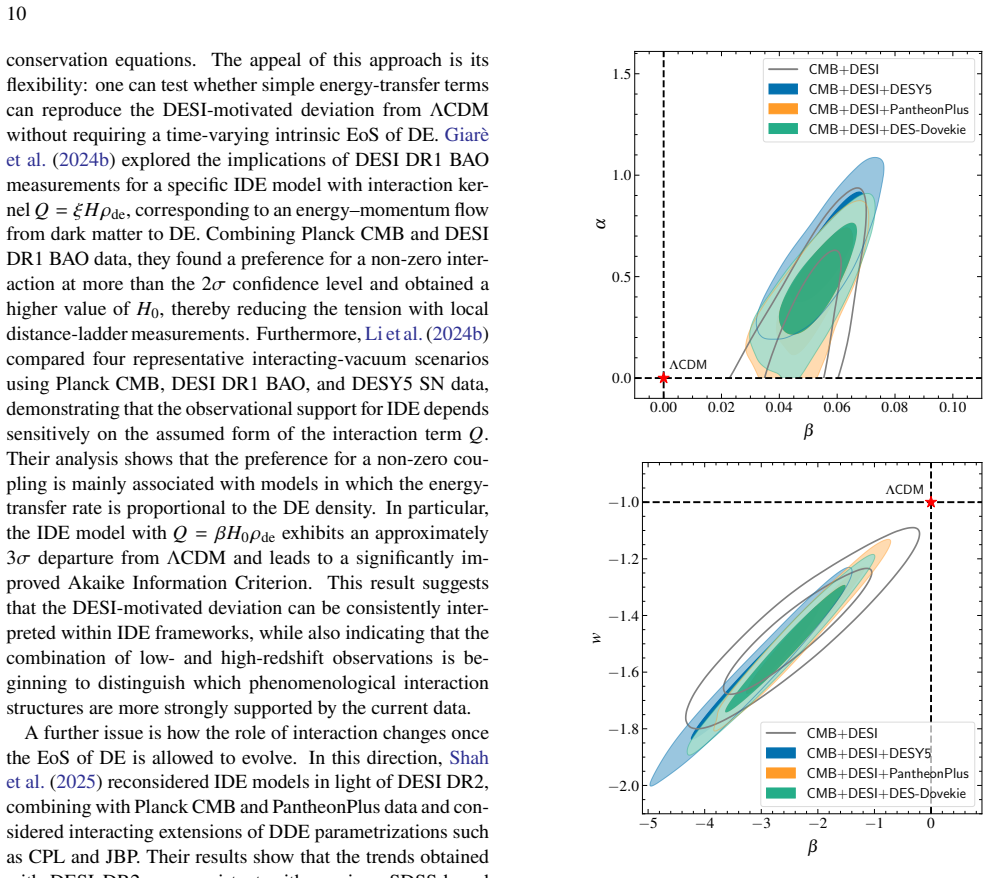
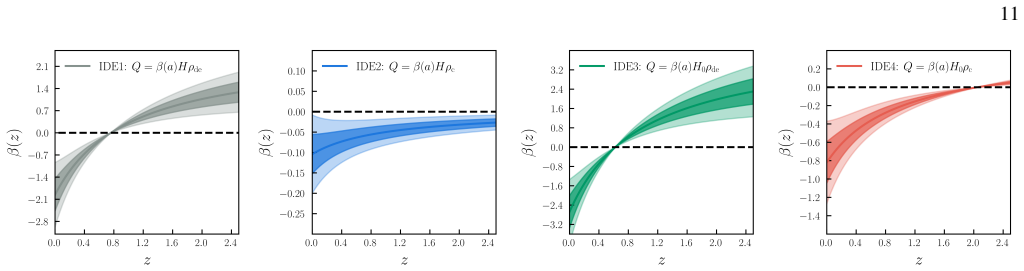
- [§3.1, Fig. 4, §5] The claim that CF and CQ models show 'evidence for non-vanishing dark-sector interactions at the about 3−5σ level' (Li et al. 2026c) is presented as a settled result, but it relies entirely on a single preprint from the authors' own group using their own ePPF/IDECAMB pipeline. The body itself shows that the preference for interaction is model-dependent: §3.1 states that support depends sensitively on the assumed Q form, with only the Q = βH0ρde case giving 'approximately 3σ' (Li et al. 2024b). The conclusion's 'up to 5σ' is therefore misleading. Please report the spread of significances across models and datasets, and explicitly flag the provenance and the lack of independent confirmation.
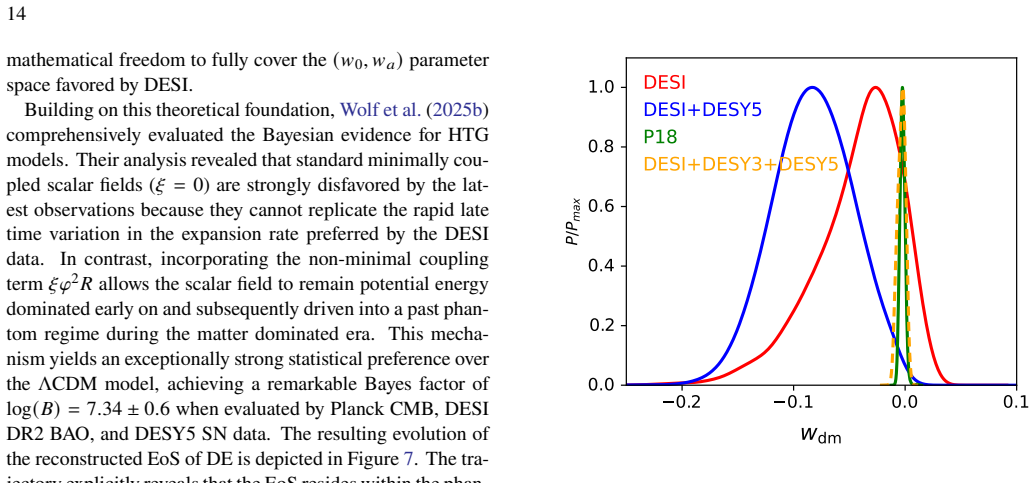
- [§3.3, §5] Selective reporting in the conclusion: the statement that non-standard dark matter is preferred at 'approximately 2.4σ to 3σ' ignores the paper's own §3.3 finding that, once CPL dark energy is introduced, the significance drops to 0.8–1.1σ (Li et al. 2025e). Likewise, the conclusion's 'IDE up to 5σ' omits the weaker or model-dependent results reported earlier. A review should not cherry-pick the largest significance in the literature; it should give the range and the conditions under which the strongest values arise.
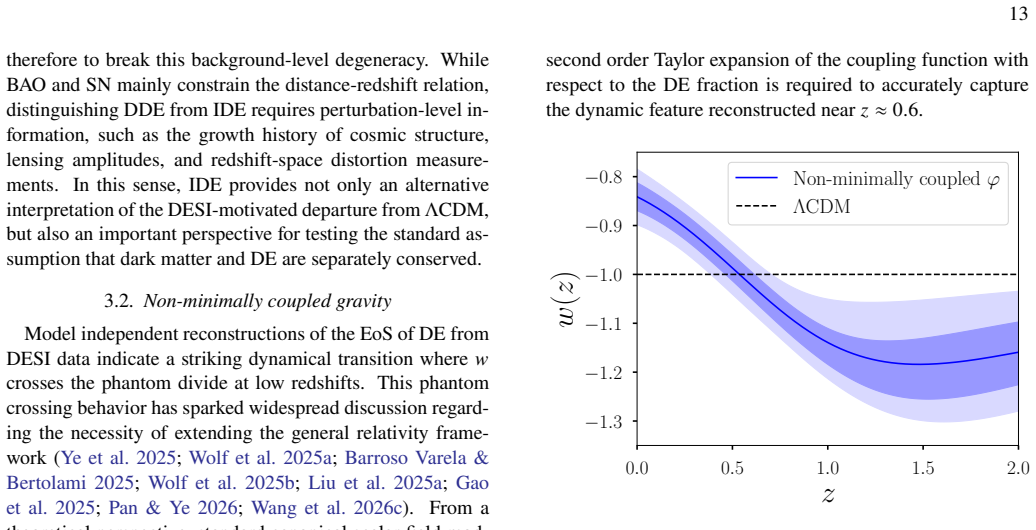
- [§3.2, Eq. (12)–(15), §5] The 'remarkable' Bayes factor of log(B) = 7.34 ± 0.6 for the hilltop thawing gravity model comes from a single analysis (Wolf et al. 2025b). No caveat is given about prior sensitivity, dataset choice, or the fact that this is not an independent cross-check. Given that the review's stated goal is to 'disentangle new physics scenarios from systematic errors,' the Bayesian evidence should be presented with the same caution applied to the DESI-DDE significance. Please add a sentence noting the model- and prior-dependence of such Bayes factors.
minor comments (4)
- [§1, §2.1] The significance range is quoted as 2.8–3.8σ in §1 but 2.5–3.9σ in §2.1. Please make these numbers consistent and define which dataset combination each endpoint refers to.
- [§4.1, §4.3] Duplicate reference in the text: 'Yashiki 2025' appears twice in §4.1, and 'Chudaykin et al. 2025' is listed twice in §4.3. The bibliography also contains several entries with the same year but no distinguishing letter. Please clean up the reference list.
- [§5] The final paragraph advertises a future review by the same authors ('Zhang 2026, in preparation'). This is unusual in a journal article and reads as self-promotion. It should be removed or moved to the acknowledgments.
- [Throughout] The paper uses both 'parametrization' and 'parameterization' inconsistently. Pick one spelling for consistency. Also, equations (9) and (10) define w_eff^de and w_eff^c but the notation is not used later; consider either using it or removing it to avoid confusion.
Circularity Check
No significant circularity: a self-contained review whose central claim rests on external data and explicit degeneracy equations.
full rationale
This is a review paper, not a derivation, so the usual circularity tests apply less stringently. Its load-bearing claim—that DESI BAO + CMB + SN data currently show a dataset-dependent preference for w0 > -1, wa < 0 whose physical origin is ambiguous—is anchored to external DESI DR1/DR2 analyses (Adame et al. 2025; Abdul Karim et al. 2025), external SN compilations, and the paper's own parametric robustness studies, not to a circular definition. The claim that interacting dark energy, non-minimally coupled gravity, and non-standard dark matter can mimic the same background departure is demonstrated directly in the text: Eqs. (9)-(10) define effective equations of state from an interaction Q, making the degeneracy explicit and analytic rather than a fitted-then-relabeled prediction. The paper also repeatedly flags its own weak points (§2.3: hundredths-of-magnitude SN calibration offsets, DES-Dovekie reducing significance from ~4.2σ to ~3.2σ, and sensitivity to the DESI LRG2 bin), which further disarms any charge that inputs are being disguised as outputs. The frequent self-citations (ePPF/IDECAMB, running-coupling parametrization, unified CF/CQ fits of Li et al. 2026c) are genuine model fits to the same data; they support the review's 'alternative interpretations' thesis, but that thesis does not reduce to them, because the background degeneracy is independently shown in the manuscript. The only self-referential oddity is a promised future review (Zhang 2026, 'in preparation'), which is a forward reference to omitted work, not a circular argument. No step was found in which an output equals an input by construction. Score 2 reflects the presence of numerous self-citations, none of which is load-bearing for the central claim.
Assumptions & free parameters
free parameters (5)
- w0, wa (six parametrizations: CPL, JBP, BA, EXP, LOG, SIN) =
w0 ≳ −1, wa < 0; significance 2.5–4.2σ
- β (IDE couplings: Q=βHρc, Q=βH0ρde, running β(a)) =
non-zero at 3–5σ (authors' own fits)
- ξ, V0, λ (thawing gravity / HTG) =
ln B = 7.34 ± 0.6 (quoted)
- wdm (dark matter EoS) =
−0.084 ± 0.035 (DESI+DESY5, quoted)
- Σmν, Neff =
Σmν = 0.098 +0.016/−0.037 eV (quoted)
assumptions (5)
- domain assumption DESI DR1/DR2 BAO likelihoods, Planck 2018 CMB likelihoods, and the PantheonPlus/Union3/DESY5/DES-Dovekie SN compilations correctly encode the underlying measurements.
- domain assumption A two-parameter w(a) ansatz (CPL, JBP, BA, EXP, LOG, SIN) adequately describes the possible DE departure.
- domain assumption BAO+SN constrain only the background distance–redshift relation, so DDE, IDE, non-minimally coupled gravity, and non-standard DM are degenerate at the level of the DESI signal.
- domain assumption The ePPF/IDECAMB implementation provides a stable, correct perturbation treatment for IDE models.
- domain assumption The terrestrial oscillation lower bound Σmν ≳ 0.06 eV (NH) is correct.
invented entities (3)
-
Running dark-sector interaction β(a) = β0 a + βe(1−a)
-
Non-minimal coupling operator Ω (thawing gravity / HTG, ξφ²R)
-
ePPF perturbation prescription for IDE
independent evidence
Cite this review
Pith. "Pith review of Dark Energy in the DESI Era: A Brief Review of Evidence, Beyond-$\Lambda$CDM Interpretations, and Tensions." pith.science (2026). https://pith.science/paper/DBDZPNJA
@misc{pith2026260621826,
  author       = {Pith},
  title        = {Pith review of: Dark Energy in the DESI Era: A Brief Review of Evidence, Beyond-$\Lambda$CDM Interpretations, and Tensions},
  year         = {2026},
  howpublished = {\url{https://pith.science/paper/DBDZPNJA}},
  note         = {Machine review of arXiv:2606.21826}
}
abstract
Recent baryon acoustic oscillation measurements from DESI provide important new clues for reassessing whether the standard $\Lambda$CDM model offers a sufficient description of the late-time expansion history of the Universe. When combined with cosmic microwave background and type Ia supernova data, these measurements show an apparent departure from the $\Lambda$CDM model, commonly described as dynamical dark energy (DDE) with equation of state crossing the phantom divide (i.e., quintom behavior). This review examines the current status of the DESI-motivated indications for DDE and their possible implications for physics beyond $\Lambda$CDM. We discuss how the strength of the preference for DDE depends on the adopted parametrization and dataset combination, and how residual systematics or internal tensions among datasets may affect its interpretation. At the background level, several mechanisms beyond $\Lambda$CDM can produce similar expansion histories. We therefore further discuss how the same effective departure from $w=-1$ may arise from physically distinct scenarios, including interacting dark energy, non-minimally coupled gravity, and non-standard dark matter. Meanwhile, these different new-physics interpretations may have different implications for current cosmological tensions, especially those involving $H_0$, $S_8$, and $\sum m_\nu$. In conclusion, the question posed by DESI is not merely whether dark energy evolves with time, but rather how, within the framework of precision cosmology, to disentangle new physics scenarios from systematic errors.
Figures
Figures from the paper (9 more)
Forward citations
Cited by 7 Pith papers
-
General Relativistic Entropic Acceleration at the perturbation level: a CLASS implementation and first Boltzmann-code constraints
First full Boltzmann-code implementation of entropic dark energy, with MCMC constraints from CMB+BAO+SN, yields α≈1 and a fit statistically indistinguishable from ΛCDM.
-
Hubble tension: the shape wall
Late-time modifications to the expansion history can raise H0 by at most about 2% (conservative) to 3.7% (permissive) if the CMB acoustic scale is fixed.
-
Cosmological Evidence for Dark Axion-Dark Baryon Interactions from Apparent Phantom Crossing
Dark axion–dark baryon interactions improve the fit to CMB+DESI+SNe by Δχ²=-14.5 over ΛCDM, via a non-monotonic dark-matter mass that mimics phantom crossing, while leaving the Hubble tension unresolved.
-
Evaporating cosmologically coupled black holes
If a black hole's mass grows with cosmic expansion, Hawking evaporation is slowed or reversed, weakening gamma-ray bounds on primordial black holes.
-
HIcosmo: a differentiable JAX-based framework for cosmology inference
HIcosmo is a new JAX-based differentiable framework for background cosmology inference that matches Cobaya results while delivering 8.7x CPU and up to 20x GPU speedups.
-
Running into tension: primordial black holes from ultra-slow-roll inflation, spectral running, and the Hubble tension
EDE models increase inferred α_s from CMB data, strengthening tension with USR PBH models that predict negative running.
-
Neutrino mass constraints in the Schwarzschild-de Sitter black-hole dark energy model with ACT DR6 and DESI DR2 data
SdSDE dark energy yields a ~0.16–0.21 eV positive neutrino-mass preference with DESI+ACT data, but χ² strongly favors extended ΛCDM and the shift is likely compensation.
Reference graph
Works this paper leans on
-
[1]
, " * write output.state after.block = add.period write newline
ENTRY address archivePrefix author booktitle chapter doi edition editor eprint howpublished institution journal key month number organization pages publisher school series title misctitle type volume year version url label extra.label sort.label short.list INTEGERS output.state before.all mid.sentence after.sentence after.block FUNCTION init.state.consts ...
-
[2]
write newline
" write newline "" before.all 'output.state := FUNCTION format.url url empty "" new.block "" url * "" * if FUNCTION format.eprint eprint empty "" archivePrefix empty "" archivePrefix "arXiv" = new.block " " eprint * " " * new.block " " eprint * " " * if if if FUNCTION format.doi doi empty "" " " doi * " " * if FUNCTION format.pid doi empty eprint empty ur...
-
[3]
- [1] #1 = = ^ ^ ^ .\!\!^ d .\!\!^ h .\!\!^ m .\!\!^ s .\!\!^ @mss
thebibliography [1] 20pt to REFERENCES 6pt =0pt -12pt 10pt plus 3pt =0pt =0pt =1pt plus 1pt =0pt =0pt -12pt =13pt plus 1pt =20pt =13pt plus 1pt \@M =10000 =-1.0em =0pt =0pt 0pt =0pt =1.0em @enumiv\@empty 10000 10000 `\.\@m \@noitemerr \@latex@warning Empty `thebibliography' environment \@ifnextchar \@reference \@latexerr Missing key on reference command E...
2021
-
[4]
Abbott, T. M. C., et al. 2026 a . 2601.14559
arXiv 2026
-
[5]
---. 2026 b . 2602.10065
arXiv 2026
-
[6]
Abdalla, E., Piedra, O. P. F., Escobal, A. A., et al. 2026. 2605.20060
arXiv 2026
-
[7]
2022, JHEAp, 34, 49, 10.1016/j.jheap.2022.04.002
Abdalla, E., et al. 2022, JHEAp, 34, 49, 10.1016/j.jheap.2022.04.002
-
[8]
Abdul Karim, M., et al. 2025, Phys. Rev. D, 112, 083515, 10.1103/tr6y-kpc6
Show all 297 references
-
[9]
A., Pan, S., Di Valentino, E., & Yang, W
Abedin, M., Escamilla, L. A., Pan, S., Di Valentino, E., & Yang, W. 2025 a , Phys. Rev. D, 112, 123537, 10.1103/r8sv-1g4q
2025 doi
-
[10]
2025 b , Mon
Abedin, M., Wang, G.-J., Ma, Y.-Z., & Pan, S. 2025 b , Mon. Not. Roy. Astron. Soc., 540, 2253, 10.1093/mnras/staf762
2025 doi
- [11]
-
[12]
2026, JCAP, 03, 015, 10.1088/1475-7516/2026/03/015
Adi, T. 2026, JCAP, 03, 015, 10.1088/1475-7516/2026/03/015
2026 doi
-
[13]
A., Zapata, M
Adil, S. A., Zapata, M. A., Akarsu, \"O ., & Vazquez, J. A. 2026. 2603.14693
2026 arXiv
-
[14]
2020, Astron
Aghanim, N., et al. 2020, Astron. Astrophys., 641, A6, 10.1051/0004-6361/201833910
2020 doi
- [15]
-
[16]
2025, Science, 388, adq9592, 10.1126/science.adq9592
Aker, M., et al. 2025, Science, 388, adq9592, 10.1126/science.adq9592
2025 doi
-
[17]
Alam, S., & Hossain, M. W. 2026, JCAP, 04, 042, 10.1088/1475-7516/2026/04/042
2026 doi
-
[18]
2017, Mon
Alam, S., et al. 2017, Mon. Not. Roy. Astron. Soc., 470, 2617, 10.1093/mnras/stx721
2017 doi
- [19]
-
[20]
J., Aloni, D., & Sch \"o neberg, N
Allali, I. J., Aloni, D., & Sch \"o neberg, N. 2024, JCAP, 09, 019, 10.1088/1475-7516/2024/09/019
2024 doi
-
[21]
J., Li, L., Singh, P., & Fan, J
Allali, I. J., Li, L., Singh, P., & Fan, J. 2026, Phys. Rev. D, 113, 083515, 10.1103/14tf-4nk2
2026 doi
-
[22]
J., & Notari, A
Allali, I. J., & Notari, A. 2024, JCAP, 12, 020, 10.1088/1475-7516/2024/12/020
2024 doi
- [23]
- [24]
- [25]
- [26]
-
[27]
F., & Steinhardt, P
Armendariz-Picon, C., Mukhanov, V. F., & Steinhardt, P. J. 2000, Phys. Rev. Lett., 85, 4438, 10.1103/PhysRevLett.85.4438
2000 doi
-
[28]
2021, Astron
Asgari, M., et al. 2021, Astron. Astrophys., 645, A104, 10.1051/0004-6361/202039070
2021 doi
-
[29]
P., & da Silva, H
Avelino, P. P., & da Silva, H. M. R. 2012, Phys. Lett. B, 714, 6, 10.1016/j.physletb.2012.06.063
2012 doi
-
[30]
2014, Phys
Aviles, A., Bravetti, A., Capozziello, S., & Luongo, O. 2014, Phys. Rev. D, 90, 043531, 10.1103/PhysRevD.90.043531
2014 doi
-
[31]
B, A., & Suresh, P. K. 2025, Class. Quant. Grav., 42, 165008, 10.1088/1361-6382/adf40a
2025 doi
-
[32]
Banik, I., Desmond, H., Kalaitzidis, V., & Mazurenko, S. 2026. 2602.03928
2026
- [33]
-
[34]
M., & Alcaniz, J
Barboza, Jr., E. M., & Alcaniz, J. S. 2008, Phys. Lett. B, 666, 415, 10.1016/j.physletb.2008.08.012
2008 doi
-
[35]
2025, Phys
Barenboim, G., Froustey, J., Pitrou, C., & Sanchis, H. 2025, Phys. Rev. D, 111, 123549, 10.1103/kg29-yq85
2025 doi
-
[36]
2025, Phys
Barroso Varela, M., & Bertolami, O. 2025, Phys. Dark Univ., 48, 101861, 10.1016/j.dark.2025.101861
2025
-
[37]
C., Kahlhoefer, F., Lesgourgues, J., & Sch \"o neberg, N
Becker, N., Hooper, D. C., Kahlhoefer, F., Lesgourgues, J., & Sch \"o neberg, N. 2021, JCAP, 02, 019, 10.1088/1475-7516/2021/02/019
2021 doi
-
[38]
Bella, M., Poulin, V., Vagnozzi, S., & Knox, L. 2026. 2604.13535
2026 arXiv
- [39]
-
[40]
2025, JCAP, 04, 054, 10.1088/1475-7516/2025/04/054
Benso, C., Schwetz, T., & Vatsyayan, D. 2025, JCAP, 04, 054, 10.1088/1475-7516/2025/04/054
2025 doi
-
[41]
P., & Coley, A
Billyard, A. P., & Coley, A. A. 2000, Phys. Rev. D, 61, 083503, 10.1103/PhysRevD.61.083503
2000 doi
-
[42]
G., Caldera-Cabral, G., Lazkoz, R., & Maartens, R
Boehmer, C. G., Caldera-Cabral, G., Lazkoz, R., & Maartens, R. 2008, Phys. Rev. D, 78, 023505, 10.1103/PhysRevD.78.023505
2008 doi
-
[43]
G., Petronikolou, M., & Saridakis, E
Bouhmadi-L \'o pez, M., Boiza, C. G., Petronikolou, M., & Saridakis, E. N. 2026, Universe, 12, 81, 10.3390/universe12030081
2026 doi
-
[44]
2025, JCAP, 11, 064, 10.1088/1475-7516/2025/11/064
Braglia, M., Chen, X., & Loeb, A. 2025, JCAP, 11, 064, 10.1088/1475-7516/2025/11/064
2025 doi
-
[45]
A., Chacko, Z., Flood, I., et al
Buen-Abad, M. A., Chacko, Z., Flood, I., et al. 2025. 2511.16554
2025
-
[46]
S., & Boylan-Kolchin, M
Bullock, J. S., & Boylan-Kolchin, M. 2017, Ann. Rev. Astron. Astrophys., 55, 343, 10.1146/annurev-astro-091916-055313
2017 doi
- [47]
-
[48]
Cai, R.-G., & Wang, S.-J. 2026. 2606.20434
2026 arXiv
-
[49]
2025, 10.1093/nsr/nwag115
Cai, Y., Ren, X., Qiu, T., Li, M., & Zhang, X. 2025, 10.1093/nsr/nwag115
2025 doi
-
[50]
Cai, Y.-F., Capozziello, S., De Laurentis, M., & Saridakis, E. N. 2016, Rept. Prog. Phys., 79, 106901, 10.1088/0034-4885/79/10/106901
2016 doi
-
[51]
N., Setare, M
Cai, Y.-F., Saridakis, E. N., Setare, M. R., & Xia, J.-Q. 2010, Phys. Rept., 493, 1, 10.1016/j.physrep.2010.04.001
2010 doi
-
[52]
Caldera-Cabral, G., Maartens, R., & Urena-Lopez, L. A. 2009, Phys. Rev. D, 79, 063518, 10.1103/PhysRevD.79.063518
2009 doi
-
[53]
Caldwell, R. R. 2002, Phys. Lett. B, 545, 23, 10.1016/S0370-2693(02)02589-3
2002 doi
-
[54]
R., Dave, R., & Steinhardt, P
Caldwell, R. R., Dave, R., & Steinhardt, P. J. 1998, Phys. Rev. Lett., 80, 1582, 10.1103/PhysRevLett.80.1582
1998 doi
-
[55]
2023, Phys
Capozziello, S., & D'Agostino, R. 2023, Phys. Dark Univ., 42, 101346, 10.1016/j.dark.2023.101346
2023
-
[56]
2026, Astron
Carloni, Y., Luongo, O., & Muccino, M. 2026, Astron. Astrophys., 707, A383, 10.1051/0004-6361/202556049
2026 doi
-
[57]
M., Duvvuri, V., Trodden, M., & Turner, M
Carroll, S. M., Duvvuri, V., Trodden, M., & Turner, M. S. 2004, Phys. Rev. D, 70, 043528, 10.1103/PhysRevD.70.043528
2004 doi
-
[58]
2024, JCAP, 05, 003, 10.1088/1475-7516/2024/05/003
Castello, S., Mancarella, M., Grimm, N., et al. 2024, JCAP, 05, 003, 10.1088/1475-7516/2024/05/003
2024 doi
-
[59]
K., Das, S., & Dutta, K
Chakraborty, A., Chanda, P. K., Das, S., & Dutta, K. 2025, JCAP, 11, 047, 10.1088/1475-7516/2025/11/047
2025 doi
-
[60]
2026, JHEP, 05, 053, 10.1007/JHEP05(2026)053
Chattopadhyay, S., & Dighe, A. 2026, JHEP, 05, 053, 10.1007/JHEP05(2026)053
2026 doi
-
[61]
K., G \'o mez-Vargas, I., & Mustafa, G
Chaudhary, H., Capozziello, S., Sharma, V. K., G \'o mez-Vargas, I., & Mustafa, G. 2026, Eur. Phys. J. C, 86, 564, 10.1140/epjc/s10052-026-15806-w
2026 doi
- [62]
-
[63]
2026, JCAP, 01, 041, 10.1088/1475-7516/2026/01/041
Chebat, D., et al. 2026, JCAP, 01, 041, 10.1088/1475-7516/2026/01/041
2026 doi
-
[64]
M., Muralidharan, V., & Salewicz, B
Chen, R., Cline, J. M., Muralidharan, V., & Salewicz, B. 2026, JCAP, 03, 044, 10.1088/1475-7516/2026/03/044
2026 doi
-
[65]
2025, JCAP, 07, 059, 10.1088/1475-7516/2025/07/059
Chen, X., & Loeb, A. 2025, JCAP, 07, 059, 10.1088/1475-7516/2025/07/059
2025 doi
-
[66]
A., Sen, A
Cheng, H., Di Valentino, E., Escamilla, L. A., Sen, A. A., & Visinelli, L. 2025 a , JCAP, 09, 031, 10.1088/1475-7516/2025/09/031
2025 doi
-
[67]
2026, Astrophys
Cheng, H., Pan, S., & Di Valentino, E. 2026, Astrophys. J., 999, 190, 10.3847/1538-4357/ae3a8f
2026 doi
-
[68]
Cheng, H., Yin, Z., Di Valentino, E., Marsh, D. J. E., & Visinelli, L. 2025 b . 2506.19096
2025
-
[69]
2001, Int
Chevallier, M., & Polarski, D. 2001, Int. J. Mod. Phys. D, 10, 213, 10.1142/S0218271801000822
2001 doi
-
[70]
P., Richarte, M
Chimento, L. P., Richarte, M. G., & S \'a nchez Garc \' a, I. E. 2013, Phys. Rev. D, 88, 087301, 10.1103/PhysRevD.88.087301
2013 doi
-
[71]
2025, Mon
Chluba, J., Vasil, G., & Battye, R. 2025, Mon. Not. Roy. Astron. Soc., 543, 456, 10.1093/mnras/staf1465
2025 doi
- [72]
-
[73]
2024, Phys
Chudaykin, A., & Kunz, M. 2024, Phys. Rev. D, 110, 123524, 10.1103/PhysRevD.110.123524
2024 doi
-
[74]
2012, Phys
Clemson, T., Koyama, K., Zhao, G.-B., Maartens, R., & Valiviita, J. 2012, Phys. Rev. D, 85, 043007, 10.1103/PhysRevD.85.043007
2012 doi
-
[75]
G., Padilla, A., & Skordis, C
Clifton, T., Ferreira, P. G., Padilla, A., & Skordis, C. 2012, Phys. Rept., 513, 1, 10.1016/j.physrep.2012.01.001
2012 doi
-
[76]
\'O ., Dainotti, M
Colg \'a in, E. \'O ., Dainotti, M. G., Capozziello, S., et al. 2026, JHEAp, 49, 100428, 10.1016/j.jheap.2025.100428
2026
-
[77]
\'O ., & Sheikh-Jabbari, M
Colg \'a in, E. \'O ., & Sheikh-Jabbari, M. M. 2025, Mon. Not. Roy. Astron. Soc., 542, L24, 10.1093/mnrasl/slaf042
2025 doi
-
[78]
J., Sami, M., & Tsujikawa, S
Copeland, E. J., Sami, M., & Tsujikawa, S. 2006, Int. J. Mod. Phys. D, 15, 1753, 10.1142/S021827180600942X
2006 doi
-
[79]
E., & Manohar, A
Dalal, N., Abazajian, K., Jenkins, E. E., & Manohar, A. V. 2001, Phys. Rev. Lett., 87, 141302, 10.1103/PhysRevLett.87.141302
2001 doi
-
[80]
Das, A., Dev, P. S. B., Gao, C., Ghosh, S., & Kim, T. 2026, Phys. Rev. Lett., 136, 131003, 10.1103/jprg-jll6
2026 doi
-
[81]
S., & Khoury, J
Das, S., Corasaniti, P. S., & Khoury, J. 2006, Phys. Rev. D, 73, 083509, 10.1103/PhysRevD.73.083509
2006 doi
-
[82]
F., Forero, D
de Salas, P. F., Forero, D. V., Gariazzo, S., et al. 2021, JHEP, 02, 071, 10.1007/JHEP02(2021)071
2021 doi
-
[83]
Denton, P. B. 2025. 2501.08374
2025
-
[84]
2021, Mon
Di Valentino, E. 2021, Mon. Not. Roy. Astron. Soc., 502, 2065, 10.1093/mnras/stab187
2021 doi
-
[85]
2022, Universe, 8, 399, 10.3390/universe8080399
---. 2022, Universe, 8, 399, 10.3390/universe8080399
2022 doi
-
[86]
2026, PoS, COSMICWISPers2025, 012, 10.22323/1.507.0012
---. 2026, PoS, COSMICWISPers2025, 012, 10.22323/1.507.0012
2026 doi
-
[87]
Di Valentino, E., Gariazzo, S., & Mena, O. 2024. 2404.19322
2024 arXiv
-
[88]
2017, Phys
Di Valentino, E., Melchiorri, A., & Mena, O. 2017, Phys. Rev. D, 96, 043503, 10.1103/PhysRevD.96.043503
2017 doi
-
[89]
2020, Phys
Di Valentino, E., Melchiorri, A., Mena, O., & Vagnozzi, S. 2020, Phys. Dark Univ., 30, 100666, 10.1016/j.dark.2020.100666
2020
-
[91]
2021 b , Class
Di Valentino, E., Mena, O., Pan, S., et al. 2021 b , Class. Quant. Grav., 38, 153001, 10.1088/1361-6382/ac086d
2021 doi
-
[92]
2021 c , Astropart
Di Valentino, E., et al. 2021 c , Astropart. Phys., 131, 102604, 10.1016/j.astropartphys.2021.102604
2021
-
[93]
2025, Phys
---. 2025, Phys. Dark Univ., 49, 101965, 10.1016/j.dark.2025.101965
2025
-
[94]
2016, Phys
Dimakis, N., Karagiorgos, A., Zampeli, A., et al. 2016, Phys. Rev. D, 93, 123518, 10.1103/PhysRevD.93.123518
2016 doi
-
[95]
Dinda, B. R. 2024, JCAP, 09, 062, 10.1088/1475-7516/2024/09/062
2024 doi
-
[96]
Du, G.-H., Li, T.-N., Ling, J.-L., et al. 2025 a . 2510.26355
2025 arXiv
-
[97]
Du, G.-H., Li, T.-N., Liu, T., Zhang, J.-F., & Zhang, X. 2026 a . 2602.03110
2026 arXiv
-
[98]
2026 b , Eur
Du, G.-H., Li, T.-N., Wu, P.-J., et al. 2026 b , Eur. Phys. J. C, 86, 110, 10.1140/epjc/s10052-025-15237-z
2026 doi
-
[99]
Du, G.-H., Li, T.-N., Wu, P.-J., Zhang, J.-F., & Zhang, X. 2025 b . 2507.16589
2025 arXiv
-
[100]
2025 c , Eur
Du, G.-H., Wu, P.-J., Li, T.-N., & Zhang, X. 2025 c , Eur. Phys. J. C, 85, 392, 10.1140/epjc/s10052-025-14094-0
2025 doi
-
[101]
2025, Mon
Efstathiou, G. 2025, Mon. Not. Roy. Astron. Soc., 538, 875, 10.1093/mnras/staf301
2025 doi
-
[102]
A., & Perivolaropoulos, L
Efstratiou, D., Paraskevas, E. A., & Perivolaropoulos, L. 2025. 2511.04610
2025
- [103]
- [104]
-
[105]
A., Akarsu, O., Di Valentino, E., & Vazquez, J
Escamilla, L. A., Akarsu, O., Di Valentino, E., & Vazquez, J. A. 2023, JCAP, 11, 051, 10.1088/1475-7516/2023/11/051
2023 doi
-
[106]
G., & Abazajian, K
Escudero, H. G., & Abazajian, K. N. 2025, Phys. Rev. D, 111, 043520, 10.1103/PhysRevD.111.043520
2025 doi
-
[107]
C., Maltoni, M., et al
Esteban, I., Gonzalez-Garcia, M. C., Maltoni, M., et al. 2024, JHEP, 12, 216, 10.1007/JHEP12(2024)216
2024 doi
-
[108]
C., Maltoni, M., Schwetz, T., & Zhou, A
Esteban, I., Gonzalez-Garcia, M. C., Maltoni, M., Schwetz, T., & Zhou, A. 2020, JHEP, 09, 178, 10.1007/JHEP09(2020)178
2020 doi
-
[109]
2008, Phys
Fang, W., Hu, W., & Lewis, A. 2008, Phys. Rev. D, 78, 087303, 10.1103/PhysRevD.78.087303
2008 doi
-
[110]
R., & Peebles, P
Farrar, G. R., & Peebles, P. J. E. 2004, Astrophys. J., 604, 1, 10.1086/381728
2004 doi
-
[111]
2026, Astrophys
Fazzari, E., Giar \`e , W., & Di Valentino, E. 2026, Astrophys. J. Lett., 996, L5, 10.3847/2041-8213/ae2917
2026 doi
-
[112]
2005, Phys
Feng, B., Wang, X.-L., & Zhang, X.-M. 2005, Phys. Lett. B, 607, 35, 10.1016/j.physletb.2004.12.071
2005 doi
-
[113]
2020 a , Sci
Feng, L., He, D.-Z., Li, H.-L., Zhang, J.-F., & Zhang, X. 2020 a , Sci. China Phys. Mech. Astron., 63, 290404, 10.1007/s11433-019-1511-8
2020 doi
-
[114]
2020 b , Sci
Feng, L., Li, H.-L., Zhang, J.-F., & Zhang, X. 2020 b , Sci. China Phys. Mech. Astron., 63, 220401, 10.1007/s11433-019-9431-9
2020 doi
-
[115]
2025, Phys
Feng, L., Li, T.-N., Du, G.-H., Zhang, J.-F., & Zhang, X. 2025, Phys. Dark Univ., 48, 101935, 10.1016/j.dark.2025.101935
2025
-
[116]
2026, Phys
---. 2026, Phys. Dark Univ., 52, 102296, 10.1016/j.dark.2026.102296
2026
-
[117]
2024, JCAP, 05, 097, 10.1088/1475-7516/2024/05/097
Forconi, M., Giar \`e , W., Mena, O., et al. 2024, JCAP, 05, 097, 10.1088/1475-7516/2024/05/097
2024 doi
-
[118]
2024, Chin
Gao, L.-Y., Xue, S.-S., & Zhang, X. 2024, Chin. Phys. C, 48, 051001, 10.1088/1674-1137/ad2b52
2024 doi
-
[119]
2021, JCAP, 07, 005, 10.1088/1475-7516/2021/07/005
Gao, L.-Y., Zhao, Z.-W., Xue, S.-S., & Zhang, X. 2021, JCAP, 07, 005, 10.1088/1475-7516/2021/07/005
2021 doi
-
[120]
2025, Phys
Gao, Q., Gong, Y., Yi, Z., & Zhang, F. 2025, Phys. Dark Univ., 50, 102106, 10.1016/j.dark.2025.102106
2025
-
[121]
Garny, M., Niedermann, F., & Sloth, M. S. 2026. 2602.23895
2026
-
[122]
2024, Phys
Ghosh, B., & Bengaly, C. 2024, Phys. Dark Univ., 46, 101699, 10.1016/j.dark.2024.101699
2024
-
[123]
D., H \"u tsi, G., Raidal, M., et al
Gialamas, I. D., H \"u tsi, G., Raidal, M., et al. 2025, Phys. Rev. D, 112, 063551, 10.1103/kdqc-y37v
2025 doi
-
[124]
2025, Phys
Giani, L., Von Marttens, R., & Camilleri, R. 2025, Phys. Rev. Lett., 135, 071004, 10.1103/zr92-m7py
2025 doi
- [126]
-
[128]
2025 b , Phys
Giar \`e , W., Mena, O., Specogna, E., & Di Valentino, E. 2025 b , Phys. Rev. D, 112, 103520, 10.1103/njfc-pd1w
2025 doi
-
[129]
Giar \`e , W., Najafi, M., Pan, S., Di Valentino, E., & Firouzjaee, J. T. 2024 a , JCAP, 10, 035, 10.1088/1475-7516/2024/10/035
2024 doi
-
[130]
A., Nunes, R
Giar \`e , W., Sabogal, M. A., Nunes, R. C., & Di Valentino, E. 2024 b , Phys. Rev. Lett., 133, 251003, 10.1103/PhysRevLett.133.251003
2024 doi
-
[131]
2024 c , Phys
Giar \`e , W., Zhai, Y., Pan, S., et al. 2024 c , Phys. Rev. D, 110, 063527, 10.1103/PhysRevD.110.063527
2024 doi
-
[132]
Goh, L. W. K., & Taylor, A. N. 2025, Mon. Not. Roy. Astron. Soc., 544, 3142, 10.1093/mnras/staf1927
2025 doi
-
[133]
o k c en, M., Akarsu, \
G \"o k c en, M., Akarsu, \"O ., & Di Valentino, E. 2026, Phys. Dark Univ., 52, 102273, 10.1016/j.dark.2026.102273
2026
-
[134]
W., Green, D., & Meyers, J
Graham, P. W., Green, D., & Meyers, J. 2026, Phys. Rev. D, 113, 043514, 10.1103/1bqb-qlrj
2026 doi
-
[135]
2025, Phys
Green, D., & Meyers, J. 2025, Phys. Rev. D, 111, 083507, 10.1103/PhysRevD.111.083507
2025 doi
-
[136]
2014, Phys
Gruber, C., & Luongo, O. 2014, Phys. Rev. D, 89, 103506, 10.1103/PhysRevD.89.103506
2014 doi
-
[137]
2025, Nature Astron., 9, 1879, 10.1038/s41550-025-02669-6
Gu, G., et al. 2025, Nature Astron., 9, 1879, 10.1038/s41550-025-02669-6
2025 doi
-
[138]
2013, JCAP, 02, 032, 10.1088/1475-7516/2013/02/032
Gubitosi, G., Piazza, F., & Vernizzi, F. 2013, JCAP, 02, 032, 10.1088/1475-7516/2013/02/032
2013 doi
-
[139]
2018, Sci
Guo, J.-J., Zhang, J.-F., Li, Y.-H., He, D.-Z., & Zhang, X. 2018, Sci. China Phys. Mech. Astron., 61, 030011, 10.1007/s11433-017-9131-9
2018 doi
-
[140]
2017, JCAP, 05, 040, 10.1088/1475-7516/2017/05/040
Guo, R.-Y., Li, Y.-H., Zhang, J.-F., & Zhang, X. 2017, JCAP, 05, 040, 10.1088/1475-7516/2017/05/040
2017 doi
-
[141]
2019, JCAP, 02, 054, 10.1088/1475-7516/2019/02/054
Guo, R.-Y., Zhang, J.-F., & Zhang, X. 2019, JCAP, 02, 054, 10.1088/1475-7516/2019/02/054
2019 doi
-
[142]
2005, Phys
Guo, Z.-K., Piao, Y.-S., Zhang, X.-M., & Zhang, Y.-Z. 2005, Phys. Lett. B, 608, 177, 10.1016/j.physletb.2005.01.017
2005 doi
-
[143]
2024, Phys
Halder, S., de Haro, J., Saha, T., & Pan, S. 2024, Phys. Rev. D, 109, 083522, 10.1103/PhysRevD.109.083522
2024 doi
-
[144]
2009, Phys
He, J.-H., Wang, B., & Abdalla, E. 2009, Phys. Lett. B, 671, 139, 10.1016/j.physletb.2008.11.062
2009 doi
-
[145]
2025, Phys
Herold, L., & Kamionkowski, M. 2025, Phys. Rev. D, 111, 083518, 10.1103/PhysRevD.111.083518
2025 doi
-
[146]
A., Landim, R
Hoerning, G. A., Landim, R. G., Ponte, L. O., et al. 2025, Phys. Rev. D, 112, 023523, 10.1103/6zrh-8fmv
2025 doi
-
[147]
o g a s, M., & M \
H \"o g a s, M., & M \"o rtsell, E. 2025, Phys. Rev. D, 112, 103515, 10.1103/zz5k-kzzk
2025 doi
-
[148]
2010, JCAP, 04, 007, 10.1088/1475-7516/2010/04/007
Hojjati, A., Pogosian, L., & Zhao, G.-B. 2010, JCAP, 04, 007, 10.1088/1475-7516/2010/04/007
2010 doi
-
[149]
2010 a , Phys
Holsclaw, T., Alam, U., Sanso, B., et al. 2010 a , Phys. Rev. D, 82, 103502, 10.1103/PhysRevD.82.103502
2010 doi
- [150]
- [151]
-
[152]
2012, JCAP, 04, 027, 10.1088/1475-7516/2012/04/027
Howlett, C., Lewis, A., Hall, A., & Challinor, A. 2012, JCAP, 04, 027, 10.1088/1475-7516/2012/04/027
2012 doi
-
[153]
2023, Universe, 9, 94, 10.3390/universe9020094
Hu, J.-P., & Wang, F.-Y. 2023, Universe, 9, 94, 10.3390/universe9020094
2023 doi
- [154]
-
[155]
2025, Sci
Huang, L., Cai, R.-G., & Wang, S.-J. 2025, Sci. China Phys. Mech. Astron., 68, 100413, 10.1007/s11433-025-2754-5
2025 doi
- [156]
-
[157]
Huterer, D., & Shafer, D. L. 2018, Rept. Prog. Phys., 81, 016901, 10.1088/1361-6633/aa997e
2018 doi
-
[158]
E., Jee, M
Hwang, S.-g., L'Huillier, B., Keeley, R. E., Jee, M. J., & Shafieloo, A. 2023, JCAP, 02, 014, 10.1088/1475-7516/2023/02/014
2023 doi
-
[159]
Ili \'c , S., Kopp, M., Skordis, C., & Thomas, D. B. 2021, Phys. Rev. D, 104, 043520, 10.1103/PhysRevD.104.043520
2021 doi
- [160]
-
[161]
2025, JCAP, 09, 053, 10.1088/1475-7516/2025/09/053
Ishak, M., et al. 2025, JCAP, 09, 053, 10.1088/1475-7516/2025/09/053
2025 doi
- [162]
-
[163]
M., Toomey, M
Ivanov, M. M., Toomey, M. W., & Kara c ayl , N. G. 2025, Phys. Rev. Lett., 134, 091001, 10.1103/PhysRevLett.134.091001
2025 doi
-
[164]
K., Bagla, J
Jassal, H. K., Bagla, J. S., & Padmanabhan, T. 2005, Phys. Rev. D, 72, 103503, 10.1103/PhysRevD.72.103503
2005 doi
-
[165]
2026, Nature Astron., 10, 317, 10.1038/s41550-025-02737-x
Jedamzik, K., Pogosian, L., & Abel, T. 2026, Nature Astron., 10, 317, 10.1038/s41550-025-02737-x
2026 doi
-
[166]
Jhaveri, T., Karwal, T., Crawford, T., et al. 2026. 2604.08530
2026 arXiv
-
[167]
2025, Phys
Jhaveri, T., Karwal, T., & Hu, W. 2025, Phys. Rev. D, 112, 043541, 10.1103/6vd2-rbfn
2025 doi
-
[168]
D., Hu, J
Jia, X. D., Hu, J. P., Gao, D. H., Yi, S. X., & Wang, F. Y. 2025, Astrophys. J. Lett., 994, L22, 10.3847/2041-8213/ae1965
2025 doi
-
[169]
2025, Phys
Jiang, J.-Q. 2025, Phys. Dark Univ., 48, 101902, 10.1016/j.dark.2025.101902
2025
-
[170]
S., & Vagnozzi, S
Jiang, J.-Q., Pedrotti, D., da Costa, S. S., & Vagnozzi, S. 2024, Phys. Rev. D, 110, 123519, 10.1103/PhysRevD.110.123519
2024 doi
-
[171]
2025, JCAP, 01, 153, 10.1088/1475-7516/2025/01/153
Jiang, J.-Q., Giar \`e , W., Gariazzo, S., et al. 2025, JCAP, 01, 153, 10.1088/1475-7516/2025/01/153
2025 doi
-
[172]
2026, Sci
Jin, S.-J., Song, J.-Y., Sun, T.-Y., et al. 2026, Sci. China Phys. Mech. Astron., 69, 220401, 10.1007/s11433-025-2829-9
2026 doi
-
[173]
2024, Sci
Jin, S.-J., Zhang, Y.-Z., Song, J.-Y., Zhang, J.-F., & Zhang, X. 2024, Sci. China Phys. Mech. Astron., 67, 220412, 10.1007/s11433-023-2276-1
2024 doi
-
[174]
Kamionkowski, M., & Riess, A. G. 2023, Ann. Rev. Nucl. Part. Sci., 73, 153, 10.1146/annurev-nucl-111422-024107
2023 doi
-
[175]
Kang, Y., Li, M., & Yi, C. 2026. 2602.00506
2026 arXiv
-
[176]
S., Swagat Mishra, S., & Sahoo, P
Kavya, N. S., Swagat Mishra, S., & Sahoo, P. K. 2025, Sci. Rep., 15, 36504, 10.1038/s41598-025-23502-0
2025 doi
-
[177]
A., Escamilla, L
Kessler, D. A., Escamilla, L. A., Pan, S., & Di Valentino, E. 2025. 2504.00776
2025 arXiv
- [178]
-
[179]
Khandelwal, S., Capistrano, A. J. S., Kumar, S., & Nunes, R. C. 2026. 2605.20748
2026 arXiv
-
[180]
2025, Phys
Khoury, J., Lin, M.-X., & Trodden, M. 2025, Phys. Rev. Lett., 135, 181001, 10.1103/w4qb-plk8
2025 doi
-
[181]
K br s, C., Elbers, W., Akarsu, \"O ., & Di Valentino, E. 2026. 2605.21456
2026 arXiv
-
[182]
B., & Ili \'c , S
Kopp, M., Skordis, C., Thomas, D. B., & Ili \'c , S. 2018, Phys. Rev. Lett., 120, 221102, 10.1103/PhysRevLett.120.221102
2018 doi
- [183]
-
[184]
Kumar, S., & Nunes, R. C. 2017, Phys. Rev. D, 96, 103511, 10.1103/PhysRevD.96.103511
2017 doi
-
[185]
Kumar, U., Ajith, A., & Verma, A. 2025. 2504.14419
2025 arXiv
-
[186]
2026, Astron
Labate, A., Guidi, M., Moresco, M., & Veropalumbo, A. 2026, Astron. Astrophys., 708, A210, 10.1051/0004-6361/202558719
2026 doi
-
[187]
C., Pan, S., & Yang, W
Ladeira, A., Nunes, R. C., Pan, S., & Yang, W. 2026, Phys. Rev. D, 113, 083503, 10.1103/q1ng-2xvp
2026 doi
-
[188]
2025, Nature Astron., 9, 1123, 10.1038/s41550-025-02627-2
Leauthaud, A., & Riess, A. 2025, Nature Astron., 9, 1123, 10.1038/s41550-025-02627-2
2025 doi
-
[189]
H., Yang, W., Di Valentino, E., Pan, S., & van de Bruck, C
Lee, D. H., Yang, W., Di Valentino, E., Pan, S., & van de Bruck, C. 2026, Phys. Rev. D, 113, 063554, 10.1103/z7y2-yvhg
2026 doi
-
[190]
2025, Phys
Lee, N., Braglia, M., & Ali-Ha \" moud, Y. 2025, Phys. Rev. D, 112, 083506, 10.1103/9q3f-5zrd
2025 doi
-
[191]
2026, JCAP, 03, 003, 10.1088/1475-7516/2026/03/003
Legner, S., Handley, W., Barker, W., & Ormondroyd, A. 2026, JCAP, 03, 003, 10.1088/1475-7516/2026/03/003
2026 doi
-
[192]
2000, Astrophys
Lewis, A., Challinor, A., & Lasenby, A. 2000, Astrophys. J., 538, 473, 10.1086/309179
2000 doi
-
[193]
N., & Cai, Y.-F
Li, C., Ren, X., Yang, Y., Saridakis, E. N., & Cai, Y.-F. 2025 a . 2512.16551
2025 arXiv
-
[194]
2025 b , JCAP, 07, 056, 10.1088/1475-7516/2025/07/056
Li, H.-H., Zhang, X.-z., Qiu, T., & Xia, J.-Q. 2025 b , JCAP, 07, 056, 10.1088/1475-7516/2025/07/056
2025 doi
-
[195]
2026, Mon
Li, J.-X., & Wang, S. 2026, Mon. Not. Roy. Astron. Soc., 548, 1, 10.1093/mnras/stag584
2026 doi
-
[196]
2013, JCAP, 09, 021, 10.1088/1475-7516/2013/09/021
Li, M., Li, X.-D., Ma, Y.-Z., Zhang, X., & Zhang, Z. 2013, JCAP, 09, 021, 10.1088/1475-7516/2013/09/021
2013 doi
-
[197]
Li, T.-N., Du, G.-H., Li, Y.-H., et al. 2025 c . 2510.11363
2025
-
[198]
2026 a , Sci
---. 2026 a , Sci. China Phys. Mech. Astron., 69, 210413, 10.1007/s11433-025-2771-5
2026 doi
-
[199]
2026 b , Phys
Li, T.-N., Du, G.-H., Zhou, S.-H., et al. 2026 b , Phys. Dark Univ., 52, 102254, 10.1016/j.dark.2026.102254
2026
-
[200]
Li, T.-N., Giar \`e , W., Du, G.-H., et al. 2026 c . 2601.07361
2026 arXiv
-
[201]
2024 a , Astrophys
Li, T.-N., Jin, S.-J., Li, H.-L., Zhang, J.-F., & Zhang, X. 2024 a , Astrophys. J., 963, 52, 10.3847/1538-4357/ad1bc9
2024 doi
-
[202]
2025 d , Eur
Li, T.-N., Li, Y.-H., Du, G.-H., et al. 2025 d , Eur. Phys. J. C, 85, 608, 10.1140/epjc/s10052-025-14279-7
2025 doi
-
[203]
2024 b , Astrophys
Li, T.-N., Wu, P.-J., Du, G.-H., et al. 2024 b , Astrophys. J., 976, 1, 10.3847/1538-4357/ad87f0
2024 doi
-
[204]
2025 e , Phys
---. 2025 e , Phys. Dark Univ., 50, 102068, 10.1016/j.dark.2025.102068
2025
-
[205]
2025 f , JCAP, 12, 048, 10.1088/1475-7516/2025/12/048
Li, T.-N., Zhang, Y.-M., Yao, Y.-H., et al. 2025 f , JCAP, 12, 048, 10.1088/1475-7516/2025/12/048
2025 doi
-
[206]
2026 d , Astrophys
Li, X., Liu, T., Li, T.-N., et al. 2026 d , Astrophys. J. Lett., 1001, L21, 10.3847/2041-8213/ae5a36
2026 doi
-
[207]
2019, Astrophys
Li, X., & Shafieloo, A. 2019, Astrophys. J. Lett., 883, L3, 10.3847/2041-8213/ab3e09
2019 doi
- [208]
-
[209]
2012, Sci
Li, X.-D., Wang, S., Huang, Q.-G., Zhang, X., & Li, M. 2012, Sci. China Phys. Mech. Astron., 55, 1330, 10.1007/s11433-012-4748-z
2012 doi
-
[210]
2014, Phys
Li, Y.-H., Zhang, J.-F., & Zhang, X. 2014, Phys. Rev. D, 90, 063005, 10.1103/PhysRevD.90.063005
2014 doi
- [211]
-
[212]
2011, Eur
Li, Y.-H., & Zhang, X. 2011, Eur. Phys. J. C, 71, 1700, 10.1140/epjc/s10052-011-1700-8
2011 doi
- [213]
-
[214]
2023, JCAP, 09, 046, 10.1088/1475-7516/2023/09/046
---. 2023, JCAP, 09, 046, 10.1088/1475-7516/2023/09/046
2023 doi
-
[215]
2025, JCAP, 12, 018, 10.1088/1475-7516/2025/12/018
---. 2025, JCAP, 12, 018, 10.1088/1475-7516/2025/12/018
2025 doi
-
[216]
Linder, E. V. 2003, Phys. Rev. Lett., 90, 091301, 10.1103/PhysRevLett.90.091301
2003 doi
-
[217]
2025, Phys
Ling, J.-L., Du, G.-H., Li, T.-N., et al. 2025, Phys. Rev. D, 112, 083528, 10.1103/p8nz-djjm
2025 doi
-
[218]
Liu, G., Wang, Y., & Zhao, W. 2024. 2407.04385
2024 arXiv
-
[219]
Liu, L., Yi, Z., & Gong, Y. 2025 a . 2505.02407
2025 arXiv
-
[220]
2025 b , Phys
Liu, T., Cao, S., & Wang, J. 2025 b , Phys. Rev. D, 112, 123539, 10.1103/3c2h-g7cz
2025 doi
-
[221]
2025 c , Astrophys
Liu, T., Li, X., & Wang, J. 2025 c , Astrophys. J., 988, 243, 10.3847/1538-4357/aded8b
2025 doi
- [222]
-
[223]
Loverde, M., & Weiner, Z. J. 2024, JCAP, 12, 048, 10.1088/1475-7516/2024/12/048
2024 doi
-
[224]
Lucca, M., & Hooper, D. C. 2020, Phys. Rev. D, 102, 123502, 10.1103/PhysRevD.102.123502
2020 doi
-
[225]
2026, Phys
Lyu, Z.-H., Cai, R.-G., Wang, S.-J., & Zeng, X.-X. 2026, Phys. Rev. D, 113, 083041, 10.1103/rmgx-rp87
2026 doi
-
[226]
2011, Phys
Ma, J.-Z., & Zhang, X. 2011, Phys. Lett. B, 699, 233, 10.1016/j.physletb.2011.04.013
2011 doi
-
[227]
2008, Phys
Ma, Y.-Z., & Zhang, X. 2008, Phys. Lett. B, 661, 239, 10.1016/j.physletb.2008.02.028
2008 doi
-
[228]
2025, Phys
Malekjani, M., Davari, Z., & Pourojaghi, S. 2025, Phys. Rev. D, 111, 083547, 10.1103/PhysRevD.111.083547
2025 doi
-
[229]
R., Pacif, S
Mishra, K. R., Pacif, S. K. J., Kumar, R., & Bamba, K. 2023, Phys. Dark Univ., 40, 101211, 10.1016/j.dark.2023.101211
2023
-
[230]
A., Carlevaro, N., & Di Valentino, E
Montani, G., Escamilla, L. A., Carlevaro, N., & Di Valentino, E. 2026, Phys. Rev. D, 113, 023507, 10.1103/mn69-1dn6
2026 doi
-
[231]
Montefalcone, G., & Stiskalek, R. 2026. 2603.25735
2026
-
[232]
Muller, C. M. 2005, Phys. Rev. D, 71, 047302, 10.1103/PhysRevD.71.047302
2005 doi
-
[233]
2016, JCAP, 04, 014, 10.1088/1475-7516/2016/04/014
Murgia, R., Gariazzo, S., & Fornengo, N. 2016, JCAP, 04, 014, 10.1088/1475-7516/2016/04/014
2016 doi
-
[234]
A., Banik, I., Desmond, H., & Kalaitzidis, V
N \'a jera, J. A., Banik, I., Desmond, H., & Kalaitzidis, V. 2026, Galaxies, 14, 19, 10.3390/galaxies14020019
2026 doi
- [235]
-
[236]
2024, Phys
Naredo-Tuero, D., Escudero, M., Fern \'a ndez-Mart \' nez, E., Marcano, X., & Poulin, V. 2024, Phys. Rev. D, 110, 123537, 10.1103/PhysRevD.110.123537
2024 doi
-
[237]
C., & Di Valentino, E
Nunes, R. C., & Di Valentino, E. 2021, Phys. Rev. D, 104, 063529, 10.1103/PhysRevD.104.063529
2021 doi
-
[238]
C., Pan, S., & Saridakis, E
Nunes, R. C., Pan, S., & Saridakis, E. N. 2016, Phys. Rev. D, 94, 023508, 10.1103/PhysRevD.94.023508
2016 doi
-
[239]
Ong, D. D. Y., Yallup, D., & Handley, W. 2026. 2603.05472
2026 arXiv
-
[240]
N., Handley, W
Ormondroyd, A. N., Handley, W. J., Hobson, M. P., & Lasenby, A. N. 2025. 2503.17342
2025 arXiv
-
[241]
\"O z \"u lker, E., Di Valentino, E., & Giar \`e , W. 2025. 2506.19053
2025 arXiv
- [242]
-
[243]
N., & Yang, W
Pan, S., Paul, S., Saridakis, E. N., & Yang, W. 2026, Phys. Rev. D, 113, 023515, 10.1103/5y21-k39n
2026 doi
-
[244]
2023, 10.1007/978-981-99-0177-7\_29
Pan, S., & Yang, W. 2023, 10.1007/978-981-99-0177-7\_29
2023 doi
-
[245]
2020, Eur
Pan, S., Yang, W., & Paliathanasis, A. 2020, Eur. Phys. J. C, 80, 274, 10.1140/epjc/s10052-020-7832-y
2020 doi
-
[246]
2025 a , Sci
Pang, Y.-H., Zhang, X., & Huang, Q.-G. 2025 a , Sci. China Phys. Mech. Astron., 68, 280410, 10.1007/s11433-025-2713-8
2025 doi
-
[247]
2025 b , JCAP, 04, 057, 10.1088/1475-7516/2025/04/057
---. 2025 b , JCAP, 04, 057, 10.1088/1475-7516/2025/04/057
2025 doi
-
[248]
2026 a , Phys
Pantos, I., & Perivolaropoulos, L. 2026 a , Phys. Dark Univ., 52, 102286, 10.1016/j.dark.2026.102286
2026
-
[249]
2026 b , Phys
---. 2026 b , Phys. Dark Univ., 52, 102347, 10.1016/j.dark.2026.102347
2026
-
[250]
---. 2026 c . 2601.00650
2026
-
[251]
Pedrotti, D. 2026. 2604.25813
2026 arXiv
-
[252]
A., Marra, V., Perivolaropoulos, L., & Vagnozzi, S
Pedrotti, D., Escamilla, L. A., Marra, V., Perivolaropoulos, L., & Vagnozzi, S. 2026, Phys. Rev. D, 113, 043507, 10.1103/pn9j-8whx
2026 doi
-
[253]
2025, Phys
Peng, Z.-Y., Jiang, J.-Q., Wang, H., & Piao, Y.-S. 2025, Phys. Rev. D, 112, 123519, 10.1103/ys4m-3qws
2025 doi
-
[254]
2022, New Astron
Perivolaropoulos, L., & Skara, F. 2022, New Astron. Rev., 95, 101659, 10.1016/j.newar.2022.101659
2022
- [255]
-
[256]
2025, Eur
Plaza, F., Le \'o n, G., & Kraiselburd, L. 2025, Eur. Phys. J. C, 85, 1262, 10.1140/epjc/s10052-025-14995-0
2025 doi
-
[257]
2026, Mon
Popovic, B., et al. 2026, Mon. Not. Roy. Astron. Soc., 548, stag632, 10.1093/mnras/stag632
2026 doi
-
[258]
L., Calder \'o n, R., & Simon, T
Poulin, V., Smith, T. L., Calder \'o n, R., & Simon, T. 2025, Phys. Rev. D, 111, 083552, 10.1103/PhysRevD.111.083552
2025 doi
- [259]
-
[260]
L., Karwal, T., & Kamionkowski, M
Poulin, V., Smith, T. L., Karwal, T., & Kamionkowski, M. 2019, Phys. Rev. Lett., 122, 221301, 10.1103/PhysRevLett.122.221301
2019 doi
-
[261]
2016, Phys
Pourtsidou, A., & Tram, T. 2016, Phys. Rev. D, 94, 043518, 10.1103/PhysRevD.94.043518
2016 doi
-
[262]
Pulido-Hern \'a ndez, H., & Cervantes-Cota, J. L. 2026. 2603.13208
2026
-
[263]
2026, Chin
Qiu, T.-t., Cai, Y., Liu, Y., et al. 2026, Chin. Phys. C, 50, 012001, 10.1088/1674-1137/ae30e9
2026 doi
-
[264]
J., Surrao, K
Qu, F. J., Surrao, K. M., Bolliet, B., et al. 2025, Phys. Rev. D, 111, 123507, 10.1103/xhh6-9v62
2025 doi
-
[265]
2025, Phys
Racco, D., Zhang, P., & Zheng, H. 2025, Phys. Dark Univ., 47, 101803, 10.1016/j.dark.2024.101803
2025
-
[266]
Ratra, B., & Peebles, P. J. E. 1988, Phys. Rev. D, 37, 3406, 10.1103/PhysRevD.37.3406
1988 doi
-
[267]
2026, Phys
Reeves, A., Ferraro, S., Nicola, A., & Refregier, A. 2026, Phys. Rev. D, 113, 103512, 10.1103/w737-nk6r
2026 doi
-
[268]
2026, Astron
Reischke, R., et al. 2026, Astron. Astrophys., 709, A82, 10.1051/0004-6361/202558581
2026 doi
- [269]
- [270]
-
[271]
2025, JCAP, 08, 016, 10.1088/1475-7516/2025/08/016
Rodrigues, G., de Souza, R., Rodrigues, J., & Alcaniz, J. 2025, JCAP, 08, 016, 10.1088/1475-7516/2025/08/016
2025 doi
-
[272]
2025, Astrophys
Roy Choudhury, S. 2025, Astrophys. J. Lett., 986, L31, 10.3847/2041-8213/ade1cc
2025 doi
-
[273]
2018, JCAP, 09, 017, 10.1088/1475-7516/2018/09/017
Roy Choudhury, S., & Choubey, S. 2018, JCAP, 09, 017, 10.1088/1475-7516/2018/09/017
2018 doi
-
[274]
Ruchika, Mukherjee, P., & Favale, A. 2025. 2510.03742
2025
-
[275]
A., Silva, E., Nunes, R
Sabogal, M. A., Silva, E., Nunes, R. C., Kumar, S., & Di Valentino, E. 2025, Phys. Rev. D, 111, 043531, 10.1103/PhysRevD.111.043531
2025 doi
-
[276]
Sahni, V., & Starobinsky, A. A. 2000, Int. J. Mod. Phys. D, 9, 373, 10.1142/S0218271800000542
2000 doi
-
[277]
S., Ferraro, S., & White, M
Sailer, N., Farren, G. S., Ferraro, S., & White, M. 2026, Phys. Rev. Lett., 136, 081002, 10.1103/6r54-8lv4
2026 doi
-
[278]
2020, Phys
Sakstein, J., & Trodden, M. 2020, Phys. Rev. Lett., 124, 161301, 10.1103/PhysRevLett.124.161301
2020 doi
-
[279]
2013, Phys
Salvatelli, V., Marchini, A., Lopez-Honorez, L., & Mena, O. 2013, Phys. Rev. D, 88, 023531, 10.1103/PhysRevD.88.023531
2013 doi
-
[280]
Sanchez G., I. E. 2014, Gen. Rel. Grav., 46, 1769, 10.1007/s10714-014-1769-0
2014 doi
- [281]
-
[282]
A., Montani, G., & Di Valentino, E
Schiavone, T., De Angelis, M., Escamilla, L. A., Montani, G., & Di Valentino, E. 2026. 2601.14222
2026 arXiv
-
[283]
2022, Phys
Sch \"o neberg, N., Franco Abell \'a n, G., P \'e rez S \'a nchez, A., et al. 2022, Phys. Rept., 984, 1, 10.1016/j.physrep.2022.07.001
2022 doi
-
[284]
2024, Phys
Seto, O., & Toda, Y. 2024, Phys. Rev. D, 110, 083501, 10.1103/PhysRevD.110.083501
2024 doi
-
[285]
2021, Astron
Shah, P., Lemos, P., & Lahav, O. 2021, Astron. Astrophys. Rev., 29, 9, 10.1007/s00159-021-00137-4
2021 doi
-
[286]
2025, Mon
Shah, R., Mukherjee, P., & Pal, S. 2025, Mon. Not. Roy. Astron. Soc., 542, 2936, 10.1093/mnras/staf1442
2025 doi
-
[287]
J., Dunkley, J., et al
Shao, H., Givans, J. J., Dunkley, J., et al. 2025, Phys. Rev. D, 111, 083535, 10.1103/PhysRevD.111.083535
2025 doi
-
[288]
K., & Lesgourgues, J
Sharma, R. K., & Lesgourgues, J. 2026, JCAP, 02, 034, 10.1088/1475-7516/2026/02/034
2026 doi
-
[289]
Shlivko, D., & Poulin, V. 2026. 2603.22406
2026
-
[290]
A., Scherer, M., et al
Silva, E., Sabogal, M. A., Scherer, M., et al. 2025, Phys. Rev. D, 111, 123511, 10.1103/qqc6-76z4
2025 doi
-
[291]
Sim \ o es, L. N. L., Naidoo, K., Joachimi, B., Elbers, W., & Frenk, C. S. 2025. 2512.16517
2025 arXiv
-
[292]
P., & Di Valentino, E
Smith, A., Mylova, M., van de Bruck, C., Burgess, C. P., & Di Valentino, E. 2025. 2512.13544
2025
-
[293]
2026, Sci
Song, J.-Y., Du, G.-H., Li, T.-N., et al. 2026, Sci. China Phys. Mech. Astron., 69, 240413, 10.1007/s11433-025-2888-0
2026 doi
-
[294]
2025, Astrophys
Song, J.-Y., Qi, J.-Z., Zhang, J.-F., & Zhang, X. 2025, Astrophys. J. Lett., 985, L44, 10.3847/2041-8213/add999
2025 doi
-
[295]
2024, Sci
Song, J.-Y., Wang, L.-F., Li, Y., et al. 2024, Sci. China Phys. Mech. Astron., 67, 230411, 10.1007/s11433-023-2260-2
2024 doi
- [296]
- [297]
-
[298]
2025, Mon
Stiskalek, R., Desmond, H., & Banik, I. 2025, Mon. Not. Roy. Astron. Soc., 543, 1556, 10.1093/mnras/staf1571
2025 doi
-
[299]
J., Pandey, S., et al
Sui, C., Bartlett, D. J., Pandey, S., et al. 2025, Astron. Astrophys., 698, A1, 10.1051/0004-6361/202452854
2025 doi
-
[300]
Tamayo, D., & Vazquez, J. A. 2019, Mon. Not. Roy. Astron. Soc., 487, 729, 10.1093/mnras/stz1229
2019 doi
Reviewed August 2, 2026 · model on record in the stance chip above.
Discussion (0). Continue with ORCID to comment.